Abstract
Social network Sites (SNS) and Cloud Based video Sharing is the most interactive and efficient technology which can use in now a days. It is mostly attracted by the College Students, Researchers, and Industrial Persons and mainly attracted by School Students also. Using this technology the video has been shared through cloud Based Technology. In this we have discuss about the development and futures for the Social Network Sites and Video Sharing using cloud Technology.SNS like facebook, twitter, YouTube are most popular and familiar sites which now a day’s used largely by the peoples. We mainly used the correlations in between video sharing and video playing into the presence of cloud sharing system is used efficiently to communicate between video sharing and video streams in the high end technology level.
Keywords: SNS, Cloud, CMC, QoS, Video streaming, Video Sharing
1. INTRODUCTION
Social Network Sites is web related services which has been used with internet to build the high profile with enlarged system. Using the Social Network Sites we can easily shared our thoughts, photos, videos, files etc by cloud services. The word Social Network Site which has describes the social websites and also shows in open discourse and the main terms are may be changed. SNS is mainly communicate with the initiation and then between strangers. SNS is used by commonly all people in the forms of Computer-Mediated Communication (CMC).
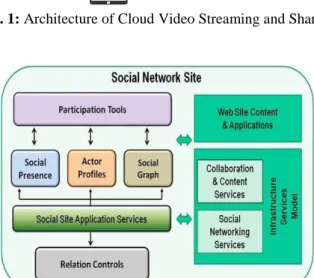
Fig. 1: Architecture of Cloud Video Streaming and Sharing
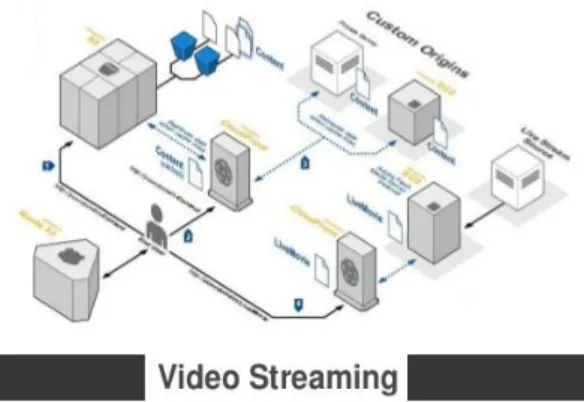
1025 Fig. 3: Video Streaming Architecture
The latest innovations in cloud computing are making our business applications even more mobile and collaborative, similar to popular consumer apps like Facebook and Twitter
.
Fig. 4: Timeline of the launch dates of many major SNSs and dates when community sites re-launched with SNS features. The cloud system is effectively analysis with both PaaS (Platform-as-a-Service) and IaaS (Infrastructures-a-Service) to use in the current place experience of video sharing to discuss the group activates in the discrepant users which can communicate socially while sharing video. To assurance with video streaming services dynamite by the user with time varying radio connectivity that deploy user with cloud video sharing by the user. In this Technology we use cloudmov for perform the video sharing in the social networks.
Social Capital: Online and Offline
Social capital broadly refers to the resources accumulated through the relationships among people (Coleman, 1988). Social capital is an elastic term with a variety of definitions in multiple fields (Adler & Kwon, 2002), conceived of as both a cause and an effect (Resnick, 2001; Williams, 2006). Bourdieu and Wacquant (1992) define social capital as ‘‘the sum of the resources, actual or virtual, that accrue to an individual or a group by virtue of possessing a durable network of more or less institutionalized relationships of mutual acquaintance and recognition’’. The resources from these relationships can differ in form and function based on the relationships themselves.
Social Capital and the Internet
The Internet has been linked both to increases and decreases in social capital. Nie (2001), for example, argued that Internet use detracts from face-to-face time with others, which might diminish an individual’s social capital. However, this perspective has received strong criticism (Bargh & McKenna, 2004). Moreover, some researchers have claimed that online interactions may supplement or replace in-person interactions, mitigating any loss fromtime spent online (Wellman,Haase,Witte, &Hampton, 2001). Indeed, studies of physical (e.g., geographical) communities supported by online networks, such as the Netville community in Toronto or the Blacksburg Electronic Village, have concluded that computer-mediated interactions have had positive effects on community interaction, involvement, and social capital (Hampton & Wellman, 2003; Kavanaugh, Carroll, Rosson, Zin, & Reese, 2005).
3. RESEARCH DIRECTION IN CLOUD VIDEO SHARING Resource demand prediction
The Process of cloud resource allocation takes time to complete; it will be too late to prevent the QoS degradation if the resource reallocation is only carried out when resources become insufficient. Therefore, an accurate resource demand prediction model is required to forecast the resource demand in the near-term future based on the previous statistics. Workload Monitoring
The workload in cloud is changing in real time. To allocate resources to satisfy the dynamic workload, especially the burst of requests, a live workload monitoring is needed for cloud providers. In addition, it is a challenge to dynamically allocate the cloud resources to handle the time-varying workload.
Workload Scheduling
There are two level of scheduling in cloud computing. The first level is the user-level scheduling, in which the requests for one application are distributed to different VMs according to the current workload. Compared to the user-level scheduling, the task-level scheduling performs in a finer granularity. An application can be decomposed into a set of tasks, each of which requires different resources.
Resource migration
With current techniques, VMs and application migrations have been implemented in the local area network environment. In the future, cloud should be able to migrate VMs and services to other clouds, which can greatly improve the robustness of cloud data center.
Joint resource optimization
Currently, most of the resource optimization methods focus only on the cloud side, while ignoring the transmission path and the used side. In fact, it is a challenging task to maximize or minimize an end-to-end QoS metric by jointly optimizing the resources in the cloud, at the client and along the transmission path between the cloud and the client.
1025 4. CLOUD BASED VIDEO SHARING
Cloud video sharing files directly streaming by server to any internet linked device. The user wants to use the video streaming like the media streaming service because the video load quickly for sharing. The user willing lot because of it is tie up with the high end server. The Video Sharing system which used for sharing flash media server to host streaming data like MP4, MP3, FLV, MKV and other formats also.
Fig. 5: Video Sharing Cloud Perform Architecture
It is designed for access easily by user to embedding the sharing files in our social media website and has several options for customization. Cloud video service makes it easy to store and share the video and do lot in the cloud. This service makes the preservation of our content simple and cost effective. This is the one of the service which makes it easy to move, copy, share the video into the cloud and store them with different provider, all with just in one click. Mostly we eliminate the high risk of storing the video content with a single cloud service provider by making it to access move, copy, share the videos of any size and any format. Use this service we can do more with our content video. We can stream it, view it, copy it, move it, share it and manage it. We are continually adding more video sharing to make our content safer and easier to share.
Backup and Synchronize
Cloud Video Sharing automatically copies our content into several different cloud storage providers. Simply subscribe to the Cloud video service and choose two or more cloud storage providers and Cloud video service will ensure that all copies of your content remain synchronized. In addition, the Cloud video service ensures that whenever you upload new content, all the copies we manage for you get the same exact content. The duplication occurs when a change is made to your content, which means that the service watches for all content that is added or updated in your Cloud video service account, determines if it should be copied to another Cloud video service storage site, and copies the content when necessary.
Media and Access Video Streaming Services
Cloud video service can stream video and audio files directly from Cloud service to any internet-linked device. Users like the media streaming service because the videos load quickly. We will like it because it doesn't tie up our servers. The Cloud video service media streamer is based on high value Cloud front service which uses the Flash Media Server to host streaming files over RTMP in MP3, MP4, FLV, and other formats. It is designed to allow for easily embedding media in your web site and has several options for customization.
The Cloud aspect test service verifies the integrity of our content data by collecting the content data checksum values for each item from the underlying storage provider, streaming through each item while recalculating their checksums, and comparing the two listings. The service then generates a report that is available to you in the Cloud video dashboard and the best part is that the Cloud aspect test service runs automatically in the background, so you never have to worry about the aspect of our content data and Cloud video service has we covered.
5. CLOUD VIDEO SERVICE
Hype frequently exceeds reality when it comes to new technologies, and cloud computing is no exception. Media enterprises recognize the key benefits of the cloud as an opportunity to replace up-front capital infrastructure expenses with low variable costs that scale with a project. They know that with the cloud, they no longer need to plan for and procure servers and other IT infrastructure weeks or months in advance. Producers of broadcast TV programming, B2B, or live events streamers can spin up hundreds or thousands of servers in minutes-and scale them down after use.
interested in, and upload new content for their collaborators to use. The Solution
Cloud Video Service allows user who collaborate while working half a world away from one another to get further faster. Cloud video service has a web-based interface to all of the content you have stored in the cloud, so everyone can work with the same sources. The Cloud service dashboard lets users easily upload and download content any time they wish. It's also easy to add tags and metadata to content through our interface and when other scholars want to join, adding them to the list of collaborators is a breeze. Cloud service makes it easy for you to give users the tools they need to conduct collaborative online research, as well as to share your content with a broader community and the world.
CONCLUSION
This paper presents Social Network Sites and Video Sharing in cloud computing which express cloud computing designs, targeted on how cloud can completely gives the video sharing services and assured QoS preparation. Optimal resource allocation in cloud video sharing with cloud computing can largely polish the completion for video sharing applications. In recent days the cloud based video sharing in social network sites based on the multimedia services and that performs into the video sharing resource allocation in cloud computing. Using the CloudMov the social network site user can sharing the video to watch any shared video by video streaming in the social network site and watch and share video frequently and enjoy it social sites.
REFERENCES
[1] Yu Wu, Zhizhong Zhang, Chuan Wu, Member, IEEE, Zongpeng Li, and Francis C. M. Lau” CloudMov: Cloud-Based Mobile Social TV”, IEEE TRANSACTIONS ON MULTIMEDIA, VOL. 15,NO. 4, JUNE 2013
[2] Search for "e-commerce, social networking". Google Trends. Retrieved 26 October 2009.
[3] S. Kosta, A. Aucinas, P. Hui, R. Mortier, and X. Zhang, “Thinkair: Dynamic resource allocation and parallel execution in the cloud for mobile code offloading,” in Proc. of IEEE INFOCOM, 2012.
[4] Z. Huang, C. Mei, L. E. Li, and T. Woo, “Cloudstream: Delivering high-quality streaming videos through a cloud-based svc proxy,” in INFOCOM’11, 2011, pp. 201–205.
[5] R. Schatz, S. Wagner, S. Egger, and N. Jordan, “Mobile TV becomes Social - Integrating Content with Communications,” in Proc. of ITI, 2007.
[6] R. Schatz and S. Egger, “Social Interaction Features for Mobile TV Services,” in Proc. of 2008 IEEE International Symposium on Broadband Multimedia Systems and Broadcasting, 2008.
[7] C.-F. Lai, Y.-M.Huang, and H.-C. Chao, “DLNA-based multimedia sharing system for OSGI framework with extension to P2P network,”IEEE Syst. J., vol. 4, no. 2, pp. 262–270, Jun. 2010.
[8] K.-D. Chang, C.-Y.Chen, J.-L.Chen, and H.-C. Chao, “Challenges to next generation services in IP multimedia subsystem,”J. Inf. Process. Syst.,vol. 6, no. 2, pp. 129–146, Jun. 2010.
[9] J. Santos, D. Gomes, S. Sargento, R. L. Aguiar, N. Baker, M. Zafar, and A. Ikram, “Multicast/broadcast network convergence in next generationmobile networks,” Comput. Netw., vol. 52, pp. 228–247, January 2008.