PostgreSQL/FreeBSD performance and scalability
on a 40-core machine
∗
v1.0
Konstantin Belousov <[email protected]>
July 13, 2014
SVN revision 138
Contents
1 Overview 2
1.1 Measuring contention . . . 3
2 Page Fault Handler 3 2.1 Fast Path . . . 5
2.2 Phys backing for shared area . . . 6
2.3 Pre-populating the shared area . . . 6
2.4 DragonFlyBSD shared page tables . . . 6
3 Buffer Cache 7 3.1 nblock . . . 7 3.2 bqclean . . . 7 4 Page Queues 8 5 Semaphores 8 6 sched_ule cpu_search() 10 7 Miscellaneous 10 7.1 hwpmc(4) on Westmere-EX . . . 10
7.2 mfi(4) unmapped I/O . . . 10
7.3 tmpfs(5) shared locking . . . 10
7.4 Process titles . . . 10
8 Results 11
9 Appendix: Patch use 13
∗This work is sponsored by The FreeBSD Foundation.
1 OVERVIEW 2
1
Overview
This report details my investigation into reports of poor scalability of the PostgreSQL database on FreeBSD, and describes system changes and tuning to significantly improve performance and scalability.
Testing was done using two machines, pig1 and zoo in the FreeBSD Test-ClusterOne laboratory hosted at Sentex Communications.
Machine Usage
pig1 Device under test
zoo Test cluster infrastructure: build and netboot host
Table 1: Machines used.
Thepig1configuration:
• Four Westmere-EX E7-4850 CPUs at 2.0GHz, 10 cores with HTT each, for a total of 40 cores, and 80 hardware threads;
• 1TB of RAM;
• LSI ThunderBolt MegaRAID disk controller;
• 3 Samsung SSD 840 in single-volume RAID-1 configuration.
The machine is netbooted fromzoo. The software configuration onpig1:
Software Revisions
FreeBSD HEAD at r267575, amd64, stripped down and modularized kernel config
PostgreSQL 9.3.4 + patches, built from ports
pgbench 9.3.4 from portdatabases/postgresql-contrib
Table 2: Software versions.
The investigation started with rumors of abysmalPostgreSQLperformance on many-core machines. Evidence was provided in [1] that the issue is an enormous performance drop in the pgbenchbenchmark when the parallelism increases. At-tempts to use even half of the cores on the machine madePostgreSQL perform even worse than the single-threaded test.
The nature of the problem makes lock contention an immediate suspect. Other causes are also possible, like excessive cache sharing, or algorithmic issues. Still, a check for locking problems is due. It was decided to measure contention using the
LOCK_PROFILING(9) facility of the FreeBSD kernel. LOCK_PROFILING(9)
provides essential data for analyzing lock contention, but requires a custom kernel configuration and introduces higher system overheads.
2 PAGE FAULT HANDLER 3
1.1
Measuring contention
For measurement, a production kernel config was created. In particular, all debug-ging options which slow down the kernel were removed.
option LOCK_PROFILING
was added to the kernel config, and the machine was booted with the new kernel. Profiling was done with the following script, which assumes that the caches are already hot:
#!/bin/sh
sudo sysctl debug.lock.prof.reset=1 sudo sysctl debug.lock.prof.enable=1
pgbench -j 40 -c 40 -T 180 -S -h /tmp -U bench bench sudo sysctl debug.lock.prof.enable=0
sudo sysctl debug.lock.prof.stats >prof.1.txt
(head -2 prof.1.txt; sort -k 4 -nr <prof.1.txt) >prof_sorted.1.txt
After execution, prof_sorted.1.txt contains the profiling results sorted by lock wait time. See table 3 for the first six lines of the report on the unpatched kernel.
2
Page Fault Handler
After initial lock profile data was obtained from the sample run for 40 clients, the immediate outstanding lock congestion appears to be the VM object(9) lock in the page fault handler vm_fault_hold(9) function. The first three lines in table 3 provide irrefutable evidence for this claim. There are three lines, but the affected code path is the same. The profile data is split due to the fault handler dropping and re-acquiring the object lock during execution. Cumulative wait time for these three places is larger by an order of magnitude than the next appearance in the profile output.
Stating only the details of theFreeBSDalgorithm for page fault handling which are relevant to the current discussion, fault processing is:
• the low-level machine-dependent (MD) handler callsvm_fault(9), which is machine-independent (MI) VM code.
• vm_fault_hold(9)locks thevmspacefor the current process and looks upvm_map_entrywhich describes the faulting address.
• vm_object, which backs the foundvm_map_entry, is locked exclusively. The tested load on the PostgreSQL server side is comprised of server processes accessing the shared data area, which was created as a large shared anonymous memory region. The region is implemented by our VM in the process-private address spaces as process-unique VM map entries which all point to the same backing
2 PAGE FAULT HANDLER 4 max w ait_max total w ait_total count avg w ait_avg cnt_hold cnt_lo ck name 375 46 5018 120484291 2595677997 4328075 27 599 0 4187237 vm/vm_fault. c:105 6 (rw:vm object) 9868 495017 33096852 1982263541 2226088 14 890 0 2113302 vm/vm_fault. c:303 (rw:v m object) 9304 465838 24335805 1864397319 2147294 11 868 0 1984397 vm/vm_fault. c:909 (rw:v m object) 61 1743 70250978 601931512 10998523 6 54 0 9968930 k ern/sub r_turnstile.c:551 (spin mutex:turnstile) 40 440034 886032 70222211 78794 11 891 0 74764 vm/vm_page.c:900 (rw:vm object) 939787 433240 47110362 49641604 2245668 20 22 0 65106 vm/vm_object.c:513 (rw:vm object) T able 3: de bug.lo ck.p rof.stats sample outp ut
2 PAGE FAULT HANDLER 5
vm_object. Both the object’s pages and page table entries are populated on demand. Prefaulting is performed by the VM in a limited form, but is not significant since the connection processes are started from a cold shared region state.
Threads which access a non-mapped page in the shared region congest on the backing object lock, as outlined above. For the 40-client test, the wait time on the object lock was an order of magnitude higher than on the next most congested lock. Explained below are two changes which completely eliminated thevm_objectlock from the top lock profiles.
2.1
Fast Path
The final goal of the vm_fault(9) function is to install the proper page table entry (or fill TLB) for the faulted address by callingpmap_enter(9). To do the job, the function must:
• ensure that the address is valid.
• find the corresponding page from the hierarchy of backing objects.
• if the page does not exist, allocate it.
• populate the page with valid content, either from the pager or from the lower object for COW.
There is a lot of work to do, and it happens mostly under the top vm_object’s lock taken in exclusive mode. This explains the lock profiling results.
Now, assume that there is
• no backing object chain (our mapping is shared and anonymous);
• the object is of swap (or phys, see 2.2) type;
• the page to map already exists in the object.
In this situation, which is exactly the case for page faults on the shared region, most of the work performed byvm_fault_hold(9) is reduced to checking the condi-tions and deciding that no action is required. Still, a lot of code must execute just to check that we are ready to callpmap_enter(9). Moreover, thevm_object
is not modified during the fault, because the page already exists and does not need to be allocated. This means that exclusive object locking is excessive.
I added code to vm_fault_hold(9) which takes the vm_object lock in shared mode immediately after the object is resolved, and checks whether the con-ditions above hold. If true, we can callpmap_enter(9) right away instead of going through the long path for the common case.
One complicated issue with the fast path is interaction between the shared mode object lock and page busying. Right now, there is no code inFreeBSDwhich would busy a page while the owner object is shared locked, as done in the patch. Busying is needed to call pmap_enter(9). It is not clear at present whether this mode of operation should be put into mainline, since shared object lock owners must be ready for the page busy state changing underneath them.
2 PAGE FAULT HANDLER 6
2.2
Phys backing for shared area
Typical mappings in the process address space are managed. For a physical page participating in the mapping, the VM may askpmap(9)to revoke all access (see
pmap_remove_all(9)) or downgrade all access to read-only, which is done by
pmap_remove_write(9). This is needed, for example, for paging out or for setting up the page for write.
It is up to pmap(9)to implement manageability, but it is not too wrong to assume that it must be able to enumerate all page mappings to perform the opera-tions. The typicalFreeBSDpmap(9)implements it by creatingpv entriesfor each page mapping, which describes address space and address of the mapping, and linking them together in the MD part ofvm_page. pmap_enter(9)needs to allocatepv entry. If the page participates in shared mappings in a large number of address spaces, the page’spv_listbecomes large.
For many years, the FreeBSD implementation of System V Shared Memory
has provided the tunablesysctl(2) kern.ipc.shm_use_phys, which allows using aPHYS-type VM object to back shared memory segments. The end result is that the shared memory is not pageable, and pv entries are not needed to track the mappings.
I implemented a similar tunablevm.shared_anon_use_phys, which forces thePHYS-type for the objects backing the anonymous shared memory. This way, thePostgreSQL shared area avoids the overhead of the pv entries maintenance.
A more fine-grained approach is probably needed there, allowing the application to request PHYS mappings instead of enforcing it on all shared users. A new
mmap(2)flag, perhapsMMAP_NON_SWAP, could be introduced.
2.3
Pre-populating the shared area
Even after the removal of pv entries for the shared area, and the fast page fault han-dler path, the first access to the shared area page still causes exclusivevm_object
locking to allocate the physical page. Exclusive locking blocks other threads’ page fault handlers, which could have proceeded by the fast path in the shared lock mode. A new tunable, sysctl(2) vm.shm_anon_phys_preload, is added. It requests that the object backing the shared anonymous area is populated with the pages during object creation.
With the fast fault handler path, physical backing for the shared area and pre-population of it, all page faults are handled by the fast path. The object lock is shared-locked, eliminating contention invm_fault_hold(9).
Future work should consider applyingRLIMIT_MEMLOCKwhen populating the object.
2.4
DragonFlyBSD shared page tables
The DragonFlyBSD approach to fixing the performance issue of contention on parallel page faults to the shared area was to allow sharing page tables. The change would require major rework of thepmap(9) layer for each machine architecture,
3 BUFFER CACHE 7
together with complicated interaction with the fine-grained pmap(9)locking. It is also not clear how parallel initial population of the page tables for the shared region could be achieved. This matters for real-worldPostgreSQLperformance, as opposed to a purely isolated test setup.
Due to the doubts outlined above, I decided to implement the fast path for the page fault handler and physical backing of the shared regions.
3
Buffer Cache
After the page fault handler contention was sorted out, albeit in a hackish way, the next outstanding locks in the profile appeared to be related to the buffer cache, at least when thePostgreSQLdata files were located on aUFS(5)filesystem.
On FreeBSD, the file data is cached in pages kept in the vm_object and connected to the corresponding vnode. Nonetheless, to perform the I/O, UFS instantiates thebuf(9)buffers. These buffers mimic the old UNIX buffer cache, but reference the physical memory pages containing the data. The profile indi-cated that congestion points are the buffer reclamation, done bybqrelse(9)and
brelse(9) functions, and insertion of the clean buffers into the global queues from where they can be reused.
3.1
nblock
Thenblockmutex serves two purposes:
1. it protects theneedsbuffervariable which keeps flags indicating the buffer request types which cannot be satisfied now;
2. it protects against missed wakeups from thebrelse(9)whengetnewbuf(9)
blocks due to reasons specified inneedsbuffer.
Despite getnewbuf(9) rarely blocking in the testing load, the need to protect
needsbufferinbufspacewakeup()andbufcountadd()in thebrelse()
execution path created very significant congestion onnblock.
I moved theneedsbufferupdates toatomic(9)operations. The wakeup protection is ensured by changing nblock to rw lock. The update code takes
nblockin read mode, andgetnewbuf_bufd_help()checksneedsbuffer
and goes to sleep under write-lockednblock. Contention onnblockforbrelse()
was eliminated.
The changes are committed as r267255. A followup fix for the gcc build was committed asr267264.
3.2
bqclean
The buffer cache keeps unused (unlocked) clean buffers on several lists. These lists group buffers with similar characteristics with regard to the attached resources. The buffer may be returned to use, or it may be reclaimed for reuse if another buffer
4 PAGE QUEUES 8
must be created. The lists are scanned for a suitable buffer for reuse. Note that thestruct bufs are type-stable.
The clean lists themselves, and the scan procedure to select the buffer for reuse, are protected by thebqcleanmutex. After the other changes, it appeared high in the lock profile. The lock blocks bothbrelse(), when the buffer is put on a clean queue, and scan.
I redefinedbqcleanto only protect the queue modifications. Scan code now walks the queues without taking thebqcleanlock. The queue structure could be changed under the iterator. That would be tolerable since buffers are type-stable, and we always get the next pointer pointing to the live buffer, although possibly no longer from the iterated queue. The next buffer is locked and its location on the queue is rechecked afterward. If we are dropped from the queue, the scan is restarted.
A queue generation counter prevents infinite waits which could occur if buffers are placed on the queue before the iterator.
4
Page Queues
The inactive queue lock appeared to be highly congested in the test load due to the buffer release.
When the buffer is formed, it wires the pages which constitute it. On buffer reclamation, the pages are unwired. Wired pages belong to the wire owner. Unwired pages are put on the active or inactive queues, where they can be found by the
pagedaemon(9). In particular, the corresponding queue must be locked when the page is wired or unwired. When unwiring, buffer cache always requests deactivation of the page, which causes the inactive queue lock to be held for page insertion.
During the multithreaded pagedaemon work, the page queues were split into queues of pages owned by a corresponding NUMA proximity domain. For the 4-socketpig1, this meant that the inactive queue was in fact split into four queues. There is no intrinsic relation between NUMA domain and VM page domain, and nothing prevents splitting the NUMA domains into more fine-grained sets of pages with a corresponding split of the queues and page queue locks.
The tunablevm.ndomain_split_factor is introduced, which additionally splits each NUMA domain into the specified number of sub-domains. This reduces the contention on the (inactive) page queue locks.
5
Semaphores
Traditionally, PostgreSQL uses System V semaphores for inter-process synchro-nization. The FreeBSD implementation of semaphores uses a mutex pool lock for protection of kernel data describing the semaphore set. This mutex is highly congested when many parallel threads operate on the single set.
ThePostgreSQLcode allows using either SysV semaphores orPosix semaphores
5 SEMAPHORES 9
usem(2) for congested operations. After switching the PostgreSQL server to Posix semaphores, the kernel lock profile was cleaned from the inter-processing synchronization locks. The change was done as a (trivial)ports(5)patch for the
6 SCHED_ULE CPU_SEARCH() 10
6
sched_ule cpu_search()
Rough profiling using the top mode frompmcstat(8)for the
instructions-retired
event demonstrated that up to 25% of the samples gathered are for the
cpu_search()function of thesched_ule(9)scheduler.
Apparently, theclang(1)compiler neither inlines the function nor uses con-stant propagation here, resulting in a convoluted code path with many conditional branches executed for each context switch. An experiment with compilingkern/ sched_ule.cwithgcc(1)version 4.9.0 reduced the sample rate to 8–9%.
7
Miscellaneous
7.1
hwpmc(4) on Westmere-EX
Trying to usehwpmc(4)on the test machine, it appeared non-functional, causing general protection faults when trying to access non-existent uncore PMC MSRs. This is due to the uncore PMC subsystem being significantly different from that used in desktop-class CPUs and Xeon 7500 (Nehalem-EX) and E7 (Westmere-EX) variants. To get a workinghwpmc(4), although without uncore monitoring, the Core i7 and Westmere support in the driver was restructured to avoid touching uncore for EX microarchitectures, seer267062.
7.2
mfi(4) unmapped I/O
The driver formfi(4) controllers on pig1 did not support unmapped I/O. On an 80-thread machine, IPI overhead from TLB shootdowns is enormous. As the first step, before doing any measurements, I added support for unmapped I/O to
mfi(4), committed asr266848.
7.3
tmpfs(5) shared locking
Running the load with thePostgreSQL data files on tmpfs(5)(to exclude the
UFS(5) and buffer cache overhead), I noted that tmpfs(5) enforces exclusive mode for its vnode lock acquisitions. tmpfs(5)should allow shared vnode locks for non-modifying vnode accesses, but this was overlooked during the porting effort. The glitch was corrected inr267060.
7.4
Process titles
FreeBSDprovides a facility for the running process to change the displayed com-mand in ps(1) output, see setproctitle(3). The operation is performed usingsysctl(2) KERN_PROC_ARGS.
By default, PostgreSQL updates the title of the connection handler when-ever a new SQL command is received. This can cause high-frequency calling
8 RESULTS 11
of setproctitle(3), which is CPU-intensive and causes contention on the
sysctl(9)internal locks. It is important to disable title update in thePostgreSQL
configuration to avoid unnecessary CPU load.
8
Results
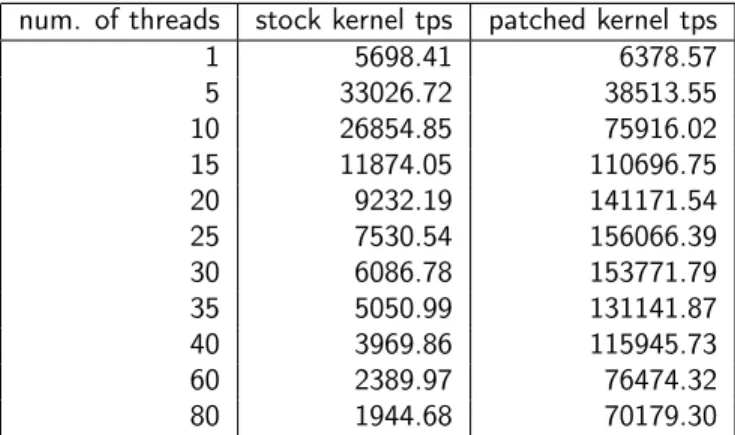
Measurements were obtained using methodology similar to that described in [2]. The results are presented in the figure below. The ’stock’ graph corresponds to the unpatched kernel from head atr267575, while the ’patched’ graph is for a patched kernel with the same configuration.
num. of threads stock kernel tps patched kernel tps 1 5698.41 6378.57 5 33026.72 38513.55 10 26854.85 75916.02 15 11874.05 110696.75 20 9232.19 141171.54 25 7530.54 156066.39 30 6086.78 153771.79 35 5050.99 131141.87 40 3969.86 115945.73 60 2389.97 76474.32 80 1944.68 70179.30
8 RESULTS 12 0 20000 40000 60000 80000 100000 120000 140000 160000 0 10 20 30 40 50 60 70 80 tps threads data-20140617/stock data-20140617/patched
9 APPENDIX: PATCH USE 13
9
Appendix: Patch use
1. Apply the kernel patch.
2. Apply the patch to thePostgreSQLserver by placing thepatch-2file into
databases/postgresql93-server/filesand rebuilding the port. 3. Ensure that the multithreaded pagedaemon is enabled with the
options MAXMEMDOM=N
kernel config setting. Set N to the number of sockets multiplied by the domain split factor. The latter is set with thevm.ndomain_split_factorloader tunable. Set the split factor so that N is at least greater than the number of cores.1
4. Set thesysctl(8)s
• vm.shared_anon_use_phys=1
• vm.shm_anon_phys_preload=1
before starting thePostgreSQLserver.
5. Ensure thatpostgresql.confdisables updates to the server process titles by using the
update_process_title = off
directive.
1For pig11, I used MAXMEMDOM=128 and vm.ndomain_split_factor=8, which gives 4(sockets)∗8(splitfactor) = 32 domains. There is no overhead from setting MAXMEMDOM higher than the actual number of domains. However, a current artificial limitation is that the number of physical segments must be less than or equal to the number of bits in the long type, 64 for amd64, and each domain consumes a physical segment.
REFERENCES 14
References
[1] http://lists.dragonflybsd.org/pipermail/users/ attachments/20140310/4250b961/attachment-0002.pdf [2] http://lists.dragonflybsd.org/pipermail/users/ attachments/20121010/7996ff88/attachment-0002.pdfREFERENCES 15
The author thanks The FreeBSD Foundation for allowing him to work on the issues, and to Ed Maste, Warren Block and Dimitry Andric for providing suggestions and editorial help with the text.