The Positive Consequences of Negative Stereotypes: Race, Sexual Orientation, and the Job Application Process*
David S. Pedulla Department of Sociology
Princeton University
* The author gratefully acknowledges the guidance and support of Devah Pager, Martin Ruef, Viviana Zelizer, Christopher Muller, Lindsay Owens, Michaela DeSoucey, Rourke O’Brien, Meredith Sadin, Joanne Golann, Liz Derickson, Karen Levy, and the members of Princeton University’s Center for the Study of Social Organization workshop. Data collection for this project was completed with assistance from Time-Sharing Experiments for the Social Sciences, NSF Grant 0818839, Jeremy Freese and Penny Visser, Principal Investigators. Please direct all correspondence to David S. Pedulla [[email protected]; 107 Wallace Hall / Princeton, NJ 08544].
The Positive Consequences of Negative Stereotypes: Race, Sexual Orientation, and the Job Application Process
ABSTRACT
Negative stereotypes about African Americans, women, and gay men have been linked to unequal outcomes across institutional contexts, including employment and housing. While researchers have demonstrated that providing positive counter-stereotypical information about a negatively stereotyped group can reduce the prejudice and discrimination they experience, in this article we argue that negative counter-stereotypical information can also have prejudice-reducing consequences. Specifically, we argue that stereotypes about black men as aggressive and gay men as effeminate lead both groups to face prejudice. However, we posit that the oppositional content of these stereotypes enables them to serve as counter-stereotypical information for one another, a concept we call “offsetting stereotypes.” Our central hypothesis, therefore, is that gay black men will face less prejudice than both gay white men and straight black men. Drawing on nationally representative survey-experimental data, our findings support our main hypothesis, contributing to theoretical debates about stereotypes, prejudice, and intersecting social identities.
The Positive Consequences of Negative Stereotypes: Race, Sexual Orientation, and the Job Application Process
Negative stereotypes about African Americans, women, and gay men have been linked to unequal outcomes across institutional contexts, including employment (Moss and Tilly 2001; Tilcsik 2011), education (Noguera 2009; Steele and Aronson 1995), criminal justice (Sweeney and Haney 1992), and housing (Farley et al. 1994; Lauster and Easterbrook 2011). The broad impact of stereotypes in shaping social interactions and processes of social stratification has led researchers to explore the ways stereotype activation can be constrained, limited, or altered. A key finding from this literature is that providing counter-stereotypical information about a group or individual can reduce the use of negative stereotypes in forming attitudes toward and judgments about that group or individual. In turn, counter-stereotypical information can reduce prejudice and discrimination. Thus far, however, the research in this area has focused on the effects of counter-stereotypical information that is positive – for example, describing a negatively stereotyped individual as personable, hard-working, or intelligent (Kaas and Manger 2011; Peffley, Hurwitz, and Sniderman 1997; Power, Murphy, and Coover 1996).
In this paper, we expand the literature on stereotyping and prejudice formation by arguing that negative counter-stereotypical information can also have prejudice-reducing consequences when the content of the negative counter-stereotype is in direct opposition to the primary negative stereotype. We develop this theoretical framework using the case of stereotypes about black men and gay men in the context of the labor market; a setting in which research has demonstrated that these groups face prejudice and discrimination
(Bertrand and Mullainathan 2004; Pager 2003; Pager, Western, and Bonikowski 2009; Tilcsik 2011). Existing research indicates that discrimination against black men and gay men is driven, in part, by negative stereotypes (Neckerman and Kirschenman 1991; Moss and Tilly 2001; Tilcsik 2011). Research suggests that black men are commonly stereotyped as aggressive and threatening (Pager and Karafin 2009; Moss and Tilly 2001; Neckerman and Kirschenman 1991; Shih 2002), whereas gay men are stereotyped as effeminate and weak (Haddock, Zanna, and Esses 1993; Herek 1984; Madon 1997). We argue that the opposing nature of the negative stereotypes associated with black men and gay men – aggressiveness and effeminacy – enable these social categories to serve as counter-stereotypical information for one another, reducing prejudice against each group. Therefore, we posit that combining black and gay social categories will reduce the prejudice experienced by men who are either black or gay, even though the counter-stereotypical information in this case is also negatively stereotyped.
To empirically test this theory, we draw on data from an internet-based survey experiment conducted on a national probability sample of respondents (n=418). Respondents were randomly assigned to review and evaluate one of four different resumes where we experimentally manipulated the race (white vs. black) of the job applicant along one axis and the sexual orientation (straight vs. gay) of the applicant along the other axis. After reviewing the resume to which they were randomly assigned, each respondent was asked to provide a starting salary recommendation for the job applicant that they reviewed. Given that the only differences between the resumes were the race and sexual orientation of the applicants, we take the average differences in the
salary recommendations provided for each experimental condition as an indication of prejudice towards that group. Our results indicate that straight white men and gay black men received higher salary recommendations than both straight black men and gay white men. Thus, our findings support the theory that negative counter-stereotypical information can reduce prejudice.
These results make important contributions to the sociological research on stereotypes, prejudice, and discrimination as well as the drivers of social stratification. Our findings also provide support for one of the core insights of theories of “intersectionality,” which argues that the combination of different marginalized social identities is more than the sum of its parts (Hill Collins 2000[1990]). While some researchers have posited that social categories – such as being black and female – are additive and create a “double disadvantage” (Beale 1979; King 1988), our findings challenge this additive line of thought and contribute to a growing body of empirical evidence about the about how social categories may combine in non-additive ways (see Greenman and Xie 2008). By using quantitative methods and an experimental research design, this article also extends the largely qualitative body of research that investigates the intersections of race and sexuality (see Gamson and Moon 2004).
This article proceeds as follows. First, we examine the research on how counter-stereotypical information can reduce the impact of stereotypes on prejudice and discrimination. We then introduce and develop the notion of “offsetting stereotypes,” a concept that accounts for the way that two negative stereotypes can serve as counter-stereotypical information for one another, reducing the prejudice faced by either
stereotyped group independently. Next, we discuss our particular case – prejudice against black men and gay men in the job application process – and introduce our data and methods. We then present our findings and discuss their implications for theories of stereotypes, prejudice, and discrimination as well as the sociological literature on intersecting social identities.
STEREOTYPES, PREJUDICE, & COUNTER-STEREOTYPICAL INFORMATION
Stereotypes can play an important role in shaping attitudes and behaviors and, thus, are often linked to prejudice and discrimination (see Dovidio et al. 1996; Quillian 2006; Quillian and Pager 2001). For example, early social psychological work by Duncan (1976) and Sager and Schofield (1980) provides compelling evidence that – in line with stereotypes of blacks as aggressive, threatening, and violent – whites are more likely to interpret identical actions as hostile and threatening when the actor is black rather than white. Below, we discuss the role that counter-stereotypical information can play in disrupting this link between stereotypes, prejudice, and discrimination.
Counter-Stereotypical Information & Prejudice Reduction
Sociologists and social psychologists have focused significant attention on the forces that shape the activation and use of stereotypical information in producing prejudicial attitudes and discriminatory behaviors. In a review of the literature, Blair (2002) identifies four primary factors that shape automatic stereotypes and prejudice: self and social motives, the focus of attention of the perceiver, the configuration of stimulus cues, and specific strategies used to counter stereotypes. Blair (2002) places the use of
counter-stereotypical information in this final category. In this framework, an individual is presented with or draws upon “opposing counterstereotypic associations that could challenge the dominance of stereotypes in information processing” (Blair 2002:248). The central idea here is that counter-stereotypical information provides positive associations between a perceiver and the negatively stereotyped individual or group. In turn, this positive association reduces the link between the negative stereotype and prejudicial attitudes. For example, presenting information about a gay man as being athletic could assist in reducing the activation and application of stereotypes of gay men as weak.1
Counter-stereotypical information has been shown to reduce prejudice against negatively stereotyped groups, including African Americans, women, and gay men (see Dasgupta and Greenwald 2001). For example, in a large-scale survey experiment with 1,841 white respondents, Peffley, Hurwitz, and Sniderman (1997) find that positive counter-stereotypical information – being hard-working or being well-behaved – dramatically improved prejudiced respondents’ attitudes towards African Americans in the realms of welfare and criminal justice, respectively. Similarly, Power, Murphy, and Coover (1996) use experimental methods to examine the role of counter-stereotypical information in shaping respondents’ interpretations of media events. They find that a positive counter-stereotypical portrayal of an African American male led participants to subsequently make more external or situational attributions of responsibility to black men in unrelated media events. However, when the researchers presented respondents with stereotype-consistent portrayals of black men, respondents made more internal or personal attributions to black men’s behavior in media events. Both of these findings
suggest that counter-stereotypical information can play an important role in reducing racial prejudice.
Counter-stereotypical information has also been shown to reduce prejudice against women and gay men. In an experimental research design, Blair, Ma, and Lenton (2001) had a “treatment” group in their sample spend five minutes creating a mental image of a strong woman, thus producing in their minds a woman who possessed counter-stereotypical traits. After this short exercise, participants completed a measure of automatic gender stereotypes. The group that had imagined the counter-stereotypical woman, compared to a variety of different control groups, produced weaker automatic stereotypes, suggesting that counter-stereotypical imagery can reduce stereotype activation in the context of gender stereotypes (Blair, Ma, and Lenton 2001). Cohen, Hall, and Tuttle (2011) examine the role of counter-stereotypical information in evaluations of gay men in a laboratory experiment. They presented respondents with descriptions of gay men who were either more masculine (counter-stereotypical) or more feminine (stereotype-consistent) and found that gay men who were presented as masculine, challenging the feminine stereotype of gay men, were deemed more likable by straight male respondents than the feminine gay men (Cohen, Hall, and Tuttle 2011). Providing straight men with counter-stereotypical information about gay men’s gender performance improved their perceived likability, suggesting that counter-stereotypical information can reduce prejudice against gay men.
Outside of the laboratory, counter-stereotypical information has also been demonstrated to reduce stereotype activation and its link to discriminatory behavior. For
example, Kaas and Manger (2011) tested for national origin discrimination in the German labor market. They submitted job applications with Turkish- and German-sounding names for student internships to various German employers. They found that the call-back rate was approximately 14% higher for German-sounding names (39.6% for German-sounding names vs. 34.7% for Turkish-sounding names). However, the call-back rate differences disappeared when the sample was restricted to the applications where the researchers included reference letters containing positive information about the candidates’ personalities. Kaas and Manger’s (2011) analysis, therefore, demonstrates that counter-stereotypical information, in this case positive information about an individual’s personality, can actually reduce discrimination in a real labor market.
The Positive Consequences of Negative Stereotypes
The above literature on prejudice reduction focuses on the ways that positive counter-stereotypical information can reduce prejudice and discrimination. For example, presenting experiment participants with information about gay men as being more masculine improved the likability of those targets in the eyes of straight men. In this article, we expand the existing literature by arguing that negative counter-stereotypical information can also reduce prejudice, when the content of that negative counter-stereotypical information runs directly counter to the primary negative stereotype. We refer to pairs of stereotypes that operate in this way as “offsetting stereotypes.”
To our knowledge, there are only two existing studies that explore the ways that two negative stereotypes can offset one another. Remedios et al. (2011) showed
participants 104 headshots of self-identified straight white men, straight black men, gay white men, and gay black men in a laboratory experiment. Respondents were then asked to rate each applicant on a likeability scale. First, the researchers found that both gay white photographs and straight black photographs received lower ratings on likeability than the straight white photographs. However, the gay black photographs received higher ratings on likeability than the straight black photographs, indicating that adding a negative category (being gay) to another negative category (being black) can actually neutralize negative outcomes. Thus, in terms of likability, there is preliminary evidence that adding independently negatively stereotyped information to other negatively stereotyped information can have positive consequences. However, this study differs from our analysis in important ways. The research was conducted in a laboratory setting on a non-representative sample of respondents, was not linked to a particular institutional context such as the labor market, and did not focus on the mechanisms underlying the empirical findings.
A similar set of results emerges from Livingston and Pearce’s (2009) exploration of the relationship between having a “baby face” and the success of black male CEOs. Previous research indicates that having a baby face is negatively related to the success of white male leaders (see Zebrowitz and Montepare 2005). Livingston and Pearce (2009), however, argue that having a baby face plays the opposite role for black men by increasing perceptions of black men as warm and deferent, while reducing stereotypes of black men as being threatening. In their laboratory experiment, they showed respondents faces of 40 real black and white CEOs from Fortune 500 companies, with differing scores
on a “baby face scale,” and had the respondents guess the salary for each of the CEOs. They found that respondents perceived baby-faced black CEOs as earning higher salaries than mature-faced black CEOs (Livingston and Pearce 2009). While not theorized in a “offsetting stereotypes” framework, Livingston and Pearce (2009) are working with a similar set of theoretical ideas. Whites hold stereotypes of black men as threatening, which means that information countering those threatening stereotypes (i.e. having a baby face) should improve the outcomes of black men, even though having a baby-face is negatively related to the outcomes of white business leaders. Thus, for business leaders, the negatively stereotyped counter-stereotypical information of having a baby face can actually have positive consequences when it is applied to black CEOs, individuals who are already negatively stereotyped.
The two studies discussed above and our theory of “offsetting stereotypes” have important implications for sociological theories about how marginalized social categories combine with one another. Some sociological research argues that combining multiple marginalized social categories (such as being black and female or black and gay) produces a “double disadvantage” for the individuals who occupy both of those social positions (Beale 1979; King 1988). Each additional marginalized social category is argued to produce further disadvantage for the individual. However, theories of “intersectionality” argue that social categories do not simply combine in additive ways (Hill Collins 1990[2000]). This line of thought, which tends to explore the intersection of race and gender, argues that the experience of being black and female and the consequences of this joint identity are more complicated than adding the experiences of
“femaleness” and “blackness.” A growing body of empirical research has attempted to address the non-additive ways that race and gender intersect. For example, recent research by Greenman and Xie (2008) finds non-additive effects of race and gender on earnings (for a summary of the literature on race and gender intersections in the labor market, see Browne and Misra 2003). In line with the “intersectionality” framework, our theoretical proposition challenges the additive assumptions of the “double disadvantage” perspective. We bring this perspective to bear on how race and sexuality combine with one another. And, while researchers have begun to explore the ways that race and sexuality interact and intersect (Gamson and Moon 2004), limited attention has been paid the intersection of these categories in the labor market and few researchers in this area have used experimental or quantitative methods.
Drawing on the literature about the prejudice-reducing consequences of counter-stereotypical information, theories of “intersectionality,” and the empirical work of Remedios et al. (2011) and Livingston and Pearce (2009), we formulate and empirically test our theory of “offsetting stereotypes.” When the content of two negative stereotypes are in direct opposition to one another, we argue that these stereotypes serve as “offsets” for one another, removing the prejudice faced by either group independently. Below, we build and test this theory using the case of racial and sexual orientation stereotypes in the context of evaluating job applicants.
THE CASE OF RACE & SEXUAL ORIENTATION
Field-experimental research has provided compelling evidence about the persistence of racial and sexual orientation discrimination in the U.S. labor market. While not without limitations (Heckman 1998), experimental audit methods are a powerful way of generating causal estimates of the effect of social categories on labor market hiring outcomes. Testing for racial discrimination in the Chicago and Boston labor markets, Bertrand and Mullainathan (2004) used a correspondence study method, sending out resumes for 1,300 job openings and submitting approximately 5,000 different applications, and found that applicants with white-sounding names received approximately 50% more call-backs for jobs than identical applicants with black-sounding names. Using a field-experimental approach with actors posing as job applicants, Pager, Western, and Bonikowski (2009) tested for racial discrimination in New York City’s low-wage labor market. Similar to Bertrand and Mullainathan (2004), they found that white applicants were approximately twice as likely as nearly identical black applicants to receive positive responses from employers (Pager, Western, and Bonikowski 2009).
Researchers have also used experimental methods to test for discrimination against gay-identified individuals (Drydakis 2009; Hebl et al. 2002; Weichselbaumer 2003). Most relevant for our analysis is a recent field experiment where Tilcsik (2011) submitted pairs of applications for 1,769 job openings in seven different labor markets in the U.S. Within each pair of applications, the researcher randomly assigned one applicant experience with the “Gay and Lesbian Alliance” in college and the other applicant
experience with the “Progressive and Socialist Alliance” in college. The gay-identified applicant received a call-back from employers 7.2% of the time, compared to 11.5% of the time for the “straight” applicant – a statistically significant difference. These results were also moderated by whether the job opening indicated a preference for more masculine traits. The gay applicant was additionally penalized in cases where the job posting explicitly mentioned desiring masculine attributes (Tilcsik 2011). Tilcsik’s (2011) findings, therefore, provide clear empirical evidence of discrimination against gay men in the U.S. labor market and also indicate that this discrimination may in part be driven by stereotypes of gay men as effeminate. The research presented above informs our first theoretical propositions. Similar to the patterns of discrimination in hiring detected by experimental audit methodologies, we hypothesize that straight black male job applicants will receive lower salary recommendations than straight white male applicants, ceteris paribus. Second, we posit that gay white male applicants will receive lower salary recommendations than the straight white male applicants, ceteris paribus.
Stereotypes, Race, & Sexual Orientation
Qualitative and experimental research has closely examined the ways that racial and sexual orientation categories are imbued with stereotypes. In terms of race, qualitative research indicates that stereotypes of black men as aggressive and threatening are particularly salient in the employment context (Moss and Tilly 2001; Neckerman and Kirschenman 1991; Shih 2002). Drawing on interviews with 180 Chicago employers, Neckerman and Kirschenman (1991) argue: “… some respondents said more generally
that inner-city blacks, especially men, did not know how to interview … they were belligerent or had ‘a chip on their shoulder’ … one respondent commented that black men were not willing to ‘play the game’ and to ‘follow the rules’” (Neckerman and Kirschenman 1991:442). Shih (2002) provides similar evidence from 145 in-depth interviews with employers in four industries in Los Angeles. One employer told Shih: “(Black women’s) attitude is definitely different. The men are not necessarily that much more aggressive, but they are definitely more … hostile. More angry. As opposed to women, who don’t necessarily have that attitude: black women are easier to get along with” (Shih 2002:111).
Through interviews with employers and people involved in the job placement process, Moss and Tilly (2001) relay similar findings. One of their respondents, a site manager at a public employment agency that works to assist people in finding jobs, reported: “You have people right now who are afraid to hire black males, because they think there is a certain level of violence associated with black males. Some employers don’t even do business with us because they realize the office is in [a primarily black neighborhood]” (Moss and Tilly 2001:107). Pager and Karafin (2009) present similar data from interviews with over fifty employers in New York City. One employer from a garment factory reported: “I find that the great majority of this minority group that you are talking about [black men] either doesn’t qualify for certain jobs because they look a bit more, they come on as if, well, they are threatening” (Pager and Karafin 2009:82). One clear theme that emerges from these interviews is that these employers perceive black men as possessing aggressive and threatening attributes. Therefore, drawing on the
qualitative research in this area, we generate our third hypothesis: straight black men will be perceived as more aggressive than straight white men, ceteris paribus.
While there is limited research about the ways that employers perceive gay men, significant qualitative and experimental research has probed how people stereotype gay men more generally. In direct opposition to the stereotypical characteristics associated with black men, researchers have found that gay men are often stereotyped as effeminate and weak (Haddock, Zanna, and Esses 1993; Herek 1984; Madon 1997). Among the attributes stereotypically associated with gay men are that they are sensitive, gentle, emotional, and passive (Gurwitz and Marcus 1978; Jackson and Sullivan 1989; Madon 1997; Tilcsik 2011). Gay men are also frequently stereotyped as not possessing “toughness” or the traits that are associated with being “macho” (Madon 1997). It is likely that these stereotypes play an important role in hiring decisions, especially for positions that are closely linked to stereotypically masculine traits, such as management jobs that require leadership skills (Koenig et al. 2011). The literature on the stereotypes associated with gay men leads us to our fourth hypothesis: gay white men will be perceived as more feminine than straight white men, ceteris paribus.
Above, we outlined the ways that black men and gay men will both face prejudice and discrimination in the labor market and how stereotypes are likely implicated in this process. At the same time, the opposing content of the stereotypes about black men and gay men – aggressiveness versus effeminacy – make the combination of black male and gay male stereotypes an ideal case to test our theoretical concept of “offsetting stereotypes.” The stereotype of black men as aggressive is negative when examined in
isolation. And, the stereotype of gay men as effeminate is negative when presented independently. However, stereotypes of black men can be seen as counter-stereotypical information in the evaluation of gay male job applicants. Similarly, stereotypes of gay men can serve as counter-stereotypical information in the evaluation of black male job applicants. Thus, in this case, we posit that independently negatively stereotyped information will neutralize negative consequences when it is combined with a second negative stereotype. We use this theoretical framework to generate our final two hypotheses. First, gay black male job applicants will receive higher salary recommendations than gay white male applicants, ceteris paribus. And, second, gay black male job applicants will receive higher salary recommendations than straight black male applicants, ceteris paribus.
DATA & METHODS
The data for this analysis were gathered through an internet-based survey experiment. The survey experiment was conducted on a national probability sample of respondents – selected through a combination of random-digit dial and address-based sampling methods – from a panel maintained by Knowledge Networks, a survey research organization. While the survey was conducted online, the sample is not limited to current internet users or computer owners. Knowledge Networks provides the members of their panel with internet access and/or computer access, if necessary. The analysis draws on data from 418 respondents who self-identify as white.2 Respondents were contacted via e-mail in September of 2011 and asked to participate in the survey.3 Each respondent was
then randomly assigned to one of four conditions in the survey experiment. Knowledge Networks constructed survey-specific sample weights to adjust the sample population to be representative of the U.S. population and address issues related to survey non-response. These weights are used in the analyses presented below, increasing the external validity of our experimental findings.4 Some basic weighted descriptive statistics about our sample, compared to the U.S. population, are provided below in Table 1. While our sample is slightly more likely to have completed high school than the U.S. population, the sample is quite similar to the U.S. population along dimensions of sex, age, and income.
[Table 1 About Here]
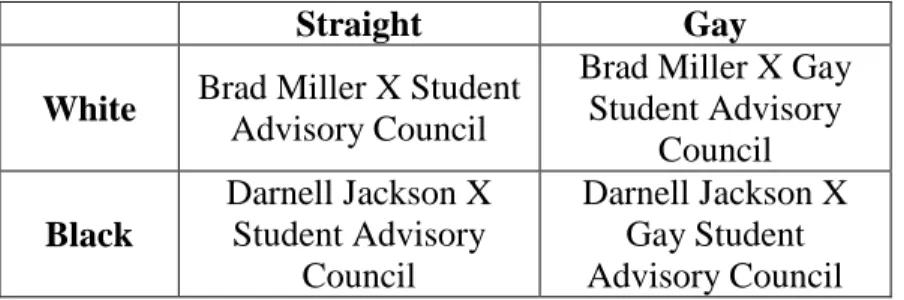
The resumes that were shown to respondents were experimentally manipulated along two axes. Along one axis we manipulated the race of the applicant and along the other axis we manipulated the sexual orientation of the applicant. The resulting 2X2 experimental design is presented in Figure 1, below. Respondents in this study were only shown one resume, rather than multiple resumes, to reduce the likelihood that they would be able to identify the experimental manipulations. Only showing one resume to each respondent also assisted in reducing the role of social desirability bias in our analysis by avoiding comparisons that might trigger socially desirable responses from respondents (see Schuman et al. 1997). The result is a between-subjects experimental design. Therefore, we are not able to estimate the racial or sexual orientation prejudice of a given individual respondent in our sample. However, the random assignment of respondents to
each experimental condition enables us to reliably estimate prejudice within our sample by comparing the mean ratings of the applicant for each condition.
[Figure 1 About Here]
Drawing on existing literature in this area (see Bertrand and Mullainathan 2004; Correll, Benard, and Paik 2007), the race of the applicant was manipulated through the use of white-sounding and black-sounding names: Brad Miller and Darnell Jackson, respectively. One concern about using names to signal race is that racialized names may also signal a class cue and, thus, confound the effects of race and class. We address this issue in two ways. First, we used first names that had been utilized in previous research and shown not to have a class-signaling effect (Bertrand and Mullainathan 2004). Second, we empirically tested for whether the black-sounding name we used signaled both race and class by examining respondents’ answers to a survey item asking them to rate the job applicant’s social class on a five-point scale from “upper class” to “poor.” The results from this empirical analysis indicated that there were no statistically significant differences between the perceived social class of the applicants with white- and black-sounding names. Thus, we have compelling evidence that the names used in our experimental design signaled race without signaling class.
In line with Tilcsik’s (2011) field-experimental work, the sexual orientation treatment was signaled through participation in a college student organization. The “gay” sexual orientation signal was that the student was the President of the Gay Student Advisory Council. The control signal was that the applicant served as President of the Student Advisory Council. Thus, the treatment condition clearly signals that the applicant
is gay, but the organizational affiliation is not with an overtly political gay organization, which keeps the treatment and control conditions closely aligned. (The resumes used in the experiment can be found in Appendix A).
Other than the experimental treatments listed above, the resumes were identical. All of the applicants had the same address, same phone number, and an e-mail address that was in a consistent format ([email protected]). They all attended The Pennsylvania State University, received a degree in Business Administration, and had a strong GPA of 3.71 out of 4.00. The “Professional Experience” section on the resumes was identical. All applicants had experience as an Assistant Manager at a Target in North Bergen, New Jersey, where they had also worked during their summers in college.
In each of the experimental conditions, respondents received the same set of instructions for the survey: “… Please imagine that your friend, who runs a large retail store, is in the process of hiring someone for an assistant manager position. He has asked you to help him with the hiring process by reviewing one of the resumes he received for the position…. After you have thoroughly reviewed this resume, please move to the next screen and respond to the questions that follow with your first, uncensored impressions.” We chose to have respondents review an application for an assistant manager position at a retail store for three reasons. First, it is a job with which most people will have a certain level of familiarity and be able to realistically evaluate an applicant’s ability to perform the tasks associated with the job. Second, employment at a retail store necessitates interacting with customers on a regular basis, which will likely make salient the stereotypes of black men as aggressive and threatening. Finally, managerial positions
likely trigger stereotypes associated with leadership – being agentic and strong-willed – which are likely to activate stereotypes about gay men as effeminate and weak. The prompt also indicates that the respondent is being asked to review the application to assist their friend with the hiring process. We include this information in order to heighten the respondent’s “comprehension goals” and “self-enhancement goals,” which are linked to stereotype activation and application (Kunda and Spencer 2003).5 Thus, our experimental design provides a context where stereotypes about black men and gay men are likely to be activated and applied by respondents.
Dependent Variables
The outcome variables for our analysis were constructed from responses to survey items asking the respondent to evaluate the resume that he or she reviewed. After being presented with the resume for the experimental condition to which he or she was randomly assigned, the respondent was asked to make a recommendation for the starting salary of the applicant (an open text response). The open text response resulted in some salary recommendations that were extremely high or low. For our analysis, we only keep annual salary recommendations between $10,000 and $100,000.6 Robustness checks, discussed below, demonstrate that our primary analyses are not dependent on the cut-off points that we selected. We use differences in the average salary recommendations between experimental conditions as our primary indication of prejudice. After providing a salary recommendation, respondents were also asked to evaluate the applicant’s aggressiveness, using a seven-point sliding scale. Additionally, respondents were asked
to rate the gender of the applicant on a scale ranging from one to seven, where one was “completely masculine” and seven was “completely feminine.” In all analyses, we use list wise deletion to deal with missing data.
Manipulation Checks
The survey also included items that helped to identify whether the respondent consciously received the experimental manipulations in his or her experimental category. At the end of the survey, we asked respondents to answer items about the race and sexual orientation of the applicant. First, we explored whether respondents accurately recalled the sexual orientation treatment. While 2.6% of the applicants in the Student Advisory Council (i.e., the “straight condition”) were described as gay, fully 83.2% of the applicants who were in the Gay Student Advisory Council were described as gay. This difference is highly statistically significant and provides compelling evidence that respondents accurately recalled the sexual orientation treatment. Next, we examined the reception and recall of the race signal. Respondents accurately identified applicants with black-sounding names as being black 47.4% of the time in the “straight black” condition and 30.1% of the time in the “gay black” condition. While these percentages may seem low, it is important to remember that these are only the percentages of respondents who consciously processed and recalled the accurate race of the black applicants. Also, some respondents may not have been comfortable identifying the applicant as black based just on his name, further downwardly biasing these numbers. Thus, it is likely that the race signal was accurately primed for a higher proportion of respondents.
Covariate Balance
Finally, before presenting our findings, we address whether the demographic covariates of the survey respondents were balanced across experimental conditions. Multinomial logistic regression models were used to test for the covariate balance of the 2X2 research design. The dependent variable for the multinomial logit models was the experimental condition to which the respondent was assigned. In separate models for each demographic characteristic, the predictor variable was the sex, age, or education of the respondents. For each test, the p-value on the demographic variable for each group was above 0.10, which indicates that key demographic variables – sex, age, and education – were balanced across conditions.7
RESULTS
In this section, we empirically test each of the hypotheses advanced above. First, we examine whether straight black men and gay white men received lower salary recommendations than straight white men.8 As Figure 2 demonstrates, straight black men received salary recommendations that were, on average, $4,133 (10.5%) lower than for straight white men, a difference that is statistically significant at the 5% level. Next, Figure 2 indicates that the salary recommendations for gay white men were, on average, $6,168 (15.7%) lower than for straight white men, which is statistically significant at the 1% level. In line with our first two hypotheses and previous research, the data provide
strong empirical support that straight black men and gay white men face prejudice when compared to straight white men.
[Figure 2 About Here]
In addition to positing that straight black men and gay white men would receive lower salary recommendations than straight white men, we also hypothesized that specific stereotypes about the masculinity of these groups would be activated. We posited that straight black men would be perceived as more aggressive than straight white men and gay white men would be perceived as more feminine than straight white men. Figure 3 demonstrates that the average aggressiveness score for straight white men was 4.02, compared to 4.52 for straight black men, which is a difference of approximately one-third of a standard deviation on the aggressiveness scale.9 This difference is statistically significant at the 5% level. Next, we address whether gay white men were perceived as more feminine than straight white men. Table 4 indicates that on a gender scale where a score of one is “completely masculine” and a score of seven is “completely feminine,” the average score for straight white men was 3.17, compared with 4.06 for gay white men. This difference is approximately two-thirds of a standard deviation on the gender scale and is statistically significant at the 0.1% level. These comparisons provide support for our hypotheses about the differing stereotypes of black men and gay men. Straight black men are perceived as more aggressive than straight white men and gay white men are perceived as more feminine than straight white men.
[Figure 3 About Here] [Figure 4 About Here]
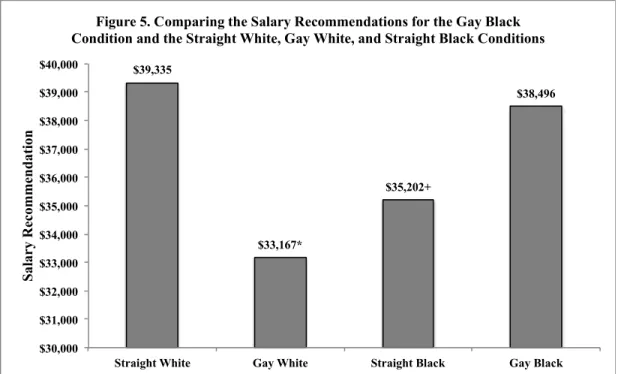
The previous analyses provide strong support for our propositions about the prejudice faced by straight black men and gay white men and identified key differences in the stereotypes associated with these groups. In Figure 5, we test our final two hypotheses. We hypothesized that gay black men would receive higher salary recommendations than both gay white men and straight black men. We can see in Figure 5 that the average salary recommendation for the gay black men was $5,329 (16.1%) higher than for the gay white men (a difference that is statistically significant at the 5% level). Figure 5 also indicates that gay black men, on average, received salary recommendations that were $3,294 (9.4%) higher than straight black men (a marginally significant difference at the 10% level). Finally, we are unable to reject the null hypothesis that there is no difference in salary recommendations between the straight white male and the gay black male job applicants. These findings support our hypothesis that gay black men would receive higher salary recommendations than both straight black men and gay white men. Thus, our empirical analysis provides support for our under-riding theoretical argument that negatively stereotyped counter-stereotypical information can neutralize the effects of negative stereotypes.
[Figure 5 About Here]
ALTERNATIVE HYPOTHESES & ROBUSTNESS CHECKS
The empirical findings presented above provide strong support for our set of hypotheses. In this paper, we argue that stereotypes of gay men as effeminate and stereotypes of black men as aggressive serve as “offsetting stereotypes” for one another
and, thus, when they are combined, remove the prejudice faced by each constituent group. Below, we empirically test an alternative hypothesis and conduct two robustness checks on our findings.
An alternative hypothesis to our theoretical proposition is that the gay signal merely provides individuating information about the black applicant, which, in turn, reduces prejudice (see Peffley, Hurwitz, and Sniderman 1997). Similarly, the “black signal” may provide individuating information about the gay white applicant. Thus, it may be the individuating nature of the gay and black counter-stereotypical information, rather than its connection to the content of underlying stereotypes, that removes the discrimination in salary recommendations for the jointly gay and black job applicant.
We empirically test this alternative hypothesis by examining a separate survey item where respondents were asked about how much of an individual they perceived the job applicant to be. Respondents were asked on a seven-point scale how accurately the following statement described the applicant that they reviewed: “The applicant has many unique characteristics.” We model this “uniqueness” variable using linear regression techniques to test for the individuating information hypothesis. We regress the uniqueness variable on whether the resume had the black signal, whether the resume had the gay signal, and an interaction between the black signal and the gay signal. If the individuating information alternative hypothesis were accurate, then we would expect to find a positive and statistically significant coefficient for the interaction term in the regression model. Our results indicate, however, that the interaction term is far from statistically significant (p-value = 0.76). Thus, it does not appear as if the positive effects
of being black and gay are due to providing individuating information about the job applicant.
A second concern may exist about respondents’ seemingly low recall rate of the signal that the applicant was black, especially in the “gay black” condition. To address this concern, we tested the robustness of our final analyses on the subset of respondents who accurately recalled the race and sexual orientation signals. Among this group of respondents, the gay black applicant received an average salary recommendation that was $7,633 higher than the average salary recommendation for the gay white applicant. This difference was marginally statistically significant at the 10% level. It is likely that the drop in statistical significance, compared to the main analysis, is due to the reduced statistical power that comes with a smaller sample rather than a reduction in effect size, since the dollar value of the difference is larger here than it is in the main analysis. When we examine the salary recommendation differences between straight black men and gay black men, limiting the sample to those who accurately recalled the race and sexual orientation signals, gay black men received average salary recommendations that were $7,416 higher, on average, than the salary recommendations for straight black men. This difference was statistically significant at the 10% level. Thus, our primary finding about the non-additive effect of combining black and gay stereotypes replicates on the subset of respondents in our sample who accurately recalled the race and sexual orientation signals. Finally, the salary recommendation analyses in the paper limit the salary recommendations to values between $10,000 and $100,000. This restriction was implemented to deal with some extremely high and some extremely low values that were
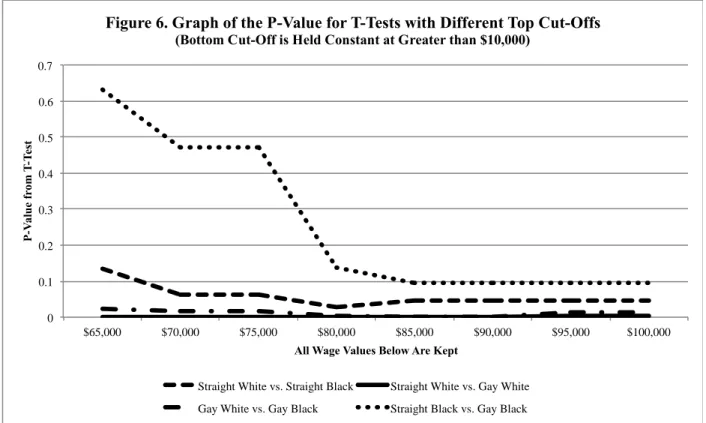
a result of the salary recommendation survey item being open-ended. However, there may be a concern that our findings are dependent on these cut-off points. Here, we demonstrate that the statistical significance of our main findings remains similar if other cut-off points are used. In Figure 6, we plot the p-value for each salary recommendation t-test (straight white vs. straight black, straight white vs. gay white, gay white vs. gay black, and straight black vs. gay black) against various top cut-off points for the salary recommendation. As the graph shows, using any cut-off above $85,000 results in p-values for all t-tests that are below 0.10. In Figure 7, we plot the p-value for each t-test against various bottom cut-off points. As the graph shows, using any cut-off above $5,000 produces p-values for all t-tests that are below 0.10. These robustness checks provide strong evidence that our findings are not dependent on the cut-off points used for the salary recommendation analysis.
[Figure 6 About Here] [Figure 7 About Here]
DISCUSSION & CONCLUSION
Sociologists and social psychologists have focused significant attention on the role of negative stereotypes in shaping attitudes and behaviors and have examined the ways that counter-stereotypical information can reduce that link. However, most research in this area has focused on the ways that positive counter-stereotypical information can reduce prejudicial attitudes. Our analysis complicates and contributes to this literature by developing a theory of “offsetting stereotypes,” which puts forth a framework for how
negatively stereotyped counter-stereotypical information can sometimes have positive consequences. We explore this theory by examining the case of stereotypes about black men and gay men in the process of evaluating job applicants.
Using survey-experimental methods, we first investigated differences in the salary recommendations provided to straight white, gay white, and straight black job applicants. We found that straight black men and gay white men received lower salary recommendations than straight white men, indicating prejudice against straight black male and white gay male job applicants. Next, we found that straight black men were perceived as more aggressive than straight white men. And, gay white men were perceived as more feminine than straight white men. These findings provide support for the notion that people hold differing stereotypes about black men and gay men and that these stereotypes were active in our experimental context. Finally, we found that gay black men received higher salary recommendations, on average, than both straight black men and gay white men. Together, these findings provide compelling empirical support for our hypothesis of “offsetting stereotypes.”
In addition to developing our understanding of how counter-stereotypical information shapes the link between stereotypes and prejudice, our findings contribute important insights to ongoing sociological debates about the ways that socially marginalized categories work in combination with one another. Some scholars have argued that combining multiple marginalized social categories, such as being black and gay, creates a “double disadvantage” (Beale 1979; King 1988). In this framework, which has focused on the intersection of race and gender, each additional marginalized category
further disadvantages the individual. In line with theories about the “intersectionality” of social identities (Hill Collins 2000[1990]; Greenman and Xie 2008), however, our analysis explicitly challenges these additive assumptions of prejudice and discrimination. Being black and gay is not just the sum of the marginalization associated with being black added to the marginalization associated with being gay. In our case, we find clear non-additive effects of race and sexuality for men. We find that male job applicants who are black and gay face less prejudice than male job applicants who are black or gay. Thus, our analysis encourages further investigation into the conditions under which marginalized social categories combine in an additive or in a non-additive manner.
Our analysis explores how stereotypes about African American men intersect with stereotypes about gay men. But, what other social categories that independently experience marginalization might serve as “offsetting stereotypes” for one another? While this is an empirical question worthy of additional research, there are some potential “offsetting stereotypes” that seem likely. In the U.S. context, for example, stereotypes about Muslim men as violent and threatening (Sides and Gross 2011) may intersect with gay identities in a similar way to how stereotypes about African American men intersect with gay identities. Additionally, stereotypes that individuals with physical disabilities are weak (Nario-Redmond 2010) may “offset” stereotypes about black men as threatening and violent. Future empirical research exploring how these, and other, social categories interact with one another across a range of contexts – for example, housing and credit markets – would assist in expanding the theory of “offsetting stereotypes” beyond the intersection and black and gay identities for male job applicants.
While our investigation makes important contributions to theories of stereotyping and prejudice as well as the literature on intersecting social identities, it is not without limitations. Importantly, this research design does not test how stereotypes and prejudice operate in an actual labor market. The survey respondents are not employers and they are not making actual salary recommendations. While an audit study method would contribute to this line of research by testing for the role of stereotypes about masculinity in real hiring decisions, there are benefits to the survey-experimental method employed here. Audit studies provide a crude measure of discrimination because they can only capture the binary outcome of whether or not the applicant receives an interview or some other form of positive feedback from the employer. Our survey-experimental design, however, provides insight into respondents’ reactions to the experimental treatments along multiple axes – the aggressiveness of the applicant, the gender of the applicant, and the uniqueness of the applicant – providing a more nuanced and detailed depiction of how job applicants are evaluated.
Our analysis contributes important insights to the sociological literatures on prejudice and discrimination, processes of social stratification, and the consequences of intersecting social identities. Our primary empirical findings supports our theoretical proposition of “offsetting stereotypes,” which argues that negatively stereotyped counter-stereotypical information can have positive consequences when the content of the negative counter-stereotype is in direct opposition to the primary negative stereotype.
ENDNOTES
1
There are two additional bodies of psychological research that are related to the line of inquiry in this article. First, psychologists have investigated how individuals process counter-stereotypical information – whether it is “up-weighted” or discounted (see Allen et al. 2009; Sherman, Stroessner, Conrey, and Azam 2005). Second, social psychologists have explored whether there are penalties experienced by individuals when they present counter-stereotypical information (see Phelan and Rudman 2010; Rosenfield et al. 1982; Schimel et al. 1999).
2
The data analyzed here are part of a larger experiment that included non-white respondents and additional experimental conditions.
3
The survey was fielded between September 2, 2011 and September 19, 2011. The completion rate was 65.6%.
4
For a summary of how Knowledge Networks creates the survey-specific weights for the surveys that they field, see: http://www.knowledgenetworks.com/ganp/docs/kn-weighting-synopsis.pdf. In our analysis, similar empirical patterns are found when the sample weights are not used.
5
“Comprehension goals” include the need to understand events, reduce complexity, and form coherent impressions. “Self-enhancement goals” include the need to maintain and enhance one’s self-concept. Knowing that one is evaluating a job applicant on behalf of a friend is likely to heighten the comprehension and self-enhancement goals of respondents (Kunda and Spencer 2003).
6
In the raw data, 2.4% of respondents did not provide any salary recommendation. There were 8.1% of cases with salary recommendations of $10,000 or less. Only 0.7% of respondents listed annual salary recommendations that were $100,000 or higher.
7
We also ran chi-square tests for independence for the sex, age, and education of the respondents, where age and education were broken into broad categories. We were unable to reject the null hypothesis of independence in any analysis, providing additional evidence that the demographic covariates are balanced.
8
It is more accurate to say “applicants in the straight white male condition,” rather than “straight white male applicants,” since not everyone accurately received the race and sexual orientation signals. However, for ease of writing and reading, we use the later phrasing.
9
The standard deviation difference was calculated by conducting the analysis on a standardized version of the aggressiveness variable.
REFERENCES
Allen, Thomas J., Jeffrey W. Sherman, Frederica R. Conrey, and Steven J. Stroessner. 2009. “Stereotype Strength and Attentional Bias: Preference for Confirming Versus Disconfirming Information Depends on Processing Capacity.” Journal of Experimental Social Psychology 45:1081-1087.
Beale, Frances M. 1979. “Double Jeopardy: To Be Black and Female.” Pp. 90-100 in The Black Woman, edited by Toni Cade. New American Library.
Bertrand, Marianne, and Sendhil Mullainathan. 2004. “Are Emily and Greg More Employable than Lakisha and Jamal? A Field Experiment on Labor Market Discrimination.” The American Economic Review 94(4):991-1013.
Blair, Irene V. 2002. “The Malleability of Automatic Stereotypes and Prejudice.” Personality and Social Psychology Review 6(3):242-261.
Blair, Irene V., Jennifer E. Ma, and Alison P. Lenton. 2001. “Imagining Stereotypes Away: The Moderation of Implicit Stereotypes Through Mental Imagery.” Journal of Personality and Social Psychology 81(5):828-841.
Browne, Irene, and Joya Misra. 2003. “The Intersection of Gender and Race in the Labor Market.” Annual Review of Sociology. 29:487-513.
Cohen, Taya R., Deborah L. Hall, and Jennifer Tuttle. 2009. “Attitudes Toward Stereotypical Versus Counterstereotypical Gay Men and Lesbians.” Journal of Sex Research
46(4):274-281.
Correll, Shelley J., Stephen Benard, and In Paik. 2007. “Getting a Job: Is There a Motherhood Penalty?” American Journal of Sociology 112(5):1297-1338.
Dasgupta, Nilanjana, and Anthony G. Greenwald. 2001. “On the Malleability of Automatic Attitudes: Combating Automatic Prejudice with Images of Admired and Disliked Individuals.” Journal of Personality and Social Psychology 81(5):800-814.
Dovidio, John F., John C. Brigham, Blair T. Johnson, and Samuel L. Gaertner. 1996. “Stereotyping, Prejudice, and Discrimination: Another Look.” Pp. 176-319 in Stereotypes and Stereotyping, edited by C. Neil Macrae, Charles Stangor, and Miles Hewstone. Guilford Press.
Drydakis, Nick. 2009. “Sexual Orientation in the Labour Market.” Labour Economics 16:364-372.
Duncan, Birt L. 1976. “Differential Social Perception and Attribution of Intergroup Violence: Testing the Lower Limits of Stereotyping of Blacks.” Journal of Personality and Social
Farley, Reynolds, Charlotte Steeh, Maria Krysan, Tara Jackson, and Keith Reeves. 1994. “Stereotypes and Segregation: Neighborhoods in the Detroit Area.” The American Journal of Sociology 100(3):750-780.
Gamson, Joshua and Dawne Moore. 2004. “The Sociology of Sexualities: Queer and Beyond.”
Annual Review of Sociology 30:47-64.
Greenman, Emily, and Yu Xie. 2008. “‘Double Jeopardy?’ The Interaction of Gender and Race on Earnings in the United States. ” Social Forces 86(3):1217-1244.
Gurwitz, Sharon B., and Melinda Marcus. 1978. “Effects of Anticipated Interaction, Sex, and Homosexual Stereotypes on First Impressions.” Journal of Applied Social Psychology
8(1):47-56.
Haddock, Geoffrey, Mark P. Zanna, and Victoria M. Esses. 1993. “Assessing the Structure of Prejudicial Attitudes: The Case of Attitudes Toward Homosexuals.” Journal of Personality and Social Psychology 65(6):1105-1118.
Hebl, Michelle R., Jessica Bigazzi Foster, Laura M. Mannix, and John F. Dovidio. 2002. “Formal and Interpersonal Discrimination: A Field Study of Bias Toward Homosexual Applicants.” Personality and Social Psychology Bulletin 28:815.
Heckman, James J. 1998. “Detecting Discrimination.” Journal of Economic Perspectives 12:101-116.
Herek, Gregory M. 1984. “Attitudes toward Lesbians and Gay Men: A Factor-Analytic Study.”
Journal of Homosexuality 10(39-51).
Hill Collins, Patricia. [1990]2000. Black Feminist Thought: Knowledge, Consciousness, and the Politics of Empowerment. New York: Routledge.
Jackson, Linda A., and Linda A. Sullivan. 1989. “Cognition and Affect in Evaluations of Stereotypes Group Members.” The Journal of Social Psychology 129(5):659-672.
Kaas, Leo, and Christian Manger. 2011. “Ethnic Discrimination in Germany’s Labour Market: A Field Experiment.” German Economic Review 1-20.
King, Deborah K. 1988. “Multiple Jeopardy, Multiple Consciousness: The Context of a Black Feminist Ideology.” Signs: Journal of Women in Culture and Society 14(1):42-72.
Koenig, Anne M., Alice H. Eagly, Abigail A. Mitchell, and Tina Ristikari. 2011. “Are Leader Stereotypes Masculine? A Meta-Analysis of Three Research Paradigms.” Psychological Bulletin 137(4):616-642.
Kunda, Ziva, and Steven J. Spencer. 2003. “When Do Stereotypes Come to Mind and When Do They Color Judgment? A Goal-Based Theoretical Framework for Stereotype Activation and Application.” Psychological Bulletin 129(4):522-544.
Lauster, Nathanael, and Adam Easterbrook. 2011. “No Room for New Families? A Field Experiment Measuring Rental Discrimination against Same-Sex Couples and Single Parents.” Social Problems 58(3):389-409.
Livingston, Robert, and Nicholas Pearce. 2009. “The Teddy Bear Effect: Does Babyfaceness Benefit Black CEOs?” Psychological Science 20(1):1229-1236.
Madon, Stephanie. 1997. “What Do People Believe about Gay Males? A Study of Stereotype Content and Strength.” Sex Roles 37(9-10):663-685.
Moss, Philip I., and Chris Tilly. 2001. Stories Employers Tell: Race, Skill, and Hiring in America. Russell Sage Foundation.
Nario-Redmond, Michelle R. 2010. “Cultural Stereotypes of Disabled and Non-Disabled Men and Women: Consensus for Global Category Misrepresentations and Diagnostic Domains. ” The British Psychological Society 49:471-488.
Neckerman, Kathryn M., and Joleen Kirschenman. 1991. “Hiring Strategies, Racial Bias, and Inner-City Workers.” Social Problems 38(4):433-447.
Noguera, Pedro A. 2008. The Trouble with Black Boys: And Other Reflections on Race, Equity, and the Future of Public Education. Jossey-Bass.
Pager, Devah. 2003. “The Mark of a Criminal Record.” The American Journal of Sociology
108(5):937-975.
Pager, Devah, and Diana Karafin. 2009. “Bayesian Bigot? Statistical Discrimination, Stereotypes, and Employer Decision Making.” Annals of the American Academy of Political and Social Sciences 621:70-93.
Pager, Devah, Bruce Western, and Bart Bonikowski. 2009. “Discrimination in a Low-Wage Labor Market: A Field Experiment.” American Sociological Review 74(5):777-799. Peffley, Mark, Jon Hurwitz, and Paul M. Sniderman. 1997. “Racial Stereotypes and Whites'
Political Views of Blacks in the Context of Welfare and Crime.” American Journal of Political Science 41(1):30-60.
Phelan, Julie E., and Laurie A. Rudman. 2010. “Reactions to Ethnic Deviance: The Role of Backlash in Racial Stereotype Maintenance.” Journal of Personality and Social Psychology 99(2):265-281.
Power, J. Gerard, Sheila T. Murphy, and Gail Coover. 1996. “Priming Prejudice: How Stereotypes and Counter-Stereotypes Influence Attribution of Responsibility and Credibility among Ingroups and Outgroups.” Human Communication Research 23(1):36-58.
Quillian, Lincoln. 2006. “New Approaches to Understanding Racial Prejudice and Discrimination.” Annual Review of Sociology 32:299-328.
Quillian, Lincoln, and Devah Pager. 2001. “Black Neighbors, Higher Crime? The Role of Racial Stereotypes in Evaluations of Neighborhood Crime.” The American Journal of Sociology
107(3):717-767.
Remedios, Jessica D., Alison L. Chasteen, Nicholas O. Rule, and Jason E. Plaks. 2011. “Impressions at the Intersection of Ambiguous and Obvious Social Categories: Does Gay + Black = Likable?” Journal of Experimental Social Psychology 47(6):1312-1315.
Rosenfield, David, Jeff Greenberg, Robert Folger, and Robert Borys. 1982. “Effect of and Encounter with a Black Panhandler on Subsequent Helping for Blacks: Tokenism or Confirming Negative Stereotypes.” Personality and Social Psychology Bulletin 8(4):664-671.
Sager, H. Andrew, and Janet Ward Schofield. 1980. “Racial and Behavioral Cues in Black and White Children’s Perceptions of Ambiguously Aggressive Acts.” Journal of Personality and Social Psychology 39(4):590-598.
Schimel, Jeff, Linda Simon, Jeff Greenberg, Tom Pyszczynski, Sheldon Solomon, Jeannette Waxmonsky, and Jamie Arndt. 1999. “Stereotypes and Terror Management: Evidence that Mortality Salience Enhances Stereotypic Thinking and Preferences.” Journal of Personality and Social Psychology 77(5):905-926.
Schuman, Howard, Charlotte Steeh, Lawrence Bobo, and Maria Krysan. 1997. Racial Attitudes in America: Trends and Interpretations. Harvard University Press.
Sherman, Jeffrey W., Steven J. Stroessner, Frederica R. Conrey, and Omar A. Azam. 2005. “Prejudice and Stereotype Maintenance Processes: Attention, Attribution, and Individuation.” Journal of Personality and Social Psychology 89(4):607-622.
Shih, Johanna. 2002. “‘... Yeah, I could hire This One, But I know it’s Gonna be a Problem’: How Race, Nativity and Gender Affect Employers’ Perceptions of the Manageability of Job Seekers.” Ethnic and Racial Studies 25(1):99-119.
Sides, John, and Kim Gross. 2009. “Stereotypes of Muslims and Support for the War on Terror.” Working Paper.
Steele, Claude M., and Joshua Aronson. 1995. “Stereotype Threat and the Intellectual Test Performance of African Americans.” Journal of Personality and Social Psychology
69(5):797-811.
Sweeney, Laura T., and Craig Haney. 2006. “The Influence of Race on Sentencing: A Meta-Analytic Review of Experimental Studies.” Behavioral Sciences and the Law 10(2):179-195.
Tilcsik, András. 2011. “Pride and Prejudice: Employment Discrimination against Openly Gay Men in the United States.” American Journal of Sociology 117(2):586-626.
Weichselbaumer, Doris. 2003. “Sexual Orientation Discrimination in Hiring.” Labour Economics 10:629-642.
Zebrowitz, Leslie A., and Joann M. Montepare. 2005. “Appearance DOES Matter.” Science
APPENDIX A
RESUMES USED IN SURVEY EXPERIMENT
Brad Miller/Darnell Jackson
784 Golden Avenue, Apt. #4 Secaucus, NJ 07094
brad.miller/[email protected] 201-330-3211
Education
The Pennsylvania State University (State College, PA)
May 2009
Bachelor of Arts in Business Administration GPA: 3.71/4.00
Professional Experience
Target (North Bergen, NJ) 2009 - Present Assistant Manager
Assist in managing all aspects of Target, a large retail store, in North Bergen, New Jersey. Resolve customer service problems, manage personnel, and schedule employee hours.
Served as cashier and department manager, during college summers, before being promoted to assistant manager.
Leadership Experience
[Gay] Student Advisory Council
President
Served as member and then president of the [Gay] Student Advisory Council.
Planned and ran meetings, wrote meeting agendas, and conducted meeting follow-up.
Track Club of Penn State
Treasurer
Served as member and treasurer of the Track Club of Penn State. Managed organizational budget and participated in competitions.
TABLES
Survey Sample U.S. Population
Male 49.1% 49.3% Age 18 to 29 22.5% 22.5% 30 to 44 20.2% 26.6% 45 to 59 28.0% 27.2% 60 plus 29.3% 23.9% Education
Less than High School 9.3% 14.8%
High School 34.7% 28.5%
Some College 27.9% 28.8%
College Degree 28.1% 27.9%
Household Income (median) $55,000 $50,221 Table 1. Weighted Descriptive Statistics of Survey Respondents Compared to U.S. Population
Notes: Sex, education, age and income for the U.S. population were obtained from 2009 single-year estimates produced by the American Community Survey (see factfinder.census.gov).