c
INTENT MODELING AND AUTOMATIC QUERY REFORMULATION FOR SEARCH ENGINE SYSTEMS
BY
HUIZHONG DUAN
DISSERTATION
Submitted in partial fulfillment of the requirements for the degree of Doctor of Philosophy in Computer Science
in the Graduate College of the
University of Illinois at Urbana-Champaign, 2013
Urbana, Illinois
Doctoral Committee:
Professor ChengXiang Zhai, Chair Professor Jiawei Han
Professor Dan Roth
ABSTRACT
Understanding and modeling users’ intent in search queries is an important topic in studying search engine systems. Good understanding of search intent is required in order to achieve better search accuracy and better user experience. In this thesis work, I identify and study three major problems in the subject: ambiguous search intent, ineffective query formulation and vague relevance criteria. To systematically study these problems, the thesis consists of three parts. In the first part, I study search intent ambiguity in search engine queries and propose a click pattern-based method that captures ambiguous search intent based on behavioral difference rather than semantic difference. Analysis shows that the proposed method is more accurate and robust in measuring query ambiguity. In the second part, I study how to provide query formulation support to facilitate users in expressing search intent. Query completion and correction, and syntactic query reformulation are proposed and studied in this part. Experiments show that the proposed query formulation support methods can help users formulate more effective queries and alleviate search difficulty. In the third part, I study how to model search intent so that we can gain insights about users’ behaviors and leverage the knowledge to improve search engines. Two topics are studied in this part: modeling search intent with data level representation and discovering coordinated shopping intent in product search. It is shown that the proposed methods can not only discover meaningful user intent but also improve search and other related applications. The proposed models and algorithms in the thesis are general and can be applied to improve search accuracy in potentially many different search engines. As a systematic study on intent modeling and automatic query reformulation in search engine systems, this thesis work also provides a road map to future exploration on intent understanding and analysis.
ACKNOWLEDGMENTS
I want to express my sincere gratitude to my advisor Professor ChengXiang Zhai, who supported and guided me through my Ph.D study. His knowledge, vision and passion in academic has always inspired me to pursue my research to the full extent. He offered invaluable advices to my work. This thesis would not have been possible without his help. He is also kind, patient and encouraging to me. His way of advising has made it possible for me to work and improve myself more effectively. From him I have learned not only the knowledge, but also the mindset to become an independent researcher.
I would also like to thank my doctoral committee members, Professor Jiawei Han, Professor Dan Roth and Doctor Emre Kiciman, for their valuable guidance on my study and research, as well as constructive suggestions on this dissertation.
I owe gratitude to my colleagues and friends, Yanen Li, Rui Li, Paul Hsu, Yue Lu, Hongning Wang, Yunliang Jiang and Mianwei Zhou. They offer valuable help to my research. I also want to thank all my colleagues in Database and Information System (DAIS) group, and all my friends in UIUC.
I am deeply indebted to my father Yunhai Duan and my mother Yaqin Han. Without their love and support, none of my achievements is possible. Last but not least, I am grateful to my wife Zhen Wu and my daughter Emma Duan for their love and care, and for the happiness they bring into my life.
TABLE OF CONTENTS
CHAPTER 1 INTRODUCTION . . . 1
CHAPTER 2 RELATED WORK . . . 6
2.1 Search Intent Analysis . . . 6
2.2 Supporting Query Formulation . . . 8
2.3 Intent Modeling in Structured Entity Retrieval . . . 10
PART I Modeling Ambiguous Search Intent . . . 13
CHAPTER 3 MODELING AMBIGUOUS INTENT WITH CLICK PATTERNS . . . 14
3.1 Introduction . . . 14
3.2 Click Patterns . . . 15
3.2.1 Definition . . . 16
3.2.2 Modeling and Identifying Click Patterns . . . 16
3.2.3 Exploring Click Patterns in Search Logs . . . 17
3.3 Click Patterns and Query Ambiguity . . . 20
3.3.1 Pattern Entropy . . . 21
3.3.2 Properties of Ambiguity Metrics . . . 22
3.4 Classifying Ambiguous Queries . . . 26
3.4.1 Problem Setup . . . 26
3.4.2 Classification Results . . . 27
3.4.3 Case Study . . . 28
3.5 Click Patterns and Query Recommendations . . . 28
3.5.1 Problem Setup . . . 29
3.5.2 Query Recommendation Results . . . 30
3.5.3 Case Study . . . 30
3.6 Conclusions . . . 31
PART II Supporting Query Formulation . . . 32
CHAPTER 4 QUERY COMPLETION AND CORRECTION . . . 33
4.1 Introduction . . . 33
4.2 Problem Formulation . . . 33
4.3.1 Model Estimation . . . 37 4.3.2 Model Pruning . . . 39 4.3.3 Model Smoothing . . . 39 4.3.4 Mixture Models . . . 40 4.3.5 Discussions . . . 41 4.4 Search . . . 41 4.4.1 Trie . . . 42 4.4.2 A* Search . . . 43 4.4.3 Pruning . . . 45 4.4.4 Thresholding . . . 45 4.5 Experiment . . . 46 4.5.1 Datasets . . . 46 4.5.2 Evaluation Metrics . . . 48 4.5.3 Experiment Results . . . 49 4.6 Conclusion . . . 54
CHAPTER 5 QUERY REFORMULATION WITH SYNTACTIC OPERATORS . . . 55
5.1 Introduction . . . 55
5.2 Syntactic Operators for Improving Search Results . . . 58
5.3 Automatic Reformulation with Syntactic Operators . . . 59
5.3.1 Features . . . 60
5.3.2 Combining Operators in Prediction . . . 63
5.4 Experiments . . . 63
5.4.1 Experiment Setup . . . 63
5.4.2 Experiment Results . . . 64
5.4.3 Cases Studies . . . 66
5.5 Conclusion . . . 67
PART III Deep Intent Modeling for Structured Entity Retrieval . . . 68
CHAPTER 6 MODELING QUERY INTENT WITH ENTITY STRUCTURES . . . 69
6.1 Introduction . . . 69
6.2 Probabilistic Query Model for Ranking Product Entity . . . 72
6.2.1 Probabilistic Entity Ranking Based on Query Generation . . . 73
6.2.2 Model Estimation Based on Entity Specifications . . . 77
6.2.3 Improve Estimation by Leveraging Associated Text Data . . . 79
6.2.4 A Mixture Model of Review Text Data . . . 79
6.2.5 Maximum a Posterior (MAP) Estimation of the Mixture Model . . . 81
6.2.6 Smoothing and Interpolation . . . 82
6.2.7 Indexing and Search . . . 83
6.3 Experiments . . . 85
6.3.1 Datasets and Evaluation Metrics . . . 85
6.3.2 Experiment Results . . . 86
6.3.3 Search Efficiency . . . 90
6.4.1 Facet Generation . . . 90
6.4.2 Query Independent Facet Generation . . . 92
6.4.3 Query Specific Facet Generation . . . 93
6.4.4 Review Annotation . . . 94
CHAPTER 7 DISCOVERING COORDINATED SHOPPING INTENT IN PRODUCT SEARCH . . . 95
7.1 Introduction . . . 95
7.2 Discovering Coordinated Shopping Intent in Product Search . . . 98
7.2.1 Topic Modeling Approach Adapted for Intent Discovery . . . 100
7.2.2 Coordinated Representation of Shopping Intent in Product Search . . . 102
7.2.3 Joint Mixture Model for Discovering Shopping Intent . . . 103
7.2.4 Model Estimation . . . 104
7.2.5 Combining Similar Intent Models . . . 105
7.3 Discovered Shopping Intent . . . 106
7.4 Applications . . . 111
7.4.1 Intent-Oriented Query Ambiguity Analysis . . . 111
7.4.2 Improving Product Search . . . 114
7.4.3 Improving Product Recommendation . . . 116
7.5 Conclusion and Future Work . . . 118
CHAPTER 8 SUMMARY AND FUTURE DIRECTIONS . . . 120
8.1 Summary . . . 120
8.2 Discussions and Future Directions . . . 123
CHAPTER 1
INTRODUCTION
Search engine systems exist everywhere in the world of data. As an important tool for information access, search engine systems are built on top of various data sources, including unstructured text data as well as semi-structured/structured data. In all the search engine systems, the utility of a system is directly affected and largely determined by its ability to understand a user’s search intent. Good understanding of search intent usually leads to better search accuracy and better user experience.
However, search intent is a complicated issue. Accurate understanding and modeling search intents is difficult in many ways.
Unclear/Ambiguous Intent. First, it is often that a user does not have a clear search intent. This is especially true for exploratory search, where the user doesn’t have a fixed goal. In this case, a user’s query is only a rough hint about what exactly is interesting to the user.
Ineffective Query Formulation. Second, even when a user’s information need is clear, there are at least two reasons why a user may not be able to describe the information need (query intent) very clearly. First, there is usually a vocabulary gap between the user and the documents, making it difficult for the user to use the right words for the query. Second, the user may not realize that there are many distracting documents in the collection, and additional constraints on top of a keyword query may be needed (e.g., two words should occur next to each other) in order to retrieve some particular content.
Vague Relevance Criteria.Finally, even when a user can describe an information need clearly, the query by itself can only convey a vague criteria for relevance matching, as there is typically difference in intent and data representation. Therefore, it is still challenging to obtain a deep level of representation of intent that allows us to easily match with the relevant data (i.e., obtain a document-level representation of intent).
In this work, I propose to tackle these challenges in intent modeling and exploit search logs to help understanding user intent. I will further leverage the understanding of intent to improve retrieval accuracy through query reformulation. Specifically, I will study the following topics:
• Modeling ambiguous search intent. People issuing the same query may target very differ-ent information. Ambiguity of search intdiffer-ents exists ubiquitously in search engine systems. Understanding such ambiguity is important for intent modeling and will largely benefit the search experience. Traditional methods in ambiguity analysis assumes that each clicked re-sult represents an unique intent. However, there are many search tasks, such as comparison shopping and research survey, where a user’s intent is to explore many documents. In these cases, the simple assumption of a one-to-one correspondence between clicked documents and user intent breaks down. In this work, I will study the modeling of search intents from the per-spective of behavior analysis. Specifically, the notion of “click pattern” is proposed to serve as the fundamental unit for intent analysis. Click patterns can be effectively discovered by analyzing user behavior in click-through logs. The model will lead to a better understanding and a more accurate measurement of ambiguity in search intent.
• Supporting Query Formulation.
– Query completion and correction. One major difficulty that users encounter in ex-pressing their search intent is the vocabulary gap between the users and the data. Due to the vocabulary gap it is difficult for end users to formulate effective queries based on their search intents. In this work, I will study query completion and correction to help users clarify their search intents. The idea is to provide real time feedback to the user while the query is being entered. This way, by detecting the most likely intent based on active input of the user, we can help the user complete and refine their search intent in real time. Consider a user entered a keyword “schwarzenegger” to the search interface, if we can infer that the most possible targeted query is “shwartzeneger movie 2013”, it can provide the query in a drop down list so that the user can directly enter the complete query (by selecting using the arrow keys or the pointing devices) without typing in the rest. To alleviate the problem of vocabulary gap, we further consider the cases where users may not be able to spell correctly. For instance, “schwarzenegger”
can be misspelled as “shwartzeneger” and the system should still provide the sugges-tion of “shwartzeneger movie 2013” as the most possible intent query. To achieve these goals, I will study the modeling of similarity between search intents. A generative joint sequence model will be adapted for the problem. Complex similarity models will be estimated and studied. Efficient search algorithms will also be studied for finding the most possible query completion and correction based on inferred search intent from a (partial) user query.
– Query reformulation with syntactic operators. Although the use of keyword query is prevailing in IR systems, it has not been well understood whether it is sufficient for expressing search intents. Indeed, modern search engines support a range of advanced syntax beyond keyword queries. These syntax are designed to further clarify the users’ search intents by imposing certain constraints on one or more keywords. For instance, the query “change “default java” +unix” states that the phrase “default java” must be matched as a phrase rather than as separate keywords, and additionally the keyword “unix” must be matched. Although they are both intended for the same information, the lightly modified query with the syntactic operators (quotation mark for phrase match and plus sign for necessity) turned out to more effective in retrieving the relevant in-formation than the plain keyword query on major search engines. The lack of such semantic constraints in keyword query makes it insufficient to express certain search intents. In this work, I will systematically study the advantage of query syntax in search intent expression. I will also study the automatic reformulation of search queries with syntactic operators based on the inferred search intents. The problem will be casted into a supervised learning to rank problem and a set of effective features will be proposed and studied.
• Deep intent understanding/modeling in structured entity retrieval. Even if search intent can be clearly conveyed in query, it is still challenging to obtain a deep level of intent repre-sentation which matches with the document reprerepre-sentation in the data. Such a reprerepre-sentation is usually critical in relevance matching because it determines the relevance criteria. Under-standing and modeling of deep intent representation is, however, difficult due to the various types of search intent and document representation.
On the other hand, structured entity retrieval, an emerging and important issue in information retrieval, is of particular importance in e-commerce, medical information system and many other search systems. The difference in data representation (structured data of product entities vs. unstructured text of Web documents) raises challenges as well as new opportunities in intent modeling. In this work, I use structured entity retrieval as a platform for extending my study on deep intent understanding and modeling. Particularly, I study the following two topics.
– Modeling query intents with entity structures for product search. In the scenario of product search, the objects to be retrieved are structured entities defined by a set of attributes and values. For example, products are defined by their specifications. Each specification consists of a name and a value, which can be either numeric or categorical. For instance, a laptop can be represented by its brand, cpu speed, screen size, etc. In the scenario of product search, a user’s search intent is strongly tied with the specifications of products. However, the query language users use to describe their search intent is usually in an unstructured text format. Because of such difference, it is necessary to obtain a deep level of representation of search intent with the entity structure so that we can understand what users are shopping for given the vague relevance criteria conveyed in the user query. In this work, I study the problem of intent matching between user query and product information in the form of probabilistic models for product search. I show how this can improve the accuracy of product search as well as benefit important related applications such as automatic facet generation.
– Discovering coordinated shopping intent in product searchIn the previous part of work, I study the problem of query intent modeling in product search by matching be-tween user queries and structured product information. Although the proposed method is effective for improving the accuracy of entity retrieval, it does not provide much in-sight in understanding user intent as it analyzes intent on a per query basis. In reality, user intent is a more complicated issue, especially in product entity search. Different users may use the same query to express different intent, or use different queries to express the same intent. To capture this, we need to model search intent at a higher con-ceptual level. This calls for an explicit and accurate representation of search intent. In
this part of work, I propose a novel coordinated intent representation, where each intent is collectively represented by query terms and product attributes. A joint mixture model is then proposed to automatically discover such intent by analyzing search engagement logs. I show that the proposed method can effectively discover distinct, coherent and meaningful intent models, and with the interpretable coordinated intent representation, we can gain insights into the user shopping preferences. The discovered intent models can not only be directly incorporated in product search to improve search accuracy, but also be leveraged in search related applications such as query ambiguity analysis, prod-uct recommendation and search result diversification and personalization to promote the overall search experience.
Thesis Organization: The rest of the thesis is organized as follows. Chapter 2 surveys the related literature. Chapter 3-7 are divided into three parts. In Part I (Chapter 3), I present one published work on modeling ambiguous search intent. In Part II (Chapter 4 and Chapter 5), I present two published work onsupporting query formulation. In Part III (Chapter 6 and Chapter 7), I present one published work and one work in submission onunderstanding and modeling of deep search intent. Finally, the thesis work is summarized in Chapter 8.
CHAPTER 2
RELATED WORK
2.1
Search Intent Analysis
User intent/query intent analysis has been the subject of much research in recent years, especially for the purposes of search personalization and vertical search engine selection.
Understanding user’s intent in search queries helps identify queries that require more personal-ized search results. Song et al. proposed to summarize queries as in three categories: ambiguous query, broad query and clear query [64]. They found that through topical categorization, the three types of queries are to a certain extent distinguishable according to the topical distribution. They classified the queries into these categories and estimated that 16% of queries are ambiguous in sampled logs. Teevan et al. studied how to automatically identify ambiguous queries [69]. They proposed “potential for personalization curve” for measuring the ambiguity of search queries. They measure the ability of one ranking list of search results satisfying multiple users. They show that the implicit measure (using click-through data) correlates well with the explicit measure. They also show that click entropy correlates well with “potential for personalization”. Mei and Church stud-ied the difficulty of search and personalization from an information theory perspective [52]. They used conditional entropy of URLs as an indicator of search difficulty, and compared the general search difficulty to the search difficulty when personalized with user’s IP address. Their results show that personalization has huge potential in reducing search difficulty. A backoff model for per-sonalization is also proposed where multiple layers of perper-sonalization are combined in optimizing the effectiveness.
Query intent analysis has also been studied in refining search result presentation [25] and vertical search engine selection [51, 39]. Daume and Brill proposed to group web search results based on reformulating the original query to alternative queries the user may have intended [25]. Li et
al. proposed to identify queries for different vertical search engines by connecting with the close labeled queries in the click graph [51]. Hu et al. leveraged wikipedia to form query intent space, and used it to improve vertical selection[39]. However, these studies are focused on the semantic level of query intent. In our study, we approach user intent from a fundamentally different aspect by analyzing users’ click behaviors.
The problem of query ambiguity has potential impact on the performance of retrieval [42, 60, 2]. The study of query ambiguity has a long history [75]. Early studies are focused on word sense disambiguation[70, 61, 24, 65, 33] with the use of dictionary and thesaurus. Allan and Raghavan studied the use of Part-of-speech Pattern to form clarification questions and reduce query ambiguity. Cronen-Townsend and Croft proposed query clarity as a measure of ambiguity [19]. Query clarity is computed as the KL-divergence of the query language model and the collection language model. The query language model is estimated from the top ranked documents of the query. Therefore, a high query clarity indicates the query is more concentrated on specific topics. Query clarity has been used often for predicting query difficulty.
Wang and Agichtein studied how to distinguish informational and ambiguous queries. They propose the use of user averaged click entropy (average entropy)[74]. Average entropycomputes the average of the click entropy on the click distribution of each individual user. The assumption is that while a query may be ambiguous in general, each individual user has a clear navigational intent (which is different from others) and therefore will click on only few web pages; on the other hand, users with information seeking intent tend to click on more web pages, although the overall intent is clear. As a result, informational queries shall have higher average entropy than the ambiguous queries. However, the assumption that individual intents are clear and navigational for ambiguous queries is ungrounded. An ambiguous query can also be (completely/partially) associated with information seeking intents.
In this thesis work, I propose to study query ambiguity from a different perspective. Rather than analyzing each clicked URL individually, as was done in most previous researches, we tie the concept of query ambiguity to the users’ click behaviors. We propose to discover the click patterns and use pattern entropy as a new metric for query ambiguity. To the best of our knowledge, no previous research has studied click pattern for measuring query ambiguity before.
User behavior modeling is an active research area in query log analysis. Craswell et al. studied the problem of position bias in users’ click behaviors [18]. Through a large scale experiment of perturbing the search engine rankings, the best explanation for position bias was found to be a model where users view results from top to bottom and leaving as soon as they see a worthwhile document. User modeling has also been studied for search evaluation [27, 77]. Dupret and Piwowarski explored the underlying hypothesis for the mean average precision metric [27]. Yilmaz et al. proposed a new evaluation metric that uses a sophisticated user model tuned by observations over many thousands of real search sessions [77]. This work extends the study of user modeling with an exploration of fine grained user models where each query may correspond to a mixture of different types of behaviors.
2.2
Supporting Query Formulation
Research on spelling correction has a long history [22, 48, 58]. Edit distance, initially proposed by Damerau [22] and Levenshtein [48], has been widely used in generic spelling correction. More re-cent work on offline spelling correction tends to focus on search engine queries [14, 21, 32, 49, 66]. Cucerzan and Brill [21] studied spelling correction as an iterative process to exploit the informa-tion in query logs. Li et al. [49] explored distribuinforma-tional similarity of query terms to estimate the error model. Chen et al. [14] leveraged web search results to improve the performance of spelling correction on rare queries. Sun et al. [66] explored click-through data to identify user correction pairs, and applied them to build a phrase-based error model. Gao et al. [32] proposed the use of a general ranker as a generalization of the traditional noisy channel model in spelling correction, and implemented it with a distributed infrastructure to incorporate large scale data. As offline spelling correction is just a special case of online spelling correction, we consider the performance of both conditions when evaluating our system.
One of the earliest forms of auto-completion is the tab completion feature found in many com-mand prompts. It is later extended by Darragh et al. [23] to support the prediction of general text. Recently, Chaudhuri and Kaushik [13] proposed a technique to further extended auto-completion to tolerate errors. Particularly, they made use of a simple edit distance model and performed a fuzzy search over database records to find completions. To the best of our knowledge, this is the only prior work that addresses the problem of online spelling correction. Unfortunately, with a
prede-termined cap on edit distance and linear lookup time with increasing data size, the algorithm is not sufficiently robust and scalable for online spelling correction for query completion.
The approach taken in this work for spelling correction is largely inspired by previous work in grapheme to phoneme transformation. Chen [15] studied conditional and joint maximum en-tropy models for grapheme to phoneme conversion. Taylor [68] used a hidden Markov model, where the graphemes are observations of the hidden phoneme states. Bisani and Ney [9] proposed a joint-sequence model for modeling grapheme to phoneme transformation, where graphemes and phonemes are viewed as a joint sequence generated with a Markov model. In this work, we adapt the joint sequence modeling of Bisani and Ney to model the transformation from the intended query to the observed sequence. However, whereas grapheme to phoneme conversions are strongly con-strained by pronunciation rules, typographical errors do not impose any constraint on possible trans-formations, increasing the difficulty in model training.
Query reformulation/refinement is a broad topic on using modified versions of queries to im-prove search results. Our work is naturally subsumed by this topic. Under this broad topic, query expansion, query contraction, spelling correction and many other topics have been extensively stud-ied. Query expansion aims to expand the keywords of a query with additional terms, so as to enrich the short keyword query and bridge the vocabulary gap. Recent work studied query expansion based on corpus analysis [76], concept dictionaries [56] and relevance feedback [53]. Query contraction, on the other hand, attempts to abridge long and verbose queries in order to concentrate on the rel-evant topics [44][5][45][43]. None of these work studied the use of syntactic operators for query reformulation as we did in this work. Guo et al. [34] employed a modified conditional random field model for simultaneously performing multiple reformulation tasks including spelling correc-tion and query segmentacorrec-tion. They used human annotated queries for training, which is not directly targeted at increasing retrieval performance. Moreover, it is unclear how this method would work for alleviating search difficulty and how it could be generalized to different syntactic operators.
Beside explicit reformulation of query, there are also many studies on implicit refinement of queries, such as term proximity and term necessity. This type of refinement is usually transparent to users and more subtle to search results. For instance, term proximity has been widely adopted [57][67][11] to improve retrieval performance. Zhao and Callan proposed to estimate term necessity probability and used it to refine existing retrieval models [81]. These refinements can all be viewed
as soft versions of the hard constraints imposed by corresponding syntactic operators. However, there are two major differences that clearly distinguish the explicit use of syntactic operators. First, existing work on implicit refinements are all retrieval model dependent. It requires extra work to integrate refinement scores into different retrieval models. Second, the syntactic operators of query language carry clear and well defined semantics. Therefore, they can be used by search systems to interact with users through query suggestions. Compared with blindly making refinements, it lowers the risk of disappointing users in case the refinements are not appropriate.
Another line of related work is query difficulty prediction. Cronen-Townsend et al. proposed to use query clarity as a predictor to estimate the performance of a query [20]. Hauff et al. did a com-prehensive survey on various kinds of query difficulty predicators [35]. Yom-Tov et al. proposed a learning framework to estimate query difficulty. Our work of automatic syntactic reformulation is related to query difficulty prediction in that we want to estimate performance of modified queries and suggest queries with hypothetical performance benefits. Some of the features we use in our method are inspired by the work on query difficulty prediction.
My research is also strongly related to the work on negative feedback. Wang et al. used EM algorithm to estimate language models for negative feedback and use them to re-rank the rest of the results [72]. They later systematically studied the existing methods for improving search accu-racy with negative feedback in different retrieval models [73]. Our method also uses the negative feedback information to assist search difficulty, but it distinguishes itself by making use of syntac-tic operators to introduce additional semansyntac-tics. Compared with existing methods, this is a novel approach and provides better usage of the negative feedback.
2.3
Intent Modeling in Structured Entity Retrieval
There have been extensive study of supporting keyword queries in structured entity data, but most of the work assume that the returned results are a set of tuples that match all the keywords (see, e.g., [40, 1, 38]) without tackling the important problem of intent modeling, which is critical for a problem such as product entity search. Standard information retrieval (IR) models have been adapted to rank objects in databases (e.g., [37]), but the application is a straightforward use of existing retrieval models to score each single attribute, assuming the relevance definition implied in
a traditional IR model, thus this line of work has not addressed the special notion of relevance in product search where we must model preferences of users. Moreover, the retrieval units are joining trees of tuples, which are not appropriate for product entity search.
Another major limitation of these previous work on supporting keyword queries is that they have mainly focused on lexical level of relevance. For instance, relevance is determined by matching keywords with different attributes of the entity. In this case, queries such as “radeon hd graphics laptop” may work reasonably well, but “laptop with dedicated graphics card” will clearly not work. As the method depends on the description of the entity, keywords that are not in the description cannot be matched well. This problem is commonly known as the “ vocabulary gap”. Some work have attempted to go beyond this simple notion of relevance and applied probabilistic models in IR to database object ranking [12], but the focus was on leveraging workload data to improve estimation of probabilistic models, and the queries considered are restricted to structured queries rather than plain natural language keyword queries as we address in the work. Integration of IR and database search has been considered in some previous work, particularly in developing probabilistic models (see, e.g., [28, 29, 30]). A main goal of this line of work to extend standard relational algebra in such a way that it can handle probabilistic weights required for performing IR-style ranking, thus they have not addressed how to optimize ranking of database objects for unstructured keyword preference queries.
A significant amount of work has been done on XML retrieval, which is also related to our work in that the documents dealt with have weak structures and keyword queries are handled. A comprehensive review of the work in this line can be found in [47]. However, there are many important differences between XML retrieval and product entity retrieval. One major difference is that the queries in XML retrieval tend to refer to structures whereas in product search that we are considering in our work, the queries are pure keyword queries similar to those for Web search. Moreover, the notion of relevance has a unique and different interpretation in product search, i.e., a relevant entity object is one whose attribute values match well the preferred attribute values of a keyword query.
The work in this thesis is also related to recent work on leveraging review data for ranking en-tities [31], in which the reviews associated with each entity are simply used as text representation of an entity, and keyword queries would be matched with these reviews directly to rank entities.
Such an approach has ignored the attribute value descriptions of product entities completely, thus they do not offer any formal model for ranking product entities in a database with product specifi-cations. Since itsolelyrelies on product reviews, it would suffer from the problem of data sparsity as reviews are only available for some product entities, and even fewer of them have enough con-tent for estimating an accurate model. In contrast, we leverage reviews as well as search queries as supplementary data to improve estimation of probabilistic models that would otherwise have to be based on product specifications only. There are also some studies of e-commerce related appli-cations based on product search log mining. Li et al. proposed a semi-supervised method trained with search queries and matched products for tagging query keywords with product meta-data [50]. Sarkas et al. studied a similar problem with a supervised and an unsupervised model [62]. Pound et al. studied facet discovery by mining a search log that contain structured product information [55]. These work are application oriented and utilize task specific mining heuristics. In comparison, our work is focused on deep search intent modeling with entity structure.
Part I
CHAPTER 3
MODELING AMBIGUOUS INTENT WITH CLICK
PATTERNS
3.1
Introduction
Understanding and interpreting a user’s search intent is the first step a web search engine must take to fulfill the user’s needs. However, accurate understanding and interpretation is usually difficult because of the ambiguity in search intent. Ambiguity is typically caused by a broad query, which is usually entered by user who does not have a clear search intent in the beginning.
To solve this problem, web search engines routinely analyze the click behaviors of past searchers to extract information about query intents and are used to measure query ambiguity, influence rank-ing decisions and result presentation, as well as generate query recommendations.
Current query analysis techniques assume that each clicked web result provides evidence of a distinct intent. Such a simplifying assumption is problematic, however, as it ignores the many rea-sons why users with the same semantic intent may click on more than one web result: they may have a high-recall information need, such as when users are comparison shopping or completing a research task; or they may have an exploratory intent with no specific predefined interest. When query analysis techniques ignore suchmulti-click intents, they lose important evidence of relation-ships among documents and cloud their representation of users’ intents.
For example, state-of-the-art measures of query ambiguity are based on measuring the entropy of clicks on web documents aggregated across users issuing a common query [74, 69, 52]. This ap-proach, however, conflates click entropy due to multi-click intents with click entropy due to lexical and task ambiguities. For instance, the querywedding dressesrepresents a high-recall information need and, correspondingly, most users click on all of the top search results (brides.com, elegant-gowns.com, onewed.com). In contrast, the query auto rent represents an aggregation of multiple distinct navigational intents, where different users each click on one of the three URLs
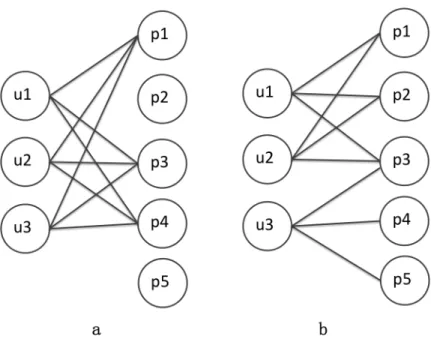
rental-Figure 3.1: Examples of query clicks.
cars.com, nationalcar.comandenterprise.com. Despite the clear differences in query intents and user behaviors, both have similarly high click entropies.
We argue for explicitly representing multi-click intents by making click patternsa first-class abstraction in query analyses. Specifically, we think each individual user demonstrates a particular type of behavior when confronting a search result page. Therefore, we model the ambiguous search intents by identifying the common patterns of users’ behaviors. Such patterns, namely click pat-terns, are a proxy representation of the user intents underlying a query. The underlying assumption is that although we do not know for sure the true intent of two users issuing the same query, we can be fairly sure about their similarity: when two users have similar click patterns, we believe their true intents must also be similar. One of the interesting conceptual implications is that this allows us to represent query intent as a mixture of multiple navigational and multi-click intents.
3.2
Click Patterns
Each individual user behaves in different ways when they are presented with the same search results. However, we hypothesize that underneath the noisy click behaviors each search query corresponds to an underlying behavior model, where users obey a set of common behavioral patterns.
3.2.1 Definition
Formally, we define click pattern and click profile as follows.
Definition 1: Click Pattern Given a queryq and its click-through document set Cq, a click
pattern τq is a probability distribution over the Cq representing how likely each document will
be clicked on. Specifically, we use multinomial distribution to model click patterns, i.e. τq =
{p(c)|c∈Cq,Pc∈Cqp(c) = 1}. In practice, we simplify the representation of click pattern by only
considering the top 3 most probable clicks. Therefore, each click pattern is written as a ordered list of 3 elements:
τ :={(c1, p(c1)),(c2, p(c2)),(c3, p(c3))} wherep(c1)> p(c2)> p(c3).
Definition 2: Click ProfileWe further defineΓqas the click profile of queryq. Γq ={p(τq)}
is a multinomial probability distribution over all the possible click patterns of q. The probability p(τq)indicates how likely a user will obey a certain click patternτq when Cq presented. In later
discussions, we also useΓqto denote the set of all possible click patterns (i.e. p(τq)>0) of query
qwhere it doesn’t cause confusion.
3.2.2 Modeling and Identifying Click Patterns
Ideally, we want to discover a small set of underlying click patterns that capture the common click behavior of most users. Users obeying the same click pattern are expected to show very similar click behaviors, while users obeying different click patterns shall behave in quite different manners. Because the clicked documents are usually quite different for each query, obtaining direct su-pervision is difficult. Therefore, we resort to unsupervised methods. Specifically, we employ the divisive clustering algorithm to find the patterns among the noisy sample of observed click behav-iors. The detail of the algorithm is shown in Algorithm 1.
The algorithm starts with a click profile of only one click pattern. Then it essentially keeps splitting the click pattern until the average intra-distance of each cluster is below a certain threshold. One merit of the algorithm is that it does not require us to preset the number of click patterns, which varies across queries. Instead, the number of click patterns is determined dynamically by the
Algorithm 1:Divisive Clustering for Discovering Click Patterns
input : A set of click-vectorsVqfor queryq, a similarity thresholdσ, a distance functionF
output: The click profileΓqforq
Init Clusterc0with all click vectors inVq
Init Result listl Enqueuec0to queues whilesis not emptydo
Dequeue first itemcfroms
Compute average intra-cluster distancedistcofcwithF
ifdistc< σthen
Add (c.center,c.prob) tol else
Use KMeans to dividecinto two sub clustersc0 andc00 Enqueuec0andc00to queues
returnl
thresholdσ. This aligns with our principle of modeling click patterns as we control the similarity of click behaviors of users who obey the same click pattern.
We do not specify the distance functionFin this algorithm. Each alternative distance function F might lead to an interesting exploration of click patterns. In our study, we use cosine distance (one minus cosine similarity) as the distance function. We choose this distance function mainly because it makes the setting of the distance thresholdσmore intuitive.
However, it is worth mentioning that here are potentially better ways for devising the distance function, e.g. by taking into account the ranking positions. This could allow us to explore more specialized behavior models. For instance, in analyzing mobile search logs, the ranking position is of particular importance. We plan to continue exploring this idea in our future work.
3.2.3 Exploring Click Patterns in Search Logs
In this section, we explore click patterns and click profiles in real search logs1, to study how they can help us understand user behaviors and represent complex query intents.
To facilitate our exploration, we empirically categorize click patterns into three categories as follows. These categories are intended to provide the reader with an intuitive understanding of common click patterns.
1
• Navigational patterns. A navigational pattern has a single dominating URL in the click vector. It represents the user’s intent of directly navigating to a particular URL.
• Informational patterns. An informational pattern corresponds to an information seeking in-tent where the purpose is to acquire knowledge on a given topic. In this case, each URL has similar chance of getting clicked. Possible scenarios for informational patterns are “compar-ison shopping” or “research survey” of a topic.
• Semi-navigational patterns. Beside navigational patterns and informational patterns, there is a third category of click pattern, where more than one URL dominate the click distribution. In this case, the query intent is still mostly navigational, but the destination of the navigation is not a single URL. We refer to this type of click patterns the semi-navigational pattern. A common scenario for semi-navigational pattern is when there is a complementary page to the major destination of the navigation. The complementary page might not be necessary for completing the user’s task, but it contains useful information and improves the user’s understanding of the topic.
Table 3.1 shows the click profiles of several queries discovered by the proposed algorithm. The queries were sampled from the test data set released by Wang and Agichtein [74]. For each click profile, the major click patterns and their probabilities are shown. Query 1, Query 2 andQuery 3 have simple click profiles as each of them consists of only one click pattern. ForQuery 1, the intent is to navigate to the website of “radio shack”. Consequently a single navigational pattern is observed. ForQuery 2, the intent is to survey the information of “wedding dresses” available on the Web. Correspondingly an informational pattern is observed. ForQuery 3, while users mostly navigate to the the URLprom-hair.org, some find the siteprom.hairresources.netalso helpful and explore both resources. The click pattern falls into the category of semi-navigational pattern. All three queries have clear query intents.
Query 4 is a typical ambiguous query where different users have very different targets. Its corresponding click profile shows three major navigational patterns.Query 5is an interesting query whose click profile is a mixture of different types of click patterns. In fact, this type of click profile is not rare in search queries. For this particular queryhonda parts, some of the users directly navigate to the online company store, while others take time to survey all the other web stores beside the
Table 3.1: Examples of click patterns Query 1: radio shack
τ1(100%): Nav.
http://radioshack.com/:0.97 http://radioshack.com/search/:0.03 Query 2: wedding dresses
τ1(100%): Inf.
http://brides.com/:0.42 http://elegantgowns.com/:0.38 http://onewed.com/dresses/:0.2 Query 3: prom hair
τ1(64%): Sem.
http://prom-hair.org/:0.56
http://prom.hairresources.net/:0.26 http://prom-hairstyles.us/:0.04 Query 4: rental cars
τ1(50%): Nav. http://rentalcars.com/:0.83 http://priceline.com/:0.08 τ2(21%): Nav. http://nationalcar.com/:0.77 http://alamo.com/:0.2 http://enterprise.com/:0.01 τ3(10%): Nav. http://enterprise.com/:0.83 http://priceline.com/:0.08 http://thrifty.com/:0.04 Query 5: honda parts
τ1(70%): Inf. http://hondapartspro.com/:0.34 http://partstrain.com/:0.2 http://hondapartstore.com/:0.15 τ2(24%): Nav. http://estore.honda.com/:0.76 http://partstrain.com/:0.11 http://hondapartspro.com/:0.09
official company store. Compared with the former three queries, the query intents ofQuery 4and Query 5are much more complex. Such a difference is well captured by the increase of complexity in their click profiles.
Based on our analysis of 5,000 random samples of search queries from MSN search log, the majority of queries (63%) have only a single click pattern, over a third (37%) of queries have multiple click patterns, and 11% have a mixture of different kinds of click patterns, as determined
by a categorization of navigational, informational and semi-navigational patterns. The distribution of click patterns shifts when we examine the most popular 5k queries. In this sample, we find significantly fewer single-intent queries (29%) as well as many more mixed-intent queries (30%).
Based on this analysis, it is clear that click pattern’s richer representation of user behavior—as compared to representations that assume each unique URL represents a distinct semantic intent—is useful in capturing the observed behavior of a significant fraction of all queries, and is even more important when focusing on the most popular queries or the high-entropy queries that are the hardest to answer.
3.3
Click Patterns and Query Ambiguity
In this section, we show that our modeling of ambiguous search intent has immediate impact in query analysis. We study the measuring of ambiguity level of queries (i.e. query ambiguity). Typ-ically, query ambiguity is measured by “click entropy”, which is computed as the information en-tropy of the distribution of user clicks. Formally, given queryq and the set of clicked documents Cq, the click entropyHc(q)is computed by Equation 3.1:
Hc(q) =
X
d∈Cq
−p(d) logp(d) (3.1) where p(d)is the empirical probability of documentdbeing clicked. A higher entropy value indicates the query is more ambiguous. The concept of information entropy was originally proposed by [63] to measure the value of information in a message. Click entropy, however, does not work well in discriminating ambiguous queries, especially from information seeking queries, as both scenarios may result in very similar distribution of clicks, although the search intent of the latter is much clearer.
The fundamental assumption of using click entropy as a measure of query ambiguity is that each document represent a unique “semantic meaning” of the search query. We think this is the reason that click entropy is not able to discriminate ambiguous queries effectively. Even semantically distinct web pages may not always increase query ambiguity if they play a complementary role in fulfilling the user’s intent. Recently proposed measures such as domain entropy [74] begin to
consider the relationship among multiple clicked URLs. However, they do not fully separate the notion of a user’s intent from the lexical and task ambiguity of a query. As a result, they still cannot represent and measure the ambiguity of complex mixtures of intents shown in Section 3.2 that exist in real search logs.
3.3.1 Pattern Entropy
We propose to model query ambiguity as an empirical notion pertaining to user behaviors, in con-trast to the previous measures that emphasize on the semantic ambiguity of the query. Particularly, we compute the information entropy of the click profile of a query, i.e. the empirical distribution over the click patterns as a measurement of query ambiguity. We refer to this measurement as pattern entropy.
Formally, given the click profileΓqfor queryq, the pattern entropyHp(q)is computed as:
Hp(q) =
X
τq
−p(τq) logp(τq) (3.2)
wherep(τq)is the empirical probability ofτq, given byΓq.
Pattern entropy is superior to click entropy as an ambiguity measure. It yields low entropy values to both navigational and informational queries where the search intents are clear, while maintaining high entropy values for queries of ambiguous intents. Take two previously discussed queries , wedding dresses andauto rent, as examples. Although both queries have similar distribution of clicks, they have distinct click profiles. For the querywedding dresses, most users tend to obey the same informational pattern to explore all the URLs. For the queryauto rent, different users form three distinct navigational patterns, leading to a more complex click profile. With the entropy of click profiles, we can recognize thatauto rentis an ambiguous query andwedding dressesis a clear query with an informational intent.
3.3.2 Properties of Ambiguity Metrics
In this section, we identify three important properties of metrics of query ambiguity, i.e. discrimi-native power,consistencyandtemporal stability. We then put the previous proposed measurements to test with a synthetic search log and a real search log, according to the three properties.
• Discriminative power: The most important property of an ambiguity metric is the ability to discriminate ambiguous queries from queries of clear search intents. That being said, the metric should distinguish ambiguous queries not only from navigational queries, but also from informational queries.
• Consistency: It is also important that an ambiguity metric generate consistent output for the same type of queries. The number of log entries for different queries usually vary a lot, even when they are of the same type (navigational, informational or ambiguous). A good query ambiguity metric should not be affected too much by this factor.
• Temporal Stability: Temporal stability is a property of particular practical importance. Query log is a continuous data stream and we can only process the log within a certain temporal pe-riod at a time. The analysis on the query log needs to be updated from time to time. Therefore, being able to generate temporal stable results is an important criteria for any query log anal-ysis method.
In the following discussions, we first test the discriminative power and consistency of different ambiguity metrics with a synthetic query log. Then we continue to study the temporal stability with a real query log.
Discriminative Power and Consistency. To test the discriminative power and consistency of different ambiguity metrics and to better understand their behaviors under controlled conditions, we created a synthetic query log where different types of user behaviors were observed for different queries. The query ambiguity metrics we study are click entropy, average entropy [74] and pattern entropy. Essentially, average entropy is computed as the average of each user’s click entropy.
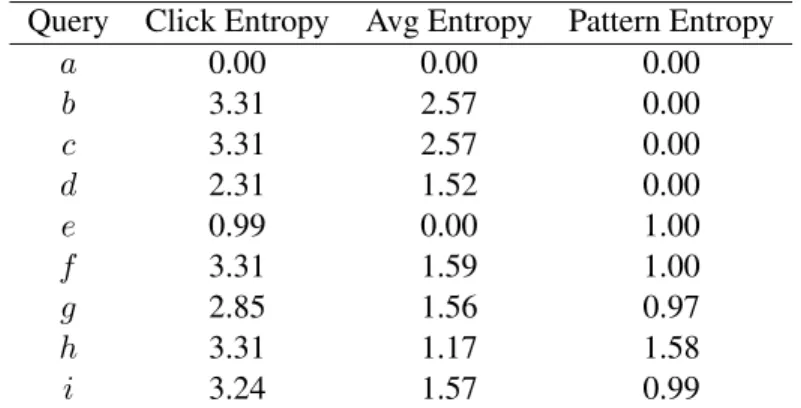
Table 3.2 shows a set of synthetic click logs representing different level of ambiguity. Table 3.3 shows the comparison for different ambiguity metrics on the synthetic queries, i.e. click entropy, average entropy and pattern entropy.
Table 3.2: Synthetic queries with different levels of ambiguity Query Description
a All users click on one same URL.
b All users perform 10 random clicks on 10 URLs. c Half of the users perform 10 random clicks on 10 URLs. d All users perform 5 random clicks on 5 URLs.
e Two groups of users, each of first group click on the same URL, the second group all click on a different URL.
f Two groups of users, each of first group performs 5 random clicks on 5 URLs; second group perform 5 random clicks on the 5 different URLs. g Two groups of users, each of first group performs 5 random clicks on
URL 1-5; second group perform 5 random clicks on the URL 3-8. h Three groups of users, each perform 3 random clicks on 3 different set
of URLs (1-3,4-6,7-9).
i Three groups of users, each perform 5 random clicks on 3 overlapping set of URLs (1-5,3-8,6-10).
Table 3.3: Comparison of ambiguity metrics on synthetic queries Query Click Entropy Avg Entropy Pattern Entropy
a 0.00 0.00 0.00 b 3.31 2.57 0.00 c 3.31 2.57 0.00 d 2.31 1.52 0.00 e 0.99 0.00 1.00 f 3.31 1.59 1.00 g 2.85 1.56 0.97 h 3.31 1.17 1.58 i 3.24 1.57 0.99
Queryais a clear navigational query where every user click on the same document. In this case every metrics yields the lowest value 0. Queryb,canddare clear, informational queries intended to test the consistency of the metrics. In each of the three queries, the users have a clear intention of exploring a set of URLs. Querybhas in total 20 users. Querycreduces the number of participants by half to simulate the lack of data (data sparsity). Querydis different frombandcas it targets at a document set of half the size. Yet they all have a clear informational intent. We see neither click entropy nor average entropy is consistent on clear intent queriesa−das they give low value to navigational queries and high value to informational queries. Pattern entropy, however, consistently generates the lowest value for all these the four queries.
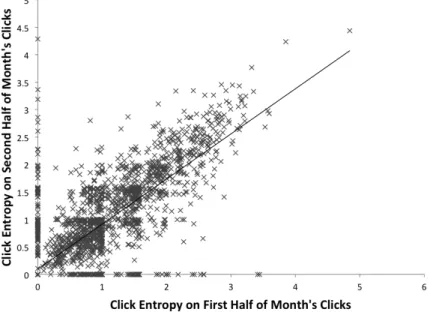
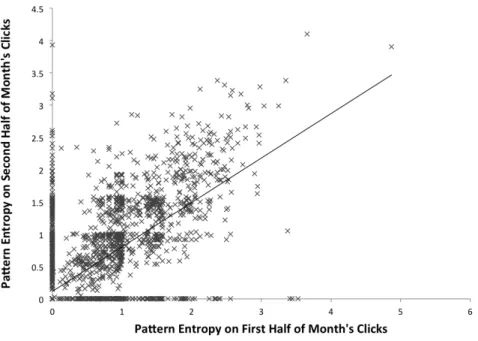
Query e−iare all ambiguous queries. Querye, f andg each has two groups of users with different behaviors. Queryehas two different navigational patterns, while queryf andgboth have two informational patterns. We see that either the click entropy metric and the average entropy metric give consistent results to the three queries. They assign relative low entropies to queries with navigational patterns and high entropies to the ones with more informational patterns. In contrast, pattern entropy is consistent for the three queries. Query h and i both have three types of user behaviors. They are even more ambiguous than Querye,f andg. There is, however, no reflection of the increase in ambiguity in click entropy or average entropy. The average entropy of query h even decreases as the number of individual clicks is reduced. Queryhshows an increase in pattern entropy which is in accordance with the increase in the level of ambiguity. However, our algorithm does not recognize all the three patterns in query i. This is because the second click pattern on documents 3-8 overlaps much with both the other two patterns on documents 1-5 and 6-10. As a result, instances from the second random click patterns are mistaken as from the other two patterns. Temporal Stability.The purpose of this study is to test whether a metric generates stable results in different time periods. We first randomly sample a set of 5000 queries, denoted asrand5k, from the MSN query log. The MSN query log spans over an entire month from May 1st, 2006 to May 31st, 2006. Therefore, we extract the log entries of the queries inrand5kand split them into two buckets (May 1st to May 15th and May 16th to May 31st). We then compute the ambiguity metrics on the two buckets of logs and draw the scatter plots of click entropy, average entropy and pattern entropy in Figure 3.2, Figure 3.3 and 3.4, respectively. In addition, we compute the correlation between the values of each metric calculated with different time period’s data:
cor(X, Y) = PN i=1(xi−x¯)(yi−y¯) q PN i=1(xi−x¯)2PNi=1(yi−y¯)2 (3.3) We can see that both click entropy and pattern entropy show strong correlation in the two halves of months’ data, with cor of 0.81 and 0.68, respectively. Therefore, they tend to generate stable results across different time periods. Average entropy, on the other hand, does not show strong visual correlation and has a lowcor value of 0.54. This indicates that unlike the other two metrics, the computation of average entropy is more volatile in terms of time. This makes it less dependable for query log analysis and application purposes.
Figure 3.2: Temporal stability of click entropy on 5000 random queries,cor = 0.81.
Figure 3.4: Temporal stability of pattern entropy on 5000 random queries,cor = 0.68. It is interesting to see that in all three figures, many data points falls onto the axis. This phe-nomenon is mostly caused by the volatility of users and queries on search engines. Such queries are usually related to temporal events, such aswhat is May day(on the event “May day” which takes place in May every year) orTyphoon Chanchu(on the event “Typhoon Chanchu” in 2006).
3.4
Classifying Ambiguous Queries
To further verify the effectiveness of the proposed ambiguity metric, we use a human labeled query set to experiment with automatic classification of ambiguous queries.
3.4.1 Problem Setup
We use the same dataset as used in Wang and Agichtein’s work [74]. There are in total 150 queries in the dataset, labeled as either “navigational”, “informational” or “ambiguous” by human annotators. The Kappa value was 0.77. The query log is extracted from the MSN search query log released in 2006. We target at identifying ambiguous queries from the query log. Therefore, instead of performing three class classification, we merge together the “clear” and “informational” queries in
the query log as all clear queries. Then we perform binary classification to separate ambiguous and clear intent (“clear” and “informational”) queries. We use logistic regression as our classification method. All results are generated by 10-fold cross validation. The feature sets we use are listed in Table 3.4. The domain entropy features are computed by replacing the URLs with corresponding domains, where domains are obtained by truncating the URLs of the clicked web pages to their top level domain (truncating before the first “/” in the URL).
Table 3.4: Features used for classification Feature set Description of features clk-ent
length of query frequency of query click entropy
domain click entropy avg-ent average entropy
domain average entropy pat-ent pattern entropy
domain pattern entropy
3.4.2 Classification Results
Table 3.5 shows classification results. We can see that both average entropy and pattern entropy features improve the overall accuracy of classification. Both sets of features improve the ambiguous queries more than the clear queries. We also observe that pattern entropy features perform better than average entropy features. This confirms that pattern entropy is a superior ambiguity metric. However, we do not see further improvement in combining the average entropy features and pattern entropy features. This is probably because the additional information delivered by the two set of features overlapped with each other.
Table 3.5: Classification results
Overall Clear Ambiguous
Acc Prec Rec Prec Rec
clk-ent 0.77 0.80 0.95 0.14 0.07 w/ avg-ent 0.78 0.82 0.92 0.37 0.20 w/ pat-ent 0.81 0.83 0.96 0.42 0.21 w/ both 0.79 0.83 0.94 0.37 0.19
3.4.3 Case Study
In Table 3.6 we show several examples of human annotated queries with different entropy values to help understand how pattern entropy helps improving the classification of ambiguous queries.
Most navigational queries tend to have low entropy values for any ambiguity metrics. Therefore they are easy to handle for any ambiguity metric. We see that for navigational queries, their patterns are solely navigational patterns.
Both the two queriesonline auctionandwhite pagesare labeled as informational queries. The average entropy for the former is relatively high. But the latter does not get the same high value. By identifying click patterns, we find that online auctionhas a single semi-navigational pattern. It therefore has a zero pattern entropy. The query white pages, however, has a mixture of both navigational and informational patterns, and the majority of the users are with different navigational patterns. This leads to the relatively low average entropy and pattern entropy.
The queriessong lyricsandaresare labeled as ambiguous queries. The querysong lyricshas a mixture of navigational, informational and semi-informational patterns. A possible explanation is depending on the “lyric” the user is looking for, he/she may have to try different number of websites to get it. As a result, the query has a relative high average entropy and pattern entropy. For the query ares, multiple navigational and semi-navigational click patterns are discovered. Since the individual intents are mostly navigational, it has a low average entropy. However, the pattern entropy is high because different patterns have comparable amount of users.
Overall, we see click pattern is quite consistent in separating the ambiguous queries from the clear queries (both navigational and informational). However, the average entropy does not work well in some cases when mixtures of click patterns exist for one query.
3.5
Click Patterns and Query Recommendations
In this section, we demonstrate the impact of our model for ambiguous search intent in the appli-cation of query recommendation. The purpose of query recommendation is to help users explore the query space so that they can quickly find the query that best describe their search intent. To serve this purpose, we want to start from the close neighborhood of the given query and suggest queries that share major intents with the given query. Baeza-Yates et al. proposed to use query log
Table 3.6: Examples of entropies and patterns
Query Avg-Ent Pat-Ent Patterns
Clear Navigational Queries
chase 0.03 0.00 Nav.
ca lottery 0.01 0.13 Nav.
Clear Informational Queries
online auction 0.81 0.00 Sem.
white pages 0.13 0.78 Nav+Inf.
Ambiguous Queries
song lyrics 0.64 3.09 Nav.+Inf.+Sem.
ares 0.28 1.56 Nav.+Sem.
for query recommendation based on the notions of query similarity and support [3]. It was sug-gested later that the reduction of query ambiguity of the query should also be accounted for in query recommendation [78, 7].
We leverage our model for ambiguous search intent to improve the computation of query simi-larity and ambiguity reduction. The reduction in ambiguity is naturally measured by pattern entropy. We compute the pattern similarity between two queriesqandq0 as:
Sp(q, q0) = X τ∈Γq X γ∈Γq0 p(τ)·p(γ)·cos(τ, γ) (3.4) whereΓqis the set of click patterns andwτ is the weight of patternτ.
3.5.1 Problem Setup
We devise query recommendation as a classification task by restricting the search space to queries that add only one term to the original query. We randomly select 200 queries that have frequency above 10 from MSN search query log release in 2006 and generate the candidate recommendations in this way. The queries with no candidate suggestions are removed from the dataset, and we finally have 127 queries. Instead of performing human annotation, we adopt an automatic annotating process. Specifically, we count how many times a candidate suggestion appear after the original query in a session with a different query log. We use the AOL search query log released in 2006 for
this purpose. The reason to use a secondary query log is to avoid overfitting a single query log. As the AOL query log is released the same year as the MSN query log, the changes in queries would not be dramatic. We then label the candidate as recommendation or not by checking if the count is above 10 times. In total we have 848 queries labeled as recommendations out of 3416 candidates. We then perform binary classification for each candidate query. Note that this experiment is intended to demonstrate the usage of click pattern and pattern entropy in a real world application, rather than compete with current state-of-the-art techniques for query recommendation.
3.5.2 Query Recommendation Results
Table 3.7 shows the classification result for query recommendation. We see by adding pattern entropy and pattern similarity features, we can incrementally improve the performance of classi-fication. The best performance by using both pattern entropy and pattern similarity with query popularity.
Table 3.7: Results of Query Recommendation as a Classification Task Overall Recommended
Acc Prec Rec
popularity 0.75 0.67 0.54
w/ pattern entropy 0.76 0.68 0.56 w/ pattern similarity
0.78 0.70 0.59 and pattern entropy
3.5.3 Case Study
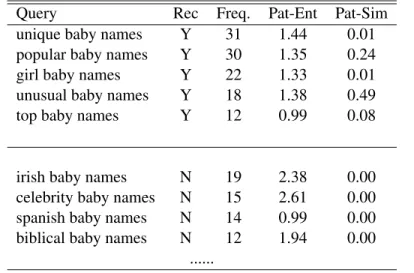
In Table 3.8 we show the classification result for candidate query suggestions for “baby names”. We can see that the recommended queries generally have high frequency, low pattern entropy and high pattern similarity with the original query.
Once again, this application confirms the effectiveness of pattern entropy as an ambiguity met-ric. Beside query recommendation, click pattern is also potentially useful in many other applica-tions, e.g. personalized search and diversification of search results. In the future, we plan to further study the applications of click pattern and pattern entropy.
Table 3.8: Query recommendation for “baby names” (Hp(q)=2.76)
Query Rec Freq. Pat-Ent Pat-Sim
unique baby names Y 31 1.44 0.01
popular baby names Y 30 1.35 0.24
girl baby names Y 22 1.33 0.01
unusual baby names Y 18 1.38 0.49
top baby names Y 12 0.99 0.08
irish baby names N 19 2.38 0.00
celebrity baby names N 15 2.61 0.00
spanish baby names N 14 0.99 0.00
biblical baby names N 12 1.94 0.00
...
3.6
Conclusions
In this work, we propose and study the use ofclick patternsas an empirical representation of user intent for queries with ambiguous search intents. We show how click patterns can be extracted from logs of user behavior and demonstrate that click patterns provide a richer representation of query intents, from multi-click intents such as high-recall research tasks to navigational intents, and mixtures of query intents of various kinds. We examine real query logs and find that the richer representation of query intents afforded by click patterns is critical for capturing the user behavior for a significant fraction of queries, and especially for popular and high entropy queries. We further demonstrate the integration of click patterns into existing query analyses by adapting traditional query ambiguity and query recommendation tasks to use click patterns as the fundamental unit of user behavior.
Part II
CHAPTER 4
QUERY COMPLETION AND CORRECTION
4.1
Introduction
One major obstacle in accurate search intent understanding is the vocabulary gap between users’ queries and the intended information. Lacking knowledge of the relevant information, users are usually unable to accurately describe their search intent in queries, making it challenging to infer the real intent. In this chapter, we propose and study several approaches that alleviate the difficulty of query formulation.
One strategy to alleviate the problem of vocabulary gap is to provide real time guidance in query formulation through query completion and correction. By do so we can effectively guide the users to choose the right terminologies to represent their search intent. In this work we study the problem of real time query completion and correction by modeling search intents from search engine query logs.
Particularly, we propose and study a generative model, where we assume the original search intent is transformed through a noisy channel into a potentially misspelled query. By estimating the intent popularity through click-through logs, we can capture the important search intent and provide guidance to the users so that they can compose search queries that can effectively convey the intent. With an accurate model for the noisy channel (i.e. the transformation between the target query and the user entered query), we can make sure that we will guide the user toward the desired search intent instead of biasing toward the common popular intent.
4.2
Problem Formulation
ˆ c= argmax c p(c|q) = argmax c p(q|c)p(c) (4.1) where q is the original query and c is a candidate suggestion. In this noisy channel model formulation,p(c)is a query language model that describes the prior probability ofcas the intended user query. p(q|c) = p(c → q) is the transformation model that represents the probability of observing the queryqwhen the original user intent is to enter the queryc.
In the setting of query completion and correction, we are given only the prefixq¯of the potentially misspelled input queryq. Thus, the objective is to find the correctly spelled querycˆthat maximizes the probability of yielding any query q that extends the given partial queryq¯. More formally, we want to find: ˆ c= argmax c,q:q=¯q···p(c |q) = argmax c,q:q=¯q···p(q |c)p(c) (4.2)
whereq = ¯q· · · denotes thatq¯is a prefix ofq. Modeling the query language model is usually trivial. In this work, we use the popularity model as an empirical distribution of query language model. The challenge is to achieve an accurate transformation model so that automatically complete and correct users’ query based on the query intent.
As we can see from Equation 4.2, by relaxingq to be any query that extends the partial query
¯
q, online spelling correction and completion significantly increases the theoretical search space. However, with appropriate data structures and algorithms, this search can be done efficiently.
4.3
Transformation Model
In this work, we propose to study the joint sequence model for query correction and completion. Joint sequence model was originally proposed for grapheme to phoneme conversion in speech recognition [9].
Specifically, we segment the conversion fromctoq as a sequence of substring transformation units, ortransfemes. For example, the transformationschwarzenegger → shwartzeneger can be segmented into the transfeme sequence: {sch → sh,war → war, ze → tze,negg → neg, er → er}. As another example, the transformationbritney → britnycan be segmented into the