Author's Accepted Manuscript
Dimension Reduction with Meta
Object-groups for Efficient Image Retrieval
Shuo Shang, Jiajun Liu, Kun Zhao, Mingrui Yang
, Kai Zheng, Ji-rong Wen
PII:
S0925-2312(15)00684-0
DOI:
http://dx.doi.org/10.1016/j.neucom.2014.08.105
Reference:
NEUCOM15549
To appear in:
Neurocomputing
Received date: 29 April 2014
Revised date: 18 June 2014
Accepted date: 14 August 2014
Cite this article as: Shuo Shang, Jiajun Liu, Kun Zhao, Mingrui Yang, Kai Zheng,
Ji-rong Wen, Dimension Reduction with Meta Object-groups for Efficient
Image Retrieval,
Neurocomputing,
http://dx.doi.org/10.1016/j.neucom.2014.08.105
This is a PDF file of an unedited manuscript that has been accepted for
publication. As a service to our customers we are providing this early version of
the manuscript. The manuscript will undergo copyediting, typesetting, and
review of the resulting galley proof before it is published in its final citable form.
Please note that during the production process errors may be discovered which
could affect the content, and all legal disclaimers that apply to the journal
pertain.
Dimension Reduction with Meta Object-groups for
Efficient Image Retrieval
Abstract
Bag-of-Word (BoW) has been a prominent form for representing visual content such as image and video in recent years, as a result of its unique capability of characterizing visual content in a picture-level while still preserving part of the object-level information. However, it is also noticed that the dimensionality of BoW is usually as high as a few hundreds or even thousands, posing a serious challenge for any application that requires efficient processing. In this article we propose a dimension reduction method called Meta object-Group Component (MGC) to tackle this problem. MGC aims at discovering the hidden relations of objects by examining the correlations between dimensions in the BoW fea-tures and maximizing the relations of the members in a meta object-group. By exchanging message passing between object-groups, meta object-groups are identified for a dataset. A meta object-group does not only contain visually similar objects, but also includes objects that are likely to co-occur with each other. As the meta object groups are obtained, group-specific dimension re-duction is performed to obtain denser representations for efficient retrieval. We evaluate the framework on the NUS-Wide image dataset with approximately 270,000 images represented by BoW features, and demonstrate its advantage over existing method.
Acknowledgements
Shuo Shang and Jiajun Liu have equal contributions to this article. Shuo Shang is supported by the Science Foundation of China University of Petroleum, Beijing (No.2462013YJRC031), and the Excellent Talents of Beijing Fellowship.
1. Introduction
Image retrieval based on content similarity has been put in spotlight for the past few decades [1]. Bag-of-Word (BoW), a type of histogram constructed by counting the occurrences of key-points that belong to each key-point cluster, has gain huge popularity in multimedia and information retrieval applications. A BoW is a summarization of object-level key-points, enabling it to describe objects in an image at a coarse level while representing the image as a whole. However, such advantage comes with a cost. To maintain the tightness of key-point clusters, the number of total clusters are often substantial. With the BoW
representation, it is common to use a few hundred clusters or even thousands of clusters. Each cluster requires a bin in every BoW feature vectors to record the occurrences related to it. Hence the dimensionality of BoW is often considered too high for efficiency-sensitive applications.
Dimension reduction is a natural tool for improving the performance when dealing with very high-dimensional data. However it does have its limitations for handling BoW features for images. For example, many dimension reduction methods are based on the assumption that the data is sparse. However, for a BoW feature vector for an image, unlike BoW features for text, though the information distribution is spread-out and long-tailed, its sparsity is usually not considered to be high (unless the number of clusters is set to an exceptionally large number such as 100,000). For instance, in the NUS-WIDE dataset, where the dimensionality is 500 for the BoW features, only 53.8% bins from all BoW features are zero. Such a property prevents various techniques to be applied on image BoW features.
We observe that the generation of BoW features are commonly based on the similarity of key-point descriptors, emphasizing the coherence of key-point clusters. On the other hand, key-points not only have visual similarities, but also show certain patterns of co-occurrences. For instance, for the same car in different images, the key-points describing its shiny wheels are very likely to be assigned to different clusters with those depicting the car body. Theoretically such separation guarantees that BoW’s description power is precise, however in reality it might be reasonable to reduce computational complexity for large datasets, for which case knowing they belong to the same car is accurate enough.
1 1 1
2 2 2
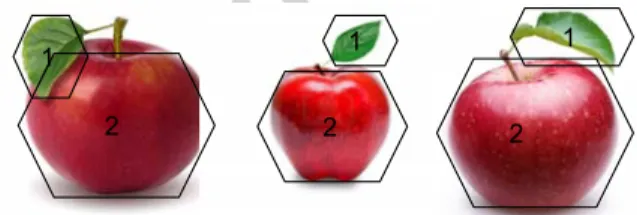
Figure 1: Different dimensions in the BoWs, representing different “object-groups”, may have hidden correlation due to the co-occurrences of the objects they represent in the original images.
BoW’s high dimensionality provides a large room for effective dimension reduction. However conventional methods like Principle Component Analysis (PCA)[8] regard the features as general high dimensional points, regardless of the interesting properties of BoW that can otherwise be exploited to optimize the dimension reduction process. For instance, PCA finds an orthogonal trans-formation to transform the variables in the original space into un-correlated variables in the principal component space. Information from the original space is kept in the principal components, weighted by the corresponding eigenvalue for each principal component found by the eigen-decomposition. Such procedure implies that the more dependent (correlated) the original variables are, the more
concentrated the information will be in the principal component space, hence the less dimensions are needed to perform accurate retrieval on the transformed data. Interestingly, BoW’s generation mechanism provided us the opportunity to exploit the hidden relations of the objects to find such correlated patches in a BoW dataset, as there are likely to have columns that represent differ-ent key-points for the same object, or differdiffer-ent key-points for differdiffer-ent objects which tend to appear simultaneously. Figure 1 depicts an example of such rela-tions. In each image, the key-points detected on the apple and on the leaf are grouped into different object-groups. However, imagine in a large-scale image database, the matching of the whole apple is accurate enough to distinguish relevant images from the rest, meaning that the two object-groups can actually be represented with one object-group. We call this higher-level group Meta object-Group (MG), and finding the MGs from a BoW dataset will benefit the dimension reduction substantially.
Consequently, we propose to exploit such hidden relations of object-groups in the BoW features to achieve effective dimension reduction. We make the follow contributions in this article:
• We propose to use the message passing algorithm to find the hidden struc-ture of objects, i.e. Meta object-Groups (MG), in a BoW dataset for image. The algorithm discovers MGs by maximizing the correlation of MG members to the MG’s center, namely the exemplar. The MGs hence represent groups of tighted related object-groups.
• We devise a procedure to perform dimension reduction based on the MGs identified for efficient image retrieval.
• We perform comprehensive experimental evaluation of our dimension re-duction method on a well-known image dataset and demonstrate its ad-vantages over the baseline method.
The rest of the paper is organized as follows. Section 2 formulates the problem and describes how to discover MGs as well as how to perform dimension reduction with the identified MGs. In Section 3 we present the evaluation results of experiments performed on a well-known image database. Then we review some related work in Section 4. The article is then concluded by Section 5.
2. Dimension Reduction with Meta Object-groups
2.1. The Problem
In BoW form, an image is usually represented by a high-dimensional vector, denoted as:
x=hxii, 1≤i≤d, (1)
wheredis the dimensionality of the BoW. An image dataset is hence represented as a matrix:
X = [xj]T ∈ Rn×d, 1≤j≤n, (2)
wherenis the number of images anddis the dimensionality of the BoW features. In dimension reduction, matrixX is projected to a lower-dimensional matrix
Xp= [xpj]T ∈ Rn×dp
, 1≤j ≤n, dpd. (3)
where the dimensionality is reduced greatly. The objective of dimension reduc-tion for image retrieval is subsequently described as reducing the dimensionality while retaining the distance information for each BoW so that the results of re-trieval will be consistent as in the original space.
We refer to each column of an image BoW data matrix as an Object-Group (OG), when each row is regarded as an image. Formally, we define the task as:
arg min {gij} K X i=1 X j corr dist(gij, gie), (4)
whereKis the number of MGs,gieis an exemplar OG in theithMG, andgijis a member OG in theithMG.corr dist(∗,∗) is the correlation distance, defined as one minus the linear correlation between two points. In matrix representation, eachg is a column, which can be understood as an OG.
By organizing OGs into MGs, we are able to find tightly related OGs for each MG, so that when we perform MG-specific dimension reduction, the information of the original BoW will concentrate more on the dominant principal component in the projected space. Next we describe the algorithm of finding MGs. 2.2. Meta Object-Group Discovery via Message Passing
Message passing [5] algorithms have been extensively studied and have demon-strated its capability in finding close to optimal solution of complex optimization problems. Inspired by the message passing-based Affinity Propagation algo-rithm [5], we model the optimization problem in Equation 4 using a graph on which two types of messages are exchanged between nodes (OGs), namely avail-ability and responsibility. Responsibility is sent from an OG to all candidate exemplars, quantifying how well-suited a candidate exemplar would be for an OG. Availability on the other hand is passed from a candidate exemplar to other OGs, defining how appropriate it would be for an OG to pick it as its exemplar. Responsibility and Availability are then iteratively updated until convergence, when the best candidates for exemplar are found. Finally, based on the sim-ilarity to all exemplars, an OG will either be chosen to be an exemplar, or it will pick the most similar exemplar to serve as its exemplar, hence forming into MGs from all OGs.
In our scenario, responsibilityr(∗,∗) is formally defined as: r(gi, gk) =corr(gi, gk)−max
k06=k{a(gi, gk
0) +s(gi, gk0)}, (5) which is initialized first at the start of the algorithm. Here a(∗,∗) stands for the availability sent from an OG to an candidate exemplar, ands(∗,∗) indicates the similarity (correlation in our case) between two OGs.
Then for each pair of different OGs, the availability is calculated by: a(gi, gk) =min 0, r(gk, gk) + X i0∈{/ i,k} max(0, r(gi0, gk)) , (6)
whereas the self-availability for each OG is aggregated as: a(gk, gk) =
X
i0∈{/ i,k}
max(0, r(gi0, gk)). (7)
The availability and responsibility for each OG is iteratively updated until con-vergence.
The optimization process from Equations 5, 6, and 7 defines a sequence of interesting behaviors. The componentcorr(gi, gk) in Equation 5 shows that re-sponsibility as a message sent from an OG to a candidate highly favors similar OGs to be an OG’s exemplar, while−maxk06=k{a(gi, gk0) +s(gi, gk0)}exists as a penalty term to the current candidate for which there are other candidates currently seem to suit better as its exemplar. Equation 6 indicates that the availability is also affected by two factors: the self-confidence of an OG to be exemplar, and the accumulative evidence of other OGs choosing it as their ex-emplar. To avoid a sequence of self-reinforced increases ofr(gk, gk) anda(gk, gk) through the iterations, in Equation 7, the self-availability only takes into account how other OGs regard of an exemplar candidate, disregarding the candidate’s self-responsibility.
The algorithm starts with constructing an affinity matrix for allgi, gk pairs, initializing allr(gi, gj) and a(gi, gj) to zero, and assigning tor(gk, gk) a group of preference values, normally as
mediani6=j({corr(gi, gj)}), (8)
and thena(gi, gj) andr(gi, gj) are iteratively updated until convergence. By find the nearest exemplars for each OG, all OGs are assigned to different exemplars, forming different MGs. As the MGs are identified, we have tightly coherent groups of OGs ready for dimension reduction, each of which has a series of closely correlated members.
There are numerous choices for dimension reduction. In this article we show particularly that using Principal Component Analysis [8] (PCA) we can clearly demonstrate the positive effect of MG discovery. The implication here is that PCA is sensitive to the structure of the data: the more correlated the original data is, the more concentrate the information will be in the principal compo-nent space, reflected by the faster decaying of eigenvalues corresponding to the principal components.
2.3. The Algorithm
We define an dimension reduction algorithm based on the MGs discovered in Algorithm 1.
Algorithm 1: Dimension Reduction with Meta Object-groups
Input: BoW feature matrix X∈ Rn×d, reduced dimensionality
d0 (d0d)
Output: Transformed feature matrix X0 ∈ Rn×d0
Algorithm:
1: Construct affinity matrix S forX’ OGs
2: while Expected number of MGsd0 not satisfieddo
3: Initialize the diagonal elements ofS with the preference values
4: Initialize availability vector Aand responsibility vectorR
5: while Algorithm not convergeddo
6: UpdateA andRaccording to Equations 6, 7 and 5
7: if ∆(A+D)< threshold or maximum iteration reachedthen
8: Break iteration
9: end if
10: end while
11: Search for new preferences values
12: end while
13: forEach OGdo
14: Assign the OG to its closest exemplar
15: end for
16: forEach ithidentified MGdo
17: Xt←Extract fromX the elements that belong to the MG
18: Xt←N ormalize(Xt)
19: P C ←P CA(Xt)
20: ithcolumn inX0←first column inP C
21: end for
22: return X0
The algorithm starts with finding closely correlated OGs by message passing. As the OGs are grouped into MGs, they are processed by PCA to perform dimension reduction. By only keeping the most significant principal component for each MG after projecting the MG’s data into the principal component space, the original BoW feature matrixX∈ Rn×d is reduced toX0 ∈ Rn×d0.
In the next section, we perform extensive evaluations on our method to demonstrate its advantages empirically.
3. Experiments
In this section we test the method on the NUS-WIDE [3] image dataset, which contains over 269,000 images. The test procedures are as follows:
• 10,000 images are randomly selected from the dataset, and are inserted into the matrix X.
• The dimension reduction algorithm in Algorithm 1 is performed on the original BoW feature matrixX, resulting a reduced feature matrix X’.
• 1,000 images are randomly selected as queries to perform image retrieval in the original BoW space.
• For the same subset of query images, retrieval is performed using the reduced feature matrix X’.
• The query results of the original space are regarded as ground truth, whereas the results from the reduced space are treated as the test results.
• Such random test procedure is performed for 100 times, the average precision-recall and the mean average precision of the proposed method and the comparative method, i.e. PCA, are reported and compared.
In the rest of the section, we examine three aspects of the performance of the proposed method, namely: 1) the average Precision and Recall, 2) the effect on Mean Average Precision (MAP) when we change the reduced dimensionalityd0 3) The number of required dimensions to achieve certain precision.
0.1 0.2 0.3 0.4 0.5 0.6 0.7 0.8 0.9 1 0.1 0.2 0.3 0.4 0.5 0.6 0.7 0.8 0.9 1 Recall Precision MGC PCA
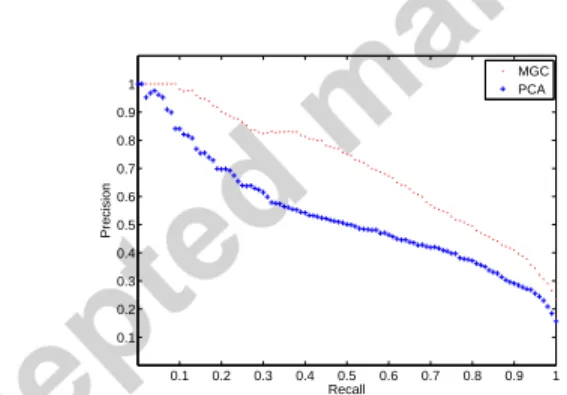
Figure 2: Average precision and recall for 100 test runs, compared with the results of PCA.
3.1. Average Precision and Recall
Figure 2 shows the averaged precision and recall for the 100 test runs. In this experiment d0 is set to 200, marking a 60% dimension reduction from the original representation. It is evident that the MGC method demonstrates a significant performance improvement over the conventional PCA. For example, at 0.5 recall, the precision of MGC and PCA are 0.73 and 0.51 respectively. The average precision of MGC and PCA across all recall values are 0.7063 and 0.534 respectively, indicating that in average MGC yields over 32% better precision than PCA when using the same reduced dimensionality. Next we use different d0 to perform the same tests and see how it affects both methods.
20 40 60 80 100 120 140 160 180 200 0.5 0.6 0.7 0.8 0.9 1 Reduced Dimensionality
Mean Average Precision
MGC PCA
Figure 3: Average precision v.s. Reduced dimensionality
3.2. The Effect ofd0 on Precision
The effect ofd0on average precision is shown in Figure 3. In this experiment, we vary the reduced dimensionality and see the Mean Average Precision (MAP) from both methods under the same settings. For each different d0, we rerun
the randomized tests for 100 times under the same settings from the previous experiment, and report the changes of MAP according to dimensionality.
Not surprisingly, both curves climbs steadily as the reduced dimensionality increases. It is noticeable that MGC is consistently showing around 0.1 MAP improvement for different reduced dimensionality.
0.6 0.62 0.64 0.66 0.68 0.7 0 20 40 60 80 100 120 140 160
Mean Average Precision
Dimensions Required
MGC PCA
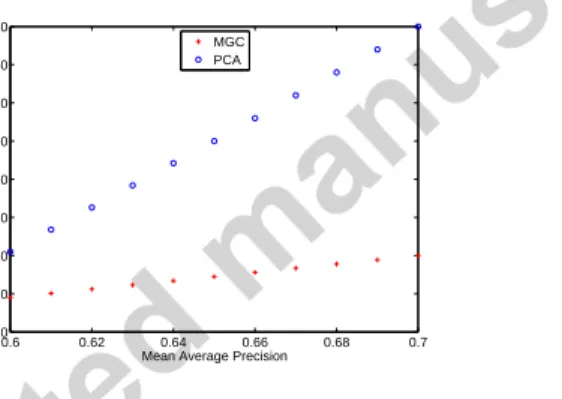
Figure 4: Number of dimensions required to achieve the same precision
3.3. Requiredd0 According to Precision
We also examine what dimensionality is required to achieve the same MAP with both methods. The results are reported in Figure 4. Without losing generality, we choose the range of MAP to be [0.6,0.7]. The figure exhibits significant differences in the performances of the two methods in this experiment. As the MAP increases from 0.6 to 0.7, the required dimensionality for MGC increments from 18 to 40, while for PCA it quickly inflates from 42 to 160. In practice this implies that using MGC, a dataset can be indexed using 12 to 14 of the number of dimensions used by PCA, while maintaining the same search accuracy. As the number of dimensions directly affects the efficiency of the retrieval, this also indicates that for the same search accuracy, retrieval using the MGC-projected features is significantly more efficient.
4. Related Work
Bag-of-word representation of images has become popular for numerous ap-plications such as content-based mutimedia retrieval[11], tagging [13, 15] and
other visual content analysis[17, 4, 9]. Unlike many conventional global-level representations such as color histogram [12], or extremely high-dimensional fea-tures like Local Binary Feature [1], BoW exhibits a well-balanced performance between image-level query efficiency and object-level visual description. Due to the high dimensionality of BoW feature representation, researchers often seek for dimension reduction tools to optimize the BoW feature[10], so that more information in the original BoW feature will be preserved in the reduced space, or utilize index structures such as inverted file or Locality Sensitive Hashing to facilitate BoW-based content retrieval[7, 2]. Particularly, in recent years, dimension reduction methods are widely studied for better image classification and annotation [6, 18], but literature that exploits the relations between object-groups of BoW features to perform dimension reduction remains rare.
On the other hand, clustering has played a key role in knowledge and pattern discovery. Various clustering methods including K-means, spectral clustering have demonstrated strong competency in handing non-linearly connected data [14, 16], which are common in multi-label analysis of images. For the task of discovering Meta Object-groups for efficient image retrieval, literature finds that clustering by message passing [5] offers performance advantages in finding clusters based-on non-metric similarity measures. However, its effect in finding related object-groups in BoW features has not yet been studied.
5. Conclusion
In this article we proposed a dimension reduction method which exploits the hidden relations of the object-groups represented by the BoW features. An object-group, represented by a dimension in the BoW feature, exhibits a degree of visual consistency over the objects described by key-points included in the group. However, in reality objects not only share visual similarity, but also are correlated to each other through co-occurrences. We proposed to find such hidden relations to organize correlated object-groups into a high-level structure called Meta Object-Group, and to perform specific dimension reduction for each of such Meta Object-group structures. We demonstrated that on a large-scale real-life dataset, the proposed method offered substantial performance gain over the conventional method.
[1] T. Ahonen, A. Hadid, and M. Pietikainen. Face description with local bi-nary patterns: Application to face recognition.IEEE TPAMI, 28(12):2037– 2041, 2006.
[2] A. Andoni and P. Indyk. Near-optimal hashing algorithms for approximate nearest neighbor in high dimensions. CACM, 51(1):117–122, 2008. [3] T.-S. Chua, J. Tang, R. Hong, H. Li, Z. Luo, and Y. Zheng. Nus-wide: a
real-world web image database from national university of singapore. In CIVR, 2009.
[4] G. Csurka, C. R. Dance, L. Fan, J. Willamowski, and C. Bray. Visual cat-egorization with bags of keypoints. InIn Workshop on Statistical Learning in Computer Vision, ECCV, pages 1–22, 2004.
[5] D. Dueck and B. J. Frey. Non-metric affinity propagation for unsupervised image categorization. InICCV, pages 1–8, 2007.
[6] S. Ji and J. Ye. Linear dimensionality reduction for multi-label classifica-tion. In IJCAI, pages 1077–1082, 2009.
[7] Y.-G. Jiang and C.-W. Ngo. Bag-of-visual-words expansion using visual relatedness for video indexing. InSIGIR, pages 769–770, 2008.
[8] I. T. Jolliffe. Principal Component Analysis (2nd ed.). Springer-Verlag, 2002.
[9] S. Lazebnik, C. Schmid, and J. Ponce. Beyond bags of features: Spatial pyramid matching for recognizing natural scene categories. In CVPR (2), pages 2169–2178, 2006.
[10] J. Liu. Image retrieval based on bag-of-words model.CoRR, abs/1304.5168, 2013.
[11] J. Liu, Z. Huang, H. Cai, H. T. Shen, C.-W. Ngo, and W. Wang. Near-duplicate video retrieval: Current research and future trends. ACM Com-put. Surv., 45(4):44, 2013.
[12] J. Liu, Z. Huang, H. T. Shen, and B. Cui. Correlation-based retrieval for heavily changed near-duplicate videos. ACM Trans. Inf. Syst., 29(4):21, 2011.
[13] Y. Yang, Z. Huang, Y. Yang, J. Liu, H. T. Shen, and J. Luo. Local image tagging via graph regularized joint group sparsity. Pattern Recognition, 46(5):1358–1368, 2013.
[14] Y. Yang, D. Xu, F. Nie, S. Yan, and Y. Zhuang. Image clustering using local discriminant models and global integration. IEEE Transactions on Image Processing, 19(10):2761–2773, 2010.
[15] Y. Yang, Y. Yang, Z. Huang, H. T. Shen, and F. Nie. Tag localization with spatial correlations and joint group sparsity. In CVPR, pages 881–888, 2011.
[16] Y. Yang, Y. Yang, and H. T. Shen. Effective transfer tagging from image to video. TOMCCAP, 9(2):14, 2013.
[17] Y. Yang, Z.-J. Zha, Y. Gao, X. Zhu, and T.-S. Chua. Exploiting web images for robust semantic video indexing via sample-specific loss. Multimedia, IEEE Transactions on, PP(99):1–1, 2014.
[18] Y. Zhang and Z.-H. Zhou. Multi-label dimensionality reduction via depen-dence maximization. In AAAI, pages 1503–1505, 2008.