Scalable Semi-Supervised Query Classification Using Matrix Sketching
Young-Bum Kim† Karl Stratos‡ Ruhi Sarikaya†
†Microsoft Corporation, Redmond, WA ‡Columbia University, New York, NY
{ybkim, ruhi.sarikaya}@microsoft.com [email protected]
Abstract
The enormous scale of unlabeled text available today necessitates scalable schemes for representation learning in natural language processing. For instance, in this paper we are interested in classi-fying the intent of a user query. While our labeled data is quite limited, we have access to virtually an unlimited amount of unlabeled queries, which could be used to induce useful representations: for instance by principal component analysis (PCA). However, it is prohibitive to even store the data in memory due to its sheer size, let alone apply conventional batch algorithms. In this work, we apply the recently proposed matrix sketching algo-rithm to entirely obviate the problem with scalability (Liberty, 2013). This algorithm approximates the data within a specified memory bound while preserving the covariance structure necessary for PCA. Using matrix sketching, we significantly improve the user intent classification accuracy by leveraging large amounts of unlabeled queries.
1 Introduction
The large amount of high quality unlabeled data available today provides an opportunity to im-prove performance in tasks with limited supervi-sion through a semi-supervised framework: learn useful representations from the unlabeled data and use them to augment supervised models. Un-fortunately, conventional exact methods are no longer feasible on such data due to scalability
is-sues. Even algorithms that are considered rela-tively scalable (e.g., the Lanczos algorithm (Cul-lum and Willoughby, 2002) for computing eigen-value decomposition of large sparse matrices) fall apart in this scenario, since the data cannot be stored in the memory of a single machine. Con-sequently, approximate methods are needed.
In this paper, we are interested in improving the performance for sentence classification task by leveraging unlabeled data. For this task, supervi-sion is precious but the amount of unlabeled sen-tences is essentially unlimited. We aim to learn sentence representations from as many unlabeled queries as possible via principal component anal-ysis (PCA): specifically, learn a projection matrix for embedding a bag-of-words vector into a low-dimensional dense feature vector. However, it is not clear how we can compute an effective PCA when we are unable to even store the data in the memory.
Recently, Liberty (2013) proposed a scheme, calledmatrix sketching, for approximating a ma-trix while preserving its covariance structure. This algorithm, given a memory budget, deterministi-cally processes a stream of data points while never exceeding the memory bound. It does so by occa-sionally computing singular value decomposition (SVD) on a small matrix. Importantly, the algo-rithm has a theoretical guarantee on the accuracy of the approximated matrix in terms of its covari-ance structure, which is the key quantity in PCA calculation.
We propose to combine the matrix sketching al-gorithm with random hashing to completely re-move limitations on data sizes. In experiments, we significantly improve the intent classification ac-curacy by learning sentence representations from
huge amounts of unlabeled sentences, outperform-ing a strong baseline based on word embeddoutperform-ings trained on 840 billion tokens (Pennington et al., 2014).
2 Deterministic Matrix Sketching
PCA is typically performed to reduce the dimen-sion of each data point. Let X ∈ Rn×d be a
data matrix whose n rows correspond to n data points inRd. For simplicity, assume thatXis
pre-processed to have zero column means. The key quantity in PCA is the empirical covariance ma-trixX>X ∈ Rd×d(up to harmless scaling). It is
well-known that the m length-normalized eigen-vectors u1. . . um ∈ Rd ofX>X corresponding
to the largest eigenvalues are orthogonal directions along which the variance of the data is maximized. Then if Π ∈ Rd×m be a matrix whose i-th
col-umn isui, the PCA representation ofXis given by XΠ. PCA has been a workhorse in representation learning, e.g., inducing features for face recogni-tion (Turk et al., 1991).
Frequently, however, the number of samples n
is simply too large to work with. Asn tends to billions and trillions, storing the entire matrix X
in memory is practically impossible. Processing large datasets often require larger memory than the capacity of a typical single enterprise server. Clusters may enable a aggregating many boxes of memory on different machines, to build distributed memory systems achieving large memory capac-ity. However, building and maintaining these in-dustry grade clusters is not trivial and thus not ac-cessible to everyone. It is critical to have tech-niques that can process large data within a lim-ited memory budget available in most typical en-terprise servers.
One solution is to approximate the matrix with someY ∈ Rl×dwherel n. Many matrix
ap-proximation techniques have been proposed, such as random projection (Papadimitriou et al., 1998; Vempala, 2005), sampling (Drineas and Kannan, 2003; Rudelson and Vershynin, 2007; Kim and Snyder, 2013; Kim et al., 2015b), and hashing (Weinberger et al., 2009). Most of these tech-niques involve randomness, which can be undesir-able in certain situations (e.g., when experiments need to be exactly reproducible). Moreover, many are not designed directly for the objective that we care about: namely, ensuring that the covariance matricesX>XandY>Y remain “similar”.
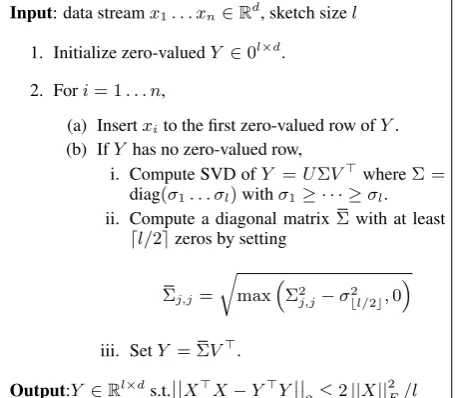
Input: data streamx1. . . xn∈Rd, sketch sizel
1. Initialize zero-valuedY ∈0l×d.
2. Fori= 1. . . n,
(a) Insertxito the first zero-valued row ofY.
(b) IfY has no zero-valued row,
i. Compute SVD ofY =UΣV>whereΣ = diag(σ1. . . σl)withσ1≥ · · · ≥σl.
ii. Compute a diagonal matrixΣwith at least dl/2ezeros by setting
Σj,j= r
maxΣ2
j,j−σ2bl/2c,0
iii. SetY = ΣV>. Output:Y ∈Rl×ds.t.
X>X−Y>Y
[image:2.595.308.538.66.265.2]2≤2||X||2F/l
Figure 1: Matrix sketching algorithm by Liberty (2013). In the output,X ∈Rn×ddenotes the data
matrix with rowsx1. . . xn.
A recent result by Liberty (2013) gives a de-terministicmatrix sketching algorithm that tightly preserves the covariance structure needed for PCA. Specifically, given a sketch sizel, the algo-rithm computesY ∈Rl×dsuch that
X>X−Y>Y
2 ≤2||X|| 2
F/l (1)
This result guarantees that the error decreases inO(1/l); in contrast, other approximation tech-niques have a significantly worse convergence bound ofO(1/√l).
The algorithm is pleasantly simple and is given in Figure 1 for completeness. It processes one data point at a time to update the sketch Y in an on-line fashion. Once the sketch is “full”, its SVD is computed and the rows that fall below a threshold given by the median singular value are eliminated. This operation ensures that every time SVD is per-formed at least a half of the rows are discarded. Consequently, we perform no more thanO(2n/l)
SVDs on a small matrixY ∈ Rl×d. The
analy-sis of the bound (1) is an extension of the “median trick” for count sketching and is also surprisingly elementary; we refer to Liberty (2013) for details. 3 Matrix Sketching for Sentence
Representations
for intent classification. We do so by learning a PCA projection matrixΠfrom the unlabeled data and applying it on both training and test sentences. The matrix sketching algorithm in Figure 1 en-ables us to computeΠon arbitrarily large data.
There are many design considerations for using the sketching algorithm for our task.
3.1 Original sentence representations
We use a bag-of-words vector to represent a sentence. Specifically, each sentence is a d -dimensional vector x ∈ Rd where d is the size
of the vocabulary andxiis the count of ann-gram iin the sentence (we use up to n = 3 in exper-iments); we denote this representation by SENT. In experiments, we also use a modification of this representation, denoted by SENT+, in which we explicitly define features over the first two words in a query and also use intent predictions made by a supervised model.
3.2 Random hashing
When we process an enormous corpus, it can be computationally expensive just to obtain the vo-cabulary size din the corpus. We propose using random hashing to avoid this problem. Specif-ically, we pre-define the hash size H we want, and then on encountering any word w we map
w → {1. . . H}using a fixed hash function. This allows us to compute a bag-of-words vector for any sentence without knowing the vocabulary size. See Weinberger et al. (2009) for a justification of the hashing trick for kernel methods (applicable in our setting since PCA has a kernel (dual) interpre-tation).
3.3 Parallelization
The sketching algorithm works in a sequential manner, processing each sentence at a time. While it leaves a small memory footprint, it can take pro-hibitively long time to process a large corpus. Lib-erty (2013) shows it is trivial to parallelize the al-gorithm: one can compute several sketches in par-allel and then sketch the conjoined sketches. The theory guarantees that such layered sketches does not degrade the bound (1). We implement this par-allelization to obtain an order of magnitude speed-up.
3.4 Final sentence representation:
Once we learn a PCA projection matrixΠ, we use it in both training and test times to obtain a dense
feature vector of a bag-of-words sentence repre-sentation. Specifically, ifxis the original bag-of-words sentence vector, the new representation is given by
xnew= ||xx||⊕ ||xΠxΠ|| (2)
where ⊕ is the vector concatenation operation. This representational scheme is shown to be effec-tive in previous work (e.g., see Stratos and Collins (2015)).
3.5 Experiment
To test our proposed method, we conduct in-tent classification experiments (Hakkani-T¨ur et al., 2013; Celikyilmaz et al., 2011; Ji et al., 2014; El-Kahky et al., 2014; Chen et al., 2016) across a suite of 22 domains shown in Table 1. An in-tent is defined as the type of conin-tent the user is seeking. This task is part of the spoken language understanding problem (Li et al., 2009; Tur and De Mori, 2011; Kim et al., 2015c; Mesnil et al., 2015; Kim et al., 2015a; Xu and Sarikaya, 2014; Kim et al., 2015b; Kim et al., 2015d).
The amount of training data we used ranges from 12k to 120k (in number of queries) across different domains, the test data was from 2k to 20k. The number of intents ranges from 5 to 39 per domains. To learn a PCA projection matrix from the unlabeled data, we collected around 17 billion unlabeled queries from search logs, which give the original data matrix whose columns are bag-of-n-grams vector (up to trigrams) and has di-mensions approximately 17 billions by 41 billions, more specifically,
X∈R17,032,086,719×40,986,835,008
We use a much smaller sketching matrix Y ∈
w/o Embed 6B-50d 840B-300d SENT SENT+
alarm 97.25 97.68 97.5 97.68 97.74
apps 89.16 91.07 92.52 94.24 94.3
calendar 91.34 92.43 92.32 92.53 92.43 communication 99.1 99.13 99.08 99.08 99.12 finance 90.44 90.84 90.72 90.76 90.82 flights 94.19 92.99 93.99 94.59 94.59
games 90.16 91.79 92.09 93.08 92.92
hotel 93.23 94.21 93.97 94.7 94.78
livemovie 90.88 92.64 92.8 93.28 93.37 livetv 83.14 85.02 84.67 85.41 85.86 movies 93.27 94.01 93.97 94.75 95.16
music 87.87 90.37 90.9 91.75 91.33
mystuff 94.2 94.4 94.51 94.51 94.95
note 97.62 98.36 98.36 98.49 98.52
ondevice 97.51 97.77 97.6 97.77 97.84 places 97.29 97.68 97.68 98.01 97.75 reminder 98.72 98.96 98.94 98.96 98.96
sports 76.96 78.53 78.38 78.7 79.44
timer 91.1 91.79 91.33 92.33 92.61
travel 81.58 82.57 82.43 83.64 82.81
tv 91.42 94.11 94.91 95.19 95.47
weather 97.31 97.33 97.4 97.4 97.47
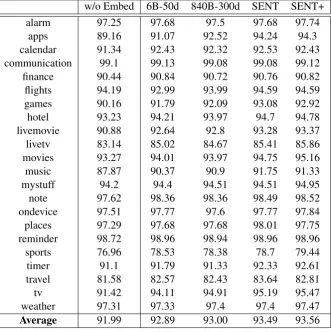
[image:4.595.131.464.57.394.2]Average 91.99 92.89 93.00 93.49 93.56 Table 1: Performance comparison between different embeddings style.
6 billion tokens (6B-50d) and 840 billion tokens (840B-300d) (Pennington et al., 2014) achieved 92.89% and 93.00%, respectively. 50d and 300d denote size of embedding dimension. To use word embeddings as a sentence representation, we sim-ply use averaged word vectors over a sentence, normalized and conjoined with the original rep-resentation as in (2). Surprisingly, when we use sentence representation (SENT) induced from the sketching method with our data set, we can boost the performance up to 93.49%, corresponding to a 18.78% decrease in error relative to a SVM without representation. Also, we see that the ex-tended sentence representation (SENT+) can get additional gains.
As in Table 2 , we also measured performance of our method (SENT+) as a function of the per-centage of unlabeled data we used from total un-labeled sentences. The overall trend is clear: as the number of sentences are added to the data for inducing sentence representation, the test perfor-mance improves because of both better coverage and better quality of embedding. We believe that if we consume more data, we can boost up the
per-formance even more.
3.7 Results of Parallelization
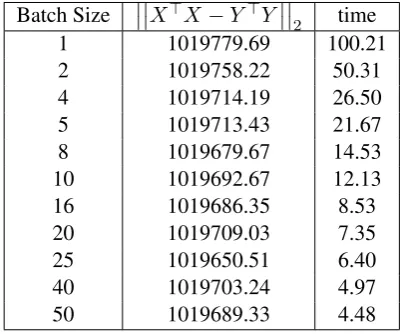
Table 3 shows the sketching results for vari-ous batch size. To evaluate parallelization, we first randomly generate a matrix R1,000,000×100 and it is sketched to R100×100. And then we sketch run with different batch size. The results show that as the number of batch increases, we can speed up dramatically, keeping residual value
X>X−Y>Y
2. It indeed satisfies the bound value,||X||2F/l, which was 100014503.16.
4 Conclusion
[image:4.595.134.466.63.396.2]0 10% 20% 30% 40% 50% 60% 70% 80% 90% 100% apps 89.16 89.83 90.04 90.26 90.88 91.9 92.41 92.41 92.95 93.72 94.3 music 87.87 89.12 89.61 90.4 90.83 91.26 91.31 91.33 91.38 91.33 91.33
[image:5.595.80.284.158.325.2]tv 91.42 92.28 92.83 93.61 93.96 94.67 94.91 95.12 95.34 95.44 95.47 Table 2: Performance for selected domains as the number of unlabeled data increases.
Batch Size X>X−Y>Y
2 time
1 1019779.69 100.21
2 1019758.22 50.31
4 1019714.19 26.50
5 1019713.43 21.67
8 1019679.67 14.53
10 1019692.67 12.13
16 1019686.35 8.53
20 1019709.03 7.35
25 1019650.51 6.40
40 1019703.24 4.97
50 1019689.33 4.48
Table 3: Results for corresponding batch size. Second column indicates the norm of gap between original and sketching matrix. Time represents the running time for sketching methods, measured in seconds.
References
Asli Celikyilmaz, Dilek Hakkani-T¨ur, and Gokhan T¨ur. 2011. Leveraging web query logs to learn user intent via bayesian discrete latent variable model. ICML.
Yun-Nung Chen, Dilek Hakkani-T¨ur, and Xiaodong He. 2016. Zero-shot learning of intent embeddings for expansion by convolutional deep structured se-mantic models. InProc. of ICASSP.
Koby Crammer and Yoram Singer. 2002. On the learn-ability and design of output codes for multiclass problems. Machine Learning, 47(2-3):201–233.
Jane K Cullum and Ralph A Willoughby. 2002. Lanc-zos Algorithms for Large Symmetric Eigenvalue Computations: Vol. 1: Theory, volume 41. SIAM.
Petros Drineas and Ravi Kannan. 2003. Pass effi-cient algorithms for approximating large matrices. InSODA, volume 3, pages 223–232.
Ali El-Kahky, Xiaohu Liu, Ruhi Sarikaya, Gokhan Tur, Dilek Hakkani-Tur, and Larry Heck. 2014. Ex-tending domain coverage of language understand-ing systems via intent transfer between domains using knowledge graphs and search query click logs. In Acoustics, Speech and Signal Processing (ICASSP), 2014 IEEE International Conference on, pages 4067–4071. IEEE.
Dilek Hakkani-T¨ur, Asli Celikyilmaz, Larry P Heck, and G¨okhan T¨ur. 2013. A weakly-supervised ap-proach for discovering new user intents from search query logs. InINTERSPEECH, pages 3780–3784.
Yangfeng Ji, Dilek Hakkani-Tur, Asli Celikyilmaz, Larry Heck, and Gokhan Tur. 2014. A variational bayesian model for user intent detection. In Acous-tics, Speech and Signal Processing (ICASSP), 2014 IEEE International Conference on, pages 4072– 4076. IEEE.
Young-Bum Kim and Benjamin Snyder. 2013. Opti-mal data set selection: An application to grapheme-to-phoneme conversion. In HLT-NAACL, pages 1196–1205.
Young-Bum Kim, Minwoo Jeong, Karl Stratos, and Ruhi Sarikaya. 2015a. Weakly supervised slot tagging with partially labeled sequences from web search click logs. In Proc. of the Conference on the North American Chapter of the Association for Computational Linguistics - Human Language Tech-nologies, pages 84–92.
Young-Bum Kim, Karl Stratos, Xiaohu Liu, and Ruhi Sarikaya. 2015b. Compact lexicon selection with spectral methods. InProc. of Annual Meeting of the Association for Computational Linguistics: Human Language Technologies.
Young-Bum Kim, Karl Stratos, and Ruhi Sarikaya. 2015c. Pre-training of hidden-unit crfs. In Proc. of Annual Meeting of the Association for Computa-tional Linguistics: Human Language Technologies, pages 192–198.
Young-Bum Kim, Karl Stratos, Ruhi Sarikaya, and Minwoo Jeong. 2015d. New transfer learning tech-niques for disparate label sets. InProc. of Annual Meeting of the Association for Computational Lin-guistics: Human Language Technologies.
Xiao Li, Ye-Yi Wang, and Alex Acero. 2009. Extract-ing structured information from user queries with semi-supervised conditional random fields. In Pro-ceedings of the 32nd international ACM SIGIR con-ference on Research and development in information retrieval.
Gr´egoire Mesnil, Yann Dauphin, Kaisheng Yao, Yoshua Bengio, Li Deng, Dilek Hakkani-Tur, Xi-aodong He, Larry Heck, Gokhan Tur, Dong Yu, et al. 2015. Using recurrent neural networks for slot filling in spoken language understanding. Au-dio, Speech, and Language Processing, IEEE/ACM Transactions on, 23(3):530–539.
Christos H Papadimitriou, Hisao Tamaki, Prabhakar Raghavan, and Santosh Vempala. 1998. La-tent semantic indexing: A probabilistic analy-sis. In Proceedings of the seventeenth ACM SIGACT-SIGMOD-SIGART symposium on Princi-ples of database systems, pages 159–168. ACM. Jeffrey Pennington, Richard Socher, and Christopher D
Manning. 2014. Glove: Global vectors for word representation. Proceedings of the Empiricial Methods in Natural Language Processing (EMNLP 2014), 12:1532–1543.
Mark Rudelson and Roman Vershynin. 2007. Sam-pling from large matrices: An approach through ge-ometric functional analysis. Journal of the ACM (JACM), 54(4):21.
Karl Stratos and Michael Collins. 2015. Simple semi-supervised pos tagging. InProceedings of NAACL-HLT, pages 79–87.
Gokhan Tur and Renato De Mori. 2011. Spoken lan-guage understanding: Systems for extracting seman-tic information from speech. John Wiley & Sons. Matthew Turk, Alex P Pentland, et al. 1991. Face
recognition using eigenfaces. In Computer Vi-sion and Pattern Recognition, 1991. Proceedings CVPR’91., IEEE Computer Society Conference on, pages 586–591. IEEE.
Santosh S Vempala. 2005. The random projection method, volume 65. American Mathematical Soc. Kilian Weinberger, Anirban Dasgupta, John Langford,
Alex Smola, and Josh Attenberg. 2009. Fea-ture hashing for large scale multitask learning. In
Proceedings of the 26th Annual International Con-ference on Machine Learning, pages 1113–1120. ACM.
Puyang Xu and Ruhi Sarikaya. 2014. Contextual do-main classification in spoken language understand-ing systems usunderstand-ing recurrent neural network. In