Changes in Wagering Within
the Racing Industry
FINAL REPORT
Commissioned by:
The Victorian Gambling Research Panel
Prepared by:
South Australian Centre for Economic Studies
Swinburne Institute for Social Research
University of Western Sydney
Funded by the Victorian Government
through the Community Support Fund
May 2005
The Research Team
This report was prepared by:
Michael O’Neil, Director, South Australian Centre for Economic Studies
Steve Whetton, Senior Research Economist, South Australian Centre for Economic Studies Ben Dolman, Research Economist, South Australian Centre for Economic Studies
Karin Duerrwald, Research Associate, South Australian Centre for Economic Studies David Hayward, Swinburne Institute for Social Research
Richard Woolley, University of Western Sydney
Acknowledgements
The researchers interviewed many individuals with racing industry knowledge and acknowledge the assistance of the individuals listed in Appendix D ⎯ List of Interviewees and Organisations.
We record our thanks to the many bookmakers and ‘racing identities’ ⎯ in the media or close to the track ⎯ who kindly gave of their time.
TABCORP (Vic) officials greatly assisted this study ⎯ Mr Michael Piggott and Mr Neale Wheat ⎯
and Ms Fiona Gibson who relayed all our data requests. TABCORP (Vic) readily supplied information and data and kindly made time available to comment and assist on the interpretation of some of the more complex aspects of wagering. We appreciate how generously they gave of their time. Mr Mark Read of Interactive All Sports betting (IASbet) were equally generous, as was Mr Alan Giles of the Victorian branch of the Australian Hotels Association.
The Secretariat of the Victorian Gambling Research Panel demonstrated once again their professionalism and commitment to achieving high-quality research outcomes.
In particular, we gratefully acknowledge the assistance of Mr Mark Close, Manager, Government Relations with Racing Victoria Ltd, and also the Office of Gambling Regulation and the Department of Justice, Gaming and Racing.
Authors Note
During the period this report was undertaken, two significant events were unfolding. The first was that TABCORP (Vic) and UniTAB (Qld) were competing to purchase TabLimited (NSW). Ultimately TABCORP (Vic) was the successful party. Throughout the report the NSW TAB entity is referred to separately as TabLimited (NSW).
The second event was the announcement by the Minister for Communications that the Commonwealth would not intervene to prohibit betting exchanges operating in Australia. This discussion coincided with the finalisation of this report. We have endeavoured to incorporate responses to this decision; however the full ramifications of the decision and the response of State Governments, of the racing industry, of existing wagering operators have yet to be played out. In reporting some of the responses and updating parts of the text, we have been careful not to speculate about the future.
Research Secretariat
Telephone: +61 3 9651 4945
Facsimile: +61 3 9651 4900
Office of Gaming and Racing PO Box 18055
Collins Street East Melbourne Vic 8003
Email: [email protected]
Contents
The Research Team ...ii
Acknowledgements...ii
Authors Note ...ii
Executive Summary ... 7
Wagering and Gambling ... 7
Understanding Changes in Wagering... 7
Overview of the Racing Industry... 8
Scale and Scope of the Industry... 9
Trends in Wagering... 9
Trends in Gambling... 10
Trends in the Racing Industry... 11
Technology, Wagering and the Future ... 12
Future Directions ... 12
Conclusions ... 13
1. Introduction ... 15
1.1 Background, Terms of Reference, Scope and Methodology... 15
Objectives...15
Scope...15
Methodology...16
1.2 A Definition of Wagering... 17
Legal Classifications...18
Wagering and Mutuality of Risk ...19
The Australian Racing Ministers Conference (May 2001) ...20
1.3 Pure Chance and the ‘Gamblers Fallacy’ ... 22
1.4 Competition, Efficient Markets, New Products and TABs ... 23
2. Analysis of Gaming and Wagering Trends ... 25
2.1 The Racing Industry... 25
2.1.1 Employment in the Racing Industry ... 29
2.2 Wagering in Australia ... 38
2.3 Recent history of Australia’s gambling industries... 43
2.4 Have gaming machines and casinos caused the decline in wagering in Victoria?... 49
3. Overview of the Racing Industry... 55
3.1 Introduction ... 55
3.2 An Industry Perspective: Summary of Interviews ... 55
3.3 Interactive Gaming Act 2001 and the States... 62
3.4 Punters, Problem Gamblers and Target Audiences... 64
4. Technology Changes ⎯ Operation and Organisation ... 71
4.1 Literature Review on Wagering... 72
Racing and Wagering...72
Potential Threats to Existing Wagering... 78
4.2 Future Directions in Wagering... 80
4.3 Summary: Technology, Markets and Trends... 85
5. Profile of Wagering and of Electronic Gaming Machine Gambling... 89
5.1 Introduction ... 89
5.2 Who Wagers? Industry Customer Profile... 90
5.3 Who Wagers? A Subjective View... 90
5.4 Who Wagers? Social Research’s Views... 91
5.6 Who Gambles on EGMs? A Profile of Users ... 94
5.7 Who’s Wagering? Protection of Minors... 96
Conclusion... 97
6. Conclusions...99
Understanding Changes in Wagering... 99
Some Reflections on the Scale of the Industry... 100
Trends in Wagering... 100
Trends in Gambling... 100
Trends in the Racing Industry... 101
Profile of Participants... 101
Regulation and Consumer Protection... 102
Future Directions ... 103
Bibliography...105
Appendix A...109
Terms of Reference ... 109
Changes in Wagering Within the Racing Industry... 109
Appendix B...111
Granger Causality Testing of Racing Expenditure vs. EGM and Casino Gaming Expenditure ... 111
Appendix C...115
Licensing of Wagering and Gaming, Competition and Regulation ... 115
Appendix D...117 List of Interviewees/Organisations... 117 Appendix E ...119 Interview questions... 119 Appendix F ...121 Appendix G ...123
Statement from William Angliss Institute of TAFE on TAB Accreditation and Training... 123
Appendix H...125
Spread Betting Products... 125
What is Spread Betting on Sport?... 125
What is Financial Spread Betting on the Stock Exchange?... 125
Appendix I ...127
Victorian Racing Industry’s Joint Venture with TABCORP ... 127
Appendix J ...129
Wagering Facilities, Process and Protections for all (including minors) ... 129
List of Tables
Table 1: The Australian Racing Industry by State, 2002–03 Season...26
Table 2: Number of Thoroughbred Races: Australia 1988–89 to 2002–03 ...27
Table 3: Australia’s Racing Industry in an International Context — 23 major racing countries, 2002...28
Table 4: Most Popular Sporting Events, Australia and Victoria — Adults attending during 2002 ...29
Table 5: Attendance at Racing Events, Victoria and Australia — Number of Persons: 1995, 1999 and 2002 ...31
Table 6: Employment by Organisations in the Australian Horse and Dog Racing Industries (at 30 June 2001) ...31
Table 7: Income and Expenditure by Australian Racing Organisations 2000–01 ...31
Table 8: Size of the Horse and Dog Racing Industries by State 2001...32
Table 9: Employment (in Main Job) in Horse farming, by Selected Occupations, Australia — August 2001...33
Table 10: Employment (in Main Job) in Selected Wagering Occupations, Australia — August 2001...33
Table 11: Summary Indicators: Victorian and Australian Thoroughbred Racing Industries — 1999–2000...35
Table 12: Wagering and Gaming Turnover, 1989–90 to 2001–02 — Australia ($ million)...38
Table 13: Thoroughbred Wagering Turnover, 1989–90 to 2002–03 — Australia ($ million)...40
Table 14: Thoroughbred Wagering Turnover by State, 2000–01 Financial Year ($ million) ...41
Table 15: Thoroughbred Wagering Turnover by State, 2001–02 Financial Year ($ million) ...41
Table 16: Thoroughbred Wagering Turnover by State, 2002–03 Financial Year ($ million) ...42
Table 17: Summary of Wagering Outlets...42
Table 18: TABCORP (Vic): Telephone and Internet Betting Sales, Financial Year 1999–2002 — Victoria...42
Table 19: TabLimited and Internet Betting Sales, Financial Year 1999–2002 — New South Wales...43
Table 20: Measures of the Growth in Australia’s Gambling Expenditure — 1976–77 to 2001–02...44
Table 21: Australian expenditure on gambling activities — Percentage of household disposable income, 1976–77 to 2001–02 ...45
Table 22: Measures of the Growth in Victoria’s Gambling Expenditure — 1976–77 to 2001–02...46
Table 23: Victorian Expenditure on Gambling Activities —Percentage of Household Disposable Income, 1976–77 to 2001–02...48
Table 24: TABCORP Distributions to Each Code, 2001–02 ...58
Table 25: TABCORP Distributions to Each Code, 2002–03 ...58
Table 26: TABCORP Operating Revenues ($ million) by Division —1995–96 to 2002–03...58
Table 27: Racing Attendances, Victoria: 1999–2003...60
Table 28: Wagering participation in the last three months (2003)...64
Table 29: Horse Racing Punters ⎯ A Snapshot, 2000 ...65
Table 30: Percentage of Players Who Are Problem Gamblers by Favourite Gambling Mode ...66
Table 31: TABCORP (Vic) Turnover: Financial Year 2002–03...66
Table 32: TABCORP (Vic): Customer Profile ...68
Table B1: Granger-causality Test with State and Time Dummy Variables ...112
List of Figures Figure 1: Australian Thoroughbred Racing Industry Prize Money and Incentive Payments, 1986–87 to 2002–03 ...26
Figure 2: Australian Thoroughbred Racing Industry Thoroughbred Registrations 1972–73 to 2002–03 ...27
Figure 3: Wagering Turnover — Victoria and Australia — 1976–77 to 2001–02...39
Figure 4: Sports Betting Turnover in Australia ...43
Figure 5: Australia-wide Gambling Expenditure ($ million) — 1976–77 to 2001–02 ...45
Figure 6: Victorian Gambling Expenditure ($ million) — 1976–77 to 2001–02...47
Figure 7: The Changing Role of Wagering in Victoria’s Gambling Industries Share of all Gambling Expenditure...48
Figure 8: Gambling Expenditure by State or Territory — Casino Gaming, Wagering and EGM Expenditure; Real Expenditure Per Adult, 2001–02 $, 1976–77 to 2001–02...50
Figure 9: Gambling Expenditure Following the Introduction of Electronic Gaming Machines — Wagering and EGMs; Real Expenditure Per Adult, 2001–02 $...52
Figure 10: Gambling Expenditure Following the Opening of Casinos — Casino Gaming and Wagering; Real Expenditure Per Adult, 2001–02 $...53
Figure 11: Operating Revenues by Division, 1995–96 to 2000–01 TABCORP (Vic)...57
Figure 12: Greyhound Total Attendances, Victoria: 1994–2003...60
Figure 13: Real per capita Gambling Expenditure, Victoria 1991–92 to 2001–02...81
Figure B1: Actual and Predicted Real Racing Expenditure Per Adult — Victoria Estimated Effects of EGMs and the Casino, 2001–02 $ Per Adult...113
Executive
Summary
This inquiry into the changing face of wagering in the Victorian racing industry was commissioned by the Victorian Gambling Research Panel (GRP) as part of ongoing research into the dimensions of gambling and problem gambling. The critical objective of this research is to identify the principal changes and those ‘key drivers’ of change in order to inform government policy and programs. The study was not concerned with other changes in the racing industry, inter alia, reforms to the
structure of industry and possible mergers/acquisitions1 except where such developments may
contain implications for wagering and gambling. New products and potential new entrants into the wagering market are considered, because they offer scope to expand or alter wagering opportunities. New wagering platforms emerging from applications of technology are considered in this report.
Ultimately, the researchers were required to consider any matters across the racing and wagering industries ‘in order to minimise the risk of increasing problem gambling behaviours or of attracting vulnerable people to gamble when gambling would not otherwise be of interest to them’.2
Wagering and Gambling
Gambling is an all-inclusive term for wagering, betting, gaming and lottery, as each has developed a more exact definition through decisions of the courts. For our purposes wagering involves a contract between various parties where the contract is enforceable by law and the parties stand to win or lose depending on the outcome of an uncertain event. The element of chance is the dominating element in lotteries of which the playing of electronic gaming machines (EGMs) is a sub-set; lotteries and EGMs are open gambling opportunities (i.e., customised, non-contractual and open to all), they are dominated by pure chance and they operate on an extensive scale. It is precisely because of these characteristics and the potential scale of social and economic harm that may arise from open and more continuous play forms of gambling opportunities that these forms of gambling were restricted. Wagering however, is distinguished from EGMs and lotteries by the customisation of the wager to a specific event, a specific outcome and between two contracting parties.
Understanding Changes in Wagering
The observed changes across the racing industry and changes in wagering are the logical result of the interplay of three key drivers — enabling technology, deepening access and widening of the wagering product.
Enabling-technology platforms such as radio, television, telephone and computer have led to a separation of the event (and actual attendance) and the opportunity to wager. They have enabled an expansion of venues for wagering (predominantly off-course) and provided new channels for wagering. Advances in technology — principally the mobile telephone, interactive television and the internet — continue this path of expanding opportunities for wagering products. The cashless
1 TABCORP (Vic) purchased TabLimited (NSW) while this study was being undertaken. Throughout the report
TABCORP (Vic) and TabLimited (NSW) are treated as separate entities. There were other possible mergers/acquisitions being considered such as Woolworth s and ALH.
transaction and ease of funds transfer support the new channels for wagering. The licensed betting operators and access to international operators have been facilitated by these enabling technologies.
The televising of the interstate event, and now global racing and other sporting events, can be understood as deepening access to the traditional wagering product. A whole raft of changes including the co-ordinated scheduling of events is designed to support television coverage. The televising of racing and other events extends coverage and deepens access to a greater array of traditional wagering products.
The third key driver involves a widening of the wagering product with the potential to accelerate the trend towards a convergence of wagering and gaming. The widening of the wagering market encompasses an appeal to the mass market (i.e., many people wager often rather than a relatively few people wager regularly), the development of sports betting, point-to-point wagering and new products. Product innovations such as ‘the mystery spinner’ and specific combinations based on number or colour represent a drift towards the convergence of wagering and gaming products facilitated by random number generation. New products, such as the casino-based random number generated horse racing events rely on computer, micro-electronic technology.
Where wagering takes the form of continuous play and/or choice is reduced to selecting the form of the wagering product (e.g., ‘one-click, random selection’), without the requirement for any exercise of skill or customisation of a wager, then the distinction between wagering and gaming is diminished.
The following summarises the significant changes occurring in wagering, including inter alia:
•
Advances in technology platforms including mobile telephone and the internet;•
Increasing digitalisation of the wagering medium utilising home-based interactive television;•
Local, state, national and international coverage of racing and special events;•
‘Events-based wagering’ including sports-betting;•
Decline in traditional agents such as bookmakers;•
Introduction of licensed betting operators, international betting operators;•
New products and ways of customising a wager;•
Technology enabling ease of funds transfer while separating the event from the place of the wager (‘technology conquers distance’); and•
Computerised racing products for wagering.Overview of the Racing Industry
The popularity of racing can be seen in the following cross-country comparisons, that:
•
Australia is ranked the fifth-highest wagering country exceeded only by Japan, USA, Great Britain and Hong Kong;•
Australia is ranked the fourth-highest wagering country on a per capita basis;•
Australia hosts the third-highest number of horse races annually and is the third-highest ranked in prize money after USA and Japan; and•
In Victoria, attendances at horse racing events (15.8 per cent) ranks second to Australian football (33.4 per cent). For Australia, attendances at horse racing also ranks second (12.9 per cent). In ranking of attendances in Victoria, harness racing is sixth, and dog racing is ninth (refer Table 4).The Victorian thoroughbred racing industry provides almost one-fifth of all race meetings in Australia and one-third of total prize money on offer.
Scale and Scope of the Industry
There are different approaches to measuring the size and scale of the industry. Estimates of full-time employment (FTE) are an important measure, because of the high level of casual and part-time employment across the industry. The Australian Bureau of Statistics (ABS) estimates3 that
66.5 per cent of all employees in the horse and dog racing industry are employed on a casual basis, compared to 27 per cent of all wage and salary earners in the broader economy.
The racing industry estimates that 77,755 full-time jobs were due to the Australian thoroughbred racing industry, and of these 22,300 FTE were in Victoria. However, these estimates include all employment in all industries, throughout the economy, that result from spending in the thoroughbred racing industry. More conservative estimates are provided by calculating full time employment based on salary and wage costs. However, even these estimates vary based on the classification of the industry.
The ABS, using a survey approach based on the Business Register (Class 9311 Horse and Dog Racing) estimate that total employment (FTE) in the national horse and dog racing industry in 2002 was 15,900 persons. The Centre for Economic Studies indicative estimate is between 12,500 and 15,000 persons in the national horse racing industry. Both are likely to err on the conservative side, but are still well below that claimed for the Victorian industry alone. ACIL4
estimated total direct FTE in the Victorian racing industry at 12,500 (adjusted to 2003).5 The ABS,
ACIL and Centre for Economic Studies estimates are below those of the racing industry.
Trends in Wagering
•
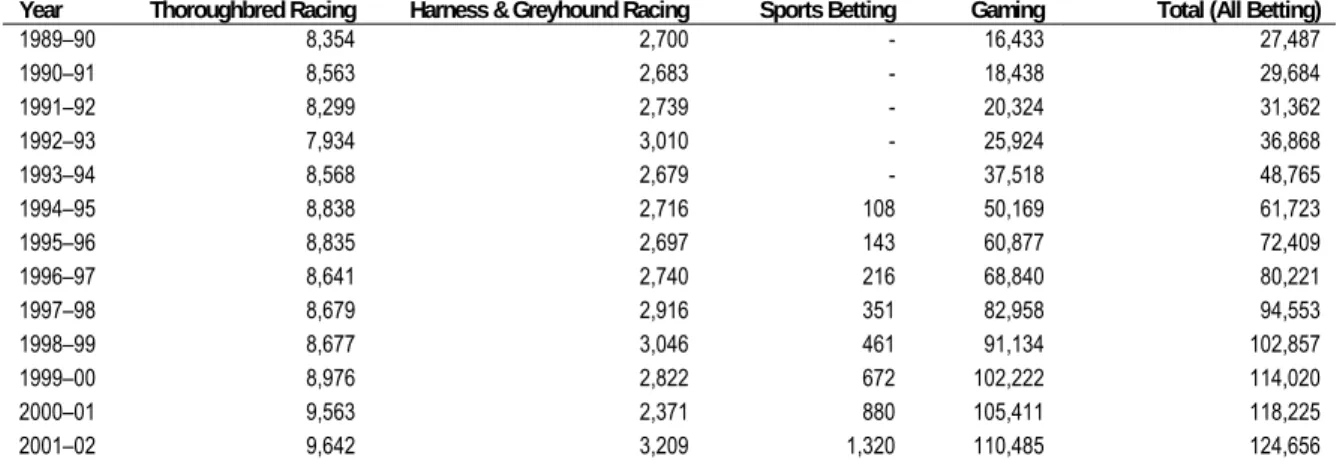
In 1989–90 wagering on thoroughbred racing represented 30.4 per cent of national wagering and gaming turnover, but had declined to 7.7 per cent by 2002; harness and greyhound racing was 9.8 per cent declining to 2.6 per cent; gaming was 59.8 per cent rising to 88.6 per cent by 2002;6•
The respective growth rates were thoroughbred races 1.2 per cent, harness and greyhounds 1.4 per cent and gaming 17.2 per cent over the period 1989–90 to 2002;•
Victorian wagering per adult ($928.62) exceeded the national average ($870.91) in 2002;•
Telephone betting in particular has increased significantly for bookmakers and the tab; sports betting has increased rapidly in the five years to 2001–02 in a component of the industry which is dominated by bookmaking firms located in the NT and ACT;
3 Australian Bureau of Statistics (2002) Sports Industries, Australia 2000-01.
4 ACIL Australia Pty Ltd (1992) “The Contribution of the Racing Industry to the Economy of Australia”.
5 ACIL estimate was 10,334 for 1990-91, adjusted by all industry growth rates for Victoria 1991-96 = 8 per cent,
1996-2001 = 10.8 per cent.
6 Respective growth rates: thoroughbred races 1.2 percent, harness and grey hounds 1.4 per cent, gaming 17.2 per
•
For Australia, the share of household disposable income spent on racing has fallen from 0.71 per cent (1976–77) to 0.43 per cent (2001–02), while the share of household disposable income spent on EGMS is up from 0.69 per cent to 2.03 per cent in the same period;•
In Victoria, the share of household disposable income spent on racing has declined from 0.8 per cent to 0.46 per cent and for EGMs, increased from 0 to 2.24 in the period 1976–77 to 2001–02;•
Participation in wagering is estimated to involve approximately 16 per cent of the adult population in Victoria and is predominantly a male activity;•
Some five per cent of the adult population are regular gamblers wagering at least once a week (approximately 180,000 adults); and•
This five per cent of the total Victorian adult population (18 years+) equates to 15 per cent of only those who wager (again approximately 180,000 adults) who contribute 78 per cent of industry turnover, similar in scale to the six per cent of Victorian adults who account for 57 per cent of EGM losses.Trends in Gambling
A key finding is that large changes in gaming produce relatively smaller changes in wagering. That is to say, the fall in real wagering expenditure represents a small transfer away from wagering and contributes only a tiny fraction of the current level of expenditure on EGMs in Victoria and at the Crown Casino.
•
For Australia the share of household disposable income spent on all gambling was 3.41 per cent (2001–02) up from 1.7 per cent in 1976–77, with all growth in the past 15 years;•
In Victoria, the share of household disposable income spent on all gambling was 3.81 per cent (2001–02) up from 1.28 per cent in 1976–77, again with dramatic growth in the last 15 years;•
The explosive rate of growth in expenditure is due entirely to the expansion of expenditure on EGMs and casino gaming;•
The researchers find some support for the hypothesis that the growing popularity of EGMs and casino gambling did contribute to a decline in the popularity of wagering;•
In Victoria the growing popularity of other gambling forms accounts for half of the $21.24 per adult fall in real wagering expenditure per adult since 1989–90;•
The introduction of EGMs in most jurisdictions has preceded a larger than normal fall in real wagering expenditure. In Victoria for 2001–02, the researchers estimate the level of wagering expenditure would have been $21 million higher without EGMs;•
The introduction of casinos preceded a larger than normal fall in real wagering expenditure, so that wagering expenditure in 2001–02 would have been $33 million higher without the Crown Casino.An examination of industry customer profile data, a review of literature, analysis of those who participate in wagering and sports betting via the internet, the views of social researchers and informed industry participants indicates that:
•
Those who wager and those who attend race meetings are predominantly male, the recreational punter tends to be younger (aged 20–35) than the professional punter (aged 45– 64); both groups often have some prior association with racing; both are likely to attend race meetings and maintain an account with a licensed bookmaker and/or the TAB;•
The regular TAB punter is also male; internet users for wagering were overwhelmingly male, were employed and generally earned high incomes in professional, management and trade occupations;•
Sports betting attracts a younger clientele; and•
There are large, well organised and sophisticated syndicates operating in the wagering market that are not participants in EGM or casino gambling.In contrast to those who wager (and participate at the casino) the EGM player is:
•
Middle aged (36 to 65 years) with heavy play by those aged 46–55 years (contribute 32 percent of turnover);•
They spend on average 1.5 hours playing per visit;•
People in the 18–25 age range contribute less than 1.4 per cent of industry turnover; and•
EGM participation involves more females (53.3 per cent) concentrated in the 50–64 age range.It is estimated:
•
Among problem gamblers, 84 per cent experience problems with EGMs, less than nine per cent report problems with wagering;•
Participation rates for EGMs are estimated at 33–35 per cent of all adults while participation in wagering is estimated at 16–19 per cent. (Note: Industry estimates suggest participation in wagering is slightly higher than this); and•
15 per cent of EGM players who are members of loyalty card programs are estimated to contribute 57 per cent of net gaming revenue (losses) while five per cent of those who regularly wager contribute 78 per cent of wagering turnover.Trends in the Racing Industry
The Joint Venture Agreement provides strong financial support to the three racing codes and has contributed to improved facilities and management of the events. The popularity of thoroughbred racing and its ‘people aspect’ is reinforced by attendance figures. It is important to acknowledge the social/community content of racing meetings, particularly major metropolitan meetings, marquee events and some rural/regional race days. These observations are drawn out in the first two summary points below:
•
Racing attendances have continued to increase, confirming the popularity of thoroughbred racing. Attendances at greyhound meetings have stabilised in recent times but average attendances fell from 832 people (1994) to 175 people in 2002–03;•
Attendance figures for thoroughbred racing for the October and November period are around half a million with no discernible increase in total turnover ($’s) per patron over the last four years; and•
The three codes have received significant financial distributions from the Joint Venture Agreement with TABCORP (Vic) ⎯ some $244 million in 2002–03 ⎯ with Racing Victoria receiving the major share (72 per cent).However, it should also be recognised that most race meetings are run for, and are essentially justified by, televising for the off-course wagering industry. This observation is considered in the following:
•
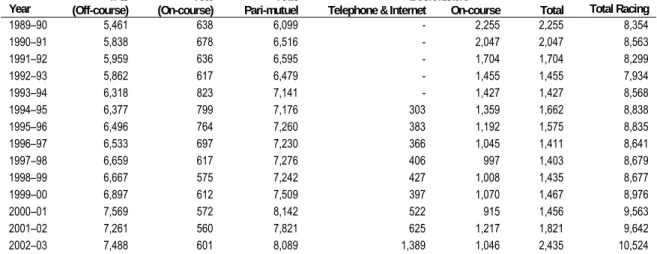
The wagering market continues to shift decisively off-course with 93.8 per cent of turnover for horse racing and 96.6 per cent for greyhounds coming from retail outlets and telephone and internet betting;•
Changes in the industry include ‘events management’ focused around a high-profile meeting and twilight meetings, that have helped stabilise attendances; other changes include expanded television coverage and the emergence of the social punter (the ‘convenience wager’), and simplified betting such as on a colour or ‘mystery bet’; and•
Continued expansion and improvement in facilities for off-course wagering, in large part reflecting changes in the target audience and changing consumer preferences.Technology, Wagering and the Future
•
Overall, telephone betting with TABCORP (Vic) accounted for 22.2 per cent of total TAB wagering turnover while wagering via the internet accounts for 0.8 per cent of total TAB wagering;•
Off-shore wagering and ‘betting exchanges’ (involve peer-to-peer [P2P] matching of individual client bets and is thus not reliant on the off-course pool wagering model) are considered by the racing industry to pose potential threats, principally in terms of lost revenue;•
Enabling technology platforms, based on digital media such as telephones, computer and interactive television will increasingly drive and shape future wagering business;•
New wagering products will continue to blur the distinction between gaming and wagering (e.g., ‘mystery spinner product, random number generated simulated race products: see Section 4.2).•
An important implication of the above is the appropriateness of the differential regulatory regimes governing wagering and gaming in Australian States and Territories.Future Directions
Future directions in wagering:
•
Will be reliant on new products that possess a potential to blur the distinction between wagering and gaming (i.e., the convergence of wagering and gaming products);•
The utilisation of new technological platforms for delivering wagering opportunities;•
Access to the ‘globalisation of racing and sporting events’; and•
Increase in competition from betting exchanges, which is likely to immediately impact for sports betting and then the ‘large stakes, high volume punter’.The three key sites for accessing new wagering products will be the home (internet and interactive television), mobile devices and leisure gambling venues. Traditional wagering (and lottery) products over the internet or telephone represent lower risk than interactive gaming products, because wagering events are controlled by an external agent and are subject to time delays. Online internet wagering is a close substitute for other platforms for wagering.
The profile of wagering participants, still significantly influenced by the ‘old social structure of racing’, is dominated by male participants who increasingly access off-course betting facilities;7 this
group is usually in employment in the professions or trades, earns above average incomes, while many have lifelong but indirect association with racing.
Another group of punters are the well-organised semi-professional syndicates. The recreational punter tends to be younger and is attracted to the sport by the special events, television coverage and newer forms of wagering which involve less skill and knowledge. A significant number of this group maintain an account with a licensed bookmaker and/or the TAB.
Relative to wagering, participants in gambling particularly via the highly accessible EGMs have a more diverse profile; they comprise more women players who are concentrated in the 46–55 age range but more broadly involve many aged 36–65 years. Young people appear to be less attracted to EGM play in part because it involves no skill level at all.
Protections for minors are in place in regard to telephone and internet wagering principally through the requirements to establish accounts, transfer funds and verify identity before a pay-out is provided. These protections are far more substantive than any that exist for EGM play. We note that the AHA (Vic) continues to oppose the ‘self-exclusion program for wagering’ which was intended to be implemented in hotel venues.8 All account holders can self-exclude from retail
outlets and from using their account.
Conclusions
Responsibility for racing and wagering will remain with the States and Territories. The National Guidelines for Responsible Wagering Practices should be agreed by all new entrants in the wagering and sports betting market.
Internet wagering is already a part of the service provided by existing TAB operators and is an extension of telephone betting where bets can be remotely lodged. However, prohibitions should remain on interactive gaming and casino type games as they differ from online wagering, in that interaction implies choices and decisions to affect the outcome of the game/activity. The other major difference is that the punter does not control or initiate the actual event in online wagering. Regulators will shape the future wagering market through the types of bets allowed rather than through determining the media by which wagering and gaming opportunities are provided.
Sports betting provides for new wagering opportunities some of which are volatile and high risk. Spread betting is one example where the punter must be highly informed. Harm minimisation measures such as stop/loss or stop/win options should always be incorporated in these betting products. This illustrates how regulators will shape the market through the types of bets and protections available to punters.
Regulators will also be required to incorporate wagering through betting exchanges into State and Commonwealth spheres of taxation, plus require that a contribution is made via the payment of product fees or access fees to those who administer racing.
Regulators will also require credit wagering audit trails as the use of mobile, internet and interactivetelevision platforms gain in popularity. Operators of wagering and betting exchanges will
7 Turnover for racing off-course: 93.8 per cent; for greyhounds 96.6 per cent.
8 See discussion in SACES report, ‘Evaluation of Self-exclusion Programs in Victoria’, February 2003 for Gambling
need to have in place early warning and detection systems to minimise wagering that is undertaken as a result of illegal or fraudulent activities.
Currently there are restrictions on ‘in-the-run-betting’ or micro-betting imposed by the Interactive Gambling Act 2001. While it is outside the scope of this inquiry to make recommendations to the Interactive Gambling Act 2001, regulators will need to satisfy themselves that forms of
micro-betting do not possess the potential to increase the number or severity of problem gamblers. Regulators should ensure that online gambling services provide mechanisms to limit harm from wagering. Credit and account-based facilities provide two obvious mechanisms:
•
The ability to set bet limits and total pre-commitment for any account; and•
Account statements to inform players of activity, wins/losses over specified time period; while•
Sports betting products such as spread betting should also provide pre-commitment limits and bet/loss limits as important harm minimisation measures.Regulators might in future require operators of wagering and betting exchanges as a condition of license, to provide more detailed analysis of client characteristics and wagering participation to satisfy themselves of the integrity of the products offered and to inform consumer protection advertising and policies.
The industry and any new entrants such as betting exchanges will need to ensure:
•
Strict identification checks are in place to protect against minors accessing wagering for racing and sports betting;9•
Potential key sites for accessing wagering products ⎯ the home and mobile devices ⎯ will require stronger consumer protection, privacy, a high level of security and confidence in online systems and trust in the provider and the product;•
Participation in wagering remains distinctly different to participation in gaming; and•
National Guidelines for Responsible Wagering Practices are universally agreed and promoted. Finally, the principal risk of an increase in problem gambling behaviours arises from the introduction and accessibility of open gambling opportunities. The researchers have noted the dramatic expansion of open gambling opportunities in recent times through the introduction of casinos, EGM venues and State and privately run lottery games. They are different from the customised wager that is linked to a specific event and specific outcome. This is no better illustrated than by wagering and gaming turnover figures for Australia in 2001–02:•
All wagering10 $14,171 million;•
Gaming $110,485 million;•
Wagering as a proportion of all betting 11.3 per cent.
9 It is our view that TABCORP (Vic) has strict processes to protect against betting by minors, it has well-developed
systems for credit card accounts and deposit facilities and it adheres to requirements in relation to cash-based transactions to protect against fraud and illegal activities.
1. Introduction
1.1 Background, Terms of Reference, Scope and Methodology
This study is part of the Victorian Gambling Research Panel’s (GRP) 2002–2003 Research Plan, dimensions of gambling and problem gambling, and forms part of a series of studies of changes that are taking place in the Victorian gambling and gaming environment which aim to identify how government policy and programs may need to be refined to adequately accommodate them. The Gambling Research Panel indicated that in recent years, wagering within the racing industry in Victoria (includes thoroughbred, harness and greyhound racing industries) has changed, with little known about its impact on existing and emerging groups of users.
This study was designed to investigate key changes in the gaming environment, including the trend towards co-location of wagering with gaming, and the development of telephone and internet wagering. It will examine the consequent changes in patterns of gambling participation across different forms of wagering.
This study is not concerned with other changes in the racing industry (again, encompassing the three codes) such as reform within the structure of the industry, rationalisation of country venues, the economic contribution of the industry to the economy or possible mergers/acquisitions. However, where these or any other changes contain a real or potential impact on wagering and access to wagering opportunities, then consideration of relevant issues and/or changes are addressed in this study.
Objectives
The primary objective of this study was to identify the implications of key changes which have been occurring to the operation and organisation of the Victorian wagering industry, including those related to the emergence of new technologies and the co-location of gaming facilities with wagering and, in particular, the current and likely future impact of these changes on the industry itself. Gambling groups within the industry and data on problem gambling and problem gamblers will be examined with a view to identifying any at-risk groups, and what measures if any, might be appropriate from a government, industry or community perspective to protect them.
It was expected that the researchers would work closely with the industry and acquire a sound understanding of the structure, dynamics, dimensions and regulatory provisions for wagering in the thoroughbred, harness and greyhound racing industries. The researchers were also expected to engage with a variety of racing industry participants to develop an understanding of changes taking place or likely to take place in the industry, that impact on wagering and access current information on those for whom wagering is a significant proportion of their gambling time or expenditure.
Scope
The Gambling Research Panel set out the scope of the project to include the following:
•
Examine the available literature and current Australian research on trends in the racing industry in terms of its impacts on gamblers;•
Describe the changes which have taken place, or are likely in the near future, in terms of co-location of wagering and EGMs and accessibility to wagering products, including telephone and internet wagering;•
Determine trends in the age, gender, ethnicity and social-economic status of those for whom wagering is a significant component of their expenditure on gambling and to identify any groups, including those under age, who are at risk;•
Determine the differences in the profile of gaming and wagering gamblers, the factors behind their choice (including advertising and other promotional measures) and their propensity to be engaged in behaviour conducive to risking unaffordable gambling losses;•
Draw on a range of research methods and innovative research strategies; and•
Examine by observation and/or survey whether the co-location of wagering facilities with EGMs changes the patterns of gambling expenditure for ‘recreational’, heavy and, if feasible, problem gamblers.It was expected that the research outcomes would include a final report that:
•
Describes the Victorian wagering industry and changes which have, and which in the future are likely to impact on gambling behaviour;•
Describes the characteristics of those gamblers for whom wagering is their major form of gambling expenditure or time spent gambling, the characteristics that differentiate them from those mainly involved in gaming, and the interaction between wagering and EGM gambling;•
Describes the impact of changes to venues, promotions to target audiences, technology (phone and internet particularly) have brought about to total gambling outlays and the relative expenditures on different types of gambling by gamblers;•
Analyses whether recent changes impact on any particular groups with regard to under-age gambling or established or new groups which may be identified as ‘at risk’ of entering into problem gambling; and•
Identifies any measures the industry might adopt, or any matters on which government might regulate, in order to minimise the risk of increasing problem gambling behaviours or of attracting vulnerable (particularly young) people to gamble when gambling would not otherwise be of interest, or available to them.Methodology
In undertaking this research the South Australian Centre for Economic Studies (SACES), the Swinburne Institute for Social Research (SISR) and the University of Western Sydney (UWS) hereafter referred to as ‘the researchers’ conducted a number of activities, including:
•
A series of extensive literature reviews on wagering, problem gambling, and trends in technology impacting on wagering, including canvassing reports and studies generated in Australia, overseas studies and public inquiries into aspects of wagering (e.g., current DOCITA Inquiry11);•
A review of studies into the size of the industry, economic contribution and employment within the Victorian and Australian racing industry;
11 Review of Issues Related to Commonwealth Interactive Gambling Regulation, Department of Communications,
•
An analysis of trends in wagering for Victoria and nationally using publicly available data, information provided by the respective codes, from public submissions and data supplied by industry stakeholders;•
An analysis of data on the number and sources of problem gambling, reporting trends and relative importance of wagering as a contributor to problem gambling;•
The conduct of wide-ranging interviews and consultations with industry stakeholders and government agencies with responsibilities for the racing industry;•
The conduct of survey-based research involving up to 3,500 Victorian households12; and•
Liaison with overseas researchers in the field.1.2 A Definition of Wagering
It is considered important to define the term wagering and to distinguish wagering from other forms of gambling.
Gambling is the all inclusive term for wagering, betting, gaming and lottery; each has developed a more exact definition particularly with the evolution of English and American law.13 A useful starting
point is to provide some general or commonly understood definitions of the terms wagering, betting, gaming and lottery. We refer here to definitions sourced from the Collins Dictionary of the English Language.14
A ‘wager is an agreement or pledge to pay an amount of money as a result of the outcome of an unsettled matter’. Thus, a wager is said to be a bet that involves the risk of one’s money against another’s on the result of a doubtful event. One notable feature of the wagering relationship is that both parties put at risk money or a stake, on an event or situation in which one party will win and the other party will lose. In the State of Victoria, wagering is defined as parimutuel betting on a horse race, harness race or greyhound race’.15 There is a degree of mutuality in participation and
of risk. Thus the term ‘parimutuel’ means mutual wager in a system of betting whereby those who have a bet on the eventual winner of a race share in the total amount wagered less a percentage for the management.
Likewise, a bet is a contract with another person or persons. A bet, as with a wager is an agreement between two or more parties that a stake (‘the amount or thing bet’) will be paid by the loser to the party that correctly predicts the outcome of an event. The system of betting or wagering may involve a third party such as the TAB, that in effect brings together the two punters, much as a bank and the banking system brings together borrowers and lenders. The parties bet on or against an unknown result, or competitor, that a thing or result will happen. The terms betting and wagering, or a bet and wager (‘I bet/wager you that…’) are used interchangeably.
A lottery is defined ‘as a game of chance in which tickets are sold, one or more of which may later qualify the holder for a prize. It is an activity or endeavour the success of which is regarded as a matter of fate or luck’16. In the Australian context, the most commonly cited examples of games of
12 This survey was undertaken for another research project commissioned by the Gambling Research panel and is
currently work in progress. The project ‘Community Impact of Gambling: A Comparison of Victorian and Western Australian Communities’ included a survey of households in both States in which several questions were asked concerning participation in wagering. Preliminary results are included in this study in Section 5.
13 Bridwell R. et al., p. 616.
14 Collins Dictionary of the English Language 1979.
15 Victorian Gaming and Betting Act 1994, Act No. 37/1994 p 6 of 83.
pure chance include TattsLotto, X-Lotto, Powerball, Bingo and raffle tickets, where the eventual winner has all the required numbers corresponding to those on a ticket, matching numbers in a row or the corresponding number to that drawn in a raffle. The conditions of a lottery most often involve specific arrangements for distributing prizes among purchasers of tickets, as in X-Lotto or raffle ticket sales, where prizes are identified and numbered (i.e., first prize through to the nth prize, sometimes showing the value of each prize on the ticket).
The three elements required in a lottery are:
•
The element of chance;•
An entry ticket price; and•
A prize or prizes.The term gaming has its origins in betting or wagering on games, sporting events or (usually) games involving mechanical devices designed to generate random outcomes (roulette wheel, spinning wheel, dice, etc.). The term gaming covers universally, games of pure chance and games requiring some combination of chance and skill. While various descriptions of ‘gaming machines’ can be found they are usually described as involving a machine for games of pure chance, requiring the insertion of a coin, card or token. Gaming machines were originally simple mechanical devices (e.g., the ‘one arm bandit’), whereas now they are electronic and computerised, hence the term electronic gaming machines (EGMs).
Legal Classifications
Classifications of games and wagering on games and events have evolved through the decisions of the courts over a considerable period of time.
Under the Victorian Gaming and Betting Act 199417 ‘wagering’, as previously noted, means
‘parimutuel betting on a horse race, harness race or greyhound race’. The Victorian Gaming Machine Control Act 1991, defines ‘gaming’to mean ‘the playing of a gaming machine’ which is a
device, ‘whether wholly or partly mechanically or electronically operated that is so designed that it may be used for the purpose of playing a game of chance or a game of mixed chance and skill and as a result of making a bet on the device, winnings may become payable’.18 The Victorian
Gaming and Betting Act 199619 defines a ‘lottery’ as ‘any scheme by which prizes of money or of
any other property matter or thing are or are proposed to be drawn or won by lot, dice or any other mode of chance or by reference to any event or contingency dependent upon chance’.
Under English law the term ‘lottery’ was not confined to the ‘state-run lottery’ as we understand them today, but to any form of ‘gaming activity which could be carried on by a variety of contrivances or devices and was not confined to the sale of tickets.’20
The distinguishing feature of a lottery was that it depended entirely on chance (the two terms chance and lottery were used synonymously) and:
‘A lottery has ‘bare bones’ requirements that are far simpler than those entailed in a gambling contract. All that a lottery requires is the offering of a prize for a price on the issue of chance (lot) which, under English law, meant that the transaction had to be entirely governed by chance.’ (Bridwell 2002, p. 644).
17 Victorian Government: Gaming and Betting Act, 1994.
18 Victorian Government: Gaming Machine Control Act, 1991.
19 Victorian Government: Lotteries, Gaming and Betting Act, 1996.
Under American law the ‘pure chance’ doctrine was not exclusively followed, instead applying what is known as the ‘dominating element rule’ to differentiate between chance and skill. It was the state of knowledge of the gambler that was determined to be the dominant or significant factor:
‘What a man does not know and cannot find out is chance as to him, and is recognised by the law as chance. Thus under the American rule, the inability to separate the result of any transaction from the element of chance is the key characteristic of a lottery.’ (Bridwell 2002, p. 648–49).
We therefore note, that under American law slot machines, ‘slots’ or poker machines are defined as a lottery following from the dominating element of randomisation and chance; in the same tradition the machines are referred to as Video Lottery Terminals (VLTs) in the USA and Canada. In Australia, poker machines or Electronic Gaming Machines (EGMs), fit within the English tradition of a lottery, as machines involving pure chance. (See further discussion in Section 1.3, Pure Chance and the ‘Gamblers Fallacy’.)
Wagering and Mutuality of Risk
Wagering has a more limited and precise definition than a lottery or games of pure chance. In legal terms, a wager or bet is a contract, and an agreement does not become a wager until a contract is formed. Specifically, in England, a wager or a bet is defined as:
‘[A] wagering contract is one by which two persons, professing to hold opposite views touching the issue of a future uncertain event, mutually agree that, dependent upon the determination of that event, one shall win from the other, and that the other shall pay and hand over to him, a sum of money or other stake; neither of the contracting parties having any other interest in that contract than the sum or stake he will win or lose, there being no other real consideration for the making of such a contract by either of the parties. It is essential to a wagering contract that each party may under it win or lose, whether he will win or lose being dependent on the issue of the event and therefore, remaining uncertain until that issue is known. If either of the parties may win, but cannot lose, or may lose but cannot win, it is a not a wagering contract.’21
A wagering contract requires mutuality of risk, although the risk shared between two parties does not have to be equal. A form of wagering or betting on horse racing is described as ‘parimutuel’,22
in which those backing the winners (i.e., win and place) share or divide amongst themselves the losers stake, minus some percentage for government taxes and the organiser or management fee, such as the totalisator or the TAB. Thus, wagering has quite a specific meaning in that:
•
The parties place money or property at risk;•
There is a contract between the parties enforceable by law; and•
The parties to the contract stand to win or lose depending upon the outcome of an uncertain event.As we have seen, the term lottery has a more generic meaning to cover various forms of gambling such as EGMs, Bingo, X-Lotto, fundraising schemes based on ticket sales and a variety of other schemes.23 Further distinctions relate to the element of ‘chance’ (under US law, chance is the
21 Bridwell R. et al., p. 653.
22 French term used to describe the system to bet on horse racing. In English speaking countries usually referred to
as the totalisator or the tote.
23 ‘In law….the term lottery embraces all schemes for the distribution of prizes by chance, such as policy playing,
gifts, exhibitions, prize concerts, raffles at fairs, etc., and includes various forms of gambling.’ (emphasis added). See Bridwell, p. 658. Footnote 307.
predominating element), the relative scale of the activity (relative to the customisation of a wager), the degree of openness for participation and the offering of a prize under a lottery.
‘All that a lottery requires is the offering of a prize for a price with the winning of the prize determinable on the issue of chance or lot. On the other hand, a wager or bet is a contract, and is treated by the law as such. The essential difference is that a lottery is a type of gambling that is designed to operate on an extensive scale, providing an opportunity for gambling on a mass basis to all comers who will tender their consideration for a prize to be determined by a chance event. Instead of being limited to certain contracting parties who have customized their wager or bet to depend on any chance event that suits them, a lottery consists of an open gambling opportunity made available to all comers by its promoters. For this reason the social costs and damage caused by lotteries have often been recognised as greater than those caused by private wagering.’ (Bridwell 2002, p 658)
In terms of social cost and individual harm, this last point is very significant. There has been a dramatic expansion of ‘open gambling opportunities’ in recent times through the advent of casinos, EGM venues and State-run lottery games. These forms of gambling opportunity continue to expand; however, they need to be differentiated from the scale and impact of the customised wager that is linked to a specific event and specific outcome. The gambling industry itself differentiates wagering (‘skill required’) and gaming such as poker machines and lottery (‘no skill required, random result’).24 Some interesting insights into the scale of wagering, the durability of
the wagering sector relative to open gambling opportunities are considered in Chapter 2, where the researchers analyse trends in gaming and wagering.
The Australian Racing Ministers Conference (May 2001)
The Australian Racing Ministers Conference (May 2001) defined wagering as the placing of a bet on the outcome of racing, sport or other events covered by totalisators or licensed bookmakers. Wagering within Australia across the three codes is conducted on and off-course. On-course wagering is conducted with bookmakers and totalisator operators and is based mainly on cash transactions. Off-course wagering is via the telephone, TAB agencies and the internet. Telephone betting and internet betting are also conducted with bookmakers, TABs and licensed providers. With all telephone and internet wagering, accounts procedures are in place prior to bets being taken (see Appendix J). Because telephone and internet betting require a pre-arranged account to be established and verified, there are in practice, more checks and balances for the operator and the punter than in the case of EGM play. The accounts may have limits. Money must be deposited into the account prior to wagering; there are usually a number of time delays in the process unlike continuous play with ‘EGM lotteries’. Off-course wagering within a TAB agency/premises is strictly cash based. Bookmakers are able to conduct credit betting.
The Australian Racing Ministers Conference (May 2001) endorsed seven objectives under the National Guidelines for Responsible Wagering Practices to promote the adoption of responsible wagering practices throughout Australia and establish uniform standards for such practices. In particular, the National Guidelines seek to promote harm minimisation and generally contribute to the integrity, fairness and quality of wagering services.
The seven objectives are to:
•
Provide consumers with the information required to make considered and informed decisions in relation to wagering products. This objective ensures consumers are fully aware of how each betting product operates and of their realistic prospects of winning;•
Provide consumers with the information likely to prevent the development of wagering-related problems or to assist consumers at risk of, or experiencing, such problems. This objective ensures that consumers are fully aware of services and procedures available to consumers experiencing wagering-related problems;•
Provide wagering services in a manner that encourages responsible wagering patterns and behaviour. This objective ensures that wagering services provided to consumers are conducive to responsible wagering patterns and behaviours on the part of the bettor;•
Ensure all appropriate personnel are capable of delivering the responsible provision of wagering. This objective ensures that totalisator and bookmaker staff are conversant with the responsible provision of wagering;•
Require that service providers act in an ethical manner. This objective ensures that service providers offer products that are, to the best of their knowledge, ethically conducted and do not have an adverse impact on the image of the relevant racing code or sport or is in any way offensive or contrary to the public interest;•
Provide that advertising and promotion is conducted in a responsible manner. This objective ensures that the advertising of wagering products is conducive to responsible wagering patterns and behaviours on the part of the individual bettor; and•
Require that the performance of responsible wagering practices is evaluated. This objective ensures that service providers are effectively implementing best-practice responsible wagering.25In summary, when considering changes in wagering within the racing industry the basic contractual relationship and mutuality of risk remains at the heart of the activity, although opportunities for wagering and the technology enabling such opportunities are rapidly changing. There are now local, state, national and international opportunities for wagering, including for inter alia, various forms of horse racing, ‘the dogs’, special events and sports betting on a wide variety
of sports. The traditional vehicles for wagering such as bookmakers, the totalisator and the TAB have been supplemented by telephone betting and the internet. Competition within the wagering industry has become far more intense with the challenge by new betting operators such as the licensed bookmaker Centrebet located in Alice Springs operated by Jupiters Casino,26
CentreRacing, Betfair, SportOdds and IASbet offering telephone and internet betting. The TABs have been very active in promoting sports betting as well. The new technologies, particularly telephone, mobile phone and the internet27 and the ability for greater ease in funds transfer have
considerable potential to expand the wagering market. These enabling technologies separate the physical destination for wagering and the requirement to attend the destination; the destination no longer matters as technology conquers distance.
In their submission to the Productivity Commission (1999) study into Australian Gambling Industries, the Australian Racing Industry considered the implications of new technologies and stated:
25 Drawn from www://harness.org.au/ahrc/RACEMIN Australian Racing Ministers Conference Nov 2002 Wagering.
26 In September 2003, SportsOdds purchased Centrebet for $46.6m.
‘The information revolution is a significant agent of change in today’s world and a major aspect of this is the disrespect for national boundaries which it may encourage. It is evident that emerging technologies lend themselves almost too well to the gambling field and particularly to avoiding the traditional controls over, and taxation on, gambling operators. For example, modern communications technology provides far greater mass access to potential clients with greater privacy, and a combination of multimedia and funds transfer technology provides convenience and colour which enables the cyber operator to compete with bricks and mortar casinos, and traditional TABs and bookmakers.
‘In terms of the Australian Racing Industry, a significant proportion of the revenue earned from wagering on racing is returned to the Industry to fund prize money, racetrack facilities and the major employment that is associated with the industry and consolidated revenue to contribute to community obligations such as, hospitals, schools etc.
‘The erosion of this revenue lifeline would have serious consequences for the economy of the Racing Industry and the State Governments, as well as for the Australian economy in general.28 Accordingly, there is significant concern that unlawful internet wagering operators should not be afforded the opportunity to establish themselves. Moreover, if such operators established a significant Australian subscriber base during these early days then it is considered that they will be that much more difficult to displace.
‘The Australian Racing Industry is already experiencing the effects of such a drain from domestic revenue through Australians betting on Australian races with Vanuatu operators. This is an ongoing problem which the Industry seeks to have addressed and, while not itself a feature of more recent technology, serves as a portent of the potential implications of internet and other new technology’.29
1.3 Pure Chance and the ‘Gamblers Fallacy’
Consistent with the elements of a lottery and the pure chance perspective, EGMs players in Victoria are informed that, ‘nothing you do can influence the symbols that appear when the reels stop spinning and that poker machines are a form of entertainment that you pay to use. The longer you play a poker machine, the more likely you are to lose all the money you have wagered (sic: gambled).’30 In short, there is, no skill required, the element of chance predominates the activity
and there is virtually no interaction involved in playing EGMs. It is this combination of the characteristics of lotteries, which includes poker machines, and the ubiquitous presence of various forms of lotteries that led government and regulatory authorities, until recently, to restrict the accessibility of lotteries and EGMs.
The dominating element of chance and randomisation leads to what is known as the ‘gambler’s fallacy’. The ‘gambler’s fallacy’ refers to the erroneous belief that in games of pure chance (e.g., electronic gaming machines and X-Lotto, Powerball) the probability of future events is affected by the history of the game. So, for example, people think that a machine that has not paid out for a while must be ready to pay-out very soon, while a machine that has just paid out is not likely to do so again for a while. Lottery sellers often provide a history of the ‘luckiest numbers’ that have come up most frequently, as if the probability of future events is affected by past history or some combination of lucky numbers.
28 The ‘consequences’ are very unlikely to have any importance for the Australian economy!
29 Submission to Productivity Commission (1999), Inquiry from Australian Racing Industry.
Many individuals have faulty conceptions of randomisation. In a random sequence of events each event is independent of all events preceding it. However, many gamblers seem to behave as if random events have an internal logic. This is perhaps due to a lack of experience with truly random sequences in everyday life. Gamblers who do not understand that events in gambling are independent, can be led to believe that a ‘near miss’ indicates that the machine ‘must be due to pay-out soon’. This lack of understanding creates difficulties for people with a gambling problem because they believe that they can recover past losses by playing the machine a bit longer. This type of behaviour only serves to worsen the problem via a downward spiral as more money is lost and the individual reaches crisis point. People who have found themselves in such a vicious cycle of irrational behaviour are in need of therapeutic interventions.
Many people in the community are left wondering how a machine can possibly guarantee a given rate of return if indeed the outcome on each new game is independent of previous games. Most people do not understand that the regulated return rate is naturally achieved by the sheer number of trials that are played (Productivity Commission, 1999). The ‘gamblers fallacy’ gives rise to behaviour such as chasing losses or people with a gambling problem frequently exhibiting overconfidence in their ability to win. The problem gambler continues to gamble so as not to miss out on a big win, or to ‘chase’ their money.
1.4 Competition, Efficient Markets, New Products and TABs
There is pressure from within the wagering sector of gambling to, on the one hand increase the scope for competition across the range of betting products while at the same time, to restrict competition from new providers of betting products.
Competitive pressure from within the wagering sector of racing is largely between bookmakers who offer a fixed-odds betting product to punters across the three codes of racing,31 and the TAB
or parimutuel betting. The Centre for International Economics observes that ‘wagering in Australia is heavily partitioned with the TAB having exclusive access to the parimutuel market. In contrast to the TAB, bookmakers have a very limited ability to offer their services to off-course punters via telephone betting which remains heavily restricted’.32
The argument maintains that, to develop an efficient market, punters should have access to full information which is reflected in the prices offered by bookmakers, the tote and the off-course TAB. Thus, bookmakers wish to extend wagering opportunities through an expansion of telephone betting direct with a bookmaker (and potentially the internet) while the TAB wishes to restrict access by bookmakers to this form of market liberalisation, while themselves offering telephone and internet wagering opportunities.
It is not the purpose of this report to consider the arguments of the respective parties.33 More
importantly, we note that following the introduction of telephone betting with bookmakers in South Australia and Western Australia in 1993 as reported by the CIE:
•
Bookmaker’s turnover across the three codes of racing increased by 42.4 per cent in South Australia, 19 per cent in Western Australia;•
TAB turnover increased by five per cent and 13 per cent respectively; and•
On-course tote wagering increased by eight per cent and 14 per cent respectively.
31 Licensed bookmakers also provide betting service on sporting events and other events.
32 Centre for International Economics (2002), p. 1.
Rather than the predicted cannibalisation of markets and profits, it appears telephone betting resulted in an overall increase in wagering through drawing in additional punters. It is anticipated by commentators across the racing industry that the removal of restrictions on betting limits and opportunities for telephone betting will enhance competition and raise wagering revenue. According to the Australian Racing Board (2001) some 37 per cent of total bookmakers’ turnover now comes from telephone betting.
Betting exchanges and sports betting34 represent new forms of wagering opportunities and new
products, in competition with the more traditional wagering on racing. Wagering on racing is largely facilitated by the TAB structures and ownership arrangements in each State. They are legislated monopolies in effect. However, sports betting is not controlled by the TAB and offers opportunities for new entrants and vigorous competition in this form of wagering. The telephone is the principal platform technology, although the internet is also important, particularly because wagering is exempt from regulations under the Interactive Gambling Act 2001. These new products and
technologies are discussed in Section 4.2, Future Directions in Wagering.
In a ‘snapshot history’ of the creation and role of TABs (Keck, 2003) records that following the establishment of the Victorian TAB in 1961, other States followed in quick succession ⎯ Western Australia in 1961, and Queensland in 1962. Then came the ACT’s TAB in 1964, the New South Wales TAB in 1964, South Australia in 1967, Tasmania in 1974 and the Northern Territory in 1985. Off-course TABs were established to ‘act as the legal off-course betting agency or arm of the existing totalisators which operated at the racecourses throughout the country. These on-course totalisator systems were responsible for accumulating the investments on various pools, such as win, place, quinella and calculating the dividends’ (Keck, 2003). Over time, the TABs assumed responsibility for all on-course totalisator wagering. The more recent history of the TABs is that successive State Governments have privatised their TABs and market activity has resulted in takeovers and consolidation. The most recent takeover involved the successful bid by TABCORP (Vic) for TabLimited (NSW).
TABs have expanded following the introduction and application of new technologies and the development of new products. This has resulted in an expanded range of distribution channels to now include the internet and the mobile telephone with the possibility of home-based wagering via digital television on the horizon. TABs also hold licences for sports betting; some own or hold an interest in casinos and hold a licence for the operation of gaming machines in licensed clubs and hotels. They also supply specialist games to licensed clubs/hotels and other gambling outlets.
34 The recent decision with respect to the Interactive Gambling Act 2001 and the possible licensing of betting