EXPLOITING KNOWLEDGE GRAPHS FOR ENTITY-CENTRIC PREDICTION
BY
SHAN JIANG
DISSERTATION
Submitted in partial fulfillment of the requirements for the degree of Doctor of Philosophy in Computer Science
in the Graduate College of the
University of Illinois at Urbana-Champaign, 2018
Urbana, Illinois
Doctoral Committee:
Professor Chengxiang Zhai, Chair Professor Jiawei Han
Assistant Professor Jian Peng
ABSTRACT
As a special kind of “big data”, text data can be regarded as data reported by human sensors. Since humans are far more intelligent than physical sensors, text data contains directly useful information and knowledge about the real world, making it possible to make predictions about real-world phenomena based on text. As all application domains involve humans, text-based prediction has widespread applications, especially for optimization of decision making.
While the problem of text-based prediction resembles text classification when formulated as a supervised learning problem, it is more challenging because the variable to be predicted is generally not directly mentioned in the text data and thus there is a “semantic gap” between the target variable and the surface features that are often used for representing text data in conventional approaches. How to bridge such a gap is a key technical challenge, but has not been well studied in the existing work. In this thesis, we propose to leverage the increasingly available knowledge graphs on the Web to bridge this gap. We propose to bridge this gap by using knowledge graph to make text representation more focused on elements in a knowledge graph that are relevant to the prediction task. We mainly focus on two a family of text-based prediction – entity-centric classification and regression where the response variable can be treated as an attribute of a group of central entities.
As a form of knowledge representation, knowledge graphs have widespread applications in information retrieval, text mining, and natural language processing. Many knowledge graphs have been constructed and applied to diverse, real-world applications. The knowl-edge graph can help to enhance the interpretability of the textual information from the perspective of predictive analytics, and hence discovers more effective features. Despite the great success made in the application of knowledge graph in various domains, one of the main deficiencies of many existing works is that the knowledge graph applied in the application is pre-constructed, which remains unchanged when applied to very different specific appli-cation tasks. Such a static task-independent knowledge graph, while useful, is non-optimal for any specific application due to the unnecessary cost from processing large amounts of non-relevant knowledge as well as the insufficient coverage of task-specific knowledge.
To address this limitation, we propose to construct a task-aware knowledge graph (TAKG) which would only contain the relevant knowledge to a particular task and absorb additional relevant knowledge from the data used in a particular task. We present a general formal framework for constructing a task-aware knowledge graph, develop specific algorithms for
constructing a task-aware knowledge graph for entity-centric prediction in both knowledge-based and task-dependent ways, and apply it to a movie review categorization task.
We propose two methods to expand the knowledge graph. One is to discover new entities and relations by a jointly embedding model which learns embedding vector for each entity and relation. In this way, the specific relationships in a finer-granularity that is pre-defined by the knowledge graph can be identified between related entities. An alternative way is to use more general word relations, e.g., paradigmatic and syntagmatic relation to expand the knowledge graph by including loosely related entities. Both methods work under certain circumstances, but the former one is helpful in a wider range of applications.
We also make a systematic study of knowledge graph assisted feature engineering. We propose several different ways to construct knowledge graph-based features and investigate their performance in multiple real applications. Our study shows that different types of ap-plication may favor different ways of constructing knowledge graph-based features. We find that the coverage of the knowledge graph is important. If it cannot provide sufficient back-ground knowledge, the effectiveness of the knowledge graph-based features will be impacted. Besides, the generated knowledge graph-based features can sometimes be very noisy, espe-cially when the correlation between text and the response variables are weak. To distinguish the signal features from the noise, we propose a two-stage filtering method to further prune the features. Our experiment result shows that the pruned knowledge graph-based features have strong predictive power, which again confirms that leveraging text data is promising for real-world phenomenon prediction.
ACKNOWLEDGMENTS
First and foremost, I would like to express my deepest gratitude to my advisor, Professor Chengxiang Zhai. Cheng is the best advisor who is always supportive and friendly to his students. He is one of the most considerate and kind-hearted people I’ve ever met. Without Cheng’s continuous guidance, encouragement and help, this thesis wouldn’t be completed. I’m deeply influenced by Cheng’s broad vision of research, modest personality, and serious attitude to work.
I would like to thank my committee members: Professor Jiawei Han, Professor Jian Peng and Professor Qiaozhu Mei, for their great feedback and suggestion on this thesis. I’m appreciative of Professor Han and Professor Zhai’s generous help for me to get through all the trouble when scheduling the defense. Professor Han has offered many valuable suggestions and feedbacks on the thesis. Taking two semesters of Professor Han’s courses stimulated my interest in data mining. Professor Peng has given me insightful comments and enlightening discussion on a wide range of related topics. I’m deeply grateful to Professor Mei. I worked with Qiaozhu for more than two years on a text mining project. I have learned so much from Qiaozhu. I would like to express my appreciation not only for his technical guidance, but also for his continuous encouragement and support for my study and career choice. I am deeply indebted to both Cheng and Qiaozhu for helping me so much on developing the idea and polishing the paper. This thesis would not be possible without their support and help.
I have had great opportunities to work with many talented researchers in the past summer internship. I sincerely thank Yuening Hu, Changsung Kang, Yi Chang, Yi Liu for being such wonderful mentors.
I’m thankful to my colleagues in the TIMAN Group for their help. I also wish to thank my friends, Jingjing, Huan and Yujing. Thank them for the unforgettable moments spent together. I will treasure these memories forever in my life. I always received encouragement and power from my family and friends when I had a tough time during my Ph.D. study.
Finally, I would like to thank my dear husband Yucheng and my parents, for their love, and everything they’ve done for me. This thesis is dedicated to them.
TABLE OF CONTENTS
CHAPTER 1 INTRODUCTION . . . 1
CHAPTER 2 LITERATURE REVIEW . . . 10
CHAPTER 3 KNOWLEDGE GRAPH-BASED FEATURE ENGINEERING IN ENTITY-CENTRIC PREDICTION . . . 13
3.1 Introduction . . . 13
3.2 Definition . . . 14
3.3 Knowledge Graph-assistant Feature Extraction . . . 18
3.4 Experiment . . . 25
CHAPTER 4 EXPAND KNOWLEDGE GRAPH . . . 32
4.1 Introduction . . . 32
4.2 Expand Knowledge graph by Paradigmatic and Syntagmatic relationships . . 34
4.3 Experiment . . . 44
CHAPTER 5 A FRAMEWORK FOR TASK-AWARE KNOWLEDGE GRAPH . . . 54
5.1 Definition of Task-aware Knowledge Graph . . . 55
5.2 Task Awareness Measurement . . . 56
5.3 Construct a Task-aware Knowledge Graph . . . 57
5.4 Apply a Task-aware Knowledge Graph . . . 58
CHAPTER 6 CONSTRUCT A TASK-AWARE KNOWLEDGE GRAPH FOR ENTITY-CENTRIC CLASSIFICATION . . . 60
6.1 Define Task Awareness Measurement for Entity-centric Classification . . . 60
6.2 Expand Knowledge Graph by Finding New Entities and Relations . . . 64
6.3 Refine Trimming and Expansion Functions . . . 67
6.4 Experiment . . . 68
CHAPTER 7 APPLY KNOWLEDGE GRAPH FOR ENTITY-CENTRIC RE-GRESSION . . . 78
7.1 Featurization . . . 78
7.2 Primary Filtering of Features . . . 79
7.3 Second-stage Filtering . . . 81
7.4 Experiment . . . 84
CHAPTER 8 SUMMARY . . . 97
CHAPTER 1: INTRODUCTION
Text data, broadly including all kinds of natural language text produced by humans (e.g., web pages, social media, email messages, news articles, government documents, and scientific literature), have been growing dramatically recently. As a special kind of big data, text data can be regarded as data generated by “human sensors” about our world, which is often much more informative and useful compared to the data generated by physical sensors due to the fact that humans are far more intelligent. This creates great opportunities for applying computational methods to mine big text data to discover all kinds of useful knowledge and support many data analytics applications, such as intelligent information system to accelerate biomedical discovery, improve homeland security, enable social media monitoring, and assist decision making in general.
Among many applications of text data mining, prediction of interesting variables based on relevant text data is especially interesting because it allows decision makers to “see” patterns behind data that they would otherwise not be able to see or easily see, thus leading to better decision making. For example, while non-text data may (indirectly) suggest a particular trend that consumers tend to like a particular feature of a product, product reviews may directly report such preferences by consumers. Since humans are involved in every application domain, text-based prediction has applications in virtually all the application domains. By exploiting the power of text information, it can help a variety of downstreaming applications, such as election forecast [1, 2], prediction of produce sales [3, 4], box office revenue [5].
While the formulation of a text-based prediction problem resembles a normal text clas-sification problem, especially when we formulate both as a supervised learning problem, text-based prediction is generally much more challenging than a normal text classification task such as topic categorization or sentiment analysis because the attribute value to be predicted is in general not directly derivable from the text data and the correlation between the text input and the response variable can be very weak. For example, in the task of movie revenue prediction, text information such as movie reviews only delivers week signals. It is hard for both machine and human being to directly infer the revenue performance by reading the reviews. Previous studies showed that sentiment analysis is helpful for the task, but revenue performance is not only determined by people’s opinion towards it. Another example is to predict election results, sentiment is also important, but it is not sufficient to only use the sentiment polarities to make accurate prediction. We need to dig into more de-tails from the text information. The challenge is that raw text is often too noisy. Sometimes
a large part of a document is not relevant at all, and only a few snippets are relevant to the response variables we want to infer. The response variables are not directly mentioned or easily derivable from the text in many cases. That is, there is often a semantic gap between the attribute value to be predicted and the surface lexical features we can extract from the text data. How to bridge such a gap is a key technical challenge, but has not been well studied in the literature. In this thesis, we propose to leverage the increasingly available knowledge graphs on the Web to bridge this gap.
To understand why knowledge graph can help bridge the gap, we can analyze the chal-lenge in text-based prediction of attribute values of entities from two perspectives – feature generation and feature generalization.
For feature generation, the most popular method is to use text-level surface lexical features (e.g., words or phrases). However, one problem with such surface lexical features is that the free-form of text contains much redundancy or noise, and lacks semantic discrimination. Deeper semantic feature representation of documents is needed to enable interpretation the text information for prediction purpose. For instance, if we want to classify online movie reviews collected from social media according to the movies that are being reviewed, we can find that it is easy to infer the movie label when people are talking about the directors or actors/actresses. Such kind of background knowledge can help a lot to identify the movie labels, but may not be easily deducible by only using surface lexical features. Another example of the semantic gap can be shown in movie revenue prediction task, which is to predict the box office revenue of movies. Discussion about the performance of actor/actress, impression of the director, and fondness of the story are all informative signals for the prediction task that can be discovered from the text data. Such a finer-grained analysis, however, would require additional knowledge on a deeper semantic layer (e.g., recognition of directors, actors/actresses and authors) which can not be fully satisfied by using word-level or phrase-level features. The main motivation for our work is to use a knowledge graph to bridge such a gap.
For feature generalization, a commonly-used type of features that are applicable to mul-tiple applications is the intermediate features extracted from the text data. For example, sentiment polarity is a widely-used feature in many applications such as movie revenue prediction, election forecast. Though such intermediate features are extracted from text automatically and shown to be effective to a variety of applications, they are not universally applicable to every text-based prediction task. Intermediate features usually rely on some pre-set assumptions. Once the pre-set assumptions do not hold any more, we need to create new intermediate features. Since it is infeasible to exhaust all possibly useful intermediate features, constructing intermediate features is not an optimal solution to represent the text
data for making accurate prediction in all scenarios. To construct features that are not only effective to facilitate precise prediction but also interpretable and generalizable, we again propose to exploit knowledge graph. By identifying what kind of information is relevant to the task based on the background knowledge acquired from a knowledge graph, we can extract more relevant semantic content from the text, and consequently better capture the correlation between the text and the target variable that is to be predicted. The constructed features are derived from human knowledge provided by the knowledge graph, they are in-terpretable and can help to explore patterns behind the text data from the perspective of predicting real-world phenomena. Besides, the knowledge graph-based features do not de-pend on pre-set assumptions, thus are more generalizable for various applications in diverse domains.
Among all kinds of applications of text-based prediction, a large number of them are entity-based where the variables to be predicted are the attribute values of a set of entities. We refer to this type of prediction problem as entity-centric prediction, and the involved entities are called central entities. For example, predicting the rating of restaurants based on socially-generated comments, predicting the sales performance of products from con-sumer feedback, and predicting the revenue of movies based on reviews are all examples of entity-centric prediction. In this thesis, we mainly focus on entity-centric prediction, where knowledge graph can serve as a natural bridge to connect the textual information and the target variables. Target variables are associated with a group of central entities. Even though it is not clear how the target variables are related to the textual information, we can assume that information related to the central entities is latently related to the target variables in a certain way. We can easily extract information related to the central entities from the background text with the help of knowledge graph. In this way, the correlation between text and response can be better captured.
We propose to generate knowledge graph-based features to represent text data for entity-centric prediction tasks, and how to obtain the best-fit knowledge graph for a particular task is also an essential problem. Constructing a large knowledge graph has been traditionally labor-intensive. With the arrival of information age, a large amount of digital text is easily available on the Internet, which makes it possible to construct a very large knowledge graph automatically or semi-automatically by using information extraction techniques. As a result, a large number of knowledge graphs have been created and widely used in many text-related applications, such as WordNet [6], DBpedia [7], Freebase [8], YAGO [9], NELL [10], PROSPERA [11], DeepDive [12] and Knowledge Vault [13]. The growth of knowledge graphs available in the public domain makes such an approach especially appealing since as we have
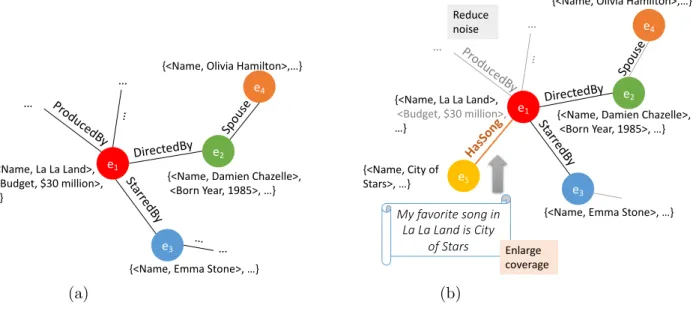
There are extensive studies on applying knowledge graph in text-based prediction tasks and demonstrating the value of knowledge graph in those real applications [1], [2], [3], [5], [4]. In spite of great success achieved so far, the power of knowledge graph is still not fully exploited. One of the main reasons is that the construction and the application of knowledge graph are disjoint from each other – once a knowledge graph has been built, it tends to remain unchanged during its use in many different applications and cannot assimilate new useful knowledge from text data used in a particular application. As shown in Figure 1.1a, in the existing applications, knowledge graph is typically used as a knowledge resource fed into the application, but receives no feedback from it.
We argue that such a feedback process is generally necessary because a pre-constructed generic knowledge graph, no matter how large it is, would unlikely be able to fully cover all the knowledge needed in all kinds of application tasks; indeed, it is impossible to build a knowledge graph that encompasses the entire knowledge of human language even though theoretically such a “universal” knowledge graph exists. Another problem with directly using a pre-constructed generic knowledge graph without adaptation is that the knowledge graph contains large amounts of non-relevant knowledge to a particular task, which not only causes unnecessary computation, but also can be even “distracting” for a particular task (e.g., causing overfitting when used in a supervised learning program).
To incorporate such task-based feedback and prune any non-relevant knowledge in a generic knowledge graph, we propose to construct a task-aware knowledge graph (TAKG) which would only contain the relevant knowledge to a particular task and assimilate addi-tional relevant knowledge from the data used in a particular task. In this way, we can build a knowledge graph that is customized to the specific entity-centric prediction problem, which not only provides the best support to the task but is also potentially helpful for similar tasks in the same domain.
The construction of knowledge graph can be considered as a process of encoding useful information from text into a graph structure which determines the semantics or domain-specific roles of words or phrases, while the application of knowledge graph in text-related applications is more like a reverse operation which decodes information embedded in the text with the help of a knowledge graph. The task-aware knowledge graph we propose in this thesis bridges the gap in the existing work between the construction and application of knowledge graph to allow for a potentially iterative process for constructing an increasingly relevant and complete knowledge graph customized toward optimizing the performance of a specific task. As shown in Figure 1.1b, feedback from the task is utilized to improve the knowledge graph in the construction of task-aware knowledge graph, and the knowledge graph and the task can mutually benefit from each other.
Task Input Knowledge Graph Output (a) Task Input Knowledge Graph Output (b)
Figure 1.1: (a) Common way of applying knowledge graph. (b) Construction and application of task-aware knowledge graph
e1 e2 DirectedBy e3 St arredB y {<Name, La La Land>, <Budget, $30 million>, …}
{<Name, Emma Stone>, …} {<Name, Damien Chazelle>,
<Born Year, 1985>, …} … … … Prod ucedBy … … e4 Spou se
{<Name, Olivia Hamilton>,…}
(a) e1 e2 DirectedBy e3 St arredB y {<Name, La La Land>, <Budget, $30 million>, …} … … Prod ucedBy … My favorite song in La La Land is City of Stars e5 {<Name, City of Stars>, …} HasS ong Enlarge coverage Reduce noise
{<Name, Emma Stone>, …} {<Name, Damien Chazelle>,
<Born Year, 1985>, …}
e4 Spou
se
{<Name, Olivia Hamilton>,…}
(b)
Figure 1.2: (a) An example of generic knowledge graph. (b) An example of how a task-aware knowledge graph is constructed
As an example, consider the task to annotate movie reviews with the movies being re-viewed, which is a text classification task with movies as class labels. Part of a generic knowledge graph that can be used to solve this problem is shown in Figure 1.2a which includes movie entities and their relations with other kinds of entities. If we find that re-lations such as “ProducedBy” and attributes of movie entities such as “Budget” are not very useful or even bring in noise sometimes for the task, we can remove them from the knowledge graph. By trimming the knowledge graph, we obtain a more relevant and less noisy task-aware knowledge graph customized for our task. Besides, we can also discover new knowledge from the text data in our task (i.e., reviews), such as extracting new entities and relations, finding more attributes of entities. For example, we find a review “City of Stars is my favorite song in La La Land”, indicating that “City of Stars” is a song of “La La Land” which is unknown to the knowledge graph. Then we can expand the task-aware
knowledge graph with this new knowledge. Such an expanded task-aware knowledge graph would then enable us to use “City of Stars” as a clue to annotate the review where this song is mentioned with the correct label “La La Land.”
This example shows that in general the construction of a task-aware knowledge graph would include (1) trimming a large generic knowledge graph (to remove noise and increase efficiency) and (2) expanding it with any new knowledge that can be extracted from the text data used in a particular task. The process can also be repeated multiple times to iteratively adapting the knowledge graph to optimize the performance of a task.
In this thesis, we provide a formal definition of task-aware knowledge graph and propose a general formal framework for constructing a task-aware knowledge graph that supports both trimming and expanding a knowledge graph. A knowledge graph is composed of a set of entities and relations between them. The basic structure of a task-aware knowledge graph is similar, but it differs from a generic knowledge graph in that a task-aware knowledge graph also carries information about the relevance or usefulness of an entity or relation from the perspective of a particular task. The framework thus includes a task awareness measurement function, which measures the relevance of entities and relations to a task and guides the construction algorithm to find the precisely-targeted knowledge needed in a task. While customized generation of knowledge graph is in general helpful for any applications, as an initial study of task-aware knowledge graph, we are particularly interested in those application tasks involving entity-centric prediction. The benefit of a knowledge graph for entity-centric prediction task is easy to obtain and construction of a task-aware knowledge graph for such tasks is more tractable. The constructed task-aware knowledge graph provides the better assistance to the specific entity-centric prediction task compared to a generic knowledge graph or a domain knowledge graph, as it is enhanced by learning new knowledge from its application in the task.
With entity-centric text prediction tasks in mind, we systematically study effectiveness of task-aware knowledge graph for such tasks. We follow the proposed general framework and develop new algorithms for constructing a task-aware knowledge graph for entity-centric prediction in both knowledge-based and dependent ways. The construction of task-aware knowledge graph can start from either an existing generic knowledge graph or a pre-generated seed knowledge graph which mainly contains the central entities. Trimming of the knowledge graph is done based on the task awareness measurement. The task-aware knowledge graph would be expanded if the coverage of the knowledge is not large enough and new relevant knowledge is available in the background text data. The expansion is data-dependent and only focuses on entities or relations with high task awareness, thus assimilating the relevant knowledge very efficiently and avoiding the completion of the whole
generic knowledge graph. The trimming and expansion can be carried out in turn repeatedly until the coverage is sufficient and the noise is ignorable.
When we get a task-aware knowledge graph specifically constructed for an entity-centric prediction task, the next question is how such a knowledge graph can help to optimize the performance in the task. This question is twofold: whether a knowledge graph (including a task-aware knowledge graph) is helpful at all; if so, how to leverage the knowledge graph to benefit the task.
To answer these two questions, we first study how a knowledge graph can be used to construct features for two representative tasks, classification and regression, and show that whether the idea of using knowledge graph is appealing. Our study shows that a generic knowledge graph is beneficial in general for some easier tasks like entity-centric classification. But it doesn’t always help, especially when the task is very difficult and the gap is large. One limitation of the generic knowledge graph we observed in these experiments is that the knowledge graph does not provide sufficient background knowledge needed in the task. To see whether the extension of coverage is important, which is one of our main motivations to construct a task-aware knowledge graph, we propose an efficient algorithm to discover both paradigmatic and syntagmatic relations from the text corpora and use both relations to expand the knowledge graph. These are two fundamental relations between words based on their co-occurrence. Different from the well-organized relations provided by a knowledge graph, paradigmatic and syntagmatic relation can tell user some hint about there may exist a certain type of “vague” connection between two words. Even though they are not categorized into the pre-defined relation types, they can still help to find more relevant entities. We find that when the coverage is enlarged, even though by more general relationships rather than the pre-defined finer-granularity relationships in a knowledge graph, the performance the performance is significantly improved, indicating that constructing a customized knowledge graph with sufficient coverage is necessary. Paradigmatic and syntagmatic relations can work very well to help us to find good features in general. However, they are not powerful enough when more accurate relations in finer granularity are needed, and a task-aware knowledge graph which can discover more accurate relations would be a better choice in this case.
To find a better way to leverage knowledge graph in entity-centric prediction tasks, we systematically study knowledge graph-based feature construction for entity-centric predic-tion applicapredic-tions. We propose several ways to construct the knowledge graph-based features and compare their performance in different kinds of real-world applications. We find that entity-based features can work very well in some cases. However, when the semantic gap between the text and the response is larger, the problems become much more challenging
example, to exploit text data in more challenging tasks such as predicting product sales or movie revenue from online reviews, we propose to construct explanatory path-based fea-tures based on the knowledge graph. The explanatory path-based feafea-tures especially benefit from task-aware knowledge graph, because task-aware knowledge graph not only enlarges the coverage but also organizes the newly discovered knowledge in a disciplinary way.
To show the effectiveness of the proposed methods, we study one case of entity-centric classification. We propose to define the task awareness measurement function based on the relatedness of entities/relations/ attributes to the central entities, as well as some statistical analysis based on the co-occurrence between features and the central entities. The trimming of the knowledge graph can then be done according to the estimated task awareness values. The knowledge graph is then expanded by discovering new entities and relations based on the jointly embedding model and finding unknown aliases from the training examples. Our evaluation results show that the best way to construct the knowledge graph-based features for the entity-centric classification problem is to represent documents by the entities mentioned in it along with the context information. The trimming and the expansion of the knowledge graph both help to improve the performance, but the expansion is more helpful since the coverage problem impact the overall performance significantly.
Second, we study another case, of entity-centric regression. We use the same way to construct the task-aware knowledge graph as for the entity-centric classification task because to identify which text snippets is relevant to the central entity is usually the primary step to identify informative text information. Our study shows that when mapping the entity into its path to the central entities in the knowledge graph which explain the relationship between them, the features work better than using individual entities as features. In those path-based features, background knowledge is embedded in the feature space, which makes the features customizable to different types of entities. Meanwhile, the features are not limited to the existing entities and can also be generalized to unseen data, allowing it to better handle the emerging entities. Though the generated features are useful in general, they can be very noisy in some regression task especially when the correlation between the text and the response variables are really weak. To solve the problem, a two-step filtering approach is applied to further reduce the noise. In the first step, a t-statistic based measure is used to select potentially better-performing features. Features that work well on all the corresponding entities are likely to have high t-stats value and would be favored. In the later stage, we use the mixed-effect model to analyze where the impact of a feature comes from, which helps to further reduce noisy features. We evaluate the proposed method on two realistic scenarios of predicting revenues of unseen movies based on movie reviews. The experiment results show that our method is effective for finding good features, which helps to improve the prediction
accuracy significantly. The proposed method can also help reveal interesting interpretable features that can help explain changes of values of the target variable.
To summarize, the main contributions of this thesis include: (1) We systematically studied the knowledge graph-assistant feature engineering in text-based prediction. We presented several ways to construct the knowledge graph-based features and investigated their perfor-mance in different tasks. (2) We introduced the concept of task-aware knowledge graph and proposed a general framework for constructing and applying the task-aware knowledge graph to text-based prediction. We showed an instantiation of how to prune the knowledge graph to reduce noise and how to expand the knowledge graph to enlarge coverage in some spe-cific types of applications. (3) We introduced a family of text-based prediction tasks called entity-centric prediction tasks and systematically studied effectiveness of many methods of constructing features for such tasks by leveraging knowledge graph. (4) We proposed and studied two general ways to expand knowledge graph. Experimental results show that both approaches are effective. Generally, when the coverage of the central entities in the existing generic knowledge graph is good enough, finding new entities and relations by the jointly embedding model is more promising. While when the coverage of the central entities is poor, making use of more general relations such as paradigmatic and syntagmatic relations is more beneficial. (5) We proposed task-specific instantiations of the general task-aware knowledge graph framework for two representative entity-centric tasks and show that task-aware knowl-edge graph not only substantially outperform task-independent knowlknowl-edge graph but also even comparable to the manually-created features which are elaborately designed for the task.
This thesis is organized as follows: Chapter 2 briefly reviews the literature.
Chapter 3 systematically studies knowledge graph-assistant feature engineering in entity-centric prediction tasks.
Chapter 4 introduces the method to expand knowledge graph by paradigmatic and syn-tagmatic relations, and examine whether the expansion can produce additional benefit.
Chapter 5 proposes a general framework to construct task-aware knowledge graph. Chapter 6 instantiates the general framework proposed in Chapter 5 in entity-centric classification.
Chapter 7 presents how to exploit the task-aware knowledge graph constructed in Chap-ter 6 in another type application of entity-centric prediction – entity-centric regression. A two-stage filtering method is proposed to select the knowledge graph-based features.
CHAPTER 2: LITERATURE REVIEW
Construction of knowledge graph has received great attention from both academia and industry ever since the knowledge graph theory was introduced. Early work usually in-volved much human effort like ontologies in different languages (e.g., the early version of WordNet [6]). Expert-edited knowledge graph is of high quality, but the construction and maintenance are very expensive and labor-intensive, making it not scalable.
The automatic construction of knowledge graph helps solve those problems and thus has become increasingly popular. Due to the rapid development of related techniques such as text mining and natural language processing, recent years have witnessed a proliferation of large-scale or even web-scale knowledge graphs being generated in an automatic way. Semi-structured text data such as Wikipedia infobox is widely used in the construction of knowledge graph. For example, DBpedia [7], Freebase [8] and YAGO [9] are all built from such kind of semi-structured text data.
Though semi-structured text data is better organized which is easier to exploit, a much richer resource still lies in the unstructured free-form text data. If we can make use of the free-form text data, we can leverage the entire web to construct a powerful knowledge graph. A lot of existing work has been explored in this direction. For example, NELL [10], PROSPERA [11], DeepDive [12] and Knowledge Vault [13] are all generated from the entire web and they do not require the data source to be structured.
Besides the generic knowledge graph, extensive effort has also been devoted to the con-struction of domain knowledge. For example, social domain knowledge graphs that can dis-cover emerging entities [14]; health knowledge graph built from electronic medical records [15] and web source [16]; enterprise knowledge graph that provides useful information about com-panies [17]; knowledge graph for technical and scientific domain [18], [19]; and knowledge graph for mobile apps [20]. Compared to the generic knowledge graphs, the domain knowl-edge graph can provide tailored background knowlknowl-edge in a particular domain. However, they are domain-oriented rather than task-oriented, which can not guarantee the coverage of the background knowledge in a random task even in the specific domain. For example, a knowledge graph constructed for the movie domain is still not likely to includes all the aliases of all the movies and other relevant entities in an arbitrary document, especially when the language is quite informal (e.g. reviews from tweets and other web forums).
There is also exploration of new schema of knowledge graph, such as event-centric knowl-edge graph [21, 22], visual knowlknowl-edge graph that contains both visual and textual entities [23], temporal knowledge graph which learns dynamic representation of entities over time [24].
These new schemas are not limited to text representations. Rather than representing the relations between entities in a static network, they also explored the possibility of taking multi-media information as supplement or even as the key points, as well as the possibility of using dynamic network to timely update the network structure in a much more flexible way.
Both the expert-edited and the automatically-generated knowledge graphs are important resources to help machines acquire human knowledge; they are widely used in many real-world applications such as question answering [25, 26], opinion mining [27, 28] and query expansion [29, 30].
Though great achievement has been made, the construction and application of knowl-edge graph in real applications are far from optimal. Most existing knowlknowl-edge graphs are generated for all purposes, but not designed to provide customized knowledge for a specific task. Their construction is thus not task-dependent and generally cannot fully satisfy the knowledge need in a particular task. Compared to the construction of existing knowledge graphs, the way we generate a task-aware knowledge graph is not only task-oriented but also enables the knowledge graph to learn new knowledge from the application. Conceptually, what we propose is to tightly integrate construction of a relevant knowledge graph to a task and its application in the task, thus enabling exploitation of feedback from task performance to iteratively optimize the knowledge graph for the particular task.
Note that the construction of task-aware knowledge graph is not incompatible with the traditional way of generating a general knowledge graph. Both schema-less and pattern-based methods that are used for the construction of general knowledge graph can also be utilized in the expansion step of constructing a task-aware knowledge graph. Knowledge graph completion and relation extraction methods [31, 32, 33] can also be used to enhance the task-aware knowledge graph when the coverage of the existing knowledge graph is not enough. Besides, existing general knowledge graphs can be utilized to initialize the task-aware knowledge graph to provide basic background knowledge.
Knowledge graph is leveraged to benefit a variety of applications, among which text-based prediction is a representative one. Text-based prediction is a powerful tool to predict real-world phenomenon from text data. It has been explored in many practical applications such as election result prediction ([1, 2]), health research ([34, 35]) and product sales prediction ([3, 5, 4]). However, the existing methods have not fully exploited knowledge graph to construct effective and interpretable features for prediction.
Free-form text is sometimes not informative enough for complex prediction tasks, and semi-structured text is more popularly used as a result. For example, hashtag and user
feature from free text is sentiment. For example, a study has shown that the movie revenue performance is somehow correlated with sentiment polarity of the reviews [36]. Such kinds of meta features or intermediate features inferred from free text can be useful for a certain type of task. However, they are not universally applicable to different domains. For example, sentiment could be a powerful feature for sales prediction but it may not work so well for health decision-making system. Besides, manually designed features need to be carefully selected in advance and it is hard to exhaust all kinds of useful features by hand. Compared to most of the existing methods, our method discovers correlation between features and response in an automatic way and can leverage the increasingly available knowledge graph resources.
As an important method of knowledge representation, knowledge graph has been widely used in various text mining applications, such as document similarity computation [37, 38], topic discovery [39, 40], opinion mining [27, 28] and information retrieval [41, 42]. Back-ground knowledge provided by KGs can be leveraged in various ways. Taking document representation as an example, it can be enriched by knowledge graphs at either entity level (e.g. [43]) or sub-graph level (e.g. [37, 41]). In this thesis, we make use of both entity-level and relation-level knowledge and incorporate it with contextual information. This is espe-cially helpful when the correlation between the textual information and the response variable is weak, which requires a tight collaboration of local context with background knowledge.
The proposed method mainly focuses on finding better features for entity-centric text re-gression applications. However, The proposed two-stage filtering algorithm is generalizable to any text-based prediction tasks. An important complementary way to enhance the perfor-mance is to improve the regression model itself. When the response is continuous variable, linear regression is typically employed. One problem with linear regression model is that the correlation between the output response and the input features is much more complex and non-linear model might be more proper [44]. The improvement of learning model can always be in parallel with generation of better features, and the combination of them would be ben-eficial in general for all kinds of applications. Our method can thus be potentially combined with many different regression models to support a variety of real-world applications.
CHAPTER 3: KNOWLEDGE GRAPH-BASED FEATURE ENGINEERING IN ENTITY-CENTRIC PREDICTION
3.1 INTRODUCTION
Most explicit knowledge is stored in the form of unstructured textual information, which makes the organizing, analyzing and exploiting of the ever growing documents on the In-ternet a challenging and vitally important problem. These text mining and management applications usually include the procedure of preprocessing, featurization and finally being casted as an unsupervised or supervised learning problem which produces some response variables according to the text input. In this procedure, feature engineering is critical to the performance of many applications. Lexical, syntactic and semantic features have thus been studied in previous studies.
Lexical features like bag of words have achieved great success in many text mining and management tasks and become the most popular way for text representation. In a variety of text-based tasks, lexical features are powerful in the detection of correlation between the text content and the response variable. For instance, sentimental words indicate the sentiment polarity in the task of analyzing the sentiment of natural language text, and topic words differentiate thematic categorization of news article about business, technology, entertainment, etc.
Though lexical features have been shown to be effective and robust, they have their limita-tion of modeling the textual informalimita-tion accurately. On one hand, they ignore the syntactic information. The structure of natural language, though not necessarily helpful in some cases, is needed in many tasks such as non-native text analysis where the syntactic structure helps to understand how the speakers construct their sentences [45].
On the other hand, lexical features are not able to capture the semantic relation between words. For example, they are not able to distinguish synonyms, which makes the corre-sponding dimensions non-orthogonal in the feature space. To solve this problem, a common solution is to represent the documents by low-dimensional vectors in a latent semantic space such as topic space and word2vec embedding space. The latent semantic space captures the semantic relations among words, thus models the textual information more accurately, especially when diversified vocabulary is used to express similar content.
Though syntactic and semantic features can break through the limitation to some extent, they are still not capable of dealing with more challenging tasks where response variables cannot be directly derivable from the text. Syntactic information is helpful for understanding the language structure, but is lack of deeper semantic information. The improvement of
text representation brought in semantic features is mainly limited to the scope of internal relations within text contents, rather than directly reveal how the text content is related to the response variables. For example, if we want to identify the online reviews about certain movies, it is more difficult to get the signal features compared to finding discriminative words or phrases in thematic categorization tasks. In such kind of tasks, the response variable is distantly related to what is explicitly mentioned in the text, which means that there exists a semantic gap. The textual information is related to the response variables by more complex reasoning with background knowledge, thus surface features extracted from the text are usually not effective in bridging the gap.
Among all the applications where background knowledge is required to allow people to see the pattern behind the textual information, a large number of them are entity-based where the response variables are closely related to certain entities. For example, in many text classification or regression tasks, the response variables can be a group of entities or a certain attribution of them. We refer to such kind of application as entity-centric text ap-plication, and name the entities that the response variables are related to as central entities. For instance, identifying online reviews about movies, predicting the sales performance of products, are both entity-centric text applications. In the movie review classification task, the central entities are the movies and the response variables can be their IDs. While in the sales prediction task, the sales performance can be considered as an attribute of a product and the product are the central entities.
Though semantic gap also exists in entity-entric text applications, the natural connection between the response variables and the central entities makes it easier to capture the corre-lation between textual information and the response variable with assistance of knowledge graph. In order to bridge the gap, we propose to leverage knowledge graph as an auxiliary to represent documents. Background knowledge provided by knowledge graph helps to dis-tinguish informative textual signal from the noise, thereby better exploiting the predictive power of the textual information.
3.2 DEFINITION
Before introducing our exploration of exploiting knowledge graph for entity-centric pre-diction in details, we first formulate the problem and define the concepts that will be used in the thesis.
3.2.1 Knowledge graph
A generic knowledge graph is composed of entities and relations between them. An entity or a relation in a knowledge graph can have an assortment of attributes, e.g., name and aliases, types, etc. Formally, we have the following definition for entity and relation:
Definition 3.1. Entity: An entity is an object or concept that can be distinctively identified. It has a set of attributes which can be considered as its components or properties. Formally, let e be an entity then its attribute set is denoted as e.A= {e.A1, e.A2, ...}where e.Ai is the i-th attributes ofe.
Definition 3.2. Relation: A relation is the relationship between two entities, and it can be represented as a triple r= ⟨ei, r.A, ej⟩. Hereei andej are
the two entities that are connected by the relation r. We name ei
and ej as the head entity and the tail entity connected by relation r respectively. r.A is the attribute set ofr.
Example 3.1 shows an instance of entity. It is a movie entity contains attributes such as name and budget. We define a function K(a) to obtain the key of an attribute a. V(a) is the function to obtain its value. ∀a = ⟨k, v⟩,K(a) =k,V(a) = v. In this example, we have
K(⟨name, LaLaLand⟩) =name and V(⟨name, LaLaLand⟩) =LaLaLand.
Example 3.1. A movie entity in Figure 1.2 can be represented as e1= {⟨name,
LaLaLand⟩,⟨Budget,$30million⟩, ...}. It contains attributes like
name, budget, etc. Each attribute is represented as a key-value pair where the key is the type of the attribute (e.g., name, budget).
An example of relation is given in Example 3.2. Type information and confidence scores are popular attributes for relation. In this example, the relations contain only one attribute which is the type of the relation.
Example 3.2. As shown in Figure 1.2, the movie entity e1 are connected with two person entities: (1) its director by relations such as ⟨e1,⟨type,
DirectedBy⟩, e2⟩; (2) and the actress who starred in the movie
⟨e1,⟨type, StarredBy⟩, e3⟩.
Based on the definition of entity and relation, we can formally define a generic knowledge graph as:
Definition 3.3. Knowledge Graph (KG): A knowledge graphGis composed of entities and relations between them. Formally, G= {E, R} where
E and R are the entity set and relation set respectively.
Entities in the knowledge graph can be considered as nodes, while relations between them can be treated as edges. Based on the graph structure, we can define the path between two entities:
Definition 3.4. Path between Entities: The set of all possible paths between two entities in knowledge graphGispath(ei, ej, G) = {⟨r1, r2, . . . rl⟩∣r1 = ⟨ei, r1.A, ek1⟩, r2 = ⟨ek1, r2.A, ek2⟩, . . . , rl= ⟨ek,l−1, rl.A, ej⟩}.
Example 3.3. A path betweene1ande4in Figure 1.2 is: ⟨⟨e1,⟨type, DirectedBy⟩,
e2⟩,⟨e2,⟨type, Spouse⟩, e4⟩⟩
The distance between two entities in a knowledge graph is then defined as the length of the shortest path between them.
Definition 3.5. Distance between Entities: The distance between two entities in knowledge graphGis defined asdis(ei, ej, G) =minp∈path(ei,ej,G){ len(p)}, wherelen(p)is the length of path p.
For instance, the distance betweene1 and e4 is 2, as the path shown in Example 3.3 is the shortest path between them.
3.2.2 Task Description
Text-based prediction takes free-form text data as input and produces an estimate of the response variable as output. Formally, we represent the input text as a set of documents
D= {d1, d2, . . . , dn}and the response variable values as a vectorY. The text-based prediction
task is thus essentially a mapping from D to Y: F(D→Y).
Definition 3.6. Document: A documentdis a set of sentencesd= {s1, s2, . . . , s∣d∣}
where each sentence can be represented as a sequency of words
si = ⟨wi1, wi2, . . . , wi∣s∣⟩.
Definition 3.7. Response Variable: The response variables are the output of text-based prediction, and can be represented as a vector Y =
[y1, y2, . . . , yn]T whereyi is the response variable of the i-th
docu-ment di inD. All the y’s are numerical, either discrete or
contin-uous.
Entity-centric prediction is a family of text-based prediction tasks where the response variables are the attributes of a group of entities. This kind of prediction tasks is very common, including examples such as prediction of sales of products, revenues of movies, stock prices, and poll results of presidential candidates.
Definition 3.8. Entity-centric Prediction: A text-based prediction taskttakes
Y as its response variables. If each response variabley∈Y is asso-ciated with an attribute of an entity (∀y∈Y,∣{e∣e∈E∧y∈e.A}∣ =
1), the task t is an entity-centric prediction task.
Definition 3.9. Central Entity: Given an entity-centric prediction task t whose response variables are Y, entities that are associated with its re-sponse variables are named as central entities. We denote the central entities of t ast.Ec, then t.Ec= {e∣e∈E∧ (∃y∈Y s.t. y∈ e.A)}.
Example 3.4. If we want to collect customers’ review about some products from social media and classify them based on the product being re-viewed, it can be considered as an entity-centric prediction task. The products are the central entities. The response variables are the class labels which equals to the IDs of the products.
Example 3.5. A movie entity has various attributes such as name, release date and box office (e.g.,e= {⟨Name: La La Land⟩,⟨Release date:12-31-2016⟩, ⟨Box office: $30 million⟩, . . .}), and the response variable (i.e., box office) is one of them. If the task is to predict the box office for a given set of movies from online reviews, it is an entity-centric prediction task with the movies as central entities.
Among all kinds of entity-centric predictions, we mainly focus on two fundamental types – entric classification and centric regression. Example 3.4 is an example of entity-centric classification, which is a fundamental family of entity-entity-centric prediction. Entity-centric classification is a representative task of entity-Entity-centric prediction, where the central entities are directly connected to the output. In other kinds of entity-centric tasks, there may be additional information required in the outcome besides central entities. For example, However, the primary step in many real-world entity-centric prediction tasks is usually to distinguish the relatedness between a central entity and an output variable. In this sense, entity-centric classification is helpful for many other kinds of entity-centric text analysis.
The response variables in entity-centric are discrete. While in some other types of tasks, the response variables can be continuous, such as the entity-centric regression task shown in Example 3.5. Such tasks can sometimes be much more challenging the entity-centric classification tasks, especially when the response variables are weakly correlated with the input text.
3.3 KNOWLEDGE GRAPH-ASSISTANT FEATURE EXTRACTION
In many text classification or regression tasks, a popular way to featurize the text data is to use lexical features such as bag of words. When using individual words or phrases as features, one issue is that it ignores the semantic relations between features. For example, it can neither distinguish polysemous words nor recognizing synonyms. This problem can be
alleviated by mapping documents to feature vectors in a latent semantic space. However, it still does not go beyond the surface semantic level from the perspective of capturing the correlation between text input and response variables.
In entity-centric classification or regression tasks, the central entities could play the role of the bridge linking the input text and the response variables which are their attributes. It is likely that the textual information has ties to the response variables if the content is related to some of the central entities. For example, if the task is to classify online reviews according to the mentioned movies, we can identify a sentence like “I love the movie and City of Stars is my favorite song of the year” as the review about the movie “La La Land” because we know that “City of Stars” is one of the songs in “La La Land”.
In general, entities related to central entities mentioned in the text content indicate a possible association with the response variables. Meanwhile, the relationship between the mentioned entity and the central entity casts into the insight how the textual information is tied to the response variables. Besides, the contextual information may also of great value to gain additional information. Our goal is to leverage these desirable features in the document representation and deliver them to the classifier or regressor in an effective form. With the assistance of knowledge graph, we can obtain the related entities and their corresponding relations easily. Therefore, we propose to featurize the text in a knowledge graph-assistant way. In order to find a better way to construct features based on knowledge graph, we propose four approaches for feature extraction.
3.3.1 Entity-based featurization
Given a knowledge graph, we first find entities that are closely related to the central entities. Entities that are connected by a certain type of relations or paths in the knowledge graph are related to each other in a particular way. Generally, they are more closely related when the path is shorter. Based on this assumption, we construct a sub-graph formed by the central entities and their close neighbor entities together with the relations between them. Intuitively, this subgraph represents the relevant knowledge from the KG to our prediction task.
Formally, let G0 = {E0, R0} be the original KG. The extracted subgraph is defined as
G= (E, R), with
E=t.Ec∪ {e∈E0∣∃e′∈t.Ec s.t. dis(e, e′, G0) ≤θd} (3.1) R= {r∈R0∣∃e∈t.Ec, e′∈E s.t. r∈p∧p∈path(e, e′, G0)
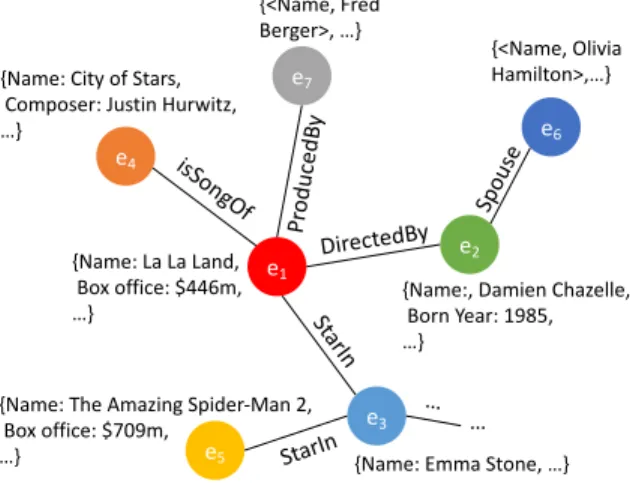
Figure 3.1: An example of related entities in the knowledge graph. e1 e2 DirectedBy e3 St arIn {Name: La La Land, Box office: $446m, …}
{Name: Emma Stone, …} {Name:, Damien Chazelle,
Born Year: 1985, …} {<Name, Fred Berger>, …} … isSongO f Produc edBy … e4
{Name: City of Stars, Composer: Justin Hurwitz, …}
e5
{Name: The Amazing Spider-Man 2, Box office: $709m, …} StarIn e6 Spou se {<Name, Olivia Hamilton>,…} e7
wheret.Ecare the central entities of the taskt. path(e, e′, G0)is the set of all possible paths from entity eto e′ in the knowledge graph G0 and dis(e, e′, G0) is the distance between the two entities which equals to the length of the shortest path. len(p) denotes the length of the path p. The neighbor entities can be directly connected to one of the central entities by a relation, or they can be connected by a path whose length is no larger thanθd. Note that
we add an extra relationship “SELF” connecting an entity with itself, which will be used later.
Example 3.6. As the example shown in Figure 3.1, the task is to classify online reviews according to the mentioned movies. There are a bunch of movie entities to be identified, includinge1 (“La La Land”) ande5 (“The Amazing Spider-Man 2”). The entity set of the subgraph is {e1, e2, e3, e4, e5} when we set the cut-off threshold of path length (θd) as 1. If we setθdto be 2, thene6 will be included in the entity set of the subgraph as well.
Given a sentences, how should we derive features based on the subgraph G? Intuitively, we first want to check whether any of the entities inG occurs ins, and if so, those matched entities in s would be relevant to the prediction task and thus should be the basis for constructing features. A most straightforward way to featurize text based on these entities is to directly use the entities themselves as the feature space. A document will be then represented as the matched entities in it, as the example shown in Example 3.7. We name the features generated by this featurization method as entity-based features.
Formally, the entity-based features extracted from a sentence s are defined as:
E(s) = {e∣e∈E∧v ∈name(e) ∧v = ⟨w1, . . . , wk⟩ ∧s= ⟨w′1, . . . , w′∣s∣⟩
∧w′j=w1∧. . .∧wj′+k−1 =wk∧j ≥1∧j+k−1≤ ∣s∣} (3.3)
where name(e) is the function to return the names of the entity e including all its aliases:
name(e) = {V(a)∣a∈e∧ K(a) =name}.
Example 3.7. Taking the document “I loved La La Land so much. City of Stars is my favorite song of the year” as an example, it is represented by the following vector given the subgraph shown in Figure 3.1 when using entity-based featurization:
(
e1 e2 e3 e4 e5 . . .
d 1 0 0 1 0 . . .)
We find two entities mentioned in the documents: e1 (“La La Land”) and e4 (“City of Star”).
3.3.2 Context-aware entity-based featurization
The related entities help to discover useful information in the text content. However, if we only use such entities as features, we would lose much context information about the mention of an entity. Apart from the occurrence of related entities, the contextual information is also helpful. In the example shown in Section 3.7, if we only want to know which movie the review “I love La La Land and City of Stars is my favorite song of the year” is talking about, the occurrence of “La La Land” and “City of Stars” provides enough information to infer that it is about the movie La La Land. However, if we also want to analyze the sentiment, it is hard to predict the sentiment polarity if the only information we can get is the occurrence of entities. In this case, what leads to a deeper understanding of the sentiment of the sentence is content like “I loved La La Land so much”.
In fact, context is helpful in many cases, it together with the mentioned entity tells us more detailed information. To capture the context information, we thus define our context-aware entity-based feature as a 3-tuple representing a combination of a mentioned relevant
entity with any n-gram from the “left context” and any n-gram from the “right context” of the mentioned entity.
To make such features more comparable with each other, we control the total length of the two “contextual” n-grams with a parameter l (i.e., requiring their total length to be l). Besides, to ensure relevance of the contextual n-grams, we further restrict the size of the context window on both sides of the entity to be not exceeding another parameter W.
Formally, given an entitye, the context-aware entity-based feature set for sentences with parameters l and W is defined as:
C(s, e, l, W) = {(⟨wi′, . . . , wi′+l1⟩, e,⟨wq′, . . . , wq′+l2⟩)∣v ∈name(e) ∧v= ⟨w1, . . . , wk⟩ ∧s= ⟨w1′, . . . , w∣′s∣⟩ ∧w′j=w1∧. . .∧wj′+k−1 =wk∧i+l1<j∧j−i≤W ∧q+l2≤ ∣s∣ ∧j+k−1<q∧q+l2− (j+k−1) ≤W∧l1+l2=l} (3.4) We can use multiple contextual phrase lengths (l) to generate the features. Denote the set of all the contextual phrase lengths we want to have as L. A document will then be represented by all the context-aware entity-based features that are extracted from it:
C(d, l, W) = ∪s∈d,e∈E,l∈LC(s, e, l, W) (3.5)
where E is the entity set of the knowledge graph that is used to extract the entity-aware entity-based features.
Example 3.8. Given a document “I loved La La Land so much. City of Stars is my favorite song of the year” and the knowledge graph shown in Figure 3.1. The document is represented as the following vector when we set both l and W as 2:
(
(⟨I love⟩, e1,⟨⟩) (⟨love⟩, e1,⟨so⟩) (⟨⟩, e4,⟨is my⟩) . . .
d 1 1 1 . . .)
3.3.3 Explanatory path-based featurization
Intuitively, entity-level features are semantically relevant to the prediction task, but they tend to cause data sparsity problem and cannot adapt to unseen data such as newly-emerging
entities. To address these limitations, we propose a method to transform the entity-level features to a explanatory path-based features that involve both entities and relations.
More specifically, we transform the entity in the entity-level features to its relationship with the central entities. This transformation is a novel idea in feature construction, which generalizes the original entity-level features without sacrificing relevance. Indeed, the relation provides an “explanation” why the entity can be potentially useful for the prediction task. Thus it generalizes much better than the original entities and is also more interpretable. Since entities that are related to the central entities in the same way can be expected to play a similar role in the prediction, merging them together as one (abstract) feature not only alleviates the sparsity problem in the feature space, but also ensures the needed generalization when we encounter entities not seen in the training data, because relation types are much more prevalent than individual entities.
Given an entitye and a set of central entities t.Ec, the explanatory path are defined as:
Ω(e, t.Ec) = {(T (p), e′)∣e′∈t.Ec∧p∈path(e, e′, G) ∧path(e, e′, G) =dis(e, e′, G)} (3.6)
where T (p) is a function to get all the relation types in pathp:
T (p) = ⟨V(r1.A1),V(r2.A1), ...V(rl.A1)⟩ if p= ⟨r1, r2, . . . rl⟩ (3.7)
Here we assume that each relationrhas type information as one of its attributes, and denote the corresponding attribute asr.A1 (the first element in the attribute set). Note that if the entity e is one of the central entities, then T (p) = ⟨“SELF”⟩.
Given a sentence s and an entity e, the explanatory path-based features are defined as:
P(s, e) =⎧⎪⎪⎨⎪⎪
⎩
Ω(e, t.Ec) if e∈ E(s);
∅ otherwise. (3.8)
Finally, a sentences is represented by all the explanatory paths that can be found in it:
P(s) = {P(s, e)∣e∈E} (3.9)
Example 3.9. Take the document “Emma Stone’s performance hits high notes. City of Stars is my favorite song of the year” as an example. Again, we have the knowledge graph shown in 3.1. Thera are two
central entities – “La La Land” (e1) and “The Amazing Spider-Man 2” (e5). We first extract the related entities mentioned in the document, namely “Emma Stone” (e3) and “City of Stars” (e4). In the next step, we find their explanatory paths to the central enti-ties, i.e.,{⟨(e3,starIn, e1)⟩,⟨(e3,starIn, e5)⟩},{⟨(e4,isSongOf, e1)⟩} for e1 and e4 respectively. Finally, we ignore the mentioned en-tity itself and utilize the rest link struction as features, which are {⟨(starIn, e1)⟩,⟨(starIn, e5)⟩} and {⟨(isSongOf, e1)⟩}. These fea-tures are used to represent the document:
(
{⟨(starIn, e1)⟩,⟨(starIn, e5)⟩} {⟨(isSongOf, e1)⟩} . . .
d 1 1 . . .)
By mapping the related entities to their explanatory paths, entities that are related to the central entities in a similar way can be grouped together. Note that if we keep the related entities in the explanatory paths, the formed feature space is equal to or larger than the entity-based feature space introduced in 3.3.1, which may even exacerbate the sparsity problem.
3.3.4 Context-aware explanatory path-based featurization
Though explanatory path-based featurization helps to reduce the degree of freedom by merging entities playing a similar role together in the feature space, it may also suffer from the information loss problem. For example, we still cannot identify the semantic polarity towards the song when we see the sentence “City of Stars is my favorite song of the year.” by using the explanatory path-based features even if we are aware that City of Stars is a song of La La Land. This is mainly due to the fact that the context information is missing. A solution to this problem is again to combine the context information.
Similar to the context-aware entity-based featurization, we also include the context words and construct so-called context-aware explanatory path-based features.
sentence s with parameters l and W is defined as:
M(s, e, l, W) = {(⟨w′i, . . . , w′i+l1⟩,Ω(e, t.Ec),⟨wq′, . . . , w′q+l2⟩)∣v∈name(e) ∧v= ⟨w1, . . . , wk⟩
∧s= ⟨w1′, . . . , w∣′s∣⟩ ∧wj′ =w1∧. . .∧w′j+k−1=wk∧i+l1<j∧j−i≤W ∧q+l2 ≤ ∣s∣ ∧j+k−1<q∧q+l2− (j+k−1) ≤W ∧l1+l2=l} (3.10) We can have multiple contextual phrase lengths (L) and the final context-aware entity-based features extracted from the document are:
M(d, l, W) = ∪s∈d,e∈E,l∈LM(s, e, l, W) (3.11)
Example 3.10. Given the knowledge graph shown in 3.1, the sentence “City of Stars is my favorite song of the year” will be represented by the following vector based on context-aware entity-based featurization by setting both l and W to be 2:
(
(⟨⟩,{⟨(isSongOf, e1)⟩},⟨is my⟩) . . .
d 1 . . .)
3.4 EXPERIMENT
In this section, we apply our method in two applications: (1) classifying reviews according to the mentioned movies; (2) predicting the revenue of movies based on reviews.
3.4.1 Dataset and experiment setup
We use the dataset in [5] to conduct our experiment. The dataset contains reviews of 1,718 movies released from 2005 to 2009. The reviews are collected by crawling Meta-Critic1. In the review classification task, we remove reviews with no more than 10 words because it is often hard to infer the referred movie from the short reviews. For example, reviews like “I love the movie” do not provide enough information for us to identify the movie labels.
Movies with no less than 12 reviews are remained in the dataset for the classification task. Finally, a dataset contains 1,354 movies are used, and these movies are considered as the class labels. 10-fold cross validation is used in this study to evaluate the performance of various features in entity-centric classification.
For the revenue prediction task, all the reviews from the original dataset are used. They are partitioned temporally into training, development and test set. Movies released from 2005 to 2007 are used for training; and those released in 2008 are included in the development set. Based on the history data, the future (2009) revenue performance is to be predicted. The central entities in the test set are all newly-emerging ones, reflecting the prediction task in a real-world application very well.
A logistic regression model with L-1 regularization is trained to identify the class labels for the movie review classification task. While a linear regression model with L-1 and L-2 regularization is trained to predict the movie revenue.
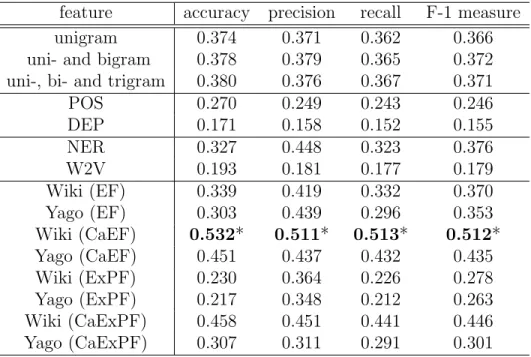
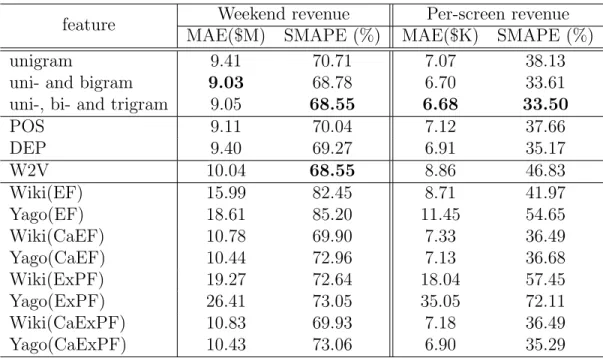
Four metrics are used to evaluate the performance of features in the classification tasks, namely, accuracy, precision, recall and F1 measure. To assess the performance of features in the revenue prediction task, we adopt two metrics – mean absolute error (MAE) and sym-metric mean absolute percentage error (SMAPE). The symsym-metric mean absolute percentage error is calculated as:
SM AP E= 1 n n ∑ i=1 ∣Fi−Ai∣ ∣Fi∣ + ∣Ai∣
where Ai is the actual revenue of the i-th movie and Fi is the predicted revenue. n is the
number of movies in the test set.
We employ two different knowledge graphs in our experiment. One is YAGO [9]. The other is constructed from the infobox of the corresponding Wiki page about the movies, merging the meta information such as authors, actors/actresses and directors of each movie provided by the dataset in [5].
3.4.2 Feature engineering in the entity-centric classification task
The primary goal of our study is to see what kind of features works best for the entity-centric classification and regression, and whether knowledge graph-assistant featurization is useful for such kind of applications.
We investigate four families of featurization methods. The first one is lexical features, including different kinds of n-gram features. The second one is syntactic features such as POS tags and dependency triples. The third one is semantic features. The named entity identified from the text are used to form the feature space. We also apply word embedding