A thesis submitted in fulfillment of the requirements for
the degree of Doctor of Philosophy
Mohammad Saidur Rahman
M.Sc (Computer Science)
B.Sc (Computer Engineering)
American International University Bangladesh (AIUB)
School of Science
College of Science, Engineering, and Health
RMIT University
Melbourne, Victoria, Australia
December, 2019
I certify that except where due acknowledgement has been made, the work is that of the author alone; the work has not been submitted previously, in whole or in part, to qualify for any other academic award; the content of the thesis is the result of work which has been carried out since the official commencement date of the approved research program; and, any editorial work, paid or unpaid, carried out by a third party is acknowledged. I acknowledge the support I have received for my research through the provision of an Australian Government Research Training Program Scholarship.
Mohammad Saidur Rahman 19 December, 2019
All praise and thanks to my God for granting me the opportunity and perseverance to undertake this research satisfactorily. I would like to express my sincere gratitude and appreciation to a group of people for their kind support, advice, guidance and inspiration. This work would not have been possible without their cooperation.
First and foremost, I would like to thank my senior supervisor, A/Prof. Ibrahim Khalil, who guided me to accomplish my research goals. His effective supervision, constructive criticism, endless encouragement and continuous support has always kept me motivated and ensured a smooth candidacy for completion of this research. I would like to thank him for his patience and sincerity in helping me reach the finishing line of my PhD journey. I would also like to thank my associate supervisor, Prof. Xun Yi and Dr. Hai Dong, for their advice and support. A special thanks to my beloved wife, Afrina Amir, who has been all time companion on this journey. Thanks for the support, encouragement, patient, unwavering love and care that I continuously receive. I would also like to thank my family. To my father, Mohammad Bazlur Rahman and my mother, Saleha Rahman, who always provided me mental strength and courage while being thousands of kilometres away. I am grateful for the sacrifice they made for me. Their prayers always helped me a lot. I would like to thank my in-laws, Md. Amir Ali and Monira Khatun, for their love, appreciation, and prayers throughout my PhD journey. I sincerely thank to my elder brother for taking care of our parents on my behalf. Thanks to my best friend Saiedur and his wife Tina for their extraordinary support on my arrival at Melbourne.
I would like to acknowledge RMIT University for providing me scholarships, resources and environment to support my research.
Portions of the materials used in this thesis have previously appeared or under consideration in the following scientific publications:
• Mohammad Saidur Rahman, Ibrahim Khalil, and Xun Yi. A Lossless DNA Data Hiding Approach for data Authenticity in mobile cloud based healthcare systems. International Journal of Information Management, 45:276–288, 2019. (Impact Factor: 5.06, SJR: Q1)- [Contribution: 70%]
• Mohammad Saidur Rahman, Ibrahim Khalil, Abdulatif Alabdulatif, and Xun Yi. Privacy preserving service selection using fully homomorphic encryption scheme on untrusted cloud service platform. Knowledge-Based Systems, 180:104-115, 2019. (Impact Factor: 5.10, SJR: Q1) - [Contribution: 70%]
• Mohammad Saidur Rahman, Ibrahim Khalil, Xun Yi., and Hai Dong. Highly Impercep-tible and Reversible Text Steganography Using Invisible Character based Codeword. In: Proceedings of the 21st Pacific Asia Conference on Information Systems (PACIS 2017), pp. 230, Langkawi, Malaysia, July 2017. (CORE Rank: A) - [Contribution: 70%]
• Mohammad Saidur Rahman, Ibrahim Khalil, Xun Yi, and Tao Gu. A Novel Privacy Preserving Search Technique for Stego Data in Untrusted Cloud. In: Proceedings of the 52nd Hawaii International Conference on System Sciences (HICSS 2019). pp. 4246.
(CORE Rank: A) - [Contribution: 70%]
• Mohammad Saidur Rahman, Ibrahim Khalil, and Xun Yi. Reversible Biosignal Steganog-raphy Approach for Authenticating Biosignals using Extended Binary Golay code. IEEE
Journal of Biomedical and Health Informatics. April 2020, (Accepted) - (Impact Factor: 4.21, SJR: Q1) - [Contribution: 70%]
• Mohammad Saidur Rahman, Ibrahim Khalil, Xun Yi, and Mohammed Atiquzzaman. Towards Privacy Preserving Edge Service Composition using Fully Homomorphic Cryp-tography. Engineering Applications of Artificial Intelligence. November 2019 (Provisionally Accepted with minor revision) (Impact Factor: 3.52, SJR: Q1) -[Contribution: 70%]
• Mohammad Saidur Rahman, Ibrahim Khalil, and Xun Yi. (2019). A Lossless Data Hiding based Authentication of Biosignals in Mobile Cloud Healthcare Systems. Inter-national Journal of Medical Informatics, November 2019,(Under revision) - (Impact Factor: 2.73, SJR: Q1) - [Contribution: 70%]
• Mohammad Saidur Rahman, Ibrahim Khalil, and Xun Yi. Privacy-Preserving Range Search Framework for Stego Data on Untrusted cloud. Knowledge-Based Systems, Octo-ber 2019,(Submitted) (Impact Factor: 5.10, SJR: Q1) - [Contribution: 70%]
Declaration iii
Acknowledgement iv
Credits v
Contents vii
List of Figures xiii
List of Tables xvii
Abstract 2
1 Introduction 3
1.1 Background and Motivation . . . 4
1.2 Preliminaries . . . 7
1.2.1 Steganography and Data Privacy . . . 7
1.2.2 Fully Homomorphic Encryption (FHE)-based Privacy Preserving Com-putation . . . 9
1.2.3 Fully homomorphic encryption (FHE) scheme . . . 10
1.3 Research Challenges . . . 11
1.4 Research Questions . . . 15
1.5 Research Contributions . . . 18
1.6 Thesis Organization . . . 21
2 Lossless Steganography method for Numerical Data 25 2.1 Motivation and Contribution . . . 27
2.1.1 Motivation . . . 27
2.1.2 Contributions . . . 28
2.2 Related Work . . . 29
2.3 Lossless Biosignal Steganography approach using Hamming Code . . . 31
2.3.1 Preliminaries . . . 31
2.3.2 Tagging Phase . . . 32
2.3.3 Generation of Stego Key . . . 35
2.3.4 Extraction of Secret Message and Reconstruction of Biosignal . . . 35
2.3.5 Security Strength . . . 37
2.3.6 Embedding Capacity . . . 39
2.4 Lossless Biosignal Steganography Method using Extended Golay Code . . . 39
2.4.1 Extended Binary Golay Code . . . 40
2.4.1.1 Construction of Generator Matrix and Parity Check Matrix . . 41
2.4.1.2 Encoding . . . 41
2.4.1.3 Decoding . . . 41
2.4.2 Embedding Phase . . . 43
2.4.3 Generation of Stego Key . . . 45
2.4.4 Extraction of Secret Message and Reconstruction of Biosignal . . . 46
2.4.5 Security Strength . . . 48
2.4.6 Embedding Capacity . . . 50
2.5 Performance Evaluation . . . 51
2.5.1 Reversibility . . . 51
2.5.2 Reliability . . . 52
2.5.3 Stego Data Effectiveness . . . 52
2.6 Experimental Results . . . 52
2.6.2 Analysis on Experimental Results . . . 53
2.6.2.1 Hamming Code based Lossless Biosignal Steganography . . . . 53
2.6.2.2 Extended Golay Code based Biosignal Stegnaogrpahy . . . 55
2.7 Summary . . . 62
3 Lossless Steganography for Textual Data 64 3.1 Motivation and Contribution . . . 65
3.1.1 Contributions . . . 67 3.1.1.1 DNA Steganography . . . 67 3.1.1.2 Text Steganography . . . 67 3.2 Related Work . . . 68 3.2.1 DNA Steganography . . . 68 3.2.2 Text Steganography . . . 69
3.3 Lossless and Blind DNA Steganography . . . 70
3.3.1 Preliminaries . . . 70
3.3.2 Notations . . . 71
3.3.3 Methodology . . . 72
3.3.3.1 Data Hiding Procedure . . . 72
3.3.3.2 Extraction and Reconstruction Procedure . . . 79
3.4 Security Analysis . . . 81
3.5 Performance Analysis and Experimental Results . . . 83
3.5.1 Performance Analysis . . . 83
3.5.2 Experimental Results . . . 84
3.6 Lossless and Highly Imperceptible Text Steganography Approach . . . 88
3.6.1 Encoding Secret Message . . . 89
3.6.1.1 Example 1 . . . 90
3.6.2 Embedding Secret Message . . . 91
3.6.3 Generation of Stego Key . . . 92
3.6.3.1 Example 2 . . . 93
3.6.4.1 Example 3 . . . 94
3.6.5 Experimental Results and Performance Analysis . . . 95
3.7 Summary . . . 98
4 Privacy Preserving Search over Stego Data 100 4.1 Motivations and Contributions . . . 101
4.2 Related Work . . . 103
4.3 System Model . . . 104
4.4 Privacy Preserving Keyword Search for Stego Data . . . 105
4.4.1 Threat Model . . . 105
4.4.2 Design Goals . . . 106
4.4.3 Construction of Stego Database . . . 107
4.4.4 Building Secure Search Index . . . 107
4.4.5 Construction of the Backdoored Hash Generation Function . . . 111
4.4.6 Privacy Preserving Query for Searching Stego Data . . . 112
4.4.7 Performance Analysis . . . 112
4.4.7.1 Privacy of search index. . . 112
4.4.7.2 Privacy of query operation. . . 113
4.4.7.3 Functionality and efficiency. . . 113
4.4.7.4 Scalibility. . . 114
4.4.8 Experimental Results and Discussion . . . 114
4.4.8.1 Experimental Setup . . . 114
4.4.8.2 Evaluation . . . 116
4.5 Privacy Preserving Ranged Search for Stego Data . . . 117
4.5.1 Symmetric Order-Preserving Encryption . . . 117
4.5.2 Preliminaries . . . 118
4.5.3 Design Goals . . . 119
4.5.4 Proposed Privacy Preserving Range Search Over Stego Database . . . . 121
4.5.4.1 Construction of Stego Database . . . 121
4.5.4.3 Building Secure Search Index for Range Search . . . 122
4.5.4.4 Privacy Preserving Range Query for Searching Stego Data . . 125
4.5.4.5 Performance Analysis . . . 126
4.5.5 Experimental Results and Discussion . . . 128
4.5.5.1 Experimental Setup . . . 129
4.5.5.2 Experimental Results and Analysis . . . 130
4.6 Discussion . . . 131
4.7 Summary . . . 132
5 Privacy Preserving Service Computation in Edge Computing 134 5.1 Motivations and Contributions . . . 136
5.1.1 Motivations . . . 136
5.1.1.1 Contributions . . . 138
5.2 Related Work . . . 140
5.2.1 Edge Service Composition . . . 140
5.2.2 Privacy preserving approaches in traditional service computing . . . 141
5.3 Preliminaries . . . 142
5.3.1 Fully homomorphic encryption (FHE) scheme . . . 142
5.3.1.1 The BGV Fully Homomorphic Encryption Algorithm . . . 144
5.3.2 MapReduce Model . . . 146
5.4 Proposed Edge Service Model . . . 147
5.4.1 Functional dependency . . . 151
5.4.2 Composability and Composability Matrix . . . 152
5.4.3 QoS Model for Privacy Preserving Service Selection Framework . . . 153
5.4.4 QoS-aware Service Selection Approach . . . 154
5.5 Privacy Preserving Edge Service Composition Framework using Fully Homo-morphic Encryption . . . 155
5.5.1 QoS-aware Edge Service Composition . . . 155
5.5.2 Proposed Privacy Preserving QoS-aware Composite Service Selection us-ing Fully Homomorphic Cryptography . . . 160
5.5.2.1 Privacy Preserving Composite Service Selection based on a
MapReduce Model . . . 162
5.5.2.2 Computational Complexity . . . 164
5.5.2.3 Analysis of Privacy Preservation . . . 164
5.6 Experimental Results and Discussion . . . 165
5.6.1 Experimental Setup . . . 165
5.6.2 Experimental Results and Performance Evaluation . . . 168
5.7 Summary . . . 171
6 Conclusion 172 6.1 Concluding remarks and discussion . . . 172
6.1.1 Lossless Steganography for Numerical Data . . . 173
6.1.2 Lossless Steganography for Textual Data . . . 174
6.1.3 Privacy preserving search mechanism for stego data . . . 175
6.1.4 Privacy preserving service computation framework . . . 176
6.2 Limitations and Future Directions of Research . . . 177
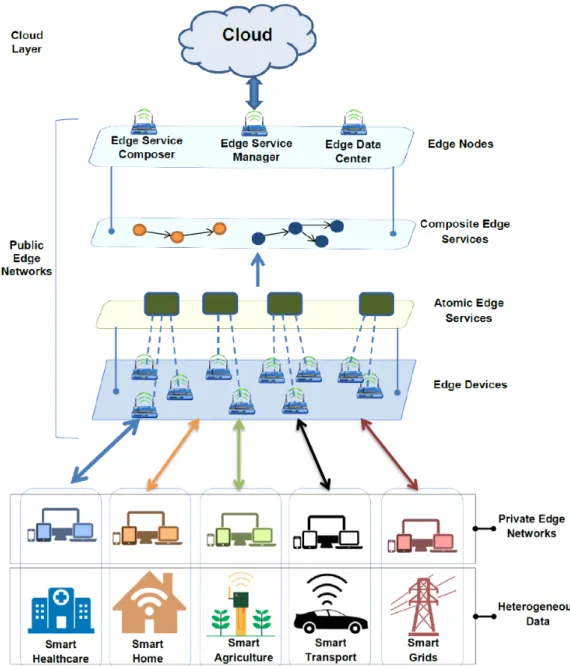
1.1 An architecture of Edge Computing based service systems . . . 5
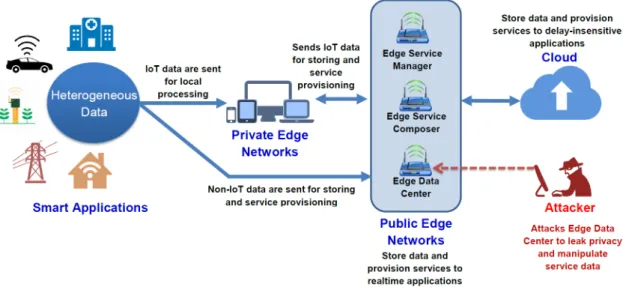
1.2 Privacy issues of storing data and service provisioning in the Edge Computing . . 6
1.3 The general model of steganography . . . 8
1.4 Different types of cover medium used in steganography . . . 9
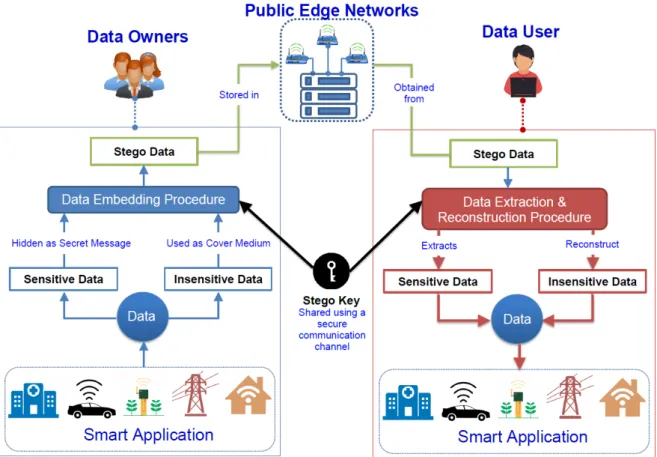
1.5 Overview of steganography based privacy-preservation model of sensitive data . . 10
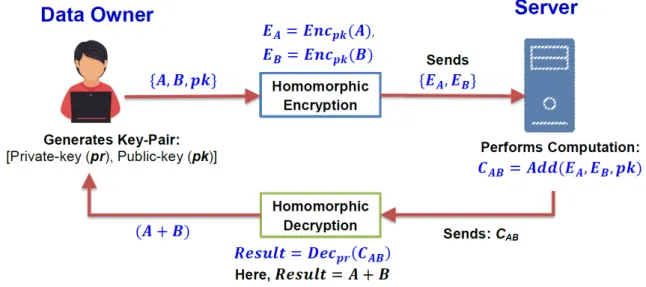
1.6 Overview of Homomorphic Encryption (HE) based privacy-preserving computa-tion model . . . 11
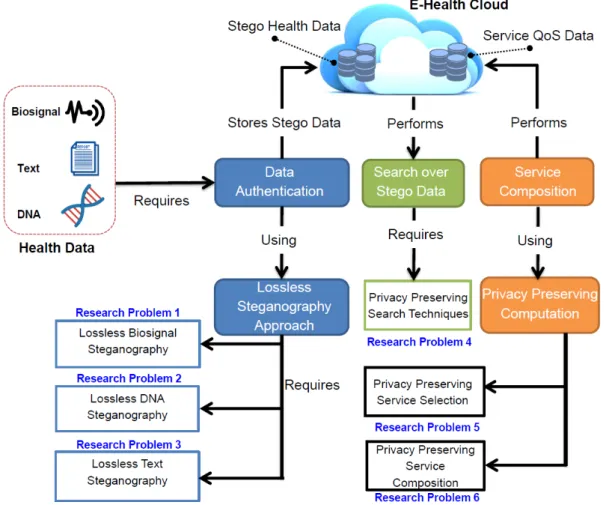
1.7 A lossless steganography and privacy-preserving service computation related re-search problems. . . 15
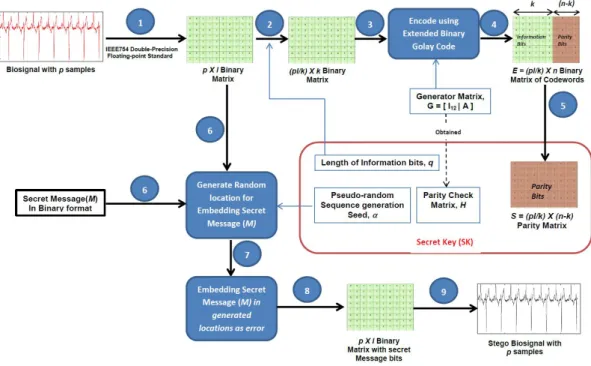
2.1 Overall View of the tagging Procedure . . . 34
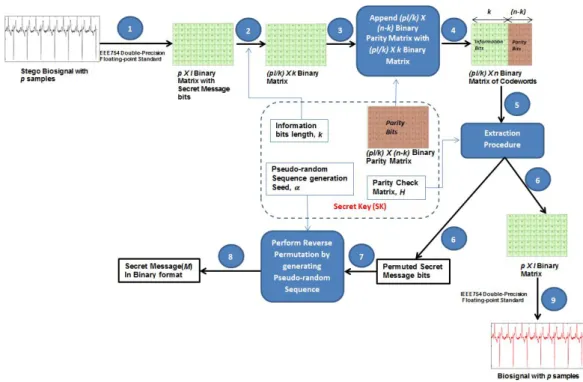
2.2 Overall View of the extraction and reconstruction procedure . . . 38
2.3 Overall View of Embedding Procedure . . . 43
2.4 Overall View of Extraction Procedure . . . 50
2.5 Comparison of PRD in stego biosignals between our proposed method and the work in [1] : (a) ECG signal, (b) PPG signal, and (c) EEG signal . . . 55
2.6 Three states of biomedical signals: (a) original signal, (b) stego signal, and (c) reconstructed signal . . . 58
2.7 Comparison of reconstructed biosignals with respect to original biosignals: (a) original vs reconstructed ECG, (b) original vs reconstructed PPG, and (c) original vs reconstructed EEG. . . 58
2.8 Comparison of imperceptibility of stego biosignals with respect to original biosig-nals for 608 and 1024 bits secret messages. (a) original vs stego ECG (608 bits), (b) original vs stego PPG (608 bits), (c) original vs stego EEG (608 bits), (d) original vs stego ECG (1024 bits), (e) original vs stego PPG (1024 bits), and (f)
original vs stego EEG (1024 bits). . . 59
2.9 Comparison of distortions or PRDs (in %) of stego biosignals. PRDs when secret data with different lengths are embedded: (a) ECG Stego signals (608 bits), (b) PPG Stego signals (608 bits), (c) EEG Stego signals (608 bits), (d) ECG Stego signals (1024 bits), (e) PPG Stego signals (1024 bits), and (f) EEG Stego signals (1024 bits). . . 61
3.1 Hiding Phase of Embedding Procedure: (a)illustrates nucleotide selection for the row pointed by an elementp2 of pseudo-random sequencePα and pseudo-random sequence Qp2, (b) demonstrates how codeword is generated from selected nu-cleotides in (a) usingsubstitution rule, and(c)represent how combined codeword is used to produce stego DNA sequence andpayload (R). . . 75
3.2 Stego DNA Sequence (C) Generation Phase of Embedding Procedure . . . 76
3.3 Illustration of the stego key size . . . 78
3.4 Generated Huffman Tree for Binary Secret Message . . . 89
3.5 Relationship among H,H0,E,R and Me . . . 92
3.6 Demonstration of Imperceptibility of Proposed method. (a) Cover Text File, and (b) Stego Text File. . . 97
3.7 Reversibility of Proposed Method . . . 97
3.8 Comparison of proposed method with existing work with respect to Impercepti-bility and Payload . . . 98
4.1 System model of privacy preserving search over stego data on the untrusted edge data centre . . . 104
4.2 Illustration of the Stego DatabaseDBS construction process. . . 106
4.4 Comparison of times for generating stego database (DBS) in kilo seconds for
different number of stego documents in thousand. . . 115 4.5 Comparison of times for building search index (SI) in milliseconds for different
number of stego documents in thousand. . . 115 4.6 Comparison of times in milliseconds for searching a stego document in the search
indexSI for different number of stego documents in thousand. . . 116 4.7 Demonstration of execution times required for generating stego database (DBS)
in seconds for: (a) different number of stego documents and fixed number of sensitive attributes (k = 25), and (b) different number of stego documents and variable number of secret attributes (k= 5,10,15,20,25). . . 129 4.8 Demonstration of execution times required for generating search index (SI) in
seconds for: (a) different number of stego documents and fixed number of sensitive numerical attributes (k= 25), and (b) variable number of secret attributes (k= 5,10,15,20,25) and same number of stego files (n= 100X103). . . 130 4.9 Query execution times in seconds for range search of stego documents in the search
indexSI for different number of search attributes and fixed number of stego files inDBS (n= 100×103). . . 131
5.1 Privacy threat in edge based QoS-aware edge service computation . . . 136 5.2 The MapReduce processes for counting words in a text. . . 146 5.3 An atomic edge service, Sj. Here, Fi is the functionality provided by the i-th
edge deviceeji of j-th atomic edge serviceSj. All of the edge devices have same
functionality inSj (i.e, e11.F1 =e11.F2 =. . . ..=e11.Fm). . . 150
5.4 A composite edge service . . . 151 5.5 Privacy Preserving Service Selection based on a MapReduce Model . . . 162 5.6 The comparison of times required to generate encrypted QoS database among
methods without MapReduce (EQoSDbGen) and with MapReduce ( EQoSDbGen-MR) for different number of edge nodes. . . 167
5.7 The comparison of times finding the best composite edge service for PT-QSC,
PP-QSC,PP-QSC-MR-EN2,PP-QSC-MR-EN4,PP-QSC-MR-EN6, PP-QSC-MR-EN8, and PP-QSC-MR-EN10. . . 169 5.8 The comparison of scalability of PT-QSC,PP-QSC,PP-QSC-MR-EN2,
PP-QSC-MR-EN4,PP-QSC-MR-EN6,PP-QSC-MR-EN8,PP-QSC-MR-EN10.169 5.9 The comparison of execution times of the proposed framework for different number
2.1 The Summary of Related Work . . . 30
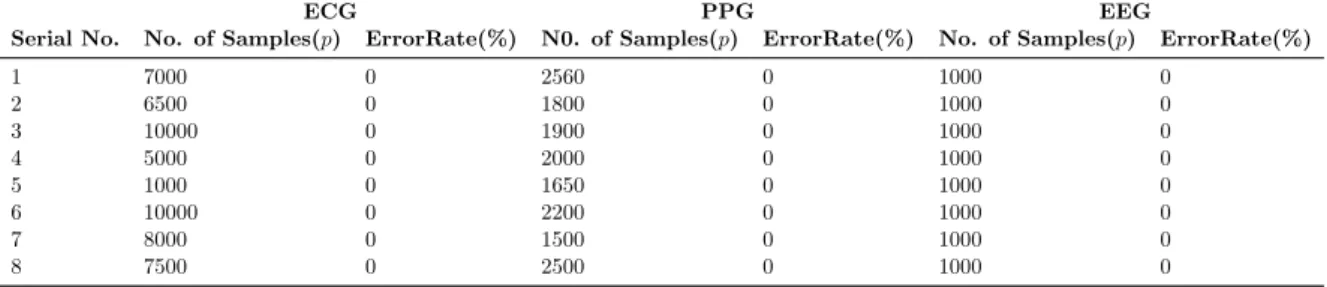
2.2 Error Rate (ErrRate) of Reconstructed Biosignal in the Proposed Steganography Method for ECG, PPG and EEG Data (Secret message size,q = 608 bits) . . . 56
2.3 The PRD Results for ECG Signal . . . 56
2.4 The PRD Results for PPG Signal . . . 56
2.5 The PRD Results for EEG Signal . . . 57
2.6 BER of Retrieved Secret Message from ECG, PPG and EEG Signals . . . 57
2.7 Error Rate (Rateerr) of Reconstructed Biosignal in the Proposed Steganography Method for ECG, PPG and EEG Data (Secret message size,q = 608 bits) . . . 57
2.8 The PRD Results for ECG Signal . . . 59
2.9 The PRD Results for PPG Signal . . . 60
2.10 The PRD Results for EEG Signal . . . 60
2.11 Bit Error Rate (Rateb) of Retrieved Secret Message from ECG, PPG and EEG Signals . . . 60
3.1 An Example of Substitution Rule (SR) . . . 74
3.2 Sample DNA Sequences that are used as Cover Medium . . . 85
3.3 The Error Rate of Proposed Method (Fixed secret message size,n= 2000 bits) . 85 3.4 The Error Rate of Proposed Method (Fixed DNA sequence, locus=AC153526, number of nucleotides = 200,117) . . . 86
3.5 The Capacity of Proposed Method for Different DNA Samples (Secret Message size, n= 2000bits) . . . 86
3.6 The Expansion Rate (ER) of Proposed Method (Secret Message size,n= 2000bits)
. . . 87
3.7 The Execution Time of Proposed Algorithm for Different DNA Samples (Secret Message size, n= 2000 bits) . . . 87
3.8 A comparison of the proposed method with closely related works . . . 88
3.9 The Coding Table,T . . . 90
3.10 Embedding Capacity of Proposed Method (Cover File Size 148416 bits) . . . 96
3.11 Bit Error Rate of Proposed Method . . . 96
4.1 The summary of symbols . . . 120
4.2 Comparison with existing work . . . 132
5.1 The summary of symbols . . . 143
Edge computing or fog computing enables realtime services to smart application users by stor-ing data and services at the edge of the networks. Edge devices in the edge computstor-ing handle data storage and service provisioning. Therefore, edge computing has become a new norm for several delay-sensitive smart applications such as automated vehicles, ambient-assisted living, emergency response services, precision agriculture, and smart electricity grids. Despite having great potential, privacy threats are the main barriers to the success of edge computing. At-tackers can leak private or sensitive information of data owners and modify service-related data for hampering service provisioning in edge computing-based smart applications. This research takes privacy issues of heterogeneous smart application data into account that are stored in edge data centers. From there, this study focuses on the development of privacy-preserving models for user-generated smart application data in edge computing and edge service-related data, such as Quality-of-Service (QoS) data, for ensuring unbiased service provisioning.
We begin with developing privacy-preserving techniques for user data generated by smart applications using steganography that is one of the data hiding techniques. In steganography, user sensitive information is hidden within nonsensitive information of data before outsourc-ing smart application data, and stego data are produced for storoutsourc-ing in the edge data center. A steganography approach must be reversible or lossless to be useful in privacy-preserving techniques. In this research, we focus on numerical (sensor data) and textual (DNA sequence and text) data steganography. Existing steganography approaches for numerical data are irre-versible. Hence, we introduce a lossless or reversible numerical data steganography approach using Error Correcting Codes (ECC). Modern lossless steganography approaches for text data steganography are mainly application-specific and lacks imperceptibility, and DNA
steganog-raphy requires reference DNA sequence for the reconstruction of the original DNA sequence. Therefore, we present the first blind and lossless DNA sequence steganography approach based on the nucleotide substitution method in this study. In addition, a text steganography method is proposed that using invisible character and compression based encoding for ensuring re-versibility and higher imperceptibility. Different experiments are conducted to demonstrate the justification of our proposed methods in these studies.
The searching capability of the stored stego data is challenged in the edge data center without disclosing sensitive information. We present a privacy-preserving search framework for stego data on the edge data center that includes two methods. In the first method, we present a keyword-based privacy-preserving search method that allows a user to send a search query as a hash string. However, this method does not support the range query. Therefore, we develop a range search method on stego data using an order-preserving encryption (OPE) scheme. In both cases, the search service provider retrieves corresponding stego data without revealing any sensitive information. Several experiments are conducted for evaluating the performance of the framework.
Finally, we present a privacy-preserving service computation framework using Fully Ho-momorphic Encryption (FHE) based cryptosystem for ensuring the service provider’s privacy during service selection and composition. Our contributions are two folds. First, we introduce a privacy-preserving service selection model based on encrypted Quality-of-Service (QoS) val-ues of edge services for ensuring privacy. QoS valval-ues are encrypted using FHE. A distributed computation model for service selection using MapReduce is designed for improving efficiency. Second, we develop a composition model for edge services based on the functional relation-ship among edge services for optimizing the service selection process. Various experiments are performed in both centralized and distributed computing environments to evaluate the performance of the proposed framework using a synthetic QoS dataset.
Introduction
The availability and popularity of ubiquitously linked smart devices are building a critical factor in computing. The Internet-of-Things (IoT) [2] are connecting millions of wearable and smart devices, machines, and vehicles via wireless networks. Hence, interconnected devices are capable of collecting and exchanging various types of data among themselves [3,4]. As a result, IoT is making everything connected and smarter, and a variety of applications can leverage the power of IoT for providing fine-grained services for users. IoT devices face challenges of processing power, battery lifetime, storage, and network bandwidth in general [5]. However, IoT devices generate a massive amount of data and require further processing for providing smart services to end users. Conventionally, IoT data are uploaded to central servers, and results are sent to end users after processing. Cloud computing technology has become a popular choice for IoT applications [5]. The cloud computing provisions several services to end users at low cost with elastic resources with regard to infrastructure, platform, and software [6].
Nevertheless, cloud computing is not a universal solution to all IoT applications. Uploading IoT data to the cloud for storing and processing requires high network bandwidth. Hence, data transmission costs are increased. Additionally, the performance of the overall system degrades with an increased amount of IoT data. The performance aggravates for IoT applications that are delay-sensitive, also known as realtime applications. In a delay-sensitive application, the response time is non-negotiable. Automated vehicles [7] in smart transportation,
assisted living in [8] smart healthcare, emergency response services [9] in smart city, precision agriculture [10] and smart electricity grids [11] are few examples of delay-sensitive IoT ap-plications. Moreover, many IoT applications require mobility support, geo-distribution, and location-awareness. In order to reduce latency, data storage and processing need to be done at proximity. From that point, cloud computing is not a feasible solution for the aforementioned realtime IoT applications.
Edge computing, or fog computing, encompasses data storage and computing at the network ”edge”, callededge node or edge devices [12, 13, 14]. Smartphones, tablets, laptops, personal computers, access points, roadside units, and cellular base stations are a few examples of edge nodes. As these devices are located nearby, data flows between edge and IoT devices require less transmission cost and achieve faster response time. In addition, the bandwidth requirements of the cloud servers are mitigated by the edge nodes. Thus, computation and data storage tasks are offloaded to edge nodes for providing computation and storage as services.
IoT devices, edge nodes, and cloud form a layered hierarchical service delivery model for realtime IoT applications. Figure 1.1 presents a typical edge computing based service systems. IoT devices produce heterogeneous types of data and send them to local edge devices within a private edge networks. Local edge devices perform initial processing, and send data and service requests to public edge networks. The public edge networks containsedge data centers
and edge service managers. An edge data center stores IoT data for realtime access. On the other hand, an edge service manager handles service requests from IoT applications. The edge computing based service system supports a wide range of applications such as smart healthcare [15], smart homes [16], smart agriculture [17], smart transportation [18], and smart electricity grids [11]. Since edge computing is considered as a significant extension of cloud computing, some security and privacy issues of cloud computing exist in the edge computing [6]. The security and privacy threats would unavoidably hamper the vision of edge computing.
1.1
Background and Motivation
Edge computing is offered by the Internet and cellular services providers. Hence, these service providers that act as edge service providers deploy Wireless access points and cellular base
Figure 1.1: An architecture of Edge Computing based service systems
stations as edge nodes and form public edge networks. Thus, edge node-based data centers and service managers are controlled by the Internet and cellular services providers. Edge computing allows the addition of new edge nodes by its service providers on demand. As a result, rogue nodes can be included by attackers who pretend to be valid nodes. These rogue nodes can scan valuable data to leak private or sensitive information of data owner and
Figure 1.2: Privacy issues of storing data and service provisioning in the Edge Computing
modify service-related data for hampering service provisioning in edge computing based smart applications.
As smart applications collect a massive amount of data about an object (human or machine), the leakage of sensitive information from data is gaining attention by edge service providers. By gathering several sensitive or private information of a data owner, edge service providers can target particular service users and customize their service offers. It is also possible that data owners’ sensitive information would be misused. For example, reading a particular house’s smart meter data will disclose lots of information about residents of a house. Thus, preserving the privacy of data owners is extremely important. However, data quality and usability should not be reduced while privacy is preserved.
Nevertheless, authorized data users may require access to sensitive information of particular data owners for ensuring accurate services. For instance, a doctor needs to identify a patient to provide remote health services in an ambient assisted living application. A legitimate user of a particular data needs to search and retrieve the data from the edge data center. However, it is crucial to ensure that sensitive information is not revealed to the unauthorized entities in edge computing during a search operation. In other words, the search operation should be performed in a privacy-preserving manner.
In order to ensure realtime services with reduced response time in edge computing, cloud services are offloaded from cloud to several edge nodes in a distributed manner. Unlike cloud services, a service orchestration or composition is required for ensuring optimal service expe-rience to service users. Edge data centers store service-related data such as Quality-of-Service (QoS) values. One or more edge nodes may act as service composers for performing service orchestration tasks using these QoS values. In general, QoS data in the edge data center would be stored as plaintexts. Hence, the stored QoS data in the edge data center can be modified by attackers to gain service providers’ service-related sensitive information, and privacy can be leaked. In addition, QoS data can be modified by an attacker to influence the service compo-sition tasks. Therefore, privacy preservation deemed necessary during service compocompo-sition as well. Figure 1.2 illustrates several privacy issues in edge computing.
This research addresses two types of privacy issues in edge computing. First, the privacy of data owners who store their data in the edge data centers. Second, the privacy of service-related data that are used during service selection and composition tasks. In this research, we aim to use the secure data hiding technique, calledsteganography [19], as the tool for ensuring the privacy of data owners in smart applications. On the other hand, we use Fully Homomor-phic Encryption (FHE)[20] based privacy-preserving computation approach for preserving the privacy of the service selection and composition process.
1.2
Preliminaries
Before going into the technical details, this section provides an overview of a few essential ter-minologies that include steganography based data privacy and FHE-based privacy-preserving computation.
1.2.1 Steganography and Data Privacy
Steganography is one of the data hiding techniques that store secret messages inside data. The hiding is performed in a way so that the existence of the secret message inside the public medium is obscured. The data that contains secret information is known as cover data. The
Figure 1.3: The general model of steganography
data produced after performing the steganography is called stego data. A sender of commu-nication uses a set of secret information for securing the steganography process. The set of secret information is called stego key. Hiding the secret message inside a cover data produces stego data. The sender shares the stego key with the intended receiver of the communication privately. Later, the sender sends the stego data to the receiver. A receiver uses the key to retrieve the secret message from stego data. The main strength of steganography is that it makes it difficult for the eavesdropper to figure out where the message is [21]. The general model of the steganography process is presented in Figure 1.3.
In literature, the steganography is widely used for providing privacy and authenticity to sen-sitive data in covert communication [1,22]. In edge computing based service systems, ensuring privacy of smart application data is extremely important. Including sensitive information with outsourced data in the edge data center alleviates the risk of privacy breach. Thesteganography
is a popular approach for ensuring privacy in several applications [22, 23,24]. For example, patient sensitive information can be embedded inside health data (wearable sensor or IoT data, and pathological test data) prior to uploading in edge data center. A legitimate data user (e.g. a doctor) can retrieve a patient secret identification information if required. However, the
doc-tor can use the stego patient data for diagnosis purpose without knowing patient identity. An overview of steganography based data privacy preservation model on edge computing is illus-trated in Figure 1.5. Cover mediums that are used in steganography can be classified asimage,
audio,video,numerical, genomic and text data types (please refer to Figure 1.4). Image is the most widely used cover medium used in the steganography [25,26,27,28,29,30,31, 32,33]. However, steganography is also performed on audio [34,35] and video [36,37]. Other popular supported cover medium types are numerical data (e.g. signal or sensor data) [22,1,23], text [38, 39, 40, 41], and genomic (e.g. DNA) [42, 43, 44, 45] data types. Collectively, text and DNA data types can be considered as textual cover medium.
Figure 1.4: Different types of cover medium used in steganography
1.2.2 Fully Homomorphic Encryption (FHE)-based Privacy Preserving Computation
The ability of Homomorphic Encryption (HE) has been studied broadly in the last few years for performing computations on encrypted data. HE has inspired many researchers to employ it in many real-world application domains such as financial, healthcare, and IoT. With the help of the HE cryptosystem, individuals and enterprises can encrypt their data and delegate to any third party for conducting specific analysis tasks on encrypted data. Figure 1.6 shows the main functionalities of Homomorphic Encryption (HE).
Data owners desire to secure their data while it is stored and handled by a third party, such as a cloud computing provider. HE was first proposed by Rivest [46] where the privacy homo-morphism concept was used to carry out computations in an encrypted domain. Consequently,
Figure 1.5: Overview of steganography based privacy-preservation model of sensitive data
many other HE schemes have been proposed, such as ElGamal [47] and Paillier [48]. However, these schemes are unable to carry out a variety of computations on encrypted data. In 2009, Gentry [20] introduced the first Fully Homomorphic Encryption (FHE) scheme.
1.2.3 Fully homomorphic encryption (FHE) scheme
The FHE scheme supports basic arithmetic computations on encrypted data. Hence, FHE is used as a privacy-preserving technique. The work in [20] follows properties of ideal lattices [49]. FHE supports an unlimited number of arithmetic operations. As a consequence of the work in [20], several homomorphic encryption schemes are proposed based on three branches: lattice-based [50,51], integer-based and learning with errors (LWE) [52] or ring-learning-with-errors (RLWE) [53] based encryption. Despite being a potential cryptographic technique, some of the FHE schemes remain quite impractical for real-world applications due to their computational
Figure 1.6: Overview of Homomorphic Encryption (HE) based privacy-preserving computation model
overhead and the number of resources that they require for computations.
1.3
Research Challenges
In this thesis, we aim to address key challenges related to steganography based data pri-vacy preservation and FHE based pripri-vacy-preserving service computing on edge computing. Steganography causes distortion in the cover medium [22, 54]. For example, hiding a secret message inside a cover image by altering the least significant bit (LSB) of the image deteriorates its quality. The steganography process is called lossy or Irreversible if the full reconstruction of a cover medium is not possible from stego medium. Lossless or reversible steganography is a process that reconstructs a cover medium after extracting the hidden information from the stego medium. The reconstruction of the cover medium is not very important, where the cover medium is only the carrier of secret message in the communication system. However, there are applications where the cover medium must be exactly reconstructed. Assume that smart ap-plications that store IoT data (numerical and textual data) in edge data centers, must require accurate data for the success of the applications. Smart meter reading in smart electricity grid applications, and remote patient monitoring data (e.g., biosignals), and genomic data (e.g.,
deoxyribonucleic acid or DNA) and medical records in text format in smart healthcare are few examples of applications that require a reversible or lossless cover medium for successful steganography. The aforementioned numerical and textual data types cannot tolerate data loss. Therefore, applying steganography for privacy preservation of numerical and textual data types is challenging. As lossless steganography approaches for the aforementioned data types are still unexplored, we develop lossless or reversible steganography approaches in this research for texts, DNA sequences, and biosignals. A summary of several reversible steganography ap-proaches for image [26], audio [55], and video [56] have already been proposed. Therefore, we do not consider reversible steganography approaches for image, audio, and video in this research.
The data owners hide their sensitive information within their data and produce stego data. The stego data are outsourced to the edge data center for storing and further use. Storing stego data introduces a new challenge. The challenge is searching the stego data of a particular data owner from the cloud without revealing the identity of the data owner. Privacy-preserving search techniques for encrypted data is a popular research area [57, 58, 59, 60]. However, existing privacy-preserving search approaches are not applicable for stego data due to the difference in fundamental characteristics of stego data and encrypted data. From there, we propose a privacy-preserving search mechanism over stego data.
The edge computing provides a service platform for several realtime service providers in smart applications. A service provider registers his/her service information in edge nodes acting as a service registry. An edge node that is playing the role of service manager takes service queries from service users and performs a service selection process to find suitable services. The service’s quality-of-service (QoS) parameters are used to perform the service selection process. Later, a QoS-aware service composition mechanism is performed by the edge node functioning as a service composer to find the best composite service for the requesting user. As we have discussed earlier, the service selection and composition process can be biased. An attacker can modify the QoS information to give advantage to one or more service providers. Therefore, we present a privacy-preserving framework for service computation using fully homomorphic encryption (FHE).
Summary of the key research challenges are discussed below under two broad categories: • Challenges of steganography approaches:
– In order to use steganography for privacy preservation in edge computing, steganog-raphy methods need to be lossless for appropriate use in smart applications.
– Steganography methods are data type-specific. A steganography approach for a particular data type cannot be applied to other data types due to the fundamental differences in characteristics. As smart applications involve heterogeneous data types, different lossless steganography approaches are required.
– Existing numerical steganography approaches [22,1, 61, 62, 63] fail to reconstruct cover medium after extraction of secret information. Therefore, these methods can-not be used for privacy preservation of smart application data in edge computing. To the best of our knowledge, a reversible or lossless numerical steganography method does not exist.
– Though several lossless steganography approaches for text documents [64,65,39,66] have been proposed so far, these approaches are not useful in the context of smart applications due to some limitations. The imperceptibility of text cover medium is very low in general. A slight modification in a text file content is easily detectable [64]. Various researches on text steganography have been done so far. The research works in [65,39] are based on degenerating the document content. These approaches are application-specific. Compression based text steganography approaches are pro-posed in [64,66]. These works compress the cover file to produce a stego file. Thus, the stego files cannot be used for general purpose and become more attractive for an attack. In addition, current methods are not applicable for small text data such as social networks blogs. A high capacity text steganography method is required to ensure the privacy of social networks blogs text data in edge computing.
– Most of the current DNA sequence steganography methods are not blind, i.e., origi-nal cover DNA sequence data is required as reference during extraction of secret mes-sage [42,43,44,67,68,69]. Therefore, the aforementioned DNA steganography
tech-niques are not usable in our scenario. Moreover, research works in [44,68,69,70,71] result in high modification rate of cover DNA sequence data and are irreversible.
– Data characteristics of stego data need to be preserved to protect against security attacks. The imperceptibility of the stego data becomes less if the data character-istics of stego data are not preserved. As a result, distorted stego data attracts the attacker, and the robustness of the steganography method becomes poor. Addi-tionally, using highly distorted stego data for research and analysis purposes in our scenario may provide inaccurate results.
– The development of privacy-preserving data retrieval techniques is challenging for stego data in the cloud. In order to retrieve stego data of an individual, the secret key needs to be given to the cloud for extracting the secret identifier of the stego data and return it to the user. In this case, no privacy is preserved. If the secret key cannot be provided to the cloud, all of the stego data needs no be downloaded by the user at the local system and perform the query. It is not a practical solution. To the best of our knowledge, no privacy-preserving data retrieval technique exists for stego data in the cloud. Several research works in [72,73,74,75,76,77,78,79,80] have been done on privacy-preserving data retrieval for encrypted data. However, the research works are not applicable for data retrieval from stego data due to fundamental differences between stego data and encrypted data.
• Challenges of privacy-preserving service computation:
– Existing privacy-aware service selection and composition approaches model relation between user and service provider privacy preferences. To the best of our knowledge, no research work exists that performs service selection and composition, keeping corresponding QoS values private.
Figure 1.7: A lossless steganography and privacy-preserving service computation related re-search problems.
1.4
Research Questions
The main research objective of this thesis is two folds. First, we aim to develop a lossless or reversible steganography methods to ensure the privacy of numerical, text, and DNA data in the edge computing. Second, we aim to build a privacy-preserving service computation framework for the edge computing based service systems. The targeted research problems in this thesis are summarized in Figure 1.7.
In order to overcome the aforementioned research challenges the following research questions are defined with the aim of achieving a lossless steganography and privacy-preserving service computation related research problems.
Aim-1. Developing lossless steganography techniques for building privacy preserv-ing model
RQ-1. How to develop lossless or reversible steganography method to hide secret information within numerical data?
This question addresses the deteriorating characteristics of the numerical steganography ap-proach. Applying the existing numerical steganography approaches, some of the data in the cover signal are lost after the extraction of sensitive information from stego numerical data. In this question, we apply error correction codes based on Hamming Code [81] and Golay code [82]. In order to ensure the lossless property of numerical data, we hide sensitive information as error bits in the cover numerical data by encoding with the aforementioned error correction codes at the data owner’s end, and correct errors by decoding with these codes at legitimate user’s side.
RQ-2. How to develop lossless and blind steganography method for DNA sequence data types with low modification rate?
This research question is designed to address issues with irreversible or lossy characteristics, dependence on a reference DNA sequence, and a higher modification rate of the stego data of the DNA steganography approach. Most of the existing DNA steganography methods require to transfer the cover DNA sequence data as a reference to the receiver for extracting the secret message. Such steganography methods are known asun-blind steganography method. Another limitation of existing DNA steganography is that the modification rate of stego DNA sequences is very high compared to the cover DNA sequence. Our proposed DNA steganography method is lossless and blind while keeping the modification rate of the stego DNA sequences much lower.
RQ-3. How to develop a reversible text steganography method with higher imperceptibility?
We design this research question to address the issue with the imperceptibility of the text medium. In general, the imperceptibility of existing lossless text steganography methods is very low. Most of the current research work on text steganography is application-specific (e.g., Microsoft Word). By answering the research questions, we demonstrate that our proposed lossless text steganography method is highly imperceptible and compatible with a wide variety of applications.
Aim-2: Developing a privacy preserving search mechanism for stego data RQ-4. How to develop a privacy preserving search mechanism for stego data?
This question addresses the difficulty of searching specific data from the collection of stego data in the edge data center. Due to privacy reasons, sensitive personal data of related objects that can be used to link a stego data with related objects are cannot be stored in the edge data center. Therefore, searching for specific data from the collection of stego data becomes impossible. In order to preserve privacy, a search mechanism is required to search a specific stego data from the edge data center without revealing any sensitive information. The gen-eral model of privacy-preserving search technique supports only the encrypted database and not applicable to stego data. In this question, we develop a privacy-preserving technique for retrieving stego data in the edge data center. The privacy is preserved by not sharing the secret key of steganography to the edge data center. Data retrieval is performed by the edge data center without knowing the secret key and secret information embedded inside stego data.
Aim-3: Developing privacy preserving service computation framework
RQ-5. How to develop a privacy preserving service selection approach keeping service provider’s QoS information private using fully homomorphic encryption (FHE)?
model that selects the set of services based on the optimal QoS value from the service repos-itory. The proposed model consists of the service composer and service monitor. The service composer is untrusted, and the service monitor acts as a trusted party. In order to preserve privacy during the service composition task, the service monitor encrypts all the QoS data. Hence, the service composer has to select services using encrypted QoS data. To answer this question, we use fully homomorphic encryption that allows performing computation on en-crypted QoS data during the service selection task. The final output is a candidate composite service with the set of selected services.
RQ-6. How to develop a service composition model for edge services that use a privacy-preserving service selection approach keeping service provider’s QoS information private using fully homomorphic encryption?
This question is designed to address the privacy-preserving service composition model in the context of edge computing based service systems. The service composition is not straight-forward if there are functional dependencies among services. In this question, we build a composability model by addressing the functional dependencies among services and apply the privacy-preserving service selection approach developed in RQ-5.
1.5
Research Contributions
The contributions of this thesis corresponding to the aforementioned research questions are as follows:
1. Lossless steganography methods for preserving privacy of smart applications data
In this thesis, we develop privacy-preserving methods using lossless steganography for only numerical (biosignal) and textual (DNA and text) data. As we have mentioned in Section 1.3, steganography methods are data type-specific. A steganography method for a particular type does not apply to other data types. Hence, a lossless steganography
method is required for each type of health data. To solve issues concerning first three research questions (RQ-1 to RQ-3), different steganography models are developed to work in edge computing. The significant contributions regarding this problem are as follows:
• With regard to thefirst research question, we present two reversible biosignal steganog-raphy methods in this work using Hamming Code and Extended Binary Golay Code based error correction methods. Both of our proposed methods embed sensitive in-formation as errors within different types of biosignals such as ECG, PPG, and EEG. The error correction method is used to extract the secret message, and reconstruct original biosignal.
• We propose a lossless and blind method for the DNA steganography technique to overcome the challenge addressed by second research question. In our proposed steganography method, secret information is embedded within the DNA sequence. A set of secret keys is used for embedding secret information within DNA sequences. The set of secret keys is generated by the data source and distributed among data consumers using a secured channel. Data consumers can extract secret informa-tion from DNA sequences and use them. The secret message is extracted from the DNA sequence without any reference DNA sequence. Therefore, our proposed DNA steganography method can be used for the privacy preservation of DNA sequence in the edge computing based healthcare system. The key contributions of our pro-posed method are reversibility and blindness. Our propro-posed method is able to fully reconstruct the DNA sequence without any error and does not rely on the public DNA database for the hiding and extraction of the secret message. These features makes it usable in healthcare systems.
• With respect to the third research question, we build a highly imperceptible and lossless text steganography approach. Text steganography is a challenging task as a slight modification in the text file can be identified. In general, the imperceptibility of text steganography is very poor. Additionally, the data hiding capacity of text steganography is very less. Current research works fail to solve both
imperceptibil-ity and capacimperceptibil-ity problems simultaneously. We propose a data compression based reversible text steganography scheme addressing both imperceptibility and capacity problems of text steganography. Our proposed method embeds a secret message within the text file as an invisible character by following a set of embedding rules. 2. Privacy preserving search mechanism for stego data
We propose the first privacy-preserving search technique for stego data in an untrusted edge data center with regards to the challenge identified by thefourth research question. Outsourcing data to the edge data center introduces serious privacy issues to the patient. For example, a dishonest edge service provider may disclose patient sensitive information to business organizations for some financial benefits. Usingsteganography, patient sensi-tive information is hidden within data for privacy preservation. As a result, stego data
is generated. To the best of our knowledge, no method exists for searching a particular stego data without disclosing any information to the cloud. We propose a framework for privacy-preserving search over stego data that supports querying a single data as well as range search. We systematically describe each component of the proposed framework. 3. Privacy preserving service selection and composition
In relation to thefifthandsixth research questions, we present a privacy-preserving service computing framework for edge computing based service systems. In the edge computing based service system, the best service is selected from a set of edge services based on their Quality-of-Service (QoS) information. The QoS information of services is sensitive to the service provider’s point of view. We claim that the service selection process can be biased in the edge computing platform. A service provider can bribe a dishonest edge service manager for taking unfair advantage during a service selection process. Therefore, it is essential to execute the service selection tasks keeping QoS information private. The significant contributions related to this are as follows:
• We develop a service selection model in which the Service selection task is performed by the edge service composer on encrypted QoS values to ensure privacy. We use
a fully homomorphic encryption (F HE) scheme in this paper for encrypting QoS values. In order to reduce computation overhead, we propose a MapReduce model for parallel execution. We conduct several experiments to evaluate the performance of our proposed privacy-preserving service selection framework using a synthetic QoS dataset.
• The aforementioned service selection tasks are not straightforward if there exists functional dependency among service. We introduce a novel QoS-aware edge ser-vice composition model to overcome this issue. Next, the proposed composition model is used to select services for determining the optimal composite service us-ing our proposed privacy-preservus-ing service selection method. We conduct several experiments to evaluate the performance of our proposed privacy-preserving service composition framework using a synthetic QoS dataset.
1.6
Thesis Organization
The organization of this thesis includes the following chapters as below:
• Chapter 2: Lossless Steganography method for Numerical Data
Biosignal steganography approaches are presented in this chapter, illustrating the prob-lem of data deterioration in biosignals due to steganography. Solutions presented here is in relation toRQ-1. This chapter has the following two sections:
– 2.1: Lossless Biosignal Steganography approach using Hamming Code based Error Correction Method. This section presents the first lossless biosig-nal steganography method. The main contribution of the paper is submitted as a full research paper as follows:
Rahman, M. S., Khalil, I., Yi, X. (2019). A Lossless Data Hiding based Authenti-cation of Biosignals in Mobile Cloud Healthcare Systems. International Journal of Medical Informatics. (Under review).
– 2.2: High Capacity Lossless Biosignal Steganography approach using Ex-tended Golay Code based Error Correction Method The second method is provided in this section. The data hiding capacity of an error-correcting code based lossless biosignal steganography method is improved in our second approach. The main contribution of the chapter is submitted as a full research paper as follows:
Rahman, M. S., Khalil, I., Yi, X. (2020). Reversible Biosignal Steganography Approach for Authenticating Biosignals using Extended Binary Golay code. IEEE Journal of Biomedical and Health Informatics (Accepted)
• Chapter 3: Lossless Steganography method for Textual Data
In relation toRQ-2and RQ-3, this chapter presents textual data steganography meth-ods. We consider two types of textual data in this chapter: DNA and text. Therefore, this chapter has the following two sections:
– 4.1: Lossless and Blind DNA Steganography In this section, a lossless and blind DNA steganography approach is presented in relation to RQ-2. The DNA allows lossless data embedding and extraction without any reference DNA sequence (i.e., blind). In addition, the modification rate of the stego DNA sequence compared with the cover DNA sequence is very less in the proposed method. The main contribution of the chapter also appears in [83].
– 4.2: Highly Imperceptible Text SteganographyIn this section, a lossless text steganography approach is presented with regard to the challenges stated inRQ-3. The solution uses Unicode based encoding and Huffman code based compression technique for achieving reversibility and higher imperceptibility. The main contri-bution of the chapter appears in [38].
• Chapter 4: Privacy Preserving Search over Stego Data on Untrusted Cloud
In relation to the solution of RQ-4, two privacy-preserving search techniques for stego data are described in this chapter. This chapter has the following two sections:
– 4.1: A Simple Privacy-Preserving Search over Stego Data. This section describes the first privacy-preserving search over stego data on the untrusted cloud. The proposed method builds a secure, searchable index using symmetric key encryp-tion and cryptographic hash. The method allows a user to submit a query string as a hash value with any number of search attributes while preserving the privacy of the query data and outcome. The main contribution of the section also appears in [84].
– 4.2: A Privacy-Preserving Range Search over stego Data. In this section, a privacy-preserving search over stego data on the untrusted cloud with a range query is presented. This method can be used in conjunction with the method described in Section 5.1. The data owner creates a secure, searchable index for the numeric attributes using order-preserving encryption (OPE) [85] method. The main contri-bution of the chapter is submitted as a full research paper as follows:
Rahman, M. S., Khalil, I., Yi, X. (2019). Privacy-Preserving Range Search Frame-work for StegoData on Untrusted cloud. Knowledge-Based Systems. (Under re-view).
• Chapter 5: Privacy Preserving Service Computing
We provide a framework for privacy-preserving service computing in this chapter with regard to the solution of RQ-5. A framework for service selection and composition using FHE is discussed in this chapter. This section describes how QoS-aware service selection tasks can be performed on encrypted data. Firstly, the QoS values are encrypted using the service monitor’s (a trusted party) public-key and stored in the edge data center. The service composer uses encrypted QoS values to determine a set of best services with different functionality. The set of selected services are composed together to fulfill the service goal. Secondly, this section articulates the functional dependency among services and builds a composability matrix for the edge services. Next, the privacy-preserving ser-vice selection approach developed in the first part is optimized using the composability
matrix to find the optimal composite services. The performance of the privacy-preserving service selection process is improved using a MapReduce task distribution model. The privacy-preserving service selection part also appears in [86]. The overall edge service composition part of the chapter is submitted as a full research paper as follows:
Rahman, M. S., Khalil, I., Yi, X., Atiquzzaman, M. (2019). Towards Privacy Pre-serving Edge Service Composition using Fully Homomorphic Cryptography. Engineering Applications of Artificial Intelligence. (Under review).
• Chapter 7: Conclusion
This chapter concludes the thesis by summarizing the main contributions, key findings, and limitations of the proposed methods. In addition, the significance of this research and potential future directions are also discussed.
Note The succeeding core chapters (Chapter 2–6) of this thesis contribute to several key research questions on privacy-preserving approaches based on lossless steganography for smart application data and FHE based privacy-preserving serving computation in the edge comput-ing. The core chapters appear in a self-contained and self-explanatory manner, which includes real-world scenarios. Different scenarios require different types of contexts. Therefore, the relevant contexts and content, including discussions on related work, developed models, and experimental results are presented in each of these chapters separately.
Lossless Steganography method for
Numerical Data
As discussed in Chapter 1, IoT data generated from the different smart applications are stored at edge nodes acting as data centers in the public edge network. These edge nodes can be compromised by an external attacker, and data can be leaked. The owner of an edge node providing data storage service can scrutinize and gather valuable information from stored data. The privacy of stored data is breached in both of the aforementioned scenarios. Hence, ensuring the privacy of stored data is necessary at edge nodes acting as an edge data center.
In addressing this issue and in relation to thefirst research questionsas presented in Section 1.4, this chapter presents lossless steganography method for numerical data. Data generated by smart meters, wearable health devices, temperature, and humidity sensors are a few examples of numerical data in the context of edge computing. For the sake of simplicity, the wearable health device’s data are termed as numerical data throughout this chapter. In general, wear-able health devices allow continuous monitoring of physiological parameters (e.g., heart rate, blood oxygen levels, and body temperature) with physical activities [87] and produce different types of biosignals. The biosignal refers to a signal collected from physiological phenomenon using bio-sensors [88]. In general, biosignals are numerical time series data. Electrocardiogram (ECG), electroencephalogram (EEG), and photoplethysmogram (PPG) are well-known biosig-nals.
A traditional encryption technique protects the data by converting it to a meaningless form, called encrypted data. The characteristics of the original data is totally lost in the encrypted data [19]. An encrypted data is not suitable in preserving the privacy of sensitive data in the edge networks as the encryption key needs to be shared to all of the users. However, sharing the encryption key with all of the users would fail the motivation of the privacy preserving approach. For example, an encrypted biosignals cannot be used for analysis tasks without decrypting it. In order to analyze an encrypted biosignal, an analyst should have the encryption key which would reveal the patient sensitive information to the analyst.
As it is mentioned in Chapter 1, the sensitive information related to numerical data can be hidden before sending it to the edge data center and extracted by a legitimate user at the time of use using steganography approaches. The key strength of steganography approach is that it can be used for hiding the existence of the sensitive information within a data [19]. At the same time, the steganography approach does not change the characteristics of the stego data embedding the sensitive information. Applying steganography approaches on data would allow data users to perform normal tasks on stego data. Therefore, the steganography is a suitable technique for preserving the privacy of data in the edge networks.
While using steganography, it is essential to maintain the quality of the original data after the extraction of sensitive information. Existing steganography approaches for time-series numerical data cannot reconstruct the original data after extracting the hidden message from it. That is, original numerical data becomes lossy or irreversible. Therefore, the data become erroneous and not suitable in a privacy-preserving scenario. In this chapter, we present the first lossless steganography technique for numerical data using Error Correcting Code (ECC) [89] in order to solve the aforementioned data quality issue. Our proposed solution consists of two approaches. The first approach usesHamming Code based Error Correction[89], and other method uses Extended Golay Code based Error Correction [82] methods. We conduct several experiments to demonstrate the performance of our proposed methods. Experimental results establish a lossless property of the proposed approaches while maintaining other steganography properties. The latter method can hide three times more sensitive data within time-series
numerical data.
The rest of the chapter is organized as follows. The motivations for this work and the challenges to overcome are highlighted in Section 2.1. Section 2.2 briefly describes some key related work. We discuss our proposed lossless biosignal steganography approach using Ham-ming Code based Error Correction method in Section 2.3. Next, we present another lossless biosignal steganography approach using the Extended Golay Code based Error Correction method in Section 2.4. We show the result of our experiments, discuss the performance of our proposed steganography method in Section 2.5. Finally, Section 2.6 summarizes this chapter.
2.1
Motivation and Contribution
As discussed in Chapter 1 and earlier in this chapter, using steganography techniques on biosignals is challenging. This section describes motivations, challenges, and contributions to this chapter.
2.1.1 Motivation
The key motivations behind lossless biosignal steganography are stated below.
• Hiding secret messages inside biosignal might change the characteristics of the stego biosignal significantly [54, 22]. As a result, the stego biosignal cannot be diagnosed without error. Moreover, the eavesdropper would detect the presence of secret message inside the biosignal. Hence, the deterioration of the cover biosignal should be minimal. Otherwise, the primary objective of steganography would be failed.
• Exiting data hiding approaches for biosignal [22,54] cannot reconstruct original biosignal after extracting the hidden message from it (i.e., lossy). Hence, these approaches are not usable for preserving privacy of sensitive information in the biosignal. Biosignal is un-doubtedly crucial for diagnosis purposes in cardiac illness. If the elements of biosignal are changed, it would be difficult for healthcare providers to perform an accurate diagnosis.
• Steganography approaches are data type-specific. Steganography approach for any of the other data types, such as text, audio, video, image, and DNA, cannot be applied to biosignals.
• Recent research works in [61,22,62,63] present steganography approaches for biosignals. However, the aforementioned works in the literature arelossy orirreversible.
• Lossy biosignal cannot be used for an accurate diagnosis. Hence, the primary objective of privacy preservation would fail.
2.1.2 Contributions
To solve the above shortcomings of the biosignal steganography technique, we propose a lossless biosignal steganography approach. The significant contributions of this chapter are listed below.
1. Two reversible biosignal steganography methods are proposed that Successfully extract hidden secret messages without any error. Additionally, they support various types of numerical data, such as ECG, PPG, and EEG.
2. Hiding a single bit of the secret message using the Hamming Code based error correction method is randomly embedded within a sample of the cover biosignal that increases the security of the proposed steganography approach. Embedding procedure generates stego biosignal with a negligible amount of signal distortion. Hence, the imperceptibility of stego biosignal is very high.
3. The other approach hides three bits of the secret message randomly within a sample of cover biosignal using the Extended Golay code-based error correction method. As a result, the hiding capacity of the steganography approach is increased, sacrificing a negligible amount of imperceptibility of the stego signal.
2.2
Related Work
In this section, we consider some of the key existing steganography approaches that use biosig-nal as a cover medium. Electrocardiogram (ECG) data is mostly used as a cover medium for performing biosignal steganography. Therefore, we describe some of the recent research works related to the ECG steganography method in this section.
[61] presents a Fast Discrete Curvelet Transform (FDCT) based ECG steganography ap-proach. In this work, a 1D ECG signal is converted into a 2D image. Next, the curvelet transform is applied to generate coefficients. The secret message is hidden inside the coeffi-cients. In fact, the work in [61] applies steganography on the 2D cover image of the ECG signal rather than the ECG signal.
Discrete Wavelet Transformation (DWT), Discrete Fourier Transform (DFT), and Discrete Cosine Transform (DCT) based ECG steganography is demonstrated in [62]. In this work, DWT, DCT, and DFT are used to decompose an ECG signal into multiple non-overlapping sub-bands. Secret bits are embedded into sub-bands with lowest frequency coefficients. In order to extract hidden information, the aforementioned transformation is performed first. Next, the secret bits are retrieved from the sub-bands with the low-frequency coefficients.
The research work in [22] proposed a 5-level wavelet decomposition based steganography approach for hiding patient data inside the ECG signal. Each level of decomposition segments the original signal into two signals. Thus, 32 sub-bands are generated after performing 5-level wavelet decomposition. Shared secret key and scrambling matrix is used for embedding patient secret information. Inverse wavelet packet re-composition is applied on watermarked 32 sub-bands to construct the stego ECG signal. The extraction process of secret patient information works almost similarly. Instead of embedding the secret bit into locations determined by the shared secret key, bits are read to reconstruct the secret patient information.
A continuous Ant Colony Optimization (CACO) based ECG steganography method is pre-sented in [63]. The work uses DWT to decompose the cover ECG signal. Singular value de-composition (SVD) and quantization approach are used for watermark embedding. This work formulates an optimization problem and solves using the CACO algorithm to obtain multiple scaling factors (MSFs). MSFs provide better imperceptibility and robustness of watermark

![Figure 2.5: Comparison of PRD in stego biosignals between our proposed method and the work in [1] : (a) ECG signal, (b) PPG signal, and (c) EEG signal](https://thumb-us.123doks.com/thumbv2/123dok_us/1987728.2795237/73.892.134.800.128.352/figure-comparison-biosignals-proposed-method-signal-signal-signal.webp)