RESEARCH
Application of 8-parallel
micro-bioreactor system with non-invasive
optical pH and DO biosensor
in high-throughput screening of
l
-lactic acid
producing strain
Xiwei Tian, Gang Zhou, Weifei Wang, Ming Zhang, Haifeng Hang
*, Ali Mohsin, Ju Chu, Yingping Zhuang
and Siliang Zhang
Abstract
Background: Compared with shake flask, bioreactor offers a relatively stable and controllable extracellular environ-ment for cell growth and metabolism. Meanwhile, parallel micro-bioreactor system could well meet the screening flux requirement in the process of high-throughput strain screening. In this study, a self-developed 8-parallel micro-bioreactor system with non-invasive optical biosensors was introduced to substitute the traditional shake flask. Results: Optical pH and DO biosensors could be well applied for the process monitoring and controlling in the cultures of commonly used microorganisms through maintaining constant temperature and bioreactor shading treatment. Subsequently, 8-parallel micro-bioreactor system was adopted in the rescreening procedure of high-throughput screening process, and it significantly increased the feasibility of scaling up a cultivating system without any sacrifice on the screening flux. As a result, a designated mutant strain Lactobacillus paracasei S4 was obtained, which presented an improvement of 18.9% on titer value of l-lactic acid. Moreover, the yield also increased from
0.903 ± 0.005 to 0.932 ± 0.013 g/g.
Conclusion: In this study, the micro-bioreactor system proved to be applicable and effective in the rescreening pro-cedure of high-throughput screening process. The adopted approach provided a robust tool for screening the strain with high l-lactic acid producing performance.
Keywords: High-throughput screening, Lactic acid, Lactobacillus paracasei, Micro-bioreactor, Optical biosensor
© The Author(s) 2018. This article is distributed under the terms of the Creative Commons Attribution 4.0 International License (http://creativecommons.org/licenses/by/4.0/), which permits unrestricted use, distribution, and reproduction in any medium, provided you give appropriate credit to the original author(s) and the source, provide a link to the Creative Commons license, and indicate if changes were made.
Open Access
*Correspondence: [email protected]
State Key Laboratory of Bioreactor Engineering, East China University of Science and Technology, 130 Meilong Road, P.O. box 329, Shanghai 200237, People’s Republic of China
Background
Bioreactor, as a cultivator for microorganisms, can pro-mote the efficiency of biochemical reactions with the advantages of offering a relatively stable and controllable extracellular environment. With the developments on manufacturing and information integrating technologies, industrial bioreactors present new trends towards large
scale and informatization. Miniaturized, automated, and high-throughput bioreactors have been widely adopted for strain screening and bioprocess development (Chen et al. 2009; Rao 2007; Schäpper et al. 2009; Thomas et al. 2014).
the strain improvement to save labor and material cost through miniaturizing the cultivation process (Betts and Baganz 2006).
Traditionally, shake flask and microtiter plate (MTP) were adopted for high-throughput strain screening (Shi et al. 2015; Tan et al. 2014; Zhu et al. 2017). However, these facilities can only support simple input–output relationship, and more importantly, difficulties are nor-mally encountered to obtain valuable process data. Par-ticularly for pH and dissolved oxygen (DO), which play important roles in reflecting the cell physiological status and quality, the traditional probes working on the elec-trochemical principle have the problems of relatively large volume, high cost, and high contamination risk. Thus, achieving an on-line monitoring and controlling the pH and DO in a micro-bioreactor became a pivotal issue. Correspondingly, in the last three decades, many devoted studies have focused on the development of opti-cal sensors for the determination of pH and DO (Harms et al. 2002; Zhang et al. 2005). However, it could be noted that due to the complex environment existing in the cell culture process, the detection of fluorescent intensity was always limited by various environmental factors, includ-ing lightinclud-ing in the surroundinclud-ing, the temperature of cul-ture, and the heterogeneity of medium. Therefore, unlike shake flask and MTP, with the integration of optical bio-sensors as well as exhaust gas mass spectrum, micro-bio-reactor could realize the whole-process dynamic analyses of cell growth and metabolism, which would be helpful to quickly understand the physiological characteristics of the mutants in high-throughput screening process.
In this study, optical pH and DO detection systems were optimized and were equipped subsequently on the self-developed 8-parallel micro-bioreactor for testing dif-ferent microbial cultures. Finally, the micro-bioreactor system was introduced into high-throughput rescreen-ing process to substitute the original shake flask for the screening of strain in the higher production of l-lactic acid.
Methods Strains and media
Three microorganisms, Escherichia coli DH5α (Takara, China), Pichia pastoris GS115 (Ye et al. 2017), and Lac-tobacillus paracasei NCBIO01 (Tian et al. 2016), were used in this study. For high-throughput strain screening experiments, the parent strain of L. paracasei NCBIO01 was adopted.
Luria–Bertani (LB) medium was used for E. coli culture, which consisted of tryptone 10 g/l, yeast extract 5 g/l, NaCl 5 g/l. The medium for P. pastoris culture was com-posed of glucose 20 g/l, K2SO4 18.2 g/l, CaSO4 0.93 g/l, MgSO4·7H2O 14.9 g/l, KOH 4.13 g/l, H3PO4 26.8 ml/l,
PTM1 12 ml/l, antifoam 1 ml/l. The medium components of L. paracasei culture contained: glucose 130 g/l, pep-tone 13.3 g/l, yeast extract 13.3 g/l, CH3COONa 0.67 g/l, MnSO4 0.0133 g/l, MgSO4 0.0133 g/l, FeSO4 0.0133 g/l, NaCl 0.0133 g/l, Tween-80 1 ml/l. 20 g/l agar, and 10 g/l CaCO3 were added in solid plate medium for L. paracasei culture.
Culture conditions
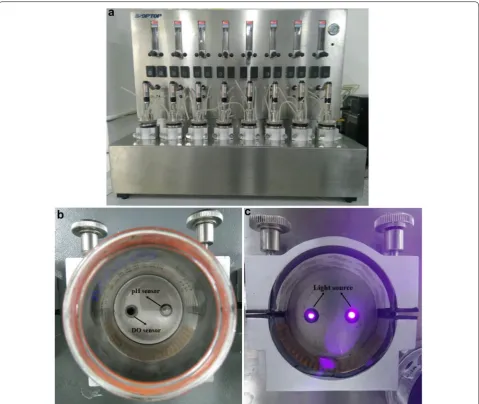
Self-developed 8-parallel micro-bioreactor (volume of 80 ml) system (Guoqiang Bioengineering Equipment Co., Ltd., China) with optical pH and DO sensors was used in this study (Fig. 1). pH biosensor was kindly provided by Prof. Zhu (East China University of Science and Technol-ogy, China). Chemosensors were introduced into poly-meric backbones via covalent bond as described by Shen et al. (2011) with an excitation wavelength of 405 nm and an emission wavelength of 520 nm. DO biosensor, which was conducted under an excitation wavelength of 405 nm and an emission wavelength of 655 nm, was com-mercially obtained (Oxygen Sensor Spot SP-PSt3-NAU-YOP, PreSens, Germany). The pH and DO sensors were equipped at the bottom of the micro-bioreactor, and the light was emitted from the bottom of the micro-biore-actor system (Fig. 1b, c). Two-point calibration strategy with standard buffers for pH, as well as nitrogen and saturated air for DO was adopted. For E. coli culture, the agitation rate was increased to 200 and 500 rpm at the time point of 1.5 and 2.4 h, respectively, and aeration was increased to 1 vvm at the time point of 2 h. For P. pastoris and L. paracasei cultures, the pH of broth was controlled at 5.5 and 6.0, respectively, with 25% (w/w) NH4OH solu-tion. Moreover, to analyze the components of exhaust gas from L. paracasei culture, an on-line process mass spectrum (Extrel, USA) was introduced. Subsequently, the physiological parameters such as oxygen uptake rate (OUR) and carbon dioxide evolution rate (CER) could be calculated on-line as described by Liu et al. (2017). The effects of temperature and external light on the opti-cal detection of pH and DO were conducted at differ-ent temperatures from 28 to 37 °C and by covering the micro-bioreactor using a foil, respectively.
High‑throughput screening of L. paracasei with high performance of l‑lactic acid production
Following this, the suspension was diluted appropriately and 100 μl each of diluted suspension was inoculated into 24-well MTPs and cultured for 24 h with 60 mg/l of bro-mocresol green as a preliminary screening director. Then, the holes of mixture presenting good performances on the production of organic acid were further spread on the solid plates with bromocresol green and the colonies forming larger yellow halos were selected. Finally, in the rescreening process, 8-parallel micro-bioreactor system and shake flasks were applied for the cultures of the can-didate mutants. To verify the fermentation performances of the candidates, l-lactic acid fermentation was carried out in a 5-l stirred bioreactor with a working volume of 4 l, 15% (v/v) inoculum, 37 °C, 150 rpm, and 0.1 vvm. The pH value was automatically controlled at 6.0 by using
25% (w/w) NH4OH solution. All the experiments were performed in triplicate. All the data presented in tables and figures were the averages with standard deviations in triple experiments. Statistical analysis was performed using One-way Analysis of Variance (ANOVA) and t test (P < 0.05) was used to test whether there is any signifi-cant difference among treatments (SPSS 22.0, SPSS Inc., USA).
Analytical methods
Cell growth determination
A spectrophotometer was used at 600 nm to measure cell growth of E. coli, P. pastoris, and L. paracasei. The cell biomass was expressed as dry cell weight (DCW), which has a linearity with optical density (OD). One OD unit
corresponds to 0.34 and 0.41 g/l DCW for P. pastoris and L. paracasei.
l‑lactic acid and residual glucose concentrations
determination
The pH indicator (bromocresol green) assay in 24-well MTPs was a qualitative method for organic acid concen-tration in preliminary screening process as described by Lv et al. (2016). The 24-well MTPs fermentation broth was centrifuged at 4000g for 10 min, and then 200 μl supernatant was transferred into a 96-well microplate (Corning, USA). The absorbance change was detected at 616 nm by Multiskan GO microplate reader (Thermo Fisher Scientific). The concentration of l-lactic acid was specifically detected by SBA-40E biosensor analyzer (Shandong Province Academy of Sciences, China). The glucose kit (Kexin Biotechnology Institute, China) was used for residual glucose concentration analysis.
Relative residual error calculation
For comparing the effects of temperature and external lighting on pH and DO detection, a relative residual error (γ) was calculated as follows:
where x were values detected by optical pH and DO sen-sors, while x′ were values detected by off-line pH meter and polarographic DO probe.
Results and discussion
Optimization of non‑invasive optical pH and DO detecting systems
The volume limitation of a traditional electrochemical probe makes it difficult to be equipped within a micro-bioreactor, whereas the non-invasive optical pH and DO sensors which are made from fluorescent dye film
γ=
n
i abs(x(i)−x′(i)) n
i x(i)
×100%
can combine with dissolved H+ and oxygen,
respec-tively, to change the molecular conformation. Thus, the fluorescence signals can be detected under the excitation wavelength and the signal intensities exhibit a positive relationship with the concentrations of H+ and oxygen.
It is reasonable to consider that the environmental tem-perature and lighting would have significant effects on the fluorescent intensities. As shown in Fig. 3a, once the environmental temperature was kept constant, the fluc-tuations of pH and DO measurements decreased from 0.15 unit and 10% to 0.01 unit and 2%, respectively. Both these values were acceptable for the culture involved with common microorganisms. Simultaneously, under different temperatures (32, 37, and 42 °C), both pH and DO measurements showed good performances (Fig. 3a). Thus, the calibrations of pH and DO should be con-ducted under the corresponding fermentation tempera-ture to eliminate the temperatempera-ture effect in the following experiments.
On the other hand, a significant fluctuation could also be noted on the pH and DO fluorescent signals when the detection system was exposed to external light (Fig. 3b). It could be observed that the maximum deviation in the measurement of pH reached 0.3 unit in the presence of
external light, while it decreased to 0.05 unit with biore-actor shading treatment. Similar for DO measurement, its maximum deviation reduced from more than 15% to about 2%. The relative standard deviations of pH and DO measurements decreased from 1.54 and 6.01% to 0.189 and 0.691%, respectively, which demonstrated the improvements in the accuracy and stability of pH and DO detection.
The broth culture is a mixed solution of water, oxy-gen, organic materials, inorganic ions etc. Environmen-tal temperature will affect the ionization degree of the electrolytes as well as the solubility of oxygen, and thus will subsequently influence the concentrations of H+ and
dissolved oxygen. Although many investigations have reported on the novel biosensors for pH and DO detec-tion in terms of principle, material, and chromophore structure (Bambot et al. 1994; Shen et al. 2011), but their practical applications in the process of cell culture were seldom taken into consideration.
Microorganism cultures in the micro‑bioreactor
Hot model experiments of the micro-bioreactors were conducted using three commonly used laboratory microbes (E. coli, P. pastoris, and L. paracasei) as the testing strains. Relatively a higher oxygen supply was required for E. coli and P. pastoris, while L. paracasei exhibited facultative anaerobic characteristics. Moreover, the pH required for an optimal growth and metabolism of the common microbes were in the range of 5.0–8.0. Thus, as compared to shake flask, micro-bioreactor pre-sented significant advantages both in monitoring and controlling the pH and DO.
Escherichia coli culture in the micro‑bioreactor with process pH detection and DO regulation
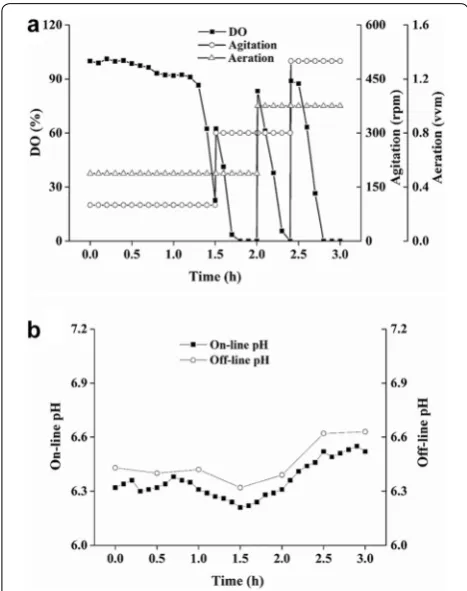
Escherichia coli, as a rapid growth microorganism, pos-sesses a doubling time of approximately 20 to 30 min, and thereby the process pH and DO evolutions were moni-tored by non-invasive optical biosensors. Otherwise, the responses of DO biosensor to the environmental agitation and aeration were also tested (Fig. 4a). It was found that after about 1 h of lag phase, DO in the broth decreased quickly along with the rapid cell growth. When the agitation rate increased at the time point of 1.5 and 2.4 h, respectively, as well as the aeration increased at the time point of 2 h, the DO value exhibited quick responses of significant raise. These results indicated that non-invasive optical DO detecting systems could well monitor the evolution of DO in an aerobic microbial culture, and subsequently it could be potentially adopted as a process control parameter for process regulation.
On the other hand, due to a minor change in the pH value, the broth pH was not controlled during the whole
process. Through the comparison of on-line pH by an optical biosensor and the off-line pH by a pH meter, the former was always approximately 0.1 unit lower than the latter (Fig. 4b), which could be partly ascribed to the dis-crepancy between the buffer of normalized pH and real broth. Simultaneously, his deviation could be considered as a system error, and the non-invasive optical pH detect-ing system could effectively monitor the change of the process pH.
Pichia pastoris culture in the micro‑bioreactor with pH control To test the applicability and stability of non-invasive opti-cal pH detection system on the change in pH during the P. pastoris culture, which would spontaneously decrease the broth pH to lower than 4.0, it was conducted by add-ing NH4OH solution as a neutralizing agent to maintain the pH at 5.5. Similar to the process in E. coli culture, a difference was also observed between on-line and off-line measurements also occurred, while it showed a little dependence on the fermentation process.
Figure 5 shows that the 5-l bioreactor resulted in the best growth performance followed by the micro-bioreac-tor and lastly the shake flask. The DCWs were 4.27 ± 0.12, 3.71 ± 0.12, and 2.21 ± 0.18 g/l, respectively, after 12-h
culture. This result could be contributed to the capacity of pH to control as well as other factors such as the mix-ing of nutrition and the efficiency of oxygen transfer with different culture facilities of 5-l bioreactor, micro-bio-reactor and l shake flask. It seemed that the capacity of pH to control in micro-bioreactor might be weaker than 5-l bioreactor due to its less buffering ability with a small working volume. However, it should be pointed out that as compared to shake flask, micro-bioreactor could effec-tively compensate the disadvantage of uncontrolled pH, and subsequently reflected into a change in the cellular physiology and metabolism.
Lactobacillus paracasei culture in the micro‑bioreactor with process pH control and exhausted gas analysis
Lactic acid bacteria which always need a small amount of oxygen for their cell growth and metabolism are defined as facultative anaerobic microorganisms. Thus, regular DO parameter detected by DO probe loses the role to represent cellular oxygen metabolism. Moreover, addi-tional neutralizing agent needs to be added into the broth to maintain a suitable range of pH for the cell growth and metabolism, as lactic acid is the main product of glucose metabolism. In this experiment, apart from control-ling the process pH at 6.0, an additional process mass spectrum was introduced for L. paracasei culture as described in 5- and 50-l bioreactors (Lu et al. 2016; Wang et al. 2010, 2016), in order to calculate on-line physiologi-cal parameters of OUR, CER, and respiratory quotient (RQ).
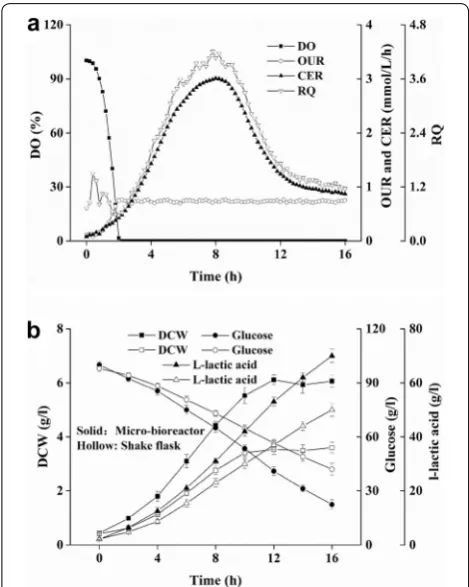
As shown in Fig. 6a, the DO dropped to zero at 2 h and continued until the end. Correspondingly, with a decrease in DO, OUR increased quickly and reached its maximum value of approximately 0.76 mmol/l/h when DO was zero. In contrast, the trend of CER and RQ was similar. CER increased quickly during the rapid cell
Fig. 4 Time profiles of DO (a) and pH (b) in E. coli culture with a micro-bioreactor
growth phase, while it began to decline once the cells entered into the late cell growth and stationary phases (Fig. 6a, b). All these results were consistent with the observations as reported earlier using 5-l bioreactor (Tian et al. 2016), indicating that the micro-bioreactor could perfectly scale down the bioprocess of L. paracasei culture. Furthermore, through a comparison on the per-formances of fermentation in the micro-bioreactor and 250-ml shake flask, it could be found that the former was obviously superior to the latter in terms of cell growth, glucose consumption as well as lactic acid production (Fig. 6b). The maximum biomass in the micro-bioreac-tor (6.1 g/l) was 1.7 times as compared to using a shake flask (3.6 g/l). Besides, the rate of glucose consumption and the productivity of lactic acid enhanced by 42.1 and 38.6%, respectively. On one side, these results could be considered as the effect of eliminating low pH inhibition in the micro-bioreactor (Venkatesh 1997), whereas on the other side, it could be due to better mixing and mass transfer in the micro-bioreactor (Bridle et al. 2008). More importantly, unlike a simple input–output model in a shake flask, some of the key process parameters could be monitored on-line and in real-time in a micro-bioreactor
to further understand the cell physiological and meta-bolic changes.
Overall, by comparing with a shake flask, the micro-bioreactor not only demonstrated the advantages on the applicability of subjecting to different culture conditions, but also could characterize the real cell metabolic status by introducing more physiological parameters.
Application and performance of micro‑bioreactor system in high‑throughput screening of high l‑lactic acid
production strain
Previous screening model as established by Lv et al. (2016) with some modifications was used in this study (Fig. 2). After ARTP treatment, a total of 2500 aliquot mutagenic mixtures were collected for preliminary screening, and 184 wells in the microplates exhibited yellow broth after culturing for 12 h. By comparing the cell growth and product formation with the parent strain, 24 wells presented higher OD (Fig. 7a), whereas 21 wells presented higher concentration of organic acid (Fig. 7b). Among these 21 wells, number 58 and 103 showed 46.5 and 41.9% higher organic acid titers than the parent strain. Subsequently, the diluted broth of
Fig. 6 Time profiles of DO, OUR, CER, and RQ in L. paracasei culture with a micro-bioreactor (a); comparison of the cell growth, glucose consumption, and l-lactic acid production in L. paracasei cultures with micro-bioreactor and shake flask (b)
number 58 and 103 were spread on the solid plates with bromcresol green, and 59 single colonies with relatively a higher ratio of clear zone diameter/colony diameter were selected. Every single colony was synchronously cultured in micro-bioreactors and shake flasks. After culturing for 24 h, it was found that four mutants of L. paracasei designated S1 to S4 in the micro-bioreactor significantly increased the production of l-lactic acid (an improvement of more than 15%), as compared with the parent strain (Fig. 8a). In contrast, besides the above four mutants, other two mutants i.e., L. paracasei S5 and S6 were selected due to their performances in the produc-tion of l-lactic acid (an improvement of more than 15%) in the shake flask rescreening process (Fig. 8b). Conse-quently, all the 6 mutants (L. paracasei S1 to S6) were cultured in the 5-l bioreactor for 24 h to test and verify their fermentation performances (Table 1). As expected, L. paracasei S1 to S4 exhibited an enhancement in the production of l-lactic acid to some extent, and L. para-casei S4 displayed the highest titer enhancement of 18.9% as well as an increase in the yield of l-lactic acid from
0.903 ± 0.005 to 0.932 ± 0.013 g/g, which might be due to an improvement in the biomass (Fig. 9), as the synthesis of lactic acid was closely dependent on the cell growth. However, it should be noted that although the concentra-tion of l-lactic acid by L. paracasei S3 only increased by 13.6%, its biomass was almost the same as that of control (Fig. 9), indicating that L. paracasei S3 presented better specific productivity on the biomass, which was generally considered as an important index to evaluate the perfor-mance of strain. In contrast, the l-lactic acid titer of L. paracasei S6 was comparable to the parent strain, and L. paracasei S5 even demonstrated a little lower titer value. It could be concluded that with regard to screening flux, the micro-bioreactor was comparable to shake flask in rescreening process, whereas the micro-bioreactor dem-onstrated absolute superiority in terms of scaling up the cultivating system. This could be ascribed to maintaining a constant pH in the micro-bioreactor, which could elim-inate the adverse effects of low pH on the cell growth and lactic acid production in the shake flask. On the other hand, in contrast to the shake flask, micro-bioreactor was more suitable for scaling up the bioprocess to 5-L bio-reactor irrespective of its geometric form, or flow field characteristics. Moreover, it could be noted that through comparing the process physiological parameters between micro-bioreactor and 5-l bioreactor, the factors that lim-ited in the process regulation or scale-up could be further inferred.
Conclusions
Considering the optimized detection conditions of non-invasive optical pH and DO biosensors, the micro-bioreactor fully satisfied the requirements for the cul-tures of commonly used laboratory microorganisms with monitoring and regulating the process pH and DO. Additionally, in the rescreening process, 8-parallel micro-bioreactor system was introduced into high-through-put screening of high l-lactic acid production strain to substitute the traditional shake flasks. The results
Fig. 8 Comparison of l-lactic acid production with mutant strains (L. paracasei S1 to S6) and the parent strain (L. paracasei NCBIO01) in the shake flask and micro-bioreactor rescreening
Table 1 Fermentation performances of parent strain,
mutants S1 to S6 at 24 h with a 5-l bioreactor
a Significant difference at P < 0.05 as compared to the control
Maximum DCW (g/l) l‑lactic acid (g/l) Yield (g/g)
Control 9.76 ± 0.42 88 ± 2.45 0.903 ± 0.005
S1 11.04 ± 0.32a 96 ± 2.45a 0.914 ± 0.009
S2 10.61 ± 0.64 90 ± 1.63 0.904 ± 0.013
S3 9.59 ± 0.28 100 ± 3.27a 0.914 ± 0.003a
S4 10.97 ± 0.33a 104 ± 1.63a 0.932 ± 0.013a
S5 9.93 ± 0.20 84 ± 1.63 0.918 ± 0.011
demonstrated that the micro-bioreactor presented com-parable screening flux with shake flask, while it could significantly increase the scale-up possibility. Finally, a mutant of L. paracasei S4 was acquired which improved the l-lactic acid titer value by 18.9% as compared with the parent strain and enhanced the l-lactic acid yield to
0.932 ± 0.013 g/g. Overall, the outcomes from this inves-tigation could be extended to other bacteria or yeasts in obtaining a high-performance strain by high-throughput screening strategy.
Authors’ contributions
XT, WW, and ZG conducted the experiments and data analysis. XT wrote the manuscript. MZ provided technical support for 8-parallel bioreactor system. HH, CJ, YZ, SZ gave advices in the experiment design and data analysis. AM participated in manuscript writing and polished the English thoroughly. All authors read and approved the final manuscript.
Acknowledgements
This work was financially supported by the National Science Foundation for Young Scientists of China (31700038), the National Key Research and Development Program (2017YFB0309302) and the National Major Scientific Technological Special Project (2012YQ15008706).
Competing interests
The authors declare that they have no competing interests.
Availability of data and materials
The datasets supporting the conclusions of this article were included in the main manuscript.
Consent for publication
All authors have read and approved the manuscript before submitting it to bioresources and bioprocessing.
Ethic approval and consent to participate
This study did not contain any studies with human participants or animals performed by any of the authors.
Publisher’s Note
Springer Nature remains neutral with regard to jurisdictional claims in pub-lished maps and institutional affiliations.
Received: 10 January 2018 Accepted: 23 April 2018
References
Bambot SB, Holavanahali R, Lakowicz JR, Carter G, Rao G (1994) Phase fluorometric sterilizable optical oxygen sensor. Biotechnol Bioeng 43:1139–1145
Betts JI, Baganz F (2006) Miniature bioreactors: current practices and future opportunities. Microb Cell Fact 5:21–34
Bridle H, Millingen M, Jesorka A (2008) On-chip fabrication to add temperature control to a microfluidic solution exchange system. Lab Chip 8:480–483 Chen A, Chitta R, Chang D, Amanullah A (2009) Twenty-four well plate
min-iature bioreactor system as a scale-down model for cell culture process development. Biotechnol Bioeng 102:148–160
Doig SD, Diep A, Baganz F (2005) Characterisation of a novel miniaturised bubble column bioreactor for high throughput cell cultivation. Biochem Eng J 23:97–105
El-Ali J, Sorger PK, Jensen KF (2006) Cells on chips. Nature 442:403–411 Harms P, Kostov Y, Rao G (2002) Bioprocess monitoring. Curr Opin Biotechnol
13:124–127
Liu X, Tian XW, Hang HF, Zhao W, Wang YH, Chu J (2017) Influence of initial glucose concentration on seed culture of sodium gluconate production by Aspergillus niger. Bioresour Bioprocess 4:55–68
Lu F, Wang ZJ, Zhao W, Chu J, Zhuang YP (2016) A simple novel approach for real-time monitoring of sodium gluconate production by on-line physi-ological parameters in batch fermentation by Aspergillus niger. Bioresour Technol 202:133–141
Lv XY, Song JL, Yu B, Liu HL, Li C, Zhuang YP, Wang YH (2016) High-throughput system for screening of high l-lactic acid-productivity strains in deep-well
microtiter plates. Bioprocess Biosyst Eng 39:1737–1747
Rao G (2007) Twenty-four-well plate miniature bioreactor high-throughput system: assessment for microbial cultivations. Biotechnol Bioeng 98:1017–1028
Schäpper D, Alam MN, Szita N, Eliasson Lantz A, Gernaey KV (2009) Application of microbioreactors in fermentation process development: a review. Anal Bioanal Chem 395:679–695
Shen LJ, Lu XY, Tian H, Zhu WH (2011) Along wavelength fluorescent hydro-philic copolymer based on naphthalene diimide as pH sensor with broad linear response range. Macromolecules 44:5612–5618
Shi F, Tan J, Chu J, Wang YH, Zhuang YP, Zhang SL (2015) A qualitative and quantitative high-throughput assay for screening of gluconate high-yield strains by Aspergillus niger. J Microbiol Methods 109:134–139
Tan J, Chu J, Wang YH, Zhuang YP, Zhang SL (2014) High-throughput system for screening of Monascus purpureus high-yield strain in pigment produc-tion. Bioresour Bioprocess 1:16–22
Thomas C, Scanlon TC, Dostal SM, Griswold KE (2014) A high-throughput screen for antibiotic drug discovery. Biotechnol Bioeng 111:232–243 Tian XW, Wang YH, Chu J, Zhuang YP, Zhang SL (2016) Improvement of l-lactic
acid production with a two-step OUR control strategy. J Chem Technol Biotechnol 91:2496–2502
Venkatesh KV (1997) Metabolic flux analysis of lactic acid fermentation: effects of pH and lactate ion concentration. Process Biochem 32:651–655
Wang ZJ, Wang HY, Li YL, Chu J, Huang MZ, Zhuang YP, Zhang SL (2010) Improved vitamin B12 production by step-wise reduction of oxygen uptake rate under dissolved oxygen limiting level during fermentation process. Bioresour Technol 101:2845–2852
Wang ZJ, Shi HL, Wang P (2016) The online morphology control and dynamic studies on improving vitamin B12 production by Pseudomonas denitri-ficans with online capacitance and specific oxygen consumption rate. Appl Biochem Biotechnol 179:115–1127
Ye R, Huang MZ, Lu HZ, Qian JC, Lin WL, Chu J, Zhuang YP, Zhang SL (2017) Comprehensive reconstruction and evaluation of Pichia pastoris genome-scale metabolic model that accounts for 1243 ORFs. Bioresour Bioprocess 4:22–33
Zhang Z, Szita N, Boccazzi P, Sinskey AJ, Jensen KF (2005) A well-mixed, polymer-based microbioreactor with integrated optical measurements. Biotechnol Bioeng 93:286–296