Web Application Testing with Customized Test Requirements —
An Experimental Comparison Study
Sreedevi Sampath, Sara Sprenkle, Emily Gibson, Lori Pollock
Department of Computer and Information Sciences
University of Delaware
Newark, DE 19716
{
sampath, sprenkle, gibson, pollock
}
@cis.udel.edu
Abstract
Test suite reduction uses test requirement coverage to determine if the reduced test suite maintains the original suite’s requirement coverage. Based on observations from our previous experimental studies on test suite reduction, we believe there is a need for customized test requirements for web applications. In this paper, we examine usage-based customized test requirements for the test suite reduc-tion problem in web applicareduc-tion testing. We conduct an ex-tensive experimental study to evaluate the tradeoffs between five classes of customized requirements with respect to re-duced test suite size, program coverage and fault detection effectiveness. Our results show that the reduced suites’ pro-gram coverage and fault detection effectiveness increases with the context or data associated with the reduction re-quirement. Based on our experimental results, we provide guidance to testers on the most useful test requirement for web applications in general and provide intuition on factors testers need to consider when selecting test requirements.
1. Introduction
Test requirement coverage is an important and well ac-cepted measure for deciding when to stop testing, selecting test cases, and reducing test suites. Test coverage criteria define rules that impose requirements on a test suite, such that a test suite can be judged by the level at which it satis-fies the coverage criterion. A set of test requirements can be described in terms of source code elements, design compo-nents, specification modeling elements, or elements of the input space [1]. In addition to traditional coverage-based criteria, test criteria have been proposed for web applica-tions, including data flow criteria [13, 18], criteria based on link transitions [18] and standard graph criteria from a model of the application based on finite state machines [2].
One particular test criterion customized to web applica-tions, and specifically used in test suite reduction, is base request coverage (base). A base request for a web appli-cation is the request type and resource loappli-cation without as-sociated data (e.g., GET /servlets/authentication/Login.jsp). In test suite reduction, thebasecoverage criterion requires that every base request in the original test suite be covered by the reduced test suite [20]. The test requirements to be satisfied for achievingbasecoverage are generated from the input space of user requests to the application in the form of base requests and optional name-value pairs (e.g., form field data). A reduced suite that provides fullbase coverage indicates that for every base requestbcovered by the original test suite, there is at least one test case in the reduced suite that coversb. Thebaserequirement is used only for reduction. During reduced suite replay, the base request and the associated name-value pairs are replayed.
In our previous work in reduction of test suites formu-lated from field data, our experiments indicated thatbase can lead to suites with large percent reduction in test suite size while maintaining high program coverage and fault de-tection effectiveness [20, 25]. However, thebasereduced suites were not as effective as the original suite in terms of program coverage and fault detection effectiveness. Intu-itively,basetest requirements are not as effective because the data associated with each request and the sequence in which users request resources is ignored during reduction. Furthermore, by covering thebase requirement we can-not estimate the resulting underlying code coverage. For example, a single request can execute several servlets and Java/JSP classes before a response is sent back to the user.
During our experimental studies of test suite reduction for web applications [20, 21, 22, 25], we encountered sev-eral indicators prompting us to investigate alternative test requirements and the experimental investigation in this pa-per. Our experimental results revealed compelling evidence that motivate alternative test requirements for reduction.
First, we usedbaseas the requirement for two different reduction techniques: Concept[20] andHGS[8]. In our studies, we found that neither technique produced reduced suites that covered as many statements or detected as many faults as the original suite [22, 25].
Our second observation is based on usingbaseas a sim-ilarity measure for clustering and then reducing the original suite by selecting single test cases from a subset of clus-ters. For our reduction heuristic to be most effective, the test cases clustered together should cover the same program code. We found test cases clustered by concept analysis (see Section 3.2.3) with base requests as a similarity metric did not always cover the same program code [21]. A simi-larity metric that includes sequencing or data in addition to base requests may create clusters that have more common program code coverage, thus increasing the effectiveness of the reduction heuristic.
These two observations motivated us to develop more so-phisticated test requirements that achieve higher program coverage and fault detection effectiveness than existing test requirements. Our intuition behind the more sophisticated requirements came from additional detailed analysis of our experimental results.
Our analysis of code covered by various reduced suites confirmed that certain code is covered and certain faults de-tected by a particular request sequence. For example, con-sider the difference in application responses when a user attempts to access a password-protected page. If the user is logged in, the web application immediately returns the re-quested resource. If not logged in, the user is redirected to a login page before accessing the password-protected page— resulting in a different sequence of requests. Unless the re-quest sequence is considered during reduction, redirection code executed by the latter sequence will not necessarily be executed by thebasereduced suite.
We also found that the data associated with a request can affect the program coverage and fault detection effec-tiveness of the reduced suite. Validating user input is im-portant to evaluating the application’s robustness with re-spect to user input and its security [15]. In our analysis, we found our applications perform validations, such as ensur-ing email addresses contain the symbol ‘@’, checking for null values, trimming blank spaces, and checking for illegal characters. Unless the data associated with the request is considered during reduction, the corresponding validation code and faults located in validation code may not be cov-ered by abasereduced suite.
By using more sophisticated request-based require-ments, it is possible to gain program code coverage and fault detection equivalent to the original suite. The sequence in which requests are accessed and the data associated with requests needs to be considered as a requirement for reduc-tion to create effective reduced suites. In this paper, we
examine the tradeoffs between five classes of requirements based on request context (sequences) and data (name-value pairs) in terms of reduced suite size, program coverage, and fault detection. We provide guidance to testers by statisti-cally analyzing the results across four subject applications and two reduction techniques and present the most suitable requirement for web applications in general. We were sur-prised by the requirement that emerged as the best overall requirement, when the desired qualities of reduced suites are considered together. Our results indicate that additional factors, such as the underlying code quality and application domain characteristics should be considered, when a tester is selecting an appropriate test requirement.
In Section 2 we describe five classes of test requirements customized to test suite reduction for web applications. In Section 3, we present our experiment to analyze the cost-effectiveness of the requirements for four subject web ap-plications and two reduction techniques. Section 4 presents a thorough analysis of these results and provides guidance to testers on the factors to consider when selecting a re-quirement for reducing test suites for their web application. Related work is presented in Section 5. We conclude and outline future research directions in Section 6.
2. Customized Test Requirements
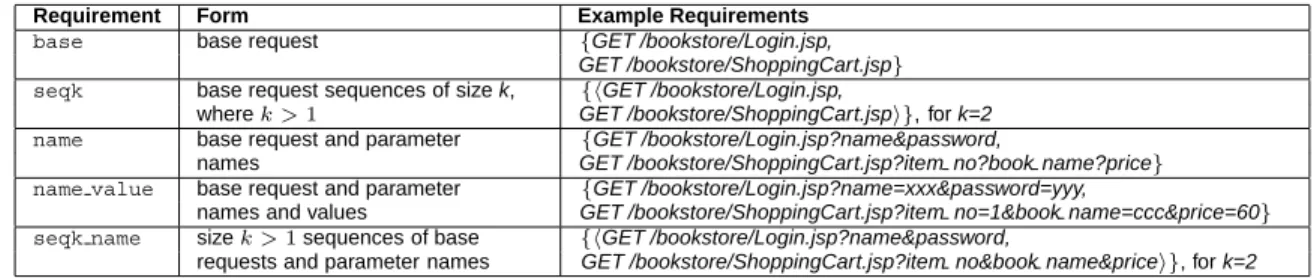
In this section, we examine five classes of requirements customized for web applications and based on field data: base,seqk,name,name valueandseqk name. For web applications, we expect test cases to be sequences of requests, where a request is of the form: request type (GET/POST), the network data object or service being requested, and associated name-value pairs. In Table 1, we present the form of each customized test requirement and the requirements for the example test case
GET /bookstore/Login.jsp?name=xxx&password=yyy, GET /bookstore/ShoppingCart.jsp?item no=1&book name =ccc&price=60.
The reduction criterion for any of the requirements can be stated as: for every customized requirementrthat occurs in the original suiteT, there is at least one test caset ∈T in the reduced suite that coversr. The requirements can be further extended to consider sequences of requests of size k with names and values of input data, but the tradeoff be-tween test suite effectiveness and size of the reduced test suite is likely to make the use of the requirement impracti-cal in practice. For this reason, we consider only size 2 se-quences of requests,seq2, and size 2 sequences of URLs and names,seq2 name, in our empirical evaluation.
A requirement mapping between each test case and the requirements that it covers is used by the reduction tech-niques to create reduced test suites that satisfy the given re-quirement. For each criterion selected, a mapping is created
Requirement Form Example Requirements
base base request {GET /bookstore/Login.jsp,
GET /bookstore/ShoppingCart.jsp}
seqk base request sequences of size k, {GET /bookstore/Login.jsp,
wherek >1 GET /bookstore/ShoppingCart.jsp}, for k=2
name base request and parameter {GET /bookstore/Login.jsp?name&password,
names GET /bookstore/ShoppingCart.jsp?item no?book name?price}
name value base request and parameter {GET /bookstore/Login.jsp?name=xxx&password=yyy,
names and values GET /bookstore/ShoppingCart.jsp?item no=1&book name=ccc&price=60}
seqk name sizek >1sequences of base {GET /bookstore/Login.jsp?name&password,
requests and parameter names GET /bookstore/ShoppingCart.jsp?item no&book name&price}, for k=2
Table 1. Customized Test Requirements
(a) Initial User Sessions
Cases Test Requirements tc4 tc3 tc2 tc1 AD AB AA BC BD CD DB {tc1 = < A, D, B, C, D>, tc2 = < A, A, B, D, B, C>, tc3 = < A, A, D>, tc4 = < B, C>} Requirements Cases Test tc3 A B C D tc1 tc2 tc4
(b) Requirement Mapping (c) Requirement Mapping for for base requests base request sequences (size 2)
Figure 1. Test Requirement Mapping
between the requirements and the test cases. In this paper, test cases are user sessions. A user session is a sequence of user requests in the form of base requests and name-value pairs (e.g., form field data). To generate user sessions, we use session cookies as identifiers when cookies are avail-able. Otherwise, we say that a user session begins when a request from a new IP address reaches the server and ends when the user leaves the web site or the session times out. In our work, we consider a 45-minute gap between two re-quests from a user equivalent to a session timing out.
Figure 1 (a) shows an initial set of test cases tc1, tc2, tc3, tc4. Figure 1 (b) shows the requirement mapping for the baserequirement, while Figure 1 (c) shows the mapping for the requirementseq2. In Figure 1 (b), test cases tc1 and tc2 appear to be equivalent, and a reduction algorithm may choose only of them (say, tc1) for the reduced suite. On changing the requirement toseq2, the test cases appear very different; this distinction may prove to be very impor-tant if tc2’s size 2 sequences, AA, AB, BC, BD, or DB, are fault-exposing sequences. However, the size of the require-ment mapping increases with the requirerequire-ment change.
3. Experimental Study
In our experimental study, we examine the use of each test requirement for test suite reduction. We use two reduc-tion techniquesHGS[8] andConcept[20]. We will eval-uate the tradeoffs between the requirements with respect to reduced suite size, program coverage and fault detection ef-fectiveness, replay costs and reduction time and space costs.
3.1. Expected Cost-benefit Tradeoffs
Our intuitions based on previous experimental studies led to several predictions about using the various test re-quirements for test suite reduction. The more context or data the requirement contains, the larger the requirement mapping. In this paper, we equate the complexity of the requirement to the data/context maintained in the ment, (i.e., the more data associated with a given require-ment, the more complex the requirement). The complexity relationship between the requirements isbase≤seq2≤ seq2 name,base≤name≤name valueandname
≤seq2 name. When applied to test suite reduction, re-quirements with larger mappings probably generate larger reduced suites. The reduced test suite size also depends on the selected requirement. We expect the trend in reduced suite size to follow the complexity relationship between the requirements, i.e., greater the complexity, larger the reduced test suite. We expect a similar trend in program coverage effectiveness and space and time costs for the different re-quirements. The tradeoffs in fault detection effectiveness are not easy to predict because faults depend on the input data and the oracle. However, we expect the fault detec-tion effectiveness to be similar to the program coverage ef-fectiveness. Since the requirement mappings are input to the test suite reduction techniques, we also expect the size of the requirements to affect time/space costs of the reduc-tion techniques. The reducreduc-tion techniques and the nature of the subject web application are likely to further impact the tradeoffs in the requirements. However, the focus of this paper is not to compare the reduction techniques but to compare the test requirements.
3.2. Independent Variables
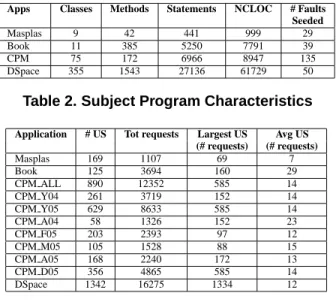
To evaluate our research questions, the independent vari-ables in our study are the subject applications, original test suites, requirements, and the test case selection technique. 3.2.1 Subject Applications and Original Test Suites We used four subject programs with different characteris-tics: a conference website (Masplas), an open-source,
e-Apps Classes Methods Statements NCLOC # Faults Seeded Masplas 9 42 441 999 29 Book 11 385 5250 7791 39 CPM 75 172 6966 8947 135 DSpace 355 1543 27136 61729 50
Table 2. Subject Program Characteristics
Application # US Tot requests Largest US Avg US
(# requests) (# requests) Masplas 169 1107 69 7 Book 125 3694 160 29 CPM ALL 890 12352 585 14 CPM Y04 261 3719 152 14 CPM Y05 629 8633 585 14 CPM A04 58 1326 152 23 CPM F05 203 2393 97 12 CPM M05 105 1528 88 15 CPM A05 168 2240 172 13 CPM D05 356 4865 585 14 DSpace 1342 16275 1334 12
Table 3. Original Test Suite Characteristics
commerce bookstore (Book) [7], a course project manager (CPM), and a customized digital library (DSpace) [5]. The characteristics of the subject programs are shown in Table 2 and original test suite characteristics are in Table 3. In Table 2, NCLOC refers to the number of non-commented source lines of code. The number of statements in Table 2 also refers to the non-commented source lines of code but excludes code artifacts, such as braces, method and class headers. In Table 3, the second and third column repre-sent the test suite size in terms of number of test cases, and the total number of requests accessed by the test cases, re-spectively. The last two columns represent the largest and average test case size in terms of requests in each test suite. Masplas. Masplas is a web application developed by one of the authors for a regional workshop. Users can register for the workshop, upload abstracts and papers and view the schedule, proceedings, and other related information. Mas-plas is written using Java, JSP, and MySQL. We collected 169 test cases when the workshop was held in 2005. Book. Book allows users to register, login, browse for books, search for books by keyword, rate books, add books to a shopping cart, modify personal information, and lo-gout. Since our interest was in testing consumer function-ality, we did not include the administration code in our ex-periments. Book uses JSP for its front-end and a MySQL database back-end. To collect 125 test cases, we sent email to local newsgroups and posted advertisements in the Uni-versity’s classifieds web page asking for volunteer users. CPM. In CPM, course instructors login and create grader accounts for teaching assistants. Instructors and teaching assistants create group accounts for students, assign grades, and create schedules for demonstration time slots. Users interact with an HTML application interface generated by Java servlets and JSPs. CPM manages its state in a
0 5 10 15 20 DSpace 1342 CPM 890 Book 125 Masplas 169 Number of Requirements
Normalized to base requests Reduced Suites
90.9 39.3 24 10 69 443 s1 n s2 s2-n n-v
Figure 2. Number of Test Requirements
Nor-malized to the Number ofbase
based datastore. We collected 890 test cases (CPM ALL in Table 3) from instructors, teaching assistants, and stu-dents using CPM during the 2004-05 and 2005-06 academic years at the University of Delaware. To observe the ef-fect of different test suite sizes in our experiments, we cre-ated six additional test suites by partitioning test cases by year (CPM Y04 and CPM Y05) and semester (CPM A04 through CPM D05).
DSpace. Our research group developed a customized web application for maintaining a digital publications library based on DSpace, an open-source digital repository sys-tem [5]. The application automatically generates sorted publications pages from a database that research group members maintain through a web application interface. A user can create dynamic views of publications by search-ing with different criteria. DSpace is written in both Java and JSP that deliver HTML content to the user and uses a PostGreSQL database and a filestore as the backend. We collected 1342 test cases after publicizing our digital library in August 2005 (DSpace in Table 3).
3.2.2 Test Requirements
Figure 2 shows the number of test requirements normalized over the number of unique base requests. The number of unique base requests for each application are shown in the graph above thebasereduced suite. The graph indicates the relative size of the requirement mappings. As expected, with an increase in the complexity of the requirement, the size of the mapping increases.
3.2.3 Test Suite Reduction Techniques
We used two reduction techniques in our experiments,HGS andConcept. Both reduction techniques initially asso-ciate test cases with the requirements met by the test cases. Harrold et al. (HGS) use a heuristic to select a re-duced suite that approximates the smallest
requirement-representative set of test cases, i.e., the minimum cardinal-ity hitting set [8]. The criterion used by HGSis to cover all requirements covered by the original suite. To address non-determinism inHGS’s heuristic to break ties, we create 100 reduced suites from the original suite with a particular requirement and select the suite generated most frequently.
In previous work [20], we presented a test case selec-tion technique,Concept, based on clustering test cases by concept analysis. We developed a heuristic based on the concept lattice for selecting a subset of user sessions to be maintained as the current test suite [20]. Our heuristic for test case selection seeks to identify the smallest set of test cases that satisfies a certain requirement, as determined by the original test suite, while representing the set of require-ments covered by the original test suite’s test cases.
3.3. Dependent Variables
The dependent variables in our study are test suite size, program coverage and fault detection effectiveness, replay costs of the reduced suites, and time and space costs of test selection.
3.4. Methodology
Testing Framework. Field data is captured at the server and converted into test cases. We then reduce the origi-nal test suite using our Java implementation ofHGS. For Concept, we use the concept analysis tool Concepts [12] to cluster test cases, and implemented our heuristic for test suite reduction in Java. The test cases are replayed by a customized version of HTTPClient [9]. Code instrumenta-tion and coverage are measured with the publicly available tool Clover [4]. The test requirements, such asbaseand name, are used only for reduction. On replay, an entire user session (sequence of base requests and name-value pairs) is converted into a test case and replayed. The experimental framework is described in detail in [19, 24].
Fault Seeding. For fault detection experiments, grad-uate and undergradgrad-uate students familiar with JSP/Java servlets/HTML manually seeded faults in Book, CPM, Masplas and DSpace. In general, five types of faults were seeded in the applications—data store (faults that exercise application code interacting with the data store), logic (ap-plication code logic errors in the data and control flow), form (modifications to name-value pairs and form actions), appearance (faults which change the way in which the user views the page), and link (faults that change the hyperlinks location). We also seeded naturally occurring faults that were discovered by users during application deployment.
We seeded faults in CPM in two phases. Initially, we seeded 85 faults arbitrarily. We then added 50 faults to bet-ter differentiate the fault detection effectiveness of the test
suites from the customized requirements. We compared the coverage of the reduced suites, characterized the dif-ferences, and seeded faults in code that may be exercised specifically by a reduced suite from a given requirement. The additional faults are broadly characterized as being ex-posed by request sequences (sequence-dependent), condi-tions on names (name-dependent) and condicondi-tions on values (value-dependent). If appropriate, we reclassified the initial 85 faults into one of these three categories.
Replay Mechanism and Oracle Comparators. We use the with state replay mechanism, where application state is restored before the replay of every session in the reduced suite [24]. For Book, we use the diff oracle, which executes the UNIX utility diff on the output HTML pages. For appli-cations CPM, Masplas and DSpace, which have real-time content, we use the struct oracle. The struct oracle com-pares the structure of the output HTML pages. Further de-tails on the oracle comparators and replay mechanisms can be found in our previous work [24].
3.5. Threats to Validity
Because of the limited number of subject applications and available test cases, our results may not show signifi-cant differences in code coverage and fault detection for the different requirements. In practice the differences between the requirements may be larger than what we find for our subject applications. Further, due to the small number of subject applications, we cannot generalize our results to all web applications.
Although we seeded faults to model naturally occurring faults, our hand-seeded faults may be harder to detect than faults in practice. Andrews et al. [3] found that hand-seeded faults are more difficult to detect than naturally occurring faults. We believe we minimized bias introduced by hand seeding the faults as described in Section 3.4.
We selected our oracle comparator and replay technique to give a conservative estimate of the fault detection effec-tiveness of the reduced suites for each requirement. The struct oracle minimizes the number of false positives de-tected, at the risk of not detecting some of the faults. Using the with state reduced suite replay strategy ensures the de-tected faults are caused by the reduced suite executing the fault, and not due to an inconsistent state issue.
4. Results and Analysis
In this section, we present our results and analysis com-paring the different test requirements when applied to the problem of test suite reduction. We abbreviate the require-mentbaseas s1,seq2as s2,nameas n,name valueas n-v andseq2 nameas s2-n. In all our figures, unless oth-erwise specified, the x-axis represents the reduced suites of
0 10 20 30 40 50 60 70 80 90 DSpace 1342 CPMD05 356 CPMA05 168 CPMM05 108 CPMF05 203 CPMA04 58 CPM05 629 CPM04 261 CPM 890 Book 125 Masplas 169
Percent of Original Test Cases
Reduced Suites
s1 n s2 s2-n n-v
Figure 3. HGS: Reduction in Test Suite Size
0 50 100 150 200 250 300 350 400 DSpace 1342 CPMD05 356 CPMA05 168 CPMM05 108 CPMF05 203 CPMA04 58 CPM05 629 CPM04 261 CPM 890 Book 125 Masplas 169
# of Originally Covered Stmts Lost Reduced Suites
90.5% 59.3% 51578.5% 44470.3% 73.4% 50.7% 41267.1% 53.6% 61.5% 58.4% 108864.5%
s1 n s2 s2-n n-v
Figure 4. HGS: Statement Coverage Loss
the different subject applications. Due to space constraints, we do not present the graphs of reduced test suite size, pro-gram coverage, or fault detection for Concept reduced suites because all the trends are similar to those ofHGS.
4.1. Reduced Test Suite Size
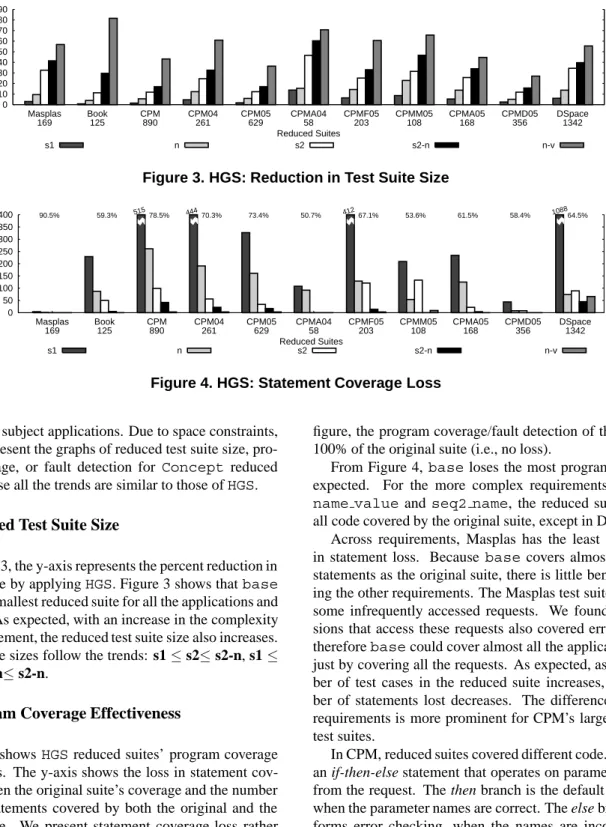
In Figure 3, the y-axis represents the percent reduction in test suite size by applyingHGS. Figure 3 shows thatbase selects the smallest reduced suite for all the applications and test suites. As expected, with an increase in the complexity of the requirement, the reduced test suite size also increases. The test suite sizes follow the trends: s1≤s2≤s2-n, s1≤ n≤n-vand n≤s2-n.
4.2. Program Coverage Effectiveness
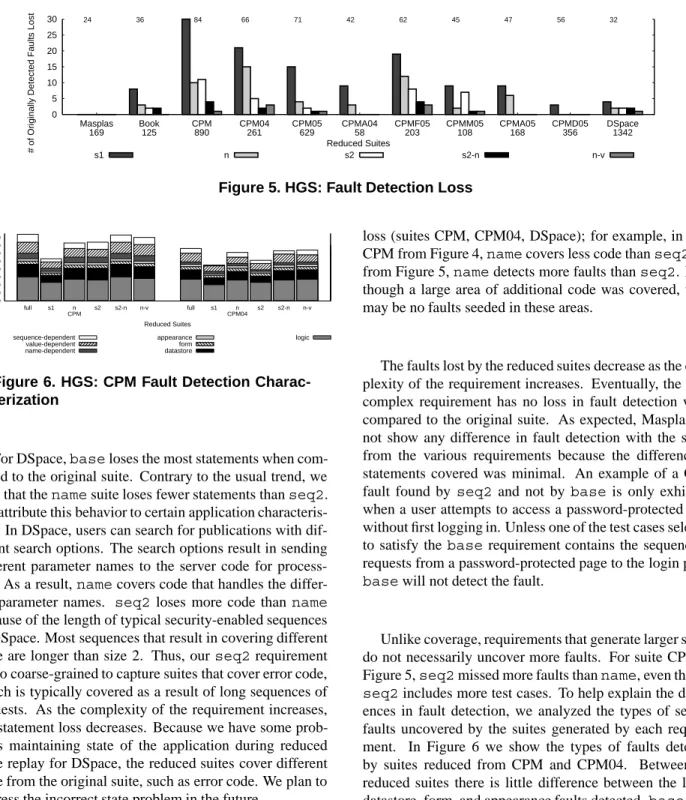
Figure 4 showsHGS reduced suites’ program coverage effectiveness. The y-axis shows the loss in statement cov-erage between the original suite’s covcov-erage and the number of actual statements covered by both the original and the reduced suite. We present statement coverage loss rather than method or conditional coverage loss because statement coverage is the finest coverage granularity we measured and best illustrates differences between requirements. The number above each cluster of reduced suites is the percent program code covered by the corresponding original suite. For both program coverage and fault detection effectiveness (Figures 4 and 5), if a reduced suite does not appear in the
figure, the program coverage/fault detection of the suite is 100% of the original suite (i.e., no loss).
From Figure 4, baseloses the most program code, as expected. For the more complex requirements, such as name value andseq2 name, the reduced suites cover all code covered by the original suite, except in DSpace.
Across requirements, Masplas has the least difference in statement loss. Becausebase covers almost as many statements as the original suite, there is little benefit to us-ing the other requirements. The Masplas test suite contains some infrequently accessed requests. We found that ses-sions that access these requests also covered error code— thereforebasecould cover almost all the application code just by covering all the requests. As expected, as the ber of test cases in the reduced suite increases, the num-ber of statements lost decreases. The difference between requirements is more prominent for CPM’s larger original test suites.
In CPM, reduced suites covered different code. Consider an if-then-else statement that operates on parameter names from the request. The then branch is the default condition when the parameter names are correct. The else branch per-forms error checking, when the names are incorrect. In CPM we observed that the reduced suite from the base requirement sometimes failed to cover the else branch of the statement. However, both the then branch and the else branch were executed by the reduced suite from thename requirement. Sincebaseconsiders only the base requests and not the names when reducing, it is likely to miss the test case with the incorrect parameter name.
0 5 10 15 20 25 30 DSpace 1342 CPMD05 356 CPMA05 168 CPMM05 108 CPMF05 203 CPMA04 58 CPM05 629 CPM04 261 CPM 890 Book 125 Masplas 169
# of Originally Detected Faults Lost Reduced Suites
24 36 84 66 71 42 62 45 47 56 32
s1 n s2 s2-n n-v
Figure 5. HGS: Fault Detection Loss
0 10 20 30 40 50 60 70 80 n-v s2-n s2 n CPM04 s1 full n-v s2-n s2 n CPM s1 full Faults Reported Reduced Suites sequence-dependent value-dependent name-dependent appearance form datastore logic
Figure 6. HGS: CPM Fault Detection Charac-terization
For DSpace,baseloses the most statements when com-pared to the original suite. Contrary to the usual trend, we note that thenamesuite loses fewer statements thanseq2. We attribute this behavior to certain application characteris-tics. In DSpace, users can search for publications with dif-ferent search options. The search options result in sending different parameter names to the server code for process-ing. As a result,namecovers code that handles the differ-ent parameter names. seq2 loses more code thanname because of the length of typical security-enabled sequences in DSpace. Most sequences that result in covering different code are longer than size 2. Thus, ourseq2requirement is too coarse-grained to capture suites that cover error code, which is typically covered as a result of long sequences of requests. As the complexity of the requirement increases, the statement loss decreases. Because we have some prob-lems maintaining state of the application during reduced suite replay for DSpace, the reduced suites cover different code from the original suite, such as error code. We plan to address the incorrect state problem in the future.
4.3. Fault Detection Effectiveness
In Figure 5, we present the results of our fault detection study. The y-axis is the number of faults detected by the original suite that are lost by the reduced suite. The number of faults detected by the original suite is represented above each cluster of reduced suites. From Figure 5, the trends in fault detection loss do not always mirror the coverage
loss (suites CPM, CPM04, DSpace); for example, in suite CPM from Figure 4,namecovers less code thanseq2, but from Figure 5,namedetects more faults thanseq2. Even though a large area of additional code was covered, there may be no faults seeded in these areas.
The faults lost by the reduced suites decrease as the com-plexity of the requirement increases. Eventually, the most complex requirement has no loss in fault detection when compared to the original suite. As expected, Masplas did not show any difference in fault detection with the suites from the various requirements because the difference in statements covered was minimal. An example of a CPM fault found by seq2 and not bybase is only exhibited when a user attempts to access a password-protected page without first logging in. Unless one of the test cases selected to satisfy the baserequirement contains the sequence of requests from a password-protected page to the login page, basewill not detect the fault.
Unlike coverage, requirements that generate larger suites do not necessarily uncover more faults. For suite CPM in Figure 5,seq2missed more faults thanname, even though seq2includes more test cases. To help explain the differ-ences in fault detection, we analyzed the types of seeded faults uncovered by the suites generated by each require-ment. In Figure 6 we show the types of faults detected by suites reduced from CPM and CPM04. Between the reduced suites there is little difference between the logic, datastore, form, and appearance faults detected.basedoes not detect as many faults that depend on request execution sequences, names, values, and logic faults, since their detec-tion depends on data entered by the user. In CPM04,seq2 detects as many sequence-dependent faults as the original suite but misses a name-dependent fault caught by name. We believe thatnameandname valuecatch most of the sequence-dependent faults because different names or val-ues can cause the user to access pages in different orders, thus exposing the sequence faults.
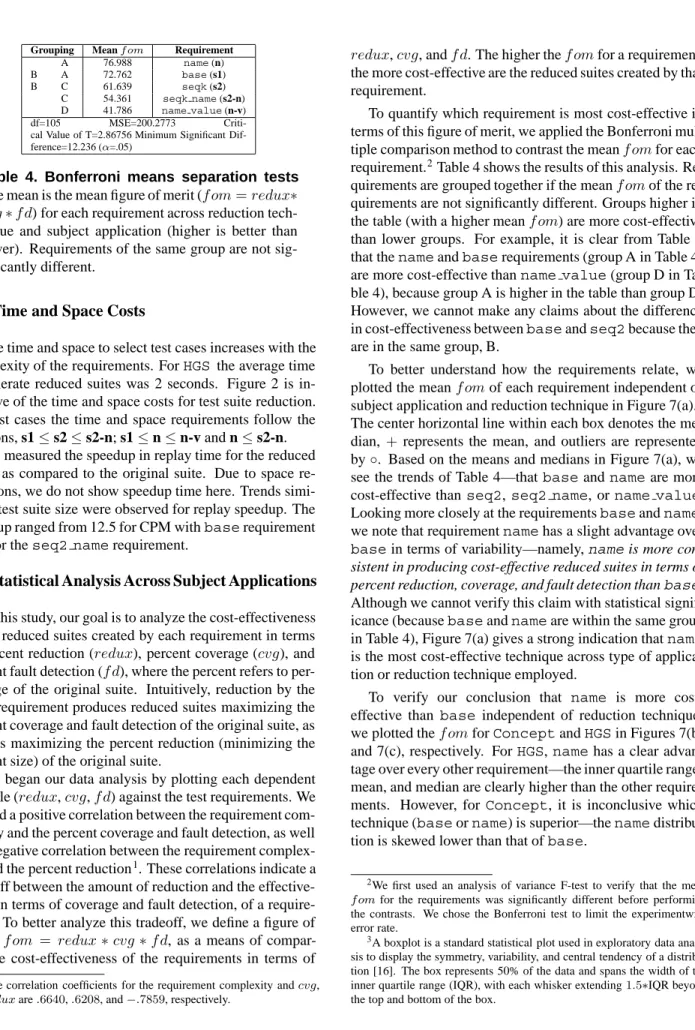
Grouping Meanfom Requirement A 76.988 name(n) B A 72.762 base(s1) B C 61.639 seqk(s2) C 54.361 seqk name(s2-n) D 41.786 name value(n-v) df=105 MSE=200.2773 Criti-cal Value of T=2.86756 Minimum Significant Dif-ference=12.236 (α=.05)
Table 4. Bonferroni means separation tests
The mean is the mean figure of merit (f om=redux∗ cvg∗f d) for each requirement across reduction tech-nique and subject application (higher is better than lower). Requirements of the same group are not sig-nificantly different.
4.4. Time and Space Costs
The time and space to select test cases increases with the complexity of the requirements. ForHGS the average time to generate reduced suites was 2 seconds. Figure 2 is in-dicative of the time and space costs for test suite reduction. In most cases the time and space requirements follow the relations, s1≤s2≤s2-n; s1≤n≤n-v and n≤s2-n.
We measured the speedup in replay time for the reduced suites as compared to the original suite. Due to space re-strictions, we do not show speedup time here. Trends simi-lar to test suite size were observed for replay speedup. The speedup ranged from 12.5 for CPM withbaserequirement to 1 for theseq2 namerequirement.
4.5. Statistical Analysis Across Subject Applications
In this study, our goal is to analyze the cost-effectiveness of the reduced suites created by each requirement in terms of percent reduction (redux), percent coverage (cvg), and percent fault detection (f d), where the percent refers to per-centage of the original suite. Intuitively, reduction by the ideal requirement produces reduced suites maximizing the percent coverage and fault detection of the original suite, as well as maximizing the percent reduction (minimizing the percent size) of the original suite.
We began our data analysis by plotting each dependent variable (redux,cvg,f d) against the test requirements. We noticed a positive correlation between the requirement com-plexity and the percent coverage and fault detection, as well as a negative correlation between the requirement complex-ity and the percent reduction1. These correlations indicate a tradeoff between the amount of reduction and the effective-ness, in terms of coverage and fault detection, of a require-ment. To better analyze this tradeoff, we define a figure of merit, f om = redux∗cvg∗f d, as a means of compar-ing the cost-effectiveness of the requirements in terms of
1The correlation coefficients for the requirement complexity andcvg,
f d,reduxare.6640,.6208, and−.7859, respectively.
redux,cvg, andf d. The higher thef omfor a requirement, the more cost-effective are the reduced suites created by that requirement.
To quantify which requirement is most cost-effective in terms of this figure of merit, we applied the Bonferroni mul-tiple comparison method to contrast the meanf omfor each requirement.2Table 4 shows the results of this analysis.
Re-quirements are grouped together if the meanf omof the re-quirements are not significantly different. Groups higher in the table (with a higher meanf om) are more cost-effective than lower groups. For example, it is clear from Table 4 that thenameandbaserequirements (group A in Table 4) are more cost-effective thanname value(group D in Ta-ble 4), because group A is higher in the taTa-ble than group D. However, we cannot make any claims about the difference in cost-effectiveness betweenbaseandseq2because they are in the same group, B.
To better understand how the requirements relate, we plotted the meanf omof each requirement independent of subject application and reduction technique in Figure 7(a).3
The center horizontal line within each box denotes the me-dian, +represents the mean, and outliers are represented by◦. Based on the means and medians in Figure 7(a), we see the trends of Table 4—thatbaseandnameare more cost-effective thanseq2,seq2 name, orname value. Looking more closely at the requirementsbaseandname, we note that requirementnamehas a slight advantage over basein terms of variability—namely,nameis more con-sistent in producing cost-effective reduced suites in terms of percent reduction, coverage, and fault detection thanbase. Although we cannot verify this claim with statistical signif-icance (becausebaseandnameare within the same group in Table 4), Figure 7(a) gives a strong indication thatname is the most cost-effective technique across type of applica-tion or reducapplica-tion technique employed.
To verify our conclusion that name is more cost-effective than base independent of reduction technique, we plotted thef omforConceptandHGSin Figures 7(b) and 7(c), respectively. ForHGS,namehas a clear advan-tage over every other requirement—the inner quartile range, mean, and median are clearly higher than the other require-ments. However, for Concept, it is inconclusive which technique (baseorname) is superior—thename distribu-tion is skewed lower than that ofbase.
2We first used an analysis of variance F-test to verify that the mean
f omfor the requirements was significantly different before performing the contrasts. We chose the Bonferroni test to limit the experimentwise error rate.
3A boxplot is a standard statistical plot used in exploratory data
analy-sis to display the symmetry, variability, and central tendency of a distribu-tion [16]. The box represents 50% of the data and spans the width of the inner quartile range (IQR), with each whisker extending1.5∗IQR beyond the top and bottom of the box.
s1 n s2 s2-n n-v Test Requirement 0 10 20 30 40 50 60 70 80 90 100 Figure of Merit (%)
(a) All Reduction Techniques
s1 n s2 s2-n n-v Test Requirement 0 10 20 30 40 50 60 70 80 90 100 Figure of Merit (%) (b)HGSReduction Only s1 n s2 s2-n n-v Test Requirement 0 10 20 30 40 50 60 70 80 90 100 Figure of Merit (%)
(c)ConceptReduction Only
Figure 7. Comparison of figures of merit (cost-effectiveness) of each requirement across applications
(+represents the mean, outliers are represented by◦)
4.6. Observations
We cannot quantitatively evaluate the effect application characteristics have on the cost-effectiveness of each re-quirement because we have insufficient data to compare requirements across applications. However, we can offer some qualitative insights into the interaction of these ap-plication characteristics and the test requirements from our exploratory data analysis.
We have found that requirements that capture context and data, such asname,name valueandseq2 name, increase reduced suite effectiveness for applications that ex-hibit significant control dependence on names and values. For example, if the control flow in the underlying appli-cation code is not dependent on the presence of particular names or values, then the tester can usebaseto obtain rea-sonably good program coverage and fault detection. How-ever, if the form field names and values affect the appli-cation control flow, such as causing the appliappli-cation to ex-ecute validation code depending on parameter names and values, a requirement such asnameorname valuewill be necessary to achieve high levels of program coverage and fault detection effectiveness. An example can be seen in our DSpace application, where the same base request displays different information based on the search parameters speci-fied in name-value pairs.
Context-dependent requirements (seq2,seq2 name), on the other hand, increase reduced suite effectiveness for applications that have specific user patterns intended by the developer. Although the application might not behave as
anticipated, a web application user can access any valid URL of an application at any time. Some applications have predefined URL sequences that users follow if they follow links displayed by the application. For example, to view the details of a publication in DSpace, a user must first visit the search results page. Reducing with theseq2or seq2 name requirements will include any unanticipated sequences of user requests and, therefore, potentially cover more code and find more faults.
5. Related Work
Multiple strategies exist to test web applications, such as link and form testers [23], structural testing tools [2, 13, 14, 15, 18] and user-session-based testing techniques [6, 10, 17]. Other techniques such as [10] emulate portions of browser behavior and test correctness of returned pages. When used in conjunction with JUnit [11], HttpUnit allows writing test cases for web applications. Web-King [17], a capture-replay tool for testing web applications, allows testers to record interactions with the application and replay the recorded tester input as test cases.
Offutt et al. [15] present an approach to generate test cases with the goal of uncovering faults and security vul-nerabilities in server software due to user’s ability to bypass client-side input validation. They model web applications and present techniques to generate bypass test cases for value level, parameter level, and control flow level bypass testing. Some of our requirements, such asname value andseq2, are similar to value and control flow bypass
test-ing, respectively. Bypass testing is complementary to user-session-based testing. Our user-user-session-based testing ap-proach uses field data to generate test cases that represent common application usage in the testing of later versions of the server software, whereas bypass testing focuses on users who bypass the client-side input validation, and thus the ro-bustness and security holes in the server applications from less normal use. Our test cases are synonymous with typical usage of the application, whereas, bypass testing generates malicious test cases.
6. Conclusions and Future Work
In this paper, we defined a set of customized require-ments for testing web applications and evaluated their ap-plicability to the problem of test case selection. Our results indicate that requirements that have more data or context as-sociated with them cover more statements and detect more faults. The faults detected by the various reduced suites change with the requirement used to select the test suite. We found that baseandname select reduced suites that are consistently small in size and effective. A tester might want to choosenamebecause it is more consistent thanbase. seq2 name might be a good alternative if test suite size is not a concern to the tester, but maximizing program cov-erage and fault detection are more important. A tester can also choose the applicable requirement by the application usage and code properties. The tradeoff however is the test suite size and the time and space requirements to generate and replay the test suite. In the future we plan to apply our requirements to other web applications and investigate addi-tional uses. We also plan to further evaluate the applicability of our requirements to certain types of web applications by classifying applications based on their usage.
Acknowledgments. We thank Frank Zappaterrini for build-ing the replay tool and customizbuild-ing DSpace, and Stacey Ecott for seeding faults in Masplas. We also thank Dr. Allen Gibson from the Stillman School of Business at Seton Hall University for his assistance with the statistical analysis.
References
[1] P. Ammann and J. Offutt. Introduction to Software Testing. In preparation, 2006.
[2] A. Andrews, J. Offutt, and R. Alexander. Testing web ap-plications by modeling with FSMs. Software and Systems Modeling, 4(3):326–345, July 2005.
[3] J. H. Andrews, L. C. Briand, and Y. Labiche. Is mutation an appropriate tool for testing experiments? In International Conference on Software Engineering, 2005.
[4] Clover: Code coverage tool for Java. http://www.
cenqua.com/clover/, 2006.
[5] Dspace federation.http://www.dspace.org/, 2006.
[6] S. Elbaum, G. Rothermel, S. Karre, and M. Fisher II. Lever-aging user session data to support web application testing. IEEE Transactions on Software Engineering, 31(3):187– 202, May 2005.
[7] Open source web applications with source code. http: //www.gotocode.com, 2006.
[8] M. J. Harrold, R. Gupta, and M. L. Soffa. A methodology for controlling the size of a test suite. ACM Transactions on Software Engineering and Methodology, 2(3):270–285, July 1993. [9] HTTPClient V0.3-3. http://www.innovation.ch/ java/HTTPClient/, 2006. [10] HttpUnit. http://httpunit.sourceforge.net, 2006. [11] Junit.http://www.junit.org, 2006.
[12] C. Lindig. Concepts tool. http://www.st.cs.
uni-sb.de/∼lindig/src/concepts.html, 2006. [13] C.-H. Liu, D. C. Kung, and P. Hsia. Object-based data flow testing of web applications. In The First Asia-Pacific Con-ference on Quality Software, 2000.
[14] G. D. Lucca, A. Fasolino, F. Faralli, and U. D. Carlini. Test-ing web applications. In International Conference on Soft-ware Maintenance, 2002.
[15] J. Offutt, Y. Wu, X. Du, and H. Huang. Bypass testing of web applications. In International Symposium on Software Reliability and Engineering, 2004.
[16] R. L. Ott and M. Longnecker. An Introduction to Statistical Methods and Data Analysis. Duxbury, Fifth edition, 2001.
[17] Parasoft WebKing. http://www.parasoft.com,
2004.
[18] F. Ricca and P. Tonella. Analysis and testing of web applica-tions. In International Conference on Software Engineering, 2001.
[19] S. Sampath, V. Mihaylov, A. Souter, and L. Pollock. Com-posing a framework to automate testing of operational web-based software. In International Conference on Software Maintenance, 2004.
[20] S. Sampath, V. Mihaylov, A. Souter, and L. Pollock. A scal-able approach to user-session based testing of web applica-tions through concept analysis. In International Conference on Automated Software Engineering, 2004.
[21] S. Sampath, S. Sprenkle, E. Gibson, L. Pollock, and A. Souter. Analyzing clusters of web application user ses-sions. In Third International Workshop on Dynamic Analy-sis, May 2005.
[22] S. Sampath, S. Sprenkle, E. Gibson, L. Pollock, and A. Souter. Applying concept analysis to user-session-based testing of web applications. Technical Report 2006-329, University of Delaware, 2006.
[23] Web site test tools and site management tools.
<http://www.softwareqatest.com/qatweb1.html>, 2006. [24] S. Sprenkle, E. Gibson, S. Sampath, and L. Pollock.
Auto-mated replay and failure detection for web applications. In International Conference of Automated Software Engineer-ing, 2005.
[25] S. Sprenkle, S. Sampath, E. Gibson, L. Pollock, and A. Souter. An empirical comparison of test suite reduc-tion techniques for user-session-based testing of web appli-cations. In International Conference on Software Mainte-nance, 2005.