Honors Scholar Theses Honors Scholar Program
Spring 4-26-2016
Underrepresentation of Minorities in Gifted and
Talented Programs: A Content Analysis of Five
District Program Plans
Jessica Stargardter
University of Connecticut - Storrs, [email protected]
Follow this and additional works at:https://opencommons.uconn.edu/srhonors_theses
Part of theEducational Assessment, Evaluation, and Research Commons, and theGifted Education Commons
Recommended Citation
Stargardter, Jessica, "Underrepresentation of Minorities in Gifted and Talented Programs: A Content Analysis of Five District Program Plans" (2016).Honors Scholar Theses. 484.
Underrepresentation of Minorities in Gifted and Talented Programs: A Content Analysis of Five District Program Plans
Jessica Stargardter Honors Thesis Neag School of Education University of Connecticut
Abstract
Many educators and researchers recognize the issue of underrepresented minority groups in gifted and talented education programs. Since the landmark Supreme Court case Brown vs Board of Education in 1954, policies, laws, and standards have been attempting to establish equity in educational programs. This content analysis explores how select districts in the metropolitan region of Colorado align with the NAGC’s standard 2. The research showed that the majority of these districts followed NAGC’s standard 2, but the underrepresentation of minority groups within the metropolitan region of Colorado continued. National, state, and local districts need to do more to promote equity and diversity.
i
Table of Contents
Chapter I: Introduction ... 1
Chapter II: Literature Review ... 3
Excellence Gap ... 8
Conceptions of Giftedness ... 10
Identification Processes ... 12
The Importance of Policy ... 15
Purpose of Study ... 16
Chapter III: Methods ... 17
Research Questions ... 17
Colorado ... 17
Design ... 19
Data Sets ... 19
Sample Size ... 21
Metro District Advanced Learning Plans Alignment With NAGC Standard 2: Assessment .. 30
Chapter IV: Discussion ... 41
Chapter V: Conclusions ... 42
Chapter VI: Limitations ... 44
Chapter VII: Implications for Further Research ... 45
ii
List of Tables
Table 1 Selected Metropolitan Districts Total Enrollment and English Learners Count and Corresponding Percentage ... 24 Table 2 Selected Metropolitan Districts Total Enrollment and Economically Disadvantaged
Pupil Count and Corresponding Percentage ... 25 Table 3 Selected Metropolitan Districts Total Enrollment and Free and Reduced Lunch Count
and Corresponding Percentage ... 25 Table 4 Selected Metropolitan Districts Total Enrollment and Gifted and Talented Count and
Corresponding Percentage ... 26 Table 5 Colorado State Gifted Enrollment ... 26 Table 6 Douglas County, CO: Race/Ethnicity, District Population, and Gifted Enrollment
Data ... 27 Table 7 Cherry Creek 5, CO: Race/Ethnicity, District Population, and Gifted Enrollment Data28 Table 8 Arapahoe 28J, Aurora, CO: Race/Ethnicity, District Population, and Gifted
Enrollment Data ... 28 Table 9 St. Vrain, CO: Race/Ethnicity, District Population, and Gifted Enrollment Data ... 29 Table 10 Adams 1-Mapleton, CO: Race/Ethnicity, District Population, and Gifted Enrollment
Data ... 30 Table 11 Metro District Advanced Learning Plans Alignment With NAGC Standard 2:
Assessment ... 31 Table 12 Examples of Metro District Advanced Learning Plans alignment with NAGC
Standard 2: Assessment ... 34 Table 13 NAGC Standard 2: Assessment ... 36 Table 14 Identification ... 39
iii
List of Figures
Figure 1. Colorado Regions Map ... 22 Figure 2. Metropolitan Region Map ... 23
1
Chapter I: Introduction
The Washington Post published a recent article titled, “Why Gifted Education Doesn’t Make Sense” (Mathews, 2014, p. 1). The title alone draws an audience. There are some issues in gifted education that simply do not make sense. A recurring problem often discussed in
education research regarding gifted education is that of underrepresentation of students from racial/ethnic groups. Many researchers and educators recognize the issue. It is clear that this issue is crucial to gifted education (McBee, 2010). There is an overrepresentation of White and Asian students in gifted and talented programs, while Black and Hispanic students are typically underrepresented. However, research does not support the notion that any one group is more intelligent than another (Renzulli, 2004). So how does this make sense? Why are racial and ethnic minorities continually underserved and underachieving (Ford, 1997)? In fact, “Black students are only 59% as likely to receive gifted services as would be predicted if their gifted participation was proportionate to their presence in the broader student population” (Grissom, Rodriguez, & Kern, 2015, p. 1). The policies and standards created by national, state, and local authorities influence program design and implementation (VanTassel-Baska, 2006). This content analysis will attempt to make sense of the standards and policies that shape gifted and talented programming. It is important to address effective and ineffective gifted education policies to discern potential links to underrepresentation.
Many gifted education experts and researchers have commented on the issue that minority racial groups are underrepresented in gifted programs (Brown et al., 2005; Ford & Grantham, 2003; Harradine, Coleman, & Winn, 2015). There is no debate about the under-enrollment of children of color in gifted and talented education programs. The reasons for this issue and possible solutions are more controversial and widely debated. Various solutions have
2
been proposed and discussed (Renzulli, 2004), but there is limited research on implementing these solutions and observing the results.
There is also limited information on the influences of policies at federal, state, and local levels on promoting equitable and diverse identification processes. Policies are important in guiding gifted education programs. VanTassel-Baska (2006) explained “improved state-level policies will inform local district policies, which, in turn, will build a strong foundation for guiding and maintaining gifted program implementation” (p. 249).
This study focuses on specific districts’ adherence to the National Association for Gifted Children’s (NAGC, 2010b) standards for assessment. Colorado metro regional districts’ websites and Advanced Learning Plans were analyzed for evidence of equity and promotion of diversity. This study looks at each district’s evidence of promoting equity and the adherence of each district to national standards. This is important when developing and adapting district policies in the future to increase representation of minority students in gifted and talented programs.
Researchers, policymakers, and educators can better implement policies that will allow high-ability students of any racial or ethnic group to achieve by formally reviewing their districts’ adherence to national standards (VanTassel-Baska, 2006).
3
Chapter II: Literature Review
Chapter II: Literature Review delves into common issues with gifted and talented
education programs. The issues, such as conceptions of giftedness and inequitable identification processes, are discussed in reference to national standards, state policies, and local district program plans.
Historical Influences on Racial Underrepresentation
Just as policies influence gifted programming today, past legislative acts had an effect on the underrepresentation of racial/ethnic minorities in gifted programs. VanTassel-Baska (2006) suggested “making connections between historical turning points and the shifting American philosophies related to equity and excellence” because “the history of gifted education offers very important and critical lessons” (p. 249). Landmark court cases, legislative initiatives and scientific breakthroughs have influenced educational policies and plans.
Brown vs. Board of Education. In 1896, Plessy v. Ferguson established that public accommodations could be separate as long as they were equal for each race. This “separate but equal” doctrine provided the rationale for segregated school systems.
Plessy v. Ferguson is the Supreme Court case that was overturned by Brown v. Board of Education in 1954. The court decided, “The ‘separate but equal’ doctrine adopted in Plessy v. Ferguson, 163 U.S. 537, has no place in the field of public education” (Brown v. Board of Education, 1954, para. 12). In 1955, the court also ordered the desegregation plans to be implemented “with all deliberate speed” (Patterson, 2001, p. XIV).
The Brown ruling was a landmark decision that led the way to more legislative change for African Americans. This case even had a unanimous ruling by the Supreme Court justices, showing a shifting opinion in segregation (Patterson, 2001). There was a lot of hope surrounding
4
this ruling, but despite changing thoughts among some politicians, social perceptions of Blacks remained the same.
Little Rock, Arkansas. Even though Brown v. Board of Education outlawed separate but
equal education, there was continued racism in school systems. One of the most well known examples of continued racism, in regard to education, after Brown, was the Little Rock Crisis. Central High School in Little Rock, Arkansas, began its integration with nine Black teenagers. Governor of Arkansas, Orval Faubus, brought in the National Guard to stop these students from entering the school, despite the Brown ruling. The Brown ruling stated, “School authorities have the primary responsibility for elucidating, assessing, and solving these problems” (Brown v. Board of Education, 1954, para. 2a). Integrationists called upon President Eisenhower for support to protect the students and allow entrance into the school. After grumblings and no help from local authorities, Eisenhower finally sent federal troops to Arkansas to protect the Little Rock Nine. However, White students continued to spit on and violate the Black students’ personal space. While legal segregation was over, social segregation was far from gone.
Supreme Court Justice at the time, Warren, identified Brown as a huge stride in the direction of knocking it down. Many contemporaries agree that the court had courageously contested America’s durable color line. Yes, the Brown case was a big step in “knocking” down racial discrimination, but racial segregation is still evident today.
The Brown ruling was undeniably a step in the right direction for the public education system; however, this court ruling did not do enough because segregation, in gifted programs and entire school systems, is still prevalent (Ford, 1995).
National Association for Gifted Children. In 1954, the National Association for Gifted Children (NAGC) was created. NAGC, which is still active today, develops practices and
5
policies to provide guidance and focus for state policies and local districts gifted programming. NAGC also conducts research to improve representation of minorities in gifted and talented programs. The federal government does not mandate services for high-ability learners or gifted students. Therefore, national organizations like NAGC plays an essential role in improving education for gifted students.
Sputnik launch. Three years after the Brown v. Board of Education ruling, Russia launched the first satellite into space. In 1957, America officially lost the Space Race. This event in history is often referred to as the beginning of gifted education. America’s desire to be
globally competitive “set the stage for an unprecedented infusion of funding from the federal government to reform public education at all levels” (Jolly, 2009, p. 50). The National Defense Education Act was passed in 1960 to provide funding for academically able students who could not afford schooling. It also gave states funding for services to increase STEM learning in high-achieving students (Jolly, 2009; McClain & Pfeiffer, 2012). The launch of Sputnik spurred legislation and policies to increase government support for high-ability students. Although gifted education was not the entire focus of the National Defense Education Act, this act was one of the first times that gifted education became important to the United States policy agenda.
The Marland Report.Shortly after the National Defense Education Act, the Marland Report (1972) to Congress by the U.S. Commissioner of Education was released in response to the amendment of the Elementary and Secondary Education Act. The Marland Report
established the first federal definition of giftedness in areas of “general intellectual ability, specific academic aptitude, creative or productive thinking, leadership ability, visual and performing arts, psychomotor ability” (U.S. Commissioner of Education, 1972, p. 2). Today,
6
most definitions of giftedness continue to include these areas as terms that outline a gifted learner.
A Nation at Risk. A Nation at Risk (The National Commission on Excellence in
Education, 1983) examined America’s high-ability students’ test scores and found that America was unable to compete with global competitors. Just like with the Soviet Union’s launch of the Sputnik, America was beginning to realize that it needed to do something to become
economically and intellectually competitive in the global market. The only specific reference to gifted programming in this report was “over half the population of gifted students do not match their tested ability with comparable achievement in school” (The National Commission on Excellence in Education, 1983, Indicators of Risk, para. 6). Although it was not policy specifically for gifted programming, it was a call to action for America to fix the “mediocre educational performance” (The National Commission on Excellence in Education, 1983, para. 2).
Javits Act. The Javits Gifted and Talented Student Education Act was established by Congress to promote and support gifted education programs. It was passed in 1988 as part of the Elementary and Secondary Education Act. The Javits Act established the Federal Office of Gifted and Talented and The National Research Center on the Gifted and Talented (Imbeau, 1999). This legislation also gave state and local education agencies financial assistance to
maintain gifted programs and gave “highest priority to the identification of gifted racial minority, economically disadvantaged, limited-English-proficient, and disabled students” (Ford, 1995, p. 52). “The Javits Act, which is the only federal program dedicated specifically to gifted and talented students, does not fund local gifted education programs.” It coordinates research and development of strategies and activities that improve gifted programming. The Javits Act
7
specifically focuses on increasing representation of historically underserved populations (NAGC, 2010a, para. 1). This act funds many research projects today to enhance gifted education
programs, including the grant that provided data sources for this honors thesis.
National Excellence. In 1993, the U.S. Department of Education issued another report entitled National Excellence: The Case for Developing America’s Talent. This report detailed how America was neglecting the talents of school-age students. The report indicated that there had been some improvement as state and local authorities made an effort to design special programs for high-achieving students. Even though there was an attempt to develop gifted programming, the point of the report was to recommend actions to improve gifted programs because the problems outweighed the small improvements. There was and still is a need to challenge the students who have gifts and talents to keep up with America’s global competitors (United States Department of Education, 1993).
NAGC standards.In 1998, NAGC published their first set of standards for Pre-K to
Grade 12. They have since been updated and revised in 2010. These standards identified seven key areas for programs for gifted and talented: Learning and Development, Assessment, Curriculum & Instruction, Learning Environments, Programming, and Professional
Development. “The development and dissemination of the NAGC standards was an important and commendable step in the ongoing professionalism of the practice of gifted education” (Matthews & Shaunessy, 2010, p. 160).
Educational policy plays a role in the disproportionate representation of students in gifted education as well. There are many policies and standards that focus on improving the
representation of minorities in gifted and talented programs. It is clear that these policies and standards influence gifted programs (Matthews & Shaunessy 2010).
8
Excellence Gap
In 2001, Congress passed the No Child Left Behind (NCLB) Act as a way to bring lower performing students up to proficient achievement levels. The purpose of this law was to close the gap between the students who are underachieving and the students who are meeting goal on standardized tests. Therefore, the distance between low performing groups and the highest performing groups should reduce over time. The assumption is that the highest performing group will continue achieving above average without challenging or focused instruction.
Gifted education has found it difficult to gain traction in the midst of 2001’s No Child Left Behind Act, which focuses public K-12 energies and monies on seeking proficiency in reading and math as a goal for all students and ignores the needs to the most able students who could benefit from high-level math and science courses. (Jolly, 2009, p. 52) Even though NCLB aimed to bring lower performing students up to grade level, it did not address any instruction to continue challenging higher performing students. The students who strived for excellence seemed to be left behind. According to Gallagher (2010), a past president of the NAGC, there are two important aspects of education in America policy: equity and excellence.
Policymakers tend to focus on equity more than excellence. The court case, Brown v. Board of Education was an attempt to foster equity through integration. The consequences of losing the Space Race focused on promoting excellence, as did the Javits Act. NCLB, however, focused mainly on equity and ensuring that all students have equal opportunities, hence the title of the legislation. Excellence, while not discouraged, had been overlooked in NCLB (Gallagher, 2010; Plucker, Burroughs, & Song, 2010). Because NCLB focused on testing and bringing the lowest performing groups up, the highest ability learners were not receiving the challenging
9
curriculum they need. A Nation at Risk aptly documented the importance of both equity and excellence:
The twin goals of equity and high-quality schooling have profound and practical meaning for our economy and society, and we cannot permit one to yield to the other either in principle or in practice. To do so would deny young people their chance to learn and live according to their aspirations and abilities. (The National Commission on Excellence in Education, 1983, Excellence in Education, para. 2)
Plucker et al. (2010) explained that since the 1970s, there has been a steady increase in reading and math scores, but NCLB left gifted students without government support. The
excellence gap refers to the “differences between subgroups of students performing at the highest levels of achievement” (Plucker et al., 2010, p. 1). This directly connects with the
underrepresentation of minorities in gifted programs, because traditionally the lower performing students are of racial minorities and lower socioeconomic status (Ford & Grantham, 2003; Scott & Delgado, 2005). NCLB focused on helping students from these subgroups to meet state standards, but did not give legislative and financial support for culturally, linguistically, or economically diverse students who were able to achieve above the state goals on statewide tests:
The goal of guaranteeing that all children will have the opportunity to reach their
academic potential is called into question if educational policies only assist some students while others are left behind. Furthermore, the comparatively small percentage of students scoring at the highest level on achievement tests suggest that children with advanced academic potential are being under-served, with potentially serious consequences for the long-term competitiveness of the United States. (Plucker et al., 2010, p. 1)
10
The idea that cultivating high-achieving students can have a positive effect on the United States economy is important, just as the National Excellence report suggested. Policy makers have long been motivated by the economic influence of laws and policies. There is evidence to support that funding high-ability students will make the United States more competitive in the global market. “Business and government leaders continue to raise concerns about the future supply of highly skilled employees that can meet the nation’s economic and national security needs” (NAGC, 2013, p.2). However, there is still a lack of funding and political mandates for gifted education. In the United States, 14 states did not provide funding to local districts for gifted education (NAGC, 2013). The educational, economic, and political implications must be addressed:
Policy makers should be aware that the gifted persons described here will comprise a large proportion of the leadership of the next generation in the arts, sciences, letters, politics, etc. If we provide this group with a mediocre education we doom ourselves to a mediocre society a generation forward.(Siegle & McCoach, 2010, p. 10)
Conceptions of Giftedness
“Researchers in the field of giftedness have bemoaned the lack of a general definition of giftedness” (Carman, 2013, p. 52). Multiple conceptions of giftedness are discussed among policymakers, researchers, and educators. There have been many different conceptions over the years, which, in part, may be due to debates over characteristics of gifted students (McClain & Pfeiffer, 2012; Renzulli, 2011). Moreover, ideas about giftedness are influenced by “culture, politics, and research findings” and are constantly changing (Moon, 2006, p. 23). Students from underserved populations may not exhibit characteristics that are stereotypically gifted.
Some gifted individuals with exceptional aptitude may not demonstrate outstanding levels of achievement due to environmental circumstances such as limited opportunities to learn as a result of poverty, discrimination, or cultural barriers; due to physical or
11
learning disabilities; or due to motivational or emotional problems. Identification of these students will need to emphasize aptitude rather than relying only on demonstrated
achievement. (Siegle & McCoach, 2010, p. 7)
Definitions of giftedness vary across states and local school districts. Because there are different conceptions about the characteristics of gifted students, it is difficult to have cohesive ways to identify these students. Identification processes start at the beginning of a child’s journey into more challenging curriculum (Gubbins, 2006). They are directly linked to definitions of giftedness and important for determining a child’s academic path, for evaluating gifted programs, and for compiling demographic data.
Researchers in gifted education have to use multiple definitions of giftedness to formulate methods of identification. Oftentimes, researchers use the most convenient definition. The use of a “flexible definition” may make identifying students easier, but “it leaves the definition of ‘gifted’ weak and hard to compare across states. This also makes it difficult to conduct research on multiple groups of gifted individuals”. (Carman, 2013, p. 52)
Defining giftedness influences assessment processes, portability, screening, and evaluation methods. Because gifted programming is not a federal mandate, politicians, researchers, and practitioners at national, state, and local levels have created definitions of giftedness. A conservative view relies heavily on standardized testing and strictly intellectual definitions of intelligence. An example of this conservative view is Terman’s definition “the top 1 percent level in general intellectual ability as measured by the Stanford-Binet Intelligence Scale or a comparable instrument” (Renzulli, 1986, p. 258). This type of definition makes it difficult for students who do not have the specific IQ score to be identified as gifted (Renzulli, 2002). Most researchers and policy makers lean towards a more liberal type of definition
12
(Renzulli, 2002). NAGC’s definition of gifted represents a more liberal view because it includes the idea of multiple intelligences. The definition is as follows:
Gifted individuals are those who demonstrate outstanding levels of aptitude (defined as an exceptional ability to reason and learn) or competence (documented performance or achievement in top 10% or rarer) in one or more domains. Domains include any structured area of activity with its own symbol system (e.g., mathematics, music,
language) and/or set of sensorimotor skills (e.g., painting, dance, sports). (NAGC, 2010c) Each state and local authority determines gifted programming. Definitions vary from state to state, which makes it difficult to “progress toward a specific goal” (Moon, 2006, p. 23). It is up to state and local authorities to implement policies and improve programming. “Definitions of what constitute students who are gifted and talented as well as policies and procedures to identify these high-ability students play a critical role in determining which individuals actually receive gifted services” (McClain & Pfeiffer, 2012, p. 59). Some state policies explicitly
described ways they will promote equity in their gifted programs.
Creating a broad definition of giftedness is important in developing an effective and inclusive gifted program. The definition of giftedness in national and state policies must be clear to close the gaps between both racial and economic groups. (Clarenbach & Eckert, 2012). As a result of developing a clearer definition of giftedness, a wider range of students can be served, including minority subgroups. The careful expansion of state definitions of giftedness will allow for an increase in students from various cultural, racial, and ethnic backgrounds in gifted
programs (De Wet & Gubbins, 2011).
Identification Processes
Identifying children as gifted has always been difficult (VanTassel-Baska, 2006), complicated by factors such as the sheer variety of gifts, several degrees of giftedness, and low
13
socioeconomic and minority cultural backgrounds (Wellish & Brown, 2012). The
underrepresentation of groups of color and students of lower socioeconomic status in gifted and talented programs could point towards a flaw in methods of identification (McBee, 2010). “Identification procedures for gifted programs reinforce social inequalities while missing some of our most promising students” (McKenzie, 2004, p. 131). Identification practices are being reassessed to provide opportunities for all high-ability students (Brown et al., 2005; Michael-Chadwell, 2010). A new standard for identification practices can provide opportunities for all high-ability students to be recognized (Brown et al., 2005; Michael-Chadwell, 2010). “A new paradigm for identifying and selecting students will help low-socioeconomic status and minority students become more represented in gifted programs” (VanTassel-Baska, Feng, & Evans, 2007, p. 218).
IQ scores. Originally, IQ scores were the only method of identification for entry into gifted and talented education programs (Brown et al., 2005).
Identification practices throughout the early part of the past century focused almost exclusively on IQ test scores or other measures of cognitive ability. It was not uncommon to observe IQ cut-off scores as being the sole criterion for entrance into gifted programs. (Reis & Renzulli, 2004, p. xxiv)
IQ scores are an indication of future academic achievement. However, there has been debate about whether IQ scores should be the only measure in determining giftedness (Brown et al., 2005; McClain & Pfeiffer, 2012). More comprehensive tests or identification methods could expand gifted and talented programs to students who have not been traditionally recognized as gifted. Using IQ scores alone “clearly discriminates against these groups when it comes to
14
despite the possible bias involved. “Although most scholars and researchers have embraced a more flexible approach to identifying students for special program services, regulations and guidelines for identification in several states continue to place major emphasis on IQ or other cognitive abilities test” (Renzulli, 2011, p. 61). According to the State of the States in Gifted Education (NAGC & Council of State Directors of Programs for the Gifted, 2010-2011), the most frequently required criterion in 19 states is IQ scores, yet 25 states require multiple criteria to identify gifted students. VanTassel-Baska et al. (2007) noted a need for the following:
New paradigm of identification would recognize the different ways in which students display giftedness and would call for more varied and authentic assessments. Instead of relying on intelligence and achievement test scores solely for identification, multiple criteria would be used. (p. 218)
There is a clear shift from using only IQ scores for the identification of gifted learners to using multiple criteria. Other methods of identification are student observations, dynamic assessment, non-verbal tests, teacher or parent nominations, and student portfolios. In practice, as mentioned, however, IQ testing is now less popular, and additional tools are required to improve
identification of twice-exceptional or “invisible gifted” children (Wellish & Brown, 2012, p. 153).
Teacher nominations. Teacher or parent nominations have become a part of identifying students as gifted. There is evidence that teacher nominations come with a certain amount of bias that may hinder the representation of students from lower socio-economic statuses and minority backgrounds (McBee, 2010; Scott & Delgado, 2005). According to McBee (2010), “the
probability of nomination for Black students was only 31% as large as the probability for White students, whereas the pass rate for the testing stage for Black students was 82% as large as the
15
pass rate for White students” (p. 284). “Teachers often act as gatekeepers for gifted programs, so their attitudes and views of children are key to why some gifted youngsters are not entering ‘the gate’” (Swanson, 2006, p. 11).
It is important to identify gifted students using multiple factors. The use of tests as a means to identify gifted children often fails to identify students from diverse backgrounds. These tests do not serve children who live in households that lack an emphasis in literacy skills
(Clarenbach & Eckert, 2012). Employing multiple processes, such as teacher nominations, parent nominations, and student portfolios, can more equitably identify gifted students.
The Importance of Policy
According to Gifted Children and the Law, state statutes, regulations, and rules
continually affect gifted education (Karnes & Marquardt, 1991). “Although substantial attention has been devoted to differential representation, evaluation and policy as research foci have been relatively neglected in the gifted education literature” (Matthews & Shaunessy, 2010, p. 159). Researchers have found that national and state services provide direction to local school districts so they can meet the needs of underserved populations (Gubbins, 2006; Moon, 2006).
NAGC offers a set of standards that influence gifted programing that provides focus and direction for state and local school districts. The standards “increase the focus on diversity and collaboration” for the programs at local levels (NAGC, 2010c, para. 2). The focus of this study is NAGC Standard 2: Assessment, which includes identification, learning outcomes, and program evaluation (NAGC, 2010b). Researchers often look to IQ Scores and standardized testing when examining causes of disproportional representation in gifted education. However, according to Matthews and Shaunessy (2010),“Educational policies enacted by states and districts also factor into the rates of representation of different groups in programs for exceptional learners” (p. 159).
16
Purpose of Study
This thesis is a content analysis that explores how publically available Advanced Learning Plans in metro regions of Colorado align with the NAGC’s standard 2. It will draw connections between this alignment and the districts’ efforts to promote equity and diversity. Demographic data for each district are included to provide a broader understanding of the composition of racial/ethnic groups. Despite the very specific sample, this study will illustrate the extent to which these selected districts are adhering to national standards, which will provide insight into the influence national policies have on population demographics of local school districts. This is important when developing and adapting policies in the future to increase representation of minority students in gifted and talented programs.
17
Chapter III: Methods
Chapter III describes how and why the state and each district were chosen and provides details about district-level demographics. It also details how data from district-level Advanced Learning Plans (ALPs) were analyzed for alignment with NAGC Standard 2: Assessment. Data from these sources were organized, reviewed, and analyzed to have a better understanding of selected districts in the metropolitan region of Colorado. The following research questions were the main emphasis of this study.
Research Questions
• Do ALPs from a subset of Colorado’s metropolitan regional school districts reflect
identification processes that align with the NAGC Standard 2: Assessment?
• How do enrollment demographics relate to evidence of equity in ALPs?
• How do documents from Colorado’s metro regional school districts promote equity
during the identification process?
Colorado
Colorado mandates gifted education identification and programming even though there is no federal mandate. This means that all the administrative units in all districts are required to identify and serve students who need advanced educational opportunities. In addition to requiring programming for high-ability learners, Colorado and several other states have established a priority of identifying and serving historically underrepresented populations. According to McClain and Pfeiffer (2006), about half the states mandate services specifically to increase identification of culturally diverse students. Colorado uses multiple methods of
identification to recognize students from culturally, ethnically, linguistically, and racially diverse backgrounds. Students in Colorado may be identified in one or more of these domains: general or specific intellectual ability, specific academic aptitude, creative or productive thinking,
18
leadership abilities, visual arts, performing arts, musical or psychomotor abilities. NAGC
(2010a) suggests using multiple assessments to “measure diverse abilities, talents, and strengths” (p. 1). This language is also used in Colorado guidelines for assessment, which shows
application of national standards to state policy. Additionally, a Body of Evidence is collected for each student. It includes both qualitative and quantitative evidence for identification. Colorado’s legislation promotes equity through their policies of assessment and identification (Colorado Department of Education, 2015a). These processes are important because they affect the demographics of the gifted program. By paying specific attention to equitable processes, Colorado is working towards a more representative gifted and talented program.
The following is the current state definition, as stated on the Colorado Department of Education (2012) website.
Gifted and talented children means those persons between the ages of five and twenty-one whose abilities, talents, and potential for accomplishment are so exceptional or developmentally advanced that they require special provisions to meet their educational programming needs. Gifted students include gifted students with disabilities (i.e., twice-exceptional) and students with exceptional abilities or potential from all socio-economic and ethnic, cultural populations. Gifted students are capable of high performance, exceptional production, or exceptional learning behavior by virtue of any or a
combination of these areas of giftedness: general or specific intellectual ability, specific academic aptitude, creative or productive thinking, leadership abilities, visual arts, performing arts, musical or psychomotor abilities. (p. 1)
Plucker, Giancola, Healey, Wang, and Ardnty (2015) prepared the report entitled Equal Talents, Unequal Opportunities for the Jack Kent Cooke Foundation, The researchers examined state
19
policies and student outcomes, specifically looking at influences on low-income students and developed a grading system familiar to policy makers and practitioners alike. Colorado received a B-, which is the highest grade that was given to any state. Only 6 of the 50 states received a B-, and not one state received an A (Plucker et al., 2015). This is an indication that Colorado is slightly ahead of the curve in providing for their gifted students, but there is still room for improvement.
Design
The purpose of this study is to examine the alignment or lack of alignment between the Advanced Learning Plans in metropolitan regions of Colorado and the NAGC standards. First, the racial/ethnic demographics for the state of Colorado and each district are presented, followed by he alignment of Advanced Learning Plans to NAGC standards. The information is presented categorically, as determined by a research-based coding scheme developed by researchers from the National Center for Research on Gifted Education (NCRGE, 2015a, 2015b). This thesis is a content analysis to determine potential pattern between the underrepresentation of minorities in these districts and the alignment of ALPs to NAGC standards.
Data Sets
Several instruments and data sets were used to compile information about policies that may influence gifted representation in specific school districts in Colorado, including the following:
• NAGC Pre-K-grade 12 Gifted Programming Standards
• Colorado Department of Education website and district websites • District-level Advanced Learning Plans
20
• The State of the States in Gifted Education: National Policy and Data and Practice Data. (NAGC & Council of State Directors of Programs for the Gifted (CSDPG), 2013)
Each one is explained in detail below.
The National Association for Gifted Children standards. NAGC is a national
organization that develops policies and practices to improve gifted programming across the United States. The theory-based and research-based Pre-K-12 Programming Standards are designed to provide direction to services and programs for gifted learners. The programming standards focus on student outcomes instead of teacher practices. Increasingly, they emphasize promoting equity and diversity within gifted programming (NAGC, 2010b).
Colorado Department of Education website and district websites. The Colorado
Department of Education website provides a lot of information of the metropolitan regions and demographic data. The department’s mission is to “ensure gifted student growth and
achievement through systems of support, programming and advocacy” (Colorado Department of Education, 2015a, para. 2). This website also has public data on test scores, racial/ethnic
population break-down, free and reduced lunch, economically disadvantaged students, and the ALPs for each district. District websites on gifted and talented identification and programming procedures provided additional information.
Advanced Learning Plans. Colorado’s Administrative Unit Program Plans (2015b) are
publically available. The program plans detail identification and programming for gifted students. Colorado Department of Education supplies a template for every administrative unit. Representatives from the school and district collaborate to complete the information and data about their district.
21
The National Center for Research on Gifted Education coding scheme for district
plans. Research team members associated with the NCRGE created a coding scheme to guide
the analysis of district program plans. All aspects of identification, curriculum, service delivery, personnel, budget, and evaluation policies and procedures were listed. Items related to
identification only were used for this study.
The State of the States in Gifted Education. The NAGC publishes this report every year in collaboration with the CSDPG. The 2012-2013 report was the data source for this thesis. The State of the States in Gifted Education provides analysis of important elements in gifted
programming across the United States. The report is used to promote analysis of program components, determine themes and patterns across states, track sources of funding, and study approaches to identification and programming.
Sample Size
This study focuses on five districts in metro regions of Colorado. Colorado has 8 education regions (see Figure 1). I wanted to focus on this region because cities tend to have more diverse populations. Since I am examining the district programming plans and the racial and ethnic representation of these local districts, I thought it would be best to do so with districts with diverse student populations. Within the metropolitan region of Colorado, there are 18 districts (see Figure 2). I studied each district’s Advanced Learning Plan and narrowed it down even further to the five that provided the most data, which includes Adams-Arapahoe 28J, Cherry Creek, Douglas County, Adams 1-Mapleton, and St. Vrain. Figure 1 shows a breakdown of Colorado by region. There are 8 regions in Colorado. The smallest central region is Metro. This region is the focus of this study.
22
Figure 1. Colorado regions map. (Colorado Department of Education, 2015d)
Figure 2 is a map of the metropolitan region of Colorado. The red arrows point to the four of the five districts discussed in this study. I adapted the map by adding the arrows so it would be easier to understand where the five districts are within the region. St. Vrain is the one district that is not featured on this map.
23
Figure 2. Metropolitan region map. (Colorado Department of Education, 2015c)
In addition to geographic information about the districts, the methods section of this thesis highlights data relevant to understanding the districts’ populations. The following tables provide background information on the public education system in Colorado. Data such as English Learners, economically disadvantaged students, and Free and Reduced Lunch are shown. Each table presents the statewide data and is followed by metro regional district data. The tables are organized from the largest total population enrollment to the smallest. This is meant to illustrate the different denominators for each district. It is important to note that all of the districts are
24
different sizes. The largest, Douglas County, having 65,672 students enrolled to the smallest, Adams 1-Mapleton, having 8,969 students enrolled. After Tables 1-5, the tables focus more specifically on gifted education programs in Colorado. The subsequent Tables 6-10 include specific information about gifted programs in each district. The tables include data on English Learners, economically disadvantaged students, free and reduced lunch, and population by race/ethnicity. Tables 1-4 are from largest to smallest district as well.
Table 1 presents total enrollment, English Learners (EL) pupil count, and percentage EL by district. Adams 1-Mapleton has the highest percentage of EL (33.1%) with the smallest total enrollment (8,969). Douglas County has the lowest percentage of EL (2.31%).
Table 1
Selected Metropolitan Districts Total Enrollment and English Learners Count and Corresponding Percentage
Total Enrollment EL Pupil Count Percent EL
Colorado 937,017 122,036 13.02 Douglas County 65,672 1,517 2.31 Cherry Creek 56,300 17,407 30.92 Adams-Arapahoe 28J 45,309 5,224 11.53 St. Vrain 28,931 4,301 14.87 Adams 1-Mapleton 8,969 2,969 33.10
Note. Data collected from, Colorado Department of Education. (2016). 2012-2013 mobility rates [District mobility rates by instructional program service type]. Retrieved from
http://www.cde.state.co.us/cdereval/201213mobilityrates
The percentage of students classified as economically disadvantaged in the state of Colorado is 8.90%. Table 2 shows that Cherry Creek has 46.80% and Adams 1-Mapleton has 57.33% economically disadvantaged students classified as economically disadvantaged. St. Vrain, the smallest district in the study, has 1.35% economically disadvantaged.
Table 3 provides data for Free and Reduced Lunch Counts in each district. Statewide information was not available. Adams 1-Mapleton and Adams-Arapahoe have 69.58% and 65.5%, respectively of their population receiving Free and Reduced Lunch. St. Vrain, Cherry
25
Creek, and Douglas County have 32.67%, 26.37%, and 11.18%, respectively, classified as free and reduced lunch status.
Table 2
Selected Metropolitan Districts Total Enrollment and Economically Disadvantaged Pupil Count and Corresponding Percentage
Total Enrollment Economically Disadvantaged Pupil Count Percent Economically Disadvantaged Colorado 937017 83,405 8.90 Douglas County 65,672 9,321 14.19 Cherry Creek 56,300 26,347 46.80 Adams-Arapahoe 28J 45,309 13,865 30.60 St. Vrain 28,931 392 1.35 Adams 1-Mapleton 8,969 5,142 57.33
Note. Data collected from, Colorado Department of Education. (2016). 2012-2013 mobility rates [District mobility rates by instructional program service type]. Retrieved from
http://www.cde.state.co.us/cdereval/201213mobilityrates
Table 3
Selected Metropolitan Districts Total Enrollment and Free and Reduced Lunch Count and Corresponding Percentage
Total Enrollment Percent Free and Reduced Lunch
Colorado -- -- Douglas County 65,672 11.18 Cherry Creek 56,300 26.37 Adams-Arapahoe 28J 45,309 65.51 St. Vrain 28,931 32.67 Adams 1-Mapleton 8,969 69.58
Note. Data collected from, Colorado Department of Education. (2016). 2012-2013 mobility rates [K-12 free and reduced lunch eligibility by country and district]. Retrieved from
http://www.cde.state.co.us/cdereval/201213mobilityrates
Table 4 displays total enrollment, gifted and talented pupil count, and percentage gifted and talented based on the metro districts. Data for the entire state of Colorado is shown first, followed by each district. This information was calculated from data available from the Colorado Department of Education website. The district with the largest student population (65,672), Douglas County, has the lowest percentage of gifted and talented students (2.91%). St. Vrain is a fairly small district with 28,931 students enrolled and has 12.89% gifted and talented students.
26
The other districts have percentages ranging from 3.61% (Adams 1-Mapleton) to 6.77% (Cherry Creek).
Table 4
Selected Metropolitan Districts Total Enrollment and Gifted and Talented Count and Corresponding Percentage
Total Enrollment G/T Pupil Count Percent G/T
Colorado 93,7017 7,1490 7.6 Douglas County 65,672 1,911 2.91 Cherry Creek 56,300 3,814 6.77 Adams-Arapahoe 28J 45,309 2,477 5.47 St. Vrain 28,931 3,728 12.89 Adams 1-Mapleton 8,969 326 3.61
Note. Data collected from, Colorado Department of Education. (2016). 2012-2013 mobility rates [District mobility rates by instructional program service type]. Retrieved from
http://www.cde.state.co.us/cdereval/201213mobilityrates
Table 5 displays percentage of gifted education enrollment by race/ethnicity in the state of Colorado. This information was calculated from district mobility rates available on the Colorado Department of Education website. The percentages refer to a sample of 937,017 students, which is the total number of identified gifted students in Colorado. Tables 6-10 present similar information by district.
Table 5
Colorado State Gifted Enrollment
Race/Ethnicity Percent Native American 0.97 Asian 3.02 Black 5.31 Hispanic 31.85 White 55.79
Native Hawaiian/Pacific Islander 0.22
2+ Races 2.83
Total: 937,017
Note. Data collected from, Colorado Department of Education. (2016). 2012-2013 mobility rates [District mobility rates by gender and ethnicity]. Retrieved from http://www.cde.state.co.us/cdereval/201213mobilityrates
Douglas County, Colorado race and ethnicity, district population, and gifted enrollment data are presented in Table 6. The total district enrollment is 65,672 students. The largest
27
population is White students who make up 76.9% of the population. Hispanic is the next largest at 13.2%. Asian students are 3.8% of the total district population and 7.7% of gifted enrollment. White students are 81.4% of gifted enrollment. White students are overrepresented in this district’s gifted program. Black and Hispanic students are not well represented in the gifted and talented enrollment data.
Table 6
Douglas County, CO: Race/Ethnicity, District Population, and Gifted Enrollment Data Race/Ethnicity District Population Gifted Enrollment
Native American 0.4 0.3
Asian 3.8 7.7
Black 2.6 0.3
Hispanic 13.2 5.8
White 76.9 81.4
Native Hawaiian/Pacific Islander 0.2 0.1
2+ Races 3.3 4.3
Total District Enrollment: 65,672
Note. Data for District Population collected from, Colorado Department of Education. (2016). 2012-2013 mobility rates [District mobility rates by gender and ethnicity]. Retrieved from
http://www.cde.state.co.us/cdereval/201213mobilityrates and data for Gifted Enrollment collected from, Colorado Department of Education (2015). Program plans and data [au-program-plans-gt-douglas-re-1-castle-rock-12-16]. Retrieved from http://www.cde.state.co.us/gt/data
Information from Cherry Creek, CO population and gifted enrollment percentages by race and ethnicity is found in Table 7. Native American and Native Hawaiian/Pacific Islander population percentages were less than 0.1 of the population. Of the 56,300 students, more than half of the students are White (55.5%). Other students represent 2+ races, Asian, Black, or Hispanic, ranging from 4.3% to 18.5%, respectively. The percentage of gifted enrollment for White students is 68.7%. The other race/ethnicity percentages were all under 11%. Hispanic students are underrepresented in this district.
28
Table 7
Cherry Creek 5, CO: Race/Ethnicity, District Population, and Gifted Enrollment Data Race/Ethnicity District Population Gifted Enrollment
Native American <0.1 <0.1
Asian 7.8 10.8
Black 13.1 5.4
Hispanic 18.5 9.57
White 55.5 68.7
Native Hawaiian/Pacific Islander <0.1 <0.1
2+ Races 4.3 4.87
Total District Enrollment: 56,300
Note. Data for District Population collected from, Colorado Department of Education. (2016). 2012-2013 mobility rates [District mobility rates by gender and ethnicity]. Retrieved from
http://www.cde.state.co.us/cdereval/201213mobilityrates and data for Gifted Enrollment collected from, Colorado Department of Education (2015). Program plans and data [au-program-plans-gt-adams-cherry-creek-12-16]. Retrieved from http://www.cde.state.co.us/gt/data
Table 8 presents race/ethnicity and gifted enrollment data. In Arapahoe 28J, Aurora, Colorado, (N=45,309) the largest population is Hispanic (50.5%) followed by White (22.3%) and Black (18.7%). Arapahoe has a very diverse population. When you examine the percentage of students enrolled in gifted and talented programs, the percentage of students by race/ethnicity is not an exact match to percentage of students enrolled in gifted programs. Specifically, there is a larger percentage of White students than Hispanic students enrolled in gifted programs.
Table 8
Arapahoe 28J, Aurora, CO: Race/Ethnicity, District Population, and Gifted Enrollment Data Race/Ethnicity District Population Gifted Enrollment
Native American 0.80 0.9
Asian 4.30 7.8
Black 18.70 10.9
Hispanic 50.50 34.9
White 22.30 39.4
Native Hawaiian/Pacific Islander 0.40 0.7
2+ Races 3.07 5.4
Total District Enrollment: 45,309
Note. Data for District Population collected from, Colorado Department of Education. (2016). 2012-2013 mobility rates [District mobility rates by gender and ethnicity]. Retrieved from
http://www.cde.state.co.us/cdereval/201213mobilityrates and data for Gifted Enrollment collected from, Colorado Department of Education (2015). Program plans and data [au-program-plans-gt-adams-arapahoe-28j-12-16]. Retrieved from http://www.cde.state.co.us/gt/data
29
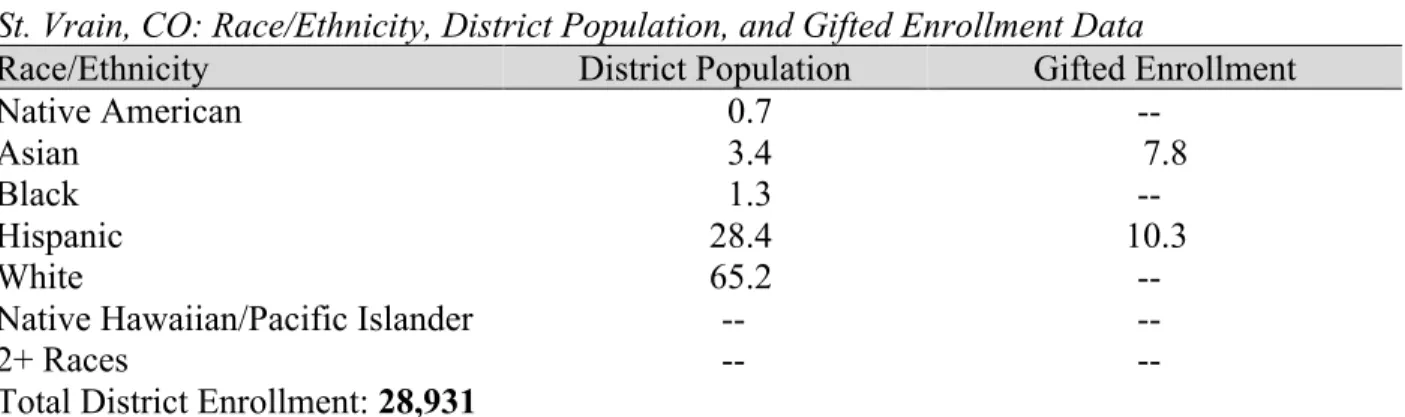
Table 9 provides the available data for St. Vrain, Colorado. This district is composed of 28,931 students. The population consists of 65.2% White and 28.4% Hispanic students. The ranges are 0.7 to 3.4 for Native American, Black, Asian, respectively. Complete data were not available for percentage of gifted students in St. Vrain’s Advanced Learning Plan. The plan highlighted the percentage of Hispanic (10.3%) and Asian (7.8%) gifted students. Hispanic students are underrepresented in the gifted program.
Table 9
St. Vrain, CO: Race/Ethnicity, District Population, and Gifted Enrollment Data
Race/Ethnicity District Population Gifted Enrollment
Native American 0.7 --
Asian 3.4 7.8
Black 1.3 --
Hispanic 28.4 10.3
White 65.2 --
Native Hawaiian/Pacific Islander -- --
2+ Races -- --
Total District Enrollment: 28,931
Note. Data for District Population collected from, Colorado Department of Education. (2016). 2012-2013 mobility rates [District mobility rates by gender and ethnicity]. Retrieved from
http://www.cde.state.co.us/cdereval/201213mobilityrates and data for Gifted Enrollment collected from, Colorado Department of Education (2015). Program plans and data [au-program-plans-gt-boulder-re1-j-st-vrain-valley-12-16]. Retrieved from http://www.cde.state.co.us/gt/data
Table 10 presents district population and gifted enrollment data by race/ethnicity from Adams 1-Mapleton, Colorado (N=8,969). This district is smaller than the other districts in this study. Data on Native Hawaiian/Pacific Islanders were not available. Hispanic (62.15%) and White (31.04) comprise the majority of Adams 1-Mapleton, CO. (Note. The Advanced Learning Plan rounded the gifted enrollment data.) Gifted enrollment percentage includes 40% White and 51% Hispanic. Hispanic students do make up more of the gifted program students in this district (51%), but this number does not match the percentage of Hispanic students in the entire district (62.15%). Again, White students are overrepresented (40%) and Hispanic are underrepresented (51%) in the gifted program.
30
Table 10
Adams 1-Mapleton, CO: Race/Ethnicity, District Population, and Gifted Enrollment Data Race/Ethnicity District Population Gifted Enrollment
Native American 1.26 3
Asian 1.14 1
Black 2.63 2
Hispanic 62.15 51
White 31.04 40
Native Hawaiian/Pacific Islander -- --
2+ Races 1.59 6
Total District Enrollment: 8,969
Note. Data for District Population collected from, Colorado Department of Education. (2016). 2012-2013 mobility rates [District mobility rates by gender and ethnicity]. Retrieved from
http://www.cde.state.co.us/cdereval/201213mobilityrates and data for Gifted Enrollment collected from, Colorado Department of Education (2015). Program plans and data [auadams1-mapleton 12-16]. Retrieved from
http://www.cde.state.co.us/gt/data
Metro District Advanced Learning Plans Alignment With NAGC Standard 2: Assessment
After researching the demographics and educational policies of each district, I reviewed the NAGC standards. These are the standards that I used as a lens to analyze the ALPs for each district studied above. NAGC standards aid schools in the development and evaluation of gifted programs. NAGC Programming standards are used in grades Pre-K through 12 to focus on student outcomes. There are six NAGC standards: Learning and Development, Assessment, Curriculum & Instruction, Learning Environments, Programming, and Professional
Development. NAGC Standard 2: Assessment was the focus of this study. It is as follows: “Standard 2 Description: Assessments provide information about identification, learning progress and outcomes, and evaluation of programming for students with gifts and talents in all domains” (NAGC, 2010b).
NAGC Standard 2: Assessment provides gifted educators a basis for assessing their students and evaluating their programs. Within each standard are sub-standards, which provide details about the overarching topic. There are 6 student outcomes in Standard 2. I was interested
31
in the identification portion of this standard, which includes Student Outcomes 1 through 3. These Student Outcomes and accompanying Evidence-based Practices are outlined in Table 11.
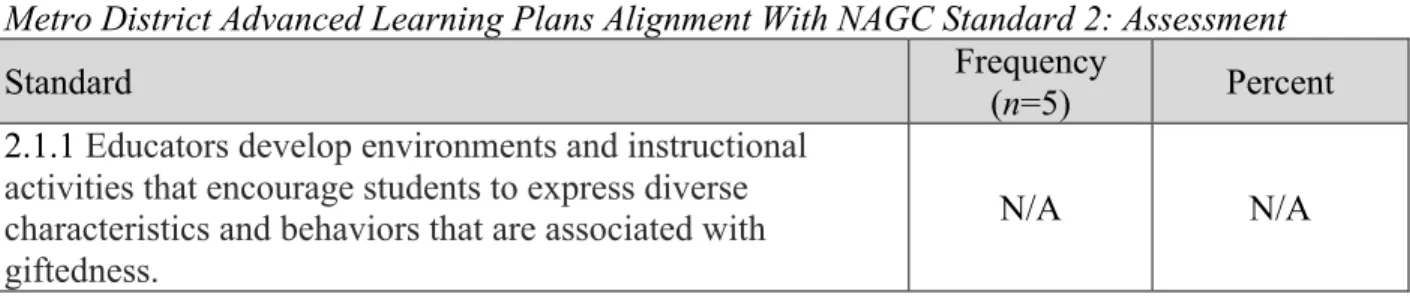
Table 11 documents how Colorado’s metro district ALPs aligns with the NAGC programming standard. I analyzed each of the ALPs to determine if there was any evidence of the programming Standard 2: Assessment. Standard 2.1.1 is not applicable because it was not possible to determine if educators were developing environments and instructional activities that encouraged students to express characteristics and instructional activities associated with
giftedness.
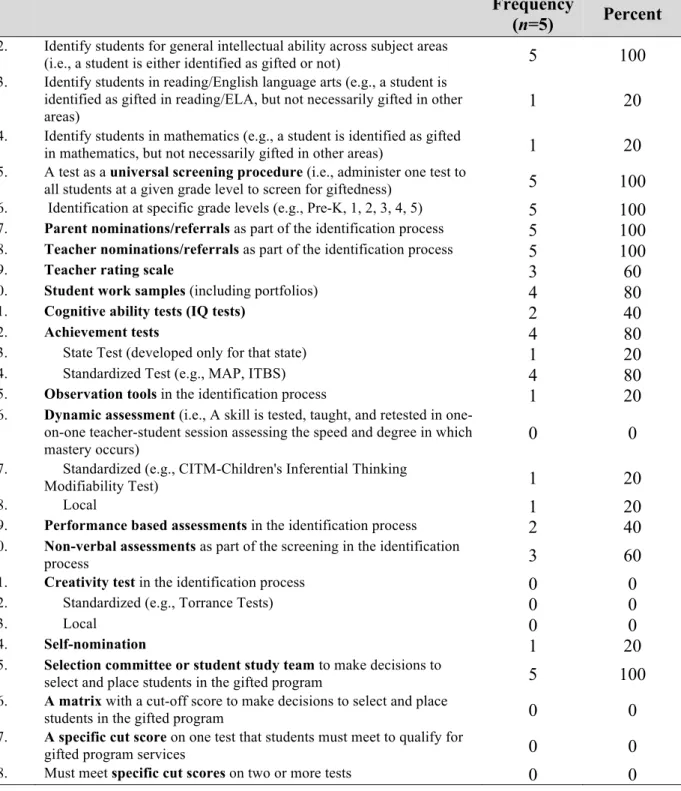
Five out of the ten sub-standards were mentioned by all five of the district Advanced Learning Plans. Standard 2.2.2 is about using multiple assessments to measure diverse strengths. All of the districts focused on this idea that giftedness can be in different categories so it is important to measure different students’ strengths. Standard 2.2.3 goes along with this idea. Five out of the five districts mentioned collecting qualitative and quantitative data on potential gifted learners. Additionally, all of the districts had ALPs that aligned with Standard 2.2.6. This standard addresses parent involvement, specifically obtaining parent/guardian permission and informing them during the identification process. Standard 2.3.1 focuses on the use of non-biased and equitable ways to identify high-ability students. Similarly, Standard 2.3.2 addresses the use of policies to promote equity in programming for gifted students. Every district made an effort to do both of these standards, as evidenced in Table 11.
Table 11
Metro District Advanced Learning Plans Alignment With NAGC Standard 2: Assessment
Standard Frequency
(n=5) Percent 2.1.1 Educators develop environments and instructional
activities that encourage students to express diverse characteristics and behaviors that are associated with giftedness.
32
2.1.2 Educators provide parents/guardians with information regarding diverse characteristics and behaviors that are associated with giftedness.
2 20
2.2.1 Educators establish comprehensive, cohesive, and ongoing procedures for identifying and serving students with gifts and talents. These provisions include informed consent, committee review, student retention, student reassessment, student exiting, and appeals procedures for both entry and exit from gifted program services.
3 60
2.2.2 Educators select and use multiple assessments that measure diverse abilities, talents, and strengths that are based
on current theories, models, and research. 5 100
2.2.3 Assessments provide qualitative and quantitative information from a variety of sources, including off-level testing, are nonbiased and equitable, and are technically adequate for the purpose.
5 100
2.2.4 Educators have knowledge of student exceptionalities and collect assessment data while adjusting curriculum and instruction to learn about each student’s developmental level and aptitude for learning.
4 80
2.2.5 Educators interpret multiple assessments in different domains and understand the uses and limitations of the assessments in identifying the needs of students with gifts and talents
4 80
2.2.6 Educators inform all parents/guardians about the identification process. Teachers obtain parental/guardian permission for assessments, use culturally sensitive
checklists, and elicit evidence regarding the child’s interests and potential outside of the classroom setting.
5 100
2.3.1 Educators select and use non-biased and equitable approaches for identifying students with gifts and talents, which may include using locally developed norms or assessment tools in the child’s native language or in nonverbal formats.
5 100
2.3.2 Educators understand and implement district and state policies designed to foster equity in gifted programming and services.
5 100
2.3.3. Educators provide parents/guardians with information in their native language regarding diverse behaviors and characteristics that are associated with giftedness and with information that explains the nature and purpose of gifted programming options.
33
Standard 2.2.4 was discussed in four out of the five districts. This standard focuses on using assessment data to adjust curriculum based on each student’s specific needs. Similarly, 80% of the districts had program plans that aligned with Standard 2.2.5.
Of the districts, 60% had program plans that aligned with Standard 2.2.1 and Standard 2.3.3. Standard 2.2.1 is one of the lengthier standards. It emphasizes the importance of using multiple strategies to create comprehensive and ongoing procedure identification procedures. Several districts included some of the procedures that were listed, but did not discuss having ongoing methods for identification. Standard 2.3.3. is similar to Standard 2.2.6. It details the practice of sharing information with parents in their native language. Several district program plans referred to parent involvement, but did not mention the accommodation of having the information in the parent or student’s native language.
Only two of the five districts informed parents and guardians about characteristics associated with giftedness. This is Standard 2.1.2. The two districts that had ALPs aligned with Standard 2.1.2 mentioned that information for parents regarding gifted characteristics is available on their district website. The other three districts failed to discuss parent involvement before the students were identified.
The following table provides examples from the ALPs of direct language that aligns with NAGC Standard 2: Assessment. There are one to two examples for each substandard. There are many more examples in the ALPs of each substandard. The examples are quoted from district program plans. Again, the first substandard was not included because it is difficult to measure how educators develop their environments having never been in the classroom. The substandard could not have been demonstrated within the ALP.
34
Table 12
Examples of Metro District Advanced Learning Plans alignment with NAGC Standard 2: Assessment
Standard Example
2.1.1 Educators develop environments and instructional activities that encourage students to express diverse characteristics and behaviors that are associated with giftedness.
N/A
2.1.2 Educators provide parents/guardians with information regarding diverse characteristics and behaviors that are associated with giftedness.
“Information about our identification process is available on our district website” (St. Vrain, p. 8)
2.2.1 Educators establish comprehensive, cohesive, and ongoing procedures for
identifying and serving students with gifts and talents. These provisions include informed consent, committee review, student retention, student reassessment, student exiting, and appeals procedures for both entry and exit from gifted program services.
“The identification process is ongoing, and occurs at all grade levels”
(Douglas County, p. 3)
2.2.2 Educators select and use multiple assessments that measure diverse abilities, talents, and strengths that are based on current theories, models, and research.
“The assessment plan includes assessments of cognitive ability, academic achievement, developmental growth and social emotional competency”
(Mapleton, p. 4)
“The traits, attributes and behaviors surveys, in addition to the nomination form, allow for a variety of strengths and interests to be recognized and used to guide individual programming”
(Adams-Arapahoe 28J, p. 7) 2.2.3 Assessments provide qualitative and
quantitative information from a variety of sources, including off-level testing, are nonbiased and equitable, and are technically adequate for the purpose.
“The body of evidence utilized to identify gifted learners is comprised of student, teacher, and parent input via
questionnaire/rating forms; performance data as evidenced by progress reports, achievement data including CSAP, MAP, and curriculum-based assessments, and cognitive ability as evidence by CogAT” (Douglas County, p. 4)
35
2.2.4 Educators have knowledge of student exceptionalities and collect assessment data while adjusting curriculum and instruction to learn about each student’s developmental level and aptitude for learning.
“Identification process allows for a variety of strengths and interests to be recognized and utilized in programming”
(Douglas County, p. 4) 2.2.5 Educators interpret multiple assessments
in different domains and understand the uses and limitations of the assessments in
identifying the needs of students with gifts and talents
“No single criterion can eliminate a student from consideration”
(Adams-Arapahoe 28J, p. 5) 2.2.6 Educators inform all parents/guardians
about the identification process. Teachers obtain parental/guardian permission for
assessments, use culturally sensitive checklists, and elicit evidence regarding the child’s
interests and potential outside of the classroom setting.
“Information about our identification process is available on our district website” (St. Vrain, p. 8)
2.3.1 Educators select and use non-biased and equitable approaches for identifying students with gifts and talents, which may include using locally developed norms or assessment tools in the child’s native language or in nonverbal formats.
“Use of culture-free assessments and data as endorsed by the district will ensure equal and equitable access to al students” (Adams-Arapahoe 28J, p. 7)
2.3.2 Educators understand and implement district and state policies designed to foster equity in gifted programming and services.
“It is critical that equal and equitable access for all students be systemic and sustainable across all buildings . . . . ”
(Cherry Creek, p. 4)
“Each year DCSD will step up efforts to seek and nurture the potential of students from all ethnic and socio-economic backgrounds”
(Douglas County, p. 4) 2.3.3. Educators provide parents/guardians with
information in their native language regarding diverse behaviors and characteristics that are associated with giftedness and with information that explains the nature and purpose of gifted programming options.
“The AU communicates this information through the AGATE website, the AGATE brochure and the AGATE parent handbook. Parents and staff from each building will receive information when nomination and testing will occur. After initial nomination, parents are made aware of the assessment process, the gifted nomination, and development and review of the student’s Advanced Learning Plan throughout the identification process”
36
When I began to look for each assessment standard in the Advanced Learning Plans, I found that there was overlap in the main ideas of some of the standards. For example, standard 2.2.6 and 2.3.3 both focus on informing parents about the identification process. I reviewed the main ideas of each standard and created two categories that encompass all of the standards. The two categories are parent involvement and measurement and development. Parent involvement is related to standards that require districts to inform and include parents in the identification process. Measurement and development standards include areas such as non-verbal and verbal assessments, equitable practices, and adaption to students’ strengths. The measurement and development standards pertain very specifically to programming in that district. Table 13
presents the standards divided into ideas that pertain to parent involvement and ideas that pertain to measurement and development. As indicated in Table 13, 8 of the standards deal with
measurement and development and 3 deal with parent involvement. This shows that developing programming and how to measure the program’s success is critical because that is the majority of the information that the assessment standard addresses.
Table 13
NAGC Standard 2: Assessment
Standard Parent
Involvement
Measurement and Development 2.1.1 Educators develop environments and instructional
activities that encourage students to express diverse characteristics and behaviors that are associated with giftedness.
X 2.1.2 Educators provide parents/guardians with information
regarding diverse characteristics and behaviors that are associated with giftedness.
X 2.2.1 Educators establish comprehensive, cohesive, and
ongoing procedures for identifying and serving students with gifts and talents. These provisions include informed consent, committee review, student retention, student reassessment, student exiting, and appeals procedures for both entry and exit from gifted program services.