Reordering in statistical machine translation
Yahyaei, Mohammad Sirvan
For additional information about this publication click this link.
http://qmro.qmul.ac.uk/jspui/handle/123456789/2517
Information about this research object was correct at the time of download; we occasionally
make corrections to records, please therefore check the published record when citing. For
more information contact [email protected]
Translation
Mohammad Sirvan Yahyaei
University of London
Thesis submitted for the degree of Doctor of Philosophy at Queen Mary, University of London
Declaration of Originality
I hereby declare that this thesis and the research to which it refers, are the product of my own work, and that any ideas or quotations from the work of other people, published or otherwise, are fully acknowledged in accordance with the standard referencing prac-tices of the discipline.
The material contained in this thesis has not been submitted, either in whole or in part, for a degree or a diploma or other qualifications at the University of London or any other university.
Some parts of this work have been previously published as:
• Sirvan Yahyaei and Christof Monz. Decoding by dynamic chunking for
statis-tical machine translation. In MT Summit XII: Proceedings of the Twelfth Machine
Translation Summit, pages 160–167, Ontario, Canada, August 2009
• Sirvan Yahyaei and Christof Monz. Dynamic distortion in a discriminative
re-ordering model for statistical machine translation. In Marcello Federico, Ian Lane,
Michael Paul, and François Yvon, editors, Proceedings of the seventh International
Workshop on Spoken Language Translation, IWSLT ’10, pages 353–360, 2010a
• Sirvan Yahyaei and Christof Monz. The QMUL system description for IWSLT
2010. In Marcello Federico, Ian Lane, Michael Paul, and François Yvon, editors,
Proceedings of the seventh International Workshop on Spoken Language Translation, IWSLT ’10, pages 157–162, 2010b
• Sirvan Yahyaei, Marco Bonzanini, and Thomas Roelleke. Cross-lingual text
frag-ment alignfrag-ment using divergence from randomness. In Proceedings of the 18th
edition of the International Symposium on String Processing and Information Retrieval (SPIRE), 2011
Sirvan Yahyaei London, October 2011
Machine translation is a challenging task that its difficulties arise from several
char-acteristics of natural language. The main focus of this work is onreorderingas one of
the major problems in MT and statistical MT, which is the method investigated in this research. The reordering problem in SMT originates from the fact that not all the words in a sentence can be consecutively translated. This means words must be skipped and be translated out of their order in the source sentence to produce a fluent and gram-matically correct sentence in the target language. The main reason that reordering is needed is the fundamental word order differences between languages. Therefore, re-ordering becomes a more dominant issue, the more source and target languages are structurally different.
The aim of this thesis is to study the reordering phenomenon by proposing new meth-ods of dealing with reordering in SMT decoders and evaluating the effectiveness of the methods and the importance of reordering in the context of natural language pro-cessing tasks. In other words, we propose novel ways of performing the decoding to improve the reordering capabilities of the SMT decoder and in addition we explore the effect of improving the reordering on the quality of specific NLP tasks, namely named entity recognition and cross-lingual text association. Meanwhile, we go beyond reordering in text association and present a method to perform cross-lingual text frag-ment alignfrag-ment, based on models of divergence from randomness.
The main contribution of this thesis is a novel method named dynamic distortion, which is designed to improve the ability of the phrase-based decoder in performing reordering by adjusting the distortion parameter based on the translation context. The model employs a discriminative reordering model, which is combining several
fea-tures including lexical and syntactic, to predict the necessary distortion limit for each sentence and each hypothesis expansion. The discriminative reordering model is also integrated into the decoder as an extra feature. The method achieves substantial im-provements over the baseline without increase in the decoding time by avoiding re-ordering in unnecessary positions.
Another novel method is also presented to extend the phrase-based decoder to dynami-cally chunk, reorder, and apply phrase translations in tandem. Words inside the chunks are moved together to enable the decoder to make long-distance reorderings to capture the word order differences between languages with different sentence structures. Another aspect of this work is the task-based evaluation of the reordering methods and other translation algorithms used in the phrase-based SMT systems. With more suc-cessful SMT systems, performing multi-lingual and cross-lingual tasks through trans-lating becomes more feasible. We have devised a method to evaluate the performance of state-of-the art named entity recognisers on the text translated by a SMT decoder. Specifically, we investigated the effect of word reordering and incorporating reorder-ing models in improvreorder-ing the quality of named entity extraction.
In addition to empirically investigating the effect of translation in the context of cross-lingual document association, we have described a text fragment alignment algorithm to find sections of the two documents in different languages, that are content-wise re-lated. The algorithm uses similarity measures based on divergence from randomness and word-based translation models to perform text fragment alignment on a collection of documents in two different languages.
All the methods proposed in this thesis are extensively empirically examined. We have tested all the algorithms on common translation collections used in different evalua-tion campaigns. Well known automatic evaluaevalua-tion metrics are used to compare the suggested methods to a state-of-the art baseline and results are analysed and discussed.
I would like to take this opportunity to thank those who supported me in several ways. First, I offer my sincerest gratitude to my former supervisor Christof Monz who intro-duced me to the field of natural language processing and supported throughout the time this thesis was created. I also thank my supervisor Thomas Roelleke who with-out his comments and constructive feedback this work would have been impossible to finish.
I would like to show my gratitude to my former and current colleagues at IR research group in Queen Mary, University of London for providing a stimulating research en-vironment. My special thanks also to my friend Yasaman Soltan-Zadeh for many pro-ductive discussions and her invaluable comments.
Finally, I would like to thank my parents for their love and support during all these years.
Sirvan Yahyaei London, October 2011
Contents
1 Introduction 14 1.1 Research Questions . . . 18 1.2 Contributions . . . 19 1.3 Thesis Outline . . . 20 1.4 Publications . . . 212 Statistical Machine Translation 22 2.1 Machine Translation . . . 22
2.2 Statistical Machine Translation . . . 23
2.3 Translation Model . . . 25 2.3.1 Word-Based Models . . . 25 2.3.2 Phrase-Based Models. . . 27 2.4 Language Model . . . 33 2.5 Decoding . . . 34 2.6 Evaluation . . . 35
2.7 TAGINE: Phrase-based Decoder . . . 37
3 Reordering in Statistical Machine Translation 39 3.1 Different Types of Reordering . . . 40
3.1.1 Short Distance Reordering. . . 40
3.1.2 Long Distance Reordering . . . 41
3.2 Current Approaches to Tackle Reordering . . . 41
3.2.2 Syntax-based Approaches . . . 44
3.2.3 Lexicalised Reordering Models . . . 49
3.2.4 Hierarchical Phrase-based Model. . . 52
4 Decoding by Dynamic Chunking 55 4.1 Introduction . . . 55
4.2 Related Work . . . 58
4.3 Integrating Chunking and Decoding . . . 59
4.3.1 Maximum Entropy Modeling . . . 60
4.3.2 Representing Evidence. . . 61
4.3.3 Maximum Entropy Principle . . . 62
4.3.4 Optimisation Algorithm . . . 63 4.3.5 Chunking Scorer . . . 63 4.3.6 Decoding by Chunking . . . 65 4.3.7 Parameters. . . 69 4.4 Experiments . . . 70 4.4.1 Experimental Setup. . . 70 4.4.2 Results . . . 71
4.5 Discussion and Error Analysis. . . 72
5 Dynamic Distortion in a Discriminative Reordering Model 77 5.1 Related Work . . . 79
5.2 Distortion and Translation Quality . . . 80
5.3 Reordering Models . . . 83
5.3.1 Lexicalised Reordering Model . . . 83
5.3.2 Discriminative Reordering Model . . . 84
5.4 Dynamic Distortion . . . 87
5.5 Experiments . . . 88
5.5.1 Baseline . . . 90
CONTENTS
5.6 Discussion . . . 92
5.7 The System Description for an Evaluation Campaign . . . 93
5.7.1 Baseline System . . . 94
5.7.2 Reordering Models . . . 98
5.7.3 Experiments . . . 99
5.7.4 Evaluation Campaign Results. . . 100
6 Evaluation of NER on SMT Output 104 6.1 Using MT to Perform Multi-Lingual NLP . . . 105
6.2 Related Work . . . 106
6.3 Named Entity Recognition . . . 108
6.4 Evaluation Method . . . 109
6.5 Experiments . . . 111
6.5.1 Translation Setup . . . 114
6.5.2 Named Entity Recognition Setup . . . 114
6.5.3 Results . . . 115
6.6 Discussion . . . 117
7 Cross-lingual Fragment Alignment using DFR 120 7.1 Why Text Alignment?. . . 121
7.2 Related Work . . . 122
7.3 Text Fragment Alignment . . . 124
7.3.1 Similarity Measures and Divergence from Randomness . . . 125
7.3.2 Extraction of Fragments . . . 126
7.4 Experimental Study . . . 128
7.4.1 Experimental Set-up . . . 128
7.4.2 Document-Summary Association. . . 128
7.4.3 Text Fragment Alignment Evaluation . . . 131
7.5 Discussion . . . 133
8.1 Summary . . . 136
8.2 Conclusions . . . 137
8.3 Limitations and Future Work . . . 140
Bibliography 143
List of Figures
1.1 Long distance reordering example . . . 16
2.1 Word alignment example;unionmethod. . . 28
2.2 Word alignment example;intersectionmethod . . . 28
2.3 Word alignment example;grow-diag-final-andmethod . . . 29
2.4 An example of translation by phrase-based models. . . 29
2.5 Extracted phrases from theunionalignment . . . 31
2.6 Extracted phrases from thegrow-diag-final-andalignment . . . 31
2.7 Extracted phrases from theintersectionalignment . . . 32
3.1 A French to English translation with a local reordering. . . 41
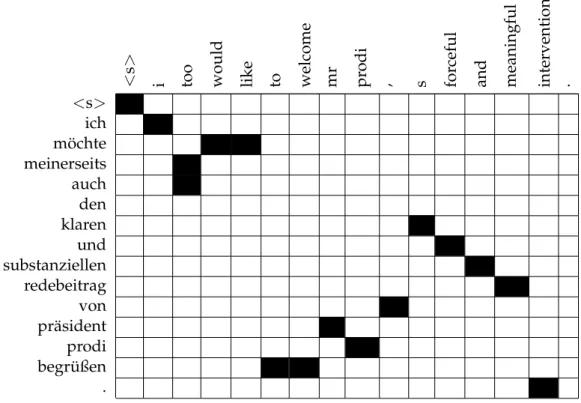
3.2 A German to English sentence with a very big difference in word order. 42 3.3 Frequencies for word distortion model . . . 50
4.1 Long distance reordering to translate the verb . . . 56
4.2 An example of chunks with left to right and right to left orientations . . 64
4.3 An example of the decoding process by dynamic chunking . . . 68
4.4 Chunk movements during the decoding . . . 69
4.5 An example of good chunk movements . . . 72
5.1 Word alignment of an Arabic to English sentence pair . . . 78
5.2 The effect of distortion limit on translation quality . . . 82
5.3 Reordering constraints on Turkish to English . . . 82
5.5 Baseline and dynamic distortion method translation samples . . . 93
5.6 BLEU scores of French-English for different distortion limit . . . 97
5.7 BLEU scores of Arabic-English for different distortion limit . . . 97
6.1 A word aligned sentence pair with NEs . . . 119
7.1 An example of aligned text fragments. . . 122
List of Tables
3.1 Rules in chunk-based source reordering . . . 48
4.1 German to English corpus statistics . . . 70
4.2 German to English EP and NC results . . . 71
4.3 Samples comparing the chunking-based decoder and the baseline . . . . 76
5.1 Results of lexicalised reordering model on Arabic-English . . . 85
5.2 Contribution of features in reordering classification . . . 87
5.3 IWSLT BTEC corpus statistics . . . 89
5.4 Turkish to English results . . . 91
5.5 Arabic to English results . . . 92
5.6 Preprocessing on vocabulary size . . . 95
5.7 OOV rate in development set . . . 95
5.8 BLEU scores on Arabic-English data sets. . . 100
5.9 BLEU scores on French-English data sets . . . 101
5.10 BLEU scores on Turkish-English data sets . . . 102
5.11 The rank of the submitted system for Arabic-English . . . 102
5.12 The rank of the submitted system for French-English . . . 102
5.13 The rank of the submitted system for Turkish-English . . . 102
6.1 NER evaluation corpus statistics . . . 113
6.2 Results of the Stanford NER regardless of entity type . . . 116
6.3 Results of the LingPipe NER regardless of entity type . . . 116
7.1 Similarity measures used to estimate the similarity between sentences . 127
7.2 English-Italian corpus statistics . . . 129
7.3 One-stage document-to-summary association . . . 130
List of Algorithms
4.1 Decoding and chunking integration algorithm. . . 66
6.1 NER evaluation algorithm . . . 110
Introduction
Machine Translation1 is the task of translating text or speech from one natural lan-guage to another by means of a computer software. Machine translation has been a challenging problem in artificial intelligence for decades. Several approaches have been researched and investigated since 1950s, however because of translation’s dif-ficult nature, the efforts had not been very successful until recently. In early 1990s,
researchers at IBM started an approach based on information theory calledStatistical
Machine Translation (SMT). Statistical machine translation or SMT tries to perform
translation by using statistical methods and learning how to translate based on pre-viously manually translated texts. The state-of-the art SMT is a supervised machine
learning approach to translate sentences fromsourcetotargetby using a bilingual
par-allel corpus of source to target sentences.
An ideal statistical machine translation system for sentence translation is consisted of a sentence dictionary with all the possible sentences with their correct translations. However, apart from computational complexities of such a system, building such a system is not practical, because language vocabularies are not finite and contain open word classes. In addition, there is no limit for sentence length in practice. Therefore, SMT approaches need to employ a method to segment sentences into smaller units and maintain dictionaries to translate those units. The pioneering work in IBM, considered words as these units and translated sentences word by word. Later, phrase-based
CHAPTER1: INTRODUCTION
els which take a sequence of words as the basic unit were proposed that substantially improved the quality of translation over the previous word based model. In this re-search, we explore methods to improve the quality of phrase-based statistical machine translation and evaluate SMT quality beyond automatic metrics.
There are several factors that make MT in principle a difficult task. For a few examples: words in different languages do not always have a one-to-one relationship. Sometimes concepts are expressed differently in different languages. There are many ambigu-ous phrases and terms that need a very wide context to resolve. Additional to above examples, different languages differ in their syntactical structure and one of the impor-tant syntactical differences is word ordering. Even languages with similar main word order may not have the same word order in expressing the same concept. Recent stud-ies show that word reordering accounts for a large portion of performance variability
among European languages [Birch et al.,2008]. For an example of the effect of
reorder-ing on the output structure and also correct phrase translation, consider the example in
Figure1.1. This example shows a German sentence translated into English. The SMT
decoder can not easily skip the distance betweenwillanderfahrento correctly
trans-late them intowants to know, because there are more than 182words between the two
phrases and considering all the permutations possible is intractable.
Current state-of-the art statistical machine translation approach is called phrase-based SMT. The basic unit for translation in PBSMT is a phrase or a sequence of words. There are different types of PBSMTs. Firstly, non-syntactic models that consider any sequence of words as a phrase ad generate the translation by composing target phrases. The source and target phrases for these models can be contiguous or with gaps that can be filled later by other phrases. The sequence of words does not need to be a syntactic unit. This characteristic gives the PBSMT systems the ability to learn a vast number of phrases including non-syntactic phrases that have been shown to be very useful in cap-turing obscure and complex phrase translations across different languages. Secondly, there are models which are based on phrases, but with restrictions on source or target sides to be syntactic units. The syntactic constraints prevents these models to benefit
218 non-tokenised words; if the sentence is tokenised, based on the method of tokenisation there will be more than 18 words.
DE Der SPD-Haushaltsexperte Johannes Kahrs will
von Kanzlerin Angela Merkel Einzelheiten über die Feier im Kanzleramt anlässlich des 60. Geburtstages von Deutsche-Bank-Chef Josef Ackermann erfahren.
MT The SPD budget expert Johannes Kahrs wishes of Chancellor Angela Merkel in the Chancellery of details of the ceremony to mark the 60th Birthday of German Bank chief Josef Ackermann learned. HUM The SPD budget expert Johannes Kahrs
wants to know from Chancellor Angela Merkel the
details of the ceremony in the Chancellery to mark the 60th birthday of Deutsche Bank CEO Josef Ackermann.
Figure 1.1:A German sentence that requires a long distance reordering to cor-rectly translate the verb. DE is the German sentence, MT is the output of the machine translation system and HUM is the human translation.
from the useful non-syntactic phrase, however allows them to generate more grammat-ically correct translation and easily take advantage of syntax in reordering decisions. In all the models and experiments described in this work, the former approaches are used and investigated.
The main focus of this research is the problem of reordering in phrase-based statistical machine translation. Because of the core role of reordering in machine translation, it af-fects several aspects of translation. On one hand, better reordering directly influences the quality of the output. On the other hand, the reordering method has a signifi-cant impact on determining the performance of the translation algorithm in terms of speed. In addition to improving and investigating reordering, we explore the prob-lem of cross-lingual text fragment alignment, which is not directly affected by reorder-ing. For this problem, the focus is the effectiveness of similarity measures based on divergence from randomness and word-based translation models without reordering constraints.
In the following chapters of this thesis, we present methods of performing reordering that lead to better translations, while investigating their effect on the speed of the main
CHAPTER1: INTRODUCTION
algorithm. In addition, we analyse the effect of reordering on the quality of translation for specific natural language tasks. In other words, apart from automatic evaluation of the algorithms and the contribution of the reordering models by general evaluation metrics, we evaluate the quality of the generated translations for specific applications such as named entity recognition. Further than that, word-based translation models are combined with similarity measures based on models of randomness to perform mono-lingual and cross-lingual text fragment alignment and analyse the effectiveness of the models in the aforementioned settings.
In this research, we aim to improve the quality of statistical machine translation with re-spect to automatic evaluation metrics by focusing on the reordering phenomenon. The models proposed in this work are independent from the source and target languages and solely rely on statistics collected from the bilingual parallel data. In addition, com-mon natural language applications such as named entity recognition and text fragment alignment have been selected for evaluation to go beyond the general automatic met-rics and explore the effectiveness of the models in improving translation quality for particular tasks. Likewise, the method to perform text fragment alignment is language independent and relies on word statistics in the documents. The word-based transla-tion models are built using parallel corpus and similarity measures use DFR models and the word-based translation models to estimate the text fragment similarities. Throughout this thesis all the models and methods have empirically been evaluated. Human evaluation of machine translation can be very expensive to perform and im-practical in evaluating several methods repeatedly. We have used automatic evaluation metrics and test collections provided by international evaluation campaigns for the ex-periments. All the proposed approaches are compared to the state-of-the-art baselines, trained and tuned on the same data. The baselines are all well-established approaches in the community with strong performances at the time of experiments. Even though, the benchmarking experiments can not fully show that our approaches are always and on all data superior to other methods, they are providing a level field for comparing the proposed models with established ones. Additionally, we have tried to perform the ex-periments across different language pairs and several test sets to make the exex-periments
representative of real world applications.
1.1
Research Questions
1. How can one take advantage of the fact that words tend to move together when they are translated across languages?
2. Is chunking and grouping words together a helpful solution for long-distance reordering?
3. How important and effective is language modelling in dealing with the reorder-ing problem?
4. Are distortion constraints influence the quality of translation significantly and how can an important parameter such as distortion limit be tuned to avoid using the same parameter for sentences with different structure?
5. What kind of features in a reordering model help to relax the reordering
con-straints3 in phrase-based SMT without degrading the performance of the
algo-rithm in terms of speed and quality?
6. Does adjusting the distortion limit improve quality of the translation compared to manual tuning?
7. What is the effect of being cross-lingual on text fragment alignment and is the difference between the performance of the mono-lingual algorithm and cross-lingual algorithm substantial enough to rule out the full translation as a viable approach in performing fragment alignment?
8. Is translating to English and using available tools in English to perform NLP tasks such as named entity recognition a viable alternative to multi-lingual tools? 9. What is the effect of improving reordering on different NLP tasks for different
language pairs? and is improving the reordering going to improve the quality of these tasks for all language pairs?
CHAPTER1: INTRODUCTION
1.2
Contributions
We present an approach to extend the phrase-based decoder thatdynamically chunks,
reorders, and applies phrase translations in tandem. By grouping words and moving
them together, we try to enable the decoder to consider long-distance re-orderings and avoid unnecessary short distance permutations. In addition, our method does not rely on language-dependent parsers or chunkers and uses the word alignment information to build the chunker. To keep the search space manageable, phrases inside the chunks are monotonically translated, thus by eliminating the unnecessary local re-orderings, it is possible to perform long-distance re-orderings beyond the common fixed distortion limit.
To overcome the issue of setting the optimum distortion parameters in the phrase-based decoders and the fact that different sentences have different reordering
require-ments,a method to predict the necessary distortion limit for each sentence and each
hypothesis expansionis proposed. A discriminative reordering model is built for that
purpose and also integrated into the decoder as an extra feature. Many lexicalised and syntactic features of the source sentences are employed to predict the next reordering move of the decoder. The model scores each reordering before the sentence translation, so the optimum distortion limit can be estimated based on these score.
We devise a method to evaluate the performance of state-of-the-art named entity
recognisers on the text translated by a SMT. Specifically, we investigate the effect
of word reordering and incorporating reordering models in improving the quality of named entity extraction.
Finally, we proposean approach to automatically align fragments of texts of two
doc-uments in different languages. A text fragment is a list of continuous sentences and
an aligned pair of fragments consists of two fragments in two documents, which are content-wise related. Cross-lingual similarity between fragments of texts is estimated based on models of divergence from randomness. A set of aligned fragments based on the similarity scores are selected to provide an alignment between sections of the two documents.
1.3
Thesis Outline
The thesis is structured as follows:
• Chapter2provides the background on statistical machine translation needed for
the rest of the thesis. It gives a brief overview of word-based models and in-troduces the main concepts of phrase-based models and their variations. We also describe some of the main evaluation metrics currently used in the machine trans-lation community and the discussions on their effectiveness.
• Chapter 3 discusses the reordering phenomenon in machine translation. We
present a description of the problem and various reordering requirements of dif-ferent language and overview the previous and current approaches proposed to deal with reordering so far.
• Chapter 4 introduces an approach of dynamically chunking and translating in
tandem. The proposed method enables the decoder to consider permutations which include long distance re-orderings. Several examples are shown to demon-strate that by grouping words and moving them together, the decoder is able to consider long-distance re-orderings and avoid unnecessary short distance per-mutations.
• Chapter5presents a new method that aims to dynamically adjust the distortion
limit in phrase-based decoding. Adjusting the distortion limit prevents the de-coder to explore undesirable parts of the search space. The performance of this approach is compared to several other systems in an evaluation campaign and the results are discussed in this chapter.
• Chapter6describes an approach to evaluate the models and MT in general in the
context of several NLP tasks. Since the quality of even the best SMT systems dif-fers for different language pairs and heavily depends on the available language resources, it is important to evaluate the performance of different NLP tasks on machine translation output.
CHAPTER1: INTRODUCTION
• Chapter7presents an approach to align text fragments of two documents in two
different languages. One aim of the chapter is to investigate the effectiveness of divergence of randomness model in the context of cross-lingual fragment align-ment.
• Chapter8 concludes the work done in the thesis and proposes some directions
for future research.
1.4
Publications
The work presented in Chapter4is also described in“Decoding by dynamic chunking for
statistical machine translation”presented at MT Summit XII [Yahyaei and Monz,2009].
Chapter5 was presented as“Dynamic distortion in a discriminative reordering model for
statistical machine translation” in the seventh International Workshop on Spoken
Lan-guage Translation (IWSLT) [Yahyaei and Monz,2009]. Chapter7is accepted as
“Cross-lingual text fragment alignment using divergence from randomness”to be presented in the 18th edition of the International Symposium on String Processing and Information
Statistical Machine Translation
The subject of this thesis it to explore and examine methods and models to improve and evaluate reordering in statistical machine translation. In this chapter, we briefly introduce the basic foundations of machine translation and specifically discuss statis-tical MT concepts and methods used throughout the rest of the thesis. Since there are several different approaches to machine translation and even various views in statisti-cal MT, we do not touch upon all the methods and approaches in this chapter. The main aim of this chapter is to clearly introduce the terminology used in this work. First, we give an introduction to statistical machine translation and various stages used in train-ing the models. Then we discuss the procedure of evaluation in machine translation and describe the most common used automatic metrics available today. Finally, we ex-plain the in-house decoder developed during this research and its main components.
2.1
Machine Translation
Machine translation is the task of translating text or speech from one natural language to another by means of a computer software. Due to the complex nature of natural lan-guage, there are many challenges in statistical machine translation. For example, lexical ambiguity which occurs due to the limitation of fully modelling of the context; differ-ent languages have differdiffer-ent word orders; in many cases, syntactic structures are not preserved across translation; treatments of tenses are different in different languages and so on. There have been several approaches to perform machine translation since
CHAPTER2: STATISTICALMACHINETRANSLATION
the beginning of computers. Recently the use of statistical methods in translation, as well as natural language processing tasks, has been very successful.
Statistical machine translation tries to perform translation by using statistical
meth-ods. The process is mapping sentences from thesourcelanguage into sentences from
thetargetlanguage. The main idea of statistical machine translation is automatically
translating by means of models estimated from parallel and mono-lingual corpora. A parallel corpus is a set of source-target documents that are translation of each other. Huge amount of text in different languages and the existence of massive computa-tional power and distributed algorithms have made SMT a very strong candidate in the MT industry1.
2.2
Statistical Machine Translation
Although the idea of using statistical methods was first suggested in 1949 [Weaver, 1955], the current SMT approaches are based on the pioneering work started in early
1990s in IBM [Brown et al.,1990,1993]. The initial models by IBM, were called
word-based models. In word-word-based models, translation units are words and the selection of translation options is mainly done by a combination of translation probabilities and the fluency of the generated output.
Later, phrase-based models which consider a sequence of words as the basic unit, were
proposed [Och et al.,1999;Koehn et al.,2003] that substantially improved the quality
of translation. The improvement was achieved by automatically taking into account the local context for many of replacements and implicitly addressing many of the local reorderings. Here, we formally define the machine translation problem and introduce the main methods of solving it.
Assume we want to translate a foreign sentencef= f1J = f1, ..., fJinto a target sentence
e = eI1 = e1, ...,eI. The problem of statistical machine translation can be written as the following equation:
1At the time of writing, Google translate provides a free online service for translation between 63 languages (http://translate.google.com)
ˆ
e(f) =arg max
e
{Pr(e|f)} (2.2.1)
where arg max is the search problem for finding the target sentence. There are many
approaches to solve the equation2.2.1: Syntax-based methods that deal with the
prob-lem as a tree-to-tree [Yamada and Knight,2001], tree-to-string or string-to-tree [Galley
et al.,2004] mapping. Phrase-based models such as [Koehn et al.,2003;Och and Ney,
2004] use aggressive methods to learn contiguous phrases from the parallel corpus and use them during translation. A modified version of phrase-based models is hierarchi-cal phrase-based model which learns both contiguous and non-contiguous phrases and
differently use them for translating [Chiang,2005,2007].
Independent of general approach to the search problem, they all mainly rely on two
models calledtranslation modelandlanguage model. A translation model consists of two
elements. Firstly, a series ofrulesthat describe the steps to transform a source sentence
to a target sentence [Lopez,2009]. Secondly, a set ofparametersthat are used to score
the unweighted ruleset, mentioned before. The process of assigning values to these
parameters is calledparameter estimation[Lopez,2008]. A language model is an order
nMarkov chain model that assigns a probability to each string. Languages models are
built for the target language to score the produced hypothesis at each step. We will discuss each model further later in this chapter.
Apart from the two main models mentioned above, many other models and penalties have been suggested to guide the search process. All these models are integrated in a uniform way as features and their importance is determined though empirical means.
Equation2.2.1can be rewritten as:
ˆ
e(f) =arg max
e
(Σiλifi(e,f)) (2.2.2)
where fiis a feature andλi is its weight in this log-linear model. Current SMT models
employ a wide range of features to perform the task of translation. For an example of a set of features, the following list is a standard list used in many baseline phrase-based
CHAPTER2: STATISTICALMACHINETRANSLATION
systems:
• phrase translation probabilities and lexical probabilities for both directions.
• ann-gram language model.
• phrase and word penalties.
• distance-based reordering penalty.
2.3
Translation Model
To build translation models, we need to extract a ruleset, which as defined before is a set of mapping from the source strings to the the target strings. In word-based models, the ruleset is basically a dictionary of source words to target words. After extracting the ruleset, a weight function must be defined to score each rule and assign a weight or several weights to each rule.
2.3.1 Word-Based Models
The word-based models, as a first statistical approaches to machine translation, were introduced in the late of 1980s and early 1990s by IBM [Brown et al.,1990,1993]. Since it is difficult to manually align enough sentences to be used for learning the probabilities for each language pair, the word alignment process starts with non-aligned parallel sentences and most of the times an unsupervised machine learning algorithm such
Expectation Maximisation[Dempster et al.,1977] to iteratively learn the probabilities. In the IBM models, Model 1 is the simplest model and later models extend and improve on it. Model 1 is relatively easy to integrate into the EM algorithm and is fast to train. The generative story of IBM Model 1 goes like this: given an English sentence, choose a length for a French sentence. Then for each position in the French sentence uniformly connect it to an English position and decide what French word to be there. All the connections in this model are equally likely and order of the words is irrelevant. Since
Model 1 is an easy and fast model to train, it is a good start to provide initial estimations for higher models.
In Model 2, the ordering and position of the words relative to the length of the sentence
is added. The HMM Model of [Vogel et al.,1996] is not an IBM model, but it is widely
used for word-alignment in a mixture with IBM models. This model adds a relative ordering model compared to the absolute model of Model 2. Model 3 adds fertility probabilities that give the probability of how many French words are generated by an English word. Model 4 adds a relative reordering model and Model 5 fixes the deficiency of models 3 and 4.
Although the word-based models are not state of the art any more, most of the concepts and methods are still used. The above word-based models are widely employed to produce word alignments that are used to make learning phrases practical in phrase-based models.
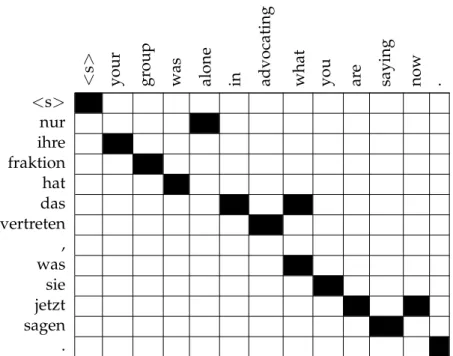
Figure2.1shows a visualisation of a word alignment between a German sentence and
its translation in English. The alignments between words are shown by black cells in the matrix. As you can see, words may have multiple or no alignment points. Un-fortunately, finding the perfect alignment between a sentence and its translation is not always possible. Sometimes, function words do not have a clear correspondence in the other language, but still make changes to the other words. Another source of problem is words inside idioms that can have a completely different equivalent outside of the idiom.
A common approach to improve the alignment quality is called symmetrisation of word alignments, which is finding the alignments in both directions and then using a method such as intersection or union to combine both alignments [Och and Ney,
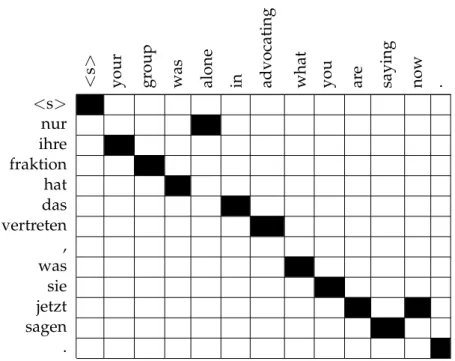
2003,2004]. Figure2.1shows the result of the symmetrisation process after taking the
union, while Figure 2.2 shows the same sentence pair and the word alignment
pro-duced by the intersection. It is clear from the figures that the number of aligned points
are less in theintersectionmethod, which is mostly used to produce high precision
word alignments. On the other hand, to achieve high recall theunionmethod is
CHAPTER2: STATISTICALMACHINETRANSLATION
heuristic approach that starts with theintersectionmethod and adds new alignment
points based on a few criteria [Och et al.,1999;Koehn et al.,2003]. Figure2.3shows the
previous sentence pair aligned by the heuristic approach calledgrow-diag-final-and
[Koehn,2009]. Ingrow-diag-final-and, the reliable alignment points ofintersection
are taken and some of the points produced by theunion method are added. This
ap-proach is based on the observation that good alignment points are in the
neighbour-hood of other points. diagingrow-diag-final-andmeans that diagonal neighbours
that are inunion, but not inintersectionare added. In thefinalstep, alignment for
still unaligned words are added, however, theand tag restricts this step to alignment
points that both words are unaligned.
Apart from symmetrisation, there have been many suggestions to improve the word
alignment quality [Cherry and Lin,2003;Moore,2004] and even completely different
approaches to the original IBM models [Ittycheriah and Roukos,2005; Moore, 2005],
however some studies have shown that word alignment quality has a minor impact on
the translation quality of phrase-based models [Ayan et al.,2005].
2.3.2 Phrase-Based Models
The next generation of statistical machine translation systems after word-based models
is phrase-based models which translation units are multi-words orphrases. As
men-tioned before, there are several models based on phrases. A string-to-string model, that both source and target phrases are contiguous, are simply called phrase-based models
[Koehn et al.,2003]. Another model that uses phrases with gaps that can be filled with
other phrases is called hierarchical phrases-based model [Chiang, 2007]. In addition
there are several models that constraint phrases of one or both sides to constitute a syntactic unit. These models are models are generally called syntax-based models
[Ya-mada and Knight,2001;Galley et al.,2004;Marcu et al.,2006].
Figure2.4shows a translation process in a phrase-based model2. One of the advantages
of phrase-based models over word-based models is resolving the problem of multiple
2This is an example of phrase-based models that is not hierarchical and phrases are contiguous strings without gaps
<
s
>
your group was alone in advocating what you are saying now . <s> nur ihre fraktion hat das vertreten , was sie jetzt sagen .
Figure 2.1:Word alignment between a German sentence and an English
sen-tence; symmetrisation is done by theunionmethod.
<
s
>
your group was alone in advocating what you are saying now . <s> nur ihre fraktion hat das vertreten , was sie jetzt sagen .
Figure 2.2:Word alignment between a German sentence and an English
CHAPTER2: STATISTICALMACHINETRANSLATION
<
s
>
your group was alone in advocating what you are saying now . <s> nur ihre fraktion hat das vertreten , was sie jetzt sagen .
Figure 2.3:Word alignment between a German sentence and an English
sentence; symmetrisation is done by the grow-diag-final-and
method.
2 nur
1
ihre fraktion hat
3 das vertreten
4 , was
5 sie jetzt sagen .
your group was 1 alone 2 in advocating 3 what 4
you are saying now . 5
mappings. Since there are a lot of one-to-many or many-to-one mappings in transla-tion, words as base units are not enough to resolve them. Additionally, translating a group of words together helps to incorporate more context and resolve many trans-lation ambiguities. As we will discuss later, a big advantage of phrase-based models over word-based models is capturing the local re-orderings in phrase pairs.
As mentioned before different phrase extraction methods are available in the literature.
[Marcu and Wong,2002] present a joint SMT model to learn phrases from parallel
cor-pus. However, despite its mathematical foundation, the search space is too large to be practical for current collections. Instead, here we explain a heuristic approach which is
widely used in the community. Our description is based on [Koehn et al.,2003].
For each sentence pair, we collect all the phrases that are consistent with the word alignment of the sentence pair. A phrase pair(f˜, ˜e)is consistent with alignmentA, if
all the words in ˜f and ˜e have alignment points with each other. In other words, we
extract following set of phrases:
{(e˜, ˜f)| ∀ei ∈ e˜:(ei,fj)∈ A→ fj ∈ f˜
∧ ∀fj ∈ f˜:(ei, fj)∈ A→ei ∈e˜
∧ ∃ei ∈ e˜,fj ∈ f˜:(ei,fj)∈ A}
where the last constraint ensures that, there is at least one alignment point between the words inside the phrase pair.
Figures2.5,2.6 and2.7 show the extracted phrases from the sentence pair in Figures
2.1,2.3and2.2respectively. Since there are less alignment points in theintersection
method, there are more extracted phrases compared to the other two word alignment methods. As you can see, there might be more than one mapping for some of the phrases or no mapping at all. Note that, this method of phrase extraction does not require any kind of syntactic structure from a string of words for being a phrase. Sur-prisingly, this is one of the main strengths of phrase-based models over syntax-based
CHAPTER2: STATISTICALMACHINETRANSLATION
nur ||| group ||| 0-0 nur ihre ||| group was ||| 0-0 1-1
nur ihre fraktion ||| group was alone ||| 0-0 1-1 2-2 ihre ||| was ||| 0-0
ihre fraktion ||| was alone ||| 0-0 1-1 fraktion ||| alone ||| 0-0
hat ||| your ||| 0-0 vertreten ||| advocating ||| 0-0 vertreten ||| advocating what ||| 0-0
was ||| are ||| 0-0
sie jetzt sagen ||| saying now ||| 0-0 1-1 2-0 jetzt ||| now ||| 0-0
. ||| . ||| 0-0
Figure 2.5:All the extracted phrases from a word alignment matrix produced
by theunionmethod symmetrisation in Figure 2.1. The third
col-umn is the inside phrase word alignment links.
das ||| in ||| 0-0
das vertreten ||| in advocating ||| 0-0 1-1 das vertreten ||| in advocating what ||| 0-0 1-1
vertreten , ||| advocating what you ||| 0-0 1-2 , ||| you ||| 0-0
, ||| what you ||| 0-1 , was ||| you are ||| 0-0 1-1 , was ||| what you are ||| 0-1 1-2
Figure 2.6:Extra phrases extracted from a word alignment matrix produced
by thegrow-diag-final-andmethod symmetrisation in Figure2.3.
Note that all the phrases extracted in Figure2.5is also extracted in
ihre fraktion ||| was alone in ||| 0-0 1-1 das vertreten ||| advocating what ||| 1-0 das vertreten ||| in advocating ||| 1-1 das vertreten , ||| advocating what you ||| 1-0 2-2
vertreten ||| in advocating ||| 0-1 vertreten ||| in advocating what ||| 0-1
jetzt sagen ||| saying now ||| 0-1 1-0 jetzt sagen . ||| saying now . ||| 0-1 1-0 2-2
sagen ||| saying ||| 0-0
Figure 2.7:A few examples of extra phrases extracted from a word alignment
matrix produced by theintersection method symmetrisation in
Figure2.2. These are phrases in addition to the phrases extracted
in2.5and2.6.
To estimate a probability for each pair, we simply use relative frequency:
φ(f˜|e˜) = count(e˜, ˜f)
Σ˜ficount(e˜, ˜f)
(2.3.1)
In addition to relative frequency probabilities, many smoothing methods have been
proposed to overcome the problem of sparse data [Zens and Ney,2004;Foster et al.,
2006].
Despite their success over word-based models, phrase-based models have some limita-tions. Firstly, according to the phrase extractor algorithm non-contiguous phrases can not be extracted. For example, in the German sentence, “Ich habe das Haus gekauft” and English sentence “I bought the house“, a very good phrase is (habe...gekauft, bought). However, the phrase extraction algorithm is not able to capture the phrase without including (das Haus, the house) pair. An alternative approach to address this
issue is proposed in [Chiang,2005] which will be discussed in Section3.2.4. Secondly,
as it will be discussed in detail later, despite their effectiveness in reordering of the words inside phrases, phrase-based models are not very good in capturing the reorder-ing requirements between phrases.
CHAPTER2: STATISTICALMACHINETRANSLATION
2.4
Language Model
An important component of each statistical machine translation system is thelanguage
model. Generally, a language model estimates how likely is a sentence or a sequence of words to be uttered by a native speaker. A statistical language model gives a probabil-ity to a sequence of words based on the context of sequence. The most common type of
language model isn-gram language models. Ann-gram language model is a Markov
model of ordernwhich gives the probability of seeing a given word only based on the
lastn−1 words preceding it [Manning and Schtze,1999]:
P(wk1):=Πk1P(wi|wi−i−n1+1) (2.4.1)
where wk1 represents a sequence of k wordsw1,w2,· · · ,wk. N-gram language mod-els are very effective in word selection of tasks such as Automatic Speech Recognition
[Bahl et al.,1990]. For an example a good language model should give “this is a small
house” a higher probability than “this is a small home”. This example shows, how a lan-guage model feature aids a statistical machine translation system in choosing words
in different contexts. Lexical probability feature might give “home” a higher
probabil-ity than “house”, but the language model steps in to select the better overall
hypoth-esis. Another area that language models help statistical machine translation is word
reordering. For example, suppose we have two hypotheses “this is a house” and “this a
is house”. A language model must give the first sentence a higher probability, so the de-coder prefers the hypothesis with the correct word order over the other one. In general, a language model feature selects a reordering choice only if it leads to a translation that seems to be a better sentence than the other alternatives. In other words, for a language model feature the source sentence is irrelevant and the origin of the reordering is not taken into account. It only scores the generated target hypotheses and favours the ones that are more likely.
In Chapter 3 we argue that despite the relative effectiveness of language models in
selecting words and in local reorderings, they are not sufficient to address the general problem of reordering.
2.5
Decoding
Recalling Figure2.4, to translate a sentence, apart from finding equivalent phrases from
the phrase table. we need to reorder the phrases to build a grammatically correct tar-get sentence. Due to the problems of the alignment process and aggressive nature of phrase extraction algorithm, there are many, usually more than 30, candidates for each phrase. Considering the number of possible permutations even for a short sentence and possible translations for each phrase, the search space is overwhelmingly big. [Knight, 1999] shows that searching among all possible translation options is an NP-complete problem. The state-of-the-art SMT systems employ a set of features to model different aspects of the translation problem and use a dynamic programming approach to
ex-plore a part of search space and maximise the right hand side of equation2.2.1. One
way to limit the number of translation options is to constraint the window size that words can permute in. However, still the search space is large enough to make the translation process on modern machines impractical. A widely used technique for
de-coding in statistical machine translation systems isBeam Search.
To translate a sentence with beam search decoding, we try to find a chunk of words, a phrase, that we know how to translate, which means we have at least one equivalent phrase in our phrase table for it. After generating a hypothesis for each equivalent phrase of this phrase, the next phrase is selected to translate. Meanwhile, to enable reordering of the phrases, the next phrase is selected from a window with a specific
length 3, around the previous phrase. Continuing this approach, each hypothesis is
expanded by selecting and translating a next phrase. In beam search technique, we want to keep the best partial translation and discard those which are worse than a
threshold. According to equation2.2.2we can compute the score for each hypothesis to
compare to others and discard some of them, which means, we do not expand them any more. Since while we translate more, the score of hypotheses get lower, we organise the hypotheses based on the number of the words that have been translated so far, so we can compare the candidates that have done a same amount of job.
CHAPTER2: STATISTICALMACHINETRANSLATION
2.6
Evaluation
How we can measure the quality of a statistical machine translation system is a very crucial question. An intuitive method to evaluate machine translation output is manual evaluation where human annotators understand at least the target language and
eval-uate the output inadequacyandfluency. Obviously, due to huge amount of human
effort requirement and also disagreement between annotators, even inconsistency of the judgements of one annotator over time, this is not a practical approach to evaluate a system. For example, during development of a system we need to evaluate the output several times a day, therefore having an automatic, easy to use and cheap evaluation method is essential.
A good evaluation measure should be fast, automatic and consistent. In addition, we need a measure that correlates well with human judgement. Some evaluation measures are borrowed from Automatic Speech Recognition such as Word Error Rate [McCowan
et al., 2004], however because they have been designed for another task, they do not
measure all the aspects of the translation quality and do not correlate well with human judgements.
Many evaluation measures have been proposed in the SMT community. Here we briefly introduce the most important ones:
• BLEU It measures the precision of uni-gram, bi-gram, tri-gram and four-gram
of the output with respect to one or more reference translations. Additionally, it has a penalty for short sentences. BLEU measures the accuracy, so higher BLEU scores are better. The BLEU-4 metric is defined as:
BLEU-4=brevity-penalty
4
∏
i=1
precisioni (2.6.1)
wherebrevity-penalty, as we said, is used to penalise dropping words and
is then-gram precision which is:
precisionn =
number of correctn-grams
number ofn-grams in the reference sentence (2.6.2)
[Papineni et al.,2001]
• NISTVery similar to BLEU, it is a weighted n-gram precision with penalty for
short sentences [Doddington,2002].
• METEORIn this metric evaluation is done through a sequence of stages, which
in each stage a set of matching uni-grams will be found and scored. For exam-ple, the first stage is the exact matches and the second is the match of stemmed words. METEOR is based on the weighted harmonic mean of Precision and
Re-call [Banerjee and Lavie,2005;Lavie and Agarwal,2007].
• TERThis metric measures the number of edits required to transform an output
into one of the translation references. Edits includeinsertions,deletions,
substi-tutionsandshifts. Also, capitalisation and punctuation errors can be included.
TER is equal to the number of above edits divided by the average number of reference words, where the main reference, which edit operations are calculated against it, is the closest one to the output [Snover et al.,2006].
Although, there are many debates about the best evaluation measure in machine
trans-lation community [Callison-Burch et al.,2006], BLEU is currently widely used and
al-most all researchers report their experiments based on the BLEU metric. The state of the art SMT system achieves BLEU scores in different ranges for different language pairs. Some language pairs are more difficult and the BLEU scores are lower com-pared to others. In addition, the number of reference translations affects the range of the BLEU score achieved by the state of the art systems. For example in WMT 2011, the best performing system achieved the BLEU score of 0.25 for the German to English
task and 0.17 for the English to German task [Callison-Burch et al.,2011]. On the other
hand in this thesis, we report experiments on Arabic to English with BLEU scores close 0.60. The test data set for Arabic to English has 16 reference translation compared to 1
CHAPTER2: STATISTICALMACHINETRANSLATION
reference translation for the German to English data set. Although the automatic met-rics are designed for comparing systems and most of the times the absolute values do not have specific meanings, a 0.1 BLEU points improvements is very likely to mean noticeable positive changes in the translation quality.
To evaluate the translation systems, apart from the training data which is used to build the translation and language models, we generally use two different sets, including source sentences and their references, namely development and test sets. The develop-ment set is used to tune the parameters of the system, particularly the weights of the features in the log-linear model. The test set is the set that the final score is reported and is used to in comparison of the systems. Usually, a test or development set contain 1000 sentence with 4 reference translation for each sentence, and if 4 reference transla-tions are not available, a 2000-sentence set is used to make the result of the tuning and testing reliable.
2.7
TAGINE: Phrase-based Decoder
Similar to other natural language processing tasks, in statistical machine translation, to empirically verify every new approach or idea to get accepted by the community as an effective approach, it needs to be compared to valid baseline. Therefore, along the liter-ature study we implemented a state of the art phrase-based decoder as a foundation for our future experiments. We re-implemented the existing phrase-based decoder in the group with focusing on modularity and speed. To reach a good speed performance and also taking advantage of object orientation for modularity, we developed the system in Java and C++ programming language.
Tagine4, is a phrase-based multi-stack, multi-beam decoder with ability to add more
features very easily. Main features are categorised in three classes: Translation model,
language model and distortion model. Additional features such as phrase penalty5
can be integrated without affecting other components of the system. All the features are managed by a component which acts as an interface between the features and the
4TrAnslation enGINE
main decoder. Tagine has a component to manage all the constants and parameters of the decoder through configuration files, so many adjustments can be made without recompiling the system. It reads a generated phrase table in a widely used format as
its translation model and has an interface to interact with SRILM [Stolcke, 2002] and
IRSTLM [Federico and Cettolo,2007] language model tool-kits.
We have developed a web application which connects to Tagine through a socket and can perform the translation online. This version has an implementation of the binary
phrase table of [Zens and Ney,2007], so it can use very large phrase tables or multiple
languages simultaneously.
As described in Section2.2the problem of statistical machine translation can be written
as:
ˆ
e(f) =arg max
e
(Σiλifi(e,f)) (2.7.1)
where fi is a feature andλi is its weight in this log-linear model. The performance of
the this translation system is largely dependent on the finding proper weights for the
features (λs). To optimise the weights, we use Minimum Error Rate Training algorithm
of Franz Och [Och, 2003]. To find the best weights for the features, MERT algorithm
needs a large amount of candidate translations, so it iteratively runs the decoder with the best weights from the previous iteration and cumulatively use the translations to find the minimum points.
Summary
In this chapter, we briefly introduced machine translation and the main ideas of statisti-cal MT. The word-based models of IBM and their application in the heuristic phrase ex-traction method of phrase-based models were also discussed. We pointed out that the two main models of statistical MT are translation and language models and described
some of their attributes. In addition in Section 2.6, some of the main automatic
met-rics and the logic behind MT evaluation were discussed. This chapter was concluded by a description of our implementation of a phrase-based decoder and experimental framework used for the rest of the thesis.
CHAPTER 3
Reordering in Statistical Machine
Translation
There are several factors contributing to the difficulty of machine translation. For ex-ample, different levels of morphology between the source and target languages can make it difficult to generate the right verb, with correct morphology, in the target side. Another problem is the issue of unknown words. If both languages are using the same alphabet and are historically related, there is a chance of success in translating un-known words, if simply the unun-known word is reproduced in the target side. However, if the languages are historically distant or more importantly the alphabets are different, this approach has a little chance to succeed.
One of the major problems in MT is different word orders between the source and the target language. In translating a source sentence to a target sentence, reordering is the requirement of the decoding algorithm to skip words and cover them after translating later words in the sentence. In other words, reordering in statistical machine translation is the need for not necessarily sequentially translate all the phrases in a source sentence. The main reason that reordering is needed is the fundamental word order differences between languages. The main word order in some languages is Subject-Object-Verb
such as Persian1and in some it is Subject-Verb-Object such as English. There are other
word order differences, such as the order of noun modifiers and the noun between
1Although most of the sentences are in the form of SOV, the word order is almost free and many sentences can be written in different order while pertaining the same meaning.
different languages.
In this chapter, we define different types of reordering and overview the current ap-proaches proposed to deal with the problem. In the rest of this chapter, we discuss the difference between the main SMT approaches in tackling the word order differences and the role of syntactic knowledge in some of these works.
3.1
Different Types of Reordering
We categorise different reorderings based on the width of the distance between the words that are moved to be translated consequently. There are many ways to categorise them into a few classes such as short, medium and long distance reorderings. Here, we discuss short and long distance reorderings and show examples of both to demonstrate the difference between them and the reason different methods are used to deal with them.
3.1.1 Short Distance Reordering
An intuitive difference in word order between languages is the location of noun modi-fiers with respect to the noun. For example, in English adjectives precede the noun, but
in French they follow the noun. Figure3.1shows an alignment for a translation from
French to English2.
As you can see from the alignment matrix, to translate such a sentence, the decoder
should allow a jump over the wordgroupand a jump back to translatepse. This kind of
permutation that requires a skip of a few words, less than three, is called short distance or local reordering. Fortunately, phrase-based models are relatively successful in this kind of reordering. Three different features of phrase-based models enable it to handle this situation effectively. Firstly, it is likely to extract the phrasegroupe pseduring train-ing and translate this phrase in one phrase application, hence with correct word order.
Secondly,n-gram language models are very effective to assign a higher probability to
the correct permutation of the words in such a short distance. Finally, the distance
CHAPTER3: REORDERING INSTATISTICALMACHINETRANSLATION
<
s
>
( applause from the pse group ) <s> ( applaudissements du groupe pse )
Figure 3.1:A French to English translation with a local reordering.
based reordering model (see Section3.2.1) does not penalise short distance jumps such
as 1 and−1 too harsh, consequently, there is chance for other features like language
model to compensate the penalty.
3.1.2 Long Distance Reordering
Although, a good language model or a lexicalised distortion model (see Section3.2.3),
can deal with local reordering problem, they are not usually sufficient for long
dis-tance reorderings. A long disdis-tance reordering3 is needed, where one is dealing with
languages with very essential different word orders. For example, many German sen-tences are in SOV order which is very different from English word order, SVO. In these cases, the problem is a long distance between the subject and the verb. After translat-ing the subject, the decoder has to skip rather a large number of words to reach the
verb and consequently jump back after translating the verb. Figure3.2shows an
exam-ple of German to English translation which requires a long distance jump to correctly translating the verb.
3.2
Current Approaches to Tackle Reordering
In general, there are two main approaches to SMT: non-syntactic phrase-based and syntax-based. In both approaches there are different strategies to address the issue of
<
s
>
i too would like to welcome mr prodi ’ s for
ceful
and meaningful intervention . <s> ich möchte meinerseits auch den klaren und substanziellen redebeitrag von präsident prodi begrüßen .
Figure 3.2:A German to English sentence with a very big difference in word order.
reordering. Non-syntactic phrase-based models, which are simply called phrase-based models, are divided into two classes: hierarchical and non-hierarchical or string-to-string phrase-based models.
Recently, there have been many efforts to incorporate syntax in statistical machine translation, particularly in word reordering. In syntax-based models the reordering problem is principally addressed by learning a ruleset that is constrained by syntactic rules. Generating a syntactically correct output with combining the phrase rules from the ruleset leads to implicitly performing the required reordering moves. Later in this chapter, we overview some of the ways of integrating syntactic information into SMT systems.
On the other hand, in phrase-based models there is no syntactic restrictions on phrases and reordering is mostly addressed by lexical models and features. Most of the
phrase-based models rely onn-gram language models for their reordering decisions. As we
CHAPTER3: REORDERING INSTATISTICALMACHINETRANSLATION
translation over reorderings, unless there is enough evidence by the language model
to show that the reordering is the case. Asn-gram language model only considers the
lastn−1 words as context, they are not effective for distances longer thann. Another
issue with current phrase-based models is distortion limit. To control the size of the search space, most phrase-based models, limit the length of the window that words can be reordered in. For similar languages in word order, this might be harmless, but for languages with totally different word order such as SVO and SOV languages, this limitation makes the finding of proper word order almost impossible. In summary, current phrase-based systems have a relatively limited ability to capture the word or-der differences between languages and require extra models to guide the decoor-der in making reordering decisions.
3.2.1 Basic Distance-based Penalties
IBM Distortion Models
A very basic and simple reordering model is first introduced by [Berger et al., 1996].
This models completely relies on the language model to select among the reordering
options. A constantk is defined and the decoder is allowed to skip up tok words to
translate the next word or phrase. [Zens et al.,2004] provide an overview of the effect of this simple reordering model on translation quality compared to monotone decoding.
Distance-based Reordering Model
Similar to the IBM distortion model, distance-based reordering model considers re-ordering relative to the previous phrase. We define the start position of the next phrase
(the phrase we are about to translate) asstarti andendi−1 as the end position of the
previous phrase andiis the index of corresponding English phrase. So, the distortion
cost of translatingith English phrase after(i−1)th, is:
This model penalises more as the skips increases. If a phrase is translated exactly after the previous phrase, then the distortion cost is 0, becausestarti =endi−1+1. Although,
it is not necessary, we can convertd(x)to a probability distribution by rewriting it as
d(x) = α|x| where α ∈ [0, 1][Koehn, 2009]. Despite its simplicity, distance-based
re-ordering is widely used in many baseline systems. The publicly available SMT system
pharaoh [Koehn,2004] uses distance-based reordering model and it is also the default
reordering model of the open source SMT system, Moses [Koehn et al.,2007].
3.2.2 Syntax-based Approaches
Syntax-based SMT
Recently, many SMT systems started to incorporate syntactic information to capture the
word order differences between the languages. [Yamada and Knight, 2001] allow
re-ordering operations on syntactic parse-trees of the source sentence. Their model trans-forms a source parse-tree into a target string by applying learnt rules on the nodes of
the tree. They define three operations,reordering,insertingextra words andtranslating
leaf nodes, to transform the tree to a target string. The operations are applied based on probabilities learnt from the training data. Their syntax-based translation model was tested on translation from English to Chinese. Although, their SMT system were
outperformed by phrase-based decoders [Koehn et al.,2003;Och and Ney,2004], new
generation of syntax-based decoders such as [Marcu et al., 2006; Galley et al., 2006]
perform very well and in some cases better than phrase-based systems. [Galley et al., 2004] propose a linear algorithm to define a minimal set of syntax-based translation rules from word alignments. They explain a method to extract complex rules in a way
to address the problems raised by [Fox,2002]. In contrast to [Yamada and Knight,2001]
in [Galley et al.,2004] parse-trees of the target sentences are generated and reordering
operations are taken place by extracted rules from the training data. [Galley et al.,2004] prepared a background theory to build a system which is able to properly explain the data and derive sufficient rules to perform the translation. In [Galley et al.,2006], they extend the framework to acquire not only a minimal set of rules, but a large number


![Table 3.1: Examples of reordering rules in chunk-based source reordering [Zhang et al., 2007a].](https://thumb-us.123doks.com/thumbv2/123dok_us/10204610.2923441/50.892.355.594.750.897/table-examples-reordering-rules-chunk-source-reordering-zhang.webp)