Journal of Emergency Practice and Trauma
Introduction
Cardiopulmonary Resuscitation (CPR) which is part of Advanced Cardiovascular Life Support (ACLS) is a pro-cedure to preserve brain function until the establishment of spontaneous blood circulation and breathing in a cars-diac arrested patient. These urgent interventions include airway management, respiration support, treatment of Bradyarrhythmia and Tachyarrhythmia (1). In fact rescu-ing the patient in complex cardiovascular, respiratory as well as other metabolic, toxicological and other emergen-cies simply takes a pair of hands and basic skills (2). Obvi-ously, educational levels of involved personnel in the oper-ation affect the quality and outcome of cardiopulmonary resuscitation (3). Simulation technology is one of the sug-gested educational methods which can boost the learning process and provide a safe and controlled environment for practice. In this method, learners practice on a human simulator so eliminating any chances of jeopardizing real patients. This method provides more opportunities for
observation and needed corrections, shedding students’ fear of operation and building up their self-confidence preparing them for real life situations (4). In this trial we intend to assess the effect of simulation-based education approach on ACLS skills among medical students.
Methods
During a four-month period, 40 interns of Mashhad Uni-versity of Medical Sciences in their emergency medicine rotation (from September to December 2012) participat-ed in this study. These interns variparticipat-ed by gender as well as elapsed time from the start of their internship period. Participants were unaware of the purpose of the exam and classes and a blinded study was adopted. ACLS workshops with pretest and post-test exams were performed. Work-shops were designed for 10 hours over two days based on the training objectives of ACLS, according to the lat-est American Heart Association (AHA) guidelines (5). In addition, slide lectures and tutorials were given after the
Original Article
Volume 1, Issue 1, 2015, p. 7-11
Improving advanced cardiovascular life support skills in
medical students: simulation-based education approach
© 2015 The Author(s). Published by Kerman University of Medical Sciences. This is an open-access article distributed Hamidreza Reihani1, Niazmohammad Jafari1, Mohsen Ebrahimi1, Elham Pishbin1, Ehsan Bolvardi1,
Veda Vakili2*
1Emergency Department, Mashhad University of Medical Sciences, Mashhad, Iran
2Community Medicine Department, Mashhad University of Medical Sciences, Mashhad, Iran
Received: 14 March 2014
Accepted: 2 June 2014
Published online: 4 August 2014
*Corresponding author: Veda Vakili, Department of Community Medicine, Mashhad University of Medical Sciences, Mashhad, Iran.
Email: [email protected]
Competing interests: The authors declare that no competing interests exist.
Funding information: There is none to be declared.
Citation: Hamidreza Reihani H,
Niazmohammad Jafari N, Mohsen Ebrahimi M, Pishbin E, Ehsan Bolvardi E,
Vakili V. Improving advanced cardiovascular life support skills in medical students: simulation-based education approach. Journal of Emergency Practice and Trauma 2015; 1(1): 7-11.
Abstract
Objective: In this trial, we intend to assess the effect of simulation-based education approach on advanced cardiovascular life support skills among medical students.
Methods:Through convenient sampling method, 40 interns of Mashhad University of Medical Sciences in their emergency medicine rotation (from September to December 2012) participated in this study. Advanced Cardiovascular Life Support (ACLS) workshops with pretest and post-test exams were performed. Workshops and checklists for pretest and post-test exams were designed according to the latest American Heart Association (AHA) guidelines.
Results: The total score of the students increased significantly after workshops (24.6 out of 100 to 78.6 out of 100). This demonstrates 53.9% improvement in the skills after the simulation-based education (P< 0.001). Also the mean score of each station had a significant improvement (P< 0.001).
Conclusion: Pretests showed that interns had poor performance in practical clinical matters while their scientific knowledge, such as ECG interpretation was acceptable. The overall results of the study highlights that Simulation based-education approach is highly effective in Improving ACLS skills among medical students.
Keywords: Advanced cardiovascular life support (ACLS), Cardiopulmonary resuscitation (CPR), Intern, Human patient simulation (HPS), Simulation-based education
end of each item and participants practiced on mega code mannequins as well. The training manikin was like a real patient encounter and attendants could accurately moni-tor the students’ activity to identify and resolve their prob-lems. The pretest encompassed 10 Objective Structured Clinical Examination (OSCE) stations that students had to pass the exam before the workshops. Then they took part in the workshops and after 2 weeks they participated again in the OSCE stations. The checklists for each station were designed according to the AHA guidelines. Scores of each station were expressed as percentage (100 means that one did all steps correctly). Finally, after completing the workshop along with the post test, a questionnaire of sat-isfaction, self-esteem and the need for more training was completed by the interns. The questionnaire was based on a Likert scale.
SPSS 11.5 software (SPSS Inc., Chicago, Illinois, USA) was used for all statistical analyses. Standard descriptive statis-tics were applied to describe the pattern of the data. Gen-der, pre-internship score (out of 200) as an indicator of baseline knowledge, duration from the start of internship and passing cardiology and internal courses were correlat-ed to pre-correlat-education performance. Analysis was performcorrelat-ed using paired T-test and Spearman correlation test. All tests were 2-tailed, and probability values equal to 0.05 were considered significant.
Results
40 interns of Mashhad University of Medical Sciences in their emergency medicine rotation (from September to
December 2012) participated in this study. 58% of partici-pants were women and 42% men. Duration from the start of internship was more than 9 months among 50% of par-ticipants. The mean of pre-internship score (out of 200) as an indicator of baseline knowledge was 136.8 ± 10.48 with the range of 120 to 170. In pretest exam, the maximum score was attributed to ECG station (68 ± 15.7) and the minimum score was for the approach to stable wide com-plex Tachycardia station (9.54 ± 16).
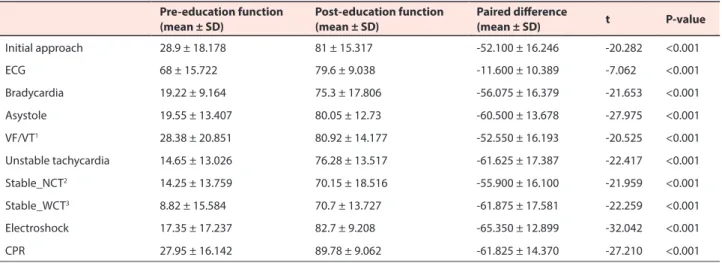
Table 1 depicts the total scores of OSCE stations. The
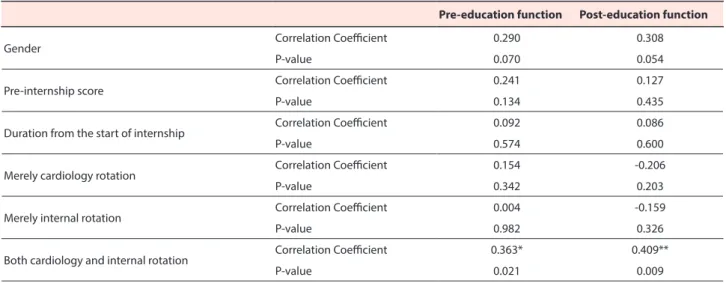
total score of the students had a significant increase af-ter the workshops (24.6 out of 100 to 78.6 out of 100) which showed 53.9% improvement in the skills after the simulation-based education (P< 0.001) (Table 2). On the other hand, the score of each station after the interven-tion increased significantly (P< 0.001). The highest effect of simulation-based education was in Asystole station (t= -27.975), and the lowest improvement was in ECG station (t= -7.062). Table 3 shows the Correlation of pre- and post-education function with possible related items. Female gender, higher pre-internship score, and longer internship period poorly correlated with both before and after training function, but neither was statistically sig-nificant (P> 0.05). Performance after the intervention was minimally improved among those who had passed only internal or cardiology course, but it was not statistically significant (P> 0.05), however, better performance signifi-cantly correlated to passing both internal and cardiology courses (P= 0.009). In addition, pre-education function was strongly correlated to post-education performance
Table 1. Total scores of OSCE stations
Minimum Maximum Mean Std. Deviation
Pre-education function 9 48 24.67 9.415
Post-education function 57 96 78.60 10.175
Table 2. Pre- and post-education function in OSCE stations Pre-education function
(mean ± SD) Post-education function(mean ± SD) Paired difference(mean ± SD) t P-value
Initial approach 28.9 ± 18.178 81 ± 15.317 -52.100 ± 16.246 -20.282 <0.001 ECG 68 ± 15.722 79.6 ± 9.038 -11.600 ± 10.389 -7.062 <0.001 Bradycardia 19.22 ± 9.164 75.3 ± 17.806 -56.075 ± 16.379 -21.653 <0.001 Asystole 19.55 ± 13.407 80.05 ± 12.73 -60.500 ± 13.678 -27.975 <0.001 VF/VT1 28.38 ± 20.851 80.92 ± 14.177 -52.550 ± 16.193 -20.525 <0.001 Unstable tachycardia 14.65 ± 13.026 76.28 ± 13.517 -61.625 ± 17.387 -22.417 <0.001 Stable_NCT2 14.25 ± 13.759 70.15 ± 18.516 -55.900 ± 16.100 -21.959 <0.001 Stable_WCT3 8.82 ± 15.584 70.7 ± 13.727 -61.875 ± 17.581 -22.259 <0.001 Electroshock 17.35 ± 17.237 82.7 ± 9.208 -65.350 ± 12.899 -32.042 <0.001 CPR 27.95 ± 16.142 89.78 ± 9.062 -61.825 ± 14.370 -27.210 <0.001
1Ventricular tachycardia/Ventricular fibrillation 2Stable narrow complex tachycardia
with the correlation coefficient of 0.662 (Table 4). Self-report on satisfaction, self-esteem and demand for more training after participation in workshops by participants on a five-point Likert scale is shown in Table 5.
Discussion
Cardiopulmonary failure is the most possible dangerous condition for human and the most critical situation for a doctor to deal with. The doctor must be enough trained to make the best decisions and react in the shortest pos-sible time to save the patient’s life. These skills can only be achieved through a good educational method. Different results show that hospitals with experienced and educated teams have a higher rate of success in CPR and patient
discharge (6). In this trial, the effect of simulation-based education approach on ACLS skills among medical stu-dents was assessed. This study showed that before the intervention, interns had poor performance in practical clinical matters, while their scientific knowledge such as ECG interpretation was acceptable. Studies carried out in Chicago University indicate that the quality of resuscita-tion differs when handled by experienced personnel who even have not read any published guidelines. Furthermore; most internal residents have very little or no experience at all dealing with different situations aroused during ACLS in the first residency year (3). Although 75% of interns passed internal and cardiology internship courses, their academic knowledge and practice in management of
car-Table 3. Spearman’s correlation of pre- and post-education function with possible related items
Pre-education function Post-education function
Gender Correlation Coefficient 0.290 0.308
P-value 0.070 0.054
Pre-internship score Correlation Coefficient 0.241 0.127
P-value 0.134 0.435
Duration from the start of internship Correlation Coefficient 0.092 0.086
P-value 0.574 0.600
Merely cardiology rotation Correlation Coefficient 0.154 -0.206
P-value 0.342 0.203
Merely internal rotation Correlation Coefficient 0.004 -0.159
P-value 0.982 0.326
Both cardiology and internal rotation Correlation Coefficient 0.363* 0.409**
P-value 0.021 0.009
*Correlation is significant at the 0.05 level (2-tailed). **Correlation is significant at the 0.01 level (2-tailed).
Table 4. Pre- and post-education function according to passing internal and cardiology rotation
Pre-education function (mean ± SD) Post-education function (mean ± SD)
Neither 16.4 ± 4.648 74.4 ± 10.058
Cardiology 26.43 ± 5.996 73.43 ± 11.574
Internal 24.25 ± 8.382 75.5 ± 4.041
Both 28.47 ± 10.151 83.37 ± 8.946
Total 24.67 ± 9.415 78.6 ± 10.175
Table 5. Satisfaction, self-esteem and demand for more training after participation in workshops (scores out of 5)
Mean SD
Simulation-based education strengthens my clinical skills 4.2 1.1
I received very useful feedback from Simulation-based education 4.6 0.9
Simulation-based training enhances my confidence 4.6 1.2
Simulation-based training is more valuable than bedside teaching 2.8 1.3
diopulmonary arrest patients and other ACLS conditions were poor. This could be due to the lack of efficient educa-tion and active participaeduca-tion in the reanimaeduca-tion process and clinical training during internal and cardiology rota-tions. The overall results of the study and statistical analy-sis of the data showed that the simulation-based educa-tion approach is highly effective in improving ACLS skills among medical students. In a study carried out in Imam Khomeini Hospital by Tehran University of Medical Sci-ences, the success rate of operations when executed by ex-perienced staff showed an increase from 18.4% to 30% (7). Better performance, after our trial, significantly correlated to passing both internal and cardiology course in this study. It shows that baseline knowledge and experience can boost educational process. Other studies indicated that using educated and experienced personnel in resus-citation operations dramatically increase recovery (8-17). This study had some limitations. ACLS workshops were held in the morning while some interns spent their night shift after hours of emergency care. Therefore, practitio-ners in these classes were present and felt tired and sleepy and yield reduction was having an effect. This study showed that education of ACLS by simulation and mega code manikin is accompanied by a great increase in stu-dent learning. So it is suggested that this kind of education should carry a special consideration in the learning cur-riculum of medical students.
Total sample size was relatively small and as this is the first study which used simulation-based education approach on medical students, a need for further studies is crucial. Interns should be actively involved in clinical teaching. Lack of clinical skills centers in our setting is a problem and if there are any, they should be equipped with the state of the art technologies for better education.
This study showed that education of ACLS by simulation and mega code manikin was accompanied by a great in-crease in students learning. In addition; interns were very interested, welcomed and satisfied in the process. There-fore; applying this method in all parts of medical educa-tion can be proposed. This kind of educaeduca-tion should carry a special consideration in the learning skills and curricu-lums of medical students and even different groups.
Ethical issues
This study was approved by the ethic committee of Mash-had University of Medical Sciences.
Authors’ contributions
Authors contributed to the publication of this article as follows: Conception and design (HR, ME, EP, and EB); Analysis and interpretation (VV); Data collection (NJ, HR, ME, EP, and EB); Writing the article (VV); Critical revision of the article (VV, HR); Final approval of the ar-ticle (VV, HR); Statistical analysis (VV); Obtained funding
(HR); Overall responsibility (VV). References
1. Neumar RW, Otto CW, Link MS, Kronick SL, Shuster M, Callaway CW, et al. Adult advanced cardiovascular life support 2010 American Heart Association Guidelines for Cardiopulmonary Resuscitation and Emergency Cardiovascular Care. Circulation 2010; 122: S729-67.
2. Farah R, Stiner E, Zohar Z, Eisenman A, Zveibil F. The importance of CPR training for assessing the knowledge and skills of hospital medical and nursing personnel. Harefuah 2007; 146(7): 529-33.
3. Diane B, Viva J, Monica J, Fudala BA, Leonard D, William C. Mastery learning of advanced cardiac life support skills by internal medicine residents using simulation technology and deliberate practice. J Gen Intern Med 2006; 21: 251–6.
4. Ruesseler M, Weinlich M, Müller MP, Byhahn C, Marzi I, Walcher F. Simulation training improves ability to manage medical emergencies. Emerg Med J 2010; 27(10): 734-8.
5. Travers AH, Rea TD, Bobrow BJ, Edelson DP, Berg RA, Sayre MR, et al. Part 4: CPR Overview: 2010 American Heart Association Guidelines for Cardiopulmonary Resuscitation and Emergency Cardiovascular Care. Circulation 2010; 122 (18 Suppl 3): S676-84.
6. Wayne DB, Butter J, Siddall VJ, Fudala MJ, Linquist LA, Feinglass J, et al. Simulation-based training of internal medicine residents in advanced cardiac life support protocols: a randomized trial. Teach Learn Med 2005; 17 (3): 210-6.
7. Borimnejad L, Rasouli M, Nikbakht Nasrabadi AR, Mohammadi H, Kheirati L. Effect of trained cardiopulmonary resuscitation team on the outcomes of cardiopulmonary resuscitation. J Babol Univ Med Sci 2008; 10 (3): 55-61. [In Persian]
8. Rodgers DL, Securro S, Pauley RD. The effect of high-fidelity simulation on educational outcomes in an advanced cardiovascular life support course. Simul Health 2009; 4 (4): 200-6.
9. Wayne DB, Didwania A, Feinglass J, Fudala MJ, Barsuk JH, McGaghie WC. Simulation-based education improves quality of care during cardiac arrest team responses at an academic teaching hospital: a case-control study. Chest 2008; 133 (1): 56-61.
10. Lee CC, Im M, Kim TM, Stapleton ER, Kim K, Suh
GJ, et al. Comparison of traditional advanced cardiac
life support (ACLS) course instruction vs. a scenario-based, performance oriented team instruction (SPOTI) method for Korean paramedic students. J Emerg Med 2010; 38(1): 89-92.
11. Ko PY, Scott JM, Mihai A, Grant WD. Comparison of a modified longitudinal simulation-based advanced cardiovascular life support to a traditional advanced cardiovascular life support curriculum in third-year medical students. Teach Learn Med 2011; 23(24):
324-30.
12. Stefan MS, Belforti RK, Langlois G, Rothberg MB. A simulation-based program to train medical residents to lead and perform advanced cardiovascular life support. Host Pract (1995) 2011; 39(4): 63-9.
13. Wayne DB, Siddall VJ, Butter J, Fudala MJ, Wade LD, Feinglass J, et al. A longitudinal study of internal medicine residents’ retention of advanced cardiac life support skills. Acad Med 2006; 81(10): S9-12. 14. Mieure KD, Vincent WR, Cox MR, Jones MD. A
high-fidelity simulation mannequin to introduce pharmacy students to advanced cardiovascular life support. Am J Pharm Educ 2010; 74(2): 22.
15. Delasobera BE, Goodwin TL, Strehlow M, Gilbert G, D’Souza P, Alok A. Evaluating the efficacy of simulators and multimedia for refreshing ACLS skills in India. Resuscitation 2010; 81(2): 217-23.
16. Lo BM, Devine AS, Evans DP, Byars DV, Lamm OY, Lee RJ, et al. Comparison of traditional versus high-fidelity simulation in the retention of ACLS knowledge. Resuscitation 2011; 82(11): 1440-3. 17. Schwid HA, Rooke GA, Ross BK, Sivarajan M. Use
of a computerized advanced cardiac life support simulator improves retention of advanced cardiac life support guidelines better than a textbook review. Crit Care Med 1999; 27(4): 821-4.