Ho
w Shanghai D
oes I
t
Liang , K idwai, and Zhang
How Shanghai Does It
Insights and Lessons from the Highest-Ranking
Education System in the World
Xiaoyan Liang, Huma Kidwai, and Minxuan Zhang
D I R E C T I O N S I N D E V E L O P M E N THuman Development
Public Disclosure Authorized
Public Disclosure Authorized
Public Disclosure Authorized
Public Disclosure Authorized
Public Disclosure Authorized
Public Disclosure Authorized
Public Disclosure Authorized
Public Disclosure Authorized
Public Disclosure Authorized
Public Disclosure Authorized
Public Disclosure Authorized
Public Disclosure Authorized
Public Disclosure Authorized
Public Disclosure Authorized
Public Disclosure Authorized
Public Disclosure Authorized
Public Disclosure Authorized
Public Disclosure Authorized
Public Disclosure Authorized
Public Disclosure Authorized
Public Disclosure Authorized
Public Disclosure Authorized
Public Disclosure Authorized
Public Disclosure Authorized
Public Disclosure Authorized
Public Disclosure Authorized
Public Disclosure Authorized
Public Disclosure Authorized
Public Disclosure Authorized
Public Disclosure Authorized
Public Disclosure Authorized
Public Disclosure Authorized
Public Disclosure Authorized
Public Disclosure Authorized
Public Disclosure Authorized
Public Disclosure Authorized
Public Disclosure Authorized
Public Disclosure Authorized
Public Disclosure Authorized
Public Disclosure Authorized
Public Disclosure Authorized
Public Disclosure Authorized
Public Disclosure Authorized
Public Disclosure Authorized
Public Disclosure Authorized
Public Disclosure Authorized
Public Disclosure Authorized
Public Disclosure Authorized
Public Disclosure Authorized
Public Disclosure Authorized
Public Disclosure Authorized
Public Disclosure Authorized
Public Disclosure Authorized
Public Disclosure Authorized
Public Disclosure Authorized
Public Disclosure Authorized
Public Disclosure Authorized
Public Disclosure Authorized
Public Disclosure Authorized
How Shanghai Does It
Insights and Lessons from the Highest-Ranking
Education System in the World
Xiaoyan Liang, Huma Kidwai, and Minxuan Zhang D I R E C T I O N S I N D E V E L O P M E N T
How Shanghai Does It • http://dx.doi.org/10.1596/978-1-4648-0790-9
© 2016 International Bank for Reconstruction and Development / The World Bank 1818 H Street NW, Washington, DC 20433
Telephone: 202-473-1000; Internet: www.worldbank.org Some rights reserved
1 2 3 4 19 18 17 16
This work is a product of the staff of The World Bank with external contributions. The findings, interpreta-tions, and conclusions expressed in this work do not necessarily reflect the views of The World Bank, its Board of Executive Directors, or the governments they represent. The World Bank does not guarantee the accuracy of the data included in this work. The boundaries, colors, denominations, and other information shown on any map in this work do not imply any judgment on the part of The World Bank concerning the legal status of any territory or the endorsement or acceptance of such boundaries.
Nothing herein shall constitute or be considered to be a limitation upon or waiver of the privileges and immunities of The World Bank, all of which are specifically reserved.
Rights and Permissions
This work is available under the Creative Commons Attribution 3.0 IGO license (CC BY 3.0 IGO) http:// creativecommons.org/licenses/by/3.0/igo. Under the Creative Commons Attribution license, you are free to copy, distribute, transmit, and adapt this work, including for commercial purposes, under the following conditions:
Attribution—Please cite the work as follows: Liang, Xiaoyan, Huma Kidwai, and Minxuan Zhang. 2016.
How Shanghai Does It: Insights and Lessons from the Highest-Ranking Education System in the World.
Directions in Development. Washington, DC: World Bank. doi:10.1596/978-1-4648-0790-9. License: Creative Commons Attribution CC BY 3.0 IGO
Translations—If you create a translation of this work, please add the following disclaimer along with the attribution: This translation was not created by The World Bank and should not be considered an official
World Bank translation. The World Bank shall not be liable for any content or error in this translation.
Adaptations—If you create an adaptation of this work, please add the following disclaimer along with the attribution: This is an adaptation of an original work by The World Bank. Views and opinions expressed in
the adaptation are the sole responsibility of the author or authors of the adaptation and are not endorsed by The World Bank.
Third-party content—The World Bank does not necessarily own each component of the content contained within the work. The World Bank therefore does not warrant that the use of any third-party–owned individual component or part contained in the work will not infringe on the rights of those third parties. The risk of claims resulting from such infringement rests solely with you. If you wish to reuse a component of the work, it is your responsibility to determine whether permission is needed for that reuse and to obtain permission from the copyright owner. Examples of components can include, but are not limited to, tables, figures, or images.
All queries on rights and licenses should be addressed to the Publishing and Knowledge Division, The World Bank, 1818 H Street NW, Washington, DC 20433, USA; fax: 202-522-2625; e-mail: pubrights@ worldbank.org.
ISBN (paper): 978-1-4648-0790-9 ISBN (electronic): 978-1-4648-0791-6 DOI: 10.1596/978-1-4648-0790-9
Cover photo: © Tingyan Xie/Shanghai Education Magazine. Used with permission of Tingyan Xie/Shanghai Education Magazine. Further permission required for reuse.
Cover design: Debra Naylor, Naylor Design, Inc.
v
How Shanghai Does It • http://dx.doi.org/10.1596/978-1-4648-0790-9
Contents
Foreword xi Acknowledgments xiii
About the Authors xv
Executive Summary xvii
Abbreviations xxvii
Introduction 1
Background 1 Chapter 1 Overview of Shanghai and Its Education System 3 Introduction 3
Education Development in Shanghai 8
Annex 1A 9
Notes 11
References 11 Chapter 2 Systems Approach to Analyzing Education Policies and
Linking Them to Implementation and Learning Outcomes 13 Introduction 13 Measuring Policy Intent and the SABER Instruments 14
Measuring Policy Implementation 16
Connecting Policy Intent, Implementation, and PISA
Learning Outcome Measures 16
Limitations of the Study 17
References 17 Chapter 3 Attracting and Developing an Excellent Teaching Force 19 Introduction 19 Policy Goal 1: Setting Clear Expectations for Teachers
(Advanced) 19 Policy Goal 2: Attracting the Best into Teaching (Advanced) 24 Policy Goal 3: Preparing Teachers with Useful Training
vi Contents
How Shanghai Does It • http://dx.doi.org/10.1596/978-1-4648-0790-9 Policy Goal 4: Matching Teachers’ Skills with Students’
Needs (Established) 31
Policy Goal 5: Leading Teachers with Strong Principals
(Established) 32 Policy Goal 6: Monitoring Teaching and Learning
(Advanced) 36 Policy Goal 7: Supporting Teachers to Improve
Instruction (Established) 38
Policy Goal 8: Motivating Teachers to Perform (Established) 42 Summary 43 References 45 Chapter 4 Financing Education for Quality and Equity 47 Introduction 47 Policy Goal 1: Ensuring Basic Conditions for Learning
(Advanced) 47 Policy Goal 2: Monitoring Learning Conditions and
Outcomes (Established) 52
Policy Goal 3: Overseeing Service Delivery (Established) 54 Policy Goal 4: Budgeting with Adequate and Transparent
Information (Established) 56
Policy Goal 5: Providing More Resources to Students
Who Need Them (Established) 58
Policy Goal 6: Managing Resources Efficiently (Advanced) 65 Summary 65 Notes 67 References 67 Chapter 5 Balancing Autonomy and Accountability 69 Introduction 69 Policy Goal 1: Level of Autonomy in Planning and
Management of the School Budget (Established) 70 Policy Goal 2: Level of Autonomy of Personnel
Management (Established) 73
Policy Goal 3: Role of the School Council in
School Governance (Emerging) 74
Policy Goal 4: School and Student Assessment
(Established) 77 Policy Goal 5: School Accountability (Emerging) 78 Summary 81 References 82 Chapter 6 Creating an Effective Student Assessment System 85 Introduction 85
Contents vii
How Shanghai Does It • http://dx.doi.org/10.1596/978-1-4648-0790-9
Classroom Assessments (Established) 86
Examinations 89
National Large-Scale Assessment (Established) 95
International Large-Scale Assessment (Established) 96 Summary 98 Notes 99 References 99 Chapter 7 Linking Policies and Implementation to Learning
Outcomes 101
Introduction 101
Shanghai’s Performance on PISA 2012 101
Comparing Performance between Programs 103
Comparing Individual and Family Background
Characteristics between Programs 104
Comparing School Characteristics 106
Estimating Mathematical, Reading, and Scientific Literacy 110
Problem-Solving Skills 115
Summary 126
Annex 7A 130
Notes 132 References 133
Chapter 8 Summary and Discussion 135
Introduction 135 Factors Associated with Mathematical, Reading,
and Scientific Literacy 140
Factors Associated with Problem-Solving Skills 140
Policy Considerations for Shanghai 142
References 144 Appendix A Summary of Shanghai’s Basic Education Policy
Environment by the World Bank–SABER
Policy Framework 145
Boxes
3.1 Teacher Policy Areas for Data Collection under
SABER–Teachers 20
3.2 Obtaining a Teacher Certificate 25
3.3 An Account of a Teacher’s Experience, Jinshan 31
3.4 Teaching-Research Groups in China 40
3.5 Lesson Observations, Shanghai 41
3.6 Japan’s Lesson Study Approach 41
viii Contents
How Shanghai Does It • http://dx.doi.org/10.1596/978-1-4648-0790-9 4.2 The Origin of Entrusted Management Model of Shanghai:
The Pudong Experience 61
4.3 Special Education Provision in Other Countries 63
5.1 The Bian Zhi System of China 71
6.1 Purposes of Student Assessment and Achievement Data 89
7.1 Definitions of PISA Domains 102
7.2 Definitions and Implications of the Nature and Processes
of Problem Solving 120
Figures
1.1 Shanghai Education Management 4
1.2 Shanghai Education Structure 5
1.3 Percentage of Private Enrollment in Shanghai by Level and Year 6
2.1 The Black Box of Education Production 14
2.2 SABER Domains or Policy Areas 15
3.1 Eight Teacher Policy Goals under SABER–Teachers 20
3.2 Distribution of Working Hours Spent on Various Teaching
and Nonteaching Activities 23
3.3 Distribution of Weekly Class Time Spent on Various Teaching
and Nonteaching Activities 24
3.4 Average Wage in Various Employment Categories, China, 2013 27 3.5 Average Student-to-Teacher Ratio for Primary Schools,
2012–13 28 3.6 Teacher Test Scores and Passing Rates in Rural Shanghai 30 3.7 Officially Required Days of Professional Training per Year,
Secondary Education 39
3.8 Shanghai’s Teacher Development Framework 44
4.1 Six Policy Goals under SABER–Finance 48
4.2 Cross-District Differences in Teacher-to-Student Ratios in
Shanghai Primary and Junior Secondary Schools 50
4.3 Cross-District Differences in Proportion of Teachers with Higher-than-Required Certificate in Shanghai Primary and
Junior Secondary Schools 51
7.1 Performance on Mathematics, Science, Reading, and Problem
Solving, by Program and Ordinary versus Model 104
7.2 Percentage of Total Variation in PISA Mathematics Performance Explained by Between-School Variation and Study Programs (junior or senior secondary level,
vocational or general) 105
7.3 Distribution of Students by Percentage of Funding from
Government versus Student Fees 107
7.4 Problem Solving, Mean Score, PISA 2012 116
7.5 Solution Rates on PISA Items Measuring Different Natures
Contents ix
How Shanghai Does It • http://dx.doi.org/10.1596/978-1-4648-0790-9 Tables
1.1 Key Characteristics of Shanghai’s Education System, 2014–15 7 1.2 Snapshot of Performance on PISA 2012 in Math, Reading,
and Science in Shanghai and OECD Average 8
1A.1 Development Phases for Shanghai’s Basic Educational
Reforms (19th Century to Present) 9
2.1 SABER Scoring Rubric 15
3.1 SABER–Teachers Scoring, Shanghai, 2015 21
3.2 Selected Learning Objectives for First and Second Grade
Chinese 22 3.3 Selected Learning Objectives for First and Second Grade Math 22
3.4 Teaching Time by Subject, Primary Education 23
3.5 New Teachers’ Salary in Comparison with GDP per Capita 26
3.6 Tiered Ranking System for Teachers 28
3.7 Requirements for Professional Skills under “Professional
Standards for Basic Education Principals” 34
3.8 School Principals’ Class Observations, School Principals Survey 34 3.9 School Principals’ Feedback to Teachers after Class Observation,
School Principals Survey 35
3.10 School Principals’ Professional Knowledge in Shanghai, School
Principals Survey 36
4.1 SABER–Finance Scoring, Shanghai 49
4.2 Actual Qualifications of New Teachers in Junior Secondary
Schools in Shanghai 49
4.3 School Resources by Type of School in Shanghai 50
4.4 Green Indicators of Academic Quality of Primary and
Secondary School Students 54
4.5 Average Number of Intended Instruction Hours per Year,
Primary Education 55
4.6 Public Expenditure on Education as a Share of GDP 57
4.7 Total per Student Public Expenditure by Level of
Education, 2013 57
5.1 SABER–School Autonomy and Accountability, Shanghai 70
5.2 Level of Autonomy, Public and Private School Principals 73 5.3 Key Responsibilities—Private School Board and Principal 76 5.4 School Board Involvement in Private Schools, Data from
Principal Survey 76
6.1 SABER–Student Assessment, Shanghai 87
6.2 Zhong Kao Entry Score Requirement in 2015 91
6.3 Gao Kao Minimum Entry Score Requirement in 2015
and 2014, Shanghai 93
7.1 Number of Schools in PISA 2012 Shanghai Sample 102
7.2 Number of Students in PISA 2012 Shanghai Sample, by
x Contents
How Shanghai Does It • http://dx.doi.org/10.1596/978-1-4648-0790-9 7.3 Performance on Mathematics, Science, Reading, and Problem
Solving, by Program and Ordinary versus Model 103
7.4 Comparing Individual and Family Characteristics by Program 106 7.5 Comparing Characteristics of Different Types of Schools 108 7.6 Comparing Characteristics of Ordinary versus Model or
Experimental Secondary Schools 109
7.7 Estimates of Mathematical, Reading, and Scientific Literacy
Using School Characteristics, Junior Secondary 111
7.8 Estimates of Mathematical, Reading, and Scientific Literacy Using School Characteristics, Senior Secondary General
Students 113 7.9 Estimates of Mathematical, Reading, and Scientific Literacy
Using School Characteristics, Senior Secondary Vocational 114 7.10 Estimates of Mathematical, Reading, and Scientific Literacy
Using Individual and Household Background Characteristics,
Controlling for School Fixed Effects 115
7.11 Estimates of Problem-Solving Skills Using School Characteristics 117 7.12 Estimates of Odds Ratios for Success, by Nature of Problem 123 7.13 Estimates of Odds Ratio for Success, by Problem-Solving
Process 124
7A.1 Description of PISA Variables 130
xi
How Shanghai Does It • http://dx.doi.org/10.1596/978-1-4648-0790-9
Foreword
Education is widely recognized as a fundamental right and as one of the most powerful instruments for economic growth and poverty alleviation. Education is critical to the World Bank Group’s mission to end extreme poverty and boost shared prosperity in the world by 2030. It also features prominently in the Sustainable Development Goals adopted by the United Nations in 2015 to trans-form the world. The fourth of these global goals calls for access to quality educa-tion and lifelong learning opportunities for all. In fact, quality educaeduca-tion is essential for any country aiming for sustained and diversified economic growth.
The question that policy makers are constantly asking is how to achieve quality in education in the face of daunting challenges. The World Bank’s Education Strategy 2020 calls for investing early, investing smartly, and investing for all—with a particular emphasis on strengthening education systems and rais-ing learnrais-ing outcomes. Worldwide, education systems differ in history, context, policy focus, and implementation, as well as results. Through its financing, devel-opment knowledge, and global partnerships, the World Bank Group aspires to bring the best global and comparative evidence to individual country contexts. This study, How Shanghai Does It, provides many exciting, valuable, and relevant lessons from Shanghai, one of the world’s best-performing education systems according to the Organisation for Economic Co-operation and Development’s (OECD’s) Program for International Student Assessment (PISA).
By analyzing and benchmarking education policies and practices pertaining to teachers, school financing, student assessment, and school autonomy and accountability, the study provides an unparalleled and comprehensive account of the insights and lessons from Shanghai. The account reveals that Shanghai has managed to strategically plan, develop, and establish a set of highly coherent and synergistic education policies that have together boosted education results. Furthermore, the study reveals a second secret—that Shanghai implements its education policies consistently and constantly strives to innovate and reform to meet new challenges. The breadth of the information and analysis in this study is both practical and relevant, not only for education systems aspiring to achieve Shanghai’s success, but for Shanghai itself in view of the rapidly changing land-scape of social demography and educational purpose and technology in the region and globally.
xii Foreword
How Shanghai Does It • http://dx.doi.org/10.1596/978-1-4648-0790-9 One of the most impressive aspects of Shanghai’s education system is its pro-cess for development and management of teachers. Teaching is a well-respected profession, not so much because of the level of pay teachers receive, but rather because of the society’s respect for the profession, sustained through long-term, rigorous preservice education and pervasive school-based professional development. Both of these attributes are linked to a well-structured professional career ladder and performance evaluation system. Teachers are expected to be active researchers who constantly reflect on their pedagogy and implement inno-vations in relation to student outcomes. Principals are strong instructional leaders who can provide guidance on teaching and learning and who understand how best to evaluate teachers. Teachers and principals alike maintain a high level of professional accountability.
What Shanghai has to offer the world is not just its past or even its present, but the future it intends to create for the country as a leading economy in the East Asia and Pacific region, and in the world beyond. In a way, Shanghai itself has already moved beyond PISA and is deliberating even harder questions and challenges, such as the social-emotional well-being of its children, global citizen-ship, and environmental consciousness, creativity, and innovation.
Shanghai’s long-term vision and persistent efforts to reflect on and reform long-held educational traditions, values, and practices are a source of inspiration to the international education and development community.
Claudia Maria Costin Senior Director of Education World Bank
Bert Hofman
China Country Director World Bank
xiii
How Shanghai Does It • http://dx.doi.org/10.1596/978-1-4648-0790-9
Acknowledgments
This report was prepared by Xiaoyan Liang, Huma Kidwai, and Minxuan Zhang. Shuang Chen and Yinan Zhang provided excellent background research. A highly competent team of researchers from Shanghai Normal University, including Dr. Wenle Yan, Ms. Qingqing Song, Dr. Bo Ning, Mr. Youyuan Wang, Mr. Xiaohu Zhu, Mr. Hui Chen, Ms. Yun Zhou, Ms. Chunhua Zhao, and Ms. Jingjing Liu, made significant contributions to the report. They painstakingly collected policy data for the Systems Approach for Better Education Results (SABER) modules, answered many rounds of questions, and further facilitated school visits and interviews in Shanghai for the World Bank team.
Within the Bank, the team is grateful to the technical assistance provided by the various SABER teams, including Halsey Rogers and Andrew Paul Trembley for SABER–Teacher and SABER–School Finance, Angela Demas for SABER– School Autonomy and Accountability, and Margarite Clarke for SABER–Student Assessment.
Valuable comments were received from peer reviewers, including Hana Brixi (Program Leader), Barbara Bruns (Lead Education Specialist, World Bank), Juan Manuel Moreno (Lead Education Specialist and the World Bank’s Global Lead for Basic Education), and Dandan Chen (Practice Leader). The team further owes gratitude to the extremely supportive World Bank senior management, including China Country Director Bert Hofman, Senior Director for Education Claudia Maria Costin, Director of Education Amit Dar, and Education Manager for East Asia and Pacific (EAP) Harry Anthony Patrinos, who was the first to encourage the team and provided initial financing for the study before he became the EAP Education Manager. The work would not have happened with-out the strong endorsement and support from Luis Benveniste, who was the previous Education Manager for EAP, and China Human Development Program Leader Elena Glinskaya.
xv
How Shanghai Does It • http://dx.doi.org/10.1596/978-1-4648-0790-9
Dr. Xiaoyan Liang is a Senior Education Specialist and the World Bank’s Education Team Leader for China, Malaysia, Mongolia, and the Republic of Korea. Dr. Liang joined the World Bank as a Young Professional almost two decades ago, after graduating from Harvard University with a doctor of education degree. Since then, she has led policy analysis and dialogue and managed educa-tion programs in African, Latin American, and East Asian countries. Dr. Liang is passionate about development through education and has solid education policy and program expertise in wide-ranging areas, including early childhood educa-tion, technical and vocational education and skills development, higher education and science and technology, education finance, and teacher education. She is widely published on various education topics within and outside the World Bank. Dr. Huma Kidwai is an education consultant in the World Bank’s Education Global Practice, East Asia and Pacific Region. She has a doctorate of education from Columbia University and has conducted extensive research on education reform and faith-based educational institutions in India. Previously, Dr. Kidwai has worked with the Poverty Reduction Group of the World Bank, the Know Violence in Childhood global initiative, the Praxis Institute for Participatory Practices, and the Earth Institute’s Columbia Global Centers. Her professional experience includes projects on education, child protection, health, and poverty reduction, with a particular focus on issues of exclusion.
Professor Minxuan Zhang is currently the Director of the Research Institute for International and Comparative Education at Shanghai Normal University and a Fellow of the Consultant Council of the International Institute of Educational Planning, UNESCO. Professor Zhang has had a long and distinguished career and held important positions in education in Shanghai, such as President of Shanghai Normal University, Director of Shanghai PISA, Director of the Shanghai Academy of Educational Sciences, Deputy Education Commissioner in Shanghai, and Principal of the Shanghai Experimental School. Professor Zhang is a globally recognized education expert and remains active in advising various ministries of education on education policies.
xvii
How Shanghai Does It • http://dx.doi.org/10.1596/978-1-4648-0790-9
This report, How Shanghai Does It: Insights and Lessons from the Highest-Ranking Education System in the World, presents an in-depth examination of how students in Shanghai achieved the highest scores in the areas of reading, science, and mathematics on a respected global assessment of 15-year-olds’ educational abili-ties. It documents and benchmarks key policies in Shanghai’s basic education, provides evidence on the extent to which these policies have been implemented in schools, and explores how these policies and their implementation have affected learning outcomes.
The report uses the World Bank’s Systems Approach for Better Education Results (SABER) as an organizing framework to organize and benchmark poli-cies. School-based surveys and other existing research are employed to shed light on educational impact and implementation. Programme for International Student Assessment (PISA) 2012 data are used to analyze the variations in Shanghai students’ achievement and to examine the extent to which school variables may be associated with variation after accounting for family and stu-dent background.
Based on the SABER framework and rubric, Shanghai scored “established” and “advanced” in almost all areas across four key educational domains: teachers, school finance, school autonomy and accountability, and student assessment. SABER rated school accountability and role of the school council in governance as “emerging” (appendix A).
One finding is that Shanghai has a high degree of coherence between policy and implementation. The study does not find significant divergence between policy statements and reality. This noteworthy connection between policy and implementation can possibly be attributed to a number of factors, including the cultural and historical Chinese characteristics of top-down and centralized gov-ernment administration; close monitoring of the programs and policies and align-ment of performance with incentives; high levels of professional accountability among teachers, principals, and administrators within the education system; and, to some extent, modest and realistic policy statements and goals.
Shanghai also stands out for its constant drive to renew and improve its education system and practices. The city has been on a journey of educational reform ever since China opened up to the world in the 1800s, when western missionaries established new western-style schools. Reform efforts have further
xviii Executive Summary
How Shanghai Does It • http://dx.doi.org/10.1596/978-1-4648-0790-9 intensified during the past three decades, subsequent to the Cultural Revolution in the 1970s. Three key strategic documents issued by the Chinese State Council during this period have guided national education reform in three distinct phases. The documents include “Decisions about Education System Reform” (1988), “Decisions on Deepening Education Reform and Promoting Quality-Oriented Education in an All-Round Way” (1999), and “China’s Medium- and Long-Term Education Reform and Development Plan Outline” (2010). The city has been a pioneer and leader of the national education reform movement and is now mak-ing plans for new reforms through 2050. The followmak-ing sections summarize key policy highlights and describe some main policy considerations as Shanghai con-tinues along its educational reform path.
Attracting and Developing an Excellent Teaching Force
Clear learning objectives and standards, compact and well-aligned teaching learn-ing materials, and efficient evaluation systems for all subjects across all grade levels provide the framework for teachers in Shanghai. The Teachers Law of the People’s Republic of China (1993) defines teachers’ general obligations and working hours. Not only should teachers fulfill teaching contracts and carry out the school teaching plan, but they should also dedicate themselves to the moral, physical, and intellectual development of students and organize relevant student learning activities. The Teachers Law also requires teachers to improve their own moral ethics and pedagogical expertise. Teacher responsibilities go beyond the classroom to encompass professional development and extracurricular activities.
Teaching in Shanghai is an attractive and respected middle-class profession. The working conditions, such as educational facilities and student-to-teacher ratios, are attractive, and clear career advancement mechanisms are in place. Shanghai requires at least a three-year tertiary education for primary school teachers and a four-year university education for secondary school teachers. In practice, however, the academic requirement is more stringent, and most teach-ers in Shanghai have at least a bachelor’s degree. Teachteach-ers fulfill a one-year pro-bationary period before being formally hired by the school districts.
The city offers teachers incentives to teach in hard-to-staff rural and semi-urban schools. It transfers and rotates teachers to help underperforming schools and disadvantaged student populations. Teachers and principals working in hardship areas can advance more quickly in their careers. Although Shanghai does not face a critical teacher shortage in any particular subject, a disparity remains in the allocation of teachers and other resources between rural and central urban districts.
Recruitment criteria for school principals are high and stringently adhered to, with a clear focus on instructional leadership. But detailed qualification requirements vary across districts. Principals in Shanghai participate in various leadership programs, based on the “Professional Standards for Basic Education Principals,” over the course of their tenure. Principals have opportunities for career advancement. The city links part of principals’ pay to the overall performance of
Executive Summary xix
How Shanghai Does It • http://dx.doi.org/10.1596/978-1-4648-0790-9
their schools. It also explicitly expects principals to be instructional leaders. Most principals in Shanghai observe between 30 and 50 classes per semester and provide feedback to teachers.
Results from a series of student assessments serve a diagnostic purpose for monitoring and evaluating teachers. Teacher performance is monitored using multiple mechanisms, not just students’ academic achievement. These processes include frequent district-level inspections of teachers’ work and classroom obser-vations by senior teachers and principals.
Shanghai designs professional development activities to be collaborative and to focus on instructional improvement. School principals are responsible for creating targeted teacher training plans based on each teacher’s evaluation results. Professional development is often a substantial part of schools’ opera-tional expenditure. The city pairs weak and inexperienced teachers with high-performing and experienced ones. Important platforms for teacher professional development and performance evaluation—teaching-research groups and lesson observations—are also practiced universally in schools. Teachers are expected to be researchers who would evaluate and modify their own pedagogy in relation to student outcomes. The city requires new teachers to complete at least 360 hours of professional development in their first five years of service, and an addi-tional 540 hours to be considered for a senior rank.
The city rewards good teachers. Performance affects promotional opportuni-ties, and a small part of teacher pay reflects workload and performance. Policy guidelines require teachers to be accredited once every five years to continue teaching. The city can dismiss teachers for misconduct, child abuse, or poor per-formance, but these events are rare. In cases of poor perper-formance, transfers and early retirement are the more commonly observed reprimanding practices.
Overall, Shanghai is characterized by a coherent and comprehensive sys-tem of teacher professional development that incorporates multiple layers of in-service training, school-based teacher research groups, evaluation of teacher performance, and a structured career ladder that provides both motivation and a mechanism for teachers to progress in their careers, which is key to Shanghai’s demonstrated excellence in education.
Financing Education for Quality and Equity
Detailed policies and regulations are in place to ensure minimum educational inputs of infrastructure, staffing norms, learning materials, and teacher qualifica-tions. The education budget is channeled to schools via teacher salaries, capital investment, and an operational budget based on the number of students. However, because of the decentralized nature of education financing, in which each district finances its own basic education, disparities remain across districts and between city and rural schools. Shanghai’s public expenditure on education as a share of GDP was about 3.5 percent in 2013, a smaller proportion than spent by other high-performing economies such as Finland, Japan, the Republic of Korea, and the United States.
xx Executive Summary
How Shanghai Does It • http://dx.doi.org/10.1596/978-1-4648-0790-9 The system increasingly designs education financing to ensure that it lifts all students’ learning outcomes by assisting low-performing schools and districts through financial and other means. Shanghai has discarded the inequitable basic education “key school” system1 and is instead focusing on making every
neighborhood school excellent. Innovative financing instruments such as “entrusted management,” which pairs low-performing schools with high- performing peer institutions, is rapidly gaining support. The municipal govern-ment transfers half of education surplus taxes to economically weak districts and mandates that top secondary schools reserve some spaces for middle school graduates from poor districts.
Shanghai closely monitors the school management environment and teaching-learning outcomes. The municipality collects school and district data annually. However, Shanghai could improve the way it uses information and communi-cations technologies to collect data. Efforts are being made in this regard. In 2010, based on the lessons from PISA, the Shanghai Municipal Education Commission established its own quality-monitoring system called “Green Indicators of Academic Quality of Primary and Secondary School Students,” also known as Green Indicators. The main objective was to assess school quality holis-tically, including academic rigor, teaching motivation, and student-teacher rela-tionships. Shanghai has a city-level system for determining the school’s annual calendar, and mechanisms are in place to monitor the availability of school learn-ing materials and physical resources.
Education budgeting is based on adequate and transparent information and made available to the public. Data are collected at the school and district level to adequately inform future budget planning. Internal and external audit systems are in place to verify the use of educational resources. Schools that fail internal or external audits receive legal sanctions.
Shanghai has specific policies to assist disadvantaged students with education expenses. The city provides free school meals for migrant children and students living below the poverty line, and provides education subsidies to students with disabilities or economic hardships. Shanghai has made more progress in attaining equitable access to schooling than any other region in China according to the 2015 National Compulsory Education Quality Monitoring Assessment.2 Migrant
children, however, continue to face barriers in accessing local public compulsory education schools. These children cannot always produce the necessary docu-ments to prove their family’s working status and they cannot access Shanghai’s public senior secondary schools after completing the nine-year basic education. The city should further implement special education and strengthen efforts to help migrant and other disadvantaged children.
Balancing School Autonomy and Accountability
Schools in Shanghai are afforded a high level of autonomy in planning and man-aging the school budget. Budget planning is a collaborative and multistep process. After receiving budget approval from the district Department of Finance and the
Executive Summary xxi
How Shanghai Does It • http://dx.doi.org/10.1596/978-1-4648-0790-9
municipal government, schools can execute the budget under defined categories. Schools have limited influence over teachers’ base pay scale, which is set at the municipal level, but have the autonomy to allocate merit-based pay. The school wage bill is divided into two parts: The base salary of teachers makes up 70 per-cent of the total wage budget. The remaining 30 perper-cent is distributed on the basis of work load and performance. Schools tend to have more say in determin-ing the salaries of nonteachdetermin-ing staff. Public schools have less autonomy than private schools, particularly in their ability to raise funds. Detailed guidelines are in place for regulating financial management and transparency standards in public and private schools. Compliance failure leads to legal sanctions.
Schools have substantial autonomy in personnel management. Based on their district, schools have varying levels of autonomy to appoint and dismiss teachers. Schools in principle have the authority to hire and fire teachers, but in practice they can only hire additional teachers if their quota is raised. Otherwise they can only hire teachers on short-term contracts. Teachers are rarely fired. The hiring and deployment process for nonteaching staff is more flexible. Mechanisms are in place for schools to participate in teacher recruitment and select the preferred candidates.
Private school principals in Shanghai tend to exercise greater autonomy over staff and pay-related decisions than do public school principals. Shanghai does not have a uniform municipal-level policy on the appointment and deploy-ment of principals; districts have the authority to establish their own processes. Districts usually maintain and cultivate a pool of principal candidates over a sustained period before formal recruitment.
In addition to complying with financial management guidelines, schools are also accountable for school management and learning outcomes. The city inspects schools annually and comprehensively evaluates them with the Green Indicators. It uses a well-established and frequently administered system of school assessments to inform teaching practices and make necessary adjustments and also conducts citywide examinations annually at the end of ninth and twelfth grades. China’s first nationwide basic-education quality assessment was con-ducted in 2015. Shanghai is also the first Chinese province or city to have par-ticipated in the international PISA since 2009. The rich set of student data helps policy makers track student learning outcome trends. One positive observation is that Shanghai has made an effort not to rank or publish individual student exam results or to use exam results as an explicit mechanism for teacher rewards or sanctions.
Shanghai schools have some autonomy in curriculum and pedagogy. At the central level, the Ministry of Education sets overall national curriculum standards for all subjects. Shanghai, along with a few selected provinces, is allowed to have its own curriculum and has released its subject-specific “Curriculum Plan for Regular Elementary and Secondary Schools in Shanghai.” Shanghai schools fur-ther have the autonomy to design 30 percent of the curriculum as school-based curriculum, according to each school’s strengths and the areas of their curricular focus. Furthermore, teachers have a certain level of pedagogical autonomy.
xxii Executive Summary
How Shanghai Does It • http://dx.doi.org/10.1596/978-1-4648-0790-9 The system promotes and maintains professional accountability through rela-tions within the teaching staff and through the execution of in-service teacher training and monitoring procedures. As school principals and senior teachers engage with others through teaching-research groups and through other support and mentoring methods, professional accountability becomes more apparent.
Public schools are not mandated to have school councils but follow the “school principal responsibility system,” in which principals make key decisions, usually in consultation with party secretaries and increasingly in consultation with teacher staff associations. Private schools in Shanghai are legally required to establish “school boards.” Although the boards participate in decision making on general planning and budgeting, they are generally not involved in profes-sional teaching and learning matters. Parent-teacher associations, formed begin-ning in 2012, are limited to supporting basic school management tasks and helping students learn at home. There is no city guideline, manual, or policy regu-lating the participation of the community in school activities and learning inputs. No explicit policies or public forums are in place for expressing accountability to stakeholders. Communities and parents trust educational professionals to manage their professional affairs and to educate.
Creating an Effective Student Assessment System
The common formats for student assessment used in China and Shanghai are those of continuous and formative classroom assessments, summative examina-tions particularly at the end of ninth grade (zhong kao) and twelfth grade (gao kao), and national and international large-scale assessments. Classroom assess-ments are frequent and are executed in a variety of formats, such as quizzes, oral tests, presentations, home assignments, and so forth, allowing students greater possibilities for demonstrating their learning based on their abilities than afforded by summative examinations that mostly tend to be written tests.
There are clear guidelines on assessment standards, and efforts have been made to align these standards with appropriate, age-relevant expected learning outcomes. It has been ascertained that efforts are made to monitor the quality of assessments at the school level, and the data are effectively used to inform teaching-learning and future assessment practices in the classroom. As part of government efforts to improve education quality the State Council formally rolled out the Plan for National Compulsory Education Quality Monitoring in April 2015. In 2011, the Shanghai Municipal Educational Commission also launched a series of surveys entitled “Green Indicators of Academic Quality of Primary and Secondary School Students.” The surveys aim to improve educa-tional management and the educaeduca-tional ecology. The indicators include student academic achievement, student learning motivation, student academic workload, teacher-student relations, teachers’ instruction styles, and the annual progress on such indicators. The surveys are aimed at all primary and junior secondary stu-dents in the compulsory education stage. To further improve classroom assess-ment, the municipal and district-level Teaching Research Offices undertake
Executive Summary xxiii
How Shanghai Does It • http://dx.doi.org/10.1596/978-1-4648-0790-9
regular research projects on the status of student assessments to inform policy decisions.
Senior secondary entrance and graduation exams are well-recognized social events in Shanghai and are closely followed by students, parents, educators, and the media. Effective execution of these exams is enabled by a well-structured system with clear policy guidelines, regular funding, and sufficient and well-trained human resources. These exams are aligned with learning goals for stu-dents and teachers. These exams are considered high in quality and transparent and fair in process. However, the exams are often blamed for creating high pressure on students and motivating schools and teachers to teach to the test. Exam test scores almost exclusively determine whether a student can attend a university and which tier.3 To alleviate the fear parents and students have of these
examinations, the Shanghai Municipal Education Commission is currently making an effort to revise the gao kao and zhong kao exams to make them more flexible. The new formats will be rolled out in 2017–18.
Shanghai is one of the pioneer Chinese provinces to participate in interna-tional large-scale assessments. It performed outstandingly on the 2009 and 2012 PISA and garnered significant national and international attention for its educa-tional success. The enabling context for its participation in PISA, which includes the presences of clear policy guidelines, necessary funding, and effective human resources, were assessed at the “advanced” level. However, it scored rather poorly on its policy goal of ensuring effective use of the data generated through such international assessments.
Linking Policies and Implementation to Learning Outcomes
The extent to which Shanghai’s education policies and practices foster learning outcomes is revealed in the 2012 PISA results. Variations are substantial across educational programs, with upper secondary students performing better than lower secondary, and model or experimental senior secondary students perform-ing better than those from vocational schools. Overall, model or experimental upper secondary school students scored the highest across math, science, and reading. Shanghai also emerged as one of the most equitable education systems among the PISA participants, with the highest proportion of disadvantaged stu-dents performing among the top 25 percent of stustu-dents after controlling for socioeconomic status.
The between-program variation in PISA scores is greater than the within-program variation, indicating that the system efficiently places students into different programs at the end of lower secondary school based on test scores. However, the analysis performed for this report was able to show that within each of the program types, policies and practices at the school level play a significant role in explaining students’ PISA performance. School factors that are positively associated with PISA performance largely fall into the following cate-gories: educational resources, extracurricular activities, principal instructional leadership, curriculum autonomy (slightly negative on math performance in
xxiv Executive Summary
How Shanghai Does It • http://dx.doi.org/10.1596/978-1-4648-0790-9 lower secondary school), accountability (vocational schools with more parental pressure do better in math), and teacher participation in school governance (positive on math at the upper secondary level).
Moreover, individual and family background characteristics have demon-strated consistent correlation with student performance across academic pro-grams. Girls perform significantly worse on math and science and better on reading than boys, consistent with findings from other PISA participants.4 Home
educational resources, cultural possessions, and parental education are positively associated with student literacy. In contrast, family wealth is negatively related to performance. Students who have attended at least a year of preschool perform significantly better on all three domains.
Policy Considerations for Shanghai
The comprehensive assessment and benchmarking of education policies provides an opportunity to reflect on a few considerations for Shanghai.
Consider delaying tracking to tenth grade or later. The zhong kao exam after ninth grade tracks students into three distinct senior secondary programs with very little horizontal mobility between programs. Cumulative differences in endowment in teachers and other resources further accentuate the disparity in education quality among programs. Shanghai could potentially pilot eliminating the zhong kao and delaying tracking to tenth or twelfth grades like other advanced nations and provide more curriculum diversification.
Increase assistance to migrant and other disadvantaged children. Shanghai has proactively enacted policies and approaches to expand education services to migrant and other disadvantaged children. However, the current eligibility crite-ria of three years of residency and employment may need to be relaxed to allow more migrant children to enroll in local public or government-sponsored private schools. “Disadvantaged” children are required to update their status every year to qualify for assistance, which could ostracize them further. The city does not allow migrant children to enroll in its public senior secondary schools, limiting their potential.
Expand the role of parents, the community, and society in education. Parent-teacher associations are a fairly new practice and tend to have limited responsibilities. At the same time, many anecdotes and isolated studies seem to indicate some dissat-isfaction with the public education system. Shanghai could consider expanding the role of parents, the community, and society in general in the education system.
Further explore the role of public-private partnerships to address the last-mile issues in education service delivery. Promising initiatives such as entrusted manage-ment of low-performing schools and purchase of education services from private providers could be scaled up and formally institutionalized.
Find a healthier balance between academic excellence and students’ social and emotional well-being. Though not explicitly discussed in this report, students in Shanghai report more unhappiness and parental pressure compared with their international peers. The city could further encourage institutions to engage in
Executive Summary xxv
How Shanghai Does It • http://dx.doi.org/10.1596/978-1-4648-0790-9
evidence-based education research and public education debates. It could also continue to build a virtuous cycle of reform and development toward an educa-tion system that is even more competitive globally.
Notes
1. “Key schools” were schools selected for their records of educational accomplishment and were given priority in assignment of teachers, equipment, and funds. In practice, key schools favored urban areas and were allowed to admit and train high-achieving students for entrance into top universities. The practice was gradually abolished beginning in the late 1980s in stages across different regions of the country.
2. China implemented its first national compulsory education quality assessment in 2015. The sample included about 200,000 fourth- and eighth-grade students in 6,474 primary and middle schools in 323 counties or districts from the 31 Chinese provinces as well as autonomous regions. Students were tested in the two subjects of mathematics and physical education/health. More than 100,000 teachers responded to teacher surveys.
3. Chinese universities are grouped into four tiers: first-tier universities consist of the best Chinese universities; second-tier universities are regular tertiary degree universities; third-tier universities are mainly provincial or city-level universities; and the fourth tier are mainly tertiary technical and vocational education and train-ing colleges. The Ministry of Education announces cutoff scores for each tier after the exam.
4. On the 2009 PISA, boys outperformed girls in mathematics in 35 of the 65 partici-pating countries and economies. In 5 countries, girls outperformed boys, and in 25 countries there was no significant difference between the genders. (Organisation for Economic Co-operation and Development [OECD]. 2011. PISA 2009 at a Glance. Paris: OECD Publishing, Paris. http://dx.doi.org /10.1787/9789264095298-en.)
xxvii
How Shanghai Does It • http://dx.doi.org/10.1596/978-1-4648-0790-9 EMIS education management information system
GDP gross domestic product
ICT information and communications technology ISCED International Standard Classification of Education
OECD Organisation for Economic Co-operation and Development PISA Programme for International Student Assessment
PRC People’s Republic of China
PTA parent-teacher association
SAA School Autonomy and Accountability
SABER Systems Approach for Better Education Results (World Bank) SAR Special Administrative Region
SHPISA Shanghai PISA Committee
TALIS Teaching and Learning International Survey RMB renminbi (China’s official currency)
US$ U.S. dollars
1
How Shanghai Does It • http://dx.doi.org/10.1596/978-1-4648-0790-9
Introduction
Background
The release of the 2012 Organisation for Economic Co-operation and Development (OECD) Programme for International Student Assessment (PISA) results has sparked another round of discussion and comparison of student achievement across the globe. PISA is an international assessment that measures the capabilities of 15-year-olds in reading, science, and mathematical literacy. In addition, PISA surveys participating students, parents, and school principals on a wide range of detailed and internationally comparable measures of background information, covering students’ family characteristics and institu-tional features of the school systems. PISA has been conducted once every three years since 2000. Specifically, PISA 2012 tested mathematics literacy in depth and updated the assessment of student performance in reading and science in 65 economies. The 2012 PISA also included modules on problem-solving skills and financial literacy.
Among the 65 participating economies in 2012, Shanghai, China, ranked first in mathematics literacy, with a mean score of 613 points, which is 119 points higher than the OECD average (equivalent to approximately three years of schooling). Hong Kong SAR, China; Japan; the Republic of Korea; Liechtenstein; Macao SAR, China; the Netherlands; Singapore; Switzerland; and Taiwan, China, were among the top 10 performers in mathematics. Shanghai also achieved the highest scores in reading and science. Shanghai first participated in the PISA tests in 2009 when it also ranked highest in the three subjects.
An intense discussion has been trailing the Shanghai PISA story since 2009, ranging from initial questioning of the true representativeness of the sample, to attempting to discredit Shanghai’s results by saying that Shanghai is not China, or attributing Shanghai and East Asian achievements to merely “Confucius,” culture, or parental emphasis on education. In paral-lel, professional efforts have also tried to “demystify” Shanghai’s secrets. Most prominently, Tom Friedman shared his observations on Shanghai’s
2 Introduction
How Shanghai Does It • http://dx.doi.org/10.1596/978-1-4648-0790-9 elementary schools in his article “The Shanghai Secret” in the opinions pages of the New York Times on October 22, 2013:
When you sit in on a class here and meet with the principal and teachers, what you find is a relentless focus on all the basics that we know make for high-performing schools but that are difficult to pull off consistently across an entire school system. These are: a deep commitment to teacher training, peer-to-peer learning and constant professional development, a deep involvement of parents in their chil-dren’s learning, an insistence by the school’s leadership on the highest standards and a culture that prizes education and respects teachers.
In a similar but more global fashion, the OECD put together a series of country education highlights focusing on high-performing countries in a short video program “Strong Performers and Successful Reformers” in 2012. In the video, Shanghai’s success was largely attributed to government leadership and a policy focus on improving low-performing schools.
Missing from the picture, however, is a more comprehensive, systematic, in-depth, and objective rendition of the policies and practices of basic education in Shanghai, benchmarked against others in key dimensions. This report, there-fore, is an attempt to systematically organize and document the policy and implementation efforts in the realm of basic education in Shanghai. The report uses an existing systems diagnostic and benchmarking tool developed by the World Bank, the Systems Approach for Better Education Results, or SABER, along with supplemental data from school-level principal surveys, existing stud-ies carried out mostly in Chinese, and additional data and information on educa-tion expenditures and labor force surveys.
The report also provides extensive analysis of student performance on the 2012 PISA and makes an effort to identify school-level variables that are correlated with variation in student performance across Shanghai. The report attempts to adopt a systems approach, but particular emphasis is placed on teachers, education financing, balancing autonomy and accountability, and student assessment.
The report has three broad audiences in mind. The most relevant audience would be education policy makers from other countries and the rest of China interested in learning more about Shanghai’s education system and policies. A second audience would be the relevant education authorities in Shanghai and China, given that the report attempts to benchmark Shanghai against other systems and in the process identify highlights, challenges, and recommendations for future reform in light of other countries’ experiences. Finally, because of its scope and depth, the report can serve as an important review for education researchers and policy analysts and help direct future education research efforts in Shanghai.
3
How Shanghai Does It • http://dx.doi.org/10.1596/978-1-4648-0790-9 C h A P T E R 1
Overview of Shanghai and
Its Education System
Introduction
Located on the eastern shore of China, Shanghai is the country’s most populous city, inhabited by 23 million people as of 2013. Administratively, Shanghai has been granted provincial status (along with Beijing, Guangzhou, and Chongqing). As a province Shanghai is divided into 16 county-level divisions or districts. Even though every district has its own urban core, a few districts collectively form the main city while the others form the suburban part, composed of satellite towns and rural areas farther away from the urban core.
Since the Chinese government shifted to more open economic policies in 1978, Shanghai has become one of the largest economic centers in China, with annual GDP per capita close to US$12,000, nearing the World Bank’s high-income threshold. The manufacturing and services sectors contribute 48 percent and 51 percent, respectively, to the city’s overall economy; agriculture contrib-utes barely 1 percent.
In 2010, the Port of Shanghai overtook the Port of Singapore to become the world's busiest container port. In 2014, the Port of Shanghai set a historic record by handling more than 35 million containers. Shanghai has already set its mid- and long-term development goals: to build the city into one of the finest economic, finance, trade, and shipping centers in the world and to realize its vision of becoming a modern socialist international metropolis by 2020. Shanghai also leads the nation in educational achievement—19 percent of the adult population possess higher education degrees and another 26 percent have attained high school education, as compared with 8.9 percent and 14 percent nationwide.1
China has a centralized leadership structure but a decentralized government administration system, delicately balancing the authority of the central govern-ment with the autonomy and flexibility of local administration. The central Ministry of Education is responsible for education nationwide, in charge of formulating national development goals and plans for education, and for
4 Overview of Shanghai and Its Education System
How Shanghai Does It • http://dx.doi.org/10.1596/978-1-4648-0790-9 developing guidelines and policies in all educational domains and monitoring their implementation. However, provinces and municipalities, including Shanghai, maintain a relatively high level of autonomy for developing localized policies, implementation and financing strategies, and province-specific goals and targets. A centerpiece of decentralization is education financing. In the 1980s, the Chinese government reformed education financing from a central-ized system with a narrow revenue base to a decentralcentral-ized system with a diversi-fied and larger revenue system. With the guidance of upper-level educational committees and bureaus, county-level governments became responsible for the financing of compulsory education. The decentralized education financing pol-icy is at the heart of the education outcome disparities between provinces and between rural and urban areas (Ngok 2007).
Education affairs in Shanghai are managed by the Shanghai Municipal Education Commission, under the Chinese Ministry of Education. As shown in figure 1.1, the Shanghai Municipal Education Commission shoulders the major responsibility for educational affairs in Shanghai, in particular the financing and provision of affiliated institutions of higher education. Although a few key higher education institutes are directly financed and managed by the central Ministry of Education, most of Shanghai’s universities and colleges are financed and man-aged by the Shanghai Municipal Education Commission. At the same time,
Figure 1.1 Shanghai Education Management
Ministry of Education of PRC Shanghai Municipal People’s Government
Shanghai Municipal Education Commission (SHMEC)
University under M
inistr
y of Education
University under SHME
C
Senior high school and secondar
y vocational
education schoo
l
Junior high school Prima
ry school Kindergar te n People’s government of district or county
Education bureau of district or county
Overview of Shanghai and Its Education System 5
How Shanghai Does It • http://dx.doi.org/10.1596/978-1-4648-0790-9
district (in urban areas) and county (in rural areas) governments are responsi-ble for the financing and provision of preprimary education, the nine-year basic education, and senior secondary education.
Figure 1.2 illustrates the educational structure in Shanghai. Basic education (also known as compulsory education in China) includes primary education (first through fifth grades) and secondary education (sixth through ninth grades).2
Shanghai’s education system has evolved to be the best in the nation in access, equity, and quality. Enrollment in the nine-year basic education has remained about 99.9 percent in the past few years, slightly higher than the national average of 99.7 percent. The promotion rate among junior middle graduates was 96 percent in 2013 compared with 91.2 percent nationwide.3 Among the
1.2 million basic education students, almost 47 percent, or 0.57 million, were migrant children in 2013. Shanghai achieved a remarkable outcome by enrolling 77 percent of those migrant children in neighborhood public schools and the remaining 23 percent in private schools but with the municipal government covering all tuition and fees.
After completing the nine years of compulsory education, Chinese students, including those in Shanghai, are tracked into various streams of senior secondary education programs strictly based on the scores from the junior secondary gradu-ation examingradu-ation (zhong kao). The streams are general academic or vocgradu-ational.4
Within the academic track, there are two further types of programs or schools: Figure 1.2 Shanghai Education Structure
Labor market or continuing education
Higher education Tertiary TVET
Senior secondary (3 years) Secondary TVET
Nine-year basic and compulsory education
Early childhood education Note: TVET = technical and vocational education training.
6 Overview of Shanghai and Its Education System
How Shanghai Does It • http://dx.doi.org/10.1596/978-1-4648-0790-9 the most elite model or experimental senior secondary schools and regular senior secondary schools. Competition is fierce for spots in the model senior secondary schools, which also tend to have the highest proportion of graduates entering the elite and first-tier universities in China or world-class universities abroad.
The government is the dominant financer and provider of education in Shanghai and China, especially in the compulsory education period. Data from the 2012 Programme for International Student Assessment (PISA) confirm that only about 10 percent of regular junior secondary and vocational schools are private.5 Figure 1.3 presents trends in private enrollment in all levels of education
using official data. Private schools that provide compulsory education (within the citizen education track) are nonprofit organizations regulated by the Bureau of Education.6 They tend to follow the same curriculum as public schools, and most
receive government funding in various forms including per student subsidies and teacher training, and they can be eligible for specific project funding.
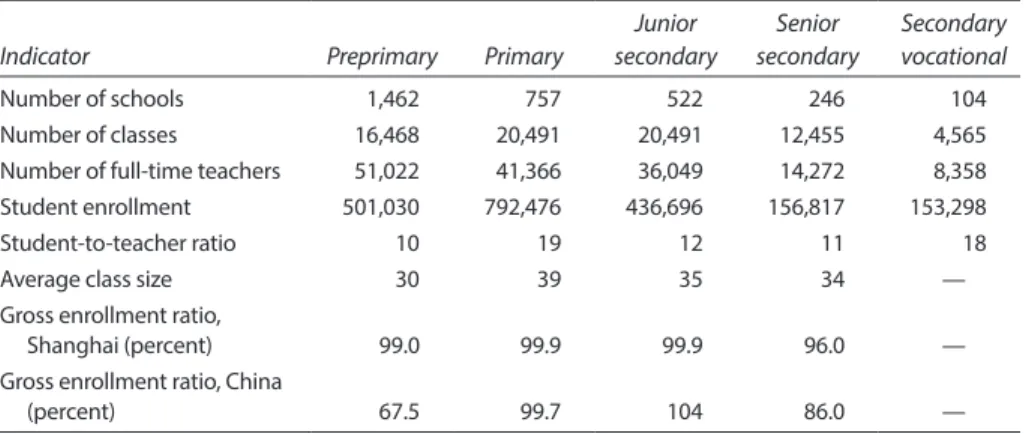
Table 1.1 presents key information about the size of the Shanghai system and the endowment of teachers. It is important to note that although Shanghai over-all has fairly low pupil-to-teacher ratios in preprimary, primary, junior secondary, and even senior secondary education, the average class size is almost triple the pupil-to-teacher ratio. This results from the way teaching and classes are organized. Within each grade there are a number of classroom sections. Each section hosts a group of students that take the same classes and courses with the same teachers and progress to the next grade together. The general basic education subjects include Chinese, math, English, crafts, art, music, physical education, information technology, and natural sciences. In addition, primary school students take ethics and social studies, and secondary school students take science, physics, chemistry, biology, history, geography, fine art, and political science and ethics.
Figure 1.3 Percentage of Private Enrollment in Shanghai by Level and Year
0 5 10 15 20 25 30 35 2000 2010 2012 2013
Kindergarten Primary Secondary Specialized secondary Vocational Higher education Source: Data from Shanghai Statistical Yearbook: Education 2014 (http://www.stats-sh.gov.cn/data/toTjnj.xhtml?y=2014e).
Overview of Shanghai and Its Education System 7
How Shanghai Does It • http://dx.doi.org/10.1596/978-1-4648-0790-9
As in most other Asian countries, segregation of curriculum and pedagogy by subject is the norm and one of the key characteristics of the Chinese education system and philosophy. School children, beginning in first grade, are taught by teachers who are trained and recruited by subject. Each key subject teacher is responsible for teaching that subject. Depending on the school, teachers might be teaching different classes in the same grade or different classes across grades, but only in one subject. However, teachers of noncore subjects such as music, arts, and information technology could teach more subjects.
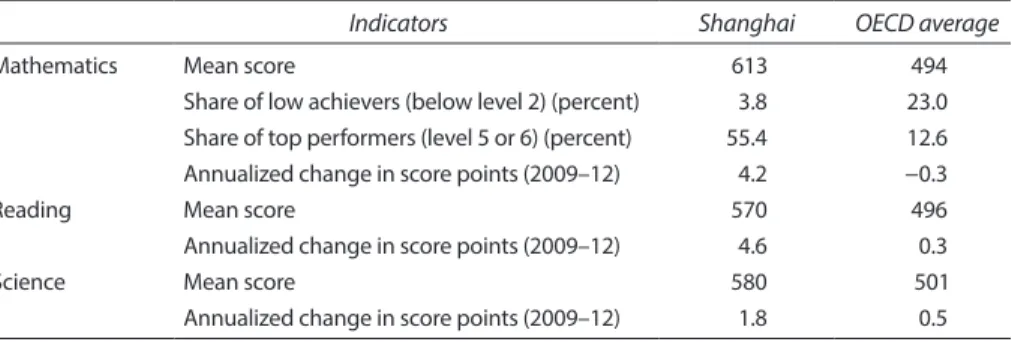
In 2009 Shanghai participated for the first time in the Organisation for Economic Co-operation and Development’s (OECD’s) PISA and ranked first in all three subjects (math, reading, and science) (OECD 2009). In 2012, Shanghai continued to be the top performer (OECD 2014). Its mean mathematics score of 613 points, representing a 4.2 percent annualized increase from 2009, is 119 points above the OECD average, the equivalent of nearly three years of schooling. Its mean score of 570 points in reading represents annualized improve-ment of 4.6 percent since 2009, the equivalent of more than a year-and-a-half of schooling above the OECD average of 496 points. Its mean score in science, 580, is more than three-quarters of a proficiency level above the OECD average of 501. Furthermore, Shanghai is also home to the largest proportion of top per-formers (proficient at level 5 or 6) in mathematics (55.4 percent), reading (25.1 percent), and science (27.2 percent). With 55.4 percent of students attain-ing level 5 or 6 in mathematics, Shanghai is the only PISA participant with more students at these top levels than in any other level (table 1.2).
Moreover, Shanghai has one of the most equal education systems among PISA participants. For example, it has the highest proportion of resilient stu-dents (19.2 percent), that is, disadvantaged stustu-dents who perform among the top 25 percent of students across all participating countries and economies after controlling for socioeconomic status. The strength of the relationship between mathematics performance and socioeconomic status is also below the OECD average.
Table 1.1 Key Characteristics of Shanghai’s Education System, 2014–15
Indicator Preprimary Primary
Junior secondary Senior secondary Secondary vocational Number of schools 1,462 757 522 246 104 Number of classes 16,468 20,491 20,491 12,455 4,565
Number of full-time teachers 51,022 41,366 36,049 14,272 8,358
Student enrollment 501,030 792,476 436,696 156,817 153,298
Student-to-teacher ratio 10 19 12 11 18
Average class size 30 39 35 34 —
Gross enrollment ratio,
Shanghai (percent) 99.0 99.9 99.9 96.0 —
Gross enrollment ratio, China
(percent) 67.5 99.7 104 86.0 —