A Proposed Framework for Integration of Visualization
Techniques and Active Learning Strategy in Wireless
Communication Network
Che Zalina Zukifli and Sumiati Suparmin
Computing Department, Faculty of Art, Computing and Creative Industry Universiti Pendidikan Sultan Idris,
35900, Tanjong Malim Perak, MALAYSIA
Abstract. This paper reviews the issues and problems faced by students in learning wireless communication network. Wireless communication network courses are said to be complex and difficult, particularly to novice students. They failure in understanding and inability to visualize and illustrate how wireless communication network is operates. Thus, this paper recommends a conceptual framework to overcome the problem. The technology that used is a visualization technique. In this paper we propose the architecture named Wireless Kits (Wkits) as one of the available learning support tools that can help novice students in enhancing their understanding of the wireless communication. This kits focus in wireless networking such as Bluetooth, Wi-Fi, WSN and RFID technology.
Keywords: Active learning, wireless communication, network technology, visualization
1
Introduction
Wireless communication and networking is a challenging subject to teach in a meaningful way because many students appear to find the subject rather dry and technical and quite boring [1]. Wireless communication and networking courses are becoming increasingly popular in universities, polytechnics, postsecondary colleges, and private training institutions around the globe. This is partly because of rapid developments in wireless communication and networking technology and the high demand for wireless communication networks skills in the industry worldwide. Visualization help student to understand how concept network are applied in the real world by using graphical [2].Student in computer and engineering ( CSE) and electrical engineering (EE) are at best exposed to data communication aspect, while wireless communication system remain untouched, as it is relatively difficult to learn about wireless technology without having substantial background in communication technology [3]. Besides that, Education and Research Kit provides a comprehensive platform for education, research and development of applications for wireless communications and sensor networks to provides a graphical user interface to monitor
the wireless sensor network, including visualization of the network topology and sensor readings [4] . Moreover, related study strongly believe that students grasp more effectively from courses that allows active involvement in hands-on learning experiences [1].A good visualization tool increases understanding of the problem and allows us to approach in another dimension to find a solution [5]. Besides that, students can understand better and adapt the information from the subject, when they can visually on how the system operates. [12]. In this paper we present the proposed architecture namely WKits in order to provide the students of wireless communication and networking with a hands-on learning experience. These WKits are designed via low-cost wireless modules which is affordable for any user. The projects are suitable for classroom.
In this paper, we describe our framework in integrating of visualization technique and active learning strategy in wireless communication network. We first describe the theoretical framework
2
Theoretical Framework
The theoretical framework of this study is grounded on Atkinson-Shiffrin Memory Model [8], and Cognitive Load Theory [9]. Learning is a process where information is received, processed, encoded and retrievable from memory structure [12]. Atkinson & Shiffrin, (1971) classifies memory storage into three categories which are sensory memory, working memory and long-term memory (Figure 1). Each of these memories has its own role in receiving and processing information. Typically, information stored in sensory memory is merely about 1 to 1 seconds, working memory will store information about 15 to 30 seconds and long-term memory will store information permanently (Ismail, 2011). New information can purely be stored in long-term memory after the first appearance and process in working memory. However, as disclosed, working memory capacity is limited and the duration of information storage is short span. Therefore, not all information which are penetrated through the memory structures will work successfully, and register permanently in the long-term memory, which is in the form of perfect schema [10].
Fig. 1. Information Flow in Memory System [11].
Cognitive Load theory [12] describes the learning process from the perspective of information processing system that keeps all information obtained from working memory in the long-term memory in the form of perfect schema. Scheme is a memory structure which creates path for students to deal with a large number of information blocks as if they are a single block. New information which enters the working needs to be integrated with pre-existing schemas in long term memory for sufficient mental
model development in working memory. For this to take place, relevant schemas in long-term memory must be activated and decoded into working memory which is also defined as the process of schema acquisition. The inability of perfect mental models construction can be a barrier in the learning process, primarily to novice students who are not capable of recognizing the relevant pre-existing scheme in the learning process. Due to limited capacity of working memory, when student are overloaded with information and the complexity of teaching materials that are not well managed, it will result in a cognitive load that can potentially cause the process of loaded coding scheme to be affected. Cognitive load is divided into three different categories of: i) intrinsic cognitive load, refers to the level of complexity or difficulty of the information to be learned; ii) extraneous cognitive load, refers to the technique and strategies used in presenting information; and iii) germane cognitive load, refer to impulse formation scheme through learning content management and integration of educational content to student knowledge [11]. Consequently, the development of instructional materials must be taken into consideration of principles which can reduce intrinsic cognitive load and extraneous cognitive load, and simultaneously will increase germane cognitive load. Optimizing the learning outcomes is through by balancing the three cognitive loads, for instance to reduce intrinsic cognitive load and extraneous cognitive load which will indirectly increase germane cognitive load [10].
3 Conceptual Framework
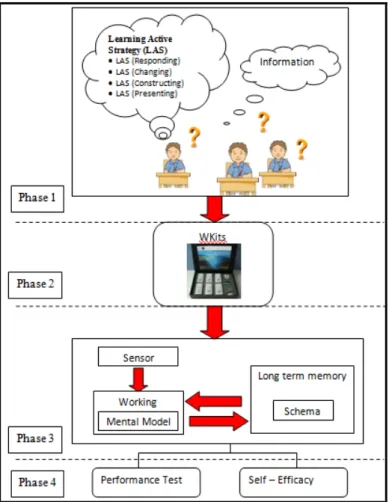
Based on theories, principles and literature overview, we put forward the framework of utilizing a visualization technique for the learning the program as depicted in Figure 2.
Phase 1: Engagement Taxonomy (ET)
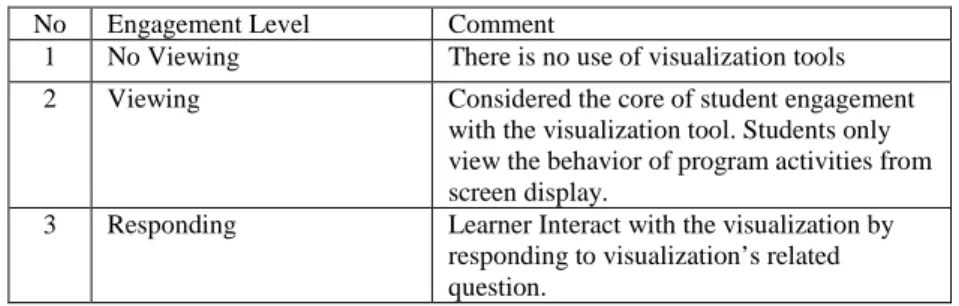
The central idea of the taxonomy is a higher-level engagement between learner and the visualization results for better learning outcomes. The ET consists of six levels of engagement and they are described in Table 4. Nevertheless question for novice students since they do not have strong existing knowledge related to topics studied. Without a strong pre-existing knowledge, active involvement may be limited. In this regard, impact of the engagement level and learning performance would be of a great value and interest.
Table 4. Engagement Taxonomy Level
No Engagement Level Comment
1 No Viewing There is no use of visualization tools 2 Viewing Considered the core of student engagement
with the visualization tool. Students only view the behavior of program activities from screen display.
3 Responding Learner Interact with the visualization by responding to visualization’s related question.
4 Charging Visualization or state of visualization can be altered
5 Constructing Learner can create awn visualization
6 Presenting Leaner present visualization for discussion and feedback.
Phase 2: Support Tool
Students should be actively engaged with tool Kits in order to active processing occurs in working memory. Active learning is generally defined as any method of teaching that involves students in the learning process. It requires students to do meaningful learning activities and think about what they are doing. In the theory of constructivism, knowledge is constructed by students as a result of the learning experience through which they had [12]. It means during the learning process, students will activate prior knowledge stored in long-term memory and try to connect with new knowledge learned [12]. Consequently, this framework propose the implementation of active learning strategies based on the taxonomy levels of engagement with the central idea of ET of the higher level of student engagement with WKits tools, which would lead to better learning outcome.
Phase 3: Education Memory Model
Strategy and approaches of the visual representation of information is also essential to ensure effective use of information in long-term memory. Inappropriate use of strategies will lead to increase in cognitive load during learning activities, particularly if the visual information from the tool kits only focuses the characteristic of wireless network. Students should be actively engaged with Wkits in order to activate the process occuring in the working memory. This is because the visual information conveyed by Wkits tool should be able to render students in developing accurate mental models in working memory for processing. This will lead to creation of the perfect scheme to be stored in long-term memory
Phase 4: Performance
This framework involves the relationship of logical ability which incorporates the proposed active learning strategy using the Wkits. This is because as understood, student’s logical ability is recognized as one of the important elements needed to understanding the wireless network during the learning activities. Thus, it is important to investigate whether the student’s logical ability really affect the learning performance through the active learning strategies approach aided by Wkits tool.
Fig. 2. Conceptual Framework
4
Conclusion
Wireless communication and networking technology courses are rapid developments in and the high demand for wireless communication networks skills in the industry worldwide. However, the subject is said to be difficult and complex. This is because novice students require a proper understanding to capture an abstract concept of the learning and difficult to imagine. Previous finding shows that some factors that reveals in students’ difficulty to master in wireless communication and networking technology is because they could not visualize the wireless process. Therefore, the design and development of Wkits functions as the potential learning support tools to strengthen student’s understanding on the wireless communication and networking technology in learning process. Wkits use the approaches and techniques of visualization and illustration of the characteristic of wireless network. These help students to understand the operation of technology network. Nevertheless, using
Wkits merely without the active engagement of students will not be able to give an effective impact on students in learning performance. Therefore, an active learning strategy functions as an approach that must be embedded in the learning process of learning process. Through active learning strategies aided by WKits, It is hoped that it will help to develop student's confidence in mastering the basic concepts of wireless communication and technology networking.
Reference
1. Nurul I. Sarkar.: IEEE and Trevor M. Craig : Teaching Wireless Communication and Networking Fundamentals Using Wi-Fi Project. In: IEEE Transactions On Education, Vol. 49 No. 1. (2006)
2. Bo Zhang, Yuping Lin You.: Study Of Computer Network Education Simulation System, College Of Engineering, Bohai University, Jinzhou ,Liaoning China Modern Educational Technology Cebtre. Liaoning Medical University Jinzhou Liaoning China (2014).
3. Dharma Prakash Agrawal Qing An Zhane.: Introduction To Wireless And Mobile System, 3 Edition (2011)
4. Daniel Roggen, Marc B¨achlin, Johannes Schumm.: An educational and research kit for activity and context recognition from on-body sensors (2010)
5. J. B. Mathews.: Why are Wireless Services Important to State and Education Leaders (2005)
6. WiFi, http://en.wikipedia.org/wiki/Wi-Fi at 25 september 2014 RFID, http://en.wikipedia.org/wiki/Radio-frequency_identification at 25 September 2014. 7. Siti Rosminah Md Derus. : Integration of Visualization Techniques and Active Learning
Strategy in Learning Computer Programming (2014)
8. Sweller, J.: Visualization and instructional design. In Proceedings of the International Workshop on Dynamic Visualization and Learning pp. 1501–1510 (2008)
9. Jai P. Agrawal Yakov E Cherner. : A Classroom/Distance Learning Engineering Course on Wireless Networking with Virtual Lab (2009)
10. Ahmad Zamzuri Mohamad Ali, Siti Rosminah Md Derus.: Usability And User Satisfaction Of Hardware-Software Interfacing Visualization Kit For Novice Learning Programming. Social and Behavioral Sciences 103 (2013) 1252 –1260 ( 2014)
11. Loyens, S. M. M., & Gijbels, D.: Understanding the effects of constructivist learning environments: introducing a multi-directional approach. Instructional Science, 36(5-6), 351–357(2009)
12. Priyang Bhatt, Brijesh Patel.: Wireless Networks Simulation with Assessment in PT Software, International Journal on Recent and Innovation Trends in Computing and Communication ISSN: 2321-8169 Volume: 1 Issue: 12 870 –875(2013)
![Fig. 1. Information Flow in Memory System [11].](https://thumb-us.123doks.com/thumbv2/123dok_us/363225.2539992/2.892.210.698.798.887/fig-information-flow-memory.webp)