Towards a Model of Awareness Support of Software Development in GSD
James Chisan, Daniela Damian
Department of Computer Science
University of Victoria
PO Box 355, Victoria BC V8W 3P6 Canada
chisan, danielad
@cs.uvic.ca
Abstract
Awareness is a powerful concept that can be used to en-able developers to quickly and easily grasp the state of the workspace which they operate within. We begin by explain-ing one approach to how awareness might be used to sup-port software development and to enhance developer coop-eration and communication. However, since this approach assumes on-going collaboration it is useful to couch the dis-cussion within a collaborative model. This paper presents a model of how awareness could support software collab-oration, by describing typical software collabcollab-oration, how it is deficient and how awareness helps ameliorates those deficiencies.
Finally, we discuss a variety of issues that become ap-parent when considering the approach. It is intended that these issues will stir debate and may help generate insight that ultimately improves global software development via awareness support.
1. Introduction
Software development is essentially a collaborative ef-fort among the stakeholders of a project, especially so for those directly involved in development. Business ana-lysts, system anaana-lysts, designers, programmers and testers all work together toward the common goal of producing a software solution. Furthermore, they do this in a common workspace comprised by the intermediate artifacts of de-velopment: requirements document, design, test scenarios, code, etc. This paper describes a model for how awareness can support collaboration during software development. In global software development (GSD) environments physical separation impairs communication and infringes on the col-laborative freedom collocated developments enjoy. There-fore the aim here is to illustrate our vision of how awareness of the workspace might address deficiencies in software col-laboration that are exacerbated during GSD.
This paper follows up on work presented last year at the ICSE 2003 GSD workshop (Damian, Chisan, Allen, and Corrie, 2003), where we described how [small] co-located teams benefit from social mechanisms that natu-rally facilitate work practices and diminish the apparent need for explicit workspace awareness support. To address this need, we propose that when changes are made within the workspace environment particularly to requirements to which much subsequent development depends, developers should be selectively notified about the nature of the change so that changes in requirements are quickly integrated into their work and the development effort on the whole. Re-quirements are particularly important since it is here that important decisions which directs all subsequent develop-ment is, or should be, recorded.
This work describes the first step to implementing that proposal. It seeks to illustrate a model that shows how awareness can support existing collaboration patterns that are typically exhibited during software development. By using the model, shortcomings in collaboration practices that occur during development can be identified. Then, the means in which awareness can support such practices is demonstrated and analyzed. Ultimately this serves to con-tribute to the larger, primary research goal to improve soft-ware development collaboration.
2. Background
Awareness simply refers to knowledge one has of the changing environment which one operates within, essen-tially ‘knowing what is going on’ (Endsley, 1995). In soft-ware development, this environment is the workspace envi-ronment composed of all the intermediate products of de-velopment. In particular, with respect to requirements en-gineering, document change and contact discovery, both facets of the workspace, have been identified as a source of ineffectiveness, confusion and development paralysis (Herbsleb, Mockus, Finholt, and Grinter, 2000). Further-more, development is hampered by ‘organizational
amne-sia’ where issues that have already been discussed and re-solved are repeatedly reopened for no other reason than their outcomes have been forgotten (Catledge and Potts, 1996). While the current state of the workspace could be as-certained from the contents of the organizational and project documents, these documents have been shown to be a poor communication media (Curtis, Krasner, and Iscoe, 1988; Al-Rawas and Easterbrook, 1995). Likely, as in the case of requirements, formal mechanisms (documents) are not updated quickly enough and, instead, news is propagated informally (Herbslebet al., 2000). As developers come to depend on informality, it is no wonder there is little moti-vation to record progress in formal documents in a timely manner.
While there are a variety of tools that implement aware-ness as an central feature of the system (Jang, Steinfield, and Pfaff, 2000; Bentley, Horstmann, Sikkel, and Trevor, 1995), these systems are not tailored directly to software develop-ment. In some cases, even when such tools are used primar-ily in development support, awareness refers only to noti-fication of change to authors of the artifact (Brush, Barg-eron, Grudin, and Gupta, 2002). Such an approach is not sufficient where developers rely on documents they do not author themselves.
In contrast, our proposal is to use the artifacts that exist in the workspace and from their contents build, [semi-] au-tomatically, relationships describing document hierarchies and their authors. This establishes dependence between ar-tifacts (ie. designxfulfills requirementy) and developer-artifact relationships (ie. Jim and Bob wrote design x). Then, when changes in artifacts in the workspace are de-tected, authors of dependant documents are notified (ie.Jim andBob are notified when requirementychanges). This method serves to leverage existing document structures and content to selectively deliver awareness to those who need it.
3. Purpose of the Model
Software development is largely a collaborative task, a result of many different stakeholders working closely to-gether to implement a software solution. The purpose of the model presented in this paper, is to show how awareness fits in to the broader system of development collaboration. This is necessary to articulate, in a structured, detailed way how development practices might be improved with awareness support.
To improve development practices, any method must consider the constraints which limit the possible solutions. In large part, the development habits and processes within organizations are a severe constraint that any approach must consider. Thus the model is used first to describe collabo-ration patterns that capture the nature of current
develop-ment practices as a means to show potential insufficiencies in these practices. Second, the model serves as a means to structure where faults occur in collaboration and to analyze the nature of awareness support that might address these faults and strengthen the effectiveness of collaboration. By utilizing this model, we establish a formal descriptive, the-oretic framework on which to base further research.
4. The Model
To show how failures in software collaboration might be improved with awareness support, we begin by describing an idealistic model of collaboration and how it is weakened in GSD projects. These weaknesses transcend purely GSD origins, such as impaired communication, lack of informal, impromptu discussions; they also relate to other pressures such as time to market, resource constraints or skill short-age.
To accurately describe typical projects that might involve GSD, a development effort of sufficiently large magnitude must be chosen. Therefore, it is assumed that there are a set of unique stakeholders in the project that include: business interests of (1) the development company and (2) the cus-tomer company, (3) end users, (4) system analysts, devel-opers including (5) designers, (6) programmers, (7) testers and (8) documenters. For completeness it is useful to briefly illustrate the roles of these stakeholders.
The business interests of the development company may include marketing tactics, product strategy, future vision, stockholder interests, internal efficiency and policy. The customer company is responsible for the contractual and financial obligations of the software purchase, thus their concerns may be primarily more basic focusing on cost, benefit, product adoption and product support. However, the goal of software is to improve the efficiency and ef-fectiveness of the end user whose satisfaction is based on usability, features, quality and reliability. System analysts are tasked with the responsibility of determining the char-acteristics (requirements) of the software solution, typically from the above mentioned stakeholders, while being con-strained by the limitations of the following development stakeholders. Development consists of designers who elab-orate on system requirements and produce detailed techni-cal designs to satisfy software solution, programmers use those designs to produce software that complies with their design, meanwhile testers use requirements and designs to develop, and later execute, test cases. Documenters also use requirements and design to publish user documentation.
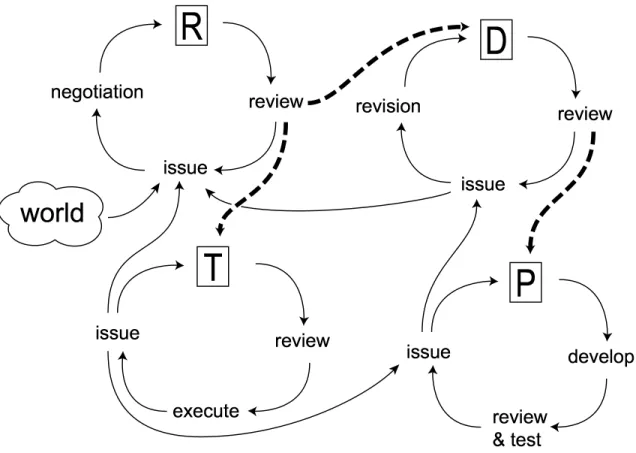
As figure 1 illustrates the model shows collaboration paths as work on the software development occurs in clus-ters of activity each centered on task types within the de-velopment. While many interactions occur throughout iter-ations within the activity (circular), equally important
!#" $% & ' ( )+*-,/.10
Figure 1. Model of collaboration in software development. Bold, dashed arrows show collaboration paths between development tasks that can be supported with our awareness approach
actions occur between activities. System analysts develop requirements (“R”) then review requirements and field con-cerns about requirements from development and incorpo-rate issues raised by non-development stakeholders, such as customers, users, management or marketing. The require-ments activity is concentrated around the task of develop-ing concise, complete requirement documents. Designers take requirements and develop technical designs (“D”) then they refine their designs by raising concerns about ambigu-ous, conflicting or impossible requirements, and by fielding concerns of programmers. The design activity is concen-trated around the task of developing complete, logical de-signs for programmers. Tests also take requirements (and may also use designs) to develop test cases and test sce-narios to validate the software (“T”) then they refine their tests by raising concerns about questionable requirements and by coordinating with programmers over the execution of their testing procedures. The testing activity is concen-trated around the task of developing tests to validate that the software product works and fulfills the software require-ments. Programmers take designs and develop the code that becomes the software product (“P”) then they progressively
refine their code by raising concerns about the design to de-signers. The programming activity is concentrated around the task of developing functional software that satisfies their designs. In ideal circumstances once the requirements activ-ity has concluded no further events would affect the nature of the requirements, design and test could begin, and then at the conclusion of detailed design, programming could begin and finally the software would be validated with a minimum of activity iteration.
Unfortunately, the model fails to capture the difficulties encountered during real-life software development. In all development the constraint of time bears down most heavily on the life-cycle of the development process. Development that occurs in GSD environments is further handicapped by a lack of timely, lucid communication between developer activities.
When time is constrained, development time is com-pressed by encouraging each activity phase to begin as soon as possible. In many cases this means that requirements, design, coding and test all start simultaneously. However, the consequence of this philosophy is that interactivity com-munication is increases, both in frequency and importance.
As requirements become available it is crucial that they are communicated quickly to development and test to minimize the efforts they spend using out-of-date requirements infor-mation. (see Figure 1, bold arrows) Likewise, designs need to be propagated quickly to programmers so that they min-imize wasted effort. Conversely, issues about requirements need to be recognized quickly by design so that systems an-alysts can resolve conflicts and ambiguities. During GSD, this scenario is further hindered by slow, sometimes asyn-chronous communication that is unclear and ambiguous.
Software development failures have often been attributed to requirements error. In particular, captured changes in requirements are not broadcasted to appropriate develop-ers who would otherwise adjust their efforts to reflect such change. In part, this may be attributed to requirements that are only informally captured and are not formally articu-lated within requirements documents, which become, and remain, habitually out-of-date - making them a redundant waste of effort (Herbslebet al., 2000).
For example, consider the following frustrating scenario that many industrial practitioners could probably identify with: An unavoidable technical constraint discovered by a programmer causes design to be reworked, designers ne-gotiate an adjustment in requirements with system analysts and modify their designs appropriately. Subsequently, this technical constraint is raised repeatedly by other program-mers who were not informed of the design changes (or are using designs that may have been unrelated to the ad-justed design, but related to the affected requirement). This chaotic disruption wastes time and effort and causes unnec-essary aggravation to the development team.
Clearly this scenario could benefit directly from an awareness of changes in the development workspace that reflect project decisions made by developers. By effectively employing awareness for development artifacts, it is possi-ble to automate some of the communication that occurs be-tween development activities. (see Figure 1, bold arrows). By detecting changes within requirements and automati-cally notifying relevant designers, testers and programmers, these developer stakeholders can be kept aware of the re-quirements on which they rely. Furthermore, this promotes development artifacts as first class documents in which to record and organize information. Developers are not inter-ested in wasting their time polling documents for change, but if notified of changes, they are (further) motivated to refer to those documents to determine the nature of those changes. Authors, system analysts in the case of require-ments, are motivated to articulate their refinements in the document. Thus, the document itself becomes a medium of communication and developers can begin to rely on their timeliness and currency.
Although this approach does not address the effective-ness of any particular activity, it does suggest that
improve-ments to interdepartmental communication can be realized. For example, awareness does not help the system analyst to capture shifts in markets or abrupt changes business strat-egy. In contrast, awareness helps the system analyst to com-municate these changes (once identified) via the require-ments document in a reliable timely fashion to relevant de-velopers. Only then can development be made dynamic and responsive to emergent requirements inherent during itera-tive, time-constrained development.
5. Issues of the Proposed Solution
In using the model to develop possible awareness solu-tions to improve collaboration and development during soft-ware development a variety of issues become apparent. The issues described below are presented for discussion during the workshop in which this paper is submitted, in the hope that further insight can be exchanged by attendees.
5.1. Extent of Information Dissemination
Of central concern to providing awareness to participants of the development process is striking a balance between providing information germane to their current work re-sponsibilities and limiting extraneous, redundant informa-tion that overwhelms developers or desensitizes them to awareness mechanisms. Rather than a scattershot broad-cast approach, the analysis of person-artefact relationships makes it possible to provide information to developers in context to their responsibilities and contributions to the workspace.
To maximize the accuracy of notification, person-artifact relationships can be, in many cases, extracted from existing information in the workspace - for example authors of a de-sign could be extracted from the dede-sign itself. While this may establish sufficient relationship between developer and artifact additional questions still remain about the extent of awareness required to keep developers up to date.
5.2. Privacy
Software organizations interact in increasingly complex arrangements of acquired, partner and/or outsourcing com-panies. Data that is [automatically] collected from interme-diate artifacts created during GSD can span physical and organizational boundaries. If this information is used for awareness purposes, then this represents a potential for in-formation flow across boundaries, in such cases questions of privacy may arise. For example, an outsource com-pany may want to limit what information is be collected and disseminated to its client (an intimate stakeholder in the project). Even within a single company, some devel-opers may oppose the collection of information that could
reflect on their progress and productivity. This issue can be most closely related to that of personal privacy prob-lems that have been considered with respect to video confer-encing (Boyle and Greenberg, 2000) and presence aware-ness (Godefroid, Herbsleb, Jagadeesany, and Li, 2000), where control over data fidelity is used to maintain pres-ence awareness while preserving personal privacy. This is-sue differs because it transcends personal privacy to include organizational privacy, and is with respect to the virtual workspace rather than a mere reflection of physical space.
5.3. Delivery
Ideally awareness of the workspace should be as natural as awareness of night and day. The challenge is to minimize the effort and distraction required of developers to keep up-to-date with the goings-on within the workspace. In other words, to provide awareness information as tacitly as possi-ble. Delivery of awareness can vary widely although a few obvious choices include the provision of awareness infor-mation in a textual or semi-textual/visual manner via email, the web, instant messenger, or with the use of some spe-cialized application. Management overhead, more stuff to read
5.4. Visualization of Artifact Relationships
Providing awareness requires the establishment of re-lationships among artifacts and between artifacts and the stakeholders involved in the development. Once this infor-mation has been collected it may have significant value on its own as a resource for developers and analysts. Further-more, these relationships may dramatically enrich aware-ness events delivered to developers, providing context for the event. The inherent value of this information suggests that it needs to be intuitively accessible to developers. Nat-urally, we wish to consider how these relationships could be visualized by determining what information developers need to extract and what sorts of questions they may find themselves asking about relationships among artifacts.
6. Future Work
The model presented above is only an intermediate step on the way to achieving the larger research goal of improv-ing software development by providimprov-ing better support to collaboration in global software teams. This model is a first version based primarily from reports reviewed in available literature, however validation of this model is required. To validate the model we intend to present the model to an in-dustrial partner and survey a sample breadth of stakehold-ers to critique the model based on their experience. With
this input the model will be adjusted to capture those ex-periences and through this validation process the develop-ment of the model will continue to evolve, becoming more refined and more accurately capturing the true nature of collaboration during software development. In the longer run, the model will be used to develop technological or process-based solutions that are specifically designed to de-liver awareness to enhance collaboration in GSD. Short-comings of that solution will also serve to reflect insuffi-ciencies of the model so that the model can be improved.
7. Conclusion
Awareness is a collaborative response to the problem of improving software development practices in GSD. The model described herein serves to show how awareness could be used to improve the naturally collaborative process of software development. Not only could awareness help ame-liorate GSD-specific issues, but such solutions also promise to be highly beneficial to co-located development too.
References
A. Al-Rawas and S. Easterbrook. “Communication prob-lems in requirements engineering: A field study.” In First Westminster Conference on Professional Awareness in Software Engineering. London, 1995.
R. Bentley, T. Horstmann, K. Sikkel, and J. Trevor. “Supporting collaborative information sharing with the WWW: The BSCW shared workspace system.” In Pro-ceedings of the Fourth International WWW Conference. Boston, MA, 1995.
M. Boyle and S. Greenberg. “Balancing awareness and pri-vacy in a video media space using distortion filtation.” In Proceedings of the Western Computer Graphics Sumpo-sium. 2000.
A. J. B. Brush, D. Bargeron, J. Grudin, and A. Gupta. “No-tification for shared annotation of digital documents.” In Proceedings of the SIGCHI conference on Human factors in computing systems. ACM Press, 2002.
L. Catledge and C. Potts. “Collaboration during conceptual design.” InProceedings of the 2nd International Confer-ence on Requirements Engineering. 1996.
B. Curtis, H. Krasner, and N. Iscoe. “A field study of the software design process for large systems.” Communica-tions of the ACM, 31(11) 1988, pp. 1268–1287.
D. Damian, J. Chisan, P. Allen, and B. Corrie. “Aware-ness meets requirements management: aware“Aware-ness needs
in global software development.” InInternational Work-shop on Global Software Development (colocated with ICSE ’03). Portland, OR, 2003.
M. Endsley. “Toward a theory of situation awareness in dynamic systems.” Human Factors, 37(1) 1995, pp. 65– 84.
P. Godefroid, J. D. Herbsleb, L. J. Jagadeesany, and D. Li. “Ensuring privacy in presence awareness: an automated verification approach.” InProceedings of the 2000 ACM conference on Computer supported cooperative work. ACM Press, 2000.
J. D. Herbsleb, A. Mockus, T. A. Finholt, and R. E. Grinter. “Distance, dependencies, and delay in a global collab-oration.” InProceedings of the 2000 ACM conference on Computer supported cooperative work. ACM Press, 2000.
C. Y. Jang, C. Steinfield, and B. Pfaff. “Supporting aware-ness among virtual teams in a web-based collaborative system: the teamscope system.” SIGGROUP Bulletin, 21(3) 2000, pp. 28–34.