
International Journal of Artificial Intelligence and Applications (IJAIA), Vol.10, No.2, March 2019
DOI: 10.5121/ijaia.2019.10203 27
E
XTRACTIVE
S
UMMARIZATION WITH
V
ERY
D
EEP
P
RETRAINED
L
ANGUAGE
M
ODEL
Yang Gu
1and Yanke Hu
21
Suning USA, Palo Alto, California, USA
2Humana, Irving, Texas, USA
A
BSTRACTRecent development of generative pretrained language models has been proven very successful on a wide range of NLP tasks, such as text classification, question answering, textual entailment and so on. In this work, we present a two-phase encoder decoder architecture based on Bidirectional Encoding Representation from Transformers(BERT) for extractive summarization task. We evaluated our model by both automatic metrics and human annotators, and demonstrated that the architecture achieves the state-of-the-art comparable result on large scale corpus – CNN/Daily Mail1 . As the best of our knowledge, this is the first work that applies BERT based architecture to a text summarization task and achieved the state-of-the-art comparable result.
K
EYWORDSBERT, AI, Deep Learning, Summarization
1.
I
NTRODUCTION
Document summarization is a widely investigated problem in natural language processing, and
mainly classified into two categories: extractive summarization and abstractive summarization.
Extractive approaches work in the way of extracting existing words or sentences from the original
text and organizing into the summary, while abstractive approaches focus more on generating the
inherently same summary that is closer to the way human expresses. We will focus on extractive
summarization in this paper.
Traditional extractive summarization approaches can be generally classified into two ways like:
greedy approaches [1] and graph-based approaches [2]. Recently, deep learning techniques have
been proven successful in this domain. Kageback et al. 2014 [3] utilized continuous vector
representations in the recurrent neural network for the first time, and achieved the best result on
Opinosis dataset [4]. Yin et al. 2015 [5] developed an unsupervised convolutional neural network
for learning the sentence representations, and then applied a special sentence selection algorithm
to balance sentence prestige and diversity. Cao et al. 2016 [6] applied the attention mechanism in
a joint neural network model that can learn query relevance ranking and sentence saliency
ranking simultaneously,and achieved competitive performance on DUC query-focused
summarization benchmark datasets
2. Cheng et al. 2016 [7] developed a hierarchical document
1https://github.com/deepmind/rc-data 2https://www-nlpir.nist.gov/projects/duc/
encoder and an attention-based extractor,and achieved results comparable to the state
CNN/Daily Mail corpus [8] without linguistic annotation.
Recent development of GPT
trained language model on a wide range of different tasks, such as text classification, que
answering, textual entailment, etc, but neither of these approaches
summarization task.
In this paper, we introduced a two
tuned this model on the CNN/Daily Mail
result demonstrated that our model has the state
automatic metrics (in terms of ROUGE
this is the first work that applies BERT based architecture to a text summarization task.
2.
T
RAINING
D
ATASET
CNN/Daily Mail [8] dataset is the most widely used large scale dataset for summarization and
reading comprehension. The training set contains 287226 samples. The validation set contains
13368 samples. The test set contains 11490 samples. Each sample contains an article and
referenced summary. After tokenization, an article contains 800 tokens on average, and a
corresponding summary contains 56 tokens on average.
3.
S
UMMARIZATION
M
ODEL
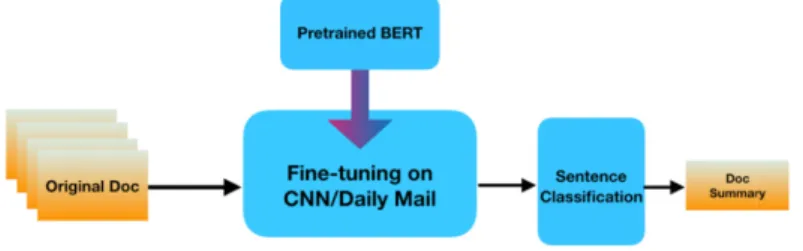
In this section, we propose the summarization model that efficiently utilizes BERT
text encoder. The architecture is shown in Figure
encoder and sentence classification.
Figure 1: Architecture of the Summarization Model
The sentences of the original document will be feed into the BERT encoder sequentially, and be
classified as if or not to be included in the summary. BERT is essentially a multi
bidirectional Transformer [19]
layer and a following linear affine sub
process utilizes query matrix
dimension
, and it can be expressed as E
,
,
based extractor,and achieved results comparable to the state
without linguistic annotation.
[9] and BERT [10] has proven the effectiveness of a generative pre
trained language model on a wide range of different tasks, such as text classification, que
answering, textual entailment, etc, but neither of these approaches has been tested on the text
ced a two-phase encoder decoder architecture based on BERT. We fine
tuned this model on the CNN/Daily Mail corpus for single document summarization task. The
result demonstrated that our model has the state-of-the-art comparable performance by both
automatic metrics (in terms of ROUGE [11]) and human assessors. As the best of our knowledge,
rk that applies BERT based architecture to a text summarization task.
dataset is the most widely used large scale dataset for summarization and
reading comprehension. The training set contains 287226 samples. The validation set contains
13368 samples. The test set contains 11490 samples. Each sample contains an article and
referenced summary. After tokenization, an article contains 800 tokens on average, and a
corresponding summary contains 56 tokens on average.
ODEL
In this section, we propose the summarization model that efficiently utilizes BERT
text encoder. The architecture is shown in Figure 1 and consists of two main modules, BERT
encoder and sentence classification.
Figure 1: Architecture of the Summarization Model
The sentences of the original document will be feed into the BERT encoder sequentially, and be
classified as if or not to be included in the summary. BERT is essentially a multi
[19] encoder. Each layer consists of a multi-head self
layer and a following linear affine sub-layer with the residual connection. The BERT encoding
process utilizes query matrix
, key matrix
of dimension
, and value matrix
, and it can be expressed as Eq.(1).
28
based extractor,and achieved results comparable to the state of the art on
has proven the effectiveness of a generative
pre-trained language model on a wide range of different tasks, such as text classification, question
been tested on the text
phase encoder decoder architecture based on BERT. We
fine-corpus for single document summarization task. The
art comparable performance by both
) and human assessors. As the best of our knowledge,
rk that applies BERT based architecture to a text summarization task.
dataset is the most widely used large scale dataset for summarization and
reading comprehension. The training set contains 287226 samples. The validation set contains
13368 samples. The test set contains 11490 samples. Each sample contains an article and a
referenced summary. After tokenization, an article contains 800 tokens on average, and a
In this section, we propose the summarization model that efficiently utilizes BERT [10] as the
of two main modules, BERT
The sentences of the original document will be feed into the BERT encoder sequentially, and be
classified as if or not to be included in the summary. BERT is essentially a multi-layer
ead self-attention
sub-layer with the residual connection. The BERT encoding
, and value matrix
of
International Journal of Artificial Intelligence and Applications (IJAIA), Vol.10, No.2, March 2019
29
Given the input document as
{
!, … ,
#}
where
%denotes one source token. The BERT
encoder’s output can be expressed as Eq. (2).
&
,
,
!, … ,
#(2)
In CNN/Daily Mail dataset, the ground truth is the referenced summaries without sentence labels,
so we follow Nallapati et al. [20] to convert the abstractive referenced summaries to extractive
labels. The idea is to add one sentence each time incrementally to the candidate summary, so that
the Rouge score of the current set of selected sentences is increasing in regard to the referenced
summary. We stopped when the remaining candidate sentences cannot promote the Rouge score
with respect to the referenced summary. With this approach, we convert a text summarization
task to a sentence classification task.
Our BERT encoder is based on Google’s TensorFlow
3implementation (TensorFlow version >=
1.11.0). We used the BERT-Base model(uncased, 12-layer,768-hidden,12-heads, 110M
parameters) and then fine tune the model on training set of CNN/Daily Main corpus. All inputs to
the reader are padded to 384 tokens; the learning rate is set to 3x10⁻⁵, and other settings are by
default.
4.
E
XPERIMENT
R
ESULT
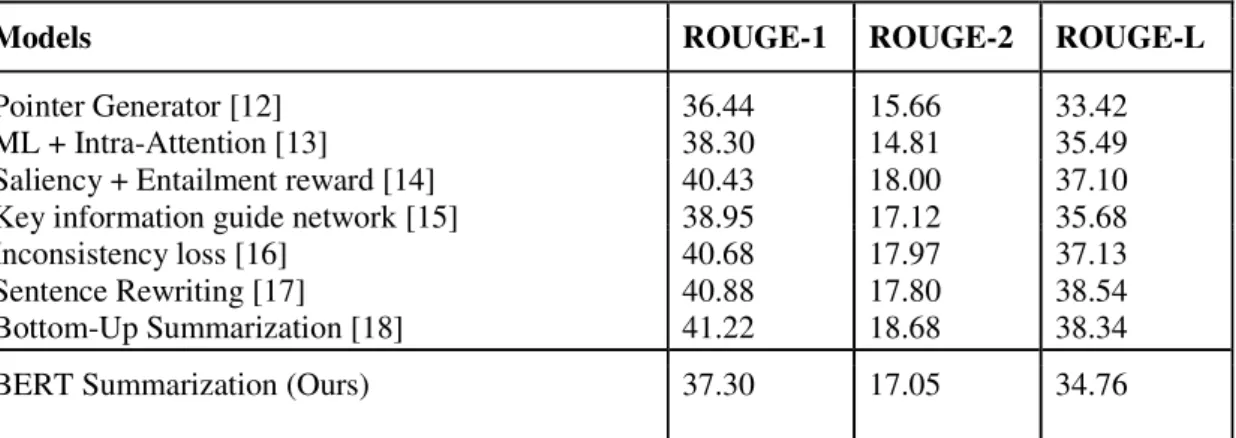
We evaluate ROUGE-1, ROUGE-2, and ROUGE-L [11] of our proposed model on CNN/Daily
Mail test dataset. This automatic metric measures the overlap of 1-gram (R-1), bigrams (R-2) and
the longest common subsequence between the model generated summaries and the reference
summaries. We also listed the previously reported ROUGE scores on CNN/Daily Mail in Table 1
for comparison. As Table 1 shows, the ROUGE score of BERT summarization is comparable to
the start-of-the-art models.
Table 1: Comparative evaluation of BERT Summarization with recently reported summarization systems
Models
ROUGE-1
ROUGE-2
ROUGE-L
Pointer Generator [12]
ML + Intra-Attention [13]
Saliency + Entailment reward [14]
Key information guide network [15]
Inconsistency loss [16]
Sentence Rewriting [17]
Bottom-Up Summarization [18]
36.44
38.30
40.43
38.95
40.68
40.88
41.22
15.66
14.81
18.00
17.12
17.97
17.80
18.68
33.42
35.49
37.10
35.68
37.13
38.54
38.34
BERT Summarization (Ours)
37.30
17.05
34.76
As per Schluter [21], extractive summarization performance tends to be undervalued with respect
to ROUGE standard, so we also conduct human assessment on Amazon Mechanical Turk
(MTurk)
4for the relevance and readability between Bottom-Up Summarization model (best
3https://github.com/google-research/bert 4
30
reported score on CNN/Daily Mail) and our BERT Summarization model. We selected 3 human
annotators who had an approval rate over than 95% (at least 1000 HITs), and showed them 100
samples from the test dataset of CNN/Daily Mail, including the input article, the reference
summary, and the outputs of the two candidate models. We asked them to choose the better one
between the two candidate models’ outputs, or choose “tie” if both outputs were equally good or
bad. The relevance score is mainly based on if the output summary is informative and redundancy
free. The Readability score is mainly based on if the output summary is coherent and
grammatically correct. As shown in Table 2, our BERT Summarization model achieves higher
scores than the best reported Bottom-Up Summarization model by human assessment.
Table 2: Human assessment: pairwise comparison of relevance and readability between Bottom-Up Summarization [18] and BERT Summarization
Models
Relevance
Readability
Total
Bottom-Up Summarization
42
38
80
BERT Summarization (Ours)
49
46
95
Tie
9
16
25
5.
C
ONCLUSIONS
In this paper, we present a two-phase encoder decoder architecture based on BERT for extractive
summarization task. We demonstrated that our model has the state-of-the-art comparable
performance on CNN/Daily Mail dataset by both automatic metrics and human assessors. As the
best of our knowledge, this is the first work that applies BERT based architecture to a text
summarization task. In the future, we will test employing better decoding and reinforcement
learning approaches to extend it to abstractive summarization task.
R
EFERENCES[1]
Carbonell, J., and Goldstein, J. 1998. The use of mmr, diversity-based reranking for reordering documents and producing summaries. In Proceedings of the 21st annual international ACM SIGIR conference on Research and development in information retrieval, 335–336. ACM.[2] Radev, D., and Erkan, G. 2004. Lexrank: Graph-based lexical centrality as salience in text summarization. Journal of Artificial Intelligence Research 457–479.
[3] Kageback, M.; Mogren, O.; Tahmasebi, N.; and Dubhashi, D. 2014. Extractive summarization using continuous vector space models. 31–39.
[4] Ganesan, K.; Zhai, C.; and Han, J. 2010. Opinosis: a graph based approach to abstractive summarization of highly redundant opinions. In Proceedings of the 23rd international conference on computational linguistics, 340–348. Association for Computational Linguistics.
International Journal of Artificial Intelligence and Applications (IJAIA), Vol.10, No.2, March 2019 [5] Yin, W., and Pei, Y. 2015. Optimizing sentence modeling and selection for document
summarization. In Proceedings of the 24th International Conference on Artificial Intelligence, 1383–1389. AAAI Press.
[6] Cao, Z.; Li, W.; Li, S.; and Wei, F. 2016. Attsum: Joint learning of focusing and summarization with neural attention. arXiv preprint arXiv:1604.00125.
[7] Cheng, J., and Lapata, M. 2016. Neural summarization by extracting sentenc Annual Meeting of the Association for Computational Linguistics.
[8] Karl Moritz Hermann, Tomas Kocisky, Edward Grefenstette, Lasse Espeholt, Will Kay, Mustafa Suleyman, and Phil Blunsom. 2015. Teaching machines to read and comprehend. I
of Neural Information Processing Systems (NIPS).
[9] Alec Radford, Karthik Narasimhan, Tim Salimans, Ilya Sutskever.2018. [Online]. Available: https://s3-us-west-2.amazonaws.com/openai
unsupervised/language_un
[10] Jacob Devlin, Ming-Wei Chang, Kenton Lee, and Kristina Toutanova. 2018. BERT: Pre of deep bidirectional transformers for language understanding. arXiv:1810.04805. [11] Chin-Yew Lin. 2004. ROUGE: a package for automatic e
of ACL Workshop on Text Summarization Branches Out.
[12] Abigail See, Peter J Liu, and Christopher D Manning. 2017. Get to the point: Summarization with pointer-generator networks. arXiv preprint arXiv:1704.04368.
[13] Romain Paulus, CaimingXiong, and Richard Socher. 2017. A deep reinforced model for abstractive summarization. arXiv preprint arXiv:1705.04304.
[14] RamakanthPasunuru and Mohit Bansal. 2018. Multireward reinforced summarization with saliency and entailment. In Proceedings of the 2018 Conference of the North American Chapter of the Association for Computational Linguistics: Human Language Technologies, Volume 2 (Short Papers), volume 2, pages 646
[15] Chenliang Li, Weiran Xu, Si Li, and Sheng Gao. 2018
summarization based on key information guide network. In Proceedings of the 2018 Conference of the North American Chapter of the Association for Computational Linguistics: Human Language Technologies, Volume 2 (Sho
[16] Wan-Ting Hsu,
Chieh-unified model for extractive and abstractive summarization using inconsistency loss. arXiv preprint arXiv:1805.06266.
[17] Yen-Chun Chen and Mohit Bansal. 2018. Fast abstractive summarization with reinforce sentence rewriting. arXiv preprint arXiv:1805.11080.
[18] Sebastian Gehrmann, Yuntian Deng, and Alexander M Rush. Bottom summarization. arXiv preprint arX
[19] Ashish Vaswani, Noam Shazeer, Niki Parmar, Jakob Uszkoreit, Llion Jones, Aidan N Gomez, Lukasz Kaiser, and IlliaPolosukhin. 2017. Attention is all you need. In Advances in Neural Information Processing Systems, pages 6000
[20] Ramesh Nallapati, FeifeiZhai, and Bowen Zhou. SummaRuNN
based sequence model for extractive summarization of documents. In AAAI, pp. 3075 AAAI Press, 2017.
[21] Natalie Schluter. 2017. The limits of au
of the 15th Conference of the European Chapter of the Association for Computational Linguistics: Short Papers. Valencia, Spain, pages 41
Authors Yang Gu
Software Engineer at Suning USA AILab. 2 years research experience in computer vision and natural language processing.
International Journal of Artificial Intelligence and Applications (IJAIA), Vol.10, No.2, March 2019 Yin, W., and Pei, Y. 2015. Optimizing sentence modeling and selection for document summarization. In Proceedings of the 24th International Conference on Artificial Intelligence,
1389. AAAI Press.
Cao, Z.; Li, W.; Li, S.; and Wei, F. 2016. Attsum: Joint learning of focusing and summarization with neural attention. arXiv preprint arXiv:1604.00125.
Cheng, J., and Lapata, M. 2016. Neural summarization by extracting sentenc Annual Meeting of the Association for Computational Linguistics.
Karl Moritz Hermann, Tomas Kocisky, Edward Grefenstette, Lasse Espeholt, Will Kay, Mustafa Suleyman, and Phil Blunsom. 2015. Teaching machines to read and comprehend. I
of Neural Information Processing Systems (NIPS).
Alec Radford, Karthik Narasimhan, Tim Salimans, Ilya Sutskever.2018. [Online]. Available:
2.amazonaws.com/openai-assets/research-covers/language-unsupervised/language_understanding_paper.pdf
Wei Chang, Kenton Lee, and Kristina Toutanova. 2018. BERT: Pre of deep bidirectional transformers for language understanding. arXiv:1810.04805.
Yew Lin. 2004. ROUGE: a package for automatic evaluation of summaries. In Proceedings of ACL Workshop on Text Summarization Branches Out.
Abigail See, Peter J Liu, and Christopher D Manning. 2017. Get to the point: Summarization with generator networks. arXiv preprint arXiv:1704.04368.
Romain Paulus, CaimingXiong, and Richard Socher. 2017. A deep reinforced model for abstractive summarization. arXiv preprint arXiv:1705.04304.
RamakanthPasunuru and Mohit Bansal. 2018. Multireward reinforced summarization with t. In Proceedings of the 2018 Conference of the North American Chapter of the Association for Computational Linguistics: Human Language Technologies, Volume 2 (Short Papers), volume 2, pages 646–653.
Chenliang Li, Weiran Xu, Si Li, and Sheng Gao. 2018. Guiding generation for abstractive text summarization based on key information guide network. In Proceedings of the 2018 Conference of the North American Chapter of the Association for Computational Linguistics: Human Language Technologies, Volume 2 (Short Papers), volume 2, pages 55–60.
-Kai Lin, Ming-Ying Lee, Kerui Min, Jing Tang, and Min Sun. 2018. A unified model for extractive and abstractive summarization using inconsistency loss. arXiv preprint arXiv:1805.06266.
un Chen and Mohit Bansal. 2018. Fast abstractive summarization with reinforce sentence rewriting. arXiv preprint arXiv:1805.11080.
Sebastian Gehrmann, Yuntian Deng, and Alexander M Rush. Bottom summarization. arXiv preprint arXiv:1808.10792, 2018.
Ashish Vaswani, Noam Shazeer, Niki Parmar, Jakob Uszkoreit, Llion Jones, Aidan N Gomez, Lukasz Kaiser, and IlliaPolosukhin. 2017. Attention is all you need. In Advances in Neural Information Processing Systems, pages 6000–6010.
feiZhai, and Bowen Zhou. SummaRuNNer: A recurrent neural network based sequence model for extractive summarization of documents. In AAAI, pp. 3075 Natalie Schluter. 2017. The limits of automatic summarization according to rouge. In Proceedings of the 15th Conference of the European Chapter of the Association for Computational Linguistics: Short Papers. Valencia, Spain, pages 41–45.
Software Engineer at Suning USA AILab. 2 years research and development experience in computer vision and natural language processing.
International Journal of Artificial Intelligence and Applications (IJAIA), Vol.10, No.2, March 2019
31 Yin, W., and Pei, Y. 2015. Optimizing sentence modeling and selection for document summarization. In Proceedings of the 24th International Conference on Artificial Intelligence, Cao, Z.; Li, W.; Li, S.; and Wei, F. 2016. Attsum: Joint learning of focusing and summarization Cheng, J., and Lapata, M. 2016. Neural summarization by extracting sentences and words. 54th Karl Moritz Hermann, Tomas Kocisky, Edward Grefenstette, Lasse Espeholt, Will Kay, Mustafa Suleyman, and Phil Blunsom. 2015. Teaching machines to read and comprehend. In Proceedings Alec Radford, Karthik Narasimhan, Tim Salimans, Ilya Sutskever.2018. [Online]. Available:
-Wei Chang, Kenton Lee, and Kristina Toutanova. 2018. BERT: Pre-training of deep bidirectional transformers for language understanding. arXiv:1810.04805.
valuation of summaries. In Proceedings Abigail See, Peter J Liu, and Christopher D Manning. 2017. Get to the point: Summarization with Romain Paulus, CaimingXiong, and Richard Socher. 2017. A deep reinforced model for RamakanthPasunuru and Mohit Bansal. 2018. Multireward reinforced summarization with t. In Proceedings of the 2018 Conference of the North American Chapter of the Association for Computational Linguistics: Human Language Technologies, Volume 2 (Short . Guiding generation for abstractive text summarization based on key information guide network. In Proceedings of the 2018 Conference of the North American Chapter of the Association for Computational Linguistics: Human Ying Lee, Kerui Min, Jing Tang, and Min Sun. 2018. A unified model for extractive and abstractive summarization using inconsistency loss. arXiv un Chen and Mohit Bansal. 2018. Fast abstractive summarization with reinforce-selected Sebastian Gehrmann, Yuntian Deng, and Alexander M Rush. Bottom-up abstractive Ashish Vaswani, Noam Shazeer, Niki Parmar, Jakob Uszkoreit, Llion Jones, Aidan N Gomez, Lukasz Kaiser, and IlliaPolosukhin. 2017. Attention is all you need. In Advances in Neural er: A recurrent neural network based sequence model for extractive summarization of documents. In AAAI, pp. 3075–3081. ation according to rouge. In Proceedings of the 15th Conference of the European Chapter of the Association for Computational Linguistics:
Yanke Hu
Senior Cognitive/Machine Learning Engineer at Humana, responsible for deep learning research and AI platform development. 9
development experience in software industry at companies majoring in navigation (TeleNav), business analytics (IBM), finance(Fintopia), retail (AiFi) and healthcare (Humana).
Senior Cognitive/Machine Learning Engineer at Humana, responsible for deep learning research and AI platform development. 9 years research and development experience in software industry at companies majoring in navigation (TeleNav), business analytics (IBM), finance(Fintopia), retail (AiFi)
![Table 2: Human assessment: pairwise comparison of relevance and readability between Bottom-Up Summarization [18] and BERT Summarization](https://thumb-us.123doks.com/thumbv2/123dok_us/371930.2540975/4.892.117.754.419.620/table-assessment-pairwise-comparison-relevance-readability-summarization-summarization.webp)
