University of Warwick institutional repository: http://go.warwick.ac.uk/wrap
A Thesis Submitted for the Degree of PhD at the University of Warwick
http://go.warwick.ac.uk/wrap/57817
This thesis is made available online and is protected by original copyright.
Please scroll down to view the document itself.
Overhauser Dynamic Nuclear Polarisation Studies
in Solution-State at 3.4T
by
Thomas Kai Yip Tam
Thesis
Submitted to the University of Warwick
for the degree of
Doctor of Philosophy
Department of Physics
Contents
List of Tables iv
List of Figures v
Acknowledgments xi
Declarations xii
Abstract xiii
Abbreviations xiv
Chapter 1 Introduction 1
1.1 Development of microwave-driven DNP . . . 2
1.1.1 Early experiments . . . 2
1.1.2 Modern revival . . . 2
1.2 Thesis overview and motivation . . . 3
Chapter 2 Theoretical background 5 2.1 Nuclear magnetic resonance . . . 5
2.1.1 Spin angular momentum and nuclear magnetism . . . 5
2.1.2 Zeeman splitting . . . 6
2.1.3 Longitudinal magnetisation . . . 7
2.1.4 Transverse magnetisation . . . 8
2.1.5 Spin relaxation . . . 8
2.1.6 Internal spin interactions . . . 12
2.1.7 Detection and Fourier transformation . . . 14
2.2 Electron paramagnetic resonance . . . 15
2.2.1 Electron spin and the Zeeman effect . . . 15
2.2.3 Hyperfine interaction . . . 16
2.2.4 Electron-spin exchange . . . 18
2.2.5 Detection . . . 18
2.3 Dynamic nuclear polarisation . . . 18
2.3.1 Electron-nuclear spin system . . . 19
2.3.2 The Overhauser effect . . . 20
Chapter 3 Review of dynamic nuclear polarisation experiments 28 3.1 Discovery and early investigations of the Overhauser effect . . . 28
3.2 Solid-state mechanisms and DNP at high magnetic field strengths . . 31
3.3 Feasibility of high-field liquid DNP . . . 31
3.3.1 Direct polarisation in-situ . . . 31
3.3.2 Sample transfer . . . 34
3.4 Polarising agents . . . 35
3.5 Overhauser equation parameters . . . 37
3.5.1 Coupling factors at high frequency . . . 38
3.5.2 Saturation factor . . . 40
Chapter 4 Experimental details 44 4.1 A 94 GHz spectrometer for in-situ DNP-NMR at 3.4 T . . . 44
4.1.1 Microwave source . . . 45
4.1.2 Modified ENDOR probe and cavity . . . 48
4.1.3 NMR spectrometer . . . 49
4.2 Sample preparation and positioning . . . 50
4.3 One-pulse NMR experiment . . . 52
4.4 NuclearT1measurements — inversion-recovery and saturation-recovery experiments . . . 52
4.5 Acquisition of CW-EPR spectra . . . 54
4.6 Overhauser DNP experiments . . . 54
4.7 Simultaneous use of two independent microwave sources . . . 56
Chapter 5 DNP enhancement of water protons with TEMPOL rad-ical 61 5.1 Introduction . . . 61
5.1.1 Polarisation of water protons . . . 62
5.1.2 Factors reducing maximum enhancement . . . 62
5.2 Experimental details . . . 63
5.2.2 Experiment . . . 63
5.3 Results and discussion . . . 64
5.3.1 Temperature dependence of enhancement, nuclear relaxation and EPR spectrum . . . 64
5.3.2 Modelling of data with time-step calculations using instanta-neous Ienh and T1I values . . . 70
5.4 Conclusions . . . 78
Chapter 6 Overhauser DNP of small organic compounds in aqueous solutions 80 6.1 Glycine . . . 81
6.1.1 Experimental details . . . 82
6.1.2 Results and discussion . . . 83
6.2 L-proline . . . 92
6.2.1 Experimental details . . . 93
6.2.2 Results and discussion . . . 93
6.3 Acrylic acid . . . 98
6.3.1 Experimental details . . . 99
6.3.2 Results and discussion . . . 99
6.4 Conclusions . . . 109
Chapter 7 Investigation of saturation by simultaneous irradiation of two EPR lines 113 7.1 Introduction . . . 113
7.2 Experimental details . . . 115
7.2.1 Samples . . . 115
7.2.2 Dual irradiation experiments . . . 116
7.3 4-oxo-TEMPO-d16-15N — two hyperfine lines . . . 116
7.4 TEMPOL — three hyperfine lines . . . 119
7.5 Discussion . . . 123
7.6 Conclusions . . . 127
List of Tables
5.1 Summary of DNP enhancements and coupling factor data for several studies conducted at 3.4 T . . . 76
6.1 Summary of relaxation time and enhancement measurements used to estimate leakage factors and coupling factors in three different
samples of organic compounds in aqueous solutions. . . 110
7.1 Summary of dual irradiation DNP experiment results for 5 mM 4-oxo-TEMPO-d16-15N in toluene, showing the effect of increasing
satura-tion of second EPR transisatura-tion onε. Experiments where all microwave
power is applied on-resonance have been emphasised in the table with bold font and double arrows; ‘L’ and ‘S’ indicate ‘large’ and ‘small’
changes in enhancement, respectively (arbitrarily defined as >15%
and <15%). . . 120 7.2 Summary of dual irradiation DNP experiment results for 2.5 mM
TEMPOL in toluene, showing the effect of increasing saturation of a
second EPR transition onε. Experiments with Source B and A irradi-ating allowed EPR transitions are highlighted with enhancements in
bold and enhancement change represented by double arrows; ‘L’ and
List of Figures
2.1 Lorentzian spectral density functions showing molecular motion in the slow, intermediate and fast regimes. . . 10
2.2 Plot illustrating the variation of the spin-lattice (1/T1 ∝ τc/(1 +
(ω0τc)2)) and spin-spin (1/T2∝3J(0) + 5J(ω0) + 2J(2ω0)) relaxation
time constants with the correlation time of molecular motion [16].
Regions for slow, intermediate and fast motion are indicated, as well as the effect of increasing molecule size, liquid viscosity and
temper-ature on relaxation. . . 10
2.3 Energy levels resulting from the Zeeman effect and hyperfine splitting for an S = 1/2 electron and I = 1 nucleus. The 3 allowed EPR
transitions are indicated by the blue arrows, corresponding to an
energy gaphν. . . 17 2.4 Energy level diagram for an electron spin S = 1/2 coupled to a
nu-clear spin I = 1/2. All possible transition probabilities are shown,
where wI is the nuclear spin relaxation rate, wS is the electron spin
relaxation rate, w2 is the double-quantum relaxation rate, w0 is the
zero-quantum relaxation rate. The microwave excitation of an
elec-tron transition is also indicated. . . 20 2.5 Calculated field dependence of coupling factor for pure dipolar
re-laxation, modeled with rotational (solid black line) and translational
(dashed blue line) diffusion, using a correlation time τ = 20 ps. . . . 25
3.1 Theoretical field dependence of coupling factors, calculated using a
20 ps correlation time (from Reference [33]). Top 2 lines — pure
dipo-lar relaxation mechanism, modelled with rotational and translational diffusion; bottom 4 lines — pure scalar relaxation mechanism, shown
for various values of the fast electron spin relaxation correction termβ. 30
4.2 Photograph of the Warwick 94 GHz DNP-NMR spectrometer. . . 46
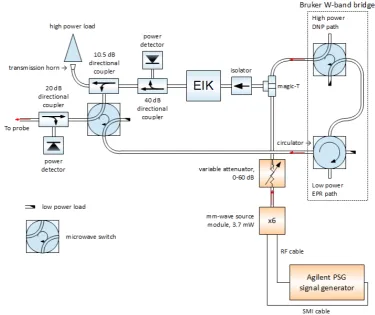
4.3 Schematic of W-band microwave bridge for Bruker ELEXSYS E680 EPR system. . . 47
4.4 EIK amplifier characteristics. . . 49
4.5 Diagram of modified ENDOR probe: (1) W-band cavity, (2) RF coil, (3a,b) RF leads, (4) sample access, (5) variable tuner, (6) coupling
iris, (7) waveguide to microwave assembly, (8) thermocouple [43]. . . 50
4.6 Structures of derivatives of the nitroxide free radical TEMPO. . . 51 4.7 Typical sample. Surface of outer capillary tube marked with red
dots with a separation of 1 mm in order to ensure proper sample
positioning in the sample holder and cavity. . . 52 4.8 One-pulse sequence. . . 53
4.9 Pulse sequences used to measure spin-lattice relaxation time T1. . . 53
4.10 Example of 94 GHz CW-EPR spectrum for 100 mM TEMPOL radical in water at room temperature. . . 55
4.11 Typical pulse sequence for Overhauser DNP experiments. . . 56
4.12 Schematic of the microwave assembly utilising two microwave sources. The orange coloured components were added as the second microwave
source, whilst the blue coloured components constitute the original setup for the experiments in Chapters 5 and 6. . . 57
4.13 Output of low-power side of Bruker W-band bridge in CW-mode,
measured using Hewlett Packard power meter. . . 59 4.14 Output of high-power side of Bruker W-band bridge in pulse-mode,
measured using Hewlett Packard power meter at the bridge and at the
magic-T output. The loss in microwave power in travelling from the bridge through to the magic-T output is plotted in red (diamonds)
and corresponds to the right-hand axis. . . 59
4.15 Output of magic-T when used with two sources simultaneously. The contributions to the total input power from each source is
approxi-mately equal. . . 60
4.16 Agilent frequency ‘sweep’ in which DNP enhancement is plotted as a function of frequency; used to determine the required input frequency
for two-source DNP experiments. DNP experiments were conducted
5.1 1H NMR spectra of water with 120 mM TEMPOL; top — no mi-crowave irradiation, 100 acquisitions; bottom — 1.3 W mimi-crowave irradiation for one second, single acquisition. . . 64
5.2 Water proton spin-lattice relaxation rates. . . 67
5.3 Proton chemical shift and inferred temperature in water as a function of duration of 1.3 W microwave irradiation, for different
concentra-tions. Dotted line — fit of the form (1−exp(−t/τT)) withτT = 0.25 s.
The inset shows the same data for 80 mM and 120 mM over an ex-tended irradiation period. . . 68
5.4 Enhancement as a function of 1.3 W microwave irradiation time for
different radical concentrations. Dotted lines are single exponent fits of the data with time constants τ displayed. The inset shows the
first second of irradiation for concentrations of 120 mM, 80 mM and
40 mM. The dotted line is once again a single exponent fit. . . 69 5.5 Evolution of nuclear spin polarisation with 1.3 W microwave
irradia-tion. Enhancement values are corrected for the change in Boltzmann
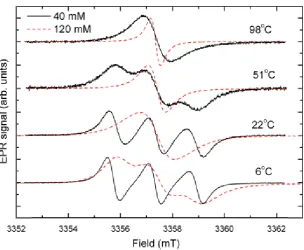
factor with temperature increase. . . 71 5.6 CW-EPR spectra of TEMPOL in water recorded at different
temper-atures, at two radical concentrations. . . 72 5.7 DNP enhancement as a function of magnetic field for a sample of
water with 120 mM TEMPOL, 10 mm length. 1 s microwave
irradi-ation. Circles — 1.3 W, 130◦C; squares — 0.25 W, 40◦C. Lines are integrated CW-EPR spectra: solid line — 98◦C; dashed line — 22◦C. 72
5.8 Simulations fitted to experimental data of DNP enhancement in water
with 100 mM TEMPOL resulting from 1.3 W microwave irradiation. 75
6.1 Skeletal formula of glycine (NH2CH2COOH). . . 82
6.2 1H NMR spectrum of 3 M glycine-100 mM TEMPOL-D2O sample:
no microwave irradiation, 40,000 acquisitions, 7.0±0.5◦C. . . 83 6.3 DNP-enhanced1H NMR spectrum of 3 M glycine-100 mM
TEMPOL-D2O. ∼1.1 W applied microwave power, 400 acquisitions, 101±3◦C. 84
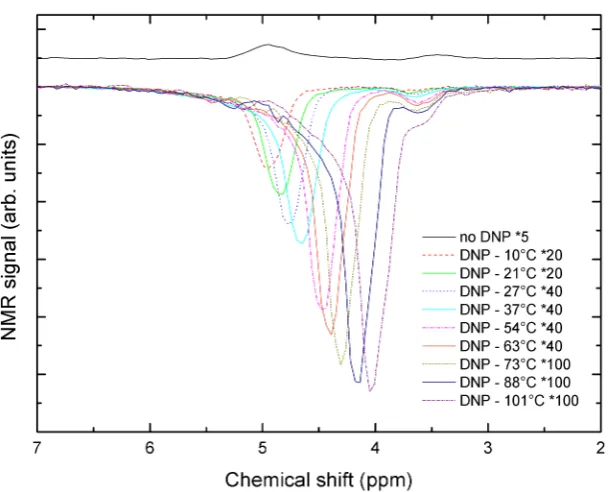
6.4 Overlay of DNP-enhanced spectra, illustrating the increasing enhance-ment and temperature of both HDO and CH2 protons. The DNP
spectra have been normalised to the same number of acquisitions
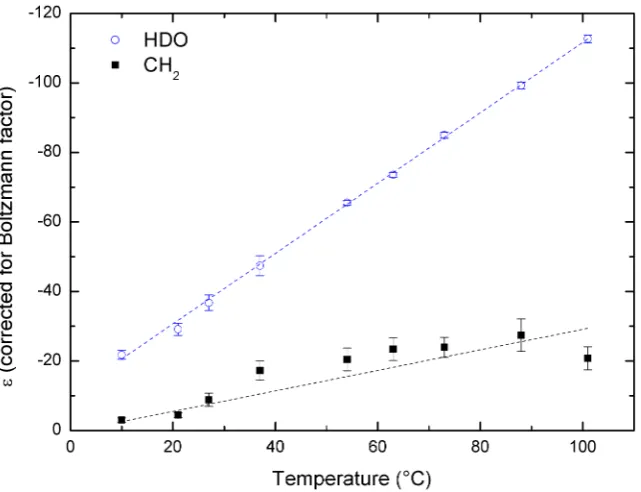
6.5 DNP enhancement as a function of temperature, as calculated from
the chemical shift. Dashed lines — linear fits with slopes of −1.01 and −0.30 for HDO and CH2 protons, respectively. Ratio of slopes
mHDO/mCH2 = 3.4±0.5. . . 86 6.6 Saturation-recovery experiment at 143 MHz. Sample temperature is
100±3◦C. Dashed lines — fit of the form (1−exp(−t/T1I)) with
resulting nuclear relaxation times displayed in the figure. . . 88
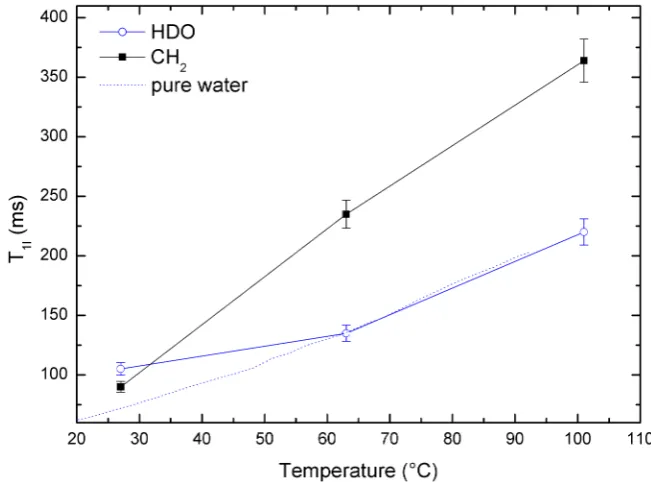
6.7 Temperature dependence of proton T1 of HDO and CH2 in water
with 3 M glycine and 100 mM TEMPOL at 143 MHz. Data are
shown with temperature indicated by chemical shift. TheT1 of pure
water is shown as a dotted line and has been scaled to agree with the glycine-TEMPOL-D2O sample value at 63◦C. . . 88
6.8 Room temperatureT1Ivalues of 3 M glycine-D2O at 143 MHz,
inter-polated from measurements made at 100 MHz and 300 MHz. . . 90 6.9 Skeletal formula of L-proline (C5H9NO2). . . 92
6.10 1H NMR spectrum of 1 M L-proline-100 mM TEMPOL-D2O sample:
no microwave irradiation, 48,000 acquisitions, 6.0±0.5◦C. . . 93 6.11 DNP-enhanced1H NMR spectrum of 1 M L-proline-100 mM
TEMPOL-D2O. ∼0.4 W applied microwave power, 200 acquisitions, 70±3◦C. 94
6.12 Overlay of DNP-enhanced spectra, demonstrating the increase of
en-hancement and temperature of HDO, C-CH2-N and C-CH2-C
pro-tons. The DNP spectra have been normalised to the same number of acquisitions and the thermal equilibrium spectrum (multiplied by a
factor of 5) is displayed on top for comparison. . . 95
6.13 DNP enhancement as a function of temperature, as calculated by chemical shift change. Dashed lines — linear fits with slopes of−1.31,
−0.48, −0.08 and −0.26 for HDO, C-CH2-N, C-CH2-C and Peak Y
protons, respectively. Ratio of slopes mHDO/mC-CH2-N = 2.8±0.4, mHDO/mC-CH2-C = 15.8±0.7,mHDO/mY= 5.1±0.6. . . 96 6.14 Effect of temperature on proton T1I of HDO and C-CH2-C in water
doped with 100 Mm TEMPOL and 1 M L-proline. Data are shown with the temperature calculated from chemical shift, and have an
uncertainty of approximately ±3◦C. The T1I of pure water has been
included, and scaled to agree with the sample value at 11◦C, for comparison. . . 97
6.16 1H NMR spectrum of acrylic acid-D2O(10:90 % v/v)-100 mM
TEM-POL sample: no microwave irradiation, 100,000 acquisitions, 6.0±
0.5◦C. . . 100
6.17 The reduction of TEMPOL by acrylic acid, resulting in the formation
of the diamagnetic TEMPOL-H molecule. . . 101 6.18 DNP-enhanced1H NMR spectrum of acrylic acid-D2O-100 mM
TEM-POL.∼1.7 W applied microwave power, 400 acquisitions, 83±3◦C. 101 6.19 Overlay of DNP-enhanced spectra, showing the increasing
enhance-ment of HDO and AA protons, whilst showing the changing shift
of HDO and constant position of AA. The DNP spectra have been
normalised to the same number of acquisitions and the thermal equi-librium signal (top) increased by a factor of 5 for comparison. . . 102
6.20 Change in nuclear spin-lattice relaxation time as a function of time,
due to reduction of TEMPOL. Measured at room temperature at 284 MHz. . . 103
6.21 Evolution of integrated X-band EPR signal intensity with time,
show-ing a continuous degradation of TEMPOL radical at room tempera-ture. Inset — expansion of the first 275 minutes after the sample was
prepared. . . 104 6.22 Temperature dependence of DNP enhancement, with temperatures
calculated from change in chemical shift of water protons. Dashed
lines — linear fits with slopes of -0.72, -0.34 and -0.14 for HDO, AA and CH3 protons, respectively. Ratio of slopes mHDO/mAA =
2.1±0.2, mHDO/mCH3 = 5.3±5.3. . . 105 6.23 Temperature dependence of proton T1I of HDO and AA protons in
D2O with acrylic acid and an initial radical concentration of 100 mM
TEM-POL which is thought to have reduced by at least ∼40%. Data are shown with temperatures indicated by HDO chemical shift. The T1I
of pure water is shown as a dotted line and has been scaled to agree
with the sample value at 4◦C. . . 107
6.24 T1I values of acrylic acid-D2O (10:90 % v/v) at 143 MHz at room
temperature, interpolated from measurements made at 100 MHz and
300 MHz. . . 108
7.2 Source A frequency sweep of 5mM 4-oxo-TEMPO-d16-15N in toluene,
used to find electron resonance frequencies at fixed magnetic field. PA≈429µW, Source B off. Arrows — frequencies used in later
ex-periments corresponding to irradiating: off-resonance (1, 5); allowed
EPR transitions (2, 4); and forbidden transitions (3). νi = 94.070,
94.155, 94.183, 94.211, 94.300 GHz; fori= 1, 2,... 5. . . 117
7.3 Dual irradiation experiment with Source B irradiating on-resonance
at ν4 with constant power (PB ≈ 78 µW), whilst simultaneously
ramping Source A power (PA≈10–429µW) off-resonance atν1.
In-set — measured diode voltages indicating transmitted and reflected
power. . . 118 7.4 Irradiation of both hyperfine lines. Source B at ν4 with constant
power (PB ≈ 78 µW), ramping Source A power (PA ≈ 10–429 µW)
atν2. . . 118
7.5 Source A frequency sweep of 2.5 mM TEMPOL in toluene, used to
find electron resonance frequencies at fixed magnetic field. PA ≈
PB ≈78 µW. Arrows — frequencies used in later experiments
corre-sponding to irradiating: off-resonance (1, 7); the allowed EPR
tran-sitions (2, 4, 6); and forbidden trantran-sitions (3, 5). νi = 94.100, 94.163,
94.185, 94.205, 94.230, 94.246, 94.300 GHz; fori= 1, 2,... 7. . . 121
7.6 Dual irradiation experiment with Source B irradiating central
transi-tion (ν4) with constant power (PB ≈78 µW), whilst simultaneously
ramping Source A power (PA≈ 10–429µW) off-resonance atν1. . . 122
7.7 Irradiation of two hyperfine lines. Source B at central transition (ν4)
with constant power (PB≈78µW), ramping Source A power (PA≈
10–429µW) at low frequency transition (ν2). . . 122
7.8 Schematic of part of the microwave assembly, showing the addition
of a calibrated variable attenuator used to measure relative output powers of the EIK, cf. Figure 4.12. . . 125
7.9 Change in EIK output power corresponding to a 10 dB increase in
input power, for varying levels of total power. As measured using a calibrated variable attenuator and diode power detector. . . 126
7.10 Frequency dependence of EIK amplifier output. Measured with
sin-gle microwave source (Source A) using constant powerPA≈429µW.
Frequency of allowed EPR transitions for two TEMPO-derived
Acknowledgments
Firstly, I would like to thank my supervisors Prof. Mark Newton, Prof. Ray Dupree
and Prof. Mark Smith for their guidance.
I am grateful to the Warwick Solid State NMR Group, particularly the
mem-bers of the DNP Project: Dr. Thomas Kemp, Dr. Eugeny Kryukov, Dr. Hiroki
Takahashi, Dr. Radoslaw Kowalczyk and Dr. Andrew Howes for all their help
throughout my PhD. Special thanks to my unofficial supervisor — Dr. Kevin Pike.
I would also like to thank William Woodruff for his collaboration and Dr. Graham
Smith and Dr. David Bolton for kindly lending me their equipment without which
the final stages of my work would not have been complete.
I am incredibly thankful to my family and friends for their support and
encouragement. To my wife Szevone, thank you for your love and companionship.
Finally, my deepest thanks go to my parents for their never-ending support
Declarations
I declare that the work presented in this thesis is my own except where stated,
and was carried out entirely at the University of Warwick, during the period of
October 2009 to March 2013, under the supervision of Prof. Mark E. Newton, Prof.
Ray Dupree and Prof. Mark E. Smith. The research reported here has not been
submitted, either wholly or in part, in this or any other academic institution for
admission to a higher degree.
Some parts of the work reported in this thesis have been published in the
following paper:
E. V. Kryukov, K. J. Pike, T. K. Y. Tam, M. E. Newton, M. E. Smith and R. Dupree,
Abstract
Studies of Overhauser DNP in liquids are presented in this thesis, where the polarisation is achieved in-situ using TEMPO-derived radicals at a magnetic field of 3.4 T (143 MHz/94 GHz1H NMR/EPR frequency).
The dielectric heating of lossy water solvent is unavoidable at high field, and so knowledge of temperature effects is important to properly compare enhancement results. It is shown that the temperature dependent DNP enhancement of water protons can be determined provided that the 1H NMR shift is sufficiently resolved and the nuclear relaxationT1I is sufficiently fast. Considerable sensitivity gains are
made at modest temperatures, e.g. |ε| ∼40 at ∼40◦C, and much greater enhance-ments are achievable at elevated temperatures, e.g. |ε| ∼130 at∼100◦C. Since high radical concentrations (100 mM TEMPOL) are used, the leakage and saturation factors approach 1, enabling an experimental determination of the coupling factor from the enhancement. A value ofξ= 0.055±0.003 is found at 25◦C, which agrees well with values in the literature calculated from molecular dynamics simulations.
The DNP enhancement is measured as a function of temperature for three organic compounds dissolved in water: glycine, L-proline and acrylic acid; with en-hancements of−17, −16 and −11 at ∼40◦C. To the author’s knowledge, this is the first report of solute molecule enhancements for direct in-situ liquid DNP at this field. Significant enhancements are obtained, however, further analysis of the re-sults reveals significantly weaker coupling of the electron spin to the solute molecule protons than to the solvent molecule protons. Discrepancies between experimen-tal coupling factor ratios and those calculated from a force-free hard-sphere model suggest that the classical analytical models used to describe Overhauser DNP may require refinement.
Abbreviations
ADC Analogue-to-Digital Converter
BDPA Bisdiphenylene-β-phenylallyl
BPA Bisphenol A
bTbK Bis-TEMPO-Bis-Ketal
BWO Backward Wave Oscillator
CSA Chemical Shift Anisotropy
CW Continuous Wave
DNP Dynamic Nuclear Polarisation
DPPH 2,2-diphenyl-1-picrylhydrazyl
EIK Extended Interaction Klystron
ELDOR Electron Electron Double Resonance
ENDOR Electron Nuclear Double Resonance
EPR Electron Paramagnetic Resonance
FFHS Force-Free Hard-Sphere (model)
FID Free Induction Decay
FWHM Full Width at Half Maximum
HPNO 4-hydroxy-2,2,6,6-tetramethyl piperid-1-yloxy
ID Inner Diameter
IF Intermediate Frequency
MAS Magic Angle Spinning
MD Molecular Dynamics
NMR Nuclear Magnetic Resonance
NMRD Nuclear Magnetic Relaxation Dispersion
OD Outer Diameter
OE Overhauser Effect
PEDRI Proton-Electron Double-Resonance Imaging
ppm Parts Per Million
r.f. Radio-Frequency
SMI Source Module Interface
SNR Signal-to-Noise Ratio
TAM Triarylmethyl
TEMPOL 4-hydroxy-2,2,6,6-tetramethyl piperidine (4-hydroxy-TEMPO)
Chapter 1
Introduction
“Overhauser proposed ideas of startling originality, so unusual that they initially took portions of the scientific community back, but of such depth
and significance that they opened vast new areas of science.”
— Citation for honorary degree conferred on Dr. Albert Warner
Over-hauser by the University of Chicago (1979) [1].
Since the 1940s, nuclear magnetic resonance (NMR) spectroscopy has proven to
be a remarkably effective and versatile analytical technique and as technological
innovations have been made, so too have advances in NMR. Sensitivity, in partic-ular, has improved greatly with the development of magnet technology — fields
∼20 T are not uncommon in modern-day NMR. However, even at these high field strengths NMR remains an intrinsically insensitive technique, in contrast to the analogous electron paramagnetic resonance (EPR) spectroscopy which exploits the
much larger magnetic moment of the electron. For example, in order to reach
com-parable levels of polarisation achievable with electrons at room temperature in a 3.4 T magnetic field; 1H NMR (protons having the highest γ of commonly studied nuclei) would have to be conducted at liquid helium temperatures (∼4 K) in a field of 30 T. Whilst such low-temperature NMR studies are often performed, suitably homogeneous magnetic fields ∼30 T are well beyond the current state-of-the-art. Overcoming these sensitivity limitations has been a major goal in NMR, and
1.1
Development of microwave-driven DNP
1.1.1 Early experiments
DNP was first proposed in 1953 by Overhauser in his seminal paper “Polarization of
Nuclei in Metals” [2], and was experimentally confirmed in the same year by Carver and Slichter [3]. It was initially suggested as a phenomenon observable in metals
where the saturation of conduction electron spins permitted polarisation transfer to nuclei via relaxation processes. Later, this concept would be extended to include
the solution-state [4], the condition under which most Overhauser DNP work is now
done. For the first three decades or so after the discovery of this ‘Overhauser effect’, many experiments were carried out in metals and liquids. Perhaps some of the
most important liquid DNP results in the early stages of this emerging field came
from Hausser and co-workers [5, 6], who predicted a steep drop in DNP efficiency (more specifically, the electron-nuclear coupling) at higher microwave excitation
frequencies, i.e. higher magnetic field strengths. The data available at the time all
seemed to support Hausser’s prediction.
As NMR technology improved and superconducting magnets became
avail-able at greater and greater fields, Overhauser DNP no longer seemed to be a
prag-matic solution to improving NMR sensitivity; it was easier to simply go to higher magnetic fields, where spectral resolution is also enhanced. Moreover, a lack of
availability of microwave sources able to produce sufficiently strong and stable
mi-crowaves at the high frequencies necessary for the common NMR fields of the time prevented investigations beyond 1.3 T. DNP seemed to have, for the time being,
reached its limits.
1.1.2 Modern revival
The development of NMR spectrometers operating at increasingly high magnetic
field strengths is a lengthy process which, for example, took approximately 20 years
for the state-of-the-art to increase from 10 T to 20 T [7]. The rate of development appears to have been relatively slow in recent years and the limits of what is
prac-tically achievable with the current technology may be fast approaching [8]. The
nuclear spin polarisation, even at today’s highest field strengths, is still much less than 1%; so in order for NMR to further push the boundaries of what is possible and
open up to new areas of application, it seems advances in methodology may need to
play a greater role rather than adopting a ‘brute force’ approach. Hyperpolarisation by dynamic nuclear polarisation is one such method.
Massachusetts Institute of Technology who utilised a novel microwave source — a
cyclotron resonance maser or gyrotron — to successfully conduct DNP experiments at high fields (5 T) in the solid-state [9]. This new type of microwave source (for
DNP) was later used for solution-state Overhauser DNP experiments at 5 T [10].
Modern DNP research was further invigorated by Ardenkjaer-Larsen and co-workers when they reported massive (∼10,000) signal enhancements at high field (3.4 T) in the liquid-state using a novel experimental design — now commonly referred to as
‘dissolution DNP’. Following these landmark results, DNP became the subject of intense focus in the magnetic resonance community and has begun to ‘catch up’
with modern magnetic fields, allowing never-before-achieved levels of sensitivity in
NMR.
1.2
Thesis overview and motivation
This thesis is focused solely on DNP-enhanced NMR in the solution-state, driven by the Overhauser effect mechanism. Over the last decade or so, liquid DNP has shown
the potential to be a useful analytical tool at high fields, with sizable enhancements
being reported at fields up to 9.2 T [11, 12]. However, there still remain some doubts as to its applicability. For instance, whilst high DNP enhancements have been
observed for solvents into which polarising agents are dissolved, there is little data
in the literature regarding the polarisation of other solute compounds in the sample. The high-field DNP data that is available has called into question the validity of
the theoretical framework in which the Overhauser effect has been traditionally
described: enhancements are actually higher than expected. The work presented here aims to address some of these issues, the organisation of which is described
below.
The theoretical background to the relevant areas of magnetic resonance is given in Chapter 2, and should provide the basic physics required to understand
the experimental results and conclusions. Chapter 3 provides an overview of the
progress made in dynamic nuclear polarisation in the last 60 years. The emphasis is strongly on liquid DNP developments, providing a context for the present work.
Chapter 4 gives specific details of the equipment and methods used to study the
chosen systems, particularly the use of any non-standard hardware and procedures. In Chapter 5, results are presented for a study of water protons with the nitroxide
radical TEMPOL (4-hydroxy-2,2,6,6-tetramethyl piperidine). Substantial enhance-ments are reported reaching a factor of>100 times the thermal equilibrium signal.
and a method for determining the maximum enhancement and coupling factor is
demonstrated. The work in Chapter 6 continues with temperature dependent DNP studies, but on organic molecules dissolved in water in addition to the usually studied
solvent molecules. The enhancement of solvent and solute molecules is compared,
and the magnitude of enhancement attainable for small (solute) target molecules over a range of temperatures is reported. These results, the first of their kind at
3.4 T (to the author’s knowledge), give an indication of the possible applicability of
this type of DNP to larger molecules at physiological temperatures. In Chapter 7, the effect of simultaneous irradiation of two EPR resonances is investigated, with the
aim of increasing the effective electron spin saturation, thereby generating greater
enhancement of the NMR signal. The potential benefits of constructing such a dual irradiation system are discussed. This is believed to be the first study of this type
at 3.4 T (having been attempted once previously by H¨ofer’s group at 0.35 T [13]).
Chapter 2
Theoretical background
2.1
Nuclear magnetic resonance
Nuclear magnetic resonance (NMR) spectroscopy was first utilised in solids in 1946 by Bloch et al. [14] and Purcell et al. [15]. Since its inception, many advances have
been made in both technology and methodology to improve the sensitivity of this
technique. Dynamic nuclear polarisation (DNP) is one such method, which is the topic of this thesis, and the theory of which will be addressed later in this chapter.
First, some theoretical background of NMR will be presented as it is the basis of all
DNP experiments. Further information can be found in References [16], [17], [18], [19], [20], [21], [22] and [23].
2.1.1 Spin angular momentum and nuclear magnetism
Magnetic nuclei have an intrinsic property called spin angular momentum charac-terised by the spin quantum numberI, which can take either integer or half-integer
values (i.e. I = 0,1/2,1,3/2, . . .). The magnitude of this spin is quantised in units
of ¯h and is equal to pI(I+ 1)¯h.
The vast majority of elements on the periodic table have at least one isotope
with spinI >0, making NMR an incredibly powerful tool for probing the structures
and dynamics of materials. For example, the most abundant isotope of hydrogen,
1H (i.e. a proton), has spin I = 1/2. Neutrons are also spin-1/2 particles, and
the total spin of a nucleus is the sum of the proton and neutron spin contributions.
However, for any given nucleus, there exists numerous possible configurations of the spins (parallel or anti-parallel). Calculating the lowest energy nuclear spin state
of all these possibilities (the ground state) is not usually possible and is generally
momentum is a magnetic momentµ:
µ=γI (2.1)
where the constantγ is called the gyromagnetic (or magnetogyric) ratio, which can
take either a positive or negative value for a given nucleus.
In a sample containing magnetic nuclei, the distribution of the direction of spin angular momentum vectors (the spin polarisation axes) and, therefore, the
magnetic moments, will be isotropic in the absence of a magnetic field. If a field is
externally applied, the magnetic moments will begin to precess about the field on a cone of constant angle dependent on the initial angle of the spin polarisation. The
rate of this precession is given by
ω0=−γB (2.2)
where the angular frequency ω0 is the precession frequency known as the Larmor
frequency, andB is the magnetic field at the nucleus.
2.1.2 Zeeman splitting
The spin angular momentumI can be considered as a vector with 2I+ 1 projections
onto an arbitrary axis, usually chosen to be thez-axis. In that case, thez-component is quantised by the magnetic quantum numbermI so that
Iz =mI¯h (2.3)
wheremItakes 2I+ 1 values betweenI and −I in integer steps (e.g. for14N,I = 1,
so there exists three allowed states for the spinIz =−¯h,0,¯h), and ¯h is the Planck
constant divided by 2π.
Upon the application of an external magnetic field B0, the degeneracy of the 2I + 1 spin states of the nucleus is lifted, and the nuclear ground state is split
into sublevels by the Zeeman effect. In this field, the energy of a magnetic moment
is given by the scalar product of magnetic moment and the magnetic field. If the magnetic field is assumed to be in thez-direction, soB0= (0,0, Bz) the energy is
E =−µzB0 =−mI¯hγB0 (2.4)
reso-nance condition
∆E=hν = ¯hγB0 (2.5)
whereν is the electromagnetic radiation frequency used to excite transitions.
2.1.3 Longitudinal magnetisation
The bulk magnetisation of a sample is the vector sum of the individual magnetic moments,M =P
iµi, which is zero in the absence of an applied magnetic field due
to the isotropic distribution of spins. This situation changes as an external field is
applied. Not only do nuclear spins experience the applied field, they also experi-ence small local fields from other magnetic particles (i.e. the magnetic moments of
unpaired electrons and other nuclei) which fluctuate due to thermal motion. This
allows the angle of each cone of precession to vary, with a slight bias towards paral-lel alignment of the magnetic moments with the magnetic field, i.e. towards to the
lowest energy state — thermal equilibrium.
So the application of an external magnetic field causes the sample to ‘relax’ from its initial state of equilibrium towards a new thermal equilibrium, resulting in
a bulk magnetisation in the direction of the external field (typically defined to be thez-direction). The build up of this longitudinal magnetisationMz, as a function
of time t, is given by
Mz(t) =M0(1−exp(−t/T1)) (2.6)
whereM0 is the equilibrium magnetisation in the z-direction and T1 is a time
con-stant for the spin-lattice or longitudinal relaxation process (see Section 2.1.5).
For a sample of I = 1/2 nuclei, such as 1H, two energy states exist (mI =
±1/2). The probability of occupation of these states is given by the Boltzmann distribution and the polarisation can be defined as [24]:
p= N+1/2−N−1/2 N+1/2+N−1/2
= exp(−E1/2/kT)−exp(−E−1/2/kT) exp(−E1/2/kT) + exp(−E−1/2/kT)
= tanh
γ¯hB0
2kT
(2.7)
whereNi is the probability of a nuclear spin occupying theith state,kis the
Boltz-mann constant, and T is the temperature in Kelvin. From Equation 2.7, it can
be seen that NMR is an inherently insensitive technique, e.g. for 1H nuclei in a 3.4 T field, at room temperature,p = 0.0012%. In contrast, the much larger γ for electrons gives a much greater population difference and a polarisationp= 0.78%.
It is this fact which DNP takes advantage of (see Section 2.3). To approach similar nuclear polarisations would require very high fields and low temperatures, e.g. 1H
2.1.4 Transverse magnetisation
A bulk longitudinal magnetisation is not practically detectable in NMR (at high
fields) due to its cylindrically symmetric nature. A transverse magnetisation is
therefore generated by rotating all the spin polarisations by 90◦ about, say, the x -axis. The result is a bulk magnetisation along the−y-axis, with the spins precessing about thez-axis on a plane perpendicular to B0 at the Larmor frequency ω0. The
motion of this transverse magnetisation is described by the following equations:
Mx=M0sin(ω0t)exp(−t/T2) (2.8)
My =−M0cos(ω0t)exp(−t/T2) (2.9)
whereT2 is the time constant for spin-spin or transverse relaxation, which takes into
account the decay of the transverse magnetisation (see Section 2.1.5).
This transverse magnetisation is generated by use of a r.f. (radio-frequency)
pulse carried in the wire coil of a probe in the NMR spectrometer, whose winding
axis is perpendicular to the main magnetic field. This creates a time-dependent oscillating field, which can be represented by two vectors rotating with frequency
±ωrf, in opposite directions on thexy-plane of the laboratory reference frame. The
component rotating in the same sense as the precessing magnetisation is known as the B1 field; whilst the other (counter-rotating) component will have very little
interaction with the bulk magnetisation and can be neglected since it is far from
resonance.
Consider transferring from the laboratory frame (x, y, z) to a reference frame
(x0, y0, z0) rotating about the z-axis with frequencyωrf=ω0. Both the B1 field and
the bulk magnetisation would then appear to halt their precessing motion, andM would then precess about B1. Adjusting the strength and length of the r.f. pulse used allows the magnetisation to be rotated through any angle. This ‘flip angle’θp
is given by the relation:
θp=−γB1t (2.10)
wheretis the duration of the pulse.
2.1.5 Spin relaxation
When a system of nuclear spins is perturbed from thermal equilibrium, e.g. by a
resonant r.f. field, it experiences transitions that will tend to restore it to equilibrium
Spin-lattice relaxation — T1
After an r.f. pulse, the bulk magnetisation will undergo spin-lattice (or longitudinal)
relaxation back to equilibrium along theB0 direction. In a timeT1, the
magnetisa-tion will have returned to approximately 63% (≈1−(1/e)) of its initial value. This process requires the flipping of nuclear spins and an exchange of energy between
the excited spins and surrounding environment (or ‘lattice’). SoT1 is a measure of
the time taken for the nuclear spins to transfer the energy they gained from the r.f. pulse to the rest of the sample. T1 is critical in setting up an NMR experiment as it
determines how quickly scans can be repeated and, hence, the signal-to-noise ratio
achievable in a given time frame.
ForI = 1/2 nuclei, such as1H, there are three main causes of spin-lattice re-laxation: the dipolar interaction, where the local magnetic fields at the nucleus vary in time due to the motion of nearby spins; the chemical shift anisotropy, where the
chemical shielding due to the surrounding electron density fluctuates with
molecu-lar motion; and spin-rotation interactions, where the tumbling of molecules causes the circulating electron and nuclear charges to generate small fluctuating magnetic
fields at the nucleus. Of these interactions, the dipolar interaction usually has the
greatest effect.
In order for energy to be transferred to the lattice, there must be a
compo-nent of the randomly fluctuating magnetic field (caused by motion) at the Larmor
frequency to induce transitions which eventually allow the spins to return to equi-librium. The random molecular tumbling motion has a range of frequencies, and
the probability of a component of that motion occurring at a given frequency is
described by the spectral density J(ω) (see Figure 2.1). The typical frequencies of motion in liquids are much greater than nuclear Larmor frequencies, so only the
relatively low proportion of slow molecular motions contribute to spin-lattice
relax-ation, making it a relatively slow process. The precise form of the spectral density function is usually unknown, but often assumed to be Lorentzian, with the
correla-tion timeτc of the fluctuations then assumed to be exponential. A plot of T1 as a
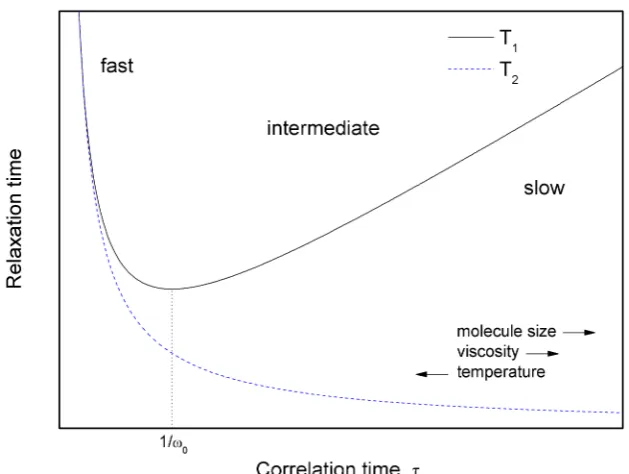
function ofτc is given in Figure 2.2.
It can be seen from Figure 2.2 that there is a maximum relaxation rate
which occurs when 1/τc matches the Larmor frequency, i.e. ω0τc = 1. This can
be understood by examining the spectral density function in various regimes of motion (Figure 2.1). When the molecular tumbling is slow (ω0τc1) only a small
component of the motion is at the Larmor frequency. As the motion becomes more rapid, a larger proportion is atω0, eventually reaching some optimum value. Beyond
Figure 2.1: Lorentzian spectral density functions showing molecular motion in the slow, intermediate and fast regimes.
Figure 2.2: Plot illustrating the variation of the spin-lattice (1/T1 ∝τc/(1+(ω0τc)2))
and spin-spin (1/T2 ∝3J(0) + 5J(ω0) + 2J(2ω0)) relaxation time constants with the
[image:27.595.163.478.397.634.2]thereby reducing the relaxation rate.
It should be noted that the regions of slow tumbling correspond to low tem-peratures, large molecules and high viscosity liquids, and the regions of fast tumbling
to high temperatures, small molecules and low viscosity liquids. This is indicated
in Figure 2.2.
Spin-spin relaxation — T2
Spin-spin (or transverse) relaxation describes the decay of transverse magnetisation
and is characterised by the exponential time constantT2. It is a result of the slightly
different local magnetic fields experienced by each spin, which causes a gradual dephasing of the magnetisation in the xy-plane. The process involves no energy
exchange with the lattice (in contrast to T1 processes), only the redistribution of
energy amongst the spins (hence ‘spin-spin’ relaxation).
In liquids, the physical processes responsible for longitudinal and transverse
relaxation are often the same, soT1 andT2 are often the same. However, there can
be additional transverse relaxation caused by chemical exchange or J-coupling mod-ulated by chemical exchange or fast longitudinal relaxation of the coupled nucleus.
Spin-spin relaxation, like spin-lattice relaxation, is sensitive to field fluctuations at
ω0; but in addition, it is also sensitive to fluctuations atω ∼0 [22]. So in the case
of fast motion,T1 andT2 are equal, but as the motion significantly slows down (and
the spectral density has a larger low frequency component)T2 continues to fall past
theT1 minimum (see Figure 2.2).
In actuality, in real NMR experiments, the measured time constant is smaller
thanT2and calledT2*. This includes the additional effect of destructive interference
of spins caused by the spatial inhomogeneity present in all real applied magnetic fields.
Bloch equations
The combined effect of spin-lattice and spin-spin relaxation on the ‘motion’ of the
bulk magnetisationM can be described using the classical, phenomenological equa-tions known as the Bloch equaequa-tions, which can be written as [20, 17]:
dM
dt =γM×B−
Mxi+Myj
T2
−Mz−M0 T1
2.1.6 Internal spin interactions
In addition to the external fields applied, magnetic nuclei within a sample will
also experience internal interactions from the surrounding environment. The most
commonly encountered interactions in NMR are chemical shielding (CS), direct dipole-dipole coupling (DD), J-coupling (J) and quadrupolar coupling (Q). The total
interaction energy of a nucleus can be expressed as the sum of the Hamiltonians for
each of these interactions:
Htotal=HZ+Hrf+HCS+HDD+HJ+HQ (2.12)
where the first two terms on the right-hand side represent the Zeeman interaction with the main magnetic field and the interaction with the radio-frequency pulse,
respectively. HZ is usually by far the greatest at high magnetic fields.
Nuclei in different chemical environments will experience slightly different magnetic fields as a result of induced fields (proportional to the applied field B0)
from the surrounding electrons. For an atom, this effect generally reduces the total
magnetic field at the nucleus, hence the term ‘shielding’ used to describe this phe-nomenon, although in molecules the net effect may be to increase the field. As a
result, the local field at the nucleus is
B= (1−σ)B0 (2.13)
whereσ is in general a rank-2 tensor representing the chemical shielding. However,
the fast molecular motion in liquids causesσ to become a scalar quantity known as the isotropic chemical shift [21]. Equation 2.2 can now be rewritten:
ω0 =−γB0(1−σ) (2.14)
Nuclei with different chemical shielding are chemically different. This is what makes NMR so useful as an analytical tool, because the precise resonance frequency is
dependent on the surrounding electron density and hence the local chemical bonds,
allowing nuclei in different structural positions to be distinguished by the shifts of resonant peaks in the spectrum. The field-dependent chemical shift is usually
expressed as a field-independent ratio for convenience:
δppm=
ω0−ω0REF
ω0REF ×10
6 (2.15)
compound, or an internal reference), and the chemical shift is given in parts per
million (ppm).
J-coupling, also referred to as indirect spin-spin coupling, is the interaction
of two nuclear spins mediated through the electrons in chemical bonds. The
corre-sponding Hamiltonian can be written [17]:
HJ=hJijIiIj (2.16)
where Jij is the scalar coupling constant (in Hz). This ‘through-bond’ interaction
is isotropic so is not averaged out by the fast molecular reorientation that occurs in liquids, and is also independent of field strength. The effect can result from
spin-orbital, spin-dipolar or Fermi contact interactions and causes the splitting of resonant lines in the NMR spectrum. The resulting multiplet pattern depends on
the type of spins and also the number, with intensities: 1:1 for a doublet, 1:2:1 for
a triplet, 1:3:3:1 for a quartet, and so on, in accordance with Pascal’s triangle. Spins can also couple through space, via a dipolar (or direct dipole-dipole)
interaction. The strength of this coupling between two spinsiand j is given by
Dc∝
γiγj
r3
ij
(2.17)
where r is the distance between the spins. The splitting is also dependent on the
angle between the inter-nuclear vector and the applied field θ. This orientation
dependence gives rise to an averaging to zero of short-range dipolar couplings in liquids due to molecular motion. Long-range couplings are still present in liquids,
but are usually very weak and so are generally ignored [21]. Hence, to a good
approximation
HDD = 0 (2.18)
and line splitting due to dipolar interactions is not typically observed in liquid NMR. It does, however, play an important role in relaxation.
Quadrupolar nuclei (I >1/2) possess non-spherically symmetric nuclear
elec-tric charge distributions which give rise to an elecelec-tric quadrupole moment. This interacts with electric field gradients in molecules, which have electric charge
dis-tributed asymmetrically. Whilst quadrupolar coupling can cause large line splitting
in solids; in liquids, to a first approximation, the interaction is averaged to zero [16]:
2.1.7 Detection and Fourier transformation
The rotating transverse magnetisation generated by the r.f. pulse causes an
oscil-lating magnetic field, which in turn induces a detectable osciloscil-lating current in the
transmitter/receiver coil. This is the NMR signal, known as the free induction decay (FID). In the spectrometer, this signal is mixed down with two r.f. waveforms with
frequencyωrefbut 90◦out of phase with each other. This allows the frequency of the
signal to be reduced to a value, detectable by modern analogue-to-digital converters (rather than ω0 ∼ hundreds of MHz), called the resonance offset Ω0 = ω0−ωref,
whilst also detecting its sign. The resulting two signals constitute the real and
imaginary parts of an oscillating and decaying complex time-domain signal
s(t)∝exp((iΩ0−1/T2)t) (2.20)
Fourier transformation of this signal gives a complex frequency-domain signal with an absorptive and dispersive mode (real and imaginary parts) Lorentizian lineshape
centred at Ω0. The full width at half maximum (FWHM) of the absorptive-mode lineshape is given by
FWHM = 1
πT2
(2.21)
where FHWM is measured in Hz.
The signal intensity in NMR is directly proportional to the number of spins
in the sample N and inversely proportional to the temperature T
signal∝ N γ
3B2 0
T (2.22)
It is also directly proportional to the number of repetitions of the experiment n; with the noise proportional to √n, the signal-to-noise ratio (SNR) is then
SNR∝√n (2.23)
From Equations 2.22 and 2.23 it is clear that the sensitivity of the NMR experiment
can be improved in several ways: increasing the sample size, increasing the external
2.2
Electron paramagnetic resonance
Electron paramagnetic resonance (discovered in 1945 [25]) is largely based on similar
principles to NMR, except that it is electron spin transitions rather than nuclear transitions that are observed. There are also considerable experimental differences in
actually carrying out the two spectroscopic techniques. Only a very brief summary
of the relevant theoretical framework will be given here, with more detailed accounts of EPR theory available in References [26], [27], [28] and [29].
2.2.1 Electron spin and the Zeeman effect
The electron has a spin angular momentum S = 1/2, the magnitude of which is quantised in units of ¯h and given by pS(S+ 1)¯h. Similarly to nuclear spin, the
z-component of the electron spinSz =mSh¯ can be in one of two states,mS =±1/2.
Associated with each electron spin, is a magnetic moment
µe=−gµBS (2.24)
where g is a dimensionless quantity known as the g-factor and µB =|e|h/4πme is
a constant called the Bohr magneton, here defined to be a positive quantity (me is
the electron mass).
In a magnetic field of strengthB0 (conventionally defined in thez-direction),
an electron spin will have an energy of
E =mSgµBB0=±
1
2gµBB0 (2.25)
and the degeneracy of the spin states will be lifted, resulting in the splitting of the
energy level into two (the Zeeman effect) with an energy difference that gives the
resonance condition for EPR:
∆E =gµBB0 =hν (2.26)
whereν is the frequency of electromagnetic field (usually in the microwave region) used to induce transitions.
2.2.2 The g-factor
The magnetic field actually experienced by each spin will differ from the externally
in Equation 2.26 with an effective field:
Beff =B0+Blocal (2.27)
where Blocal is the induced field at the electron. However, it is more practical to
continue using the externally applied field B0 and use an effective g-factor g that
varies from the g-factor of a free electronge:
Beff= (1−σS)B0 (2.28)
where σS is a term analogous to the chemical shielding constant σ in NMR (see
Section 2.1.6).
2.2.3 Hyperfine interaction
Measuring the g-factor provides useful information about electronic structure, but
insight into the molecular structure of the sample comes from the hyperfine inter-action between the electron spin and nuclear spins in the molecule. The hyperfine
interaction can be split into two contributions: a Fermi contact interaction, which
accounts for the hyperfine field in the region inside the nucleus and is independent of direction; and dipole-dipole interaction in the region outside the nucleus whose
strength has a 1/r3 dependence (whereris the electron-nuclear distance) and is also orientation dependent. In liquid samples, as considered in this thesis, the
dipole-dipole contribution is averaged to zero by rapid molecular tumbling. So only the
Fermi contact contribution needs to be considered.
The strength of the hyperfine interaction is characterised by the hyperfine
coupling constant
a= 8π
3 gµBgNµN|ψ(0)|
2 (2.29)
where the EPR notationgNµN is equivalent to the NMR notation γ¯h and |ψ(0)| is
the wavefunction describing the motion of the electron calculated at the nucleus.
In the strong field approximation (|a| gµBB0), the energy of the electron spin is
given by:
E =gµBB0mS−gNµNB0mI+amSmI (2.30)
where the first and second terms on the right-hand side are the electron and nuclear
Zeeman terms, respectively [27].
This interaction gives rise to the (hyperfine) splitting of EPR lines into 2I+1
Figure 2.3: Energy levels resulting from the Zeeman effect and hyperfine splitting for an S = 1/2 electron and I = 1 nucleus. The 3 allowed EPR transitions are indicated by the blue arrows, corresponding to an energy gaphν.
electron withS = 1/2 is hyperfine coupled to a nucleus, such as14N, withI = 1 then there are 6 possible energy states, corresponding to mS =±1/2 and mI =−1,0,1.
The following selection rules then apply:
∆mS=±1, ∆mI= 0 (2.31)
for EPR transitions, and
∆mS= 0, ∆mI=±1 (2.32)
for NMR transitions. The EPR selection rule (Equation 2.31) is for allowed tran-sitions which apply in the strong field approximation, as already mentioned. If,
however, the hyperfine interaction becomes very large and|a| gµBB0 is no longer
the case, so-called forbidden transitions (∆mS = ±1,∆mI = ±1) are observable
(though small compared to the allowed transitions). The hyperfine splitting and
2.2.4 Electron-spin exchange
The rapid tumbling motion of radicals in low viscosity solutions results in the
aver-aging out of anisotropies and results in narrow lineshapes. For the case considered
in Figure 2.3, for example, three well-resolved hyperfine lines can be observed in dilute solution. However, as the radical concentration is increased, a quantum
me-chanical effect known as electron-spin exchange broadens the hyperfine lines as the
unpaired electrons on two different molecules swap spin orientations. Eventually this broadening results in the lines collapsing into a single broad resonance. Upon
further increase of the radical concentration the line will begin to narrow
(exchange-narrowing) since the spin exchange is occurring on such a rapid timescale that the average hyperfine field approaches zero [26].
2.2.5 Detection
In EPR spectrometers a resonant cavity (analogous to a coil in NMR) is used to amplify the sample signals. The efficiency of this cavity is expressed as its quality
factor
Q= 2πEsto Edis
(2.33)
where Esto is the energy stored and Edis is the energy dissipated per microwave
period. Use of a resonant cavity is especially important in liquid-state DNP, where lossy solvents such as water are frequently used, as it maximises the magnetic field
whilst minimising the electric field at the sample. In an EPR experiment, and a
DNP experiment, the cavity must be coupled to the microwaves by matching the impedance of the cavity to the microwave-carrying waveguide.
Continuous-wave (CW)-EPR utilises phase-sensitive detection, where the
magnetic field applied to the sample is modulated sinusoidally. The modulated EPR signal is then compared to a reference signal with the same frequency as the
field modulation, so noise and other interference is suppressed and the experimental
sensitivity improved. In contrast to NMR, EPR spectra are usually recorded and reported as the first derivative of the corresponding absorption spectrum.
2.3
Dynamic nuclear polarisation
Dynamic nuclear polarisation (DNP) is a technique that exploits the large
gyro-magnetic ratio of the electron by transferring the thermal polarisation of electron
conditions. For solids, DNP can occur via the Overhauser effect, the solid effect,
thermal mixing, or the cross effect; for liquids, the Overhauser effect is the only known mechanism. An overview of the Overhauser effect in liquids is given in the
following sections.
2.3.1 Electron-nuclear spin system
The Hamiltonian for a electron-nucleus coupled system in a magnetic field can be written as:
H =ωSSz−ωIIz+HSS+HSI+HII (2.34)
The first two terms represent the electron and nuclear Zeeman interactions,
respec-tively; whilst the third, fourth and fifth terms represent the spin-spin interactions
between electrons, electrons and nuclei, and nuclei, respectively. The term of most interest for DNP is the hyperfine term HSI, which can be considered in two
sep-arate parts: a scalar Fermi contact interaction part HSIS (isotropic) and a dipolar interaction partHSID (anisotropic), given by [20, 30]:
HSIS =X
i,j
aijIi.Sj =
X
i,j
1 2aij(I
+
i S − j +I
−
i Sj+) +IziSzj (2.35)
HSID=X
i,j
γSγI¯h
r3
ij
(Aij+Bij+Cij +Dij+Eij+Fij) (2.36)
Aij = (1−3cos2θij)IziIzj (2.37)
Bij =−
1
4(1−3cos
2θ
ij)(Ii+S − j +I
− i S
+
j ) (2.38)
Cij =−
3
2sinθijcosθije
−iϕij(Ii zSj++I
+
i Szj) (2.39)
Dij =−
3
2sinθijcosθije
iϕij(Ii zSj−+I
−
i Szj) (2.40)
Eij =−
3 4sin
2θ
ije−2iϕijIi+Sj+ (2.41)
Fij =−
3 4sin
2θ
ije2iϕijIi−S−j (2.42)
where rij, θij and ϕij are the polar coordinates of the vector joining the nucleus i
Figure 2.4: Energy level diagram for an electron spinS= 1/2 coupled to a nuclear spinI = 1/2. All possible transition probabilities are shown, wherewIis the nuclear
spin relaxation rate,wSis the electron spin relaxation rate,w2is the double-quantum
relaxation rate, w0 is the zero-quantum relaxation rate. The microwave excitation
of an electron transition is also indicated.
2.3.2 The Overhauser effect
In the Overhauser effect, the polarisation transfer is not direct, rather it is achieved via relaxation processes. Initially, the allowed EPR transitions are saturated by
microwave irradiation which equalises the populations. The system then undergoes
spin-lattice relaxation which acts to generate a non-thermal equilibrium population of the energy levels that results in greater nuclear polarisation.
As mentioned in Section 2.1.5, spin-lattice relaxation processes involve loss of
energy to the surrounding environment or lattice. This energy transfer requires en-ergy≈¯hωS, and so modulation of the hyperfine termHSI(Equation 2.34) is needed
on a timescale ≈ 1/ωS (∼2 ps at 3.4 T). This modulation is generally considered
to come from random molecular motion, as contributions from fluctuations due to electron relaxation (∼nanoseconds [31, 32]) are negligible [30].
Understanding of the Overhauser effect is most easily achieved by considering
a simple system in which an electron spin S= 1/2 is coupled to a proton I = 1/2. The resulting four energy levels are shown in Figure 2.4, wherewi is the transition
probability between a pair of levels.
The effect on the population of each level Ni of the various relaxation
pos-sible transitions. These can be written as [33]: d dt N1 N2 N3 N4 =
−wA wI wS w0
wI −wB w2 wS
wS w2 −wB wI
w0 wS wI −wA
N1−N10
N2−N20
N3−N30
N4−N40
(2.43)
whereNi0 are the thermal equilibrium Boltzmann populations,wA=wI+wS+w0
andwB=wI+wS+w2.
Solomon [34] derived a rate equation for the nuclear polarisation expectation valuehIziof such a two-spin system:
dhIzi
dt =−(w2+ 2wI+w0+w
0)(hI
zi −I0)−(w2−w0)(hSzi −S0) (2.44)
where hSzi is the expectation value of the electron polarisation; I0 and S0 are the
thermal equilibrium values of hIzi and hSzi, respectively; and w0 represents the
nuclear relaxation rate in the absence of a radical. Taking the steady state solution
of Equation 2.44, i.e. dhIzi/dt = 0, multiplying the top and bottom by S0(w2 +
2wI+w0) and appropriate rearrangement gives:
hIzi=I0
1 + w2−w0 w2+ 2wI+w0
. w2+ 2wI+w0 w2+ 2wI+w0+w0
.S0− hSzi S0
.S0 I0
(2.45)
At this point it is common to define the following parameters:
ρ=w2+ 2wI+w0; σ =w2−w0 (2.46)
and
ξ= w2−w0 w2+ 2wI+w0
= σ
ρ (2.47)
f = w2+ 2wI+w0 w2+ 2wI+w0+w0
= ρ
ρ+w0 (2.48)
s= S0− hSzi S0
= γ
2
SB12T1ST2S
1 +γ2
SB12T1ST2S
(2.49)
whereσ is sometimes called the cross relaxation rate constant, and ξ, f and s are
known as the coupling constant, leakage factor and saturation factor, respectively. Equation 2.45 can now be rewritten in the much more convenient form:
hIzi=I0
1 +ξf sγS γI
This leads to defining the Overhauser DNP enhancement as [6]:
ε= hIzi −I0 I0
=ξf sγS γI
(2.51)
The three parameters ξ, f and s of Equation 2.51, sometimes referred to as the
Overhauser equation, can take a range of values with the maximum magnitude being 1. So the ratio of the gyromagnetic ratios γS/γI, which is a constant, is the
maximum achievable enhancement in an Overhauser DNP experiment. Therefore,
the three aforementioned variable parameters are of great interest since they are limiting factors of the DNP enhancement; each will now be considered in turn.
Leakage factor — f
The leakage factor accounts for the effect of electron spins on the nuclear relaxation,
and can also be written:
f = 1− T1I T1I0
(2.52)
whereT1I and T1I0 are the nuclear spin-lattice relaxation times in the presence and
absence of a radical, respectively. The value off can range from 0 to 1, and can be measured relatively easily using standard NMRT1experiments on samples with and
without the polarising agent. The value generally approaches, and is often assumed
to be, 1 for radical concentrations of about 10–20 mM and higher [35].
Saturation factor — s
The saturation factor is a measure of the extent of electron spin saturation and
varies from 0 to 1. In theory, it can be measured using EPR but is practically
challenging due to shortT2Stimes (in the low ns range [36] [37]) at the common liquid
DNP conditions of nitroxide radicals in high magnetic fields at room temperature.
Achieving complete saturation often requires high microwave powers, which can lead
to significant heating in cases where lossy solvents such as water are used.
If the radical EPR spectrum displays a single line, the DNP enhancement
varies linearly with applied microwave powerPmw in the low power region
(γ2
SB12T1ST2S 1) wheres1. Therefore, a plot of 1/εas a function of 1/Pmw can
be used to extrapolate to infinite power, complete saturation, and hence maximum
enhancement. However, the situation is more complex for EPR spectra displaying hyperfine splitting, as is frequently the case since commonly used nitroxide radicals
hyperfine lines not being directly pumped by microwave irradiation are still partially
saturated due to electron spin exchange and nuclear relaxation processes. Whilst the presence of non-resonant EPR lines does not prevent high saturation as previously
thought (see Section 3.5.2), it does make full saturation more difficult, typically
requiring a combination of high microwave power and high radical concentration to approachs= 1.
Coupling factor — ξ
The coupling factor is dependent on the inherent physical properties of the
electron-nuclear spin system and, in particular, is directly proportional to the difference between the double- and zero-quantum relaxation rates. It can take a range of values
from−1 for pure dipolar relaxation and 0.5 for pure scalar relaxation. The variation of ξ with field is the primary cause for reduced Overhauser DNP enhancement at higher magnetic fields. Therefore, accurate modelling of this parameter is very
important.
— Analytical approach
The expression for the coupling factor in Equation 2.47 can be split into scalar (s) and dipolar (d) contributions:
ξ = σ ρ =
σs+σd
ρs+ρd
(2.53)
A semi-classical approach can be evoked to derive the spectral densities of the molec-ular motions responsible for scalar and dipolar relaxation [34, 20, 6]:
ρs =−σs=
a2
2 Js(ωI−ωS) +βJs(ωI) (2.54) ρd=
γI2γS2h2
10r6SI [6Jd(ωI+ωS) +Jd(ωI−ωS) + 3Jd(ωI)] (2.55) σd =
γI2γ2Sh2
10r6SI [6Jd(ωI+ωS)−Jd(ωI−ωS)] (2.56) where the last term in Equation 2.54 is to account for fast electron relaxation which
reduces the DNP effect, and β is a weighting factor that takes values from 0 to 1.
The spectral density is characterised by a Lorentz function:
J(ω) = τc 1 +ω2τ2
c
whereτcis the correlation time. For the case of pure dipolar relaxation, the coupling
factor becomes:
ξd=
σd
ρd
≈ 5Jd(ωS)
7Jd(ωS) + 3Jd(ωI)
(2.58)
using the approximations ωI±ωS ≈ ωS since ωI ωS. This model is based on
rotational motion of the electron and nucleus. However, for nitroxides in water, it has
been shown that the translational diffusion component dominates the modulation of the dipolar coupling [38], and so a Lorentzian spectral density function is no
longer suitable. Various models for the spectral density have been proposed, but
the most commonly used is based on a force-free hard-sphere (FFHS) model [39] where the spins are modelled as being in the centre of hard spheres undergoing
diffusion without the influence of any other forces. The resulting spectral density
function was found to be:
Jt(z) =
8 + 5z+z2
81 + 81z+ (81/2)z2+ (27/2)z3+ 4z4+z5+z6/8 (2.59)
wherez=√2ωτt and the correlation time is the translation diffusion time:
τt=
d2 DS+DI
(2.60)
whereDSandDIare the diffusion constants for the radical and solvent (or other
tar-get) molecules, anddis their distance of closest approach. Equations 2.57 and 2.59 have been used with Equation 2.58 to calculate the field dependence of the coupling
factor for rotational and translational diffusion, which is shown in Figure 2.5. The
dramatic fall in the coupling factor, and thus the DNP enhancement, at high fields is clear, with a somewhat flatter curve observed for translational diffusion models.
This model has frequently been used to describe the coupling factor, since
it provides soluble analytical equations. However, it is not clear whether it is still sufficiently precise at higher magnetic fields where other types of motion may become
important. It may be that the spectral densities in use at present need to be revised
or replaced, which is currently an important open question in liquid DNP. It should come as no surprise that a model based on hard spheres with centralised spins, that
does not reflect the physical reality, would likely breakdown eventually.
— Atomistic simulation approach
Figure 2.5: Calculated field dependence of coupling factor for pure dipolar relax-ation, modeled with rotational (solid black line) and translational (dashed blue line) diffusion, using a correlation timeτ = 20 ps.
and calculating coupling factors. Such simulations allow the dynamics of the radical-solvent system to be probed to atomic detail, down to sub-picosecond timescales.
MD simulations have been applied to study the nitroxide radical TEMPOL
in water [40]. A simulation box was filled with water molecules (1000 or 2991) and one radical molecule was used, and numerical integrations with 2 fs time steps were
carried out. The model used for water is known to result in unrealistically fast
dy-namics, so this was corrected for by adjusting a friction coefficient in the simulation to match the simulated and experimentally determined diffusion constant.
Scalar and dipolar electron-nuclear interaction energies were calculated from
first principles, for 5 different orientations of the water molecules relative to the radical. The simulations were then used to calculate the correlation functions:
C(m)(τ) =F(m)(r(t))F(m)∗(r(t+τ)) (2.61)
where the superscript (m) denotes three different spatial directions, which were
calculated separately but found to be equal to within the uncertainty of the