Design and Development of support for GPU
Unified Memory in OMPSS
Master in Innovation and Research in Informatics (MIRI)
High Performance Computing (HPC)
Facultat d’Inform`
atica de Barcelona (FIB)
Universitat Polit`
ecnica de Catalunya (UPC)
Aimar Rodriguez Soto
Supervisor:
Vicen¸c Beltran Querol
Cosupervisor:
Antonio Jose Pe˜
na Monferrer
Abstract
Heterogeneous computing has become prevalent as part of High Performance Com-puting in the last decade, with asynchronous devices such as Graphics Processing Units constantly evolving. As HPC becomes more specialized and heterogeneous de-vices become more advanced and implement new features, a challenge is presented to traditional programming models.
Programming models and tools needs to adapt in order to keep a competitive performance. Due to this, a new version of the OmpSs programming model is being developed, taking into account the nuances of newer technologies and architectures. In this context, a need to develop support for heterogeneous devices for the new version of the model arises. This project presents the development and evaluation of support for CUDA enabled devices on the Nanos6 runtime being developed for the OmpSs-2 programming model. The design choices are analyzed in the context of modern GPU programming and architectures, and the performance and execution of a series of benchmarks is analyzed to understand the performance characteristics of the runtime.
Contents
1 Introduction 6
1.1 Context And Motivation . . . 6
1.2 Document Organization . . . 7
2 State of the Art 9 2.1 GPU Architecture . . . 9
2.1.1 CUDA Pascal Architecture . . . 10
2.2 CUDA . . . 11
2.2.1 CUDA Streams . . . 12
2.2.2 Unified Memory . . . 12
2.3 OMPSS Programming Model . . . 13
3 Environment and Methodology 19 3.1 Methodology . . . 19
3.2 Environment . . . 20
3.2.1 Nanos6 . . . 20
3.2.2 Applications . . . 24
4 Design & Development 31 4.1 Nanos6 Runtime . . . 31
4.1.1 Hardware . . . 31
4.1.2 Scheduler . . . 32
4.1.3 Executors . . . 35
4.1.4 Nanos6 API . . . 37
4.2 Nanos6 CUDA changes . . . 38
4.2.1 Unified Memory . . . 38 4.2.2 Hardware . . . 41 4.2.3 Scheduler . . . 42 4.2.4 Executors . . . 45 4.2.5 Nanos6 API . . . 51 5 Evaluation 53 5.1 Evaluation Platforms . . . 53 5.1.1 Ironman . . . 53 5.1.2 CTE-POWER . . . 54 5.2 Microbenchmark Analysis . . . 54 5.2.1 Analysis of Performance . . . 55 5.2.2 Microbenchmark Analysis . . . 58 5.3 Performance evaluation . . . 60
5.3.1 Rodinia application performance . . . 61 5.3.2 BSC Application Performance . . . 65 5.3.3 Common performance considerations . . . 67
List of Figures
2.1 The architecture of a Pascal GP100 . . . 10
2.2 The architecture of the Streaming Multiprocessors of a Pascal GP100 10 2.3 Unified memory as conceptualized by Nvidia . . . 13
2.4 Mercurium compilation flow . . . 17
2.5 Nanos++ GPU event driven flow . . . 17
3.1 Task states of Nanos6 . . . 22
3.2 A hierarchical scheduler tree for a 2 NUMA Node machine with no asynchronous devices . . . 24
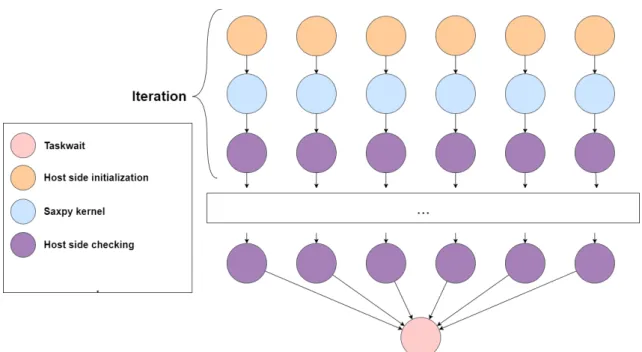
3.3 Saxpy task graph . . . 26
3.4 Multi-Saxpy task graph . . . 27
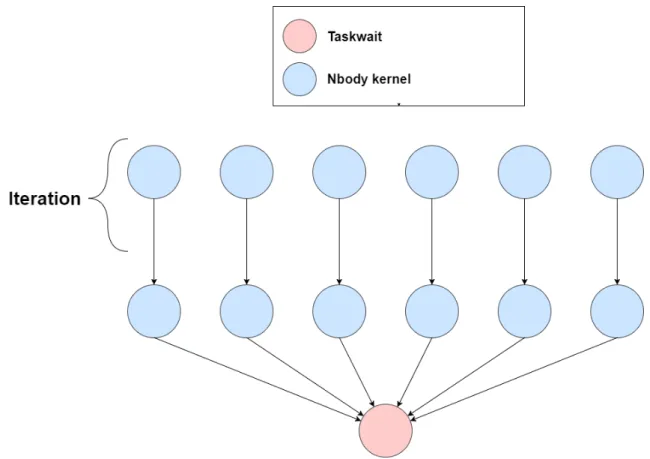
3.5 Nbody task graph . . . 28
3.6 k-Nearest Neighbours task graph . . . 29
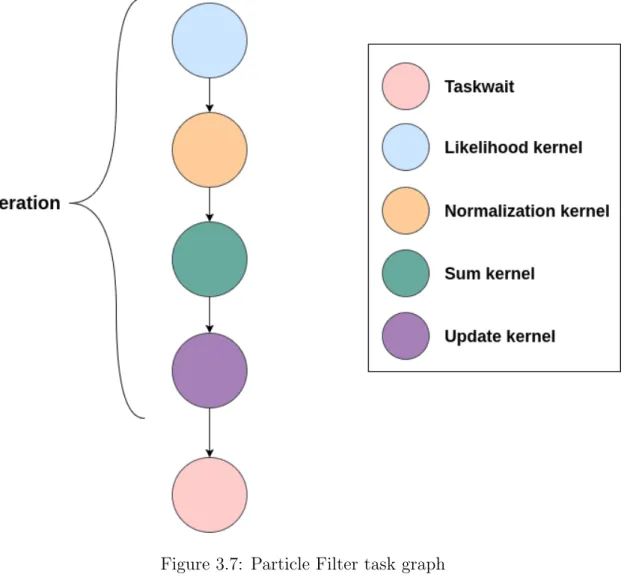
3.7 Particle Filter task graph . . . 30
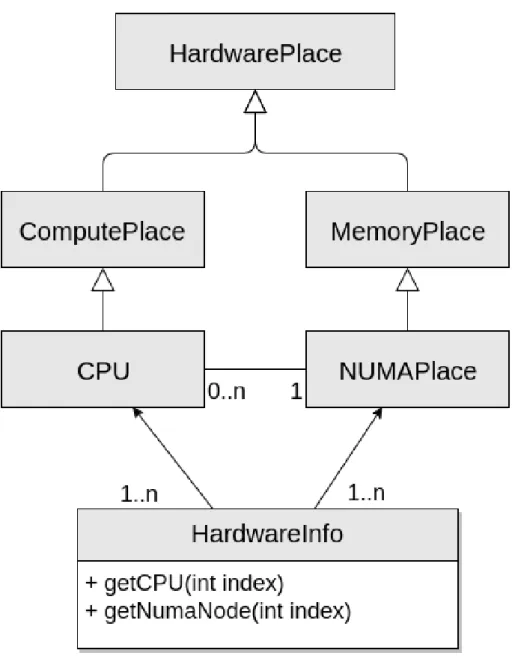
4.1 Structure of the Hardware Information component . . . 32
4.2 General view of the scheduler component of Nanos6 . . . 33
4.3 General view of the executor component of Nanos6 . . . 36
4.4 Program flow of the execution of a SMP task . . . 37
4.5 Changes on the hardware component of Nanos6 . . . 41
4.6 Changes on the scheduler component of Nanos6 . . . 43
4.7 Illustration of a hierarchical scheduler with CUDA GPUs . . . 44
4.8 Changes done to the executor component of Nanos6 . . . 45
4.9 Program flow of the execution of a CUDA task . . . 47
4.10 Stream usage on Nanos++ . . . 48
4.11 Stream usage on Nanos6 . . . 49
4.12 A general view diagram of the Polling Services on Nanos6 . . . 50
5.1 Execution time of the Saxpy program with different Nanos versions . 55 5.2 Profile of the execution of a Saxpy application . . . 56
5.3 Execution time of the Saxpy program with different Nanos versions and prefetch configurations . . . 57
5.4 Execution time of the Saxpy program with different Nanos versions and prefetch configurations (focused on the Y axis range for small task numbers) . . . 57
5.5 CPU Execution time of the cudaMemPrefetchAsyncoperations over a program execution . . . 58
5.6 CPU Execution time of the cudaMemPrefetchAsyncoperations over a program execution, synchronizing every 512 operations . . . 59
5.8 Speedup of the different benchmarks using a non-OmpSs version as
baseline . . . 61
5.9 Comparison of the execution profiles obtained for different OmpSs executions on the Gaussian application (Nanos++ top, Nanos6 bottom) 62 5.10 Speedup of the different benchmarks at different polling frequencies . 63 5.11 Speedup of the different benchmarks using the default and a polling scheduler . . . 63
5.12 Speedup comparison over the original program using Nanos++, Nanos6 and Nanos6 with a polling scheduler . . . 64
5.13 Saxpy execution trace . . . 65
5.14 Speedup of Saxpy with and without warm-up runs . . . 66
Chapter 1
Introduction
1.1
Context And Motivation
Heterogeneous computing has become prevalent as part of High Performance Com-puting in the last decade. One of the most common types of heterogeneous devices used are Graphical Processing Units. GPUs were initially developed for graphics processing, essentially computing thousands of pixels in a very short amount of time, however, with the rise in popularity of General Purpose GPU computing (GPGPU) manufacturers have begun creating frameworks and hardware specifically suited for HPC environments.
On the beginning of GPGPU graphical environments such as OpenGL Shaders were used to compute mathematical problems by mapping the problems to graphical parameters. Modern frameworks have made GPU computer user friendlier, but pro-gramability is still an issue, since GPU programming models differ from traditional CPU models. An average GPU program consists on moving the data from host memory to device memory, executing a GPU function (called kernel) and moving the data produced back to the host. The memory transfers must be done manu-ally, which alongside other GPU specific nuances make programming on GPUs a relatively complex tasks.
Multiple programming frameworks have been developed for GPU programming, the most widely used being OpenCL[7] and CUDA[11]. A notable development on the latest versions of these models is the introduction of features concerned with programmability and ease of use instead of performance on this frameworks, for example, Unified memory in CUDA, a mechanism that provides automatic memory management, relieving the user from this task.
Frameworks focused in ease of use are not uncommon in High Performance Com-puting, were programability is considered one of the biggest issues to tackle in the coming years. Among such frameworks the OmpSs[4] programming model devel-oped at the Barcelona Supercomputing Center can be found. This model provides programmers with a task based approach to parallel computing, where the user can execute an application by describing it as a series of tasks with dependencies among each other, leaving to the frameworks the responsibility of finding maximum parallelism.
In addition to regular CPU tasks, OmpSs supports a series of task models for different architectures, among them CUDA and OpenCL for GPUs. This allows a programmer to write a task based program capable of running on a GPU without
having to worry about any memory management.
OmpSs is based on two software components: the Mercurium compiler and the Nanos++ runtime. The compiler transforms C, C++ or FORTRAN code to an intermediate representation which uses the runtime to execute the tasks in parallel. HPC devices, however, have become more specialized and advances and tradi-tional programming models have to adapt to keep up. New features and architec-tures are introduced in the world of GPGPU and OmpSs needs to adapt in order to keep competitiveness. For this, a new version of the programming model is being developed, called OmpSs-2, as well as a new runtime to implement it, called Nanos6. The reason for the development of a new runtime instead of improving on the existing system is because of several issues that can be found on the design and implementation of the current one. The main issue of Nanos++ is programability and maintainability; due to the development process followed in its development it is difficult and cumbersome to add new features and fix existing bugs on the code base. In addition to this, improving performance, flexibility and adding new features are the focus on the development of the runtime.
Due to this, instead of modifying the existing software, the new system is being built from the ground up, which creates a need for many of the features on the previous runtime to be redeveloped. Since an existing Nanos6 runtime is already functioning, the need to start re-implementing the different features of a runtime arise.
This project is concerned with the development of the support for CUDA tasks in the new runtime. Instead of just copying the functioning of the previous runtime, one of the goals is to re-imagine the existing design and to avoid its shortcomings as much as possible. In addition, since CUDA GPU architectures and language features have changed from the time in which the previous version was developed, the new features of CUDA will be used where adequate. For starters, this means that the new CUDA support is being developed using unified memory instead of regular memory management.
In addition to developing the feature a stated it is important to take into ac-count that in the future more architectures need to be implemented Thus, it is desirable to create when possible an escalable and flexible system for asynchronous task execution, in order to ease the development of future projects. Besides this, a number of benchmarks and tests to evaluate the performance of the runtime must be developed, since no such suite exists for Nanos++.
The work on this project includes the development of support for the CUDA task execution on the Nanos6 runtime and the porting of several benchmarks to the OmpSs-2 model of programming, in order to evaluate the performance of the feature developed.
1.2
Document Organization
This document is divided into 6 chapters. Chapter 1 covers this introduction giv-ing some context and motivation behind the project. In chapter 2 the relevant state of the art is presented, including GPGPU and Nvidia GPU architectures, the CUDA programming environment as well as the OmpSs programming model and the Nanos++ runtime.
Afterward, chapter 3 presents the methodology used to develop the project, together with the environment of the project, including a brief description of the existing Nanos6 runtime and a listing of the applications ported for this project. In chapter 4, Design & Development, the changes done to the runtime through this project are presented as well as a more in depth description of the components which have been modified.
Before the final conclusions and future work in chapter 6, the evaluation and results obtained in the project are presented in chapter 5, as well as the hardware environment in which the project is developed.
Chapter 2
State of the Art
Heterogeneous architectures have become popular in High Performance Computing on the latest years due to the performance they provide over CPUs on some appli-cations. While the speedup that accelerators can provide is significant, programma-bility is an issue, since they are usually incompatible with traditional languages and paradigms, thus, a number of programming models focused on accelerators have been created.
In order to extract performance from accelerators it is vital to understand the nuances of the different architectures. In GPU computing in particular, being a rapidly changing field, is is particularly important to know the differences between the architectures of the different GPU devices and the features their programming models offer.
In this section, the relevant state of the art for this project is presented. Since the project is concerned with implementing GPU (specifically CUDA) support on the Nanos6 runtime, the latest Nvidia GPU architecture, the latest version of the CUDA runtime and the previous version of the OmpSs runtime are presented.
2.1
GPU Architecture
The capabilities of Graphical Processing Units for general purpose computing stem from their architectural difference over traditional CPUs. GPUs were originally designed solely for graphics computing. This means that the only task they were created to performs is pixel processing, comprised of completely parallel huge num-ber of small operations.
The traditional architecture of CPUs is composed of a few powerful cores with a lot of cache memory that can run a few software threads at the time. In contrast, GPUs are composed by hundreds or thousands of small cores, with little to no cache memory, capable of running a big amount of software threads at the same time. Broadly speaking, GPUs are optimized for taking huge batches of data and performing the same operation over all of the data simultaneously.
CUDA GPU architectures are composed of several Streaming Multiprocessors (SM) which run the GPU functions, calledkernels. Each of the SMs is composed of several CUDA cores and receives a single instruction, thus, each of the processors inside a SM runs the same instruction over multiple data, forming a Single Instruc-tion Multiple Thread (SIMT) execuInstruc-tion model. A scheme of the architecture of a GP100, the first Pascal CUDA GPU can be seen on figure 2.1. In this figure it is
possible to appreciate the distribution of several SM over the chip as well as a small cache, a feature included to newer GPU architectures.
Figure 2.1: The architecture of a Pascal GP100
2.1.1
CUDA Pascal Architecture
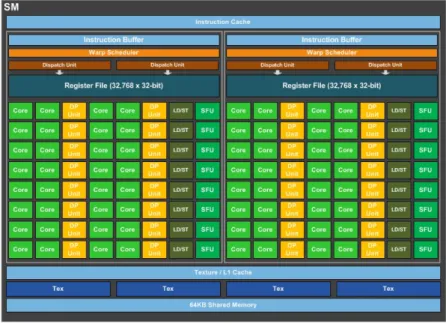
Pascal is the latest micro-architecture developed by NVIDIA, as of 2017. Released in April 2016 it is the successor of the previous Maxwell architecture. The SMs of this architecture contain each 64 CUDA cores, partitioned into 2 blocks, each having 32 single-precision CUDA Cores, an instruction buffer, a warp scheduler, 2 texture mapping units and 2 dispatch units. An scheme of a Pascal SM can be found on figure 2.2.
Figure 2.2: The architecture of the Streaming Multiprocessors of a Pascal GP100 In addition to the architecture changes, Pascal comes with a new version of CUDA, CUDA 8. This new version of the runtime includes numerous changes to the Unified Memory system. The most significant of these changes is concerned with
how the data needed to run kernels is transferred. In previous versions of CUDA, when a kernel with managed memory accesses was run, all managed data, even the one not needed by the kernel, has to be copied before the kernel can be run, which can be a major issue for performance. In PascalGPU Page Faults are implemented, allowing kernels to launch without any transference, instead moving data when it is needed on the GPU, though this comes with a penalty for performance, since the CPU must process the page faults.
Besides this, there are other improvements on the Unified Memory. Since Pascal, it is possible to run code on the CPU using managed data while a GPU kernel is running (though it can cause severe performance issues), and several optimization functions are provided such as a prefetch function (cudaMemPrefetchAsync). All in all, Pascal makes it possible to optimize programs using unified memory, allowing it to move beyond just a prototyping framework.
2.2
CUDA
Compute Unified Device Architecture (CUDA)[11] is a parallel computing platform and programming model developed by Nvidia for general purpose computing on CUDA-enabled GPUs. This means that the whole CUDA toolkit, including a com-piler, computing libraries, analysis tools, etc. is limited to Nvidia cards, which is generally regarded as the main disadvantage of the model.
To use this model, the programmer has to write specialized functions (called kernels) which are executed concurrently on the Graphics processor. In order to run a kernel, the programmer calls a function annotated with a global keyword through a specialized syntax which indicates the number of threads needs to run in the GPU (in the forms of threads and blocks).
The programmer is not only responsible for writing the computational kernel, but also of performing memory allocation and transfer between host and device memory, though this can be leveraged from the programmer with a mechanism introduced in the 6th version of CUDA called Unified Memory. A simple CUDA application generally involves the following steps:
1. Initializing the data on the CPU 2. Copying the data to the GPU 3. Launching the kernel
4. Copying the generated data back to the host 5. Checking/Storing/etc. the output data
In general a CUDA programmer needs to deal with some key factors for perfor-mance. One of the most important is minimizing the memory movements in the application. The cause for this is that generally the slowest portion of the architec-ture is the connection between the Host and the CPU, thus reducing the amoung of data movement is crucial. The programmer also needs to deal with other mechanism such as the usage of shared memory in order to reduce the number of (expensive) accesses to global memory.
1 // Declaration of kernel
2 __global__ void saxpy(int n, float a, float *x, float *y); 3
4 // Memory allocation: Host
5 x = (float*)malloc(N*sizeof(float)); 6 y = (float*)malloc(N*sizeof(float)); 7
8 // Memory allocation: Device
9 cudaMalloc(&d_x, N*sizeof(float)); 10 cudaMalloc(&d_y, N*sizeof(float)); 11
12 // Memory transfer
13 cudaMemcpy(d_x, x, N*sizeof(float), cudaMemcpyHostToDevice); 14 cudaMemcpy(d_y, y, N*sizeof(float), cudaMemcpyHostToDevice); 15
16 //Kernel launch
17 saxpy<<<(N+255)/256, 256>>>(N, 2.0f, d_x, d_y);
Listing 1: CUDA pseudocode
Additionally, the CUDA toolkit provides a series of computing libraries such as cuBLAS (Basic Linear Algebra Subroutines)[10] and cuFFT (Fast Fourier Transfor-mations)[12] as well as a series of functions to run programs on multiple CUDA-enabled GPUs.
2.2.1
CUDA Streams
CUDA streams are a concept central to the execution of CUDA operations. By default all CUDA functions are synchronous, except for kernel executions which need some form of synchronization. It is possible to execute different operations asynchronously and concurrently by using a mechanism called CUDA stream.
A stream acts as a queue to which operations are submitted, including asyn-chronous variants of regular CUDA function calls as well as kernel functions. Tasks sent to a queue are executed sequentially, however, they can be run in parallel with any operation in a different stream. This allows to potentially occupy all the SMs of the GPU device as well as using the different copy engines simultaneously. In ad-dition, the FIFO queue like behaviour of streams allow for implicit synchronization of operations if used correctly, for example, by issuing to the same stream a transfer of data for a kernel and the kernel in order.
2.2.2
Unified Memory
Unified Memory is a mechanism introduced with the release of CUDA 6 which allows the programmer to avoid the task of memory management. Traditionally, the CPU memory and the GPU memory are separated in the programming model and the
program explicitly copies memory from one to another, calling functions such as cudaMemcpy.
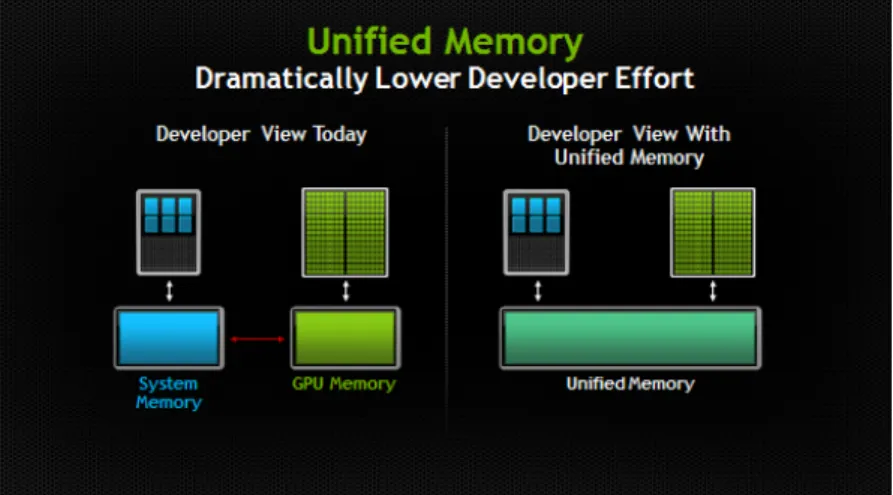
Unified Memory creates a pool of managed memory shared between host and device. This memory can be accessed by all devices with a single pointer, in contrast to regular memory which needs a host pointer and a device pointer (see figure 2.3. In order for this to work, the system automatically migrates data allocated in this pool of managed between the devices.
Figure 2.3: Unified memory as conceptualized by Nvidia
Using Unified Memory means that the programmer sacrifices performance for productivity due to which it is often used as a prototyping tool. With more recent versions of CUDA, emphasis has been made in increasing performance and tuning primitives have been included in unified memory.
In the newest version on the CUDA toolkit (version 8) intorduced with the Pascal Architecture, Unified Memory has been improved with the usage of GPU page faults, enabled by the new architecture. GPU page faults are used to trigger transfers,instead of batch copying of the whole unified memory pool on kernel ex-ecution). Together with this new optimization and tuning functions, for example, cudaMemPrefetchAsync, have been added. In addition, a support mechanism for certain operating systems is in development in order to enable allocation of managed memory with the default OS allocator (i.e. malloc).
With this changes it seems that there is a shift in focus on the Unified Memory from a tool for prototyping to a mechanism that can be used for the development of well performing and production ready programs.
2.3
OMPSS Programming Model
The OmpSs programming model [4] is an effort to extend OpenMP [1] with new directives to support asynchronous task-based programming and heterogeneity.
OmpSs takes ideas from StarSs [6], and enhances OpenMP with support for irregular and asynchronous parallelism as well as heterogeneous architectures, while including StarSs dependence support and data-flow concepts allowing the runtime to automatically move data between devices as necessary and perform different optimizations.
OmpSs aims to ease the development of applications for HPC systems while keeping a good performance. For this, the framework uses compiler directives (sim-ilar to OpenMP) to annotate the code with tasks and dependencies. This approach allows to produce a parallel version of programs without affecting the semantics of the applications.
Execution Model
OmpSs uses a thread-pool execution model. There is a master thread, which starts the execution of the application and several worker threads which cooperate in order to execute the work it creates through Task constructs. The parallelism of applications is obtained from these task constructs at runtime, and their data dependencies.
During execution, a data dependency graph is generated from the information extracted from dependency clauses and their directionality (in, out and inout
clauses). The dependency mechanism is the key for the correct running of tasks, allowing that with no dependencies or only read dependencies to run concurrently.
Memory Model
From the programmers point of view, there is a single address space, in order to simplify programming. Internally, however, they may be multiple address spaces, due to for example, the presence of heterogeneous devices such as GPU. Any data that has been marked with the OmpSs syntax can be safely accessed by the parallel regions of the program (tasks) though safety is only guaranteed for the sequential code after a synchronization point. The runtime takes care of the management of data, keeping track of the location of any region of memory and transferring data to the location it is needed in.
Syntax
OmpSs annotates code by marking regions of code, such as functions, with C com-piler directives. These directives are formed with the#pragma omp or#pragma oss
clauses followed by the specific syntax of the directive.
Tasks
Tasks are specified with #pragma omp task followed by a specification of the de-pendencies in a region of code, for example, at the declaration of a function. The dependencies are specified with 3 clauses,in for input dependencies, outfor output dependencies and inout for input and output dependencies. These clauses allow specifying arrays and pointers, the data addresses and sizes do not need to be con-stant since they are computed at execution time.
Taskwait
The taskwait directive, constructed with #pragma omp taskwait is used as a syn-chronization point. When the runtime encounters this clause, it will wait for all the pending tasks to finish executing before continuing the execution. In addition all
1 #pragma omp task in([n]x) inout([n]y)
2 void saxpy(int n, float a, float* x, float* y);
Listing 2: OmpSs task construct
data that has been moved around is flushed to their origin addresses, since the se-mantics of the directive specify that all data can be accessed by the sequential code after a synchronization point. However, taskwait can be provided with a noflush
clause to avoid data transfers.
Target construct
The target construct is used to support heterogeneity. The directive is applied to tasks (in a separate pragma) and specifies the type of device as well as what data needs to be copied. The construct is formed as#pragma omp target device(...)
and can be followed by copy in, copy out or copy inout to specify which data has to be copied to and from the device. These can be replaced by copy deps to indicate that all data specified in the dependencies must be transferred. CUDA and OpenCL tasks must also indicate the parameters for the execution (Gird and Block dimensions for CUDA) with the ndrangeclause.
1 #pragma omp target device(cuda) copy_deps ndrange(1, n, 128) 2 #pragma omp task in([n]x) inout([n]y)
3 void saxpy(int n, float a, float* x, float* y);
Listing 3: OmpSs task construct
Components
OmpSs relies on two components, the Mercurium source-to-source compiler [15] and the Nanos++ parallel runtime [16].
Nanos++
Nanos++ is a runtime library that supports the OmpSs programming model. It is responsible for the scheduling and execution of tasks following the constraints specified by the user, such as dependencies. Nanos++ supports a number of different architectures and scheduling mechanisms. The runtime creates the different threads, calculates and resolves the dependencies, manages the data transfers and runs the tasks.
Architectures
Currently OmpSs supports several different architectures:
smp-numa: Non-Unified Memory Access (NUMA) systems with general purpose CPUs.
gpu: CUDA-capable GPUs.
opencl: Any architecture supporting OpenCL (GPUs, CPUs and Xeon Phi).
fpga: FPGA devices.
hstreams: Any architecture supported by the hStreams library (Xeon Phi).
cluster: A cluster system with several nodes, can be combined with any of the previous architectures.
mpi: A cluster system, using the Message Passing Interface (MPI) to distribute tasks among nodes.
Task flow
When the runtime encounters a piece of code annotated as a task, it creates a
taskstructure inside and captures its environment, data and dependencies. For the execution, a tasks life can be divided into 5 stages:
Instantiated: When the data is created, the runtime computes the dependencies and adds a node to the dependency graph representing this task.
Ready: A task is ready when all its data dependencies are satisfied and it is ready to be executed on a available resource. At this stage is when task scheduling occurs.
Active: A task is active when all the scheduling operations for a task have been done but before the task is run. At this stage, the coherence mechanisms of the runtime are accessed to ensure that all necessary data is available and to perform transfers.
Run: The task is being run.
Completed: When the task finishes running, output data is processes by the co-herence layer and the dependency system updates the graph, marking all the tasks whose dependencies have been resolved as ready.
Mercurium
Mercurium is a source to source compiler, aimed at fast prototyping. Its main purpose is to be used as a compiler for OmpSs and it supports C, C++ and Fortran. The role of the compiler is to recognize the directives of the language and trans-form them into Nanos++ runtime calls. The compiler is also responsible to re-structure code for different target devices, and of invoking the native compilers of each of the target architectures. The compiler is able to generate several files for different device-specific code, however all the binaries and files are merged into a single object file, recovering all information on the linkage step, in order to maintain the traditional compiler behaviour of generating a single executable.
Figure 2.4: Mercurium compilation flow
GPU Support
The Nanos++ GPU architecture is based on a event driven flow [9] based on the scheme in figure 2.5.
Figure 2.5: Nanos++ GPU event driven flow
In order to implement this scheme, Nanos++ creates separate helper threads for the heterogeneous architectures, dedicated to launch tasks and copy operations, as well as checking for the synchronization events and available tasks. When a task or a memory operation is launched, an event is created on the system and the helper thread will poll it until it has finished in order to launch the following operation.
The CUDA support system uses multiple streams for execution. One stream is dedicated to input transfers and another one to the output transfers, separate from a pool of streams for kernels with a variable number configurable by environment variables. This separation of streams makes the usage of events and polling on the CPU a necessity. More details on this are given in section 4.2.4.
In order to operate, the runtime keeps track of the location of all the data. CPU regions of data are transferred via regular CUDA copy operations to a pool of GPU memory that is pre-allocated at start-up.
The Mercurium compiler creates a wrapper function when a CUDA kernel is called. Inside this wrapper, the launch parameters of the kernel are calculated (grid size and block size), a runtime API function is called to obtain a execution kernel and the kernel is launched. This wrapper functions are implemented on a intermediate
file dedicated to CUDA code, which is compiled with the Nvidia CUDA compiler before being merged with the rest of the program.
Chapter 3
Environment and Methodology
3.1
Methodology
The project has been carried out through an iterative prototype based development process. After a initial design phase, the works has followed a structure of developing a minimal working system, evaluation and iterating on the design.
The initial design of the runtime has been done with the feedback of developers of Nanos6 and Nanos++, trying to avoid the mistakes the previous runtime did and considering the nuances of the new runtime being developed.
The progress of the project has been tracked via weekly meeting when possible, where the progress and results obtained as well as the tasks to do were discussed.
Design phases consist on analyzing the results of previous evaluations and testing some considered feature, as well as discussing how a feature can be implemented in the weekly meetings. Implementation phases mostly consisted on writing C++ code on a branch of the Nanos6 project hosted by the BSC, as well as occasionally talking with the main developer of the system in order to understand the inner workings of components crucial for the implementation of CUDA support. Evaluation phases, on the other hand, involve porting application to OmpSs and OmpSs-2 as well as running the applications on a machine and analyzing the results.
A iterative approach was chosen because the project is part of a bigger project with many developers involved and it requires many features to be implemented, many of which are still works in progress. By using a more agile iterative develop-ment process it is possible to adapt to changes and new developdevelop-ments performed by other developers (such as a hierarchical scheduler developed in parallel to this project) and to build a working system without the need for it being feature com-plete, as well as quickly adapting to issues found with the design chosen.
Application Porting
A number of applications have been ported to OmpSs-2 for the evaluation of this project. The porting of the non OmpSs applications has followed the following steps.
1. Determine the relevant sections to convert into tasks.
2. Separate the kernels into a separate .cufile from the rest of the code 3. Create a header file for the kernel in which the task is annotated
4. Remove the CUDA memory transfers on the code and substitute the kernel launch for a direct function call to the function in the header mentioned On the other hand, already existing OmpSs+CUDA applications only require modifications to their pragmas to update them to the current version of the runtime, as well as working around the features that are not yet implemented, though no such case has been found.
Besides this, when executing applications before the compiler support for CUDA tasks is implemented, additional steps are needed to run. In order to work around this, the tasks are masked to the compiler as SMP task and the intermediate files are kept using the -K flag on mercurium. In the intermediate files, the objects in which the task information of each task is kept are modified for the CUDA tasks are modified with a task type indicator, and the declaration of functions called by the runtime is modified with any parameter introduced only on the runtime. Trough this process, it is possible to run OmpSs v2 CUDA applications without compiler support.
3.2
Environment
3.2.1
Nanos6
Nanos6 is a runtime created to run underneath a new specification of the OmpSs programming model, called OmpSs version 2. Nanos6 is the next version of the existing Nanox (also called Nanos++) runtime, and the goal of its development is to remake the runtime from the ground up to avoid the mistakes that may cause performance issues in the previous version as well as designing the runtime in a way that is more expandable and maintainable than it was. This project is part of the development project of Nanos6.
As of now, a first functioning version of Nanos6 exists and offers some basic functionality, though it is lacking some of the functions available in Nanox, such as heterogeneous device support. The first asynchronous task type to be added are CUDA task, and the work to develop this functionality is done through this project. The system can be divided into the following components, considering how the code base is currently divided:
API: The external interface of Nanos6, which contains the functions called by the code generated by mercurium in order to create task, register tasks, synchro-nize, etc. There is additionally a debug API for developers.
Loader: The loader is a component used to load the version of the runtime to use. This is needed because the compilation process of Nanos6 generates different binaries according to the version, compiled with different flags.
Dependency Manager: The dependency manager is the component is charge of tracking the dependencies of the tasks and unblocking those whose dependen-cies are solved.
Executors: The executors are the elements of running the code of the tasks, be they SMP task, CUDA kernels or any supported architectures. This component is the one ”running” the application, including the worker threads, etc.
Scheduler: The scheduler determines the policy used to select which tasks are run first in the limited computing resources in the system.
Hardware Information: The hardware info is in charge of reading the information of the underlying hardware of the system in order to provide a model that the runtime can use to optimize the execution.
Instrumentation: The instrumentation component implements the functions needed to instrument the execution of a OmpSs 2 application on environments such as Extrae[8].
Tasks: Task objects are used to represent the tasks that the user annotates on the application. The data structures contain the data necessary for its execution, such as the user function and the dependency data, as well as internal variables to track and log its status through the execution of the program.
System: This portion of the code contains the implementation of the functions on the external API as well as the start up and shut down portions of the system.
Low-level: The low-level components contain different implementations of neces-sary elements for the functioning of the runtime, such as spin-locks.
A more in depth description of some sections of the runtime; as well as some nuances of the OmpSs second version for which the runtime has been developed follow. Chapter 4 delved into the changes and new functionality implemented as part of this project as well as some more in depth explanations needed to understand the implementation. The goal of the descriptions on this section is to give a broad idea of parts of the system that are not affected by the work on this project.
Thread Model
Both Nanos6 and Nanos++ use a pool of threads for the execution, creating (by de-fault) as many threads as processor cores in the system. Threads will run iteratively executing the available tasks obtained from the scheduler, however, similarities end there. In Nanos++ tasks can be paused and can be resumed in any of the available threads, while in Nanos6 tasks are assigned a thread and will be resumed on the same threads. Additionally, Nanos6 threads will become asleep when no tasks are available for execution (such as when there are less tasks that threads on the system) and will be resumed when new tasks become ready.
Regarding asynchronous executions, Nanox uses a number ofHelper Threads in order to track the different events created by the asynchronous tasks and to keep the coherence of the application. A thread is created for each device of a non SMP architecture in use and it runs a number of helper tasks (to launch asynchronous tasks, check for task completion, etc.) iteratively. The problem with this approach is that the helper thread will compete with the SMP worker threads, and can limit the performance obtained. In order to tackle this, the SMP threads on Nanos6 will also be in charge of running the tasks of the asynchronous helper threads on the previous runtime, thus eliminating the need for helper threads. In order to do this, the helper tasks are run when the worker threads are idle or in between task executions.
Task Execution Model
The task model in Nanos6 is comprised of a number of states through which a task in Nanos6 goes during its lifetime. Currently the following states exist:
Blocked A task is blocked (by others) when its dependencies are not yet solved. This is the starting state of tasks when they have dependencies, however, it is possible that a running task becomes idle when a taskwait is found in its code, since tasks can spawn other tasks. The dependency manager component of the runtime is responsible for tracking blocked tasks.
Ready When its dependencies are solved or the taskwait is satisfied a task is be-comes ready and it is sent to the scheduler. The scheduler is responsible of choosing which of its ready tasks will be run first.
Running A task is running once it starts executing its body (the user level code). Once it is finished running, the responsibility of notifying the dependency system once it is finished corresponds to the computing resource it is running on.
Finished Once a task has finalized its execution, it is considered finished. The diagram on figure 3.1 illustrates the task state flow.
Figure 3.1: Task states of Nanos6
Dependency Manager
The dependency manager is the component of Nanos6 which takes charge of solving the dependencies of the system. It exposes some functions to be called by the threads of the runtime when a task is solved in order to update the pending tasks and unblock them if necessary. It is also accessed by the API functions used to submit tasks, in order to either add it to the list of blocked tasks or to be sent to the scheduler directly.
• Discrete regions • Linear regions
The dependency model using discrete variable is only capable of identifying de-pendencies by the variable name (base pointer) without considering subsets of the data. Due to this limitation, most of the work is currently done on the Linear Re-gions model, which allows to specify dependencies by using a base pointer as well as size or array subset indications.
Scheduler
The scheduler of the runtime determines the policy used to determine the order in which ready tasks (those whose dependencies are solved)
Several schedulers are available for Nanos6, which are selected using a envi-ronment variable called NANOS6 SCHEDULER. There are several different schedulers, among them:
• A Naive Scheduler which executes tasks in a LIFO manner without taking into account neither locality or priority.
• A Immediate Successor Scheduler which gives priority to the successor of a task to be run the CPU that ran the antecessor in order to exploit locality. • A simple FIFO Scheduler.
In addition to the regular schedulers, a number of polling schedulers are also available which re-implement the policies of the available schedulers, providing a different querying mechanism to the rest of the runtime. For regular schedulers, the threads will query to see whether a task is available for them, and if there is none they will become idle. If a polling scheduler is used and a task is not available for a thread, that thread will be given a slot data type which will be updated with a task when one is available, allowing the thread to poll instead of becoming asleep.
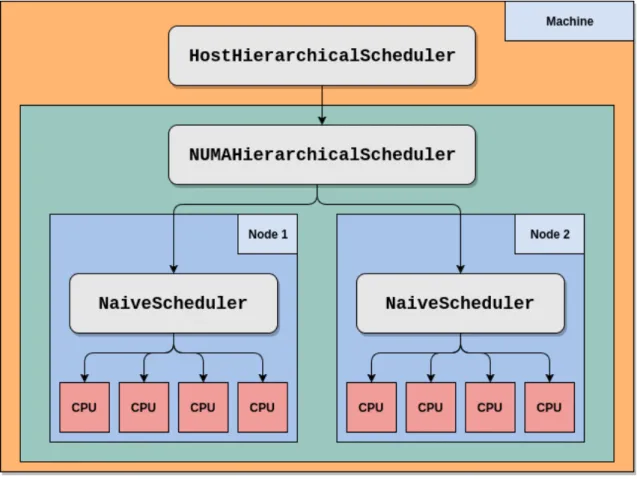
Additionally, a hierarchical scheduler has been developed in order to provide more flexible development and adaptability over the monolithic development used up to now. In order to do this, a HostHierarchicalSchedulertype of scheduler is added, as well asNUMAHierarchicalSchedulerin order to build a tree of schedulers. The design aims to have a host scheduler with contains a number of schedulers per each NUMA node on the system. The scheduler for each NUMA node can be configured differently, regardless, the tasks are first redirected to the most appro-priate node according to the NUMA scheduler policy, where it is sent to a concrete CPU depending on the policy of the scheduler on that node. A possible tree for a system is illustrated in figure 3.2.
OmpSs 2 Changes
Some changes have been made to OmpSs version 2 programming. Most of them come from the lack of features present in the previous version due to them being yet unimplemented. Some changes are planned for the future, for example, a clause equivalent to the current ndrange of CUDA/OpenCL tasks which allows to use a more CUDA-like notation. In addition the default pragma name has been changed from ompto oss, which will be reflected in all the following code listings.
Figure 3.2: A hierarchical scheduler tree for a 2 NUMA Node machine with no asynchronous devices
3.2.2
Applications
For the testing and evaluation of the work developed a series of applications have been ported to OmpSs and OmpSs-2. The applications can be categorized into 2 groups, applications previously existing on the BSC application repository[14] and OmpSs learning examples[17] and benchmarks ported from the Rodinia benchmark suite[3].
In addition a microbenchmark has been developed to test the behaviour of the GPU on certain scenarios related to the functioning of Nanos6.
This section provides a brief description of the different benchmarks used for the application, along with a depiction of the task graph in some cases. Graphs are not shown for all applications since the outline of some applications is similar or identical to others, so only those with significant differences are shown.
BSC Application Repository and OmpSs examples
The applications on the BAR are written using the OmpSs model. Some modifica-tions have been needed due to the applicamodifica-tions having been developed some years ago and the model having changed slightly. Besides that, the only additional changes needed for testing involve modifying the directives to OmpSs version 2, introduced with nanos6.
Saxpy SAXPY stands forSingle-Precision A X Plus Y, which is a combination of scalar multiplication and vector addition. It is a very simple operation, it takes two 32-bit float vectors (X and Y) and a scalar value (A). It multiplies each element of X by A and adds it to Y. The kernel used is the following:
1 __global__ void saxpy(long int n, float a, float* x, float* y) 2 {
3 long int i = blockIdx.x * blockDim.x + threadIdx.x; 4 if(i < n) y[i] = a * x[i] + y[i];
5 }
Listing 4: CUDA Saxpy code
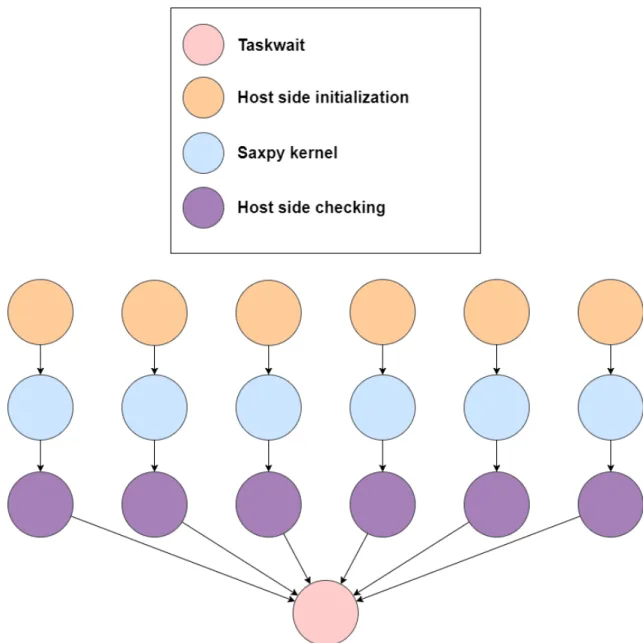
Since there are no dependencies between the vector elements, in OmpSs, the vector is divided into equal sized chunks and the execution of each chunk becomes a task. There being no dependencies, it is a good application to evaluate the ability of the runtime to handle many concurrent tasks and compare it to the one on the previous runtime. The dependency graph of the application is quite simple, as is shown in figure 3.3.
Multi-Saxpy Multi-Saxpy is a modified version of the previous application de-veloped specifically to test a specific scenario for Nanos6. Its is to test the mem-ory transfer capability, thus the application describes the worst case for memmem-ory transfers. This micro-benchmark runs a number of SAXPY kernels iteratively, and between each iteration it modifies the data on the CPU.
The goal of the application is to create a situation where data needs to constantly move back and forth from the GPU to the CPU. Each run of the kernel and CPU modification is divided in blocks of equal size, a task being created for each block. The application serves no particular purpose in the mean that it does not produce any useful results, however, it is useful to test the performance of the runtime. Its task graph is shown in figure 3.4.
Nbody Simulation The N-Body simulation is a molecular dynamics computation where a system of bodies (atoms and molecules) interacts for a period of time. The result of the simulation gives a view of the motion of the bodies whose trajectories are determined by forces between bodies and their potential energy.
The data dependency graph for this application is shown on figures 3.5.
Matrix Multiplication This application performs a dense matrix multiplication of two matrices and stores the result into another matrix: A * B = C. For sim-plicity, all matrices are square matrices and are divided into square tiles as well. Matrix multiply is a well-known algorithm that requires a significant amount of data movements.
Perlin Noise Perlin Noise is a algorithm used to increase the realism on computer generated images. The application involves 3 steps which are computed for each pixel
Figure 3.3: Saxpy task graph
of the image; grid definition, computation of the dos product between the distance gradient vectors and interpolation between the values.
In the OmpSs version, a input image represented as a two dimensional array is divided into several stripes containing multiple rows of pixels, with each task computing the gradient noise for one of these chunks.
Krist This application is used on crystallography to find the exact shape of a molecule using Rntgen diffraction on single crystals or powders. It computes crys-tallographic normalized structure factors. For this, data is kept on 3 arrays, two of which are read intro the GPU while the other is used to store the results.
In the OmpSs version, the arrays are divided into chunks and the computation is performed independently, with almost no data sharing between the tasks.
Figure 3.4: Multi-Saxpy task graph
Rodinia Benchmarks
Rodinia[3] is a benchmark suit focused on heterogeneous computing, created to tackle the lack of standardized heterogeneous computing benchmark suites.
Its applications are written in CUDA (as well as OpenCL), thus they need to be ported to OmpSs. This requires identifying the GPU related regions as well as the potentially parallel CPU regions and creating pragmas to parallelize them. In addition, any transfer operation must be removed, since these operations become responsibility of the runtime, and kernel launched must be changed to direct (anno-tated) function calls.
Only 8 of the Rodinia CUDA benchmarks have been translated and evaluated due to time constraints.
Breadth-First Search The BFS benchmark provides a GPU implementation of this graph traversing algorithm. The application is formed by two kernels which are run iteratively one after the other, the first used to traverse the graph and the second to determine a stopping point for the algorithm..
Gaussian Elimination Gaussian Elimination computes result of a liner system row by row, solving for all of the variables. The algorithm must synchronize between iterations, however the computation in each iteration can be processed in parallel..
Hot-Spot Hot-Spot is a tool used to estimate processor temperature based on the architectural design and simulated power measurement. A single kernel is used to calculate the temperature iteratively, however, on the OmpSs version, data is divided in blocks an a kernel is launched for each block. The process is repeated iteratively, using the dependencies of the tasks to synchronize without the need for a explicit synchronization..
Figure 3.5: Nbody task graph
k-Nearest Neighbours The algorithm finds the k-nearest neighbors from an un-structured data set. The sequential version algorithm reads in one record at a time, calculates the Euclidean distance from a target latitude and longitude, and evaluates the k nearest neighbors. The CUDA version reads many records at the same time and calculated the euclidean distances on multiple kernels (records are calculated in separate blocks) and the CPU updates the list of nearest neighbours. The task graph is shown on figure 3.6.
Needleman-Wunsch NW is a nonlinear optimization method for DNA sequence algorithms. The potential pair of sequences are organized into a 2D matrix. First, the algorithm fill the matrix top left to bottom right, where the optimum alignment is the path through the array with maximum score, the score being the value of the maximum weighted path ending at the cell. In the second step, the maximum path is traced backwards to deduce the optimal alignment.
The computation is done by running two kernels, one for each step. Both kernels are run in separate iterations, first the one corresponding to the filling step and then running the one corresponding to the back-trace step.
Particle Filter Particle Filer[5] is a statistical estimator of the location of a ob-ject given noisy measurement of the location and an idea of the obob-ject’s path in a Bayesian framework. The PF begins tracking a object by making a series of guesses given what is already known, The likelihood of those guesses is determined using a predefined likelihood model. Then the guesses are normalized based on their like-lihoods and the normalized guesses are summed to determined the object current
Figure 3.6: k-Nearest Neighbours task graph
location. Before repeating the process for all the remaining frames in the video, the guesses are updated based on the determined location.
Four kernels are created for the CUDA version, one for each mentioned operation; likelihood calculation, guess normalization, sum of normalized guesses and guess updating. The dependency graph of the application is illustrated in figure 3.7.
CUDA Microbenchmark
A GPU microbenchmark was developed for this project in order to evaluate different approached to GPU execution. This was initially done to find a problem causing performance losses when performing some optimizations in CUDA unified memory; this is described in chapter 5.
The microbenchmark executes a modified version of the Saxpy code. The most notorious modification is that it is not executed in OmpSs, but rather it mirrors the ”divide in blocks to create various tasks” approach used in OmpSs. In addition, the execution is done iteratively, the goal not being performing a specific operation but rather testing a worst case scenario for Nanos in which a program requires all data
Figure 3.7: Particle Filter task graph to be move to the GPU and back to the host in each iteration.
This benchmark has been used to test different capacities of the CUDA environ-ment which are not necessarily obvious or are not present in the docuenviron-mentation but are needed to obtain a good performance in the runtime. This included the limit of prefetch operations that can be simultaneously performed on the GPU before the performance degrades, the performance of different synchronization approached as well as the optimal number of streams to use when executing tasks.
The task graph is identical to that of the Multi-Saxpy application previously shown.
Chapter 4
Design & Development
The goal of the Nanos6 project is to redesign and improve upon the previous runtime, thus the choices made when designing the new runtime have been done taking into account the shortcomings of the previous version. This section describes the design of the runtime and explains the reasons behind the decisions made. It is structured in 2 sections, 4.1 describing the existing Nanos6 components involved in detail and 4.2 illustrating the changed made.
4.1
Nanos6 Runtime
4.1.1
Hardware
In order to assign resources and schedule work efficiently, the runtime needs to be aware of the underlying hardware of the system. The hardware is read on start-up and a tree of objects representing the hardware is built on the runtime. This tree is based on two different kind of objects:
Memory Place A memory place is a device on the system in which data can be placed. This refers to the different NUMA nodes on a machine or to the device memories of accelerators. It can also represent user manageable specialized hardware such as the High Bandwidth Memory on a Xeon Phi KNL.
Compute Place A compute place is any kind of place where a task can be run, which comprises CPUs and CUDA GPUs at the moment. Compute places are related to a Memory Place, which corresponds to the ones accessible by them, so for instance, a CPU in a NUMA system contains links to all the NUMA nodes in the system, but not to any separate device memory (such as a GPU memory).
The hardware tree can be accessed by any other element of the runtime, such as the scheduler, in order to optimize the execution of tasks by, for example, exploiting locality. The diagram on figure 4.1 shows the structure of the hardware information component.
Figure 4.1: Structure of the Hardware Information component
4.1.2
Scheduler
Before describing the mechanisms for the execution of tasks, it is important to understand how the runtime schedules these very tasks for their execution.
The time a task spendsblocked (as described in section 3.2.1), as well as the time in which it is finished are responsibility of the dependency system. The scheduler instead, becomes relevant when tasks become ready.
The scheduler provides an API for the executor components of the runtime. The different threads can query this interface to request ready tasks. The scheduler will in turn, return a task appropriate to the computing resources that asked for the task. In this way, the scheduler acts as a passive component, which keeps track of the ready tasks and waits for the threads to request tasks, at which point it provides an adequate one according to its scheduling policy.
The scheduler is also responsible of managing the different computing resources. What this means is that when a thread requests a task but the scheduler has none to provide, it must mark the thread as idle, and when a ready task is added an idle
thread may be resumed in order to execute the new task. This is required because threads with no work to execute (when there are not enough tasks to use all the CPU or when the load balancing is not perfect) become asleep.
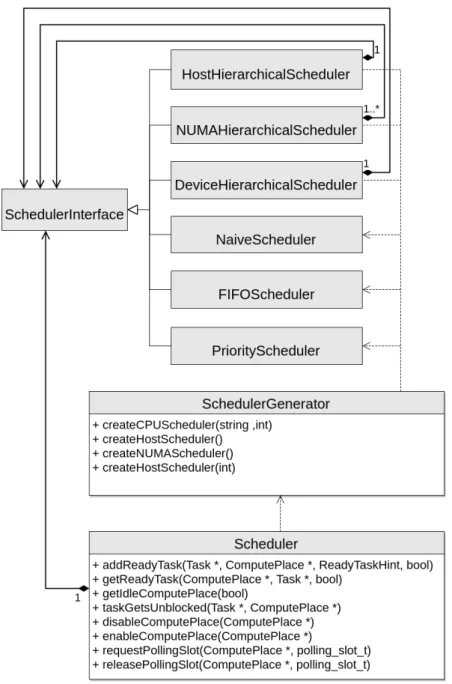
The general design (excluding the components introduced to provide CUDA support) of the scheduler is shown on figure 4.2.
Figure 4.2: General view of the scheduler component of Nanos6
The general design is relatively simple, there is aSchedulerclass which contains a single instance of a SchedulerInterface, which is the actual implementation of the scheduler.The hierarchical nature of the scheduler as described in section 3.2.1, in constructed by using aHostHierarchicalScheduleras the base, which contains another instance of a SchedulerInterface. Not all schedulers are reflected in the diagram, however, the bottom 3 are actual scheduler implementations and will be at the leaves of the hierarchical tree of schedulers.
envi-ronment variables. NANOS6 SCHEDULER determines the topmost level of scheduling, it accepts either ”hierarchical” to build a hierarchical scheduler or any device sched-uler value to use a monolithic schedsched-uler, using one of the low level schedsched-ulers as the base. When the scheduler is hierarchical, the variable NANOS6 DEVICE SCHEDULER
determines which scheduler is used at the leaves of the tree.
Since the scheduler needs to keep track of the computing resources, all the low level scheduler implementations keep some list of the CPUs as well as a list of ready tasks. How these elements are stored depends on the actual implementation and the policy of the scheduler.
The definition of the API provided by the scheduler is shown in the following snippet of the Scheduler class.
1 virtual ComputePlace *addReadyTask(Task *task, 2 ComputePlace *computePlace, ReadyTaskHint hint, 3 bool doGetIdle = true);
4
5 virtual void taskGetsUnblocked(Task *unblockedTask, 6 ComputePlace *computePlace);
7
8 virtual Task *getReadyTask(ComputePlace *computePlace,
9 Task *currentTask = nullptr, bool canMarkAsIdle = true); 10
11 virtual ComputePlace *getIdleComputePlace(bool force=false); 12
13 virtual void disableComputePlace(ComputePlace *computePlace); 14
15 virtual void enableComputePlace(ComputePlace *computePlace); 16
17 virtual bool requestPolling(ComputePlace *computePlace, 18 polling_slot_t *pollingSlot);
19
20 virtual bool releasePolling(ComputePlace *computePlace, 21 polling_slot_t *pollingSlot);
Listing 5: Scheduler API declaration The following is the role of the different functions:
addReadyTask This is the function called by the dependency system to add a task whose dependencies have been resolved. In addition in may be called by the external Nanos6 API when a task with no unresolved dependencies is created. This function will add the task to the list of tasks on the scheduler and will return an appropriate computing resource (the ComputePlace) from its idle device/thread list, which will be waken up.
taskGetsUnblocked This function is called when a task that was blocked it un-blocked. This is not relevant to this project, since only SMP tasks can be blocked and this functionality has not been explored.
getReadyTask This function is called by the different threads or devices in order to obtain a task that is ready to execute. This function receives the calling ComputePlace as a parameter in order to return the adequate task that may be assigned in a previous moment or may be determined when the function is called.
(enable/disable)ComputePlace These functions are placed in the API for future use.
(request/release)Polling Used for schedulers which have a polling mechanism, as a substitute for the getReadyTaskfunction.
4.1.3
Executors
The execution of tasks in the runtime is done through the usage of Worker Threads, which represent the underlying execution threads which run the application. One thread is created for each CPU on the system by default, with its corresponding
WorkerThread. Each of these worker threads executes a loop with the following steps:
1. A task is requested from the scheduler.
2. Thebody of the task (the user level code of the task) is run. 3. The dependency manager is notified of the finalization of the task.
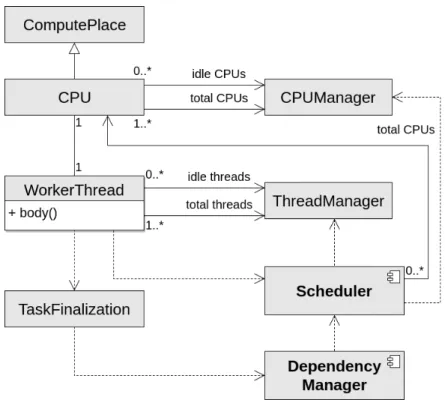
If a ready task is not found the thread will become registered in the schedulers idle list and the thread will become asleep, unless the scheduler used is a polling scheduler, in which case they can stay polling until a task is given. The worker threads can be later resumed up by the scheduler using the ThreadManager which manages the state of all the threads on the system. The structure of the executors of the runtime is illustrated on figure 4.3.
At the initialization phase of the runtime, a thread is created for each CPU. From that moment onwards the pausing and resuming of components is done by the
CPUManagerand theThreadManager. Worker threads will not directly communicate with the dependency manager, instead a class TaskFinalization offers a function to release the dependencies in order to decouple the executor elements and the dependency manager.
In the same fashion, the Scheduler does not directly handle the threads (although it keep track of the CPUs), but instead delegates the task of handling the computing resources to the respective manager classes. The threads, however, do access the scheduler directly through the interface of the system.
Figure 4.3: General view of the executor component of Nanos6
Task execution
Execution of the SMP tasks is shown in the diagram on figure 4.4.
The life of a task starts when it is created and submitted to the runtime (not depicted on the diagram). When this is done, two things can happen, on the first case the task has no pending dependencies and it is directly added to the scheduler; on the second case there are unresolved dependencies and the task is stuck on the dependency manager until they are solved. Once the dependencies are solved, the dependency subsystem calls theaddReadyTaskfunction of the scheduler. This may return a computing resource that will be resumed immediately. It must be noted that all these functions are executed on the underlying hardware thread of the
WorkerThread that released the dependencies of the task on which the added task was waiting.
Once the worker thread is resumed, it will begin running its body in a loop. At the start of each iteration it will call the getReadyTaskof the scheduler, obtaining a ready task or nothing if no task is available. If a task is obtained, the body of the task is executed and at its return, the function disposeOrUnblockTask of the
TaskFinalization is called, which may cause pending tasks to become ready and start the cycle again. If not task is returned by the scheduler, the thread will instead be paused.
Figure 4.4: Program flow of the execution of a SMP task
4.1.4
Nanos6 API
The Nanos6 API is the external component of the runtime, an interface used by the intermediate code generated by mercurium to communicate with the runtime. The API exposes a number of structures and functions which are needed to use the runtime. While the API is too extensive to list, the most crucial functions and structures for the execution of tasks are described as follows:
nanos create task This function is used to create a Task object on the runtime, however, it is still pending submission to the dependency manager or the scheduler
nanos submit task This function is used to submit a task previously created. This is the function that actually registers the task on the runtime so that it may begin its execution.
nanos taskwait This function replaced any annotation #pragma oss taskwait, marking where a synchronization point exists. For this, the runtime creates a special task depending on all submitted tasks. In Nanos6 taskwaits are implemented creating a tasks that is blocked by all existing tasks and pausing the main thread which runs the user code until the taskwait is solved.
nanos task info This is a structure used to keep data needed for the execution of a task, such as the identification of the dependencies of the task and a pointer to the function containing the body of the task.
The most relevant component of the API for this project is thenanos task info
it is where modifications have been made to support GPU tasks. The description of this structure is as follows:
1 typedef struct {
2 void (*run)(void *args_block,
3 nanos6_taskloop_bounds_t *taskloop_bounds); 4
5 //! \brief Function that the runtime calls to retrieve
6 // the information needed to calculate the dependencies 7 void (*register_depinfo)(void *handler, void *args_block); 8
9 //! \brief Function that the runtime calls to obtain 10 // a user-specified priority for the task instance 11 nanos_priority_t (*get_priority)(void *args_block); 12
13 char const *task_label;
14
15 char const *declaration_source;
16
17 //! \brief Function that the runtime calls to
18 // obtain an estimation of the cost of the task 19 size_t (*get_cost)(void *args_block);
20
21 char const *type_identifier;
22 } nanos_task_info __attribute__((aligned(64)));
Listing 6: nanos task info structure definition
This part of the API is enough to translate a simple annotated task. When a task annotation is found, the compiler will generate a function containing a create task and submit task function calls, as well as a nanos task info structure correspond-ing to the data required for that function. In the same manner when a taskwait annotation is found, it is simply substituted by a nanos taskwaitcall.
4.2
Nanos6 CUDA changes
4.2.1
Unified Memory
Before describing the changes to the code base, it is important to contextualize the usage of unified memory. While a CUDA implementation would generally require the creation of memory management elements on the runtime, none are needed on the current implementation due to the early decision of using Unified Memory. The previous runtime (Nanos++) required keeping track and moving around of CUDA memory, which translated to the following:
• The runtime allocates a pool of CUDA memory at start-up to use during the execution.
• The runtime keeps a list of memory addresses and the current locations on a directory and keeps track of dirty data.
• The runtime copies the input data marked for copying on a CUDA task before the execution to the GPU. This implies either host to device or device to device copies.
• The runtime copies all the output data of the CUDA tasks back to the host in every Taskwait operation.
This, together with the fact that the synchronization between memory transfers and kernel executions is done in the host side (via registering CUDA events and polling their status) can cause performance issues.
The following list contains the shortcomings found on the usage of the CUDA memory in the Nanos++ runtime:
• Initial allocation of CUDA memory is done by allocating (by default) a 95% of each GPU, which is in most cases unnecessary. This solution did not present a problem originally, since older GPUs had smaller memory sizes, however, on modern devices it can result on a big performance loss due to the allocation of unnecessary memory. It is possible to tune this using environment variables, however, for a inexperienced user it may present a hard to identify source of bad performance. On the other hand, it may not be possible to know beforehand how much memory will be enough.
• The semantics of OmpSs specify that after a taskwait the data on a program should be accessible by the user, which means that the data on the GPU have to be copied after a taskwait. While not usual, this may mean copying of data that is not necessary, for example, output variables on a kernel used only as input on a subsequent kernel. While it is again possible to tune this ”flushing” of data via OmpSs pragmas, it can be a source of issues for inexperienced users. • Tracking the location of data is not done efficiently. Since synchronization between memory operations and kernels is done on the host instead of on the CUDA streams, there are delays introduced between the different device operations. This documents get into more detail regarding the transfer/kernel synchronization on the section dedicated to the execution of tasks.
In addition, using device memory requires tracking where each region of data is stored at any point in time as well as what copies have been made and where are they located currently. In Nanos++ this was done by implementing a global directory of memory regions which contained the location of every region at the current point in time as well as smaller directories with the data on each device, including their status, modifications, etc. Creating this functionality is a difficult and time consuming task.
Considering all of the previous, it was decided to use the Unified Memory mech-anism provided by the runtime of CUDA. This provides a series of benefits and drawbacks, and it is enabled only by the new features in Nvidia Pascal GPUs.
Unified Memory was introduced in CUDA versions 6, however, it was not as sophisticated as the most recent version. The following restrictions, found on the first iteration of the mechanism, would make a OmpSs-2 runtime using unified memory impossible:
• Before a kernel is run, the semantics specified that all managed data (data allocated for the unified memory) has to be copied to the GPU. This in itself, is not a problem, however, in practice, the runtime does not only copy the data needed for the kernel, but all of the managed data on the system. This causes unneeded movement of data, as well as limiting the potential for Multi-GPU execution, due to all the data being stored on a single GPU.
• A limitation for all programs before the CUDA 8 version is that the maximum amount of data that can be allocated in the GPU corresponds to the total device memory, which can be insufficient for some applications. This is prob-ably related to the runtime transferring all data to the GPU at the launch of a kernel, but it cannot be said for sure.
• Versions of the runtime previous to CUDA 8 and GPUs not supporting con-current execution, it is illegal to access any managed data while in the time between a kernel launch and a host side synchronization with the device. While it is reasonable for performance not to access simultaneously data on the GPU and the CPU, the constraint specified that no managed data may be accessed, even if it is not used by the kernel. This severely limits the possibility to overlap CPU and GPU execution, which is one of the strengths of OmpSs. CUDA 8, introduced together with the Pascal Architecture, relaxes these con-straints by introducing the following mechanisms:
• GPU side page faults are introduced. This allows memory transfers to be made on-demand instead of needing to transfer all the managed data before a kernel execution. Previously this mechanism was used in device-to-host transfers, using CPU page faults, and now it is possible to use it also on input transfers. • The limit on allocated managed data is changed to the maximum virtual
mem-ory of the system.
• Concurrent access of data is allowed on devices that support it, though, si-multaneous access of the same data in host and device results on significant performance losses.
Alongside this changes, a number of operations allowing for optimizations on unified memory are introduced in CUDA 8, such a prefetch operations a hints for the preferred or accessed locations of different memory regions. In summary, it can be said that the focus of unified memory has moved from being solely a mechanism for fast prototyping to being a memory model from which reasonable performance can be attained.
Considering the development difficulty and inefficiencies that can be introduced by the need to develop manual memory management, and the features on modern Nvidia graphics processors, it was decided to use unified memory on the runtime to
leverage the task of memory management on devices on Nanos6. For this reason, the designs on this chapter, lack references to device memory management, which should be present if manual memory management needed to be implemented, instead the focus of the project has been in the execution and evaluation of the system under unified memory.
4.2.2
Hardware
The only change required by the runtime on the hardware information component is the addition of a ComputePlace representing a CUDA GPU. Without unified memory an additionalMemoryPlacewould have to be added, which would exist in a 1 to 1 relationship with the CUDA devices, however, there is no need to do so when us