Obese Women’s Perceptions of Their Physicians’
Weight Management Attitudes and Practices
Thomas A. Wadden, PhD; Drew A. Anderson, PhD; Gary D. Foster, PhD; Alexis Bennett, MA; Carrie Steinberg, MA; David B. Sarwer, PhD
Background:Obesity has reached epidemic propor-tions in the United States. Primary care physicians will see increasing numbers of patients with long-term weight management problems.
Objective:To examine obese women’s perceptions of their physicians’ weight management attitudes and prac-tices.
Design and Setting:Women who participated in obe-sity trials at a univerobe-sity clinic completed a question-naire that assessed their views of weight control pro-vided by their primary care physician.
Participants:The patients were 259 women whose age was 44.0±10.0 years; weight, 96.7±13.2 kg; and body mass index(calculatedasweightinkilogramsdividedbythesquare of height in meters), 35.2±4.5 (all data given as mean±SD). Main Outcome Measures:Using 7-point scales (1 in-dicates low; and 7, high), patients rated their satisfac-tion with care provided for their general health and that for their obesity. They also identified methods their phy-sician recommended for weight management and the
fre-quency of negative interactions with their physician con-cerning weight control.
Results:Participants were generally satisfied with the care they received for their general health and with their physicians’ medical expertise (mean scores, 6.1 and 6.2, respectively). They were significantly (P,.001) less sat-isfied with care for their obesity and with their physi-cians’ expertise in this area (mean scores, 4.1 and 4.3, respectively). Almost 50% reported that their physician had not recommended any of 10 common weight loss methods, and 75% indicated they looked to their physi-cian a “slight amount” or “not at all” for help with weight control. Only a small minority of patients (0.4%-8.0%) reported frequent, negative interactions with physi-cians concerning their weight.
Conclusions:The last finding helps allay concerns that obese patients are routinely treated disrespectfully by phy-sicians when discussing weight. The challenge, how-ever, for primary care physicians appears to be provid-ing patients better assistance with weight management. Arch Fam Med. 2000;9:854-860
A
MERICA’S HEALTHcarepro-viders are confronted by an epidemic of obesity. Fully 22% of US adults are obese, as judged by a body mass index (BMI) (calculated as weight in kilograms divided by the square of height in meters) of 30 or more, and an addi-tional one third areoverweight(defined by a BMI of 25.0-29.9).1Thus, practitioners can expect that 1 of every 2 patients po-tentially will need assistance with weight control. Despite the scope of this prob-lem, remarkably little is known about the management of obesity in primary care
practice.2-4In an article titled “Futility and Avoidance: Medical Professionals in the Treatment of Obesity,” Frank5lamented that many physicians do not recognize obe-sity as a significant medical condition. In-stead, this disorder is frequently thought to result from lack of control, self-indulgence, or other personal failings.6-9 These perceptions, coupled with high re-lapse rates and marginal reimbursement for weight management, appear to have led many practitioners to neglect the manage-ment of obesity.5
Studies have suggested that patients are aware of and may be adversely af-ORIGINAL CONTRIBUTION
From the Department of Psychiatry, University of Pennsylvania School of Medicine, Philadelphia.
fected by physicians’ reportedly negative attitudes to-ward obesity.10 Rand and MacGregor,11(p1395)for ex-ample, found that 78% of severely obese patients who sought bariatric surgery reported that they were always
or usually “treated disrespectfully by the medical pro-fession” because of their obesity. Additional inves-tigations12-14found that obese women delayed or avoided obtaining medical care, including clinical breast
exam-PATIENTS AND METHODS
PATIENTS
The patients were 259 obese women who sought treatment in 1 of 3 randomized clinical trials at the University of Penn-sylvania’s Weight and Eating Disorders Program, Philadel-phia. This is a tertiary care unit that accepts for treatment only
obese individuals (BMI$30) who have a history of weight
loss and regain. Patients were consecutive enrollees in 3 ran-domized trials conducted between September 1996 and June 1998. Nearly all participants (96%) were self-referred; they responded to television or print coverage that described the research studies. The remaining patients (4%) were referred by their physician. This sample was selected for the present study because we thought that patients with a history of treat-ment failure would be the most likely to have experienced negative weight-related interactions with their physician. This study was approved by the Institutional Review Board of the University of Pennsylvania School of Medicine, and all pa-tients gave informed consent to participate.
PROCEDURE
Before treatment, weight and height were measured on all patients, who were dressed in light clothing, without shoes. Respondents completed the Beck Depression Inventory II
(BDI-II),18a 21-item self-report measure of mood. Each item
is scored on a 0 to 3 scale, with higher total scores (0-63) indicative of greater symptoms of depression. Patients also completed a “Health Care Questionnaire,” developed by us. A set of background items inquired about demographic vari-ables (age, educational level, and ethnicity) and history of weight loss, which was assessed by having patients record all weight reduction efforts on which they had lost 4.5 kg
or more ($10 lb). This method has been shown to have
acceptable reliability for the number of diets reported and
total lifetime weight loss with these efforts.19Patients
re-ported whether their general medical care was provided by a primary care physician (defined as a “family physician,” “general practitioner,” or “internist”), a gynecologist, or a nurse practitioner. They also noted their average number of medical visits per year, years with their present physi-cian, and their type of health coverage. All information in this background section was obtained by self-report and was not independently verified by us.
The Health Care Questionnaire continued with a first series of 7 items that asked patients to rate their satisfac-tion with various aspects of the care their physician pro-vided for their general health. Participants, for example, were asked, “How satisfied are you with your doctor’s degree of
medical expertise concerning your health?” Satisfaction was rated on a scale from 1 to 7, in which 1 indicates very dis-satisfied; 2, moderately disdis-satisfied; 3, slightly dissatis-fied; 4, neutral or neither satisfied nor dissatisdissatis-fied; 5, slightly satisfied; 6, moderately satisfied; and 7, very satisfied. A sec-ond parallel set of 7 items, on a separate page of the ques-tionnaire, asked patients to rate their satisfaction with the same components of care but as they related to their weight (or weight control) rather than to their general health. Thus, patients were asked, “How satisfied are you with your doc-tor’s medical expertise concerning your weight?” This method allowed us to compare directly patients’ satisfac-tion with care for their general health with that for their weight. A third group of 2 items asked how frequently phy-sicians discussed weight control with patients and the ex-tent to which respondents looked to their physician for help with weight management. A fourth series of questions pre-sented a list of 10 weight loss methods and asked patients to check those that their physician had ever prescribed for them. These ranged from provision of a diet plan to use of medication to recommendation of a commercial weight loss program. A final group of 10 items inquired about the fre-quency of patients’ negative interactions with physicians concerning their weight. Participants, for example, were asked to respond to the statement, “I have been very upset by comments that doctors have made about my weight,” by selecting 1 of 5 responses: (1) always, (2) usually, (3) sometimes, (4) rarely, or (5) never. For this set of ques-tions only, patients were instructed to respond in refer-ence “to all of the doctors you have seen over your life-time.” This was done to increase the likelihood of detecting negative patient-physician interactions concerning weight. STATISTICAL ANALYSES
Differences between patients’ satisfaction with treatment for their general health, compared with that for their weight,
were analyzed using parametric (pairedttests) and
non-parametric (Wilcoxon signed rank tests) tests. ThePvalue
for each of the 7 comparisons was set at#.007 (ie, 0.05/
7 = 0.007) to control for multiple tests. The results of the parametric and nonparametric analyses were identical; thus, only the parametric results are presented. Pearson prod-uct moment correlations were used to assess patients’ sat-isfaction with weight control in relation to continuously distributed variables, including patients’ age, BMI, and BDI-II score. An analysis of variance was used to assess possible differences in patient satisfaction that were related to eth-nicity, physicians’ sex, and related variables. Alpha levels were adjusted in all cases to control for multiple tests. Data are given as mean ± SD unless otherwise indicated.
inations, gynecologic examinations, and Papanicolaou smears. This avoidance has been attributed to patients’ embarrassment about their weight14and to physicians’ purported bias against obese individuals.15,16
These reports are cause for concern but do not pro-vide a full picture of patients’ attitudes. Surprisingly, we were unable to identify any studies that had assessed, in detail, patients’ satisfaction with weight management pro-vided by their primary care practitioner.3,14,17Thus, the present study assessed patients’ satisfaction with treat-ment for their obesity, compared with their satisfaction with their overall medical care. In addition, patients re-ported the frequency with which their physician dis-cussed weight management during office visits and iden-tified the weight control methods that they had been prescribed.
With the exception of the Rand and MacGregor11 study, which was limited to only one question, we also could not find any studies that assessed how patients be-lieved they were treated interpersonally by their physi-cian concerning their weight. Thus, obese participants in the present investigation responded to several questions concerning their physicians’ attitudes and behaviors to-ward them, including the Rand and MacGregor item about being treated disrespectfully because of their obesity.
RESULTS
PATIENT CHARACTERISTICS
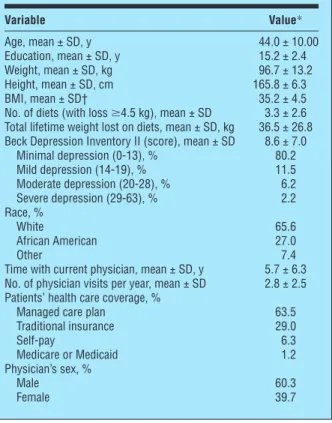
The characteristics of the 259 women are presented in Table 1. Their mean BDI-II score of 8.6 ± 7.0 indicated “minimal” symptoms of depression.
Most patients (85.3%) reported that they had a pri-mary care physician; a gynecologist or nurse practi-tioner was identified as the primary provider by 8.9% and 2.3% of participants, respectively. The 3.5% of respon-dents who did not have a primary care physician (cluding a gynecologist or other provider) were in-structed to respond to the questionnaire items with regard to their previous experience with physicians.
RELIABILITY OF THE HEALTH CARE QUESTIONNAIRE
Fifty-seven patients completed the Health Care Question-naire on 2 separate occasions, 2 to 3 weeks apart, to pro-vide estimates of item test-retest reliability. Pearson prod-uct moment correlations were used to calculate reliability for all questions that used 5- or 7-point scales. For the 14 items inTable 2that measured satisfaction with care for general health and weight, reliability coefficients ranged fromr=0.62 tor=0.79 (r=0.71 for both mean and me-dian). The coefficients for the 2 items inTable 3were r= 0.72 and r= 0.65, respectively. For the 10 items in
Table 1. Demographic and Other Characteristics of the 259 Women Studied
Variable Value* Age, mean ± SD, y 44.0 ± 10.00 Education, mean ± SD, y 15.2 ± 2.4 Weight, mean ± SD, kg 96.7 ± 13.2 Height, mean ± SD, cm 165.8 ± 6.3 BMI, mean ± SD† 35.2 ± 4.5
No. of diets (with loss$4.5 kg), mean ± SD 3.3 ± 2.6 Total lifetime weight lost on diets, mean ± SD, kg 36.5 ± 26.8 Beck Depression Inventory II (score), mean ± SD 8.6 ± 7.0
Minimal depression (0-13), % 80.2 Mild depression (14-19), % 11.5 Moderate depression (20-28), % 6.2 Severe depression (29-63), % 2.2 Race, % White 65.6 African American 27.0 Other 7.4
Time with current physician, mean ± SD, y 5.7 ± 6.3 No. of physician visits per year, mean ± SD 2.8 ± 2.5 Patients’ health care coverage, %
Managed care plan 63.5
Traditional insurance 29.0 Self-pay 6.3 Medicare or Medicaid 1.2 Physician’s sex, % Male 60.3 Female 39.7
*Percentages may not total 100 because of rounding.
†BMI indicates body mass index (calculated as weight in kilograms divided by the square of height in meters).
Table 2. Patients’ Satisfaction With Care Provided by Their Physician for Their Health Compared With Their Weight*
Patients Were Asked, “How
Satisfied Are You With . . .” Health Weight “Your doctor’s degree of medical
expertise concerning your”
6.2 ± 1.2 4.3 ± 1.7 “The overall care your doctor
provides for your”
6.1 ± 1.4 4.1 ± 1.6 “The degree to which your doctor
explains things about your”
6.0 ± 1.4 4.3 ± 1.7 “How your doctor talks with you
about your”
5.9 ± 1.4 5.1 ± 1.6 “The degree to which your doctor
listens to you discuss your”
5.9 ± 1.6 4.7 ± 1.7 “How well your doctor understands
your feelings about your”
5.7 ± 1.5 4.6 ± 3.1 “The amount of time your doctor
spends discussing your”
5.7 ± 1.6 4.1 ± 1.7
*Data are given as the mean ± SD. All items were rated using 7-point scales, in which 1 indicates very dissatisfied; 2, moderately dissatisfied; 3, slightly dissatisfied; 4, neutral or neither satisfied nor dissatisfied; 5, slightly satisfied; 6, moderately satisfied; and 7, very satisfied. For each item, satisfaction with care for general health vs weight was assessed using paired sample t tests. For all 7 pairs of items, patients reported that they were significantly ( P,.001) less satisfied with the aspects of care related to their weight than with those related to their general health.
Table 4, which assessed negative weight-related interac-tions with physicians, reliability coefficients ranged from r=0.54 tor=0.74 (r=0.66 for both mean and median). The reliability with which patients reported the weight loss meth-ods that their physicians had prescribed was assessed by percentage agreement. For each item, we determined the percentage of respondents who gave the same answer (yes or no) on both test administrations. Percentage agree-ment ranged from a low of 83.6% for physician “provided a diet plan” to a high of 100% for physician “referred you to a dietitian” and “referred you to a commercial weight loss program.” The mean was 93.3%, and the median was 92.7%. The values for the 4 different sets of items, previ-ously described, indicate that the questionnaire had ac-ceptable test-retest reliability.
PATIENTS’ SATISFACTION WITH CARE Patients reported that they were generally satisfied with the medical care their physician provided for their gen-eral health. As shown in Table 2, mean ratings for each of the 7 items were in the moderately satisfied range. The highest 2 satisfaction ratings were for “your doctor’s de-gree of medical expertise” and for “the overall care your doctor provides.” Even for the lowest-rated item, “how well your doctor understands your feelings about your general health,” respondents were still close to moder-ately satisfied.
By contrast, patients’ satisfaction with care they re-ceived for their weight fell only in the neutral to slightly satisfied range. For example, satisfaction with overall care their physicians provided for their weight was rated neu-tral. Data in Table 2 show that for all 7 pairs of items, patients reported that they were significantly (P#.001) less satisfied with the aspects of care related to their weight than with those related to their general health.
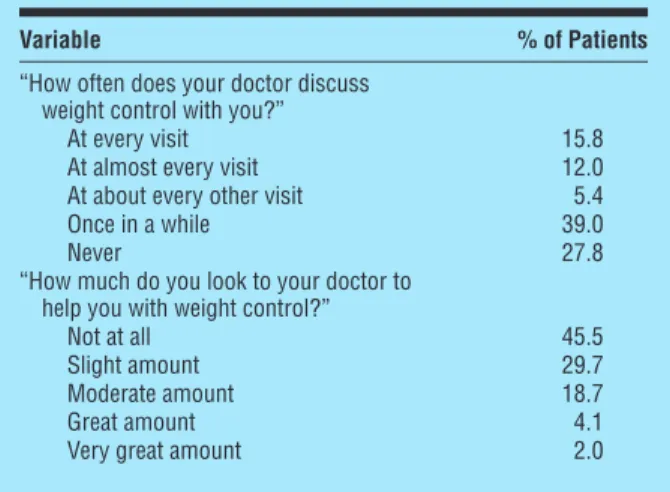
Table 3. Patients’ Description and Evaluation of Physicians’ Weight Control Counseling
Variable % of Patients
“How often does your doctor discuss weight control with you?”
At every visit 15.8
At almost every visit 12.0
At about every other visit 5.4
Once in a while 39.0
Never 27.8
“How much do you look to your doctor to help you with weight control?”
Not at all 45.5
Slight amount 29.7
Moderate amount 18.7
Great amount 4.1
Very great amount 2.0
Table 4. Patients’ Reports of Negative Interactions With Physicians Concerning Weight
Variable % of Patients*
“When I lost weight and regained it, doctors criticized me for not trying harder”
Always 0.0
Usually 0.4
Sometimes 9.7
Rarely 14.9
Never 75.0
“Doctors have said critical or insulting things to me about my weight” Always 1.2 Usually 0.8 Sometimes 11.2 Rarely 15.3 Never 71.5
“I have been very upset by comments that doctors have made about my weight”
Always 1.6
Usually 2.8
Sometimes 17.7
Rarely 31.0
Never 46.8
“I feel that I have been treated disrespectfully by the medical profession because of my weight” Always 0.8 Usually 7.2 Sometimes 14.5 Rarely 21.7 Never 55.8
“Doctors have tried to scare me into losing weight by warning me about health risks associated with being overweight”
Always 2.8
Usually 4.0
Sometimes 24.2
Rarely 25.0
Never 44.0
“I feel that I cannot speak freely with doctors about my weight” Always 3.2 Usually 10.9 Sometimes 20.6 Rarely 23.8 Never 41.5
“I feel that doctors don’t believe me when I tell them that I don’t eat that much”
Always 5.8
Usually 5.4
Sometimes 24.0
Rarely 18.2
Never 46.7
“I feel that doctors don’t treat overweight people as nicely as they do average-weight people” Always 2.0 Usually 8.5 Sometimes 28.5 Rarely 21.1 Never 39.8
“Doctors have told me that I need to lose weight without my asking them”
Always 3.2
Usually 16.1
Sometimes 39.1
Rarely 16.5
Never 25.0
“I feel that most doctors don’t understand how difficult it is to be overweight”
Always 8.1
Usually 19.0
Sometimes 36.8
Rarely 17.0
Never 19.0
CORRELATES OF SATISFACTION WITH CARE Patients’ degree of satisfaction with the care they received for their obesity was examined in relation to several vari-ables, shown in Table 1, including depression (as measured by the BDI-II) and patients’ weight. Each variable was cor-related with the 7 items shown in Table 2. Only correlations significant atP#.007 (ie, 0.05/7=0.007) were considered statisticallysignificant.Patients’BDI-IIscorescorrelatednega-tively with all 7 weight satisfaction items, withrvalues rang-ing from −0.18 to −0.27 (P,.007 for all). Thus, the more symptoms of depression patients reported, the less satis-fied they were with the components of care they received fortheirobesity.Norelationswerefoundbetweenthe7items and patients’ BMI, years with their physician, or number of office visits per year. An analysis of variance revealed no significant (P..23) differences in satisfaction with obesity care in relation to patients’ ethnicity, physicians’ sex, or type of health care coverage. There were no significant (P..37) relations between these same variables (shown in Table 1) and patients’ satisfaction with their general medical care.
PHYSICIANS’ WEIGHT MANAGEMENT PRACTICES
Data presented in Table 3 reveal that patients did not ap-pear to rely on their primary care physicians for weight management. Almost half (45.5%) of the participants re-ported that they did not look to their physician “at all” for help with weight control, and 29.7% indicated that they did so only a “slight amount.” One third of patients reported that their physician discussed weight control with them at least at every other visit. However, 39% re-sponded “once in a while,” and 27.8% reported “never.” Almost half (44.8%) of the respondents indicated that their physician had not prescribed any of the 10 weight con-trol methods shown in theFigure; 21.6% reported that
their physician had prescribed 1 intervention; 17.0%, 2 methods; 7.7%, 3 methods; and 5.0%, 4 methods.
Nearly one fourth (23.2%) of the physicians were re-ported (by respondents) to have prescribed a diet plan, with a commercial weight loss program (Weight Watchers), medication, readings, and exercise the 4 next most com-monly prescribed interventions. Physicians, according to patients, made few referrals to dietitians, exercise instruc-tors, or other commercial weight loss programs. No sig-nificant relations were found between patient characteris-tics (including BMI) and the number of weight loss methods that physicians were reported to have prescribed.
PATIENTS’ REPORTS OF NEGATIVE INTERACTIONS WITH PHYSICIANS Findings presented in Table 4 indicate that patients gen-erally did not report negative interactions with physi-cians concerning their weight. Nearly 80% of the respon-dents indicated that they rarely or never had been “treated disrespectfully by the medical profession because of my weight.” Similarly, approximately 80% indicated that they rarely or never: (1) had “been very upset by comments that doctors have made about my weight,” (2) had phy-sicians say “critical or insulting things to me about my weight,” or (3) had “doctors criticize me for not trying harder” when patients lost weight and regained it.
In contrast to these generally favorable findings, nearly two thirds of the respondents indicated that their physicians “don’t understand how difficult it is to be overweight” (as indicated by responses of “always,” “usually,” or “some-times”). About one third of patients indicated that “doctors don’t believe me when I tell them that I don’t eat that much.”
CORRELATES OF NEGATIVE INTERACTIONS No significant (P..41) relations were found between pa-tients’ reports of negative interactions with physicians and 25 15 20 10 5 0
Diet Plan Commercial Program (Weight Watchers) Readings Medication Exercise Plan Eating Habits Exercise Instructor Controlled Energy Diet
Dietitian Other Commercial Programs 23.2 18.5 14.7 16.6 12.7 7.3 6.2 11.2 6.9 3.9
% of Physicians Reported to Recommend Different Methods
The percentage of physicians who, according to their patients, recommended each of 10 weight loss methods. Patients were given no additional information about the weight loss methods than that shown.
participants’ BMI or depression score. Similarly, none of the 10 items in Table 4 was significantly related to phy-sicians’ sex. White and African American women dif-fered significantly on only one scale. White women were more likely than African American women to report that “I cannot speak freely with doctors about my weight” (score, 4.3 ± 1.1 vs 3.8 ± 1.1;P,.003).
COMMENT
Results of this study provide encouragement for the treat-ment of obesity in primary care practice, while also raising concerns. The encouraging news is that the great majority of obese women did not report being treated disrespectfully or insensitively by their physicians when weight manage-ment was discussed. This finding presents a welcomed con-trast to the anecdotal portrait of a hostile practitioner who berates patients for not losing weight.9,20The concern, how-ever, is that most practitioners, according to their patients, offer little or no guidance for weight management. In this regard, the findings support the contention of Frank5that many physicians avoid the treatment of obesity.
This study was undertaken because of concerns that obese patients might be treated disrespectfully by health care professionals (who, for the purposes of weight management, include dietitians, exercise specialists, nurses, physicians, and psychologists). Several of us (T.A.W., D.A.A., G.D.F., and D.B.S.) have encountered patients who reported that they were criticized by their physician for failing to lose weight, for supposedly lying about what they ate, or for sim-ply not trying harder. We were troubled by these reports and sought to repair any damage to patients’ self-esteem. We also wanted, however, to determine the prevalence of such occurrences in a well-defined sample. The results of this study indicate that a small minority of patients do be-lieve that they are routinely (always or usually) criticized or treated disrespectfully by health care professionals, as revealed by responses to the first 4 items in Table 4. This finding is cause for concern. The prevalence, however, of such complaints, which ranged from 0.4% to 8.0%, was far lower than we had feared, based on anecdotal reports. Thus, even though the patients we studied were significantly over-weight and had a history of failed over-weight loss efforts, 90% reported that their primary care physicians had rarely or never criticized them for not trying harder or said critical or insulting things about their weight. These results con-trast with those of Rand and MacGregor,1178% of whose patients reported having been treated disrespectfully. The difference between these 2 studies may have been related to the greater obesity of Rand and MacGregor’s patients (ie, their mean BMI was 45.4) and to their potentially greater distress with weight management. High distress or frustra-tion may be factors that lead patients to choose bariatric sur-gery. However, Rand and MacGregor surveyed only 57 pa-tients and assessed negative patient-physician interactions
using only a single item. These findings need to be repli-cated in a larger sample of patients who undergo bariatric surgery, using more questions, as in the present study.
The obese women we studied appeared to be gener-ally satisfied with their overall medical care and with their physicians’ expertise pertaining to their general health. As expected, however, they were significantly less satisfied with their care (and their physicians’ expertise) related to weight management. Ratings of each of these items fell in the neutral range (ie, neither satisfied nor dissatisfied). Moreover, as shown in Table 2, patients were signifi-cantly less satisfied with each of the components of care provided for their weight than for their general health.
We had expected patients to report greater dissatis-faction with their physicians’ weight-related attitudes and practices. Two factors may have minimized such com-plaints, the first which is overweight individuals’ ten-dency to blame themselves for their obesity and for their inability to lose weight.9Many obese individuals view their obesity as a personal failing. Second, these women did not appear to expect their physicians to provide weight coun-seling; 75% reported that they did not look to their phy-sician at all or only a slight amount to help them with their weight. According to patients, almost half of their physi-cians had not prescribed any of the weight loss methods shown in the Figure, and more than two thirds of physi-cians never or only once in a while broached the topic of weight control. Thus, for many of these women, the treat-ment of obesity appears to have ended in a stalemate; pa-tients have few expectations of receiving assistance from their physicians, and few practitioners offer significant help. It is possible that a review of patients’ medical rec-ords (or transcripts of office visits) would reveal that more physicians had, in fact, discussed the importance of weight loss and recommended appropriate methods of weight re-duction. Unfortunately, we were unable to conduct such a review. If this finding were obtained, it would suggest that primary care physicians would need to either dis-cuss weight control more frequently or tailor their mes-sages so that patients would be more likely to hear them. The generalizability of our findings is open to ques-tion, given that they were obtained with patients in a research clinic. It is possible that obese patients who were surveyed inprimarycarepracticeswouldbemorelikelytoreportnega-tive weight-related interactions with physicians. Our sample, however, was selected specifically to increase the likelihood of identifying patients who had failed to control their weight with their physicians’ assistance, thus increasing the like-lihood of unfavorable patient-physician interactions con-cerning weight. Similarly, we thought that assuring patients’ confidentiality, and assessing them at a site removed from their physician’s office, also would increase reports of nega-tive, weight-related interactions. Apparently, it did not. An-other explanation for our relatively low rate of complaints is that if patients had been offended by their physicians’
re-marks, they might be unlikely to seek weight reduction at a research clinic such as ours. This would prevent us from assessing individuals who potentially would report the most negative physician-patient interactions concerning weight. A final explanation is that negative physician attitudes toward obesity, reported 10 to 30 years ago, may have im-proved in light of important discoveries concerning the roles of genetic21and neuroendocrine22factors in the regulation of body weight. Physicians may treat obese individuals with greater respect and understanding than they did before such discoveries.
Physicians in this study were defined generically as “primary care physicians” and were identified, as such, by their patients. In future studies, each practitioner’s area of specialization should be identified and verified independently. Differences, for example, in patients’ satisfaction with weight management might be ob-served based on whether their physician specialized in family medicine, internal medicine, gynecology, or other areas.
Further studies are needed to determine whether pa-tients who are less obese than our participants, or who have not sought weight management in a specialty clinic, have different views of physicians’ weight control atti-tudes and practices. Such investigations might best be completed using a randomly selected national sample that includes men and women and individuals of varied eth-nicity and socioeconomic status. It would also be useful to assess physicians’ perceptions of their own weight con-trol attitudes and practices, compared with patients’ re-ports of these factors.
In the meantime, the good news from this study is that primary care physicians do not appear to have rou-tinely alienated their obese patients by making critical or offensive remarks about weight. The challenge, how-ever, for physicians, raised by Frank,5is to determine how they can help obese individuals reduce their initial weight by 5% to 15% and, thus, improve physical and psycho-logical health.1,23-26New treatment guidelines and ap-proaches1,4,25,27should be of assistance to this end, as should physicians’ communicating that they recognize the substantial effort that many obese individuals have already devoted to weight control.28
Accepted for publication July 10, 2000.
This study was supported by a Research Scientist De-velopment Award from the National Institute of Mental Health, Rockville, Md; by grant DK-5008 from the Na-tional Institutes of Health, Bethesda, Md; and by a grant from Knoll Pharmaceutical Co, Mount Olive, NJ.
Reprints: Thomas A. Wadden, PhD, Department of Psy-chiatry, University of Pennsylvania, 3600 Market St, Suite 738, Philadelphia,PA19104(e-mail:[email protected]).
REFERENCES
1. NHLBI Obesity Education Initiative Expert Panel. Clinical guidelines on the identification, evaluation, and treatment of overweight and obesity in adults: the evidence report.Obes Res.1998;6(suppl):51S-209S. 2. Simkin-Silverman LR, Wing RR. Management of obesity in primary
care.Obes Res.1997;5:603-612.
3. Levy BT, Williamson PS. Patient perceptions and weight loss of obese adults.J Fam Pract.1988;27:285-290.
4. Anderson DA, Wadden TA. Treating the obese patient: suggestions for primary care practice.Arch Fam Med.1999;8:156-167.
5. Frank A. Futility and avoidance: medical professionals in the treat-ment of obesity.JAMA.1993;269:2132-2133.
6. Stunkard AJ, Wadden TA. Psychological aspects of severe obesity.Am J Clin Nutr.1992;55(suppl 2):524S-532S.
7. Maddox GL, Leiderman V. Overweight as a social disability with medi-cal implications.J Med Educ.1969;44:214-220.
8. Price JH, Desmond SM, Krol RA, Snyder FF, O’Connell JK. Family prac-tice physicians’ beliefs, attitudes, and pracprac-tices regarding obesity.Am J Prev Med.1987;3:339-345.
9. Foster GD, Johnson C. Facilitating health and self-esteem among obese patients.Primary Psychiatry.1998;5:89-95.
10. Yanovski SZ. Large patients and lack of preventive health care: phy-sician or patient driven [editorial]?Arch Fam Med.1998;7:385. 11. Rand CSW, MacGregor AMC. Morbidly obese patients’ perceptions of
social discrimination before and after surgery for obesity.South Med J.1990;83:1390-1395.
12. Adams CH, Smith NJ, Wilbur DC, Grady KE. The relationship of obe-sity to the frequency of pelvic examinations: do physician and patient attitudes make a difference?Women Health.1993;20:45-57. 13. Fontaine KR, Faith MS, Allison DB, Cheskin LJ. Body weight and health
care among women in the general population.Arch Fam Med.1998; 7:381-384.
14. Olson CL, Schumaker HD, Yawn BP. Overweight women delay medi-cal care.Arch Fam Med.1994;3:888-892.
15. McAffe L. Discrimination in medical care.Healthy Weight J.1997;11: 96-97.
16. Smith SE. Patient perspective.Arch Fam Med.1994;3:892. 17. Murphree D. Patient attitudes toward physician treatment of obesity.
J Fam Pract.1994;38:45-48.
18. Beck AT, Steer RA, Brown GK.Beck Depression Inventory: Second Edi-tion Manual.San Antonio, Tex: Psychological Corp; 1996.
19. Wadden TA, Bartlett SJ, Letizia KA, Foster GD, Stunkard AJ, Conill AM. Relationship of dieting history to resting metabolic rate, body com-position, eating behavior, and subsequent weight loss.Am J Clin Nutr. 1992;56(suppl 1):203S-208S.
20. Wadden TA, Wingate BJ. Compassionate treatment of the obese in-dividual. In: Brownell KD, Fairburn CG, eds.Eating Disorders and Obe-sity: A Comprehensive Handbook.New York, NY: Guilford Publica-tions; 1995:564.
21. Stunkard AJ, Harris JR, Pederson NL, McClearn GE. The body mass index of twins who have been reared apart.N Engl J Med.1990;322: 1483-1487.
22. Campfield LA, Smith FJ, Guisez Y, Devos R, Burn P. Recombinant mouse OB protein: evidence for a peripheral signal linking adiposity and cen-tral neural networks.Science.1995;269:475-476.
23. Blackburn GL. Effect of degree of weight loss on health benefits.Obes Res.1995;3(suppl 2):211S-216S.
24. Pi-Sunyer FX. Short-term medical benefits and adverse effects of weight loss.Ann Intern Med.1993;119:722-726.
25. World Health Organization.Obesity: Preventing and Managing the Global Epidemic.Geneva, Switzerland: World Health Organization; 1998. 26. Wadden TA, Steen SN, Wingate BJ, Foster GD. Psychosocial
conse-quences of weight reduction: how much weight loss is enough?Am J Clin Nutr.1996;63(3 suppl).
27. Bray GA.Contemporary Diagnosis and Management of Obesity. New-town, Pa: Handbooks in Health Care Co; 1998.
28. Stunkard AJ. Talking with patients. In: Stunkard AJ, Wadden TA, eds. Obe-sity: Theory and Therapy.New York, NY: Raven Press; 1993:355-363.