UKnowledge
Information Science Faculty Publications
Information Science
3-3-2017
Lightweight Three-Factor Authentication and Key
Agreement Protocol for Internet-Integrated
Wireless Sensor Networks
Qi Jiang
Xidian University, China
Sherali Zeadally
University of Kentucky, [email protected]
Jianfeng Ma
Xidian University, China
Debiao He
Wuhan University, China
Right click to open a feedback form in a new tab to let us know how this document benefits you.
Follow this and additional works at:
https://uknowledge.uky.edu/slis_facpub
Part of the
Digital Communications and Networking Commons
, and the
Information Security
Commons
This Article is brought to you for free and open access by the Information Science at UKnowledge. It has been accepted for inclusion in Information Science Faculty Publications by an authorized administrator of UKnowledge. For more information, please [email protected].
Repository Citation
Jiang, Qi; Zeadally, Sherali; Ma, Jianfeng; and He, Debiao, "Lightweight Three-Factor Authentication and Key Agreement Protocol for Internet-Integrated Wireless Sensor Networks" (2017).Information Science Faculty Publications. 48.
Notes/Citation Information
Published in
IEEE Access
, v. 5, p. 3376-3392.
© 2017 IEEE
The copyright holder has granted the permission for posting the article here.
Digital Object Identifier (DOI)https://doi.org/10.1109/ACCESS.2017.2673239
Received January 29, 2017, accepted February 14, 2017, date of publication March 3, 2017, date of current version March 28, 2017. Digital Object Identifier 10.1109/ACCESS.2017.2673239
Lightweight Three-Factor Authentication and Key
Agreement Protocol for Internet-Integrated
Wireless Sensor Networks
QI JIANG1, SHERALI ZEADALLY2, JIANFENG MA1, AND DEBIAO HE3,4
1School of Cyber Engineering, Xidian University, Xi’an 710071, China
2College of Communication and Information, University of Kentucky, Lexington, KY 40506-0224, USA 3Software Engineering, Wuhan University, Wuhan 430072, China
4School of Computer and Software, Nanjing University of Information Science and Technology, Nanjing 210044, China Corresponding author: Q. Jiang ([email protected])
This work was supported in part by the National Science Foundation of China under Grant 61672413, Grant 61572379, Grant 61501333, Grant U1405255, Grant 61372075, and Grant U1536202, in part by the Natural Science Basic Research Plan in Shaanxi Province of China under Grant 2016JM6005, in part by Fundamental Research Funds for the Central Universities under Grant JB161501 and
Grant JBG161511, in part by the National High Technology Research and Development Program (863 Program) of China under Grant 2015AA016007, and in part by the China 111 Project under Grant B16037.
ABSTRACT Wireless sensor networks (WSNs) will be integrated into the future Internet as one of the components of the Internet of Things, and will become globally addressable by any entity connected to the Internet. Despite the great potential of this integration, it also brings new threats, such as the exposure of sensor nodes to attacks originating from the Internet. In this context, lightweight authentication and key agreement protocols must be in place to enable end-to-end secure communication. Recently, Aminet al. proposed a three-factor mutual authentication protocol for WSNs. However, we identified several flaws in their protocol. We found that their protocol suffers from smart card loss attack where the user identity and password can be guessed using offline brute force techniques. Moreover, the protocol suffers from known session-specific temporary information attack, which leads to the disclosure of session keys in other sessions. Furthermore, the protocol is vulnerable to tracking attack and fails to fulfill user untraceability. To address these deficiencies, we present a lightweight and secure user authentication protocol based on the Rabin cryptosystem, which has the characteristic of computational asymmetry. We conduct a formal verification of our proposed protocol using ProVerif in order to demonstrate that our scheme fulfills the required security properties. We also present a comprehensive heuristic security analysis to show that our protocol is secure against all the possible attacks and provides the desired security features. The results we obtained show that our new protocol is a secure and lightweight solution for authentication and key agreement for Internet-integrated WSNs.
INDEX TERMS Authentication, biometrics, key management, privacy, Rabin cryptosystem, smart card, wireless sensor networks.
I. INTRODUCTION
One vision of future Internet is that objects and things with sensing and actuating capabilities will be connected and inte-grated making up the Internet of Things (IoTs). As Wire-less Sensor Network (WSN) is one of the core technologies supporting the sensing capabilities required by future appli-cations, the integration of WSN with the Internet will have an active role in the evolution of the architecture of future Internet [1]–[3]. The Internet Engineering Task Force (IETF) has developed a suite of protocols and open standards for
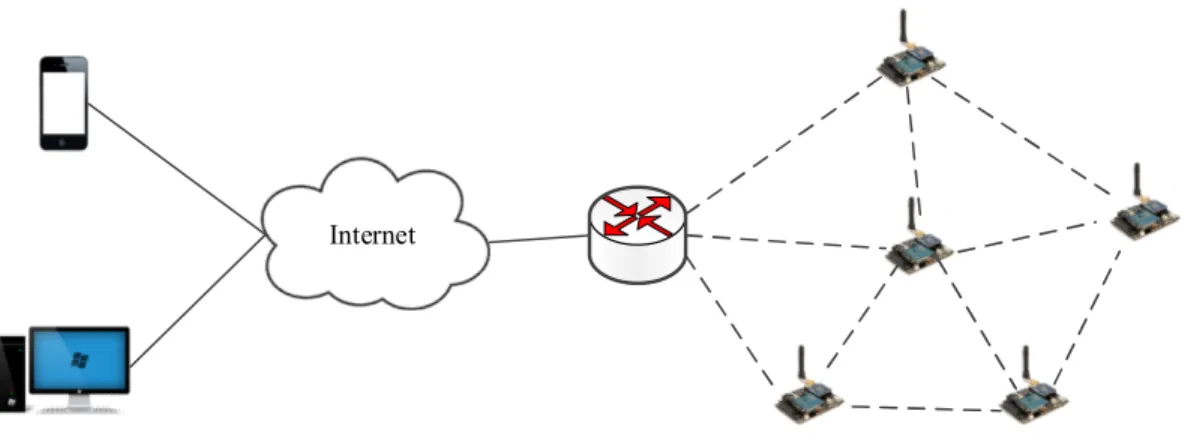
integrating WSN into Internet [4], such as 6LoWPAN [5] and ROLL [6]. As illustrated in Fig. 1, sensor nodes (SNs) can be connected by low rate and low power wireless technologies such as IEEE 802.15.4, and can be further linked to the Internet via a 6LoWPAN gateway. Therefore, sensors will be globally addressable by any entity connected to the Internet thereby enabling the remote access of sensor data.
Despite its great potential, the integration of WSN with the Internet also brings new threats, such as the exposure of resource-constrained SNs and low rate wireless links in
3376
2169-35362017 IEEE. Translations and content mining are permitted for academic research only.
FIGURE 1. Typical architecture of Internet integrated wireless sensor networks.
WSN to attacks emanating from the Internet [3], [7]–[12]. Given its sensitivity and criticality, the sensor data in transit must be protected by an end-to-end (E2E) secure channel between the SN and the entity outside the WSN. The creation of such a channel requires authentication and key agree-ment mechanisms that allow two remote entities to mutually authenticate and negotiate secret keys that are used to protect the sensor data against various types of active and passive attacks [2], [13], [14]. Note that even if the WSN itself has security measures at a lower layer such as the link layer security services defined by IEEE 802.15.4, the openness of the Internet still requires authentication and key agreement protocols for establishing the E2E secure channel between the two communicating peers [2].
It is not possible to directly utilize Internet-centric security solutions because of the inherent characteristics of WSN (e.g., the limited computational capabilities and power supply of sensors and mobile devices) [2]. As discussed in [15], many attempts (for instance, IPsec [16], IKEv2 [17]) have been made to adapt standard Internet security protocols in this scenario.
However, resource limitation and the large number of SNs hinder the adoption of these solutions. Therefore, it is imper-ative to enable authentication and key establishment between the SN and the entity outside WSN in a secure and lightweight manner. However, past experiences [18]–[20] have shown that it is not trivial to design such security protocols.
A. RELATED WORKS
In the last decade, various security mechanisms [7], [21]–[25] have been proposed to prevent unauthorized access to the sensor data in transit. Li and Xiong [24] proposed a signcryption scheme to protect the information flow between a sensor and an entity outside the WSN, which fulfills con-fidentiality, integrity, authentication, and non-repudiation in one step. However, bilinear pairing is used in the scheme, which makes it unsuitable (because of its high computation and processing overheads) for regular SNs.
Astorga et al. [25] proposed the Ladon security protocol which provides E2E authentication and key
establishment mechanism for resource-constrained devices. To prevent potential eavesdroppers from tracking users’ access patterns, they also presented a privacy-enhanced Ladon protocol by integrating the original protocol with the PrivaKERB user privacy framework for Kerberos [7]. In these protocols, the long keys need to be securely stored and may be compromised.
To improve WSN security, two-factor authentication (2FA) protocols [26] have been introduced in WSN. In such pro-tocols, two different types of security credential are used, i.e., smart card and password, to prove his/her identity. Over a dozen of 2FA schemes for WSNs have been proposed in recent years [18]–[20], [27]–[31]. We briefly review the ones closest to this work.
In 2014, Turkanovic et al. [32] proposed a lightweight 2FA protocol based on hash function for WSNs, which is claimed to be energy efficient and secure. However, Amin and Biswas [33] showed that the protocol of Turkanovic et al. [32] has several security weaknesses, including offline identity guessing attack, offline password guessing attack, impersonation attack, etc. To address these security deficiencies, they proposed a 2FA protocol for multi-gateway WSN. Independently, Farash et al. [34] also revealed that the protocol of Turkanovic et al. [32] is susceptible to smart card loss attacks (SCLA), impersonation attack, session key disclosure, et al. and proposed an improved 2FA proto-col. In the same year, Chang and Le [35] demonstrated that the 2FA protocol by Turkanovic et al. [32] is prone to SN spoofing attack, stolen smart card attack, and stolen verifier attack, et al. Then they proposed two 2FA protocols P1 and P2 [37]. P1 is based on hash functions, while P2 employs Elliptic Curve Cryptography (ECC).
Lu et al. [36] analyzed Amin-Biswas’s 2FA protocol [33] and identified several security drawbacks in their protocol. Next, they proposed an enhanced 2FA scheme using sym-metric key cryptography, which is claimed to be resilient to a variety of attacks. Wu et al. [37] also pointed out that the 2FA protocol of Amin and Biswas [33] is insecure. Most recently, Das et al. [38] showed that both P1 and P2 by Chang and Le [35] are vulnerable to session specific temporary
information attack and offline password guessing attack, etc. Amin et al. [39] found that the protocol of Farash et al. [34] cannot provide user anonymity, or withstand SCLA, offline password guessing attack, user impersonation attack, known session-specific temporary information attack (KSSTIA).
To address the vulnerabilities associated with the various 2FA approaches and further enhance the security strength of 2FA protocols, three-factor authentication (3FA) proto-cols have attracted the attention of researchers [40]–[44]. In the context of WSN, Das [45] presented a 3FA protocol based on symmetric cryptographic primitives. Next, he also proposed two other 3FA protocols [46]–[47]. Unfortunately, Wu et al. [48] demonstrated that all the three protocols are not secure. To address the drawbacks, they proposed an improved 3FA scheme based on ECC. Independently, Li et al. [49] presented a novel 3FA protocol based on the concept of biohashing. However, Das et al. [50] demonstrated that the protocol of Li et al. [49] is vulnerable to privileged insider attack, SN capture attack and cannot provide user anonymity. Most recently, to remedy these security loopholes in the protocol of Farash et al. [34], Amin et al. [39] presented a new secure 3FA protocol, which is claimed to be secure against all the known security attacks. Additionally, to satisfy the practi-cal requirements, their protocol provides the functionalities of post deployment, identity update, password update, and smart card revocation. However, we observe that the protocol by Amin et al. still has some subtle security weaknesses.
B. OUR RESEARCH CONTRIBUTIONS
Although several 3FA protocols [38], [39], [45]–[49] have been proposed in the literature, all these protocols either fail to provide adequate security protection or suffer from various security vulnerabilities. In this paper, we use the most recent 3FA protocol of Amin et al. [39] as a case study to show the challenge of designing a lightweight authentication protocol suitable for Internet integrated WSN. Then we propose an authentication protocol for Internet integrated WSN which exploits the computational asymmetry feature of Rabin cryp-tosystem. We summarize our main research contributions as follows:
• First, we analyze the most recent 3FA protocol of Amin et al. [39] and we present its security drawbacks. Specif-ically, we found that their protocol suffers from Type I SCLA (the secret data obtained from the smart card is enough for an adversary to reveal the user password) and Type II SCLA (the transcripts of an authentication ses-sion are needed for an attacker, in addition to the secret parameters in the user’s smart card). Specifically, the user identity and password can be exhaustively guessed in an offline manner along with the secrets stored in the stolen smart card and the intercepted authentication mes-sages. Additionally, the protocol suffers from KSSTIA if the temporal parameters in an authentication session are disclosed. Furthermore, the protocol is prone to tracking attack and cannot fulfill user untraceability.
• Second, we present an efficient and secure 3FA protocol based on the Rabin cryptosystem. Unlike other public key-based encryption algorithms such as RSA and ECC, Rabin has the characteristic of computational asymme-try. In this case, the encryption is very efficient while the decryption is relatively heavyweight. This feature is particular well suited for Internet integrated WSN because the mobile device of users is generally resource-constrained while the gateway has no such restriction. • Third, we conducted a formal verification using
ProVerif [51] to demonstrate that our protocol fulfills the required security features. Furthermore, we also present comprehensive heuristic security analysis to demonstrate that our protocol is capable of withstand-ing all the possible active and passive attacks includ-ing the security weaknesses revealed in the protocol of Amin et al., and we show how it provides the desired security features. Additionally, performance analysis shows that our proposed protocol is a practical solution that can provide authentication and key agreement for Internet integrated WSN, while achieving both security and efficiency.
The remainder of this paper is organized as follows. The preliminaries of Biohashing and Rabin cryptosystem are given in Section 2. We review and analyze Amin et al.’s protocol [39] in Section 3 and 4 respectively. In Section 5, we propose a novel 3FA and key agreement protocol for Internet integrated WSN. Section 6 and Section 7 present security and efficiency analyses of the new protocol. Section 8 concludes the paper.
II. PRELIMINARY
A. BIOHASHING
Biometric is widely used to verify the identity of a user. It offers several advantages over traditional authentication methods, i.e., password and smart card. Biometric feature data is closely coupled with each individual and cannot be replaced. As a result, the disclosure of biometric data leads to serious privacy risks. Numerous schemes have been proposed to preserve the privacy of biometric template [52]–[55].
Biohashing [55], [56] is one of the mainstream privacy-preserving biometric schemes. In the enrollment stage, a biohash value BH(K,B) is generated from the biometric templateBand a random secret key K. Specifically, a pre-processing is performed onBin order to make the biometric feature invariant to small variations in the input biometric signal. Then, the biohash value BH(K,B) is generated by comparing the inner product of the random vector generated from the user specific secret keyK and the feature vector extracted against a predefined threshold. In the verification stage, by following the process used at the enrolment stage, a biohash valueBH(K,B0) can be generated from the received biometric signal B0 and the secret key given by the user. Afterwards, the verification is done by comparingBH(K,B0) with the stored valueBH(K,B) [52].
B. RABIN CRYPTOSYSTEM
The Rabin cryptosystem [57], [58] is a public key crypto-graphic primitive based on integer factorization. The scheme includes three algorithms, i.e., key generation, encryption and decryption.
Key generation: We choose two large distinct primespand qsuch thatp,q ≡3(mod4), and computeN =pq. ThenN is the public key, and (p,q) is the private key.
Encryption: We encrypt a plaintext m by computing c=m2modN.
Decryption: We decrypt a ciphertext m = √cmodN. Specifically, the receiver who knows the private key (p,q) can apply the Chinese remainder theorem to derive the four possible plaintexts{m1,m2,m3,m4}. One common technique
used to identify the correct plaintext is to add some pre-defined padding in the plaintext or requires the plaintext to conform to some pre-defined format.
If y has a square root x, i.e., there is a solution for y = x2modN, thenyis a quadratic residue mod N. The quadratic residue problem is described as follows: for y ∈ QRn, whereQRnis the set of all quadratic residues modN, it is computationally infeasible to findxwithout knowingp andqdue to the hardness of factoringN.
III. REVIEW OF Amin et al.’s PROTOCOL
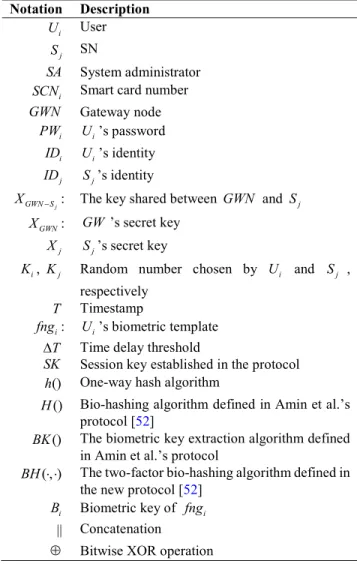
Amin et al.’s 3FA protocol [39] consists of 9 phases, i.e., system setup, SN registration, user registration, login, authen-tication, post deployment, identity update, password change, and smartcard revocation. We use the notations listed in Table 1 throughout this paper.
A. SYSTEM SETUP
SA selects and computes the system parameters in offline mode.
Step 1: SAchooses a master secret keyXGWN.
Step 2: SAselects an identityIDjand computes the secret keyXj=h(IDjkXGWN) for each SNSj(1≤j≤m).
Step 3: SA randomly generates a number Rshrd, which is shared between GWN and Sj. Finally, Sj stores < IDj,Xj,Rshrd >in its memory.
B. SN REGISTRATION
When GWN andSj(1 ≤ j ≤ m) are deployed to form a WSN. EachSj executes the following procedure to register withGWN.
Step 1: Sj computesS1 = IDj ⊕h(RshrdkTs1) andS2 =
h(IDjkXjkRshrdkTs1), and then sends < S1,S2,Ts1 > to
GWN.
Step 2: GWNverifies whether|TGWN−Ts1| ≤1T holds.
If it is false, GWN rejects the request of Sj; otherwise, it computes ID0j = S1 ⊕h(RshrdkTs1),X0 = h(ID0jkXGWN), andS20 =h(ID0jkXj0kRshrdkTs1) and checks whetherS20 =S2
holds. If it is not true,GWN rejectsSj; otherwise, it accepts Sj and stores IDj into the database. Then GWN sends a confirmation message toSj.
TABLE 1.Notations.
Step 3: After receiving the confirmation message, Sj deletesRshrdfrom its memory.
C. USER REGISTRATION
In this phase,Uiexecutes the following procedure to register withSA.
Step 1: Ui sends the selected identity IDi and personal credentials to SA through a secure channel.
Step 2: SAchecks whetherIDiexists in the database. If it does,SAindicatesUito select a new identity; otherwise,SA computesdi=h(IDikXGWN) andLi=h(SCNikXGWN), then the smart card storing< di,Li,SCNi,BK() >is delivered toUisecurely.SAmaintains a database storingUi’sIDiand credentials.
Step 3: Ui inserts the card into a card reader. Ui then enters < IDi,PWi > and fingerprint fngi. The card computes Bi = BK(H(fngi)), ei = h(IDikPWikBi), fi = di ⊕ h(IDikPWi), and gi = Li ⊕ h(PWi ⊕ IDi). Then the card stores < Bi,ei,fi,gi,SCNi,BK() > and deletes<di,Li>.
D. LOGIN
The following procedure is performed when Ui wishes to access sensor data.
Step 1: Ui inserts the smart card and imprints the fin-gerprint fngi. Then, the card computes B∗i = BK(H(fngi)) and checks whetherB∗i = Bi. IfB∗i 6= Bi, the card denies Ui’s login request; otherwise,Ui continues to enter his/her identity ID∗i and password PWi∗, and the card computes e∗i = h(ID∗ikPWi∗kB∗i). The card rejectsUi’s login request ife∗i 6=ei; otherwise, the enteredID∗i andPWi∗are valid.
Step 2: The card generates a random numberKi and the timestampT1, computesdi∗=fi⊕h(ID∗ikPWi∗),Li∗=gi⊕ h(PWi∗⊕ID∗i),M1=ID∗i ⊕h(L
∗
ikT1),M2=Ki⊕h(di∗kT1),
M3=h(di∗kKikT1) andSCTi=SCNi⊕h(T1).
Step 3: Ui selects the identity IDj of the sensor that he/she wishes to access, then the card computes EIDj = IDj ⊕ h(IDikKikT1)and sends MSG1 =<
M1,M2,M3,T1,SCTi,EIDj>toGWN.
E. AUTHENTICATION
Ui,GWN, andSjmutually authenticate each other and nego-tiate a secret key through the following steps.
Step 1: After receiving MSG1 from Ui,GWN computes
SCNi = SCTi ⊕ h(T1), Li0 = h(SCNikXGWN), ID0i =
M1⊕h(Li0kT1),di0 = h(IDi0kXGWN),Ki0 = M2⊕h(di0kT1),
andM30 = h(di0kKi0kT1).GWN aborts the current session if
M30 6= M3; otherwise, it computesM4 = h(ID0ikdi0kT1) and
then forwardsMSG1=<M4>toUi.
Step 2: UicomputesM4∗ = h(IDikdi∗kT1). IfM4∗ 6= M4,
Uiterminates the session; otherwise, he/she calculatesM5=
h(di∗kIDikKikT1) and transmitsMSG3=<M5>toGWN.
Step 3: GWNcalculatesM50 =h(di0kID0ikKi0kT1) and aborts
the connection ifM50 6=M5; otherwise, it proceeds to execute
the next procedure.
Step 4: GWNcomputesID0j=EIDj⊕h(IDikKikT1),Xj0=
h(ID0jkXGWN),M6 = h(ID0ikID0jkIDGWNkXj0kKi0kT2),M7 =
ID0i⊕h(IDGWNkXj0kT2),M8=Ki0⊕h(ID0ikXj0) and then sends
MSG4=<IDGWN,M6,M7,M8,T2>toSj.
Step 5: Sj checks whether|T3−T2| ≤ 1T holds, where
T3is the current timestamp. If it is invalid, Sj immediately terminates the session; otherwise, it computesID∗∗i =M7⊕
h(IDGWNkXjkT2),Ki∗∗=M8⊕h(ID∗∗i kXj), andM6∗∗=M7⊕
h(ID∗∗i kIDjkIDGWNkXjkKi∗∗kT2).Sjaborts the connection if M6∗∗ 6= M6; otherwise, it accepts that Ui and GWN are legitimate. Next,Sj computesSKj = h(IDi∗∗kIDjkKi∗∗kKj), M9 = h(SKjkXjkKjkT3), andM10 = Ki∗∗⊕Kj, whereKj
is a random number generated by Sj. Finally, Sj forwards MSG5=<M9,M10,T3>toGWN.
Step 6: GWNchecks whether|T4−T3| ≤1Tholds, where
T4is the current timestamp. If it is invalid,GWN aborts the
session; otherwise, it computesKj0 = M10⊕Ki0,SKGWN = h(ID0ikIDjkKi0kK 0 j), andM 0 9 = h(SKGWNkXj0kK 0 jkT3).GWN
rejects the session if M9∗ 6= M9; otherwise, it
com-putes M11 = h(SKGWNkIDi0kdikKj0). Finally, GWN sends MSG6=<M11,M10 >toUi.
Step 7: Ui computes Kj∗ = M10 ⊕ Ki, SKi =
h(IDikIDjkKikKj∗), andM11∗ =h(SKikIDikdikKj∗).Uirejects the session ifM11∗ 6= M11; otherwise,Uiaccepts thatGWN andSjare authentic. The session keySKi =SKj = SKGWN are shared amongUi,Sj, andGWN.
F. POST DEPLOYMENT
In this phase, SNs can be deployed after the installation of a WSN. Assume that a new SNSkis required to be deployed in the target field.SAfirst chooses the identityIDk ofSk, com-putesXk = h(IDkkXGWN), and writes < IDk,Xk,Rshrd > into the memory ofSk. ThenSk executes the SN registration phase to register withGWN.
G. IDENTITY UPDATE
In this phase, a registered user securely updates his/her iden-tity as follows.
Step 1:Step 1 of the login phase is performed to verify the legitimacy ofUi. Then Ui inputs a new identity IDnewi , and then the smart card computesdi∗ = fi⊕h(IDikPWi),Li∗ = gi⊕h(PWi⊕IDi),Zi =h(di∗kIDikTid),Wi=IDi⊕h(LikTid), SCTi = SCNi⊕h(Tid), andDD∗i = IDnewi ⊕h(LikdikTid). The card then sends<Zi,Wi,DDi,SCTi,Tid >toGWN.
Step 2: GWN computes SCTi = SCNi ⊕h(Tid), Li0 = h(SCNikXGWN),IDi0 =Wi⊕h(Li0kTid),di0 =h(IDikXGWN) andZi0 = h(di0kID0ikTid), and then checks whetherZi0 = Zi holds. If it holds, GWN believes that Ui is authentic. GWN then computesIDnewi = DDi⊕h(Li0kdi0kTid),di∗∗ = h(IDnewi kXGWN), Yi = di∗∗ ⊕ di0, ZZi = h(di∗∗kZi0), and sends< ZZi,Yi >to the smart card and updates IDnewi in the database.
Step 3:The smart card calculatesdi∗∗=Yi⊕d0
iandZZi= h(di∗∗kZi), and checks whetherZZi∗=ZZiholds. If it holds, the card computesenewi =h(IDnewi kPWikBi),finew=ddi∗∗⊕ h(IDnewi kPWi), andgnewi =Li⊕h(IDnewi ⊕PWi). Finally, the card updates<ei,fi,gi>with<enewi ,finew,gnewi >.
H. PASSWORD CHANGE
In this phase,Uiupdates the passwordPWilocally as follows. Step 1: Uiinserts his or her smart card into the card reader and executes Step 1 of the login phase to verify the validity of fingerprint, password, and identity.
Step 2: Ui inputs a new password PWinew, and the card computesenewi =h(IDikPWinewkBi),di0 =fi⊕h(IDikPWi), finew = dinew⊕h(IDikPWinew),Li0 = gi⊕h(PWikIDi), and gnewi =Li0⊕h(IDi⊕PWinew).
Step 3: The card updates < ei,fi,gi > with < enewi ,finew,gnewi >.
I. SMART CARD REVOCATION
IfUi’s smart card is stolen or lost,Uican obtain a new smart card as follows.
Step 1: Ui sends the identity IDi and his credential to SA through a secure channel. SA first verifies Ui’s cre-dential, if it is valid, it computes dinew = h(IDikXGWN) and Linew = h(SCNinewkXGWN), where SCNinew is the
new smart card number. Then, the new card storing < dinew,Linew,SCNinew,BK()>is sent toUisecurely. Then,SA updates the database withSCNinew.
Step 2: Ui attaches the smart card into a card reader, enters IDi and PWi, and provides fingerprint fngi at the biometric capturing device. The card then computesBnewi = BK(H(fngi)), enewi = h(IDikPWikBnewi ), finew = dinew ⊕ h(IDikPWi) and gnewi = Linew ⊕h(IDi⊕PWi). Finally, the smart card stores<Bnewi ,enewi ,finew,gnewi ,SCNinew,BK()> into its memory, and deletes<dinew,Linew>.
IV. WEAKNESSES OF THE PROTOCOL BY Amin et al. Before presenting the cryptanalysis of Amin et al.’s protocol, we first briefly present the adversarial model [59]–[61].
1) The adversary A may capture all messages sent or received in the authentication session.
2)Acan either (i) obtain the password of a registered user, or (ii) obtain a stolen or lost smart card of the user, and reveal the secret parameters in it by side channel attacks [62], [63], but not both at the same time.
3)Ahas the capability of enumerating offline all possible candidates in the Cartesian productDid∗Dpwin polynomial time, whereDid andDpw denote the identity space and the password space respectively.
4)Amay somehow learn the identityIDiof the victim when considering security properties (such as mutual authentica-tion and session key security) and attacks (such as imperson-ation attack and SCLA).
In [39], Amin et al. claimed that their protocol can with-stand various attacks even if the smart card is stolen. How-ever, we show that Amin et al.’s protocol is prone to Type I SCLA, Type II SCLA, KSSTIA and tracking attack. Thus, Amin et al.’s protocol is not actually suitable for practical deployment.
A. TYPE I SCLA
In a SCLA,Aattempts to guessUi’s identity and password after extracting information from the smart card. It is worth noting that it is widely accepted when designing password-based protocols that the space of Dpw is enumerable [64]. SCLAs can be classified into eight types [61]. In this paper, we focus on the attacks involving the extraction of secret information from a lost smart card, and classify them into two types, type I and II. In type I SCLA, the secret data obtained from Ui’s card is enough for A to reveal Ui’s password. In type II SCLA, the transcripts of an authentication session are needed forA, in addition to the secret parameters inUi’s smart card.
In [39], the authors assumed that the probability of guessing IDi and PWi using ei is negligible. However, Wang et al. [59] pointed out that the identity of a user can be revealed by the attacker when the user’s smart card is lost. Thus it is more prudent to take this risk into consideration.
Suppose that the smart card is somehow acquired byA, and thenAreveals the parameters< Bi,ei,fi,gi,SCNi,BK() > from the card. With the secret information
ei = h(IDikPWikBi) and Bi, A may conduct an offline password guessing attack described below [61].
Step 1: Aguesses a possible valueID∗i ofIDi and a value PWi∗ofPWi.
Step 2: A calculates e∗i = h(ID∗ikPWi∗kBi) and vali-dates the correctness ofID∗i andPWi∗by checking whether ei? =e∗i holds. If it is positive,Ahas found out the correct pair of identity and password. Otherwise,Arepeats the steps (1) and (2) untilei=e∗i.
Let|Dpw|and|Did|denote the dictionary space ofDpwand Did, respectively. In practice, the dictionary size is|Dpw| ≤ |Did| ≤ 106[61]. The time complexity of the above attack isO(|Dpw| ∗ |Did| ∗TH), whereTH is the execution time for the Hash operation. Hence, the time needed forAto carry out this attack is linear to|Dpw| ∗ |Did|.
The root cause of the above attack is that there is a definite password verifier (i.e.,ei) stored inUi’s card. As a result, it can be utilized byAto offline guessUi’s password.
B. TYPE II SCLA
Besides the assumption about the smart card in Type I SCLA, it is widely accepted thatAcan capture the messages (e.g.,MSG1=<M1,M2,M3,T1,SCTi,EIDj >) exchanged betweenUi andS in the process of authentication. Then,A can exhaustively guessUi’s passwordPWias follows:
Step 1: Aguesses a possible valueID∗i ofIDi and a value PWi∗ofPWi.
Step 2: AcomputesLi∗ =gi⊕h(PWi∗⊕ID∗i) andM1∗ = ID∗i ⊕h(Li∗kT1), wheregi is revealed fromUi’s smart card,
T1is captured from the open channel.
Step 3: Achecks whetherM1∗?=M1. If it is positive,Ahas
found the correct pair of identity and password. Otherwise,A repeats the steps (1) to (3) untilM1∗=M1.
The time complexity of the above attack isO(|Dpw|∗|Did|∗ 2TH), and the time required forAto carry out this attack is linear to|Dpw| ∗ |Did|.
C. KNOWN-SESSION SPECIFIC TEMPORARY INFORMATION ATTACK
In the authentication phase, ifUiis legitimate,GWN sends MSG4 =< IDGWN,M6,M7,M8,T2 >toSj, whereM8 =
Ki⊕h(ID0ikXj0),Kiis a random number chosen byUi. After verifying the authenticity ofGWN,Sj forwardsMSG5 =<
M9,M10,T3>toGWN, whereM10=Ki∗∗⊕Kj, andKjis the
random number generated bySj. The session key betweenUi andSjisSKj =h(ID∗∗i kIDjkK∗∗
i kKj). IfKiis compromised, Acan derive the valueh(ID0ikXj0)=Ki⊕M8, which is static
and remains unchanged in all authentication sessions between Ui andSj. With this value,Acan derive all the previous and future session key betweenUiandSj.Afirst derives the ran-dom numbersKi=M8⊕h(ID0ikX
0
j) andKj=Ki∗∗⊕M10, and
then computesSKj=h(ID∗∗i kIDjkKi∗∗kKj). We note that the disclosure of a random number in one authentication session will compromise all the session keys. Therefore, Amin et al.’s protocol has the problem of KSSTIA.
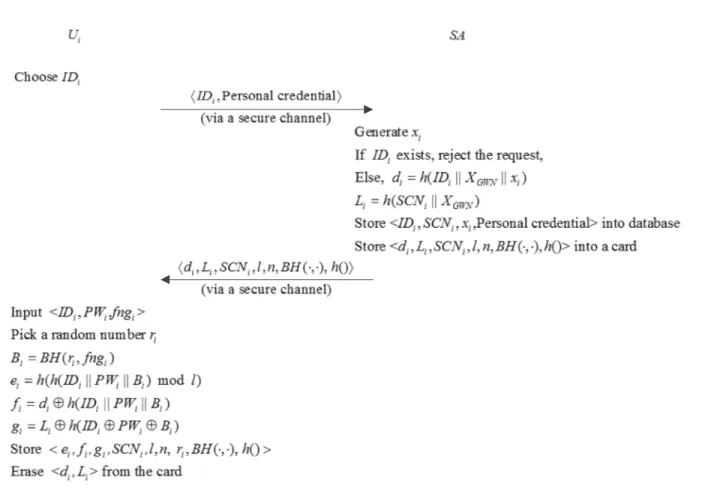
FIGURE 2. User registration phase of our proposed protocol.
D. TRACKING ATTACK
WhenUiwishes to access sensor data,Uisends the message MSG1 =< M1,M2,M3,T1,SCTi,EIDj > to initiate the
authentication session. AlthoughIDiis concealed inM1, and
each field inMSG1is dynamic, the identity of the smart card
SCNican be derived asSCNi=SCTi⊕h(T1). Generally, the
value ofSCNiis fixed for a specific user, which is generated bySAin the registration phase, and updated only in the smart card revocation phase. With this fixed value, an adversaryA can launch tracking attack as follows.
Suppose that a legal user Ui interacts with GWN. A first captures Ui’s message MSG1 =< M1,M2,M3,T1,
SCTi,EIDj >, then retrieves and storesSCNi. Then Acan threaten the privacy ofUithrough two ways [29]. Firstly, if AobtainsUi’s identity by accident, then he/she is capable of identifying the user at the instant thatUiinteracts withGWN by using the value SCNi. Moreover, even though Acannot obtainIDi, he/she is always capable of identifying different authentication sessions ofUivia the valueSCNiderived from each message MSG1 =< M1,M2,M3,T1,SCTi,EIDj >.
Then, he/she might collect various types of sensitive infor-mation related to Ui, such asUi’s traveling routes, sensor access patterns, which may helpAto violate user anonymity provided in Amin et al.’s protocol [39]. Therefore, Amin et al.’s protocol [39] is prone to tracking attack and cannot provide untraceability.
V. OUR PROPOSED AUTHENTICATION PROTOCOL We enhance Amin et al.’s protocol as follows: (1) The pub-lic key primitive Rabin cryptosystem is employed to avoid SCLA and tracking attack. (2) The concept of fuzzy veri-fier [60] is adopted to achieve local password verification. (3) The timestamp mechanism mitigates session specific tempo-rary information attack. Our new protocol also has 9 phases. SN registration and post deployment phase which remain unchanged are omitted here.
A. SYSTEM SETUP
SAselects and computes the system parameters in offline mode.
Step 1: SAfirst generates two large primesp andq, and computesN =pq, and keeps (p,q) as the private key. Then SAselects a master secret keyXGWN and an integer 24 ≤ l≤28as the parameter of fuzzy verifier.
Step 2: SAselects an identityIDjand computes the secret keyXj=h(IDjkXGWN) forSj(1≤j≤m).
Step 3: SA randomly generates a number Rshrd, which is shared between GWN and Sj. Finally, Sj stores < IDj,Xj,Rshrd >in its memory.
B. USER REGISTRATION
In this phase,Uiexecutes the following procedure to register withSAas shown in Fig. 2.
Step 1: Ui sends the selected identity IDi and personal credentials toSAthrough a secure channel.
Step 2: SA checks whether IDi exists in the database. If it does, SAindicates Ui to select a new identity; other-wise, SA generates a random number xi, computes di = h(IDikXGWNkxi) andLi=h(SCNikXGWN). ThenSAdelivers the smart card storing < di,Li,SCNi,l,n,BH(·,·),h() > to Ui securely. SA maintains a database storing each Ui’s parameters <IDi,SCNi,xi,Personal credential>.
Step 3: Ui attaches the card into a card reader. Then he/she enters < IDi,PWi > and imprints fngi. The card selects a random number ri, computes Bi = BH(ri,fngi), ei=h(h(IDikPWikBi) modl),fi=di⊕h(IDikPWikBi), and gi =Li⊕h(IDi⊕PWi⊕Bi). Finally, the smart card stores
<ei,fi,gi,SCNi,l,n,ri,BH(·,·),h()>into its memory and deletes<di,Li>.
C. LOGIN
The following procedure is performed when Ui wishes to access sensor data as shown in Fig. 3.
Step 1: Uiattaches the smart card and enters the identity ID∗i, passwordPWi∗, and fingerprintfngi. Then, the card com-putesB∗i = BH(ri,fngi) and e∗i = h(h(ID ∗ ikPW ∗ i kB ∗ i) mod l). The card rejectsUi’s login request ife∗i 6=ei.
Step 2: The card generates a random number Ki and a timestamp T1, calculates di∗ = fi ⊕ h(ID∗ikPW ∗ i kB ∗ i), Li∗ = gi ⊕h(ID∗i ⊕PW ∗ i ⊕B ∗ i),M1 = (IDikSCNikKi)2 modn,M2=h(di∗kL ∗ ikKikT1).
Step 3: Uiselects the identityIDjof the sensor that he/she wishes to access, then the card computes EIDj = IDj ⊕ h(IDikKikT1)and sendsMSG1 =< M1,M2,T1,EIDj >to GWN.
D. AUTHENTICATION
To achieve mutual authentication and session key agreement amongUi,GWN, andSj, the following steps are executed as shown in Fig. 3.
Step 1: After receiving MSG1 from Ui, GWN decrypts
M1usingpandqto obtainIDi0,SCNi0,Ki0, and then retrieves
xi according toID0, and verifies whetherSCNi0matches the value in the entry. If the two values do not match, then GWN rejects the request and aborts; otherwise,GWN com-putesLi0 = h(SCNi0kXGWN),di0 = h(ID 0 ikXGWNkxi),Ki0 = M2⊕ h(di0kT1), and M20 = h(d 0 ikL 0 ikK 0 ikT1). GWN aborts
the current session if M20 6= M2; otherwise, GWN
com-putes ID0j = EIDj ⊕ h(IDikKikT1), Xj0 = h(ID0jkXGWN), M3 = h(ID0ikID0jkIDGWNkXj0kKi0kT2), M4 = ID0i ⊕
h(IDGWNkXj0kT2),M5 = Ki ⊕h(ID0ikIDj0kXj0kT2) and then
sendsMSG2=<IDGWN,M3,M4,M5,T2>toSj.
Step 2: Sj checks whether|T3−T2| ≤ 1T holds, where
T3 is the current timestamp. If it is invalid, Sj immedi-ately terminates the session; otherwise, it computesID∗∗i = M4⊕h(IDGWNkXjkT2),Ki∗∗ = M5⊕h(ID∗∗i kIDjkXjkT2),
and M3∗∗ = h(ID∗∗i kIDjkIDGWNkXjkKi∗∗kT2). Sj aborts the connection if M3∗∗ 6= M3; otherwise, it accepts that
Ui and GWN are legitimate. Next, Sj computes SKj = h(ID∗∗i kIDjkKi∗∗kKj),M6 = h(SKjkXjkKjkT3), andM7 =
Ki∗∗ ⊕Kj, where Kj is a random number generated by Sj. Finally,SjforwardsMSG3=<M6,M7,T3>toGWN.
Step 3: GWNchecks whether|T4−T3| ≤1Tholds, where
T4is the current timestamp. If it is negative,GWNaborts the
session; otherwise it computesKj0 = M7⊕Ki0,SKGWN = h(ID0ikIDjkKi0kK 0 j), andM 0 6 = h(SKGWNkXj0kK 0 ikT3).GWN rejects the session ifM60 6=M6; otherwise, it computesM8=
h(SKGWNkID0 ikd 0 ikK 0 j). Finally, GWN sends MSG4 =< M7,M8>toUi. Step 4: Ui computes Kj∗ = M7 ⊕ Ki, SKi = h(IDikIDjkKikKj∗), andM 0 8=h(SKikIDikdikKj∗).Uirejects the session ifM8∗ 6= M8; otherwise,Ui accepts thatGWN andSjare authentic. At this point, a session keySKi=SKj= SKGWN has been established amongUi,Sj, andGWN.
E. IDENTITY UPDATE
In this phase, a registered user securely updates the identity as follows.
Step 1: Ui attaches the card and enters the identityID∗i, passwordPWi∗, and fingerprintsfngi. Then, the card com-putesB∗i =BH(ri,fngi) and e∗i =h(h(IDikPWikBi) modl). The card rejectsUi’s login request ife∗i 6=ei. ThenUiinputs a new identityIDnewi , and then the card generates a timestamp Tid, computes di∗ = fi ⊕ h(ID∗ikPW ∗ i kB ∗ i), L ∗ i = gi ⊕ h(ID∗i⊕PWi∗⊕B∗i),DDi=(IDikSCNikIDinew)2modn,Zi= h(di∗kLi∗kIDnewi kTid). The card then sends<Zi,DDi,Tid > toGWN.
Step 2: GWN decrypts DDi using p and q to obtain ID0i,SCNi0,IDnewi , then retrievesxiaccording toID0i, and ver-ifies whetherSCNi0matches the value in the entry. If the two values do not match, thenGWN terminates; otherwise,GWN computesLi0=h(SCNi0kXGWN),di0=h(ID0ikXGWNkxi),Zi0= h(di∗kLi∗kIDnewi kTid).GWNaborts the current session ifZi06= Zi; otherwise,GWN computes di∗∗ = h(IDnewi kXGWNkxi), Yi = di∗∗⊕h(di0kTid), andZZi =h(di∗∗kdi0kLi0kIDnewi kTid). Then GWN sends<ZZi,Yi>to the card and updatesIDnewi in the database.
Step 3: The card computes di∗∗ = Yi ⊕ h(di∗kTid) andZZi∗ = h(di∗∗kdi∗kLi∗kIDnewi kTid), and checks whether ZZi∗ = ZZi holds. If it holds, the card computes enewi = h(h(IDnewi kPWikBi) modl), finew = dd
∗∗ i ⊕ h(IDnewi kPWikBi), and ginew = Li ⊕ h(IDnewi ⊕ PWi ⊕ Bi). Finally, the card replaces the old information with < enewi ,finew,gnewi >.
F. PASSWORD CHANGE
In this phase, an authorized userUiupdates the passwordPWi locally.
Step 1: Uiinserts his/her smart card into a card reader and carries out Step 1 of the login phase to verify the validity of fingerprint, password, and identity.
Step 2: Ui inputs a new password PWinew, and the card calculatesenewi = h(h(IDikPWinewkBi) modl), di0 = fi ⊕
FIGURE 3. Authentication and key agreement of our proposed protocol.
h(IDikPWikBi),finew = d 0
i ⊕h(IDikPWinewkBi),Li0 = gi⊕ h(IDi⊕PWinew⊕Bi), andgnewi =L
0
i ⊕h(IDi⊕PWinew).
Step 3: The card updates < ei,fi,gi > with < enewi ,finew,gnewi >.
G. SMART CARD REVOCATION
IfUi’s smart card is stolen or lost,Uiobtains a new smart card as follows.
Step 1: Ui sends the identity IDi and his/her cre-dential to SA through a secure channel. SA first veri-fies Ui’s credential. If it is valid, it computes dinew = h(IDikXGWNkxi) and Linew = h(SCNinewkXGWN), where SCNinew is the new smart card number. Then the new card storing <dinew,Linew,SCNinew,l,n,BH(,),h()> is sent toUi securely. Then,SAupdates the database withSCNinew.
Step 2: Uiinserts the smart card into a card reader, inputs
< IDi,PWi > and imprints fngi. The card picks up a random number ri, computes Bi = BH(ri,fngi), enewi = h(h(IDikPWikBi) modl),finew=dinew⊕h(IDikPWikBi), and gnewi = Linew⊕h(IDi⊕PWi⊕Bi). Finally, the smart card stores< enewi ,finew,gnewi ,SCNinew,l,n,ri,BH(,),h() >into its memory and deletes<dinew,Linew>.
VI. SECURITY ANALYSIS
We first conduct a formal verification using ProVerif to demonstrate that our protocol fulfills the required secu-rity properties. Furthermore, we also present comprehensive heuristic security analysis and comparison.
A. FORMAL VERIFICATION WITH ProVerif
ProVerif [51] is a widely used formal verification tool for automatic security analysis of security protocols, which is used to prove the secrecy and authentication properties of our proposed protocol.
First we define the channels and types. c1 is the public channel between the user device and GWN and c2 is the public channel between GWN and the sensor.
free c1:channel. free c2:channel.
The basic types of variables are defined as follows: type key. type nonce. type fingerprint. type timestamp. type N. type Q. type P. type User. type Server. type Sensor.
The cryptographic functions are modeled as follows: (∗Hash operation∗)
fun Hash(bitstring): bitstring. (∗BH operation∗)
fun BH(nonce, fingerprint): bitstring. (∗Rabin cryptosystem∗)
fun rabinEnc(bitstring, N):bitstring. reduc forall x: bitstring, p: P, q: Q, n: N; rabinDec(n, p, q, rabinEnc(x, n))=x. (∗XOR operation∗)
fun XOR(bitstring, bitstring): bitstring. reduc forall x: bitstring, y: bitstring;
XORagain(XOR(x, y), y)=x. (∗Mod operation∗)
fun Mod(bitstring, bitstring): bitstring. (∗Concat operation∗)
fun Concat(bitstring, bitstring):bitstring. reduc forall x: bitstring, y: bitstring; Split(Concat(x, y))=(x, y). (∗Type convertion∗)
fun timestamp2(timestamp): bitstring. fun nonce2(nonce): bitstring. fun key2(key): bitstring. fun bit2key(bitstring): key. (∗Check timestamp fresh∗)
fun checkFresh(timestamp, bool): bool reduc forall t: timestamp;
checkFresh(t, true)=true otherwise forall t: timestamp; checkFresh(t, false)=false The secret keys are defined as follows:
(∗Secrecy assumptions∗) not attacker(new p). not attacker(new q).
not attacker(new XGWNTemp). not attacker(new XjTemp).
The following events and queries are defined: event scAccept(User).
event serverAccept(User). event sensorGen(User, Server). event serverGen(Sensor). event userGen(Server, Sensor). query inj-event(userGen(server, sensor))
==>inj-event(serverGen(sensor)). query inj-event(serverGen(sensor))
==>inj-event(sensorGen(user, server)). query inj-event(sensorGen(user, server))
==>inj-event(serverAccept(user)). query event(serverAccept(user))
==>event(scAccept(user)).
The process of the user is modeled as follows:
let processUser(IDiEx: bitstring, PWEx: bitstring, fngEx: fingerprint, e: bitstring, g: bitstring, f: bitstring, r: nonce, B: bitstring, SCN: bitstring, l: bitstring, IDj: bitstring, IDi: bitstring)=
let BEx=BH(r, fngEx) in
let e’=Hash(Mod(Hash(Concat(Concat(IDiEx, PWEx), B)), l)) in
if e’=e then event scAccept(user);
let dEx=XORagain(f,Hash(Concat(Concat(IDiEx, PWEx), BEx))) in
let LEx=XORagain(g, Hash(XOR(XOR(IDiEx, PWEx), BEx))) in
new KiTemp: nonce; let Ki=nonce2(KiTemp) in new T1: timestamp;
let M1=rabinEnc(Concat(Concat(IDi, SCN), Ki), n) in let M2=Hash(Concat(Concat(Concat(dEx, LEx), Ki), timestamp2(T1))) in
let EIDj=XOR(IDj, Hash(Concat(Concat(IDi, Ki), timestamp2(T1)))) in
out(c1, (M1, M2, T1, EIDj)); in(c1, (M7: bitstring, M8: bitstring));
let KjEx=XOR(M7, Ki) in
let SKi=bit2key(Hash(Concat(Concat(Concat(IDi, IDj), Ki), KjEx))) in
let M8Ex=Hash(Concat(Concat(Concat(key2(SKi), IDi), dEx), KjEx)) in
if M8Ex=M8 then
event userGen(server, sensor).
The process of the gateway node is modeled as follows: let processServer(XGWN: bitstring, x: nonce, p: P, q: Q, IDi: bitstring, IDGWN: bitstring, IDj: bitstring)=
in(c1, (M1: bitstring, M2: bitstring, T1: timestamp, EIDj: bitstring));
let (temp: bitstring, Ki’: bitstring)=Split(rabinDec(n, p, q, M1)) in
let (IDi’: bitstring, SCN’: bitstring)=Split(temp) in let L’=Hash(Concat(SCN’, XGWN)) in
let d’=Hash(Concat(Concat(IDi’, XGWN), nonce2(x))) in (∗let Ki’=XORagain(M2, Hash(Concat(d’,
timestamp2(T1)))) in∗)
let M2’=Hash(Concat(Concat(Concat(d’, L’), Ki’), timestamp2(T1))) in
if M2’=M2 then event serverAccept(user);
let IDj’=XORagain(EIDj, Hash(Concat(Concat(IDi, Ki’), timestamp2(T1)))) in
let Xj’=Hash(Concat(IDj’, XGWN)) in new T2: timestamp;
let M3=Hash(Concat(Concat(Concat(Concat(Concat(IDi’, IDj’), IDGWN), Xj’), Ki’), timestamp2(T2))) in
let M4=XOR(IDi’, Hash(Concat(Concat(IDGWN, Xj’), timestamp2(T2)))) in
let M5=XOR(Ki’, Hash(Concat(Concat(Concat(IDi’, IDj’), Xj’), timestamp2(T2)))) in
out(c2, (IDGWN, M3, M4, M5, T2, true));
in(c2, (M6: bitstring, M7: bitstring, T3: timestamp, isFresh: bool));
new T4: timestamp;
if checkFresh(T4, isFresh) then let Kj’=XORagain(M7, Ki’) in
let SKGWN=bit2key(Hash(Concat(Concat(Concat(IDi’, IDj), Ki’), Kj’))) in let M6’=Hash(Concat(Concat(Concat(key2(SKGWN), Xj’), Ki’), timestamp2(T3))) in if M6’=M6 then event serverGen(sensor);
let M8=Hash(Concat(Concat(Concat(key2(SKGWN), IDi’), d’), Kj’)) in
out(c1, (M7, M8)).
The process of SNs is modeled as follows: let processSensor(Xj: bitstring, IDj: bitstring)=
in(c2, (IDGWN: bitstring, M3: bitstring, M4: bitstring, M5: bitstring, T2: timestamp, isFresh: bool));
if checkFresh(T2, isFresh) then
let IDiExEx=XORagain(M4, Hash(Concat(Concat(IDGWN, Xj), timestamp2(T2)))) in
let KiExEx=XORagain(M5, Hash(Concat(Concat(Concat (IDiExEx, IDj), Xj), timestamp2(T2)))) in
let M3ExEx=Hash(Concat(Concat(Concat(Concat(Concat (IDiExEx, IDj), IDGWN), Xj), KiExEx), timestamp2(T2))) in
if M3ExEx=M3 then new Kj: bitstring; let SKj=bit2key(Hash(Concat(Concat(Concat(IDiExEx, IDj), KiExEx), Kj))) in new T3: timestamp; let M6=Hash(Concat(Concat(Concat(key2(SKj), Xj), Kj), timestamp2(T3))) in let M7=XOR(KiExEx, Kj) in event sensorGen(user, server); out(c2, (M6, M7, T3, true)).
The whole protocol is modeled as follows. (∗Start process∗)
process (∗Constants∗)
(∗Share constants between user and server∗) new SCN: bitstring;
new l: bitstring; new IDj: bitstring; new IDi: bitstring; new PW: bitstring; new r: nonce; (∗User/Smartcard constants∗) new fng: fingerprint; (∗Server constants∗) new x: nonce;
new XGWNTemp: key;
let XGWN=key2(XGWNTemp) in new IDGWN: bitstring;
(∗Sensor constants∗) new XjTemp: key; let Xj=key2(XjTemp) in (∗Rabin parameters∗) new p: P;
new q: Q;
(∗Constants computed∗)
let d=Hash(Concat(Concat(IDi, XGWN), nonce2(x))) in let L=Hash(Concat(SCN, XGWN)) in
let B=BH(r, fng) in
let e=Hash(Mod(Hash(Concat(Concat(IDi, PW), B)), l)) in let f=XOR(d, Hash(Concat(Concat(IDi, PW), B))) in let g=XOR(L, Hash(XOR(XOR(IDi, PW), B))) in (
(!(processUser(IDi, PW, fng, e, g, f, r, B, SCN, l, IDj, IDi)))|
(!processServer(XGWN, x, p, q, IDi, IDGWN, IDj))|
(!processSensor(Xj, IDj)) )
The outcome of executing the processes in ProVerif version 1.96 is given below. The results demonstrate that our protocol achieves session key secrecy and mutual authentication.
RESULT event(serverAccept(user[]))==> event(scAccept(user[])) is true. RESULT inj-event(sensorGen(user[],server[]))==> inj-event(serverAccept(user[])) is true. RESULT inj-event(serverGen(sensor[]))==> inj-event(sensorGen(user[],server[])) is true. RESULT inj-event(userGen(server[],sensor[]))==> inj-event(serverGen(sensor[])) is true. RESULT not attacker(SKj[]) is true. RESULT not attacker(SKGWN[]) is true. RESULT not attacker(SKi[]) is true.
B. ANALYSIS OF SECURITY PROPERTIES
We first show that our 3FA protocol could overcome weak-nesses in Amin et al.’s authentication protocol, and then we show that our protocol achieves all the desired security features.
1) RESISTING TYPE I SCLA
Type I SCLA is infeasible in our protocol. We explain why below.
Assume that the opponent A extracts the smart card information < ei,fi,gi,SCNi,l,n,ri,BH(·,·),h() > of the legal user Ui, where Bi = BH(ri,fngi), ei = h(h(IDikPWikBi) modl),fi = di ⊕h(IDikPWikBi), andgi = Li ⊕h(IDi ⊕PWi ⊕Bi). ThenAcan guess ID∗i and PWi∗, and computes e∗i = h(h(ID∗ikPWi∗kBi) modl), as presented in Section 4.1. However, A cannot verify the correctness ofID∗i andPWi∗definitely becauseeiis a ‘‘fuzzy verifier’’ [59], [60].
Therefore, our protocol is secure against type I SCLA.
2) RESISTING TYPE II SCLA
Moreover, type II SCLA is also infeasible in our protocol. Suppose Acould also intercept the message MSG1 =<
M1,M2,T1,EIDj > sent by Ui in the login phase, where di∗=fi⊕h(ID∗ikPW ∗ i kB ∗ i),L ∗ i =gi⊕h(ID∗i ⊕PW ∗ i ⊕B ∗ i), M1 = (IDikSCNikKi)2modn, M2 = h(di∗kL ∗ ikKikT1). A can derivedi∗ =fi⊕h(ID∗ikPW ∗ i kB ∗ i),L ∗ i =gi⊕h(ID∗i ⊕ PWi∗⊕B∗i), wheregiis revealed fromUi’s smart card. Due to the hardness of quadratic residue problem, it is impossi-ble for the adversary to computeR1from the value M1 =
(IDikSCNikKi)2modn. Therefore,A is unable to calculate M2∗ = h(di∗kLi∗kKikT1), which is a necessary to check the
correctness ofID∗i andPWi∗.
Thus, our 3FA protocol is completely secure against type II SCLA.
3) RESISTING KSSTIA
In Amin et al.’s protocol, the static valueh(ID0ikXj0) is used to protect the ephemeral random numbers, where Xj0 is the sensor key shared between Sj and GW. As a result, the disclosure of ephemeral random numberKi will lead to the compromise of the static valueh(ID0ikXj0), which in turn will cause the compromise of ephemeral random numbers in other authentication sessions. In our proposed protocol, we avoid this risk by introducing the mechanisms of timestamp and hash. Specifically, we computeM5=Ki⊕h(ID0ikID0jkXj0kT2).
In this case, even though Ki is compromised, the opponent can only obtain the hashed valueh(ID0ikID0
jkX 0
jkT2), which is dynamic in each authentication session and will not endanger the ephemeral random number in other authentication ses-sions. Thus our 3FA protocol is immune from KSSTIA.
4) RESISTING USER IMPERSONATION ATTACK
The opponent A cannot carry out user impersonation attack against our protocol. Assume that A has the
user Ui’s smart card and has extracted the data < ei,fi,gi,SCNi,l,n,ri,BH(·,·),h() > stored in it. We also assume thatAhas intercepted the messages exchanged in the previous authentication sessions. In our protocol,A has to possess all the authentication factors, i.e.,PWi, the smart card, and the biometric, to produce a legal messageMSG1 =<
M1,M2,T1,EIDj >. Specifically, the key to proving the legitimacy ofUi is the value M2 = h(di∗kL
∗
ikKikT1). The
critical fields of the computation ofM2are the valuesdi∗ = fi⊕h(ID∗ikPW ∗ i kB ∗ i) andL ∗ i = gi⊕h(ID∗i ⊕PW ∗ i ⊕B ∗ i). However, without eitherPWi, the smart card, or the biometric, Acannot calculatedi∗orLi∗.
5) RESISTING GATEWAY IMPERSONATION ATTACK
In our protocol, the opponent A is unable to imperson-ate as GWN to either Ui or Sj. In order to impersonate as GWN to Sj, A needs to compute a legal value M3 =
h(ID0ikID0jkIDGWNkXj0kK 0
ikT2). However, without knowing
the valueXj0 = h(ID0jkXGWN), it is infeasible for Ato com-pute M3. Moreover, since we use the hash algorithm and
timestamp,Acannot obtain any useful information from the messages from the previous authentication sessions.
In contrast, to impersonate asGWN to eitherUi,Aneeds to compute a legal valueM8=h(SKGWNkIDi0kdi0kKj0). To do
so,Aneeds to have knowledge ofKi to compute the value SKGWN = h(IDikIDjkKikKj). To get Ki, A has to know the secret key p and q of GW. It is impossible because the secret key is carefully protected by the administrator. The other way left for A is to decrypt the value M1 =
(IDikSCNikKi)2modn, which is computationally infeasible because of the hardness of quadratic residue problem. Thus, the protocol can withstand the gateway node impersonation attack.
6) RESISTING SN IMPERSONATION ATTACK
SupposeAtries to impersonate Sj after capturing the mes-sages exchanged in the previous authentication sessions. A needs to generate MSG3 =< M6,M7,T3 > to
imper-sonate Sj, where SKj = h(ID∗∗i kIDjkKi∗∗kKj), M6 =
h(SKjkXjkKjkT3), andM7=Ki∗∗⊕Kj. Thus,Ahas to know Ki in order to computeM6 = h(SKjkXjkKjkT3). Similar to
the analysis of gateway impersonation attack,Ais unable to obtain Ki. Thus A cannot carry out the SN impersonation attack.
7) RESISTING MODIFICATION ATTACK
In our protocol, the opponentAis unable to modify any of the messagesMSG1 =< M1,M2,T1,EIDj >,MSG2 =<
IDGWN,M3,M4,M5,T2 >, MSG3 =< M6,M7,T3 >, or
MSG4 =< M7,M8 >. Assume that A intercepts one of
these messages, and then transmits a modified one. However, each message is protected by a hash value computed with a secret value. For instance, in MSG1, A cannot calculate
M2 = h(di∗kLi∗kKikT1), sincedi∗ = fi⊕h(ID∗ikPW ∗ ikB ∗ i) andLi∗=gi⊕h(ID∗i ⊕PW ∗ i ⊕B ∗