
*Corresponding author: [email protected] 12 Tr Ren Energy, 2020, Vol.6, No.1, 12-36. doi: 10.17737/tre.2020.6.1.00110
Implementation of ANN Technique for Performance
Prediction of Solar Thermal Systems: A Comprehensive
Review
Ashfaque Ahmad, Harish Kumar Ghritlahre*, Purvi Chandrakar
Department of Energy and Environmental Engineering, Chhattisgarh Swami Vivekanand Technical University, Bhilai, Chhattisgarh, 491107, India
Received November 28, 2019; Accepted January 13, 2020; Published January 17, 2020
Solar thermal systems (STS) are efficient and environmentally safe devices to meet the rapid increasing energy demand now a days. But it is very important to optimize their performance under required operating condition for efficient usage. Hence intelligent system-based techniques like artificial neural network (ANN) play an important role for system performance prediction in accurate and speedy way. In present paper, it is attempted to scrutinize the approach of ANN as an intelligent system based method to optimize the performance prediction of different solar thermal systems accurately. Here, 25 research works related to various solar thermal systems have been reviewed and summarized to understand the impact of different ANN models and learning algorithms on performance prediction of STS. Using ANN, a brief stepwise summary of research work on various STS like solar air heaters, solar stills, solar cookers, solar dryers and solar hybrid systems, their predictions (results) and architectures (network and learning algorithms) in the literature till now, are also discussed here. This paper will genuinely help the future researchers to overview the work concisely related to solar thermal system performance prediction using various types of ANN models and learning algorithm and compare it with other global methods of machine learning.
Keywords: Solar energy; Solar thermal systems; Artificial Neural Network; Learning algorithm
1. Introduction
Energy is a primary feed in for almost all activities and economic development. Therefore, there is an ultimate dependency between the energy availability and the growth of a nation. Since energy is imperative to execute the operation of production, transport, agriculture and household services, the process of economic growth requires higher proportion of energy consumption, which forces us to focus on ensuring its continuous supply to meet our ever-rising demands [1-4].
The two main sources of energy are termed as conventional and non-conventional sources. Besides conventional energy sources like coal, petroleum and natural gas, some non-conventional energy sources also known as renewable energy sources are solar energy, wind energy, tidal energy and bioenergy.
Within these renewable energy sources available on earth, solar energy is the most plentiful and clean source of energy. The sun produces a huge amount of energy which is accumulated through a system and further converted into heat and electricity.
Tr Ren Energy, 2020, Vol.6, No.1, 12-36. doi: 10.17737/tre.2020.6.1.00110 13 As energy demand is increasing rapidly for industrial as well as domestic use, it is now becoming crucially important to develop solar thermal systems as an efficient solution for this huge energy demand procurement. It can be achieved well only by maximizing the performance of solar thermal systems under specific operating conditions.
The experimental and mathematical study along with computational techniques, require a long time to come with precise results for a physical problem. On the other hand, the use of ANN technique as a performance prediction tool saves time and also provides key information patterns in a multi-dimensional information domain [5-35].
Compared to other computational techniques, ANN is simpler and more capable of solving complex non-linear relationship between the variables and extracted data [5].
The technique of Artificial Neural Network is used to model, optimize and predict a system's performance. Thanks to its faster processing speed and high accuracy, it has become more popular in the last two decades. Many researchers have used ANN technique in the domain of atmospheric sciences [6], chemical process control [7], energy systems [8, 9], modeling and control of combustion processes [10], photovoltaic applications [11], thermal science and engineering [12], sizing photovoltaic systems [13], refrigeration and heat pumps systems [14], nuclear engineering [15], controlling wind– PV power systems [16], solar radiations prediction [17], heat exchangers [18],wind energy systems [19], solar systems designing [20], hybrid energy systems [21], solid desiccant systems [22], solar collector systems [23] and various thermal systems [24-35].
In the previous years, ANN had been used by numerous researchers in the domain of energy utilization and conversion systems for performance predictions, designing heat pumps and PV systems, air conditioning, wind and PV power systems, hybrid energy systems and many other thermal systems [24-35].
ANN is a powerful data-driven, self-adaptive, flexible computational tool having capability of handling large amount of data sets. Additionally, this technique is found very suitable for implicitly detecting complex non-linear relationship between dependent and independent variables with high accuracy.
This inclusive review paper covers following points:
1. A concise discussion on ANN, its types, its field and methodology of implementation, usage in different solar thermal applications.
2. Different standard statistical performance evaluation criteria used in the evaluation of ANN performance are also discussed here.
3. The application of ANN in various solar thermal systems like solar collectors, solar air and water heaters, photovoltaic/thermal (PV/T) systems, solar dryers, solar stills and solar cookers are summarized here.
4. Conclusion and suggestions for future research are also outlined here. 1.1. Solar Thermal Systems
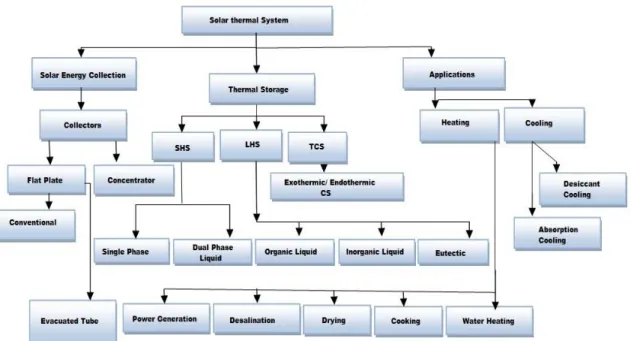
Solar systems are used to harness solar energy for generation of thermal or electrical energy that can be used in industrial and residential regions. Solar energy is used for heating of fluids also. A schematic chart of type of solar thermal systems is described in Figure 1. Chart clearly elaborates the classification of solar thermal systems according to their structure, construction material, and purpose of usage. Its application includes heating/cooling, desalination other than drying of fruits, meat, vegetables, egg incubation and other industrial purposes [1-3].
Tr Ren Energy, 2020, Vol.6, No.1, 12-36. doi: 10.17737/tre.2020.6.1.00110 14 Figure 1. Solar thermal systems and their applications
2. Artificial Neural Network (ANN)
Artificial neural networks are data processing systems identical to data processing software in the human brain. Figure 2 clearly shows that neurons are basic elements, and dendrites, cell body or soma and synapses are other components, within biological networks. Dendrites receives input signals or information, cell body works as a processor, synaptic works as a reference, and axon transmits output signals to other neurons and performs non-linear operations [5, 23]. ANN system consists of many processing components, known as neurons.
Figure 2. Basic structure of biological neurons
ANN functions work like the human brain in two ways: learning and storing information that is called weights in interconnected connections. The neuron collects multiple inputs in combination with attachment weights from other neurons and performs a nonlinear activation process and generates a single output data that can go to the other
Tr Ren Energy, 2020, Vol.6, No.1, 12-36. doi: 10.17737/tre.2020.6.1.00110 15 neurons. Such input data is analyzed by the neurons and transferred to the next network layer.
In the solar thermal systems, following ANN models are used majorly: 1. Multi-layer feed forward neural network (MLFFNN)
2. Radial basis function (RBF)
3. General Regression Neural Network (GRNN)
2.1 Multi-layer Feed Forward Neural Network (MLFFNN)
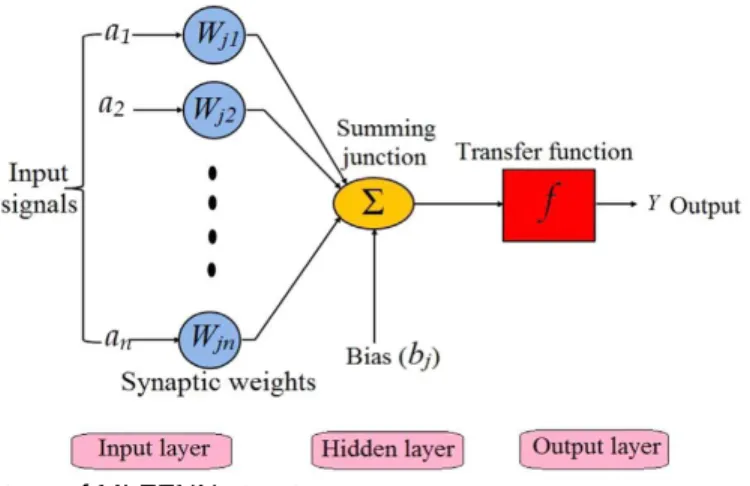
The basic structure of multi-layer feed forward neural network (MLFFNN) is shown in Figure 3. The MLFFNN model basically contains three layers: one input layer, one or more hidden layers, and one output layer. Every neuron receives information from other neurons and moves over the hidden layers to the output layer. Interconnected nodes of storage termed as neurons, merge to render an ANN. Every neuron's output is the product of weighted inputs. The sum of weighted inputs formed by neurons is given as [5, 72, 73]: 1 n i j i j i X w a b = = +
(1)where, n is the number of input data (i = 0, 1, 2, 3………n) and wij are the
interconnecting weights of the input data ai, respectively, and bjis the bias for the neuron.
The information is stored in the form of set of connection weights and biases. A transfer function F through which the sum of weighted inputs with bias is processed and the output is given by Equation (2):
1 ( ) n j i j i j i F X u F w a b = = = +
(2)Hidden and output layers generally have a linear or non-linear activation/transfer function. There are many types of learning algorithms available to derive the input-output relationships. The most commonly used algorithm is the learning algorithms for feed forward back propagation [57-59]. The widely used nonlinear activation function is
sigmoid function whose output lies between 0 and 1, and the sigmoid transfer function is
given by: 1 ( ) 1 X F X e− = + (3)
When values are resulted negative at input or output layer, then the tansig transfer function is used; which is expressed as:
( ) X X X X e e F X e e − − − = + (4)
The model is trained in hidden layer, momentum variable, and transfer function with selected number of neurons. MLFFNN is the most common form of neural model to predict the efficiency of the solar thermal system.
Tr Ren Energy, 2020, Vol.6, No.1, 12-36. doi: 10.17737/tre.2020.6.1.00110 16 Figure 3. Basic structure of MLFFNN structure
2.2 Radial Basis Function (RBF)
There are also three layers in the RBF model: input layer, hidden layer and output layer. RBF model's primary structure is shown in Figure 4. This is identical to the MLFFNN model's three layers. RBF and MLFFNN, both models are feed forward neural network. In the RBF model, the signals are collected at the input layer and passed through the hidden layer of the second layer, which generates the output data [48, 49].
The hidden layer of RBF model is Radial basis activation function. The hidden layer’s transfer function is normally a Gaussian function, which is expressed as [60, 62]:
2 2 ( ) exp 2 i j j j x c a x − = − (5) where, σj is the width of the jth neuron, and xi and cj are the input and the center of RBF
unit respectively. In Equation (6), aj is the notation for the output of the jth RBF unit.
1 ( ) ( ) n k jk j k j y x w a x b = =
+ (6)where, bk is the bias, yk is the kth output unit for the input vector x, wjk is the weight
connection between the kth output unit and the jthhidden layer unit.
Tr Ren Energy, 2020, Vol.6, No.1, 12-36. doi: 10.17737/tre.2020.6.1.00110 17 2.3 General Regression Neural Network (GRNN)
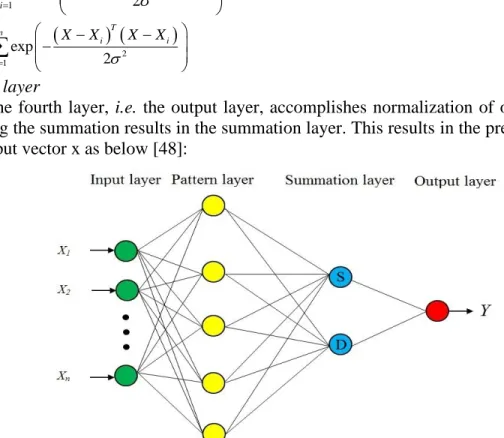
Specht (1991) used the GRNN technique for the first time [71]. GRNN is a variant of the kernel regression network-based RBF architecture. In order to simulate the effects such as back propagation algorithms, this method does not need an iterative approach. It has its own capacity to approximate any arbitrary equation between vectors of input and output. [48, 49]. Generalized regression neural network (GRNN) technique is a probabilistic model between an independent (Input) and dependent (Output) variables. Figure 5 shows the basic structure of GRNN.
The structure shows that the GRNN model consist of four layers:
Input layer
The first layer is termed as input layer which is fully connected to the second layer. The number of input neurons at this layer depends on the total number of selected observation variables. This layer gathers information and the pattern layer is given. Pattern layer
Pattern layer is used to perform clustering on the training process. Usually the
number of pattern layer neurons is equal to the number of data sets of training pairs. Summation layer
Summation layer contains two neurons, namely D Summation and S Summation neuron. These two neurons in the summation layer derive the underlying relation [71]:
(
) (
)
2 1 exp 2 i T n i i i X X X X D Y = − − = −
(7)(
) (
)
2 1 exp 2 T n i i i X X X X S = − − = −
(8) Output layerThe fourth layer, i.e. the output layer, accomplishes normalization of output set by
dividing the summation results in the summation layer. This results in the predicted value y to input vector x as below [48]:
Tr Ren Energy, 2020, Vol.6, No.1, 12-36. doi: 10.17737/tre.2020.6.1.00110 18 ( ) ( ) ( ) ( ) ( ) 2 1 2 1 exp 2 exp 2 i T n i i i T n i i i X X X X Y D Y X S X X X X = = − − − = = − − −
(9)3. Assessment Criteria for Model Performance
The neural model performance assessment is approved on the basis of the selection of minimum values of the errors of SSE, MSE, RMSE, MAE, MRE and COV. The least values of these errors indicate the most accurate value of ANN predicted results. In addition to this, the best fit of ANN predicted data with actual available data in terms of coefficient of determination (R2) and correlation coefficient (R) are also considered as the selection criteria of model performance [71]. If the values of R2 or R are proximate to unity, the predicted results are confirmed to be more accurate.
Sum of square error 2 , , 1 ( ) n A i P i i SSE X X = =
− (10)Mean square error
2 , , 1 1 ( ) n A i P i i MSE X X n = =
− (11)Root mean square error
2 , , 1 1 ( ) n A i P i i RMSE X X n = =
− (12)Mean absolute error
, , 1 1 ( ) n A i P i i MAE X X n = =
− (13)Mean relative error %
, , 1 , | | 1 100 n A i P i i A i X Y MRE n = X − =
(14) Coefficient of variance , 1 100 1 n P i i RMSE COV X n = =
(15) Coefficient of determination 2 , , 2 1 2 , 1 ( ) 1 n A i P i i n P i i X X R X = = − = − (16)Tr Ren Energy, 2020, Vol.6, No.1, 12-36. doi: 10.17737/tre.2020.6.1.00110 19
4. ANN Simulation Technique
Figure 6. Basic steps flow chart of ANN simulation technique [71]
The basic steps of ANN simulation technique are shown in flow chart Figure 6. These important steps are followed in ANN prediction [5, 65].
1. In ANN technique, variables are selected at first.
2. Then data sets are collected by means of analytical and experimental procedure. 3. Data is pre-processed and set into input and output data sets.
4. Input data is divided into training, testing and validation sets.
5. Model is developed by training with standardized input data using different learning algorithms with different number of hidden layers neurons.
6. Based on statistical error analysis, model performance is checked. 7. Now ANN model is ready for prediction.
8. Finally, predicted data is extracted from the optimal model and correlated with actual data obtained through experiments.
5. Application of ANN Technique for Performance Prediction of Solar Thermal Systems
In the field of thermal engineering systems, the use of ANN methodology has been very widespread in the last two decades. Several researchers used ANN to model and forecast the thermal performance of solar thermal systems. Present paper explores the use of the ANN method to measure the thermal efficiency of different types of solar heating systems.
Tr Ren Energy, 2020, Vol.6, No.1, 12-36. doi: 10.17737/tre.2020.6.1.00110 20 Figure 7. Literature review of different solar thermal systems (STS)
Figure 7 shows the classification of solar thermal systems used in the present work. Numerous research works have been carried out for performance prediction of these thermal systems with and without artificial computational techniques.
The important research works related to use of ANN modeling in the field of thermal energy systems are given below.
5.1 Performance prediction of solar water/ air heating systems using ANN
Kalogirou et al. [36] trained an artificial neural network (ANN) with minimum sets of input data for prediction of solar domestic water heating (SDWH) system’s usable energy extraction and stored water temperature rise. He used 18-8-2 (3 hidden layers with 18 neurons) neural model of MLPNN network. For prediction of its performance, BP learning algorithm was used. The statistical R2 value for training data set was obtained as 0.972 and 0.975 for two performance parameters.
Farkas et al. [37] used ANN model to predict the performance analysis of flat plate solar collector. The ANN model was constructed with three input parameters of solar intensity, ambient temperature and inlet air temperature, and in output layer single parameter with outlet temperature of air. In the hidden layer, 7 neurons with two layers were taken. Basically, ANN model was structured with FFBP network. For training of the model, LM learning algorithm was used. The tansig and purlin transfer functions were used in hidden and output layer, respectively. The generated data from Hottel-Vhillier (H-V) model and heat network model with measured data for 17 days were used in training process of the model. Finally, they predicted satisfactory results of output temperature of three different types of solar collector. They found that overall average deviation in outlet temperature of solar collector was 0.9°C.
Kalogirou [39] developed six ANN models to predict typical performance collector equation coefficients in both wind and no wind conditions, incidence angle multiplier coefficients in both longitudinal and transverse directions, collector time constant, collector heat capacity and collector temperature stagnation. Due to the different nature of the input and output needed in each case, different MLP networks of 3 and 4 layers of neural model were used. This work had helped design engineers, probably with a combination of different materials, to obtain the quality parameters of 'new' collector models without having to perform experiments.
Tr Ren Energy, 2020, Vol.6, No.1, 12-36. doi: 10.17737/tre.2020.6.1.00110 21 Sozen et al. [40] used MLP network of 7-20-20-1 neural model to predict the thermal performance of solar flat plate collector (Figure 8). Author used logistic sigmoid transfer function and Ankara's summer session meteorological information (from July to September) as training data. The network input layer used surface temperature of collector, time, location, solar radiation, angle of decline, angle of tilt and angle of azimuth. The maximum and minimum deviations were found 2.5584 and 0.0019 at 27.2°C and 71.2°C surface temperatures, respectively.
Figure 8. Experimental set up of solar water heater [40]
Xie et al. [42] also estimated the performance of solar collectors under the
meteorological conditions of Beijing using ANN with BP learning algorithm and logistic sigmoid transfer function. For this, authors prepared an experimental setup as shown in Figure 9. In the input layer ambient temperature of collector, solar intensity, declination, tilt and azimuth angle were used along with efficiency and heating capacity for output. Results achieved that ANN of 5-10-10-2 system is the most suitable algorithm with peak correlation coefficient (R2) as 0.9999, (RMSE) as 0.0075 and low variance coefficient (COV) as 0.3384. Results indicated that the ANN predicted precisely matched experimental value for output.
Tr Ren Energy, 2020, Vol.6, No.1, 12-36. doi: 10.17737/tre.2020.6.1.00110 22 Figure 9. Experimental set up of the solar collector under the meteorological conditions of Beijing [42]
Varol et al. [43] experimentally measured the performance of the solar collector system using sodium carbonate decahydrate (Na2CO3.10H2O) as a substrate for phase change material (PCM) and comparison of collector efficiency was done with conventional systems without PCM (Figure 10). Authors found that use of PCM increases collector efficiency; thus, large amounts of solar energy can be stored while the daytime and used after sunset for water heating. Also performed numerous predictions by using three different soft computing techniques as Artificial Neural Networks (ANN), Adaptive-Network-Based Fuzzy Inference System (ANFIS) and Support Vector Machines (SVM)and found that SVM technique give the best results than that of ANFIS and ANN.
Figure 10. Experimental set up of the solar collector system using sodium carbonate decahydrate as PCM [43]
Fischer et al. [45] reviewed that although the state-of-the-art approach for collector modelling and testing didn’t fit for some designs (e.g., “Sydney” tubes using heat pipes and “water-in-glass” collectors) which are difficult to model with the similar precision than conventional flat plate collectors. Hence authors carried out comparative performance measurements of flat plate and an evacuated “Sydney” tubular collector using NARX (Nonlinear Auto-Regressive model with exogenous inputs) architecture of ANN model. Researchers obtained results showed better agreement for the artificial
Tr Ren Energy, 2020, Vol.6, No.1, 12-36. doi: 10.17737/tre.2020.6.1.00110 23 neural network (5-5-1 & 5-4-1 neural model) approach between measured and calculated collector output compared to state-of - the-art modelling.
Kalogirou et al. [47] structured neural model with 7–24-2 neurons for prediction of thermal performance of thermo-siphon solar water heating system. For this work, they collected 54 data sets, in which 46 were used for training and rest of 8 used for testing. With the use of learning algorithm ANN model was trained and predicted results with maximum deviations 1 MJ and 2.2 °C for two output parameters.
Esen et al. [50] had adopted ANN and WNN based methods for efficient modeling of SAH system. Efficiency of collector and air temperature were used as output parameters in those models. The proposed WNN method for 0.03 kg/s air mass flow rate was used to achieve efficiency/air temperature leaving values of 0.0094/0.0034 for RMSE, 0.9992/0.9994 for R2 and 2.7955/2.4100 for COV values. For the air mass flow rate of 0.05 kg/s in the flow pipe, the collector efficiency/air temperature values are 0.0126/0.0058, 0.9992/0.9989 and 2.8047/3.9574. Authors found that WNN is reliable option for of SAH system efficiency prediction with satisfactory accuracy than that of the methods reported before.
Caner et al. [52]experimentally examined two types-zigzagged and flat absorber surface type of solar air collectors (Figure 11) with 40 sample data sets each for 5 days. Authors calculated thermal performance by using data obtained from experimental setup and designed ANN model for calculation of solar air collector thermal performances for comparison with predicted values. Researchers proposed that LM based MLP network of 8-20-1 neural model gave the best prediction results with 0.9967 errors by stepwise regression analysis.
\
Figure 11. Zig-zaged and flat solar air collector [52]
Benli [54] applied ANN technique with 8-3-1 ANN system with LM learning algorithm to assess the SAH thermal efficiency of 2 different types (trapeze and corrugated shaped absorber plate). He had a maximum R2 value of 99.71% for LM-3, a
Tr Ren Energy, 2020, Vol.6, No.1, 12-36. doi: 10.17737/tre.2020.6.1.00110 24 minimum RMSE value of 4.18% for LM-3 for Type-I SAC and a maximum R2value of 99.85% for LM-3 and a minimum RMSE value of 2.62% for LM-3 for Type-II SAC.
Hamdan et al. [55] developed a 5-20-5 neural ANN model of an unglazed flat-plate solar collector with air passing behind the absorbing flat-plate to study the heat transfer. A NARX model estimated the mean indoor temperature at each solar collector surface and the heat given to the air flow. The results obtained were tested against the mathematical calculation used by the optimization technique to find the above values. Author found that the NARX model can be used for estimation of mean inside temperature at each surface of the flat-plate collector with coefficient of determination of 0.99997.
Kalogirou [67] used ANN method to predict the expected daily energy output for typical operating conditions, as well as the temperature level of large solar systems. For about 1 year (226 days) experimental measurements had been taken to estimate the ANN ability. Author found that 3-5-5-5-2 neural model of MLPNN network type with BP learning algorithm effectively predicts everyday system energy output (Q) and Tsmax (Maximum water temperature in the storage tank at the end of the day). The statistical R2 -value obtained for the training and validation data sets was better than 0.95 and 0.96 for the two performance parameters, respectively.
Ghirtlahre and Prasad [56] have done prediction of thermal performance of unidirectional porous bed solar air heater. A process diagram of unidirectional flow SAH is shown in Figure 12. Authors used neural model to predict the performance of SAH using 4-5-3 neutral structure. They used in learning process four different types of transfer functions such as LM, CGP, SCG, and OSS. Authors concluded that trained LM training function are optimal transfer function for accurate prediction.
Figure 12. Unidirectional flow solar air heater [56]
Ghirtlahre and Prasad [62] have done exergetic performance prediction of SAH with different types of neural models as MLP, GRNN and RBF models of ANN technique. For that aim, they collected 210 data sets from experiments. They found that RBF model with 6-6-2 NN with LM training function is the best prediction model on basis of ANN analysis.
Ghirtlahre and Prasad [61] used two different types of ANN learning algorithms such as LM and SCG to estimate performance of roughened SAH. They found that the model 6-6-1 and 6-7-1 with LM and SCG learning algorithm respectively was optimal for prediction. They also concluded that the LM based ANN model was best model.
Tr Ren Energy, 2020, Vol.6, No.1, 12-36. doi: 10.17737/tre.2020.6.1.00110 25 Ghritlahre and Prasad [65] developed feed forward neural network model to predict the energy and exergy efficiency of transverse wire rib roughened solar air heater. To achieve this aim, they collected 50 sets of experimental data and calculated values of energy and exergy efficiencies. They structured NN model with 6 input parameters and 2 output parameters. 4 to 7 numbers of neurons were used with LM and SCG learning algorithms for obtaining best model. It was found that the 6-6-2 neural model successfully predicted the data using LM learning algorithm.
Cetiner et al. [66] constructed an experimental setup of solar water heater (Figure 13), which consists of a cylindrical concentrator, an absorber, a heat exchanger, a pump, water storage and a control unit. Authors used MLP network of 4-7-3 neural model with LM learning algorithm to forecast system performance. Author executed a plot between easily measurable traits such as environmental conditions, input and output water temperatures, solar radiation and flow rate of hot water and obtained 40% system efficiency at power supplied of 18 kW maximum at noon and 6 kW minimum in the afternoon.
Figure 13. Experimental set up of solar hot water generator [66]
5.2 ANN Model for Performance Prediction of Solar Hybrid System (SHS)
Facao et al. [38] did the prediction of performance of two hybrid types solar air collectors (plate and tube heat pipe type) using ANN. Authors constructed MLPNN model of 8-9-1, 9-3-1, 9-6-1 neural model and 9-84-1 neural model of RBFNN to calculate the solar efficiency and useful heat gained. MLP configuration with 6 hidden neurons found to be an excellent alternative to calculate useful heat and thermal efficiency for both designs. The networks were trained using results from mathematical models generated by Monte Carlo simulation. Between the two neural models, MLPs performed slightly better than RBFs.
Tr Ren Energy, 2020, Vol.6, No.1, 12-36. doi: 10.17737/tre.2020.6.1.00110 26 Kamthania and Tiwari [53] had used ANN very uniquely for performance evaluation (thermal energy, electrical energy, and overall exergy) of a semi-transparent hybrid photovoltaic thermal double pass air collector (Figure 14). That ANN model used 200 sets of data of ambient air temperature, global solar radiation, diffuse radiation and number of cloudless days as input parameters from 4 weather conditions (Srinagar, jodhpur, Mumbai and Bangalore) for training and the 5th weather station (New Delhi) data has been used for testing purpose. Author finally found that MLPNN model of LM algorithm with 15 neurons in the hidden layer is the most suitable algorithm with RMSE ranges from 0.10–2.23% for various output parameters.
Figure 14. Hybrid PV/T double pass SAH [53]
Ammar et al. [46] proposed a PV/T (hybrid system) controlled algorithm based on ANN to detect the optimal power operating point (OPOP). The OPOP computes the optimum mass flow rate of PV/T for an acknowledged radiation and ambient temperature. Finally, the researchers constructed a FFNN network of 2-5-1 neural model for its estimation of OPOP of different mass flow rates at solar radiation (300-950 w/m2) and corresponding ambient temperatures (5-35 °C). Model performance estimated by calculating the Normal Mean Bias Error (NMBE) was found to be -13.05%
5.3 ANN Model for Performance Prediction of Solar Dryers (SD)
Cakmak and Yildiz [51] developed a novel type of dryer (Figure 15) particularly included an expanded surface SAC, a solar air collector with PCM and drying room with swirl element and estimated the drying rate using nonlinear regression analysis at 3 different air velocities. Finally, authors estimated drying rate using FFNN and compared performance of this model with those nonlinear and linear regression models by RMSE, ME, and the correlation coefficient statistics. Based on error analysis results, authors achieved that 3-10-1 neural model of LM technique and hyperbolic tangent sigmoid activation function was the most suitable FNN configuration for transient drying rate prediction.
Tr Ren Energy, 2020, Vol.6, No.1, 12-36. doi: 10.17737/tre.2020.6.1.00110 27 Figure 15. Complete Experimental set up of solar dryer [51]
Tripathy and Kumar [41] investigated application of ANN for prediction of temperature variation of food product (potato cylinders and slices) with experimental data of 9 typical days of different months in a year. Researchers prepared various MLP network models of SCG (scaled conjugate gradient), CGP (Polak-Ribiere conjugate gradient), BFGS quasi-newton and LM training algorithms with logsig, tansig, poslin and
satlin transfer functions for comparative analysis of performance. An experimental setup
of solar dryer is shown in Figure 16. Researchers also proposed an analytical heat diffusion model and a statistical model and concluded that 4 neurons (2-4-1) network of LOGSIG transfer function and TRAINRP back propagation algorithm were the best model with minimum error for potato slices and cylinder both.
Figure 16. Experimental setup of solar dryer [41]
Nazghelichi et al. [44] did the energy and exergy prediction of carrot cubes in a fluidized air dryer by ANN. He conducted experiments with different air temperatures, bed width and square cubed dimensions and compiled total 518 data and determine energy and exergy of carrot cubes in fluidized bed dryer. By using these data, 4-30-4
Tr Ren Energy, 2020, Vol.6, No.1, 12-36. doi: 10.17737/tre.2020.6.1.00110 28 ANN model was constructed and it successfully predicted energy and exergy with minimum error.
5.4 ANN Model for Performance Prediction of Solar Cookers (SC)
Kurt et al. [68] successfully predicted thermal performance of the experimentally investigated box type solar cooker including parameters such as enclosure air (Ta), absorber plate temp (Tp), and pot water temperatures (Tw) by using the ANN for the very first time. Cross section of that solar cooker is presented below in Figure 17. Authors used 126 experimental data sets, i.e. 96 for training/learning and 30 for validation of network performance. Researchers concluded that 5-10-3 neural model of FFNN of BP algorithm showed the best prediction results with the correlation coefficients ranging between 0.9950–0.9987 and MREs ranging 3.925–7.040 %.
Figure 17. Cross section of solar cooker [68]
5.5ANN Model for Performance Prediction of Solar Stills (SS)
Mashaly et al. [69] determined the modelling feasibility instantaneous thermal efficiency (ἠith) of a solar still by using weather and operational data with MLP neural network and multiple linear regressions (MLR). Authors used nine variables as input parameters: Julian day, ambient temperature, relative humidity, wind speed, solar radiation, temperature of feed and brine water, total dissolved solids of feed water and brine water for both models. Performance evaluation revealed that COD for MLP model was 11.23% higher than for the MLR model. The average value of RMSE for the MLP model (2.74%) was lower compared to the MLR model.
Hidouri et al. [70] had determined performance of single slop hybrid solar still integrated with heat pump (SSDHP) by experimental study and compared with suitable ANN model. Authors evaluated the effect of an air compressor on productivity of SSDHP and predicted ANN models for different combination of most influential parameters (the solar radiation, glass cover temperature, basin temperature, water temperature and temperature of the evaporator). Authors concluded that SSDHP with air was recorded 33.33% higher yield as compared to the SSDHP without air. For training, validation, test and all, value of R was found equal to 0.99454, 0.99121, 0.99974 and 0.99374, respectively, in ANN’s proposed model which shows very good agreement with the experimental result.
Tr Ren Energy, 2020, Vol.6, No.1, 12-36. doi: 10.17737/tre.2020.6.1.00110 29
Table 1. Summary report of literature survey on application of ANN technique used in solar thermal systems
S. No.
Authors Year System Used Neural Model
Network Type
Learning Algorithm
Work carried out/ Result 1. Kalogirou et al. [36] 1999 Solar domestic water heater 8-18-2 MLPNN BP Found statistical R2 value approx. 0.97 2. Kalogirou et al. [47] 1999 Solar water heater 7-24-2 MLPNN BP Found maximum deviations of 1 MJ and 2.2oC. 3. Cetiner et al. [66] 2005 Solar water heater 4-7-3 MLPNN LM Obtained 40% system efficiency at power supplied of 18kW max. and 6kW min. at noon 4. Farkas et al. [37]
2003 Flat plate solar collector
3-7-1 MLPNN TRAINLM Found 3-7-1 MLP network for optimal performance analysis. 5. Facao et al. [38] 2004 Hybrid solar collector / heat pipe system ANN: 8-9-1, 9-3-1, RBF: 9-84-1 MLPNN RBFNN BP, RBF Found MLP better than RBF 6. Kalogirou [39]
2006 Flat plate solar collector
Six models MLPNN BP Found ANN fast and precise than conventional methods
7. Sozen et al. [40]
2008 Flat plate solar collector 7-20-20-1 MLPNN BP Collected experimental data from July to September for constructing ANN model with 7- 20-20-1 neurons 8. Esen et al. [50] 2009 Double flow SAH 6-4-2, 6-5-2 ANN, WNN ANN: LM, SCG, CGP WNN: LM WNN model found best compared to ANN model 9. Kurt et al. [68]
2007 Solar cooker 5-10-3 FFNN BP R2 ranging 0.9950–
0.9987 and MREs ranging 3.925– 7.040% 10. Tripathy and Kumar [41]
2009 Solar air dryer 2-4-1 MLPNN SCG, CGP,LM, RP,BFG Found 2-4-1 TRAINRP model as most appropriate 11. Xie et al. [42]
2009 Solar collector 5-10-10-2 MLPNN BP Results found as R2=0.999,
RMSE=0.0075, COV=0.3384
Tr Ren Energy, 2020, Vol.6, No.1, 12-36. doi: 10.17737/tre.2020.6.1.00110 30 12. Varol et al. [43] 2010 Solar collector (phase change material) 5-7-1 MLPNN LM SVM > ANFIS, ANN 13. Caner et al. [52]
2011 zigzag and flat absorber surface SAH 8-20-1 MLPNN LM Found 8-20-1 best neuron model of LM learning algorithms 14. Nazgheli-Chi et al. [44] 2011 Fluidized bed solar dryer 4-30-4 MLPNN LM Found 4-30-4 ANN model prediction with min error 15. Kamthania
et al. [53]
2012 hybrid PV/T double pass air collector
4-15-4 MLPNN LM Taken input parameters from 4 weather conditions for training and 5th weather station data used for testing. 16. Fischer et
al. [45]
2012 Flat plate and Sydney tubular solar collector
5-5-1, 5-4-1
NARX LM Used conventional flat plate and an evacuated “Sydney” tubular collector. 17. Benli [54] 2013 Corrugated and trapeze shaped collector SAH 8-3-1 MLPNN LM Used 8-3-1 ANN model with LM training algorithm 18. Ammar et al. [46] 2013 Hybrid PV/T SAH 2-5-1 FFNN LM Found NMBE to be -13.05% for OPOP estimation 19. Hamdan et al. [55]
2014 Flat plate solar air collector (unglazed)
5-20-5 NARX Rprop Concluded with a NARX model with R2 values as 0.99997 20. Kalogirou et al. [67] 2014 Solar air collector
3-5-5-5-2 MLPNN BP Found R2 values for
training & validation = 0.95 & 0.96 21. Ghritlahre and Prasad [56] 2017 Porous bed solar air heater
4-5-3 MLPNN LM, CGP, SCG, and OSS Found 4-5-3 LM model as optimal transfer function with min. error 22. Ghritlahre
and Prasad [60]
2018 Porous bed solar air heater (unidirectional flow) 6-6-2 MNP, GRNN, RBF LM Observed RBF model is best wrt MLP and GRNN for exergy prediction R2 as 0.9999 23. Ghritlahre and Prasad [61] 2018 Transverse wire rib roughened SAH 6-6-1 6-7-1 MLPNN LM, SCG Found 6-6-1 LM based ANN model as optimal wrt 6-7-1 SCG model 24. Mashaly et al. [69] 2016 Hybrid Solar Still 9-12-1 MLP MLR LM RMSE for MLP model (2.74%) was lower compared to the MLR model
Tr Ren Energy, 2020, Vol.6, No.1, 12-36. doi: 10.17737/tre.2020.6.1.00110 31
25. Cakmak and Yildiz [51]
2011 Solar Dryer 3-10-1 FFNN LM Predicted drying rate using optimal model with 3-10-1
6. Suggestions for Future Research
It is reviewed above that many researchers have done performance prediction of different types of solar thermal systems successfully by applying ANN. Although researchers had approached almost every type of solar thermal systems for implementation of ANN and suggested to utilize it as more efficient, simple and speedy tool than conventional computational methods for designing and performance prediction; there are still many aspects untouched. Some potential points that can be carried forward for further research are pointed below:
(i) Researchers had used different input parameters for performance prediction of solar thermal systems, but the relevant input parameters are not classified yet. (ii) Comparative analysis of ANN modeling with conventional approach like SVM,
RSM, GA and MLR has not been done.
(iii) Hybrid technology like GA with ANN has not been used effectively.
(iv) Very limited number of training algorithms has been used for ANN modeling. (v) The numbers of neurons in hidden layer can be estimated by various formulas to
predict the best results which are given by various researchers [63, 64]. (vi) By the use of SA approach ANN model may be optimized.
(vii) Neural models can be optimized by ANT colony algorithm.
7. CONCLUSION
In this paper, a comprehensive review has been carried out for performance prediction of different solar thermal systems using ANN technique. This review covers performance prediction of various solar thermal systems like solar air heater, solar cooker, solar dryer, solar stills, solar water heater and solar hybrid systems through different ANN modeling (MLP, RBF, GRNN, NARX and WNN) and different learning algorithms (LM, SCG, CGP, OSS) successfully presented by previous researchers. It is outlined by most of the researchers that ANN is potentially superior for modeling of these devices due to its high accuracy, simplicity and short computing time with respect to other modeling techniques.
This paper will genuinely help the future researchers to overview the work concisely related to solar thermal system performance prediction using various types of ANN models and learning algorithm and compare it with other global methods of machine learning.
CONFLICTS OF INTEREST
The authors declare that there is no conflict of interests regarding the publication of this review article.
Tr Ren Energy, 2020, Vol.6, No.1, 12-36. doi: 10.17737/tre.2020.6.1.00110 32
REFERENCES
[1] Sukhatme, S.P., Nayak, J.K. (1996). Solar Energy: Principles of thermal collection
and storage. Tata McGraw Hill, New Delhi.
[2] Garg, H.P., Prakash, J. (2006). Solar energy fundamentals and applications, Tata McGraw Hill publishing Co. Ltd.
[3] Duffie, J.A., Beckman, W.A. (2006). Solar Engineering of Thermal Processes, third ed. Wiley Inter science, New York.
[4] Goswami, D.Y. (2015). Principles of Solar Engineering, third ed., CRC Press, Taylor & Francis Group.
[5] Haykin, S. (1994). Neural networks: a comprehensive foundation. New York: Macmillan.
[6] Gardner, M.W., Dorling, S.R. (1998). Artificial Neural Networks (The Multilayer Perceptron): a review of applications in the atmospheric sciences. Atmos. Env., 32: 2627-2636.
[7] Hussain, M.A. (1999). Review of the applications of neural networks in chemical process control- simulation and online implementation. Artif. Intell. Eng., 13: 55-68. [8] Kalogirou, S.A. (2000). Applications of artificial neural networks for energy systems.
Appl. Energy, 67: 17-35.
[9] Kalogirou, S.A. (2001). Artificial neural networks in renewable energy systems applications: a review. Renew. Sustain. Energy Rev., 5: 373-401.
[10] Kalogirou, S.A. (2003). Artificial intelligence for the modeling and control of combustion processes: a review. Progress in Energy and Combustion Science, 29(6): 515-566.
[11] Mellit, A., Kalogirou, S.A. (2008). Artificial intelligence techniques for photovoltaic applications: a review. Prog. Energy Combust. Sci., 34: 574-632.
[12] Yang, K.T. (2008). Artificial neural networks (ANNs): A new paradigm for thermal science and engineering. ASME J. Heat Transf., 130(9): 093001-5–093001-19 [13] Mellit, A., Kalogirou, S.A., Hontoria, L., Shaarid, S. (2009). Artificial intelligence
techniques for sizing photovoltaic systems: A review. Renewable and Sustainable
Energy Reviews, 13(2): 406-419.
[14] Mohanraj, M., Jayaraj, S., Muraleedharan, C. (2012). Applications of artificial neural networks for refrigeration, air-conditioning and heat pump systems—a review.
Renew Sustain Energy Rev, 16: 1340–58.
[15] Cong, T., Su, G., Qiu, S., Tian, W. (2013). Applications of ANN in fluid flow and heat transfer problems in nuclear engineering: a review work. Prog Nucl Energy, 62:54–71.
[16] Karabacak, K., Cetin, N. (2014). Artificial neural networks for controlling wind–PV power systems: a review. Renew Sustain Energy Rev, 29:804–27.
[17] Yadav, A.K., Chandel, S.S. (2014). Solar radiation prediction using Artificial Neural Network techniques: a review. Renew Sustain Energy Rev, 33: 772–81.
[18] Mohanraj, M., Jayaraj, S., Muraleedharan, C. (2015). Applications of artificial neural networks for thermal analysis of heat exchangers- A review. International
Journal of Thermal Sciences, 90: 150-172.
[19] Ata, R. (2015). Artificial neural networks applications in wind energy systems: a
Tr Ren Energy, 2020, Vol.6, No.1, 12-36. doi: 10.17737/tre.2020.6.1.00110 33 [20] Qazi, A., Fayaz, H., Wadi, A., Raj, R.G., Rahim, N.A., Khan, W.A. (2015). The artificial neural network for solar radiation prediction and designing solar systems: a systematic literature review. J Clean Prod; 104:1–12
[21] Zahraee, S.M., Assadi, M.K., Saidur, R. (2016). Application of Artificial Intelligence Methods for Hybrid Energy System Optimization. Renew Sustain
Energy Rev, 66: 617–30.
[22] Jani, D.B., Mishra, M., Sahoo, P.K. (2017). Application of artificial neural network for predicting performance of solid desiccant cooling systems – a review. Renew
Sustain Energy Rev, 80: 352–66.
[23] Ghritlahre, H.K., Prasad, R.K. (2018). Application of ANN technique to predict the performance of solar collector systems – a review. Renew Sustain Energy Rev, 84: 75–88.
[24] Pacheco-Vega, A., Sen, M., Yang, K.T., McClain, R.L. (2001). Neural network analysis of an-tube refrigerating heat exchanger with limited experimental data.
International Journal of Heat and Mass Transfer, 44: 763–70.
[25] Arcaklioglu, E., Erisen, A., Yilmaz, R. (2004). Artificial neural network analysis of heat pumps using refrigerant mixtures. Energy Conversion Management, 45 (11-12): 1917–1929.
[26] Abbassi, A., Bahar, L. (2005). Application of neural network for the modeling and control of evaporative condenser cooling load. Applied Thermal Engineering , 25 (17-18): 3176–86.
[27] Yigit, K.S., Ertunc, H.M. (2006). Prediction of the air temperature and humidity at the outlet of a cooling coil using neural networks. International Communications in
Heat and Mass Transfer, 33: 898–907.
[28] Hosoz, M.H., Ertunc, M. (2006). Modeling of a cascade refrigeration system using artificial neural networks. International Journal of Energy Research, 30: 1200–15. [29] Ertunc, H.M., Hosoz, M. (2006). Artificial neural network analysis of a refrigeration
system with an evaporative condenser. Applied Thermal Engineering, 26: 627–35. [30] Movagharnejad, K., Nikzad, M. (2007). Modeling of tomato drying using artificial
neural network. Computers and electronics in agriculture, 59: 78-85.
[31] Hosoz, M., Ertunc, H.M., Bulgurcu, H. (2007). Performance prediction of a cooling tower using artificial neural network. Energy Conversion and Management, 48: 1349–59.
[32] Hosoz, M., Ertun, H.M., Ozguc, A.F. (2008). Modelling of a direct evaporative air cooler using artificial neural network. International Journal of Energy Research, 32: 83–89.
[33] Sanaye, S., Dehghandokht, M., Beigi, M.H., Bahrami, S. (2011). Modeling of rotary vane compressor applying artificial neural network. International Journal of
Refrigeration, 34:764–772.
[34] Jani, D.B., Mishra, M., Sahoo, P.K. (2016). Performance prediction of solid desiccant - vapor compression hybrid air-conditioning system using artificial neural network. Energy ,103: 618-629.
[35] Jani, D.B., Mishra, M., Sahoo, P.K. (2016). Performance prediction of rotary solid desiccant dehumidifier in hybrid air-conditioning system using artificial neural network. Applied Thermal Engineering, 98:1091-1103.
[36] Kalogirou, S.A., Sophia, P., Argiris, D. (1999). Modeling of solar domestic water heating system using artificial neural network. Solar energy, 65; 335-342.
Tr Ren Energy, 2020, Vol.6, No.1, 12-36. doi: 10.17737/tre.2020.6.1.00110 34 [37] Farkas, I., Geczy Vig., P. (2003). Neural network modeling of flat plate solar
collectors. Computers and Electronics in Agriculture, 40 (1–3): 87-102.
[38] Facao, J., Varga, S., Oliviera, A. (2004). Evaluation of the Use of Artificial Neural Networks for the Simulation of Hybrid Solar Collectors. International journal of
green energy, 1(3): 337-352.
[39] Kalogirou, S.A. (2006). Prediction of flat plate collector performance parameters using ANN. Solar energy, 80 (3): 248-259.
[40] Sozen, A., Menlik, T., Unvar, S. (2008). Determination of efficiency of flat plate solar collector using ANN approach, Expert system with applications, 35: 1533-1539. DOI: 10.1016/j.eswa.2007.08.080
[41] Tripathy, P., Kumar, S. (2009). ANN approach for food temp. prediction during solar drying. International journal of thermal sciences, 48 : 1452-1459.
[42] Xie, H., Lui, L., Ma, F., Fan, H, (2009). Performance prediction of solar collectors using artificial neural networks. DOI:10.1109/AICI.2009.344
[43] Varol, Y., Koca, A., Oztop, H., Avci, E. (2010). Forecasting of thermal energy storage performance of phase change material in a solar collector using soft computing technique. Expert Systems with Applications, 37(4): 2724–2732.
[44] Nazghelichi, T., Aghbaslo, M., Kianmehr, M., Omid, M. (2011). Prediction of energy and exergy of carrot cubes in a fluidized bed dryer by ANN. Drying
technology: An international journal, 29(3): 295-307.
[45] Fischer, S., Frey, P., Druck, H. (2012). A comparison between state of the art and neural network modeling of solar collectors. Solar Energy, 86: 3268–3277.
[46] Ammar, M., Chaabene, M., Chtourou, Z. (2013). ANN based control for PV/T to track optimum thermal and electrical power. Energy Conversion and Management 65: 372–380.
[47] Kalogirou, S.A. Panteliou, S., Dentsoras, A. (1999). Artificial neural network used for performance prediction of thermosiphon solar water heater. Renewable energy 18: 87-99.
[48] Kisi, O., Tombul, M., Kermani, M.Z. (2014). Modeling soil temperatures at different depths by using three different neural computing techniques. Theoretical and
Applied Climatology, 121(1–2): 377–387.
[49] Wang, L., Kisi, O., Kermani, M.Z., Salazar, G.A., Zhu, Z., Gong, W. (2016). Solar radiation prediction using different techniques: model evaluation and comparison.
Renewable and Sustainable Energy Reviews, 61: 384-397.
[50] Esen, H., Ozgen, F., Esen, M., Sengur, A. (2009). Artificial neural network and wavelet neural network approaches for modeling of a solar air heater. Expert Systems
with Applications, 36:11240–11248.
[51] Cakmak, G., Yıldız, C. (2011). The prediction of seedy grape drying rate using a neural network method. Computers and Electronics in Agriculture, 75 :132–138. [52] Caner, M., Gedik, E., Keçebas, A. (2011). Investigation on thermal performance
calculation of two type solar air collectors using artificial neural network. Expert
Systems with Applications, 38:1668–1674.
[53] Kamthania, D., Tiwari, G.N. (2012). Performance Analysis of a Hybrid Photovoltaic Thermal Double Pass Air Collector Using ANN. Applied Solar Energy, 48(3): 186– 192.
Tr Ren Energy, 2020, Vol.6, No.1, 12-36. doi: 10.17737/tre.2020.6.1.00110 35 [54] Benli, H. (2013). Determination of thermal performance calculation of two different types of solar air collectors with the use of artificial neural networks. International
Journal of Heat and Mass Transfer, 60: 1–7.
[55] Hamdan, M.A., Abdelhafez, E.A., HajKhalil, R.A. (2014). Heat Transfer Analysis of a Flat-Plate Solar Air Collector by Using an Artificial Neural Network. J. Infrastruct.
Syst., doi/abs/10.1061/(ASCE)IS.1943-555X.0000213
[56] Ghritlahre, H.K., Prasad, R.K. (2017). Prediction of thermal performance of unidirectional flow porous bed solar air heater with optimal training function using Artificial Neural Network. Energy Procedia, 109:369 – 376.
[57] Ghritlahre, H.K., Prasad, R.K. (2017). Energetic and exergetic performance prediction of roughened solar air heater using artificial neural network. Ciência e
TécnicaVitivinícola, 32 (11): 2-24.
[58] Ghritlahre, H.K., Prasad, R.K. (2018). Investigation on heat transfer characteristics of roughened solar air heater using ANN technique. International Journal of Heat
and Technology, 36 (1): 102-110.
[59] Ghritlahre, H.K., Prasad, R.K. (2018). Exergetic Performance Prediction of roughened Solar Air Heater Using Artificial Neural Network. Strojniškivestnik -
Journal of Mechanical Engineering, 64 (3):195–206.
[60] Ghritlahre, H.K., Prasad, R.K. (2018). Investigation of thermal performance of unidirectional flow porous bed solar air heater using MLP, GRNN, and RBF models of ANN technique. Thermal Science and Engineering Progress, 6: 226-235. DOI: 10.1016/j.tsep.2018.04.006
[61] Ghritlahre, H.K., Prasad, R.K. (2018). Development of Optimal ANN Model to Estimate the Thermal Performance of Roughened Solar Air Heater Using Two Different Learning Algorithms. Annals of Data Science, 5(3):453–467.
[62] Ghritlahre, H.K., Prasad, R.K. (2018). Exergetic performance prediction of solar air heater using MLP, GRNN and RBF models of artificial neural network technique.
Journal of Environmental Management, 223: 566-575.
[63] Witten, I.H., Frank, E. (2005). Data mining: Practical machine learning tools and techniques, Morgan Kaufmann, San Francisco, CA: 560.
[64] Shibata, K., Ikeda, Y. (2009). Effect of number of hidden neurons on learning in large-scale layered neural networks. In Proceedings of the ICROS-SICE
International Joint Conference: 5008–5013.
[65] Ghritlahre, H.K. (2018). Development of feed-forward back-propagation neural model to predict the energy and exergy analysis of solar air heater. Trends Renew
Energy, 4:213–235. DOI: 10.17737/tre.2018.4.2.0078
[66] Cetiner, C., Halici, F., Cacur, H., Taymaz, I. (2005). Generating hot water by solar energy and application of neural network. Applied Thermal Engineering, 25 :1337– 1348.
[67] Kalogirou, S.A, (2014). Artificial neural networks for the performance prediction of large solar systems. Renewable Energy, 63: 90-97.
[68] Kurt, H., Atik, K., Ozkaymak, M., Recebli, Z. (2008). Thermal performance parameters estimation hot box type solar cooker by using ANN. International
Journal of Thermal Sciences, 47: 192–200.
[69] Mashaly, A., Alazba, A. (2016). MLP and MLR models for instantaneous thermal efficiency prediction of solar still under hyper-arid environment. Computers and
Tr Ren Energy, 2020, Vol.6, No.1, 12-36. doi: 10.17737/tre.2020.6.1.00110 36 [70] Hidouri, K., Mishra, D., Benhmidini, A., Chouachi, B. (2017). Experimental and theoretical evaluation of a hybrid solar still integrated with an air compressor using ANN. Desalination and Water Treatment, 88: 52–59.DOI:10.5004/dwt.2017.21333 [71] Ghritlahre, H.K., Chandrakar, P., Ahmad, A. (2019). A comprehensive review on
performance prediction of solar air heater using ANN. Annals of data science, doi:10.1007/s40745-019-00236-1.
[72] Ghritlahre, H.K., Prasad, R.K. (2018). Prediction of exergetic efficiency of arc shaped wire roughened solar air heater using ANN model. Int J Heat Technol, 36(3):1107–1115.
[73] Ghritlahre, H.K., Prasad, R.K. (2018). Prediction of heat transfer of two different types of roughened solar air heater using Artificial Neural Network technique.
Thermal Science and Engineering Progress, 8: 145-153.
DOI:10.1016/j.tsep.2018.08.014
Article copyright: © 2020 Ashfaque Ahmad, Harish Kumar Ghritlahre, Purvi Chandrakar. This is an open access article distributed under the terms of the Creative Commons Attribution 4.0 International License, which permits unrestricted use and distribution provided the original author and source are credited.
![Figure 6. Basic steps flow chart of ANN simulation technique [71]](https://thumb-us.123doks.com/thumbv2/123dok_us/1374709.2684048/8.918.313.599.155.510/figure-basic-steps-flow-chart-ann-simulation-technique.webp)

![Figure 8. Experimental set up of solar water heater [40]](https://thumb-us.123doks.com/thumbv2/123dok_us/1374709.2684048/10.918.273.646.266.617/figure-experimental-set-solar-water-heater.webp)
![Figure 10. Experimental set up of the solar collector system using sodium carbonate decahydrate as PCM [43]](https://thumb-us.123doks.com/thumbv2/123dok_us/1374709.2684048/11.918.228.692.620.877/figure-experimental-solar-collector-using-sodium-carbonate-decahydrate.webp)
![Figure 11. Zig-zaged and flat solar air collector [52]](https://thumb-us.123doks.com/thumbv2/123dok_us/1374709.2684048/12.918.304.611.622.993/figure-zig-zaged-flat-solar-air-collector.webp)
![Figure 12. Unidirectional flow solar air heater [56]](https://thumb-us.123doks.com/thumbv2/123dok_us/1374709.2684048/13.918.260.656.626.814/figure-unidirectional-flow-solar-air-heater.webp)
![Figure 13. Experimental set up of solar hot water generator [66]](https://thumb-us.123doks.com/thumbv2/123dok_us/1374709.2684048/14.918.328.591.437.846/figure-experimental-set-solar-hot-water-generator.webp)
