Rule Extraction
as a
Formal
Method
for
the
Verification
and
Validation
of Neural
Networks
BrianJ.Taylor,MaijorieA. Darrah
Institute forScientificResearch, Inc. Fairmont,WV26555-2720
E-mail:[email protected], [email protected]
Abstract-The term formal method refers to the use of techniques from formal logic and discrete math in the
specification, design, and construction of computer systems and software. These techniques enable the formalization of software for development and testing so that it may be verified and validated in a more thorough way. Although not specifically identified in the literature as a verification and validation (V&V) formal method technique, neural network rule extraction fits the basic definition by using techniques from formallogic to formalize neural networksoftwareso that it may be examined more completely. This paper identifies severalareaswhere ruleextractioncan be aneffective tool for theV&V of neural networks.
I.
INTRODUCTION
One example ofan adaptive neural network used in a
safety- and mission-critical system comes from the Intelligent Flight Control (IFC) program. This program is a
collaborative effort of the NASA Dryden Flight Research Center,the NASAAmesResearchCenter,BoeingPhantom Works, and the Institute for Scientific Research, Inc.(ISR).
This program seekstoflight-demonstrate, onboardan F-15
aircraft, a research flight control system that can adaptto accommodate changing aerodynamic conditions, including
loss ofaircraft surfaces or improper surface control. The firsttwogenerations ofthe IFC system have utilized neural networks. Since this experiment is flown with a human pilot, the system is bothsafety-and mission-critical.
Safety-andmission-criticaluses of neural networksare
not limitedto flightcontrol systems. Neural networks are used in vehicle health monitoring, power generation and transmission control systems, fault detection and identification in industrial processes, and medicaldiagnosis
systems [1]. They have the potential for use in space
exploration as part ofa decision and control process for planetary rovers or for improving autonomous systems.
Yet while neural networks are slowly being used ina few fields requiring high assurance, the limitations associated
with their certification restricts their widespread acceptance.
Consider the IFC program's use ofan adaptive neural network. Since theflightcontrol system is a research, and
notcommercial,system, the certification processtoapprove theadaptiveneural networkisnot asrigorousasitwould be for Federal Aviation Administration (FAA) approval.
Existing NASA standards, documentation and testing procedures, and a physical isolation of the neural network software from critical aircraft systems have thus far been enough to qualify as adequate assurance. However, as these adaptive control systems show promise, it is hoped such systems can eventually be given greater roles and eventually adopted in commercial airliners to improve their safety. The FAA review procedures for adaptive system
use in a civilian aircraft will likely be very stringent and inhibit their use.
Developers in general of neural network systems have been cautious about expanding their use into safety- and mission-critical domains due to the complexities and uncertainties associated with these complex, adaptive software systems [2]. Since adaptive neural networks are
beginning to be used within high-assurance systems, like the IFC program, the NASA Independent Verification and Validation (IV&V) facility has encouraged research in the
area of neural network V&V to answerthe question: How can webesurethatanysystem thatincludes neural network technology is going to behave in a known, consistent and
correctmanner?
Common formal method techniques like model checking and theorem proving appear unabletocompletely
address theV&Vrequirements of neural networks. Model
checkingstarts from an initial state and repeatedly applies
the transition relation to search all reachable states for a
property violation, while remembering explored states to
avoid looping [3]. Model checking seems less applicable
when the state space is infinite or extremely large, a possibilitywithanadaptive neural network. In[4], theidea of using model checking to verify properties ofrecurrent
neuralnetworks is discussed. The systempresented inthat paper, by the author's own conclusion, was clearly
undecidable and therefore couldnotbe automated.
Theoremprovingis theuseoflogicalinductionoverthe execution steps of the program to prove system requirements. System requirements are translated into
complex mathematical equations and solved by verification experts to prove the system is accurate [5]. Like model checking, theorem provinginthetraditionalsensedoes not
seem to be applied to adaptive neural networks. Rather
than an approach where the proofofrequirements is done
approaches foradaptive neuralnetworks deal with proving convergenceandstability. Lyapunovorstochasticmethods
can be used and take the place of theorem proving for
neuralnetworks.
A formal approach that seems more suited for neural
network V&V is ruleextraction. Rule extraction has been
researched bythe neural network scientific community for
atleastthepasttwo decades and fits the basic definition for
a formal method because it uses techniques from formal
logic toformalize neural network softwaresothat it maybe
examinedmore completely. Inessence, itchangesablack
box system into a white box system by translating the
internal knowledge of a neural network into a set of
symbolic rules. These rules have the potential for several uses intheV&Vandcertification of neuralnetworks, many of whicharediscussed in thefollowingsections.
A. RuleExtractionOverview
By design, neural networks changewhile training on a
data set. After training, some networks are fixed while others are allowed to adapt during operation. It is a challenge to understand how the network will handle additional input. Testingcan givesomelevel of confidence but may not provide a satisfactory level in safety- or
mission-critical cases.
A solution, rule extraction, is the process ofdeveloping
naturallanguage-like syntax that describes the behaviorofa
neural network [6]. These techniques can convert the neural network structure to a prepositional if-then format
offering the possibility of requirements traceability.
Without this representation, it becomes difficultto identify
design aspects of the neural network since the internal knowledge doesnotundergotraditional design.
Thesametechniques used to map rules from the neural network in rule extraction can also be used in two additional ways: ruleinitialization and rule insertion.
Rule initialization [7] is the process of giving a neural network some pre-system knowledge, possibly through early training or configuration. A system developer may have improved confidence if the starting condition of the neural network is known, which may lead to a constrained path ofadaptation.
Rule insertion [8] is the method of moving symbolic rules back into a neural network, forcing the knowledge to incorporate rule modifications or additional rules. A system developer canuse this scheme to exert a condition
orreinforce conditions within an adaptive neural network. Examples of this include restricting the neural network to a region ofthe input space or instructing it to deliberately forgetsomedata ithasalready seen.
B. RuleFormats
There are several main rule formats. Rule extraction algorithms will generate rules of either conjunctive form or
subset selection form, commonly referred to as M-of-N rules named for the primary rule extraction that makes use of the form. All rules follow the natural language syntactical if-then prepositional form.
Conjunctiverules follow the format:
IFcondition I AND condition2AND condition3
THENRESULT
Here the RESULT can be of a binary value (TRUE/FALSE or YES/NO), a classification value (RED/WHITE/BLUE),or arealnumber value(0.18).
The condition can be either discrete (flower is RED, ORANGE orYELLOW)orcontinuous(0.25 < diameter<
0.6). Therule extraction algorithmwillsearchthrough the
structureof the network, and/or the contentsof a network's training data, and narrow down values across each input looking for the antecedents (conditions) that make up the rules.
Subsetrules,orM-of-Nrules, follow the format: IF(Mof thefollowingNantecedents are TRUE)
THENRESULT
Cravin and Shavlik explainthat the M-of-N rule format
providesmoreconcise rulesets incontrasttothe potentially lengthyconjunctive rule format [9]. This can be especially
true when a network usesseveralinput parameters. C. RuleExtractionCategories
Andrews [7] identifies three categories for rule extraction procedures: decompositional, pedagogical, and
eclectic.
Decompositional rule extraction involves the extraction ofrules from a network in a neuron-by-neuron series of steps [10]. This process can betedious and result in large and complex descriptions. The drawbacks to decompositional extractions are time and computational limitations. The advantages of decompositional techniques
arethat theydo seem to offer the prospect of generating a completesetofrulesfor the neural network.
Pedagogical rule extraction [11] is the extraction of a network description by treating the entire network as a blackbox. Inthis approach,inputsand outputs are matched
toeachotherand therule extraction algorithm is a machine-learner approach. The decompositional approaches can produce intermediary rules that are defined for internal connections ofanetwork,possibly between the input layer and the first hidden layer. Pedagogical approaches do not resultinthese intermediary terms. Pedagogical approaches
can be faster than the decompositional, but they are somewhat less likely to accurately capture all of the valid rulesdescribing a network's contents.
The eclectic approach is merely the use of those techniques that incorporate some of a decompositional
approach withsomeofapedagogical approach. The
Rule-Extraction-As-Learning (REAL) method [9], for example,
isdesigned such thatitcan useeither technique.
II.
RULES
FORV&VForpurposes ofV&V, rule extraction is usedto model the knowledge that the neural network has gained while
trainingoradapting [2, 12]. Therules give insightinto the
workings of the neural network and may also be used to
check against basic system requirements. The rules extracted are generally represented by a set of if-then
statementsthatmaybeexamined byahuman. Iftheneural
network is fixed after training, then the extracted rules model the way the neural network will handle other data
that is processed with a confidence level based upon the
rule extraction technique used. Ifthe neural network is a
real-time adaptive neural network, thenrule extraction can
bedone foronepoint intime to establishwhat the system
looks like at that instance. Repeated application of rule
extractionwillyieldanunderstandingoftheprogressionof
thenetwork duringadaptation.
Ruleextraction, rule initialization, andrule insertioncan
all beused forV&Vpurposes throughoutthedevelopment
life cycle, including the activities of Concept,
Requirements, Design,Implementation,andTesting. Requirements foradaptive systemsaredifficulttowrite
because the system changes during training and operation
and developers may be at a loss as to how to define the
intendedsystemknowledge. Ifarule-like syntaxis usedto
create knowledge requirements, then extracted rules from
the neural network structure can be used for direct
comparisonagainsttherequirements.
The extracted rules can also undergo design team
review and analysis to detect improper network behaviors
ormissing knowledge. A system analyst might be able to
ascertain novel learning behaviors that had not been
previously recognized. By translating these features into
comprehensible logical statements,the analystcan gainnot
only a better understanding of the network's internal
knowledge, butperhapsoftheinput domainaswell.
Ruleextraction algorithmuses inseveral specific areas
of V&V are discussed below. Specific examples showing
rule extraction in V&Vcanbe found in [10].
A. SymbolicRulesfor Knowledge Requirements
As mentioned before, creating adaptive system
requirements can be difficult. The initial requirements for anadaptive system maybeintentionally incomplete (hence
theneedtoinclude anadaptivesystem). Therequirements
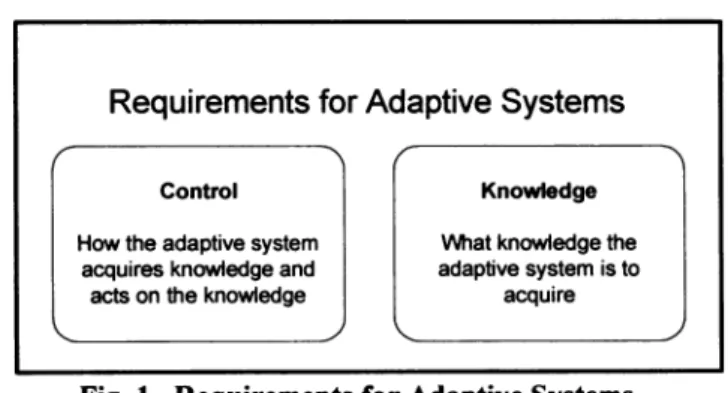
should address thetwoaspectsof the system shown in Fig.
1,namelycontrol andknowledge.
The controltype requirements are the type that would
typically be generated for any software system. The
knowledgetyperequirementsare moredifficulttowriteand
must fully address the adaptive nature of the system and
howitcanevolveovertime.
Fig. 1. Requirements for AdaptiveSystems
Early in the process of developing adaptive system
requirements, theadaptive behaviormustbeclearly defined
anddocumented. Project documentsat earlystages should contain high-level goals for the adaptive system behavior andknowledge. These high-level goalsshould be stated in
early documents, such as the Project Plan, and then be
traceable through Systems Requirements, Software and Interface Requirements, and Design documents. The
high-levelgoalsare arepresentation of the problemtobesolved, possiblyintheform ofinformaldescriptions.
From the high-level goals, the system level requirements can be developed. One approach to
developing requirements related to knowledge in neural networks, and other adaptive systems, is to model, or
describe the knowledge tobe acquired inthe form of rules
[13]. Kurd's model is summarized in the next section. Experts, or those involved in development, can translate
knowledge requirements into symbolic rules labeled as
initialknowledge.
In Fig. 2, the top row shows the typical requirements
developedforthe system. Thesecondrowofboxes shows
how this initialknowledgecanleadtorefinedknowledgeas
the system is trained and then either to intermediate
knowledge giventotheadaptive systembeforedeployment
System Software Requirements Requirements
Control
Knowleg InitealKexmde Refined
Knowledge
Fig.2. RequirementsforAdaptiveSystems(Control
andKnowledge)
or finalknowledge ifthe system is fixed. These tworows
representthe difference between thecontrol andknowledge
typerequirements.
Requirements for Adaptive Systems
Control Knowledge
How theadaptive system VVhat knowledgethe acquiresknowledgeand adaptivesystem is to
acts ontheknowledge acquire
B. RuleInsertionforHazardMitigation
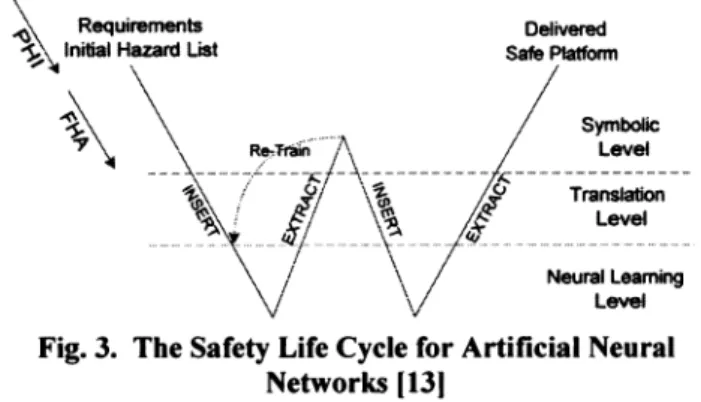
Kurd, Kelley, and Austin [13] describe a model that uses rule initialization, extraction, and insertion and ties hazard analysis into the development of the neural networks' knowledge and specifically addresses neural networksdevelopedforsafety-criticalapplications.
The following information is summarized from [13]. The authors describe a process for developing neural networks considering the safety criteria that must be enforced to justify the safety of the neural network in
operation.
Fig. 3 illustrates the development and safety life cycle.
The description of the three main levels and the major stagesin thediagramaredescribed below.
> Requirements Delivered
InitfalHazardList SafePlatform
Re2Ftsn A
~~~Symbolic
Re'''-;Xt / Level
/ Level
\,/ \/
~~~~Neural LeamiNng
Fig. 3. TheSafetyLifeCycle for Artificial Neural
Networks 1131
Symbolic Level: This level is associated with the
symbolic information. At this level the gathering and
processing of initial knowledge occurs, as well as
evaluatingextractedknowledge gathered post-learning.
Translation Level: This level is where the symbolic knowledge and the neural architectures are combined or
separated through the use of rule insertion and rule extraction techniques.
Neural Learning Level: This level uses neural learning
to refine the symbolic knowledge through the training of the neural networkusing learning algorithms.
Themajor stages that outline the process follow the "W" model in the development life cycle. These stages are
* Determination of requirements: These requirements describe the problem to be solved in informal terms andareintentionally incomplete.
* Sub-initial knowledge: Knowledge given by domain experts during a Preliminary Hazard Identification
(PHI)is translated into logical rules.
* Initial knowledge: The rules that describe the sub-initial knowledge are converted into symbolic forms
during Functional Hazard Analysis (FHA). These forms are compatible for translation into the neural networkstructure.
* Dynamic learning: Suitable learning algorithms and training sets are used to refine the initial symbolic knowledge and addnewrules to reduce theerrorinthe
output. This may result in topological changes to the neural network.
* Refined symbolic knowledge: Knowledge refined by the learning is extracted using appropriate algorithms. This results ina new setof rules thatcanbeanalyzed. * Static learning: Refined symbolic knowledge may be
modified by domain experts and re-inserted into the neural network. This further refines the knowledge in the neural network but does not allow topological or
architectural changes.
* Knowledge extraction: This can be performed at any timeduringstaticlearningtogetamodified ruleset. C. RuleExtractionfor Traceability
Neural network rule insertion/extraction can facilitate requirements traceability of top-level system requirements, in the form of knowledge requirements, to software requirements in theform of more specific rule bases.
Forthe neural network knowledge the traceability from
source code to design specifications is more difficult. As
the neural network learns andadapts, the changes that occur inthe internal parameters and structure act like source code modifications. However, implementation traceability can be achieved by running rule extraction algorithms from a trained neural network. The extracted rules can be compared directly against the design rules, or the extracted rules can be compared to higher-level software and system knowledge rules.
The refinement of requirements into software rules and
designrules are presented here and shown in Fig. 4.
Controle
KnowAedge
Fig. 4. Use of Rule Extraction to Develop System Knowledge
One approachtodeveloping the functional requirement related to the neural network knowledge may be to model,
or describe the knowledge to be acquired, in the form of rules. This would allow the neural network requirements to have a sufficient level of detail so they can be traced
throughout the life cycle documentation. The following three-step process outlines how this can be achieved.
Step 1. Translate System Specifications dealing with thefunction, basic knowledge, and constraints of the neural network into initial symbolic information in the form of a rule base for the system. These rules can also include information from thePHIand the FHA to address what the neuralnetwork is not allowedtodo or learn. These initial
rules should be translated into aformat that can beinserted into theneural network (architecture specific).
Step 2. Refine initial rules and translate them into software requirements. The process of refining the rules may include prototyping the neural network, inserting the initial symbolic knowledge, training the neural network to allow the rules to adapt to thetraining sets, and extracting the rules.
Step 3. Translate refined rules into a format (neural network architecture specific) that can be inserted into the neural network.
For projects that lack well defined knowledge requirements, another method for performing traceability maybe had by using machine learners ontraining data in
conjunction with rule extraction techniques on trained neural networks. After the training sets have been developed to reflect requirements, the neural network is trained and a set of rules is extracted. Machine-learning techniques, like a decision tree, are then usedon the same training set to produce a second set of rules. The neural network extracted rules can be compared against the machine learning results, enabling a kind oftraceability between design intent (the machine learning rules) and
implementation(the neural network rules.)
D. RuleExtractionforTesting
Rule extractioncanbe used inseveral waysto improve
the testing V&V activities for trained neural networks,
whether they be fixedpriortosystem usageorjust givena
basic set of knowledge before deployment and online
adaptation. Proof of correct operation (and thus correct learning) can be evidenced through knowledge evaluation criteria achieved via extracted rules. These rules can be assessed with theirown
pass/fail
criteria like the number of rules,complexityof the rules (e.g., number ofantecedents),
or rule size (e.g., graphical dimensions - too large/toosmall).
Extracted symbolic rules can directtestdatageneration
and highlight specific areas within an input domain for
testing. Anexampleis theuseofsymbolicrulesto act as a form of datageneration. Ifthe rules areofa mathematical
equation form, randomly generating inputs for the antecedent part of the rule allows computation of a consequent. Consequents can becollected,combined with the randomly generated antecedents, and formed into test datasets.
System testing can be difficult due to a lack of
well-specified knowledge requirements. If there are only few system requirements related toknowledge, the system test
designshould focusonpayingspecialattentiontoboundary
data. In this circumstance, extracted symbolic rules
describing the neural network can guide the generation of datanearthesystemknowledgeboundaries.
Ifthe neural networkusesreal-timeV&Vin theform of
an operational monitor, the symbolic rules ofthe neural
network can aid in testing the monitor. The symbolic rules expose the behavior of the neural network that in turn
facilitates selection of input domain regimes to exercise the monitor.
Assertion testing is another area within testing that is possible once rules are extracted. An assertion is a statement describing a specific condition against the system. Assertions can be stated that represent system or software requirements and possible hazards.
Oncean assertion is created, it can be checked against the extracted symbolic rules allowing domain experts the ability to analyze the rules to identify discrepancies from theintended design. Testers can use assertions to determine if certain scenarios like specific input combinations or
possible outputs can occur given the neural network knowledge.
E. RuleInsertion/RefinementforSystemStability and Fault
Tolerance
Online adaptive neural networks continue to learn and change during system operation. In some cases, a neural network may be pre-trained prior to deployment and additional learning directs the network away from this
original knowledge foundation. If the neural network is to
be initialized withsome aprioriknowledge that represents thedesignspecification, then thisknowledgecanbewritten in ruleformat andtechniques used for rule insertioncanbe repeated during operation to steerthe neural network back tothisbasicsetofknowledge.
This method provides a sense of system stability because the network canbe allowed to adapt to whatever theoperational environment encounters but the network can also be reminded ofimportantcoreknowledge.
Fault recoverycould also be accomplishedviasymbolic
rules like rule refinements, rule re-insertion, or some
combination. If a system is somehow flagged as being
erroneous,basicknowledgecanbere-inserted back into the networktotrytorecoverfrom theproblem. Anotheroption
is the complete reloading of a neural network with knowledge that is deemed acceptable from a previous system state or from the bare knowledge given at system delivery and installation.
F. RuleExtractionforOperational V& V
A prevalent technique to evaluate correct system behavior is the use of operational monitors, sometimes
referred to as run-time monitors. These separate software modules exist as oracles, continuouslyjudging the neural networkperformance based upon some pre-defined criteria established by the system designers. These observations lead to a system specific decision-making process or control,especially ifaproblem isfound.
Onepossibleoperationalmonitordesignis the real-time extraction ofrules from a neural network for comparison
against a set of acceptable rule conditions. Allowed
conditions can be based on system requirements, hazard limits, orperhapsboundary conditions.
The feasibility of this approach is still under investigation. Rule extraction offline is well documented
and easily accomplished. Rule extraction on a complex,
continually adapting neural network at high computation speedsremains to be established.
III. CONCLUSIONS
Neural networks lack the ability to explain how they reached aspecific output. This is oneof the main reasons
neural networks are not trusted. Inmostapplications users
want to know the reasoning behind the conclusion ofthe
learning system or expert system.
Rule extraction algorithms provide a means for either
partially or completely decompiling a trained neural
network. This is seen as a promising vehicle for at least
indirectly achieving the required goal of enabling a comparisontobe made between theextracted rules andthe
softwarespecifications.
One of the remaining issues with rule extraction is the
lack oftoolstoassist withextractingandusingrules. NaYve
rule extraction could result in the creation oflarge sets of
rules that are too unwieldy for human comprehension. Automated tools, like the one mentioned in [10] could reduce thatproblem.
Rule extraction from neural networks mayhave greater
utility for fixed neural networks than for dynamic neural networks. Fixed neural networks proceed through the steps oftraining and testing until they reach an acceptable error threshold andonly then are they used withinasystem. The knowledge of the domain is considered embedded inside theweightsandconnections of the network. If the network is no longer encouraged to adapt, the symbolic rules extracted to describe it can be a useful tool to validate that network at thetime of extraction.
With a dynamic neural network, symbolic rule
extraction may be required at intermediate stages in the
learning. At some intermediate points symbolic rules would be extracted andpassedthrough anoracle or system monitor to confirm that the network is still "correct." It may be that the maximum benefits for dynamic systems lie with rule insertion or ruleinitialization.
ACKNOWLEDGMENT
This research was sponsored by NASA Goddard
Research Center through the NASA Independent
Verification & Validation Facility, under Research Grant
NAG5- 12069.
REFERENCES
[1] Lisboa, P. 2001. Industrial use ofsafety-related artificial neural networks. Health and Safety Executive Contract ResearchReport327.
[2] Taylor, Brian J., Marjorie Darrah, Laura Pullum, et. al. 2004. Methods and Procedures for the Independent
Verificationand Validation of Neural Networks. Technical
Reportpreparedby InstituteforScientificResearch, Inc. for NASA Independent Verification and Validation Facility
undergrantNAG5-12069.
[3] Pecheur, Charles. 2000.Verification and Validation of AutonomySoftware at NASA. NASA/TM 2000-209602.
[4] Rodrigues, Pedro, Jose Felix Costa, and Hava T.
Siegelmann. 2001.Verifying Properties ofNeural Networks. IWANN(1)2001: 158-165.
[5] Pecheur, Charles and Stacy Nelson. 2002. V&V of AdvancedSystems at NASA.
[6] Tickle, Alan B.; R. Andrews; M. Golea; and J. Diederich. 1998. The truth is in there: directions and challenges in extracting rules from trained artificial neural networks.
[71
Andrews, Robert; J. Diederich; and A. B. Tickle. 1995. A Survey and Critique Of Techniques For Extracting Rules From Trained Artificial NeuralNetworks.Knowledge Based Systems 8:373-389.[8] Tan, A. 1997. Cascade ARTMAP: Integrating Neural Computation and Symbolic Knowledge Processing. IEEE Transactions on Neural Networks, 8 (2) 237-250.
[9] Craven, Mark; and J.W. Shavlik. 1994. UsingSampling and QueriestoExtract Rules from TrainedNeural Networks. In Proceedings of the 1 Ith International Conference on MachineLearning 37-45.
[10] Darrah, Marjorie, Brian Taylor and Michael Webb. A Geometric Rule Extraction Approach used for Verification
and Validation of a Safety Critical Application. 2005
Florida Artificial Intelligence Research Society Conference, Clear Water Beach, FL, May 16-18, 2005.
[11] Nayak R., R. Hayward and J. Diederich. 1997. "Connectionist KnowledgeBaseRepresentation by Generic Rules from Trained Feedforward Neural Networks", Proceeding of Connectionist Systems for Knowledge Representation and Deduction Workshop, Townsville, Australia, July 13-19.
[12]Taylor, B.J., MarjorieDarrah, Spiro Skias. 2004. Weaving it All Together - A Methodology for the Verification and
Validation of Adaptive Neural Networks. NIPS-2004
Workshop on Verification, Validation, and Testing of Learning Systems. Whistler, British Columbia, December 2004.
[13] Kurd,Zeshan, and Tim Kelley. 2003. Safety Lifecycle for Developing Safety Critical Artificial Neural Networks. In
Proceedingsof 22ndInternational Conference on Computer
Safety, Reliability, and Security (SAFECOMP'03) 23-26