Archaic and recent Ursus spelaeus forms
from Lombardy and Venetia Region (North
Italy)
Formas arcaicas y recientes de
Ursus spelaeus
en
Lombardía y la región de Venecia (Norte de
Italia)
ROSSI, M.1& SANTI, G.2
A B S T R A C T
Some Ursus spelaeus Rosenmüller-Heinroth, 1784 cranial and mandibular remains coming from Northern Italy (Lombardy Region -Buco dell’Orso Cave, Laglio, Como-) and from Venetia Region (Cerè, S. Donà di Lamon and Velo), are biometrically analysed. The compared fossils could be inserted in two typological forms: archaic and modern. To the first belongs a part of Venetia Region remains and to the second, the Buco dell’Orso Cave fossils and some of the Venetia Region caves too. The probable thesis of derivation of U. spelaeus by U. arctos is mentioned, although the phylogenetic hypothe-sis U. etruscus→U. deningeri→U. spelaeus, is still eff e c t i v e .
Key words: Ursus spelaeus, archaic and modern forms, comparison
(1) Museo Civico di Storia Naturale, L.go Adige, I-45100 Verona (Italy) (2) Dipartimento di Scienze della Terra, Via Ferrata 1, I-27100 Pavia (Italy)
INTRODUCTION
The Ursus spelaeus R o s e n m ü l l e r-Heinroth, 1784 remains are very abun-dant in the Northern Italy caves (SANTI & ROSSI, in press, for a bibliographic analysis), but the last discoveries taken in the Venetia Region have shown the pro-bably presence of archaic elements of this species. The fossils (about fifteen among the skulls and mandibles) come particu-larly from Cerè Cave, near Verona: this cave is placed along the Falconi Vajo near Ceredo (figure 1 A). Together with these bear fossils, have been found a great quan-tity of mammals remains that "…sembra rappresentare in realtà più momenti del Pleistocene" (BON et al., 1991, p.189). Skulls and mandibular bears remains from Cerè Cave are fragmentary, with the exception of two skulls and one mandible, partially deformed by fossilization pro-cess. These ones have the typical "spelaeus" characters, in particular those linked to a more herbivorous diet.
1) DOME CONFORMATION OF THE FRONTALS. This character is cle-arly visible in some fossils (V 160 and V 162), less in the V 161 specimen because of post-mortem process. The frontal region convexity has been signalled in some U. deningeri "modern" elements too (KURTÉN, in TORRES, 1988), but not in the "archaic" forms. Furthermore, in lateral view a profile of the cranic vault lit-tle convex, similar to the U. spelaeusone, is evidenced. The small dimensions of the V 161 specimen suggest the possibility that this fossil could belong to this species. The lack of P2 could not destroy this
hypothesis: in fact the U. deningeri dental
formula is very variable and the lack of second premolar remain, as in this case, has been signalled.
2) THE NASAL AREA, as in U. spe -l a e u s, is lightly concave (MAZZA & RUSTIONI, 1994).
3) THE ZYGOMATIC ARC presents an arcuated profile with the convex boun-dary in the upper side and the concave below. Dorsally, the orbits’ profile of the specimens as in U. spelaeus, is rounded and a little protruding (TORRES, 1988, figu-re 1.8 a). On the contrary, in U. arctos is protruding and triangular (T O R R E S, 1988, figure 1.9 a).
4) THE VERTICAL RAMUS of the mandible has a posterior straight boun-dary like the inferior side of the coronoid crest that always link it vertically to the horizontal ramus (cf. TORRES, 1988, figs 7.2 b, c).
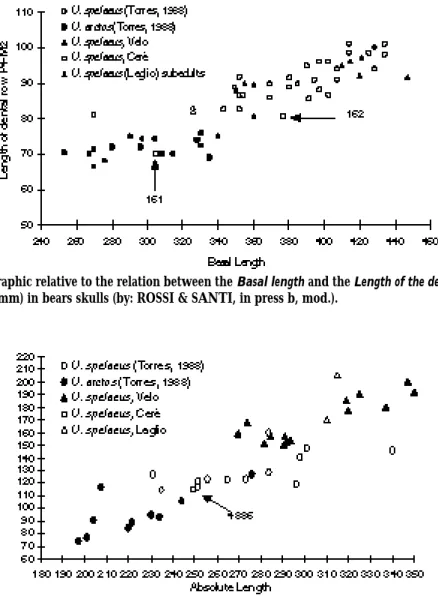
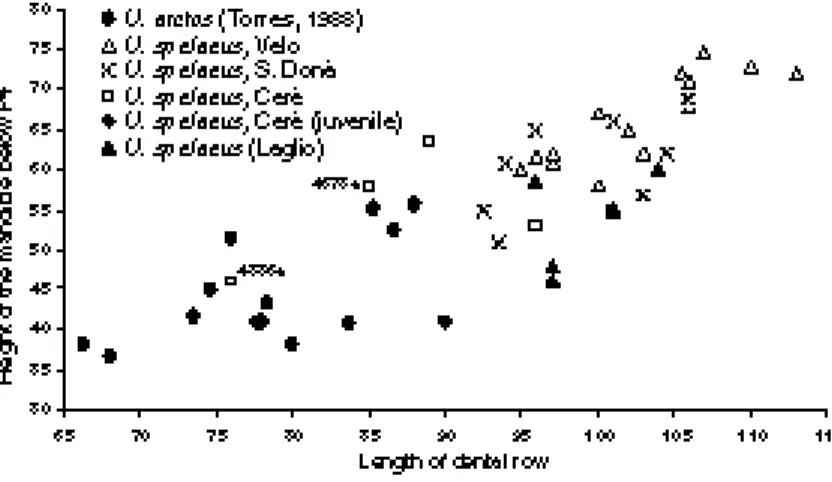
Biometric data confirm the observa-tions following the morphology, but show a decrease in size in comparison to the ave-rage found in the classic speloid elements. In particular, size is intermediate between the typical U. spelaeus and U. arctos (figu-res 2-3). Biometric values show that the skulls V 161 and V 162 (figure 2) and the mandibles belonging to the more robust elements (figures 3-4), fall in the field defined by U. spelaeus. Graphic of the figu-re 3 shows the typical speloid characters: in fact observing that the mandible V 4886 is the smaller among all the analysed specimens, it is possible to extend similar morphometric characters also to the other mandibular remains. Therefore, conside-ring the assigned age of Cerè deposit (BONet al., 1991) and the observed mor-phological and biometric characteristics,
it is possible to assign the analysed fossils to the archaic forms of U. spelaeus, only supposing, while waiting for new data, the presence of U. deningeri.
The U. spelaeus remains from the Buco dell’Orso Cave near Laglio (Como) (figure 1 B) have been studied by ROSSI & SANTI (in press a) and by SANTI & ROSSI (in press). The effected analyses
have demonstrated that the studied forms fall well in the morphologic and biometric spectrum typical of U. spelaeus, although the reduced size could let think to U. deningeri appurtenance (RABEDER, com. pers.) with the exception of one maxillary fragment. For it we have advanced an U. arctosappurtenance.
Diagrams of figures 2-3-4 propose a Figure 1. Geographic position of the fossiliferous localities of Cerè (Verona) (A) and Buco dell’Orso (Laglio) (B) Caves.
first, meaningful comparison between the cranial and mandibular morphometry of the Buco dell’Orso Cave and Cerè remains compared to the bears ones (U. spelaeusand
U. arctos) from venetian (Velo and S. Donà) and foreign localities (Spain). We put first is that we have utilised the main
meaningful parameters useful to this aim. Therefore the few data available demons-trate until now the clear difference of the points’ position referred to Cerè and Laglio fossils. Referring to diagram of figure 2 the Laglio bears representative points are placed in order to the boundary
320 ROSSI & SANTI CAD. LAB. XEOL. LAXE 26 (2001)
Figure 2. Graphic relative to the relation between the Basal length and the Length of the dental row
(P4-M2) (in mm) in bears skulls (by: ROSSI & SANTI, in press b, mod.).
Figure 3. Graphic relative to the relation between the Absolute length and Height of the vertical
of "spelaeus" dispersion data, while in the other graphics are placed very well inside the "spelaeus" cloud. The boundary posi-tion of the Laglio skulls representative points could have a logic explanation in the consideration that the fossils should belong to subadult forms and therefore still not come to maturity. Considering in particular both the Cerè bears, and the Laglio ones, we found two well distinct "spelaeus" types: the typical ones (main part) and the forms that having also "spe -laeus" morphologic characters, have par-tially the arctoid ones (V 4886a and V 161 for example) (ROSSI & SANTI, in press b). This "type diversity" could be explai-ned by the presence of U. spelaeus archaic forms (supposing only the U. deningeri
presence) and more "modern" ones. To the first should be referred a part of the consi-dered Cerè elements, and to the second, those of the Laglio and others of the Verona and Venetia region cave ones (figu-re 5).
Therefore with this first preliminary comparison should confirm for the moment, the hypothesis of the possible presence of U. spelaeusarchaic forms in the Verona Region. Notwithstanding that on the base of MAZZA & RUSTIONI’s (1994) considerations a possible deriva-tion of U. spelaeusfrom U. arctos could be advanced, morphologically and palaeogeo-graphically is more acceptable until now a phylogenetic sequence U. etruscus → U. deningeri → U. spelaeus with the new U. arctosinvasion in the Middle Galerian that originated the Upper Pleistocene and present arctoid forms (Petronio, pers. com.).
ACKNOWLEDGEMENTS
We would like to thank Prof. Petronio C. (Rome) for the useful advise and for the critical reading of the manuscript. Figure 4. Graphic relative to the relation between the Length of the dental row and Height of the
322 ROSSI & SANTI CAD. LAB. XEOL. LAXE 26 (2001)
Figure 5. Cranial morphologic variation on the chronological base, by Ursus deningeri at Ursus spe
-laeus ("archaic" and "modern"). U. deningeri and U. spe-laeus "modern" are reprised by STUART
REFERENCES
BON M., PICCOLI G. & SALA B. (1991). I giaci -menti quaternari di vertebrati fossili nell’Italia Nord-orientale. Mem. Sci. Geol. Padova,XLIII: 185-231.
MAZZA P. & RUSTIONI M. (1994). On the phylogeny of eurasian bears. Paleontographica, Abt. A,230: 1-38.
ROSSI M. & SANTI G. (in press a). Gli ursidi della grotta del Buco dell’Orso (Laglio-Como-Lombardia, Italia settentrionale). II- analisi morfometrica degli arti: indagine preliminare.
Atti Soc. Ital. Sci. Nat. e del Museo Civ. St. Nat. Milano.
ROSSI M. & SANTI G. (in press b). La fauna pleis-tocenica della grotta del Cerè (Verona).
1-prime osservazioni sui resti craniali e mandibo-lari di ursidi. Boll. Mus. Civ. St. Nat. Verona. SANTI G. & ROSSI M. (in press). Bears from the
Buco dell’Orso Cave (Laglio-Como-Lombardy, Italy). I- Morphometric study of the cranial and mandibular fossil remains. Memorie Soc. Ital. Sci. Nat. e del Museo Civ. St. Nat. Milano.
STUART A.J. (1982). Pleistocene Vertebrates in the British Isles. Longman London and New York, 212 pp.
TORRES PEREZ HIDALGO, T. (1988). O s o s (Mammalia, Carnivora, Ursidae) del Pleistocene Ibérico (U. deningeri Von Reichenau, U. spelaeus R o s e n m ü l l e r-Heinroth, U. arctos Linneo). B o l . Geol. y Min. I- Filogenia, Distribucion estrati-grafica y geoestrati-grafica. Estudio anatomico y metrico del craneo, 3-46. II- Estudio anatomi-co y metrianatomi-co de la mandibula, hioides, atlas y axis, 220-249.