Predicting intraindividual changes in teacher burnout: The role of perceived
school environment and motivational factors
Claude Fernet
*, Frédéric Guay, Caroline Senécal, Stéphanie Austin
Université Laval
a r t i c l e i n f o
Article history:Received 24 June 2011 Received in revised form 10 November 2011 Accepted 28 November 2011 Keywords: Burnout Teachers Job demands Job resources Autonomous motivation Self-efficacy Intraindividual changes
a b s t r a c t
Based on self-determination theory, this study proposes and tests a motivational model of intraindividual changes in teacher burnout (emotional exhaustion, depersonalization, and reduced personal accom-plishment). Participants were 806 French-Canadian teachers in public elementary and high schools. Results show that changes in teachers’ perceptions of classroom overload and students’ disruptive behavior are negatively related to changes in autonomous motivation, which in turn negatively predict changes in emotional exhaustion. Results also indicate that changes in teachers’perceptions of students’
disruptive behaviors and school principal’s leadership behaviors are related to changes in self-efficacy, which in turn negatively predict changes in three burnout components.
Ó2011 Elsevier Ltd. All rights reserved.
1. Introduction
Job burnout is an affective reaction due to prolonged exposure
to job stress (Maslach, Schaufeli, & Leiter, 2001). Although the lack
of validated cut-off points in most countries makes it difficult to
determine the prevalence of burnout, two broadfindings emerge
from the research: 1) teachers are more vulnerable than other
workers to burnout symptoms (see de Heus & Diekstra, 1999;
Schaufeli & Enzmann, 1998), and 2) burnout affects teachers
around the world (Byrne, 1999; Rudow, 1999).
In Canada, and more particularly, in the province of Quebec (where this study was conducted), current data suggest that from 12% to 20% of teachers report burnout symptoms at least once
a week (Fernet, 2003; Houlfort & Sauvé, 2010). Presumably, the
relational nature of teaching puts teachers at high risk for emotional drainage, which could explain their vulnerability to burnout. The need to better understand teacher burnout is evi-denced in, among others, the relationship between burnout and
other significant consequences for individuals (e.g., teachers’
ill-being; Hakanen, Bakker, & Schaufeli, 2006), organizations (e.g.,
turnover and absenteeism; Cherniss, 1980; Jackson, Schwab, &
Schuler, 1986), and school missions (e.g., quality of teaching; Cherniss, 1980).
To prevent teacher burnout, researchers have investigated a variety of causes. So far, the work environment has been
considered the main determinant of burnout (Maslach et al., 2001).
For instance, the job demands-resources (JD-R) model (Demerouti,
Bakker, Nachreiner, & Schaufeli, 2001; Schaufeli & Bakker, 2004) emphasizes two sets of workplace factors: job demands and resources. At school, job demands include several aspects such as
work overload, role problems, deficient equipment, school policies
and climate, interpersonal conflicts, and students’ behavioral
problems. Job resources include administrative leadership,flexible
schedules, decision latitude, skill utilization, participation in decision-making, recognition, professional development, coaching,
and support from colleagues, among others (seeByrne, 1999and
Rudow, 1999). The literature has provided consistent support for the JD-R model and the primary role of job demands and resources
in burnout (seeFernet, Austin, Trépanier, & Dussault, in press, for
a recent review). For example,Hakanen et al. (2006)found that
burnout is predicted by teachers’ perceptions of job demands
(overload, students’behaviors, and physical environment) and the
absence of job resources (job control, information, supervisory support, and innovative and social climate).
Although the JD-R model has been proven useful in predicting burnout, it has been restricted mainly to the study of work envi-ronment factors. As a result, motivational factorsdwhich may be *Corresponding author. Département des sciences de la gestion, Université du
Québec à Trois-Rivières, 3351 boul. des Forges, C.P. 500, Trois-Rivières, Québec, Canada G9A 5H7. Tel.:þ1 819 376 5011; fax:þ1 819 376 5079.
E-mail address:[email protected](C. Fernet).
Contents lists available atSciVerse ScienceDirect
Teaching and Teacher Education
j o u r n a l h o me p a g e : w w w . e l s e v i e r . c o m/ l o ca t e / t a t e0742-051X/$esee front matterÓ2011 Elsevier Ltd. All rights reserved. doi:10.1016/j.tate.2011.11.013
important underlying mechanisms in the burnout processdhave been neglected. Yet, some studies have revealed that individual
factors, such as self-efficacy, optimism, and organizational-based
self-esteem (Xanthopoulou, Bakker, Demerouti, & Schaufeli, 2007)
as well as self-esteem (Byrne, 1999) mediate the relationships
between workplace factors and burnout. Other research has
evi-denced that self-efficacy (Brouwers & Tomic, 2000; Skaalvik &
Skaalvik, 2010), and autonomous motivation (Fernet, Senécal, Guay, Marsh, & Dowson, 2008) are negatively related to teacher
burnout. Building on self-determination theory (SDT;Deci & Ryan,
1985, 2002), our study proposes and tests a motivational model of intraindividual changes in teacher burnout. The model posits that
changes in teachers’perceptions of the school environment are
likely to predict changes in burnout through changes in motiva-tional factors.
This study contributes to the research on burnout in three ways.
First, in line with Maslach’s conceptualization (1982), we evaluate
changes in burnout components over time. More precisely, we focus on intraindividual changes to better understand its correlates and the reason for increased (or decreased) teacher burnout. Second, in contrast to the previous research, we do not focus on global inferences about the work environment or motivational
factors, but rather on specific inferences. We examine the role of
particular interpersonal (students’ behavior and principal’s
lead-ership) and organizational factors (overload and decision latitude) as well as motivational factors (autonomous motivation and
self-efficacy) that stem from the classroom environment. Third, based
on a well-known theoretical framework (SDT), this study provides valuable insights into current burnout models, such as the JD-R
model (Demerouti et al., 2001; Schaufeli & Bakker, 2004). In the
sections below, we present issues about changes in burnout and
content domain specificity to address the limitations of the
previous research. We then present an overview of SDT along with supporting evidence for the proposed model.
1.1. Changes in burnout components
Burnout is an ongoing process that emerges gradually over time. It is characterized by three components: emotional exhaustion,
depersonalization, and reduced personal accomplishment
(Maslach, 1982). Emotional exhaustion in teachers refers to the
depletion of energy resources. Depersonalization refers to
a detached attitude that teachers adopt toward the job itself or the
people associated with it.Reduced personal accomplishmentrefers
to a decrease in teachers’feelings of achievement and competence
at work. Although emotional exhaustion is the acknowledged hallmark of burnout, we focus on each component separately in
order to capture critical aspects of the burnout syndrome (Schaufeli
& Taris, 2005).
Despite the fact that burnout components are expected to evolve, few studies have used a longitudinal design to investigate them. Moreover, existing longitudinal studies have failed to
reproduce the effects observed in cross-sectional studies (Schaufeli,
2003). In addition, based on correlations over time, many
researchers have concluded that burnout components are stable for most people regardless of intraindividual changes (i.e., within-person stability and change) over time. Although this approach provides important information on between-person groups, it obscures individual differences in stability and change. For example, perceptions of burnout may be stable for some
individ-uals, whereas they mightfluctuate for others. Thus, patterns of
change across individuals, which capture the notion of
interindi-vidual differences in intraindiinterindi-vidual change, are difficult to assess
with stability coefficients. We believe that a more complete
understanding of burnout and its correlates requires a greater
appreciation of intraindividual changes. To our knowledge, these
concerns were investigated in only one study (Burisch, 2002),
based on a three-year panel of data spanning seven time points. Results showed no association between intraindividual changes in burnout and dispositional or workplace factors. In light of these
unexpectedfindings, Burisch has called for“novel approaches to
make the study of intraindividual change a more promising
endeavor”(p.16).
Accordingly, we used a latent variable approach to investigate
intraindividual change (Steyer, Partchev, & Shanahan, 2000). This
approach was used by Otis, Grouzet, and Pelletier (2005) to
examine the impact of motivational changes on students’
educa-tional outcomes (dropout intentions, absenteeism, homework frequency, and educational aspirations). Among other things, it allows investigating the relationships between different patterns of change. For instance, is increased teacher burnout during the school year predicted by increasingly deleterious environmental factors and/or decreased motivational factors? Assuming that these change patterns are related, we sought to provide a more comprehensive understanding of burnout as a dynamic phenom-enon rather than the outcome of a static set of more or less stress-related predictors. For example, burnout components might evolve not only because teachers begin to doubt their professional abilities at the beginning of the school year, but also because their percep-tions erode drastically over time.
1.2. Work task specificity in assessing teachers’self-perceptions
Most burnout studies have used generic measures to assess
potential causes of burnout (Van der Doef & Maes, 2002). Such
measures assess global job stressors regardless of the occupation’s
particularities. Although this approach enables comparisons between professions, it neglects to evaluate the critical sources of
stress in a specific occupation. For example, a teacher mightfind
class management or teaching stressful, but not administrative or complementary tasks. More importantly, generic measures do not take into account the complexity and variation of self-perceptions
in a particular domaindperceptions that may impair the
under-standing and prediction of behavior (Marsh & Yeung, 1998). Based
on previous research, we decided to assess motivational and workplace variables that stem from the classroom environ-mentdan environment reported to be particularly stressful for
teachers (Friedman, 2003). For instance, in a study in 5426
Cana-dian and American teachers and administrators, 63% reported that
students’disruptive behavior was the most stressful factor in the
school environment (Kuzsman & Schnall, 1987). More recently, in
a sample of 416 Australian high school teachers, McCormick and
Barnett (2011) investigated the link between burnout and
teachers’perceptions of job stress in specific domains (personal,
classroom, school, and external). They concluded that the most salient stress for burnout was student disruptive behavior. Without denying other sources of stress related to tasks (e.g., administrative paperwork), the school (e.g., sense of community), and the larger school system (e.g., reforms), our model focuses on the classroom. Classroom work primarily involves teaching and class management (Friedman, 2003). Teaching comprises classroom instruction, including presenting lessons, answering questions, and responding
to students’needs. Class management refers to disciplinary
prac-tices, including handling disciplinary issues and problems, applying
rules, and preventing and/or managing interruptions and conflicts.
Therefore, instead of regrouping the variables under general headings (e.g., job demands and resources, motivational factors, burnout), we consider relationships between distinct aspects of the
school environment (teachers’perceptions of students’disruptive
leadership behaviors). This approach is justified by research that has shown that burnout is differentially related to distinct work
environment factors (Lee & Ashforth, 1996). More importantly, it
can provide new perspectives and a deeper understanding of the classroom antecedents of teacher burnout.
1.3. Self-Determination Theory (SDT) 1.3.1. Motivational factors and burnout
SDT (Deci & Ryan, 1985, 2002) is an approach to human
moti-vation in which autonomous motimoti-vation is deemed essential for optimal functioning. Autonomous motivation refers to the experi-ence of choice in initiating behavior. Teachers are autonomously motivated when they perform their job for the intrinsic value of achieving meaningful and interesting goals or because they personally grasp the value of their work activities. SDT distin-guishes between intrinsic motivation (doing something for its own sake) and extrinsic motivation (doing something for an instru-mental reason). The theory also proposes that extrinsic motivation can be internalized, meaning that by acquiring and accepting new values or goals, people become autonomously motivated to engage in behavior that expresses these values and goals. Thus, internali-zation can give rise to different forms of extrinsic motivation that may be aligned on a continuum, with external regulation at the low
end, followed by introjected and identified regulation. External
regulationoccurs when behavior is regulated to obtain a reward or
avoid a constraint.Introjected regulationis the process whereby an
external demand becomes an internal representation. Individuals put pressure on themselves through internal coercion (e.g., anxiety, guilt, or shame) to ensure that they behave in a certain way. Finally,
identified regulationis defined as behavior that individuals choose
to engage in because they value it. Instead of succumbing to external or internal pressures, individuals experience choice while performing the activity, even if the activity is not interesting. Given
that identified behavior is accepted as one’s own, it is regarded as
autonomously regulated.
Research in the workplace has evidenced that employees who show more autonomous than controlled motivation display greater
well-being (seeRyan & Deci, 2000, for a review). A recent study on
teacher motivation indicated that autonomous types of motivation
(intrinsic motivation and identified regulation) toward work
activities are negatively related to burnout, whereas controlled types of motivation (introjected and external regulation) are
posi-tively associated with burnout (Fernet et al., 2008). Thesefindings
suggest that work motivation is influential in explaining burnout.
Another central SDT concept is perceived competence, or
confidence that one can succeed at optimally challenging tasks and
attain desired outcomes (White, 1959). To illustrate, teachers who
are confident in their abilities to teach and deal with disruptive
students perceive themselves as being competent in the classroom.
Perceived competence is similar to self-efficacy, defined byBandura
(1997)as“beliefs in one’s capabilities to organize and execute the
courses of action required to produce given attainments” (p.3).
Although SDT views perceived competence as an innate propensity (Ryan & Deci, 2000), the operationalized definition of self-efficacy
and perceived competence are theoretically related (Deci, 1992).
Past studies have shown that self-efficacy is a key variable in
pre-dicting burnout (Brouwers & Tomic, 2000; Salanova, Peiro, &
Schaufeli, 2002). We therefore use a measure of teachers’
perceived efficacy to assess this motivational factor, and
accord-ingly, the term self-efficacy is used for the remainder of this article.
Recent research has acknowledged the importance of assessing
teachers’efficacy with respect to domain specificity (
Tschannen-Moran, Woolfolk Hoy, & Hoy, 1998, for a review). In line with this, Friedman (2003)found that, in the classroom and the school as
a whole, a teacher’s capacity to positively influence others (called
interpersonal efficacy) is negatively correlated to burnout.
Simi-larly, studies have revealed that teachers’ classroom efficacy is
negatively associated with burnout (Brouwers & Tomic, 2000).
1.3.2. Work environment and motivational factors
At the heart of SDT is the assumption that environmental factors are critical because they can facilitate or thwart motivational
factors, which in turn influence individual psychological
func-tioning. SDT-based research has thus devoted considerable atten-tion on the workplace factors that can affect employee motivaatten-tion (Gagné & Deci, 2005). Different aspects of the school or classroom environment may be considered as either autonomy-supportive or
controlling (Ryan & Deci, 2000). Autonomy-supportive conditions
allow teachers to make certain choices and decisions about their work and develop a meaningful rationale. They also minimize
pressure, provide competence feedback, and acknowledge
teachers’feelings and views (Deci, Eghrari, Patrick, & Leone, 1994).
These conditions parallel job resources, because they are thought to
be functional in achieving work goals (Demerouti et al., 2001;
Schaufeli & Bakker, 2004) and they allow the satisfaction of basic psychological needs such as autonomy, competence, and
related-ness (Ryan & Deci, 2000). Conversely, controlling factorsdsuch as
imposed goals, time restraints, or contingent rewardsdconstrain
and pressure how teachers think, feel, and behave. Such conditions preclude energy investment and may become job stressors.
It is important to recognize that these assumptions share some similarities with the JD-R model. Also relying on environmental factors, this model posits that burnout is mainly the result of deleterious working conditions. The main proposition is that job demands and resources imply two distinct processes that may result in burnout. First, there is the energetic process, in which
demanding aspects of the job drain the employee’s energy, leading
to exhaustion. Second, there is a motivational process whereby a lack of job resources hampers employee motivation and contributes to depersonalization and reduced personal
accom-plishment (Bakker, Demerouti, Taris, Schaufeli, & Schreurs, 2003).
Despite growing evidence in support of this model, some studies also suggest that job resources are involved in the energetic process
and job demands in the motivational process (Lee & Ashforth,
1996). For instance, in a subsample of health care employees,
Bakker et al. (2003) found that job resources were related to emotional exhaustion in addition to depersonalization and personal accomplishment. Results also showed that job demands
were related to personal accomplishment. In addition, Van den
Broeck, Vansteenkiste, De Witte, and Lens (2008)demonstrated
that psychological needs satisfactiondas indexed by competence,
autonomy, and relatednessdplays a partial mediating role between
job demands and emotional exhaustion and acts as a full mediator between job resources and exhaustion. Other studies have shown that both job demands and resources are related to energy
deple-tion (e.g.,Crawford, LePine, & Rich, 2010; Hakanen et al., 2006). This
suggests that employee motivation factors are affected not only by the availability of job resources, but also by demanding aspects of
the job. Based on SDT assumptions, we argue that it is difficult to
completely differentiate these processes, because they may have the same underlying motives (autonomous motivation and
self-efficacy). Thus, burnout may be precipitated by demanding
aspects of the job that weaken employee autonomous motivation
and self-efficacy. For instance, teachers who perceive that they have
insufficient time to accomplish their work may feel exhausted, not
only due to the demands of their job, but also, and more
particu-larly, due to a lack of autonomous motivation. Simiparticu-larly, teachers’
perceptions of students’disruptive behavior may provoke burnout,
In this study, we focused on specific demanding and resource-based aspects of the job content (decision latitude and classroom overload) and interpersonal relationships (student behavior and
principal’s leadership behaviors). We assessed two types of job
demands: classroom overload and students’disruptive behavior,
both of which have been considered as important determinants of
teacher burnout (Hakanen et al., 2006). Classroom overload
involves too many demands and not enough time to meet them (Byrne, 1999). Students’disruptive behavior refers to the negative attitude of some students, which is typically part of the classroom
experience (Hastings & Bham, 2003). Although we focused on
teachers’ perceptions of students’ disrespectful behaviors, other
negative attitudes in the classroom, such inattentiveness and
unsociability (Friedman, 1995) and student distrust (Goddard,
Tschannen-Moran, & Hoy, 2001; Van Houtte, 2006) have been connected to job dissatisfaction and burnout in teachers. We also
considered two job resources: teachers’ perception of decision
latitude in the classroom and the school principal’s leadership style.
Decision latitude refers to the extent to which an occupation or activity provides opportunities to make decisions and exercise
control over the tasks to be accomplished (Karasek, 1985). This job
resource contrasts with autonomous motivation, which concerns the degree to which an employee engages in work activities out of choice and interest. Some studies have provided support for the
crucial role of decision latitude in reducing burnout (Taris,
Stoffelsen, Bakker, Schaufeli, & Van Dierendonck, 2005). There is also considerable evidence that interpersonal support at work, especially from the school principal, plays a major role in alleviating
job stress and burnout in teachers (Leithwood, Menzies, Jantzi, &
Leithwood, 1996). School principals can help teachers accomplish their work in different ways. For example, they can allocate minor administrative paperwork and assignments to other staff members, thereby freeing up teachers to focus on their main tasks. They can also provide instrumental support such as pedagogical resources. Most importantly, the manner in which school principals express their support (e.g., autonomy-supportive vs. controlling) may affect
teachers’functioning.Deci, Connell, and Ryan (1989)showed that
employees whose supervisors reportedly adopted autonomy-supportive behaviors presented much greater trust in the organi-zation, felt less pressure, and expressed greater satisfaction with
their job. Thesefindings are consistent with increasingfindings in
education that teachers’perceptions of trust in different sources,
such as principals, colleagues, parents, and students, produce
favorable educational outcomes (e.g., Goddard et al., 2001;
Tschannen-Moran & Hoy, 1998).
Empirical evidence has also provided support for the relation-ships between job resources and motivational factors. Some studies have found that decision latitude is positively associated with
employees’perceived efficacy at work (e.g.,Salanova et al., 2002).
Similarly, studies have found that managerial autonomy support and leadership behaviors (e.g., providing opportunities for choice or encouraging self-initiative) are important correlates of employee
motivation (e.g.,Deci et al., 1989). Moreover, in a study conducted
in Gabonese teachers,Lévesque, Blais, and Hess (2004)found that
teachers’perceptions of autonomy-support by their principal are
related to autonomous motivation, which in turn is positively related to job satisfaction and negatively to burnout.
The findings of studies that investigated links between job
demands and motivational factors are less consistent. Some found a negative association between job demands and motivational
factors, such as autonomous motivation (Fernet, Guay, & Senécal,
2004), learning motivation (Taris, Kompier, DeLange, Schaufeli, &
Schreurs, 2003), and work engagement (Hakanen et al., 2006). Others found no evidence of a relationship between job demands
and intrinsic motivation (Van Yperen & Hagedoorn, 2003), or
between job demands and perceived efficacy (Salanova et al.,
2002). Nevertheless, it is important to note that the lack of
signif-icant relationships found in studies does not necessarily imply a true absence of relationship between job demands and
motiva-tional factors. In fact, the absence of significant relationship could
be explained by several factors, including the number of partici-pants, the magnitude of the effect size, variance heterogeneity, the operationalization of constructs, and the presence of moderating
variables. Regarding operationalization, Crawford et al. (2010)
showed in their meta-analysis that the link between job demands and employee motivation depends on the nature of the demands (hindrances vs. challenges). Demands that employees perceived as hindrances (e.g., time pressure, overload) were negatively associ-ated with work engagement, and demands perceived as challenges (e.g., responsibility, workload) were positively associated with engagement.
1.4. The proposed model
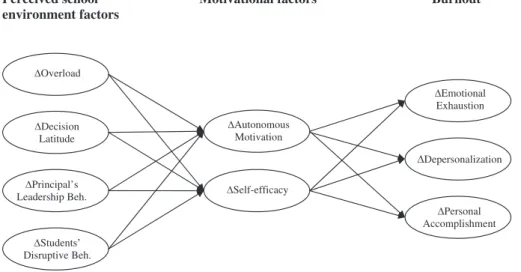
The proposed model is presented inFig. 1. The model suggests
that intraindividual changes over the school year in teachers’
Perceived school
Motivational factors Burnout
environment factors
Overload Decision Latitude Principal’s Leadership Beh. Autonomous Motivation Self-efficacy Students’ Disruptive Beh. Emotional Exhaustion Depersonalization Personal Accomplishmentperceptions of demanding aspects (classroom overload and
students’disruptive behavior) and resource-based aspects
(class-room decision latitude and principal’s leadership behaviors) will
predict intraindividual changes in burnout components (emotional exhaustion, depersonalization, and reduced personal accomplish-ment) through intraindividual changes in motivational factors
(autonomous motivation and self-efficacy).
2. Method
2.1. Procedure and participants
The data were collected as part of a research project on the work-related well-being of school teachers in the province of
Quebec, Canada. Quebec’s education system consists mainly of
public French-language schools. In this study, only elementary (grades 1e6) and high school (grades 7e11) teachers are consid-ered, although the system also includes colleges and universities.
We first approached the administrations of two school boards
containing a total of 103 schools: 84 elementary and 19 high schools. A letter explaining the study objectives, a questionnaire, and a self-addressed return envelope were then sent to the teachers in the two boards at the beginning of the school year (October; Time 1). Participation in the study was voluntary. The teachers were informed that we were conducting an eight-month longitudinal study, and were invited to respond to a second (identical) questionnaire at the end of the school year (June; Time 2). Interested respondents were then asked to provide their coor-dinates to ensure follow-up.
Of the 2512 teachers approached, 806 teachers (646 women, 160 men) completed the questionnaire at Time 1 (T1), for a response rate of 32%. This relatively low response rate is attributable in part to the voluntary participation (no working time allowed to complete the questionnaire), the mail-out procedure, and the fact that the school boards did not grant permission to send follow-up
reminders. Participants’mean age was 41.5 years (SD¼10.4) and
mean years of experience was 15 (SD¼10.4); 77% of participants
had a life partner and 55% had at least one child. The sample included 570 elementary teachers and 236 high school teachers. Of the participants, 80% held a permanent position, of which 87% were full-time. The sample fairly represented the demographic distri-bution of elementary and high school teachers in the school boards, with the exception of teaching level. Elementary teachers were slightly overrepresented (70.7% of respondents vs. 62.1% of school boards employees). Of the 806 teachers that participated at T1, 433 also completed a questionnaire at Time 2 (T2), for a 54% response rate.
To rule out a potential selection bias, we examined whether teachers who participated at both measurement times were equivalent to those who participated at only T1. Preliminary anal-yses indicate that the two samples did not differ on either back-ground variables (gender, age, school level, and job position) or the study variables. Although these results suggest no selection bias, it is generally considered inappropriate to disregard missing values
by using a listwise deletion of cases (Davey, Shanahan, & Schafer,
2001; Peugh & Enders, 2004). We explored this issue thoroughly and decided to use the full sample of 806 participants and to esti-mate the missing values at T1 (see the discussion on missing data in the Statistical analysis section below).
2.2. Measures
Autonomous motivation was measured with the Work Tasks
Motivation Scale for Teachers (WTMST; Fernet et al., 2008). The
WTMST includesfive motivational constructs related to different
work tasks. Each task is assessed by five subscales (intrinsic,
identified, introjected, and external regulation, and amotivation). In
this study, we focused on intrinsic and extrinsic motivation. Amo-tivation, which is likely to result from a lack of personal control or
efficacy (Deci & Ryan, 2000), was not considered because it
addresses the quantity rather than the quality of motivation. The subscales each contain three items, each of which addresses a possible reason for engaging in a particular task. Sample items
are,“Because Ifind this task interesting to do”(intrinsic);“Because
this task allows me to attain work objectives that I consider
important”(identified);“Because I would feel guilty not doing it”
(introjected); and“Because my job requires it”(external). Items are
scored on a seven-point scale ranging from 1 (does not correspond at all) to 7 (corresponds completely). The original validation of the
WTMST provides support for assessing teachers’motivation toward
specific job tasks. The scale has good construct validity and internal
consistency. In the present study, we calculated Hancock’s coeffi
-cients (also called coefficient H) to determine the reliability of the
measures (Hancock & Mueller, 2001). Computed from standardized
factor loadings, this coefficient estimates the stability of the latent
construct across multiple observed variables. For the four
motiva-tional constructs, coefficient H values ranged from .71 to .96 at T1
and .76 to .88 at T2, satisfying the .70 cut-off value (Hancock &
Mueller, 2001).
Following the procedure commonly used in the SDT literature (seeRyan & Connell, 1989), we used items from the four subscales to assess autonomous motivation. We used the following weighting
procedure: [(intrinsic motivation þ identified regulation) e
(introjected regulation þ external regulation)]. Positive scores
indicate that teachers perceive themselves as more autonomously motivated, whereas negative scores indicate that they feel more controlled when performing classroom activities. Score scales
ranged from12 to 12. Because each motivation type was assessed
on the basis of three items, we used the mean of these three indices to assess the manifest indicator of each work task. Thus, we created
two indicators to assess the latent variableautonomous motivation
in the classroom(teaching and class management).
Self-efficacy was measured with the French-Canadian version
(Fernet, Senécal, & Guay, 2005) of the Classroom and School
Context Teacher Self-Efficacy Scale (Friedman, 2003). The
class-room efficacy subscale consists of three factors: instruction (7
items, e.g.,“I believe I can be creative in my work with students”,
H¼.83T1,H¼.81T2), discipline (3 items, e.g.,“I believe I easily
overcome student interruptions in class,”H¼.84T1,H¼.85T2), and
consideration of students (7 items, e.g.,“I believe I amflexible and
adaptive in my relations with students,”H¼.85T1,H¼.86T2). All
items were rated on a six-point scale ranging from 1 (never) to 6 (always). The French-Canadian version has shown adequate construct validity, supported by correlations between subscales
and indicators of teachers’functioning at work (burnout and work
satisfaction). However, because the subscales for instruction and
consideration of students are highly correlated (r¼.85,Fernet et al.,
2005), we aggregated them into a single manifest variableperceived
efficacy in teaching. On the other hand, the discipline subscale was
used to assess teachers’self-efficacy in class management.
There-fore, we used two indicators to assess the latent variableself-effi
-cacy in the classroom(teaching and class management).
Perceptions of classroom overloadwere assessed with the
French-Canadian version (Brisson et al., 1998) of the Job Content
Ques-tionnaire (JCQ;Karasek, 1985), which presents comparable indices
of reliability and validity. The overload subscale is composed of nine
items (e.g.,“I have enough time to perform this task”; reverse).
However, we eliminated two items that addressed working with
other people because they do not apply to classroom tasks (“When
wait until others havefinished theirs,”and“For this task, I don’t
receive any contradictory demands from others”(reverse scored).
Each of the seven remaining items was rated on a Likert scale ranging from 1 (strongly disagree) to 4 (strongly agree). In addition, we slightly adapted the seven items to assess overload in terms of
teaching (H ¼ .75T1,
a
¼ .75T2) and class management tasks(
a
¼.78T1,a
¼.83T2). Participants had to rate each item for bothteaching and class management tasks. We created two indicators by averaging corresponding items to build the latent variable of
perceptions of classroom overload(teaching and class management).
Perceptions of students’disruptive behaviorwas measured with
a French translation of the Pupil Behavior Patterns Scale (PBP; Friedman, 1995). The PBP has shown good internal consistency and
temporal stability (Friedman, 1995) as well as satisfactory factorial
validity (Hastings & Bhan, 2003). We focused on the students’
disrespect subscale (11 items, e.g.,“Students in my class all speak at
the same time, which makes a lot of noise,”H¼.87T1,
a
¼.89T2).This subscale has been positively associated with teacher burnout (Hastings & Bhan, 2003). All items were rated on a six-point scale ranging from 1 (never) to 6 (always). We created three indicators by
averaging items to build the latent variableperceptions of students’
disruptive behavior.
Perceptions of decision latitude in the classroomwere assessed
with a subscale of the French-Canadian version (Brisson et al., 1998)
of the Job Content Questionnaire (JCQ;Karasek, 1985). This subscale
is composed of three items measuring overall decisional latitude over work. Each item was rated on a scale ranging from 1 (strongly disagree) to 4 (strongly agree). As for the overload measure, we
adapted items to assess decision latitude in teaching (H¼.72T1,
a
¼.75T2) and class management tasks (H¼.80T1,a
¼.83T2). Asample item is,“This work task allows me to make a lot of decisions
on my own.”We created two indicators by averaging corresponding
items to build the latent variableperceptions of decision latitude in
the classroom.
Perceptions of school principal’s leadership behaviors were
measured with a four-item scale adapted from the Supervisory
Style Inventory (Blais, Lachance, Brière, Dulude, & Richer, 1991),
which was developed in French. This scale assesses leadership
behaviors (autonomy-supportive, competency-supportive,
involvement-supportive, controlling, depreciative, and laissez-faire). Participants were asked to indicate the extent to which
their school principal interacted with them in a given way (e.g.,“I
am very closely monitored by my school principal”; controlling). In
this study, because we focused on teachers’autonomous
motiva-tion and self-efficacy, we used matching leadership behaviors, that
is, autonomy-supportive and controlling as well as competency-supportive and depreciative. We used one item to assess each
style, for a total of four items (H¼.71T1,
a
¼.75T2). Items were ratedon a seven-point scale ranging from 1 (do not agree at all) to 7 (agree very strongly). We created two indicators by subtracting
a positive from a negative style (autonomy-supportivee
control-ling and competency-supportiveedepreciative).
Burnoutwas assessed with the French-Canadian version (Dion &
Tessier, 1994) of the Maslach Burnout Inventory (MBI;Maslach & Jackson, 1986). Emotional exhaustion was composed of nine items
(e.g., “I feel emotionally drained from my work,” H ¼ .93T1,
H¼.95T2). Depersonalization was assessed withfive items (e.g.,
“I’ve become more callous toward people since I took this job,”
H¼.70T1,H¼.80T2). Personal accomplishment was measured by
eight items (e.g.,“I have accomplished many worthwhile things at
this job,”H¼.78T1,
a
¼.83T2). Responses to all items were scored ona seven-point scale ranging from 0 (never) to 6 (daily). The psychometric properties (internal consistencies and factorial and construct validity) of the French-Canadian version of the MBI are
similar to those of the original version (Maslach et al., 2001). We
created three indicators by averaging items from subscales to build latent constructs for each burnout component.
2.3. Statistical analysis
2.3.1. Structural equation modeling
We assessed model adequacy with structural equation modeling
(SEM) using Mplus 5.21 (Muthén & Muthén, 1998e2010). All
models were tested with standardized coefficients obtained by
maximum likelihood estimation. Modelfit indices were evaluated
using the comparativefit index (CFI), the root-mean-square error of
approximation (RMSEA), the standardized root-mean-squared residual (SRMR), and the square test statistic. Because the chi-square test is sensitive to sample size, where the probability of rejecting a hypothesized model increases with sample size, use of
relative fit indices is strongly recommended. Following Bentler
(2007), we used the CFI, SRMR, and RMSEA. Values below .05 for
RMSEA and SRMR indicate a good fit, whereas values up to .08
represent acceptable errors of approximation. As a general rule, CFI
values greater than .90 indicate a goodfit, superior to .95 being
ideal.
2.3.2. True intraindividual change model
Based on SEM, Steyer et al. (2000)proposed an approach to
modeling interindividual differences in intraindividual change called the true intraindividual change (TIC) model. Using a multi-state model (i.e., multiple measurement occasions) with invariant parameters (MSIP) as a starting point, it is based on two
assump-tions:first, at least two observed variables measure the same latent
variable on at least two occasions; and second, the measurement
model (i.e., coefficients of the regressions of the observed values on
latent variables) is invariant across time points. To test the second assumption, we performed a CFA analysis to verify the metric invariance (i.e., invariance of factor loadings) of the latent variables investigated across time (October to June). Results provide support for factorial invariance. Compared to the constraint model
(
c
2(827)¼1666.088, CFI ¼.94, SRMR ¼.05, RMSEA¼.04 [90%confidence interval (CI)¼.033, .038]), thefit of the model with no
invariance constraints (
c
2(813)¼1648.259, CFI¼.94, SRMR¼.05,RMSEA ¼ .04 [CI ¼ .033, .038]) did not improve significantly
(Δc2(14)¼19.32; n.s.). The TIC model therefore represents true
(error-free) intraindividual changes in a longitudinal design.
We used the change version of the MSIP (Steyer et al., 2000),
where latent variable differences represent true intraindividual change scores between the two measurement times (October and June). We regressed indicators of each latent variable in June onto the corresponding latent variables for October. Setting these added
coefficients at equal to the corresponding factorial loadings (which
are equal across time points) transformed the latent factors in June into true intraindividual change scores during the school year (from October to June). This approach therefore allows testing the proposed model based on intraindividual changes. For simplicity,
the term“change”is used for the remainder of the manuscript to
denote intraindividual change.
Thus, in our study, independent latent change variables
(perceptions of overload, decision latitude, students’ disruptive
behavior, and principal’s leadership behaviors) were regressed onto
dependent latent change variables (exhaustion, depersonalization, and personal accomplishment) through the mediating latent
change variables (autonomous motivation and self-efficacy). The
regression effects of corresponding predicating latent variables were included to control for baseline levels of each endogenous
variable (e.g., latent overload and latent change overload/latent
change autonomous motivation). Synchronous correlations
each group of independent, mediating, and dependent factors. Covariances between all baseline latent variables and error terms (uniquenesses) between corresponding indicators were also
spec-ified. As mentioned above, factor loadings were treated as invariant
over time. 2.3.3. Missing data
To rule out differences between teachers who participated or not at both measurement times, we tested the measurement model at T1 for factorial invariance across the two samples. This test is especially important, because failure to demonstrate factorial invariance as a function of missing values would mean the test is inadequate for evaluating true intraindividual change. For example, if there were no relationships between autonomous motivation and exhaustion in teachers for whom values are missing, the
general-izability of thefindings would be considerably lessened.
Accord-ingly, we tested for invariance of factor loadings, factor variances,
and factor covariances. We compared the fit of the constrained
multiple-group model (
c
2(461)¼645.553, CFI¼.92, SRMR¼.06,RMSEA¼.06 [CI¼.055, .065]) to that of a model with no invariance
constraints (
c
2(402)¼983.799, CFI¼.92, SRMR¼.08, RMSEA¼.06[CI¼.051; .060]). Compared to the constraint model, thefit of the
model with no invariance constraints did not improve significantly
(Δc2(59) ¼ 44.799; n.s.). This means that the invariance of the
measurement model including burnout components, school envi-ronment, and motivational factors is supported: factor loadings,
error variances, and covariances do not differ significantly across
either sample at T1. Moreover, results indicate no significant
differences between the two samples in the means for all latent variables.
Although these results suggest no selection bias, it is generally considered inappropriate to disregard missing values by using
a listwise deletion of cases (Davey et al., 2001; Peugh & Enders,
2004). To circumvent this problem, we used the full information
maximum likelihood (FIML) approach (Mplus) to estimate missing
values. Briefly, this methodology rebuilds the covariance matrix
and sample means estimates. This enables maximum use of all non-missing data, resulting in more accurate results than with
tradi-tional approaches to missing data (Jamshidian & Bentler, 1999).
Thus, all analyses presented in the Results section are based on a sample of 806 participants with estimated missing values at Time 2. It is worth mentioning that we also tested the proposed model with the subsample that participated at both measurement times
(n¼433) and obtained the same results pattern.
3. Results
3.1. Preliminary analysis
Descriptive statistics and correlations among study variables are
presented inTable 1. Correlations were estimated using confi
rma-tory factorial analysis (CFA), which provides satisfacrma-tory data fit
(
c
2(1035) ¼15,719.808, CFI ¼ .94, SRMR ¼.05, RMSEA ¼ .036[CI¼.033, .038]). As can be seen inTable 1, all correlations between
latent variables at T1 are significant and in the expected direction.
Note that negative correlations between latent change variables
(
h
2h
1) are due to the fact thath
1is a component of the differenceh
2h
1(seeSteyer et al., 2000). In addition, the patterns of changein the teachers’ burnout component are related to patterns of
change in motivational factors and most school environment factors.
We also examined latent means (seeTable 1), or mean change in
latent constructs (taking measurement error into account). Results reveal three general tendencies in our sample toward changes in
burnout and its correlates. First, regarding teachers’perceptions of Table
1 Descrip tiv e statistics and corr elations betw een late nt and lat ent chang e v ariab les. Variables Latent means Variances 1 2 3 4 5 6 7 8 9 10 11 12 13 14 15 16 17 18 1-Overload T1 2.85 .18 e 2-Decision latitude T1 3.68 .07 .20** e 3-Principal ’ s leadership beh. T1 2.60 2.35 .27** .37** e 4-Students ’ disruptive beh. T1 2.22 .23 .45** .30** .19** e 5-Autonomous motivation T1 6.81 5.16 .37** .33** .33** .34** e 6-Self-ef fi cacy T1 4.53 .20 .24** .43** .38** .34** .46** e 7-Emotional exhaustion T1 3.10 1.34 .51** .35** .48** .46** .47** .45** e 8-Depersonalization T1 1.48 .91 .38** .27** .41** .47** .41** .56** .60** e 9-Personal accomplishimentT1 4.88 .30 .29** .41** .43** .40** .44** .84** .52** .51** e 10-Δ Overload .02 .09 .36** .01 .09 .10 .18* .03 .10 .07 .03 e 11-Δ Decision latitude .08** .06 .03 .54** .00 .02 .04 .02 .01 .07 .04 .04 e 12-Δ Principal ’ s le adership beh. .16 1.41 .00 .09 .29** .01 .07 .03 .04 .06 .05 .15 .08 e 13-Δ Students ’ disruptive beh. .21 .13 .06 .05 .03 .22** .08 .07 .01 .06 .05 .21** .10 .08 e 14-Δ Autonomous motivation. .72** 2.31 .02 .03 .07 .02 .17* .03 .10 .07 .02 .29** .03 .11 .25** e 15-Δ Self-ef fi cacy .08** .07 .00 .04 .06 .03 .05 .19** .04 .11 .11 .13 .02 .34** .38** .27** e 16-Δ Emotional exhaustion .03 .70 .04 .01 .09 .09 .12* .04 .29** .23 .03 .22** .04 .25** .38** .40** .39** e 17-Δ Depersonalization .30** .68 .03 .05 .00 .04 .02 .10 .05 .21** .07 .10 .00 .16 .28** .20* .40** .60** e 18-Δ Personal accomplishment .09** .14 .07 .04 .15 .17* .08 .10 .10 .16* .15* .26** .00 .28** .29** .22** .68** .40** .32** e Note. Δ ¼ intraindividual change ( h 2e h 1); correlations in italics represent relationships among latent change variables; Beh. ¼ behavior. * p < .05; ** p < .01.
burnout, although emotional exhaustion was stable over the school year, depersonalization increased and personal accomplishment
decreased. Second, as for motivational factors, teachers’
autono-mous motivation and self-efficacy decreased over the school year.
Third, latent means for perceived school environment factors were stable over time, except for decisional latitude in the classroom, which increased over the school year. That said, it is important to note that these trends do not exclude potential differences in
intraindividual change. For instance, although there is no signifi
-cant change at the group level, some teachers may have perceived more change than others, such as increased classroom overload.
In order to determine the effect of background variables, we built an SEM model in which each latent and latent change variable was related to demographic variables (age, gender, teaching level, and employment contract). Fit indices for this model are
satisfac-tory (
c
2(969)¼1993.381, CFI¼.93, SRMR¼.05, RMSEA¼.037[CI¼.035, .040]). Results reveal nine significant paths (p<.01), of
which two concern gender and seven teaching level. Gender is
negatively associated with depersonalization at T1 (
b
¼ .17,p<.01) and changes in depersonalization over the school year
(
b
¼ .17,p<.01). Thus, women reported higher depersonalizationthan men, not only at the beginning of the school year but also with a greater increase over the school year. Regarding teaching level,
high school teachers show greater autonomous motivation (
b
¼.14,p<.01), self-efficacy (
b
¼.19,p<.01), personal accomplishment(
b
¼.17,p<.01), and lower depersonalization (b
¼ .13,p<.01)than then their elementary counterparts at T1. In addition, although
high school teachers show a significant increase in perceived effi
-cacy (
b
¼.14,p<.01) over the school year compared to elementaryteachers, they reported a greater increase in job demands (
b
¼.14,p<.01) and emotional exhaustion (
b
¼.16,p<.01). We thereforecontrolled for the effects of gender and teaching level in subsequent analyses.
3.2. Testing the motivational model of change in teacher burnout To test the adequacy of the proposed model, three models were
built according toKelloway’s (1998)procedure to test mediation. 1)
A fully mediated model included only indirect paths from latent change school environment factors to latent change burnout components through latent change motivational factors. 2) A
partially mediated model consisted of the proposed model with the addition of direct paths connecting latent change school environ-ment factors to latent change burnout components. 3) A non-mediated model comprised direct paths connecting latent change school environment to both latent change meditators and latent change burnout components, with no path from latent change motivational factors to latent change burnout components. The SEM analysis results show that the fully mediated model provides
a satisfactoryfit to the data (
c
2¼1871.343,df¼913, CFI¼.936,SRMR¼.057, RMSEA¼.036 [.034, .038]). Thefit of the partially
mediated (
c
2 ¼1842.348, df ¼ 889, CFI ¼.936, SRMR ¼ .056,RMSEA ¼ .036 [.034, .039]) and non-mediated model
(
c
2¼1846.708,df¼895, CFI¼.936, SRMR¼.056, RMSEA¼.036[.034, .039]) are almost identical to that of the fully mediated model
(Δc2[24]¼28.995; n.s. andΔc2[18]¼24.635; n.s.). This indicates
that neither including direct paths nor excluding mediation paths
significantly improves the modelfit. Thus, in terms of parsimony,
the fully mediated model offers the best-fitting solution. Coefficient
paths of the fully mediated model are depicted in Fig. 2 (for
simplicity, covariance paths between latent variables and/or latent change variables are not depicted because they are virtually the
same as the latent correlations presented inTable 1). Controlling for
the effects of gender and teaching level, and taking into account the baseline regressive effect of corresponding latent variables, results
show that changes in teachers’perceptions of classroom overload
(
b
¼ .29) and students’disruptive behavior (b
¼ .24) arenega-tively related to changes in autonomous motivation, which in turn
predict changes in emotional exhaustion (
b
¼ .28). They alsoindicate that changes in teachers’perceptions of students’
disrup-tive behaviors (
b
¼ .46) and school principal’s leadershipbehav-iors (
b
¼.39) are related to changes in self-efficacy, which in turnpredict changes in emotional exhaustion (
b
¼ .37),depersonal-ization (
b
¼ .38), and personal accomplishment (b
¼.63).4. Discussion
In recent decades, the burnout research has identified a number
of potential work environment and motivational determinants of teacher burnout. Still, little is known about how the correlates change over time or how patterns of change predict changes in teacher burnout. Using a latent intraindividual change approach,
Perceived school
Motivational factors
Burnout
environment factors
ΔOverload ΔDecision Latitude ΔPrincipal’s Leadership Beh. ΔAutonomous Motivation ΔSelf-efficacy ΔStudents’ Disruptive Beh. ΔEmotional Exhaustion ΔDepersonalization ΔPersonal Accomplishment -.29** -.24* -.46** .39** -.28* -.37** -.38** .63** Gendera -.12*we developed and tested a motivational model of teacher burnout.
This model posits that, over the school year, changes in teachers’
perceptions of the school environment (demands and resources) are likely to predict changes in burnout components (emotional exhaustion, depersonalization, and personal accomplishment) through motivational factors (autonomous motivation and
self-efficacy). Taken together, our results, when controlled for
poten-tially confounding variables, provide support for the proposed model.
4.1. Theoretical implications
This study makes a number of theoretical contributions to the literature. First, it underscores intraindividual changes in burnout over time. Thus, even though burnout components such as emotional exhaustion may be relatively stable at the group level, some teachers feel more (or less) burnt out than others over the school year. These results are interesting in that burnout has typi-cally been viewed as rather stable and consistent over time (Schaufeli, 2003). Our findings contribute to prior longitudinal studies that reveal patterns of change in burnout components at the group level. More importantly, they underscore the fact that
changes in burnout are predicted by changes in teachers’
percep-tions of school environment and motivational factors. The inclusion of demographic variables (gender and teaching level) reveals some trends, such as the fact that women are more likely to become emotionally exhausted over a school year. Although this result is
not inconsistent with past research (Maslach et al., 2001), it opens
the door for future studies to more systematically explore the
potential effects of teachers’ demographic characteristics on
changes in burnout.
Second, our study underscores that changes in teachers’
perceptions of school environment and motivational factors are important correlates of change in burnout components over the school year. Although we examined a limited set of variables, our
findings suggest that teachers’perceptions of interpersonal factors
(students’behavior and the principal’s leadership behaviors) are
particularly influential in the burnout process. Thesefindings are
interesting in light of SDT, which places greater emphasis on interpersonal elements in the work environment, such as
mana-gerial climate and leadership, which influence employee
well-being (see Gagné & Deci, 2005). However, our results indicate
that other demanding aspects of the job, such as classroom
over-load, are involved in the burnout process. These findings are
consistent with the larger literature on burnout, which suggests that job demands are crucial in the etiology of burnout. More
specifically, the JD-R model states that demands induce a stress
process that results in energy depletion. Nevertheless, our results reveal that a gain (or loss) in a particular job resource, such as perceptions of support by the school principal, may also contribute to a decrease (or increase) in burnout components over time. Although our study does not directly address this differential process, as we used bivariate correlations, future studies could consider the possibility that not only does the experience of loss precipitate burnout, the experience of gain may also prevent its
development (seeHobfoll, 1998).
As for motivational factors, it appears that teachers’perceptions
of both autonomous motivation and self-efficacy are important
correlates of burnout. Teachers who gradually perceive themselves
as less autonomously motivated and efficacious in accomplishing
their classroom tasks, even as they perceive greater pressure to do so, are more likely to be more exhausted at the end of the school
year. Although the role of self-efficacy has been largely recognized
in the burnout literature (Brouwers & Tomic, 2000; Skaalvik &
Skaalvik, 2010), our results argue that self-determination is
another key motivational factor in teacher burnout. Thesefindings
shed further light on the burnout sequence.Leiter and Maslach
(1988) suggest that emotional exhaustion is the hallmark of burnout, and that it can trigger other dimensions (i.e., deperson-alization and reduced feelings of personal accomplishment). Accordingly, if autonomous motivation is an additional motiva-tional factor that buttresses personal energy, it might consequently
delay the burnout process. Although firm conclusions about
causality cannot be drawn from our study, the results suggest that
teachers’perceptions of efficacy over time are likely to reduce the
manifestation of all three burnout components. Thesefindings are
in agreement withLeiter’s (1992)view that burnout may reflect
a crisis in professional self-efficacy. Although further research is
needed on this issue, the present study clearly indicates that the three components of burnout should be considered separately, and not as a combined variable.
Furthermore, ourfindings highlight the active role of
motiva-tional factors in the burnout process, suggesting that teachers’
perceptions of both resource-based (principal’s leadership
behav-iors) and demanding aspects of the school environment (classroom
overload and students’disruptive behavior) are related to burnout
components through motivational factors. In other words, the effect of environmental demands is particularly detrimental to
teachers’psychological well-being when they perceive that their
self-determination and efficacy are threatened. These findings
contribute to the previous research, particularly concerning the JD-R model, which suggests that motivational factors are triggered by
job resources alone (Bakker & Demerouti, 2007).
A third theoretical contribution is ourfinding that changes in
perceptions of certain types of job demands and resources are more
salient than others for understanding changes in teachers’
moti-vational factors and burnout components. Nevertheless, the results patterns suggest that burnout is not prompted solely by a particular
set of environmental factors. The relevance of considering specific
aspects of the school environment is underscored by the links between environmental and motivational factors. It is not that burnout is related more to perceptions of job demands than to perceptions of job resources, but rather that the psychological processes underlying the progression of burnout over time differ within these work-related aspects. For instance, perceptions of
excessive classroom overload may exacerbate teachers’exhaustion,
because it erodes their autonomous motivation in the classroom,
whereas it may have less influence on teachers’ perceptions of
efficacy. In contrast, students’ disruptive behavior may lessen
teachers’capacities to teach and manage the class effectively, with
perhaps less effect on teachers’motivation in the classroom. Future
research could seek to evaluate further aspects of teacher
func-tioning. With respect to motivational factors,Skaalvik and Skaalvik
(2011)recently showed that a sense of belongingness is a
non-negligible factor in predicting teacher burnout. Similarly,Pyhalto,
Pietarinen, and Salmela-Aro (2011) contend that the interper-sonal relationships that teachers have with their students and with the larger school environment, including parents and the community, contribute to teacher burnout. Given the complex work of teachers, considering a wider range of work-related activities would allow a more complete analysis of the anteced-ents of job burnout.
4.2. Practical implications
Although ourfindings need to be further validated, the issue of
changes in burnout and its correlates provides insights into how to
develop effective interventions to promote teachers’ well-being.
Specifically, it allows identifying specific aspects of teachers’tasks
With respect to classroom work, which forms the cornerstone of our model, the results suggest that burnout may be precipitated by motivational factors and perceptions of certain aspects of the job. In this sense, interventions to reduce demands or to increase
resources should manage to modify teacher’s perceptions of the
work environment, at least in terms of these aspects. For instance,
collaborative coaching could encourage teachers to reflect on their
practices and rethink them, for example, work organization and classroom management. By promoting professional development,
such initiatives could support teachers’feelings of competence in
the classroom, and lead them to appreciate and value their work more. Furthermore, in terms of the variables considered in this
study, more positive perceptions of the principal’s leadership
behaviors could foster feelings of self-efficacy in teachers. By their
nature and through their actions, principals tend to shape their
employees’perceptions, given that they can define and design the
reality in which their teachers evolve (Smircich & Morgan, 1982).
Principals who adopt autonomy-supportive behaviors can make themselves available to provide information, clarify ambiguities related to their role or tasks, respond to questions, and offer assistance or guidance as needed. Furthermore, they can foster a positive perception of resources by creating an autonomy-conducive environment, sharing information, and acknowledging
teachers’contributions.
Another important and parallel route to alleviating teacher burnout would be to improve their motivational resources for classroom work. To this end, educational interventions may help teachers develop the requisite attitudes and competencies to more effectively deal with problematical work situations. For instance, teachers may be able to manage classroom overload and disruptive student behavior if they value class management and feel that it is important (autonomous motivation), or if they feel effective in
coping with situations (self-efficacy). Although few studies have
investigated the effectiveness of such interventions, Gaudreau,
Royer, Frenette, and Beaumont (submitted for publication) suggest the relevance of training programs on positive manage-ment of classroom situations. More precisely, they showed that an ongoing training program consisting of eight sessions during
a school year contributed to perceptions of self-efficacy in teachers,
specifically in classroom management. Future research along these
lines would be a promising direction. 4.3. Limitations
Certain limitations should be taken into consideration when interpreting the results of this study. First, although the longitu-dinal design improves on previous burnout research and provides stronger support for correlates of change in teacher burnout, data were collected at two time points only. Although the time interval respected the typical school-year calendar, a panel of data based on more than two time points would be more informative on the long-term stability of change in correlates of burnout among teachers. It
would also allow for investigating specific patterns of change in
a number of variables over the school year.
Second, although our results show significant relationships
between patterns of change in teacher burnout and its correlates, no causal inference should be made. For example, it is possible that teachers whose perceptions of burnout increased would not only feel less self-motivated, they would also perceive the work environment more aversively. Although the burnout research has typically supported the contention that work environment and
individual factors result in burnout (Zapf, Dormann, & Frese, 1996),
it is difficult to demonstrate unambiguous causality in
non-experimental studies. In large-scale studies, a fruitful avenue would be to incorporate additional school environment and
motivational factors into the study of teacher burnout in order to
examine their impact on students’ achievement (Van Houtte,
2011).
Third, the proposed model appears consistent with the idea that motivational factors mediate the relationships between percep-tions of school environment factors and burnout. Although the vast body of STD-oriented research has supported the idea that moti-vational factors act as mediators between the social milieu and
psychological functioning (Ryan & Deci, 2000), a comprehensive
testing of the model in the present study would require more than
two time points (Cole & Maxwell, 2003). Further research is needed
to better delineate the mediating processes assumed in the moti-vational model of teacher burnout.
Fourth, our study relies exclusively on self-reported measures, which raises the possibility of shared method variance. We tried to minimize this problem by a) selecting differently formulated self-report measures, b) using different scale ranges, and c) corre-lating uniquenesses between same constructs measured at both
time points (seePodsakoff, MacKenzie, Lee, & Podsakoff, 2003). It is
important to keep in mind that this study addressed intraindividual
change. It would have been difficult to use methods other than
self-reported measures to address these concerns, especially with the large number of participants in this study.
In sum, despite the above-mentioned limitations, ourfindings
provide support for the proposed motivational model of changes in
teacher burnout. There is evidence that variations in teachers’
perceptions of the school environment over time are likely to predict burnout through motivational factors. Accordingly, we believe that considering a combination of motivational and work-place factors provides additional cues for preventing teacher burnout.
Acknowledgments
This article was prepared with thefinancial support of the Social
Sciences and Humanities Research Council of Canada (C.F.), the Fonds de la Recherche en Santé du Québec (C.F.), and the Canada Research Chair program (F.G.). We are thankful to Denis Talbot for statistical assistance.
References
Bakker, A. B., & Demerouti, E. (2007). The job demands-resources model: state of the art.Journal of Managerial Psychology, 22, 309e328.
Bakker, A. B., Demerouti, E., Taris, T. W., Schaufeli, W. B., & Schreurs, P. J. G. (2003). A multigroup analysis of the job demands-resources model in four home care organizations.International Journal of Stress Management, 10(1), 16e38. Bandura, A. (1997).Self-efficacy: The exercise of control. New York: W.H. Freeman. Bentler, P. M. (2007). On tests and indices for evaluating structural models.
Personality and Individual Differences, 42, 825e829.
Blais, M. R., Lachance, L., Brière, N. M., Dulude, D. M., & Richer, S. (1991, November). L’inventaire des perceptions du style de supervision au travail (IPSST): Une mesure d’antécédents motivationnels. [The Inventory of perceptions of super-vision styles in the workplace].Paper presented at the 14th Congrès annuel de la Société Québécoise pour la Recherche en Psychologie, Trois-Rivières, Canada. Brisson, C., Blanchette, C., Guimont, C., Dion, G., Moisan, J., Vézina, M., et al. (1998).
Reliability and validity of the French version of 18-item Karasek job content questionnaire.Work and Stress, 12(4), 322e336.
Brouwers, A., & Tomic, W. (2000). A longitudinal study of teacher burnout and perceived self-efficacy in classroom management. Teaching and Teacher Education, 16, 239e253.
Burisch, M. (2002). A longitudinal study of burnout: the relative importance of dispositions and experiences.Work and Stress, 16, 1e17.
Byrne, B. M. (1999). The nomological network of teacher burnout: a literature review and empirically validated model. In R. Vandenberghe, & A. Michael Huberman (Eds.),Understanding and preventing teacher burnout: A sourcebook of international research and practice (pp. 15e37). Cambridge, UK: Cambridge University Press.
Cherniss, C. (1980).Professional burnout in human service organizations. New York: Praeger.
Cole, D. A., & Maxwell, S. E. (2003). Testing mediational models with longitudinal data: questions and tips in the use of structural equation modeling.Journal of Abnormal Psychology, 112(4), 558e577.
Crawford, E. R., LePine, J. A., & Rich, B. L. (2010). Linking job demands and resources to employee engagement and burnout: a theoretical extension and meta-analytic test.Journal of Applied Psychology, 95(5), 834e848.
Davey, A., Shanahan, M. J., & Schafer, J. L. (2001). Correcting for selective nonre-sponse in the National Longitudinal Survey of Youth using multiple imputation. Journal of Human Resources, 36(3), 500e519.
de Heus, P., & Diekstra, R. F. W. (1999). Do teachers burn out more easily? A comparison of teachers with other social professions on work stress and burnout symptoms. In R. Vandenberghe, & A. Michael Huberman (Eds.),Understanding and preventing teacher burnout: A sourcebook of international research and practice (pp. 269e284). Cambridge, UK: Cambridge University Press.
Deci, E. L. (1992). On the nature and functions of motivation theories.Psychological Sciences, 3, 167e171.
Deci, E. L., Connell, J. P., & Ryan, R. M. (1989). Self-determination in a work orga-nization.Journal of Applied Psychology, 74, 580e590.
Deci, E. L., Eghrari, H., Patrick, B. C., & Leone, D. R. (1994). Facilitating internalization: the self-determination theory perspective.Journal of Personality, 62(1), 119e142. Deci, E. L., & Ryan, R. M. (1985).Intrinsic motivation and self-determination in human
behavior. New York: Platinum Press.
Deci, E. L., & Ryan, R. M. (2002).Handbook of self-determination research. Rochester, NY: University of Rochester Press.
Deci, E. L., & Ryan, R. M. (2000). The‘‘what’’and‘‘why’’of goal pursuits: human needs and the self-determination of behavior. Psychological Inquiry, 11, 319e338.
Demerouti, E., Bakker, A. B., Nachreiner, F., & Schaufeli, W. B. (2001). The job demandse resources model of burnout. Journal of Applied Psychology, 86, 499e512.
Dion, G., & Tessier, R. (1994). Validation and translation of the burnout inventory of Maslach and Jackson.Canadian Journal of Behavior Science, 26, 210e227. Fernet, C. (2003).Profil de la santé en milieu de travail chez les enseignants. [Profile of
occupational health in teachers]. Unpublished manuscript. Université Laval, Canada.
Fernet, C., Austin, S., Trépanier, S. G., & Dussault, M. (in press). How do job char-acteristics contribute to burnout? Exploring the distinct mediating roles of perceived autonomy, competence, and relatedness.European Journal of Work and Organizational Psychology.
Fernet, C., Guay, F., & Senécal, C. (2004). Adjusting to job demands: The role of work self-determination and job control in predicting burnout.Journal of Vocational Behavior, 65(1), 39e56.
Fernet, C., Senécal, C., & Guay, F. (2005, March). La perception d’efficacité des enseignants: validation canadienne-française du“Classroom and School Context Teacher Self-Efficacy Scale”[Teacher self-efficacy: The French Canadian valida-tion of the“Classroom and School Context Teacher Self-Efficacy Scale”]. Paper presented at the 27th Congrès de la Société Québécoise pour la Recherche en Psychologie (SQRP), Québec, Canada.
Fernet, C., Senécal, C., Guay, F., Marsh, H., & Dowson, M. (2008). The Work Tasks Motivation Scale for Teachers (WTMST). Journal of Career Assessment, 16, 256e279.
Friedman, I. A. (1995). Student pattern behaviors contributing to teacher burnout. Journal of Educational Research, 88, 281e289.
Friedman, I. A. (2003). Self-efficacy and burnout in teaching: the importance of interpersonal-relations efficacy.Social Psychology of Education, 6, 191e215. Gagné, M., & Deci, E. L. (2005). Self-determination theory and work motivation.
Journal of Organizational Behavior, 26, 331e362.
Gaudreau, N., Roy