Graph mode-based contextual kernels for robust SVM tracking
Xi Li
†, Anthony Dick
†, Hanzi Wang
◦, Chunhua Shen
†‡, Anton van den Hengel
† †School of Computer Sciences, University of Adelaide, Australia
‡
NICTA
∗, Canberra Research Laboratory, Australia
◦
Center for Pattern Analysis and Machine Intelligence, Xiamen University, China, 361005
Abstract
Visual tracking has been typically solved as a binary classification problem. Most existing trackers only consider the pairwise interactions between samples, and thereby ig-nore the higher-order contextual interactions, which may lead to the sensitivity to complicated factors such as noises, outliers, background clutters and so on. In this paper, we propose a visual tracker based on support vector machines (SVMs), for which a novel graph mode-based contextual kernel is designed to effectively capture the higher-order contextual information from samples. To do so, we first cre-ate a visual graph whose similarity matrix is determined by a baseline visual kernel. Second, a set of high-order contexts are discovered in the visual graph. The problem of discovering these high-order contexts is solved by seek-ing modes of the visual graph. Each graph mode corre-sponds to a vertex community termed as a high-order con-text. Third, we construct a contextual kernel that effectively captures the interaction information between the high-order contexts. Finally, this contextual kernel is embedded into SVMs for robust tracking. Experimental results on chal-lenging videos demonstrate the effectiveness and robustness of the proposed tracker.
1. Introduction
Recently, visual tracking has attracted much research at-tention. It remains a challenging problem due to issues such as complicated appearance and illumination change, occlu-sion, cluttered background etc. To build a robust tracker, a variety of appearance models using different learning tech-niques have been proposed in the literature. According to the learning techniques, these appearance models may be roughly classified into two categories: generative learning based and discriminative learning based appearance mod-els. Generative learning based appearance models (GLMs)
∗NICTA is funded by the Australian Government as represented by the
Department of Broadband, Communications and the Digital Economy and the Australian Research Council through the ICT Center of Excellence program.
mainly concentrate on how to construct robust object repre-sentation in specified feature spaces, including the integral histogram [1], kernel density estimation [3], spatial-color mixture of Gaussians [2], subspace learning [18, 19, 20], sparse representation [4, 23], visual tracking decomposi-tion [17] and so on. A drawback of these methods is that they often ignore the influence of background, and conse-quently suffer from distractions caused by the background regions with similar appearance to foreground objects.
In contrast, discriminative learning based appearance models (DLMs) aim to maximize the inter-class separabil-ity between the object and non-object regions using dis-criminative learning techniques, including SVMs [7, 8, 21], boosting [5, 6], random forest [14], multiple instance learn-ing [9], spatial attention learnlearn-ing [13], etc. Most of these DLMs have used the pairwise interaction information from samples for object/non-object classification, and conse-quently ignore the higher-order contextual interaction in-formation (e.g., the interaction between two contexts in Fig. 1(d)). As a result, they may achieve unstable or unsuc-cessful tracking performance since the pairwise interactions are easily corrupted by complicated factors such as noises, outliers, background clutters and so on. In this paper, we show that the contextual information can play an important role in DLMs based tracking.
Motivation Typically, the pairwise similarity of two samples is based only on the individual samples themselves. Once one sample is corrupted by noise, their pairwise sim-ilarity will change significantly, so their true affinity cannot be computed in a stable way. Thus, designing a robust sim-ilarity measure is a key issue in visual tracking.
In this paper, we show that the high-order contextual information from samples can help to alleviate this issue. Usually, a high-order context is defined as a group of sam-ples having some common properties. Each sample in the high-order context is influenced by other samples in the same high-order context. In this case, the similarity mea-sure depends on not only two individual samples but also their corresponding contexts. Thus, although the pairwise interaction between two individual samples is sensitive to noise, the interaction (illustrated in Fig. 1(d)) between their
high-order contexts is much more stable because it consid-ers more cross-link information from their high-order con-texts. Even if the pairwise similarity is corrupted, the high-order contextual interaction can still provide complemen-tary information to counteract the impact of noise.
Here we propose a robust tracker that is based upon a graph mode-based contextual kernel for SVM tracking. Our main contributions are three-fold.
1. We introduce the high-order context into the visual tracking process. The high-order context of a sample is defined as a set of samples with similar visual content to the sample. Moreover, we design a contextual sim-ilarity measure (defined in Eq. (7)) between two high-order contexts to capture their interaction information. 2. The problem of building the high-order context is con-verted to that of graph mode seeking, which can auto-matically discover the modes (i.e., dense subgraphs) of a given visual graph characterized by a baseline visual kernel. According to the information provided by the graph modes, we can find that the graph vertexes be-longing to the same vertex community have some com-mon visual properties, as illustrated in Fig. 2. Such vertex communities correspond tohigh-order contexts. 3. We design a novel contextual kernel that fully com-bines the information from the baseline visual kernel and the high-order contexts. The contextual kernel takes a large value when samples share not only the similar visual content but also the mutually correlated high-order contexts. We also prove that the designed contextual kernel is a Mercer kernel. Therefore, we can naturally embed the contextual kernel into an SVM for robust tracking.
Related work Discriminative learning based tracking An online AdaBoost classifier [5] is developed for discrim-inative feature selection, which enables the tracker to adapt to appearance variations caused by out-of-plane rotations and illumination changes. Later, Grabneret al.[6] present a semi-supervised online boosting algorithm for tracking. This algorithm can significantly alleviate the model drifting problem caused during updating the model for the online AdaBoost classifier. Avidan [10] constructs a confidence map by pixel-wise classification using an ensemble of on-line learned weak classifiers, and mean shift is used to lo-cate the mode of the confidence map. Collinset al. [11] propose online feature selection for robust tracking. They try to find the most discriminative linear combination of the RGB color channels at each frame. Liu and Yu [12] propose an efficient online boosting algorithm based on gradient-based feature selection for pedestrian tracking. Babenkoet al.[9] present a tracking system based on online multiple instance boosting. Their tracker is able to update the ap-pearance model with a set of image patches, which is robust
but can lose accuracy if none of the patches precisely cap-ture the object appearance information.
Avidan [7] proposes an off-line SVM-based tracking algorithm for distinguishing a target vehicle from back-grounds. Since the algorithm needs many labeled training data, extending the algorithm to general object tracking is difficult. Tianet al.[8] utilize the ensemble of linear SVM classifiers for visual tracking. These classifiers can be adap-tively weighted according to their discriminative abilities during different periods. Tanget al.[21] present an online semi-supervised learning based tracker. The method con-structs two feature-specific SVM classifiers in a co-training framework, and thus is capable for improving each indi-vidual classifier using the information from other features. However, all of these tracking algorithms do not take the contextual information into account.
Context-aware tracking Yang et al. [22] propose a context-aware tracking algorithm, which considers a set of auxiliary objects in the tracking process. As the context of the target, these auxiliary objects need to satisfy the follow-ing three conditions: (a) persistent co-occurrence with the target; (b) consistent motion correlation to the target; and (c) easy to track. However, these conditions may not be easily satisfied in practice.
2. The proposed visual tracker
The workflow of the proposed visual tracker is listed in Algorithm 1. For better illustration, we elaborate the impor-tant components of the proposed visual tracker in this sec-tion, including contextual kernel design and training sample selection.
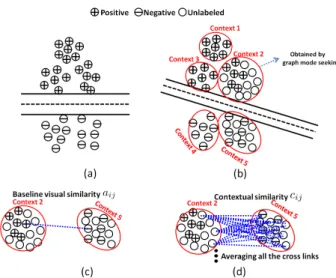
Contextual kernel designFor discriminative learning-based visual tracking, a large amount of unlabeled samples in each frame can provide rich useful contextual informa-tion for object/non-object classificainforma-tion. Figs. 1 (a) and (b) illustrate that the contextual information from unlabeled samples may have a great influence on the SVM learning re-sults. Hence, it is necessary to consider the influence of both labeled and unlabeled samples in the process of designing a contextual kernel for SVM classification. Inspired by this, we design a contextual kernel as follows.
First, we introduce some notation used hereinafter. Let
Z = {zi}Ni=1 denote a sample set, Zl = {zi}γi=1 denote the labeled sample subset ofZ,Yl = {yi}γi=1denote the corresponding label set of Zl for yi ∈ {−1,+1}, and
Zu ={zi}Ni=γ+1denote the unlabeled sample subset ofZ. Based onZ={zi}Ni=1, we create a visual graphGwithN vertexes. Mathematically, the graphGcan be denoted as
G= (V, E, W), whereV = {vi}Ni=1is the vertex set cor-responding to{zi}Ni=1,E⊆V ×V is the edge set, andW is the edge-weight function returning the affinity value be-tween two vertexes. In practice, the graphGis formulated
Algorithm 1Contextual kernel-based SVM tracking Input: Frame t, the object state L∗
t−1 in the frame t−1, pre-vious labeled sample set Zl from previous observed frames,
posi-tive maximum buffer size T+, and negative maximum buffer size T−.
1: Sample a number of candidate object statesLt = {Lit}using the
particle filters (referred to [18]).
2: Crop out the corresponding normalized image regions ofLtby affine
warping.
3: Extract the corresponding HOG feature setZu={zi}.
4: Construct the graph mode-based contextual kernelCK∗from (12) using the data setZ={Zl,Zu}.
• Compute the baseline visual kernelKfrom (4).
• Build a visual graphGwhose similarity matrixAis defined in (3).
• Solve the optimization problem (5) to seek a set of graph modes {Mi}Qi=1by graph shift.
• Calculate the contextual affinity matrixCfrom (9). • Compute the contextual kernelCK∗from (12).
5: Train an SVM classifierh(z)from (14) overZlby solving the
opti-mization problem (13).
6: Determine the optimal object stateL∗
t by the MAP (maximum a
pos-terior) estimation in the particle filters, where the observation model is defined as: p zi|Lit ∝ 1 1 + exp (−µh(zi)) (1) whereµis a scaling factor.
7: Extract the corresponding positive and negative support vector sets of
h(z), i.e.,S+andS−.
8: Select positive samplesZ+t and negative samplesZ−t fromZu.
9: Update the labeled sample set Zlwith Z+l SZ−l, whereZ+l =
S+SZ+t andZ−l =S
−S
Z−t.
• If|Z+l| >T+, thenZ+l is truncated to keep the lastT+ ele-ments occurring recently.
• If|Z−l |>T
−, then
Z−l is truncated to keep the lastT
−
ele-ments occurring recently.
10: returnThe object stateL∗tand the updated labeled sample setZl. as a weighted similarity matrixA= (aij)N×N:
aij=
W(vi, vj) if(vi, vj)∈E
0 otherwise (2)
whereW(vi, vj) = K(zi,zj)with K(·,·)being a base-line visual kernel function. Since G is a graph without self-loops, A = (aij)N×N is a matrix whose diagonal elements are all zeros. As a result, the similarity matrix
A= (aij)N×N can be reformulated as:
aij=
K(zi,zj) ifi6=j
0 otherwise (3)
The above graph creation is independent of the choice of kernel functions. It is easy to incorporate various kernel functions into the above graph creation process. In our case, the Gaussian RBF kernel function is used as the base-line visual kernel, which evaluates the visual similarity be-tween two image regions. Furthermore, each image region is represented as a HOG feature descriptor (referred to [16]) in the five spatial block-division modes (like [20]). More specifically, given two image regions, we extract their cor-responding HOG feature vectors zi = (hi`)r`=1and zj =
Figure 1:Illustration of the proposed contextual SVM learning. (a) shows the SVM classification boundary without using the contextual information from samples; (b) shows the SVM classification boundary using the contextual information of samples; (c) depicts the process of computing the baseline visual similarityaij(see Eq. (3)); and (d) illustrates the process of computing the contextual similaritycij(see Eq. (7)).
(hj`)r
`=1, whereris the HOG feature dimension. The Gaus-sian RBF kernel functionK(zi,zj)is formulated as:
K(zi,zj) = exp −β r X `=1 (hi`−hj`)2 ! . (4)
whereβ is a scaling factor. Since K(zi,zj) is equal to
K(zj,zi),aij is equal toaji. Consequently, the weighted similarity matrixAof the graphGis a symmetric matrix in our case.
Given the graphGdefined above, how to effectively cap-ture the useful contextual information fromGplays a vital role in contextual kernel design. Due to the robustness to noises and outliers (as claimed in [15]), a dense subgraph ofG, that is a coherent subset of vertexes in a graph, can be used as a contextual information carrier. In the dense subgraph, the vertexes are cohesively interconnected so that their intrinsic properties are similar to each other. Conse-quently, each vertex in the dense subgraph is greatly influ-enced by the other vertexes in the same dense subgraph. Thus, the dense subgraph is essentially a context providing contextual information to its own vertexes. In graph the-ory, the cohesiveness of a subset of vertexes in the graph
Gis measured by a graph density whose local maxima cor-respond to the modes of the graphG. Mathematically, the graph density is formulated as: g(x) = P
i,jaijxixj =
xTAx, wherexindicates a probabilistic cluster of vertexes, and thei-th componentxiofxreflects the probability ofvi belonging to this cluster. To seek the modes of the graphG, we need to optimize the following quadratic programming problem:
maximize g(x) =xTAx
s.t. x∈ 4N (5)
where4N = {x∈ RN|x ≥ 0 and kxk
1 = 1}. The op-timization problem (5) can be efficiently solved by graph
shift [15]1. More specifically, let{M
i}Qi=1be theQgraph modes sought by graph shift, andMi be the vertex index set of thei-th graph mode. Without loss of generality, we suppose the size ofMiisqi. Consequently,Miis equiva-lent to{Ii`}
qi
`=1whereI i
`indexes the`-th vertex of thei-th graph mode. Based onIi
`, we introduce an N×1 graph mode vectorsiwhose element is defined as:
si(n) = 1 ifn∈ {Ii`} qi `=1 0 otherwise (6)
wheren ∈ {1,2, . . . , N}. In this case, the affinity value between thei-th andj-th graph modes can be measured by the average similarity between these two graph modes (as illustrated in Fig. 1(d)): cij= 1 qiqj X m∈{Ii`} qi `=1 X n∈{Ij`} qj `=1 amn (7)
For simplicity, Eq. (7) can be transformed into its matrix form: cij= 1 qiqj sTiAsj= 1 qjqi sTjATsi= 1 qjqi sTjAsi=cji (8) In this case, we have a cross-mode affinity matrixCij ∈ RN×N formulated as:
Cij =cijsisTj. Thus, we can obtain all the cross-mode affinity matrices: i.e., {{Cij}Qi=1}
Q j=1. By taking the average of these cross-mode affinity matrices, a unified contextual affinity matrixCis computed to evalu-ate the total contextual similarity between any two vertexes:
C= 1 Q2 Q X i=1 Q X j=1 Cij= 1 Q2 Q X i=1 Q X j=1 cijsisTj (9) Based on the contextual affinity matrixCand the Gaussian RBF kernel (4), a contextual kernelCKis designed as fol-lows:
CK(zi,zj) =K(zi,zj) exp(C(zi,zj)) (10) For simplicity, Eq. (10) can be transformed into its matrix form:CK=K◦exp(C), where◦is the element-wise ma-trix multiplication operator andexp(·)is the element-wise exponent operator. To avoid singularity, the term exp(C)
can be replaced withexp(C) +ξIN, whereINis anN×N identity matrix andξ is a control variable which is deter-mined by:
ξ=
−λ∗ ifλ∗<0
0 otherwise (11)
whereλ∗is the minimum eigenvalue ofexp(C). So we have the final contextual kernelCK∗:
CK∗=K◦(exp(C) +ξIN) (12) Proposition 2.1. The contextual affinity matrixCis a sym-metric matrix.
1http://sites.google.com/site/lhrbss/
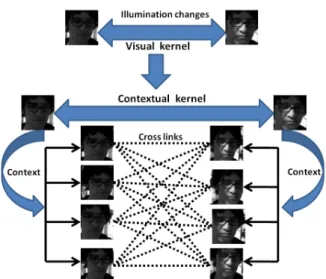
Figure 2:An example of illustrating the differences between the visual kernel and the proposed contextual kernel. The upper part corresponds to the visual kernel while the lower part is associated with the proposed contextual kernel, which captures the contextual interaction relationships (i.e., cross links).
Proof. The mathematical derivation is formulated as: CT = 1 Q2 Q X i=1 Q X j=1 cijsjsTi = 1 Q2 Q X i=1 Q X j=1 cjisjsTi = 1 Q2 Q X i=1 Q X j=1 Cji= 1 Q2 Q X i=1 Q X j=1 Cij =C
Proposition 2.2. The contextual kernelCK∗is a Mercer kernel.
Proof. For simplicity, the term(exp(C) +ξIN)is abbreviated as
fC. SinceCis a symmetric matrix,fCis also a symmetric matrix:
fCT = exp(C
T
) + (ξIN)T = exp(C) +ξIN =fC
As a positive semi-definite matrix, fC can be decomposed into
UTΛU = (UΛ12)T(UΛ 1
2), where Λ = diag(λ1, . . . , λN) andU = (ui)Ni=1 correspond to the eigenvalues and eigenvec-tors offC, respectively. As a result, fC(zi,zj) can be rewrit-ten as the inner product of two terms: φ(zi)Tφ(zj), where
φ(z`) (1 ≤ ` ≤ N) is a kernel mapping such thatφ(z`) =
(√λ1u1(`), . . . ,√λNuN(`))T. Therefore,fCis a Mercer kernel.
As is known to us, the Gaussian RBF kernelK is also a Mercer kernel. Being the element-wise product of two Mercer kernelsK
andfC,CK∗is consequently a Mercer kernel.
Fig. 2 gives an example of illustrating the differences between the visual kernelK and the proposed contextual kernelCK∗. Specifically, the face regions of the same per-son in two different frames have different visual properties due to illumination changes. Their visual kernelK is only determined by the visual appearance properties of the two face regions, as shown in the upper part of Fig. 2. How-ever, the proposed contextual kernel CK∗ considers not
only the visual affinity relationship between the two face re-gions but also the contextual interaction relationships (i.e., cross links) between their corresponding contexts, as shown in the lower part of Fig. 2.
Based on the contextual kernel CK∗, we can derive a standard SVM optimization problem over the labeled sam-ple setZl. Mathematically, the dual form of the SVM
opti-mization problem can be formulated as:
max α Pγ i=1αi−12Pγi=1 Pγ j=1yiyjαiαjCK∗(zi,zj) s.t. Pγ i=1yiαi= 0; 0≤αi≤D (13) whereyi∈ {−1,1},γis the size ofZlandDis a regular-ization factor. After solving the optimregular-ization problem (13) using the libsvm tool, an SVM classification function is ob-tained as: h(z) = γ X i=1 αiyiCK∗(z,zi) +b. (14) In real tracking applications, the cardinality of Zl can become larger and larger as new labeled samples from dif-ferent frames are added toZl. For computational efficiency, we have to discard some older samples and retain the re-cently added samples in the SVM training process. Specifi-cally, we define a thresholdT+(orT−) to limit the positive
(or negative) sample size ofZl. If exceedingT+(orT−),
the positive (or negative) sample size will be reduced to only retain the lastT+(orT−) elements occurring recently.
Al-gorithm 1 gives more details.
Training sample selectionIn the proposed tracker, we take a conventional strategy for training sample selection. Namely, the image regions from a small neighborhood around the object location are selected as positive samples, and the negative samples are generated by selecting the im-age regions which are relatively far from the object loca-tion. Specifically, an ascending sort for the samples from
Zuis made according to their spatial distances to the cur-rent object location, resulting in a sorted sample setZsu. By selecting the top (or bottom)10%of the samples fromZsu, we have a subset denoted asZ+t (orZ−t) , which is the final positive (or negative) sample set. Whent = 1(i.e., in the first frame), the object location is manually labeled. Zlis equal toZ+1
S
Z−1.
3. Experiments
Video sequencesWe evaluate the proposed contextual SVM tracker on six challenging videos, which are com-posed of 8-bit grayscale images. All of the six videos are captured with moving cameras in different scenes.
Video 1A car runs fast in a dark road scene with back-ground clutters and varying lighting conditions.
Video 2 A car runs in a highway with many shadows (caused by bridges or trees). When the car crosses a bridge, its appearance drastically changes because of the shadow disturbance. Furthermore, the pose of the car gradually changes over time.
Video 3A man walks under a treillage. Meantime, sev-eral events take place simultaneously, including drastic illu-mination changes and head pose variations.
Video 4A girl rushes along a pavement. Her appearance varies with significant scale changes. In particular, she col-lides with a man in the middle of the video, and then her body drastically rotates.
Video 5There is an ice hockey match. During the match, there exist several events such as partial occlusions, out-of-plane rotations, body pose variations, abrupt motion and so on.
Video 6Several skaters are dancing in a dark scene with illumination changes. Their appearances drastically vary due to several factors such as partial occlusions, body pose variations, illumination changes and so forth.
Implementation detailsSix experiments on the above-mentioned challenging six videos are conducted to demon-strate the advantages of the proposed tracker using the graph mode-based contextual kernel, referred to as CKST. The proposed CKST is implemented in Matlab on a worksta-tion with an Intel Core 2 Duo 2.66GHz processor and 3.24G RAM. The average running time of the proposed CKST is about two seconds per frame. The main computational time of CKST is spent at Steps 3-5 in Algorithm 1. In prac-tice, the parametersT+andT−in Algorithm 1 are both set
to 500. For the sake of computational efficiency, we only consider the object state information in 2D translation and scaling in the particle filtering module. The particle number at Step 1 in Algorithm 1 is set to 200. The scaling factorµ
defined in Eq. (1) is set to 1. The above parameter settings remain the same in all the experiments.
We also compare the performance of CKST against six other state-of-the-art trackers. Specifically, the six compet-ing trackers are referred to as SVMWC (SVM without us-ing the contextual information), MIBT (multiple instance boosting-based tracker [9]), VTD (visual tracking decom-position [17]), OAB (online AdaBoost [5]), IPCA (incre-mental PCA [18]), and L1T (`1-minimization tracker [4]). We use the source code of MIBT2, VTD3, OAB4, IPCA5, and L1T6from their websites.
The reasons for selecting the six competing trackers are as follows. First, SVMWC is close to CKST while SVMWC does not use the contextual information. More specifically, SVMWC directly uses the Gaussian RBF ker-nel (4) for SVM classification while CKST uses the con-textual kernel (12) for SVM classification. Thus, the pur-pose of comparing CKST with SVMWC is to verify the superiority of CKST using the contextual information over SVMWC. Second, MIBT is a recently proposed discrim-inant learning-based tracker, which uses multiple instance boosting for object/non-object classification. To deal with
2http://vision.ucsd.edu/∼bbabenko/project miltrack.shtml 3http://cv.snu.ac.kr/research/∼vtd/
4http://www.vision.ee.ethz.ch/boostingTrackers/download.htm 5http://www.cs.utoronto.ca/∼dross/ivt/
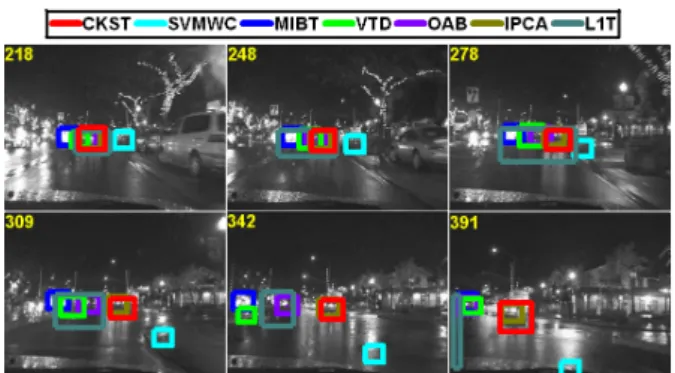
Figure 3:The tracking results of the seven trackers over the representative frames (218, 248, 278, 309, 342, 391) of Video 1 in the scenarios with varying lighting conditions and background clutters.
Figure 4:The tracking results of the seven trackers over the representative frames (235, 286, 341, 392, 512, 559) of Video 2 in the scenarios with shadow disturbance and pose variation.
the inherent ambiguity of object localization, MIBT utilizes multiple instances for object representation. In comparison, OAB utilizes online boosting for object/non-object classifi-cation. Thus, comparing CKST with MIBT and OAB can demonstrate the discriminative capabilities of CKST in han-dling large appearance variations. Third, VTD is a recently proposed tracker based on visual tracking decomposition. Using sparse principal component analysis, VTD decom-poses the observation (or motion) model into a set of ba-sic observation (or motion) models, each of which covers a specific type of object appearance (or motion). IPCA uses incremental principal component analysis to construct the eigenspace-based observation model for visual tracking. L1T treats visual tracking as a sparse approximation prob-lem using`1-regularized minimization. Thus, comparing CKST with VTD, IPCA, and L1T can show their capabili-ties of tolerating complicated appearance changes.
Tracking results Figs. 3–8 show the corresponding tracking results (highlighted by the bounding boxes in dif-ferent colors) of the seven trackers over the representative frames of the six videos.
Video 1 After frame 271, VTD loses the car due to il-lumination changes. Distracted by background clutters, SVMWC, MIBT, L1T, and OAB fail to track the car after frames 196, 211, 288, and 289, respectively. In comparison, only CKST and IPCA succeed in tracking the car through-out the video sequence.
Video 2 In face of both shadow disturbance and pose
Figure 5:The tracking results of the seven trackers over the representative frames (343, 351, 372, 382, 422, 435) of Video 3 in the scenarios with drastic illumination changes and head pose variations.
Figure 6:The tracking results of the seven trackers over the representative frames (31, 45, 67, 100, 111, 119) of Video 4 in the scenarios with drastic scale changes and body pose variations.
variation, SVMWC, MIBT, and OAB break down when they track the car. In contrast, VTD is able to track the car before frame 240. However, it tracks the car inaccurately or unsuccessfully after frame 240. On the contrary, CKST can track the car effectively in the situations of shadow dis-turbance and pose variation throughout the video sequence. Both IPCA and L1T achieve less accurate tracking results than CKST.
Video 3 Under the circumstances of drastic changes in environmental illumination and head pose, SVMWC loses the face after frame 441 while MIBT, VTD, and OAB fail to track the face after frames 201, 148, and 180, respectively. IPCA loses the face after frame 201. L1T begins to lose the face from frame 249. Compared with these competing trackers, CKST can successfully track the face all the time. Video 4 After colliding with another human body, the human body significantly rotates, leading to the drastic ap-pearance changes. In this case, MIBT, VTD, OAB, L1T, and IPCA begin to lose the human body from frame 23. SVMWC has difficulties in accurately tracking the human body from frame 71 to frame 113, and it loses the human body after frame 114. In contrast, CKST can successfully deal with the difficulties caused by drastic body pose varia-tion, and achieve robust tracking results.
Video 5Four main factors cause the object appearance changes, including partial occlusions, out-of-plane rota-tions, body pose variarota-tions, and abrupt motion. From frame
Figure 7:The tracking results of the seven trackers over the representative frames (79, 452, 461, 515, 520, 530) of Video 5 in the scenarios with partial occlusions, out-of-plane rotations, body pose variations, and abrupt motion.
Figure 8:The tracking results of the seven trackers over the representative frames (282, 286, 289, 292, 296, 303) of Video 6 in the scenarios with partial occlusions, body pose variations, and illumination changes.
36 to frame 328, MIBT achieves bad tracking performance. After frame 408, MIBT loses the ice hockey player. VTD and SVMWC lose the ice hockey player after frames 512 and 468, respectively. Both OAB and IPCA fail to track the ice hockey player after frame 56. In contrast, CKST can adapt to the object appearance changes caused by the four factors, and achieve the most accurate tracking results.
Video 6 Starting from frame 287, VTD fails to track the dancer while SVMWC and MIBT achieve inaccurate tracking results. IPCA, L1T, and OAB lose the dancer after frames 48, 275, and 279, respectively. In compari-son, CKST can adapt to the object appearance changes, and achieve robust the most accurate tracking results in the sit-uations of partial occlusions, body pose variations, and illu-mination changes.
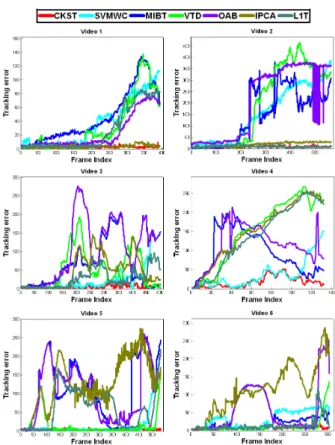
Quantitative comparisonThe object center locations are labeled manually and used as the ground truth. Hence, we can quantitatively evaluate the tracking performances of the seven competing trackers by computing their correspond-ing pixel-based trackcorrespond-ing location errors to the ground truth. Fig. 9 plots the tracking location error plots (highlighted in different colors) obtained by the seven trackers in the six ex-periments. Further, we also compute the mean of the track-ing location errors in the six experiments, and report the results in Table 1. From Fig. 9 and Table 1, we can see that the proposed CKST achieves the most robust and accurate tracking performance over the six video sequences.
Figure 9:The tracking location error plots obtained by the seven trackers over the six videos.
Discussion The reasons why the proposed CKST out-performs the six other competing trackers are briefly an-alyzed as follows. Both VTD and IPCA are based on principal component analysis which is sensitive to noises and outliers. During tracking, large appearance changes caused by complex factors (e.g., partial occlusions, abrupt motion, drastic illumination changes, or drastic pose varia-tions) can introduce a large number of outliers to the train-ing data. Ustrain-ing the polluted traintrain-ing data, both VTD and IPCA may learn an inaccurate or wrong subspace model for object representation, leading to inaccurate or wrong track-ing results. Moreover, neither of VTD and IPCA takes the object/non-object discriminative information into account, resulting in the distractions by background. L1T performs dynamic template learning for object tracking. In the pres-ence of drastic appearance variations caused by occlusions, L1T may utilize incorrect appearance information in learn-ing and updatlearn-ing templates. OAB learns an AdaBoost clas-sifier for object tracking. Since ignoring the spatial con-textual relationships among samples, OAB is sensitive to noises and outliers. MIBT learns a multiple-instance boost-ing classifier for object trackboost-ing. Since representboost-ing an ob-ject as multiple instances, MIBT may introduce many false positive samples in the process of boosting learning, leading to tracking degradations or even failures. Without consid-ering the contextual information among samples, SVMWC
Table 1:Quantitative comparison results of the seven trackers over the six videos (referred to as Vkfork= 1, . . . ,6). We report the mean of their tracking location errors over the six videos.
V1 V2 V3 V4 V5 V6 CKST 2.7 8.1 5.2 17.7 3.3 6.9 SVMWC 36.6 154.6 25.7 37.2 15.6 32.2 MIBT 45.5 144.7 59.9 95.4 111.9 46.1 VTD 32.7 194.5 51.1 151.2 14.8 11.4 OAB 22.8 209.1 106.5 114.9 102.8 56.1 IPCA 3.9 17.9 46.4 152.1 127.9 113.4 L1T 26.6 9.9 27.7 139.2 59.8 14.2
cannot effectively adjust the SVM’s separating hyperplane to adapt to complicated object appearance changes during tracking. By the graph mode seeking procedure, the pro-posed CKST is able to capture the intrinsic contextual in-formation (i.e., graph modes and their interactions) from samples. The intrinsic contextual information can reflect the high-order interaction relationships among samples (il-lustrated in Fig. 1(d)), leading to the robustness of CKST to noises, outliers, and complicated appearance changes. By embedding the intrinsic contextual information into SVM, CKST is capable of learning an effective separating hyper-plane for object/non-object classification, leading to robust tracking results.
4. Conclusion
We have proposed a graph mode-based contextual ker-nel for robust SVM tracking. In this work, a set of high-order contexts are discovered and combined into the track-ing process. The problem of discovertrack-ing these high-order contexts is formulated as graph mode seeking, which can be efficiently solved using graph shift [15]. Each graph mode corresponds to a mode-specific vertex context, in which the graph vertexes share some common visual prop-erties. Furthermore, we design a contextual kernel to cap-ture the interaction information between the mode-specific vertex contexts. We theoretically prove that this contex-tual kernel is a Mercer kernel. Therefore, embedding this contextual kernel into the standard SVM, the global opti-mum is guaranteed. We incorporate this contextual ker-nel into the object/non-object SVM classification scheme for visual tracking. Compared with several state-of-the-art trackers, the proposed CKST tracker is more robust to illu-mination changes, pose variations, partial occlusions, back-ground clutters, and complicated appearance changes. Ex-perimental results on challenging videos have demonstrated the effectiveness and robustness of the proposed CKST.
Acknowledgments
This work is partially supported by ARC Discovery Project (DP1094764). H. Wang’s participation in this work is supported by Xiamen Science & Technology Planning Project Fund (3502Z20116005) of China.
References
[1] A. Adam, E. Rivlin, and I. Shimshoni, “Robust Fragments-based Tracking using the Integral Histogram,” in Proc. IEEE Int. Conf. Comp. Vis. & Pattern Recognition, pp.798-805, 2006.
[2] H. Wang, D. Suter, K. Schindler, and C. Shen, “Adaptive Object Tracking Based on an Effective Appearance Filter,”IEEE Trans. Pat-tern Anal. Mach. Intell.,vol. 29, pp.1661-1667, 2007.
[3] C. Shen, J. Kim, and H. Wang, “Generalized Kernel-based Visual Tracking,”IEEE Trans. Circ. Syst. Video Tech.,vol. 20, pp. 119-130, 2010.
[4] X. Mei and H. Ling, “Robust Visual Tracking using`1Minimization,” inProc. IEEE Int. Conf. Comp. Vis.,pp. 1436-1443, 2009.
[5] H. Grabner, M. Grabner, and H. Bischof, “Real-time Tracking via On-line Boosting,” inProc. British Machine Vis. Conf.,pp. 47-56, 2006.
[6] H. Grabner, C. Leistner, and H. Bischof, “Semi-supervised On-line Boosting for Robust Tracking,” inProc. Euro. Conf. Comp. Vis.,
pp.234-247, 2008.
[7] S. Avidan, “Support Vector Tracking,”IEEE Trans. Pattern Anal. Mach. Intell.,vol. 26, pp. 1064-1072, 2004.
[8] M. Tian, W. Zhang, and F. Liu, “On-Line Ensemble SVM for Robust Object Tracking,” inProc. Asian Conf. Comp. Vis.,pp. 355-364, 2007. [9] B. Babenko, M. Yang, and S. Belongie, “Visual Tracking with Online Multiple Instance Learning,”IEEE Trans. Pattern Anal. Mach. Intell.,
2010.
[10] S. Avidan, “Ensemble Tracking,”IEEE Trans. Pattern Anal. Mach. Intell.,vol. 29, pp. 261-271, 2007.
[11] R. T. Collins, Y. Liu, and M. Leordeanu, “Online Selection of Dis-criminative Tracking Features,”IEEE Trans. Pattern Anal. Mach. In-tell.,vol. 27, pp.1631-1643, 2005.
[12] X. Liu and T. Yu, “Gradient Feature Selection for Online Boosting,” inProc. IEEE Int. Conf. Comp. Vis.,pp. 1-8, 2007.
[13] J. Fan, Y. Wu, and S. Dai, “Discriminative Spatial Attention for Ro-bust Tracking,” inProc. Euro. Conf. Comp. Vis., pp. 480-493, 2010. [14] J. Santner, C. Leistner, A. Saffari, T. Pock, and H. Bischof, “PROST:
Parallel Robust Online Simple Tracking,”, inProc. IEEE Int. Conf. Comp. Vis. Pattern Recognition,pp.723-730, 2010.
[15] H. Liu and S. Yan, “Robust Graph Mode Seeking by Graph Shift,” in
Proc. Int. Conf. Mach. Learn., 2010.
[16] N. Dalal and B. Triggs, “Histograms of Oriented Gradients for Hu-man Detection,” inProc. IEEE Int. Conf. Comp. Vis. Pattern Recogni-tion, 2005.
[17] J. Kwon and K. M. Lee, “Visual Tracking Decomposition,” inProc. IEEE Int. Conf. Comp. Vis. Pattern Recognition, 2010.
[18] D. A. Ross, J. Lim, R. Lin, and M. Yang. “Incremental Learning for Robust Visual Tracking,” Int. J. Comp. Vis., vol. 77, pp. 125-141,
2008.
[19] X. Li, W. Hu, Z. Zhang, X. Zhang, and G. Luo, “Robust Visual Tracking Based on Incremental Tensor Subspace Learning,” inProc. IEEE Int. Conf. Comp. Vis.,2007.
[20] X. Li, W. Hu, Z. Zhang, X. Zhang, M. Zhu, and J. Cheng, “Vi-sual Tracking Via Incremental Log-Euclidean Riemannian Subspace Learning,” inProc. IEEE Int. Conf. Comp. Vis. Pattern Recognition,
2008.
[21] F. Tang, S. Brennan, Q. Zhao, and H. Tao, “Co-Tracking Using Semi-Supervised Support Vector Machines,” inProc. IEEE Int. Conf. Comp. Vis., 2007.
[22] M. Yang, Y. Wu, and G. Hua, “Context-Aware Visual Tracking,”
IEEE Trans. Pattern Anal. Mach. Intell.,vol. 31, pp.1195-1209, 2009. [23] H. Li, C. Shen, and Q. Shi, “Real-time Visual Tracking with Com-pressed Sensing,” inProc. IEEE Int. Conf. Comp. Vis. Pattern Recog-nition,2011.