Tampereen teknillinen yliopisto. Julkaisu 1276 Tampere University of Technology. Publication 1276
Joonas Nikunen
Object-based Modeling of Audio for Coding and Source
Separation
Thesis for the degree of Doctor of Science in Technology to be presented with due permission for public examination and criticism in Tietotalo Building, Auditorium TB223, at Tampere University of Technology, on the 16th of January 2015, at 12 noon.
Supervisor:
Tuomas Virtanen, Adjunct Professor Department of Signal Processing Tampere University of Technology Tampere, Finland
Pre-examiner:
Alexey Ozerov, Ph.D. Technicolor
Cesson-Sévigné, France
Pre-examiner and opponent:
Ville Pulkki, Associate Professor
Department of Signal Processing and Acoustics Aalto University
Helsinki, Finland
Opponent:
Derry FitzGerald, Ph.D. Cork Institute of Technology Cork, Ireland
ISBN 978-952-15-3438-6 (printed) ISBN 978-952-15-3452-2 (PDF) ISSN 1459-2045
Abstract
T
histhesis studies several data decomposition algorithms for obtaining an object-based representation of an audio signal. The estimation of the representation parameters are coupled with audio-specific criteria, such as the spectral redundancy, sparsity, perceptual relevance and spatial position of sounds. The objective is to obtain an audio signal representation that is com-posed of meaningful entities called audio objects that reflect the properties of real-world sound objects and events. The estimation of the object-based model is based on magnitude spectrogram redundancy using non-negative matrix factorization with extensions to multichannel and complex-valued data. The benefits of working with object-based audio representations over the conventional time-frequency bin-wise processing are studied. The two main applications of the object-based audio representations proposed in this thesis are spatial audio coding and sound source separation from multichan-nel microphone array recordings.In the proposed spatial audio coding algorithm, the audio objects are es-timated from the multichannel magnitude spectrogram. The audio objects are used for recovering the content of each original channel from a single downmixed signal, using time-frequency filtering. The perceptual relevance of modeling the audio signal is considered in the estimation of the parameters of the object-based model, and the sparsity of the model is utilized in encod-ing its parameters. Additionally, a quantization of the model parameters is proposed that reflects the perceptual relevance of each quantized element.
The proposed object-based spatial audio coding algorithm is evaluated via listening tests and comparing the overall perceptual quality to conven-tional time-frequency block-wise methods at the same bitrates. The proposed approach is found to produce comparable coding efficiency while providing additional functionality via the object-based coding domain representation, such as the blind separation of the mixture of sound sources in the encoded channels.
For the sound source separation from multichannel audio recorded by a microphone array, a method combining an object-based magnitude model and spatial covariance matrix estimation is considered. A direction of arrival-based model for the spatial covariance matrices of the sound sources is pro-posed. Unlike the conventional approaches, the estimation of the parameters of the proposed spatial covariance matrix model ensures a spatially coherent solution for the spatial parameterization of the sound sources. The separa-tion quality is measured with objective criteria and the proposed method is shown to improve over the state-of-the-art sound source separation methods, with recordings done using a small microphone array.
Preface
T
his work has been carried out at the Department of Signal Processing, Tampere University of Technology, during 2010-2014. First and fore-most I want to thank my supervisor Tuomas Virtanen for all the guidance and support during my doctoral studies. His help and advice in the process of accomplishing the research discoveries leading to the included publications of this thesis has been irreplaceable. I also want to extend my gratitude to Anssi Klapuri who was leading the audio research group when I originally joined the group as a Master’s thesis worker, which has eventually led to the completion of this doctoral thesis.I thank the pre-examiners of this thesis, Dr. Alexey Ozerov from Techni-color and Associate Professor Ville Pulkki from Aalto University, for provid-ing valuable feedback for improvprovid-ing and finalizprovid-ing the thesis. The opponents of the public defense of my thesis, Associate Professor Ville Pulkki and Dr. Derry FitzGerald from Cork Institute of Technology, also receive my highest gratitude.
The research work included in this thesis was made possible by funding from Nokia Research Center (NRC). My gratitude goes to the people at NRC, Mikko Tammi, Miikka Vilermo, Adriana Vasilache, Matti H¨am¨al¨ainen and Mauri V¨a¨an¨anen. Their scientific input in evaluating the work and discussion of ideas and directions to look into have had a major role in developing the methods presented in the included publications of this thesis.
I want to thank all the past and present colleagues at the audio re-search group, this includes but is not limited to, Pasi Pertil¨a, Antti Hur-malainen, Katariina Mahkonen, Hanna Sil´en, Mikko Parviainen, Toni Heit-tola, Annamaria Mesaros, Aleksandr Diment, Tom Barker and Toni M¨akinen. Over the years they have made the audio research group a welcoming and relaxed, yet the most professional place to conduct research in the field of audio signal processing.
Finally, my most sincere thanks and love goes to Susanna, without her support over the years this thesis would have not been possible. I also want to thank my parents Erkki and Satu for their endless support and my sister Emmi for all the shared joys in life.
Joonas Nikunen Tampere, December 2014
Contents
Abstract i
Preface iii
Contents v
List of Abbreviations ix
List of Included Publications x
1 Introduction 1
1.1 Object-based Audio Coding . . . 2
1.2 Sound Source Separation . . . 3
1.3 Objectives of the Thesis . . . 5
1.4 Main Results of the Thesis . . . 6
1.5 Organization of the Thesis . . . 9
2 Background 11 2.1 Definition of an Audio Object . . . 11
2.2 Hearing . . . 12
2.2.1 Ear Anatomy . . . 13
2.2.2 Critical Bands and Masking . . . 13
2.2.3 Spatial Hearing . . . 14
2.3 Sound and Recording . . . 15
2.3.1 Sound Sources and Propagation . . . 15
2.3.2 Microphones and Microphone Arrays . . . 16
2.3.3 Sound Capture . . . 18
2.3.4 Mixing Model . . . 19
2.4 Frequency-domain Representations . . . 20
2.4.1 Mixing in Frequency Domain . . . 21
2.4.2 Spatial Covariance Domain . . . 22
3 Object-based Models of Audio Signals 25 3.1 Spectral Redundancy and Spectrogram Decompositions . . . . 25
3.2 Independent Component Analysis . . . 27
3.3 Non-negative Matrix and Tensor Factorization . . . 28
3.3.1 Model for Single Channel Audio . . . 29
3.3.2 Model for Multichannel Audio . . . 30
3.3.3 Optimization Criteria and Parameter Estimation . . . 31
3.3.4 Algorithm Description . . . 32
3.4 Complex-valued Non-negative Matrix Factorization . . . 32
3.4.1 Component-wise Spatial Covariance Estimation . . . . 33
3.4.2 Source-wise Spatial Covariance Estimation . . . 34
3.4.3 Interpretations of Complex-valued NMF . . . 34
4 Object-based Audio Coding 37 4.1 Audio Coding Background . . . 37
4.1.1 Measuring Coding Distortions with Perceptual Criteria 38 4.1.2 Spatial Audio Coding . . . 39
4.1.3 Spatial Audio Object Coding . . . 40
4.1.4 Blind Upmixing . . . 41
4.1.5 Entropy Coding and Redundancy . . . 42
4.2 Channel-wise Object-Based Audio Coding Using NMF . . . . 42
4.2.1 Coding Framework Overview . . . 43
4.2.2 Perceptual Optimization Criterion for NMF . . . 45
4.2.3 Quantization and Rate of the Model Parameters . . . . 45
4.2.4 Sparsity of the Model Parameters . . . 47
4.2.5 Results and Findings . . . 48
4.2.6 Conclusion on Channel-wise Approach . . . 49
4.3 Multichannel Audio Upmixing by NTF . . . 50
4.3.1 Spatial Cues and NTF . . . 50
4.3.2 Upmixing by Time-Frequency Filtering . . . 51
4.3.3 Cost Function for Upmixed Signal Perceptual Quality . 53 4.3.4 Evaluation of Coding Efficiency . . . 55
4.3.5 Audio Source Separation with NTF-based SAC . . . . 56
5 Source Separation from a Multichannel Audio Recording 59 5.1 Problem Definition and Earlier Work . . . 60
5.2.1 Time Difference of Arrival . . . 61
5.2.2 Beamforming . . . 63
5.2.3 Direction of Arrival Estimation . . . 66
5.3 Source Separation Using Complex-valued NMF . . . 67
5.3.1 Spatial Covariance Matrix Estimation . . . 68
5.4 Direction of Arrival-based Model for Spatial Covariance . . . . 69
5.4.1 SCM Model by Superposition of DOA Kernels . . . 69
5.4.2 Complex-valued NMF with the DOA-based SCM Model 71 5.5 Direction of Arrival Estimation Performance . . . 73
5.6 Source Separation Results . . . 75
6 Conclusions and Future Work 79 6.1 Conclusions . . . 79 6.2 Future Work . . . 81 Bibliography 83 P1 Publication 1 99 P2 Publication 2 105 P3 Publication 3 117 P4 Publication 4 123 P5 Publication 5 131 P6 Publication 6 147 P7 Publication 7 163
List of Abbreviations
ASR Automatic speech recognition
BSS Blind source separation
CNMF Complex-valued non-negative matrix factorization
DFT Discrete Fourier transform
DOA Direction of arrival
DSB Delay and sum beamformer
EM Expectation maximization
GCC Generalized cross correlation
HRTF Head-related transfer function
IBM Ideal binary mask
ICA Independent component analysis
ICC Inter-channel coherence
ICLD Inter-channel level difference
ICTD Inter-channel time difference
ILD Interaural level difference
ISR Image-to-spatial distortion ratio
ISS Informed source separation
ITD Interaural time difference
IVA Independent vector analysis
KLD Kullback-Leibler divergence
MVDR Minimum variance distortionless beamformer
NMF Non-negative matrix factorization
NMR Noise-to-mask ratio
NTF Non-negative tensor factorization
RIR Room impulse response
SAC Spatial audio coding
SAOC Spatial audio object coding
SCM Spatial covariance matrix
SDR Signal-to-distortion ratio
SED Squared Euclidean distance
SIR Signal-to-interference ratio
STFT Short-time Fourier transform
TDOA Time-difference of arrival
List of Included Publications
This thesis is a compound thesis consisting of the following publications, preceded by an introduction to the research field and summary of the main findings of the publications. Parts of this thesis have been previously pub-lished and the original publications are reprinted with a permission from the respective copyright holders. The publications are referred in the text by the notation [P1],[P2] and so forth.
P1 J. Nikunen and T. Virtanen, “Noise-to-Mask Ratio Minimization by Weighted Non-negative Matrix factorization,” inProceedings of the 35th International Conference on Acoustics, Speech, and Signal Processing, Dallas, Texas, USA, pp. 25–28, 2010
P2 J. Nikunen and T. Virtanen, “Object-based Audio Coding Using Non-negative Matrix Factorization for the Spectrogram Representa-tion,” in Proceedings of the 128th Audio Engineering Society Conven-tion , London, U.K., 2010
P3 J. Nikunen, T. Virtanen and M. Vilermo, “Multichannel Au-dio Upmixing Based on Non-negative Tensor Factorization Represen-tation,” in Proceedings of IEEE Workshop on Applications of Signal Processing to Audio and Acoustics, New Paltz, NY, USA, pp. 33–36, 2011
P4 J. Nikunen, T. Virtanen, P. Pertil¨a and M. Vilermo, “Permu-tation Alignment in Frequency-domain ICA by the Maximization of Intra-source Envelope Correlations,” in Proceedings of the 20th Euro-pean Signal Processing Conference, Bucharest, Romania, pp. 1489– 1493, 2012
P5 J. Nikunen, T. Virtanen and M. Vilermo, “Multichannel Au-dio Upmixing by Time-Frequency Filtering Using Non-Negative Tensor
Factorization,” in Journal of the Audio Engineering Society, vol. 60, no. 10, pp. 794–806, 2012
P6 J. Nikunen and T. Virtanen, “Direction of Arrival Based Spatial Covariance Model for Blind Sound Source Separation,” in IEEE/ACM Transactions on Audio, Speech and Language Processing, vol. 22, no. 3, pp. 727–739, 2014
P7 J. Nikunen and T. Virtanen, “Multichannel audio separation by Direction of Arrival Based Spatial Covariance Model and Non-negative Matrix Factorization,” inProceedings of the 39th International Confer-ence on Acoustics, Speech, and Signal Processing, Florence, Italy, pp. 6727–6731, 2014
Author’s Contributions to the Publications
The thesis author is the main author in all the included publications. The included works have been done in close collaboration with, and under the guidance of T. Virtanen who has provided feedback in preparation of all the publications, while the author has done most of the writing. The motiva-tion and initial idea for Publicamotiva-tion [P1] was proposed by T. Virtanen who helped in formulating the problem to its final form. The idea for the algo-rithm proposed in Publication [P4] was provided by T. Virtanen, while the implementation and formulation of the algorithm are by the author. The multichannel audio coding framework in Publications [P3] and [P5] was ini-tially discussed among the thesis author, T. Virtanen and M. Vilermo, while the implementation and refinement of the idea was done by the author. The evaluations of audio coding quality in [P3] and [P5] are done by M. Vil-ermo while the separation quality evaluation in [P5] is done by the author. The original ideas of Publications [P2] and [P6] were proposed by the au-thor, while formulation of the final form includes feedback from T. Virtanen. Evaluation material for publication [P4] was provided by P. Pertil¨a. All the other evaluations and implementations were done by the author.
Chapter
1
Introduction
R
ecordings of natural auditory scenes are composed of mixtures of dif-ferent sounds. For us humans the separation of difdif-ferent sound sources and events by their spatial position or spectral features comes naturally. Our hearing functions subconsciously by enhancing, separating or focusing on dif-ferent sound sources of interest. For example, at a concert we can easily shift the focus of our hearing to different instruments or, in the case of multi-ple simultaneous speech sources, we can hear and recognize the speech of our conversation partner. It is evident that our hearing processes the audi-tory information using a higher level representation which is assumed to be object-based [93, 94, 152], meaning that our consciousness of sounds is based on entities referred to as audio objects.The adoption of object-based processing into computer audio is an active and ongoing field of research [13, 103, 131, 145]. It has been enabled by the recent advances in machine learning algorithms that are applicable for struc-tural analysis of audio signals [19, 80]. Machine learning in this case can be divided into supervised and unsupervised methods. In supervised learning the system is presented with annotated data of which structure and proper-ties it tries to learn. In operation the system is applied to process unforeseen data which is assumed to reflect the statistics and structure of the data used in learning. In unsupervised methods the learning occurs during the oper-ation, and assumptions on the structure of the data can be included in a definition of the model it uses, for example, assuming certain statistics of the input data [78].
A fair amount of the analysis abilities of human hearing can be attributed to the memory and combining information from other sensory systems such as vision and touch. Our hearing is presented with annotated stimuli over the whole course of our life and the brain makes associations and
interpreta-tions of it. This learning allows us to recognize and classify different sounds and recognize speech and the speaker’s identity even in difficult and unfa-miliar environments [14]. The functioning of the hearing extends to concepts that seem trivial in our everyday life, which include, for example, associ-ating different notes as originassoci-ating from the same instrument even though their fundamental frequency and spacing of harmonics vary. Integrating such processing and decision making into an algorithm analyzing an audio signal is nearly impossible, at least with the level of precision we humans are ca-pable of. Specializing the algorithm for a single task, for example speech recognition or instrument classification, and using adequate training mate-rial can result in satisfying performance [7, 21, 44]. However, there exists a need for more generic audio models for cases where training is not viable, the most notable being separation of sound sources from an audio recording done in unforeseen conditions with no knowledge of the sources involved in the recording. In such cases the focus of the research shifts towards blind source separation approaches [20, 127] that operate on information derived solely from the data they observe.
In this thesis the aspects of unsupervised machine learning are studied with the intent of deriving an object-based models and representations of audio signals. The audio objects within the studied models reflect the various properties of sound objects and entities, such as phonemes, words and notes, all the way up to entire sound sources. The two applications focused upon in the thesis are object-based audio coding and sound source separation. These fields are briefly introduced in the following sections in order to provide the problem statement and preliminaries of conventional approaches contrasted with object-based methods.
1.1
Object-based Audio Coding
The consumption of audiovisual content has been revolutionized by the in-crease in both the bandwidth and processing power of portable devices. The streaming of video with several audio tracks may be viewed with devices rang-ing from those comprised of only one channel of audio playback to the full scale multichannel home theater setups. The scalability of audio coding in terms of the number of channels addresses this issue and is known as spatial audio coding (SAC) [33, 125]. The SAC methods share a similar framework, where a perceptually encoded downmix, along with auxiliary information consisting of the spatial position of each time-frequency (TF) block, is used to recover the original multichannel audio signal. The parameters for en-coding the spatial position are based on the magnitude and time difference
between the input channels [4, 34]. Additionally, coherence and diffuseness of the time-frequency blocks between the channels are used [55, 110].
The conventional SAC methods [54, 55] do not utilize any object-based model and estimate the spatial position of each time-frequency block individ-ually. In the context of this thesis an audio object is a spectral pattern with a time-dependent activation which represents a part of or an entire sound source. These audio objects occur redundantly during the audio signal that is under analysis and finally encoded. Obtaining an object-based model of the multichannel audio signal allows representation of the spatial position of each audio object, spanning the whole frequency range, using a single param-eter. This greatly decreases the amount of auxiliary information as compared to the block-wise approaches. Additionally, the long term redundancy in au-dio signals become utilized with the object-based representation. In return, the representation and transmission of the object-based model requires extra bitrate.
A class of related methods known as spatial audio object coding (SAOC) [13, 56] assumes that the individual audio tracks of each audio object are available during the encoding. In such a setting the object-wise spatial pa-rameterization of the multichannel signal can be done without first blindly decomposing the mixture into audio objects.
The additional benefit of using blindly estimated object-based representa-tion for SAC is its source separarepresenta-tion capability. The sound source separarepresenta-tion ability is based on learning recurrent and repetitive spectral patterns using audio spectrogram decompositions, such as the non-negative matrix factor-ization (NMF) and non-negative tensor factorfactor-ization (NTF) [19, 37, 80]. The NMF and NTF applied on decomposing the audio signal spectrogram are known to produce audio objects that can be used for sound source separa-tion [20, 147]. Such object-based models of audio signals allow manipulasepara-tion of its content based on meaningful entities, i.e., the audio objects. Using the NMF and the NTF for SAC not only allows channel-wise scalability, but also audio object-based control for the user over the reconstruction. This enables the possibility of the removal or amplification of sound sources present in the encoded content, without separate encoding of each source track. Addition-ally, it is not necessary for the separate source tracks to be present in the encoding stage as is the case in most music content to be encoded.
1.2
Sound Source Separation
The field of sound source separation studies the process of obtaining sepa-rate source audio tracks from the mixture audio signal that it is composed
of. The audio signal is recorded by one or several microphones in a situation where multiple sources are emitting sound simultaneously. The use of sound source separation has been conventionally associated with telephony, telecon-ferencing and automatic speech recognition (ASR), where the enhancement and separation of multiple speakers is sought after [149]. Applications re-lated to entertainment, such as gaming and the sharing of videos in social media, have generated an increased demand for generic sound source separa-tion. The recording of audio and video has never been more accessible than during the current age of mobile phones with capabilities to record audio using miniature microphones that not only handle high dynamics [74] but are also capable for capturing high-quality audio in any practical scenario. The recordings are usually done in public places with lots of interfering noise, which prevents understanding of the speech or other essential content present in the recording. The need for sound source separation in such cases is ev-ident. Another example is the voice interface and communication used in gaming consoles [75] which employ ASR in a home environment containing numerous sources of interfering noise.
The field of sound source separation can be roughly divided into super-vised [128, 132, 147], informed [82, 91, 106] and blind approaches [65, 108, 118, 150]. The supervised and semi-supervised methods either require training or other annotated information to operate. In the field of informed source ration (ISS), a set of known sources are mixed together and need to be sepa-rated from the mixture after transmission. The completely blind approaches assume no information being available for the sources, their parameters or the environment used in recording. For the ASR, the reconstruction of separated signals is not a mandatory step. The feature extraction through means of source separation can be used directly as the input of the recognition module (recognition back-end), for example, as in [45, 60, 95].
Furthermore, the sound source separation methods can be categorized based on operation in either a single [132, 147] or multichannel context [65, 108, 118, 150]. This thesis concentrates on blind sound source separation from a multichannel audio signal assuming that no information regarding the sources or the recording environment is available. The use of portable devices for audio recordings and the growing number of microphones embedded in one device encourage research on algorithms that are suitable for arrays of microphones of a very compact size. For example, there already exist systems that run independently on a mobile phone [100] and are able to separate two sources from a two-channel audio recording.
The conventional multichannel blind sound source separation methods include independent component and vector analysis (ICA and IVA) [62, 81] applied in frequency domain and spatial filtering by beamforming and
spa-tial post-filters [139]. ICA and IVA are usually restricted to determined cases where the number of microphones is higher or equal to the number of sources to be separated. In beamforming the good spatial selectivity, and thus sep-aration, requires a high number of microphones, which is a contradictory requirement with respect to the size and cost of a portable device.
The benefits of object-based models of audio signals for sound source separation were mentioned in the previous section regarding object-based audio coding. In the single channel case, where no spatial information exists to be utilized, the NMF-based models of audio signals have been considered for supervised source separation [128, 147]. The NMF is known for being able to learn repetitive spectral patterns and events from the audio signal spectrogram, and such audio objects can be used as a basis for building a model for sound sources and their separation. More recently the NMF model has been extended to multichannel audio recordings and estimation of spatial properties of the audio objects [101, 121]. These methods utilize the spatial information in combining several audio objects to model complete sound sources that are spatially discriminant.
Several ISS methods utilize an object-based model which is obtained us-ing NMF or NTF [83, 103]. In the codus-ing-based ISS [103], the goal is to represent and encode the sources for transmission. The sources are param-eterized by an object-based model obtained by applying NTF to the mag-nitude spectrogram. The encoded object-based model is used for recovering the source signals from a mixture signal in the decoding stage. Coding-based ISS is alternatively known in the literature as spatial audio object coding (SAOC) [13], which extends the SAC framework for separate audio source tracks. The ISS methods based on NMF and NTF are thus closely related to both topics of the thesis by combining object-based separation and coding.
1.3
Objectives of the Thesis
The main objective of this thesis is to study and utilize conventional blind data decomposition methods, such as the NMF and the NTF, in developing object-based audio signal models for multichannel audio coding and sound source separation. Models inherently incorporating structures suitable for modeling spectral content and spatial position of audio objects are proposed and estimations of the parameters of the models are presented.
In this thesis the object-based models for audio signals are obtained by means of unsupervised machine learning that relies on the spectral redun-dancy, perceptual relevance, sparsity, independence and analysis of the spa-tial position of the audio object. This thesis introduces two main applications
for these blindly estimated object-based models of audio, multichannel audio coding and sound source separation, both in single and multichannel cases.
The developed models and audio signal representations for the purpose of audio coding are compared to conventional methods that operate on time-frequency blocks with fixed size. Additionally, the performance of object-based models in sound source separation are compared to generic data de-composition algorithms applied to audio signals.
1.4
Main Results of the Thesis
The development and proposed use of object-based models of audio signals for the tasks of audio coding and sound source separation is the main con-tribution of this thesis. The main results include introduction of new func-tionality to spatial audio coding and improving separation performance over conventional time-frequency block-wise approaches. Additionally, estimating object-based representation of audio signals by combining spectral redun-dancy, perceptual relevance and spatial position of the audio objects can be regarded as the main novelty of the thesis.
The main results regarding audio coding include the proposed object-based SAC approach in [P3] which uses non-negative tensor factorization (NTF) [37, 80] for estimation of object-based representation of the multi-channel magnitude spectrogram. The SAC algorithm relies on the percep-tually motivated optimization criteria for the object-based approximation of the audio magnitude spectrogram proposed in [P1] and utilizes the quanti-zation and perceptual encoding framework considered in [P2]. The coding efficiency of the proposed SAC is found to be comparable to conventional methods in [P3], while a completely new functionality, the blind separation of audio sources mixed in the encoded channels, is studied in [P5].
The sound source separation from a multichannel audio recording intro-duced in this thesis consists of both conventional approach of ICA applied in frequency domain [P4] and estimation of spatial properties of audio objects in [P6] and [P7]. In the case of ICA-based separation, a source activation en-velope estimation for improving the permutation alignment of frequency-wise source estimates is proposed in [P4] and is found to improve the separation quality over conventional approaches. Sound source separation based on esti-mation of spatially coherent audio objects derived by the NMF is proposed in [P6]. The spatially coherent audio object estimation is extended to cover es-timation of entire sound sources in [P7] and is found to exceed the separation performance of other spatial NMF algorithms and conventional methods.
The results and contributions of the individual publications included in the thesis are summarized in the following listing.
Publication 1 : Noise-to-Mask Ratio Minimization by
Weighted Non-negative Matrix Factorization
The publication introduces a perceptually motivated cost function for mod-eling the magnitude spectrogram of audio using the NMF. The cost function proposed minimizes the noise-to-mask ratio [140] between the magnitude ob-servations and its NMF approximation. The proposed cost function is found to improve perceptual quality of the NMF model over conventional cost func-tions such as squared Euclidean distance and Kullback-Leibler divergence.
Publication 2 : Object-based Audio Coding Using
Non-negative Matrix Factorization for the Spectrogram
Rep-resentation
In this publication a single channel object-based audio coding algorithm is proposed which utilizes the perceptually motivated NMF from [P1]. The publication concentrates on developing a quantization and entropy coding scheme for the NMF model parameters, i.e., the object-based model. Addi-tionally the quantization of the phase spectrogram required for time-domain signal reconstruction is proposed. The NMF model is found to be very effi-cient for representing magnitude information due to its sparsity properties, but overall coding efficiency remains low due to the required coding of the phase information.
Publication 3 : Multichannel Audio Upmixing Based on
Non-negative Tensor Factorization Representation
The publication proposes a spatial audio coding algorithm based on mul-tichannel upmixing utilizing an object-based model obtained by using the NTF. The coding framework consists of the transmission of a perceptually encoded downmix and quantized NTF model, which is reconstructed on the decoder side and used for recovering multiple channels from the downmix via upmix filtering. The perceptually motivated cost function from [P1] is extended for multichannel observations, and perceptual quality is optimized for the upmix filtering operation. The proposed SAC algorithm is evaluated using listening tests and is concluded to achieve perceptual quality similar to conventional SAC methods [54].Publication 4 : Permutation Alignment in
Frequency-domain ICA by the Maximization of Intra-source
Enve-lope Correlations
The publication investigates blind source separation using frequency domain ICA and proposes a permutation alignment based on correlation of source activation envelopes. The estimation of the source envelopes is based on the singular value decomposition applied to the source spectrum after an initial frequency-wise alignment by clustering the time difference of arrival (TDOA) of ICs at each frequency. The method is shown to improve the separation quality of multiple speakers recorded in a real environment where the cap-ture consists of a high amount of spatial aliasing. This poses difficulties for the TDOA-based permutation alignment due to the aliasing of the phase differences in frequency domain processing.
Publication 5 : Multichannel Audio Upmixing by
Time-Frequency Filtering Using Non-Negative Tensor
Factor-ization
This publication further examines the source separation properties and en-coding benefits of the object-based SAC proposed in [P3]. The upmixing process using the NTF is formulated in a more general manner, allowing use of either mono or stereo downmix. The evaluation of the source separation quality with user-created clustering of the NTF components to entire sources is presented and found to be comparable to ideal binary mask separation. The manipulation of the selected individual sources of the upmixed mixture by attenuating or boosting is concluded to be plausible, allowing similar abilities as the SAOC [13] without the need of individual source tracks being available during the encoding.
Publication 6 : Direction of Arrival Based Spatial
Co-variance Model for Blind Sound Source Separation
The publication proposes a direction of arrival-based spatial covariance model to be used in conjunction with NMF and utilized for blind source separation of multichannel audio. The proposed spatial model and estimation of its pa-rameters independent of frequency ensures NMF components to be spatially coherent, i.e., originating from one direction. Furthermore, a k-means clus-tering applied to direction parameters of NMF components is proposed for combining them to entire acoustical sources. The separation quality of theproposed method, measured with energy-based and perceptual metrics, is shown to exceed the conventional approach of frequency-wise spatial covari-ance matrix estimation of NMF components and the ICA based separation from [P4].
Publication 7 : Multichannel audio separation by
Di-rection of Arrival Based Spatial Covariance Model and
Non-negative Matrix Factorization
This publication proposes an improved version of the NMF based sound source separation algorithm proposed in [P6] by introducing the estimation of the NMF component to the source clustering parameter as a part of the entire optimization problem. Additionally, the direction of arrival-based spatial covariance model is defined as being estimated source-wise, instead of NMF component-wise as in [P6]. Utilizing the concurrent optimization, with all the parameters affecting the separation and enforcing spatially coherent sources, the algorithm is able to improve the separation over all previous attempts and other state-of-the-art sound source separation methods.
1.5
Organization of the Thesis
The thesis is organized as follows. First, an introduction to the field of audio signal processing consisting of topics such as sound, capture, hearing and frequency domain signal processing is presented in Chapter 2. The decom-position models of audio signals as a basis for object-based representations are introduced in Chapter 3.
The first main part of this thesis, consisting of the object-based model for spatial audio coding, is presented in Chapter 4. The section includes a short review of audio coding and is followed by an investigation of the main findings of Publications [P1],[P2],[P3] and [P5]. The topics include the per-ceptually motivated cost function for estimation of the object-based model in Section 4.2.2, quantization in Section 4.2.3 and entropy coding of its pa-rameters in Section 4.2.4. Optimizing the model for the recovery of multiple channels for SAC is introduced in Sections 4.3.2 and 4.3.3. Additionally, the source separation possibilities of the proposed SAC framework are discussed in Section 4.3.5 based on the evaluations presented in [P5].
The second main application of blind sound source separation from a multichannel audio signal is introduced in Chapter 5. The chapter starts by presenting preliminaries of array signal processing in Section 5.2. The direction of arrival-based spatial covariance model, as proposed in Publication
[P6] and utilized in [P7], is presented in Section 5.4 along with an introduction to source separation using the NMF with spatial covariance estimation. The separation performance analyses from [P4], [P6] and [P7] are summarized in Section 5.6.
The research included in this thesis is concluded in Chapter 6, followed by a discussion of future work regarding improving the algorithms and possible other uses of the object-based audio signal models.
Chapter
2
Background
T
he auditory scenes we perceive are composed of multiple simultaneous sound sources. Their combination is called a mixture. The auditory event the mixture invokes is characterized by attributes such as the source radiation pattern, their location and the interacting environment affecting the sound propagation in the form of reflections and diffraction. Our hearing processes the auditory event and is able to resolve certain quantities for the sources, such as their direction of arrival (DOA). Additionally, our hearing is able to distinguish sound sources as separate entities based on their spectral content and timbre [94].This chapter introduces the background of sound and audio as related to topics discussed in this thesis. The introduced concepts include sound propagation, capture using microphone arrays and the processing of the cap-tured multichannel signal in sampled time-domain and frequency-domain. Additionally, the basics of hearing related to resolving the spatial location of sound sources and the perceptual relevance of sounds is presented.
2.1
Definition of an Audio Object
The term sound source refers to the physical entity causing the sound, whereas the sound object refers to the physical sound wave (movement of air molecules) the source causes. The sound sources we perceive and conceptualize vary, depending on the context. A concert might be considered as a single sound source and object when heard from a distance, whereas each instrument (and the crowd) can be considered separate sound sources as well. The relation of a sound object to an audio signal-domain object is defined in order to standardize the terminology used in the context of this thesis.
The term audio object has been conventionally used in the field of audio coding to denote different audio source tracks available for separate encod-ing. The spatial audio object coding (SAOC) methods [13, 53, 56], have been developed to cope and efficiently encode sources such as speech and different instruments. However, within the scope of this thesis considering the object-based representations blindly estimated from the mixture requires a broader definition of an audio object.
The recent popular matrix and tensor decomposition models (NMF and NTF) [19, 80] applied on the audio spectrogram [39, 131, 147] produce an object-based approximation of the audio signal. The representation is based on spectral templates (single or multiple time frames) and their time-dependent activation. These matrix and tensor factorization tools enable the extraction of meaningful repetitive content from an audio spectrogram, such as words, phonemes, notes and chords. It is justifiable to refer to these representations as being audio object-based and to consider the pair of spectral template and its time dependent activation as a fundamental audio object. The rep-resentation of the audio object thus spans the whole frequency range making it broad-band and it is estimated over the whole duration of the analyzed signal segment. The spectral content of the obtained audio object and the redundancy reduction ability of such a model in representing audio signal magnitude spectrogram is discussed in more detail in Section 3.1.
Including the NMF-based signal models in the category of object-based audio representations is justified by their powerful analysis properties proved by numerous applications based on them. Applications in the field of audio signal processing include single-channel source separation [128, 147], multi-pitch detection in score transcription [6, 130] and multichannel source sepa-ration [101, 121], [P6],[P7].
2.2
Hearing
The understanding of the operation of human hearing in resolving sound ob-jects and their spatial properties is essential in building object-based models of audio signals. The field studying the perception of sounds is known as psy-choacoustics and it tries to explain the relation of the physical stimulus and the auditory event it produces. The essential theories related to the topics of perceptual relevance, and spatial position of sound sources are introduced in the following sections.
The functioning of hearing as a physical process is well known through the studying of the anatomy of the ear and measurement of the neural activity caused by different stimuli. However, the way in which cognitive processing
of the auditory event occurs in the brain is less agreed upon. The auditory models [84, 152] are based on a knowledge of the physical process of hearing and can be used in predicting the perceptual relevance of individual sound components causing an auditory event [140]. This compact presentation re-garding operation of the ear and perception of sound is based on literature from hearing research [93, 94], psychoacoustics [152] and neuroscience [5].
2.2.1
Ear Anatomy
The ear is divided into the outer, middle and inner ear and all have different characteristics regarding the perception of sound. The outer ear consists of the pinna and auditory canal which, ends at the tympanic membrane. The pinna causes a direction- and frequency-dependent filtering for sounds arriving from different directions; this is discussed in more details in Section 2.2.3 regarding spatial hearing. The middle ear is composed of the tympanic membrane, small bones called the ossicles and another membrane known as the oval window, which is located at the beginning of the cochlea. The air pressure in the auditory canal causes the tympanic membrane to vibrate, and its mechanical movement is further transmitted by the ossicles to the oval window. The inner ear consists of the cochlea, which is filled with fluid. The movement of the oval window causes the basilar membrane inside the cochlea to vibrate and causes a resonance to occur at a location proportional to the frequency of the sound. The hair cells attached to the basilar membrane bend due the resonance and cause neural activity which is then sent through the auditory nerve, ultimately ending up in the auditory cortex of the brain. The brain then resolves the auditory event based on the neural stimulus.
2.2.2
Critical Bands and Masking
Human hearing is known to operate on frequency bands known as the crit-ical bands. Additionally, the perception of pitch is logarithmic, meaning that doubling the frequency of a tone is perceived as an equal increment, regardless of the reference frequency. In audio signal processing the con-cept of critical bands refers to the mapping of the linear frequency scale to frequency bands in a non-linear (logarithmic) relationship with bandwidth increasing towards the higher frequencies. The critical band decompositions include, for example, the Bark bands [152], and equivalent rectangular band-width [92]. Frequency bands with constant bandband-width in the Mel-frequency scale [137] are also widely used for critical band decomposition in audio sig-nal processing. The logarithmic relation in specifying the bandwidth causes each obtained band to have equal informational relevancy.
Within the body of hearing research, the concept of critical bands is known as auditory filter [46]. It refers to a phenomenon where a complex sound composed of several neighboring tones (frequency components) creates an auditory filter around the most energetic tone and the neighboring tones are not resolved and thus become inaudible. This complex sound causes a joint neural stimulus that is not proportional to the linear combination of the amplitude or energy of the individual tones, but is rather determined by the most energetic tone.
The auditory filter can be explained by the physical properties of the ear [5]. The frequency-resolving ability of human hearing can be attributed to the different locations in the basilar membrane invoking neural activity, which is known as the mapping of the location of hair cells in the basilar membrane to the perceived frequency of a tone. Additionally, the basilar membrane is an elastic organ and its floppiness and width increase towards the end of the membrane where low frequencies resonate. In the case of a single tone, the resonance peak caused by the physical stimulus slowly attenuates towards neighboring locations and the hair cells of corresponding frequencies are also activated. Such a sound is perceived as a pure tone even though the hair cells corresponding to neighboring frequencies are bent by the resonance and this indicates that the neural stimulus from them is being suppressed.
The auditory filters are the reason for the masking phenomenon, i.e., faint tones can become inaudible if a stronger tone is present on the neighboring frequencies [152]. The masking and auditory filters behave similarly to the pitch perception, i.e., in the linear frequency scale the masking extends fur-ther towards higher frequencies and thus the auditory filters are wider at higher frequencies. The masking effect also continues for a short time after the sound causing the mask has ended and is then called post-masking. For an even shorter time period the masking occurs before the sound event and is called pre-masking. The utilization of the masking effect can be used in measuring the perceptual quality of processed audio [140] and thus is uti-lized in the perceptual coding of audio for specifying what information can be disregarded without altering the perceived sound [134].
2.2.3
Spatial Hearing
Spatial hearing, or alternatively binaural hearing, refers to the ability to sense the direction and spaciousness of different sound sources and is based on perceiving slightly different sound with different ears. The differences between ears can be characterized by following binaural cues, interaural time-difference (ITD), interaural level-time-difference (ILD) and interaural coherence
(IC). In determining the location of the sound source the spatial cues work in different frequency regions.
The ITD is utilized in the frequency range of 200 - 1500 Hz [152]. The time-difference is determined by locking on the phase of the signal [5]. The fact that the ITD does not work at frequencies above 1500 Hz is caused by the wavelength being less than the average distance between human ears (20 cm) and several cycles of such signal being able to fit within that distance. In such a situation the phase difference becomes ambiguous. It has been reported that ITD is also utilized in higher frequencies, through the process of detecting ITD from amplitude envelope changes [8].
At higher frequencies the ILD is used for localization of the sound source and is caused by head blocking the wavefront and attenuating high frequency components of the signal. Regarding low frequencies, the physical size of the head is not proportional to the wavelength, and causes no acoustical shade. The IC is considered to be the measure of how ambient and diffuse the perceived sound is.
Additionally, the pinna and its directional properties have a large role in spatial hearing. The localization by direction-dependent attenuation and amplification of certain frequencies is a learned ability, and every person’s pinna causes a unique frequency response. The direction-dependent filter-ing property is especially used in locatfilter-ing sources in the region called the cone of confusion, where ITD and ILD are identical for sources located at the surface of a cone. All the cues working together and associated to one direction of arrival form the head-related transfer function (HRTF) for both ears for that given direction of arrival. By filtering anechoic signals with the HRTF and then listening them through headphones produces an illusion of binaural hearing, where the sound is perceived to originate from the direction associated to the HRTF that was used to filter the anechoic signal.
Binaural hearing is considered to be one of the most important factors in speech intelligibility within a multi-speech scenario [26, 51]. This ability to concentrate on a specific sound source within a noisy environment is known as the cocktail-party effect.
2.3
Sound and Recording
2.3.1
Sound Sources and Propagation
Sound is a pressure wave caused by a sound source. The sound wave propa-gates through air from its originating location to the observer which senses small changes in the atmospheric pressure. In free field propagation the sound
pressure is attenuated in proportion to the inverse of the distance between the sound source and the observer. Also absorption of sound energy by air causes attenuation [31].
An auditory scene is composed of multiple sound sources. Sound sources can have varying radiation patterns, from omni-directional point sources (start pistol) to line sources (highway noise). Additionally the auditory scene can include diffuse sounds that are considered as originating from all direc-tions and thus do not have an interpretable origin.
With non-diffuse sounds the propagation is characterized by the direct path and interaction with the surrounding environment which consists of reflections, diffraction and scattering of the original source signal. The re-flection is caused by the sound wave hitting a boundary with which it is not fully absorbed. In practice some amount of energy is always absorbed in the reflection. The phase of the reflected sound pressure wave is reversed. Diffraction is caused by the wavefront interacting with an obstacle or a slit which creates a new sound source through interference. The scattering of sound refers to a sound wave being reflected to a direction other than the opposite direction of arrival when interacting with an obstacle. All the above are generally referred to as reverberation in the case of indoor sound propa-gation. The amount of reverberation is characterized by reverberation time
T60, which indicates the time when the sound has attenuated 60 dB from the
original sound pressure level [139].
The sound propagation and observing a sound event in outdoor and in-door environments differs in terms of reverberation and the amount of re-flections occurring. Outdoors the reverberation consists mainly of first-order reflections from the ground whereas in indoors higher order reflections are observed. Typical floor, ceiling and wall materials do not absorb a significant amount of the energy of the sound wave and several interactions (reflections) with such low absorbing materials are required for 60 dB attenuation of the sound pressure level. A special indoor space is the anechoic room, where all surfaces are treated so as to absorb all sound energy and no reverberation occurs.
2.3.2
Microphones and Microphone Arrays
Sound is recorded using microphones which have various directivity patterns. The most typical types of microphones are omni-directional, dipole, cardioid and hyper-cardioid. Spatial audio signal processing with estimation and uti-lization of channel-wise properties requires using two or more microphones in the capture. Such a recording setup is called a microphone array.
Microphone arrays can be divided into spaced arrays and coincident ar-rays. Spaced arrays are composed of omni-directional microphones and no assumption on direction-dependent level difference between microphones can be made. In practice the body of the array (where the microphones are at-tached) causes an acoustical shadow, particularly at higher frequencies, and differences in sound level. In coincident arrays the microphones are directive (cardioid) and the level difference with respect to sound source direction of arrival can be utilized. The coincident arrays are used in field recording of X-Y stereo, B-format and other directional recordings. The coincident arrays can be used to determine the intensity vector which point in the opposite direction of the DOA of the sound wave recorded.
The signal processing with spaced arrays is based on observing time delays in terms of phase difference between the array elements. The microphone array signal processing is analogous to the processing developed for antenna arrays, but it involves few notable fundamental differences mainly due to the size of the aperture with respect to the wavelength of the electromagnetic versus acoustical waves.
Far Field Assumption
The propagation and observation in considered to happen in far field when the curvature of the wavefront is no longer a significant factor with respect to time delay between array elements and thus the sound wave can be considered to be a plane wave. An established rule of thumb for distinguishing near and far field propagation is defined as follows: the capturing scenario can be treated as far field when the receiving array is at distance r > 2Dλ2 from the emitting source, λ being the wavelength and D is the maximum distance between the array elements. The above definition originates from antenna array signal processing literature [136].
Contrary to electromagnetic waves at radio frequencies, in audio signal processing the recorded and observed frequency range (20Hz - 20 kHz) con-sists of several decades and corresponds to a wavelength of from several meters to a few centimeters. This makes use of the above mentioned rule difficult, i.e., the distance that fulfills the far field condition is much larger for high frequencies than for low frequencies of the audible spectrum. With-out further scientific reasoning, in the context of this thesis far field wave propagation is always assumed. However, it is worth noting that there exist numerous spatial audio applications where near-field propagation and curva-ture of the wavefront needs to be considered, for example [18, 22].
Spatial Aliasing
The observed phase difference is unambiguous only up to the spatial aliasing frequency f = 2vD, wherev is the speed of sound. It means that frequencies corresponding to a wavelength greater than half of the microphone spacing have multiple cycles between the microphones of the array and thus the phase difference is ambiguous.
The spatial aliasing causes several problems in array signal processing algorithms. Beamforming is one of the most prevalent applications of micro-phone arrays where the phase differences are used for aligning the micromicro-phone signals in time to enhance sounds originating from certain direction. The spa-tial aliasing causes amplification of undesired directions, as will be explained in more detail in Section 5.2.2. These problems are not usually faced in antenna array signal processing, since the relative bandwidth of the signal observed is much narrower, and antenna elements can be placed optimally at every half wavelength [139].
Microphone arrays in practical applications are usually small, at most several tens of centimeters in diameter, and the number of microphones is limited. These properties make them highly non-optimal at both ends of the usable audio frequency range. The ratio of the wavelength of the lowest frequencies compared to the overall aperture (size) is poor and spatial aliasing increases if the size is increased.
Practical Considerations
A comprehensive introduction of specialties in microphone array signal pro-cessing compared to antennas can be found in Chapter 5 in [139]. It covers topics such as the noise properties of the capturing environment, self noise of the array elements and computing power needed for a high number of mi-crophones. Based on the aforementioned restrictions and the fact that the microphone arrays need to be of a size that allows for embedment in devices such as cellphones, laptops or placed on the desktop in a teleconferencing scenario, makes the spatial audio signal processing a challenging research area.
2.3.3
Sound Capture
Recording an auditory scene with one or several microphones captures the source signals sq(t) convolved with their spatial impulse response hmq(τ).
The recording is considered to happen by sampling the continuous change of air pressure at discrete time instances and thus the variables involved are
indexed by the time-domain sample index t and discrete sample delay index
τ. The spatial impulse response is the transfer function for a sound source q
at location sq ∈ R3 to each microphone m at location m∈ R3. The spatial
impulse response hmq(τ) incorporates all propagation attributes of a specific
source, which are the radiation pattern of the sound source and its position with respect to the microphone array and the surrounding environment. In room acoustics the spatial response is referred as the room impulse response (RIR) and this thesis will use this notation hereafter when referring to any form of sound source capture and the associated spatial impulse response.
In measurement of RIR a known input signal is produced by a loud-speaker, and the output after interaction with the environment is measured using a microphone. Assuming that the system under analysis is linear time-invariant, the impulse response can be calculated based on the measured output and knowing the input. Over the years numerous methods for mea-surement of the RIR have been proposed [135] with the most prevalent being exponentially the swept sine [35] and the maximum length sequence (MLS) technique [124]. Regarding the topics covered in this thesis, the most impor-tant observation regarding measurement of the RIR is that it includes the directivity of the loudspeaker and the microphone used in capturing it.
2.3.4
Mixing Model
Audio sources in the discretely sampled time-domain behave similarly to their physical counterpart, i.e., source signals are additive, but instead of the movement of air molecules, the superposition principle is carried out by summing the source signals in each time instance in which they were sampled. The audio signal capture by m = 1. . . M microphones in a sampled time-domain can be given as
xm(t) = Q X q=1 X τ hmq(τ)sq(t−τ), (2.1)
where the xm(t) is the mixture signal consisting of Q sources. The single
channel sources sq(t) are convolved with their associated spatial impulse
re-sponses hmq(τ).
2.3.5
Sound Source Separation
The field of sound source separation studies the estimation of the original source signals sq(t) from the observed mixture of xm(t). The separation
methods were referred to in Section 1.2. In the case of single channel source separation, the algorithm usually relies upon supervised learning of the pa-rameters of the sources in order to apply the learned model to unforeseen data. The multichannel source separation utilizes spatial array signal pro-cessing, i.e., observation of level and time-differences between the recorded channels [65, 118, 150].
In the development and comparison of the different sound source separa-tion methods a set of objective metrics are used. The energy-based separasepara-tion metrics proposed in [144, 146] are some of the most widely used and consists of the following: signal-to-distortion ratio (SDR), image-to-spatial distortion Ratio (ISR), signal-to-interference ratio (SIR), and signal-to-artefact ratio (SAR). The SDR measures how much the separated signal resembles the orig-inal signal from signal energy perspective, ISR measures the correct spatial positioning of the separated source, SIR measures the interference between separated sources and SAR denotes how many artefacts are added in the process of encoding and separation. Perceptually motivated mapping of the above metrics have been proposed in [30]. Perceptual speech quality metrics are mainly used in measuring enhancement of noisy speech and include per-ceptual evaluation of speech quality (PESQ) [114] and short-time objective intelligibility measure (STOI) [138]. These can also be used for measuring sound source separation quality.
2.4
Frequency-domain Representations
The human hearing operating on frequency bands for resolving a mixture of sounds is one of the most utilized concepts in audio signal processing. Thus spectral representations, the digital domain equivalent of frequency bands in hearing, are widely used as an input for audio processing algorithms. One of these is the discrete time short-time Fourier transform (STFT), which is obtained by dividing the time-domain signal into overlapping frames, apply-ing an (analysis) window function and then calculatapply-ing the discrete Fourier transform (DFT) of each windowed frame. In practice fast Fourier transform (FFT) is used in calculating the DFT.
The result of the STFT, calculated from a multichannel mixture signal
xm(t), is time-frequency representationxil = [xil1, . . . , xilM]T defined for each
frequency bin i = 1...I in each analyzed frame l = 1...L of length N = 2I −1. The complex-valued result of the STFT is hereafter referred to as spectrogram and the absolute value of each of its elements is referred to as magnitude spectrogram. The argument of the STFT results in phase spectrogram.
In audio signal processing a time-frequency transform is said to be in-vertible if the original signal can be perfectly reconstructed by applying the inverse operations. The STFT produces a spectrogram which can be perfectly transformed back to the original signal. In case of the STFT the operations are the inverse DFT/FFT, application of a suitable synthesis window func-tion [134] and the combining of the frames using the overlap-add method.
The perceptually motivated time-frequency representation can be ob-tained by grouping the magnitude spectrogram frequency indices i = 1...I
into critical bands. The most common divisions of frequencies into critical bands are Bark bands [152] or the use of triangular bands equally spaced on Mel-frequency scale [137]. It is worth noting that grouping the frequency bins causes information loss, and the original signal cannot be reconstructed from the critical band decomposed spectrogram. However, the result of an audio signal processing algorithm operating on critical bands can usually be applied to the linear frequency scale STFT and the output signal can be reconstructed without loss of information, as in, for example, time-frequency mask-based separation [50].
The STFT is a redundant representation due to the fact that the DFT is applied to overlapping data. Especially in audio coding this is not desired property and instead of the STFT the modified discrete cosine transform (MDCT) is used [134] as a spectral representation. The invertibility of the MDCT can be interpreted through the analysis-synthesis filter bank which it realizes and through its perfect reconstruction requirements [134]. More recently in musical signal analysis the method of constant-Q transform [15] and its invertible realizations [123] have been considered instead of the STFT.
2.4.1
Mixing in Frequency Domain
The convolution of sources and their spatial impulse responses in the time domain can be approximated in the STFT domain by a simple multiplication of DFTs of the source signal and its associated spatial impulse response. It equals out to instant mixing at each frequency bin individually and can be written as xil ≈ Q X q=1 hiqsilq = Q X q=1 yilq, (2.2)
where xil is the STFT of the array capture. The mixing of each source
q is denoted at each frequency bin i by spatial frequency response hiq =
[hik1, . . . , hikM]T and the source signals are denoted by their STFT silq. The
source signals as seen by the array are given asyilq =hiqsilq. The
impulse tail is attenuated to negligible energy) of spatial impulse response
hmq in time-domain can be longer than its corresponding DFT hiq of the
length N = 2I −1. Thus the spatial impulse response is truncated to the window length used in calculating STFT.
The frequency-domain processing of audio signals can be reasoned as originating from the analogue to human hearing and its ability to discriminate sounds by their spectrum. Additionally, certain properties of mixtures of sounds can be described and formulated in frequency domain, for example, the approximate W-disjoint orthogonality of speech [113], which indicates that the time-frequency information of multiple simultaneous speakers does not overlap.
Another benefit of processing audio signals in frequency domain is the approximation of the convolutive mixing process in Equation (2.1) by instan-tanous mixing in Equation (2.2). The instantaneous mixing indicates that each time-frequency point is linear combination of the source signals. This is utilized in, for example, using of ICA for sound source separation [61, 128].
2.4.2
Spatial Covariance Domain
In audio signal processing applications operating on channel-wise properties it is beneficial to operate with spatial covariance matrices calculated from the input signal STFT. The spatial covariance matrix in the context of this thesis is calculated from the square rooted STFT
ˆ
xil = [|xil1|1/2sign(xil1), . . . ,|xilM|1/2sign(xilM)]T, (2.3)
where sign(·) is the signum function. The covariance matrix of a single time-frequency point is obtained as the outer product
Xil =ˆxilˆxHil, (2.4)
where H stands for Hermitian transpose. The result of Equation (2.4) for
each time-frequency point is the spatial covariance matrix of the observed STFT. The elements of matrix Xil for each time-frequency point encode the
spatial behavior of the captured signal in the form of amplitude and phase difference with respect to each microphone pair. The use of square rooted STFTxˆil as proposed in [120] means that the diagonal of each matrixXil ∈
CM×M contains the STFT magnitudes xil = [|xil1|, . . . ,|xilM|]T. The
off-diagonal values [Xil]nm, n6=mrepresent the magnitude correlation and phase
The mixing defined in Equation (2.2) can be expressed in the spatial covariance domain as Xil ≈ Q X q=1 Hiqˆsilq, (2.5)
where Hiq is the spatial covariance matrix (SCM) for each source q at each
frequency i and ˆsilq = (silqsilq)(1/2) =|silq| is the magnitude spectrogram of
each source q. SCMs Hiq for all frequencies i = 1, . . . , I defines the mixing
of qth source in spatial covariance domain.
Equivalence between Equations (2.5) and (2.2) is achieved by defining Hiq =
hiqhHiq ||hiqhHiq||F
(2.6) and assuming that ||hiq||1 = 1. In practice the connection between hiq and
Hiq is not utilized and thus it is stated only for the completeness of the
derivation.
It can be assumed that the source covariances are uncorrelated and thus the source magnitudes can be considered to be approximately additive, i.e., the diagonal of Xil is |xil| ≈
P
q|yilq|. In the context of this thesis the
covariance mixing defined in Equation (2.5) is referred to as spatial covariance domain.
Expressing the instantaneous mixing defined in Equation (2.2) in spa-tial covariance domain by model in Equation (2.5) has several benefits. The source spectrum ˆsilq is real valued and estimation of its absolute phase is
not required in separation applications. Additionally the source mixing is expressed by the magnitude correlation and phase difference encoded in the covariance matricesHiq, which is known to be easily estimated by aid of
time-difference of arrival (TDOA) estimation with a generalized cross-correlation method [139]. Many separation methods also rely on the estimation of the TDOA [65, 117], which is equivalent to the argument of the covariance ma-trix entries (phase difference). The benefits of defining the SCMs and source magnitude spectrum separately are made more evident in the context of complex-valued NMF for spatial sound source separation presented in Chap-ter 5.
Chapter
3
Object-based Models of Audio Signals
I
n digital audio signal processing the sampled time-domain signal is oftentransformed to a mid-level representation [29] in order to analyze it and to apply other signal processing operations. In typical applications a frequency domain representation such as the STFT introduced in Section 2.4 or critical band decompositions of it are used. The desired property of a mid-level representation for an object-based audio model is that they allow utilization of similar processing as known to be applied by human hearing for resolving different audio objects. Additionally, the invertibility of the representation is desired, which allows reconstruction of the time-domain signal by minimal added artefacts caused by loss of information.
The derivation of an object-based model in the context of this thesis consists of using two mid-level representations. The first is the STFT of the mixture, which is further approximated using the NMF, producing yet another mid-level representation composed of spectral bases and their activa-tions. This chapter introduces the NMF and NTF models for the magnitude spectrogram and the complex-valued NMF for spatial covariance matrices given in Section 2.4.2. Additionally, frequency domain ICA for sound source separation is considered for contrasting the object analysis in the later dis-cussion of source separation results in Section 5.6.
3.1
Spectral Redundancy and Spectrogram
Decompositions
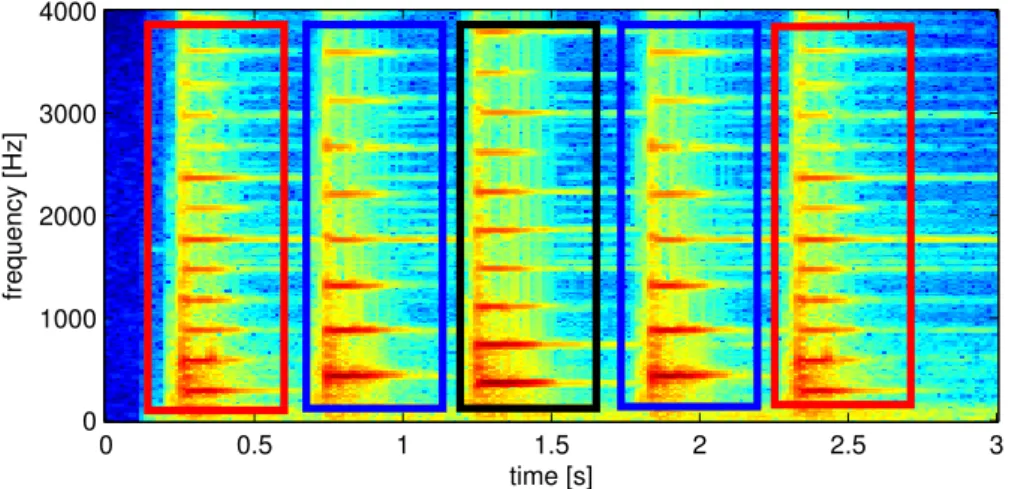
Natural auditory scenes are constructed of events that repeat over time, such as, individual phonemes in speech and identical notes of musical instruments. The magnitude spectrum, i.e., the absolute value of the STFT, of such an
au-time [s] frequency [Hz] 0 0.5 1 1.5 2 2.5 3 4000 3000 2000 1000 0
Figure 3.1: Example of magnitude spectrogram redundancy of piano notes. Re-peating events are denoted by rectangle of same color, the note in the middle occurs only once.
dio signal is constructed of spectral patches that also have a repetitive manner and resemblance. This can be visually confirmed from Figure 3.1 depicting a few different notes played on a piano in repeating sequence. Additionally, the STFT is already redundant due to its definition having analysis frames over-lapping, and thus DFT is being applied to partially redundant content. The object-based representation based on magnitude spectrum templates derived in the frequency domain also benefits from the shift-invariance property of the spectral transform, meaning that the absolute phase of the audio object or event can be disregarded.
The redundancy of the sound events can be utilized by a model that is composed of a few spectral templates and their time-dependent activation. The degree of the model, i.e., the number of spectral templates, restricts the modeling accuracy. Given that a certain degree of error is allowed in representing the spectrogram, similar yet slightly different sound events can be modeled using the same spectral template. Such a model reduces the redundancy in representing the overall spectral content. Additionally, the single spectral template representing redundant content can be interpreted to perform a separation at a very basic level.
The purpose of decomposing an audio spectrogram into objects is for the learning of underlying structures from the original data, which are beneficial for further signal processing stages. These stages include, for example, speech recognition [111], audio coding [145] and source separation [121, 147]. In the course of this thesis the decomposing techniques of ICA and the family of algorithms based on non-negative matrix and tensor factorization are utilized
and introduced.
Algorithms suited for monaural spectrogram decomposition rely on the machine learning approaches that learn redundant parts occurring over time in the spectrogram. The difference in decomposing monaural and multichan-nel spectrogram is that the latter includes inter-chanmultichan-nel information regard-ing spatial position of the audio objects and events. The inter-chan