FACULTY OF LAW
Lund University
Madelene Nilsson
The share capital requirement
-‐ a comparative study of its functions, problems and future.
JURM02 Graduate Thesis
Graduate Thesis, Master of Laws programme
30 higher education credits
Supervisor: Henrik Norinder
Contents
SUMMARY 1 SAMMANFATTNING 3 PREFACE 5 ABBREVIATIONS 6 1 INTRODUCTION 71.1 Purpose and outline 8
1.2 Method and material 9
1.3 Delimitations 9
2 THE SWEDISH SHARE CAPITAL RULES 11
2.1 Why an Aktiebolag? 11
2.1.1 Other possible company forms 11
2.2 History of the share capital 12
2.3 Functions of the Swedish Share Capital 13
2.3.1 Quote value of shares 14
2.3.2 Shareholder protection and obligations. 15
2.3.3 Creditor protection 15
2.3.3.1 The contribution duty 16
2.3.3.2 Limitations to dispose of the shareholders´ equity. 16
2.3.4 Control of finances: the special balance sheet 17
2.3.5 Transaction costs 18
2.3.6 Seriousness of entrepreneurs 19
2.4 The minimum share capital amount 19
3 THE EU 21 3.1 Introduction to the EU 21 3.2 Cases 22 3.2.1 Daily Mail, 1988 22 3.2.2 Centros, 1999 23 3.2.3 Überseering, 2002 24 3.2.4 Inspire Art, 2003 24
3.3 EC Insolvency Law: the EIR 25
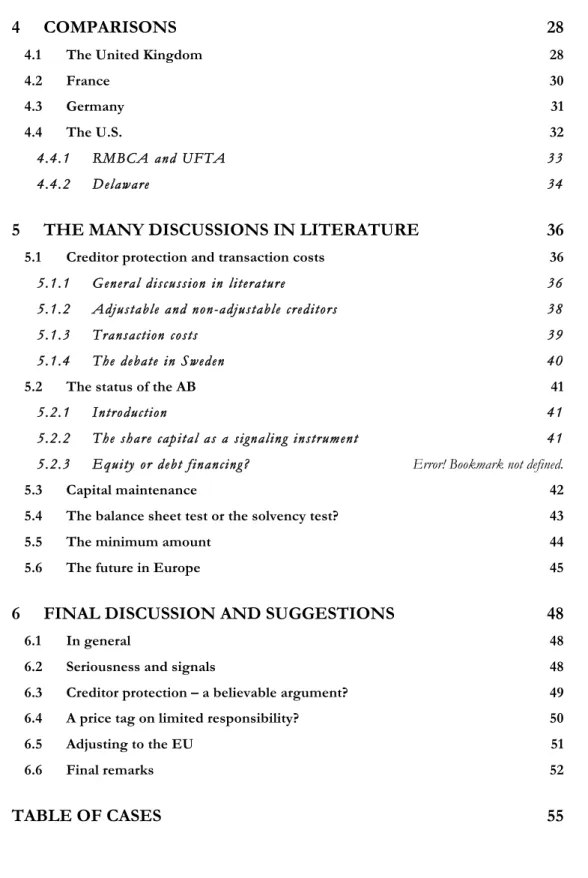
4 COMPARISONS 28
4.1 The United Kingdom 28
4.2 France 30
4.3 Germany 31
4.4 The U.S. 32
4.4.1 RMBCA and UFTA 33
4.4.2 Delaware 34
5 THE MANY DISCUSSIONS IN LITERATURE 36
5.1 Creditor protection and transaction costs 36
5.1.1 General discussion in literature 36
5.1.2 Adjustable and non-adjustable creditors 38
5.1.3 Transaction costs 39
5.1.4 The debate in Sweden 40
5.2 The status of the AB 41
5.2.1 Introduction 41
5.2.2 The share capital as a signaling instrument 41
5.2.3 Equity or debt financing? Error! Bookmark not defined.
5.3 Capital maintenance 42
5.4 The balance sheet test or the solvency test? 43
5.5 The minimum amount 44
5.6 The future in Europe 45
6 FINAL DISCUSSION AND SUGGESTIONS 48
6.1 In general 48
6.2 Seriousness and signals 48
6.3 Creditor protection – a believable argument? 49
6.4 A price tag on limited responsibility? 50
6.5 Adjusting to the EU 51
6.6 Final remarks 52
Summary
This thesis aims to clarify the effects of the minimum share capital requirement in relation to Swedish private limited liability companies. The “be or not to be” of a minimum share capital requirement has been debated for a long time, both in Sweden and abroad.
Sweden and many of the European continental countries such as Germany has a tradition of requiring that entrepreneurs wishing to form a private limited company commit capital to it. The reasons are many, but protection for both adjusting and non-adjusting creditors is historically the most prominent one. Other reasons are that the share capital functions as an entry barrier, as capital maintenance rules and are a way of reducing transaction costs since the legal rules create a standard contract. As an entry barrier, the share capital is said to make sure that only serious entrepreneurs have access to the form of corporation and thus preventing the company form from being used for illegal purposes. This is one of the strongest arguments in the Swedish government’s proposition but has been criticized since many entrepreneurs might be lost due to a lack of capital. It has further been discussed, in the context of the share capital as an instrument signalling seriousness, whether financing by share capital or financing by debt creates the most credible companies.
Anglo-Saxon countries such as England and the United States do not express the same belief in the minimum share capital’s function as creditor protection and has therefore abolished these requirements. Instead insolvency law is important and this allows the market itself to determine how to protect itself best, through different agreements.
When looking at the European Union, attempts have been made to harmonize company law and in the Commission’s Draft Statute for the SPE company, the suggested European private limited liability company, the minimum share capital requirement was set to one euro. However, in the now suggested Presidential Compromise, the Member States themselves may choose a share capital requirement of 1-8 000 euros, a compromise that leads to the SPE company losing one of its signalments. Now, the advantage is primarily that the company is able to operate throughout Europe.
The future is very interesting, with increased harmonization within the EU, the SPE company and an increasing amount of European companies incorporating in the UK. Sweden has several decisions to make and paths to choose from, and the minimum share capital requirement is central in this.
This thesis shows that the minimum share capital requirement actually is an out dated concept. It does not ensure creditor protection even to the non-adjustable creditors since the amount of equity has no relation to the amount of potential future tort claims or tax debts. This especially since when a financial crisis is discovered the share capital is probably long gone. The author is further quite fond of using insurances as an alternative to share capital above all to fulfil the demand for non-adjustable creditor protection.
Transaction costs are not something that should be considered when making law, this is strictly business and inquiries have shown that most creditors makes individual arrangements even if there is a share capital in the company. When it comes to an entry barrier, the author finds it very peculiar that it is possible to buy limited liability when it should be earned.
Sammanfattning
Denna uppsats undersöker effekterna av minimikapitalkravet i relation till svenska privata aktiebolag. Aktiekapitalets ”vara eller inte vara” är något som länge debatterats, i Sverige och utanför.
Sverige och många av de kontinentaleuropeiska länderna, såsom Tyskland, har en tradition att kräva att entreprenörer som önskar att starta ett privat aktiebolag bidrar med kapital till detta. Skälen är många, men skyll för frivilliga men framför allt ofrivilliga borgenärer är historiskt sett det mest uttalade. Andra skäl är att aktiekapitalet fungerar som en inträdesbarriär, som regler för att kapital ska stanna kvar i företaget och att det är ett sätt att reducera transaktionskostnader eftersom lagreglerna utgör ett standardkontrakt. Som en inträdesbarriär ska aktiekapitalet bidra till att endast seriösa entreprenörer har tillgång till aktiebolagsformen och möjligen att hindra den från att utnyttjas för mindre lagliga eller lämpliga syften. Detta är ett av de starkaste argumenten i den svenska regeringens proposition men resonemanget har kritiserats eftersom man kan gå miste om många duktiga entreprenörer för att de saknar kapital. Vidare har det diskuterats, i sammanhanget att se aktiekapitalet som ett sätt att signallera seriositet till marknaden, om finansiering via aktiekapital eller skuld skapar de mest trovärdiga företagen.
Anglosaxiska länder såsom England eller USA har inte samma tilltro till minimikapitalkravets funktion som borgenärsskydd och har därför slopat dessa krav. I stället spelar insolvenslagstiftningen en stor roll och detta gör att marknaden själv får avgöra hur den bäst skyddar sig, via olika typer av överenskommelser.
När blicken vänds mot EU så har försök gjorts för att harmonisera bolagsrätten och i kommissionens förslag till stadga för SPE-bolaget, det föreslagna privata europabolaget, sattes minimikapitalet till en euro. Men i den nu aktuella presidentkompromissen kan medlemsstater själva välja vilket kapitalkrav de vill tillämpa, mellan en euro och upp till åtta tusen euros. Kompromissen gör att SPE-bolaget går miste om ett viktigt karaktärsdrag och nu är fördelen främst att bolaget kan driva verksamhet i de olika medlemsländerna.
Framtiden är mycket intressant, med ökad harmonisering i EU, SPE-bolaget och fler och fler bolag från alla europeiska länder som väljer att skapa sitt privata bolag i Storbritannien. Sverige har flera beslut att ta och vägar att välja från och minimikapitalkravet är en central fråga.
Denna uppsats visar att minimikapitalkravet är ett utdaterat koncept. Det ger inte något borgenärsskydd ens till ofrivilliga borgenärer eftersom aktiekapitalets storlek inte har någon relation till framtida skadeståndsanspråk eller skatteskulder, speciellt eftersom aktiekapitalet oftast redan är förbrukat när ett bolags ekonomiska kris uppdagas. Författaren förordar vidare idén om en obligatorisk försäkring som alternativ till aktiekapitalet för att framför allt fullgöra kravet på just säkerhet för ofrivilliga borgenärer.
Transaktionskostnader är inte något som bör övervägas i lagstiftningsprocessen då det gäller affärer och undersökningar har visat att de flesta borgenärer väljer att skapa individuella överenskommelser även om företaget i fråga har ett aktiekapital. När det kommer till en inträdesbarriär finner författaren det udda att det är möjligt att köpa begränsat ansvar. Det bör förtjänas.
Preface
With this thesis, many years in Lund studying law is completed. I will never again study for a 30 credits and eight hours written exam or buy a pencil so small that I have to use an enlargement glass to read what I have written. Never will I wonder why I did not start on the essay earlier than the night before it was due. Never will I experience the horrible three weeks between an exam and when the grade is published.
I will miss it.
A great thank you to my supervisor Henrik Norinder, who has not only made sure I finish this thesis but also made the final advanced courses so much more interesting. Henrik always offers an alternative view to everything, which is as irritating as it is useful.
I also wish to thank the faculty of law in Lund where I have been working since my second semester. I have had a great time and have probably learned more about law during the coffee breaks than during the whole education. This essay was written while I was doing an internship at Göta hovrätt, an opportunity I am very grateful for. It has given me new insights in law and a great respect of the knowledge and humanity of Swedish courts.
I need not say my good-byes to Juridiska Föreningen and Lundakarnevalen, these two wonderful organizations are always with me and I shall visit them often.
Finally, a thank you to my family and to Fredrik, who has never been anything but supportive, no matter what I do.
Madelene Nilsson
Göta hovrätt, Jönköping, den 10 oktober 2011.
Abbreviations
ABF Aktiebolagsförordning (2005:559)
ABL Aktiebolagslag (2005:551)
BGB Bürgerliches Gesetzbuch – German civil law
BFL Bokföringslag (1999:1078)
CA Companies Act 2006 (The UK)
CC Code Civil – French civil law
CdC Code de Commerce – French company law
COMI Centre of Main Interest (EU Standars)
DGCA Delaware General Corporation Act
DLLCA Delaware Limited Liability Company Act
ECJ European Court of Justice
EIR European Insolvency Regulation
EURL Enterprise unipersonnelle à responsabilité limitée GmbH Gesellschaft mit beschränkter Haftung – German
company form with limited responsibility. GmbHG Deutsches Gesetz über die Gesellshaften mit
beschränkter hafting – German law for GmbH:s
IA Insolvency Act (The UK)
LLC Limited Liability Company – Company form in
the USA with limited responsibility
Ltd Limited Company – Company form in the UK
with limited responsibility
RMBCA Revised Model Business Corporations Act – company act in the USA implemented by most of the States.
NJA Nytt Juridiskt Arkiv (Cases from the Swedish Supreme Court)
SA Société anonyme
SARL Société à responsabilité limitée
SE Societas Europea – Public European Company
SPE Societas Privata Europea – Private European Company
UG Unternehmergesellschaft – Special form of GmbH.
UFTA Uniform Fraudelent Transfer Act, USA
1
Introduction
The private limited liability company form exists in almost every country, in different forms. Common for them all is that they bring limited liability to their owners and is thus a company form to be preferred if an entrepreneur wishes to create a company without too much personal risk.
In common in most of these countries when forming a company is that it is necessary to establish some kind of documents, which form the company’s constitution. Most often, the company also need to be registered in an official register. What differs between the countries is the amount needed as share capital. In the U.S., no capital at all is required. In the UK the famous and much used company form Ltd requires one pound.
In continental Europe, the last decade had been a very interesting one. Many new company forms have arisen and most countries have opened up for the possibility to at least start a company with very little share capital. In Sweden the minimum capital was lowered from 100.000 SEK to 50.000 SEK. Furthermore, the EU has proposed a European private limited company, the SPE company, where the minimum capital requirement can be between one euro to 8.000 euros. Which minimum amount to require is up to the member states themselves.
In the US, almost half of the companies on the New York Stock Exchange are registered in Delaware, since this state is very company friendly with a lot of competence in areas such as company law and of course requires very little from anyone that wishes to start a company. The registration process is swift and there is no capital requirement. The development in the US is sometimes called a race to the bottom and some authors have argued that we will see the same development in Europe.
Sweden is, as an EU member state, in the midst of the debate. As with most legislation today, the European regulation on company law must be taken into account when making national decisions. For private limited liability companies, ABs in Sweden, the minimum share capital required by law is 50.000 SEK. The reasons behind this regulation are, as we shall see, many and comprises of creditor protection, the wish to protect the AB as a serious and trustworthy company form, capital maintenance, reduction of transaction costs and the prevention of the AB being used for illegitimate purposes.
During many lectures and seminars within the advanced course Comparative Company Law during the spring 2011, we have discussed the importance, or non-importance, of a legally required minimum share capital in companies with a limited personal responsibility. The advantages and disadvantages of the minimum share capital rules are the questions that this thesis will focus on. To make it a bit more practical, I focus on the Swedish share capital rules: its functions, problems and future. In order to problematize, I will thus focus on the reasons behind the rules concerning share capital in Sweden – the issues the legal construction is aimed at solving – and then examine how these issues
are solved in countries with a different legal construction and different amounts as their minimum share capital requirement.
1.1
Purpose and outline
The ultimate purpose of the essay is to analyze and discuss whether the Swedish legal construction is the best legal construction concerning minimum share capital requirements or if the rules should be changed.
The first part of my thesis is aimed at finding the reasons behind the Swedish construction and the answer(s) to the question: Why does Sweden have a minimum share capital requirement and why is it set at 50.000 SEK?
The second part of the thesis is aimed at finding how other countries do. I have chosen to look at the EU, some European countries and the U.S. The focus on this study is: How do countries with different legal constructions than Sweden solve the same issues that Sweden solves using a minimum share capital requirement?
I will first present the view and many difficulties of the EU when trying to harmonize primarily the company law and as part of this, the minimum requirement rules. This part is important since I will later discuss the Swedish share capital rules in a EU context, and possibly as part of a corporate law competition between the EU Member States. During 2008-2009 the EU proposed a private European company and I will go through the proposed Statute for this company since it may soon be a reality and possibly a true competition for the Swedish AB. I will further present how the US, UK, Germany and France deal with the share capital and problems concerning this. The countries are chosen since they are interesting in Sweden both from a trade perspective and as possible ways to handle corporation law. Regarding the US I will focus on three sets of rules in the U.S. First the RMBCA and UFTA, since these are common corporate law standards in many of the US States. Together with RMBCA, I will focus on U.S. insolvency law since this law is common grounds to the whole U.S. and thus not exposed to competition in the same way as the company law. U.S. insolvency law deals with many issues concerning creditor protection and capital maintenance. Secondly, I will focus on Delaware, since many of the American corporations are incorporated in Delaware.
The third part is a study of the theories behind and debates concerning different issues in context to minimum share capital requirements. I will present the different views on the functions of the share capital and the advantages and/or disadvantages with different legal constructions and capital requirements.
In the final discussion, I will discuss which legal construction best solves the issues that Sweden today solves using a minimum share capital requirement. I will thus relate back to the findings in chapter two and compare them to how other countries do. Hopefully, the literature I have examined in chapter five will help discussing the different alternatives and the consequences of these. This part will answer the question: Should Sweden keep the regulation regarding the minimum share capital requirement as it is or should changes be made?
1.2
Method and material
Throughout the essay, a dogmatic method is applied, meaning that the analysis is based on legal sources such as statute, case law and doctrine. I attempt to give due weight to each source depending what legal system is treated. This means that regarding e.g. the EU great weight is put on case law.
The obvious starting point for this thesis has been legislation. I have looked at the Swedish legislation together with the legislative history in order to get a complete picture of the regulation complex. Regarding the French and German legislations I have used English translations. When unsure, I have read the French legislation in French and thus been able to make sure that I understood everything correctly. I have also made great use of different websites, not as a source but as a means to understand how the legislation works. Since the author does not know German, the German legislation has been read in English. I have double checked the English version using literature and also some websites. The legislations in UK and the US I have read, sometimes with use of examples from websites not used as a source. Regarding the material from the European Union, I have made great use of the EU’s website where I have found the documents themselves, guides and general information.
Illuminating cases from primarily the ECJ have been used to further understand the system and to show on a development not always written out in law.
Textbooks and articles have been used for two reasons. The first reason is to further explain the different judicial systems, the consequences of these and certain key issues. The other reason is to get the authors’ opinions on issues such as the function of the share capital, transaction costs and how they see the future in Europe regarding company law. All of these opinions are mainly gathered in chapter five. The articles have been published in well renowned journals and are mostly written by professors in company or EC law. The articles are written in Swedish or English. Sometimes the articles have referred to sources in German and these sources I have not been able to check. However, the main argument is seldom based on these sources and thus I am comfortable in using the article anyway.
1.3
Delimitations
To keep the essay focused and relevant, I have chosen only to write about the share capital requirement in Swedish private limited companies. In the comparative study however, it has sometimes been necessary to look at the rules for public limited companies and other times there is no difference between public companies and private companies.
Since this thesis is about the minimum share capital requirement, its functions, and issues and future, I will not, at any depth, discuss rules concerning e.g. creditor protection, transaction costs or capital maintenance. These are functions of the share capital and will at times be given a fair amount of space
and at times simply be mentioned. The purpose of this essay is not to problematize around these functions as themes in their own right, however important and interesting they may be, except when required while discussing the share capital.
2
The Swedish Share Capital rules
This chapter will focus on Swedish company law. I will explain the basics of the Swedish Aktiebolag, AB, the history of the share capital and point on other possible ways to have a limited responsibility. I will thoroughly describe the many reasons behind the requirement of a minimum share capital, using legislative history, literature and some cases. In addition, the reasons for having 50.000 SEK as the minimum amount required will be explained.
The Swedish laws that are relevant in this context are Aktiebolagslagen (ABL), Årsredovisningslagen (ÅRF) and Aktiebolagsförordningen (ABF).
2.1
Why an Aktiebolag?
The limited company form is probably one of the reasons of the economic advances in the west during the last centuries. Its great significance is partly because of the financing of the company and partly because of the limited responsibility. In combination with the opportunity to trade shares, the limited company form is recognized by its economic flexibility.1 In Sweden, the limited company form is primarily the AB, which can exist as a public or private company.
The point of most limited companies is simply that they grant their owners limited liability. Usually, the only risk an owner (shareholder) in an AB takes is that his or her shares might become worthless and the money ventured might be lost. You do not risk your or your family’s private economy.
2.1.1
Other forms of incorporation
In order to better understand the AB, I will shortly describe some alternative forms of corporation available in Sweden. I do not aspire to make a complete list, but simply to present some common possibilities.
If you wish to run a business in Sweden, there are other types of company forms to choose from, with different advantages and disadvantages. However, if you wish to do so with a limited responsibility you can only choose between the following:
• Limited Partner in a Kommanditbolag, • Member of an Economic Union,
• Shareholder in an Aktiebolag, private or public,
• Shareholder in a limited company in another EU member state, with a
branch in Sweden.
A Handelsbolag is a company form with two or more owners. The owners are personally and severally responsible for the company’s debts and contracts, which means that a creditor can ask any of the owners to pay and that owner will have to turn to the other owners to be reimbursed. A Handelsbolag needs to be registered by the competent Swedish authority2. A special kind of Handelsbolag is the Kommanditbolag where at least one of the owners (partners) has a limited responsibility and at least one has an unlimited responsibility for the company.3
Soon the possibility to start an SPE-company, which will be described later on in this thesis, might be available to all Europeans. Today, the SE-company (public limited liability company form) is already in existence as the public limited European company form.
An Economic Union is a special company form where the purpose is to take care of the members’ common economic interests. The members might be consumers, producers or suppliers of goods or services or contribute to the union in other similar ways. An Economic Union need to be registered and have a board. Its members’ responsibility is limited to their share or effort. Anyone who fulfils the membership requirements shall be allowed as a member.4
Another type of very common company is the Enskild Firma, a company form with a single owner. The registration number of the company is the same as the owner’s personal identification number and thus the economy of the company is closely related to the economy of the owner. An Enskild Firma is not a legal person and only has to register at the competent Swedish Authority5 if it wishes to have its name protected. It does not grant the owner limited liability.
2.2
History of the share capital
The first Swedish law concerning limited corporations came in 1848. In the law was a share capital requirement, but the amount of the share capital was not regulated. Since then, the share capital requirement has been revised a number of times. In 1885, the required minimum share capital was 5.000 SEK and it stayed this way until 1973 when it was raised to 50.000 SEK.6
The raise to 50.000 SEK led to demands, especially from smaller businesses, that Swedish law should offer an alternative to the AB. An Inquiry presented its suggestion concerning Andelsbolag in 1974 and suggested a special type of AB. The Andelsbolag would give limited responsibility to its owners, and have a minimum capital requirement of 20.000 SEK. The Inquiry also suggested that the minimum share capital for an AB would be raised to 125.000 SEK.
2 In this case, the Swedish Bolagsverket. 3 BL.
4 Lagen om Ekonomiska Föreningar, 1:2, 2:1, 3:1. 5 Bolagsverket.
However, the suggestion received a lot of negative criticism and was never carried out.7
In 1995 it was decided that the limited company would now become two kinds of companies: the private limited company and the public limited company. For private limited companies, the required amount was raised to 100.000 SEK.8 The reason for the split was mainly Sweden’s membership in the European Union. Many of EU’s Company Directives contained special demands on companies with several small owners, opposed to closely-held companies.9 In 2005 a new ABL entered into force, but no changes were made concerning the share capital amount.
During the year 2008 an Inquiry regarding the minimum share capital in private limited companies was commenced and the alternatives the Inquiry should take into consideration were to lower the share capital to 50.000 SEK, 20.000 SEK or remove it completely.10 It suggested, for reasons described later in this chapter, 50.000 SEK. The reasons behind the Inquiry were, among other things, criticism concerning the difficulty to start an AB and the trend in the EU and the other Member States. The Inquiry writes about a possible competition in the EU after some crucial cases11 that Sweden might have to adjust to.12
In 2007, the government gave a directive for an Inquiry concerning a less complicated AB.13 The Swedish government recognized the need of a company form with limited responsibility for smaller companies, possibly without a capital requirement. The Inquiry’s first task was to analyze the need of a new company form and consider advantages and disadvantages. The Inquiry presented its conclusions in April 2009.14 A new company form with limited responsibility was however not suggested, primarily because of the suggested SPE company form15 and that the Inquiry found it better to simplify some rules in ABL instead.16 It did not discuss the issue of the share capital due to the parallel investigation concerning this issue.
2.3
Functions of the Swedish Share Capital
The shareholders shall pay the share capital when the company is formed. The payment can be in cash or capital contributed in kind, e.g. a machine. Usually, the owners pay when they acquire their shares17. When payment is made
7 SOU 2008:49, page 58.
8 For public limited companies, the amount was raised to 500.000 SEK. 9 Sandström, page 55.
10 SOU 2008:49, page 56 ff.
11 We will look at these cases in chapter 3.2 12 SOU 2008:49, page 61-62.
13 Dir. 2007:132. 14 SOU 2009:34.
15 See chapter 3.4 about the EU and SPE company form. 16 SOU 2009:34, page 136 ff.
through contribution in kind, the company’s auditor must state that the contribution has been made, that it is of use to the company and that the value of the contribution is not entered into the accounts at a higher value than it should be18.
In the company’s bylaws the share capital shall be defined and Swedish companies can choose to state a minimum and maximum share capital, to be able to enable flexibility without making changes in the bylaws. The number of shares, minimum and maximum, shall also be stated.
The share capital shall be represented by a post in the balance sheet.
2.3.1
Quote value of shares
The quota between an AB’s share capital and the number of shares is called the quote value. When an AB is created the share capital as well as the number of shares is decided. When the new ABL was introduced in 2005, one of the news was the quota system that replaced the old system of nominal share value.19 ABL 1:6 states that every share represents an equal part of the company and that this part is the share’s quote value. The system enables the share capital to be increased or decreased without having to give out new shares or take back old ones.20
The share’s quote value can be changed without changes to the share capital. The number of shares can be increased or decreased. To expensive shares may be considered impractical and thus divided in two, a so-called split. A too low share value can be a problem for a company, e.g. because of transaction costs. In this case, shares may be fusioned, so that two earlier shares becomes one new with a higher value.21
A share may not be bought at a price lower than its quote value.22
18 ABL 2:19.
19 Nominal value is when every share has a set, nominal value per share (Hamilton, page
176). The nominal value system was motivated by the fact that in older AB:s shares had been given out that did not represent a paid amount, but simply the owner’s share in the company and the company’s assets. Since the share capital was considered the only base for creditors, legislators found it important to make sure that this base is somewhat consistent. The legislators thought that this could be achieved by settling a required minimum share capital in combination with a lowest nominal value per share. The purpose of the nominal value system was thus to secure a company’s non-free capital when the company was created or during an emission. That a decided amount was stated in money and written on the shares probably also made the shareholders feel more secure (NJA II 1895, page 58-59 and Sandström, page 104).
20 Sometimes it is necessary to notify the creditors when decreasing the share capital, ABL
6:1.
21 Sandström, page 105f. 22 ABL 2:5 and 13:4.
2.3.2
Shareholder protection and obligations.
The share is the base of the shareholder’s rights and obligations concerning the company’s economy and management. It symbolizes the shareholder’s part of the company.23 One of the arguments for the share capital is that it makes it easier to gain capital to the company. A lack of legal protection for investors might both decrease the opportunity for the company to get external financing and force the company to pay a higher interest.24
In case law, especially in NJA 1947 page 647, the Swedish Supreme Court decided that when the limited liability gives unreasonable advantages or results, a personal responsibility might be put on the shareholders. There is however no clear definition of when this should happen. It could be when the shareholders run a business that is not separated from one of the shareholders’ own businesses. It could be when shareholders in an objectionable way have used the limited company form in order to minimise their own liability or it could be when the company obviously has insufficient funding.25 However, one should be careful when using the above-mentioned possibility.26
2.3.3
Creditor protection
As stated earlier, one of the distinguishing features of a limited company is the limited responsibility for the owners. However, this interest of freedom for shareholders must be considered in the light of the creditors’ interests: that the company is able to pay its debts.
There are many types of creditors. Banks, suppliers, and the state (in the form of tax claims) are usual examples but there are also other types. An obligation can be created via non-contractual torts, and the employees are considered a creditor because of their interest that their payment claim is covered.27
The share capital, together with the rest of the shareholders’ equity, creates a buffer between the assets and debts of a company to make sure that the company’s economic commitments can always be fulfilled.28 However, in its proposition29 the government stated that it is probable that creditors more often look at cash flow or liquidity than the share capital and the government’s proposition concluded that the protection of creditors is not the main reason for the minimum share capital requirement.
Traditionally creditor protection is considered one of the reasons for the share capital30 and many of the rules involving the share capital is based on or have 23 Sandström, page 98-110. 24 SOU 2008:49, page 84. 25 Andersson, page 204 ff. 26 Prop 2004/05:85, page 207 f. 27 SOU 2008:49, page 50 28 Sandström, page 98-110.
29 Prop 2004/05:85, page 10f. The proposition proposed a new ABL.
30 See e.g. chapter 2.2. and Rodhe, Aktiebolagsrätt, page 19 where prof Rodhe (1909-1999)
consequences for the protection of creditors. For this reason, the following parts will explain the ABL rules connected to the share capital and creditor protection. The legislation protecting creditors in Sweden today may be divided into three: the contribution duty, the limitations in the company’s right to dispose over its capital and involuntary liquidation rules.31 In the following, we shall have a short look at the two first protection systems and which kind of protection it gives creditors. In chapter XXX we will go further in to the involuntary liquidation rules, since these rules protects many other interested parties as well as the creditors.
2.3.3.1
The contribution duty
The purpose of the contribution duty is that the capital the company officially have also should be contributed to the company.32 The payment of shares should happen when the company is created and may not be below the share’s quote value, ABL 2:15. As seen above, the payment might be made through a contribution in kind.
The contribution duty is not only relevant at the creation of the company but also later on: regarding issuing of new shares or convertibles, ABL 11:1.
2.3.3.2
Limitations to dispose of the shareholders´ equity.
The limitation in a company’s right to dispose of its shareholders’ equity is divided into two principles: The cover principle, ABL 17:3, means that an asset transaction is only legitimate if there is full cover for the company’s equity after the transaction. The decision shall be based upon the latest balance sheet with consideration to later occurrences. The principle is meant to give the creditors a guarantee that the equity cannot be decreased through asset transactions. The second principle is the caution principle, also found in 17:3 ABL. Even if the asset transaction is compatible with the cover principle, the transaction will still have to be defendable considering demands that the extent, nature and risks of operations puts on equity, liquidity and the company’s position in all. The consequence of the caution principle is that a transaction might be smaller than what the cover principle would allow, but never greater. The size of the buffer needed must be determined for each individual company, taking into account e.g. the business cycle and the size of the shareholders’ equity. The caution principle further means that a company need to take its current costs into consideration. Asset transactions may not involve a sum so grand that the company deteriorates its ability to fulfil obligations and the company should still have a buffer in case of unexpected events. The caution principle is a standard rule, and there are unfortunately no cases to explain it further.33
that this capital is actually created when the company is registered and doesn’t disappear during the company’s operations.
31 The same division is used in SOU 2008:49, page 9. 32 Sacklén, page 138
33 Karnov, comment to 17:3 ABL. NJA 1995 page 742 gives some guidance since it
explains that the value the cover principle refers to is the value entered into the accounts, not the market value.
Section 17:3 and its principles can be applied to all kinds of asset transactions.
2.3.4
Control of finances: the special balance sheet
In ABL34 we find the rules concerning the liquidation of an AB, before it has severe financial problems. The main purpose of the rules is to put pressure on the board so that it acts in time. If the board has reason to suspect that half of the share capital is used, they have to create a special balance sheet that is to be audited by the company’s auditor, ABL 25:13.If the special balance sheet shows that half of the company’s equity is covered, the board no longer has a duty to act. However, if the special balance sheet shows that half of the share capital is in fact used, then an extra shareholders’ meeting is to be summoned. At the shareholders’ meeting the shareholders can decide that the company should be liquidated, ABL 25:15. If the meeting does not take a decision, the board will try to gain control over the economy during a maximum time of eight months. During this time the board is busy with plans of reconstruction such as discussing if the shareholders are able to contribute more capital to the company35.
After a maximum eight months, the shareholders shall meet again to discuss a new special balance sheet, produced by the board and/or reconstruction officers, ABL 25:16. If the share capital is not fully covered, the company has to be liquidated, ABL 25:17.
The members of the board might be held personally responsible if they do not act accordingly to what ABL demands of them, presuming they have been neglectful. The responsibility would comprise of the commitments the company has made since the point of time when the board did not follow the rules of ABL. The same responsibility applies to a person who, knowing that the board has not acted properly, acted in the company’s name.36 A shareholder might also be responsible together with the company for commitments the company made after he or she participated in a decision that the company should not be liquidated, knowing that according to law the company should be liquidated.37
The rule is based on the idea that a company should not be allowed to be economically unstable during a longer period of time. If the company’s economic situation is not improved the company will be liquidated to protect creditors from even more damage.38 Another idea is that the rule should function as a warning and give time to acknowledge and try to sort out the company’s problem.39 34 Chapter 25, section 13-20. 35 Sandström, page 325. 36 25:18 ABL. 37 25:19 ABL.
38 Skog, Rodhes Aktiebolagsrätt, page 83. 39 Nerep, Aktiebolagsrättslig analys, page 471.
2.3.5
Transaction costs
A transaction cost is all the costs connected to the main transaction, such as a purchase or loan. The most common transaction costs are the search- and information costs, bargaining costs and policing and enforcing costs.40 Obviously, the size of the transaction cost varies greatly depending on the type of transaction. Transaction costs are relevant to discuss in context of the share capital since the share capital has been seen as a way to decrease these costs. No requirement of share capital might lead to greater transaction costs since the company and creditors would be forced to make individual deals instead of relying on the capital existing in the company. Since individual contracts take more time and demands more research, the costs are greater than for a generalized contract and this might create problems, especially for the smaller businesses41.
There are two types of creditors that are interesting in the transaction cost context: the adjusting creditors and the non-adjusting creditors. An adjusting creditor is a creditor that has the opportunity to make individual agreements with the company. It might be a bank considering giving a loan to the company or a supplier wishing to make business. The adjusting creditors are willing to incur the transaction costs necessary to adjust the terms upon which credit is extended so as to compensate them appropriately for the risk they are bearing.42 What they have in common is that they may choose whether or not to engage in business with the specific company. Examples of how these creditors protect themselves in Sweden are through keeping the ownership of their goods until full payment has been received, financial leasing and pledges.43 Adjusting creditors might also ask for personal securities from the owners rather than from the company.
Not every creditor has the opportunity to make individual contracts with a company and in that way decrease the risk they are taking concerning their claim towards the company. Tort victims are the most intuitive example of a non-adjusting creditor, but also the state has a claim for taxes and in some cases a wages guarantee can be counted as non-adjustable creditors.44 Non-adjusting creditors thus need a greater protection than the Non-adjusting ones, and the rules concerning capital protection of which the share capital is part might be seen as a standard contract for them.45
A creditor that cannot be classified as either an adjustable or a non-adjustable creditor are the ones that, due to lack of knowledge, will or information, does not protect its own interests by making an individual contract with the
40 A Dictionary of Economics: ”Transaction cost”. 41 SOU 2008:49, page 84.
42 Armour, page 5. 43 Sacklén, 153ff.
44 SOU 2008:49, page 83, Armour page 5.
company. These groups are called weak creditors and have to rely on the company’s capital.46
2.3.6
Seriousness of entrepreneurs
When proposing a new ABL, the government clearly stated that to protect the AB’s good reputation as a serious and credible company form is one of the main reasons for the share capital and the amount required.47 The government further wished to make the point that an entrepreneur that is not committed enough to the company/business idea to commit capital to it should be referred to other types of corporations.48
The share capital might be a way of making sure that the entrepreneur has a well-developed business idea to which he/she is prepared to commit capital. In this aspect, the minimum capital requirement functions as an entrance barrier. It might also work as a first barrier to prevent the limited liability company form from being used for illegitimate purposes.49
The Inquiry discussed the risk that an AB might be used for illegitimate purposes, such as different kinds of economic criminality. However, since all lines of business should abide by the same laws it would be difficult to raise the required minimum capital, since such a raise would also affect business branches with little problems concerning crimes. However, the Inquiry concluded that the minimum capital requirement would not put an end to the abuse of the AB company form, but might be a barrier for those persons wishing to use it for unserious purposes.50
2.4
The minimum share capital amount
As seen above, a private AB needs at least 50.000 SEK as share capital.
The official Inquiry presented in 200851 a thorough discussion concerning the amount required as share capital. According to its directive, the Inquiry should investigate if the share capital requirement should be lowered from 100.000 SEK to 50.000 or 20.000 SEK or to be kept unchanged.
The Inquiry concludes that the share capital requirement should be lowered to make the AB more accessible to all. They discovered that four out of five companies that started in 2006 were within the service sector, where capital is less necessary.
According to the Inquiry, the statutory minimum share capital has the disadvantage that there is no connection between this more or less randomly determined amount and the capital requirements and risks connected to the
46 SOU 2008:49 page 83 and Armour, John, pages 15-20. 47 Prop 2004/05:85, page 11
48 Prop 2004/05:85, page 212 49 SOU 2008:49, page 11 50 SOU 2008:49, page 86. 51 SOU 2008:49
individual company. If the statutory minimum requirement was to be removed, the share capital would be determined by the shareholders themselves in proportion to the extent and nature of the operations.
The Inquiry also observed the transaction costs, as we have seen above. The conclusion was that no requirement of share capital might lead to greater transaction costs since the company and creditors would have to make individual deals. These creditors would ask more of the company and maybe demand guarantees from the owners. If the share capital requirement was completely removed, it would likely be replaced by contracts. Since individual contracts take more time and demands more investigations and materials, the costs are greater than for a generalized contract.
The conclusion of the Inquiry was that there was no reason to remove the minimum share capital requirement in Sweden, but that the limited liability company form should be made more accessible by lowering the amount required. The amount of 50.000 SEK was chosen since the Inquiry believed that a reduction to less than 50.000 SEK would increase the demands from creditors for securities, capital contributions and information. The Inquiry also believed that it was an appropriate amount out of the perspective that some creditors cannot make individual deals with the company, that it would function well as a entry barrier to entry and that the lower the capital requirement is, the greater the risk of the company entering into an involuntary liquidation situation which should be avoided.52
3
The EU
3.1
Introduction to the EU
Today, the Swedish legislation and case law are obviously much influenced by the European Union. The EU is trying hard to harmonize the European company law and its many Company Directives have had some success in doing this. In order to get a better overview of the EU regulations, this part of the chapter will describe the basic common company law. However, since this thesis does not focus on public companies, large parts of this EU law are irrelevant. In order to be able to analyze the Swedish share capital rules out of an EU and EU Competition perspective later on, I will also write about the interpretation of the freedom of establishment for companies, using some cases. I will then move on to describe the proposed private limited European Company, the SPE.
Share capital rules have traditionally been among the cornerstones of EU company law. Already the Second Company Directive 1976 concerned the formation and maintenance of a share capital. Lately however, these rules, theories and ideas have created a debate among European Scholars. When the Commission set up a High Level Group of Company Law experts in 2001, it recognized the debate and asked the Group to investigate the share capital rules. Since then, the debate has been more vivid than ever.53
The view on the function and purpose of company law differs between the Member States. In the continental company law, it is important to protect the stakeholders in general and the company’s creditors especially. In the Anglo-Saxon company law, it is believed that the different parties can protect themselves best through different agreements and the focus is on flexibility and availability.54
The two theories deciding a company’s nationality are the real seat theory and the
incorporation theory and in Europe we have supporters of both, which explains a large part of the complex of problems regarding freedom of establishment for companies.
The real seat theory is practiced by e.g. Germany, France, Spain and Italy and means that a company must have its real seat in the country where it is also registered. A company is considered to have a legal personality only if this demand is fulfilled. The purpose of the real seat theory is to protect national interests through protecting creditors and other stakeholders, such as employees. The disadvantage of the real seat theory is that it might be uncertain where a company has its real seat. A consequence of the real seat method is that if the company decides to move its real seat to another country, it will no longer have a legal personality. A consequence of this is that the
53 Mulbert and Birke, page 2. 54 SOU 2008:49, page 81.
company representatives might be personally responsible for commitments the company made after moving its seat.55
The incorporation theory on the other hand is practiced by e.g. Sweden, the UK, Denmark and the Netherlands. It means that a foreign company is considered a legal personality under national law if the company has that status in its country of registration.56 There is no uncertainty when considering a company’s legal personality.
It is thus often impossible to move a company in itself between the different Member States.57 What companies can do is to register in the Member State that suits the company best and uses the incorporation method. The company can then create a branch in the Member State it wishes to operate in.58
The fundamental four freedoms59 and cases such as Centros60, Überseering61 and Inspire Art62 make sure that there is some freedom of establishment in Europe. These cases are interesting in order to understand how a Swedish AB may move within the EU and whether a foreign company may move its business to Sweden. This is important to understand in order to better discuss the future of the Swedish minimum share capital requirement, in regard to a possible EU competition.
3.2
Cases
3.2.1
Daily Mail, 1988
63Daily Mail (UK) is primarily a tax-law case but has some interesting company law issues as well. Daily Mail wished to move its de facto head office (and tax residence) to the Netherlands because of the more favourable tax rules there, while at the same time it planned to remain a company under UK Company Law. The UK Treasury Dep. refused permission for the transfer of seat, which is necessary to receive under UK law. The UK supports the incorporation theory.
Because of the refusal, Daily Mail referred the question to the ECJ: whether the EC Treaty precludes a member state from obstructing the transfer of the de facto head office from a member state.
The ECJ concluded that the freedom of establishment is one of the four freedoms and should also apply to companies. However, a company only exists
55 Dotevall, SvJT 2006, page 885. 56 Dotevall, SvJT 2006, page 885.
57 Pehrson, Kan aktiebolag flytta?, page 89f. 58 Dotevall, SvJT 2006 page 886.
59 EC Treaty art 3.3
60 Case C-212/97 Centros Ltd v. Erhervs-och Selskabsstyrelsen.
61 Case C-208/00 Überseering BV v. Nordic construction Company Baumanagement
GmbH
62 Case C-167/01 Kamer van Koophandel en Fabrieken voor Amsterdam v. Inspire Art Ltd. 63 Case 81/87 1988. All information is from the case text.
according to the national law of the country in which it is registered. Finally, the ECJ states that the EC Treaty does not in itself give company’s the right to move its head office. It also stated that this problem needs to be solved through further harmonization.
The principles of Daily Mail were reaffirmed by the ECJ in 2008, in the case Cartesio64. The court stated that: “As Community law now stands, articles 43 EC and 48 EC are to be interpreted as not precluding legislation of a member state under which a company incorporated under the law of that member state may not transfer its seat to another member state whilst retaining its status as a company governed by the law of the member state of incorporation”.
3.2.2
Centros, 1999
Two Danes established Centros Ltd under UK company law, but the company was only active in Denmark. The owners clearly stated that they had established the company under UK company law solely to avoid the minimum capital requirement for Danish limited liability companies. However, the Danish commercial registry considered this to be an unlawful circumvention of Danish law and refused to register the company’s branch office in Denmark. 65 First, the ECJ ruled that when a company exercises its freedom of establishment under the EC Treaty, the Member States are prohibited from discriminating against this company on the grounds that it was formed in accordance with the law of another member state in which it has its registered office but does not carry on any business. Second, a state is not authorized to restrict freedom of establishment on the ground of protecting creditors or preventing fraud if there are other ways of countering fraud or protecting creditors. Besides, the Court points to the availability to member states of the option of adopting EC harmonizing legislation in this area of company law. Thus, the ECJ concluded that a Member State has to recognize a branch of a company incorporated in another state, even if the local branch is the only part of the company that is actually doing business.
Later, the case Cadbury Schweppes from 200666 modifies the principle a little. In this case Cadbury Schweppes had established two subsidiaries in Ireland solely in order to gain from Ireland’s more favorable tax rules. The ECJ stated that a restriction of freedom of establishment is possible in cases of a “letterbox” or “front” subsidiary. A company cannot invoke freedom of establishment in another member state for the sole purpose of benefiting from more advantageous legislation unless the establishment in the other member state is intended to carry out genuine economic activity.
64 Case C-210/06 Cartesio Oktató és Szolgáltató bt.
65 C-212/97 Centros Ltd v. Erhervs-och Selskabsstyrelsen. All information is from the case
text..
66 Case C 196/04 Cadbury Schweppes plc & Cadbury Schweppes Overseas Ltd v.
3.2.3
Überseering, 2002
All the directors of Überseering BV, a limited liability company under Dutch law, were resident in Germany. As a consequence the German courts decided that German corporate law applies to the company, since the location of the head office was in Germany. For this reason Überseering did not have a legal personality in Germany and was dismissed from court proceedings. 67
The ECJ ruled that it was incompatible with the freedom of establishment to deny legal capacity to a company formed in one member state, which moves its central place of administration to another member state. The ECJ also stated that when a company incorporated in another member state exercised its freedom of establishment in another member state, that other member state is required to recognize the company’s legal capacity, which it enjoys under the laws of its state of incorporation.
The conclusion in Überseering was thus that a limited company registered in a country using the incorporation principle shall be recognized also in countries using the real seat theory.
3.2.4
Inspire Art, 2003
A person from the Netherlands established Inspire Art Ltd under UK company law and requested the registration of the company’s Dutch branch office in the Netherlands. The registry decided that specific Dutch rules for foreign entities registered in the Netherlands would apply. As a consequence, Inspire Art would have been required to use a company name indicating its foreign origin and comply with the minimum capital requirements for Dutch Limited Liability Company.68
The ECJ stated that a foreign company is not only to be respected as a legal entity having the right to be a party to legal proceedings, but rather has to be respected as such. That is, as a company that is subject to the company law of its state of incorporation. Any adjustment to that foreign company law of the host state is hence not compatible with European law.
Inspire Art resulted in that a Member States cannot, through special rules regarding foreign companies, have higher requirements than the country of registration e.g. regarding share capital or the board’s responsibility towards creditors.
It is also interesting that in the Inspire Art case, the Court states that creditors primarily must protect its own interests by gathering information about the company it is doing business with. The Court does not however have a standpoint in the question of whether or not the requirement of a share capital is a good construction for creditor protection.
67 C-208/00 Überseering BV v. Nordic construction Company Baumanagement
GmbH All information is from the case text.
68 C-167/01 Kamer van Koophandel en Fabrieken voor Amsterdam v. Inspire Art Ltd. All
3.3
EC Insolvency Law: the EIR
There are strong complementarities between company law and insolvency law, as we will see throughout this thesis.
Independently of other corporate law developments, such as the cases referred to above and other harmonization initiatives, the European Community adopted an important regulation on insolvency proceedings, the European Insolvency Regulation. The EIR mainly aimed to enhance cooperation among EU courts in bankruptcy law by introducing some common rules in an interjurisdictional framework that was, until then, characterized by strictly territorialist solutions. The EIR uses the centre of main interest, the COMI standard, to determine which Member State has jurisdiction to open main insolvency proceedings and identifies the law applicable as the law of that State. EIR introduces the principle of mutual recognition of insolvency proceedings, contains rules on information for creditors and on the lodgment of their claims. The law has been critizesed for being fuzzy and that it has led to new forum shopping opportunities in bankruptcy law.69
Despite COMI’s key role in determining jurisdiction and solving conflict of laws in insolvency, there is no definition of COMI in the text. It is presumed that for companies and legal persons the place of the registered office is the centre of main interests in the absence of proof to the contrary.70
The conclusion regarding the EIR is that it offers ex post forum shopping opportunities that the different EU bankruptcy systems will have to deal with. Although vague, the COMI standard is here to stay and consequently, forum shopping might hurt some creditors. However, States will probably not actively compete to attract bankruptcies.71
3.4
The SPE-company
The summer 2008, the European Commission presented a proposal for a Council regulation on the statute for the private European company, a so called SPE company.72 In March 2009, the European parliament passed a resolution approving the proposal in an amended version, the EP Draft. Thus, the debate shifted to a Council level. During the Swedish Presidency in December 2009, the Council submitted a compromise proposal73 but unanimity was not reached. The Precidency priorities state that all efforts will be made to reach an agreement on the Regulation.74 When referring to the SPE Statute in this thesis, it is the Presidential Compromise that is meant.
69 Enriques and Gelter, page 2 and 10. 70 Enriques and Gelter, page 10. 71 Enriques and Gelter, page 16. 72 COM/2008/396.
73 The so-called Presidency Compromise. 74 Siems et al, page 2.
The new company form will enable small- and medium sized enterprises (SMEs) to do business throughout the EU. The proposal aims to reduce compliance costs on the creation and operation of businesses arising from the disparities between national rules both on the formation and on the operation of companies. It would also reduce the administrative burden for SMEs wishing to operate in several Member States.75
The SPE Statute provides a set of company law rules related to the company form. It does not regulate matters related to labour law, tax law, accounting, or the insolvency of the SPE. Nor does it deal with contractual rights and obligations of the SPE or those of its shareholders other than those deriving from the articles of association of the SPE. The Statute and appendix should cover most occurrences; if not the national legislation in the country where the SPE is established will be a complement.76 The SPE Statute’s approach to leave more and more questions open and let the different Member States decide has been criticized since this means that the SPEs across the EU will be very dissimilar.77
In order to facilitate start-ups, the regulation sets the minimum capital requirement at one euro78. The proposal departs from the traditional approach that considers the requirement of a high minimum of legal capital as a means of creditor protection. Studies show, the commission says, that creditors nowadays look rather at aspects other than capital, such as cash flow, which are more relevant to solvency. Director-shareholders of small companies often offer personal guarantees to their creditors and suppliers also use other methods to secure their claims, e.g. providing that ownership of goods only passes upon payment. Moreover, companies have different capital needs depending on their activity, and thus it is impossible to determine an appropriate capital for all companies. The shareholders of a company are the best placed to define the capital needs of their business.79
Something quite special for the SPE Company is that it has to state its capital on its entire letters, order forms and its website. This guarantees transparency and may also be a positive signal to creditors and others dealing with the company.80
One of the main characteristics of the SPE is that the company might be moved between the member states whilst keeping its legal personality. The company may not move if it is subject to liquidation, insolvency or other similar situations. When a move is made, the member state need to, through a special authority, examine whether the move is legal according to the statute. If yes, the company should be registered in the new member state and seize to be
75 European Commission homepage on the European Private Company. 76 SPE Statute, page 2.
77 Siems et al, page 7.
78 However, Member States have the freedom to demand up to 8.000 euros for the SPE:s
registered in their territory. This had been criticized since the general aim is to establish the SPE in a manner as uniform as possible. See Siems et al, page 7.
79 COM/2008/396, page 7 (and article 19.4).