Defining and Enforcing Privacy in Data Sharing
Ashwin Kumar V. Machanavajjhala
Abstract.Recent advances in processing and storing information has led to an explosion of data collec-tion. Many organizations like the Census, hospitals and even search engine companies collect, analyze and distribute personal information in return for useful services. However, the collected data track entire pub-lic and private lives of individuals, thus resulting in an immense privacy risk of unauthorized disclosure. This dissertation presents novel conceptual and practical tools to ensure privacy of individuals while en-abling the dissemination of valuable data about humans to improve their lives. Our contributions include novel formal definitions of privacy risk arising from unauthorized disclosure, and practical algorithms for enforcing these definitions of privacy.
We consider two distinct settings of data dissemination that require different notions of privacy. In the first part of this dissertation, we consider a setting where no sensitive information should be disclosed. We consider the problem of deciding whether answering a query on a relational database leads to any disclo-sure of sensitive information. This problem was shown to be intractable; we propose practical algorithms for a reasonably large set of query classes.
In the second part of the dissertation, we consider the problem of publishing “anonymous” aggregate information about populations of individuals while preserving the privacy of individual-specific informa-tion. We present a novel framework for reasoning about the privacy risk in this setting and present the first formal privacy definition and practical algorithms for publishing “anonymous” data that provably guarantees privacy of the individuals contributing to the data while releasing useful aggregate informa-tion. We also present a case study of applying formal privacy definitions to a real Census data publishing application.
Contents
1 Introduction 3
1.1 Problem Setting . . . 3
1.2 What is Privacy? . . . 5
1.3 Overview of Database Privacy Solutions . . . 5
1.3.1 Access Control in Databases . . . 6
1.3.2 Anonymous Data Publishing . . . 7
1.4 Thesis Contributions and Organization . . . 9
2 On the Efficiency of Enforcing Perfectly Private Access Control 11 2.1 Introduction . . . 11 2.2 Overview . . . 13 2.2.1 Preliminaries . . . 13 2.2.2 Intuition . . . 14 2.3 Critical Tuples . . . 17 2.4 Perfect Privacy . . . 18
2.4.1 Perfect Privacy with Independent Tuples . . . 19
2.4.2 Perfect Privacy with Key Constraints . . . 28
2.5 Finding Tractable Cases . . . 29
2.5.1 Using Tractability ofQ1⊆Q2 . . . 29
2.5.2 Using Tractability ofQ|(G,Gˆ)⊆Q . . . 32
2.5.3 Queries from Different Classes . . . 33
2.6 Summary . . . 33
3 `-Diversity: Privacy beyondk-Anonymity 35 3.1 Introduction . . . 35
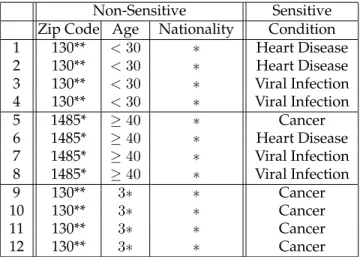
3.1.1 Attacks Onk-Anonymity . . . . 36
3.1.2 Contributions and Chapter Outline . . . 37
3.2 Model and Notation . . . 38
3.3 Bayes-Optimal Privacy . . . 40
3.3.1 Changes in Belief Due to Data Publishing . . . 40
3.3.2 Privacy Principles . . . 44
3.3.3 Limitations of the Bayes-Optimal Privacy . . . 44
3.4 `-Diversity: Privacy beyondk-Anonymity . . . . 45
3.4.1 The`-Diversity Principle . . . . 45
3.4.2 `-Diversity: Instantiations . . . . 48
3.4.3 Multiple Sensitive Attributes . . . 50
3.4.4 Discussion . . . 51
3.5 Implementing Anonymous Data Publishing . . . 51
3.6 Experiments . . . 54
3.8 Summary . . . 70
4 From Theory to Practice on the Map 71 4.1 Introduction . . . 71
4.1.1 Contributions and Chapter Outline . . . 71
4.2 Starting Point: Privacy Definition . . . 72
4.3 Starting Point: Anonymization Algorithm . . . 74
4.4 Revising the privacy definition . . . 75
4.4.1 Analysis of Privacy . . . 76
4.4.2 (², δ)-Probabilistic Differential Privacy: Ignoring Unlikely Privacy Breaches . . . 78
4.4.3 (², δ)-Probabilistic Differential Privacy for Synthetic Data . . . 79
4.5 Revising the algorithm . . . 84
4.5.1 Accept/Reject . . . 84
4.5.2 Shrinking the Domain . . . 85
4.6 Experiments . . . 87
4.7 Summary . . . 90
5 Related Work 93 5.1 Trusted Data Collector . . . 93
5.1.1 Access Control . . . 93
5.1.2 Anonymous Data Publishing . . . 95
5.1.3 Statistical Databases . . . 98
5.1.4 Private Collaborative Computation . . . 99
5.2 Untrusted Data Collector . . . 99
6 Summary and Discussion 101 6.1 Summary of Contributions . . . 101
6.2 Future Directions . . . 102
A Entropy`-Diversity with Don’t-Care Sets 113 A.1 Correctness of Entropy`-diversity with Don’t-Care Sets . . . 115
A.2 Monotonicity of Entropy`-diversity with Don’t-Care Sets . . . 120
Chapter 1
Introduction
Knowledge will forever govern ignorance, and a people who mean to be their own governors, must arm themselves with the power knowledge gives. A popular government without popular information or the means of acquiring it, is but a prologue to a farce or a tragedy or perhaps both.
– James Madison
One of the greatest triumphs of computer science is the unprecedented availability of information. This has been made possible by breakthroughs in hardware, faster processing speeds, massive storage capabil-ities and reliable communication, coupled with rapid advances in information retrieval, data management and data integration. These capabilities, in turn, have revolutionized the way people work, communicate, gather information, and even shop. However, these advances have also led to an explosion of data collec-tion. Almost every action performed by an individual is being electronically logged – the news she reads, the clothes she buys, the friends she meets, the doctors she visits and the food she eats. Individuals benefit immensely by allowing such data collection. Critical services like health-care have markedly improved with the digitization of medical records. Governments around the worlds base their economic policies on demographic information collected by Census bureaus. Search engine and web service companies track user actions in return for personalized web services.
However, as a side-effect, these electronic logs track the entire public and private lives of individuals, thus posing an immense privacy risk of unauthorized disclosure [6, 71]! For instance, in October 2004, Choicepoint released private financial information about 145,000 individuals to criminals operating a scam [6]. In August 2006, the reputed Internet company America OnLine (AOL) released anonymous logs of search queries collected from users to aid information retrieval research in academia. However, identities of individuals were easily uncovered [1], revealing their private lives to millions.
Privacy is globally recognized as a universal value. We as computer scientists have the power and the responsibility to create tools that ensure this integral part of human dignity while enabling the dissemina-tion of valuable data about humans for improving their lives. This thesis proposes techniques for collecting and sharing personal information that provably guarantee privacy, towards fulfilling this responsibility.
1.1 Problem Setting
We introduce our problem setting via the following example scenario. A centralizedtrusteddata collection agency, say Gotham City Hospital, collects information from a set of patients. The information collected for each patient includes identifying information like name, address and social security number, demographic information like age, race and gender, and personal information like symptoms and medical condition.
Name Zip Code Age Nationality Condition Ward # Alex 13053 28 Russian Heart Disease 2323 Bruce 13068 29 American Heart Disease 2323 Umeko 13068 21 Japanese Viral Infection 1212 Dick 13053 23 American Viral Infection 1212
Eshwar 14853 50 Indian Cancer 1212
Fox 14853 55 Russian Heart Disease 1212 Gray 14850 47 American Viral Infection 2323 Harry 14850 49 American Viral Infection 2323
Igor 13053 31 American Cancer 2323
Jay 13053 37 Indian Cancer 2323
Ken 13068 36 Japanese Cancer 1212
Lewis 13068 35 American Cancer 1212
Table 1.1: Inpatient Medical Records Relation
Name Zip Code Age Nationality Condition Ward #
Eshwar 14853 50 Indian Cancer 1212
Fox 14853 55 Russian Heart Disease 1212 Gray 14850 47 American Viral Infection 2323 Harry 14850 49 American Viral Infection 2323
Table 1.2: View of the Medical Records Relation containing records of patients of Ithaca NY.
There are a number ofusersof this data. For instance, Dr. Drake requires access to the medical histories of all his patients. Nurse Natalia needs access to the drugs prescribed to the patients in her care. Finally, researcher Riddler, who studies how diseases correlate with age and gender, may require age, gender and medical condition information from all patients.
Over the last half a century many database systems have been built that can efficient store, index and process such queries on large volumes of data. Throughout this thesis we will assume that the data is stored in a relational database system [109]. In a relational database, the collected data is stored in one or more relationsor tables. Table 1.1 is an example of a relation. Each row in this relation, also called a
tuple, contains the medical records of a unique patient in the hospital. Each column in the table represents differentattributesof each patient. We denote byt[A] the value of theAattribute for tuple t;t[A]is also called acell. Users request access to parts of the data by formulatingqueriesover the data. We refer to the result of a query, which is also a relation, as aviewof the database. For instance, Table 1.2 is the view of the database corresponding to the query “list all the information about patients from Ithaca NY (ZipCode = 14850 or 14853)”.
While a relational database guarantees efficient query processing, with the increasing concerns about privacy, organizations like Gotham City Hospital face a conflict between a patient’s right to privacy and the hospital’s need to know and process information. While patients trust the hospital’s database systems, they might not trust the users who view their information. For instance, nurse Natalia, who only tends to the patients in ward #1212, should not be allowed to access the medical records of patient Bruce admitted to ward #2323. Moreover, though Bruce may want researchers to study the correlation between symptoms and diseases, he may not want them to be able to precisely infer what he is suffering from. Hence, we are interested in designingprivacy-aware database systemsthat (a) allows legitimate users to efficiently query the data, while (b) provably guaranteeing the privacy of the individuals who contribute to the data.
1.2 What is Privacy?
Few values so fundamental to society have been left so undefined in social theory or have been the subject of such vague and confused writing by social scientists.
– Prof. Alan Westin, Public Law and Government, Columbia University.
In order to design a privacy-aware database system we need to prescribe to some reasonable notion of pri-vacy. The term “privacy” is often used in daily conversation as well as in philosophical, political and legal discussions; yet there is no single definition or meaning for the term [50]. The first discussions of infor-mation privacy are accredited to the famous essay by Warren and Brandeis [132] who recognize privacy as the “right to be let alone”, and laid the foundation for a concept of privacy that has come to be known as
control over information about oneself. In this thesis, we subscribe to Alan Westin who describes privacy as
“the ability to determine for ourselves when, how, and to what extent information about us is communicated to others”
[133]. While this definition is a good starting point we still need to adapt it to the context of databases, and formalize, for instance, “to what extent” information that is released to a user discloses sensitive informa-tion about an individual contributing to the data. Proposing formal definiinforma-tions for privacy in the context of database systems will be a focus of this thesis.
1.3 Overview of Database Privacy Solutions
A wide range of technological solutions are required to implement privacy-aware database systems. Pri-vacy breaches occur in databases due to four main reasons [6]:
• Lack of Physical Security: Most privacy breaches occur due to the theft of physical devices like hard drives, laptops and backup tapes.
• Intrusion by Hackers: Poor system security and wrong network administration render the data vulner-able to malicious hackers. For instance, in 2007, U.S. Secret Service agents found Ralph Polo Lauren [5] customers’ credit card numbers in the hands of Eastern European cyber thieves who created high-quality counterfeit credit cards.
• Dishonest Insiders: Dishonest or disgruntled employees of a data collection agency may disclose per-sonal information. For instance, a woman in Pakistan hired by University of California San Fransisco Medical Center for transcribing medical records threatened to post patients’ confidential files on the Internet unless she was paid more money [7].
• Incorrect Privacy Practices: Supposedly privacy-aware databases can lead to egregious breaches of privacy if they are based on unsound principles. The AOL data release fiasco described earlier is one glaring example.
The first three threats may be solved by employing technology like encryption, firewalls and intrusion detection systems, educating administrators, and improving legislation and government regulation.
In this thesis, we will focus on the fourth “threat” of information being shared by data collection agencies using unsound privacy practices. We consider two standard techniques for implementing privacy-aware databases, namely,access controlandanonymous data publishing, and show that current implementation can cause unintentional breaches of sensitive information. We show that this is because these systems are implemented using ad-hoc notions of privacy. Hence, this thesis deals with formally understanding and defining privacy for both access control and anonymous data publishing, developing efficient algorithms to enforce these privacy notions, and evaluating them on real applications. Before we enumerate the contributions of this thesis in more detail (Section 1.4), let us describe the current state of the art in access control and anonymous data publishing.
1.3.1 Access Control in Databases
Access control is the traditional solution that allowscontrolled accessto a set of resources. Access control typically includes three parts –authentication,authorizationandaudit. Authentication refers to the process of establishing the identity of a user. Authorization is the process of verifying that an authenticated user has the privileges to perform certain operations on the system. Finally, audit is the process of verifyingpost facto
that all the operations on the system have been performed by authorized users. Though authentication and audit are very important problems, they are not the focus of this thesis.
Any authorization system can be modeled as a set ofaccessors(e.g., users), a set ofresources(e.g., files, relations or views), anaccess control policyor a set of rules describing whether an accessor is authorized to access a resource (positive authorization) or not (negative authorization), and anenforcement algorithmthat can efficiently decide whether a request for a resource can be allowed based on the policy. Authorization systems also contain an administrative mechanism tograntandrevokeauthorizations.
The simplest kind of an access control system is usually seen in file systems. The files in the file system correspond to the resources, and the users of the file system are the accessors. The access control policy is described in the form of anaccess control list(ACL), where every filef is associated with the list of users ACL(f)who are authorized to access it. The permissions to access a file are usually granted by a file system administrator or the owners of the individual files. Given a request from userufor filef, the enforcement algorithm allowsuto accessf if and only ifu∈ACL(f).
In the context of databases, however, such a simple policy does not suffice since database systems cannot afford to grant authorizations at the granularity of files or whole relations. In a hospital, for instance, a singlePatientrelation can contain the information about thousands of patients. For each patient, in turn, thePatientrelation contains a variety of attributes. Hence, the hospital might want to specify more fine grained access control policies on this relation. For instance, the hospital may want nurse Natalia to only access the names and medical conditions of patients in ward #1212.
One simple solution to implement such fine-grained access controlis to maintain access control lists for every cell in the relation. However, in such a naive solution, the number of authorizations in the access control policy is inordinately large – the number of cells in the relation times the number of users in the system. This problem becomes even more daunting in the case ofdiscretionary access control(DAC), where the user who creates a relation should specify an ACL for each cell. This challenge is usually solved by specifying authorizations over groups of users and groups of cells. Rows(tuples) and columns(attributes) are a natural choice for grouping cells. More generally, arbitrary groups of cells can be described using views over the relation. Hence, in DAC based database systems, authorizations are granted by the owner of a relation to either the whole relation or to some derived view over the relation. For instance, Dr. Drake may create aDrake-Patientview relation containing the medical records of his patients. Dr. Drake may also createDrake-Patient-Prescriptionrelation containing the names of his patients and the medication prescribed to them. Using DAC, Dr. Drake can authorize nurse Natalia to access both the above relations.
Users are typically grouped in two ways, leading to two different kinds of access control methods. In
mandatory access control (MAC) [93], each resource (relation, view, row, column or an individual cell) is labeled by a security level, each accessor is associated with a security clearance, and the authorizations are granted to (level, clearance) pairs. In military settings, for instance, security levels and clearances both are one of{Unclassified, Classified, SecretandTop Secret}. These labels are ordered as
U nclassif ied < Classif ied < Secret < T op Secret
Access is granted according to the Bell-LaPadula rules [27]: a user can read any data item that has a security level lower than her clearance, but write to only those data items that have a higher security level.
In role based access control (RBAC) [29], authorizations are based on the role in which an accessor is accessing information, rather than her identity. Positive and negative authorizations are defined per role
to resources that are either complete relation, views, or in some cases individual cells in the table. For instance, Dr. Drake may act in two roles both as a physician treating patients and as a researcher correlating symptoms to new diseases. Dr. Drake is allowed/disallowed access to very different kinds of information in these two roles. As a physician, Dr. Drake may be allowed to view the complete medical records of his patients, but as a researcher, he may not be able to access their medical prescriptions and other information that is not necessary for the purposes of research.
However, allowing authorization over cells and arbitrary views over base relations introduces another problem – access control policy design and enforcement becomes hard, especially when considering neg-ative authorizations. Unlike in file systems, where access to one file does not usually disclose information about other files, in databases, access to one view over a relation can disclose information about other negatively authorized views in the following two ways.
The answers to two queries might depend on each other if they access some common cell in the relation while computing the corresponding views. For instance, consider a useruwho is not allowed to access the view “the names of Dr. Drake’s patients” (V1), and supposeurequests access to “the names of patients in ward #1212” (V2). Can we grantuaccess to the viewV2? Even though there may be no correlation between being in ward #1212 and being treated by Dr. Drake, userucan get information aboutV1fromV2as follows. Useruis allowed to access the view “the names and ward numbers of all the patients who are not treated by Dr. Drake” (V3). Hence, userucan find out the names of patients who are treated by Dr. Drake and in ward #1212, if any, usingV3−V2. Therefore, userushould not be allowed to accessV2.
The problem becomes trickier in the presence of inference channels [31]. Inference channels occur in databases either due to integrity constraints like functional and multivalue dependencies [109], or due to known correlations between attributes. Consider the following example of a functional dependency in the
Patientrelation. A functional dependencyA→Boccurs in a relationRif for every two tuplest1, t2inR, if t1[A] =t2[A]thent1[B] =t2[B]. For instance,Doctor→W ardis a functional dependency if all the patients treated by one doctor are housed in the same ward. Hence, if the patients of Dr. Drake are housed in ward #1212, access toV2leaks all the information aboutV1.
In summary, database authorizations differ from traditional access control lists because access to one view in a database may disclose information about other views. Hence, database authorizations need to precisely define the semantics of what information can be accessed given positive or negative authoriza-tions; we call this aprivacy definition. The first part of this thesis (Chapter 2) deals with the study of formal privacy definitions for negative authorizations in access control.
1.3.2 Anonymous Data Publishing
Many organizations like hospitals, the Census and, more recently, search engine companies collect infor-mation from individuals and expose this inforinfor-mation to the public with the goal of furthering medical, economic and information retrieval research, respectively. Hence, these organizations want to provide re-searchers access to interesting aggregate statistical information about the personal information they collect, but disallow researchers from discovering sensitive information about specific individuals from the data.
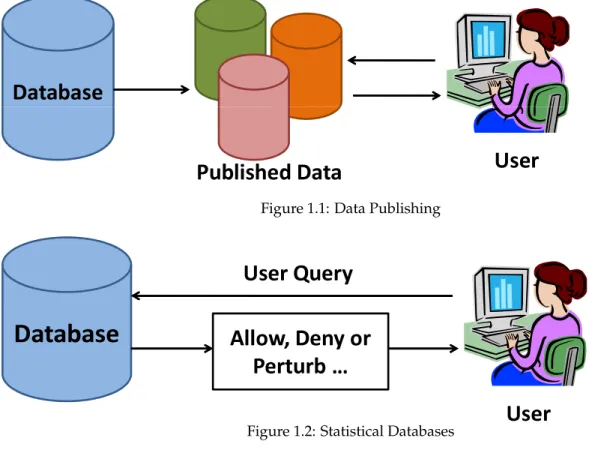
A number of techniques have been proposed for disseminating aggregate information about individuals (see Chapter 5), and most of them fall under one of two broad categories, data publishingand statistical databases. Figures 1.1 and 1.2 illustrate the main difference between the two classes of techniques. Statistical databases host a query answering service that evaluate queries posed by the researcher on the original data, and then decide to perform one of the following actions based on a privacy policy and the history of queries answered – (i) return the correct answer, (ii) deny an answer, or (iii) return a perturbed answer. In contrast, the data publishing class of techniques publish one of more views of the data that preserve statistical information about the original data. The researchers can run arbitrary queries on these published views.
Figure 1.1: Data Publishing
Figure 1.2: Statistical Databases
While both these classes of techniques have their advantages and disadvantages, many organizations prefer data publishing due to the following reasons:
• Data publishing requires only a one time effort in creating the published views. Since researchers are allowed to run arbitrary queries on the published data, thereafter, this data can be distributed to researchers. On the other hand, statistical databases require online server support to monitor user queries and to evaluate how to answer those queries.
• Researchers usually need access to the data in order to determine how to analyze the data and might not be able to pose queries oblivious of the data. Hence, researchers prefer a data publishing system to a query answering system.
Therefore, data collection agencies strive to publish data that disclose as much aggregate statistical infor-mation as possible, while preserving the privacy of the individuals contributing to the data. One popular technique, and a focus of this thesis, is publishinganonymous microdata. Organizations like the Census dis-tribute personal data in its raw, unaggregated form, also known as microdata, after removing atdis-tributes like name and social security number that are known to uniquely identify individuals. Anonymous microdata is particularly attractive to researchers since it retains all the statistical information about the original data, and since the data is in a form that can be readily input into existing statistical analysis algorithms.
However, individual-specific information can still be inferred from microdata even after removing iden-tifying attributes as suggested in following excerpt [103],
Some deficiencies inevitably crop up even in the Census Bureau. In 1963, for example, it reportedly pro-vided the American Medical Association with a statistical list of one hundred and eight-eight doctors residing in Illinois. The list was broken down into more than two dozen categories, and each category was
further subdivided by medical specialty and area residence; as a result, identification of individual doctors was possible . . . .
In fact, a recent study conducted by Sweeney [127] estimated that 87% of the population of the United States can be uniquely identified using the seemingly innocuous attributes gender, date of birth, and 5-digit zip code. In fact, those three attributes were used to link Massachusetts voter registration records (which included the name, gender, zip code, and date of birth) to supposedly anonymized medical data from GIC1(which included gender, zip code, date of birth and diagnosis). This “linking attack”, also called are-identification attackmanaged to uniquely identify the medical records of the governor of Massachusetts in the medical data [128]. Sets of attributes (like gender, date of birth, and zip code in the example above) that can be linked with external data to uniquely identify individuals in the population are called quasi-identifiers.
Hence, there has been over a half a century of research primarily dedicated to developing algorithms and notions of privacy that disallow re-identification attacks [70, 134]. More recently, Samarati and Sweeney proposed a definition of privacy called k-anonymity [119, 128] to counter linking attacks using quasi-identifiers. A table satisfiesk-anonymity if every record in the table is indistinguishable from at leastk−1 other records with respect to every set of quasi-identifier attributes; such a table is called ak-anonymous table. Hence, for every combination of values of the quasi-identifiers in thek-anonymous table, there are at leastkrecords that share those values. This ensures that individuals cannot be uniquely identified by linking attacks.
Because of its conceptual simplicity, k-anonymity has been widely discussed as a viable definition of privacy in data publishing, and due to algorithmic advances in creating k-anonymous versions of a dataset [78, 23, 100, 11, 12, 87, 88, 89] k-anonymity has grown in popularity.
Thoughk-anonymity disallows re-identification attacks, we have no reason to believe that there aren’t other attacks that can disclose personal information about individuals. So, we ask the following question,
“Doesk-anonymity really guarantee privacy?” Interestingly, we show that the answer to this question isno; in Chapter 3, we illustrate using simple attacks that despite beingk-anonymous a published dataset can disclose sensitive information about individuals. Motivated by these attacks, in this thesis (Chapters 3 and 4) we initiate a formal study of attacks, privacy definitions and new algorithms for publishing anonymous microdata that provably guarantee privacy.
1.4 Thesis Contributions and Organization
In this thesis we propose novel formal definitions of privacy and develop efficient algorithms that provably guarantee privacy.
The first part of this thesis (Chapter 2) deals with enforcing formal privacy definitions in access con-trol. As we noted before, current access control systems do not associate formal semantics with negative authorizations over arbitrary views causing unwanted disclosure of sensitive information. We remedy this situation by adopting a formal privacy definition for negative authorizations on views. Recently, Miklau et al. [102] proposedperfect privacy, a particularly attractive semantics for deciding whether the answer to a queryQV discloses information about the answer to a secret queryQS. Perfect privacy requires that queryQV is truthfully answered by the database if and only if it disclosesno informationabout the answer to the secret queryQS. This ensures that the user’s belief about the answer toQS does not change even on observing the answer to the queryQV. In this thesis we propose adopting perfect privacy asthesemantics for negative authorizations. Not only does it provide a theoretically sound semantics for negative autho-rizations, it also solves the problem of inference channels by enforcing access control at the tuple level – either a user can access a complete tuple or cannot access any attribute of the tuple.
However, Miklau et al. showed that deciding whether a queryQV leaks any information about the sen-sitive viewQS is intractable (π2p-complete) whenQS andQV belong to a class of queries called conjunctive queries.
In Chapter 2, we show why the problem of enforcing perfect privacy is hard, and, in the process, identify large sub-classes of conjunctive queries for which perfect privacy can be efficiently enforced. This work originally appeared in the proceedings of the Principles of Database Systems, 2006 [94].
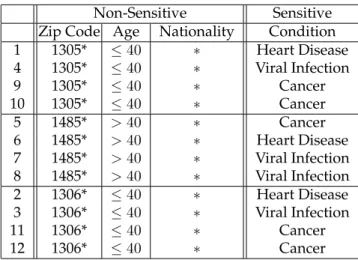
In the second part of this thesis (Chapters 3−4), we consider the problem of formal privacy definitions for publishing anonymous microdata. In Chapter 3, we show thatk-anonymity does not guarantee privacy. We give examples of two simple, yet subtle attacks on a k-anonymous dataset that allow an attacker to iden-tify individual records. First, we show that an attacker can discover the values of sensitive attributes when there is little diversity in those sensitive attributes. Second, attackers often have background knowledge, and we show that k-anonymity does not guarantee privacy against attackers using background knowledge. We give a detailed analysis of these two attacks and we propose a novel and powerful privacy definition called`-diversitythat defends against them. In addition to building a formal foundation for`-diversity, we show in an experimental evaluation that`-diversity is practical and can be implemented efficiently. This work originally appeared in the proceedings of the International Conference of Data Engineering, 2006 [95], and subsequently appeared in the Transactions of Knowledge Discovery from Data, 2007 [97].
One of the strengths of `-diversity is its formal methodology to reason about privacy. We conclude Chapter 3 by describing a general framework for privacy definitions. Under this framework, we observe that`-diversity is but a point in a whole space of privacy definitions. We then briefly describe some of the other points in this space, including perfect privacy from Chapter 2.
One of the main reasons for the popularity of anonymous microdata is the belief that the data could be anonymized with very little loss in statistical information; this holds true if removing identifying attributes alone guarantees sufficient privacy. However, when microdata is required to satisfy stronger privacy crite-ria there is a substantial loss of statistical information. For instance, it has been shown that [10] for sparse high-dimensional data (with a large number of attributes), even a weak condition likek-anonymity dra-matically reduces the utility of the data. Hence, any study proposing new privacy definitions is incomplete without a concurrent study of the loss of utility due to enforcing privacy.
Quantifying the utility of an anonymous dataset is a complex task. It depends on the application sce-nario and the kinds of queries or analyses a researcher would like to run on the published data. In Chapter 4 we study the utility of anonymous microdata in the context of a real world application. We consider a real world Census Bureau application, called OnTheMap, that plots the commuting patterns of the population of the United States. The source data for this application that was collected by the U.S. Census Bureau cannot be used directly by the mapping program due to privacy concerns. Hence, the application uses synthetic data that statistically mimics the original data. However, there is no proof that this synthetically generated data guarantees privacy.
Chapter 4 chronicles the challenges we faced in applying theoretical privacy definitions to the above application. We find that while some existing definitions of privacy are inapplicable to our target appli-cation, others are too conservative and render the synthetic data useless since they guard against privacy breaches that are very unlikely. Moreover, the data in our target application is sparse, and none of the existing solutions are tailored to anonymize sparse data. We propose efficient algorithms to address both the above issues. This work originally appeared in the proceedings of the International Conference of Data Engineering, 2008 [96].
We conclude this thesis with a detailed discussion of related work in Chapter 5, and a summary in Chapter 6.
Chapter 2
On the Efficiency of Enforcing Perfectly
Private Access Control
2.1 Introduction
This chapter provides a theoretical study of the problem of enforcing access control in databases. Specifi-cally, we study the following problem of enforcing negative authorizations: given a user who is not allowed to access the views defined bysecret queriesQS1, QS2, . . ., efficiently decide whether or not to permit access to a viewV defined by the queryQV.
In order to answer the above question, one needs to first specify which viewsV can besafelyaccessed given a secret queryQS; we call such a specification aprivacy definition. Intuitively, it is safe to releaseV if it does not disclose any information about the answer toQS; but how does one check whether a view V discloses information about another query? In fact, a view can disclose information about a query to various extents, often in very subtle ways, as illustrated in the following example.
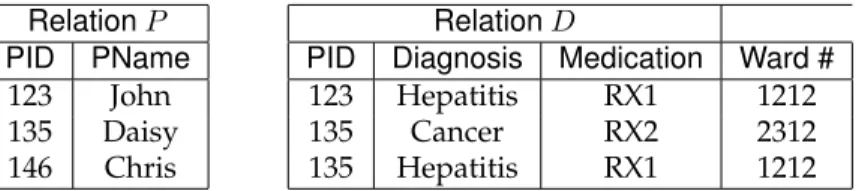
Example 2.1 Consider a hospital which maintains patient records in two relations with schemata shown in Fig-ure 2.1. RelationP stores patient identifiers and their names. RelationDstores patient identifiers, diagnosis, pre-scribed medication, and their ward numbers. Suppose nurse Natalia is not allowed to access the answer to the query “list the names of patients who have cancer” (QS). First, consider the viewV1defined by the query “list the names of patients who do not have cancer”. Since no patient who has cancer will feature inV1, it seems reasonable to assume thatV1does not leak any information aboutQS, and hence, it issafeto allow Natalia to accessV1. Next consider the viewV2defined by the query “list the names of patients in ward #1212 who have cancer”. The names presented inV2
will be a subset of the answer toQS, and clearly, it isnot safeto allow access toV2.
Finally, consider the view V3 defined by the query “list the names of patients in ward #1212”. It is not clear whetherV3discloses information aboutQS, since there is no reason to believe there is a correlation between patients who are in ward #1212 and the patients who have cancer. However, it is, in fact,not safeto allow access toV3, since
V3leaks information aboutQS in the following subtle way. Since Natalia can accessV1, by excluding the names of
patients who do not have cancer (V1) fromV3she can deduce the names of the patients in ward #1212 who have cancer (i.e.,V2=V1−V3). We argued that it is not safe to releaseV2; therefore, it is should not be safe to releaseV3either.
Hence, we need a formal privacy definition that specifies which views can be safely accessed without disclosing information about a secret query. One such privacy definition calledperfect privacywas proposed by Miklau et al. [102]. Perfect privacy guarantees that a viewV defined by the queryQV is deemed safe to be accessed if and only if it does not disclose any information about the secret queryQS. This ensures that
Relation P
PID PName
Relation D
PID Diagnosis Medication Ward #
Figure 2.1: Relational schema of Hospital database.
the user’s (or adversary’s) belief about the answer toQS does not change on observing the answer to the queryQV.
Perfect privacy has two attractive properties. First, perfect privacy requires queries and views to be specified using a class of queries calledconjunctive queries. The usage of conjunctive queries enables the policy writer to express complex access control policies. In Example 2.1, the secret query can be expressed by the following conjunctive query:
QS(name) :− P(pid, name), D(pid,cancer, med, ward). The viewV2can be expressed by the following conjunctive query:
QS(name) :− P(pid, name), D(pid,cancer, med,1212).
As a more complex example, suppose the hospital is required to release as much data as possible to a phar-maceutical company without disclosing the names of patients diagnosed with both hepatitis and cancer. The secret query in this scenario can be expressed as the following conjunctive query:
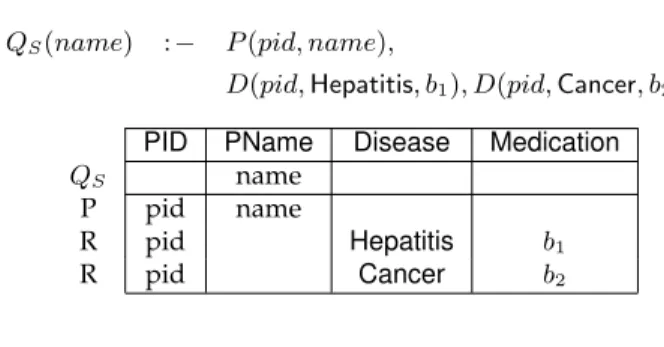
QS(name) :− P(pid, name),
D(pid,hepatitis, med1, ward1), D(pid,cancer, med2, ward2).
Second, perfect privacy has the followingcollusion resistanceproperty. Consider again a secret queryQS, and assume that there are n adversaries{A1, . . . , An}, where adversary Ai requests access to the view defined by queryQVi. Perfect privacy ensures that eachQVi will be answered only if each queryQVidoes
not disclose any information aboutQS. Moreover, perfect privacy also ensures that the adversaries cannot learn any sensitive information by colluding with each other [102]. This collusion-resistance is also crucial for efficient query answering when the database answers queries interactively. When enforcing perfect privacy, the database does not need to keep track of all queries ever answered in order to guarantee that future query answers cannot be combined with old query answers to disclose information [82].
However, these nice properties of perfect privacy do not come for free. The problem of checking whether a conjunctive queryQV discloses any information about another conjunctive queryQSisΠp2-complete [102], even when the conjunctive queries have only equality comparisons.
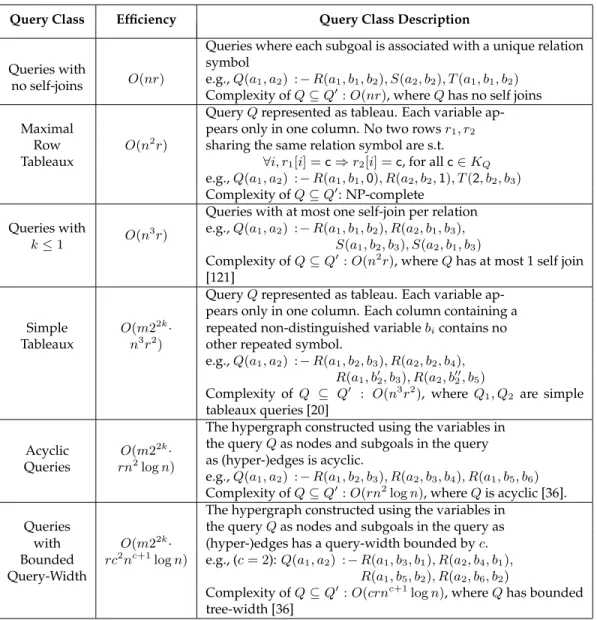
In this chapter, we show that there are interesting sub-classes of queries for which enforcing perfect privacy is tractable (i.e., there is an algorithm which runs in time polynomial in the size of the two queries QS andQV). We first propose an alternate characterization of perfect privacy in terms of the well studied notion ofquery containment[33]. We exploit this connection between perfect privacy and query containment to identify many subclasses of conjunctive queries (described in Figure 2.1) where checking perfect privacy is tractable.
The rest of this chapter is organized as follows. In Section 2.2, we introduce notation and give the intuition behind the ideas presented in this chapter. Section 2.3 gives an alternative characterization of critical tuples, a core property of perfect privacy. We use this new characterization to connect perfect privacy with query containment in Section 2.4. In Section 2.5 we use this connection to prove tractability results for checking perfect privacy for different query classes. We conclude by summarizing our results in Section 2.6.
2.2 Overview
2.2.1 Preliminaries
We start with some basic notation.
Relations and Queries: ArelationRconsists of arelation schemaR(A1, . . . , Ar)and an associated relation instance which is a finite two-dimensional table with r columns; we call r thearity of relationR. The columns are calledattributesand the rows are calledtuples. AttributeAihas domainD(Ai). We defineDR as the domain of tuples in the relationR, i.e.,DR =D(A1)×. . .×D(Ar). We assume that all the domains are finite. Each tupletin the relation is an element(c1, . . . , cr)∈ DRand is denoted byt =R(c1, . . . , cr); we callRtherelational symboloft. We denote byt[Ai]or shortt[i]the value of attributeAiin tuplet.
Adatabase schemaSis a finite set of relational schemata{R1, . . . , Rm}.T up(S)denotes the set of all tuples over all relations in the schema that can be formed from the constants in the respective domains. Adatabase instanceIis a subset ofT up(S)and letIdenote the set of all database instances. We henceforth useT up(I) to meanT up(S). We assume that the only constraints on the database are key constraints. Akeyof a relation Ris a minimal set of attributesAsuch that for every two tuplest1, t2 ∈DR,t1[A] =t2[A] ⇒ t1 =t2. Let IKdenote the set of all possible database instances satisfying the key constraints inK. LetK
Rdenote the set of key constraints on relationR.
Aconjunctive query with inequalitiesQhas the form
Q(a1, a2, . . . , am) :− G1∧G2∧. . .∧Gn∧ CQ; whereCQis a set of inequality constraints.
We callG`asubgoal,Q(a1, a2, . . . , an)thegoal. Each subgoalG`is of the formR`(x1, x2, . . . , xk`), where
R`is a relation. Similar to a tuple, we callR`therelational symbol of subgoalG`. Eachxi =G`[i]is either a constant inD(R`.Ai)or a variable ranging overD(R`.Ai). Note that while each field in a tuple is a constant, a field in a subgoal can be a variable. Eachaiin the goal is either a variable appearing in one of the subgoals, or a constant in the domain of one of the attributes of a relation appearing in the query. We denote the set of variables appearing in the goal byAQ and we also refer to it as the set ofdistinguished variables. The set of variables which appear in the subgoals but not in the goal is denoted byBQ and called the set of non-distinguished variables. LetKQdenote the set of all constants appearing in the query. We abuse the notation Qto also denote the set of subgoals inQ; i.e.,Q={G1, G2, . . . , Gn}. The inequality constraints in the set CQare of the formxiθxj, whereθ∈ {≤, <,≥, >,=6 },xiis a variable inAQ∪BQ andxjis either a variable inAQ∪BQor a constant in the domain thatxiranges over.
Semantically, a query is a function from database instances to relation instances. We define the output of a query on a database instance using the idea of avaluation. Avaluationρon a conjunctive queryQis a function that(i)maps variables in the query (AQ∪BQ) to constants in the respective domains and(ii)is the identity function for constants inKQ. Aconstraint preserving valuationρonQis a valuation such that (xiθ xj)∈ CQ ⇒ρ(xi)θ ρ(xj). Unless otherwise specified, all valuations in the remainder of the paper are constraint preserving. A subgoal is said to becompatiblewith a tupletif the subgoal and the tuple have the same relational symbol and there is a valuationρmapping the subgoal tot. A set of subgoals{G1, . . . Gn} iscompatibleif there is a tupletthat∀i∃ρ:ρis a valuation mappingGitot.
Given a conjunctive query with inequalitiesQand a database instanceI, a tupleto=Q(c1, c2, . . . , c m)is said to be in the output ofQ(I)if there is a valuationρsuch thatρ(ai) =ci, i.e., each distinguished variable aiis mapped to a constantci; andρ(R(x1, . . . , xr))∈I, i.e., subgoalR(x1, . . . , xr)is mapped to one of the tuples in relation instanceRof the database instanceI.
Query Containment: QueryQ1is said to becontainedin queryQ2on the set of databases inIand is denoted byQ1⊆Q2, if
Throughout the paper, we use the termconjunctive queryto denote aconjunctive query without inequalities, unless otherwise specified.
Perfect Privacy [102]: We give a quick recap of the basic notions of perfect privacy from Miklau et al. [102]. LetP be a probability distribution over all the possible tuplesP : T up(I) → [0,1], where P(t) = p de-notes the probability that tupletwill occur in a database instance. Miklau et al. call the pair(T up(I), P)a
dictionary. LetP(QS =s)denote the probability that the queryQS outputss. Then queryQS is perfectly private with respect toQV if for every probability distribution and for all answerss,vto the queriesQS, QV respectively,
P(QS =s) = P(QS =s|QV =v). (2.1)
In other words, the queryQS is perfectly private with respect toQV if the adversary’s belief about the answer toQS does not change even after seeing the answer toQV.
When the only constraints in the database are key constraints, the above condition can be rephrased in terms of critical tuples. A tupletiscriticalto a queryQ, denoted byt∈crit(Q), if∃I∈ I, Q(I∪{t})6=Q(I). Let us now state one of the main results from Miklau et al. [102].
Theorem 2.1 (Perfect Privacy [102]) Let(T up(I), P)be a dictionary. Two queriesQS andQV are perfectly pri-vate with respect to each other if and only if
crit(QS)∩crit(QV) =∅.
LetK={A1, . . . ,Am}be a set of key constraints over the relations involved inQV andQS. Then queryQV and QSare perfectly private with respect to each other if
∀tS ∈crit(QS), tV ∈crit(QV),∀Ai ∈ K, tS[Ai]6=tV[Ai]. Miklau et al. also proved the following complexity result.
Theorem 2.2 (Intractability of Perfect Privacy[102]) The problem of checking whether a queryQV is perfectly private with respect to queryQSisΠp2-complete.
2.2.2 Intuition
In this section we provide some intuition behind the rest of the chapter. We are interested in identifying subclasses of conjunctive queries which allow specification of interesting privacy policies while permitting tractable enforcement of perfect privacy. We first take a very simple class of queries – queries without self-joins – and illustrate that enforcing perfect privacy is indeed tractable . In order to determine the complexity of other query classes, we could have laboriously enumerated every interesting query class and investigated the hardness of checking perfect privacy for queries in that class. Instead, we show a connection between the problem of checking perfect privacy and the problem of query containment . We use this connection and the vast literature in query containment to identify interesting query classes .
A Simple Tractable Case
Example 2.2 Consider the hospital database from Figure 2.1. Let the sensitive information be specified by the follow-ing queryQS:
RelationP PID PName 123 John 135 Daisy 146 Chris RelationD
PID Diagnosis Medication Ward #
123 Hepatitis RX1 1212
135 Cancer RX2 2312
135 Hepatitis RX1 1212
Figure 2.2: A database instanceI∈ Isatisfying the relation schema of the Hospital database.
QueryQS has no self joins, i.e., no two subgoals have the same relational symbol. Which tuples in the domain of relationDare critical to this query? Clearly, any tuplethaving the diagnosis attribute valued cancer, for example
t=D(135, cancer, RX2, 2312), is critical toQS. In particular, fort=D(135, cancer, RX2, 1212), the instance
Iin Figure 2.2 is such that QS(I∪ {t}) 6= QS(I). Also, it is easy to see that any tuple not having cancer as the value for the diagnosis attribute, such ast0=D(123, hepatitis, RX1), is not critical toQ
S. For any instanceI0∈ I, adding the tuplet0will not lead to a new output tuple being created sincet0is not compatible with any subgoal. Hence,
a tuple in the domain of relationDis critical toQS if and only if the value for the diagnosis attribute is cancer. As illustrated in this example, ifQShas no self-joins, a tupletis critical toQSif and only iftis compatible with some subgoal inQS. Using this simple check for critical tuples, the condition for perfect privacy can be simplified as follows. QueriesQS andQV, both without self-joins, share a critical tuple if and only if there are subgoalsGS ∈QS andGV ∈QV both of which are compatible with some common tuplet∈DR. Recall that subgoals are compatible if they have the same relation symbol and the subgoals do not have differing constants for any attribute. Checking this condition is linear in the size of the queries and hence the problem is tractable.
Connecting Privacy and Query Containment
Let us now give an intuition behind our alternate characterization of perfect privacy. Suppose a tupletis critical toQ. By definition, there is some database instanceI, such that Q(I∪ {t}) 6= Q(I). SinceQis a conjunctive query, it is monotone, i.e.,Q(I)⊆Q(I∪ {t}). Therefore, there is an output tupleto, such that to∈Q(I∪ {t})andto6∈Q(I). Consider a valuationρonQwhich creates this output tupleto∈Q(I∪ {t}). Recall thatρshould mapQ’s goal totoand the subgoals in Qto tuples in(I∪ {t}). Since,to 6∈ Q(I),ρ cannot map all the subgoals inQto tuples inI. Hence,ρshould map some set of subgoals fromQ, sayG, to the critical tuplet.
Consider a queryQ0which is constructed fromQby replacing all of the variablesx
iappearing inQby ρ(xi). Since a valuation is an identity function on constants,ρis still a valuation fromQ0to(I∪ {t})which outputs the tupleto. So we still haveto∈Q0(I∪ {t})andto6∈Q(I).
Remove fromQ0the subgoals inG. Call this new queryQ|
(G,t)(see Section 2.3 for a formal definition). The valuationρ now maps all the subgoals inQ|(G,t) toI and the goal of Q|(G,t) to to. Thus we have, to∈Q|
(G,t)(I)andto6∈Q(I); i.e.,Q|(G,t)6⊆Q. This gives the following condition:
t∈crit(Q)⇒ ∃Gcompatible witht,Q|(G,t)6⊆Q (2.2) Interestingly, wheneverGis a set of subgoals compatible witht, the queryQ|(G,t)is such thatQ|(G,t)(I)⊆ Q(I∪ {t})(see Section 2.3). This is because any valuationρfromQ|(G,t)toIcan be extended to a valuation ρ0fromQto(I∪ {t}), where the subgoals inGare mapped totand the other subgoals are mapped to tuples
inIas inρ.
When t is not critical to Q, for every instance I, Q(I ∪ {t}) = Q(I). Hence, for every instance I, Q|(G,t)(I)⊆Q(I). This gives us the condition
Query Class Efficiency Query Class Description
Queries where each subgoal is associated with a unique relation symbol
Queries with
O(nr) e.g.,Q(a1, a2) :−R(a1, b1, b2), S(a2, b2), T(a1, b1, b2)
no self-joins
Complexity ofQ⊆Q0:O(nr), whereQhas no self joins QueryQrepresented as tableau. Each variable ap-Maximal pears only in one column. No two rowsr1, r2
Row O(n2r) sharing the same relation symbol are s.t.
Tableaux ∀i, r1[i] =c⇒r2[i] =c, for allc∈KQ
e.g.,Q(a1, a2) :−R(a1, b1,0), R(a2, b2,1), T(2, b2, b3)
Complexity ofQ⊆Q0: NP-complete
Queries with at most one self-join per relation Queries with e.g.,Q(a1, a2) :−R(a1, b1, b2), R(a2, b1, b3),
k≤1 O(n
3r)
S(a1, b2, b3), S(a2, b1, b3)
Complexity ofQ⊆Q0:O(n2r), whereQhas at most 1 self join
[121]
QueryQrepresented as tableau. Each variable ap-pears only in one column. Each column containing a Simple O(m22k· repeated non-distinguished variablebicontains no
Tableaux n3r2) other repeated symbol.
e.g.,Q(a1, a2) :−R(a1, b2, b3), R(a2, b2, b4), R(a1, b02, b3), R(a2, b002, b5)
Complexity of Q ⊆ Q0 : O(n3r2), whereQ
1, Q2 are simple
tableaux queries [20]
The hypergraph constructed using the variables in the queryQas nodes and subgoals in the query Acyclic O(m22k·
as (hyper-)edges is acyclic. Queries rn2logn)
e.g.,Q(a1, a2) :−R(a1, b2, b3), R(a2, b3, b4), R(a1, b5, b6)
Complexity ofQ⊆Q0:O(rn2logn), whereQis acyclic [36].
The hypergraph constructed using the variables in Queries the queryQas nodes and subgoals in the query as
with O(m22k· (hyper-)edges has a query-width bounded byc.
Bounded rc2nc+1logn) e.g., (c= 2):Q(a
1, a2) :−R(a1, b3, b1), R(a2, b4, b1),
Query-Width R(a1, b5, b2), R(a2, b6, b2)
Complexity ofQ⊆Q0:O(crnc+1logn), whereQhas bounded
tree-width [36]
Table 2.1: Tractable Perfect Privacy
Using Statements 2.2 and 2.3, we can now characterize the perfect privacy condition using query con-tainment:
QV is perfectly private wrtQS ⇔crit(QV)∩crit(QS) =∅
⇔ ∀t∈T up(I), t6∈crit(QV)∨t6∈crit(QS) ⇔ ∀t∈T up(I),∀GS,GVcompatible witht,
QS|(GS,t)⊆QS∨QV|(GV,t)⊆QV
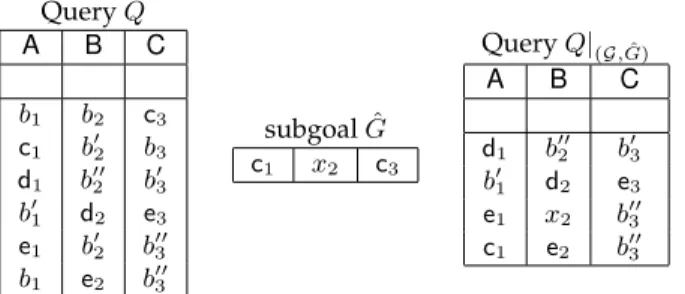
Our final goal is to identify cases when the above check is tractable. This will, however, not be easy as long as the condition has a universal quantifier over all the tuples in the domain. We show that when attributes have sufficiently large domains, the universal quantifier over the domain of tuples can be elimi-nated. Given a set of subgoalsG, letGbe a subgoal such that every tuple compatible withGis also compati-ble withG. LetQ|(G,G)be constructed analogous toQ|(G,t). We show, in Section 2.4, that ifQ|(G,G)6⊆Q, then
n Total number of subgoals:n=|QS|+|QV|
m Number of relations appearing inQSandQV r Max arity of relation appearing inQSandQV k Max number of self-joins per relation in either query
Table 2.2: Size of instance (QS,QV)
some tuple compatible withGis critical toQ. Using this property, we provide an alternate characterization for perfect privacy as follows. A queryQV does not disclose any information aboutQS if and only if for every set of compatible subgoalsGSinQSandGV inQV:
QS|(GS,G?)⊆QS∨QV|(GV,G?)⊆QV,
whereG?is the most general unifier of the subgoals inG
S∪ GV (see Section 2.4). Using the Connection
We can draw three key insights from this alternate definition. First, it is now intuitively clear why the problem of enforcing perfect privacy is inΠp2; for every set of compatible subgoals (universal quantification over a finite number of choices) we perform a query containment check (which is in NP for conjunctive queries [33] and is inΠp2 when queries have inequalities [130]). Next, we observe that if the maximum number of subgoals in a query which share the same relational symbol is bounded by a constant (alternately, the number of self-joins per relation is bounded), then the problem of enforcing perfect privacy is only as hard as performing a constant number of containment checks. Finally, the query containments we are required to check are not between two arbitrarily complex queries, and we can use their structure to propose efficient algorithms for enforcing perfect privacy even for query subclasses where query containment is intractable.
Table 2.1 enumerates our complexity results. The first column enumerates the subclasses of conjunctive queries where perfect privacy can be enforced in time polynomial in the size of the queries. The second column gives the bound on the time required to enforce perfect privacy whenQS andQV are from the specified query class; Table 2.2 explains our notation. Notice that the case of queries without self-joins is actually a special case of our framework. For maximal row tableaux, a subclass of tableaux queries, query containment is intractable. However, since the query containments we check are of a special form, we can show that perfect privacy in this scenario can be enforced with a very simple algorithm. Tractability of the rest of the query classes leverage tractability results for query containment [20, 121, 36]. WhenQS andQV are from different classes, the tractability result for the less efficient query class holds.
2.3 Critical Tuples
In this section we propose an alternate characterization of critical tuples for conjunctive queries in terms of query containment. In order to state the alternate characterization, we first describe how to construct Q|(G,t)from a conjunctive queryQ, a set of compatible subgoalsGinQ, and a tupletwhich is compatible with all the subgoals inG. The constructQ|(G,t)has interesting properties (Lemmas 2.1 and 2.2) which we will exploit in the rest of the paper. Finally, we re-characterize the critical tuple condition for conjunctive queries in terms of query containment (Theorem 2.3).
Denote byQ− Gthe query constructed by removing all the subgoals inGfrom the queryQ. Denote by Q|(G,t)the queryρt(Q− G), whereρtis apartial valuationwhich maps the variables appearing in subgoals inGto corresponding constants in tuplet, and is the identity function for all other variables in the query
Q− G. Formallyρtis defined as follows: LetVQ denote the variables appearing inQ, andVG denote the
set of variable appearing inG. LetK denote the set of all constants. Then,ρtis a functionρt: K∪VQ → K∪(VQ−VG)such that,
ρt(xi) =
½
t[j], ifG[j] =xi, for someG∈ G xi, otherwise
Q|(G,t)has the following two properties.
Lemma 2.1 LetQbe a conjunctive query andtbe a tuple. For every set of subgoalsG inQwhich are compatible witht,
∀I, Q|(G,t)(I)⊆Q(I∪ {t}).
Proof. Letρtbe the partial valuation that maps the subgoalsGto the tuplet, and is the identity function for all other variables and constants.Q|(G,t)is equivalent toρt(Q− G). Consider any valuationρthat maps the subgoals ofQ|(G,t)to tuples in the instanceIand the goal to output tupleto. Sinceρtmaps subgoals in Gtot,ρ◦ρtis a valuation which maps the subgoals inQto the tuples inI∪ {t}outputting the same tuple to. Hence, every tuple in the output ofQ|
(G,t)(I)is also in the output ofQ(I∪ {t}).
Lemma 2.2 LetQbe a conjunctive query, ta tuple andI a database instance. Letρbe a valuation mapping the subgoals inQto tuples in(I∪ {t}). LetGbe the set of subgoals inQthat are mapped totunderρ. Ifρmaps the goal ofQtoto, thento∈Q|
(G,t)(I).
Proof. ρis a valuation mapping the subgoals inQto tuples inI∪ {t}. Sinceρmaps the subgoals inGto t, it is clear thatρis a valuation from subgoals inQ− Gto tuples inI. Hence,to ∈(Q− G)(I). Consider a valuation ρ0 which maps variables appearing Q|
(G,t) to constants as follows: ρ0(xi) = ρ(xi). Also ρt coincides withρon the variables appearing inG. Hence,ρ0maps the subgoals inQ|
(G,t)to tuples inI, and the goal ofQ|(G,t)to the same output tupleto. Therefore,to∈Q|(G,t)(I).
We can now state our alternate characterization of critical tuples in terms of query containment. Theorem 2.3 A tupletis critical to a conjunctive queryQif and only if there is some set of subgoalsGinQwhich are compatible witht, such thatQ|(G,t)6⊆Q.
Proof. t6∈crit(Q)if and only if for every instanceI,Q(I∪ {t}) =Q(I). From Lemma 2.1, for any set of subgoalsG ⊆Qwhich are compatible witht, for every instanceI,Q|(G,t)(I)⊆Q(I∪ {t}). Therefore,
t6∈crit(Q)⇒ ∀Gcompatible witht,Q|(G,t)⊆Q
To prove the other direction, letIbe an instance such thatQ(I∪ {t})6=Q(I). SinceQis monotone, there is a tupleto, such thatto∈Q(I∪ {t})andto6∈Q(I). Hence, there is a valuationρwhich maps the goal ofQ totoand the subgoals ofQto tuples inI∪ {t}. Sinceto6∈Q(I),ρshould map some set of subgoalsGinQ to the tuplet(otherwiseto∈Q(I)). We can now use Lemma 2.2 to show thatto∈Q|
(G,t)(I). Therefore, t∈crit(Q)⇒ ∃Gcompatible witht,Q|(G,t)6⊆Q
2.4 Perfect Privacy
In this section, we give an alternative characterization of perfect privacy in terms of query containment. In particular, we use our new characterization of critical tuples to give a novel characterization of perfect
Algorithm 1Perfect Privacy (naive).
Input: Conjunctive QueriesQSandQV.
Output: WhetherQSandQV share a critical tuple.
1: //for every tuple in the domain
2: for alltuplest∈T up(I)do
3: //for every set of subgoals in the query
4: for allGS⊆QS,GV ⊆QV having the same relational symbol astdo 5: ifGS∪ GV is compatible with the tupletthen
6: //consider the partial valuationρtmapping the //subgoals inGS∪ GV to the tuplet
7: ρt:AQ∪BQ→AQ∪BQ∪KQsuch that ρt(xi) = ½ t[j], ifG[j] =xi, for someG∈ GS∪ GV xi, otherwise 8: QS|(GS,t)=ρt(QS− GS),QV|(GV,t)=ρt(QV − GV). 9: if¡QS|(GS,t)6⊆QSANDQV|(GV,t)6⊆QV ¢ then
10: returnQSandQV SHARE a critical tuple.
11: end if
12: end if
13: end for
14: end for
15: returnQSandQV do NOT SHARE a critical tuple.
privacy in terms of query containment. Our new characterization, however, involves a universal quantifier over all the tuples in the domain, making this characterization very expensive to check. The major technical contribution of this section is to eliminate this universal quantification over all tuples (Theorem 2.5).
We first discuss the case where in every database instance inIthe tuples are independent of each other (Section 2.4.1). We also discuss the scenario with key constraints (Section 2.4.2).
2.4.1 Perfect Privacy with Independent Tuples
In the case when the tuples are independent of each other, a queryQV does not disclose any information about the queryQS if and only if no tuple is critical to bothQS andQV [102]. Hence, given our novel characterization for critical tuples (Theorem 2.3), perfect privacy can be rephrased as
Theorem 2.4 A conjunctive queryQV does not disclose any information about another conjunctive queryQSif and only if for every tuplet ∈T up(I), and for every set of subgoalsGS inQS andGV inQV where all the subgoals in GS∪ GV are compatible witht,
QS|(GS,t)⊆QS∨QV|(GV,t)⊆QV.
Consider an algorithm which naively implements the above condition for perfect privacy (see Algo-rithm 1). There are three steps which would make such an algoAlgo-rithm intractable.
• H1:for everytuplet∈T up(I)(Line 2).
• H2:for everyset of subgoalsGS inQS andGV inQV which are compatible witht(Line 4). • H3: Checking whetherQS|(GS,t)⊆QS ORQV|(GV,t)⊆QV (Line 9).
To identify query classes for which Algorithm 1 is tractable, each of the above three steps should be tractable.