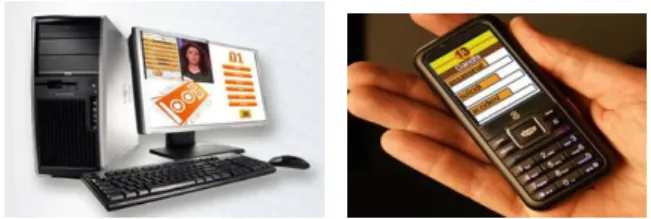
CREA: Defining future multiplatform interaction on
TV shows through a user experience study
Abstract. Television programs use to involve a passive role by the viewer. The aim of the project described in this article is about changing the roll of the viewer to become a participant. To achieve this goal it is necessary to define a type of application that does not yet exist. The way to get information on how to create a positive user experience of an interactive television game show concept has been to involve users on the product concept definition phase. Applying user experience exploration techniques centered on users needs and desires the main factors that would affect the user in case of developing this concept have been obtained. Using a qualitative strategic design method is possible to achieve well-defined and subtle information regarding the motivations and desirable game mechanics for the future users.
Keywords: User experience, Usability, User Involvement, Psychology, Co-Reflection, Television.
1 Introduction
Television Game Shows are one of the more traditional genres of audiovisual entertainment. The classical mechanics of questions and answers contests still work today, and continue to motivate the audience to participate, either from a television studio or from the couch in their house.
CREA project proposes what should be the next evolutionary step for television game shows. There have been attempts to induce the interaction of the viewers from home using a mobile phone or a computer, but the response from users has not been sufficiently representative as to change the concept of the program. The key to define this change lies not only in the improvement of new technologies but in the motivation of users to use them. The focus of this project focuses on how to motivate users to participate in contests televised by new technologies. Starting from this premise, it has been conducted a study focused on the needs and desires of the user to define a new concept of interaction in televised game shows that really encourages the viewer to become involved.
The CREA project was aimed at defining requirements on a non existing product. The hiring company asked the Userlab team for a study regarding how an interactive quiz television show should be. The goal was de definition of a game in which the user can participate remotely through several multimedia devices. The concept to be developed is a hybrid between conventional television quiz contest and a quiz videogame.
To define a compelling game play mechanics and a motivating interaction to the user, a qualitative baseline study was conducted. This study was used to obtain information about the factors that would lead to a satisfactory user experience in a kind of application in which users could not have previous experience.
1.1 Methodological Design
The main challenge on this study was mainly methodological. Due to the absences of prototype on which apply the tests was difficult to design a test taken into account most of existing usability techniques. Moreover, the project objectives were focused on the definition of a category of product does not yet exist. However the context of the study was well defined then was not appropriate to apply techniques only based on ethnographic or participant observation, as it was necessary to generate information from a non-natural scenario.
Finally it was decided to devise a method combining various qualitative techniques of user experience that would respond the needs of this project.
In order to define the premises to be implemented on the first prototype was carried out a qualitative study divided in two parts:
- Exploration: The exploration phase aims to define the strengths and
weaknesses with the current media platforms to engage the user regarding answer type quizzes.
- Immersion: The immersion phase is designed to extract a definition of the concept of multi-platform interaction game during TV game show broadcasting.
To meet the objectives of both parts of the study specific methods of exploration and definition of user experience were applied to each phase.
1.2 Sample
The sample of users used for the first phase of the project was divided in two different profiles:
- Expert users: an expert user is someone that is familiar with participating in
televised game shows.
- Medium Users: is the kind of user that has not a clear willingness to participate in person in televised game shows.
Both user profiles made the same test separately. The number of users was 11 on the expert users group and 10 on the medium users group.
2 Exploration Phase
To carry out this phase of the test technique, it has been applied focus BLA: Bipolar Laddering (BLA) method is defined as a psychological exploration technique, which points out the key factors of the user experience with a concrete product or service. This system allows knowing which concrete characteristics of the
product cause users’ frustration, confidence or gratitude (between many others). BLA method works on positive and negative poles to define the strengths and weaknesses of the product. Once the element is obtained the laddering technique is going to be applied to define the user experience relevant details. The object of a laddering interview is to uncover how product attributes, usage consequences, and personal values are linked in a person’s mind. The characteristics obtained through laddering application will define what specific factors make consider an element as strength or as a weakness. Once the element is been defined, the interviewer ask to the user for a solution of the problem in the case of negative elements or an improvement in the case of positive elements.
2.1 BLA Performing
BLA performing consists in three steps:
1. Elicitation of the elements: The test starts from a blank template for the positive elements (strengths) and another exactly the same for the negative elements (weaknesses). The interviewer will ask the users to mention what aspects of the product they like best or help them in their goals or usual tasks. The elements mentioned need to be summarized in one word or short sentence. 2. Marking of elements: Once the list of positive and negative elements is done, the interviewer will ask the user to score each one from 1 (lowest possible level of satisfaction) to 10 (maximum level of satisfaction).
3. Elements definition: Once the elements have been assessed, the qualitative phase starts. The interviewer reads out the elements of both lists to the user and apply the laddering interviewing technique asking for a justification of each one of the elements (Why is it a positive element? Why this mark?). The answer must be a specific explanation of the concrete characteristics that make the mentioned element a strength or weakness of the product.
To apply the BLA participants were entrust to play a quiz game using four different types of platforms. Before starting the focus group session participants spend 40 minutes playing quiz games using the following platforms:
1. Fixed console (Wii, PS3): The game used was Buzz.
2. Nintendo DS: The game used was Who wants to be a millionaire?
3. Mobile Phone: The game used was Trivial Pursuit.
4. Web of an existing TV Show: The game used was Bocamoll. The Bocamoll
contest is a quiz television program that aired at the time of testing and had a website with game on line.
2.2 Results of Exploration Phase
The type of data obtained in the exploratory phase were used to identify the strengths and weaknesses of current devices, this technique was used to identify wants and needs to be meaningful for future applications.
The following will show some of the results achieved by applying the method focus BLA (Bipolar laddering) to illustrate the information obtained in this phase of the project.
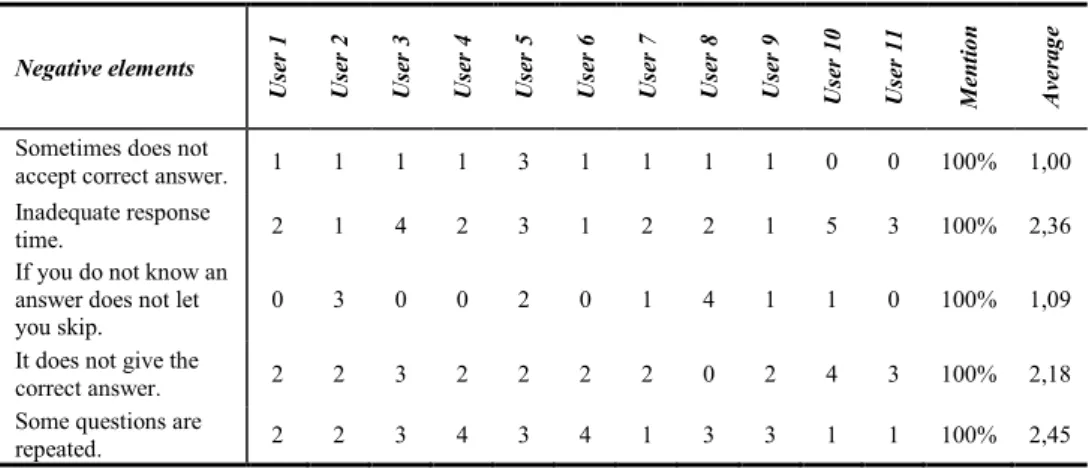
In the elicitation phase of expert user group the following table of results was obtained.
Table 1. Table of negative elements for on web game Bocamoll, expert group.
Negative elements U ser 1 U ser 2 U ser 3 U ser 4 U ser 5 U ser 6 U ser 7 U ser 8 U ser 9 U ser 10 U ser 11 M en tio n A ve ra ge
Sometimes does not
accept correct answer. 1 1 1 1 3 1 1 1 1 0 0 100% 1,00 Inadequate response
time. 2 1 4 2 3 1 2 2 1 5 3 100% 2,36
If you do not know an answer does not let
you skip. 0 3 0 0 2 0 1 4 1 1 0 100% 1,09 It does not give the
correct answer. 2 2 3 2 2 2 2 0 2 4 3 100% 2,18 Some questions are
repeated. 2 2 3 4 3 4 1 3 3 1 1 100% 2,45 In this case it shows the table of negatives elements obtained with the technique focus BLA. The 5 elements have a mention of 100% which means that is a relevant element to all users. The lowest ranked element was NE1: Sometimes does not accept correct answer. Since each element has a subjective justification we can see the reasons for the low valuation of the users.
Fig. 1. Scores of negative element 1 (NE1), expert group.
Each of the elements obtained in the table has a subjective justification of the problem and offers a solution generated by the consensus of the group. If there is no consensus, the proposed solutions are registered separately regarding the percentage of users agree to each solution.
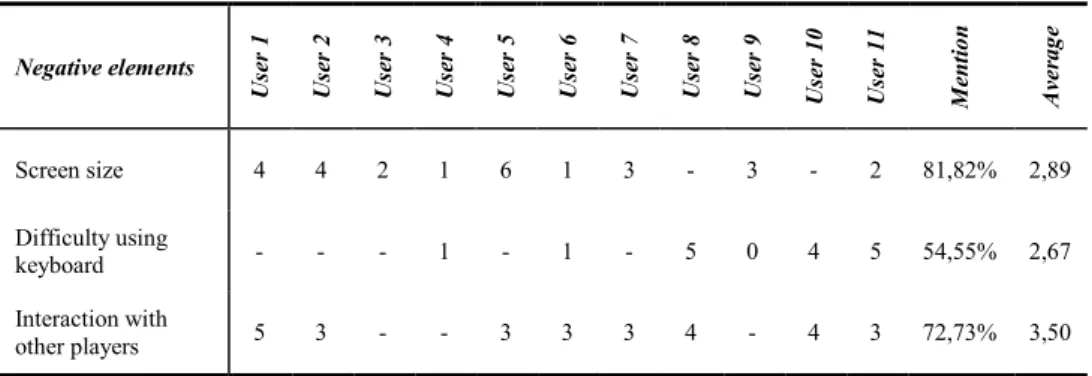
Table 2. Table of negative elements on mobile phone gaming, expert group.
Negative elements U ser 1 U ser 2 U ser 3 U ser 4 U ser 5 U ser 6 U ser 7 U ser 8 U ser 9 U ser 10 U ser 11 M en tio n A ve ra ge Screen size 4 4 2 1 6 1 3 - 3 - 2 81,82% 2,89 Difficulty using keyboard - - - 1 - 1 - 5 0 4 5 54,55% 2,67 Interaction with other players 5 3 - - 3 3 3 4 - 4 3 72,73% 3,50 In case users do not identify the element defined by the group as a problem (or strong point in case of positive elements) will not score such element as it is not relevant for the user.
During the exploration phase were obtained two tables of results, positive and negative elements, for each of the devices tested.
This information allows having a clear idea of the main strengths and weaknesses of each type of interaction with the game. That helps to define a starting point to carry out the new application design.
3 Immersion Phase
Once defined the main factors that affect the user in major gaming platforms is intended to obtain information about the motivations and game mechanics that should be included in a television contest (quiz) in which the user can remotely participate during the program broadcast.
The immersion phase is designed to extract a definition about desirable’s multi-platform interaction during the TV game show broadcasting. To achieve this goal an exploration technique based on visual elements has designed.
The visual elements, with which users are asked to work, are a series of cards that represent different types of interaction elements to help users define their ideal interaction and game mechanics.
There are four types of cards:
1. Interaction Scenarios: Scenarios are reproduced in which the user can interact remotely, as a living room, bedroom, a sitting on a train or an airport.
2. Devices: Cards that reproduce devices interfaces to real size. The devices are: mobile phone, computer screen, television screen and iPhone.
3. Interface elements: Interface elements will be divided into minimum units and provided with the same size as the devices, so users can repeat the same item with different devices.
4. Blank Cards: All cards/scenarios described above will be mirrored in blank to the same size to allow the user create new items in any category.
Fig. 2. Example of visual element cards.
When users receive the artwork start working by groups of 3 or 4 people and defined as they would like to interact with a game of this type. The premise given is the following "Imagine that while the quiz contest Bocamoll is on air you have the chance of play from your mobile, your laptop or your TV like a videogame. Tell us how you like running a contest of this kind using the visual material you have”.
From this premise users combine the visual elements and proposed the ideal game mechanics. To filter surface information a detailed explanation of each step was requested of each proposal, thus eliminating much of the information that can be unreflective by the user.
Fig. 3. Example of visual elements cards put it in a device interface.
Each of these images is composed of several visual elements; users organize those elements to configure a desirable interface depending on the device they use.
Depending on the type of device the interface elements change significantly. For instance on case of mobile phone users opt to remove the television broadcasting due the small interface space they had. This premise was obtained when users realized that due to the large amount of space occupied by the emission interface could not read or interact comfortably with the interactive elements of the game.
3.1 Results of Immersion Phase
Immersion phase helped to identify key problems that could have the game concept for each device tested.
Mobile Phone
Interface
The principal condition while designing an interface for game shows for mobile phones is the limited screen size. If the options for interaction and information are not easily identifiable, the application tends to cause rejection.
This factor has been mentioned for both profiles of user’s during the exploration phase and has been manifested through the design proposals at the immersion phase.
Interaction Suitable
Prioritize the interactive part. To solve the problem of screen size, it was reached at a consensus solution: you must prioritize the interactive part of the competition in the mobile phone interface. Users do not wish to appear on the mobile interface the TV broadcast. The only reason is the lack of interface area, because when they raised the possibility of interaction with more spacious interfaces (e.g. computer) always have preferred to see both the television broadcast and interactive options simultaneously.
What if the user does not have a television in front? The response from users has been to resolve this situation including optional audio during interaction with the game. In this way the user could play the game using the speech program. Although users were not there to explain, you should consider the inclusion of visual reinforcement of interface for tests that may be confused just listening to them. Computer
Interface
The computer is certainly the device that gives users more interaction options. The interface desired by the computer includes the interactive part and the television broadcast at the same time.
The distribution of the screen should be stable and consistent, so that one side always appears the interactive part and on the other side the game show broadcasting.
Interaction Suitable
The problems of interaction that appear on other platforms virtually disappear with the computer. There are two elements that cause this to happen: mouse and keyboard. Both are tools that give the resources to successfully interact with any type of test included in the game show.
Touch PDA or Smart Phone
Interface
The screen size of PDAs, iPhone, Nintendo DS and similar devices is much greater than that of conventional phones. This factor significantly affects the display of the interface and allows that it may be more complex. Users, in cases of interaction with a TV game show, have included items that did not want the mobile phone interface such as punctuation, which would be fixed in a corner or rankings data.
Tactile interaction is the most important distinguishing feature of this type of device. This factor determines the approach of interaction that was defined for mobile phones, since in any case be raised by the use of buttons in response. Tactile devices in the selection of an item screen (how to choose the correct answer) may be pressing on the screen. This advantage presents a comparative offense for users who would play through a buttons mobile phone.
Television
Although the TV does not have a high level of interaction, it has an interface very generous in space, and in this case it can represent both the interactive information (time, position, rank, etc.) and the game show emission.
Interface
Television is the device more intuitive for users because the default is to associate a broadcast TV quiz to it.
In this case the distribution of the interface follows the same model has been proposed with the computer, half the screen to broadcast the program and the other half by the game interaction.
Interaction Suitable
Unlike the computer case, the interaction allowed through the television device is very limited due to the only tool users have is the remote control.
Users are more inclined to navigate with arrows than with numbers, since they considered as more intuitive. Users consider that navigation with numbers was a complicated interaction.
4 Multiplayer Competition
One of the most interesting results obtained in this project is the multiplayer concept applied to this game context.
Users have clearly defined elements of motivation inspired by on line games design, especially when they talked about rankings or game rooms.
Some users have mentioned the Liga Marca or Facebook’s Farmville to define a desirable interactive TV quiz game. The factor of competitiveness and social interaction offered a clear motivator for the users.
Users have defined two types of virtual multiplayer spaces in which competing both online users and with users present on the TV set.
Generic Rooms
The generic rooms would allow a game in large group as large cities or neighborhoods, then user’s town compete as a team.
In this type of competition the user should be able to identify himself individually within the group where he is participating, is important the user to know the number of total participants inside the group and what position does he respect the other players.
It has also appeared to be an interesting factor to meet the users personally. For example, within the group Barcelona (Sants area) would not be surprising that there
are two or more acquaintances. This is a motivating factor for the user, but the applications should leave always the option to participate anonymously.
The generic room is a motivator for two primary reasons: 1. There is a sense of community that motivates by default.
Taking part for your city, your neighborhood and competing against other cities or groups arouses user’s motivation.
2. The user has the feeling that is possible to win if there are a reasonable number of competitors. Though the user can have references to inter-group (groups against groups) and intra-group (individual regarding the rest of the group) is very important and advisable to give the user the reference of his global position (all the players respect him) because is a desired reference point and a major motivation.
Configurable Rooms
Another type of rooms very attractive for users is the configurable rooms. In this case the user would play against a selection of users picked by him. Thus there could be games between members of his department of the company (playing against each other) or against various departments of the same company (e.g. finance department against marketing department) at any case the players would be known by the user.
Within this category has also emerged the option of "challenge" in this case the game would be a "one on one" between players, challenging other users to see who gets better marks.
Options as rankings and rooms do not have to be mutually exclusive; the user should be able to play for his department and also for his city or neighborhood.
5 Conclusions
The following points summarize the factors of motivation and acceptance more relevant for the users in case they were able to interact synchronously with a television quiz show.
The Application Should Be Free
Users have shown a systematic refusal to pay per game. Accept that there is a fee to download software or to contest any specific service, but do not accept the idea of paying for fraction of time or game.
Most Bocamoll Program Tests Are Difficult to Adapt
The television show format must be designed taking care of the remote interaction of the user.
In this project one of the main conclusions is that Bocamoll format is very attractive as a spectator, as many established communication (both verbal and nonverbal) between the contestants and the presenter, but have found many problems while taking the game to a remote device.
It has been noticed the need for an integrated design of the contest, which affects the design itself of the television program. It is important that the questions presented
and the structure of the program is designed to interact using remote devices. The Live Emission Factor Is Clearly a Motivator
The fact of interacting with a program being broadcast at that time throughout Catalonia is a great motivator for users, in fact this is a basic condition, and so most users will not participate in case the game was not synchronized by the emission. The Need to Use the Application in an Existing Platform
Users do not want a new device to play the contest. The implementation of the contest, whatever it is, must be using a device that the user already used previously. It Must Have Prizes
It is important for users to win a prize. Both users’ profiles have stated that the possibility of winning a gift would be a great motivation. Was also noted the importance of the user learns that an acquaintance has won a prize.
Response Time Factor
One of the principles that have been established for this type of game is that the response time has to score, e.g. the score obtained for both the correct answer as to respond quickly. This score shared between accuracy and time has to be applied in order to avoid the user frustration in short term, removing him right away or giving the impression that it is difficult to win.
We Need a Dynamic Interaction
Users do not want to write. This is a premise of interaction that has been almost unanimously, the final application should be quick and easy interactive, if the user has to write, it lows their motivation. This principle is given even by the interaction with the computer, so that is a factor to be considered while designing the final application. The Voice Interaction Would Be Ideal for Users
Although now it is technically a difficult solution, the voice interaction style seems ideal for this type of application. The answer by voice would avoid many problems such as writing, overloading the interface errors or pressing a button. Similarly, although users had the option of voice response also would want the ability to interact digitally, since it is not always convenient to have to speak loudly to play the contest.
References
1. Gauntlett, D.: Creative Explorations: New Approaches to Identities and Audiences. Routledge (2007).
2. Sanders, E.: Information, Inspiration and Co-creation. In Proceeding of the 6th International Conference of the European Academy of Design. Bremen, University of the Arts (2005). 3. Neimeyer, R. A.: Features, foundations and future directions. In Neimeyer, R. A., Mahoney,
M. J. (Eds.): Constructivism in Psychotherapy. Washington: American Association (1995). 3. Jensen, B. G.: The role of the artifact in participatory design research. In Design
4. Pifarré, M.: Bipolar Laddering (BLA): a Participatory Subjective Exploration Method on User Experience. Dux 07: Conference on Designing for User eXperience. Chicago-USA, (November 2007).
5. Södergard, C.: Mobile television-technology and user experiences, VTT Information technology (2003).
6. Tomico, O., Pifarré, M., Lloveras, J.: Analyzing the role of constructivist psychology methods into user subjective experience gathering techniques for product design. ICED 07: International Conference on Engineering Design. Paris-France. (August 2007).