SP DISCUSSION
PAPER
23 160
Australia's
Mandatory
Q
Retirement
Saving Policy:
t
A View from the
New Millennium
Hazel
Bateman
and John
Piggo-ii
March 2001
La
Prot
tton
LABOR MARKETS, PENSIONS, SOCIAL ASSISTANCE
Public Disclosure Authorized
Public Disclosure Authorized
Public Disclosure Authorized
Australia's Mandatory Retirement Saving Policy: A View
from the New Millennium
Hazel Bateman and John Piggott
Universitv of New South Wales
March 2001
Abstract
Formal retirement income provision in Australia can be traced back to occupational superannuation schemes first offered by banks and state governments in the 19'h centurv.
However, the vear 1909 marks the beginning of a national retirement income policy with the introduction of a means-tested age pension. Since then retirement income provision has evolved into a multi pillar arrangement comprising the Age Pension, occupational superannuation and other long term saving through property, shares and managed funds. The 1990s saw the introduction of private mandatorv retirement saving in the form of the Superannuation Guarantee. With the introduction of the Superannuation Guarantee, Australia joined a growing group of countries which centre their retirement income policy
on pnvate mandatory retirement saving. This paper provides a succinct description of the current system along with an analysis of its strengths and areas where improvement is still needed.
E~~~~~~~UUX
LZ ... N O ISfl'ID N O D 6
_z... o
enbzy
ub... stunaps auwoouT iuatuatmzaT pue 'uoisuad a! xueRTd 1 ISJJ otp atqm uopelTQuT
tz. .. ;ISSGIICIQ M qkaHI NVD .)&OH (NV' NIVlG SWTIAO, Id LjYHAC 8
.Z.
-... -.. SNOIIY1cHfOYd (NV 3DNaCIIA3 LN0IIND L
61... . HHN VfID NOIIVfLNNv'T3dafS 3HL LIO INHISSHSSV NV 9
81...s~s v u u n m T) n
91 ...*... -Is`Asse uoaNnuNV IeL dns
91.---V -- - - fIYTESfWr NI XklILSflNI NOIIYflNNVN'dflS JHI S
.I
... NOIIvIfl9D3 CNY NOILVXVL t
bI - --- . --- slauaq luatuamai amlr
CL.'''''''''''''''''''''''''''''''''''''''''''''''''''''''''''sxeaX c > .tinuue ll
... Lt.~~~~~~~~~~ ... C <
~~~~~SIEM;)•
c flMUUU > ... UU31JP... ULLI.~~~~~~~~~~~~~~~~~~~~~~~~~~~~~~~~~...uoilzj.,a;)ui
... -0 -N---- OyeIJVaDlIN
11.SNYVTIId 3IIMONI IN3TMThLIIINONIIIThN
o. -... . . a.. i fuln uoDenuueQdnsl atp - i;oddns .eilrrd puoDas
6.- uoisuad aS atpt jo XDenbape
9 .uosuad a aup - i.ioddns euTd isnj
9.... ... .VI--IsV NI NOISIAOUdIC 3IODNI INLIATIII'TU IN'INf1D z
NI NOISILOId INHP'HdIIH O DNIIVCNVN kILVAMd JO NOlIlfO,&A3 I
1 Evolution of private mandating of retirement provision in Australia
Traditionally, Australia relied on its Age Pension (a universal, but means tested, benefit pavment) for retirement income provision. Entitlement is based on age, residencv status, income, and assets, but not on employment history. It is paid from general revenues. Tax concessions for voluntary superannuation were first introduced in 1915 and strengthened in 1936, but preservation was poor and coverage was low. As recently as the mnid-1980s, only 30% of private sector workers were covered by occupational superannuation.
Unlike most other developed countries, Australia never introduced policies to compel participation in a publicly provided employment or earnings-related retirement income scheme. Prior to the introduction of the Superannuation Guarantee, Australian retirement income policy comprised onlv two pillars - the means tested Age Pension and voluntary
retirement saving.
Australia's status as odd man out in this regard seems to have been more a matter of historical and political accident than of any consistent policy stance. It was always recognised that the Age Pension alone was not sufficient to fund adequate provision for the retired in a developed and rich society such as Australia's. Between 1913 and 1938, three unsuccessful attempts were made to introduce public earnings related retirement income (social insurance) arrangements similar to those which were proving popular in Western Europe and the Americas. In 1938 Australia even got as far as passing the enabling legislation, but, with the coming of the Second World War, implementation was deferred indefinitely.
Nevertheless, occupational superannuation grew rapidly in the public sector in the years following the Second World War. But, it was less common in the private sector where it grew haphazardly, covering some occupations and not others and providing markedly variable conditions and benefits. While the taxation arrangements were concessionary, the industry was largely unregulated and benefit standards were poor. As a result, even by the mid 1980s, less than 50% of full time employees were covered by superannuation. Of this, private sector coverage was only around 30%, and coverage of full time female workers was even lower at around 25%.
There was renewed interest in public earnings-related retirement income provision in the earlv 1970s when a commissioned studv' also recommended a scheme along the lines of those operating in most other OECD countries. However, this was disregarded bv the government of the time in favour of greater support for voluntarv superannuation. The trade union movement then carried the push for earnings-related retirement incc me provision Xwith the emphasis moving awav from publiclv provided to multi-employer occupational arrangements.
When a Labor Government was elected in March 1983, a major part of its econoMic strategy was a continuing contract w-ith the union movement, the "Accord", which survived through Labor's tenure of office. The Accord, along with Australia's then centralised xvage determination system, contained the idea of building superannuation contributions into a national centralised wage decision. The idea became reality in 1986, when the Accord -ark II was agreed. A crucial element in that agreement was that while the increase in compensation to employees should be 6%, to keep pace wvith inflation, half of the increase would accrue in the form of a 3% emplover superannuation contribution, to be paid intc, an individual account in an industrv fund. This was known as productivity aw-ard superannuation.
The introduction of productivitrv award superannuation in 1986 led to large increases in the coverage of occupational superannuation. Over the next three Xvears, as individual induscrial
award agreements were negotiated and ratified under the umbreEla of the 1986 national w-vage case decision, superannuation coverage increased markedlv, particularlv in the private sector and in industries dominated bv women, part time and casual workers. In retail trade an industrv representative of all of these groups, coverage grew from 246% in 1986 to 89° o in
1993. Aggregate coverage nearlv doubled from 40% to 79%.
However, award superannuation proved to be difficult and cosdt to enforce. In 1991 the Australian industrial court rejected an application, supported bv both the govemment and the unions, for a further 3°%o increment. The govemment responded bv introducing legislation requinrng emplovers to make superannuation contributions to an approved ftind
The Hancock Report - see Hancock- (1976).
This agreement was subsequently ratified by the nation's industrial court, and survived a Hiigh Court challenge brought by the Confederation of Australian Industry questioning its constitutioralitv (Dabscheck (1989), p.99)
on behalf of their employees. This policy commenced in 1992 and is now known as the Superannuation Guarantee
Since the introduction of the Superannuation Guarantee, superannuation coverage has
continued to grow, reaching 92% of employees in 19993.
A chronology of Australian retirement policv is set out in Annex 1.
2 Current Retirement Income Provision in Australia
Current retirement income provision in Australia compnrses three components (or pillars).
The first pillar is a universal (but targeted) Age Pension financed from general revenues;4 the
second pillar is the slowly maturing private mandatory provision under the Superannuation Guarantee; and the third pillar is voluntary saving, including tax preferred superannuation. The Age Pension provided under the first pillar is withdrawn where retirement income and assets provided under the other pillars, exceed statutory thresholds.
Two aspects of the Australian arrangements are unusual when compared with other private mandatory arrangements. Firstly, the first pillar Age Pension operates as both the safetv net and the second pillar guarantee, and secondly, the first pillar is means tested against all income and assets, rather than against private pension income only.
Each of the three pillars of retirement income provision, and the interaction between them, is discussed below.
First Pillar Support - The Age Pension5
The Age Pension commenced in 1909. For most of the period since that time it has served as the social welfare safety net for the elderly and, in the absence of a compulsory earnings related pillar, has provided a major source of retirement income for most retired people. In
3 A detailed discussion of the histonrcal back-ground can be found in Bateman and Piggott (1997) and
Bateman and Piggott (1998).
4 The Australian public Age Pension is universal to the extent that all residents of qualifving age are
e]igible, but targeted to the extent that it is subject to income and assets means tests.
5 In the discussion, we ignore the distinction between the Age Pension and the Service Pension,
which is paid to ex-servicemen and women. The two pensions are verv similar, except that the Senrice Pension is paid five years earlier.
1998 around 83%o of the retired of eligible age received some Age Pension - of which around 680 o were paid at the full rate (Centrelink 1998)6.
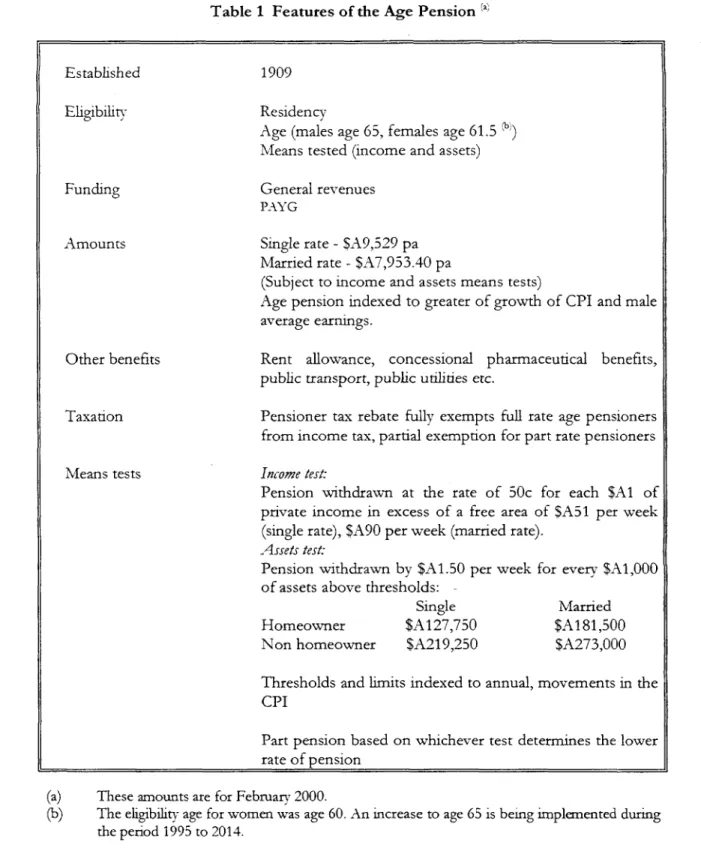
The main features of the Age Pension are summarised in Table 1.
The Age Pension is payable to women aged 61.5 years and over, and to men aged 65 -ears and over 7. Claimants must also satisfy certain residencv qualifications. The Age Pension is
means tested in accordance w%ith either a person's income or, assets;, xhichever determines the lower rate of pension. A higher rate of pension is pavable to a single person than to each member of a married couple. The pension is automatically indexed twice y-earlv. since 1997, indexation has been against the greater of the growth of the Consumer Pnrce Index (CPI) and male average earnings9. Assistance received through the Age Pension is subje-t to personal income tax but a pensioner tax rebate is available which fullyv exempts full-rate pensioners from income tax and provides partial exemption for part-rate pensioners.
6 Although only 10% of these rely solely on the Age Pension.
The eligibility age for women is being increased to age 65 by the year 2014.
s Ser-ice pensions are available to men and women 5 y'ears earlier than the Age Pension. 9 Specificallv male total average weekly earnings.
Table 1 Features of the Age Pension
Established 1909
Eligibility Residency
Age (males age 65, females age 61.5 () Means tested (income and assets)
Funding General revenues
PAYG
Amounts Single rate - $A9,529 pa
Married rate - $A7,953.40 pa
(Subject to income and assets means tests)
Age pension indexed to greater of growth of CPI and male average earnings.
Other benefits Rent allowance, concessional pharmaceutical benefits,
public transport, public utilities etc.
Taxation Pensioner tax rebate fully exempts full rate age pensioners
from income tax, partial exemption for part rate pensioners
Means tests Income test:
Pension withdrawn at the rate of 50c for each $A1 of private income in excess of a free area of $A51 per week
(single rate), $A90 per week (married rate).
Assets test:
Pension withdrawn by $A1.50 per week for everv $A1,000 of assets above thresholds:
Single Married
Homeowner $A127,750 $A181,500
Non homeowner $A219,250 $A273,000
Thresholds and limits indexed to annual, movements in the
CPI
Part pension based on whichever test determnines the lower rate of pension
(a) These amounts are for Februarv 2000.
(b) The eligibilitv age for women was age 60. .An increase to age 65 is being implemented during the period 1995 to 2014.
In Februarv 2000 the Age Pension amounts wvere SA9,529 pa for single people (around .'5%o average male earnings) and SA7,953.40 pa (around 20/o average male earnings) for each of a married couple.
Recent policv has reflected an increased emphasis on targeting. Following a nurmber of reviews over the 1980s and 90s, the longstanding means testing was endorsed and the admninistration simplified'1.
Adequac- of the Age Pension
The govemrnment has legislated to maintain the single rate Age Pension at a minimum of 25 0'o of male average earnings". As retirees solelv reliant on the Age Pension pav no income tax, this translates to a net of tax replacement rate of 37%..io Compared with other nch developed countries, these magnitudes are favourable for safetv net payments, but fall far short of the payments promised under typical public emplovment related pension schemes. As Tablepe 2 indicates, in 1991, Canada was the only G7 nation with a higher minimum level of age benefit than Australia.
Table 2 Minimum social security provision - single older person - in Australia and
G-7 countries in 1991, $A"
Australia United Canada France Germany 'United It l+v
States - Kingdom
Level of
benefits SA880 $A6648 $A9462 SA7899 SA6201 SA6635 SA-434
Source: Whiteford (1995).
Notes: (a) Precise estimates for Japan are not available, but the mrinimumr v-alue is below the G, average. Purchasing power paritv conversions were used.
MIeans testing has ensured that a high proportion of government transfers are received Dv the poorest aged, therebv generating significant redistribution (Bateman el al 1994). It h2s also helped to keep the aggregate value of transfers modest.
I' Simplification related to the application of the income and assets to retirement income streams and the introduction of extended 'deeming' for financial assets. Under 'deeming', the income ta be tested under the income test is determined by applying a statutorn rate of return to the capital value of financial assets. The 1998/99 deeming rates are 3% for the first $A30,400 (single retiree) /SA50,600 (couple) and 5% for the remainder.
Second Pillar Support - The Superannuation Guarantee
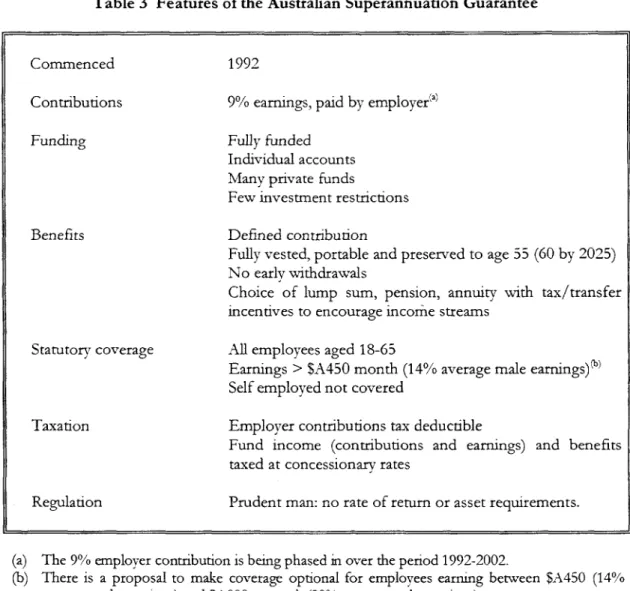
The Superannuation Guarantee mandates employers to make superannuation contributions on behalf of their employees to superannuation funds of their choice. Employers that fail to do so are subject to the Superannuation Guarantee Charge12. The superannuation
contributions are placed in individual accounts in private superannuation funds and invested on behalf of the employees. Table 3 summarises the main features of the Superannuation Guarantee.
Table 3 Features of the Australian Superannuation Guarantee
Commenced 1992
Contributions 9% earnings, paid by employer'
Funding Fully funded
Individual accounts Many private funds
Few investment restrictions
Benefits Defined contribution
Fully vested, portable and preserved to age 35 (60 by 2025) No early withdrawals
Choice of lump sum, pension, annuity with tax/transfer incentives to encourage incomre streams
Statutory coverage All employees aged 18-65
Earnings > SA450 month (14% average male earnings)~b) Self employed not covered
Taxation Employer contributions tax deductible
Fund income (contributions and earnings) and benefits taxed at concessionary rates
Regulation Prudent man: no rate of return or asset requirements.
(a) The 9% emplover contribution is being phased in over the period 1992-2002.
(b) There is a proposal to make coverage optional for employees earning between $A450 (14% average male earnings) and $A900 a month (28% average male earnings).
12 The Superannuation Guarantee Charge compnrses the shortfall in the minirmum level of
superannuation support plus interest plus an administrative cost component. It costs more to pay the Superannuation Guarantee Charge than the mandator! contribution, not least because this Charge is not a deductible business expense, unlike the Superannuation Guarantee.
The arrangements apply to all emplovers and to almost all emplovees. Employees earning less than SA450 per month (around 14% o of average male earnings) are specifically excluded"1 . The mandatorv contributions are fullv vested (i.e. the member is fullv entitle d to
all accrued benefits), fully preserved (i.e. accrued benefits must remain in a fund until the statutorv preservation age for access to benefits is reached). fullv funded and must be paid into a complying superannuation fund."4 Boards of trustees manage the superannuaion funds.
The minimum level of superannuation support is being phased in, with the target of a 9%'o emplover contribution to be reached bv 2002.
Third Pillar Support - Voluntarv Retiremnent Saving
Voluntarv retirement saving comprises voluntarv (or quasi voluntarn) occupational superannuation, personal superannuation and other forms of long term saving through propertr, shares, managed investments and home-ow-nership. Voluntarv occupational superannuation accounted for 62% of total superannuation contributions in 1998-991' with 430/o of employees making voluntary or personal superannuation contributions at an average rate of 6% otf earnings. Around 85% of current retirees own their home.
3 Integration of Retirement Income Pillars
While the major source of income for most retirees is currentlv the Age Pension, this will change over coming decades as more Australians reach retirement wvith long period; of Superannuation Guarantee coverage.
Pnrvate Retirement Benefits
Retirement benefits accumulated under the Superannuation Guarantee and/or voluntarv superannuation mav be taken as a lump sum or an income stream upon reaching the
13 This decision was made largelv on the grounds of high administration costs on small amount
accounts. As well, the government proposes to make contributions optional for emplcvees earning between 5A450 and SA900 per month (14-28% average male earnings).
14 Or a retirement savings account (RSA) offered bv a financial institution. For public sector employers, a government guarantee can substitute for full funding. Defined benefit schemes can count in meeting Superannuation Guarantee obligatons provided an actuarial benefit certifizate, specifving that the implicit level of superannuation support accords with the requirements, is obtained.
preservation age, currentlv 55, increasing to age 60 over the penrod to 2025. Income streams are encouraged bv tax and means test incentives, but it is unclear whether these are affecting the long-term preference for lump sum benefits (Bateman eta! 1993).
Currentlv around 75%o of the value of retirement benefits are paid as lump sums, but benefits are generallv small: the 1997 ABS Retirement and Retirement Intentions Survev reports that, in the previous four years, around 50%. of lump sum retirement payments were less than S60,000. However, the same survey indicates that lump sums are largelv used for retirement purposes. Table 4, which sets out the disbursement of lump sum payments for recent retirees, shows that most superannuation payments are invested, rolled-over or used
to pay off the family home.
Table 4 Disbursement of lump sum payment, November 1997
Age at retirement from full-time work 65 and over
(proportion of total lump-sum benefits)
Rolled over 25.9
Purchased imrnediate annuity 0.8
Invested 42.0
Paid off home 12.4
Bought motor vehicle 0.8
Cleared outstanding debts 5.9
Paid for holiday 6.7
Assisted family members 0
Undecided 1.9
Other 3.8
Source: ABS Retirement and Retirement Intentions, Australia, November 1997, ABS Cat No. 6238.0. Table 12.
Because superannuation accumulations do not have to be taken as a particular type of income stream, a range of retirement income stream products have evolved. There are three main categones- superannuation pensions, traditional annuities and allocated pensions or annuities.
Superannuation pensions are pensions paid by, or on behalf of, superannuation funds. These have traditionally been paid by defined benefit schemes in the public and corporate sectors.
contributions.
* Traditional annuities are offered bv life insurance companies. Current products include fixed or indexed annuities for life or an agreed term. In the 12 months to June 1998, gross annuitv sales totaled SA806million, of which 16.6° o were life annuities.
* Allocated pensions and allocated annuities (also known as phased wNithdrawals, are offered bv a wide range of financial institutions. Annual income payments are reqcpred to lie betveen defined minimum and maximum amounts.
Product design and demand has been driven bh the differential tax and means test arrangements applying to altemative types of income streams. Allocated products (phased 'withdrawals) have been the fastest growing segment of the market in recent vears., but changes to the age pension means tests in September 1998 led to increased demand fo: life and life expectancy products"6.
Integration
The Age Pension means tests do not distinguish between voluntary and mandatory superannuation. However, they do distinguish between t,pe of retirement benefit. Where a lump sum is taken and used to purchase financial assets, the capital value is assessed under the assets test and 'deemed' income is subject to the income test1' . WNhere a retirerment income stream is purchased, the means tests apply differentiallv depending on the product type. The current rules are summnarised in Table 5.
Table 5 Retirement income streams - income and asset tests
Product type Asset test Income test
Life pension!annuitv Income less full purchaset
no price/life expectancy
(o.-Life expectancv pension/annuitv term)
Other term annuitv > 5 vears ves Income less full purchast:
price/term Term annuitr < 5 vears
yes Deeming applies
Allocated pension/annuirv
(phased
wI-ithdrawal)
16 In the 12 months to June 1998, gross sales of allocated products totalled SA4.3billion, over five
times that of traditional annuites.
tests-Life and life expectancv products are given greatest preference, with exemption from the assets test and preferential income test treatment. Allocated products (phased withdrawals) and short duration income streams are given least preference.
Future Retirement Benefits
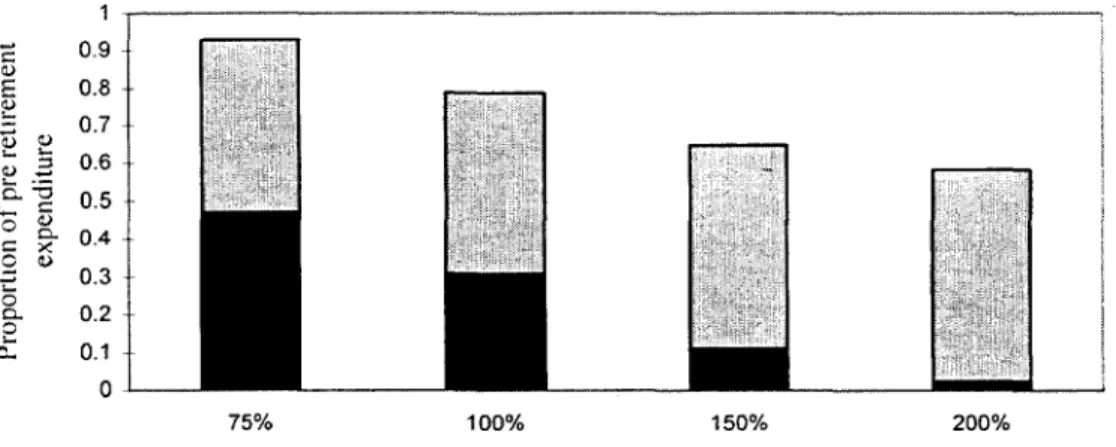
'With almost all employees now covered by the Superannuation Guarantee, manv workers with additional voluntary superannuation coverage and improvements in vesting, portability and preservadon, the composition of retirement income, and therefore the role of the public Age Pension as the major source of income in retirement, will change in future years.
This is illustrated in Figure 1, which shows the expected composition of net total (public and private) retirement income for a full working life of Superannuation Guarantee coverage.
Figure 1 Future composition of retirement benefits (a)
09-11.9 0.) E 0.8 ] 1W0 C.) 0.7 o 0.30.5 0.4 0. 75% 100% 150% 200%
Per cent of average earnings
Age pension
0 9% Superannuation Guarantee
Source: Bateman and Piggott (1997), page 27.
(a) WVe assume a single male worker on fixed income levels between 75 per cent and 200 per cent of male average earnings. Voluntarv saving is excluded and net of tax replacement rates are
calculated as a percentage of pre retirement expenditure.
4 Taxation and Regulation
W-ith the move towards greater reliance on private provision for retirement, the related areas of the taxation and regulation have also been reformed.
Pnor to 1983 superannuation benefited from a generous tax treatment: contributons were largely tax deductible, fund earnings were exempt from tax and only .% of the value of a lump sum, the main form of retirement income, was included in taxable income. Howcver, there was little industr- regulation and the vesting, portabilitv and preservation standairds were poor.
Since the early 1980s the taxation of superannuation has been reshaped. Taxation of lump sum benefits was introduced in 1983 and a tax on superannuation fund income (including both contributions and investment income) in 1988. Taxation now applies at all three possible points: contributions, fund earnings and benefits. This contrasts 'with similar arrangements operating elsewhere in the world which generally tax benefits only. Under the Australian arrangements, employer contributions are tax deductible (up to age deterrrned limits) but are taxed in the hands of the superannuation fund at a rate of 15%. In additicn, a 15%°o superannuation surcharge applies to the contributions of high-income earners. Fund earnings are taxed at a statutory rate of 15%o, which is reduced to the extent that income accrues in the form of dividends or capital gains."' Retirement benefits are taxed as well, wxith the amount of taxation depending on the type of benefit and its size.
The 1980s also saw the introduction of a comprehensive regulatorv framework for superannuation. As the Australian government does not have the constitutional power to make laws concerning superannuation per se, the taxation powers were utilised. Enforcement of the regulations was tied to tax concessions provided to superannuation fund;: a superannuation fund did not meet the regulatory requirements did not receive the tax concessions. An industrv regulator was established'9 and a set of operational standards for the industr- was introduced. However, when the regulatorv framework was strengthene i in the 19 90s greater enforcement powers were required. This time the enabling legislation was enacted under the Australian govemment's corporations and pensions power, in addition to s Full corporate tax imputation credits are available on dividend income wl-hich may be set off against tax on any income, including capital gains and taxable contributions, while capital gains tax is indexed to inflation.
the taxation power. This allowed the introduction of civil and criminal remedies against trustees who failed in their duties.
Prudential issues are largely left to superannuation fund trustees, who are personally liable to fund members for their decisions. Trustees are responsible for the management, operation and investments of superannuation funds. WS7ith the exception of a 5%/o of asset ceiling on in-house investments, and a "no borrowing" rule, there are no asset requirements, nor is a minimum rate of return required.
5 The Superannuation Industry in Australia
The main institutions responsible for private mandatory retirement saving in Australia are superannuation funds2 0. Superannuation funds operate as trusts and are managed by boards of trustees, which are generally required to include equal employee and employer representation. Other institutions such as banks, life insurance companies and investment
managers have important roles as service providers.
There are five types of superannuation fund, each introduced in response to different historical and policv considerations. The public sector superannuation funds appeared first in the l9 th century, followed by corporate superannuation funds for white-collar workers.
Retail funds were established by life insurance companies to promote personal superannuation, while the introduction of award superannuation in the 1980s followed by the Superannuation Guarantee in 1992 led to the introduction and rapid growth of industry superannuation funds and a variant of retail fund - the master trust2'. Finally, the mandatory coverage of small employers, combined with favourable tax treatment of superannuation has led to the introduction and growth of small (self managed) superannuation funds22.
In December 1999 there were 203,272 superannuation funds in Australia, comprising 200,204 'small' and 3,576 'other' superannuation funds. The largest 100 superannuation funds account for around 65% of total superannuation assets (Clare and Connor 1999).
Prudential Regulation Authoritv.
211 Since 1997 other institutions have been allowed to offer Retirement Savings Accounts (RSAs) as
an alterrative.
21 WV4hich allows non-related individuals or companies to operate superannuation under a single trust
deed.
22 Small superannuation funds have 5 or less members and are generally established by a family
owned company with familh members as trustees.
All types of superannuation fund accept both mandatorv and voluntarv contributions and anv superannuation fund can applv to be established as an 'open' or public offer fund.
A recent development has been the introduction of retirement savings accounts (RSAs), wlhich aim to provide a low cost option for small contributions. RSAs are simple capital guaranteed products offered bv banks, building societies, credit unions and life insura-ice companies. Thev are owned and controlled bv the superannuation members holding the accounts and are taxed and regulated like all other superannuation accounts. RSAs currentlv account for less than 1% o of superannuation assets.
Assets and membership of the five superannuation fund types and RSAs are summansed in Table 6.
Table 6 Characteristics of superannuation funds, December 1999
Tvpes of fund Assets ($A billion) No. of funds No. of accounts
, ______________|______ (m illions) Corporate 74 2,746 1.389 Industrv 33 92 6.184 Retail 123 190 9.886 Public Sector 102 40 29677 Small Funds 59 200,204 0.439 RSAs 2. 6D9 na Na
Annuities, life office 48 na Na
reserves etc.
All funds 439 203,272 20.528
Source: APRA Superannuanon Trends, December 1999.
Notes: (a) Retirement savings accounts are included in retail funds.
In practice, trustees delegate manv tasks to service providers including fund adrninistratDrs, investment managers, asset consultants, custodians and other professionals such as law,ers, actuaries and marketing specialists. Industrv estimates indicate that nearlv 86% of industrv funds, 70% of public sector funds and around 60%iO of corporate funds use external find adrninistrators.
Superannuation assets
There has been a large increase in superannuation fund assets since the introduction of award superannuation and the Superannuation Guarantee. Mteasured as a percentage of
GDP, total superannuation fund assets have grown from 2.8% in 1972, to 18.1%o in 1986 to
around 70% in 1999. Government estimates suggest that by the vear 2020, superannuation
fund assets could total around 116.5%°o of GDP (Tinnion and Rothman 1999).
In the absence of asset or rate of return restrictions, Australian superannuation funds tend to invest in a wide varietv of assets with a mix of duration and risk return characterstics. Less than thirty percent of assets are directly invested by superannuation funds: in
December 1999 3 9
%
of assets were invested by external investment managers and 33% inpooled superannuation funds.
The average asset allocations of Australian superannuation funds are set out in Table 7.
Table 7 Asset allocation of Australian superannuation funds, December 1999 Assets
$A billion
Cash and deposits 32 7
Loans and placements 20 5
Interest bearing securities 90 21
Equities and units in trusts 176 40
Direct Property 22 5
Overseas 84 19
Other 14 3
Total 439
Source: APRA Superannuation Trends, December 1999.
6 An Assessment of the Superannuation Guarantee
As Australian retirement income policv is in transition, anr assessment of that policv I:lust
be contingent on the nature of future developments. Subject to this caveat, however, the Superannuation Guarantee performs favourably, when assessed against standard indiv:lual and economv wide critena for the performance of retirement income arrangements23 An assessment of the Superannuation Guarantee against the financial risks facing individuals in retirement is summarised in Table 8.
Table 8 Assessment of the Superannuation Guarantee - individual criteria
Coverage Risk * Adequate for employees only.
Replacement Rate Risk * Adequate for continuous contributions.
Inv, estment Risk * Bome bv retiree, but addressed through asset
diversification.
Longevitv lRiskl
L* Not covered - no mandatorv purchase of lifetime income streams, ineffective incentives. Inflation Risk
* Not covered - no mandatorv purchase of indexed income streams, ineffective incentives.
Political Risk * Accumulations are insulated from political risk,
except for tax changes, but the public pension safetv net remains exposed.
In a strict sense, the Superannuation Guarantee scores poorlv in terms of the individual critena, because of the lack of an income stream requirement. In particular, longevitv and inflation risks are not addressed because of the failure to require a lifetime indexed -- or indeed any - income stream.
However, even if lifetime indexed income streams were required, the Superannuation Guarantee on its own would only partially address mans of the financial risks faced by an individual in retirement. In particular, the Superannuation Guarantee does not cover the self
employed and income replacement mav be insufficient for non-standard workers24. As well, while Superannuation Guarantee accumulations rest in the private sector, and are therefore not part of the government budgetary process, thev are not completelv insulated from political nsk. It is open to any government to increase tax rates on accumulations and/or benefits - as was the case writh the introduction of the superannuation surcharge - or to
make detrimental changes to the regulatorv environment.
MIanv of these risks are, of course, mitigated by the interaction of the Superannuation Guarantee with the means tested Age Pension.
Assessment of the Superannuation Guarantee against the economy-wide criteria of efficiency, equity and administrative efficacy is summarised in Table 9.
Table 9 Assessment of Superannuation Guarantee - economy-wide criteria
Efficiency * Addresses dvnamic inconsistency of
preferences and price distortions, by compelling saving
* Does not address failure of annuities market
Equity * Enhances intergenerational neutrality
* Detrimental intragenerational impacts - low income earners forced to change
intertemporal consumption stream
- tax concessions favour high income earners Administrative efficacv
* Complex to administer
* Regulations prohibit charges on small amount accounts
The Superannuation Guarantee is likelv to lead to an improvement in economic efficiency. By compelling retirement saving, it addresses myopia and the intertemporal price distortions ansing from the income tax and the Age Pension. As well, it is likelv to improve the composition of saving bv reducing the emphasis on home ownership. However, by failing to
3 For a comprehensive discussion see Bateman and Piggott (1997) and Bateman and Piggott (1998). 24 For example, Tinnion and Rothman 1999 show that a single male with a full working life of
Superannuation Guarantee contributions out of average weeklv earnings could expect a total net-of-tax replacenrnt rate of 76% from private retirement income plus the Age Pension. This compares with a net-of-tax replacement rate of 37% from the Age Pension alone.
mandate retirement income streams the Superannuation Guarantee does little to address the issue of adverse selection in the annuities market.
The Superannuation Guarantee scores well on intergenerational equitv. It compels *hose emplovees with the lifetime resources to help fund their own retirement so would be expected to reduce calls on the means tested Age Pension. This is confirmed in Bateman and Ablett (2'000) who estimate a set of generational accounts for Australia. They finc that the introduction of the Superannuation Guarantee has halved of the generational imba.ance in favour of current generations.
Within-generation distnrbution impacts, however, raise some concerns. First, if the Superannuation Guarantee is largely absorbed through slower wage growvth, then the working poor mav suffer more through reduced access to consumption todav than thev gain through increased retirement resources tomorrow-. Second, superannuation tax conces3;ions offer more of a tax break, relative to the comprehensive income tax, to the nrch tharn the poor. Finally, the Superannuation Guarantee may be disadvantageous to non-standard workers, such as women - who have long penods out of the workforce, more part time work and lower wages on average than men. Again, however, the means tested Age Pension acts to reduce these inequities23.
Due to the absence of a broadly accepted benchmark, the Superannuation Guarantee's rating on administrative efficacy is unclear. As a privately organised and funded forrn of retirement income provision it is likely to be more complex and more costly than public PAYG retirement income provision2 6. But private provision is likelv to offer more ch Dice, better governance and the potential for higher retirement benefits.
Finally, implementation of the Superannuation Guarantee was not problem-free. Of initial concem were the relatively high administrative charges placed on many accounts -with small balances - inevitable in an immature system - and the proliferation of multiple accounts'-.
The government responded to the former with regulations limniting the fees charged on small amount accounts2 . The latter is being addressed through member education and changes in
23 Equity issues and the Superannuation Guarantee are discussed in Bateman et a/ (1994).
26 However, while reported costs data may suggest that public arrangements are less costly, much
pubhc cost data is deficient.
- There are around three superannuation accounts for evern work-er.
industry practice, which have simplified procedures for the transfer and amalgamation of
superannuation accounts. However, an emerging problem is that of 'lost' accounts2'.
7
Current Evidence and Projections
Preliminar. evidence of the success of the superannuation guarantee has focussed primarily on coverage and national saving.
Figure 2, reports trends in superannuation coverage.
Figure 2 Trends in superannuation coverage of employees
100-90 80 70 60 50 40 30
20
JfJ~I
10 0 1986 1988 1990 1992 1994 1996 1998Omales *females - 0 total
Source: Emplovment Benefits Australia, ABS No. 6334.0; Superannuation Australia, ABS 6319.0; Employee Earnings, Benefits and Trade Union Membership, ABS No. 6310.0 Since 1986 superannuation coverage has increased mark-edly for all employees, particularly women.
Government estirnates of the contribution to saving of a 9% Superannuation Guarantee is set out in Table 10.
$AI,000, fund administration costs cannot exceed fund earnings. Although accounts can be debited for investment losses, contributions tax and insurance premiums.
29 The Australian Taxation Office estimates that there are about 2.5 million 'lost' accounts and $A2.4
Table 10 the Superannuation Guarantee - contribution to national saving (a)
Public saving Private saving
I
National saving Financial year (contribution as a 06 GDP)1
1992-93 -0.03 0.D 0.4 1995-96 -0.05 0.9 0.9 1999-00 -0.18 1.4 1.2 2004-05 -0.31 2.6 2.3 2009-10 -0.37 3.2 2.8 2014-15 -0.39 3.5 3.1 2019-20 -0.35 3.9 3.6
Source: Gallagher (1 997), Table 1.
(a) Estimates assume implementation of policies announced in 1996-97 and 1997-98 Budgets, ,with no increase in member contributions. Various saving substitution rates are assumed
ranging from 5%°` for the first income decile to 50%/. for the tenth income decile.
The Superannuation Guarantee is projected to raise national saving by 1.29o of GDP bv the
cum of the centurv and bv around 3.6% of GDP bv the year 2020. Pnrvate saving improves
because of the graduallv increasing tax preferred mandatorv contribution, and the earnIngs thereon, net of saving substiution. However, over the period to 2020, public saving fall:;, as reductions in tax revenue exceed reductions in Age Pension outlavs. This will, however, turnaround in later vears as the Superannuation Guarantee matures and the retired depend less on the Age Pension.
If these projections are correct, thev reflect a major improvement in Australia's saving performance, which has been low bv international standards. Net national saving currentlv stands at around 4.5% of GDP, so a 1.2 percentage point increase represents a :5°% acceleration in net saving.
Certainlv, the composition of households' financial asset saving flows has altered dramaticallv in the last decade. Table 11 reports the net acquisition of financial assets over the past three decades. Life insurance and superannuation contributions have increased fi-om 20%o of households' net acquisition of financial assets in the 1970s to 50%O in the 1990s.
Table 11 Households - net acquisition of financial assets(a)
Bank deposits (°'o) Life insurance, Other,, (9)
superannuation contributions (0o)
1970s 42 20 38
1980s 36 39 25
1990s
28
50 22 _Source: Bateman and Piggott (1997)
Notes: (a) Includes unincorporated enterprises.
(b) 'Other' includes building society and credit union deposits, government securities, debenmres, shares, unit trusts, etc.
A final point on saving performance concems the composition of saving and investment.
There are two main channels of tax preferred saving in Australia - superannuation, and
ouner-occupier housing. The latter is both treated more concessionally under the income tax and excluded from the Age Pension means test so, in the absence of compulsory superannuation, is likely to be chosen as the preferred personal saving vehicle. The Superannuation Guarantee may therefore contribute more to the efficient allocation of economic resources through its impact on the composition of saving and investment, than on aggregate saving performance.
8 What problems remain, and how can they be addressed?
Four broad areas of Australia's private mandatory retirement saving policy remain problematic. These include integration with the first pillar Age Pension and retirement income streams, taxation, choice and adequacy.
Integration wxith the first pillar Age Pension, and retirement income streams
Perhaps the most difficult structural problem confronting the Superannuation Guarantee is its linkage with the first pillar - the Age Pension - and the related question of income stream choice in retirement.30 Lump sum withdrawal of superannuation benefits is both permitted and widespread. This, combined with the disparity between the preservation age for superannuation benefits (currently 55, but increasing to 60) and the eligibilit. age for the Age
30 For a discussion of the key public policy issues related to withdrawals from mandatory defined
Pension (61.5 for females, 65 for males), makes the integration of the Superannuition Guarantee wxith the Age Pension problematic. WhiIe most retirees dispose of their lump sum benefits prudentlv, thev have an incentive to do so in ways that maximise their Age Pension benefits3 . This mav involve reduced interest by workers in maximising invest-ment returns and means test avoidance for workers near the Age Pension threshold.
While current policy provides incentives through the Age Pension means tests to encourage the takeup of life and life expectancv income streams, it is unclear whether these incentives wiill be effective over the long term. This was shown in Bateman et a/ (1993) who founc that
the means test and tax incentives did little to encourage retirement income streams. Taxation
Mluch avoidable complexity in the Australian taxation of retirement saving is introduced bv maintaining three tax bases: contributions, earmings, and benefits. AU are taxed concessionally, so it is less the burden of tax than its complexity, which is the difficulty here. Hoxvever, the tax on earnings distorts net of tax retums, adversely affecting asset choice. In addition, earnings taxes probablv further encourage earlv retirement, since it is ' zhen retirement is a viable option that the earnings tax bites most severely, reducing the lifetime reward for working another year. As well, contributions and earnings taxes are flat rate and therefore regressive. The superannuation surcharge, which attempts to make the contributions tax on superannuation funds progressive across fund members, has provtd to be administrativelv complex and costlv.
Further, the separation of superannuation tax rates from the personal tax rate schedule reduces the political insulation offered by pnrvate retirement provision
--Choice
Choice in the Australian policv debate has two dimensions: choice of superannuation fund and choice of investment portfolio. Current policv reform has emphasised choize of superannuation fund (or retirement saving entity), but support for it is far from wvidespreadi5
3' See Atkinson et al (1996).
32 For more detail on the superannuation surcharge see Bateman and Piggott (1999). For a proposal for the simplification of superannuation taxaticn see Dovle et a (1999)
33 Draft legislation has been prepared and has been supported by the Government in Parliament, but
the Australian upper house, the Senate, has so far rejected the proposal As the current draft leg slation stands, choice of fund must be offered to all emplovees receiving Superannuation Guarantee contributions except for those employed under State awards. Under the draft legislation an emplover will be able to meet their choice of fund obligation to emplovees by electing one of the three choice of fund models:
There are arguments for and against greater choice. Choice of retirement saving organisation leads to greater marketing to individuals. In Chile (which allows emplovee choice of fund) this has proved expensive "With marketing accounting for around 45% of total administrative costs. A second negative relates to the likely, if partial, breakdown of group life insurance arrangements. However, superannuation funds are increasingly offering portfolio choice w,ith more than 50%'o of members able to choose their investment portfolio.
Irrespective of the choice model pursued, it is vital that members are well informed and have access to easily understood comparative performance criteria. Therefore, government policv to facilitate greater investment choice should be complemented by appropnrate disclosure rules and effective member education34.
Adequacy
'W'hile govemment estimates suggest that a 9%,o Superannuation Guarantee (plus the Age Pension) will deliver an adequate replacement rate for retirees with continuous workforce participation, this is no longer the norm3'. As well, under current policy design, taxation and administrative charges increasingly erode the mandatory contribution. This raises the issue of the adequacy of a mandatory contribution of 9% and whether the mandatory policy should be supplemented by incentives to make voluntary contributions.
* Limnited choice of at least 4 fund which must consist of at least one public offer fund and at least one RSA, and an industry fund and an in-house corporate fund if they exist under current arrangements; or
v Unlimnited choice, which requires employees to nominate their preferred fund; or
* Negotiating a Certified Agreement or an Austrahan 'orkplace Agreement covering superannuation between employees and emplovers, or, alternativelv, a fund proposed by an emplovee and agreed by the emplover, in wnting.
34 These issues are currently under consideration following the release of the Government Consultation Paper 'Financial Products, Service Providers and MNlarkets - an Integrated Framework' (Corporate Law Econorrmic Reform Program 1999).
35 A proposal to allow the splitting of accrued superannuation benefits is being considered by the
9 Conclusion
This paper has sought to explain the Australian version of private mandatorv retirement saving - the Superannuation Guarantee - and to provide an assessment of the policv. In summary, the Superannuation Guarantee does well in the accumulations phase, because the mandatory contributions ensure that the syvstem is fullv funded and the pnvate basis of the policy- helps proVide political insulation. In the benefits phase, the policy scores poorly, because reti7ement income streams are not mandatory. Gi-ven the historical right to take superannuation benefits as lump sums in Australia, mandating retirement income streams is politically difficult. In the long term, however, the success of the Superannuation Guarantee will depend up:)n the introduction of such a policy.
Annex 1: Chronology of retirement income policy in Australia
1908 Age Pension introduced
1913 Conservative parties proposed contributorv national superannuation 1914 Introduction of tax concessions for superannuation
1922 Commonwealth employees superannuation fund established
1928 Conservative government introduced National Insurance Bill - proposed
national insurance scheme
1936 Service pension first paid. Tax concessions for lump sums introduced 1938 National Health and Pensions Insurance Bill passed - based on 1928 Bill 1943 Labour Government establishes National Welfare Fund to fund social services 1945 Social services contribution established
1950 Social services contribution merged with personal tax system
1969 Age Pension income test taper reduced from 1009/o to 50%
1973 Means tests abolished for persons aged over 75 1975 Means tests abolished for persons aged 70 to 74 1976 Assets test abolished for all persons
1978 Reintroduction of assets test for persons age over 70
1983 Superannuation tax changes: lump sum taxes introduced, increased tax deductibility for employees and the self-employed.
1984 Rollover funds established. Tax concessions for annuities introduced
1985 Asset test reintroduced for all persons. Labor government and trade unions finalise Accord Mark II
1986 3% Productivitv Award Superannuation endorsed by Conciliation and Arbitration Commission
1987 Regulatory framework for superannuation introduced - Occupational
Superannuation Supervision Act. Supervisory body established - the Insurance and Superannuation Commission
1988 Major reforms of superannuation taxation - introduction of 15% tax on
superannuation income, reduction of lump sum taxes, 15% annuity rebate introduced, increased tax deductibility for uncovered workers and self employed, introduction of marginal RBL scales
1990 Age Pension means tests liberalised for pensions and annuities. Introduction of tax rebates for superannuation contributions low coverage employees
1991 Industrial relations Corrmssion rejects further 3% o Productivitr A,'~ard
Superannuation. Government announces introduction of 9° e Superannuation Guarantee to commence from Julv 1992
1992 Superannuation Guarantee commences.
1993 Superannuation Industrv Supervision Act passed.
1994 Flat rate RBLs replace marginal RBLs. Age determined employer contribution limits introduced. Improved preservation. Increased eligibility for 5l°o annuity re:ate. Commencement of phase-in of preservation age of 60.
1993 Commencement of phase-in of increase in Age Pension age for women from ag-i 60 to 65. Labor government proposes to increase mandatorv contributions to 15"O. 1996 Deeming applied to financial investments under Age Pension income test.
Change of goveemment. 1996-97 Budget includes proposals to introduce RSAs, spouse contributions, superannuation surcharge and opt-out from Superannuatioa Guarantee for low income earners.
1997 RSAs established and superannuation surcharge introduced. 1997-98 Budget includes proposals to introduce emplovee choice of fund and replace previous govemments proposed increased mandatory contribution rate with a 15% tax rebate for voluntarv superannuation contributions (to a max of $A3,000pa).
1998 Age Pension means tests for retirement income streams revised.
'A New Tax System' includes proposals to abolish 15% tax rebate and change Age Pension income test taper to 40%.
1999 Govemment announces reforms of business taxation - includes proposals to red ice the capital gains tax rate for superannuation funds to 10% and to refund excess imputation credits.
2000 Proposals announced in 'A New Tax Svstem', imnplemented on 1 Julv 2000.
References
Attorney-General's Department (1998), Superannuation and Family Law: A Position Paper, Miay 1998, AGPS, Canberra.
Attomey-General's Department (1999), Propertv and Familr- Law - Options for Change, MIarch 1999, AGPS, Canberra.
Atkinson, NI., J. Creedy and D. Knox (1996), "Alternative Retirement Income Strategies: A
Cohort Analysis of Lifetime Redistribution", Economic Record, 79, No. 217, pp 97-106.
Australian Bureau of Statistics (1997), Retirement and Retirement Intentions, ABS No. 6238.0,
November 1997.
Australian Bureau of Statistics, Emplo*ee Earnings, Benefits and Trade Union Membership, ABS
No. 6310.0 (various issues).
Australian Bureau of Statistics (1997), Superannuiation Australia, ABS No. 6319.0.
Australian Bureau of Statistics, Employment Benefits-AustraIia, ABS No. 6334.0 (various issues).
Australian Prudential Regulation Authority (1997), Superannuiation Trends, March 1999.
Bateman, H. and Ablett, J. (2000), "Compulsory Superannuation and Australian
Generational Accounts", Economic Analysis and Poliy.
Bateman, H. and Piggott, J. (1997), Private Pensions in OECD Countries: Australia, Labour
Market and Social Policy Occasional Papers, No. 23, OECD, Paris.
Bateman, H. and Piggott, J. (1998), "Mandatory Retirement Saving in Australia", Annals of
Pu,blic and Cooperative Economics, 69(4): 547-569.
Bateman, H. and Piggott, J. (1999), The Costs of the Superannuation Surchar,e, CEDA
Information Paper No. 65.
Bateman, H., Kingston, G. and Piggott, J. (1993), 'Taxes, Retirement Transfers and
Annuities', The Economic Record, vol. 69, No. 206: 274-84.
Bateman, H., Kingston, G. and Piggott, J. (1994), 'The Equity Implications of Mandated
Funded Pension Schemes', in J Creedy (ed) Taxation, Poverty and Income Distribtution,
Edward Edgar, England: 163-74.
Clare, R. and Conner, D. (1999), The Sutperannuation Market in Australia, ASFA Research
Centre, June 1999.
Corporate Law Economic Reform Program (1998), Financial Products, Sernice Providers and
AMarkets - An Intearated Framework, AGPS, Canberra.
Dabscheck B (1989), Aiustralian Industrial Relations in the 1980s, Oxford University Press, Melbourne.
Dovle, S., Kingston, G. and Piggott, J. (1999), "Taxing Super", <ustralian Economic Retiewn,. September 1999.
Doyle, S., and Piggott,
J
(1998), "Wh-ich WN;ay Forward? Australia's Policv for Retirement Incomes", Economic Papers, 17, 7-82.Gallagher, P. (1997), Assessing the National Savings Effect of the Governments Superannueation Poliies: Some Examples of the .N\ew RIM\IGROUTP National Savings Myletlhodology, Retirement
Income Modelling Task Force, Paper presented to the Fifth Colloquium of Superannuation Researchers, Universitv of Melbourne, July 1997.
Hancock, K. J. (1976), National Sufperannuation Committee of Inqziii - Final Report, -A PS, Canberra.
Senate Select Comrnittee on Superannuation (1995), Member Investment Choice, Parliament
House, Canberra.
Tinnion. J. and Rothman, G. (1999), Retirement Income -Adequacy and the Emeraing Superann uation System - New Estimates, Retirement Income Modelling Unit, The Treasury, paper
presented to the Seventh Colloquium of Superannuation Researchers, University of Melbourne. July 1999.
Walliser J. (2000), Regulation of Withdrawals in Individual Account Sstems. Social Prote tion
Discussion Paper No. 0008, Pensions Pnrmer Paper. Social Protection Department. World Bank, W ashington D.C.
'Whiteford, P. (1995), The Use of Replacement Rates in International Comparisons of Benefit Sy-tems.
Discussion Paper No. 54, Social Policv Research Centre, University of New South Wales.
Social Protection Discussion Paper Series
No.
Title
0113
Regulating Private Pension Funds' Structure, Performance and Investments:
Cross-country Evidence
by P.S. Srinivas, Edward Whitehouse and Juan Yermo
0112
The World Bank and the Provision of Assistance to Redundant Workers:
Experience with Enterprise Restructuring and Future Directions
by Yi Chen
0111
Labor Markets in Transition Economies: Recent Developments and Future
Challenges
by Mansoora Rashid and Jan Rutkowski
0110
A Review of Social Investment Fund Operations Manuals
by Juliana Weissman
0109
Risk and Vulnerability: The Forward Looking Role of Social Protection in a
Globalizing World
by Robert Holzmann
0108
Australia's Mandatory Retirement Saving Policy: A View from the New
Millennium
by Hazel Bateman and John Piggott
0107
Annuity Markets and Benefit Design in Multipillar Pension Schemes:
Experience and Lessons from Four Latin American Countries
by Robert Palacios and Rafael Rofman
0106
Guide for Task Teams on Procurement Procedures Used in Social Funds
by Jorge A. Cavero Uriona
0105
Programmes Actifs Pour Le Marche Du Travail: Un Aper9u General Des
Evidences Resultant Des Evaluations
by Zafiris Tzannatos and Amit Dar
0104
Kazakhstan: An Ambitious Pension Reform
by Emily S. Andrews
0103
Long-term Consequences of an Innovative Redundancy-retraining Project:
The Austrian Steel Foundation
by Rudolf Winter-Ebmer
0102
Community Based Targeting Mechanisms for Social Safety Nets
by Jonathan Conning and Michael Kevane
Social Protection Discussion Paper Series continued
No. Title
0101
Disability and Work in Poland
by Tom Hoopengardner
0024
Do Market Wages Influence Child Labor and Child Schooling?
by Jackline Wahba
0023
Including the Most Vulnerable: Social Funds and People wNith
Disabilities
by Pamela Dudzik and Dinah McLeod
0022
Promoting Good Local Governance through Social Funds and
Decentralization
by Andrew Parker and Rodrigo Serrano
0021
Creating Partnerships with Working Children and Youth
by Per Miljeteig
0020
Contractual Savings or Stock Market Development. Which Leads?
by Mario Catalan, Gregorio Impavido and Alberto R. Musalem
0019
Pension Reform and Public Information in Poland
by Agnieszka Chlon
0018
Worker Reallocation During Estonias Transition to Market: How Efficient
and How Equitable?
by Milan Vodopivec
0017
How Poor are the Old? A Survey of Evidence from 44 Countries
by Edward Whitehouse
0016
Administrative Charges for Funded Pensions: An International Comparison
and Assessment
by Edward Whitehouse
0015
The Pension System in Argentina: Six years after the Reform
by Rafael Rofman and Buenos Aires
0014
Pension Systems in East Asia and the Pacific: Challenges and Opportunities
by Robert Holzmann, Ian W. Mac Arthur and Yvonne Sin
0013
Survey of Disability Projects. The Experience of SHIA. Swedish
International Aid for Solidarity and Humanity
Social Protection Discussion Paper Series continued
No. Title
0012
The Swedish Pension Reform Model: Framework and Issues
by Edward Palmer
0011
Ratcheting Labor Standards: Regulation for continuous Improvement in the
Global Workplace
by Charles Sabel, Dara O'Rourke and Archon Fung
0010
Can Investments in Emerging Markets Help to Solve the Aging problem?
by Robert Holzmann
0009
International Patterns of Pension Provision
by Robert Palacios and Montserrat Pallares-Miralles
0008
Regulation of Withdrawals in Individual Account Systems
by Jan Walliser
0007
Disability Issues, Trends and Recommendations for the World Bank
by Robert L. Metts
0006
Social Risk Management: A New Conceptual Framework for Social
Protection and Beyond
by Robert Holzmann and Steen J0rgensen
0005
Active Labor Market Programs: Policy Issues for East Asia
by Gordon Betcherman, Amit Dar, Amy Luinstra, and Makoto Ogawa
0004
Pension Reform, Financial Literacy and Public Information: A Case Study of
the United Kingdom
by Edward Whitehouse
0003
Managing Public Pension Reserves Part I: Evidence from the International
Experience
by Augusto Iglesias and Robert J. Palacios
0002
Extending Coverage in Multi-Pillar Pension Systems: Constraints and
Hypotheses, Preliminary Evidence and Future Research Agenda
by Robert Holzmann, Truman Packard and Jose Cuesta
0001
Contribution pour une Strategie de Protection Sociale au Benin
by Maurizia Tovo and Regina Bendokat
Social Protection Discussion Paper Series continued
No. Title
* The papers below (No. 9801-9818 and 9901-9934) are no longer being printed. but are
available for dowsnload from our website at w%vww.worldbank.org/sp
9934
Helping the Poor Manage Risk Better: The Role of Social Funds
by Steen Jorgensen and Julie Van Domelen
9933
Coordinating Poverty Alleviation Programs with Regional and Local
Governments: The Experience of the Chilean Social Fund - FOSIS
by Jorge C. Barrientos
99 32
Poverty and Disability: A Survey of the Literature
by Ann Elwan
9931
Uncertainty About Children's Survival and Fertility: A Test Using Indian
Microdata
by Vincenzo Atella and Furio Camillo Rosati
9930
Beneficiary Assessment of Social Funds
by LawTence F. Salmen
9929
Improving the Regulation and Supervision of Pension Funds: Are there
Lessons from the Banking Sector?
by Roberto Rocha, Richard Hinz, and Joaquin Gutierrez
9928
Notional Accounts as a Pension Reform Strategy: An Evaluation
By Richard Disney
9927
Parametric Reforms to Pay-As-You-Go Pension Systems
by Sheetal K. Chand and Albert Jaeger
9926
An Asset-Based Approach to Social Risk Management: A Conceptual
Framework
by Paul Siegel and Jeffrey Alwang
9925
Migration from the Russian North During the Transition Period
by Timothy Heleniak
9924
Pension Plans and Retirement Incentives
by Richard Disney and Edward Whitehouse
9923
Shaping Pension Reform in Poland: Security Through Diversity
by Agnieszka Chlon, Marek G6ra and Michal Rutkowski
Social Protection Discussion Paper Series continued
No.
Title
9922
Latvian Pension Reform
by Louise Fox and Edward Palmer
9921
OECD Public Pension Programmes in Crisis: An Evaluation of the Reform
Options
by Richard Disney
9920
A Social Protection Strategy for Togo
by Regina Bendokat and Amit Dar
9919
The Pension System in Singapore
by Mukul G. Asher
9918
Labor Markets and Poverty in Bulgaria
by Jan J. Rutkowski
9917
Taking Stock of Pension Reforms Around the World
by Anita M. Schwarz and Asli Demirguc-Kunt
9916
Child Labor and Schooling in Africa: A Comparative Study
by Sudharshan Canagarajah and Helena Skyt Nielsen
9915
Evaluating the Impact of Active Labor Programrs: Results of Cross Country
Studies in Europe and Central Asia
by David H. Fretwell, Jacob Benus, and Christopher J. O'Leary
9914
Safety Nets in Transition Economies: Toward a Reform Strategy
by Emily S. Andrews and Dena Ringold
9913
Public Service Employment: A Review of Programs in Selected OECD
Countries and Transition Economies
by Sandra Wilson and David Fretwell
9912
The Role of NPOs in Policies to Combat Social Exclusion
by Christoph Badelt
9911
Unemployment and Unemployment Protection in Three Groups of Countries
by Wayne Vroman
9910
The Tax Treatment of Funded Pensions
by Edward Whitehouse
Social Protection Discussion Paper Series continued
No.
Title
9909
Russia's Social Protection Malaise: Key Reform Priorities as a Response to
the Present Crisis
edited by Michal Rutkowski
9908
Causalities Between Social Capital and Social Funds
by Jesper Kammersgaard
9907
Collecting and Transferring Pension Contributions
by Rafael Rofman and Gustavo Demarco
9906