Published online 2017 July 31. Review Article
Comparison of the Curricula of Master of Science in Nursing (MScN)
Programs in Iran and Japan: A Descriptive Comparative Study
Seyedeh Azam Sajadi,
1Nahid Rajai,
2and Jamileh Mokhtari Nouri
3, * 1Department of Medical Surgical, Nursing Faculty, AJA University of Medical Sciences, Tehran, Iran2MScN, Instructor, Department of Nursing, Faculty of AJA Nursing, AJA University of Medical Sciences, Tehran, Iran
3PhD in Nursing, Associate Professor, Department of Nursing Management, Faculty of Nursing, Baqiyatallah University of Medical Sciences, Tehran, Iran
*Corresponding author: Jamileh Mokhtari Nouri, PhD in Nursing, Associate Professor, Department of Nursing Management, Faculty of Nursing, Baqiyatallah University of Medical Sciences, Tehran, Iran. Tel: +98-2182483495, Fax: +98-2188600047, E-mail: [email protected]
Received2016 August 08;Revised2016 October 09;Accepted2017 June 13. Abstract
Background:Lack of suitable educational programs in nursing causes irreparable damage to the community’s health and reduces the academic credibility of universities. In Iran, the master of science in nursing (MScN) program is not tailored to the needs of the community, and graduates lack the required nursing skills. Considering the distinguished quality of higher education in Japan, the aim of the present study is to perform a comparative analysis of MScN programs in Iran and Japan.
Methods:In this descriptive comparative study, an extensive electronic search was carried out in Persian and English databases, including PubMed, Iran Medex, Medline, Scopus, Google Scholar, scientific information database (SID), and MagIran among articles published during 1997 - 2016. The gathered data were categorized and compared according to the study objectives.
Results:In comparison with Iran, Japan has a longer history of postgraduate nursing programs, and its educational system has prominent strengths and advantages including: admission interviews; English language requirements for admission; versatility and flexibility of the educational curricula to facilitate student employment during education; integration of research-based units in the curricula; and attention to community-based and home care nursing.
Conclusions:Comparison of the educational systems of Iran and Japan highlights the need for more flexible curricula in Iran in accordance with the community’s needs.
Keywords:Comparative Study, Educational Planning, Curriculum, Nursing Education, Iran, Japan
1. Background
The primary goal of healthcare systems is to provide high-quality care services (1,2). The presence of special-ized nurses with advanced knowledge and skills is essen-tial in healthcare settings in order to provide regular, high-quality, safe, and affordable services (2-4).
Specialized nurses were trained for the first time in 1954 when Peplau introduced the graduate program in psy-chiatric nursing at Cambridge university (5). Today, de-spite the increasing number of nurses with master of sci-ence in nursing (MScN) degrees, the quality of nursing ser-vices has failed to improve, and a decreasing trend has been observed (6). According to several studies, nursing graduates are incompetent and lack the required skills in clinical settings (7). Such problems are indicative of incon-sistency between nursing training and the community’s needs (8).
Educational programs and curricula are among the most important domains of higher education (9,10). In
recent years, evaluation of higher education systems has been of major interest to educational planners for the sake of improving the quality of curricula (11). Overall, the main goal of educational programs is to equip students with ex-cellent ethical, theoretical, and practical skills (12).
Lack of suitable educational programs in nursing can cause irreparable damage to the community’s health and reduce the academic credibility of universities (13). On the other hand, rapid changes in healthcare environments over the past years have necessitated changes in academic perspectives (14). The world health organization has called for the promotion of educational standards for newly grad-uated nursing students (15). Nevertheless, the components of postgraduate nursing programs in Iran have not signif-icantly changed since 1995 (8). In fact, some scholars be-lieve that the postgraduate programs in Iran are not in ac-cordance with the community’s needs and fail to meet any specific objectives (16).
Paying greater attention to successful educational sys-tems around the world can help institutionalize an
tive system in a country (11). In addition, comparing dif-ferent educational systems can improve the quality of ed-ucational programs and curricula (17). Comparative study, as a fully established academic field, is a prerequisite for the design of modern educational systems. However, this method has been neglected in Iran (18). In general, com-parative studies evaluate the differences and similarities among educational systems, examine the reasons for their success or failure, and use their experiences for the devel-opment of effective educational systems (19).
Japan is one of the most developed and prominent countries in the world with respect to higher education. The reason for the great success of their educational sys-tem is the localization of knowledge in accordance with the dominant culture in society (15). With this background in mind, the present study aimed to perform a compara-tive analysis of postgraduate programs in Iran and Japan.
2. Methods
This descriptive, comparative study was conducted us-ing the well-known George F. Brady method. Overall, in comparative studies, two or more phenomena are com-pared in terms of their differences and similarities (19). Based on this method, the status of postgraduate nursing education was analyzed and compared in Iran and Japan.
To obtain the required information, an extensive search was carried out among articles published in English and Farsi languages during 1997 - 2016. The search was per-formed in PubMed, Iran Medex, Medline, Scopus, Google Scholar, scientific information database (SID), and MagI-ran databases, using the following keywords: “nursing,” “e-ducation,” “curriculum,” “Japan,” “Iran,” and “descriptive comparative study.”
In total, 40 articles that met the criteria and study ob-jectives were selected and carefully reviewed. In addition, the websites of the Iranian ministry of health, ministry of sciences, Japanese nursing association, and two high-ranking Japanese universities (Chiba and Oita universities) were examined. The data was collected, classified, and compared.
3. Results
In this section, we first present a brief description of the social status of nursing in Iran and Japan. Then, the higher education systems of these countries are examined in terms of their goals, admission criteria, curricula, and employment prospects.
3.1. Nursing Status in Iran and Japan
In Iran, nurses play an important role in the health-care system. Nevertheless, dissatisfaction, lack of moti-vation (20), forced choice of study field, and the commu-nity’s stigmatizing attitude (nurses are recognized merely as “doctor’s assistants”) are among the common problems of nurses in our country.
In comparison with Iran, Japan is a smaller country with a larger population. Although Japan has the largest workforce in the world, it is still facing human resource shortage. Nursing in Japan is described in negative terms, including: “hard,” “dirty,” and “dangerous.” In addition, it is associated with “low income,” “limited vacation time,” the inferior position of “doctor’s assistant” and “minimum chance of marriage,” which reflect the poor image of this profession in society (21-23).
In both countries, the high prevalence of chronic dis-eases and advancing age of the population in recent years have been noted in the curricula of postgraduate pro-grams (23). It should be noted that the postgraduate pro-gram was first implemented in 1987 in Iran and 1980 in Japan (23).
3.2. MScN Program in Iran 3.2.1. Goals
The purpose of postgraduate programs in Iran is to train committed and competent nurses with high theoret-ical knowledge, familiarize them with advanced research methods and equip them with theoretical and practical skills in each of the domains of nursing, education, re-search, and management (24).
3.2.2. University Admission
In Iran, the requirements for admission in postgradu-ate programs include:
1) Bachelor’s degree from domestic or foreign universi-ties with a minimum passing grade of 12 out of 20
2) A minimum of 2 years of clinical experience in criti-cal care nursing, neonatal intensive care nursing, or emer-gency nursing
3) Acceptance with at least 50% of the total average score on the written exam
4) Postgraduate admission with at least 30% of the total score (25).
The score of English language proficiency test should be moderate to high (26); students are accepted in univer-sities based on their scores.
Since 1998, talent management policies have been im-plemented to encourage capable students towards strate-gic and executive roles. Consequently, each university
has been allowed to admit up to 10% of its undergrad-uate students from each discipline in postgradundergrad-uate pro-grams, besides students accepted with national postgradu-ate examinations. According to this policy, the selected stu-dents should be among honor stustu-dents of each discipline (honor students are selected among students admitted in the same year) (27).
3.2.3. Curricula
The postgraduate program continues for 4 to 6 semesters. The total number of compulsory and optional credits ranges from 30 to 44, depending on the university policies (28); normally, 4 to 6 modules are assigned to the dissertation project. The focus of classroom train-ing is on student participation in group discussions. Most presented modules focus on theoretical knowledge and clinical skills to a lesser extent. Seminar and thesis modules are usually presented in the second and third semesters, respectively.
The postgraduate program includes 2 disciplines of nursing education and management. Each discipline en-compasses 4 specialties of internal-surgical nursing, psy-chiatric nursing, pediatric nursing, and community-based nursing. The postgraduate program focuses on theoreti-cal knowledge rather than practitheoreti-cal skills and includes ba-sic, clinical, and applied courses (25). In addition, in recent years, changes in healthcare services have led to the emer-gence of new disciplines, such as intensive care nursing, pediatric intensive care nursing, military nursing, rehabil-itation nursing, emergency nursing, and elderly nursing care (26).
3.2.4. Employment Prospects
The employment prospects include teaching, research, and higher education planning assistance (24). According to some studies, Iranian nursing students continue their education due to factors such as financial advantages and escape from clinical settings (28).
3.3. MScN Program in Japan 3.3.1. Goals
The objectives of postgraduate programs in Japan in-clude knowledge acquisition, research promotion, acqui-sition of advanced nursing skills (29), and instruction of researchers and trainers (21). Students gain nursing knowl-edge and skills for activities such as physical examination and pharmacological studies (30).
University admission: In a similar manner to the un-dergraduate level, each university can establish a set of postgraduate admission criteria (31). The general admis-sion criteria include:
1) Age above 22 years
2) Completion of undergraduate studies
3) Proficiency in English language and acceptable TOEFL and IELTS scores
4) Submission of resumes or educational accomplish-ments (for those with no work experience)
5) Letter of recommendation by 2 faculty members, fac-ulty president, or undergraduate instructors
6) Presentation of the undergraduate thesis abstract (32)
3.3.2. Curriculum
This 2-year program contains 30 - 32 syllables (32), nearly 20 of which are related to seminar presentation and dissertation (33). The areas of study include nursing ed-ucation, management, advanced clinical nursing, mater-nal and child care nursing, midwifery, elderly care, psychi-atric nursing, community-based nursing, home care nurs-ing, and international nursing (33,34).
Classes are held during the day and night with the min-imum number of students and mentoring training; this system allows working students to continue their educa-tion (30). To provide educational opportunities for moti-vated students, some universities have established 4-year postgraduate programs (30). Overall, in these programs, a great amount of time is devoted to clinical training by medical professionals in hospital settings (30).
3.3.3. Employment Prospects
Overall, by increasing the number of postgraduate pro-grams, we can pave the way for higher education (32). Stu-dents of advanced professional nursing are specialized in a variety of clinical domains, such as cancer nursing or psy-chiatric nursing (35). Advanced professional nursing in Japan focuses on specialized clinical roles. Nurses exam-ine the client in the clinic and at home, cooperating with physicians to provide care services (34).
3.4. Comparison of Educational Systems in Iran and Japan
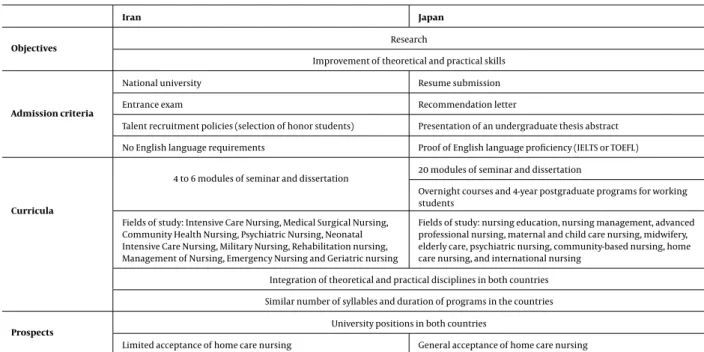
Table 1presents and compares different dimensions of nursing education systems in Iran and Japan.
4. Discussion
The aim of the present study was to compare postgrad-uate nursing programs in Iran and Japan. Based on the re-sults, there are significant differences between these coun-tries. Unlike Japanese universities, which do not hold any entrance examinations, the university entrance exam in Iran is the only means to gain admission to higher edu-cation. However, this type of examination is associated
Table 1.Different Dimensions of MScN Programs in Iran and Japan
Iran Japan
Objectives Research
Improvement of theoretical and practical skills
Admission criteria
National university Resume submission
Entrance exam Recommendation letter
Talent recruitment policies (selection of honor students) Presentation of an undergraduate thesis abstract No English language requirements Proof of English language proficiency (IELTS or TOEFL)
Curricula
4 to 6 modules of seminar and dissertation 20 modules of seminar and dissertation
Overnight courses and 4-year postgraduate programs for working students
Fields of study: Intensive Care Nursing, Medical Surgical Nursing, Community Health Nursing, Psychiatric Nursing, Neonatal Intensive Care Nursing, Military Nursing, Rehabilitation nursing, Management of Nursing, Emergency Nursing and Geriatric nursing
Fields of study: nursing education, nursing management, advanced professional nursing, maternal and child care nursing, midwifery, elderly care, psychiatric nursing, community-based nursing, home care nursing, and international nursing
Integration of theoretical and practical disciplines in both countries Similar number of syllables and duration of programs in the countries
Prospects University positions in both countries
Limited acceptance of home care nursing General acceptance of home care nursing
with several problems, such as admission of unmotivated students who have the potential to drop out of the uni-versity (25,36) or those who only continue their educa-tion to escape actual clinical settings (37). One of the ways to overcome these problems is to incorporate interviews in the student recruitment system and consider the aca-demic/clinical background of the candidates.
There are also some challenges in the talent recruit-ment system of Iran, such as students’ limitations in se-lecting their desired field of study or university (27). In Iran, unlike Japan, general English fluency is sufficient for postgraduate programs, and many students, after pass-ing general and specialized language courses, still lack the required skills to meet their academic and professional needs (38-40). This problem seems to be associated with language teaching methods (41). Some researchers believe that the main reason for students’ poor language skills is the use of traditional teaching methods (42).
Unlike Iran, the educational curricula of Japanese uni-versities are quite flexible and diverse. For instance, work-ing students can continue their education in 4-year post-graduate programs. In addition, part-time education in Japan gives students an opportunity to study while work-ing. However, this type of education is associated with re-duced leisure time, physical stress, fatigue, irritability (37), frequent absenteeism, rare use of library resources (43), and reduced academic performance (44). In fact, working while studying can influence the students’ educational
ex-periences, values, behaviors, attitudes, and sense of iden-tity (45). In addition, students, besides earning money, can improve their practical skills and experiences and increase their chances of attaining employment after graduation (46).
In Japan, home-care nursing is accepted as a profes-sion, whereas it is not as common in Iran, and few nurses (usually undergraduates) provide such services (25). Con-sidering the increasing prevalence of chronic diseases and the advancing age of the population in Iran, incorporation of community-based nursing services and reforms in the educational programs seem necessary (36).
The international nurses association has emphasized the importance of evidence-based performance in nurs-ing care. In this regard, Muir-Gray (1997) has described evidence-based performance as a great challenge for nurses (47). According to a study by Mokhtari et al. (2014), integration of evidence-based nursing standards is an ef-fective way to reduce hospitalization, increase patient sat-isfaction, and improve decision-making and healthcare quality (48).
As the findings revealed, research is among the edu-cational objectives of postgraduate programs in Iran and Japan. However, in Japan’s educational system, students are required to pass more research units, and therefore they devote more time to research activities. In Iran, thesis presentation is the first research activity of postgraduate students, while in Japan, students are required to present
a thesis even at undergraduate level, which is also one of the admission criteria for higher education (30).
The present study had certain limitations, such as the Japanese language of most articles and scarcity of studies in this area.
4.1. Conclusion
The findings show that promotion of the educational system can improve nursing training. The Japanese educa-tional system has different strengths and advantages, in-cluding: use of admission interviews for student recruit-ment; strict English language requirements; diversity and flexibility of programs for working students; focus on re-search activities and integration of more rere-search sylla-bles at universities; attention to community-based nurs-ing; and educational planning for promotion of home-care nursing. Comparison of the educational systems of Iran and Japan indicates the need for more flexible curricula in accordance with the needs of the Iranian society. Finally, we can improve Iran’s nursing education system through education localization and use of Japan’s experiences in nurse training.
Supplementary Material
Supplementary material(s) is availablehere[To read supplementary materials, please refer to the journal web-site and open PDF/HTML].
Acknowledgments
The authors would like to thank the library and Inter-net section personnel of the nursing faculties at Tehran University of Medical Sciences and Baqiyatallah University of Medical Sciences, Tehran, Iran.
References
1. Rafii F, Hajinezhad ME, Haghani H. Nurse caring in Iran and its rela-tionship with patient satisfaction.Aust J Adv Nurs. 2009;26(2):75–84. 2. MacPhee M, Ellis J, Sanchez McCutcheon A. Nurse staffing and patient
safety.Can Nurse. 2006;102(8):18–23. [PubMed:17094364].
3. Westmoreland D, Hays BJ. The health system nurse specialist curricu-lum: collaborative across specialist to prepare nurse leaders.Nurs Educ Perspect. 2002;23(4):172–7.
4. Wong FK. Senior clinical nurse specialist pilot position in Hong Kong.
Clin Nurse Spec. 2001;15(4):169–76. [PubMed:11855502].
5. Gerard P, Walker J. Charting a course for your future: a directory of clinical nurse specialist programs in the United States.Clin Nurse Spec. 2003;17(4):211–20. [PubMed:12869868].
6. Adibhajbagheri M. Compare philosophy of objectives and curricula of graduate level of nursing education in Iran and Japan, Abstracts of the fifth national conference of medical education, (in Persian).Iran J Med Educ. 2002;2(2):8–9.
7. Mirzabeygi G, Sanjari M, Salemi S, Babaei F, Kheradmand M. The ne-cessity for specialty education in nursing MS program: viewpoints of the faculty members of school of nursing and midwifery in Iran, (in-Persian).Iran J Med Educ. 2010;9(3):263–71.
8. Kermanshahi S, Memarian R, Heseni A, Zamzam S, Nezamli F. A com-parison postgraduate MS curriculum of nursing education in Iran and Canada, (in Persian).J Med Educ Dev. 2011;4(6):48–54.
9. Arefi M. Subjects in engineering of interdisciplinary curricula in higher education, (in Persian).J Interdiscipl Res Hum Sci. 2010;2(8):69– 94.
10. Seif AA.Measurement, comparison and evaluation of education, (in Per-sian). 6 ed. Tehran: Doran; 2013.
11. Aliyari SH, Maleki H, Pazargadi M, Abbas poor A. Developing and stan-dardization of quality evaluation and accreditation indicators for curricula of baccalaureate degree nursing education in Iran, (in Per-sian).Ann Mil Health Sci Res. 2012;10(1):50–61.
12. Karimi Moonaghi H, Montazeri R. A comparative study of the curricu-lum of masters degree in medical education in Iran and some other countries, (in Persian).Strides Dev Med Educ. 2015;11(4):420–33. 13. Jafari Asl M, Chehrzed MM, Shafipour SZ, Ghanbari A. Quality of
ed-ucational services from viewpoints of nursing and midwifery stu-dents of Guilan university based on servqual model.Res Med Educ. 2014;6(1):50–8. doi:10.18869/acadpub.rme.6.1.50.
14. Kaiser KL, Barr KL, Hays BJ. Setting a new course for advanced prac-tice community/public health nursing.J Prof Nurs. 2003;19(4):189–96. [PubMed:12964139].
15. Farajzadeh Z, Rakhsh Khosid M, Izadpanah A, Saadatjoo S. Factors affecting quality of education from the viewpoint of graduated nurses working in Birjand hospitals, 2012, (in Persian).Modern Care J. 2014;11(3):196–202.
16. Nasiriani K, Farnia F, Salimi T. Nursing graduates self assessment of their clinical skills acquired in medical surgical wards, (in Persian).
Iran J Med Educ. 2006;6(1):93–100.
17. Ghorbani F, Rahkar Farshi M, Valizadeh L. Comparison of masters cur-riculum of pediatric nursing in Iran and United states, (in Persian).J Nurs Educ. 2015;4(3):41–7.
18. Madandar Arani A, Abbasi P. Take a look again to the comparative ed-ucation and its mission, (in Persian).J Educ. 2007;23(2):101–26. 19. Yasini P.Comparative study of education in Iran and Japan, (secondary
school), (in Persian). Tehran: Islamic Azad University, Central Tehran Branch; 2012.
20. Rahimaghaee F, Nayeri D, Mohammadi E. Iranian nurses perceptions of their professional growth and development.Online J Issues Nurs. 2010;16(1):10. doi:10.3912/OJIN.Vol16No01PPT01. [PubMed:21800930]. 21. Fukuda H, Miyauchi S, Tonai M, Ono M, Magilvy JK, Murashima S. The first nurse practitioner graduate programme in Japan.Int Nurs Rev. 2014;61(4):487–90. doi:10.1111/inr.12126. [PubMed:25168623]. 22. Wikipedia .Nursing in Japan. Wikipedia Cite: Wikipedia; 2017.
Avail-able from:https://en.wikipedia.org/wiki/Nursing_in_Japan. 23. Mokhtari Nouri J, Nezamzadeh M. Comparative study of nursing
ed-ucation in Iran and Japan, (in Persian).J Clin Excell. 2016;4(2):99–81. 24. Wikipedia .The free encyclopedia, Master of nursing. Wikipedia Cite:
Wikipedia; 2016. Available from:https://fa.wikipedia.org/wiki. 25. Tabari Khomeiran R, Deans C. Nursing education in Iran: past,
present, and future. Nurse Educ Today. 2007;27(7):708–14. doi: 10.1016/j.nedt.2006.10.003. [PubMed:17125890].
26. Center for Medical Education .Ministery of health and medical educa-tion of Iran. 2015. Available from:http://www.sanjeshp.ir/arshad/94/
Et03.pdf.
27. Students scientific research center . Regulations to facilitate continu-ing education of talent student to the higher levels of the ministry of health and medical education. 2008.
28. Vahedian Azimi A, Ebadi A, Saadat S, Negarandeh R, Ahmadi F. Pro-fessors view on the appropriate postgraduate degree in nursing ed-ucation, A comparative study in two different sociocultural societies and literature review international, (in Persian).Int J Med Reviews. 2014;1(1):13–23.
29. Nikbakht Nasrabadi AR, Mogheri MR. The need for change in nursing education, (in Persian).Hayat. 1999;5(2):46–55.
30. Oita university of nursing and health sciences .Oita university of nurs-ing and health sciences. Japan: Oita university of nursing and health sciences; 2009. Available from:http://www.oita-nhs.ac.jp/English/
index.html.
31. Chiang Hanisko L, Ross R, Boonyanurak P, Ozawa M, Chiang L. Pathways to progress in nursing, understanding career patterns in Japan, Taiwan, and Thailand OJIN.J Issues Nurs. 2008;13(3):4. doi: 10.3912/OJIN.Vol13No03Man04.
32. Masterstudies .Masters degree in Japan postgraduate programs in Japan. USA: Masterstudies; 2017. Available from:https://www.masterstudies.
com/Masters-Degree/.
33. Graduate School of Nursing CU.Graduate School of Nursing, Chiba Uni-versity. Japan: Chiba University; 2010. Available from:http://www.
chiba-u.ac.jp/e/education/graduate/nursing.html.
34. Primomo J. Nursing around the world: Japan - preparing for the century of the elderly.Online J Issues Nurs. 2000;5(2):2. [PubMed: 11453844].
35. Horiuchi S. Doctoral nursing education in Japan. J Nurs Sci. 2013;31(1):5–8.
36. Farsi Z, Dehghan-Nayeri N, Negarandeh R, Broomand S. Nursing pro-fession in Iran: an overview of opportunities and challenges.Jpn J Nurs Sci. 2010;7(1):9–18. doi:10.1111/j.1742-7924.2010.00137.x. [PubMed: 20618672].
37. Manouchehri H, Imani E, Atashzadeh Shoorideh F, Alavi Majd H. Nurs-ing students experiences of work while studyNurs-ing, a qualitative study, (in Persian).Iran J Nurs Res. 2016;11(2):33–42.
38. ZandMoghadam A.The effect of tasked based approach on the Iranian ESP learners reading comprehension, (in Persian). Tehran: Allametabatabaei University; 2007.
39. Rahimi M, Azhegh H. The impact of TBLT on mechanical engineering
students achievement and reading comprehension in an ESP course, (in Persian).J Technol Educ. 2011;5(2):135–43.
40. Ahmadi M. Assessment the ability of medical students of Shahrekord University of medical sciences in reading the English medical text, (in Persian).Pajohandeh. 1997;2(7):103–13.
41. Shekari A.The comparison between lecturing and role playing in the teach-ing of history. Shekari, A; 2012. Available from:www.ensani.ir/storage/
Files/20120427095843-8085-5.docx.
42. Richards JC, Renandya WA.Methodology in language teaching, an an-thology of current practice. New York: Cambridge University Press; 2002. p. 242–8. doi:10.1017/cbo9780511667190.
43. Rochford C, Connolly M, Drennan J. Paid part-time employment and academic performance of undergraduate nursing students.
Nurse Educ Today. 2009;29(6):601–6. doi:10.1016/j.nedt.2009.01.004. [PubMed:19246132].
44. Schoofs N, Bosold S, Slot V, Flentje J. Nursing student employment: impact on academic achievement.Nurse Educ. 2008;33(2):57–8. doi: 10.1097/01.NNE.0000299501.32529.44. [PubMed:18317313].
45. Hasson F, McKenna HP, Keeney S. A qualitative study exploring the im-pact of student nurses working part time as a health care assistant.
Nurse Educ Today. 2013;33(8):873–9. doi: 10.1016/j.nedt.2012.09.014. [PubMed:23159073].
46. Martin E. Part time work and portgraduate students, Developing the skills for employment?.J Hosp Leisure Sport Tourism Educ. 2007;6(2):29– 40. doi:10.3794/johlste.62.133.
47. Muir Gray JA.Evidence based healthcare: how to make health policy and management decisions. London: Churchill Livingstone; 1997. 48. Salehi Z, Mokhtari Nouri J, Khademolhoseyni SM, Ebadi A. The
ef-fect of education and implementation of evidence-based nursing guidelines on infants’ weight gaining in NICU.Glob J Health Sci. 2014;7(2):148–53. doi:10.5539/gjhs.v7n2p148. [PubMed:25716388].