2351-9789 Crown Copyright © 2017 Published by Elsevier B.V. This is an open access article under the CC BY-NC-ND license (http://creativecommons.org/licenses/by-nc-nd/4.0/).
Peer-review under responsibility of the scientific committee of the 27th International Conference on Flexible Automation and Intelligent Manufacturing doi: 10.1016/j.promfg.2017.07.249
Procedia Manufacturing 11 ( 2017 ) 1231 – 1238
ScienceDirect
27th International Conference on Flexible Automation and Intelligent Manufacturing, FAIM2017,
27-30 June 2017, Modena, Italy
Framework for Risk Management Software System for SMEs in the
Engineering Construction Sector
Chike F Oduoza
a,*, Onengiyeofori Odimabo
aand Alexios Tamparapoulos
aaFaculty of Science and Engineering, University of Wolverhampton, Wulfruna Street, Wolverhampton, WV11LY, UK
Abstract
Small and medium-sized enterprises (SMEs) in construction sector are vulnerable and face exposure to risks whilst operating without risk management system in place. Evidence from market research and industry surveys confirm that SMEs underperform due to inability to manage operational risk challenges facing them. The objective of this study is to develop risk management software enabling SMEs in the construction sector to proactively identify, analyse and manage risks facing them to enhance business performance. Performance in the construction sector is assessed in terms of completion time, project execution cost and overall quality of delivery. Research framework based on balanced score card highlights risk indicators affecting performance. The risk software guides operator to avoid, minimise, mitigate or manage the relevant risks to enable successful performance outcome. The system will enable systematic risk management to achieve minimum cost and time overrun while optimising quality of delivery in a project management environment.
© 2017 The Authors. Published by Elsevier B.V.
Peer-review under responsibility of the scientific committee of the 27th International Conference on Flexible Automation and Intelligent Manufacturing.
Keywords:Risk; Software; SMEs; Construction Engineering; Balanced scorecard
* Corresponding author.
E-mail address: [email protected]
Crown Copyright © 2017 Published by Elsevier B.V. This is an open access article under the CC BY-NC-ND license (http://creativecommons.org/licenses/by-nc-nd/4.0/).
Peer-review under responsibility of the scientific committee of the 27th International Conference on Flexible Automation and Intelligent Manufacturing
1. Introduction
Most commercial activities within business operations are concentrated in Small and Medium Enterprises (SMEs). For instance, in the United Kingdom, it is reported by the Department for Business Innovation and Skills (2015) that Small businesses accounted for 99.3% of all private sector businesses at the start of 2015 and 99.9% were small or medium sized (SMEs).
The construction sector is a key sector for most economies and comprises a wide range of products, services and technologies. These are likely to vary in terms of economic value they generate, reflecting differences in their use of particular factors of productions (raw materials, physical capital, intangible investment, skilled and non-skilled labour and knowledge) and the value which they generate (BIS, 2013). Construction SMEs represent an important part of these business environments as it takes charge of most large-scale projects and minor activities that are outsourced in civil works and building rehabilitation and reform (Canamares et al, 2017).
Construction projects can be considered as the achievement of specified objective, which involves a series of activities and tasks that consume resources (Parvan et al, 2015). The construction sector is the tool through which a society achieves its goals of urban and rural development (Enshassi et al 2006). However, it is becoming increasingly more complex partly because the complexity of the construction process itself and the parties (clients, designers, contractors, regulators etc.) involved (Enshassi et al 2006). There is abundant evidence both from informal market research and industry surveys to confirm that SMEs are continuously handicapped and therefore, underperforming due to their inability to manage operational risk challenges facing them on a daily basis. These challenges are often responsible for turning profitable construction projects into loosing ventures (Sweis et al, 2008). In a sense, the construction process could be regarded as one big exercise in risk management. The level of risk has an impact on the quality of the project as well as on time, and cost. Therefore, the objective of this study is to develop a framework for a risk management software system which will enable SMEs in the construction sector to proactively identify, analyse and manage the large variety of risks facing them to enhance business performance.
2. Literature review
2.1 Construction Risk Management
Every construction organisation faces risks that occur in different construction environment and with different likelihoods and impacts. The risks associated with the construction sector can generate more or less severe consequences for an organisation (Aven, 2011). Risk in a construction context is typically referred to as a variable in the process of construction whose occurrence results in uncertainty as to the final cost, duration and/or the quality of the project (Odeyinka et al, 2006). To try to mitigate or eliminate construction risk, we count on risk management, which is an integral part of project management. Construction risk management is a positive and proactive process intended to reduce the likelihood and impact of unsatisfactory consequences to the project in its different stages, such as design, construction and operation (Rohaninejad and Bagherpour, 2013). Hence, the main purpose of construction risk management is to identify, evaluate, and control the risk for project success (Lee et al, 2009). Overall, risk management process includes the following main steps: (1) Risk identification; (2) Risk assessment (qualitative and quantitative) and (3) Risk response
Risk identification process reveals and determines the possible project risk as well as conditions and arising risk. The qualitative risk analysis process is regarded as the most useful part of risk management where the result gained is used extensively in subsequent stages. Important information about risks such as the likelihood of occurrence, the risk severity and risk ownership is required at this stage. The quantitative risk analysis process involves the creation of a model which represents the project being studied and the general uncertainties. Consequently, the process of management of risk includes risk response strategies that are defined as risk retention, risk transfer, risk reduction, and risk avoidance (Khodier and Mohamed, 2015).
The uses and capabilities of software in many areas of human activity and fields of practice have seen a massive growth over the last years. As a result, a multitude of software prototypes for risk management have been proposed, to facilitate the use of risk analysis concepts and ideas in construction management. The risk management decision system enables decision makers in the construction sector in processing, assessing, categorising and organising information on risk. That is to say, a decision support system is a computer technology solution that can be used to support complex decision making and problem solving. According to Bhatt and Zaveri (2002), a decision support system has the ability to facilitate problem recognition, realise model formation, assist in gathering, integrating, organising and presenting relevant information.
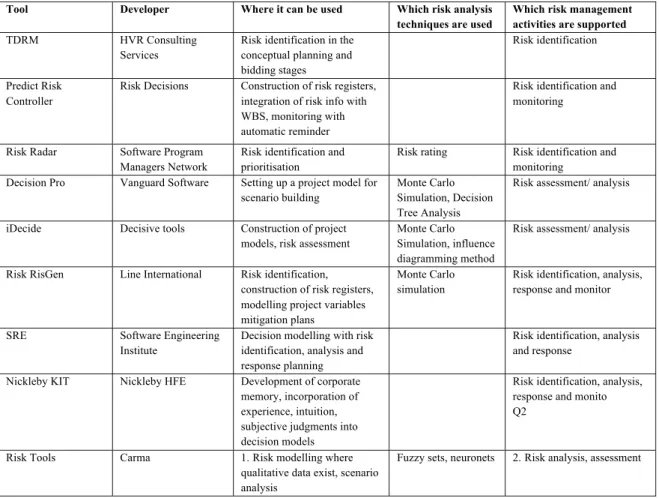
A risk management software system starts off as a computational model, which is subsequently implemented as a software prototype. The term prototype describes anything in the range from a paper schematic to a working system (Rakitin, 2001). Several researchers have conducted studies in the development of a risk management support system (Tah and Carr, 2001; Jannadi and Almishari, 2003). Table 1.0 lists some of the software used to support risk management process.
The main function of a risk management system is not to merely compute numbers, but to be able to recommend the appropriate attitude for risks avert, transfer, mitigate, retain), or opportunities (exploit, share, enhance, ignore) (Hillson, 2002).
Table 1.0 Software Tools for Risk Management.
Tool Developer Where it can be used Which risk analysis techniques are used
Which risk management activities are supported
TDRM HVR Consulting
Services
Risk identification in the conceptual planning and bidding stages
Risk identification
Predict Risk Controller
Risk Decisions Construction of risk registers, integration of risk info with WBS, monitoring with automatic reminder
Risk identification and monitoring
Risk Radar Software Program Managers Network
Risk identification and prioritisation
Risk rating Risk identification and monitoring
Decision Pro Vanguard Software Setting up a project model for scenario building
Monte Carlo Simulation, Decision Tree Analysis
Risk assessment/ analysis
iDecide Decisive tools Construction of project models, risk assessment
Monte Carlo Simulation, influence diagramming method
Risk assessment/ analysis
Risk RisGen Line International Risk identification, construction of risk registers, modelling project variables mitigation plans
Monte Carlo simulation
Risk identification, analysis, response and monitor
SRE Software Engineering
Institute
Decision modelling with risk identification, analysis and response planning
Risk identification, analysis and response
Nickleby KIT Nickleby HFE Development of corporate memory, incorporation of experience, intuition, subjective judgments into decision models
Risk identification, analysis,
response and monito Q2
Risk Tools Carma 1.Risk modelling where
qualitative data exist, scenario analysis
2.3 Exposure of small and medium size companies (smes) to risk
The prediction of company failure is an important and challenging issue for both researchers and practitioners. Failure of a company may cause substantial losses to the business community and also to society in general. It will affect various stakeholders, such as investors, creditors, shareholders or employees. Prevention of company failure underscores the importance of developing a robust model that will enable the early detection of potential company failure before it happens.
The construction industry (CI) has various characteristics that may increase the vulnerability of companies to bankruptcy compared to other sectors.
Typical characteristics include the following:
(i) Implementation of unique projects which pose a lot of uncertainty about completion (ii) Time overrun associated with late project completion
(iii) Complexity of the construction process
(iv) Partnering and supply chain issues involving multiple stakeholders (v) Uncertainty and risk involved in the construction activity.
In recent years, the bankruptcy of construction companies has become even more exacerbated due mainly to the major structural changes witnessed in the sector, such as globalization, technological evolution, increased competition and regulation. These factors combined with the global economic crisis affecting most European countries makes it mandatory to monitor the risk of failure. It is therefore essential to develop a risk management system that can anticipate problems and develop appropriate strategies to manage them in the long term (1).
The construction industry is also plagued by occupational risky situations and poor working conditions. Occupational risk assessment (ORA) at workplace sites is the first and key step to achieve adequate safety levels, particularly to support decision-making in safety programs.
Traditionally management of system failure is linked to the solution of an existing problem. However, the paradigm has now changed; the major concern of failure analysis is to emphasize the prevention of problems linked to the proactive treatment of the system (2), rather than seeking a solution after the failure happens. This is particularly true of service industries where many dissatisfied customers silently switch providers or initiate a negative word of mouth rather than express dissatisfaction following a service failure. Failures in a service system are therefore directly linked to loyalty destruction, customer dissatisfaction, customer defection, and negative word of mouth [2].
2.4 Key risk and key performance indicators in risk management
• Risk Indicators (KRI)
Risk indicator is a metric used to monitor identified risk exposures over time in a business environment. It measures the amount of exposure to a given risk using exposure indicators. To counter, minimise or mitigate the risk, a control is put in place and it is essential to monitor the effectiveness of the control plan using control effectiveness indicators. When the risk exposures are being managed, business performance is enhanced monitored by performance indicators. Risk indicator needs to have a relationship with the specific risk whose exposure it monitors. For instance, frequent customer complaints is a risk indicator of process errors within a system
• Performance Indicators (KPI)
Performance indicator is a metric that measures performance or the achievement of targets
It is applicable to finance as well as operational risk environment. It measures performance in terms of specific targets set for risk exposure reduction, minimisation and mitigation. A typical example of performance indicator is the no of hours of information technology system outage as a result of the system being affected by virus or the
percentage of items in a production line containing faults or errors. Consequently, in a production environment, risk varies inversely performance.
3. Research Methodology
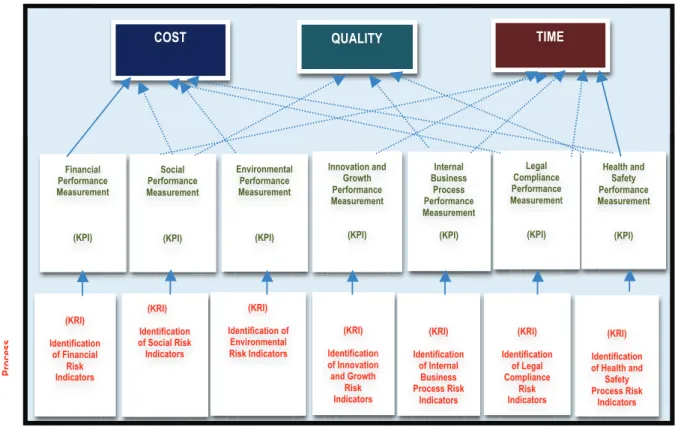
Figure 1 shows schematic of the relationship between Risk and Performance Indicators during Risk Management. The framework is bottom up and starts with the identification of relevant risk factors associated with critical risk factors in Finance, Social, Environmental, Innovation and Growth, Internal Business Process, Legal, Health and Safety amongst others. Globally, over 200 risk factors affecting business performance have been identified in the construction sector (Odimabo and Oduoza, 2015). Within a specific construction project, certain risks are relevant and more likely to affect output which is predominantly cost, quality and time related. Overall, the impacts could be cost overrun, time overrun or substandard quality of delivery. However, identification of key risk indicators early enough either prior or during the early stages of the project could result in steps taken to mitigate, manage or even eliminate the risk entirely in such a way that it doesn’t affect the performance indicators.
Figure 1: Framework for Risk and Performance Indicators in Risk Management
Key risk indicators are deemed project specific and constitute a shortlist of potential risk factors that could affect a project outcome. Decision on how to manage key risk indicators can be made by a combination of expert judgment of a practitioner based on experience and available
It is expected that using RiMaCon software, relevant key risk indicators for a project would be managed by the algorithm which could advise, prescribe or recommend tactical measures to minimise identified risks with a view to sustain high performance on the project. Key risk indicators (KRI) have been mapped with associated key
COST QUALITY TIME
Performance Process Financial Performance Measurement (KPI) Social Performance Measurement (KPI) Environmental Performance Measurement (KPI) l Innovation and Growth Performance Measurement (KPI) Internal Business Process Performance Measurement (KPI) (KRI) Identification of Financial Risk Indicators (KRI) Identification of Social Risk Indicators k (KRI) Identification of Environmental Risk Indicators (KRI) Identification of Innovation and Growth Risk Indicators n n (KRI) Identification of Internal Business Process Risk Indicators k (KRI) Identification of Legal Compliance Risk Indicators (KRI) Identification of Health and Safety Process Risk Indicators e t Legal Compliance Performance Measurement (KPI) t Health and Safety Performance Measurement (KPI)
performance indicators (KPI) and are thought to have an inverse relationship. This implies that strategically, business performance will be maximised if the key negative risks are proactively minimised. Key risk indicators are deemed project specific and constitute a shortlist of potential risk factors that could affect a project outcome. Decision on how to manage key risk indicators can be made by a combination of expert judgment of a practitioner based on experience and available secondary data from relevant literature. Key risk indicators can affect Cost, Quality and Time of delivery of a project either directly or indirectly and therefore would need to be managed adequately to enhance overall project performance.
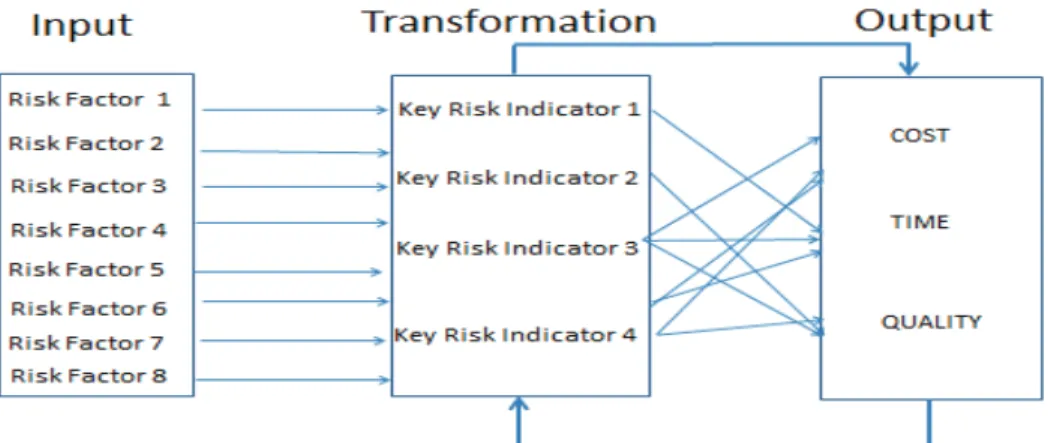
Figure 2 shows the software architecture for a risk management system developed for project management by SMEs in the construction sector. Within the system there is a human interphase that requests input of risk factors that are likely to affect the specific project performance. Next, the algorithm prioritises the risk factors in order of importance and then systematically identifies key risk indicators for this specific project that could impact on cost, quality or time individually or a combination of them. For each objective function the key risk indicators are ranked in order of priority as high, medium or low. Consequently, the user can devote more time and also pay the most attention to high risk factors that could impact negatively on the project outcome and performance.
Figure 2: RiMaCon Risk Management Software Architecture 4. Results and Discussion
4.1 Testing / Simulation Of Software
The software was used to simulate and test project V in the construction sector in Italy. The medium size company was involved in additional construction to a school building and decided to carry out a risk assessment of the project based on available data associated with costing, timing and quality requirements for the project. The output from the software identified the following key risk indicators as those that could potentially affect deliverables on the project.
4.1.1 Cost Related Risk Factors
(1) Insufficient cash flow
(3) Incompatible and inaccurate cost estimates
(4) Loss of equipment / materials at building site
4.1.2 Time Related Risk Factors
(1) Shortage of skilled labour
(2) Accident on site
(3) Low productivity from specialist equipment
(4) Unreliable supply of materials
(5) Unrealistic project completion time
4.1.3 Quality Related Risk Factors
(1) Shortage of skilled labour to perform specialist tasks
(2) Subcontracting / outsourcing issues
(3) Substandard materials used during the project
(4) Difficult soil structure
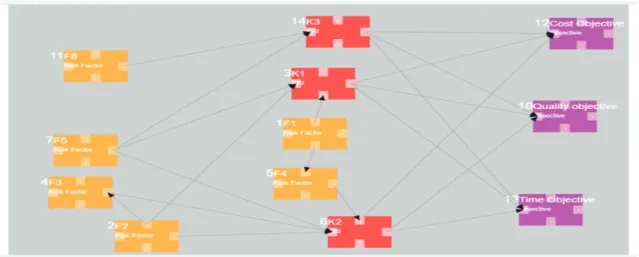
Figure 3 shows a screen shot of the output from the software highlighting the risk factors shown in yellow, key risk factors shown in red and the objectives shown in purple. The arrows depicting a cause and effect relationship describe the link between potential project risk indicators to watch out for and the actual key risk indicators that are finally identified for the project, and then the link between the key risk indicators and the overall impact they have on the various output objectives of cost, quality and time. A variety of risk indicators can connect to a key risk indicator and similarly, a key risk indicator can impact on the three assessment objectives for a specific project. The user can decide which project objective is paramount and can therefore decide to prioritise on the objective which matters for the client in terms of cost, time or quality of delivery.
Figure 3: Screen shot of the software output showing connectivity between risk and key risk indicators and the objectives
The software is capable of learning and can store useful information from previous projects on a data base which it is could recall for application to a future project.
This paper describes the final stage of a study which developed a risk management software system enabling SMEs in the construction sector to manage a variety of risks which potentially can undermine their performance. This user friendly software suitable for all level of users (from inexperienced to expert users) works by initiating a risk assessment of a project, identify potential key risk factors, and establish the likelihood of their impact on the project objectives of cost, quality and time. This would enable the user to proactively manage, mitigate, accept or eliminate these high risk factors prior to project commencement. Some of these factors are so critical that they can affect more than one project objective at a time. It is essential therefore, to manage these high priority risks to enable a successful project outcome. The software is also capable of learning and can store useful information from previous projects on a data base which it is capable to recall for application to a future project.
Overall, the software developed in this study is user friendly, cost effective and dependable and should guide both researchers and industry practitioners especially in the construction sector to proactively manage financial, legislation, environmental, health and safety and operational related risks facing them with a view to enhance business performance.
Acknowledgement
The authors wish to thank the European Commission for sponsorship of this project under EU FP7 Marie Curie Industry Academia Partnerships and Pathways Award: Project No: 324387
References
[1] Aven, T. (2011): On Some Recent Definitions and Analysis Frameworks for Risk, Vulnerability, and Resilience. Risk Analysis, Vol. 31; No. 4; pp. 515 - 522.
[2] Bhatt, G D and Zaveri, J (2002), The enabling role of decision support systems in organizational learning. Decision Support Systems, Vol. 32; pp. 297-309.
[3] Canamares M.S, Escribano B.M.V, Garcia, M.N.G and Barriuso A.R (2017): Occupational risk-prevention diagnosis: A study of construction SMEs in Spain; Safety Science; Vol. 92; pp. 104-115.
[4] Department for Business Innovation and Skills (BIS) (2015): Business population estimates for the UK and regions 2015; Statistical release; available online at https://www.gov.uk/government/uploads/system/uploads/attachment_data/file/467443/bpe_2015_statistical_release.pdf assessed 14/01/17
[5] Enshassi A, Al-Hallaq K and Mohamed S (2006): Causes of contractor’s business failure in developing countries; the case of Palestine; Journal of Construction in Developing Countries; Vol. 11; No. 2; pp. 1-14
[6] Jannadi, O and Almishari, S (2003): Risk assessment in construction. ASCE Journal of Construction Engineering and Management; Vol. 129; No. 5; pp. 492-500.
[7] Khodeir L.M and Mohamed A.H.M (2015): Identifying the latest risk probabilities affecting construction projects in Egypt according to political and economic variables. From January 2011 to January 2013; Housing and Building National Research Center; Vol. 11; pp. 129-135 [8] Lee E, Park Y and Shin J.G (2009): Large engineering project risk management using a Bayesian belief network; Expert system with
Application; Vol. 36; pp. 5880-5887
[9] Odeyinka, H. A, Oladapo, A. A. and Akindele, O. (2006): Assessing Risk Impacts on Construction Cost. Proceedings of the Annual Research; Conference of the Royal Institution of Chartered Surveyors, pp. 7-8; University College London; available online at http://eprints.ulster.ac.uk/10612/1/COBRA_2006_Risk_%2B_Construction_Cost.pdf assessed 16/01/2017
[10] Parvan, K, Rahmandad H and Haghani A (2015): Inter-phase feedbacks in construction projects; Journal of operational management; Vol. 39-40; pp. 48-62.
[11] Rakitin, S (2001): Software Verification and Validation for Practitioners and Managers; Artech House.
[12] Rohaninejad, M and Bagherpour, M. (2013). Application of risk analysis within value management: A case study in DAM engineering. Journal of Civil Engineering and Management, vol. 19: pp. 364-374
[13] Sweis G, Sweis R, Abu Hammad A and Shboul A (2008): Delays in construction projects: The case of Jordan; International Journal of Project Management; Vol. 26; pp. 665-674
[14] Tah, J H M and Carr, V (2001); Knowledge-based approach to construction project risk management; ASCE Journal of Computing in Civil Engineering; Vol. 15; No. 3; pp. 170-177.