Why and How to Differentiate
Complement Raising from Subject
Raising in Dutch
Frank Van Eynde
Centre for Computational Linguistics, University of Leuven
Liesbeth Augustinus
Centre for Computational Linguistics, University of Leuven
Proceedings of the 20th International Conference on Head-Driven Phrase Structure Grammar
Freie Universit¨at Berlin Stefan M¨uller (Editor)
2013 CSLI Publications
pages 222–242
http://csli-publications.stanford.edu/HPSG/2013
Van Eynde, Frank, & Augustinus, Liesbeth. (2013). Why and How to Differentiate Complement Raising from Subject Raising in Dutch. In Stefan M¨uller (Ed.): Pro-ceedings of the 20th International Conference on Head-Driven Phrase Structure Grammar, Freie Universit¨at Berlin(pp. 222–242). Stanford, CA: CSLI Publica-tions.
Abstract
In DutchV-final clauses the verbs tend to form a cluster in which the main verb is separated from its syntactic arguments by one or more other verbs. In
HPSGthe link between the main verb and its arguments is canonically mod-eled in terms ofargument inheritance, also known asargument composition
orgeneralized raising. When applied to Dutch, this treatment yields a num-ber of problems, making incorrect predictions about the interaction with the binding principles and the passive lexical rule. To repair them this paper proposes an alternative, in which subject raising and complement raising are modeled in terms of different devices. More specifically, while subject rais-ing is modeled in terms of lexical constraints, as for English, complement raising is modeled in terms of a more general constraint on headed phrases. This new constraint not only accounts for complement raising out of ver-bal complements, it also deals with complement raising out of adjectival and adpositional complements, as well as with complement raising out ofPP ad-juncts and subjectNPs. It is, hence, a rather powerful device. To prevent overgeneration we add a number of constraints. For Dutch, the relevant con-straints block complement raising out ofCPs,V-initialVPs andP-initialPPs. For English, the Empty COMPSConstraint is sufficient to block complement raising entirely.
1
Introduction
In DutchV-final clauses with more than one verb, the verbs tend to form a cluster, as in (1). (1) ... ... of if Peter Peter het the boek book zal will kunnen can vinden. find ‘... if Peter will be able to find the book.’
The result of this clustering is that the main verb, i.c. vinden‘find’, is separated from its syntactic arguments by other verbs, i.c. the future zal ‘will’ and the modalkunnen ‘can’. To model the relation between the main verb and its argu-ments, Head-driven Phrase Structure Grammar canonically employs the device of argument inheritance, also known asargument compositionorgeneralized raising (Hinrichs & Nakazawa, 1989, 1994). In this paper we first present the Argument Inheritance analysis and apply it to (1) (section 2). Then, we show that the ap-plication to Dutch yields a number of problems (section 3), and we propose an alternative (section 4).
†
We thank the audiences of the Workshop on Structure and Evidence in Linguistics, better known
as the Ivan Sag Fest (Stanford, April 28-30), and of theHPSG2013 conference (Berlin, August 28-29)
for their comments. The research presented in this paper is part of a project on complement raising and cluster formation in Dutch, sponsored by FWO Vlaanderen (2011-2015, G.0.559.11.N.10).
2
Argument inheritance
Building on a GPSG proposal in Johnson (1986), Hinrichs & Nakazawa (1989) argue that the German verb cluster is a constituent with a binary branching structure to which the arguments of the main verb are added one at a time. Applying this to the Dutch construction in (1) yields the phrase structure in (2).
(2) S N Peter VP NP het boek V V zal V V kunnen V vinden
The relation between the main verb and its arguments is modeled in terms of the
SUBCAT(EGORIZATION) values of the verbs. The one of the main verb vinden
‘find’ is a list which contains twoNPs. TheSUBCATvalues of the other verbs are
more complex: They take a verbal complement as their most oblique argument, and inherit theSUBCATlist of that verbal complement, as in (3), after Hinrichs & Nakazawa (1994). (3) SUBCAT A ⊕ * LOCAL|CAT " HEAD verb SUBCAT A # +
Adding this information to (2) yields (4). (4) S=V[SUBCAT < >] 1N Peter VP=V[SUBCAT <1>] 2NP het boek V[SUBCAT <1,2>] V[SUBCAT <1 ,2 ,3>] zal 3V[SUBCAT <1 ,2>] V[SUBCAT <1 ,2 ,4>] kunnen 4V[SUBCAT <1,2>] vinden
The modalkunnen‘can’ selects the bare infinitivevinden‘find’ (4) as well as the
arguments of that infinitive (1 and 2), and the resulting cluster (3) is selected by the futurezal‘will’, which also inherits the arguments of the cluster. The net result is that the combinationzal kunnen vinden‘will be able to find’ has the same
SUBCAT list as vinden‘find’. At that point, the direct object and the subject are
added and the corresponding SUBCAT requirements in the verbal projection are discarded in the usual way.
In more recent versions ofHPSG,SUBCATis replaced with the valence features
SUBJ(ECT) andCOMP(LEMENT)S, on the one hand (Pollard & Sag, 1994, chapter 9),1 and by the lexical ARG-ST feature, on the other hand (Miller & Sag, 1997).
Expressing argument inheritance in this notation yields (5).
(5) ARG-ST D 1 E ⊕ A ⊕ * LOCAL|CAT HEAD verb SUBJ D 1 E COMPS A +
The arguments are differentiated, depending on whether they are realized as sub-jects or as complements, and both are added to theARG-ST list of the selecting verb. Application to (1) yields the phrase structure in (6).2
(6) V[SUBJ< >,COMPS< >] 1N Peter V[SUBJ<1>,COMPS< >] 2NP het boek V[SUBJ<1>,COMPS<2>] V[SUBJ <1>,COMPS<2,3>] zal 3V[SUBJ <1>,COMPS<2>] V[SUBJ <1>,COMPS<2,4>] kunnen 4V[SUBJ <1>,COMPS<2>] vinden
The argument inheritance treatment has turned out to be very influential in
HPSGtreatments of German and Dutch: Something along the lines of either (3) or (5) was adopted in amongst others Rentier (1994), Bouma & Van Noord (1998),
1
There is a third valence feature (SP(ECIFIE)R) that is mainly used to model the selection of a determiner by a nominal. It is omitted here since it does not play any role in the treatment of argument inheritance, see also Van Eynde (2006).
2
It has been argued that the first argument of a finite verb is a complement in German, see M¨uller
(2002). If that assumption is adopted for Dutch, 1 is on theCOMPSlist of the future auxiliary.
Kathol (2000, chapter 8), and M¨uller (2002, chapter 2). It was also adopted for the treatment of clitic climbing in the Romance languages, as in Abeill´e et al. (1998) for French and Monachesi (1998) for Italian.
3
Why to differentiate complement raising from subject
raising
A common property of the argument inheritance proposals is that subjects and complements are raised in the same way: They are both integrated in theSUBCAT
list, c.q. theARG-STlist, of the selecting verb. This is in fact the reason why argu-ment inheritance is also known asgeneralized raising. What will be argued now is that complement raising ought to be differentiated from subject raising, at least for Dutch. The evidence comes from three sources. They concern the occurrence of complement raising with subject control verbs, the binding properties of subject-to-object raisers, also known as ACI verbs (Accusativus cum Infinitivo), and the interaction of complement raising and the passive lexical rule.
3.1 Subject control verbs and complement raising
The formulation of argument inheritance in (5) allows for the occurrence of subject raising without complement raising, since A may be the empty list.3 What (5) does not allow, though, is the occurrence of complement raising without subject raising: TheSUBJlist of the selected verb is required to contain onesynsem, and thatsynsemmust be identical to the first argument of the selecting verb.
This constraint now is too strict, since complement raising also occurs with subject control verbs, such aswillen ‘want’ andproberen ‘try’. Some instances are provided by the following sentences, taken fromLASSY, a treebank for writ-ten Dutch (Van Noord et al., 2013). The control verbs are in bold and the raised complements in italics. (7) Kasparov Kasparov beschuldigde accused Gorbatsjov Gorbatsjov ervan there-of dat that hij he het the bloedvergieten bloodshed niet not had had willen want.IPP stoppen. stop.INF
‘Kasparov accused Gorbatsjov that he had not wanted to stop the blood-shed.’ [LASSY, dpc-ind-001648-nl-sen.p.19.s.6]
(8) ... ... nadat after ze she zowel both de the PS PS als and de the PRL PRL te as vriend friend had had proberen try.IPP te to houden. keep.INF 3
In fact, if A is declared empty, one gets the constraint which is characteristic of the English
‘... after she had tried to keep both the PS and the PRL as an ally.’ [LASSY, WR-P-P-I-0000000106.p.7.s.6]
Notice that the control verbs in these sentences are affected by theIPPphenomenon (Infinitivus pro Participio), i.e. the use of the infinitive instead of the past participle in combination with the perfect auxiliary. They also allow complement raising, though, when they are not affected byIPP, as illustrated by (9), quoted from the
CGNtreebank, a treebank for spoken Dutch (Oostdijk et al., 2002).4
(9) ja yes en and en and ik I heb have ’r her geprobeerd try.PSP te to bellen call.INF maar but d’r there werd was niet not opgenomen picked-up . . . . . .
‘yes and and I’ve tried to call her but there was no reply’ [CGN, fna000583 351]
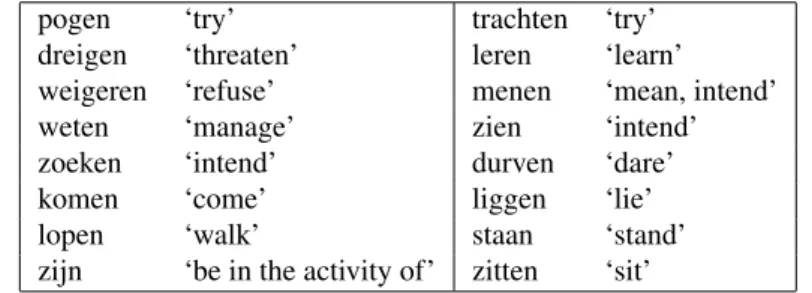
Summing up, subject control verbs are obviously not subject raisers, but they do allow complement raising, both in clustering constructions and in the third con-struction. Besideswillen‘want’ andproberen‘try’, they include the verbs in Table 1 (Augustinus & Van Eynde, 2012).
pogen ‘try’ trachten ‘try’ dreigen ‘threaten’ leren ‘learn’ weigeren ‘refuse’ menen ‘mean, intend’ weten ‘manage’ zien ‘intend’ zoeken ‘intend’ durven ‘dare’ komen ‘come’ liggen ‘lie’
lopen ‘walk’ staan ‘stand’
zijn ‘be in the activity of’ zitten ‘sit’
Table 1: Other subject control verbs that allow complement raising
Since the argument inheritance constraint in (5) does not subsume the subject control verbs, we need a separate constraint to model the complement raising in clauses like (7–9): (10) ARG-ST D NP1 E ⊕ A ⊕ * LOCAL|CAT HEAD verb SUBJ D NP1 E COMPS A +
Complying with the way in which subject control verbs are canonically differ-entiated from subject raising verbs (Pollard & Sag, 1994; Sag et al., 2003), this
4
This is an instance of the so-called third construction (den Besten et al., 1988; den Besten & Rutten, 1989).
constraint requires the unexpressed subject of the selected verb to share its index with the first argument of the selecting verb, rather than its entiresynsem value. This addition of an extra constraint is by itself unobjectionable, but it does raise the suspicion that we are missing a generalization.
3.2 Subject-to-object raisers and the binding principles
In HPSG, the binding principles are canonically defined in terms of obliqueness relations in theARG-STlist (Pollard & Sag, 1994; Sag et al., 2003).
Principle A: An anaphoric pronoun must be coindexed with a less oblique argument on the sameARG-STlist.
Principle B: A nonanaphoric NP may not be coindexed with a less oblique argument on the sameARG-STlist.
Assuming that raised subjects are integrated in theARG-STlist of the selecting verb, this makes the right prediction for the subject-to-object raiserziet ‘sees’ in (11). (11) a. ... ... dat that hiji hei zichi/∗j himselfi/∗j die that wedstrijd game niet not meteen immediately ziet sees winnen. win ‘... that he does not expect himself to win that game rightaway.’ b. ... ... dat that hiji hei hemj/∗i himj/∗i die that wedstrijd game niet not meteen immediately ziet sees winnen. win ‘... that he doesn’t expect him to win that game rightaway.’
The raised reflexive pronounzich‘himself’ in (11a) must be coindexed with the subject ofziet‘sees’, yielding the interpretation that he does not expect himself to win the contest. Similarly, the raised personal pronounhem ‘him’ in (11b) can-not be coindexed with the subject ofziet, yielding the interpretation that he does not expect that person to win the contest. Raised subjects thus behave as bona fidearguments of the matrix verb, as illustrated by theARG-STlist ofzietfor the
sentences in (11).
(12) a. ziet:ARG-ST<NPi, 1 NPi/∗j, (...,)V[SUBJ <1>]> b. ziet:ARG-ST<NPi, 1 NPj/∗i, (...,)V[SUBJ <1>]> Raised complements, by contrast, show the opposite behavior. (13) a. * ... ... dat that hiji hei ons us zichi himselfi niet not meteen immediately ziet sees uitschakelen. eliminate b. ... ... dat that hiji hei ons us hemi/j himi/j niet not meteen immediately ziet sees uitschakelen. eliminate ‘... that he doesn’t expect us to eliminate him rightaway.’
If the raised reflexive pronoun in (13a) is integrated in theARG-STlist ofzietand coindexed with its subject, as in (14a), then it complies with binding principle A, but the sentence is nonetheless illformed. Conversely, if the raised personal pro-noun in (13b) is integrated in theARG-STlist ofzietand coindexed with its subject, as in (14b), it violates binding principle B, but this interpretation is impeccable.
(14) a. ziet:ARG-ST<NPi, 1 NP, 2 NPi,V[SUBJ<1>,COMPS<2>]>
b. ziet:ARG-ST<NPi, 1 NP, 2 NPi/j,V[SUBJ<1>,COMPS<2>]>
As a consequence, we either need to tinker with the binding principles, or we have to treat the raised complements in another way than the raised subjects, inte-grating the latter but not the former in theARG-STlist of the selecting verb. 3.3 Passive and complement raising
HPSGcanonically treats passivization in terms of a lexical rule which reshuffles the
order of the arguments on theARG-STlist, as in (15), after (Sag et al., 2003, p.313).
(15) tv-lxm PHON A ARG-ST D NPi E ⊕ B =⇒LR PHON Fpsp A
SS|LOC|CAT|HEAD|VFORM pas
ARG-ST B ⊕ PPi
This rule relates a transitive verbal lexeme to its participial form, fixing theVFORM
value topassiveand changing the order in theARG-STlist: The second argument of the verbal lexeme becomes the first argument of its passive counterpart.
Assuming that raised subjects are integrated in theARG-STlist of the selecting verb, this makes the right prediction for the subject-to-object raiserexpectin (16).
(16) a. We expect them to leave tomorrow. b. They are expected to leave tomorrow.
Since the noun phrase which is realized by themis the second argument of the lexemeexpect, it can become the first argument of its passive counterpartexpected.
Raised complements, by contrast, behave differently, as illustrated in (17). (17) a. ... ... dat that hij he ons us probeerde tried het huis the te house verkopen. to sell
‘... that he tried to sell us the house.’ b. * ... ... dat that wij we werden were geprobeerd tried het the huis house te to verkopen. sell
The italicized complement of verkopen‘sell’ in (17a) is raised and realized as a dependent of the subject control verbproberen‘try’, but in contrast to the raised subject in (16) it cannot become the first argument of the passivegeprobeerd‘tried’.
As a consequence, if we want to preserve a treatment of passivization in terms of reshuffling along the lines of (15), then we should not integrate the raised comple-ments in theARG-STlist of the selecting verb.
4
An alternative treatment of complement raising
The development of the alternative proceeds in four steps. First, we differentiate complement raising from subject raising. Second, we differentiate complement raising from complement extraction. Third, we show how the new treatment of complement raising naturally extends to a number of other phenomena, including adposition stranding. Fourth, we propose some constraints on complement raising. 4.1 Complement raising versus subject raising
In order to avoid the problems in the interaction with the binding principles and the passive lexical rule, we assume that raised subjects are integrated in theARG-ST
list of the selecting verb, while raised complements are not.
For the treatment of subject raising this implies that we can use the same lexical constraints as those that are used for English, i.e. one for subject-to-subject raisers and one for subject-to-object raisers, as in (18) (Ginzburg & Sag, 2000, 22).5
(18) a. s-rsg-lx ⇒ [ARG-ST h[LOC 1] , [SUBJ hLOC 1i]i] b. orv-lx ⇒ [ARG-ST hNP, [LOC 1] , [SUBJ hLOC 1i]i] A treatment in terms oflexicalconstraints is appropriate since the two types sub-sume a limited number of verbs. The subject raising lexemes (s-rsg-lx), for in-stance, include the modal, temporal and passive auxiliaries, while the object raising lexemes (orv-lx) include a number of perception verbs and causative verbs.
For the treatment of complement raising, by contrast, we adopt the following
phrasalconstraint.
(19)
hd-ph
SS|LOC|CAT|COMPS list ⊕ Z
NONHEAD-DTR|SS|LOC|CAT|COMPS Z
In a headed phrase, the COMPS list of the nonhead daughter is appended to the
COMPSlist of the mother.6 The Z list may be empty, but it may also contain one
or more members. In (20), for instance, which is our representation of (1), Z corresponds to<2>.
5In this version, the sharing is limited to the objects of typelocal. In other versions, including
that of Pollard & Sag (1994), the sharing concerns objects of typesynsem. Nothing in this paper
hinges on that distinction.
6
In a non-headed phrase, such as a coordinate phrase, theCOMPSlist of the mother is identical to
(20) V[SUBJ< >,COMPS< >] 1N Peter V[SUBJ<1>,COMPS< >] 2NP het boek V[SUBJ<1>,COMPS<2>] V[SUBJ<1>,COMPS<3>] zal 3V[SUBJ<1>,COMPS<2>] V[SUBJ<1>,COMPS<4>] kunnen 4V[SUBJ<1>,COMPS<2>] vinden
Notice that the modalkunnen‘can’ inherits the subject requirement of its infinitival complement, but not its COMPS list. The latter is propagated directly from the
nonhead daughter to the mother. The same holds for the futurezal‘will’: It inherits theSUBJlist of its infinitival complement, but not itsCOMPSlist.
Small as it is, this difference provides exactly what we need to avoid the prob-lems with the argument inheritance treatment: It allows for complement raising in cases where there is no subject raising, and it does not integrate the raised comple-ments in theARG-STlist of the selecting verb.
4.2 Complement raising versus complement extraction
Complement raising need not only be differentiated from subject raising, but also from complement extraction. The latter concerns a long distance dependency that may cross clause boundaries, as in (21–22).
(21) Who do you think she said she would date? (22) Wie who beweert claims ze she dat that ze they in in Parijs Paris ontmoet met hebben? have ‘Who does she claim they met in Paris?’
The complements ofdateandontmoet‘met’ are extracted and realized as a filler of the main clause. In HPSG, this is modeled in terms of a lexical rule which
subtracts elements from theCOMPSlist and adds them to the nonlocalSLASHlist, see (Ginzburg & Sag, 2000).
Complement raising, by contrast, is a middle distance dependency, and does not cross clause boundaries. To make this more precise let us adopt some notions of topological field theory, i.e. the analysis of the clause in terms of two poles (Satzklammer) and three fields (Vorfeld, Mittelfeld, Nachfeld). This style of anal-ysis has been very influential in Dutch and German descriptive syntax (Haeseryn et al., 1997; Dudenredaktion, 2006), and some of its insights and terminology have
been imported inHPSG (Kathol, 2000; M¨uller, 2002). Pursuing in this direction let us make the assumption that complements cannot be raised beyond the first pole (linke Satzklammer). This is the position that is taken by the complementizer in verb-final clauses and by the finite verb in verb-initial clauses, i.e. V1 and V2
clauses.
That complementizers are a boundary for complement raising is illustrated in (23). (23) a. . . . dat . . . that ze she beweert claims dat that ze they hem him in in Parijs Paris ontmoet met hebben. have ‘. . . that she claims that they met him in Paris.’
b. * * . . . dat . . . that ze she hem him beweert claims dat that ze they in in Parijs Paris ontmoet met hebben. have
The italicized complement ofontmoet‘met’ cannot be raised out of the clause that is introduced by the complementizerdat‘that’.
That finite verbs are a boundary for complement raising is less obvious, since it is possible to realize the complement of the main verb in the Vorfeld, as in (24).
(24) Dat that boek book zal shall Peter Peter toch anyway niet not kunnen can vinden. find ‘That book, Peter will not be able to find anyway.’
Notice, though, that this is an instance of topicalization, and that topicalization is canonically treated as a long distance dependency inHPSG, amongst others because
it can cross clause boundaries, as in (25). (25) That man I wish I had never known.
A useful test for differentiating topicalization from complement raising in Dutch is exemplified by the contrast in (26).
(26) a. Peter Peter zal shall jou/je you/you.RED toch anyway niet not kunnen can vinden. find ‘Peter will not be able to find you anyway.’ b. Jou/*je you/*you.RED zal shall Peter Peter toch anyway niet not kunnen can vinden. find ‘Me Peter will not be able to find anyway.’
Pronominal complements can be raised out of a verb cluster, as in (26a), no matter whether they take the full form or a phonologically reduced form, i.e. a form with a mute vowel or without vowel. Extraction, by contrast, as in (26b), is only possible for the full form (Van Eynde, 1999).7
7
This restriction holds for extractedcomplements. Subjects may always occur in the Vorfeld, no
Taking stock, the middle distance nature of complement raising is clear from the fact that it cannot go beyond the first pole: It is bounded by the complemen-tizer in verb-final clauses and by the finite verb in verb-initial clauses. How these constraints can be spelled out in formal terms is discussed in section 4.4.
4.3 Extensions
So far, we have focussed on complement raising out of nonfinite verbal comple-ments. This, however, is not the only type of raising that the phrasal constraint in (19) allows. It also allows raising out of nonverbal complements, since it does not put any constraints on the syntactic category of the nonhead daughter. Moreover, it also allows raising out of subjects and adjuncts, since (19) applies to all headed phrases.
4.3.1 Complement raising out of nonverbal complements
Some examples of complement raising out of adjectival complements are given in (27–28). (27) . . . dat . . . that we we die that hittegolf heat wave nog still steeds always niet not kwijt lost zijn! are
‘. . . that we are not finished with that heat wave yet!’ [LASSY, WS-U-E-A-0000000221.p.32.s.2] (28) . . . dat . . . that de the bevolking people van of Zimbabwe Zimbabwe haar her huisbakken home-grown dictator dictator onderhand by now meer more dan than beu fed-up is. is
‘. . . that the people of Zimabwe are more than fed up with their homegrown dictator by now.’ [LASSY, WR-P-P-I-0000000219.p.4.s.4]
The italicized nominals are complements of the predicative adjectives in bold, but they are not realized within theAP. Instead, they are raised and realized in the left
part of the Mittelfeld, preceding theVPadjuncts.
Complement raising also subsumes the instances of adposition stranding in (29–30).8 (29) . . . dat . . . that zij she daar there nog still wel rather van of hield. liked
‘. . . that she rather liked it.’ [CGN, fna000741 12] (30) . . . als . . . if je you er there pas only achteraf later over about nadenkt, think-of, is is het it misschien maybe te too laat. late 8
For a treatment of adposition stranding in Dutch, see a.o. Van Riemsdijk (1978) and Beeken (1991).
‘. . . if you only think about it afterwards, it may be too late.’ [LASSY, WR-P-P-C-0000000047.txt-10]
Also here, the italicized pronouns are complements of the adpositions in bold, but they are not realized within thePP. Instead, they are raised and realized in the left
part of the Mittelfeld, preceding theVPadjuncts, as illustrated by the representation of (29) in (31). (31) V[SUBJ< >,COMPS< >] 1N zij V[SUBJ<1>,COMPS< >] 3 N daar V[SUBJ<1>,COMPS<3>] ADVP nog wel V[SUBJ<1>,COMPS<3>] 2P[SUBJ< >,COMPS<3>] van V[SUBJ<1>,COMPS<2>] hield
The unsaturatedCOMPSrequirement of the adposition (3) is inherited by the ver-bal projection and discharged after the addition ofdaar ‘there’. Notice that the adposition has an emptySUBJlist, in accordance with the canonicalHPSG assump-tion that argument marking adposiassump-tions do not select a subject. In the context of this paper, it provides further evidence for the claim that complement raising may occur in environments where there is no subject raising.
Since there are adjectives which take adpositional complements, complement raising can be applied iteratively, as in (32).
(32) ... ... dat that hij he daar there niet not blij happy mee with is. is ‘... that he is not happy with that.’
The pronominal complementdaar‘there’ is first raised out of thePP, then out of the predicativeAP, and finally out of theV-finalVP, as illustrated in (33).
(33) V[SUBJ<1>,COMPS< >] 4 N daar V[SUBJ<1>,COMPS<4>] ADV niet V[SUBJ<1>,COMPS<4>] 2 AP[COMPS<4>] ADJ[COMPS<3>] blij 3 P[COMPS<4>] mee V[SUBJ<1>,COMPS<2>] is
This is comparable to the iterative subject raising in sequences like (34). (34) He does not seem to be likely to win this game.
The surface subject ofdoes is the understood subject of win this game, and the relation is mediated by a sequence of subject raising lexemes, includingto,likely, be,seemanddoes.
4.3.2 Complement raising out of functors and subjects
The previous examples all concerned raising out of complements, but the constraint on complement raising in (19) does not require this: It also allows the nonhead daughter to be a functor or a subject. (35), for instance, is an example of comple-ment raising out of aPPadjunct.
(35) ... ... dat that hij he er there veel many verliezen losses door by heeft has geleden. suffered ‘... that he suffered many losses because of it.’
The italicized pronoun is a complement of the adpositiondoor‘by’ and the latter heads aPPadjunct that specifies the cause of the losses.
Raising out of subjects is exemplified in (36). (36) ... ... dat that er there nog still maar but twee two van of klaar ready zijn. are ‘... that only two of them are ready.’
The italicized pronoun is a complement of the adpositionvan ‘of’, which heads thePPadjunct of the cardinaltwee‘two’ which in its turn heads the subject of the clause, as spelled out in (37).
(37) V[SUBJ<1>,COMPS< >] 4 N er V[SUBJ<1>,COMPS<4>] ADV nog maar V[SUBJ <1>,COMPS<4>] 1 NP[COMPS<4>] N twee P[COMPS<4>] van V[SUBJ <1>,COMPS< >] klaar zijn 4.4 Constraints
Given the treatment of complement raising in terms of a phrasal —rather than a lexical— constraint and given the rather permissive nature of its formulation in (19), an obvious question is whether it is not too permissive. The equally obvious answer is that excessive permissivity can be avoided by the addition of extra con-straints on (19). To show how this can be done we first discuss English and then return to Dutch.
4.4.1 English
English is a language that allows subject raising and complement extraction, but assuming that it obeys the EmptyCOMPSConstraint, as defined in Ginzburg & Sag (2000, 33), it does not allow complement raising.
(38) EmptyCOMPSConstraint (Ginzburg & Sag, 2000, 33) phrase:
COMPS
D E →
...
Indeed, if phrases are required to have an empty COMPSlist, then it follows that the Z list in the phrasal constraint on complement raising in (19) must be empty and, hence, that complement raising is blocked.
The fact that English allows adposition stranding does not provide any evidence against this assumption, since the stranding invariably results from complement extraction, as in (39).
(39) a. Whatdo you think they were talkingabout? b. ThisI would never dare talkaboutin her presence.
Stranding that results from complement raising, as in (40), is not possible. (40) a. * John heard usthistalkabout.
b. * We saw himthatgive a talkabout.
In that respect, English differs from Dutch, where the equivalents of (40) are well-formed. (41) a. Jan Jan heeft has er there ons us over about horen hear praten. talk ‘Jan heard us talk about it.’
b. We we hebben have hem him daar there een a lezing talk over about zien see geven. give ‘We saw him give a talk about that.’
In sum, the addition of the EmptyCOMPSConstraint suffices to rule out com-plement raising from the language.
4.4.2 Dutch
Since Dutch does not abide by the EmptyCOMPSConstraint, it allows complement raising, but this does not mean that its complements can be raised anywhere. For a start, they cannot be raised beyond the first pole, as demonstrated in section 4.2. To model this for the case in which the first pole is a complementizer we add the constraint in (42). (42) hd-ph SS|LOC|CAT HEAD complementizer COMPS D E
Phrases which are headed by a complementizer are required to have an empty
COMPSlist. This suffices to block complement raising out ofCPs.9
If the first pole is a finite verb, we need an extra feature to model the relevant constraint. We call itPOSITIONand add it to theHEADvalues of verbs. Its possible values are given in (43).
(43) position
initial final
In terms of this dichotomy, the nonfinite verbs are invariablyfinaland the im-perative formsinitial. The other finite forms can occur in either position, and hence receive the underspecifiedpositionvalue.10
9It does not block complement extraction, though, since it does not require the
SLASHvalue of a
CPto be empty.
10The term
final nonfinite forms initial imperative forms
position nonimperative finite forms Table 2: Three types of verb forms
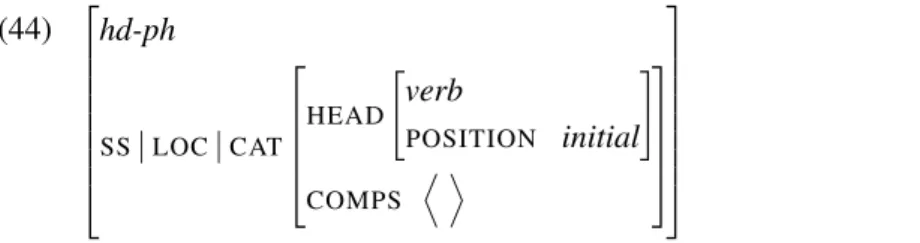
With this addition the constraint which blocks complement raising out of V -initialVPs can now be spelled out as in (44).
(44) hd-ph SS|LOC|CAT HEAD " verb POSITION initial # COMPS D E
Phrases which are headed by a verb that is inV-initial position, are required to have an emptyCOMPSlist, just likeCPs.
Together, the constraints in (42) and (44) model the fact that complements cannot be raised beyond the first pole. As such, they capture what differentiates complement raising from complement extraction.
A less conspicuous constraint concerns the raising out ofPPs. To pave the way for its treatment we start from the observation that Dutch adpositions come in three types: There are those that invariably follow their complement, such astoe‘to’ and mee‘with’, there are those that invariably precede their complement, such astot ‘to, till’ andmet‘with’, and there are those that can precede as well as follow their complement, such asin‘in’ andvan‘of’. Table 3 provides a survey.
final mee, toe, af, heen
initial met, tot, te, sinds, sedert, als, tijdens, wegens, volgens, ... position in, op, van, aan, bij, door, ...
Table 3: Three types of adpositions
The distinction is not only relevant to treat the linear order within the PP, it also
correlates with some other facts. Realization in the Nachfeld, for instance, also known as PP-over-V, is possible for P-initial PPs, as shown in (45), but not for
P-finalPPs, as shown in (46–47). (45) a. ... ... dat that we we nog still steeds always [op for een a goede good afloop] outcome hopen. hope ‘... that we are still hoping for a good outcome.’ b. ... ... dat that we we nog still steeds always hopen hope [op for een a goede good afloop]. outcome ‘... that we are still hoping for a good outcome.’
(46) a. ... ... dat that we we nog still steeds always [daar there op] for hopen. hope ‘... that we are still hoping for that.’ b. * ... ... dat that we we nog still steeds always hopen hope [daar there op]. for (47) a. ... ... dat that hij he voorzichtig carefully [de the garage garage in] in reed. drove ‘... that he drove carefully into the garage.’ b. * ... ... dat that hij he voorzichtig carefully reed drove [de the garage garage in]. in
Conversely, complement raising is possible out ofP-finalPPs, as shown in (48– 49), but not out ofP-initialPPs, as shown in (50).
(48) a. ... ... dat that we we nog still steeds always [daar there op] for hopen. hope ‘... that we are still hoping for that.’ b. ... ... dat that we we daar there nog still steeds always op for hopen. hope ‘... that we are still hoping for that.’ (49) a. ... ... dat that hij he voorzichtig carefully [de the garage garage in] in reed. drove ... that he drove carefully into the garage.’ b. ... ... dat that hij he de the garage garage voorzichtig carefully in in reed. drove ... that he drove carefully into the garage.’ (50) a. ... ... dat that we we nog still steeds always [op for een a goede good afloop] outcome hopen. hope ‘... that we are still hoping for a good outcome.’ * ... ... dat that we we een a goede good afloop outcome nog still steeds always op for hopen. hope
To model the constraint that complements cannot be raised out ofP-initialPPs we propose a constraint that resembles the one in (44).
(51) hd-ph SS|LOC|CAT HEAD " adposition POSITION initial # COMPS D E
(51) requires theP-initialPPs to have an emptyCOMPSlist, just like theV-initial
VPs and theCPs.
When this constraint is combined with the observations about PP-over-V, it correctly accounts for the fact that adpositions cannot be stranded in the Nachfeld.
(52) a. * ... ... dat that we we een a goede good afloop outcome nog still steeds always hopen hope op for b. * ... ... dat that hij he daar there nog still steeds always hoopt hopes op for c. * ... ... dat that hij he de the garage garage voorzichtig carefully reed drove in in
(52a) is illformed, since (51) does not allow to raise a complement out of aP-initial
PP, and (52b–52c) are illformed, sinceP-finalPPs are not allowed in the Nachfeld. Given that complementizers are invariablyCP-initial, at least in the Germanic and the Romance languages, it is tempting to replace the three constraints with one more general constraint, blocking complement raising out of all head-initial phrases. This, however, would be too strict, since it is possible to raise comple-ments out of head-initialAPs andNPs, as shown in (33) and (37), respectively.
Further investigation will reveal whether the three constraints suffice to pre-vent overgeneration and whether it is possible to formulate them in more general terms. What is noteworthy, though, is that they mesh remarkably well with the fact that English does not allow complement raising, since EnglishVPs andPPs are invariably head-initial.
5
Conclusion
To model the raising of complements out of verb clusters HPSG canonically em-ploys the device of argument inheritance, also known as argument composition orgeneralized raising(section 2). When applied to Dutch, its interaction with the binding principles and the passive lexical rule yields erroneous predictions (section 3). As an alternative, we propose to employ different devices for subject raising and complement raising: While the former is modeled in terms of lexical constraints, as in English, the latter is modeled in terms of a constraint on headed phrases (sec-tion 4). This constraint also subsumes other instances of complement raising, such as adposition stranding in Dutch. In order to avoid overgeneration, we added a number of constraints to prevent complement raising out ofCPs,V-initialVPs and
P-initialPPs.
In future work we will further explore the ramifications of this proposal for Dutch, investigating when complement raising is obligatory and when it is optional. We also intend to explore the potential of this proposal for the treatment of middle distance dependencies in other languages, such as clitic climbing in the Romance languages and clustering in German.
References
Abeill´e, Anne, Dani`ele Godard, Philip Miller & Ivan A. Sag. 1998. French bounded dependencies. In S. Balari & L. Dini (eds.), Romance in HPSG, 1– 54. Stanford: CSLI Publications.
Augustinus, Liesbeth & Frank Van Eynde. 2012. A Treebank-based Investigation of IPP-triggering Verbs in Dutch. In I. Hendrickx, S. K¨ubler & K. Simov (eds.), Proceedings of TLT 11, 7–12. Lisbon: Colibri.
Beeken, Jeannine. 1991. Spiegelstructuur en variabiliteit. pre- en postposities in het Nederlands: University of Leuven dissertation.
den Besten, Hans & Jean Rutten. 1989. On Verb Raising, Extraposition and Free Word Order in Dutch. In D. Jaspers, W. Klooster, Y. Putseys & P. Seuren (eds.), Sentential Complementation and the Lexicon: Studies in Honour of Wim de Geest, 41–56. Dordrecht: Foris.
den Besten, Hans, Jean Rutten, Tonjes Veenstra & Joop Veld. 1988. Verb Raising, Extrapositie en de Derde Constructie. Unpublished manuscript.
Bouma, Gosse & Gertjan Van Noord. 1998. Word Order Constraints on Verb Clus-ters in German and Dutch. In E. Hinrichs (ed.), Complex Predicates in Non-derivational Syntax, New York: Academic Press.
Dudenredaktion. 2006. DUDEN. Die Grammatik. Unentbehrlich f¨ur richtiges Deutsch. Mannheim/Leipzig/Vienna/Z¨urich: Dudenverlag.
Ginzburg, Jonathan & Ivan A. Sag. 2000. Interrogative Investigations. Stanford: CSLI Publications.
Haeseryn, Walter, K. Romijn, Guido Geerts, J. de Rooij & Maarten C. van den Toorn. 1997. Algemene Nederlandse spraakkunst. Nijhoff and Wolters Plantyn. Hinrichs, Erhard & Tsuneko Nakazawa. 1989. Flipped out: AUX in German. In Papers from the 25th Regional Meeting of the Chicago Linguistic Society, 193– 202. Chicago.
Hinrichs, Erhard & Tsuneko Nakazawa. 1994. Linearizing AUXs in German Ver-bal Complexes. In J. Nerbonne, K. Netter & C. Pollard (eds.),German in Head-driven Phrase Structure Grammar, 11–37. Stanford: CSLI Publications. Johnson, Mark. 1986. A GPSG account of VP structure in German. Linguistics
24. 871–882.
Kathol, Andreas. 2000. Linear Syntax. Oxford University Press.
Miller, Philip H. & Ivan A. Sag. 1997. French Clitic Movement without Clitics or Movement.Natural Language and Linguistic Theory15. 573–639.
Monachesi, Paola. 1998. Decomposing Italian clitics. In S. Balari & L. Dini (eds.), Romance in HPSG, 305–357. Stanford: CSLI Publications.
M¨uller, Stefan. 2002.Complex Predicates. Stanford: CSLI Publications.
Oostdijk, Nelleke, Wim Goedertier, Frank Van Eynde, Louis Boves, Jean-Pierre Martens, Michael Moortgat & Harald Baayen. 2002. Experiences from the Spo-ken Dutch Corpus Project. In M. Gonzalez Rodriguez & C.P. Saurez Araujo (eds.),Proceedings of LREC 3, 340–347. Paris.
Pollard, Carl & Ivan Sag. 1994. Head-driven Phrase Structure Grammar. Stan-ford/Chicago: CSLI Publications and University of Chicago Press.
Rentier, Gerrit. 1994. Dutch Cross Serial Dependencies in HPSG. InProceedings of COLING 94, 818–822. Kyoto, Japan.
Sag, Ivan A., Thomas Wasow & Emily Bender. 2003. Syntactic Theory. a Formal Introduction. Second Edition. Stanford, California: CSLI Publications.
Van Eynde, Frank. 1999. Major and minor pronouns in Dutch. In G. Bouma, E. Hinrichs, G.-J. Kruijff & R. Oehrle (eds.),Constraints and Resources in Nat-ural Language Syntax and Semantics, 137–151. Stanford: CSLI Publications. Van Eynde, Frank. 2006. NP-internal agreement and the structure of the noun
phrase. Journal of Linguistics42. 139–186.
Van Noord, Gertjan, Gosse Bouma, Frank Van Eynde, Dani¨el de Kok, Jelmer van der Linde, Ineke Schuurman, Erik Tjong Kim Sang & Vincent Vandeghinste. 2013. Large Scale Syntactic Annotation of Written Dutch: Lassy. In P. Spyns & J. Odijk (eds.),Essential Speech and Language Technology for Dutch, 147–164. Springer.
Van Riemsdijk, Henk. 1978. A Case Study in Syntactic Markedness. Lisse: The Peter de Ridder Press.