Challenges in establishing waste-to-energy projects in
developing countries with a case study from India
ASTHANA, Abhishek, MUKHERJEE, Sanjay, MISRA, Gyan Prakash and
BABBAR, Puneet
Available from Sheffield Hallam University Research Archive (SHURA) at:
http://shura.shu.ac.uk/26068/
This document is the author deposited version. You are advised to consult the
publisher's version if you wish to cite from it.
Published version
ASTHANA, Abhishek, MUKHERJEE, Sanjay, MISRA, Gyan Prakash and BABBAR,
Puneet (2018). Challenges in establishing waste-to-energy projects in developing
countries with a case study from India. In: COSSU, Raffaello, (ed.) SUM2018 4th
Symposium on Urban Mining and Circular Economy. Cisa Publisher.
Copyright and re-use policy
See
http://shura.shu.ac.uk/information.html
Sheffield Hallam University Research Archive
Proceedings SUM2018, Fourth Symposium on Urban Mining, 21-23 May 2018 Congress Center Giovanni XXIII, Bergamo, Italy
© 2018 by CISA Publisher, Italy
ENERGY
PROJECTS
IN
DEVELOPING
COUNTRIES WITH A CASE STUDY FROM
INDIA
Abhishek Asthana
1*, Sanjay Mukherjee
1, Gyan Prakash Misra
2and Puneet
Babbar
21
Hallam Energy, Sheffield Hallam University, Sheffield, S1 1WB, United Kingdom
*
[email protected]
2
Ernst & Young LLP, 3
rdFloor, World Mark-1, IGI Airport Hospitality District,
Aerocity, New Delhi, 110037, India
ABSTRACT: Municipal solid waste (MSW) management and its scientific disposal is a
major concern for the local municipal authorities of all major Indian cities. Under the
"Clean India Mission", the Ministry of Urban Development (MoUD) of India is investing US
$9 Billion to clean up 75 largest cities in India. Waste to Energy (WTE) plants will be a key
to its implementation. Currently, open air burning and landfilling are the most common
practices of wase disposal in India. Landfilling is considered the least favourable option
for cities as these sites occupy significant land areas in already crowded urban areas.
WTE plants or incinerators are considered the most viable solution for safe disposal of
MSW all over the world. In India, however, WTE projects have had mixed results and
outright failures. Currently, only eight such plants are operational in the country. This is
due to several technical, economic, environmental, social and policy factors involved. This
study investigates the feasibility of a proposed state-of-the art WTE plant in Delhi which
will set an example for other cities to follow. It reviews the various challenges involved in
the implementation of such a project and suggests mitigating solutions to overcome these
challenges.
Keywords: Waste Management, MSW, Waste to Energy, India, RDF, Landfill, Waste Policy
1. INTRODUCTION
India, the second most populated country in the world and one of the fastest growing economies, is experiencing an unprecedented growth in its industrial sector and is undergoing rapid urbanisation (Bhagat 2011, Pradhan 2017). The number of towns in India has increased by 50% from 2001 to 2011. Such growth and lifestyle transformation inevitably bring along a much augmented volume of municipal solid waste (MSW), produced from the country's recently transformed commercial, industrial and residential areas. In 2013-14, India was
SUM2018 / 4TH SYMPOSIUM ON URBAN MINING AND CIRCULAR ECONOMY / 21-23 MAY 2018 / BERGAMO, ITALY
generating an estimated 143,449 tonnes per day of MSW at 0.11 kg/capita/day, out of which only 32% was treated or processed (MoUD, 2016). The per capita MSW generation rate for Indian cities with population above 1 million varies between 0.4-0.6 kg/day. Any disorder in handling of the MSW generated can have catastrophic impact on India's booming economy, environment and population in future. One such accident happened on 2 September 2017 at Ghazipur landfill site in Delhi which collapsed, killing 2 people (Hindustan Timesa, 2017). Therefore, the sustainable management of the MSW is a critical concern for municipal authorities throughout the country (Hoornweg and Bhada-Tata 2012).
Most of the MSW collected in India is either burnt in open air without central collection or dumped in landfill sites. The existing landfill sites in mega cities like Delhi, Kolkata and Mumbai have dangerously exceeded their capacity already. Moreover, the traditional waste disposal technique by landfill is considered the most unfavourable route in the waste management hierarchy, as it wastes valuable land and gives rise to Green House Gases (GHG) emissions, primarily methane (Liu et al. 2017). Consequently, policies and regulations in many countries, such as the Landfill Directive in Europe, discourage landfilling and encourage recycling and resource recovery (Lukumon et al. 2013). With the drive towards circular economy gaining momentum, under current proposals, landfilling of all recyclables will be substantially reduced in the European Union (EU) in the near future (Costa et al. 2010). In India, the Ministry of Urban Development (MoUD) is seeing a long-term solution for MSW disposal in a number of large cities under Swachh Bharat Mission (MoUD 2016).
The waste incineration is seen as a conducive technique for scientific disposal of MSW that has the potential to replace landfilling of MSW. Countries such as Denmark, Japan, USA and Sweden have been leaders in using the energy generated from incineration in localised facilities supporting power generation schemes (Nakakubo et al. 2017, Lu et al. 2017). A number of other European countries rely heavily on incineration for handling municipal waste, in particular Luxembourg, Netherlands, Germany, and France. The MoUD plans to build a new state-of-the-art WTE plant in Delhi to set an example for other cities to follow. This paper aims to evaluate the feasibility of the proposed plant. It outlines the specification of the plant including the land area required, the type and quality of fuel, potential electrical outputs and capital cost requirements. Finally, it aims to identify the technical, social, political and economic challenges in the implementation of such projects and suggests solutions to overcome these challenges.
2. SIZE OF THE PLANT
Delhi, with a population of 19 million, currently produces circa 8,500 tonnes per day (TPD) of MSW which is expected to increase to 14,302 TPD by the year 2024 (MCD 2004). According to conservative estimates (GAIA, 2016), Delhi would require 100 km2 of landfill area or 6.7% of the total land area in Delhi by the year 2050 if scientific methods of disposal of MSW are not implemented on a large scale. For a densely populated metropolitan city like Delhi, it would be extremely challenging to find such large land area for waste disposal. Three of the four existing landfill sites in Delhi have already far exceeded their capacity. While the permissible upper height limit for dumping garbage at a landfill is approximately 15 to 20 metres, the sites at Okhla, Ghazipur and Bhalswa are well past 40 metres (Hindustan Timesb, 2017). The Ghazipur site has now crossed 50 m. it should have been closed in 2002 but continues to receive 3,000 TPD of MSW. Apart from dumping its waste in landfills, Delhi also uses its daily waste generated in three WTE plants that can only treat maximum of 8,000 TPD combined, as compared to 8,500 TPD generated. Based on the forecast increase in MSW generation and capacity of the existing WTE plants, it was estimated that a new WTE plant would need to
process at least 4,000 TPD to keep up with the demands by 2020.
3. QUALITY OF MSW IN DELHI
The electrical output of any WTE plant depends upon the composition of the MSW that is incinerated. The waste collected in Delhi contains a complex mixture from various sources – kitchen/food waste, road sweeping, drain silt, construction and demolition (C&D), industrial, etc. The composition of MSW varies in India from place to place, depending on the level of urbanisation, living standards and population density. For instance, MSW in metropolitan cities contains more packaging materials and plastics than that in small and semi-urbanised cities. The MSW, regardless of its place of origin, could contain approximately 30-40% moisture in it which is mainly due to the large quantities of kitchen and food wastes that come under biodegradable matter. Due to a lack of segregation practices at source, direct incineration of the waste would not be viable. Using raw or untreated MSW directly in the incinerator can cause incomplete combustion (or no combustion in some cases) which would ultimately result in higher emissions, energy losses and higher operating costs. Thus, the MSW should be pre-processed to separate the non-combustible and compostable or biodegradable parts. Its moisture content must be reduced and the MSW should be converted to Refuse-Derived Fuel (RDF).
In pre-processing, the moisture content is reduced to approximately 20%. The RDF produced after separation stages is rich in combustible matter, low in moisture and accounts for approximately 30-40% of the raw MSW on dry basis. On a typical day, 1,200 to 1,600 TPD of RDF will be produced in the new plant out of a feed of 4,000 tonnes of MSW. Raw MSW has a calorific value of 800-1000 kcal/kg (Lower heating value, LHV) whereas the RDF can have nearly 2,500 – 3,000 kcal/kg (LHV) depending on how efficiently the separation is carried out (Dubey 2013).
4. ELECTRICAL OUTPUT FROM THE WTE PLANT
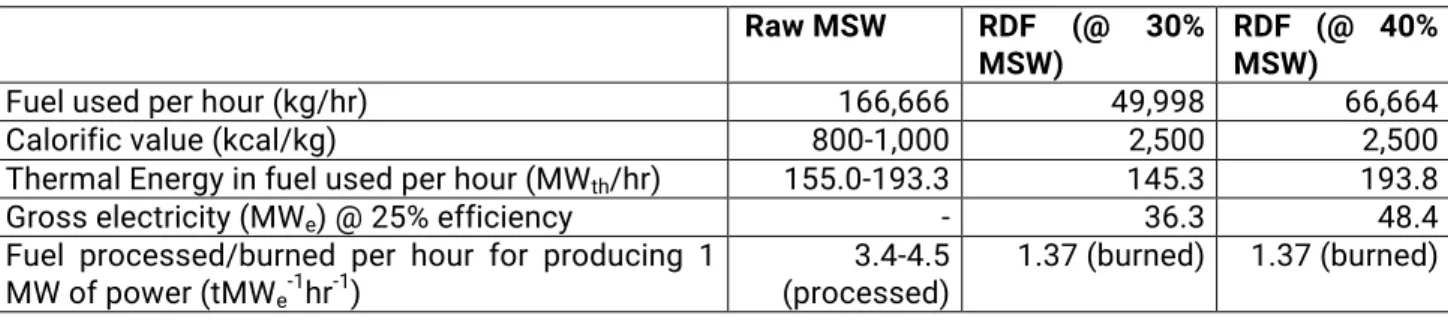
The electrical output for the 4,000 TPD capacity WTE plant proposed in this report is estimated using both MSW and RDF fuels. The key outputs of the analysis are shown in Table 1. MSW being very low in calorific value and high in moisture content should not be sent directly to the incinerator. Rather, it should be converted to RDF before it is burned in the furnace. A 4,000 TPD capacity WTE plant would treat approximately 166 tonnes of MSW per hour to produce 49.9 - 66.6 tonnes of RDF per hour (which is 30-40% of MSW by mass) depending on the quality of MSW. The calorific value of the produced RDF is taken as 2,500 kcal/kg, as recommended by the Central Electricity Regulatory Commission (CERC, 2015). Table 1 indicates that processing 166.66 tonnes per hour of raw MSW (or burning 49.9 to 66.6 tonnes of RDF in the incinerator) can produce 36 - 48 MWe of gross power output. In other words, it can be said that the plant will use 3.4 - 4.5 tonnes of MSW per hour to produce 1 MWe of power.
Table 1: MSW treated and RDF burned per hour for 1MWe gross power output
Raw MSW RDF (@ 30% MSW)
RDF (@ 40% MSW)
Fuel used per hour (kg/hr) 166,666 49,998 66,664
Calorific value (kcal/kg) 800-1,000 2,500 2,500
Thermal Energy in fuel used per hour (MWth/hr) 155.0-193.3 145.3 193.8
Gross electricity (MWe) @ 25% efficiency - 36.3 48.4
Fuel processed/burned per hour for producing 1 MW of power (tMWe-1hr-1)
3.4-4.5 (processed)
SUM2018 / 4TH SYMPOSIUM ON URBAN MINING AND CIRCULAR ECONOMY / 21-23 MAY 2018 / BERGAMO, ITALY
5. CAPITAL REQUIREMENTS AND COST OF ELECTRICITY
The CERC collected data on the existing WTE projects in India to calculate the capital cost requirements for WTE projects. The capital cost of the existing WTE plants ranges between £1 to 2.9 million per MWe. Some of these costs also include the cost incurred in pre-processing of the MSW to produced RDF. Several other regional authorities such as Madhya Pradesh Electricity Regulatory Commission (MPERC) and Gujarat Electricity Regulatory Commission (GERC) also provided similar capital cost estimates for WTE plants.
In MSW-based WTE projects, the raw MSW used as fuel is supplied free of cost by the local municipalities. Therefore, the operation and maintenance (O&M) expenses mainly involve labour, insurance, consumables, repair and statutory expenses only, and are considered to be 5% of the capital cost with an escalation of approximately 5 to 5.72% per annum. The repair, maintenance and spares cost is 15% of the total O&M cost. On the proposed normative capital cost of £1.7 million/MWe for MSW based projects, the proposed normative O&M expenses works out to £86,200/MWe for the year 2015-16. The fixed cost involves O&M cost, Depreciation, Interest on Term Loan, Interest on Working Capital and Return on Equity, and it comes out to be 25 - 26% of the total capital cost. A levelised cost of electricity of £0.078/kWh has been calculated by CERC for MSW-based WTE projects.
In RDF-based WTE plants, the RDF fuel is either purchased from an external supplier or produced by the WTE plant operator at the same or a different site. The RDF, if purchased, currently costs about £20/tonne. The fixed O&M cost for an RDF-based WTE plant is the same as that for MSW-based plant, i.e. 5% with an escalation of 5.72%. On the proposed normative capital cost of £1.03 million/MWe for RDF based projects, the proposed normative O&M expenses works out to £51,700/MWe for the year 2015-16. The fixed cost per annum for RDF projects is approximately 27.5 - 28.5% of the total capital cost. A levelised cost of electricity of £0.0106/kWh was estimated by CERC for RDF-based WTE projects.
6. FUNDING MODEL FOR THE PROJECT
BOOT (build, own, operate, transfer) is a public-private partnership (PPP) project model in which a private organisation conducts a large development project under contract to a public-sector partner, such as a government agency. A BOOT project is often seen as a way to develop large public infrastructure projects with private funding. Most of WTE projects in India have been based on this BOOT model and have been running successfully. It is thus the only proven financial model for such WTE projects in developing countries like India.
7. KEY ISSUES AND MITIGATING FACTORS
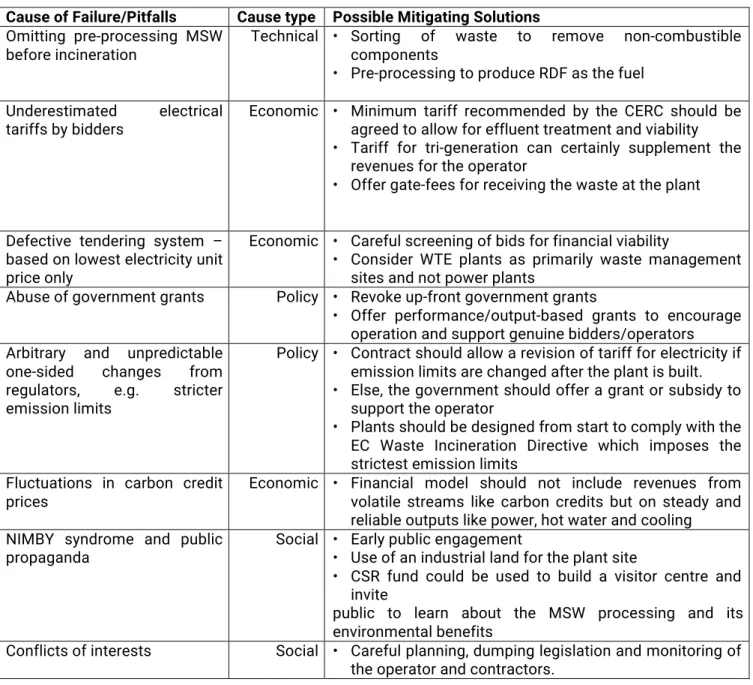
The WTE in India is perceived as "wealth from waste" since such projects had run successfully in many developed countries (The Economic Times, 2018). Articles published in newspapers described WTE as a gold mine (World Economic Forum, 2017). Such statements caused many businesses and investors in India to rush into the WTE business without full knowledge of the reality and key local factors. The first WTE plant in India was setup in 1987 at Timarpur, Delhi which failed primarily because of poor quality of MSW used as fuel in the plant (GAIA 2016, Dhamija 2013). Since then, the WTE projects have produced mixed results in India (Joshi and Ahmed, 2016). There are no proven examples of successful WTE projects in India and the initial plants faced many failures. Several critical causes behind the failures of WTE projects in India were discovered in this study and are summarised in Table 3.
Table 3: A summary of the causes of failures/pitfalls for WTE project in India and their possible mitigating factors.
Cause of Failure/Pitfalls Cause type Possible Mitigating Solutions Omitting pre-processing MSW
before incineration
Technical • Sorting of waste to remove non-combustible components
• Pre-processing to produce RDF as the fuel Underestimated electrical
tariffs by bidders
Economic • Minimum tariff recommended by the CERC should be agreed to allow for effluent treatment and viability • Tariff for tri-generation can certainly supplement the
revenues for the operator
• Offer gate-fees for receiving the waste at the plant Defective tendering system –
based on lowest electricity unit price only
Economic • Careful screening of bids for financial viability
• Consider WTE plants as primarily waste management sites and not power plants
Abuse of government grants Policy • Revoke up-front government grants
• Offer performance/output-based grants to encourage operation and support genuine bidders/operators Arbitrary and unpredictable
one-sided changes from regulators, e.g. stricter emission limits
Policy • Contract should allow a revision of tariff for electricity if emission limits are changed after the plant is built. • Else, the government should offer a grant or subsidy to
support the operator
• Plants should be designed from start to comply with the EC Waste Incineration Directive which imposes the strictest emission limits
Fluctuations in carbon credit prices
Economic • Financial model should not include revenues from volatile streams like carbon credits but on steady and reliable outputs like power, hot water and cooling NIMBY syndrome and public
propaganda
Social • Early public engagement
• Use of an industrial land for the plant site
• CSR fund could be used to build a visitor centre and invite
public to learn about the MSW processing and its environmental benefits
Conflicts of interests Social • Careful planning, dumping legislation and monitoring of the operator and contractors.
AKNOWLEDGEMENTS
The authors are grateful to Mr A.K. Gupta, Director (Electrical) and Mr Manuj Singhal, CEE (Planning) of Delhi Metro Rail Corporation (DMRC) and the Ministry of Urban Development, Indiafor funding this work. The authors would like to express their special gratitude to Mr Khandelwal of East Delhi Municipal Corporation for sharing their experience of operating WTE projects in India.
SUM2018 / 4TH SYMPOSIUM ON URBAN MINING AND CIRCULAR ECONOMY / 21-23 MAY 2018 / BERGAMO, ITALY
REFERENCES
CERC. (2015). Central Electricity Regulatory Commission of India. Available at http://www.cercind.gov.in/2015/draft_reg/Noti11.pdf. (Accessed on 7 February 2018). Costa I., Massard G., and Agarwal A. (2010). Waste management policies for industrial symbiosis development: case studies in European countries. Journal of Cleaner Production. 18(8): p. 815-822.
Dhamija U. (2013). Sustainable municipal solid waste management in a capital city territory and the role of waste to energy: a study of Delhi. WIT Transactions on Ecology and The Environment, (179). Available at https://www.witpress.com/elibrary/wit-transactions-on-ecology-and-the-environment/179/25290.
Dube R et al. (2013). Status Paper on Utilisation of Refuse Derived Fuel (RDF) in India. Indo-German Environment Partnership: New Delhi, India
GAIA, (2016). The Timarpur-Okhla Waste to Energy Venture. Available at http://www.no-burn.org/wp-content/uploads/Timarpur.pdf. (Accessed on 7 February 2018).
Hindustan Timesa. (2 September 2017). Delhi’s Ghazipur landfill collapse: 2 dead as mountain of trash sweeps many into nearby canal. Available at https://www.hindustantimes.com/delhi-
news/ghazipur-landfill-site-collapses-in-east-delhi-one-dead-many-fear-trapped/story-oSqDJtp4zqrB0yHOWCER9J.html. (Accessed on 9 February 2018).
Hindustan Timesb. (1 September 2017). Ghazipur landfill collapse in Delhi was a tragedy waiting to happen. Available at https://www.hindustantimes.com/delhi-news/ghazipur-landfill-
site-collapse-why-it-was-a-tragedy-waiting-to-happen-in-delhi/story-8sUu69iu1JsHYNzE6OY22N.html. (Accessed on 9 February 2018).
Hoornweg D. and Bhada-Tata P. (2012). What a Waste: A Global Review of Solid Waste Management. Urban development series - knowledge papers no. 15. Washington, DC: World Bank.
Liu, Y et al. (2017). Greenhouse gas emissions from municipal solid waste with a high organic fraction under different management scenarios. Journal of Cleaner Production. 147 (Supplement C): p. 451-457.
Lu, J.-W et al. (2017). Status and perspectives of municipal solid waste incineration in China: A comparison with developed regions. Waste Management, 69(Supplement C): p. 170-186. Lukumon O.O., et al. (2013). Reducing waste to landfill in the UK: identifying impediments and critical solutions. World Journal of Science, Technology and Sustainable Development, 10 (2): p. 131-142.
MCD, Municipal Corporation of Delhi. (2004). Feasibility study and master plan for optimal waste treatment and disposal for the entire state of Delhi based on public private partnership
solutions. Available at
http://www.seas.columbia.edu/earth/wtert/sofos/COWI_Waste_Characterization_Study.pdf (Accessed on 7 February 2018).
MoUD, Ministry of Urban Development. (2016). Swachh Bharat Mission, Municipal Solid Waste Management Mannual Part I. Available at:
http://indiawashforum.com/wp-content/uploads/2016/06/Book-1.pdf (Accessed on 7 February 2018).
Nakakubo T., Yoshida T, and Hattori Y. (2017). Analysis of greenhouse gas emission reductions by collaboratively updating equipment in sewage treatment and municipal solid waste incineration plants. Journal of Cleaner Production, 168(Supplement C): p. 803-813. The Economic Times, (2018), How to make Waste-to-Wealth a reality. Available at https://economictimes.indiatimes.com/industry/energy/power/how-to-make-waste-to-wealth-a-reality/articleshow/62490388.cms (Accessed on 30 January 2018).
World Economic Forum, (2017), Landfill mining: is this the next big thing in recycling? Available at https://www.weforum.org/agenda/2017/06/landfill-mining-recycling-eurelco/ (Accessed on 7 February 2018)
Joshi R., Ahmed S. (2016). Status and challenges of municipal solid waste management in India: A review, Cogent Environmental Science. 2(1). 1139434 . (DOI: http://dx.doi.org/10.1080/23311843. 2016. 113943)