178
International Journal in Management and Social Sciencehttp://ijmr.net.in, Email: [email protected] A CASE STUDY ON VIVAM AGROTECH - SOLID WASTE MANAGEMENT
* Dr. Ruhi Bakhare
Assistant ProfessorDAIMSR, Nagpur
**Mrs. Nirmala Kandalgaonkar, Proprietress,Founded Vivam AgrotechPune
About VIVAM AGROTECH
Mrs. Nirmala Kandalgaonkar, Proprietress, Founded Vivam Agrotech in 2001. The company
works in the field of solid waste management by providing consultancy along with
technology solutions such as vermicompost, biogas, mechanical & bacterial composting, and
power generation from biodegradable waste. The proprietress' scope of work includes human
relation, marketing, personal relations and generating awareness about solid waste
management in the social as well as governmental sector. She is having ability to motivate
people and delegate work. She combines strategic thinking with strong execution skills.
Being an active social worker since young age, it’s been her policy to give jobs to social help
groups (SHGs), whenever possible and well suited, in Vivam Agrotech's scope of work. The
social activities of the company are also looked over along with the operations of an NGO
chaired by her.
VIVAM AGROTECH is in the field of solid waste processing such as Composting,
Vermicomposting, Mechanical Compost and Biogas since last Ten years and in city Solid
Waste Management for last Five years. All these technologies developed by VIVAM
AGROTECH are most suitable for city waste management and sustainable development of
the city.
VIVAM AGROTECH is into the business of converting waste to energy. They have plants to
treat Solid wastes like Municipal Solid Waste, kitchen, canteen, poultry, cow dung, food
processing and agricultural wastes. They specialize in Municipal solid waste treatment plants
for power generation. They have Biogas plants from 4 Kg to 400 tons waste per day. Vivam
is now expanding its business in abroad. Some of these projects are in pipeline like Kenya
and South Africa. VIVAM is authorized technology holder of BHABHA ATOMIC
179
International Journal in Management and Social Sciencehttp://ijmr.net.in, Email: [email protected] Type of Solid Waste
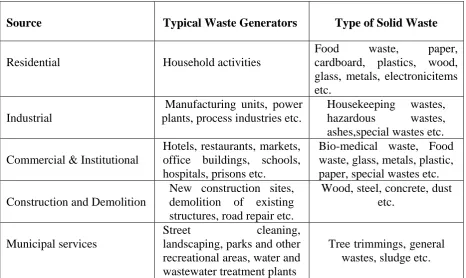
Solid waste can be classified in many ways according to its source, composition, phase,
treatment required etc. Table - 1 describes type of wastes on basis of its source. It includes
residential, municipal, mining, agricultural, industrial etc.
Table 1. Type of Industrial Waste
Source Typical Waste Generators Type of Solid Waste
Residential Household activities
Food waste, paper,
cardboard, plastics, wood, glass, metals, electronicitems etc.
Industrial
Manufacturing units, power plants, process industries etc.
Housekeeping wastes,
hazardous wastes,
ashes,special wastes etc.
Commercial & Institutional
Hotels, restaurants, markets, office buildings, schools, hospitals, prisons etc.
Bio-medical waste, Food waste, glass, metals, plastic, paper, special wastes etc.
Construction and Demolition
New construction sites, demolition of existing structures, road repair etc.
Wood, steel, concrete, dust etc.
Municipal services
Street cleaning,
landscaping, parks and other recreational areas, water and wastewater treatment plants
Tree trimmings, general wastes, sludge etc.
Products of VIVAM
1. Biogas – (i) Small
(ii) Medium
(iii) MSW
2. Mechanical Composting
3. Carbon Credit – (i) Carbon Treading
(ii) Carbon Calculator
4. Vermicomposting
180
International Journal in Management and Social Sciencehttp://ijmr.net.in, Email: [email protected] Thechallenges faced by the company:
1. Addressing and handling the population to be served
Municipal solid waste collection arrangements of cities in the emerging world
usually serve veryrestricted part of the urban people. The people still continuing
without a waste collection service are generally the less-income population
existing in peri-urban areas.
One of the main reasons, is the lack of financial resources to cope with the
increasing amount of generated waste produced by the rapid growing cities.
Frequentlyinadequatechargesimposed and insufficient funds from a chief
municipal budgetcannot finance satisfactorystages of service. Additionally the
obtainablefunds are frequentlyallotted to the high-income parts with greater tax
crops where people have more governmentalimpact, so the poor in peri-urban
areas remain unattended. Nevertheless not only financial problems have an effect
on the accessibilityor sustainability of a surplusgathering service. In many
circumstances it is also practicalmatters that delayan effective service facility and
coverage of large population. Frequently the "conservative" gatheringmethod as
advancedand recycled in the developedstates is practicalin evolving countries. The
used vehicles are classy, costly and not very easy to operate and retain, thus often
scarce for the situations in emergingcountries. After a short time of
proceduretypicallyonly a small part of the vehicle fleet remains in process.
1. Workingproductivity of Solid Waste services and partial use of the informal
and formal private sector undertakings in Solid Waste Management.
Municipal consultants in emerging countries generally spend from 20 to 50 percent of
the total municipal spending for the solid waste (SW) service. Though even at such a
stage of spending the level of service is low. Only 50 to 70 % of the solid waste is
gatheredattending less than 50 % of the population, and once gathered, it is
generallyprepared of incompetently in unrestrained open landfills.
Functioninginadequacies of Solid Waste services functioned by municipalities are
mostly
181
International Journal in Management and Social Sciencehttp://ijmr.net.in, Email: [email protected] lackingcapability of the institutes involved and use of unsuitable technologies. On the
other hand, the informal sector has usually been playing a significant role in Solid
Waste Management, particularly in reserveretrieval. Though, as their actions can
disturb the process of landfills and allocationplaces they are very terrible and
thereforeare opposed by the consultants.
1. Management of (non-industrial) dangerous waste
Pathogenic waste, produced by hospitals and clinics can be considered the
greatestsignificantwaste product from the group of non-industrial dangerous waste. About
85 percent of the total waste is produced by hospitals and clinics can be categorized as
consistent domestic wastes, whereas 10 percent can be observed as communicable and 5
percent as non- communicable but dangerous wastes. So it is vital that the produced waste
be divided, as the non- communicable and non- communicable waste can be accomplished
like normallocal waste. Dangerous and communicable waste should be gathered in
diversegroups as per the way they should be treated at advanced steps. This grouping can be
sharps (needles, scalpels etc., all presumed to be communicable), non-sharp communicable
wastes, pharmaceutical and chemical deposits and other dangerous wastes. Though most
hospitals needdeparture of their waste and the burning of their pathogenic waste, maximum
of theburners are generally out of order and these wastes regularlygo in the municipal waste
category. This leads tograve health risks to the public, particularly children, to scavengers,
gatheringstaffs and to labors at the landfill.
1. Final discarding of solid waste
Maximum of the municipal solid waste (MSW) in emerging countries is discarded on land
in a more or less unrestrainedway. Such insufficient waste discarding generatesgrave
environmental harms that may spoil health of humans and animals and become the root
cause of economic and other well-being losses.
The environmental deprivationtriggered by insufficientdiscarding of waste can be stated by
the adulteration of shallow and ground water through leachate, soil adulteration through
straight waste contact or leachate, air pollution by burning of wastes, and the dispersion of
182
International Journal in Management and Social Sciencehttp://ijmr.net.in, Email: [email protected] Because of urban growth, in the previous few years unrestraineddiscarding sites have often
been surrounded by settlements and lodgingdomains and currently are frequently centrally
situated. Such unrestrainedjunkyards with misplacedplaceorganizationstraight
awaycompromise the health of the people existingclose to, or on the site. It is
neverthelessimmature to ponder that the other people will not be exaggerated as the
chemical and biological pollutants from inadequate discarding will certainly find their way
to them. The community may be affected by the adulteration of their drinking water, by soil
adulterationdistributed on to the water and food chain and through the dispersal of viruses
by diversecourses. People existingclose or on the location are repeatedly subject to
straighttransmission of adulteration from hand to mouth and completebreathing of
hazardousinstablemixtures and sprays. There is also a straight physical hazard involved,
stemming from likely waste victories, failing landfills, bursts, fires and waste
associatedcarriagemishaps.
Monetary and officiallimitations are the key causes for insufficientremoval of waste
specially were local governments are not strong or underfinanced and quick population
progressionremains. Financing of harmlessremoval of solid waste postures a problematic
problem as most people are eager to compensate for the elimination of the waste from their
close environment but then “out of sight – out of mind” are usually not worried with its
finaldiscarding.
The currentdiscardingcondition is likely to worsen even more in the coming days because
till now the comparativeessentialplace of the discardingplaces, i.e. near to the gathering
area, and the frequentlydisappearedorganizationlabors, has allowed governments to position
of the municipal solid waste at minimum cost. This will transformrapidly with
quickdevelopment, payments and housing estates now progressivelyenclose the
currentjunkyards and the environmental ruinrelated with these junkyardsstraighttouch the
population. Waste removalplaces are so also subject to risingresistance and it is
suitableprogressivelydemanding to find new sites which find public consent and which are
situated at a sensiblespace from the assortmentzone. Siting landfills at betterspaces to the
essentialgatheringpartssuggestsadvancedtransmission costs as well as supplementaryfunds
in the organization of roads thereforeincreasing the financial problems of the
accountableexperts. Also, agrowth in service reporting will even worsen the dumping
183
International Journal in Management and Social Sciencehttp://ijmr.net.in, Email: [email protected] Questions:
1. How can the operational efficiency be improved?
2. Suggest the most realistic and promising approach seen to improve the situation of
low-income areas.
3. According to you which issue is the most difficult to tackle? Explain.