Calhoun: The NPS Institutional Archive
Theses and Dissertations Thesis and Dissertation Collection
2016-12
Auditability in the U.S. Navy: a knowledge
assessment of the contracting workforce
Grennan, Jeremy A.
Monterey, California: Naval Postgraduate School http://hdl.handle.net/10945/51705
NAVAL
POSTGRADUATE
SCHOOL
MONTEREY, CALIFORNIA
MBA PROFESSIONAL REPORT
AUDITABILITY IN THE U.S. NAVY: A
KNOWLEDGE ASSESSMENT OF THE
CONTRACTING WORKFORCE
December 2016
By:
Jeremy A. Grennan
Michael A. McCrory
Advisors: Juanita M. RendonRene G. Rendon
REPORT DOCUMENTATION PAGE Form Approved OMB No. 0704–0188
Public reporting burden for this collection of information is estimated to average 1 hour per response, including the time for reviewing instruction, searching existing data sources, gathering and maintaining the data needed, and completing and reviewing the collection of information. Send comments regarding this burden estimate or any other aspect of this collection of information, including suggestions for reducing this burden, to Washington headquarters Services, Directorate for Information Operations and Reports, 1215 Jefferson Davis Highway, Suite 1204, Arlington, VA 22202-4302, and to the Office of Management and Budget, Paperwork Reduction Project (0704-0188) Washington, DC 20503.
1. AGENCY USE ONLY
(Leave blank)
2. REPORT DATE December 2016
3. REPORT TYPE AND DATES COVERED MBA professional report
4. TITLE AND SUBTITLE
AUDITABILITY IN THE U.S. NAVY: A KNOWLEDGE ASSESSMENT OF THE CONTRACTING WORKFORCE
5. FUNDING NUMBERS
6. AUTHOR(S) Jeremy A. Grennan and Michael A. McCrory
7. PERFORMING ORGANIZATION NAME(S) AND ADDRESS(ES) Naval Postgraduate School
Monterey, CA 93943-5000
8. PERFORMING
ORGANIZATION REPORT NUMBER
9. SPONSORING /MONITORING AGENCY NAME(S) AND ADDRESS(ES)
N/A
10. SPONSORING / MONITORING AGENCY REPORT NUMBER
11. SUPPLEMENTARY NOTES The views expressed in this thesis are those of the author and do not reflect the official policy or position of the Department of Defense or the U.S. Government. IRB number NPS.2016.0027-IR-EP7-A
12a. DISTRIBUTION / AVAILABILITY STATEMENT Approved for public release. Distribution is unlimited.
12b. DISTRIBUTION CODE 13. ABSTRACT (maximum 200 words)
The Department of Defense (DOD) has some problems in its contracting workforce that make the department susceptible to procurement fraud. In fiscal year (FY) 2014, $285 billion was spent on federal contracts. In FY 2015, the DOD increased its obligation to $290 billion. The DOD committed more money than all other government agencies combined. In total, the U.S. Department of Justice in its annual evaluation stated that there were 4,801 United States government-wide fraud investigations in 2015.
The purpose of this research was to evaluate the knowledge level of Navy contracting professionals regarding procurement fraud. The research method included a survey that contained questions regarding contract management processes, internal control components, and procurement fraud schemes.
The results of this research identified differences in levels of fraud knowledge and perceptions of an organization’s vulnerability to procurement fraud. The other two aspects of auditability are effective internal controls and capable processes. Having strong auditability in an organization would help to identify susceptibilities to procurement and assist in reducing vulnerabilities. Based on the results of the survey, recommendations are provided to the Navy for improvement of organizational auditability related to contracting.
14. SUBJECT TERMS
procurement fraud, contracting, auditability, internal controls, contract management process 15. NUMBER OF PAGES 91 16. PRICE CODE 17. SECURITY CLASSIFICATION OF REPORT Unclassified 18. SECURITY CLASSIFICATION OF THIS PAGE Unclassified 19. SECURITY CLASSIFICATION OF ABSTRACT Unclassified 20. LIMITATION OF ABSTRACT UU
NSN 7540-01-280-5500 Standard Form 298 (Rev. 2-89) Prescribed by ANSI Std. 239-18
Approved for public release. Distribution is unlimited.
AUDITABILITY IN THE U.S. NAVY: A KNOWLEDGE ASSESSMENT OF THE CONTRACTING WORKFORCE
Jeremy A. Grennan, Lieutenant Commander, United States Navy Michael A. McCrory, Captain, United States Army
Submitted in partial fulfillment of the requirements for the degree of
MASTER OF BUSINESS ADMINISTRATION
from the
NAVAL POSTGRADUATE SCHOOL December 2016
Approved by: Juanita M. Rendon, Advisor
Rene G. Rendon, Co-Advisor
Rene G. Rendon Academic Associate
Graduate School of Business and Public Policy
Aruna Apte
Academic Associate
AUDITABILITY IN THE U.S. NAVY: A KNOWLEDGE
ASSESSMENT OF THE CONTRACTING WORKFORCE
ABSTRACT
The Department of Defense (DOD) has some problems in its contracting workforce that make the department susceptible to procurement fraud. In fiscal year (FY) 2014, $285 billion was spent on federal contracts. In FY 2015, the DOD increased its obligation to $290 billion. The DOD committed more money than all other government agencies combined. In total, the U.S. Department of Justice in its annual evaluation stated that there were 4,801 United States government-wide fraud investigations in 2015.
The purpose of this research was to evaluate the knowledge level of Navy contracting professionals regarding procurement fraud. The research method included a survey that contained questions regarding contract management processes, internal control components, and procurement fraud schemes.
The results of this research identified differences in levels of fraud knowledge and perceptions of an organization’s vulnerability to procurement fraud. The other two aspects of auditability are effective internal controls and capable processes. Having strong auditability in an organization would help to identify susceptibilities to procurement and assist in reducing vulnerabilities. Based on the results of the survey, recommendations are provided to the Navy for improvement of organizational auditability related to contracting.
TABLE OF CONTENTS
I. INTRODUCTION...1
A. BACKGROUND ...1
B. PURPOSE OF RESEARCH ...1
C. RESEARCH QUESTIONS ...2
D. BENEFITS AND LIMITATIONS...2
E. IMPORTANCE OF THE RESEARCH...3
F. METHODOLOGY ...3
G. ORGANIZATION OF REPORT ...4
H. SUMMARY ...4
II. LITERATURE REVIEW ...5
A. INTRODUCTION...5
B. DEPARTMENT OF DEFENSE CONTRACTING ...5
1. Procurement Weaknesses ...5
2. DOD Response to Procurement Weaknesses ...6
3. Implications of Contract Deficiencies ...7
C. AUDITABILITY THEORY ...8
D. COMPETENT PERSONNEL ...10
1. Low Quantity of Trained Personnel in Contracting ...11
2. Low Quality in Training for Contracting Personnel ...11
E. CAPABLE CONTRACT MANAGEMENT PROCESSES ...12
1. Pre-Award: Procurement Planning ...13
2. Pre-Award: Solicitation Planning ...14
3. Pre-Award: Solicitation ...14
4. Award: Source Selection ...15
5. Post-Award: Contract Administration ...15
6. Post-Award: Contract Closeout ...16
F. EFFECTIVE INTERNAL CONTROLS ...16
1. Control Environment...18
2. Risk Assessment ...19
3. Control Activities ...20
4. Information and Communication ...21
5. Monitoring Activities ...22
6. The Five-Step Transition ...23
G. PROCUREMENT FRAUD SCHEME CATEGORIES ...24
1. Fraudulent Bidding ...25
3. Collusion ...26 4. Conflict of Interest ...27 5. Fraudulent Purchases ...28 6. Fraudulent Representation ...28 H. SUMMARY ...29 III. METHODOLOGY ...31 A. INTRODUCTION...31
B. DEVELOPMENT OF ASSESSMENT TOOL ...31
1. Sources Used to Develop Questions ...31
2. Development of Demographic Questions ...32
3. Development of Knowledge-Based Questions ...32
4. Development of Organizational Perception Questions ...32
C. DEPLOYMENT OF THE SURVEY ...33
D. ANALYSIS OF SURVEY RESULTS ...33
E. SUMMARY ...33
IV. FINDINGS, ANALYSIS, AND RECOMMENDATIONS ...35
A. INTRODUCTION...35
B. FINDINGS FROM DEMOGRAPHIC QUESTIONS ...35
1. Survey Response...35
2. Reponses by Employment Category ...35
3. Responses by Experience ...36
4. Responses by DAWIA Certification Level ...36
5. Responses by Warrant Status ...37
C. FINDINGS FROM KNOWLEDGE-BASED QUESTIONS ...38
1. Analysis by Demographic Classification ...39
2. Analysis of Contracting Processes ...41
3. Analysis by Internal Control Components ...41
4. Analysis of Procurement Fraud Schemes ...42
5. Analysis of Specific Questions...43
D. ANALYSIS OF ORGANIZATIONAL QUESTIONS ...47
1. Analysis of Likert-Scale Organization Questions ...47
2. Analysis of Perception Questions ...48
E. ANALYSIS AND IMPLICATIONS ...51
1. Demographic ...51
2. Contracting Processes ...52
3. Internal Control Components ...53
4. Procurement Fraud Schemes ...53
F. RECOMMENDATIONS BASED ON ANALYSIS ...54
1. Add Procurement Fraud Training Programs ...54
2. Improve Monitoring Activities of All Contract Processes ...55
3. Improve Understanding of Procurement Fraud Schemes ...55
G. SUMMARY ...55
V. SUMMARY, CONCLUSIONS, AND AREAS FOR FURTHER RESEARCH ...57
A. SUMMARY ...57
B. CONCLUSIONS ...57
C. AREAS FOR FURTHER RESEARCH ...58
APPENDIX: LIKERT SCALE QUESTIONS AND ANSWERS ...61
LIST OF REFERENCES ...65
LIST OF FIGURES
Figure 1. Auditability Triangle. Source: R. G. Rendon & Rendon (2015, p.
716). ...9
Figure 2. Decrease in Growth of Contracting. Source: GAO (2015). ...11
Figure 3. Achieving Objectives Through Internal Controls. Source: GAO (2014, p. 5). ...17
Figure 4. Relationship of Objectives and Components. Source: COSO (2013, p. 6) ...17
Figure 5. COSO’s 17 Fundamental Principles. Adapted from COSO (2013, p. 6). ...18
Figure 6. How to Transition to Proper Internal Controls Implementation. Source: McNally (2013). ...23
Figure 7. Fraud Triangle. Source: Albrecht (2014, para. 1). ...24
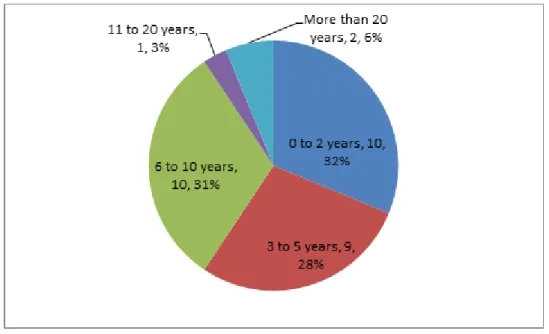
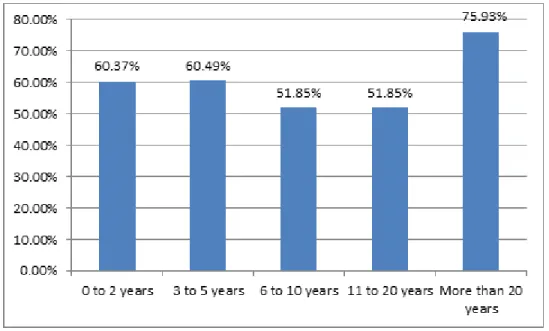
Figure 8. Number of Participants by Experience Category. ...36
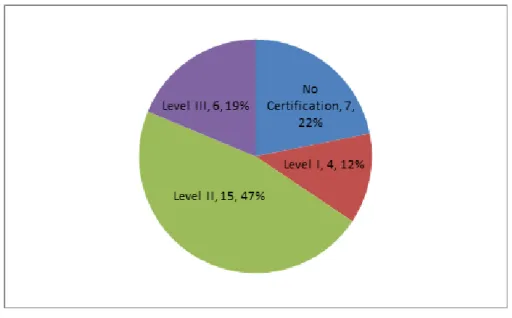
Figure 9. Number of Participants by DAWIA Certification Level. ...37
Figure 10. Responses by Warrant Status. ...37
Figure 11. Average Score by Years of Experience. ...39
Figure 12. Average Score by DAWIA Level. ...40
Figure 13. Average Score by Warranted Status. ...40
Figure 14. Average Score by Contracting Process. ...41
Figure 15. Average Score by Internal Control Components. ...42
Figure 16. Average score by Procurement Fraud Schemes. ...43
Figure 17. Percentage of Responses to Contracting Process Perception Question. ...49
Figure 18. Percentage of Responses to Internal Control Perception Question. ...50
LIST OF TABLES
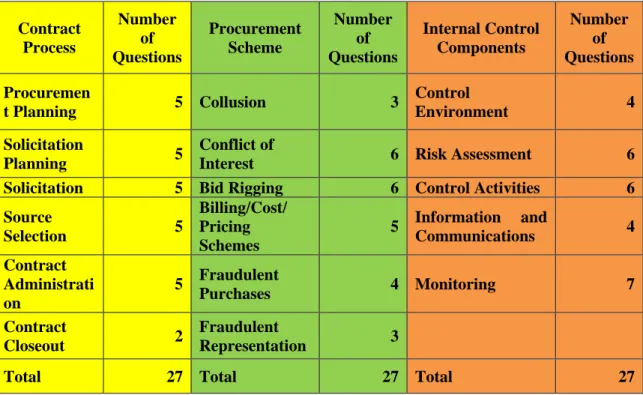
Table 1. Main Auditability Levels. Source: Weigand et al. (2013, p. 5). ...9 Table 2. Number of Knowledge-Based Questions by Categories. Adapted
LIST OF ACRONYMS AND ABBREVIATIONS
ACFE Association of Certified Fraud Examiners ACO Administrative Contract Office
CAO Contract Administration Office CLM Continuous Learning Module CLP Continuous Learning Points
COR Contracting Officer’s Representative COSO Committee of Sponsoring Organizations
CPARS Contractor Performance Assessment Reporting System CRS Congressional Research Service
DAU Defense Acquisition University
DAWIA Defense Acquisition Workforce Improvement Act DOD Department of Defense
DODIG Department of Defense Inspector General DOJ Department of Justice
FAR Federal Acquisition Regulation FEDBIZZOPS Federal Business Opportunities FFP Firm Fixed Price
GAO Government Accountability Office LPTA Lowest Price Technically Acceptable
NYSICA New York State Internal Control Association TCO Termination Contract Officer
USAID United States Agency for International Development
USD(AT&L) Under Secretary of Defense for Acquisition, Technology and Logistics
ACKNOWLEDGMENTS
Our sincerest thanks to Dr. Juanita Rendon and Dr. Rene Rendon. Their wisdom into the world of contracting and auditing was enlightening. Additionally, thanks to the Navy contracting command that allowed us to survey their personnel. This project could not have been completed without their assistance. Finally, special thanks to our spouses and families that supported us on this project. They have been and will always be our inspiration.
I.
INTRODUCTION
A. BACKGROUND
The opportunity to commit procurement fraud in the Department of Defense (DOD) is becoming a greater concern as the government continues to reduce the DOD’s budget. This budget reduction decreases the quantity of funded future projects, supplies, and services. Fraud within the DOD increases the costs of goods and services. If an agency prosecutes fraud, then fraud penalties “inefficiently increase suppliers’ costs and decrease competition among military suppliers” (Karpoff, Lee, & Vendrzyk, 1999, p. 5). Classical economist Adam Smith stated that in competition “the number of rivals, potential as well as present, must be sufficient to eliminate [or reduce] gains” (Stigler, 1957, p. 2). Therefore, the more contractors are convicted of fraud, thus becoming ineligible for government contracts, the less competitive the market becomes, which would inevitably lead to an increase in prices. Similarly, research supports this concept as “governments in the Asia-Pacific region generally pay about 20% to 100% more for public goods and services due to procurement fraud” (Tan, 2013, p. 2).
Contracting professionals, as well as all acquisition personnel, need to be diligent in reducing opportunities for procurement fraud. Contracting personnel duties include securing the right contracts and ensuring the processes of the contracts are meeting specific standards established by laws and regulations. The contracting agencies responsible for these contracts must have the appropriate training to ensure government funds are not being wasted or abused.
B. PURPOSE OF RESEARCH
The purpose of this research is to evaluate the knowledge level of Navy contracting professionals regarding contract management processes, internal control components, and procurement fraud schemes. The research method includes a survey that contains questions regarding contract management processes, internal control components, and procurement fraud schemes. The results may identify differences between levels of fraud knowledge and perceptions of an organization’s vulnerability to
procurement fraud schemes. Based on the results of the survey, recommendations will be provided to the Navy for improvement of organizational auditability related to contracting.
C. RESEARCH QUESTIONS
Chang (2013) developed the following research questions that have been previously used for the Army and the Air Force:
(1) “What is the [Navy’s] contracting professionals’ knowledge level of procurement fraud as related to the contract management process, internal control components, and procurement fraud schemes?” (p. 2) (2) “What is the [Navy’s] contracting professionals’ perception of
procurement fraud vulnerability as related to the contract management process, internal control components, and procurement fraud schemes?” (p. 2)
D. BENEFITS AND LIMITATIONS
This research will examine the procurement fraud knowledge level of contracting professionals within a United States Navy’s contracting center and will identify any areas within the contract management process and internal controls that are perceived by the contracting professionals to be vulnerable to fraud. One of the benefits could be that the results from the research may indicate whether or not contracting professionals need additional procurement fraud training to ensure competency in the Navy’s contracting workforce.
Another benefit to this research is that the data from this study can be compiled with other fraud research studies to assess the vulnerabilities for procurement fraud within the DOD. The data may also be able to provide a baseline to measure and possibly target areas for improvement within contract management processes and internal controls within the Navy and DOD.
This study has several limitations. One limitation is using an online survey method. To accurately assess the knowledge level of contracting professionals, a proctored survey may provide more accurate results. Unlimited access to online search engines enables survey participants to find an answer to virtually any question. However, the survey
questions in this research were originally developed by Chang. The questions did not come from a database. Additionally, every answer does not represent the same weight. For instance, one may consider “agree” of the same value as “strongly agree,” as both answers are subjective. (Wyse, 2012).
Furthermore, people may not like acknowledging or reporting fraud for fear of retribution. Having contracting professionals answer an anonymous survey honestly could create mistrust from their leadership even though the data is aggregated. People may not like the negative perception associated with fraud in their organization.
E. IMPORTANCE OF THE RESEARCH
Every organization should ensure the competency of its workforce. Having competent personnel in an organization helps ensure detection and aids in limiting contracting fraud. The objective of this research is to assess the Navy’s contracting professionals’ knowledge level of procurement fraud. This research is significant because auditability in organizations is important. The DOD is trying to ensure all of its services are auditable. For an organization to be auditable, it should ensure its people are competent, processes are capable, and internal controls are effective. Auditability will be discussed more in Chapter II.
The results of this research may indicate whether more fraud training is needed throughout the Navy’s contracting workforce. Another result may indicate whether or not the DOD should be focused more on the vulnerabilities in the defense and acquisition process. Attorney Laura Duffy from the United States Department of Justice (DOJ) said “The more we learn about the extent of the greed and corruption, the more determined we are to eviscerate it” (DOJ, 2015, para. 3). A Navy contracting organization can identify possible areas of procurement fraud vulnerabilities by volunteering to participate in this survey.
F. METHODOLOGY
The research methodology consists of a literature review discussing auditability theory and the three aspects of competent personnel, capable contracting management
processes, and effective internal controls. An online survey was deployed to a Navy organization. The results of the survey assessed the competency level of the contracting workforce in the areas of contracting processes, internal controls, and procurement fraud schemes. Based on the analysis from the survey responses, recommendations are provided to the Navy contracting command regarding procurement fraud competence of the contracting workforce.
G. ORGANIZATION OF REPORT
This report is organized in five chapters. Chapter I provided an introduction covering a background of DOD contracting, the purpose of the research, research questions, benefits and limitations, the importance of the research, and the methodology. Chapter II consists of a literature review of DOD contracting, auditability theory, competent personnel, capable contract management processes, effective internal control components, and procurement fraud scheme categories. Chapter III discusses the methodology used in the utilization of a previously developed assessment tool, the deployment of the survey, and the analysis of the survey results. Chapter IV presents the findings from the demographic questions, findings from the knowledge-based questions, analysis of the organizational questions, and recommendations for improvement based on the analysis. Chapter V includes a summary, conclusion, and areas for further research.
H. SUMMARY
The DOD is one of the largest government contracting agencies in the world, and the opportunity for fraud to be committed is an inherent risk whenever money is involved. This risk increases if there are poor processes in place. This chapter provided the background, the purpose, research questions, benefits and limitations, importance, methodology, and the organization of this research. The next chapter consists of a literature review of DOD contracting and auditability theory, which consist of competent personnel, capable contract management processes, and effective internal control components. The chapter concludes with a discussion of procurement fraud scheme categories.
II.
LITERATURE REVIEW
A. INTRODUCTION
This chapter first reviews the literature on Department of Defense (DOD) contracting, the impact of fraud on DOD contracting, current problems in defense contracting, and the DOD response to procurement fraud. Next, the chapter expands on auditability theory while reviewing the competency of personnel, the defense contracting process, and internal controls. The chapter concludes with the six most common fraud schemes. This literature review examines the experts in the field and current research regarding these various subjects. Linking this areas together will illustrate modern defense contracting and possible weaknesses in defense contracting. An overview of DOD contracting is discussed in the next section.
B. DEPARTMENT OF DEFENSE CONTRACTING
DOD contracting deals with a significant budget and significant issues. In fiscal year (FY) 2014, the DOD alone “obligated more money on federal contracts ($285 billion) than all other government agencies combined” (Swartz, Ginsberg, & Sargent, 2015, p. 2). In 2015, the DOD obligation increased to $290 billion and accounts for over half of the $560.4 billion DOD budget (Harrison, 2014). The Department of Justice reported 4,801 fraud investigations in 2015 (2016). The Department of State Inspector General (OIG, 2015) indicates Defense contracting fraud and mismanagement accounts for questionable costs in the DOD in the amount of $485.5 million, and $1.84 billion was over-obligated (2015).
1. Procurement Weaknesses
The DODIG and Government Accountability Office (GAO) have reported on possible procurement weaknesses in Defense contracting. The GAO listed “defense contract management as a high risk due to their greater vulnerability to fraud, waste, abuse and mismanagement” and has listed Defense contracting as high risk since 1992 (Government Accountability Office [GAO], 2013, p. 2). The GAO identifies the four
segments of contract management that still face challenges as (1) a small acquisition workforce, (2) difficult contracting techniques, (3) several issues with the acquisition of services, and (4) limited support for operational contracting (GAO, 2013). The GAO (2015) considers the amount of dollars spent and the volume of transactions the DOD processed as an issue because of the lack of skilled personnel in the acquisition workforce.
Some of the problems in DOD contracting include an increasing acquisition force, decreasing contracting offices, and the lack of critical training. The DODIG summarized specific deficiencies over the course of seven fiscal years as 467 contract process deficiencies ranging from the more prevalent acquisition planning deficiencies to the rarer competition deficiencies during solicitation (Hidaka & Owens, 2015). The six contracting processes ranked from highest to lowest deficiencies are “contract administration, procurement planning, solicitation planning, source selection, contract closeout, and solicitation” (Hidaka & Owens, 2015, p. 50).
2. DOD Response to Procurement Weaknesses
The DOD responded to the GAO’s high risk assessment and the DODIG’s contracting process deficiencies by providing more training to contracting professionals and additional guidance on contracting processes. As the DOD addresses the competency of contracting professionals and contracting processes, the results should reduce deficiencies. The Under Secretary of Defense for Acquisition, Technology and Logistics’ (USD[AT&L]) most substantial correction to deficiencies was the Better Buying Power initiative. Five of the seven principles in the Better Buying Power initiative focus on process improvements for the acquisition workforce. The remaining principles, “improve tradecraft in acquisition of services” and “improve the professionalism of the total acquisition workforce,” focus on training of personnel (Under Secretary of Defense for Acquisition, Technology and Logistics [USD(AT&L)], 2016, para.1). In addition, Castillo and Flanigan’s (2014) research concluded that the DOD had increased acquisition workforces, but it had never included additional required training for the workforce or Contracting Officer’s Representatives (CORs).
The solution does not solely rest on developing competency in contracting personnel. Rendon and Rendon propose that the “DOD [emphasizes] procurement training of its workforce” but that it is not “placing an equal emphasis on its procurement processes or internal controls” (Rendon & Rendon, 2015, p. 711). In 2011, the USD(AT&L) Ash Carter instituted other requirements, such as posting a DODIG Fraud Hotline Poster, establishing and maintaining internal controls, notifying the Office of the Inspector General whenever the organization becomes aware of fraud, and instituting additional required ethics training (USD[AT&L], 2011). In response to several department-wide issues concerning fraud, waste and abuse, Congress directed the creation of a Continuous Learning Module (CLM) 049—Procurement Fraud Indicators (Castillo & Flanigan, 2014). These responses from Congress and AT&L responses attempted to address procurement contracting weaknesses but failed to address the deficiencies that the weaknesses had created.
3. Implications of Contract Deficiencies
Denis (2009) notes two issues in the contracting profession: a growing list of responsibilities and a shortage of trained personnel. This imbalance may inevitably slow procurement process and create more fraud opportunities. Despite the USD(AT&L)’s many new requirements imposed on the contracting workforce, in 2011 Carter remarked “it is not clear, however, that these remedies are sufficient” (USD[AT&L], 2011, p. 11). Between 2011 and 2015, suspensions for contractors almost doubled from 74 to 124, and debarments increased by almost 150% from 130 to 179 (OIG, 2015). These increases in suspensions and debarments may constrict future competition and possibly drive up prices.
Despite the apparent increases in suspensions and debarments, defense hotline calls dropped from 9,340 in 2011 (DODIG, 2011) to 5,932 in 2015 (OIG, 2015). The researchers contend that this decrease indicates that either fraud is detected during external audits vice during the contracting process, or that DOD is taking a harder stance on contractor misconduct. Furthermore, Castillo and Flanigan (2014) summarize that limited fraud indicators and internal control training taught within Defense Acquisition
University contribute to GAO’s high risk designation. This lack of training may cause contracting personnel to miss signs of fraud. Competent personnel is one aspect of auditability in organizations. In total there are three aspects comprise auditability theory, which are discussed in the next section.
C. AUDITABILITY THEORY
Auditability theory began with research conducted by Power. Power addressed a need for independent authentication that “has the virtues of objectivity, publicity, and replicability” (Power, 1996, p. 289). Rendon and Rendon view auditability as a transformation of an organization when “organizations establish data collection practices and systems of documentation to make them auditable” (R. G. Rendon & Rendon, 2015, p. 713). When effective auditability is in place, an organization is more capable of detecting and deterring fraud.
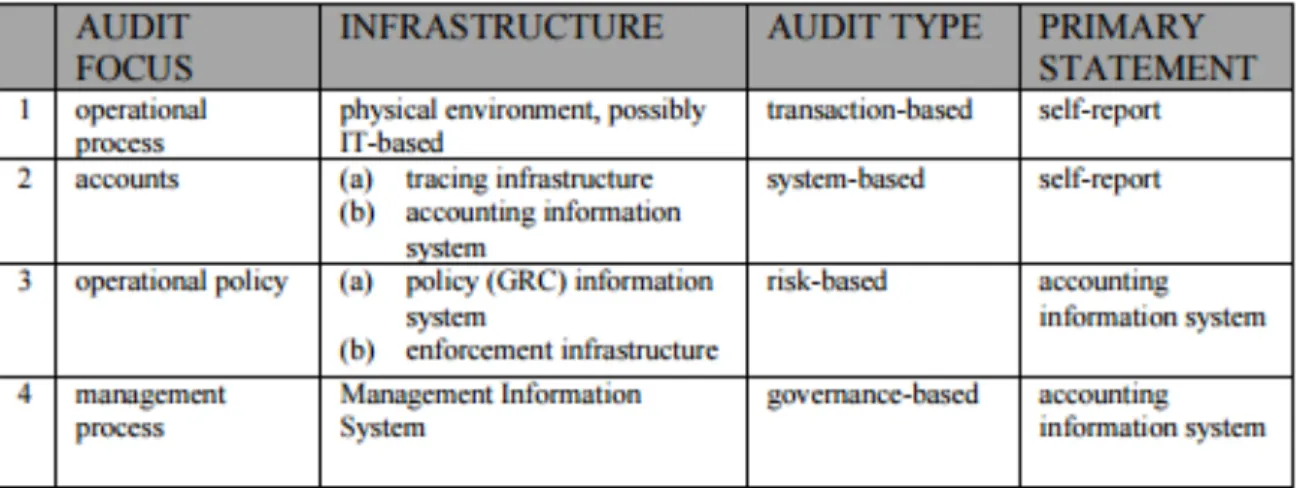
Weigand, Johannesson, Andersson, Bergholtz, and Bukhsh (2013) divided auditability into four separate audit focused levels shown in Table 1. The levels begin individually with tedious labor intensive transaction based audit types and ultimately reach management via accounting information systems. Weigand et al. (2013) contend that “if the manager is in control, by implication the validity of the accounts and the norm compliance of the agent performance are guaranteed” (p. 6). This guarantee allows transparent audits to infiltrate all levels and ensure auditability. Using the four-level auditability framework, organizations can have multiple internal controls in place and achieve a higher level of auditability (Weigand et al., 2013).
Table 1. Main Auditability Levels. Source: Weigand et al. (2013, p. 5).
In addition to auditability occurring at different levels of an organization, auditability requires three aspects to be effective. Rendon and Rendon show in Figure 1 the auditability triangle concept as a synergy of “competent personnel, capable processes, and effective internal controls” (J. M. Rendon & Rendon, 2015, p. 1).
Auditability flows from the lowest level up. Effective auditability occurs when such synergies are in place involving personnel, processes, and internal controls. The first aspect of auditability is competent personnel, which is discussed in the next section.
D. COMPETENT PERSONNEL
Rendon and Rendon define competent personnel as those with “necessary education, training, and experience requirements for each functional area” (R. G. Rendon & Rendon, 2015, p. 716). DOD contracting suffers from a low quantity of trained personnel and the low quality of the overall training (Hidaka & Owens, 2015). Contracting competency begins with education, training, and contracting field experience. In 1991, the Defense Authorization Act established the Acquisition Corps and with it the Defense Acquisition Workforce Improvement Act (DAWIA) to improve the effectiveness of training of personnel. DAWIA has established requirements for contracting personnel both military and 1102 Civil Servants at three levels of DAWIA certification (Defense Acquisition University [DAU], n.d.-a). Level I DAWIA certification requires “10 functional training classes, 24 hours in accounting, law, business, finance, contracts, purchasing, management, marketing, quantitative methods or organization and management, a Baccalaureate degree, and one year of contracting experience” (DAU, n.d.-a, para. 1). Level II DAWIA certification adds “one acquisition training class, eight functional training classes, and a second year of contracting experience” (DAU, n.d.-b, para. 1). Level III DAWIA certification adds “a second acquisition training class, eleven additional functional training classes, and a total of four years in contracting experience” (DAU, n.d.-c, para. 1).
Personnel competency encompasses more than DAWIA certification. Since the requirements of all DAWIA certifications include a Baccalaureate degree in any field and contracting work experience, many will start their contracting careers with limited or no on-the-job-training.
1. Low Quantity of Trained Personnel in Contracting
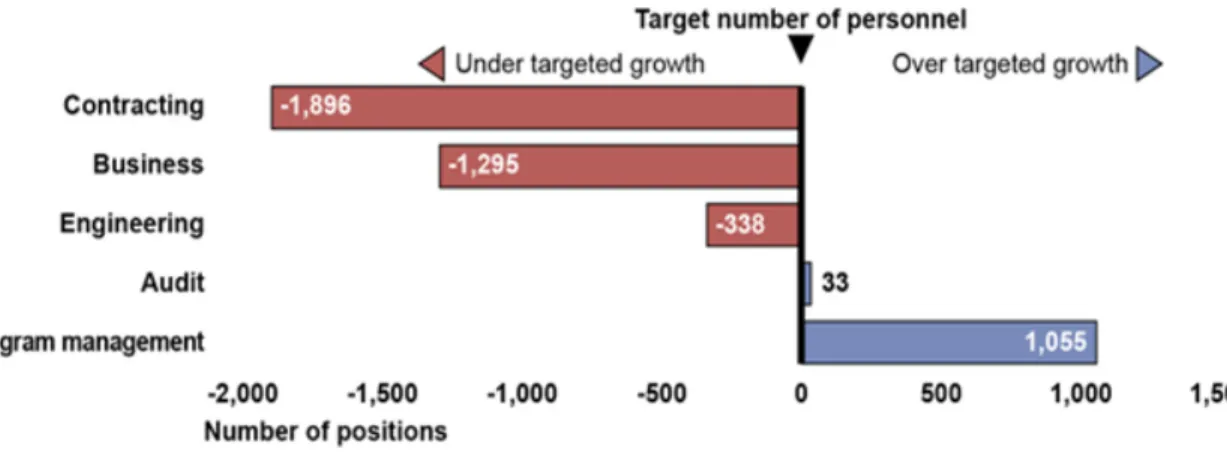
Figure 2 shows that the DOD has increased its acquisition workforce from 126,000 in September 2008 to about 153,000 in March 2015, but has under-targeted the growth in the contracting workforce (GAO, 2015).
Figure 2. Decrease in Growth of Contracting. Source: GAO (2015).
In FY 2012, Hidaka and Owens’ (2015) research found that 57% of personnel in the defense contracting field were within ten years of retirement. Since 2015, between 17% and 20% of personnel in the defense contracting field have retired. In addition, Rodriguez’s (2013) research found a decrease in contracting personnel hiring as low as 7% annually, despite an annual retirement of approximately 10%. The three combined traits of a low rehire rate, the reduction in force, and the increase in recent retirements has led to a reduction in the contracting professional workforce.
2. Low Quality in Training for Contracting Personnel
Certification is not sufficient for competency. Certification is important as “90.4% of all practitioners perceive a linkage between certification and knowledge” (Prier, McCue, & Behara, 2010, p. 524). Wilkinson stated, “if you are a GS-1102 federal employee with a Level II certification and 24 business credit hours, congratulations” but “they are minimum requirements of contract management” (Wilkinson, 2015, p. 3). Furthermore, in evaluating training for fraud, it is evident that DAU training has “limited offerings of procurement fraud, waste and abuse” (Rodriguez, 2013, p. 43). Specifically,
the Congress directed acquisition refresher CLM 049 is not a core curriculum for any of the 14 Acquisition fields for the various DAWIA Level I, II or III certifications (Rodriguez, 2013).
A 2013 survey assessed competent people and vulnerability perception. Chang (2013) surveyed Army personnel specifically on knowledge of fraud and internal controls with results of 64.3% accurate for military and 62.4% accurate for civilians. Castillo and Flanigan (2014) conducted a survey on Air Force personnel on the knowledge of fraud and internal controls, which also resulted poorly averaging 69.2% and 64.9% respectively. Castillo and Flanigan (2014) also concluded that the Air Force organization may lack the training to correctly identify fraud schemes in contracting. The fault does not solely lie on the contracting office, as there is “an important [need] for senior organizational management…to understand their roles and responsibilities in support of the contract management process” (Rendon, 2015, p. 1490).
After a sufficient number of contracting personnel have been properly trained and become competent in their areas, they must work together during the contract management process. The second aspect of auditability is capable contract management processes, which is discussed in the next section.
E. CAPABLE CONTRACT MANAGEMENT PROCESSES
Rendon and Rendon define capable processes as contracting processes that are “fully-established, institutionalized, mandated, integrated with other organizational processes, periodically measured, and continuously improved” (R. G. Rendon & Rendon, 2015, p. 716). Federal Acquisition Regulation (FAR) 2.101 states, “Acquisition planning means the process by which the efforts of all personnel responsible for an acquisition are coordinated and integrated through a comprehensive plan for fulfilling the agency need in a timely manner and at a reasonable cost” (FAR, 2016). The DOD maintains a credit card threshold of $2,500 for services and $3,500 for supplies. If it is above this threshold, a contract is a more suitable means of procurement. DAU defines a contract as “a mutually binding legal relationship obligating the seller to furnish supplies or services (including construction) and the buyer to pay for them” (“Contract,” n.d., para. 1). Schwartz noted
that the DOD’s acquisition process is “highly complex and does not always produce systems that meet estimated cost or performance expectations” (Schqartz, 2014, p. 1). Castillo and Flanigan argue that “for those organizations not directly involved [in the contracting process], the contracting process is considered a simple one” (Castillo & Flanigan, 2014, p. 7). Regardless of perceived difficulty, defense contracting splits into three areas: pre-award, award, post-award. These areas subdivide further into six total processes. The next sections describe these six contract management processes.
1. Pre-Award: Procurement Planning
Garrett defines procurement planning as “determining whether to procure, how to procure, what to procure, how much to procure, and when to procure” (Garrett, 2013, p. 43). Procurement planning is “an important part of contract management because it establishes the foundation for future successes or problems” (Hidaka & Owens, 2015, p. 13). Rendon (2007) summarizes key activities during this process as designing scope, conducting market research, evaluating funds, estimating an initial cost, predicting schedule, and determining manpower requirements.
Defining the requirement answers the question of whether to procure. Castillo and Flanigan (2014) reference FAR 7 in these questions during this process: Is it a product or service that a customer needs? Is it the first time it’s been procured? Is it available commercially? How long is it required? How complex is it? This narrows the need for procurement to what is only required and at proper quantities. These procurements can be either a product or a service. FAR 37 summarizes services available for procurement but limits services to non-inherently government functions such as some defense-related duties and many consulting duties (FAR, 2016).
Once the decision to make or buy is made, market research commences to answer the question of how to procure. FAR 10 states that market research is used to answer if sources exist, if the products or services needed are commercial, if there are bundling options, and if there is a baseline for pricing (FAR, 2016). Finally, the requirements documents will capture the what, when, and how much in one of three documents. The statements of work are related to the acquisition of supplies (Moschler & Weitzner,
2012). Second, the statement of objectives is broader in order to describe unclear or technically developing solicitations (Moschler & Weitzner, 2012). Finally, the performance work statements are designed when there are service performance based outcomes (Moschler & Weitzner, 2012).
2. Pre-Award: Solicitation Planning
Garrett defines solicitation planning as the “buyer [understanding] its own requirements…and must be able to communicate those requirements in the form of deliverables” (Garrett, 2007, p. 24). This is done by taking the management’s procurement plan, other planning documents, or a statement of work to create procurement documentation that uses the proper evaluation criteria (Garrett, 2007). Once an organization determines if the risk level is high for the government, the contract generally becomes cost reimbursable. The lower risk and commercially available contracts generally become fixed-price contracts. The DOD determines the type of contract based on risk, price, and incentives. FAR parts 19 and 26 also state federal contracting is to utilize “small businesses, woman-owned small business, small disadvantaged business, historically underutilized business zone, veteran-owned small business, and service disabled veteran owned small businesses” (FAR, 2016, section 19202). This phase results in the preparation of a solicitation document.
3. Pre-Award: Solicitation
DAU defines solicitations as “any request to submit offers or quotations to the government” (DAU, 2012, para. 1). Three methods of procuring are via government purchase card, simplified acquisition threshold, and soliciting to contractors using the best value continuum outlined in FAR 15 (FAR, 2016). If procurement is above $3,500, contracting might use pre-proposal conferences but must publicize to increase competition and broaden industry participation per FAR 5.002 (FAR, 2016). The Federal Business Opportunities (FEDBIZZOPS) website advertises the procurement opportunities of the federal government to contractors. During this phase, contracting offices will keep a list of qualified bidders and ensure contractors see amendments as they occur, but limit the exchange of information to those listed in FAR 15.201 (FAR,
2016). This phase concludes with the posting of the solicitation to the FEDBIZZOPS website.
4. Award: Source Selection
In this phase, the source selection board evaluates qualified proposals, applies evaluation criteria set in procurement planning, negotiates contract terms and conditions, sets contractor responsibility standards, and ultimately selects a contractor if enough competition exists (Garrett, 2013). If the contract is simple, proposals may be evaluated by one person. If the contract is complex, the source selection board has several tools to select proposals such as a weighing system, screening system, and the possibility of independent estimates (Garrett, 2007). During the evaluation criteria, the source selection board weighs each proposal based on attributes, management, technical, price, and past performance pre-determined in the request for proposal (Garrett, 2007). Once source selection concludes, negotiating starts, and cost analysis of the contractor begins. This phase concludes with the finalizing negotiations and producing an agreed-upon contract.
5. Post-Award: Contract Administration
Garrett defines contract administration as “a process of ensuring each party’s performance meets the contractual requirements” (Garrett, 2013, p. 46). Contract administration occurs through several agencies and in several ways. The contracting office conducts a pre-performance conference with the contracting officer, prime (or lead) contractor, sub-prime contractor, COR, and Defense Contracting Management Agency. Second, the team evaluates performance through earned value management, budget analysis, and schedule analysis with the Program Management team (Garrett, 2013). Third, the contracting officer must ensure the prime contractor is managing all FAR 22 and 23 applicable labor laws and restrictions (FAR, 2016).
The CORs are vital to this phase as they are responsible for surveying the contractor’s progress and documenting receipt and delivery. The contracting officer must measure and report a contractor’s cost against FAR 29–32. In addition, the contracting officer must ensure deliveries against the agreed upon master schedule. During this phase, the performance of the contractor is evaluated using the contract administration
office (CAO) or administrative contract officer (ACO) discussed in FAR 42.302 and 42.6 (FAR, 2016). Finally, the FAR 43 allows for contract modifications to ensure the contract reflects current requirements (FAR, 2016). If done correctly, this phase results in a completed contract. However, other results might include termination for cause or termination for convenience, which will be discussed next.
6. Post-Award: Contract Closeout
Garrett defines contract closeout as “all administrative matters are concluded on a contract that is otherwise physically complete” (Garrett, 2013, p. 47). In short, a contract closeout is final delivery, receipt, inspection, acceptance, and payment. In order for a contract to be closed out, the government requires proper paperwork of a closeout report, certificate of completion, seller’s release of claims, and contract closeout checklist (Garrett, 2007). This phase results in the evaluation of the contractor via the Contractor Performance Assessment Reporting System (CPARS). This allows contractors to develop past performance that will be evaluated in future contracts.
Organizations must have capable contract management processes for sufficient auditability. Capable contracting management processes is the second aspect of auditability theory. The final aspect of auditability is effective internal controls, which is discussed in the next section.
F. EFFECTIVE INTERNAL CONTROLS
The Committee of Sponsoring Organizations (COSO) defines internal controls as “a process, effected by an entity’s board of directors, management, and other personnel, designed to provide a reasonable assurance regarding the reliability of financial reporting” (Committee of Sponsoring Organizations of the Treadway Commission [COSO], 2013, p. 3). Effective internal control components ensure the organization is “[complying] with laws and regulations, monitoring procedures to assess enforcement, and reporting material weaknesses” (R.G. Rendon & Rendon, 2015). Internal controls are essential for organizations to maintain internal awareness and to enforce current protocols to ensure a standard of reporting. Figure 3 illustrates effective internal controls in an organization in order to achieve its objective (GAO, 2014). COSO (2013) considers
internal controls as regulations that affect all personnel and are designed to meet the organization’s objectives of operations, reporting, and compliance.
Figure 3. Achieving Objectives Through Internal Controls. Source: GAO (2014, p. 5).
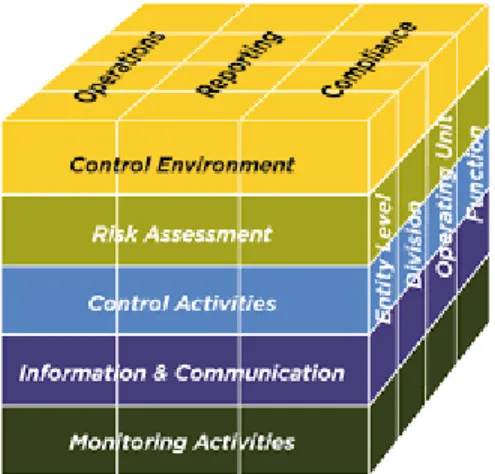
The GAO’s Green Book Standards for Internal Control in the Federal Government published the current standards based on the COSO Internal Control Framework. Figure 4 shows the five components of “control environment, risk assessment, control activities, information and communication, and monitoring activities” (COSO, 2013, p. 6).
Figure 4. Relationship of Objectives and Components. Source: COSO (2013, p. 6)
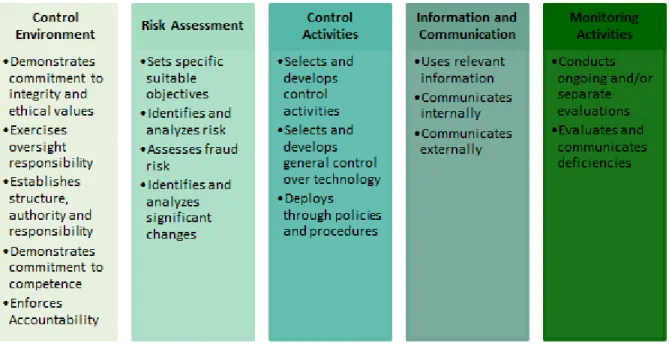
Figure 5 shows that the five components are broken down into 17 principles. COSO 2013 describes an organization applying “all principles to operations, reporting, and compliance objectives to achieve effective internal control” (COSO, 2013, p. 3).
Figure 5. COSO’s 17 Fundamental Principles. Adapted from COSO (2013, p. 6).
1. Control Environment
COSO (2013) defines control environment as “the set of standards, processes, and structures that provide the basis for carrying out internal control across the organization” (p. 4). The control environment sets the tone for the organization. Figure 5 shows the five fundamental principles of control environment as a “commitment to integrity and ethical values, oversight of the internal control system, an understood chain of command, competent personnel, and subordinates’ responsibility and authority” (COSO, 2013, p. 6).
An effective control environment operates efficiently. A poor control environment can lead to loss of faith in financial reporting or possibly the company’s ability to lead (Doss & Jonas, 2004). The five fundamental principles affect all personnel in the
organization (McNally, 2013). The first integrated component is control environment; the second component is risk assessment.
2. Risk Assessment
COSO (2013) defines risk assessment as “the possibility that an event will occur and adversely affect the achievement of objectives” (p. 4). During risk assessment, fraud vulnerability is addressed in relation to the risks taken (GAO, 2014). As Figure 5 (COSO, 2013, p. 6) shows, the four fundamental principles of risk assessment are “setting specific objectives, identifying and analyze risk, assessing fraud risk, and analyzing for significant changes” (COSO, 2013, p. 7). The risk should be measured against acceptable tolerance and against all regulations. Once senior leadership measures the risk, it should align with current operations, financial needs, and accurate reporting.
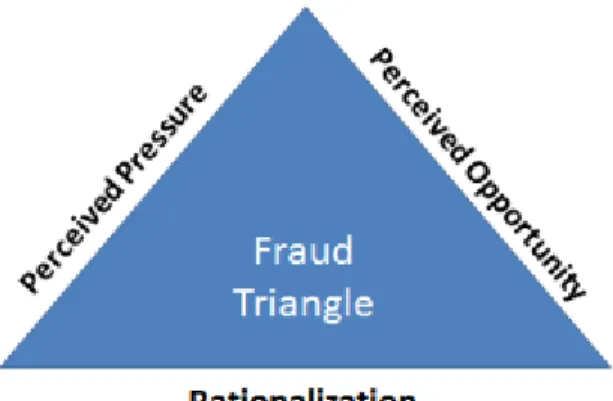
GAO (2014) concludes that risk tolerance is not the same as compliance. In other words, either an organization complies with rules and regulations, or it does not. Risk in one department may affect another department. For example, a deficiency in the contracting selection board might cancel the entire solicitation effort and double the workload if re-submittal has to occur. Proper response to risk is summarized in GAO’s report as acceptance, avoidance, reduction, and sharing (GAO, 2014). Incorrect financial reporting, misuse of assets, and other fraud must be evaluated when evaluating risk internally. These risks can increase if the fraud triangle components, which include perceived pressure, perceived opportunity, and rationalization, are present (Figure 7).
Rendon and Rendon discuss risk increasing when “weak internal controls, poor leadership, poor accountability, and lack of transparency nurture the opportunity for fraud in an organization” (J. M. Rendon & R. G. Rendon, 2015, p. 717). To decrease the likelihood of internal corruption, an organization should conduct a thorough self-assessment. Risk assessment is the second integrated component of internal controls; the third is control activities.
3. Control Activities
COSO (2013) defines control activities as “actions established through policies and procedures that help ensure that management’s directives to mitigate risks to the achievement of objectives are carried out” (p. 4). This is the functional efficiency of the organization. The three fundamental principles of control activities are the management’s responsibilities to design, develop, and implement a system through policies to achieve objectives (Figure 5). The key is the correct level of control. If control is too onerous, work may become inefficient, and over-regulation may degrade effectiveness. If control is too weak, visibility may be limited. To decrease the risk further, GAO (2014) mandates segregating the key functions of authority, custody, and accounting functions in order to negate possible conflicts of interest.
Sabatier and Mazmanian (1979) theorize that five traits of policies must exist to be effective. Policies must have a correlation between target behavior and end state, must be unambiguous, must be enforced by competent leadership, must encourage buy-in, and must not contradict other policies currently in place (Sabatier & Mazmanian, 1979). The more traits covered by control activities, the greater the effectiveness of the policies and procedures to reach the organization’s objective. When personnel in organizations embrace control activities, policies feel less restrictive to them.
However, these control activities will not work without making policies and procedures mandatory. Boss, Kirsch, Angermeier, Shingler, and Boss (2009) discuss how “routine security policies can dissuade employees from using them, and thus become vulnerable to unwelcome externalities” (p. 151). By mandating rules or the term “mandatoriness,” employees commit in three different ways by internalizing the rules, identifying with the rules, and ultimately complying with the rules (Boss et al., 2009). Control activities that become mandated will become the culture of the organization for better or for worse.
GAO (2014) contends that effective control activities help prevent or detect fraud, are performed at a higher level, are routine and consistent, and are directly related to an operational process. Information systems that gather control activities should be
complete, accurate, and valid to be effective. With these elements in place, senior leadership has a deeper understanding of the financial intricacies of their organization. The third integrated component is control activities; the fourth component is information and communication.
4. Information and Communication
COSO (2013) defines information as “necessary [details] for the entity to carry out internal control responsibilities to support the achievement of its objective” (p. 5). Separately, COSO (2013) defines communication as “the continual, iterative process of providing, sharing, and obtaining necessary information” (p. 5). Communicating relevant and accurate information is the key to a successful organization and the starting point for identifying fraud. The three fundamental principles of information and communication are high quality information, internally communicated information, and externally communicated information (Figure 5).
Information gathered must be from a relevant and reliable source. A 1991 study showed a direct correlation between the success of a business and market research received from “trusted and immediate sources” (Hartman, 1994, p. 37). Information must be shown to senior members of the organization, as well as disbursed to other members directly influenced by the results of the information. GAO (2001) describes effective communication as information given in the correct form, to the correct recipients, and at the correct time.
Information is powerful in that it can be an equalizer between a company with larger capacity and a company with smaller capacity (Li, Li, Liu & Barnes, 2011). Therefore, protecting information is just as important as collecting information. For example, the contracting office gathers in-depth information regarding a company’s capacity and pricing data that would be detrimental if it fell into the hands of a competitor. Similarly, intellectual property, pricing data, and other critical knowledge must be guarded by the contractor against fraudulent acts like espionage. The fourth integrated component is information and communication; the fifth and final component is monitoring activities.
5. Monitoring Activities
COSO (2013) defines monitoring activities as “ongoing evaluations, separate evaluations, or some combination of the two” which are used to determine whether internal controls are available and working (p. 5). As a note, GAO (2014) used the original title “monitoring” when addressing this component. This component entails making adjustments or changes to control procedures (J. M. Rendon & Rendon, 2016). The two principles of monitoring activities are conducting repetitive evaluations and taking a closer look at any deficiencies found (McNally, 2013).
Monitoring activities grant leadership a full visibility of changes, strengths, and weaknesses in their organization. It is a chance for subordinates to highlight deficiencies, senior leadership to analyze trends, and all to take follow-up actions. With “mandatoriness” in effect, leadership needs to encourage all its members to speak out and protect against reprisals. All domestic companies are subjected to the April 1989 Whistleblower Protection Act which gives freedom for employees to report fraud, waste, and abuse without fear of reprisal (Bond, 2009). The Whistleblower Protection Enhancement Act has expanded to include abuse of power and public health (Bond, 2009). Other avenues to address high risks, fraud, waste, and abuse are department-led inspector general offices such as DODIG.
Grant Thornton LLP (2009) developed additional guidance after noting many in industry have felt monitoring to be “a time-consuming task that involves a significant amount of annual management” (p. 1). For this reason, many organizations do not use monitoring to its fullest capacity in assessing effective internal controls. GAO (2001) encourages meetings for employees to see whether the current internal controls are effective. If separate evaluations occur, this assists in diffusing favoritism or internal collusion. Separate evaluations also ensure multiple evaluators are valuing reporting standards for clarity, quality, and accuracy. Separate evaluations occur when companies go through changes in leadership, inspector general inspections, and internal/external audits. All five integrated components are essential for internal controls. Organizations without these components in place may follow a five-step transition plan, which is discussed in the next section.
6. The Five-Step Transition
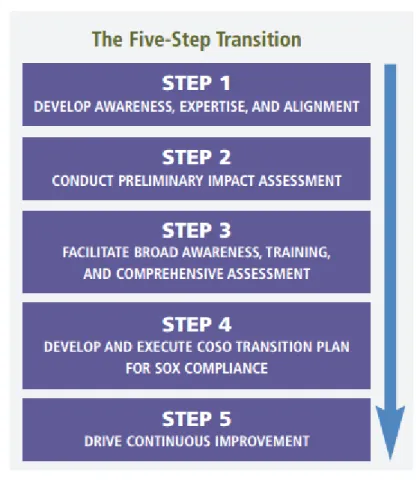
In the most recent update to COSO, McNally (2013) discussed how organizations can transition to the 2013 model. Figure 6 shows the five-step transition applicable for those organizations without internal controls in place or those lacking sufficient internal controls.
Figure 6. How to Transition to Proper Internal Controls Implementation. Source: McNally (2013).
Step one refers to managers ensuring internal controls are in working order (McNally, 2013). Step two refers to the analysis that should be done on the impact of any deficiencies found (McNally, 2013). Step three refers to employee awareness and training of updated internal control procedures (McNally, 2013). Step four refers to organizations developing a plan to finalize the COSO transition (McNally, 2013). Step five refers to organizations implementing continuous process improvement and self-evaluation
programs (McNally, 2013). As internal controls affect federal and non-federal companies alike, early controls act as prevention against a possible crisis (Chan, 2006). Companies that have proper internal controls in place benefit from leadership setting the tone, streamlining business processes, and maintaining the proper risk in management among other things (Chan, 2006).
Effective internal controls are the third aspect to the auditability theory (Figure 1). The three aspects of the auditability triangle, which include competent personnel, capable processes and effective internal controls, work together to reduce, detect, and help to deter the various types of fraud schemes. These fraud schemes will be discussed in the next section.
G. PROCUREMENT FRAUD SCHEME CATEGORIES
The Association of Certified Fraud Examiners (ACFE) uses Black’s Law Dictionary to define fraud as “a knowing misrepresentation of the truth or concealment of a material fact to induce another to act to his or her detriment” (Association of Certified Fraud Examiners [ACFE], n.d.-b, para. 2). Fraud theory was conceptualized in the 1940s by criminologist Cressey. While interviewing over 200 incarcerated embezzlers, Cressey identified that the fraudsters had three things in common, which included motivation (also called pressure), opportunity, and rationalization (Wells, 2001).
Cressey determined that if three factors are met, the organization is more susceptible to fraud by individuals with these traits.
Fraud schemes in contracting can be divided into internal and external fraud. Internal or occupational fraud is “the use of one’s occupation for personal enrichment” (ACFE, n.d.-b, para. 5). Internal fraud does not only mean fraud intra-organization, but can also include collusion between employees and contractors (Tan, 2013). The ACFE classifies external fraud into subcategories of dishonest vendor, dishonest customer, and dishonest third party (ACFE, n.d.-b). Regarding the federal contracting organization, the six most common procurement fraud schemes are fraudulent bidding, billing schemes, collusion, conflict of interest, fraudulent purchases, and fraudulent representation.
1. Fraudulent Bidding
Wells (2005) defines fraudulent bidding or “bid rigging as a process by which an employee assists a vendor to fraudulently win a contract through the competitive bidding process” (p. 283). Wells (2005) categorizes fraudulent bidding by when it occurs in the contracting process. During the procurement phase, a need recognition scheme may occur where the “buyer receives something of value” in exchange for developing the need for a good or service (Wells, 2005, p. 268). Similarly during the procurement phase, a specifications scheme can be a payoff of the buyer in exchange for “tailoring the specifications to a particular vendor” (Wells, 2005, p. 268). During the solicitation phase, “bid pooling may occur where several bidders conspire to split up the contract and each gain an amount of work” (Wells, 2005, p. 269). Another type of fraudulent bidding in the solicitation phase is the fictitious supplier where a shell company is used to ensure a bid is won (Wells, 2005). Other solicitation issues may arrive when vendors fail to bid, inflate prices, or withdraw bids at the last moment. During the source selection phase, fraudulent bidding may occur in the form of a bribe (Wells, 2005).
Protection against kickbacks during fraudulent bidding is the Anti-Kickback Act. Fraudulent bidding is unique in that it may be purely external to the contracting office. LaCasse remarks that fraudulent bidding is difficult for legal authority to determine “on the basis of bids alone, that a conspiracy has formed” (LaCasse, 1995, p. 398). Protection
against fraudulent bidding stems from market research conducted by the contracting office. No bids or extreme variances in a competitive market might be an indicator of fraud. Regarding internal collusion, contracting offices must ensure the selection process is objective as possible and free of bias.
2. Billing, Cost, and Pricing Schemes
Wells (2005) defines billing schemes as a vendor receiving “fraudulent payment by submitting invoices for fictitious goods or services, inflated invoices, or invoices for personal purchases” (p. 98). The most effective way of detecting a billing scheme is a tip from an employee (Wells, 2005). As mentioned before, with the Whistleblower Protection Act in place, subordinates have an avenue to report concerns without fear of reprisals.
Protection against billing schemes may be as using a certain type of contract for the procurement. Inflated prices are not normally an issue with fixed-price contracts, as any inflated price directly results in lost profits for the company. However, in cost reimbursable contracts, the incentive is higher for price inflation. Price inflation may occur via payroll schemes including over-commission schemes, phantom employee schemes, and overpayment schemes. Phantom or ghost employee schemes occur when the payroll office invents non-existing personnel in order to obtain more money from a contract. Overpayment schemes occur with falsified hours or rates. Commission schemes are a type of inflated sales (ACFE, n.d.-a). Other schemes include check tampering and expense schemes. Manipulation of the billing system can occur in other ways to defraud the government of money not due the contractor. Generally, billing schemes are more common when pricing is not verified against current market competition, opening the door to price inflation.
3. Collusion
Wells (2005) defines collusion as “a situation where two or more employees work together to commit fraud by overcoming a well-designed internal control system” (p. 122). Collusion can be done in falsification of hours, kickbacks, and shell companies. Falsification of hours can happen when a subordinate colludes with a supervisor to
increase hourly pay for a kickback (Wells, 2005). Fraudulent hours can also be obtained via payroll collusion where the subordinate seeks another administrative sign off on the incorrect hours (Wells, 2005). Collusion can also happen when the COR knowingly endorses an incorrect number of hours for a contractor’s work. Kickbacks are schemes that occur “where vendor pays back a portion of the purchase price to an employee” in order to gain favor (Wells, 2005, p. 283). Shell companies are “a fictitious entity created for the sole purpose of creating fraud” (Wells, 2005, p. 122). This is the case when a larger company who may not qualify for the small business benefits, creates a shell company to attempt to win a bid. Collusion occurrences may be reduced by the Small Business Association ensuring legitimacy of small businesses, current market research, and past performance evaluations.
Both falsified hours and kickbacks can be seen in the PMA Services Limited case where contractors bribed the U.S. military in exchange for kickbacks in construction projects (OIG, 2015). Congress passed the Copeland “Anti-Kickback Act” in 1934 to prosecute violators (Thai, 2000). Violations of the Copeland Act are imprisonment and/or fines for both the vendor and the buyer receiving the kickback (Thai, 2000). Laffont and Martimort (1998) stipulate that in contracting offices where vendors are properly vetted, collusion is not an issue.
4. Conflict of Interest
Wells (2005) defines conflict of interest as “when an employee, manager, or executive has an undisclosed economic or personal interest in a transaction that adversely affects the company” (p. 273). If personnel have all attributes of the fraud triangle, then conflict of interest has a higher probability of occurring. Source selection is at risk of conflict of interest “when a member of the source selection team may have interests, financial or other, in one of the offerors” (Castillo & Flanigan, 2014, p. 24).
Protection against conflict of interest include Title 18 U.S.C. § 208 and 209, which restrict external compensation and delay or limit post-contracting office employment opportunities. Section 208, titled “Acts Affecting a Personal Financial Interest,” makes it illegal for contracting personnel to financially benefit from contracts
that they administer (Roberts, 2010). Section 209 makes it illegal for a contracting officer to receive additional pay outside of federal wages and earned benefits (Roberts, 2010). Ethics regarding conflicts of interest are covered in detail in FAR 2.101-1 reminding federal employees to remain above reproach and impartial (FAR, 2016).
5. Fraudulent Purchases
Wells (2005) defines fraudulent purchases as purchasing “personal items with company money” (p. 114). Fraudulent purchases occur when the requestor is buying materials or services for personal needs rather than for government needs. This can occur internally within contracting offices or externally via contractors. GAO (2002) indicates that fraudulent purchases are more prevalent in government purchase card programs.
Protection against fraudulent purchases on a government credit card is oversight by the approving officer prior to every purchase. Another fraudulent purchase issue involves vendors charging for items not received under initial order (GAO, 2002) Protection against vendor overcharge may include ensuring proper training of the COR or the receiving official correctly verifying receipt. The final fraudulent purchase issue involves collusion between a contractor and a contracting office which leads to requesting more items than is required to fulfill the mission (Wells, 2005). Protection against collusion on fraudulent purchases involves ensuring that the solicitation defines the actual requirement of the end user.
6. Fraudulent Representation
Wells (2005) defines fraudulent representation as when “vendors provide real goods or services, albeit in an inflated price” (p. 265). Also called product substitution or “bait and switch,” the issue unfairly increases profit by the contractor at substandard quality. One notable case of this involves the contractor AEY, Inc. winning a $300 million contract to distribute weapons to Afghanistan. AEY, Inc. substituted the ammunition contracted for outdated People’s Republic of China ammunition from an Eastern bloc country (Committee on Oversight and Government Reform, 2008). In this case, AEY Inc. purposely hid documents and original Chinese stickers to conceal the place of manufacturing. Not only was the ammunition substandard, but it broke the
Defense Federal Acquisition Regulation Supplement that states munitions “may not be acquired, directly or indirectly from a Communist Chinese military company” (Committee on Oversight and Government Reform, 2008, p. 22).
Protection against fraudulent representation stems from the “Lincoln Law” also called the False Claims Act (France, 1990). This law empowers those using the Whistleblower Protection Act to at least 15% of total damages and the fines that it recoups (France, 1990). This is a substantial incentive for those witnessing fraud in their organization.
H. SUMMARY
This chapter provided foundational information on DOD contracting, the impact of fraud on DOD contracting, current problems in defense contracting, and the DOD’s response to fraud. Next, the chapter expanded on auditability theory and reviewed competency of personnel, the defense contracting process, and internal controls. The chapter concluded with the six most common fraud schemes. The literature review focused on examining the work of experts in the field and current research regarding these subjects. The next chapter describes the methodology used for this research.