Please cite this publication as:
OECD (2012), Dealing Effectively with the Challenges of Transfer Pricing, OECD Publishing.
http://dx.doi.org/10.1787/10.1787/9789264169463-en
This work is published on the OECD iLibrary, which gathers all OECD books, periodicals and statistical databases. Visit www.oecd-ilibrary.org, and do not hesitate to contact us for more information.
Dealing Effectively with the Challenges
of Transfer Pricing
Contents
Chapter 1. Introduction
Chapter 2. Selecting the right cases Chapter 3. Getting off to a good start Chapter 4. Governance arrangements
Chapter 5. Maintaining progress, tackling delay Chapter 6. Reaching a decision point
Chapter 7. Resources, skllls and use of specialists Chapter 8. Transfer pricing and developing countries Annex A. Denmark
Annex B. South Africa Annex C. France
Annex D. Transfer pricing risk identifi cation and assessment: the perspective of an advisor of MNEs Annex E. Cloud computing
www.oecd.org/tax ISBN 978-92-64-16907-4 23 2012 14 1 P
-:HSTCQE=V[^U\Y:
D ea lin g E ffe ct iv ely w ith th e C h all en g es o f T ra n sf er P ric in g TRANSFER CHALLENGES PRICINGTRANS FER PRICING CHAL LENGES PRICINGTRANSFERCHALLENGES P
CHALLENGES T
RANSFER PRIC
ING
TRANSFERCHALLE
NGESPRICING
TRANSFERCHALLE
NGESPRICING
TRANSFER PRICING C
HALLENGES TR
ANSFER PRICIN
G CHALLENGES
CHALLENGES
PRICINGTRANS
FERCHALLENGES
PRICINGTRANS
FERCHALLENGES
PRICINGTRANS
FERCHALLENGES
PRICING CHAL LENGES TRANS FER PRICING C HALLENGES TR ANSFER PRICIN G CHALLENGES TRANSFER PRICINGTRANS
FERCHALLENGES
PRICINGTRANS
FERCHALLENGES
PRICINGTRANS
FERCHALLENGES
PRICINGTRANS
FERCHALLENGES
PRICINGTRANS
FERCHALLENGES
CHALLENGES T RANSFER PRIC ING CHALLENG ES TRANSFER PRICING CHAL LENGES TRANS FER PRICING C HALLENGES TR ANS
TRANSFERCHALLE
NGESPRICING
TRANSFERCHALLE
NGESPRICING
TRANSFERCHALLE
NGESPRICING
TRANSFERCHALLE
NGESPRICIN
GTRANSFERCHALLE
NGESPRICIN G
TRANSFER PR
ICING CHALLEN
GES TRANSFER
PRICING CHALLENGES
TRANSFER PRICING C
HALLENGES TR
ANSFER PRICIN G
CHALLENGES
PRICINGTRANS
FERCHALLENGES
PRICINGTRANS
FERCHALLENGES
PRICIN
GTRANSFERCHALLE
NGESPRICING
TRANSFERCHALLE
NGESPRICING TRANSFER PRICING CHAL LENGES TRANS FER PRICING C HALLENGES TR ANSFER PRICIN G CHALLENGES
TRANSFER PRICING C
HALLENGE
PRICINGTRANS
FERCHALLENGES
PRICINGTRANS
FERCHALLENGES
PRICINGTRANS
FERCHALLENGES
PRICINGTRANS
FERCHALLENGES
PRICINGTRANS
FERCHALLENGES
CHALLENGES T RANSFER PRIC ING CHALLENG ES TRANSFER PRICING CHAL LENGES TRANS FER PRICING C HALLENGES TR ANS
TRANSFERCHALLE
NGESPRICING
TRANSFERCHALLE
NGESPRICING
TRANSFERCHALLE
NGESPRICING
TRANSFERCHALLE
NGESPRICING
TRANSFERCHALLE
NGESPRICING
TRANSFER PRICING C
HALLENGES TR
ANSFER PRICIN
G CHALLENGES
TRANSFER PRICING C
HALLENGES TR
ANSFER PRICIN G
CHALLENGES
PRICINGTRANS
FERCHALLENGES
PRICINGTRANS
FERCHALLENGES
PRICINGTRANS
FERCHALLENGES
PRICINGTRANS
FERCHALLENGES
PRICINGTRANS FER PRICING CHAL LENGES TRANS FER PRICING C HALLENGES TR ANSFER PRICIN G CHALLENGES
TRANSFER PRICING C
HALLENGE
PRICINGTRANS
FERCHALLENGES
PRICINGTRANS
FERCHALLENGES
PRICINGTRANS
FERCHALLENGES
PRICINGTRANS
FERCHALLENGES
PRICINGTRANS
FERCHALLENGES
CHALLENGES T
RANSFER PRIC
ING CHALLENG
ES TRANSFER
PRICING CHALLENGES
TRANSFER PRICING C
HALLENGES TR
ANS
TRANSFER
CHALLENGES
PRICINGTRANS
FERCHALLENGES
PRICINGTRANS
FERCHALLENGES
PRICINGTRANS
FERCHALLENGES
PRICINGTRAN TRANSFER P RICING CHALLE NGES TRANSF ER PRICING CH ALLENGES TRA NSFER PRICING CH CHALLENGES PRICINGTRANS
FERCHALLENGES
PRICINGTRANS
FERCHALLENGES
PRICINGTRANS FER
PRICING CH
ALLENGES TRA
NSFER PRICING CHAL
LENGES TR
PRICINGTRANS
FERCHALLENGES
PRICINGTRANS
FERCHALL
CHALLENGES T
RANSFER PRIC
IN
TRANSFERCHALLE NGES
Dealing Effectively
with the Challenges
of Transfer Pricing
Dealing Effectively
with the Challenges
This work is published on the responsibility of the Secretary-General of the OECD. The opinions expressed and arguments employed herein do not necessarily reflect the official views of the Organisation or of the governments of its member countries.
This document and any map included herein are without prejudice to the status of or sovereignty over any territory, to the delimitation of international frontiers and boundaries and to the name of any territory, city or area.
ISBN 978-92-64-16907-4 (print)
ISBN 978-92-64-16946-3 (PDF)
The statistical data for Israel are supplied by and under the responsibility of the relevant Israeli authorities. The use of such data by the OECD is without prejudice to the status of the Golan Heights, East Jerusalem and Israeli settlements in the West Bank under the terms of international law.
Corrigenda to OECD publications may be found on line at: www.oecd.org/publishing/corrigenda.
© OECD 2012
You can copy, download or print OECD content for your own use, and you can include excerpts from OECD publications, databases and multimedia products in your own documents, presentations, blogs, websites and teaching materials, provided that suitable acknowledgement of OECD as source and copyright owner is given. All requests for public or commercial use and translation rights should be submitted to [email protected]. Requests for permission to photocopy portions of this material for public or commercial use shall be addressed directly to the Copyright Clearance Center (CCC) at [email protected] or the Centre français d’exploitation du droit de copie (CFC) at[email protected].
Please cite this publication as:
OECD (2012), Dealing Effectively with the Challenges of Transfer Pricing, OECD Publishing.
FOREWORD – 3
Foreword
This report is the result of work that was commissioned by the Forum on Tax Administration (FTA) and undertaken by a study group led by the United Kingdom. Since its creation in 2002, the FTA has grown to become a unique forum on tax administration for the heads of revenue bodies and their teams from 43 OECD and non-OECD countries.
In 2009 participating countries developed the FTA vision setting out that… The FTA vision is to create a forum through which tax administrators can identify, discuss and influence relevant global trends and develop new ideas to enhance tax administration around the world. This vision is underpinned by the FTA’s key aim which is to….. improve taxpayer services and tax compliance – by helping revenue bodies increase the efficiency, effectiveness and fairness of tax administration and reduce the costs of compliance.
To this end the FTA undertakes a wide ranging programme of work to identify and foster best practices in the field of tax administration. In January 2011 the FTA’s Bureau agreed that transfer pricing should be the subject of a priority project during the course of the 2011 work programme. The United Kingdom has led the work that culminated in the production of this report. The study team, which comprised the United Kingdom and the Secretariat of the OECD, was greatly assisted by contributions from member and non-member countries of the FTA (Argentina, Australia, Austria, Belgium, Canada, Chile, China, Denmark, Finland, France, Hong Kong China, Hungary, Ghana, India, Ireland, Italy, Japan, Mexico, the Netherlands, New Zealand, Nigeria, Rwanda, Singapore, South Africa, Sweden, Uganda and the United States). The study team also received important contributions from the business and adviser community. Their contributions are recorded in the body of the report but the study team would like to record their gratitude for the assistance they have been afforded in the course of preparing this report.
Caveat
National revenue bodies face a varied environment within which to administer their taxation system. Jurisdictions differ in respect of their policy, legislative environment, their administrative practices and culture. As such, a standard approach to tax administration may be neither practical nor desirable across OECD and affiliated countries. This OECD report should be read with this in mind. Care should always be taken when considering a country’s practices to fully appreciate the complex factors that have shaped a particular approach.
FTA membership
At the time this report was prepared, the following countries were members of the FTA: Australia, Austria, Argentina, Belgium, Brazil, Canada, Chile, the Czech Republic, Denmark, Estonia, Finland, France, Germany, Greece, Hong Kong China, Hungary, Iceland, India, Indonesia, Ireland, Italy, Japan, Korea,
TABLE OF CONTENTS – 5
Table of Contents
Abbreviations ... 7 Executive summary ... 9 Preface ... 11 Chapter 1 Introduction ... 13Chapter 2 Selecting the Right Cases ... 19
Chapter 3 Getting Off to a Good Start ... 31
Chapter 4 Governance Arrangements ... 37
Chapter 5 Maintaining Progress, Tackling Delay ... 41
Chapter 6 Reaching a Decision Point ... 49
Chapter 7 Resources, Skills and Use of Specialists ... 57
Chapter 8 Transfer Pricing and Developing Countries ... 67
Annex A Denmark ... 79
Annex B South Africa ... 83
Annex C France ... 95
Annex D Transfer Pricing Risk Identification and Assessment: the Perspective of an Adviser of MNE's ... .101
ABBREVIATIONS – 7
Abbreviations
ADR Alternative Dispute Resolution
ATAF The African Tax Administration Forum APA Advance Pricing Agreements
BIAC Business and Industry Advisory Committee to the OECD CAP Compliance Assurance Process
CRA Canada Revenue Agency
CRM Customer Relationship Manager
DVNI Direction des vérifications nationales et internationales ENE Early Neutral Evaluation
ETR Effective Tax Rate
FAME Forecasting Analysis and Modelling Environment FTA Forum on Tax administration
GAAP General Accepted Accounting Principles HRCP High Risk Corporate Programme
HRMC HM Revenue and Customs IRS Internal Revenue Service
IT Information Technology
JITSIC Joint International Tax Shelter Information Centre LBS Large Business Service
LSS Litigation and Settlement Strategy MAP Mutual Agreement Procedures MNE Multinational Enterprise
NTA National Tax Agency
SARS South African Revenue Service
SAT State Administration of Taxation, China SKAT The Danish Tax and Customs Administration
EXECUTIVE SUMMARY – 9
Executive Summary
The increasingly integrated nature of the global economy and the ongoing importance of Multinational Enterprises (MNEs) in that economy mean that questions of transfer pricing are some of the most significant tax issues that MNEs and tax administrations have to manage. These issues are significant not just because large amounts of tax can be involved but also because they can be complex and their resolution is dependent on a good understanding of the facts and specific commercial context of the case. Consequently, the resolution of transfer pricing disputes tends to be resource intensive for both MNEs and tax administrations.
This report is concerned with the practical administration of transfer pricing programmes by tax administrations. Technical analysis of how transfer prices should be computed in accordance with the arm’s length principle is outside the scope of this report. Instead the report focuses on the practical experiences of a number of FTA member countries and some non-member countries. It also reflects comments made to the study team by transfer pricing specialists working for major advisory firms and by tax managers working in business and industry. Drawing on this evidence, the report discusses ways in which the management of transfer pricing programmes can be optimised, so that transfer pricing audits and enquiries are conducted efficiently and in a timely manner, for the benefit of MNEs and tax administrations alike. It is concerned with the practical steps tax administrations need to take to correctly identify transfer pricing cases that merit audit or enquiry and then to progress those cases to as early a conclusion as possible.
An initial survey of the current state of play in transfer pricing administration has confirmed that there is scope for improvement. Although some tax administrations reported that they settle the majority of their transfer pricing cases within12 months, most do not and the average elapsed time was around 540 days. Transfer pricing risks are among the largest tax risks that tax administrations are managing but rates of tax recovery resulting from audits and enquiries vary significantly.
The report identifies the key stages in the conduct of a transfer pricing enquiry.
Successful transfer pricing programmes are based on a clear understanding of these stages and how best to manage them. More specifically the report finds that:
• Effective risk assessment is an essential first step in the process. A number of techniques for identifying transfer pricing risk are discussed as are some of the more significant risk indicators. Tax administrations, business and advisers are all agreed that effective transfer pricing risk identification is an essential pre-requisite for more cost effective audits and enquiries that are completed in shorter timescales.
• Once a case has been selected for audit or enquiry the way in which it is opened is key to the eventual outcome. Early dialogue between the tax administration and the taxpayer is
10 – EXECUTIVE SUMMARY
DEALING EFFECTIVELY WITH THE CHALLENGES OF TRANSFER PRICING © OECD 2012
the fact finding phase is as distinct as possible from later and more adversarial phases of an enquiry. The trend towards more real time working of cases is positive and can encourage earlier co-operation between tax administrations.
• Transfer pricing programmes benefit from an explicit governance process. The report discusses some of the approaches to transfer pricing governance that countries have developed. Robust and transparent governance arrangements provide an assurance to business about the consistency of approach to transfer pricing cases.
• Maintaining progress in transfer pricing cases can be a challenge but there are some common causes of delay and some specific practical steps that can be taken to address them. Alternative dispute resolution techniques, including Early Neutral Evaluation, may well be of value in transfer pricing disputes and their use should be explored further.
• It is important to recognise when the time has come to stop further fact finding and reach a decision in a transfer pricing case. Good governance can be of assistance in helping tax administrations make decisions, including whether to litigate. Internal appeal functions can also play a positive part in resolving cases.
• Transfer pricing cases place particular demands on tax administrations, as they often require them to deploy a complex mix of scarce skills and specialist knowledge. There is no single right way to meet this challenge but improving knowledge management and training are essential. External experts have an important part to play in supporting the transfer pricing work of tax administrations.
The report discusses the particular challenges that transfer pricing poses for tax administrations in developing countries. It discusses ways in which those difficulties can be overcome.
The FTA includes tax administrations from OECD and non-OECD countries and its members are well placed to share relevant experience and expertise with administrations that are developing their transfer pricing capability. The report recommends specific actions the FTA could take to support the work of tax administrations and other international organisations in this field. This support will be demand led and includes a focus on measures that will help to improve financial transparency that will assist in transfer pricing work and more generally.
PREFACE – 11
Preface
Foreword by the Permanent Secretary for Tax of HM Revenue and Customs in the United Kingdom
Business, tax advisers and tax administrations alike see transfer pricing as one of their biggest risks. Business fears double taxation when adjustments to taxable profits have to be made following a transfer pricing enquiry, tax administrations are concerned that multi-national enterprises can choose how they allocate their global profits by the way they organise their affairs and as a result they can allocate profits to low tax jurisdictions without moving the underlying economic activity.
The OECD has produced Transfer Pricing Guidelines to help business and tax administrations apply the arm’s length principle, which requires internal transactions to be priced as though they had taken place between independent parties. This study looks at the challenges tax administrations face in the process of selecting and working transfer pricing audits and enquiries. It brings together the experiences of business, their advisers and tax administrations to offer insights and suggestions as to how audits and enquiries can be managed more effectively and resolved more efficiently. The final chapter of the study focuses on the particular difficulties faced by developing countries in relation to managing transfer pricing risks.
HM Revenue and Customs (HMRC) in the United Kingdom has led the study working with the Secretariat of the OECD’s Forum on Tax Administration (FTA). A number of FTA and non-FTA countries have worked with the team or otherwise made significant contributions, both in workshops and through bilateral contacts. A draft of the final report was circulated to FTA members and other participating countries during November. The objective of this extensive consultation was to ensure that the report would reflect the rich diversity of country experiences found in the FTA.
Important contributions have also been made by the Business and Industry Advisory Committee (BIAC), other representative bodies, the business community, their advisers and academics. Their contributions are acknowledged in the report.
The study team recognises that the range of experience of FTA member countries and other participating countries means that some of the recommendations in this report may be of more immediate relevance to some tax administrations than others and that each administration will find its own way to achieve the improvements proposed but with the knowledge that support from within the FTA is available to all.
I want to thank everyone who over the last year has given their time, advice and resources to help the study team complete this report. I want to thank in particular Melissa Tatton, Director of the Large Business Service in HMRC, and formerly head of transfer pricing, for her knowledge, skill and determination in delivering the study and Jonathan Leigh Pemberton at the OECD for the knowledge, co-ordination and experience he has brought to the study.
1. INTRODUCTION – 13
Chapter 1
Introduction
This chapter discusses the importance of transfer pricing issues and the reasons why they have tended to increase in terms of both complexity and importance. It sets out some of the administrative challenges tax administrations have to face when managing transfer pricing programmes and the purpose of the study that resulted in the report. It describes the work programme and the results of the initial survey of participating tax administrations.
14 – 1. INTRODUCTION
DEALING EFFECTIVELY WITH THE CHALLENGES OF TRANSFER PRICING © OECD 2012
Transfer pricing in context
Large Multi National Enterprises (MNEs) generally operate on a global basis and are able to decide where to locate activities and how best to structure and finance them to take advantage of different market opportunities. As a commercial matter they need to determine how global profits should be allocated between group members so that they can measure performance and that involves deciding the transfer price at which goods and services should pass internally. However, MNEs also have large discretion in the way in which they structure their business models and set internal trading terms. As a result they are able to allocate some of their global profits to group members in low-tax territories without moving corresponding economic activity, assets, risks or functions. Issues also commonly arise because group members can be unsure how to price intra-group transactions, even when they have no tax planning motive. The complexity of MNEs and the fact that some of their intra-group transactions are not directly comparable to transactions undertaken between unrelated parties can make it difficult for MNEs to comply with transfer pricing rules.
Transfer pricing rules exist to address the potential mismatch between profit allocation and the distribution of risks, assets and functions across the group. They require MNEs to price, for tax purposes, their internal or intra-group transactions and calculate profits as if the transactions had taken place between independent businesses – the arm’s length principle. This is the international standard set out in Article 9 of the OECD and United Nations model tax conventions and used by most tax administrations around the world1.
The use of the arm’s length principle attempts to ensure a consistent basis for profit allocation and also helps to prevent MNEs from suffering economic double taxation – taxation of the same profit by more than one tax administration. In addition, the arm’s length principle provides broad parity of tax treatment for MNEs and domestic corporates, preventing distortion of their relative competitive tax positions.
In recent years the complexity and importance of transfer pricing risks have increased as a result of growing globalisation, cross-border mergers and the increasing sophistication of the financial sector. This added complexity reflects fundamental changes in the way MNEs operate and how they have developed their business models. For example, advances in technology mean that the global operations of MNEs are increasingly integrated and tend to be focused on regional rather than national markets. As a result internal supply chains, which often extend across borders, have evolved or been restructured to reflect these trends. In addition, intangible assets, such as patents and trademarks play an increasingly important part in the process of adding value. At the same time the contribution MNEs make to cross border trade has continued to increase. Direct assessment of the share of international trade that is attributable to intra-group transactions is difficult because little data is collected on trade transactions between related parties. However, a recent OECD study that looked at data that is available in nine OECD countries concluded that intra-firm exports of foreign affiliates already represent 16% of total exports. The study suggests that adding the exports of parent companies to their affiliates abroad, one could come close to concluding that export sales to related parties represent one-third of total exports, the proportion suggested by US trade statistics, which do track intra-firm trade2.
As a result of these trends, the pricing difficulties that can arise because intra-group transactions are not directly comparable to transactions that commonly take place between unrelated parties, or because they involve the provision of highly specialised services and the use of unique intangible assets, are becoming more commonplace. It follows that where these factors are present transfer pricing enquiries and disputes require high levels of resource and specialist industry and economic expertise that is scarce within tax administrations and which may need to be obtained externally.
1. INTRODUCTION – 15
Against this background, it is not surprising that both MNEs and tax administrations see transfer pricing as one of the most significant tax risks they have to manage.
Administrative challenges
The internationally accepted arm’s length principle and the existing guidance on its application provide a widely adopted framework for the resolution of transfer pricing issues. That framework and the analysis of the arm’s length principle on which it is based are outside the scope of this report. But that framework is not designed to address the administrative challenges that tax administrations face today with respect to case selection and the auditing of transfer pricing cases. This report brings together practical experiences of tax administrations, business and their advisers to provide insights that are intended to help tax administrations manage their transfer pricing casework more effectively, speed up the resolution of issues and share best practice. It reflects the diversity of situations that tax administrations face, which are driven in part by underlying differences in the structure and size of their economies. This report also addresses the particular difficulties that tax administrations in developing countries have to face.
For the reasons already outlined, transfer pricing cases pose increasing challenges for tax administrations, particularly in terms of the resources needed to manage them effectively. Similar resource issues can arise for business and a particular challenge for revenue bodies and business alike is that transfer pricing cases are very fact and circumstance dependent. The costs involved in a major transfer pricing audit or enquiry can be significant as can the cost of steps taken by business to ensure they properly manage the tax implications of transfer pricing. Furthermore, transfer pricing disputes can last for many years, thereby increasing uncertainty for business around final tax outcomes in multiple jurisdictions. For business, it is important to achieve early certainty and single economic taxation. When tax rates are comparable in the jurisdictions involved, how the profits are allocated between them is less important to business, even though it still matters to Governments. Tax administrations are increasingly aware of the need to make best use of their limited resources and of the need to manage their relationship with business more effectively.
Improving the management of tax risk and developing relationships between tax administrations and large business have been two of the primary focuses of FTA work in recent years. The Study of Tax Intermediaries (2008), Building Transparent Tax Compliance by Banks (2009), Framework for a Voluntary Code of Conduct for Revenue Bodies and Banks (2010), and the Joint Audit Reports (2010), are examples of that work.3 Some aspects of those studies – such as joint audits involving more than one tax administration, bedding out competent authorities in audit teams and engagement between senior management of revenue bodies and the boards of large business - are particularly relevant to the management of transfer pricing issues. The ongoing and growing importance of transfer pricing work for tax administrations makes the practical management of transfer pricing programmes a priority area for improvement. The FTA recognised this and decided to include a study of the administrative aspects of transfer pricing in its 2011 work programme. The title of the study, “Dealing Effectively with the Challenges of Transfer Pricing” makes the purpose of the work clear. The study has deliberately focused on the internal administration of transfer pricing by tax administrations. Closer co-operation between tax administrations by means of Advance Pricing Agreements (APA), Mutual Agreement Procedures (MAP) and Joint Audits also has the potential to further improve the efficiency of transfer pricing audits and enquiries. This is a significant issue in its own right, on which the FTA has already done some work, but it may merit further study at a later date, building on the findings of this report.
16 – 1. INTRODUCTION
DEALING EFFECTIVELY WITH THE CHALLENGES OF TRANSFER PRICING © OECD 2012
The work programme
This study commenced with a written survey of FTA member countries designed to capture a broad overview of current performance in the management of transfer pricing issues and the scope for improvement. The survey was not designed for publication in full but the principal findings are summarised in below. The survey was followed by a two day workshop which was attended by transfer pricing experts from 11 tax administrations4. The study team also spoke to the leaders of transfer pricing work in Singapore and China seeking their views on the issues discussed in this report. The Commissioners of the tax administrations in South Africa, Nigeria, Rwanda and Ghana were consulted about the particular issues that tax administrations in developing countries face when they tackle transfer pricing risks.
The study team sought private sector input into its work in two ways. Leaders of transfer pricing work in the “Big Four” advisory firms took part in a workshop at which they discussed their experiences of dealing with transfer pricing enquiries involving their clients. They saw scope for improvement in the way these enquiries are managed by tax administrations. Separately the study team approached BIAC to obtain the views of business directly affected by transfer pricing audits or enquiries.
The survey
The first step in the study was to establish key facts from as many FTA member countries as possible. Tax administrations were asked to provide a range of information including: their approach to risk assessment, how transfer pricing work is overseen, numbers of cases working at any one time, elapsed times for audits or enquiries5, the average and median amounts of tax recovered over a three year period and the way experts are used. Although the survey of the results achieved by the transfer pricing programmes of various countries was not designed for publication6 in full, a brief overview of the results helps to illuminate some of the practical challenges facing tax administrations in this area of work:
• The results confirm that transfer pricing risks are among the largest tax risks that tax administrations are managing.
• The cases are complex and involve extensive fact gathering.
• Although some countries reported that they settle the majority of their transfer pricing cases within 12 months, most do not and the average elapsed time was around 540 days7.
• Some countries recover very little tax from their transfer pricing audits or enquiries whereas others recover very large amounts from almost all their audits.
• Obtaining information across borders is a particular issue for some countries whereas others have very effective international relationships and use their double taxation treaty networks to good effect.
• The stock of open cases tends to be high, usually in excess of the number of cases settled in one year and in some countries the number was as much as 3 or 4 times the average number of annual settlements.
1. INTRODUCTION – 17 • The ease of access to and the quality of relevant supporting documentation is a key practical
issue for auditors.
• The risk assessment process is central to the success of transfer pricing programmes but countries approach this in very different ways, the differences in approach being driven to some extent by the different environments in which they are operating and the particular constraints they have to work within.
The structure and content of this report
Discussions with tax administrations, business and their advisers about tax administration performance on transfer pricing led to the identification of a range of key issues. This report has been structured by reference to those issues and the key stages in the process of conducting a transfer pricing enquiry, from case selection through to eventual settlement. It also includes a chapter that discusses the management of transfer pricing issues by developing countries.
18 – 1. INTRODUCTION
DEALING EFFECTIVELY WITH THE CHALLENGES OF TRANSFER PRICING © OECD 2012
Notes
1 Model Tax Convention on Income and on Capital (www.oecd.org/ctp/tt/mtc); United Nations Model Double Taxation Convention between developed and developing countries (http://www.un.org/esa/ffd/documents/DoubleTaxation.pdf)
2 Lanz, R. and S. Miroudot (2011), “Intra-Firm Trade: Patterns, Determinants and Policy Implications”, OECD Trade Policy Working Papers, No. 114, OECD Publishing. http://dx.doi.org/10.1787/5kg9p39lrwnn-en
3 Study into the Role of Tax Intermediaries: www.oecd.org/dataoecd/28/34/39882938.pdf; Building Transparent Tax Compliance by Banks: www.oecd.org/ctp/ta/banks; Framework for a Voluntary Code of Conduct for Revenue Bodies and Banks: www.oecd.org/dataoecd/10/9/45989171.pdf; and Joint Audit Report and Joint Audit Participants Guide: www.oecd.org/dataoecd/10/13/45988932.pdf (Report) and
www.oecd.org/dataoecd/10/11/45988962.pdf (Participants Guide).
4 Austria, Canada, Denmark, Finland, France, India, Ireland, Italy, South Africa, the United Kingdom and the United States.
5 For the sake of clarity the term ‘audit’ refers only to fundamental challenges to the arm’s length price. Countries were not asked to provide information about audits whose scope is limited to ensuring that the legal requirements for documentation have been fulfilled. Some countries refer to fundamental challenges to the arm’s length prices used as ‘enquiries.’ For the sake of clarity the term audit or enquiry is used in the rest of this report.
6 In some countries the number of cases settled in any year is small and publication of the full results could compromise taxpayer confidentiality as a result. That is why only summary information has been included in this report.
7 A precise figure is difficult to calculate because countries have slightly different bases for determining when a case commences and when it is concluded, some counting the time from when the return is received and others from the point when a firm decision to enquire into a transfer pricing risk has been taken.
2. SELECTING THE RIGHT CASES – 19
Chapter 2
Selecting the right cases
This chapter examines the process of risk identification and how tax administrations go about selecting the right cases for transfer pricing audit or enquiry. It examines the information sources on which risks assessments are based and the different ways in which tax administrations approach the information gathering process. It includes a summary of the features that may suggest that a transfer pricing risk is present in a case. It considers the role of commercial understanding in the process of risk identification.
20 – 2. SELECTING THE RIGHT CASES
DEALING EFFECTIVELY WITH THE CHALLENGES OF TRANSFER PRICING © OECD 2012
Risk identification
Effective risk identification and assessment are the key steps which enable tax administrations to select the right cases for transfer pricing audits or enquiries. Since its creation in 2002, the FTA has done a great deal to highlight the important part modern compliance risk management principles have to play in improving taxpayers compliance1.
Tax administrations operate with finite resources. Effective tax administrations need to focus on maximising yield/tax revenues in ways that instill confidence and ensure the tax system is operating correctly. This requires a structured and systematic process for deciding what is important in a tax compliance context, how major compliance risks will be addressed and how to determine the most effective allocation of resources. This general advice is particularly relevant to transfer pricing work, given the demands it makes on taxpayers and tax administrations alike, and a structured approach to risk management starts with risk identification.
There are a variety of ways in which tax administrations select cases for transfer pricing audit or enquiry. At one end of the spectrum are those administrations that use sophisticated methods to identify specific cases as higher risk, for example by using computer systems to analyse and compare relevant data about businesses, or their engagement with individual businesses to identify particular risks and then prioritise them. At the other end are those tax administrations that select transfer pricing cases for audit or enquiry every few years as a matter of routine, whether or not specific risks have been identified. Other approaches fall somewhere in between and, for example, identify transfer pricing cases for audit or enquiry whenever the gross value of cross border transactions exceeds a given threshold. The more sophisticated the approach to risk assessment and management, the easier it is to focus resources on the most material risks and the less likely it is that audits and enquiries will be unproductive and waste the resources of business and tax administrations alike.
Discussions with business, their advisers and tax administrations indicate that where audits and enquiries are not based on effective risk assessment cases last much longer, and all too often the most significant transfer pricing issues are missed. As a result enquiries are more costly than they need be and much less effective in recovering tax revenue than they should be. Inadequate risk assessment and poor engagement with business by revenue bodies can cause particular frustrations for MNEs with sound systems for transfer pricing risk management who feel that they should be given a chance to demonstrate that their risks are well managed. Business believes it would be beneficial if tax administrations shared their risk assessments before committing themselves to an in depth audit of all the issues they have identified. This would allow businesses to explain any aspects of the risk assessment that were based on partial information, or a misunderstanding of the commercial context in which the transactions in question took place. Some tax administrations already do this. Business would welcome the systematic sharing of transfer pricing risk assessments, even in cases that are not selected for audit, as this would help them to allocate their own resources to the areas of most concern.
This chapter discusses how tax administrations can best identify transfer pricing risks. It considers how to obtain and use information from a variety of sources to inform the risk identification process. It looks at common indicators of transfer pricing risk and the importance of a good understanding of the business and the commercial context in which it operates. Some examples of how tax administrations identify transfer pricing risk in practice are also included later in this chapter.
2. SELECTING THE RIGHT CASES – 21 Information sources – tax returns, accounts, transfer pricing documentation and questionnaires The starting point for risk identification is usually a review of the tax returns and accounts of the relevant MNE. Many countries also require that taxpayers prepare a package of transfer pricing documentation, including basic factual descriptions of transactions and operations, relevant financial data, and economic analysis confirming the arm’s length nature of the transfer prices charged. Where such documentation exists, it can form a basic starting point for a transfer pricing risk assessment. In some countries it is possible to discuss difficult transfer pricing issues with the tax administration prior to the filing of the return, which ensures that those issues are identified without any delay2.
Some tax administrations require MNEs to supplement their tax return with a completed questionnaire that provides additional information about transfer pricing. In Denmark, for example, completion of the questionnaire (Annex 1) is mandatory where related party transactions exceed a specific monetary limit (currently 5 million DKK = $0.97 million/£0.56 million). Denmark uses the responses to the questionnaire it requires businesses to complete as the basis for a risk assessment process that is partly automated. A fuller description of that process is included in Box 1 below.
Others require MNEs to complete a transfer pricing questionnaire only after an initial review of the tax return and accounts by the tax administration. For example, South Africa also issues questionnaires (see Annex 2) but only after an initial review of the tax return suggests that there may be a transfer pricing risk to address. These questionnaires ask for additional information, including details of transactions with related entities in low tax jurisdictions, to help complete the risk assessment process. Other countries, for example France, rely solely on their own assessment of transfer pricing risk based on the accounts, tax returns and other information they can access without making formal requests to MNEs. Annex 3 provides an overview of the approach that France takes to transfer pricing cases, focusing particularly on the early stages. From that it can be seen that the information in the tax return is supplemented by a systematic review of information available from other sources within the tax administration, such as information provided about any “controlled foreign companies”, and information available from external sources.
22 – 2. SELECTING THE RIGHT CASES
DEALING EFFECTIVELY WITH THE CHALLENGES OF TRANSFER PRICING © OECD 2012
Box 1. The transfer pricing risk assessment process in Denmark • The risk assessment process in Denmark has a three-step approach.
• The first step involves a comprehensive identification of risk areas. The second step is a computer based process bringing together tax information and details from publicly available data bases. The third step involves a review of tax returns and accounts to look for indications of transfer pricing risk.
Step 1: Overall risk areas
• In the first step trends and topical issues in transfer pricing are reviewed with a view to identifying specific risk areas, e.g. ‘loss-making companies’ or transfers of intellectual property’. Looking at the detail of the approach:
Transfer pricing leaders are asked to think about the full range of risk areas.
A group of transfer pricing specialists are brought together to evaluate and prioritise the identified risks by reference to four factors:
• How much tax is at risk because of each specific risk?
• What is the danger that the risk will spread within the MNE and to other MNEs?
• Are the relevant tax rules known to tax payers and easy to follow?
• How can the risk best be managed?
A prioritised list of risks is drawn up and forms the basis of a work program for the year. Most casework will be carried out on a project basis focusing on a specific risk area. For a number of years the key risk areas have been similar, with the main ones being loss-making companies and transfer of intellectual property.
Step 2: IT based
• The second step of the risk assessment process involves an IT process where taxpayer data held by the tax administration is combined with publicly available data (e.g. Amadeus) to narrow down the population of companies to be subjected to further consideration.
• For example, equity funds are known to be a high risk area. A comprehensive search of the Internet identifies a list of all companies bought or sold by equity funds in the past 10 years. The list has been developed by a university and is publicly available. Financial data for all of the companies on the list are found in Amadeus and criteria are then applied to narrow down to a manageable size the population of companies that might be suitable for audit.
• Using multiple indicators of risk can be helpful in identifying cases for audit in that the actual number of risks can of itself be a way of prioritising cases. With equity funds such multiple indicators could be large changes in interest payments, size of interest payments, dividends payments or country of ultimate owner. Other examples include legal form and structure, branches, activity description, nature and size of income, loss deduction, dividends or tax exemptions.
At the end of Step 2 there are lists of companies marked either ‘potentially suitable for audit’ or ‘not suitable for audit’. All the ones marked ‘potentially suitable for audit’ will move on to Step 3.
Step 3: Manual intervention
• The third step is an examination of the tax returns and financial data of the companies to see if they should be subject to a transfer pricing audit. The step will lead to a list of companies suitable for audit – prioritised in case resources limit the number of audits that can be opened.
2. SELECTING THE RIGHT CASES – 23 Information sources – third parties
In addition to the data provided initially by the business, tax administrations are increasingly using a range of other data and expertise, available both from other branches of government and externally, to refine their analysis and improve their assessment of transfer pricing risks.
Databases: such as the Forecasting Analysis and Modelling Environment (FAME) take information from a variety of publicly available sources and provide a way of finding companies that are carrying out broadly similar activities to the company under review. If the financial results of the company under enquiry are completely outside the range of the apparent comparables, though the breadth of the range makes this unlikely, this may be an indication that the case is worth looking at in more detail. However, a thorough analysis is always necessary to fully understand differences between a business and potential comparables. Where results are inconclusive tax administrations will need to consider other factors.
Customs data: It is possible to use data collected for the purposes of assessing customs duties to obtain details of cross border transactions, including those between connected parties particularly as Customs data tends to be collected and available in real time. However, the existence of a cross-border movement of goods is not always indicative of a transaction (as goods often move intra-group without change of ownership), and other transactions, such as royalty flows, do not show up in customs data. Moreover, without knowledge of the ownership of the intangible property rights associated with many goods it can be difficult to assess instances of under or overvaluation.
Patent office: In Denmark the central transfer pricing team has tried to build a closer working relationship with the Patent and Trademarks Office, in order to help identify cases where cross border transfers of intellectual property have taken place and to obtain a better understanding of what intellectual property a business is developing. However, patents can be very difficult to understand. Moreover, many intra-group transfers of intellectual property take place by licence without any notification of transfer to official registries. In a similar way, transfer or registration of a patent can take place without change of beneficial ownership and in these circumstances there would be no implications for transfer pricing. The UK has recently acquired data from its Intellectual Property Office related to overseas transfers of patents, design rights and other intellectual property to further inform transfer pricing risk assessment. The data is currently being analysed by HMRC’s transfer pricing specialists.
Tax treaty intelligence, including JITSIC3: Information received from other tax
administrations, either spontaneously or as a result of a specific request, may assist in identifying transfer pricing risks. JITSIC members, for example, have found spontaneous exchanges very productive in identifying, and therefore tackling, transfer pricing risks. Spontaneous exchanges of information under double taxation agreements are encouraged so that information is exchanged at the earliest opportunity ensuring that the deadline for opening a transfer pricing audit or enquiry is not missed.
Press reports, trade magazines and other information in the public domain: These sources can provide useful information on both particular companies and their trade sectors. Information on business sectors can help decide whether declining results for a company reflect a wider malaise for that particular business sector, or reveal that the sector was in fact rather buoyant during the period in question. Articles on business sectors may also indicate when a competitor has launched a rival
24 – 2. SELECTING THE RIGHT CASES
DEALING EFFECTIVELY WITH THE CHALLENGES OF TRANSFER PRICING © OECD 2012
Internet searches: Using the Internet can provide information on particular companies and industries. It is also possible to use the Internet to access some government agencies databases open to the public. One example is the Securities and Exchange Commission (SEC) database of returns made by corporations operating in the US.
Tax administrations often use a combination of these data sources to identify indicia or features of risk which inform their transfer pricing risk assessment. Using a range of sources can ensure that less obvious risks are not overlooked by the tax administration; this can also allow for cross-checking which can usefully eliminate concerns which in fact have no substance. The quicker risks and concerns can be ruled out, the more resource can be focused on risks which need further attention.
The process of risk identification is complex and requires judgement and cannot be reduced to a set of mechanical rules. The fact that a case displays some of the features associated with transfer pricing risk does not automatically mean that an in depth investigation is necessary or worthwhile. Advisers we spoke to emphasised the need to exercise discretion when considering the indicators of risk. For example, losses are a genuine feature of business life and not necessarily the result of intra-group price manipulation.
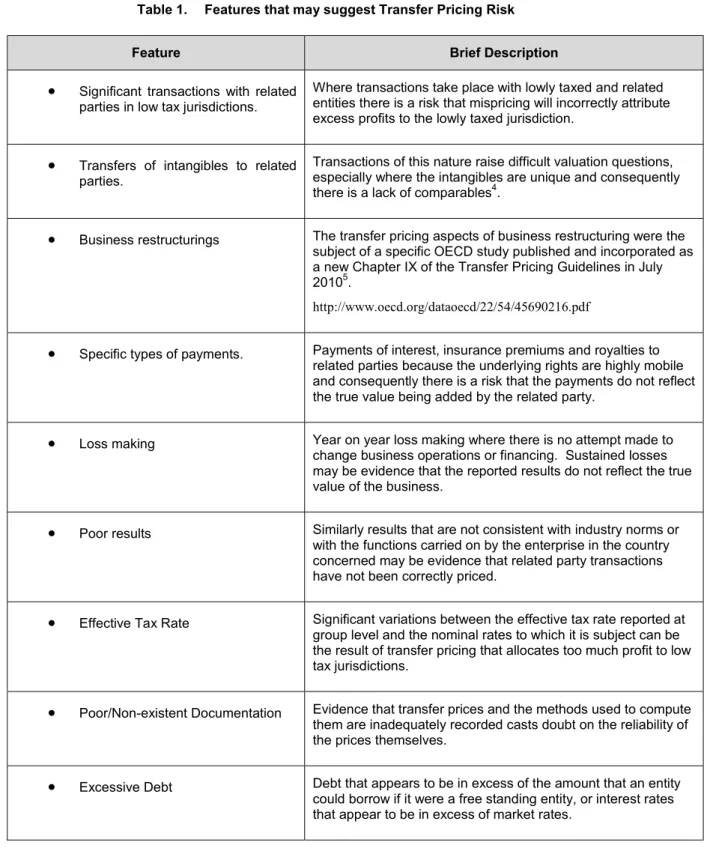
However, it is helpful to have a structured approach to the consideration of risk, as this can ensure that the assessment is comprehensive and any enquiries that do result are clearly focused and specific. The table below summarises the aspects of a case that are most likely to suggest that there is scope for transfer pricing risks to arise. It is not, however, an exclusive list of transfer pricing risks.
2. SELECTING THE RIGHT CASES – 25
Table 1. Features that may suggest Transfer Pricing Risk
Feature Brief Description
• Significant transactions with related parties in low tax jurisdictions.
Where transactions take place with lowly taxed and related entities there is a risk that mispricing will incorrectly attribute excess profits to the lowly taxed jurisdiction.
• Transfers of intangibles to related parties.
Transactions of this nature raise difficult valuation questions, especially where the intangibles are unique and consequently there is a lack of comparables4.
• Business restructurings The transfer pricing aspects of business restructuring were the subject of a specific OECD study published and incorporated as a new Chapter IX of the Transfer Pricing Guidelines in July 20105.
http://www.oecd.org/dataoecd/22/54/45690216.pdf
• Specific types of payments. Payments of interest, insurance premiums and royalties to related parties because the underlying rights are highly mobile and consequently there is a risk that the payments do not reflect the true value being added by the related party.
• Loss making Year on year loss making where there is no attempt made to change business operations or financing. Sustained losses may be evidence that the reported results do not reflect the true value of the business.
• Poor results Similarly results that are not consistent with industry norms or with the functions carried on by the enterprise in the country concerned may be evidence that related party transactions have not been correctly priced.
• Effective Tax Rate Significant variations between the effective tax rate reported at group level and the nominal rates to which it is subject can be the result of transfer pricing that allocates too much profit to low tax jurisdictions.
• Poor/Non-existent Documentation Evidence that transfer prices and the methods used to compute them are inadequately recorded casts doubt on the reliability of the prices themselves.
• Excessive Debt Debt that appears to be in excess of the amount that an entity could borrow if it were a free standing entity, or interest rates that appear to be in excess of market rates.
26 – 2. SELECTING THE RIGHT CASES
DEALING EFFECTIVELY WITH THE CHALLENGES OF TRANSFER PRICING © OECD 2012
Business understanding and risk identification
There are two principal approaches to risk assessment. Tax administrations need to consider both of them.
Bottom up – this involves consideration of information about the cross border arrangements that are specific to the MNE and jurisdiction in question, especially those that are not commonly found in transactions between unrelated parties and that may distort the allocation of profits and losses between jurisdictions. Tax administrations need to be satisfied with any analysis submitted that seeks to demonstrate that these arrangements are on arm’s length terms.
Top down – this involves an assessment of the profitability of the group’s operations in the jurisdiction in the context of the overall profitability of the MNE group, taking into account the allocation of functions, assets and risks and the business sector in which it operates. If the profitability of the company falls significantly below expectations based on high-level economic analysis, further investigation of the reason for this and the pricing of significant transactions is required.
Both approaches are dependent on a good commercial understanding of the company, the MNE group and the sector. This can be built up from published sources and, where an enhanced relationship exists, from discussions with the leadership of the MNE group itself6. Understanding the specific business context in which related party transactions are being conducted is of critical importance, as is an appreciation of the results of the business in a particular country in the context of the overall MNE group. Commercially available databases, like Amadeus, that bring together the reported results of many companies and provide information about key financial ratios and sectoral variations are used by several countries to identify risk and inform their risk assessments.
Although information from these sources can be valuable in providing potential comparables within sectors and can therefore help to refine the risk assessment process, advisers emphasised the need for tax administrations to develop an understanding of the specific business model of each taxpayer. They noted that tax administrations do not always place enough emphasis on the need to achieve a good understanding of how a business is run before focusing on specific transactions. This view was echoed by tax specialists working in business. These specialists particularly emphasised the importance of understanding the business functions undertaken by different parts of a group of companies and how those interact before entering into detailed examination of specific aspects. The internal management of MNEs is commonly more concerned with functions and product lines than the specific legal entities through which they operate.
Business, their advisers and tax administrations all emphasised the importance of understanding the operations of an MNE, their sector and the economic context in which they operate including the impact of the present, difficult economic climate. This is an approach that many considered even more important when the business cycle exhibits exceptional swings and trading conditions that are very different to anything most have experienced before.
The use of specialists is dealt with more comprehensively in Chapter 7, but they have a part to play in effective risk identification. Many tax administrations use general tax auditors or tax inspectors to undertake the initial risk assessment, but a number also involve specialists to help make the finely balanced judgements required in identifying and assessing risk. For example, some tax administrations have developed a cadre of sectoral experts who have a good understanding of key sectors, such as banking, or the pharmaceutical industry. Advisers see sectoral specialisation as a positive
2. SELECTING THE RIGHT CASES – 27
development, particularly when these sector experts are involved in the risk identification and assessment process.
In the UK, HMRC requires the case team that is reviewing a potential transfer pricing risk for audit or enquiry to consider seeking input from the relevant specialists, including, for example, economists, trade sector advisers and corporate finance specialists.
Recognising the value of specific knowledge of the business in conducting risks assessments, the Canada Revenue Agency (CRA) has recently revised its risk assessment to a two tiered approach using standardised risk assessment tools. The main features of the revised approach are summarised below.
Box 2. Transfer Pricing Risk Assessment in Canada
• The Tier 1 risk assessment incorporates an integrated team approach which encompasses domestic, international, aggressive tax planning and goods and services tax risks. The assessment differentiates inherent risk elements (resulting from complexity or change) from behavioural risk elements (related to taxpayer behaviour in the areas of governance, tax strategies or ability to deliver compliance) to ensure that both risk areas are effectively included in the global risk assessment. Tier 1 segments the MNE population into high, medium and low risk categories, which supports CRA’s objective to focus its limited resources on the higher risk cases.
• The Tier 2 risk assessment is a more detailed risk assessment which builds on the results of Tier 1. It provides an efficient and effective way for auditors to further assess and document the specific risks in the audit. It also provides a means to develop a comprehensive audit plan.
• The Tier 1 risk assessment process for International risks, in particular transfer pricing, is supported by information obtained from an information return of arm's length transactions with non-residents. This is a robust, issues-based transfer pricing information return and the data from it is entered into a system that is capable of cross-referencing and matching information in other forms. The return asks for information about transactions with related parties of many different types, including partnerships and trusts. This is helping the CRA to extend its reviews of transfer pricing risks to include networks of organisations that are related and large when considered in the round, even if individual entities are not. The form can be viewed at http://www.cra-arc.gc.ca/E/pbg/tf/t106/README.html.
Annex 4 sets out how a major adviser of MNEs approaches Transfer Pricing risk identification and assessment.
The different approaches tax administrations take to the governance of transfer pricing programmes is discussed in Chapter 4 but case selection is often the first stage in the governance process. In the UK a transfer pricing enquiry must not be opened (or any approach made to a customer that might be construed as the opening of a transfer pricing enquiry) without the prior approval of HMRC’s Transfer Pricing Panel or Board which will consider a business case. This business case is prepared using a standard template and is a narrative document which sets out the case background, the risk assessment work undertaken, the reasons for and against enquiry and any special features. The template is also used for recording later stage reviews and is a living document for control of the transfer pricing enquiry. As Chapter 4 explains, the governance process in Denmark also starts at the case selection stage.
28 – 2. SELECTING THE RIGHT CASES
DEALING EFFECTIVELY WITH THE CHALLENGES OF TRANSFER PRICING © OECD 2012
Key thoughts for the chapter
The challenge for tax administrations is to maximise yield while ensuring that business and other stakeholders have confidence in the tax system. This requires transparent processes for deciding how tax compliance risks are to be addressed. This is particularly important in the context of transfer pricing audits and enquiries which can be very resource intensive for tax administrations and business alike.
Business, their advisers and tax administrations are all agreed that the benefits of effective transfer pricing risk identification include:
• More targeted and thus more cost-effective use of limited resources from a tax administration’s perspective;
• Clearly defined documentation requests which reduce both the demands on business in providing the documentation and the time and other resource burdens on the tax administration in reviewing it; and
• Shorter timescales for audits or enquiries and for resolving disputes, which are clearly advantageous to both business and tax administration.
2. SELECTING THE RIGHT CASES – 29
Notes
1 See for example Guidance Note - Compliance Risk Management: Managing and Improving Tax Compliance www.oecd.org/dataoecd/44/19/33818656.pdf and the more recent Evaluating the Effectiveness of Compliance Risk Treatment Strategies - Guidance Note http://www.oecd.org/dataoecd/59/3/46274278.pdf
2 The Compliance Assurance Process (CAP) pilot program for large corporate taxpayers in the United States is an example of a process that allows this to happen, although CAP is not limited to transfer pricing issues.
3 Joint International Tax Shelter Information Centre. Details can be found here: http://www.hmrc.gov.uk/avoidance/aag-jitsic.htm
4 The transfer pricing aspects of intangibles are currently being discussed by Working Party No. 6 of the Committee on Fiscal Affairs on the Taxation of Multinational Enterprises, through a Special Session on the Transfer Pricing Aspects of Intangibles set up for this purpose.
5 http://www.oecd.org/dataoecd/22/54/45690216.pdf
6 For a discussion of the Enhanced Relationship, see Chapter 8 of “Study into the Role of Tax Intermediaries”: www.oecd.org/dataoecd/28/34/39882938.pdf.
3. GETTING OFF TO A GOOD START – 31
Chapter 3
Getting off to a good start
This chapter is concerned with the initial stages of a transfer pricing audit or enquiry. It looks at the fact finding process and the part that early dialogue between the tax administration and the taxpayer can play and how best to frame requests for relevant business records.
32 – 3. GETTING OFF TO A GOOD START
DEALING EFFECTIVELY WITH THE CHALLENGES OF TRANSFER PRICING © OECD 2012
The way in which a transfer pricing audit or enquiry is opened is a key factor in determining the time it will take and the quality of the eventual outcome. This chapter describes ways to improve the opening of transfer pricing audit or enquiries to ensure effective progress.
Fact finding
A successful and effective transfer pricing audit or enquiry is one that is focused and specific and, as discussed in Chapter 2, the risk identification process plays a critical part in laying the foundations for that. The next key step is the initial fact finding. Obtaining the right facts at the right time is an essential part of effective transfer pricing audits and crucial to the eventual outcome.
Feedback from tax administrations and advisers alike suggests that facts and data should be established before arguments about the application of transfer pricing principles to those facts commence. Unfortunately it is only too common for both parties to enter into discussion of complex technical arguments and the detail of transfer pricing methodology before fully scoping the problem and agreeing which facts need to be established. The experience of advisers suggests that the fact finding phase of any transfer pricing audit or enquiry should be clearly distinguished from later phases and should be as collaborative an exercise as possible. Making a clear distinction between fact finding and the more adversarial stages of an enquiry helps to avoid technical arguments arising before the issues and facts are properly understood. Premature technical disputes are a regular cause of delay and wasted effort in transfer pricing enquiries.
All tax administrations emphasised how important it is to be able to access business records relevant to transfer pricing audits or enquiries. For this report business records are either the underlying records of account of the business or specific records relevant to the pricing of the transaction under review and are often a mix of the two. At the stage of opening a transfer pricing audit or enquiry, tax administrations usually take one of two different approaches. Some issue an immediate, usually standard, request for relevant business records whilst others open a dialogue with business and find that an early meeting between the business, its advisers and the tax administration enables a more targeted request for business records to be made. Countries making a standard request for business records often find that their request can be facilitated by substantive rules requiring taxpayers to prepare a defined package of transfer pricing documentation describing the taxpayer’s related party transactions and supporting the transfer pricing determinations that have been made with economic analysis. In many countries, failure to prepare such transfer pricing documentation may be cause for imposition of substantial penalties.
Early dialogue
Whether or not the first step in an enquiry is a formal request for business records, there is a considerable degree of agreement between tax experts in business, advisers and transfer pricing specialists in tax administrations about the value of early dialogue. In one case mentioned by advisers, the focus of the enquiry was business restructuring. The taxpayer invited the tax administration team to a meeting at which the taxpayer gave a presentation about the commercial background of the restructuring. The taxpayer provided replies to questions posed in advance of the meeting, together with supplementary information to answer questions that had not yet been asked. The tax administration team obtained an understanding of commercial issues and an overview of the facts much earlier than would have been possible through written enquiries.
Face to face dialogue on transfer pricing issues will generally be a more efficient and effective way to establish the overall commercial context of the transactions being reviewed and to establish the
3. GETTING OFF TO A GOOD START – 33
facts. It is becoming increasingly normal practice in tax administrations to use face to face dialogue as a means of agreeing the scope of and next steps in a transfer pricing audit or enquiry.
Many tax administrations are moving towards real time working of large business enquiries and audits as a means of working more productively and achieving earlier certainty for tax administrators and business alike. In relation to transfer pricing this means business having early discussions with tax administrations about any restructuring and the potential impact on its transfer pricing policies. This makes it easier to identify cases that would benefit from a joint audit approach with another tax administration or an Advance Pricing Agreement.
Requests for business records relevant to transfer pricing audits or enquiries
The use of specialists is addressed in Chapter 7 but it is worth mentioning here the value that they are able to add at this early stage. Where sectoral or industry specialists exist in the tax administration, their involvement in these meetings can be very helpful.
Sectoral specialists can also help to frame requests for relevant business records. They are often able to advise, from personal experience, precisely what forms of relevant documentation are likely to have been produced and so help to ensure that any material requested will both exist and be of value to the enquiry. The Canada Revenue Agency already involves its sectoral specialists in the process of constructing information requests at the outset of enquiries. Industry experts also help focus HMRC’s interventions and provide invaluable assistance in framing information requests and scoping out many areas of dispute.
Box 3. Example of UK’s use of sector experts
In several transfer pricing cases involving the pharmaceutical industry HMRC used relevant experts to identify the nature and type of records which the businesses were likely to keep or were required to keep under industry regulations. This enabled information requests to be far more specifically targeted and importantly set out using industry ‘jargon’ where necessary. This approach was beneficial to both the taxpayer and the tax administration. It resulted in far smaller volumes of business records being requested and provided thus easing both the compliance burden on the taxpayer in terms of locating and providing it and the resource burden on the tax administration in reviewing it. Equally, it provided for less misunderstanding as to precisely what was being sought and consequently fewer but highly directed supplementary requests. Consequently, the time taken to resolve enquiries was significantly reduced.
Whatever the approach to obtaining business records - whether the tax administration makes use of early dialogue with the taxpayer to inform its information request, or prefers to make an immediate request for business records – all tax administrations emphasised the importance of obtaining the transfer pricing documentation held by the business as part of the fact finding process. This is why many countries specify what contemporaneous documentation needs to be maintained by MNEs and made available on request.
Generally tax administrations aim to provide guidance to MNEs on the transfer pricing documentation they should maintain. However, the extent to which specific requirements are spelt out in tax legislation is more varied. The spectrum ranges from those that have a very prescriptive approach to those where nothing is prescribed in legislation. Canada, for example, has specific provisions governing the maintenance and provision of documentation to support the transfer prices adopted by a business and this is backed up by a penalty regime1. In contrast the UK does not have
34 – 3. GETTING OFF TO A GOOD START
DEALING EFFECTIVELY WITH THE CHALLENGES OF TRANSFER PRICING © OECD 2012
records (2) tax adjustment records (3) records of transactions with associated businesses and (4) evidence to demonstrate an “arm’s length” result it requires business to be able to provide and when these records need to come into existence. Similarly, Austria has no specific documentation requirements but a recent court decision has made it clear that the taxpayer must be in a position to produce data on which a prudent business manager would have been able to base a pricing decision.
In the experience of many tax administrations the crucial issue is not the quantity of transfer pricing documentation, including any formal transfer pricing report that is provided, but the quality of the information it contains and whether the facts support the documentation produced.
Tax administrations and busines