Factors contributing to Flood Resilience among Rural
Community: Case Study of the East Coast of Malaysia
Omar Chong N.1 and Kamarudin K.H.1,2*
1. Razak Faculty of Technology and Informatics, Universiti Teknologi Malaysia (UTM) Kuala Lumpur, Jalan Sultan Yahya Petra, Kuala Lumpur 54100, MALAYSIA
2. Disaster Preparedness and Prevention Centre (DPPC), Malaysia-Japan International Institute of Technology, Universiti Teknologi Malaysia (UTM) Kuala Lumpur, Jalan Sultan Yahya Petra, Kuala Lumpur 54100, MALAYSIA
Abstract
From the spatial planning context, the National Rural
Physical Policy (NRPP) 2030 indicated that almost
31% villages nationwide are identified as disaster risk
villages. Based on Government of Malaysia records of
more than 89 years, flood remains as the highest
contributor to damage and economic losses in
comparison to other disasters. This study is intended to
assess internal and external factors that contributed to
rural
community
resilience
towards
disaster
particularly flood in relation to the context of disaster
resilience concept and sustainable development goals
(SDGs). Three case study areas have been selected for
household surveys including (1) Lubok Setol village in
Kelantan state; (2) Teladas village in Terengganu state
and (3) Gajah Mati village in Pahang state.
Using stratified random sampling for questionnaire
distribution, the household survey received feedbacks
from a total of 90 respondents. Results showed that
community resilience to flood in all three villages is
strongly contributed from respondent’s adoption of
local knowledge combined with intervention and
support from related government agencies as well as
from non-governmental organisations and respondents
which happen to be the disaster victims did indicate
their ability to 'bounce back' after the disaster,
indicating a positive act of resilient to disaster.
Conclusion is drawn from the data analysis to prove
that both the internal and external factors significantly
contributed towards rural community resilient to
disaster particularly flood.
Keywords: Resilience community factors, rural, flood, disaster, Malaysia.
Introduction
Building community resilience towards disaster is often an endogenous process that is linked closely to local customs that at times may be operated and/or translated into decision-making processes outside formal structure and/or the policy realm. Therefore, it is important for this process to be explored further particularly in determining the state of community resilience through understanding the role and influence of internal and external factors for resilience. As defined by Berg5, adopting a case study approach shall assist
researchers to systematically gather information. In this context, community resilient factors hence create better understanding of resilient trend of a particular community. In this light, three rural communities in the East Coast of Malaysia were identified and selected including (1) Lubok Setol village in Kelantan state; (2) Teladas village in Terengganu state and; (3) Gajah Mati village in Pahang state. Selection of each community is based on five criteria namely (1) Traditional village with disaster risk as identified in National Rural Physical Planning Policy 2030; (2) Village in East-Coast region which experienced frequent disaster occurrence identified by Social and Welfare Department (JKM); (3)Village with established disaster response team sub-committee; (4) Village with Standard Operating Procedure (SOP) being acknowledge by Disaster Management agencies and (5)Village that participated in Community Based Disaster Risk Management (CBDRM) Program by MERCY Malaysia. Information gathering process utilising multiple methods including interview, questionnaire and partial-participatory observation intended to identify measures implemented in disaster management within communities.
Findings from the survey is presented in forms of measures implemented by related parties including local community, government agencies and non-governmental organisation (NGO) and these measures were classified according to the disaster management cycle (DMC). Asian Disaster Reduction Centre in 2005 promotes DMC which consist of four (4) cycle/phases namely: prevention/mitigation, preparedness, response and rehabilitation/reconstruction3.
Currently, Malaysia has rectified and implemented these four (4) cycle stages in order to suit the existing legislation, to promote practices and to accommodate multidisciplinary practitioner background13.
Later on, the impacts of flood to the community are determined followed by identification of state of community recovery from disaster. Finally, the measures implemented in disaster management and recovery status were interpreted based on the disaster resilience model and life cycle.
Review of Literature
Disaster management cycle: In 2005, the Asian Disaster Reduction Centre3 has formulated the Disaster Risk
Management Cycle consisting of four (4) main stages of disaster management namely prevention/mitigation, preparedness, response, rehabilitation and reconstruction
(Figure 1). The proposed four stages were lesser than the 1975 framework of disaster management cycle4,7 which
indicated six (6) stages namely prevention, mitigation, warning, relief, reconstruction and rehabilitation. Despite having a different number of stages i.e. either four (4) or six (6) stages, the disaster management cycle in general can be divided into (1) pre-disaster and (2) post-disaster stages. In this light, the pre-disaster includes prevention/mitigation and preparedness while post-disaster includes response, rehabilitation and reconstruction.
Based on review of literature, Malaysia is implementing the four (4) stages of disaster management that consists of disaster prevention/mitigation, preparedness, response and recovery. The utilization of four stages is to support the existing legislation on DRM and to promote more efficient practice involving multidisciplinary practitioner backgrounds.10,13
Figure 1: Four (4) stages in Disaster Management Cycle by Asian Disaster Reduction Center3
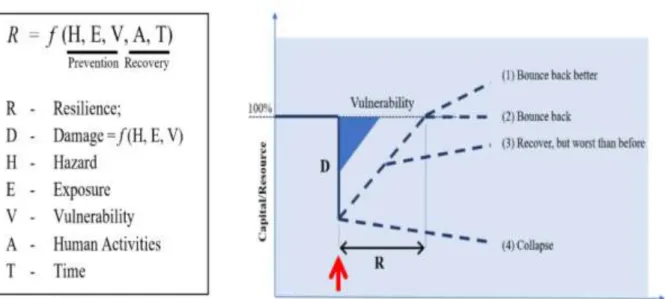
Disaster resilience model and life cycle: As defined by Hayashi8, damage is equal to the sum of hazard, exposure
and vulnerability (mathematical model in figure 2). Damage that resulted from disaster shall be reduced by implementing suitable prevention/mitigation and preparedness measures (in pre-disaster stage). However, for the post-disaster stage (including during disaster stage), recovery from damages should become the main priority for the disaster victims as well as the agencies. Adopting the appropriate activities for recovery and time factor become crucial elements for determining the speed of recovery process9.
For example, when during response stage, the success in saving human life would be determined by prompt actions involving search and rescue of disaster victims and for the rescue team to provide medical assistance. The sooner all victims received the medical assistance, there will be higher chances of survival rates. In this light, installing good preparedness measures such as emergency drills and preparation of emergency kits would help in search and rescue effort. As for the long run, particularly on the rebuilt of people’s livelihood, it would be crucial to develop strategies that will allow majority of disaster victims to be able to resume work and generate income which could minimise socio-economic losses and/or damages by the disaster.
Figure 2 shows resilience towards disaster in lifeline model1,6,8,19. The grey shaped triangle on the right represents
the ideal situation for disaster resilient progress where the vertical axis shows the implementation of prevention/mitigation measure to alter hazard and reduce vulnerability. Meanwhile, the horizontal axis indicates the appropriate activities carried out to speed up the recovery process after disaster and initiate community bounce back process or in a more ideal situation, community’s ability to bounce back better15.
Figure 2: Resilience towards disaster as illustrated in Mathematical Model8; (on the right) Resilience towards disaster illustrated in Lifeline1,6,8,19 (on the left)
As a result, for reducing hazard and vulnerability, together with improving the community capacity building as assert by Kelman et al12 would increase community’s ability for
resilience and ability to reduce disaster risk. Upon attaining this ability, the community is expected to utilise resources in a more efficient way and with minimal internal and/or external aid and assistance for recovery process11. The
disaster recovery process could also be achieved in much shorter time, signalling the resilience concept has rooted within the community.
Therefore, understanding the 'calculation' for resilience and all relevant factors including activities suitable for damage control and risk reduction into considerations will promote a stronger linkage between the concept and Sustainable Development Goals (SDGs) discourse. The implementation of resilience concept shall expedite or could become a catalyst for strengthening the Sustainable Development Goals (SDGs) agenda in the event of natural disaster management and risk reduction18.
Resilience concept and SDGs catalyst: SDGs is a global commitment to ensure 'what we possess today can be sustained for the next generations'. This paradigm later on was expanded into the context of disaster risk reduction (DRR) i.e. by linking the resilience concept with SDGs in a form of lifeline model (Figure 3).
As indicated in figure 3, the lifeline model described the link between resilience concept and SGDs using three different scenarios (and by assuming three scenarios possessing similar capital and functions):
1. The green line (Line A) represents the community progress towards SDGs without disturbances (disasters) i.e. without taking the element of disasters into equations.
2. The red line (Line B) on the other hand represents the progress towards SDGs with inclusion of elements of
disturbances (disasters) but without taking into account the concept of community resilience.
3. The yellow line (Line C) showing the progress of SDGs with element of disasters and by taking into account the resilience concept which was instilled in the community. Second assumption is that each coloured line (green/Line A, red/Line B and yellow/Line C) is a string (cotton thread) with similar length. Each string will be placed accordingly in horizontal axis to represent the SDGs 2030 target achievement. The red/Line B and yellow/Line C strings then were pulled down in vertical axis to represent distortion i.e. the disasters which impacted the community functions. Using simple comparative on the length of each string, it becomes obvious that:
1. The green string (Line A) will stretch all the way to year 2030 (i.e. achievement of SDGs) in normal progress without taking into account any disaster elements. 2. On the other hand, for the red string/Line B which
distorted by disaster (was pulled down dramatically) will leave behind at 2024 (slow recovery process of capital and functions) and the community involved will require longer time to achieve SDGs target. Therefore, in order to obtain faster recovery process, the community represented in the red string/Line B will need further assistance and longer time (probably 6 years more) to recover to its normal capital and functions to achieve SDGs.
3. The community represented in the yellow string/Line C however incorporated resilience concept and DRR and they shall continue to progress towards SDGs even with occurrence of distortions/ disturbances. By mitigating all possible damages and speed up the recovery process, the community shall require lesser constant assistance and recovery towards SDGs 2030.
Figure 3: Resilience concept as catalyst to SDGs illustrated in lifeline model Line A
Line B
In conclusion, the green line/Line A represents an ideal situation, however it is almost impossible to be obtained in a complex real world as observed today (considering climate change etc.). On the other hand, the red line/Line B represents undesirable living condition and threat to livelihoods and the yellow line/Line C is the intended scenario which needs to be nurtured so that the community could react accordingly in improving livelihoods with the occurrence of disasters.
Research Methodology
Selection of case study area: This study utilises the case study approach with focusing on the East Coast regions of Malaysia. Selection of case study areas was based on the following five (5) criteria namely:
• The case must be traditional village(s) with disaster risk as identified by DPFDN 2030 report (Criteria 1). • Village(s) located in East Coast region which frequently
experienced disaster occurrences based on record provided by the Malaysia Social and Welfare Department (JKM) (Criteria 2).
• Village(s) with own disaster response team established under Village Development and Security Committee (JKKK) (Criteria 3).
• Village(s) which had Standard Operating Procedure (SOP) endorsed by Disaster Management agencies (Criteria 4).
• Village(s) that participated in Community Based Disaster Risk Management (CBDRM) Program conducted by MERCY Malaysia (Criteria 5).
Based on the five (5) criteria listed and through thorough deductive process and evaluation, three (3) potential villages were identified as suitable case study areas as they have fulfilled most of the selection criteria. These villages are (1) Lubok Setol village in the State of Kelantan; (2) Teladas village in the State of Terengganu and (3) Gajah Mati village in the State of Pahang (Figure 4 for locations of case study areas).
Household survey using questionnaire: Household survey and field observation focus on determining possible factors contributing towards building resilience community to disasters. A total of 90 respondents participated in the survey conducted in January 2018 (i.e. immediately after major flood in the East Coast in December 2017) until mid-February 2018 (Table 1).
Figure 4: Location and distribution of selected case study areas based on selection criteria (https://i2.wp.com/investvine.com/wp-content/uploads/ecer_all4.gif, authors16)
Table 1
Distribution of sample size for household survey
1 + N. (e)2
n = n n
n - sample size; (1) N - population size;
e - level of error;
Distribution of sample size of all three case study areas Village Number of families % of each village Sample size (n=90) Lubok Setol 131 40 37 Teladas 121 37 32 Gajah Mati 70 23 21
Results and Discussion
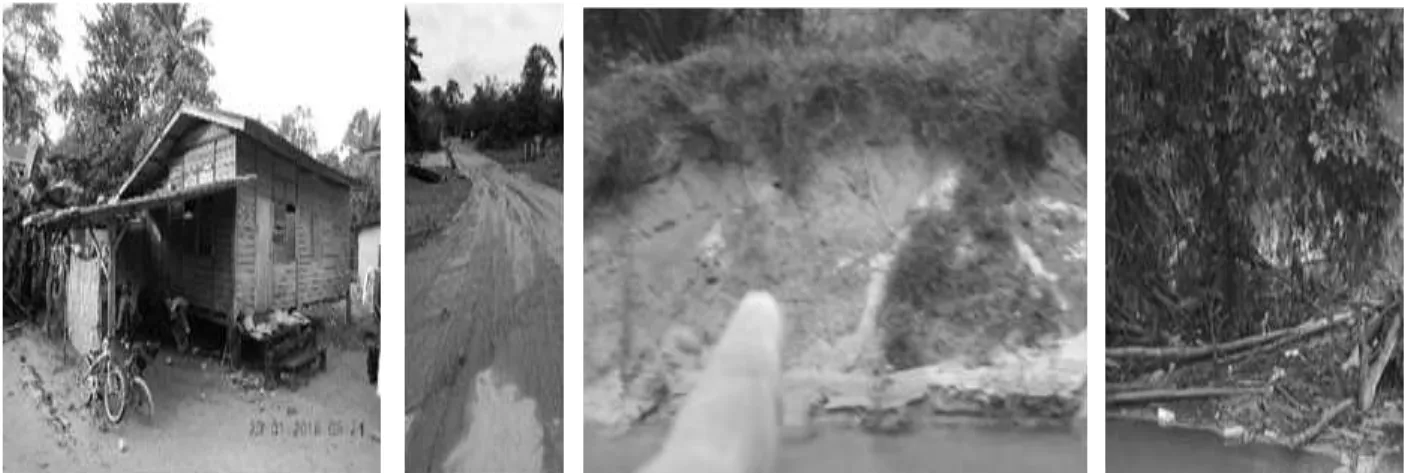
Impacts of flood on communities’ livelihood: Based on data analysis, respondents from all three villages indicated that their livelihoods were directly affected by the flood including Teladas village (96.9%), followed by Lubok Setol (83.3%) and Gajah Mati (76.2%). In general, 86.7% percent of respondents have agreed that their livelihoods were affected after flood, causing property damages and economic losses (i.e. loss of income particularly among farmers/smallholders). Field observation on the physical quality of the village indicated components of property damaged by the flood including wooden houses structure and soil erosion. Meanwhile, economic losses as mentioned by respondents include loss of income because many of them cannot continue farming and rubber tapping (for almost three months, November to January each year) and more money is needed for reconstruction of damaged house structure and slope repair project (Figure 5).
Implementation of measures according to disaster management cycle: Based on the data analysis and field observation, there are some evidence of measures for reducing disaster risks implemented in all three case study areas. For better understanding, these measures are classified into four (4) stages of disaster management cycle (DMC) with references to the three main stakeholders or actors in DMC namely (1) government; (2) non-governmental organization and (3) local community. The classification also intends to differentiate efforts taken and adopted by communities (defined as internal factors) and by other parties (defined as external factors). However, the listed measures are based on the respondents’ perception and field observation, compared to more detail measures based on documents review and agencies engagement presented in the previous study14.
Adoption of DMC measures during prevention and mitigation: At this stage, the most significant measure is construction of reservoir to reduce flood severity which could enhance community recovery process. Among all three (3) cases of study areas, only Lubok Setol village was
equipped with water reservoir constructed by the Drainage and Irrigation Department (DID) (Figure 6). Meanwhile, for Gajah Mati village, there is a plan by DID to construct a reservoir in Raub (a neighbouring district) which in turn shall ease flood issue in the study area in future. In Teladas on the other hand, there is no plan for constructing reservoir or any other mitigation measures in near future.
Adoption of DMC measures during preparedness stage: During preparedness stage, all three major stakeholders/actors (namely government, NGOs and local communities) have made necessary preparation in facing the flood (as the monsoon season is approaching). Based on the analysis, all measures stipulated by the Asian Disaster Reduction Centre2 were installed by stakeholders (Table 2).
Among these measures, government agencies (e.g. Meteorological Department) have installed meteorological observation and early warning system in all three (3) villages (provide life feeds using CCTV and alarm system in strategic locations). CCTV units were installed for monitoring water level of adjacent rivers in the villages. When the images captured showing water level in the rivers approaching the level of danger, then it will trigger the alarm and warning siren will be deployed automatically to warn communities for evacuation. The process of evacuation at the right time is crucial in reducing loss on life and might reduce burden/pressure for search and rescue team during flood.
Another preparedness project undertaken by government is conducting emergency drills which aim to educate and train local communities in study areas about safety measures, evacuation procedures and “do’s and dont’s” during event of flood. Based on interview with the head of the village, only Gajah Mati village currently received Community-based Disaster Risk Management (CBDRM) training provided by MERCY Malaysia17. Result from the survey also indicated
the component of “food and material stock piling” need further coordination among stakeholders since relevant government agencies, local communities and NGOs are all taking similar or redundant actions.
Figure 5: Evidence of physical damages caused by flood including (from left) damage of wooden house structure, main road covered with mud, slope collapse, debris in river.16,17
Local communities in all case study areas have demonstrated some evidence of utilising local knowledge in strengthening their preparedness level in facing the flood. To reduce economic losses, local communities usually suspended all farming or off-farm activities during monsoon season. In addition, all three communities have taken proactive measures including constructing overhead storage units/cabinet setting in their houses. Community in Lubok Setol has put more efforts by improving the house design (elevated pillars, higher parking garages), using materials that can withstand water penetration and building animal
shelters. Figure 6: Construction of reservoir by DID17
Table 2
Preparedness measures implemented in case study areas Village
Lubok Setol Teladas Gajah Mati
1. Government agencies
• Food and material stock piling by Malaysia Social and Welfare Department (JKM).
• Installation of early warning system - CCTV and alarm system.
• Emergency drills before
monsoon season by Fire and Rescue Department of Malaysia (JPBM).
NA • Emergency drills before
monsoon season by Malaysia Civil Defence Force (APMM).
NA • Aid and equipment store in operation
room at the evacuation centre.
• Aid and equipment store in
operation room at the evacuation center.
NA • Construction of alternative bridge in
2008.
NA
NA • Clean water supply during flood
using rain water harvesting by Ministry of Rural and Regional Development (KKLW) NA 2. Non-Governmental Organization (NGO)
• Equipment assistance - boat
donated to community.
•Equipment assistance - boat, washing machine and dryer for community to be utilized during flood
• Community-based disaster risk management (CBDRM) by MERCY Malaysia 3. Local community
• Food and material stock piling.
• Higher storage cabinet setting.
• Stop agricultural activity in monsoon season to avoid loss e.g. cultivation of new rubber tree or rubber tapping.
• House design - stilted house
not only to catch winds of higher velocity but also to avoid moving out during flood, secure the house and household equipment.
NA NA
• Material of the house also
change to concrete.
NA NA
• Rising elevation for animal
shelter.
NA NA
• Building ramp and rise house
elevation.
NA NA
NA • Own boat for mobility • Own boat for mobility
NA • Built hut for storage NA
Adoption of DMC measures during response stage: According to the Asian Disaster Reduction Centre2,
measures which shall be taken during response stage include; rescue mission, first aid, firefighting, monitoring of secondary disaster, construction of temporary housing and establishment of tent villages. Based on the survey, the JKM has gazetted an evacuation centre for each village, meaning construction of temporary housing and tent villages for victims during and after flood shall not be an issue. Response measures taken by relevant government agencies often focus on the rescue and first aid for disaster victims. The rescue effort was led by Police and Fire Department (JPBM) while first aid and emergency treatment were led by the District Heath Department (KKM). After all flood victims safely arrived at the designated evacuation centre, the JKM officers will keep records of the victims and provide food and basic necessities. The process is assisted by APMM, JKKK and local community (Table 3).
In general, all local communities studied were equipped with knowledge in disaster preparedness prior to the emergency drills and CBDRM program by MERCY Malaysia. Majority of respondents also indicated that they are willing to move to temporary shelters after receiving information and instruction for evacuation and the rescue activity normally happens in some occasions involving survival who initially refused to evacuate and later on trapped in their house when the flood worsened.
Adoption of DMC measures during rehabilitation and reconstruction stage: Based on the analysis, the role of relevant government agencies is vital in providing financial aid particularly to disaster victims at the evacuation centre. The aid is channelled through the JKM as stated in the Directive No. 20 [i.e. financial aid to be allocated only to all
eligible disaster victims using funding from the National Disaster Relief Trust Fund (Kumpulan Wang Amanah Bantuan Bencana Negara/KWAABN, 1997)]13.
Interpretation of Community Resilience and the Way Forward: This study summarised few key discussions on different measures installed by various stakeholders and at different DMC cycles as discussed earlier. As shown in table 4, more intensive efforts are implemented during preparedness and response stages as compared to prevention/mitigation and rehabilitation stages by relevant government agencies, NGOs and local communities. Findings from the study also demonstrated a prominent role of relevant government agencies in leading and executing disaster management and risk reduction in in all study areas as stated in the Directive No.20.
The efforts on disaster mitigation particularly construction of reservoir require huge amount of investment and hence capable agency is required which in this case is the government sector to step in and take the lead. However, at the community-level, the role of NGOs is gaining positive feedbacks from the disaster victims regarding the organisation ability in supplying food, first aid treatment, building materials and conducting training on CBDRM.
Conclusion
The study concluded that local community in all study areas utilises their past experience in facing annual flooding by strengthening local knowledge in DRR and imparting the knowledge in building community preparedness towards disaster and to reduce socioeconomic losses (damage) and to speed up the restoration of community functions after the flood (improve bounce back process).
Table 3
Response measures implemented in case study areas Village
Lubok Setol Teladas Gajah Mati
1. Government agencies
• Rescue efforts by various agencies in search and rescue cluster under Directive No.20 such as
Police, JPBM, APMM, Ministry of Health (KKM) with the support from Malaysian Red Crescent Society (BSM).
• Evacuation of victims to the evacuation center.
• Monitoring of secondary flood by Malaysian Meteorological Department (METMalaysia)
2. Non-Governmental Organization (NGO)
• Providing food and basic needs
3. Local community • JKKK support the evacuation of victims to the evacuation center by the government agencies. • JKKK assist government agency in victim registration, distribution of basic needs, preparation
of food, security and cleanliness in evacuation center.
Table 4
Summary of measure implemented by government, NGO and community based on the disaster management cycle. Lubok Setol village Teladas village Gajah Mati village
G overnm ent N on -G overnm ental O rgani zat ion C om m uni ty G overnm ent N on -G overnm ental O rgani zat ion C om m uni ty G overnm ent N on -G overnm ental O rgani zat ion C om m uni ty 1. Prevention/Mitigation ✓ 2. Preparedness ✓ ✓ ✓ ✓ ✓ ✓ ✓ ✓ ✓ 3. Response ✓ ✓ ✓ ✓ ✓ ✓ ✓ ✓ ✓
4. Rehabilitation and reconstruction ✓ ✓ ✓
Source: Research fieldwork17
For instance, a respondent in Lubok Setol village has recorded annual water level from Golok River in every monsoon season by putting a marking on his house pillar. By doing so, he will be able to share vital information about the worst flood that occurred in 2014 (marking of water level at 10.84 meter) as compared to flood in 1965 (below 10 meters of water level). This information was confirmed after a cross reference with data from Malaysia Drainage and Irrigation Department for flood in Rantau Panjang in 2015 and 201710.
After experiencing a big flood in 2014, more local community knowledge was accumulated useful in assisting vulnerable communities in building capacity for disaster resilience particularly flood. This is evident from the survey whereby nearly 94% of respondents from Teladas village followed by 70% from Lubok Setol and Gajah Mati (61.9%) agreed that their community managed to recover from flood within few months (41.1%) higher than those mentioned as they recovered within just few weeks (29%). Only small portion did mention “in a few years” (<6%).
In putting into perspective, the results from surveys of the three villages with comparison of lifeline model are presented in figure 2. Some DMC measures and local knowledge adopted by communities in study areas are able to (1) reduce the level of socioeconomic and physical damages (D) and (2) time for recovery/faster recovery period (R). This is also an important indication that could support the agenda of SDGs through building resilience rural community to disasters.
Acknowledgement
The authors would like to extend their appreciation to the Federal Department for Town and Country Planning for their offer of the Federal Training Prize (scholarship) which allowed Mdm. Noraini to pursue her Doctor of Philosophy Study in Universiti Teknologi Malaysia (UTM). Special thanks are also extended to UTM for partially funding this research under the Research University Grant (GUP-Tier 2, Ref. Num. PY/2017/01876: Q.K130000.2640.15J54) which made this research study possible.
References
1. Akter S. and Mallick B., The Poverty-Vulnerability-Resilience
Nexus: Evidence from Bangladesh, Ecological Economics, 96,
114–124 (2013)
2. Asian Disaster Reduction Center, Total Disaster Risk Management: Good Practice 2006 Supplement, Asian Disaster Reduction Center (2006)
3. Asian Disaster Reduction Center, Total Disaster Risk Management - Good Practices, Asian Disaster Reduction Center (2005)
4. Baird A., O’Keefe P., Westgate K.N. and Wisner B., Towards an explanation and reduction of disaster proneness, Occasional paper no.11, University of Bradford, Disaster Research Unit (1975) 5. Berg B.L., Action Research Qualitative Research Methods for the Social Sciences, 195–208 (2004)
6. Bruneau M. and Reinhorn A.M., Overview of the resilience Concept, Proceedings of the 8th US National Conference on Earthquake Engineering, Paper No. 2040, 2–6 (2006)
7. Coetzee C. and Van Niekerk D., Tracking the evolution of the disaster management cycle: A general system theory approach,
Jàmbá: Journal of Disaster Risk Studies, 4(1), 1-9 (2012)
8. Hayashi H., Introduction to Knowledge Based Action on Earthquake, Kyoto, Japan (2017)
9. Hayashi H., Scientific Decision Supports for Emergency Preparedness of Natural Hazards, Kyoto, Japan (2013)
10. JKM, Social and Welfare Department, Peraturan Tetap Operasi Pengurusan Bencana Banjir, Putrajaya: Malaysia Social and Welfare Department (2016)
11. Kamarudin K.H., Razak K.A., Omar Chong N., Abd Wahid S.N. and Wan Mohd Rani W.N.M., From Surviving to Thriving? Evaluating the Resilience of Rural Tourism Businesses in
Disaster-Prone Area of Sabah, Malaysia, Disaster Advances, 12(7), 41-48
12. Kelman I., Mercer J. and Gaillard J.C., Indigenous knowledge
and disaster risk reduction, Geography, 97, 12–21 (2012)
13. National Security Council, Directive No. 20, Malaysia: National Security Council, Prime Minister Department (1997) 14. Omar Chong N. and Kamarudin K.H., Persidangan Kebangsaan Geografi and Alam Sekitar, In Issues and Challenges in Disaster Risk Management in Malaysia: from the Perspectives
of Agencies, 6th Geography and The Environmental Conference,
164–174 (2017)
15. Omar Chong N., Kamarudin K.H. and Abd Wahid S.N., Framework Considerations for Community Resilient Towards
Disaster in Malaysia, Procedia Engineering, 212, 165–172,
https://doi.org/10.1016/j.proeng.2018.01.022 (2018)
16. Research fieldwork (2017) 17. Research fieldwork (2018)
18. Weichselgartner J. and Pigeon P., The Role of Knowledge in
Disaster Risk Reduction, International Journal of Disaster Risk
Science, 6(2), 107-116 (2015)
19. Wilson G., Community Resilience and Environmental Transitions, USA and Canada, Routledge (2011).