This is a self-archived – parallel published version of this article in the
publication archive of the University of Vaasa. It might differ from the original.
How has IFRS impacted financial reporting for
unlisted entities?
Author(s): Haapamäki, Elina
Title:
How has IFRS impacted financial reporting for unlisted entities?Year: 2018
Version: Publisher’s PDF
Copyright ©2018 the authors. Published by Editura ASE. Creative Commons Attribution 4.0 International License (CC BY 4.0)
Please cite the original version:
Haapamäki, E., (2018). How has IFRS impacted financial reporting for unlisted entities? Journal of Accounting and
Management Information Systems 17(1), 5–30.
Accounting and Management Information Systems Vol. 17, No. 1, pp. 5-30, 2018
DOI: http://dx.doi.org/10.24818/jamis.2018.01001
How has IFRS impacted financial reporting
for unlisted entities?
Elina Haapamäki
a1a
University of Vaasa, Finland
Abstract:
This paper addresses the question whether adoption of International Financial Reporting Standards (IFRS) is associated with low earnings management in unlisted companies in three European countries. Therefore, this paper investigates whether companies that have adopted IFRS voluntarily engage significantly less in earnings management compared to companies that have not adopted IFRS. Moreover, this study examines firm-specific incentives and their role in the adoption decision within different institutional settings. The distribution of earnings is analyzed to discover whether companies have managed their earnings. Logistic regression analysis is used to examine the firm-specific incentives. Empirical findings reveal that in sample of unlisted firms using IFRS the distribution of earnings is smoother. Thus, the results provide supporting evidence for the adoption of IFRS. Moreover, results of this study provide relatively good empirical support for statements that large unlisted firms with foreign owners and that are profitable are more likely to adopt IFRS voluntarily. However, the firm-specific incentives play different role in the adoption decision process in weak institutional settings compared to strong institutional settings.Keywords:
IFRS, financial reporting, international accountingJEL codes:
M41Accounting and Management Information Systems
1. Introduction
This study examines effects of adoption of International Financial Reporting Standards (from now on IFRS) on accounting quality in unlisted entities for a relative broad set of firms from three European countries that have adopted IFRS relative to a benchmark group of firms that did not adopt IFRS. Moreover, this study examines firm-specific incentives and their role in the adoption decision within different institutional settings.
Prior research using publicly listed firms suggests that the use of IFRS limits managerial discretion and requires more disclosure and greater transparency (e.g., Leuz et al., 2003; Francis et al., 2008, Bova & Pereira, 2012). In addition, listed firms applying IFRS have been found to exhibit less earnings management (e.g. Barth et al., 2008). However, unlisted firms do not have same kind of agency problems as listed firms, with respect to the separation of ownership and management, unlisted firms still engage in contracting with external parties (Francis et al., 2008). Therefore, prior research suggests that unlisted firms have incentives to improve the quality of their financial reports in order to reduce information asymmetry, and voluntary adoption of IFRS is one tool to achieve that goal. Understanding the effects of adoption on properties of accounting numbers is of potential interest to standard-setters and securities regulators in countries that are considering IFRS adoption as well as in countries that have already adopted IFRS. Furthermore, analysts, investors, and other financial information users may also find it useful to understand the effects of IFRS adoption on accounting quality in unlisted entities.
In 2002, the European Union (EU) issued a Regulation (EU, 2002) requiring all EU listed companies to adopt IFRS, set by the International Standards Board (IASB), for their consolidated financial statements for financial on or after 1 January 2005. In addition, some unlisted entities have also adopted IFRS. Many European unlisted companies have been aware of the likely benefits of voluntary adoption of IFRS. Supporters of IFRS adoption argued that companies are claimed to have contracting-driven incentives to adopt IFRS to improve the quality of their financial statements. Improved information quality enhances the comparability and the transparency of financial reporting, which is expected, for instance, to reduce the cost of capital (Jeanjean & Stolowy, 2008). Overall, the IFRS have been developed to harmonize corporate accounting practice and to answer the need for high quality standards.
This paper addresses the question whether adoption of IFRS is associated with lower earnings management in unlisted companies in three European countries. This study investigates whether companies that have adopted IFRS engage significantly less in earnings management compared to companies that have not
How has IFRS impacted financial reporting for unlisted entities?
adopted IFRS. The distribution of earnings is analyzed to discover whether companies that have not adopted IFRS have managed their earnings to avoid losses in these three European countries (Ireland, Poland and the UK). Consistent with Coppens and Peek (2005) and Jeanjean and Stolowy (2008), irregularities in distributions are analyzed as an indication of earnings management. The sample, consisting of unlisted companies, contains 131,995 firm-year observations relating to the period 2008-2012. In sample of unlisted firms using IFRS it is found that the distribution of earnings is smoother. Thus, the findings of this study indicate that adoption IFRS is associated with low earnings management. Moreover, this study examines firm-specific incentives and their relationship to the adoption decision within these three countries. The results of logistic regression analysis reveal that large unlisted firms with foreign owners and that are profitable are more likely to adopt IFRS voluntarily.
This paper contributes to the current literature by examining whether the adoption of high quality standards like IFRS is associated with high financial reporting quality in unlisted entities. This study compares unlisted firms that have adopted IFRS to companies that have not. The focus is on unlisted firms for following reasons. First, while unlisted firms are generally small in size, they are very important to global economic growth in terms of their contribution to employment and output (e.g., Francis et al., 2008). In addition, Francis et al. (2008) suggest that private firms have contracting-driven incentives to improve the quality of their accounting policies through voluntary IAS adoption. For a second reason for studying unlisted firms is that the IFRS adoptions are voluntary decisions. Due to that it is easier to identify the incentives and tease out the comparative costs and benefits of alternative financing reporting alternatives (Christensen, 2012). And finally, to focus on private firms is that accounting is likely to play a more important role for unlisted firms in addressing market imperfections in the form of agency conflicts and information asymmetry (Francis et al., 2008). For instance, Chaney et al. (2004) suggest that lack of transparency of private firms can make contracting with external parties problematic. Therefore, this study questions whether higher quality financial reporting can facilitate the contracting process. Moreover, this study examines whether IFRS are sufficient to override manager’s
incentives to engage in earnings management and affect the quality of reported earnings. A proportion of unlisted companies in Europe have chosen to adopt IFRS. This allows a comparison between companiesthat have adopted IFRS versus companies that have not. To conclude, this study contributes to the literature as follows. First, earnings management is analyzed in a different setting than most prior studies. Therefore, this study is one the few studies that empirically examines unlisted firms and their adoption of IFRS and earnings management. In addition, this study uses irregularities in earnings distributions as a proxy for earnings
Accounting and Management Information Systems
management. Moreover, this study provides evidence about the role of firm-specific incentives in the adoption of IFRS within different institutional settings. The remainder of this paper is organized as follows. First, this study reviews the relevant literature and provides the theoretical background of the paper. Second, the research questions are presented. Then, data and empirical methods are described. Finally, results are presented and discussed.
2. Literature review and research questions
With the globalization of international financial markets, widespread adoption of IFRS aims eventually to facilitate growth in EU equity market by providing high-quality financial reports and thereby serving the needs of investors and companies. The aim of adopting IFRS is to provide a common language for financial reporting and to develop international comparability. Those in favor of implementing IFRS suggested that a shared set of standards would make it easier to compare financial performance of companies across different countries. This would improve the effectiveness of competition and make international capital markets more efficient, leading to a lower cost of capital. These expected benefits are based on the premise that the use of IFRS increases transparency and improves the quality of financial reporting. However, there is evidence suggesting that accounting standards play only a limited role in determining observed reporting quality. The application of IFRS involves considerable judgment and IFRS (like any other set of accounting standards) provide managers with substantial discretion. How this discretion is used depends, for instance, on firm-specific characteristics and national legal institutions (Burgstahler et al. 2006; Ball, 2006).
Prior studies have focused mainly on earnings management practices of publicly
held firms. The idea that the use of accounting information in stakeholders’
contracting and monitoring activities induces managers to manipulate earnings underlies most of these studies. However, Coppens and Peek (2005) examined earnings management in private firms in eight European countries. To measure earnings management, they analyze the earnings distributions of private firms and compare these distributions with those of public firms in same countries. Their empirical evidence suggested that in absence of capital market pressures, firms still have incentive to manage earnings, as they found that private firms avoid reporting small losses. In addition, their result suggested that some types of earnings management are due to capital market pressures and are specific to public firms since they did not find evidence that private firms avoid earnings decreases.
How has IFRS impacted financial reporting for unlisted entities?
2.1. IFRS adoption and earnings quality
The International Accounting Standards Board (IASB) aims to achieve uniformity in the accounting standards used by businesses and other organizations for financial reporting around the world. In order to achieve these goals, IASB has issued principle-based standards and has taken steps to eliminate accounting
choices and to require accounting measurements that better reflect a firm’s
financial position and economic performance. The benefits of the adoption of IFRS are considered to be following. First, it should improve the investors to make informed financial decisions and eliminate confusion arising from different measures of financial position and performance across countries. Therefore, it suggests a reduced risk for investors and a lower cost of capital. Second, it should encourage international investment. Finally, it should lead more efficient allocation of savings (Street et al., 1999; Van Tendeloo & Vanstraelen, 2005).
The effects of IFRS adoption on accounting quality critically depend upon whether IFRS are higher or lower quality than domestic GAAP and how they affect the efficacy of enforcement mechanisms. By a higher quality standard this study means a standard that either reduces managerial discretion over accounting choices or inherently disallows smoothing or overstatement of earnings. If IFRS are of higher quality than domestic GAAP, and they are appropriately enforced, then adoption of IFRS is expected to improve accounting quality in private entities. On the other hand, if IFRS are of lower quality than domestic GAAP of if they weaken enforcement (e.g., because of increased discretion or flexibility), then it would be expected them to reduce accounting quality. Thus, the impact of IFRS on accounting quality is an empirical question.
In a number of European countries, including Ireland, Poland, and the UK, some unlisted companies have adopted IFRS. The adoption is thought to represent a substantial commitment to transparent financial reporting for example, for the following two reasons. First, IFRS might effectively enhance financial reporting quality. Second, companies which adopt IFRS might to do so because they have higher incentives to report transparently, such as high financing needs (Van Tendeloo & Vanstraelen 2005; 2008). This leads to case, where IFRS serves as a proxy for a credible commitment to higher quality accounting. A study conducted by Dumontier and Raffournier (1998) suggests that the decision to apply IFRS is primarily influenced by political costs and pressures from outside markets. Murphy (1999) found that companies that adopt IFRS have a higher percentage of foreign sales. El-Gazzar et al. (1999) found that having a lower debt to equity ratio is positively associated with the adoption of IFRS. Other determinant associated to the adoption of IFRS is a high profitability (Ashbaugh, 2001).
Accounting and Management Information Systems
Van Tendeloo and Vanstraelen (2005) examined whether voluntary adoption of IFRS is associated with lower earnings management. Their findings suggested that German listed companies that have adopted IFRS do not exhibit differences in earnings management when compared to those reporting under German GAAP. Contrary to this, Barth et al., (2008) indicated that the accounting amounts of firms that apply IFRS are of higher quality than those of non-U.S. firms that do not. They found that that firms applying IFRS exhibit less earnings smoothing, less managing of earnings towards a target, more timely recognition of losses, and a higher association of accounting amounts with share prices and returns. Their inferences are based on a comparison of accounting quality metrics for a broad sample of firms that apply IFRS. In particular, they compare accounting quality metrics for firms that apply IFRS those for a matched sample of non-U.S. firms that do not adopt IFRS. To conclude, they find that IFRS firms have higher accounting quality than firms that do not apply IFRS. Moreover, Chua et al. (2012) suggested that adoption of IFRS improves the accounting quality of listed firms in Australia. Their results indicated that subsequent to IFRS being implemented, the adopting firms exhibit less in earnings management by way of income smoothing, better timely loss recognition and stronger association between accounting and market base data. Moreover, Christensen et al. (2015) find that voluntary adoption of IFRS is associated with decreased earnings management, increased timely loss recognition, and increased value relevance.
Reverte (2008) documented that earnings management practices are significantly lower in EU countries where institutional framework is conducive towards achieving a high quality of financial reporting (i.e. in those countries with a higher level of enforcement of the rules, stricter securities regulation, lower ownership concentration and a higher degree of investor protection). Achieving high quality financial reporting means adoption of IFRS.
2.2. IFRS adoption and firm-specific incentives
Given the impact of IFRS on the quality of financial reports, it leads to the question of what factors shape firm-level voluntary adoptions of IFRS. A prevailing view is that firm reporting choices will be affected by payoffs that a firm obtains by addressing market imperfections, for example, agency conflicts and information asymmetry. Prior research suggests that firms will choose more conservative reporting to limit agency conflict between debt and equity holders. This way, the firm benefits in the form of a lower cost of debt financing. Moreover, firms which depend on external financing disclose more to reach the benefits of a lower cost of capital (Ahmed et al., 2002; Francis et al., 2008). In previous research on accounting standards choice by private firms (e.g. Francis et al., 2008), growth has also been suggested as one determinant in the decision process. Firms with expected future growth opportunities are more likely to be seeking external financing to fund current and future profitable projects, and in order to provide a
How has IFRS impacted financial reporting for unlisted entities?
signal of high quality accounting information to external capital providers are more motivated to adopt IFRS.
2.3. Earnings management incentives
Prior studies have investigated whether managers usually have an incentive to exceed certain thresholds, such as prior year earnings. For instance, Burgstahler and Dichev (1997) and Degeorge et al. (1999) investigate empirical earnings distribution under the research question that if firms manage earnings beyond earnings-related thresholds, the earnings distribution exhibits discontinuities around these thresholds. The strongest type of earnings management that these studies find is the avoidance of small losses and, to a lesser extent, small earnings decreases. Burgstahler and Dichev (1997) presented transactions cost theory that predicts that stakeholders such as customers, suppliers, short-term creditors and employees use heuristic cut-offs at zero earnings or zero earnings changes to value their implicit claim on the firm and to determine the terms of transactions with the firm. As a consequence, the firm manipulates reported earnings beyond such cut-offs to improve its terms of transactions. In addition, prior studies have investigated reasons that can explain loss avoidance and earnings decrease avoidance (e.g. Capkun et al., 2016).
While many studies have examined earnings quality and its determinants among public firms, only a few studies have considered earnings management in unlisted entities (Coppens & Peek 2005; Van Tendeloo & Vanstraelen, 2008). Unlisted companies are more closely held, have greater managerial ownership, major capital providers often have insider access to corporate information and capital providers take more active role in management. In addition, their financial statements are not widely distributed to the public and are more likely to be influenced by tax objectives (e.g. Ball & Shivakumar, 2005; Sundvik, 2017). Given these unique attributes of unlisted entities, studying earnings management and adoption of IFRS is relevant.
One way of assessing the quality of reported earnings is examining to what extent
earnings are managed, with the intention to “either mislead some stakeholders
about the underlying economic performance of the company or to influence
contractual outcomes that depend on reported accounting numbers” (Healy &
Wahlen, 1999). Though, there are incentives for earnings management, either through accounting decisions or structuring transactions. Managers may be inclined
to manage earnings due to existence of explicit and implicit contracts, company’s
relation with capital markets, and the need for external financing, the political and regulatory environment or several other specific circumstances. In other words, bank financing is usually a major source of finance in unlisted entities, resulting in agency conflicts between bankers and owners, and between bankers and
Accounting and Management Information Systems
management (Vander Bauwhede & Willekens, 2004), which may also create earnings management incentives. Typical reasons of why unlisted entities could potentially engage in earnings management are tax minimization and obtaining better terms of trade with banks, suppliers, customers, employees and government (Coppens & Peek, 2005). In addition, Ball and Shivakumar (2005) indicate that one
of the main objectives of private firms’ financial statements is tax determination.
Consequently, private firms reported earnings can be affected by their efforts to manage taxes. Coppens and Peek (2005) suggested that the following two factors determine how tax incentives influence the financial statements. First, the use of financial statements in contracting and communication with stakeholders negatively affects the severity of tax management since accounting-based contracting and tax determination create conflicting reporting incentives. Second, tax incentives have a stronger influence on financial statements in countries where accounting practice is strongly aligned with tax practice, for instance when tax accounting rules follow financial accounting rules. Prior research indicates that companies in these countries prefer low volatility in earnings (Ball et al., 2000). 2.4. Research questions
Empirical studies suggest that disclosure quality tends to improve for European companies after the adoption of IFRS rules (Daske & Gebhardt, 2006). Adopting IFRS appears to reduce information asymmetry between managers and shareholders. Thus, prior literature found a reduction of information asymmetry and as evidenced by lower earnings management, lower costs of capital and lower forecast errors. In addition, Barth et al. (2008) find that firms adopting IFRS have less earnings management, more timely loss recognition and more value relevance of earnings. They interpret these findings as evidence of higher accounting quality. Due to this aspect, this study expects that unlisted firms adopting IFRS have better accounting quality.
The purpose of this study is to examine whether adoption of IFRS is associated with high financial reporting quality in unlisted companies. In particular, it is questioned whether companies that have adopted IFRS engage significantly less in earnings management compared to companies that are not using IFRS. The first research question is stated as:
RQ1: Are unlisted firms which have adopted IFRS engaging significantly less in earnings management compared to unlisted companies that are not reporting under IFRS?
In addition, the second research question is stated as:
How has IFRS impacted financial reporting for unlisted entities?
3. Research design and sample
Prior studies have classified the research design for studies of earnings management in three categories: (1) those that use discretionary accruals (e.g., Jones, 1991; Dechow et al., 1995), (2) those that use specific accruals (Dechow et al., 2010) and those that study statistical properties of earnings identify thresholds (Degeorge et al., 1999; Coppens & Peek, 2005; Jeanjean & Stolowy, 2008). Given constraints on data availability, and consequently the difficulties of implementing the methods based on accruals, this paper applies the third methodology and analyzes the distribution of earnings in three countries, Ireland, Poland and the UK. Threshold-oriented earnings management studies analyze the distributions of reported earnings and find that the frequencies of small losses are unusually low, whereas frequencies of small profits are extraordinarily high. In accordance with McNichols (2000) and Coppens and Peek (2005) it is believed that analyzing the distributional properties of earnings is a feasible and powerful method to examine earnings management.
Following these assumptions, this study examines earnings distributions for discontinuities around thresholds. According to Glaum et al. (2004) such irregularities in distributions indicate that companies avoid reporting net income below thresholds by managing it upward. Glaum et al. (2004) suggested that without earnings management the distribution is expected to be relatively smooth
around thresholds. Thus, this study tests the “loss avoidance threshold” by
analyzing the distribution of net income. Following Leuz et al. (2003), Coppens & Peek (2005) and Jeanjean & Stolowy (2008), accounting variables are scaled by total assets and classify a firm-year observations as a small profit if net income (scaled by total assets) is in the range [0, 0.01]. A firm-year observation is classified as a small loss if net income (scaled by total assets) is in the range [-0.01, 0[. Various ratios can be used to determine discontinuities in distributions (Glaum
et al., 2004; Jeanjean & Stolowy 2008). Given the exploratory nature of this study, only one ratio is used: the small reported profits to small reported losses. This means that the number of observations to the right of zero is divided by the number of observations to the left of zero. In addition, this simple proxy for asymmetry has been used in prior studies (Brown & Higgins, 2001; Glaum et al., 2004, Jeanjean & Stolowy, 2008).
In addition, this study tests a set of firm-specific variables for their association with the voluntary adoption of IFRS. It is worth noting that the choice of variables is limited by the data availability. The firm-specific factors in this study capture the degree of information asymmetry that can influence the demand for better accounting quality. It is argued that firms are more likely to voluntarily adopt IFRS if they have strong contracting incentives (Francis et al., 2008). These contracting incentives are measure according to the prior literature (e.g. André et al., 2012) by
Accounting and Management Information Systems
using firm characteristics that proxy for (1) expected future growth opportunities, (2) current external financing, (3) foreign owners and (4) ratio of income to total assets.
It is suggested that firms with growth opportunities are more likely to be in need of external financing to fund the current and future projects (Francis et al., 2008). For
example, Easley and O’Hara (2004) stated that firms can influence their cost of
capital through the quality and quantity of information available to stakeholders
and investors. They particularly stated that a firm’s selection of its accounting
standards is important tool in this process. Moreover, firms with greater investment opportunities and a greater demand for external finance are more likely to adopt high quality accounting standards as a signal of accounting quality (Francis et al., 2008). In this study, growth (GROWTH) is measured by using actual growth rate (average) over the five years examined. External financing (EXTDEP) is a measure
of the firm’s external financing (average) and is measured as the ratio of the firm’s
financing from external sources (equity and bank loans) to total assets over the five years examined. It is expected that the coefficients on GROWTH and EXTDEP to be positively related to IFRS adoption, either to affect financing security or in anticipation of future financing activities.
Companies can also gain benefits from having foreign investors. Prior literature suggests that foreign investments facilitate growth (e.g. Alfaro et al., 2004; Francis
et al., 2008). However, it is suggested also that such companies meet additional information asymmetry problems (Francis et al., 2008). Therefore, the voluntary adoption of IFRS is one way of generating accounting quality and financial transparency to potential foreign investors. This study also includes indicator variable (FOWN) coded 1 if the nationality of the general ultimate owner of a firm is different than the place of domicile of the firm, and 0 otherwise. The coefficient on FOWN is expected to be positively associated with voluntarily adoption of IFRS.
Moreover, a ratio of total income to total assets (INCOME) is also predicted to positively affect voluntary adoption of IFRS. And finally, a variable for firm size is included in the model as a control variable. The firm size is categorized in three groups based on the average number of employees in the firm over the past five years. SIZE takes on the value of 1 if a firm employs less than 50 persons, 2 if it employs 51-500 and 3 if the firm has more than 500 employees. This study does not make prediction about the effect of firm size on IFRS, because of the competing empirical results (e.g. Beck et al., 2005; Doidge et al., 2007; Francis et al., 2008).
In summary, this study expects that entities with more growth opportunities, greater levels of external financing, more foreign ownership, less variation in reported earnings are more likely to adopt IFRS. However, no prediction is made
How has IFRS impacted financial reporting for unlisted entities?
for firm size due to competing arguments. For instance, Beck et al. (2005) argue that larger firms are more likely to depend on long-term financing and therefore large firms are more likely voluntarily adopt better governance structures (such as IAS) to facilitate external financing. In contrast, Doidge et al. (2007) suggest that large firms face a greater cost of transparency and therefore may be less likely to adopt better governance structures such as higher quality accounting standards. 3.1. Data collection and sample
Data of unlisted companies are collected from Orbis database for the years 2008-2012. The countries included are Ireland, Poland, and the UK due to highest data availability. The objective of this study is to examine whether unlisted companies that have adopted IFRS engage significantly less in earnings management compared to companies that have not adopted IFRS. Since, a threshold approach is used, the following data required: net income, total assets and turnover. The sample for the threshold approach this study comprises 1 385 unlisted firms using IFRS (6 925 firm-year observations): 150 (750) for Ireland, 254 (1,270) for Poland and 981 (4,905) for the UK.
In addition, the sample of unlisted firms using Local GAAP comprises 25,014 firms (125,065 firm-year observations): 1,165 (5,825) for Ireland, 6,140 (30,700) for Poland and 17,709 (88,450) for the UK. For the firm level analysis, the sample consists of 661 firms for the UK, 248 for Ireland and 378 for Poland. Banks, insurance and investment companies were excluded from the sample, because their specific accounts structure would prevent homogeneous statistical processing. 3.2. Empirical model for firm-level characteristics
This study estimates logistic (logit) regression model to examine the firm-level characteristics. The model classifies firms into IFRS and non-IFRS adopters. Firm-level factors model:
Prob (IFRS=1)= ₀+α₁GROWTHᵢ+α₂EXTDEPᵢ+α₃FOWNᵢ+α₄INCOMEᵢ+α5SIZEᵢ+
ε
Where:
IFRS ADOPTION = 1 if a firm uses International Financial Reporting Standards, 0 otherwise;
Accounting and Management Information Systems
EXTPED = is the ratio of the firm’s financing from external sources (equity and
bank loans) to total assets over the five years examined;
FOWN = 1 if the nationality of the general ultimate owner of a firm is different than the place of domicile of the firm, and 0 otherwise.
INCOME = a ratio of total income to total assets;
SIZE = 1 if a firm has less than 50 employees; 2 if a firm has 50-500 employees and 3 if a firm has more than 500 employees.
ε is the margin of error
4. Results
4.1. Descriptive statistics and univariate tests for earnings management
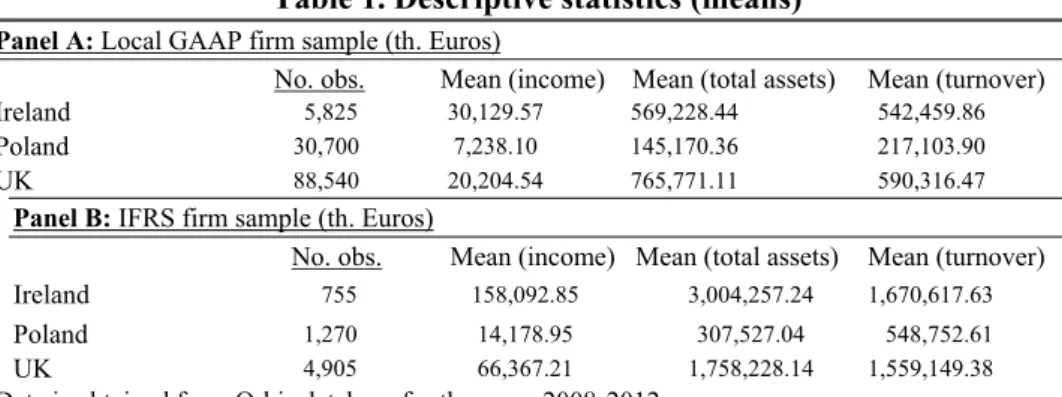
Table 1 and Table 2 present descriptive statistics for the income, total assets and turnover, in terms of means and medians, respectively. The number of available firm-year observations for unlisted firms varies considerably among the countries. To some extent this can be explained by the country size. However, since the Orbis database is a collection of several existing European country-specific databases, the number of observations per country also reflects the quality and completeness of the databases that are available in each country. Panel A reports descriptive statistics for the Local GAAP sample and Panel B reports for the IFRS sample in Table 1 and Table 2. The medians are visibly much lower than the means. This similar phenomenon is found also by Jeanjean and Stolowy (2008). It may be rationalized by the skewness of accounting variables but is not a problem for the empirical analysis. This study concentrates specifically on observations close to zero.
Table 1. Descriptive statistics (means) Panel A: Local GAAP firm sample (th. Euros)
No. obs. Mean (income) Mean (total assets) Mean (turnover) Ireland 5,825 30,129.57 569,228.44 542,459.86
Poland 30,700 7,238.10 145,170.36 217,103.90
UK 88,540 20,204.54 765,771.11 590,316.47
Panel B: IFRS firm sample (th. Euros)
No. obs. Mean (income) Mean (total assets) Mean (turnover) Ireland 755 158,092.85 3,004,257.24 1,670,617.63
Poland 1,270 14,178.95 307,527.04 548,752.61
UK 4,905 66,367.21 1,758,228.14 1,559,149.38
How has IFRS impacted financial reporting for unlisted entities?
Table 2. Descriptive statistics (medians) Panel A: Local GAAP firm sample (th. Euros)
No. obs. Median (income) Median (total assets) Median (turnover)
Ireland 5,825 2,433.00 143,570.00 135,795.86
Poland 30,700 2,236.54 49,089.54 84,992.05
UK 88,540 3,138.67 104,602.77 127,575.85
Panel B: IFRS firm sample (th. Euros)
No. obs. Median (income) Median (total assets) Median (turnover)
Ireland 755 4,500.00 311,128.00 114,181.00
Poland 1,270 3,965.23 119,291.65 134,655.44
UK 4,905 5,218.19 271,199.17 235,080.98
Data is obtained from Orbis database for the years 2008-2012.
4.2. Distribution of reported earnings
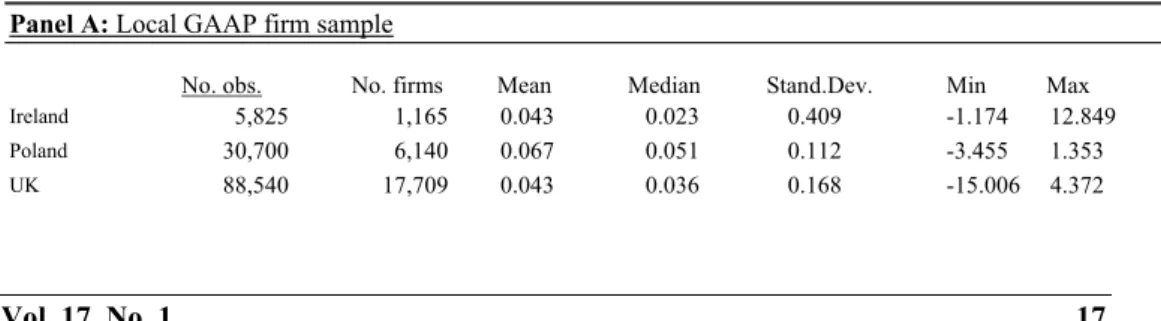
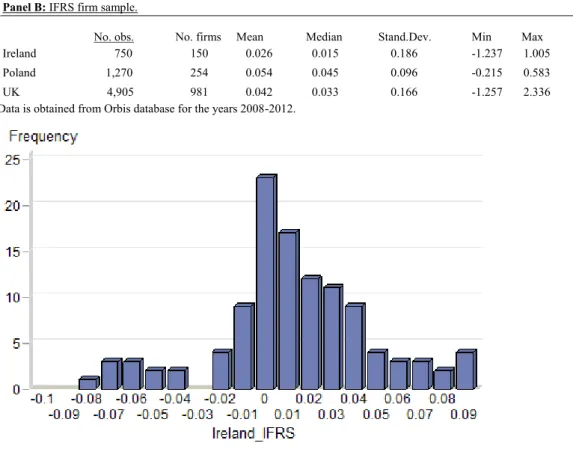
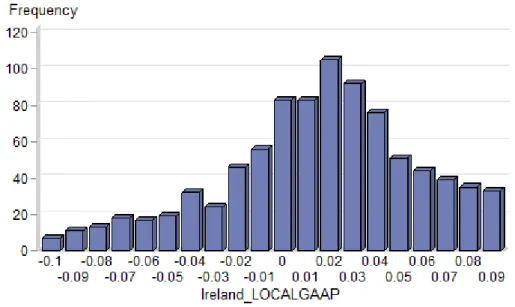
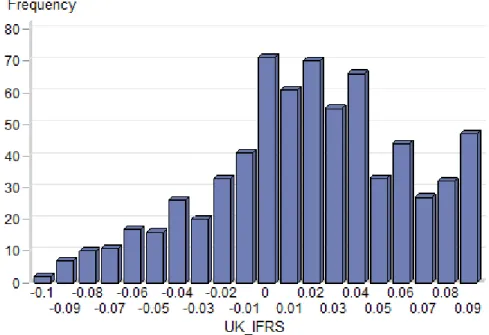
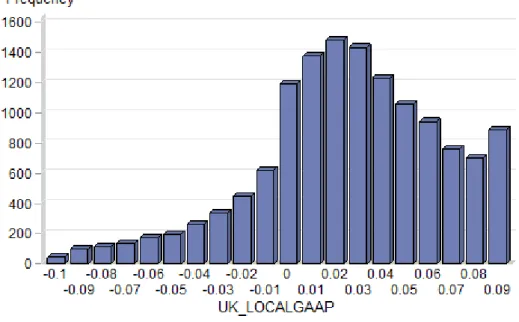
Table 3 concerns the whole sample, and therefore the whole range of net income/total assets. But the focus is on firms for which net income/total assets is a percentage relatively close to zero. However, Figures 1, 3 and 5 present distributions of net income scaled by total assets for unlisted firms using IFRS within the three countries studied with net income (scaled by total assets) of between -0.10 and 0.10. In addition, Figures 2, 4 and 6 present distributions of net income scaled by total assets for unlisted firms using Local GAAP within the three countries studied with net income (scaled by total assets) of between -0.10 and 0.10. The interval width for histograms is 0.01(net income scaled by total assets). All the histograms for Local GAAP firms indicate an abnormally high number of observations in the interval immediately to the right of zero. Moreover, the number of observations to left of zero is abnormally low. Although this phenomenon is found in the histograms for IFRS firms, however it is less clear. However, the most important factor for the purposes of this study is the differences in asymmetry in earnings distributions between the IFRS firms and Local GAAP firms. As a robustness check, the same graphs are examined using the variable net income scaled by turnover. Changes in the discontinuities are similar to those observed above with other scaling variable.
Table 3. Descriptive statistics.Income scaled by total assets Panel A: Local GAAP firm sample
No. obs. No. firms Mean Median Stand.Dev. Min Max Ireland 5,825 1,165 0.043 0.023 0.409 -1.174 12.849 Poland 30,700 6,140 0.067 0.051 0.112 -3.455 1.353 UK 88,540 17,709 0.043 0.036 0.168 -15.006 4.372
Accounting and Management Information Systems
Panel B: IFRS firm sample.
No. obs. No. firms Mean Median Stand.Dev. Min Max Ireland 750 150 0.026 0.015 0.186 -1.237 1.005 Poland 1,270 254 0.054 0.045 0.096 -0.215 0.583 UK 4,905 981 0.042 0.033 0.166 -1.257 2.336 Data is obtained from Orbis database for the years 2008-2012.
Figure 1.Loss avoidance – Distribution of Net income (scaled by total assets). Distribution of Net income (scaled by total assets) between -0.1 and + 0.1 in Ireland for firms reporting under IFRS. Data is obtained from Orbis database for years 2008-2012. The total number of observations is 112.
How has IFRS impacted financial reporting for unlisted entities?
Figure 2. Loss avoidance – Distribution of Net income (scaled by total assets). Distribution of Net income (scaled by total assets) between -0.1 and + 0.1 in Ireland for firms reporting under Local GAAP. Data is obtained from Orbis database for years 2008-2012. The total number of observations is 884.
Figure 3. Loss avoidance – Distribution of Net income (scaled by total assets). Distribution of Net income (scaled by total assets) between -0.1 and + 0.1 in Poland for firms reporting under IFRS. Data is obtained from Orbis database for years 2008-2012. The total number of observations is 189.
Accounting and Management Information Systems
Figure 4. Loss avoidance – Distribution of Net income (scaled by total assets). Distribution of Net income (scaled by total assets) between -0.1 and + 0.1 in Poland for firms reporting under Local GAAP. Data is obtained from Orbis database for years 2008-2012. The total number of observations is 4,304.
Figure 5. Loss avoidance – Distribution of Net income (scaled by total assets). Distribution of Net income (scaled by total assets) between -0.1 and + 0.1 in the UK for firms reporting under IFRS. Data is obtained from Orbis database for years 2008-2012. The total number of observations is 689.
How has IFRS impacted financial reporting for unlisted entities?
Figure 6. Loss avoidance – Distribution of Net income (scaled by total assets). Distribution of Net income (scaled by total assets) between -0.1 and + 0.1 in the UK for firms reporting under Local GAAP. Data is obtained from Orbis database for years 2008-2012. The total number of observations is 13,497.
4.3. Measures of asymmetry
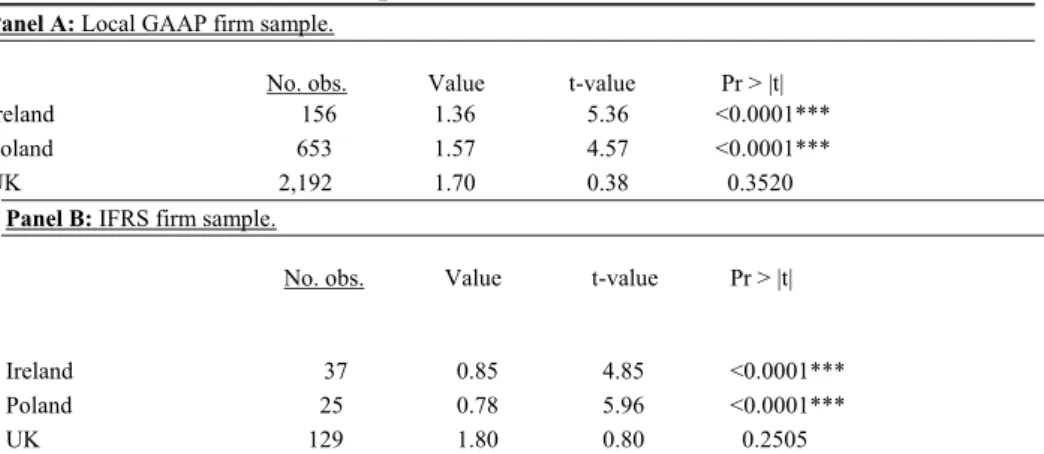
The histograms have the advantage of indicating a straightforward visual representation of discontinuities but these discontinuities must be measured to be certain of the phenomenon apparently observed, i.e. earnings management around the zero threshold. As discussed earlier, there are several measures of asymmetry, and the ratio of small reported profits to small reported losses is used (Brown & Higgings, 2001; Leuz et al., 2003; Jeanjean & Stolowy, 2008). A small profit corresponds to net income (scaled by total assets) in the range [0, 0.01] and a net loss corresponds to the range [-0.01, 0[ for the same variable. Table 4 provides evidence regarding the ratio of small reported profits to small reported losses. Table 4 investigates whether earnings management is higher for firms reporting under Local GAAP relative to firms reporting under IFRS. This is a direct test of whether Local GAAP firms manage earnings to avoid reporting a loss. In Ireland and Poland the firms using IFRS have lower ratios compared to firms using Local GAAP. And consistent with earnings management research, the ratio of small reported profits to small reported losses is significantly higher in Local GAAP
firms’ sample in the same countries. This finding suggests that in IFRS firm sample
Accounting and Management Information Systems
findings suggest that there were not statistically significant differences between the unlisted firms using IFRS and unlisted firms using Local GAAP.
Table 4. Comparison between countries: ratio of small reported profits to small reported losses. (Student t-test)
Panel A: Local GAAP firm sample.
No. obs. Value t-value Pr > |t|
Ireland 156 1.36 5.36 <0.0001***
Poland 653 1.57 4.57 <0.0001***
UK 2,192 1.70 0.38 0.3520
Panel B: IFRS firm sample.
No. obs. Value t-value Pr > |t| Ireland 37 0.85 4.85 <0.0001*** Poland 25 0.78 5.96 <0.0001*** UK 129 1.80 0.80 0.2505 ***Significant at level 1%, ** significant at level 5%, *significant at level 10%, Data is obtained from Orbis database for the years 2008-2012.
4.4. Descriptive statistics and regression results for firm-level characteristics
4.4.1 Descriptive Statistics
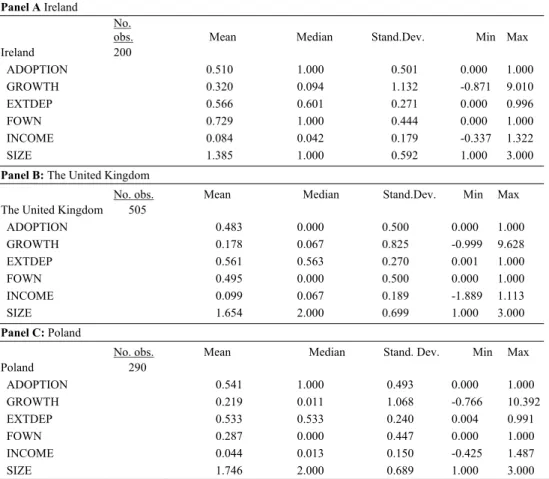
Table 5 reports the descriptive statistics for the firm-level characteristics. Panel A of Table 5 reports descriptive statistics for Ireland, Panel B for the UK and Panel C for Poland. The mean of IFRS adoption is highest in Poland (0.541) compared to the UK (0.483) and Ireland (0.510). Few points are noteworthy. First, these ratios should not be viewed as country-level adoption rates because the sample focuses on a subset of unlisted firms found within each country. It is also important to note that the focus of this study is not in understanding aggregate adoption rates across countries but rather understanding the determinants of firm-level IFRS adoption decisions. Therefore, this study examines how the self-reported firm-level IFRS adoption decision relates firm-level factors. The growth rate (GROWTH) averages from 17% to 32% and the firms’ current financing (EXTDEP) from 53% to 56%.
The median firm in Ireland and the UK has 50-500 employees and in Poland less than 50 employees. 73% of the sample firms have a foreign owner in Ireland, 50% in the UK and 28% in Poland. A ratio of total income to total assets (INCOME) averages from 0.04 to 0.09.
How has IFRS impacted financial reporting for unlisted entities?
Table 5. Descriptive statistics for firm-level characteristics.
Panel A Ireland
No.
obs. Mean Median Stand.Dev. Min Max
Ireland 200 ADOPTION 0.510 1.000 0.501 0.000 1.000 GROWTH 0.320 0.094 1.132 -0.871 9.010 EXTDEP 0.566 0.601 0.271 0.000 0.996 FOWN 0.729 1.000 0.444 0.000 1.000 INCOME 0.084 0.042 0.179 -0.337 1.322 SIZE 1.385 1.000 0.592 1.000 3.000
Panel B: The United Kingdom
No. obs. Mean Median Stand.Dev. Min Max The United Kingdom 505
ADOPTION 0.483 0.000 0.500 0.000 1.000 GROWTH 0.178 0.067 0.825 -0.999 9.628 EXTDEP 0.561 0.563 0.270 0.001 1.000 FOWN 0.495 0.000 0.500 0.000 1.000 INCOME 0.099 0.067 0.189 -1.889 1.113 SIZE 1.654 2.000 0.699 1.000 3.000 Panel C: Poland
No. obs. Mean Median Stand. Dev. Min Max Poland 290 ADOPTION 0.541 1.000 0.493 0.000 1.000 GROWTH 0.219 0.011 1.068 -0.766 10.392 EXTDEP 0.533 0.533 0.240 0.004 0.991 FOWN 0.287 0.000 0.447 0.000 1.000 INCOME 0.044 0.013 0.150 -0.425 1.487 SIZE 1.746 2.000 0.689 1.000 3.000 Notes: ADOPTION = 1 if a firm uses International Financial Reporting Standards, 0 otherwise; GROWTH = average actual turnover growth rate over the five years examined; EXTPED = is the ratio of the firm’s financing
from external sources (equity and bank loans) to total assets over the five years examined; FOWN = 1 if the nationality of the general ultimate owner of a firm is different than the place of domicile of the firm, and 0 otherwise. INCOME = a ratio of total income to total assets; SIZE = 1 if a firm has less than 50 employees; 2 if a firm has 50-500 employees and 3 if a firm has more than 500 employees.
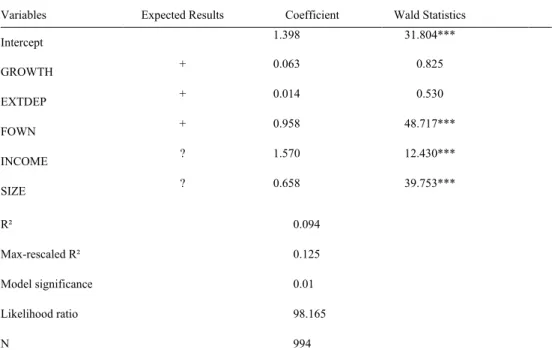
4.4.2 Multivariate analyses—Logistic regression
Table 6 reports the results of estimating the logistic regression for full sample with the Chi-Square test of model’s fit at a 0.01 significance level. With combined
analysis on the full sample (492 IFRS cases vs. 502 non-IFRS cases), this study finds that all of the firm-level variables (expect GROWTH and EXTDEP) are statistically significant. The results reveal that FOWN is positively associated with IFRS adoption (p <.01); INCOME is positively associated with IFRS adoption (p <.01) and SIZE is positively associated with IFRS adoption (p <.01). Thus, this finding provides relatively good empirical support for statements that unlisted firms with foreign owners and that are profitable are more likely to adopt IFRS voluntarily. In addition, this study suggests that large unlisted firms are more likely to comply with IFRS. While, for other firm characteristics, growth and leverage,
Accounting and Management Information Systems
the coefficients are not significantly different from zero, suggesting that these factors do not affect the decision.
Table 6. Results of the logistic regression for full sample
Model: Prob (IFRS=1)= α₀+α₁GROWTHᵢ+ α₂EXTDEPᵢ+α₃FOWNᵢ+α₄INCOMEᵢ+α5SIZEᵢ+ ε
Variables Expected Results Coefficient Wald Statistics
Intercept 1.398 31.804*** GROWTH + 0.063 0.825 EXTDEP + 0.014 0.530 FOWN + 0.958 48.717*** INCOME ? 1.570 12.430*** SIZE ? 0.658 39.753*** R² 0.094 Max-rescaled R² 0.125 Model significance 0.01 Likelihood ratio 98.165 N 994
***Significant at level 1%, ** significant at level 5%, *significant at level 10%
4.4.3 Robustness checks
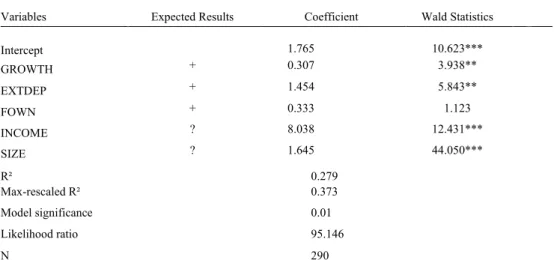
The full sample is partitioned by countries for additional tests to determine the relative importance of firm-level factors with weak and strong institutional settings. The rationale for partitioning by countries stems from the work of La Porta et al. (1998). In addition, Claessens and Laeven (2003) show that more economically developed countries have stronger legal systems and other institutions that facilitate private contracting and which increase the net payoff from the adoption of better governance structures. Tables 7 presents the logistic regression results for Poland (weak institutional settings) and Table 8 for the UK and Table 9 for Ireland (strong institutional settings). Table 7 reveals that all of the firm-level variables (expect FOWN) are statistically significant in Poland. The results suggest that GROWTH is positively associated with IFRS adoption (p <.05); INCOME is positively associated with IFRS adoption (p <.01) and SIZE is positively associated with IFRS adoption (p <.01). When examining the logistic regression for the UK and Ireland, FOWN and SIZE are both statistically significant. However, EXTDEP and INCOME show mixing result. EXTDEP is positively associated with IFRS adoption (p <.10) in Ireland and INCOME is positively associated with IFRS adoption (p <.05) in the UK. Thus, the firm-specific incentives play different role in the adoption decision process in weak institutional settings compared to strong
How has IFRS impacted financial reporting for unlisted entities?
institutional settings. Moreover, firm’s size is expected to be one factor in determining firm’s accounting standards. This study supports this view and finds
strong statistical support for the view that large unlisted firms are more likely to comply with IFRS. SIZE was statistically significant in all logistic regression models conducted.
Table 7. Results of the logistic regression for Poland
Model: Prob (IFRS=1) = α₀+α₁GROWTHᵢ+ α₂EXTDEPᵢ+α₃FOWNᵢ+α₄INCOMEᵢ+α5SIZEᵢ+ ε
Variables Expected Results Coefficient Wald Statistics Intercept 1.765 10.623*** GROWTH + 0.307 3.938** EXTDEP + 1.454 5.843** FOWN + 0.333 1.123 INCOME ? 8.038 12.431*** SIZE ? 1.645 44.050*** R² 0.279 Max-rescaled R² 0.373 Model significance 0.01 Likelihood ratio 95.146 N 290
***Significant at level 1%, ** significant at level 5%, *significant at level 10%
Table 8. Results of the logistic regression for the UK
Model: Prob (IFRS=1) = α₀+α₁GROWTHᵢ+ α₂EXTDEPᵢ+α₃FOWNᵢ+α₄INCOMEᵢ+α5SIZEᵢ+ ε
Variables Expected Results Coefficient Wald Statistics Intercept 1.268 13.740*** GROWTH + 0.025 0.8327 EXTDEP + 0.4961 1.950 FOWN + 1.133 35.590*** INCOME ? 1.232 4.958** SIZE ? 0.276 3.984** R² 0.093 Max-rescaled R² 0.124 Model significance 0.01 Likelihood ratio 49.513 N 505
Accounting and Management Information Systems Table 9. Results of the logistic regression for the Ireland
Model: Prob (IFRS=1) = α₀+α₁GROWTHᵢ+ α₂EXTDEPᵢ+α₃FOWNᵢ+α₄INCOMEᵢ+α5SIZEᵢ+ ε
Variables Expected Results Coefficient Wald Statistics Intercept 2.344 13.174*** GROWTH + 0.074 0.328 EXTDEP + 1.042 3.338* FOWN + 1.442 15.095*** INCOME ? 0.546 0.376 SIZE ? 0.493 3.571* R² 0.106 Max-rescaled R² 0.141 Model significance 0.01 Likelihood ratio 22.295 N 199
***Significant at level 1%, ** significant at level 5%, *significant at level 10%
5. Conclusions and implications
This paper examines voluntary IFRS adoption by private enterprises. First of all, this paper examines whether the adoption of IFRS standards had impact on earnings quality, and more specifically on earnings management. Therefore, this study examines whether companies that have adopted IFRS engage significantly less in earnings management compared to companies that have not adopted IFRS. Secondly, this paper examines firm-specific incentives and their role in the adoption decision within different institutional settings. The consequence of the adoption of IFRS on earning is a very important and timely topic for researchers in accounting and for professional accountants. This study concentrates on three countries, Ireland, Poland and the UK.
As Glaum et al. (2004) presented that threshold-oriented earnings management studies analyze the distributions of reported earnings and find that the frequencies of small losses are unusually low, whereas the frequencies of small profits are extraordinarily high. Following prior studies, this paper examines earnings distributions for discontinuities around thresholds comparing unlisted firms using IFRS to unlisted firms using Local GAAP. The distribution of earnings is analyzed to discover whether companies have managed their earnings. The results indicate that in sample of unlisted firms using IFRS the distribution of earnings is smoother
How has IFRS impacted financial reporting for unlisted entities?
around thresholds in Ireland and Poland. Thus, the findings of this study indicate that adoption IFRS is associated with low earnings management. Moreover, the findings of the study suggest that sharing rules might be sufficient way to create common business language among unlisted firms.
In addition, when it comes to firm-specific incentives and their role in the adoption decision within different institutional settings, results of this study provide relatively good empirical support for statements that large unlisted firms with foreign owners and that are profitable are more likely to adopt IFRS voluntarily. However, the firm-specific incentives play different role in the adoption decision process in weak institutional settings compared to strong institutional settings. As any other study, this study is not free from limitations. As in the case of many
earlier studies on earnings management, I can’t ascertain whether the earnings
management measure is the most sufficient one. Given the exploratory nature of this study, I use one measure: the ratio of small reported profits to small reported losses. However, this simple proxy has been used in prior studies (Brown & Higgins 2001; Glaum et al., 2004; Jeanjean & Stolowy 2008). In addition, this study does not consider the idea of management incentives and national institutional factors role in framing financial reporting characteristics. I acknowledge that there is still scope to for future research to expand on my study. For instance, future research can explore how institutional factors affect the adoption of IFRS among unlisted firms in European countries. The findings would be interest to the IASB, as well as to unlisted firms that are in the process of the adoption of IFRS.
Acknowledgements
I appreciate the valuable comments received from the participants at the 16th
International Accounting and Auditing Congress in Aveiro, Portugal, 12-13 October 2017. I gratefully acknowledge the financial support received from the Finnish Cultural Foundation, the Foundation for Economic Education, the Evald and Hilda Nissi Foundation, the Jenny and Antti Wihuri Foundation, the Marcus Wallenberg Foundation and Nordea Bank Foundation.
Accounting and Management Information Systems
References
Ahmed, A., Billings, B., Morton, R. & Harris, M. (2002) “The role of accounting
conservatism in mitigating bondholder – shareholder conflict over dividend policy and in reducing debt cost”, The Accounting Review, vol. 77, no. 4:
867-890
Alfaro, L., Chanda, A., Kalemli-Ozean, S. & Sayek, S. (2004) “FDI and economic
growth: the role of local financial markets”, Journal of International
Economics, vol. 64: 89-112
André, P., Walton, P. & Yang, D. (2012) “Voluntary adoption of IFRS: A study of determinants for UK unlisted firms”, Comptabilités et Innovation, Available
at: https://hal-essec.archives-ouvertes.fr/hal-00935013/document
Ashbaugh, H. (2001) “Non-US firms’ accounting standards choices”, Journal of
Accounting and Public Policy, vol. 20, no. 2: 129-153
Barth, M. E., Landsman, W. R. & Lang, M. H. (2008) “International Accounting Standards and Accounting Quality”, Journal of Accounting Research, vol.
46, no. 3: 467-498
Ball, R., Kothari, S. & Robin, A. (2000) “The effect of international institutional factors on properties of accounting earnings”, Journal of Accounting and
Economics, vol. 29, no. 1: 1-51
Ball R. (2006) “International financial reporting standards (IFRS): pros and cons for investors”, Accounting and Business Research, vol. 36, no. 1: 5-27
Ball, R., Robin, A. & Wu, J. S. (2003) “Incentives versus standards: properties of
accounting income in four East Asian countries”, Journal of Accounting and
Economics, vol. 36, no. 1-3: 235-270
Ball, R., & Shivakumar. L. (2005) “Earnings quality in U.K. private firms:
Comparative loss recognition timeliness”, Journal of Accounting and
Economics, vol. 39, no. 1: 83-128
Beck T., Demirguc-Kunt A. & Levine R. (2005) “SMEs, Growth, and Poverty:
Cross-Country Evidence”, Journal of Economic Growth, vol. 10, no. 3:
199-229
Bova, F. & Pereira, R. (2012) “The determinants and consequences of
heterogeneous IFRS compliance levels following mandatory IFRS adoption:
evidence from a developing country”, Journal of International Accounting
Research, vol. 11, no.1: 83-111
Brown, L. D. & Higgins, H. N. (2001) “Managing earnings surprises in the US versus 12 other countries”, Journal of Accounting and Public Policy, vol. 20,
no. 4-5: 373-398
Burgstahler, D. & Dichev., I. (1997) “Earnings management to avoid earnings
decreases and losses”, Journal of Accounting and Economics, vol. 24, no. 1:
How has IFRS impacted financial reporting for unlisted entities?
Burgstahler, D., Hail, L. & Leuz, C. (2006) “The importance of reporting
incentives: earnings management in European private and public firms”, The
Accounting Review, vol. 81, no. 5: 983-1016
Capkun, V., Collins, D. & Jeanjean, T. (2016) “The effect of IAS/IFRS adoption
on earnings management (smoothing): A closer look at competing
explanations”, Journal of Accounting and Public Policy, vol. 35, no 4:
352-394
Chaney, P., Debra K., Jeter, C. & Shivakumar, L. (2004) “Self-Selection of
Auditors and Audit Pricing in Private Firms”, The Accounting Review, vol.
79, no. 1: 51-72
Christensen, H.B. (2012) “Why do firms rarely adopt IFRS voluntarily? Academics
find significant benefits and the costs appear to be low”, Review of
Accounting Studies, vol. 17, no. 3: 518-525
Christensen, H.B., Lee, E., Walker, M., & Zeng, C. (2015) “Incentives or
standards: what determines accounting quality changes around IFRS
adoption?”, European Accounting Review, vol. 24, no. 1: 31-61
Chua, Y., Cheong, C. & Gould, G. (2012) “The impact of mandatory IFRS
adoption on Accounting Quality: Evidence from Australia”, Journal of
International Accounting Research, vol. 11 (1): 119-146
Coppens, L. & Peek, E. (2005) “An analysis of earnings management by European
private firms”, Journal of International Accounting, Auditing and Taxation,
vol. 14, no. 1: 1-17
Daske, H. & Gebhardt, G. (2006) “International financial reporting standards and experts’ perceptions of disclosure quality”, Abacus, vol. 42, no. 3-4:
461-498
Dechow, P., Sloan, R. & Sweeney, A. (1995) “Detecting earnings management”,
The Accounting Review, vol. 70, no. 2: 193-226
Dechow, P., Ge, W. & Schrand, C. (2010) “Understanding earnings quality: A review of the proxies, their determinants and their consequences”, Journal of
Accounting Economics, vol. 50, no. 2-3: 344-340
Degeorge, F., Patel, J. & Zeckhauser, R. (1999) “Earnings management to exceed thresholds”, Journal of Business, vol. 72, no.1: 1-33
Doidge, C., Karolyi, G.A. & Stulz, R., (2007) “Why do countries matter so much for corporate governance?”, Journal of Financial Economics, vol. 86 (1):
1-39
Dumontier, P. & Raffournier, B. (1998) “Why firms comply voluntarily with IAS”,
Journal of International Financial Management and Accounting, vol. 9, no. 3: 216-245
Easley, D. & O’Hara, M. (2004) “Information and the cost of capital”, Journal of
Finance, vol. 59 (4): 1553-1583
El-Gazzar, S. M., Finn, P. M. & Jacob, R. (1999) “An empirical investigation of
multinational firms’ compliance with International Accounting Standards”,
Accounting and Management Information Systems
Francis, J.R., Khurana, I. K., Martin, X. & Pereira, R. (2008) “The role of firm
-specific incentives and country factors in explaining voluntary IAS adoptions: evidence from private firms”, European Accounting Review, vol.
17, no. 2: 331-360
Glaum, M., Lichtblau, K. & Lindeman, J. (2004) “The extent of earnings
management in the US and Germany”, Journal of International Accounting
Research, vol. 3, no. 2: 45-77
Healy, P. M. & Wahlen, J. M. (1999) “A review of the earnings management literature and its implications for standard setting”, Accounting Horizons,
vol. 13, no. 4: 365-383
Jeanjean, T. & Stolowy, H. (2008) “Do accounting standards matter? An
exploratory analysis of earnings management before and after IFRS
adoption”, Journal of Accounting and Public Policy, vol. 27 (6): 480-494 Jones, J. (1991) “Earnings management during important relief investigations”,
Journal of Accounting Research, vol. 29, no. 2: 193-228
Leuz, C., Nanda, D. & Wysocki. P. D. (2003) “Earnings management and investor protection: An international comparison”, Journal of Financial Economics,
vol. 69, no. 3: 505-527
Murphy, A.B. (1999) “Firm characteristics of Swiss companies that utilize International Accounting Standards”, International Journal of Accounting,
vol. 35, no. 1: 121-131
McNichols, M.F. (2000) “Research design issues in earnings management studies”,
Journal of Accounting and Public Policy, vol. 19, no. 4-5: 313-345
Reverte, C. (2008) “Institutional differences in EU countries and their relationship
with earnings management differences. Implications for the pan-European
stock market”, Journal of Accounting and Organizational Change, vol. 4,
no. 2: 182-200
Street, D. L., Gray, S. J. & Bryant, S. M. (1999) “Acceptance and observance of
International Accounting Standards: An empirical study of companies
claiming to comply with IASs”, The International Journal of Accounting,
vol. 34, no. 1: 11-48
Sundvik, D. (2017) “Book-tax conformity and earnings management in response to
tax rate cuts”, Journal of International Accounting, Auditing and Taxation,
vol. 28: 31-42
Van Tendeloo, B. & Vanstraelen, A. (2005) “Earnings management under German
GAAP versus IFRS”, European Accounting Review, vol. 14, no. 1: 155-180
Van Tendeloo & Vanstraelen, A. (2008) “Earnings Management and Audit Quality in Europe: Evidence from the Private Client Segment Market”, European
Accounting Review, vol. 17 (3): 447-469
Vander Bauwhede H. & Willekens, M. (2004) “Evidence on (the Lack of) Audit
-quality Differentiation in the Private Client Segment of the Belgian Audit