Learning with Relational Knowledge in
the Context of Cognition, Quantum
Computing, and Causality
Yunpu Ma
Learning with Relational Knowledge in
the Context of Cognition, Quantum
Computing, and Causality
Yunpu Ma
Dissertation
an der Fakultät für Mathematik, Informatik und Statistik
der Ludwig–Maximilians–Universität
München
vorgelegt von
Yunpu Ma
aus Tianjin, China
Zweitgutachter: Prof. Dr. Christian Bauckhage
Drittgutachter: Prof. Dr. Evgeny Osipov
Eidesstattliche Versicherung
(Siehe Promotionsordnung vom 12.07.11, § 8, Abs. 2 Pkt. .5.)
Hiermit erkläre ich an Eidesstatt, dass die Dissertation von mir selbstständig, ohne unerlaubte Beihilfe angefertigt ist.
Ma, Yunpu Name, Vorname
München, 27.05.2020 Yunpu Ma
Ort, Datum Unterschrift Doktorand/in
Contents
Abstract xi
Zusammenfassung xiv
Acknowledgement xviii
List of Publications and Declaration of Authorship xxi
1 Introduction 1
1.1 Motivation . . . 1
1.2 Modeling of Semantic Knowledge Graphs . . . 5
1.2.1 Introduction of Semantic Knowledge Graphs . . . 5
1.2.2 Relational Learning for Semantic Knowledge Graphs . . . 7
1.3 Modeling of Episodic Knowledge Graphs . . . 9
1.3.1 Relational Learning for Episodic Knowledge Graphs . . . 9
1.3.2 Graph Hawkes Network for Modeling Episodic Knowledge Graphs . 10 1.4 Cognitive Perspectives of Knowledge Graphs . . . 12
1.4.1 Knowledge Graphs and Cognitive Memories . . . 12
1.4.2 Cognitive Architecture for Semantic Decoding . . . 15
1.5 Holographic Reduced Representation and Holistic Representation . . . 16
1.5.1 Holographic Reduced Representation . . . 16
1.5.2 Quasi-Orthogonality . . . 18
1.5.3 Holistic Representation . . . 19
1.6 Variational Quantum Circuit for Knowledge Graph Embedding . . . 21
1.6.1 Variational Quantum Circuit . . . 21
1.6.2 Modeling Knowledge Graphs with Variational Quantum Circuit . . 24
1.7.1 Classical Tensor Singular Value Decomposition . . . 26
1.7.2 Sampling-based Quantum Algorithm for Knowledge Graphs Inference 30 1.8 Causal Inference under Interference . . . 31
1.8.1 Introduction . . . 31
1.8.2 GNN-based Causal Estimators . . . 36
1.8.3 Intervention Optimization on Network . . . 39
2 Embedding Models for Episodic Knowledge Graphs 41 2.1 Introduction . . . 42
2.2 Model Descriptions . . . 46
2.3 Experiments on Episodic Models . . . 52
2.4 Semantic Memory from Episodic Memory with Marginalization . . . 57
2.5 Conclusion . . . 63
3 Holistic Representations for Memorization and Inference 69 3.1 Introduction . . . 70
3.2 Representation Learning . . . 71
3.3 Derivation of -Orthogonality . . . . 72
3.3.1 -Orthogonality for a Gaussian Distribution . . . . 72
3.3.2 -Orthogonality for a Cauchy Distribution . . . . 73
3.4 Holistic Representations for KGs . . . 74
3.4.1 HRR Model . . . 74
3.4.2 Holistic Model . . . 74
3.4.3 Experiments on Memorization . . . 75
3.4.4 Correlation versus Convolution . . . 75
3.4.5 Hyper-parameter ξ . . . 76
3.5 Inference on KG . . . 77
3.5.1 Inference via Holistic Representation . . . 77
3.5.2 Inference on New Entities . . . 78
3.6 Conclusion . . . 78
3.7 Appendix . . . 81
4 Variational Quantum Circuit Model for Knowledge Graph Embedding 91 4.1 Introduction . . . 92
CONTENTS ix
4.2.1 Knowledge Graphs . . . 92
4.2.2 Representation Learning . . . 93
4.3 Quantum Circuit Models . . . 94
4.4 Circuit Models for Knowledge Graphs . . . 94
4.4.1 Quantum Circuit Embedding . . . 94
4.4.2 Loss Function and Training . . . 96
4.4.3 Fully Parameterized Quantum Circuit Embedding . . . 96
4.5 Experiments . . . 97
4.5.1 Datasets and Evaluation . . . 97
4.5.2 Regularizations . . . 98
4.5.3 T-SNE . . . 100
4.6 Accelerated Inference . . . 100
4.7 Conclusion and Outlook . . . 102
4.8 Appendix . . . 102
5 Quantum Machine Learning Algorithm for Knowledge Graphs 105 5.1 Introduction . . . 106
5.1.1 Related Work . . . 107
5.2 Tensor Singular Value Decomposition . . . 108
5.3 Quantum Machine Learning Algorithm for Knowledge Graphs . . . 111
5.3.1 Quantum Mechanics . . . 111
5.3.2 Quantum Tensor Singular Value Decomposition . . . 112
5.4 Experiments with Classical Tensor SVD . . . 115
5.5 Conclusion . . . 116
5.6 Appendix . . . 117
6 Causal Inference under Networked Interference and Intervention Policy Enhancement 131 6.1 Introduction . . . 132
6.1.1 Related Work . . . 133
6.1.2 Notations and Previous Approaches . . . 133
6.2 GNN-based Causal Estimators . . . 134
6.2.1 Structural Equation Model . . . 134
6.2.2 Distribution Discrepancy Penalty . . . 135
6.2.4 GNN-based Causal Estimators . . . 136
6.3 Intervention Policy on Graph . . . 137
6.4 Experiments . . . 141
6.4.1 Datasets . . . 141
6.4.2 Results of Causal Estimators . . . 142
6.4.3 Results on Improved Intervention Policy . . . 145
6.5 Conclusion . . . 147
6.6 Appendix . . . 150
Abstract
Relational learning algorithms utilize structured relational data and underlying structure to extract useful information. Examples of relational data are social networks that can be abstracted as graphs with undirected edges or triple-oriented knowledge graphs as directed graphs with labeled edges. In recent years, large-scale triple-oriented knowledge graphs have become an essential approach for knowledge representation and reasoning. They are widely used in artificial intelligence systems, such as question answering systems, recom-mendation systems, etc. One well-known example is IBM’s cognitive computing platform, IBM Watson, where the knowledge graph is a core component. Another example is the world’s largest structured relational database of human knowledge, Google’s knowledge graph. Knowledge graphs are also applied in enterprises as knowledge management and process monitoring tools. For example, inside Siemens, a knowledge graph for gas turbines is applied to realize knowledge-based maintenance.
Triple-oriented knowledge graphs consist of semantic triples, which are interlinked en-tities describing the facts and human knowledge of the world, e.g., (California, locatedIn,
USA). Triple-oriented knowledge graphs are static and represent the human knowledge of
the world at a specific timestamp. However, commonly, the world is changing, as well as the human knowledge of it. For example, a healthy person becomes diagnosed with a dis-ease, or a new president is inaugurated. Hence, semantic triples can be easily generalized to episodic quadruples by incorporating timestamps, and episodic quadruples constitute an episodic knowledge graph describing the evolving knowledge and changing facts of a dynamic world. Modeling episodic knowledge graphs using tensor methods for knowledge inference is one of the subjects studied in the present dissertation.
Triple-oriented semantic knowledge graphs and quadruple-oriented episodic knowledge graphs are supposed to be the most straightforward and human-understandable form of static and evolving knowledge, respectively. Hence, it is hypothesized that semantic and episodic knowledge graphs are technical realizations of the brain’s declarative memories in
artificial intelligence systems. As the first contribution, in this dissertation, we closely in-vestigate the corresponding relation between semantic memory and the semantic knowledge graph, as well as episodic memory and the episodic knowledge graph. The interdependency between semantic and episodic memory suggests that their technical realizations, the se-mantic and episodic knowledge graphs, are also not mutually independent and support one another. We can realize a mapping from the episodic knowledge to the semantic knowledge, or, from the cognitive perspective, a transition from the episodic memory to the seman-tic memory, via marginalization of timestamps. Cognitive aspects of different knowledge graphs are wholly original and open new research directions. For example, previous stud-ies showing that semantic knowledge graph can improve visual relationship detection in images suggest that there could be a deeper connection between perception and semantic memory.
Knowledge graphs can be constructed by gathering and merging information from un-structured texts of different resources. Hence, the size of knowledge graphs, including the number of semantic triples and the number of distinguishable entities, is rapidly grow-ing. For example, the size of Google’s knowledge graph grows rapidly after launch, and currently, it contains more than 570 million distinguishable entities and nearly 100 bil-lion semantic triples. However, the speed of performing knowledge inference on knowledge graphs is greatly influenced by the massive number of triple facts and entities. Consider-ing that all the current learnConsider-ing algorithms on knowledge graphs are classical algorithms and implemented on classical computational resources, as the second contribution of this dissertation, we develop first quantum learning algorithms that can potentially speedup the knowledge inference on knowledge graphs.
We propose two quantum machine learning algorithms: a trainable quantum circuit-based method, and a quantum tensor singular value decomposition method. Both show different speedups on inference in the knowledge graph. In particular, the quantum circuit-based method applies variational quantum circuits to obtain quantum representations of entities and evaluates the score functions of semantic triples via unitary circuit evolu-tion. We prove that the resulting method shows a quadratic speedup with respect to the number of entities and could, in principle, be tested on noisy intermediate-scale quantum devices. We further investigate the performance of the circuit-based method via a quan-tum variational simulator. While the quanquan-tum circuit-based method is parametric and trainable, the quantum tensor singular value decomposition method performs knowledge inference via sampling, showing an exponential acceleration with respect to the number
CONTENTS xiii
of entities. Despite a dramatically reduced inference time, the quantum sampling-based method cannot easily be implemented on current devices, since its quantum subroutines, e.g., quantum random access memory and quantum phase estimation, are nontrivial and require error corrects. As one of the theoretical contributions of this dissertation, we prove the plausibility of the sampling-based quantum algorithm theoretically and investigate its performance by implementing classical tensor singular value decomposition on knowledge graphs.
In the last part of this dissertation, we study causal effects on relational data. Causal inference on relational data is a relatively new research area. Hence, as a first step, in-stead of studying causal effects on knowledge graphs, we investigate the causal effects in social networks and user-item networks. Commonly, consistency and lack of interference are underlying assumptions in studies of causal inference. However, the interference-free assumption becomes improper in the social network setting. For example, the treatment response of a unit in the social network can be affected by the treatment assignments or re-sponses of its neighboring units. Hence, the treatment response of a unit is a superposition of individual treatment effect and peer effect. As the third contribution of this dissertation, we propose the first causal estimators to estimate superimposed causal effects on networks using different graph neural networks. After obtaining graph neural network-based causal estimators, we employ an optimal policy network for treatment assignment on the network to maximize the network’s total welfare.
Zusammenfassung
Relationale Lernalgorithmen verwenden strukturierte relationale Daten und die zugrunde liegende Struktur, um nützliche Informationen zu extrahieren. Beispiele für relationale Daten sind soziale Netzwerke, die als Graphen mit ungerichteten Kanten betrachtet werden können, oder Tripel-orientierte Wissensgraphen, die als gerichtete Graphen mit beschrifteten
Kanten betrachtet werden können. In den letzten Jahren sind Tripel-orientierte
Wis-sensgraphen zu einem wesentlichen Ansatz für die Präsentation von Wissen geworden. Sie werden häufig in Systemen der künstlichen Intelligenz verwendet, wie z.B. in Fragen-beantwortungssystemen, Empfehlungssystemen usw. Ein bekanntes Beispiel ist die IBM kognitive Computing-Plattform, IBM Watson, bei der ein Wissensgraph eine
Kernkom-ponente ist. Ein weiteres Beispiel ist die weltweit größte relationale Datenbank
men-schlichen Wissens, der Wissensgraph von Google. Wissensgraphen werden auch in Un-ternehmen als Werkzeuge für Wissensmanagement und Prozessüberwachung eingesetzt. So wird beispielsweise innerhalb von Siemens ein Wissensgraph für Gasturbinen für bessere Wartungszyklen angewendet.
Tripel-orientierte Wissensgraphen bestehen aus semantischen Tripeln, die miteinander verbindenden Entitäten darstellen. Semantische Tripel beschreiben die Fakten und das menschliche Wissen der Welt, z.B. (Kalifornien, Lokalisiert In, USA). Tripel-orientierte Wissensgraphen sind statisch und stellen das menschliche Wissen zu einem bestimmten Zeitstempel dar. Im Allgemeinen verändert sich jedoch die Welt, ebenso wie das men-schliche Wissen darüber. Zum Beispiel wird bei einer gesunden Person eine Krankheit diagnostiziert oder ein neuer Präsident wird vereidigt. Daher können semantische Tripel leicht auf episodische Quadrupel verallgemeinert werden, indem Zeitstempel integriert wer-den. Episodische Quadrupel bilden episodische Wissensgraphen, die das sich entwickelnde Wissen und die sich verändernden Fakten der dynamischen Welt beschreiben. Die Mod-ellierung episodischer Wissensgraphen mit Tensor Zerlegung zur Wissensinferenz ist eines der in dieser vorliegenden Arbeit untersuchten Themen.
Tripel-orientierte semantische und Quadrupel-orientierte episodische Wissensgraphen sollen die direkteste und menschenverständlichste Form von statistischem bzw. sich en-twickelndem Wissen sein. Daher wird die Hypothese aufgestellt, dass semantische und episodische Wissensgraphen die technischen Realisierungen der deklarativen Gedächtnisse des Gehirns in künstlichen Intelligenzsystemen sind. Als erster Beitrag untersuchen wir in dieser Dissertation die entsprechende Beziehung zwischen dem semantischen Gedächt-nis und dem semantischen Wissensgraphen sowie Beziehung zwischen dem episodischen Gedächtnis und dem episodischen Wissensgraphen. Die Interdependenz zwischen semantis-chem und episodissemantis-chem Gedächtnis zeigt, dass ihre technischen Realisierungen, die seman-tischen und episodischen Wissensgraphen, auch nicht voneinander unabhängig sind und sich gegenseitig unterstützen. Wir können eine Abbildung vom episodischen Wissen zum semantischen Wissen oder, aus der kognitiven Perspektive, einen Übergang vom episodis-chen Gedächtnis zum semantisepisodis-chen Gedächtnis durch Marginalisierung von Zeitdimension realisieren. Kognitive Perspektiven verschiedener Wissensgraphen sind völlig original und eröffnen neue Forschungsrichtungen. Frühere Studien, die zeigen, dass semantische Wis-sensgraphen die visuelle Erkennung von Beziehungen in Bildern verbessern können, deuten beispielsweise darauf hin, dass ein tieferer Zusammenhang zwischen Wahrnehmung und semantischem Gedächtnis besteht.
Wissensgraphen können aufgebaut werden, indem Informationen aus den unstrukturi-erten Texten verschiedener Ressourcen gesammelt und extrahiert werden. Daher wächst die Größe der Wissensgraphen, einschließlich der Anzahl der semantischen Tupel und der Anzahl der Entitäten, schnell. Zum Beispiel nimmt die Größe von Googles Wissensgraphen schnell zu, und derzeit enthält er mehr als 70 Millionen unterscheidbare Entitäten und fast 100 Milliarden semantische Tripel. Die Geschwindigkeit der Durchführung von Wissensin-ferenz in Wissensgraphen wird jedoch strak durch die enorme Anzahl semantischen Fakten und Entitäten beeinflusst. In Anbetracht der Tatsache, dass alle aktuellen Lernalgorith-men für Wissensgraphen klassische AlgorithLernalgorith-men sind und auf klassischen Rechenressourcen implementiert sind, entwickeln wir als zweiten Beitrag dieser Dissertation die ersten Quan-tenalgorithmen, die möglicherweise die Wissensinferenz in Wissensgraphen beschleunigen können.
Wir schlagen zwei Quantenalgorithmen vor: eine trainierbare Quantenschaltkreis-basierte Methode und eine Quantentensor-Singulärwert-Zerlegungsmethode. Beide Quantenalgo-rithmen zeigen unterschiedliche Beschleunigungen der Wissensinferenz in Wissensgraphen. Insbesondere wendet die Quantenschaltkreis-basierte Methode variationellen Quantenschaltkreise
Abstract xvii
an, um die Quantendarstellungen von Entitäten zu erhalten. Die Score-Funktionen seman-tischer Tripel werden über die unitäre Evolution der Quantenschaltung berechnet. Wir haben bewiesen, dass die Quantenschaltkreis-basierte Methode eine quadratische Beschle-unigung in Bezug auf die Anzahl der Entitäten bei der Wissensinferenz aufweist. Wir untersuchten weiterhin die Leistungen der schaltungsbasierten Methode mit Hilfe eines Quantensimulators.
Während das quantenschaltungsbasierte Verfahren parametrisiert und trainierbar ist, führt die Quantentensor-Singulärwert-Zerlegungsmethode die Wissensinferenz durch das Sampling durch und zeigt eine exponentielle Beschleunigung in Bezug auf die Anzahl der Entitäten. Trotz einer drastisch verkürzten Inferenzzeit lässt sich diese Quantensampling-basierte Methode nicht leicht auf gegenwärtigen Rechner implementieren, da die benötigten Quantensubroutinen, z.B. der Quantenzugriffsspeicher und die Quantenphasenschätzung, nicht trivial sind und Quantenfehlerkorrekturen erfordern. Als einer der theoretischen Beiträge dieser Arbeit beweisen wir die Plausibilität des Sampling-basierten Quantenalgo-rithmus und untersuchen seine Leistung, indem wir klassische Tensor-Singulärwertzerlegung von Wissensgraphen implementieren.
Im letzten Teil dieser Dissertation untersuchen wir kausale Effekte auf relationale Daten. Kausale Inferenz auf relationale Daten ist ein relativ neues Forschungsgebiet. Daher untersuchen wir in einem ersten Schritt die kausalen Auswirkungen in sozialen Netzwerken und Benutzer-Item-Netzwerken. Im Allgemeinen sind die Konsistenz und das Fehlen von Interferenz die zugrunde liegenden Annahmen in Studien der kausalen Inferenz. Die inter-ferenzfreie Annahme wird jedoch in der Einstellung der sozialen Netzwerke unrealistisch. Beispielsweise kann die Behandlungsreaktion einer Einheit im sozialen Netzwerk durch die Behandlungszuweisungen und die Behandlungsreaktionen der benachbarten Einheiten beeinflusst werden. Daher stellt die Behandlungsreaktion einer Einheit eine Überlagerung des individuellen Behandlungseffekts und Peer-Effekts dar. Als dritten Beitrag dieser Dis-sertation schlagen wir die ersten Kausalschätzer vor, die verschiedene Graph neuronaler Netzwerke verwenden, um überlagerte Kausaleffekte im Netzwerk zu schätzen. Nach dem Erhalt von Graph neuronalen Netzwerke-basierten Kausalschätzern, setzen wir eine opti-male Strategie für die Behandlungszuweisung im Netzwerk ein, um das Gesamtwohl des Netzwerks zu maximieren.
Acknowledgement
This dissertation is based on the scientific outputs I delivered as a doctoral student
of Ludwig Maximilian University of Munich and a research scientist of the Machine Learn-ing Group at Siemens Corporate Technology. My research journey and the completion of this dissertation would not have been possible without the support and contribution of many inspiring people.
First, I would like to express my sincere gratitude to my doctoral supervisor, Dok-torvater in German, Professor Volker Tresp for his extraordinary support of my doctoral research, for his constructive advice, patience, and his invaluable insight into research. I am also grateful to Volker, who provided me the opportunity to study and do research in ma-chine learning and artificial intelligence, although I graduated from physics. He offered me a chance to participate in the Cognitive Deep Learning funded by Siemens Corporate Tech-nology. As an extraordinary mentor, he introduced me to knowledge graphs. He revealed to me the deep and most insightful relationship between knowledge graphs and cognitive memory functions, which becomes one primary subject studied in this dissertation.
I have been very fortunate that Volker encouraged me to innovate and explore new directions and provided constructive feedback, such that I can make contributions to the areas of quantum machine learning and causal inference, which became the other topics of this dissertation. Many thanks to Volker for the detailed comments on all my publications and the draft of this dissertation. I also wish to thank Volker and Siemens CT, who generously funded me to participate in different academic workshops and conferences held in Austria, Spain, the USA, and Canada and helped me building academic connections. Special thanks go to Prof. Dr. Christian Bauckhage and Prof. Dr. Evgeny Osipov for agreeing to be the external examiners of my dissertation.
I am also profoundly grateful for the contribution of my co-authors and enjoy the collaboration with them. Dr. Stephan Baier brought me to his Visual Relation Detection project. Marcel Hildebrandt and I formed an exciting idea of debating on knowledge graphs.
I enjoy the collaboration with Zhiliang Wu for his project of causal effect estimation. Zhen Han and I collaborate on several papers of temporal knowledge graphs and keep pushing this research topic further. Dr. Yuyi Wang introduced me to fantastic research areas of theoretical computer science, such as distributed computing and blockchain. Many thanks to all other great colleagues and collaborators, especially Erik Daxberger, Dr. Yinchong Yang, Dr. Denis Krompass, Dr. Sigurd Spieckermann, Dr. Liming Zhao, etc. I’d like to acknowledge the assistance provided by Siemens CT and Dr. Ulli Waltinger for patenting some of my works.
To my dear Family, thank you for encouraging me and supporting me to chase my
dreams, especially my mom Wang Chunyan , my aunt Ma Jun , and my uncle
Wang Peiwu . I am also lucky to have lovely friends who helped me through the
List of Publications and Declaration
of Authorship
• Yunpu Ma, Volker Tresp, and Erik Daxberger. Embedding Models for Episodic
Knowledge Graphs. Journal of Web Semantics, Special Issue on Representation
Learning, volume 59 (2019), pages 100490. Elsevier. doi:10.2139/ssrn.3319790
I conceived of the presented idea, performed all computations and evaluations. I wrote the initial manuscript and did most of the subsequent revisions. Erik Daxberger helped me drawing the illustrative figure. I regularly discussed this work with my supervisor Prof. Volker Tresp, who supervised the finds of this work. All co-authors discussed the results periodically and assisted in polishing the final manuscript.
Chapter 2 presents this work.
• Yunpu Ma, Marcel Hildebrandt, Volker Tresp, Stephan Baier. Holistic
Representa-tions for Memorization and Inference. In proceedings of the Conference on Uncer-tainty in Artificial Intelligence (UAI), pages 403-413. Monterey, California, USA, Au-gust 6 - 10, 2018. Archived at http://auai.org/uai2018/proceedings/papers/163.pdf, without doi.
I conceived of the presented idea, performed all computations, and developed the whole theory. I wrote the initial manuscript and did most of the subsequent revisions. Marcel Hildebrandt pointed out a mistake in the proof of the initial draft. I regularly discussed this work with my supervisor Prof. Volker Tresp, who supervised the finds of this work. All co-authors discussed the results periodically and assisted in polishing the final manuscript.
• Yunpu Ma, Volker Tresp, Liming Zhao, and Yuyi Wang. Variational Quantum Cir-cuit Model for Knowledge Graphs Embedding. Advanced Quantum Technologies, 2(7-8), 1800078. First published: February 12, 2019. Wiley. doi:10.1002/qute.201800078
I conceived of the presented idea, performed all computations and evaluations. I wrote the initial manuscript and did most of the subsequent revisions. I regularly discussed this work with my supervisor Prof. Volker Tresp, who supervised the finds of this work. All co-authors discussed the results periodically and assisted in polishing the final manuscript.
Chapter 4 presents this work.
• Yunpu Ma, Volker Tresp. A Quantum Machine Learning Algorithm for Knowledge
Graphs. under review. arXiv preprint arXiv:2001.01077, without doi.
I conceived of the presented idea, performed all implementations, and developed all theories. I wrote the initial manuscript and did most of the subsequent re-visions. I regularly discussed this work with my supervisor Prof. Volker Tresp, who supervised the finds of this work. All co-authors discussed the results peri-odically and assisted in polishing the final manuscript.
Chapter 5 presents this work.
• Yunpu Ma, Yuyi Wang, and Volker Tresp. Causal Inference under Networked
In-terference and Intervention Policy Enhancement. under review. arXiv preprint
arXiv:2002.08506, without doi.
I conceived of the presented idea, performed all implementations, and developed all theories. I wrote the initial manuscript and did most of the subsequent revisions. Yuyi Wang pointed me to the theory of concentration inequality for networked variables. I regularly discussed this work with my supervisor Prof. Volker Tresp, who supervised the finds of this work. All co-authors discussed the results periodically and assisted in polishing the final manuscript.
Chapter 1
Introduction
1.1
Motivation
Knowledge representation is an essential subdiscipline of artificial intelligence (AI) [98, 62] with focuses on translating external information and human knowledge of the world into machine-understandable language, such that an artificial agent can utilize this knowledge and undertake specific complex tasks. Different schemes for relational knowledge represen-tation have been proposed in the history of artificial intelligence, such as the Fame [77] that stores knowledge in substructures and a semantic network [104] that adopts a conceptual dependency graph to describe semantically structured knowledge. Relational knowledge representation can also be augmented with logic rules, hence bringing explainable and reliable knowledge into current artificial intelligence approaches.
Current attempts for artificial intelligence are based on neural networks and designed to extract meaningful latent representations from raw input features for subsequent tasks. Depending on the tasks, specific neural network architectures have been proposed, e.g., Feedforward Neural Network [100] for supervised learning, Convolutional Neural Network (CNN) [63] for image classification, Recurrent Neural Network (RNN) [25, 48] for sequence modeling tasks, and Graph Neural Network (GNN) [46] for modeling graph-structured raw data. Neural networks are flexible deep learning frameworks for solving various tasks, but they cannot explicitly leverage expert knowledge, and they always require massive human-labeled data. Therefore, explicit and well-structured knowledge representations are supposed to be perfect complements to machine learning and deep learning.
The semantic Web [11] is an example of explicit and relational knowledge representa-tion, which creates a standard framework for interlinking Internet data, such that these
machine-readable data can be shared and extended across different domains and systems. To develop the Semantic Web for interchangeable data, technology such as Resource De-scription Framework (RDF) [58] has been proposed, where links between two resources are expressed in the subject-predicate-object format, also known as the SPO triples. Semantic Web is an ambitious project proposed by Tim Berners-Lee, inventor of the World Wide Web, and remains to be fully accomplished. On the other hand, the Knowledge Graph (KG), as a variant of Semantic Web, inherits the RDF format and describes existing facts as relationships between entities using the subject-predicate-object triples. Due to the ex-plicit semantic meaning of the subject-predicate-object triples, facts stored in a knowledge graph are also referred to as semantic triples.
Recently, various relational knowledge bases, or knowledge graphs, have been created by different companies, research institutes, and communities for their purposes of use, es-pecially for facilitating AI systems. For example, Google Knowledge Graph [103] gathers billions of facts from a variety of resources to improve search engine’s quality and to assist the question-answering service. YAGO [105] is a huge semantic knowledge base about peo-ple, countries, and organizations, and helps to build the Watson cognitive platform [28]. Moreover, Freebase [12] is a community-oriented knowledge graph that is extracted from Wikipedia and augmented by its community members. A social network can be regarded as a domain-specific knowledge graph with nodes representing individuals and edges the friendship relations among individuals. Hence, based on the social graph nature of Face-book, a social graph search engine was developed by Facebook to enhance the friend recommendation service.
Knowledge graphs provide a structured and declarative representation of knowledge and support the intelligent reasoning on knowledge through learning. The purpose of learning on knowledge graphs is to obtain features or representations of entities and encode complex relational structures into these features as a form of knowledge representation. After learning on knowledge graphs, statistical inference can be conducted using learned representations for the tasks such as missing link prediction, entities’ attributes prediction, and entities classification [83]. This kind of learning and reasoning belongs to the field of statistical relational learning (SRL) [59]. Numerous statistical learning algorithms have been developed for modeling knowledge graphs such as RESCAL [85] and DistMult [125]. In comparison with the rule-based reasoning system, scalability and generalizability are the main advantages of learning-based algorithms. It is feasible to generalize statistical learning algorithms to knowledge graphs with millions of entities. Therefore, in this dissertation,
1.1 Motivation 3
we mainly develop learning-based algorithms to solve reasoning and prediction tasks. So far, knowledge graphs are introduced as relational databases that store relationships between entities as semantic triples. Hence, these relational databases are referred to as semantic knowledge graphs. In most circumstances, however, the world is dynamic, and facts of the world might change over time. For instance, one patient is recovered from a disease, or the political relationship between two countries becomes tense. In order to declaratively describe the changing facts, episodic knowledge graphs were introduced, which are also known as temporal or time-dependent knowledge graphs. They are large-scale event databases used to represent time-evolving and multi-relational data. Examples of standard episodic knowledge graphs are GDELT [64] and ICEWS [13], which were created to keep global events such as interactions between countries and organizations. Moreover, time-dependent facts are stored in the episodic knowledge graphs as quadruples with additional timestamps. One other subject of this dissertation is to develop statistical learning algorithms on episodic knowledge graphs and to perform probabilistic inference on them.
Semantic and episodic knowledge graphs store information in a declarative form. They are believed to be the most abstract and succinct way to represent facts and human knowl-edge. Therefore, an analogy between knowledge graphs and human’s cognitive memory functions was first observed and proposed in [111, 112]. In particular, the papers sug-gest that semantic knowledge graphs are technical realizations of semantic memory, and episodic knowledge graphs correspond to episodic memory. Semantic and episodic mem-ories are long-term declarative memmem-ories that support each other. Hence, it is expected that their technical realizations, the semantic and episodic knowledge graphs, are interde-pendent. [113, 69] demonstrate the above idea and show that a semantic knowledge can be derived from an episodic knowledge via marginalization. The ideas regarding knowledge graphs from cognitive perspectives are pushed forward recently in the effort [114], where knowledge graphs are suggested to support the semantic decoding of the perception as well as memory consolidations. Also, in this dissertation, we improve a previous cognitive architecture for the associative memory, the holographic reduced representation [89], and apply the novel framework to large-scale knowledge graphs.
Information is extracted from various text resources and aggregated into a knowledge graph such as from webpages, newspaper articles, and scientific reports, resulting in consis-tently growing knowledge graphs with an increasing number of semantic triples and unique entities. The growing number of semantic triples and entities slows down the training and
inference on knowledge graphs. In the second part of this dissertation, we, therefore, inves-tigate quantum algorithms that can accelerate the learning procedure and the reasoning on knowledge graphs, which can be regarded as our second significant contribution. Pri-marily, we propose two types of quantum algorithms for reasoning on knowledge graphs. The first approach is a training-based algorithm using a hybrid quantum-classical building block, called the variational quantum circuit [78]. This hybrid approach adopts a circuit-centric [101] parametrized quantum circuit to estimate the score functions of semantic triples, such that the computational complexity for evaluating the score functions can be dramatically reduced. Besides, it employs a classical unit for storing and updating the parameters in the variational circuit. Furthermore, we show that there exists a heuristic quantum subroutine that can quadratically accelerate the reasoning.
The second approach is a sampling-based quantum algorithm, which can be regarded as the quantum counterpart of classical tensor singular tensor decomposition [19] (tensor SVD). The quantum tensor SVD approach employs a quantum memory architecture, the Quantum Random Access Memory [33], and quantum subroutines such as density matrix exponentiation [67], quantum phase estimation [57], and quantum singular value projec-tion [54], realizing an exponential acceleraprojec-tion for the reasoning on knowledge graphs. As one theoretical contribution, we provide rigorous conditions, under which tensor singu-lar value decomposition is plausible for the tensor completion task, and under which the quantum counterpart is feasible.
In the last part of this dissertation, we investigate causal inference in complex relational domains. Major subjects studied in the causal inference are, for example, identifying the causal direction from observed data and predict the potential outcomes from observational or experimental studies. We will focus on the framework for inferring potential outcomes, also known as the Neyman-Rubin causal model [95, 97] and generalize it to the relational domain. In the relation domain, the outcome of an individual is not only affected by the treatment assignment to this individual but also by the treatment assignments or responses of its neighboring individuals. This causal interference phenomenon is referred to as the spillover effect in economics or peer effect in social science [4]. For instance, a student’s academic performance depends not only on whether it attends a tutorial class, which can be regarded as a treatment being assigned to the student, but also on whether its friends attend a tutorial class and its friends’ performances.
Such a problem, inferring causal effects under network interference, is a challenging yet intriguing research topic and has attracted attention from the causal inference community.
1.2 Modeling of Semantic Knowledge Graphs 5
To capture the neighboring influence, we adopt graph neural networks (GNNs) as powerful aggregators for aggregating information of neighboring feature vectors and develop causal estimators upon them. We provide a heuristic error bound for these novel GNN-based causal estimators and show their superior performance. After obtaining the optimal causal estimators, we further learn a policy network to maximize the average welfare on the network by reassigning intervention decisions. As a novel theoretical contribution, we provide policy regret for policy networks that employ GNN-based causal estimators with and without treatment capacity constraint.
This cumulative dissertation is organized as the following. Chapter 1 serves as a general introduction of this dissertation and provides necessary backgrounds. Section 1.1 motivates the subjects investigated and provides an overview. Section 1.2 reviews different machine learning approaches for modeling semantic knowledge graphs, while Section 1.3 introduces episodic knowledge graphs and reviews tensor decomposition and point process methods for modeling episodic knowledge graphs. In Section 1.4, we discuss the cognitive perspectives of semantic and episodic knowledge graphs and their connections to declarative memo-ries. Section 1.5 further introduces a cognitive architecture for the associative memory, the holographic reduced representation, and discusses its improvement and application on semantic knowledge graphs. Section 1.6 and 1.7 provide necessary backgrounds for understanding the two quantum algorithms for reasoning on semantic knowledge graphs. Moreover, Section 1.8 introduces the task of causal inference under interference and pro-poses the GNN-based causal estimators. Chapters 2, 3, 4, 5, and 6 present our published works and works under review. Chapter 7 gives a summary and points out further research directions as continuations of presented works.
1.2
Modeling of Semantic Knowledge Graphs
1.2.1
Introduction of Semantic Knowledge Graphs
We first provide a brief introduction of semantic knowledge graphs and representation learning of semantic knowledge graphs. A set of semantic facts that describe the relations between entities builds a semantic knowledge graph. A semantic fact in the Resource Description Framework (RDF) [61] is represented as a triple (subject, predicate, object), which is also referred to as a semantic triple. Figure 1.1 (a) illustrates a small fragment of a semantic knowledge graph. It keeps, for instance, the location of the city of Hamburg
and describes this fact as the semantic triple(Hamburg, CityOf, Germany). Freebase [12], Wikidata [120], and YAGO [73] are standard knowledge graphs that are widely used in AI systems. Similar to the preference prediction and item recommendation using the preference matrix, by modeling semantic knowledge graphs, we can infer implicit and missing knowledge from observed semantic triples [83]. Since knowledge graphs contain noisy facts and missing links after automatic extraction, the inference task becomes a standard method for testing the modeling algorithms developed on them.
Besides the database format for storing semantic triples, a knowledge graph can also be viewed as a directed graph with labeled edges representing predicates and nodes being the entities. Note that a directed and labeled graph is equivalent to a three-dimensional tensor with one dimension for subjects, one for objects, and one for predicates. Hence, another view of a knowledge graph is a three-dimensional sparse tensor, with entries indi-cating the truth values of corresponding semantic triples. A tensor decomposition method for modeling the three-dimensional semantic tensor has been proposed in [85]. This ten-sor decomposition method, also known as RESCAL, is demonstrated in Figure 1.1 (b). RESCAL decomposes the three-dimensional semantic tensor into lower-dimensional vector representations of entities and matrix representations of predicates, which can be used in subsequent tasks. Other tensor decomposition algorithms that have been applied to knowl-edge graphs are, for example, PARAFAC [44], HOSVD [22], and the Tucker model [117].
(a) (b)
Figure 1.1: (a) A fragment of a semantic knowledge graph with semantic triples, e.g.,
(Hamburg, CityOf, Germany) and (Berlin, CapitalOf, Germany), etc. (b) illustrates the tensor view of a semantic knowledge graph and the RESCAL [85] model for semantic tensor decomposition. In RESCAL, each entity has a vector representation, and each predicate possesses a matrix representation. The score function of each semantic triple is then obtained via the vector-matrix-vector multiplication.
1.2 Modeling of Semantic Knowledge Graphs 7
1.2.2
Relational Learning for Semantic Knowledge Graphs
We provide a brief introduction to different modeling methods of semantic knowledge
graphs. We let E denote the set of entities with the size Ne, and P the collection of
predicates with the size Np. We write the three-way semantic tensor as χ with entries
xspo indicating the truth value of the corresponding semantic triple (s, p, o), i.e., χ ∈
{0,1}Ne×Np×Ne. As mentioned previously, the main idea of representation learning is to obtain low-dimensional representations of entities and predicates that can well capture the global patterns in the knowledge graph. Hence, we assume unique latent representations for each entity and predicate. We let aei, i = 1, . . . , Ne, denote entity representations, and api, i = 1, . . . , Np, predicate representations. Note that given the triple (s, p, o), we also interchangeably use as, ap, and ao as representations of the subject, predicate, and
object, respectively. We further introduce a companion tensor H sharing the same shape
as χ with entries ηspo. Statistical modeling of the semantic tensor χ assumes that the
probability of an entry being true is given by Pr(xspo|ηspo) = σ(ηspo), where the sigmoid function is defined asσ(x) := 1+e1−x.
The tensor element ηspo assigns a score to the triple (s, p, o). Hence it also referred to as the score function of the triple (s, p, o). The score function is a function of latent representations, and usually, each model is associated with a unique way of composing the score function. For instance, the Tucker tensor decomposition with rank R is defined as
ηspo = R X r1,r2,r3=1
Gr1,r2,r3as,r1ap,r2ao,r3,
where we assume that each entity and predicate has an R-dimensional vector
represen-tation; G ∈ RR×R×R represents the core tensor. Moreover, the RESCAL model assumes
vector representations of entities and matrix representations of predicates (see Figure 1.1 (b)) whose score function is composed as
ηspo = R X r1,r2=1 as,r1ap,r1,r2ao,r2, with aei ∈R R, for i= 1, . . . , N e, and api ∈R R×R, fori= 1, . . . , N p.
In addition to tensor decomposition approaches, several compositional and translational methods for the score function have been proposed in [125, 116, 84]. One simple compo-sitional model DistMult [125] uses a tri-linear dot function and defines the score function as ηspo = R X r=1 as,rap,rao,r,
where it assumes that all entities and predicates are R-dimensional real-valued vectors. Moreover, ComplEx [116] is proposed as an extension of DistMult by using complex-valued vector representations. The score function for ComplEx is defined as
ηspo =<( R X r=1
as,r,ap,r,¯ao,r),
where the bar indicates the complex conjugate operation, and < represents the real part of a complex number.
The semantic tensor is usually an extremely sparse tensor whose nonzero entries take
value one and represent real or observed facts. Under the closed world assumption [83],
unobserved semantic triples are assumed to be false and registered as zero entries into the semantic tensor. Latent representations of entities and predicates are obtained by minimizing a loss function and using a dataset that consists of both true and false semantic triples. Consider a training dataset D ={(xi, yi)}mi=1 with m samples, where xi represent
semantic triples and yi the corresponding truth values. The loss function can be chosen
as, for instance, a binary cross-entropy loss that is defined as
L =−1 m m X i=1 (yilog(σ(ηxi)) + (1−yi) log(1−σ(ηxi))),
whereσis the sigmoid function, andηxi represents the score function of the semantic triple xi.
Inferring implicit knowledge, or missing link prediction, is only one of the applica-tions with knowledge graphs. Google uses knowledge graphs to enhance the quality of its search engine. Semantic knowledge graphs can also provide rich and structured knowledge to pre-trained neural language models to improve natural language understanding [127]. Complicated conjunctive logical queries can also be conducted on knowledge graphs using learned representations, e.g., an existential query “What drugs can target proteins that are associated with both mutations A and B?” on a biological knowledge base [40]. Besides, knowledge graphs can facilitate fact-checking using path-based reasoning and extracted ar-guments by two debating agents [47]. In summary, modeling knowledge graphs and using them for the subsequent tasks are exciting and imaginative research topics, and there are more can be explored.
1.3 Modeling of Episodic Knowledge Graphs 9
1.3
Modeling of Episodic Knowledge Graphs
1.3.1
Relational Learning for Episodic Knowledge Graphs
Episodic knowledge graphs, also known as temporal or time-dependent knowledge graphs, are large-scale event databases, which can describe temporally evolving multi-relational
data. An episodic knowledge graph can be viewed as a sequence of semantic
knowl-edge graphs accompanied by timestamps. Hence, the entries of an episodic knowlknowl-edge graph are quadruples composed of subject, predicate, object, and timestamp, also de-noted as (s, p, o, t) for short. For instance, Global Database of Events, Language, and Tone (GDELT) [64] and Integrated Crisis Early Warning System (ICEWS) [13] are two available event-based temporal knowledge graphs that have been drawing attention in the community. As the name suggests, the data repository GDELT registers evolving knowl-edge about interactions between countries and organizations across the globe. The ICEWS data repository contains information about national and international crises.
In the last section, we have reviewed several representation learning models of semantic knowledge graphs, including tensor decomposition and compositional models. For instance, representative tensor decomposition models are Tucker and the RESCAL model, and Dist-Mult and ComplEx are representative compositional models. In the pioneering work [69], we are the first to investigate representation learning models for episodic knowledge graphs. To generalize the semantic models to episodic knowledge graphs, we introduce unique latent representations for timestamps. For instance, Figure 1.2 (a) shows the extension of way Tucker to four-way Tucker, where a four-dimensional core tensor replaces the three-dimensional core tensor with one dimension representing the timestamp. Figure 1.2 also shows the extensions of RESCAL and ComplEx and their applications to episodic knowl-edge graphs. In particular, the ConT model, which is the extension of RESCAL, shows a superior memory capacity since each timestamp is associates with a three-dimensional core tensor in this tensor decomposition model. The high dimensionality of the timestamp representations not only results in superior memory capacity of the model, but it also facilitates the mapping from episodic knowledge to semantic knowledge.
A similar approach has been proposed in [21], which develops an extension of the trans-lational model of static knowledge graphs by introducing latent representations for times-tamps. The main disadvantage of these approaches is a restricted generalization ability to unobserved timestamps. In other words, these models are limited to the completion tasks on episodic knowledge graphs with observed timestamps in the training dataset, and they
G s t o p s t o p Im Re diag Gt p t s o (a) (b) (c)
Figure 1.2: Illustrations of (a) Tucker, (b) ComplEx, and (c) ConT models for representa-tion learning of episodic knowledge graphs introduced in [69]. The Tucker model realizes a four-way tensor decomposition with dimensions representing subjects, predicates, objects, and timestamps. The four-way ComplEx model is an extension of the ComplEx model for semantic knowledge graph. ConT can be regarded as a generalization of the RESCAL model, where Gt indicates the three-dimensional tensor representation of a timestamp.
cannot predict future events. To resolve these issues, [31] introduces latent representations for each character of the timestamp, such that latent representations can be generalized to unobserved timestamps. Know-Evolve [115], on the other hand, provides a novel deep learning architecture that allows reasoning over time and future events prediction. Know-Evolve models the non-linearly evolving events as a nonparametric point process whose intensity function is characterized by time-dependent entity representations.
1.3.2
Graph Hawkes Network for Modeling Episodic Knowledge
Graphs
It is advantageous to introduce the nonparametric point process for modeling temporal knowledge graphs. For instance, modeling events as point process can return the inten-sity or the probability of the occurrence of an event over continuous time, which makes it different from the aforementioned temporal knowledge graph models using discrete times-tamps. In particular, the intensity function can be interpolated between timestamps and extrapolated to the future, such that the occurrence time of future events can be pre-dicted. However, as pointed out by the follow-up work [42], Know-Evolve cannot deal with concurrent entities and event interactions within the same timestamp.
1.3 Modeling of Episodic Knowledge Graphs 11
To resolve the problem of concurrent events, we proposed a Graph Hawkes Network
(GHN) for future events prediction in [42] 1. The GHN model captures the underlying
interactions between entities and events using a Graph Neural Network and estimates the intensity function of an event from the historical events via a multivariant Hawkes process. To be more specific, the GNN module aggregates information from concurrent events, and the intensity functions in the Hawkes process is returned by a continuous-time LSTM [76] that uses the aggregated information from the GNN module as inputs. Note that each event type in a temporal knowledge graph corresponds to a directed and labeled edge, namely unique event types are unique semantic triples by ignoring the time information of quadruples. From another perspective, a temporal knowledge graph can be considered as an event stream with many event types. Hence, another superior advantage of the GHN model is its flexibility of modeling event stream with a large number of event types.
Hawkes Process [45] is defined to be a self-exciting multivariate point process for model-ing sequential discrete and inter-dependent events that occur over continuous time. It is a self-exciting process in which the occurrence of an event can raise the conditional intensity of other events. The conditional intensity function of one event type at instance tdepends explicitly on previously happed events, and it takes the form
λk(t) =µk+ X h:th<t
αkh,kexp(−δkh,k(t−th)),
where µk is the background intensity of event type k, αj,k characterizes the degree of
excitation of event type j on type k, and δj,k describes the exponential decay rate of the excitation with time. The conditional probability density function pk(t), which describes the probability that the next event with type k will occur during the interval [t, t+ dt) conditioned on the past events, can be calculated using survival analysis theory [1]. The density function is defined to be the product of the intensity function and the probability that no event of any type happens after the latest event, namely
pk(t) =λk(t) exp(− Z t tL X k λk(s)ds),
where tL represents the time of the latest event that happened before t.
In the context of modeling episodic knowledge graphs via Hawkes process, we let ei =
(esi, epi, eoi, ti) denote an event happed at time ti having type (esi, epi, eoi), where esi, epi, and eoi are the subject, predicate, and object of the event ei, respectively. Without going
into details of the GHN model, we discuss the reasoning ability of it. A plausible task on the temporal knowledge graph is to infer the missing entities of events at a future timestamp ti conditioned on observed histories, e.g., to predict the missing subject (?, epi, eoi, ti) or the missing object (esi, epi,?, ti). Besides entities predictions, the GHN model can infer when an event type will happen, namely (esi, epi, eoi,?), which is also known as the time prediction task.
More concretely, given query (esi, epi,?, ti), we use the GHN model to estimate the intensity functions λ(eo|esi, epi, ti,H) of all candidate objects eo and locate the possible ones, where H represents observed histories, and the intensity function is conditioned on the query and the historyH. Also, for the time prediction task (esi, epi, eoi,?), we can obtain a similar conditional intensity function λ(t|esi, epi, eoi,H) from GHN, which describes the intensity of event type (esi, epi, eoi) at instance t given the history H. The corresponding density function of this event type reads
p(t|esi, epi, eoi,H) =λ(t|esi, epi, eoi,H) exp − Z t tL λ(τ|esi, epi, eoi,H) dτ . The expected occurrence time of the given event type can then be estimated as
Z ∞ tL
t p(t|esi, epi, eoi,H) dt.
More details on the model architecture and experimental results are provided in [42].
1.4
Cognitive Perspectives of Knowledge Graphs
1.4.1
Knowledge Graphs and Cognitive Memories
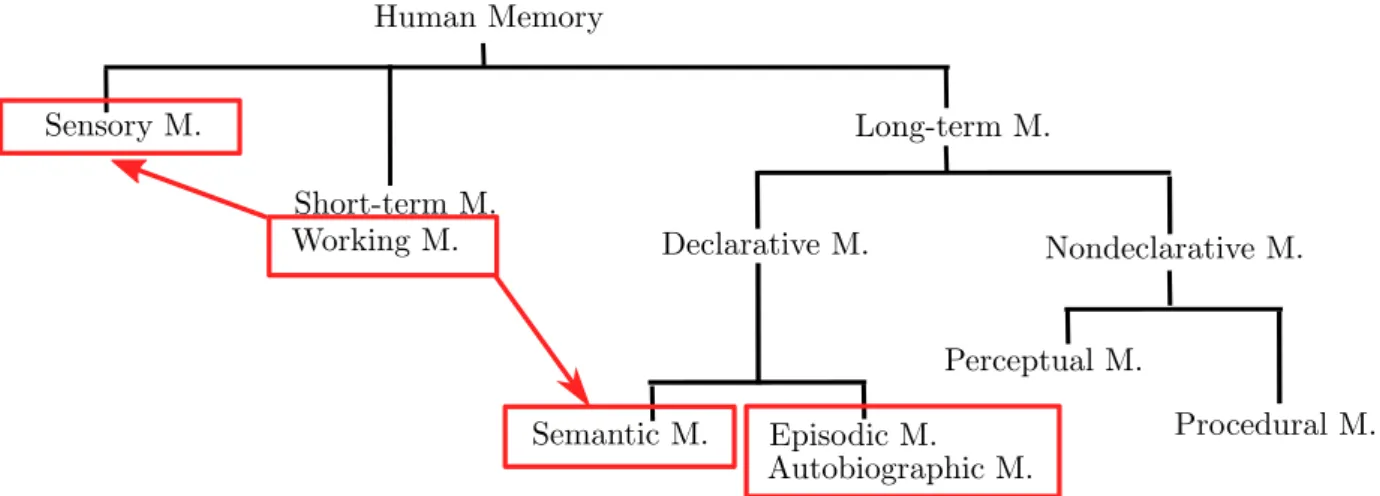
Declarative and nondeclarative memories are two components of the brain’s long-term memory, where declarative memory can be further divided into semantic memory, episodic memory, and autobiographic memory [32]. Declarative memory refers to the memory of facts and events which can be recalled and described with language. Whereas semantic memory refers to conscious recollection of factual knowledge and concepts, episodic memory is an intentional retrieval of previous events with their spatial and temporal contexts. The difference between episodic memory and autobiographic memory is that autobiographical memory is only associated with specific personal experiences. Nondeclarative memory, on the other hand, is an unconscious memory, including perceptual and procedural memories, which are related to the acquisition of better skills and formation of habits. Figure 1.3 demonstrates a simple classification of the brain’s different types of memory.
1.4 Cognitive Perspectives of Knowledge Graphs 13
Figure 1.3: Basic classification of human memory functions.
A technical realization of semantic memory is a collection of semantic triples, e.g., the triple (California, locatedIn, USA) storing the factual knowledge that California locates in the USA. The collection of quadruples, or semantic triples accompanied with
times-tamps, realizes the episodic memory, e.g., the quadruple (Jack, diagnosedWith, Diabetes,
Feb10) recording the fact that Jack was diagnosed with diabetes on February 10. A se-mantic knowledge describing the current health condition of Jack can be derived from the
quadruple by ignoring the temporal information, namely(Jack, diagnosedWith, Diabetes).
As motivated previously, a 3-way semantic tensor, with dimensions for subjects, predi-cates, and objects, is a suitable representation of semantic memory, while a 4-way episodic tensor with additional timestamp dimension is suitable a data representation of episodic memory. The tensor view of declarative memory is not efficient and compressed. Hence, a biologically more plausible view of declarative memory is proposed in [113]. In this framework, declarative memory tenors are first decomposed, and each generalized entity, predicate, and timestamp obtains a unique latent representation, such that memory tensors can be approximately reconstructed from latent representations. The tensor decomposi-tion approach provides a compressed form of declarative memory, and more advanced, knowledge generalization becomes plausible by inferring new semantic triples or episodic quadruples using latent representations.
The tensor decomposition framework for declarative memories is biologically plausible since generalized entities and distributed representations can find their counterparts in the brain, which are widely studied in cognitive neuroscience. Entities for abstract and symbolic concepts are encoded as concept cells resided in the medial temporal lobe (MTL)
- the hippocampus and its surrounding cortex [91]. Concept cell represents one neuron or a separate assembly of neurons that become activated when perceiving a specific concept. The activation of the concept cell corresponding to a specific concept can be triggered by different aspects of the same concept, e.g., the visual or acoustic features of the concept, since there exist links between the concept cell and cortical areas that store different aspects of the corresponding concept. For example, concept cell is also called as Jennifer Aniston cell, since it might be invoked by Jennifer’s appearance, voice, or even the movies she starred.
Furthermore, the entity representations in the tensor decomposition framework resem-ble the distributed representations of concepts stored in different cortical areas. Reversely, the activation of a concept cell brings the conscious retrieval of various attributes of the corresponding concept. The localized storage of concepts and distributed storage of con-ceptual representations form a flexible system of long-term memory, which even contributes to perception, language, and thought [55].
Cognitive studies suggest that semantic and episodic memories are interdependent both at encoding and retrieval phases [36]. Baddeley [8] argues that semantic memory might arise from blurred episodic memory by losing temporal information, in the sense that re-peatedly experienced episodic events become consolidated, and during conscious retrieval, only decontextualized events can be recalled. For example, by consistently noticing that Jack is diagnosed with diabetes on February 10, one becomes aware that Jack has di-abetes. As proposed in [113, 112], in the tensor decomposition framework of declarative memories, the technical realization of decontextualization of episodic memory and the tran-sition from episodic memory to semantic memory are implemented via marginalization in the time dimension. The marginalization is performed using the latent representations of
timestamps. However, since semantic memory reflects the factual knowledge of current
timestamp, marginalization should be implemented while minding the end timestamps of repeatedly experienced episodic events [69].
Until now, we have assumed that the distributed representations of timestamps only come from the tensor decomposition of the episodic tensor, and the semantic decoding of episodic events is realized by marginalization over time dimension. However, according to the definition of episodic memory, it refers to the memory of specific events and re-lated contexts, such as spatial, temporal, visual information, and associated emotion, etc. Previous theory of episodic memory, such as the Hippocampal Memory Indexing Theory (HMIT) [109], suggests that episodic events are stored by forming time indices in the brain
1.4 Cognitive Perspectives of Knowledge Graphs 15
that connect to the representation layer. Activation of the time indices brings the rec-ollection of previous experiences. However, the hippocampal memory indexing theory is subsymbolic, which contradicts the fact that episodic memory is declarative.
1.4.2
Cognitive Architecture for Semantic Decoding
Figure 1.4: A cognitive neural architecture that describes the sequential semantic decoding for perception, which is proposed in [114].
To extract the declarative information from episodic events, a cognitive neural archi-tecture for sequential semantic decoding from perception is proposed in [114]. Figure 1.4 sketches the basic idea of this cognitive architecture for scene understanding. Visual in-puts are first processed and passed through a convolutional neural network and stored in the sensory memory layer as visual representations. Representations for perceived entities are initially obtained from a linear transformation of the memory stored in the sensory memory layer and then reactivated via the connections between concept neurons and the representation layer. Visual relations are recognized by iteratively sampling the semantic triples with the help of a recurrent neural work, which mostly resembles the working mem-ory. Furthermore, the scene can be consolidated and stored as an episodic memmem-ory. More details of this cognitive neural architecture for modeling the human memory system can be found in [114].
Semantic decoding utilizes semantic memory and facilitates the interpretation of
decoding, semantic triple statements of the visual perception are generated, which can compose the thought for verbally describing the visual perception. Notice that during the semantic decoding, the semantic memory serves as prior knowledge for creating triple statements and facilitates the efficient formation of episodic memory [9, 10]. Therefore, the conscious and declarative recollection of a piece of episodic memory might be realized by activating the time index, which triggers the activation of the corresponding representation layer, and semantic decoding then follows up. Moreover, repeated recollections or experi-ences of the same episodic event lead to memory consolidation and, eventually, a transition from episodic memory to semantic memory. A summary of the cognitive perspectives of knowledge graphs is presented in Figure 1.5.
Figure 1.5: An overview of our cognitive perspectives of knowledge graphs. The semantic knowledge graph achieves a technical realization of semantic memory, while episodic mem-ory is a technical realization of episodic memmem-ory. A semantic decoder that incorporates long-term semantic memory, sensory memory, and short-term working memory provides a declarative property of episodic memory.
1.5
Holographic Reduced Representation and
Holis-tic Representation
1.5.1
Holographic Reduced Representation
The tensor decomposition framework for modeling declarative memories is a learning-based cognitive architecture where latent representations of generalized entities are obtained via
1.5 Holographic Reduced Representation and Holistic Representation 17
tensor decomposition. It also serves as a vector symbolic architecture (VSA) for structured associative memory in the sense that an incomplete entry can be approximately completed using latent representations. For example, the associative query (s, p,?) is answered by ranking the scores objects, realizing an architecture for associative recollection. Associa-tive memory is an essential component of artificial intelligence since connections between seemingly unrelated concepts can be stored in the associative memory, e.g., paired stim-uli and responses. Various approaches for modeling the associative memory have been proposed, starting from the Hopfield’s network [49], which is a learning-based architec-ture. Among various vector symbolic architectures for simulating associative memory, holographic associative memory (HAM) was first studied in [30, 121], which suggests that the holographic storage of many stimulus-response pairs might be related to the working principles of the human brain.
Holographic associative memory was further modified to the Holographic Reduced Rep-resentation (HRR) proposed in [89]. In the HRR cognitive structure, each item or symbol is associated with a vector representation. An association between two items is reduced to a single vector of the same dimension via a vector binding operation. To ensure the reduc-tion is reversible, circular convolureduc-tion and correlareduc-tion are chosen as the binding operareduc-tions. The reduced representation for the item association forms a memory trace, and multiple memory traces, i.e., multiple associations, can be compressed into a single memory trace via superposition, which is, defined mathematically, an addition in the same vector space. Two associated items are called a cue-filler pair. Through the reversible vector binding operation, encoded cue-filler pairs can be approximately retrieved from this single memory trace. However, the restored representation is usually distorted due to the interference caused by the superposition of multiple associations. Therefore, to identify the retrieved item, a clean-up post-process is required in the HRR cognitive structure.
Usually, multiple associations are stored holographically in a memory trace, e.g., a mem-ory trace of a horse might encode the breed, color, and height of the horse. Intuitively, the more associative pairs encoded in a memory trace, the less accurate associations can be retrieved. The maximal number of cue-filler pairs encoded in a single memory trace, which can still be approximately retrieved, is referred to as the memory capacity of the cognitive structure for associative memory. Before understanding how the circular convolution- and correlation-based binding operation affects the memory capacity, especially when it is ap-plied to directed knowledge graphs, we first discuss another critical factor, the initialization of vectors in the VSA. Recall that, in holographic reduced representation, distributed
rep-resentations of items are initialized by elementwise sampling from a Gaussian distribution. It has been shown in [89] that the memory capacity of the HRR architecture depends on the degree of pairwise quasi-orthogonality of initialized random vectors.
1.5.2
Quasi-Orthogonality
The concept of near orthogonality was studied in [24], which informally states that most vectors in an ensemble of independently sampled random vectors are nearly orthogonal. A more rigorous mathematical definition of near orthogonality, or quasi-orthogonality, has only recently been addressed in [16, 17], where, given an ensemble of Gaussian random vectors, the asymptotic distribution function of the cosine of pairwise angles is derived.
The more mathematical term, -orthogonality, is formally defined as follows.
Definition 1. A set ofnvectorsX1, . . . ,Xnis said to be pairwise-orthogonal, if|hXi,Xji|< for i, j = 1, . . . , n, i 6= j, where >0, and h·,·i denotes the inner product in the vector space.
We assume thatX1, . . . ,Xnareq-dimensional vectors with elements randomly sampled
from the normal distribution N(0,1). Let Θij denote the angle between vectors Xi and
Xj and let ρij := cos Θij ∈ [−1,1]. The distribution function of random variables ρij in the large n limit, n → ∞, is derived in [16, 81] and revisited in the following Lemma.
Lemma 1. Consider ρij as defined above. Then {ρij|1 ≤ i < j ≤ n} are pairwise i.i.d.
random variables with the following asymptotic probability density function
g(ρG) = 1 √ π Γ(q2) Γ(q−21)(1−ρ 2 G) q−3 2 , |ρ G|<1, (1.1)
with fixed dimensionality q, where the subindex in ρG indicates that random vectors are
sampled from Gaussian distribution.
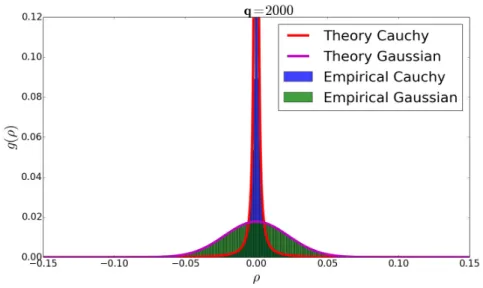
Since the concept of holographic reduced representation, it had mainly been tested on small toy datasets for associative memory tasks. The main difficulties of applying the HRR architecture to large-scale knowledge graphs are a large number of entities and the sub-stantial interference due to the superposition. The key solution is the quasi-orthogonality since, in fact, with improved quasi-orthogonality of randomly initialized distributed repre-sentations, the entities become more distinguishable from their representations even after slight distortion, and the interference can be reduced, allowing more associations to be en-coded into a single memory trace. In our recent work [68], we observed that by elementwise
![Figure 1.2: Illustrations of (a) Tucker, (b) ComplEx, and (c) ConT models for representa- representa-tion learning of episodic knowledge graphs introduced in [69]](https://thumb-us.123doks.com/thumbv2/123dok_us/9902433.2483611/32.892.156.756.159.402/illustrations-complex-representa-representa-learning-episodic-knowledge-introduced.webp)
![Figure 1.4: A cognitive neural architecture that describes the sequential semantic decoding for perception, which is proposed in [114].](https://thumb-us.123doks.com/thumbv2/123dok_us/9902433.2483611/37.892.141.732.276.627/cognitive-architecture-describes-sequential-semantic-decoding-perception-proposed.webp)