Data Structures
and Algorithms
in C++
Fourth Edition
Adam Drozdek
may be reproduced, transmitted, stored or used in any form or by any means
graphic, electronic, or mechanical, including but not limited to photocopying,
recording, scanning, digitizing, taping, Web distribution, information networks,
or information storage and retrieval systems, except as permitted under
Section 107 or 108 of the 1976 United States Copyright Act, without the prior
written permission of the publisher.
Library of Congress Control Number: 2012942244
ISBN-13: 978-1-133-60842-4
ISBN-10: 1-133-60842-6
Cengage Learning
20 Channel Center Street
Boston, MA 02210
USA
Cengage Learning is a leading provider of customized learning solutions with
office locations around the globe, including Singapore, the United Kingdom,
Australia, Mexico, Brazil and Japan. Locate your local office at:
www.cengage.com/global
Cengage Learning products are represented in Canada by Nelson Education, Ltd.
To learn more about Cengage Learning, visit
www.cengage.com
Purchase any of our products at your local college store or at our preferred
online store
www.cengagebrain.com
by Adam Drozdek
Executive Editor: Marie Lee
Senior Product Manager:
Alyssa Pratt
Associate Product Manager:
Stephanie Lorenz
Content Project Manager:
Matthew Hutchinson
Art Director: Cheryl Pearl
Print Buyer: Julio Esperas
Compositor: PreMediaGlobal
Proofreader: Andrea Schein
Indexer: Sharon Hilgenberg
For product information and technology assistance, contact us at
Cengage Learning Customer & Sales Support, www.cengage.com/support
For permission to use material from this text or product, submit all
requests online at www.cengage.com/permissions
Further permissions questions can be emailed to
[email protected]
Printed in the United States of America
1 2 3 4 5 6 7 18 17 16 15 14 13 12
Some of the product names and company names used in this book have been used for identification purposes only
and may be trademarks or registered trademarks of their respective manufacturers and sellers.
Any fictional data related to persons or companies or URLs used throughout this book is intended for instructional
purposes only. At the time this book was printed, any such data was fictional and not belonging to any real persons or
companies.
Cengage Learning reserves the right to revise this publication and make changes from time to time in its content
without notice.
Contents
1
Object-Oriented Programming Using C++
1
1.1
Abstract Data Types 1
1.2
Encapsulation 1
1.3
Inheritance 6
1.4
Pointers 9
1.4.1 Pointers and Arrays 12
1.4.2 Pointers and Copy Constructors 14
1.4.3 Pointers and Destructors 16
1.4.4 Pointers and Reference Variables 17
1.4.5 Pointers to Functions 20
1.5
Polymorphism 21
1.6
C++ and Object-Oriented Programming 23
1.7
The Standard Template Library 24
1.7.1 Containers 24
1.7.2 Iterators 25
1.7.3 Algorithms 25
1.7.4 Function Objects 26
1.8
Vectors in the Standard Template Library 28
1.9
Data Structures and Object-Oriented Programming 35
1.10 Case Study: Random Access File 35
1.11
Exercises 46
1.12
Programming Assignments 48
2
Complexity Analysis
51
2.1
Computational and Asymptotic Complexity 51
2.2
Big-O Notation 52
2.3
Properties of Big-O Notation 54
2.4
Ω
and
Θ
Notations 56
2.5
Possible Problems 57
2.6
Examples of Complexities 57
2.7
Finding Asymptotic Complexity: Examples 59
2.8
The Best, Average, and Worst Cases 61
2.9
Amortized Complexity 64
2.10 NP-Completeness 68
2.11
Exercises 71
Bibliography 74
3
Linked Lists
75
3.1
Singly Linked Lists 75
3.1.1 Insertion 81
3.1.2 Deletion 83
3.1.3 Search 89
3.2
Doubly Linked Lists 90
3.3
Circular Lists 94
3.4
Skip Lists 96
3.5
Self-Organizing Lists 101
3.6
Sparse Tables 106
3.7
Lists in the Standard Template Library 109
3.8
Concluding Remarks 113
3.9
Case Study: A Library 114
3.10
Exercises 125
3.11
Programming Assignments 127
C o n t e n t s
■
vii
4
Stacks and Queues
131
4.1
Stacks 131
4.2
Queues 139
4.3
Priority Queues 148
4.4
Stacks in the Standard Template Library 149
4.5
Queues in the Standard Template Library 149
4.6
Priority Queues in the Standard Template Library 151
4.7
Deques in the Standard Template Library 153
4.8
Case Study: Exiting a Maze 158
4.9
Exercises 165
4.10
Programming Assignments 166
Bibliography 168
5
Recursion
169
5.1
Recursive Definitions 169
5.2
Function Calls and Recursion Implementation 172
5.3
Anatomy of a Recursive Call 174
5.4
Tail Recursion 177
5.5
Nontail Recursion 178
5.6
Indirect Recursion 184
5.7
Nested Recursion 186
5.8
Excessive Recursion 186
5.9
Backtracking 190
5.10 Concluding Remarks 197
5.11 Case Study: A Recursive Descent Interpreter 198
5.12
Exercises 207
5.13
Programming Assignments 210
Bibliography 213
6
Binary Trees
214
6.1
Trees, Binary Trees, and Binary Search Trees 214
6.2
Implementing Binary Trees 219
6.4
Tree Traversal 224
6.4.1 Breadth-First Traversal 225
6.4.2 Depth-First Traversal 226
6.4.3 Stackless Depth-First Traversal 233
6.5
Insertion 240
6.6
Deletion 243
6.6.1 Deletion by Merging 244
6.6.2 Deletion by Copying 246
6.7
Balancing a Tree 250
6.7.1 The DSW Algorithm 253
6.7.2 AVL Trees 256
6.8
Self-Adjusting Trees 261
6.8.1 Self-Restructuring Trees 262
6.8.2 Splaying 263
6.9
Heaps 268
6.9.1 Heaps as Priority Queues 270
6.9.2 Organizing Arrays as Heaps 271
6.10 Treaps 276
6.11
k
-d Trees 280
6.12 Polish Notation and Expression Trees 286
6.12.1 Operations on Expression Trees 287
6.13 Case Study: Computing Word Frequencies 290
6.14
Exercises 298
6.15
Programming Assignments 302
Bibliography 306
7
Multiway Trees
309
7.1
The Family of B-Trees 310
7.1.1 B-Trees 311
7.1.2 B*-Trees 321
7.1.3 B
+
-Trees 323
7.1.4 Prefix B
+
-Trees 326
7.1.5
K-d B-trees 327
7.1.6 Bit-Trees 334
7.1.7 R-Trees 336
7.1.8 2–4 Trees 337
C o n t e n t s
■
ix
7.2
Tries 364
7.3
Concluding Remarks 373
7.4
Case Study: Spell Checker 373
7.5
Exercises 384
7.6
Programming Assignments 385
Bibliography 389
8
Graphs
391
8.1
Graph Representation 393
8.2
Graph Traversals 395
8.3
Shortest Paths 398
8.3.1 All-to-All Shortest Path Problem 405
8.4
Cycle Detection 408
8.4.1 Union-Find Problem 409
8.5
Spanning Trees 411
8.6
Connectivity 415
8.6.1 Connectivity in Undirected Graphs 415
8.6.2 Connectivity in Directed Graphs 418
8.7
Topological Sort 421
8.8
Networks 423
8.8.1 Maximum Flows 423
8.8.2 Maximum Flows of Minimum Cost 433
8.9
Matching 438
8.9.1 Stable Matching Problem 442
8.9.2 Assignment Problem 445
8.9.3 Matching in Nonbipartite Graphs 447
8.10 Eulerian and Hamiltonian Graphs 449
8.10.1 Eulerian Graphs 449
8.10.2 Hamiltonian Graphs 453
8.11 Graph Coloring 459
8.12 NP-Complete Problems in Graph Theory 462
8.12.1 The Clique Problem 462
8.12.2 The 3-Colorability Problem 463
8.12.3 The Vertex Cover Problem 465
8.12.4 The Hamiltonian Cycle Problem 466
8.14
Exercises 480
8.15
Programming Assignments 486
Bibliography 487
9
Sorting
491
9.1
Elementary Sorting Algorithms 492
9.1.1 Insertion Sort 492
9.1.2 Selection Sort 495
9.1.3 Bubble Sort 497
9.1.4 Comb Sort 500
9.2
Decision Trees 501
9.3
Efficient Sorting Algorithms 505
9.3.1 Shell Sort 505
9.3.2 Heap Sort 508
9.3.3 Quicksort 512
9.3.4 Mergesort 518
9.3.5 Radix Sort 521
9.3.6 Counting Sort 527
9.4
Sorting in the Standard Template Library 528
9.5
Concluding Remarks 532
9.6
Case Study: Adding Polynomials 534
9.7
Exercises 542
9.8
Programming Assignments 543
Bibliography 545
10
Hashing
548
10.1 Hash Functions 549
10.1.1 Division 549
10.1.2 Folding 549
10.1.3 Mid-Square Function 550
10.1.4 Extraction 550
10.1.5 Radix Transformation 551
10.1.6 Universal Hash Functions 551
10.2 Collision Resolution 551
10.2.1 Open Addressing 552
10.2.2 Chaining 558
10.2.3 Bucket Addressing 560
C o n t e n t s
■
xi
10.4 Perfect Hash Functions 562
10.4.1 Cichelli’s Method 563
10.4.2 The FHCD Algorithm 566
10.5 Rehashing 568
10.5.1 The Cuckoo Hashing 568
10.6 Hash Functions for Extendible Files 571
10.6.1 Extendible Hashing 571
10.6.2 Linear Hashing 574
10.7 Case Study: Hashing with Buckets 576
10.8
Exercises 586
10.9
Programming Assignments 587
Bibliography 588
11
Data Compression
590
11.1 Conditions for Data Compression 590
11.2 Huffman Coding 592
11.2.1 Adaptive Huffman Coding 601
11.3 Run-Length Encoding 606
11.4 Ziv-Lempel Code 607
11.5 Case Study: Huffman Method with Run-Length Encoding 610
11.6
Exercises 622
11.7
Programming Assignments 622
Bibliography 624
12
Memory Management
625
12.1 The Sequential-Fit Methods 626
12.2 The Nonsequential-Fit Methods 627
12.2.1 Buddy Systems 629
12.3 Garbage Collection 636
12.3.1 Mark-and-Sweep 637
12.3.2 Copying Methods 644
12.3.3 Incremental Garbage Collection 646
12.3.4 Generational Garbage Collection 653
12.4 Concluding Remarks 657
12.6
Exercises 667
12.7
Programming Assignments 668
Bibliography 671
13
String Matching
674
13.1 Exact String Matching 674
13.1.1 Straightforward Algorithms 674
13.1.2 The Knuth-Morris-Pratt Algorithm 677
13.1.3 The Boyer-Moore Algorithm 685
13.1.4 Multiple Searches 695
13.1.5 Bit-Oriented Approach 697
13.1.6 Matching Sets of Words 700
13.1.7 Regular Expression Matching 707
13.1.8 Suffix Tries and Trees 711
13.1.9 Suffix Arrays 717
13.2 Approximate String Matching 719
13.2.1 String Similarity 720
13.2.2 String Matching with k Errors 726
13.3 Case Study: Longest Common Substring 729
13.4
Exercises 738
13.5
Programming Assignments 740
Bibliography 741
Appendixes
A
Computing Big-O 743
A.1 Harmonic Series 743
A.2 Approximation of the Function lg(n!) 743
A.3 Big-O for Average Case of Quicksort 745
A.4 Average Path Length in a Random Binary Tree 747
A.5 The Number of Nodes in an AVL Tree 748
B
Algorithms in the Standard Template Library 749
B.1 Standard Algorithms 749
C
NP-Completeness 758
C.1 Cook’s Theorem 758
The study of data structures, a fundamental component of a computer science
edu-cation, serves as the foundation upon which many other computer science fields are
built. Some knowledge of data structures is a must for students who wish to do work
in design, implementation, testing, or maintenance of virtually any software system.
The scope and presentation of material in
Data Structures and Algorithms in C++
provide students with the necessary knowledge to perform such work.
This book highlights three important aspects of data structures. First, a very
strong emphasis is placed on the connection between data structures and their
al-gorithms, including analyzing algorithms’ complexity. Second, data structures are
presented in an object-oriented setting in accordance with the current design and
implementation paradigm. In particular, the information-hiding principle to
ad-vance encapsulation and decomposition is stressed. Finally, an important
compo-nent of the book is data structure implementation, which leads to the choice of C++
as the programming language.
The C++ language, an object-oriented descendant of C, is widespread in
indus-try and academia as an excellent programming language. It is also useful and natural
for introducing data structures. Therefore, because of the wide use of C++ in
applica-tion programming and the object-oriented characteristics of the language, using C++
to teach a data structures and algorithms course, even on the introductory level, is well
justified.
This book provides the material for an introductory data structures course,
as well as for an advanced data structures and algorithms course. It also meets the
requirements for the following units specified in the Computer Science Curriculum
2008: DS/GraphsAndTrees, PF/DataStructures, PF/Recursion, PF/ObjectOriented,
AL/BasicAnalysis, AL/AlgorithmicStrategies, AL/FundamentalAlgorithms,
AL/ PversusNP, PL/DeclarationsAndTypes, PL/AbstractionMechanisms, PL/
ObjectOrientedProgramming.
Most chapters include a case study that illustrates a complete context in which
certain algorithms and data structures can be used. These case studies were chosen
from different areas of computer science such as interpreters, symbolic computation,
and file processing, to indicate the wide range of applications to which topics under
discussion may apply.
Preface
Brief examples of C++ code are included throughout the book to illustrate the
practical importance of data structures. However, theoretical analysis is equally
im-portant, so presentations of algorithms are integrated with analyses of efficiency.
Great care is taken in the presentation of recursion because even advanced
stu-dents have problems with it. Experience has shown that recursion can be explained
best if the run-time stack is taken into consideration. Changes to the stack are shown
when tracing a recursive function not only in the chapter on recursion, but also in
other chapters. For example, a surprisingly short function for tree traversal may
re-main a mystery if work done by the system on the run-time stack is not included in
the explanation. Standing aloof from the system and retaining only a purely
theoreti-cal perspective when discussing data structures and algorithms are not necessarily
helpful.
The thrust of this book is data structures, and other topics are treated here
only as much as necessary to ensure a proper understanding of this subject.
Algo-rithms are discussed from the perspective of data structures, so the reader will not
find a comprehensive discussion of different kinds of algorithms and all the facets
that a full presentation of algorithms requires. However, as mentioned, recursion
is covered in depth. In addition, complexity analysis of algorithms is presented in
some detail.
Chapters 1 and 3–8 present a number of different data structures and the
algo-rithms that operate on them. The efficiency of each algorithm is analyzed, and
im-provements to the algorithm are suggested.
■
Chapter 1 presents the basic principles of object-oriented programming, an
intro-duction to dynamic memory allocation and the use of pointers, and a rudimentary
presentation of the Standard Template Library (STL).
■
Chapter 2 describes some methods used to assess the efficiency of algorithms.
■
Chapter 3 presents different types of linked lists with an emphasis on their
imple-mentation with pointers.
■
Chapter 4 presents stacks and queues and their applications.
■
Chapter 5 contains a detailed discussion of recursion. Different types of recursion
are discussed, and a recursive call is dissected.
■
Chapter 6 discusses binary trees, including implementation, traversal, and search.
Balanced trees are also included in this chapter.
■
Chapter 7 details more generalized trees such as tries, 2– 4 trees, and B-trees.
■
Chapter 8 presents graphs.
Chapters 9–13 show different applications of data structures introduced in the
previous chapters. They emphasize the data structure aspects of each topic under
consideration.
■
Chapter 9 analyzes sorting in detail, and several elementary and nonelementary
methods are presented.
P r e f a c e
■
xv
■
Chapter 12 presents various techniques and data structures for memory
management.
■
Chapter 13 discusses many algorithms for exact and approximate string matching.
■
Appendix A discusses in greater detail big-O notation, introduced in Chapter 2.
■
Appendix B presents standard algorithms in the Standard Template Library.
■
Appendix C gives a proof of Cook’s theorem and illustrates it with an extended
example.
Each chapter contains a discussion of the material illustrated with appropriate
diagrams and tables. Except for Chapter 2, all chapters include a case study, which
is an extended example using the features discussed in that chapter. All case
stud-ies have been tested using the Visual C++ compiler on a PC and the g++ compiler
under Unix except the von Koch snowflake, which runs on a PC under Visual C++.
At the end of each chapter is a set of exercises of varying degrees of difficulty. Except
for Chapter 2, all chapters also include programming assignments and an up-to-date
bibliography of relevant literature.
Chapters 1–6 (excluding Sections 2.9-10, 3.4, 6.4.3, 6.7-8, and 6.10-11) contain
the core material that forms the basis of any data structures course. These chapters
should be studied in sequence. The remaining six chapters can be read in any
or-der. A one- semester course could include Chapters 1–6, 9, and Sections 10.1 and
10.2. The entire book could also be part of a two-semester sequence.
Teaching Tools
The following instructor support materials are available when this book is used
in a classroom setting. All instructor teaching tools are available for download at
login.cengage.com.
Electronic Solution’s Manual.
The Solution’s Manual that accompanies this textbook
includes complete solutions to all text exercises.
Electronic Figure Files.
All images from the text are available for use in classroom
presentations.
PowerPoint Presentations.
PowerPoint slides accompany each chapter. Slides may be
used to guide classroom presentation, to make available for students for chapter review,
or to print as classroom handouts. Instructors are encouraged to customize the slides to
suit their course needs.
Student Resources
Changes in the Fourth Edition
The new edition primarily extends the old edition by including material on new topics
that are currently not covered. The additions include
■
A section on treaps (6.10) and a section on
k
-d trees (6.11)
■
A section on
k
-d B-trees (7.1.5)
■
A discussion of two additional sorting methods (Sections 9.1.3.1, 9.3.6)
■
A new hashing technique (Section 10.5.1)
■
A section on generational garbage collection (12.3.4)
1
1.1 Abstract Data Types
Before a program is written, we should have a fairly good idea of how to
accom-plish the task being implemented by this program. Hence, an outline of the program
containing its requirements should precede the coding process. The larger and more
complex the project, the more detailed the outline phase should be. The
implemen-tation details should be delayed to the later stages of the project. In particular, the
details of the particular data structures to be used in the implementation should not
be specified at the beginning.
From the start, it is important to specify each task in terms of input and output.
At the beginning stages, we should be more concerned with what the program should
do, not how it should or could be done. Behavior of the program is more important
than the gears of the mechanism accomplishing it. For example, if an item is needed
to accomplish some tasks, the item is specified in terms of operations performed on it
rather than in terms of its inner structure. These operations may act upon this item,
for example, modifying it, searching for some details in it, or storing something in
it. After these operations are precisely specified, the implementation of the program
may start. The implementation decides which data structure should be used to make
execution most efficient in terms of time and space. An item specified in terms of
op-erations is called an abstract data type. An abstract data type is not a part of a program,
because a program written in a programming language requires the definition of
a data structure, not just the operations on the data structure. However, an object-
oriented language (OOL) such as C++ has a direct link to abstract data types by
im-plementing them as a class.
1.2 Encapsulation
Object-oriented programming (OOP) revolves around the concept of an object.
Objects, however, are created using a class definition. A class is a template in
accor-dance to which objects are created. A class is a piece of software that includes a data
Object-Oriented
Programming
specification and functions operating on these data and possibly on the data
belong-ing to other class instances. Functions defined in a class are called methods, member
functions, or function members, and variables used in a class are called data members
(more properly, they should be called datum members). This combining of the data
and related operations is called data encapsulation. An object is an instance of a class,
an entity created using a class definition.
In contradistinction to functions in languages that are not object-oriented,
ob-jects make the connection between data and member functions much tighter and
more meaningful. In languages that are not object-oriented, declarations of data and
definitions of functions can be interspersed through the entire program, and only
the program documentation indicates that there is a connection between them. In
OOLs, a connection is established right at the outset; in fact, the program is based
on this connection. An object is defined by related data and operations, and because
there may be many objects used in the same program, the objects communicate by
exchanging messages that reveal as little detail about their internal structure as
neces-sary for adequate communication. Structuring programs in terms of objects allows us
to accomplish several goals.
First, this strong coupling of data and operations can be used much better in
modeling a fragment of the world, which is emphasized especially by software
engi-neering. Not surprisingly, OOP has its roots in simulation; that is, in modeling
real-world events. The first OOL was called Simula, and it was developed in the 1960s
in Norway.
Second, objects allow for easier error finding because operations are localized to
the confines of their objects. Even if side effects occur, they are easier to trace.
Third, objects allow us to conceal certain details of their operations from other
objects so that these operations may not be adversely affected by other objects. This
is known as the information-hiding principle. In languages that are not
object-ori-ented, this principle can be found to some extent in the case of local variables, or
as in Pascal, in local functions or procedures, which can be used and accessed only
by the function defining them. This is, however, a very tight hiding or no hiding at
all. Sometimes we may need to use (again, as in Pascal) a function f 2 defined in f 1
outside of f 1, but we cannot. Sometimes we may need to access some data local to
f 1 without exactly knowing the structure of these data, but we cannot. Hence, some
modification is needed, and it is accomplished in OOLs.
An object in OOL is like a watch. As users, we are interested in what the hands
show, but not in the inner workings of the watch. We are aware that there are gears
and springs inside the watch, but because we usually know very little about why all
these parts are in a particular configuration, we should not have access to this
mecha-nism so that we do not damage it, inadvertently or on purpose. This mechamecha-nism is
hidden from us, we have no immediate access to it, and the watch is protected and
works better than when its mechanism is open for everyone to see.
S e c t i o n 1 . 2 E n c a p s u l a t i o n
■
3
received by an object, the object can be replaced more easily by another object more
suitable in a particular situation; a new object can perform the same task differently
but more quickly in a certain hardware environment. An object discloses only as
much as is needed for the user to utilize it. It has a public part that can be accessed by
any user when the user sends a message matching any of the member function names
revealed by the object. In this public part, the object displays to the user buttons that
can be pushed to invoke the object's operations. The user knows only the names of
these operations and the expected behavior.
Information hiding tends to blur the dividing line between data and operations.
In Pascal-like languages, the distinction between data and functions or procedures is
clear and rigid. They are defined differently and their roles are very distinct. OOLs
put data and methods together, and to the user of the object, this distinction is much
less noticeable. To some extent, this incorporates the features of functional
lan-guages. LISP, one of the earliest programming languages, allows the user to treat data
and functions similarly, because the structure of both is the same.
We have already made a distinction between particular objects and object types
or classes. We write functions to be used with different variables, and by analogy, we
do not like to be forced to write as many object declarations as the number of objects
required by the program. Certain objects are of the same type and we would like only
to use a reference to a general object specification. For single variables, we make a
distinction between type declaration and variable declaration. In the case of objects,
we have a class declaration and object instantiation. For instance, in the following
class declaration,
C
is a class and
object1
through
object3
are objects.
class C {
public:
C(char *s = "", int i = 0, double d = 1) {
strcpy(dataMember1,s);
dataMember2 = i;
dataMember3 = d;
}
void memberFunction1() {
cout << dataMember1 << ' ' << dataMember2 << ' '
<< dataMember3 << endl;
}
void memberFunction2(int i, char *s = "unknown") {
dataMember2 = i;
cout << i << " received from " << s << endl;
}
protected:
char dataMember1[20];
int dataMember2;
double dataMember3;
};
Message passing is equivalent to a function call in traditional languages. However,
to stress the fact that in OOLs the member functions are relative to objects, this new
term is used. For example, the call to public
memberFunction1()
in
object1
,
object1.memberFunction1();
is seen as message
memberFunction1()
sent to
object1. Upon receiving the
mes-sage, the object invokes its member function and displays all relevant information.
Messages can include parameters so that
object1.memberFunction2(123);
is the message
memberFunction2()
with parameter 123 received by
object1.
The lines containing these messages are either in the main program, in a
func-tion, or in a member function of another object. Therefore, the receiver of the
mes-sage is identifiable, but not necessarily the sender. If
object1
receives the message
memberFunction1(), it does not know where the message originated. It only
re-sponds to it by displaying the information
memberFunction1()
encapsulates. The
same goes for
memberFunction2(). Therefore, the sender may prefer sending a
message that also includes its identification, as follows:
object1.memberFunction2(123, "object1");
A powerful feature of C++ is the possibility of declaring generic classes by using
type parameters in the class declaration. For example, if we need to declare a class
that uses an array for storing some items, then we may declare this class as
class intClass {
int storage[50];
...
};
However, in this way, we limit the usability of this class to integers only; if we
need a class that performs the same operations as
intClass
except that it operates
on float numbers, then a new declaration is needed, such as
class floatClass {
float storage[50];
...
};
If
storage
is to hold structures, or pointers to characters, then two more classes
must be declared. It is much better to declare a generic class and decide what type of
items the object is referring to only when defining the object. Fortunately, C++
al-lows us to declare a class in this way, and the declaration for the example is
template<class genType>
class genClass {
S e c t i o n 1 . 2 E n c a p s u l a t i o n
■
5
Later, we make the decision about how to initialize
genType
:
genClass<int> intObject;
genClass<float> floatObject;
This generic class becomes a basis for generating two new classes,
genClass
of
int
and
genClass
of
float
, and then these two classes are used to create two
objects,
intObject
and
floatObject
. In this way, the generic class manifests
it-self in different forms depending on the specific declaration. One generic declaration
suffices for enabling such different forms.
We can go even further than that by not committing ourselves to 50 cells in
storage
and by delaying that decision until the object definition stage. But just in
case, we may leave a default value so that the class declaration is now
template<class genType, int size = 50>
class genClass {
genType storage[size];
...
};
The object definition is now
genClass<int> intObject1; // use the default size;
genClass<int,100> intObject2;
genClass<float,123> floatObject;
This method of using generic types is not limited to classes only; we can use
them in function declarations as well. For example, the standard operation for
swap-ping two values can be defined by the function
template<class genType>
void swap(genType& el1, genType& el2) {
genType tmp = el1; el1 = el2; el2 = tmp;
}
This example also indicates the need for adapting built-in operators to
spe-cific situations. If
genType
is a number, a character, or a structure, then the
as-signment operator,
=
, performs its function properly. But if
genType
is an array,
then we can expect a problem in
swap(). The problem can be resolved by
over-loading the assignment operator by adding to it the functionality required by a
specific data type.
After a generic function has been declared, a proper function can be generated at
compilation time. For example, if the compiler sees two calls,
swap(n,m); // swap two integers;
swap(x,y); // swap two floats;
1.3 Inheritance
OOLs allow for creating a hierarchy of classes so that objects do not have to be
in-stantiations of a single class. Before discussing the problem of inheritance, consider
the following class definitions:
class BaseClass {
public:
BaseClass() { }
void f(char *s = "unknown") {
cout << "Function f() in BaseClass called from " << s << endl;
h();
}
protected:
void g(char *s = "unknown") {
cout << "Function g() in BaseClass called from " << s << endl;
}
private:
void h() {
cout << "Function h() in BaseClass\n";
}
};
class Derived1Level1 : public virtual BaseClass {
public:
void f(char *s = "unknown") {
cout << "Function f() in Derived1Level1 called from " << s << endl;
g("Derived1Level1");
h("Derived1Level1");
}
void h(char *s = "unknown") {
cout << "Function h() in Derived1Level1 called from " << s << endl;
}
};
class Derived2Level1 : public virtual BaseClass {
public:
void f(char *s = "unknown") {
cout << "Function f() in Derived2Level1 called from " << s << endl;
g("Derived2Level1");
// h(); // error: BaseClass::h() is not accessible
}
};
class DerivedLevel2 : public Derived1Level1, public Derived2Level1 {
public:
void f(char *s = "unknown") {
S e c t i o n 1 . 3 I n h e r i t a n c e
■
7
Derived1Level1::h("DerivedLevel2");
BaseClass::f("DerivedLevel2");
}
};
A sample program is
int main() {
BaseClass bc;
Derived1Level1 d1l1;
Derived2Level1 d2l1;
DerivedLevel2 dl2;
bc.f("main(1)");
// bc.g(); // error: BaseClass::g() is not accessible
// bc.h(); // error: BaseClass::h() is not accessible
d1l1.f("main(2)");
// d1l1.g(); // error: BaseClass::g() is not accessible
d1l1.h("main(3)");
d2l1.f("main(4)");
// d2l1.g(); // error: BaseClass::g() is not accessible
// d2l1.h(); // error: BaseClass::h() is not accessible
dl2.f("main(5)");
// dl2.g(); // error: BaseClass::g() is not accessible
dl2.h();
return 0;
}
This sample produces the following output:
Function f() in BaseClass called from main(1)
Function h() in BaseClass
Function f() in Derived1Level1 called from main(2)
Function g() in BaseClass called from Derived1Level1
Function h() in Derived1Level1 called from Derived1Level1
Function h() in Derived1Level1 called from main(3)
Function f() in Derived2Level1 called from main(4)
Function g() in BaseClass called from Derived2Level1
Function f() in DerivedLevel2 called from main(5)
Function g() in BaseClass called from DerivedLevel2
Function h() in Derived1Level1 called from DerivedLevel2
Function f() in BaseClass called from DerivedLevel2
Function h() in BaseClass
Function h() in Derived1Level1 called from unknown
member function by introducing its own definition. In this way, both the base class and
the derived class have some measure of control over their member functions.
The base class can decide which member functions and data members can be
re-vealed to derived classes so that the principle of information hiding holds not only with
respect to the user of the base class, but also to the derived classes. Moreover, the derived
class can decide which parts of the public and protected member functions and data
members to retain and use and which to modify. For example, both
Derived1Level1
and
Derived2Level1
define their own versions of
f(). However, the access to the
member function with the same name in any of the classes higher up in the hierarchy is
still possible by preceding the function with the name of the class and the scope
opera-tor, as shown in the call of
BaseClass::f()
from
f()
in
DerivedLevel2.
A derived class can add some new members of its own. Such a class can become
a base class for other classes that can be derived from it so that the inheritance
hierar-chy can be deliberately extended. For example, the class
Derived1Level1
is derived
from
BaseClass, but at the same time, it is the base class for
DerivedLevel2.
Inheritance in our examples is specified as public by using the word
public
after the semicolon in the heading of the definition of a derived class. Public
inheri-tance means that public members of the base class are also public in the derived class,
and protected members are also protected. In the case of protected inheritance (with
the word
protected
in the heading of the definition), both public and protected
members of the base class become protected in the derived class. Finally, for private
inheritance, both public and protected members of the base class become private in
the derived class. In all types of inheritance, private members of the base class are
inaccessible to any of the derived classes. For example, an attempt to call
h()
from
f()
in
Derived2Level1
causes a compilation error, “
BaseClass::h()
is not
ac-cessible.” However, a call of
h()
from
f()
in
Derived1Level1
causes no problem
because it is a call to
h()
defined in
Derived1Level1.
Protected members of the base class are accessible only to derived classes
and not to nonderived classes. For this reason, both
Derived1Level1
and
Derived2Level1
can call
BaseClass
's protected member function
g(), but a call
to this function from
main()
is rendered illegal.
S e c t i o n 1 . 4 P o i n t e r s
■
9
1.4 Pointers
Variables used in a program can be considered as boxes that are never empty; they
are filled with some content either by the programmer or, if uninitialized, by the
op-erating system. Such a variable has at least two attributes: the content or value and the
location of the box or variable in computer memory. This content can be a number,
a character, or a compound item such as a structure or union. However, this content
can also be the location of another variable; variables with such contents are called
pointers. Pointers are usually auxiliary variables that allow us to access the values
of other variables indirectly. A pointer is analogous to a road sign that leads us to
a certain location or to a slip of paper on which an address has been jotted down.
They are variables leading to variables, humble auxiliaries that point to some other
variables as the focus of attention.
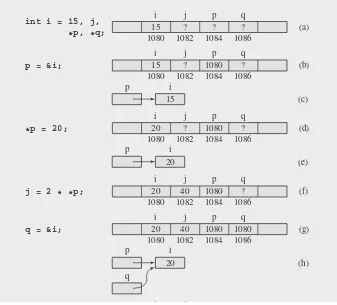
For example, in the declaration
int i = 15, j, *p, *q;
i
and
j
are numerical variables and
p
and
q
are pointers to numbers; the star in
front of
p
and
q
indicates their function. Assuming that the addresses of the variables
i, j, p, and
q
are 1080, 1082, 1084, and 1086, then after assigning 15 to
i
in the
declaration, the positions and values of the variables in computer memory are as in
Figure 1.1a.
Now, we could make the assignment
p = i
(or
p = (int*) i
if the compiler
does not accept it), but the variable
p
was created to store the address of an integer
variable, not its value. Therefore, the proper assignment is
p = &i
, where the
am-persand in front of
i
means that the address of
i
is meant and not its content. Figure
1.1b illustrates this situation. In Figure 1.1c, the arrow from
p
to
i
indicates that
p
is
a pointer that holds the address of
i.
We have to be able to distinguish the value of
p, which is an address, from the
value of the location whose address the pointer holds. For example, to assign 20 to
the variable pointed to by
p, the assignment statement is
*p = 20;
The star (
*
) here is an indirection operator that forces the system to first retrieve
the contents of
p, then access the location whose address has just been retrieved from
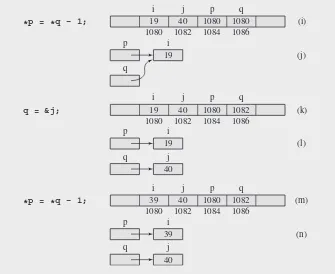
p, and only afterward, assign 20 to this location (Figure 1.1d). Figures 1.1e through
1.1n give more examples of assignment statements and how the values are stored in
computer memory.
In fact, pointers—like all variables—also have two attributes: a content and a
lo-cation. This location can be stored in another variable, which then becomes a pointer
to a pointer.
[image:28.564.122.459.126.431.2]
(29)Figure 1.1
Changes of values after assignments are made using pointer variables. Note that (b)
and (c) show the same situation, and so do (d) and (e), (g) and (h), (i) and (j), (k) and
(l), and (m) and (n).
15
int i = 15, j,
*p, *q;
1080
i
?
1082
j
?
1084
p
?
(a)
q
p
15
(c)
i
15
p = &i;
1080
i
?
1082
j
1080
1084
p
?
(b)
1086
1086
q
p
20
(e)
i
20
*p = 20;
1080
i
?
1082
j
1080
1084
p
?
(d)
1086
q
20
j = 2 * *p;
1080
i
40
1082
j
1080
1084
p
?
(f)
1086
q
39
*p = *q – 1;
1080
i
40
1082
j
1080
1084
p
1082
(m)
1086
q
p
19
(l)
i
q
40
j
19
q = &j;
1080
i
40
1082
j
1080
1084
p
1082
(k)
1086
q
p
20
(h)
i
q
20
q = &i;
1080
i
40
1082
j
1080
1084
p
1080
(g)
1086
q
p
19
(j)
i
q
19
*p = *q – 1;
1080
i
40
1082
j
1080
1084
p
1080
(i)
1086
q
To dynamically allocate and deallocate memory, two functions are used. One
function,
new
, takes from memory as much space as needed to store an object whose
type follows
new. For example, with the instruction
p = new int;
the program requests enough space to store one integer, from the memory manager,
and the address of the beginning of this portion of memory is stored in
p. Now the
values can be assigned to the memory block pointed to by
p
only indirectly through a
pointer, either pointer
p
or any other pointer
q
that was assigned the address stored
in
p
with the assignment
q = p.
If the space occupied by the integer accessible from
p
is no longer needed, it can
be returned to the pool of free memory locations managed by the operating system
by issuing the instruction
[image:29.564.154.489.98.372.2]
(30)