Implementation of Monetary and Macroprudential Policies:
A Critical Review
Alexander Lubis ab Constantinos Alexioub Joseph G. Nellis bAbstract
The emergence of macroprudential policies by Central Banks, as a means of promoting financial stability, has raised many questions regarding the interaction between them. Given the limited number of studies available, this paper sheds light on this issue by providing a critical and systematic review of the literature. The paper begins with a discussion of the trade-off between price stability and financial stability. We find that financial intermediation acts as the main channel in connecting monetary and macroprudential policies. We find that the theoretical and empirical studies are grouped around four main mechanisms in explaining this interaction: cost of funds, collateral constraint, financial intermediaries and payment systems. By examining these mechanisms, it is argued that monetary policy alone is not sufficient for maintaining macroeconomic and financial stability and macroprudential policies need to supplement monetary policy to achieve price and financial stability. We also find that the role of the exchange rate is critical in the implementation of monetary and macroprudential policies in emerging markets. Volatile capital flows pose another challenge for the implementation of monetary and macroprudential policies. The arrangement of monetary and macroprudential policies also varies across countries, depending on the challenges and institutional arrangements in a particular country. Consequently, a number of implications for theory, policy and practice are proposed.
Keywords: monetary policy, macroprudential policy, capital flows, payment system, capital flows, systematic literature review
JEL Classification: E42, E44, E52, E58, G18
a Bank Indonesia
b School of Management, Cranfield University, United Kingdom
31st Business & Economics Society International (B&ESI) Conference. 6-9 July 2017, Crete, Greece.
©2017 Business & Economics Society International. This is the Author Accepted Manuscript. Please refer to any applicable publisher terms of use.
1.
Introduction
The prolonged effect of the recent global financial crisis has taught a valuable lesson to many policymakers, particularly central banks around the world in their efforts to find a way to stabilise the economy and prevent the crisis from reoccurring. A newly bourgeoning view has been adopted which is to implement both monetary and macroprudential policies to stabilise the economy. In this framework, monetary policy is targeted mainly at achieving price stability, macroprudential policies predominantly focused on financial stability, whereas microprudential policy is directed at the safety and soundness of individual financial institutions.
The introduction of macroprudential policies in this new framework of stabilisation, however, raises a question concerning how macroprudential policies relate to monetary policy; each may improve or reduce the effectiveness of the other. Notwithstanding the growing number of studies, only limited research and analytical tools are available to support this macroprudential policy framework. In a broader sense, we lack the conceptual mechanism concerning how to connect the real economy, the financial system and monetary policy, in providing a framework of how the monetary and macroprudential policies are implemented (International Monetary Fund, 2013). A comprehensive framework of monetary and macroprudential policy is required in order to provide a guidance to policymakers in as means of achieving their objectives, and to enhance the transparency and accountability of the central bank.
Moreover, in this context it is argued that the payment system1 plays a major role in promoting financial stability. The importance of the payment system to the financial stability can be observed from how the central banks define financial stability. For example, the Bank of England stresses that “public trust and confidence in financial institutions, markets, infrastructure, and the system as a whole… is critical to a healthy, well-functioning economy”2. This view regards the payment system
as a part of financial system that needs to be preserved in order to enhance the efficiency of financial markets and the financial system as a whole, boost consumer confidence and enable the economic
1 The term payment system refers to the instruments, organisations, operating procedures, and information and
communication systems used to initiate and transmit payment information from payer to payee and to settle payments (BIS, 2001).
2 Taken from the official Bank of England website:
2
interaction and trade both in goods and services (Hasan et al., 2013). Therefore, it is necessary to discuss the payment system in the framework of monetary and macroprudential policies.
It can be argued that the framework of monetary and macroprudential policies that are associated with the macroeconomic and financial stability will vary across countries. In the context of emerging markets, any financial system shocks which are transmitted from external factors together with domestic factors of the financial system may lead to a disruption in the monetary transmission mechanism. Therefore, the volatility of capital flows needs to be taken into account. Capital flows may be transmitted to the credit or exchange rate markets or both.
These premises raise fundamental questions about how a central bank promotes stability in the macroeconomy. Specifically, how do monetary and macroprudential policies interact? How does the payment system relate to monetary and macroprudential policies? What is the impact of capital flows on monetary and macroprudential policies?
To address the aforementioned issues, this paper provides a critical systematic review of the literature on the interaction of monetary and macroprudential policies. Our objective is to identify the current policy debate in order to assist researchers in identifying the relevant research questions to support policy design and implementation for the interaction of monetary and macroprudential policies. In addition, this paper is also intended to offer information to the policymaker on the research frontier, which may help to support their decision-making.
The paper is organized as follows: Section 2 discusses the trade-off between price stability and financial stability. Section 3, presents how monetary and macroprudential policies interlink. Section 4 highlights the role of the exchange rate in the framework of monetary and macroprudential policies while section 5 assesses the implications of capital flow. Finally, Section 6 provides some concluding remarks and views concerning the way forward.
2.
Trade-off between Price Stability and Financial Stability
The recent global financial crisis has raised a question concerning extent to which price-stability-oriented monetary policy frameworks should take financial stability goals into account. Expansionary monetary policies can aggravate financial fragility since the extra liquidity injected by
3
the central bank may be utilised by financial institutions for more uncertain projects, risking their capital position and, hence, the overall financial stability (Goodhart et al., 2006). Even if liquidity and capital requirements regulations may restrict bank actions following the easing of monetary policy, these banks could take advantage by setting up special vehicles that replicate bank structures (Diamond and Rajan, 2012). Therefore, there is a trade-off between financial stability and monetary policy. In addition, monetary policy with strict inflation targeting is preferable because it not only maintains flexible price equilibrium, but it also develops full international risk-sharing. It allows the exchange rate to become a better instrument to facilitate the terms-of-trade adjustment compared to price (Devereux and Sutherland, 2008).
However, a different view is taken by Cecchetti (2016). He highlights that there is no clear conflict between macroeconomic stability and financial stability in the short-term and in the long-term macroprudential policies are required to complement monetary policy. In practice, the policy rate has been used by most central banks to tackle financial stability shocks, such as financial stress and exchange rate stress (Baxa et al., 2013). Monetary policy easing aimed at boosting output and inflation reduces financial stress and, at the level of individual firms, this adjustment may take some time to have an impact. In the short-term, leverage is mainly unaffected by the relaxation of monetary policy. If the interest rate remains low after sometime, however, the leverage seems to increase and the effect of monetary policy without the presence of macroprudential policies is more severe when the banking sector is inadequately capitalised. Monetary transmission is interlinked with the financial soundness of the banking sector. Therefore, monetary policy needs to take financial stability into account (Cúrdia and Woodford, 2010).
Moreover, the response function of monetary policy which represents the coefficients of optimal Taylor Rules3 does not significantly change if financial market stabilisation becomes part of the central bank's objective function. An adjustment in response to credit growth can improve on the standard Taylor Rule (Cúrdia and Woodford, 2010). Cúrdia and Woodford (2010) also find that a modified Taylor Rule – which responds to the banking (or financial) accelerator – helps to minimise
3 Nominal interest rate is set by the central bank as a response to a deviation of inflation from its target and a deviation
4
the welfare losses during the financial disturbance and enhances the ability of the economy to withstand the disturbance. Therefore, monetary and macroprudential policies are integrated by their contribution to social welfare, and hence, these policies should be coordinated regardless of whether or not they may be under the same institution (De Paoli and Paustian, 2013).
Turning to the empirical findings of how price stability and financial stability interlink, Fazio et al. (2015) argue that banks – including large and interconnected banks – are more stable in countries that implement inflation-targeting. These banks are also found to be more sensitive to higher inflation. They also find no evidence of the trade-off between price stability and financial stability. Greenwood-Nimmo and Tarassow (2016) find a necessity to coordinate the monetary policy and macroprudential measures by testing the impact of monetary and macroprudential shocks for financial stability4 by using the VAR method for U.S. data.
A similar result is also reported by studies that employ data for the Eurozone. Quint and Rabanal (2014) demonstrate that macroprudential measures enhance welfare by reducing macroeconomic volatility; macroprudential measures help to reduce the leverage of both borrowers and banks. As a result, the real variables, such as output and consumption, are less volatile and generate cheaper lending rates and increase welfare.
Brzoza-Brzezina et al. (2015) demonstrate asymmetric effects of financial frictions and find that significant tightening the loan-to-value ratio can have a much stronger impact on the economy than a loosening of the same size. In contrast, small policy innovations, whether expansionary or contractionary, have an effect of almost equal magnitude. The introduction of loan-to-value ratios along with monetary policy mildly decrease the volatilities of most variables including house prices, while at the same time substantially reducing fluctuations in household debt.
3.
Interlink between Monetary and Macroprudential Policies
Broadly speaking, all the reviewed studies build their explanation of the interaction of monetary and macroprudential policies through the role of the financial sector in amplifying shocks to the economy. Previously, the financial sector was abandoned by mainstream business cycle models (see Christiano
5
et al. (2005) as an example). However, the recent global financial crisis has delivered a very blunt message regarding how financial shocks may have implications for the economy. In discussing the interaction of monetary and macroprudential policies we classify the studies we review based on the mechanisms where monetary and macroprudential interlink: cost of funds mechanism, collateral constraint mechanism, financial intermediaries and payment system.
3.1. Cost of Funds Mechanism
With reference to the lack of explanation concerning how the financial sector may affect the business cycle, Bernanke et al. (1999) offer an insight into how endogenous development in the credit market escalates and proliferates shocks to the macroeconomy – termed as the financial accelerator. This amplifying effect of credit markets can be explained between the relationship by the external finance premium (the difference between the cost of funds acquired externally and the opportunity cost of funds internally) and the net worth of potential borrowers (the difference between borrowers’ liquid assets and the collateral value of illiquid asset excluding outstanding obligations).
Using Bernanke et al.'s (1999) approach, Bailliu et al. (2015) examine the model empirically by using Canadian data. In the presence of a negative financial shock, they argue that the policy rate and/or macroprudential policies improve the welfare gains. However, macroprudential policies that respond to the positive credit growth will offset the impact of monetary policy. Merola (2015) finds that the financial accelerator may explains the output contraction in 2008 in the U.S., as well as the broadening in the spread between the central bank’s policy rate and the cost of funds faced by entrepreneurs, and supports the argument that financial conditions have amplified the U.S. business cycle and the intensity of the recession.
3.2.
Collateral Constraint Mechanism
Another strand of the literature dealing with non-financial borrowers’ channel focuses on the collateral restraint that borrowers have to face (Kiyotaki and Moore, 1997). In this model, fixed assets – such as land – act not only as an input to production, but also as collateral. Lenders require collateral to reduce the risk of non-payment. Borrowers receive loans equal to the present value of their
6
collateral. Thus, borrowers have to deal with the collateral constraint if they want to expand their projects since their asset may be limited. Changes in borrowers’ collateral values amplify the impact of monetary shocks on prices and the supply side. An increase in the lending rate increases the monitoring effort and increases the collateral-loan ratio.
This constraint may cause an alteration in the composition of investment from a long-term to the short-term investment, while, in turn, decreasing the growth and amplifying the shock (Aghion et al., 2010). In addition, financial innovation5 allows the value of the collateral to increase while at the
same time exposing the risk arising from volatility in collateral requirements or the loan to value ratio (Bianchi et al., 2012). This can cause aggregate investment, employment and consumption to collapse with output (Shi, 2015). Chang and Dasgupta (2007) present an empirical evidence of this collateral constraint channel. They find that a decreasing in the collateral value exacerbates financial constraints faced by firms and reduction in investment. In addition, Abo-Zaid (2015) concludes, using the U.S. data on a New Keynesian model with collateral constraint, that long-run inflation is around 1.5% when the economy faces a Total Factor Productivity (TFP) shock and about 2.5% when the economy is hit by mark-up shocks.
Building on Kiyotaki and Moore (1997) approach, Iacoviello (2005) connects the collateral constraints in the housing market given that large proportion of the loan is secured by real estate values. Iacoviello (2005) argues that under a positive demand shock, the upswing in asset prices increases the capacity of borrowers to ask for a higher loan to spend and invest more. Consumer price inflation affects the net worth of borrowers because real value of the outstanding debt decreases since the contract is in nominal terms and amplifies the demand shock. On the contrary, consumer price inflation reduces the effects of these shocks under positive technology shocks by generating a negative correlation between output and inflation. Rubio and Carrasco-Gallego (2014) demonstrate by using the Iacoviello (2005) approach that the combination of macroprudential and monetary policies delivers a more stable financial and macroeconomic scenario. This can be achieved both when monetary and macroprudential policies act in a coordinated and in a non-coordinated way.
7
3.3.
Financial Intermediaries Mechanism
In this strand of the literature, the banking sector plays a major role in amplifying shocks to the macroeconomy. An alternative approach to analysing the role of the financial sector is offered by Goodfriend and McCallum, (2007) labelled as the banking accelerator. In contrast to the financial accelerator, the banking accelerator integrates the liabilities side of the banking sector to amplify shocks to the macroeconomy. The credit mechanism in this model is connected to the deposit side of the banking system. Given a negative shock in the macroeconomy which increases the external finance premium, a customer may have to liquidate his deposit in the banking sector. This reduction in the deposit side may cause the banking sector to increase the external finance premium even further.
Contrary to previous studies that assume there is perfect competition in the intermediary sector, Gerali et al. (2010) argue that banks face monopolistic competition. Banks receive funding by issuing deposits, provide collateralised loans to both households and firms, and build up their capital from retained earnings. Hence, loan margins are determined by the banks’ capital-to-asset ratios and by the degree of interest rate stickiness. The excess liquidity may also convey greater stickiness to the deposit rate in response to a monetary contraction and generate an easing of collateral requirements for borrowers – which in turn may transform into a lower risk premium and lower lending rates (Agénor and Aynaoui, 2010). Banks may support a stable business cycle because their monopolistic position promotes the ability of financial intermediation to screen the economic agents from fluctuations in market rates by moderating the impact of the non-financial shocks. However, a bank may also initiate additional volatility to the business cycle due to the shocks that come from the credit market vis-à-vis collateral constraints and the relationship between the loan margin and capital-to-asset ratios (Gerali et al., 2010). In addition, Mimir (2016) finds that financial shocks to the banking sector contribute significantly not only to the financial variables such as bank credit and deposits but also to the observed dynamics of macroeconomic variables such as output and consumption.
The other side of the banking liabilities that is used in discussions to connect monetary and macroprudential policy is the relationship between banks’ capital and monetary policy. Regarding the
8
capital position of the bank, a capital requirement influences bank behaviour through the capital threshold effect and capital framework effect (Borio and Zhu, 2012) 6. The capital threshold effect occurs due to the high cost that banks should pay including restraining supervisory action, damaging reputational costs and negative market reaction when a bank breaks the minimum capital requirement. The capital framework effect works on the basis of the fact that banks have to adjust their portfolio in response to changes in capital requirement given their attitude towards risk and their assessment of risks.
In order to provide further insights into the interaction between capital requirements and monetary policy, Angeloni and Faia (2013) point out that the risk-based capital requirement – a microprudential-based approach7 – augments the cycle and indicates an attenuation on welfare in its interplay with monetary policy during an economic downturn. A countercyclical capital requirement should be considered and implemented and coordinated with the monetary policy. In addition, a standard Taylor Rule interest rate policy enhanced with credit growth and countercyclical capital requirements may be an optimal option to achieve macroeconomic stability.
In more detail, the central bank is confronted with a policy trade-off when it uses either the policy interest rate or the capital requirements, but not both, in order to diminish the effect of the shock – either a shock to expected inflation or to financial stability. The effectiveness of the monetary transmission mechanism from the policy rate to the bank lending and deposit rates is influenced by financial stability policy tools, such as reserve requirements and capital ratio requirements (Barnea et al., 2015). During the ‘normal’ period – when the dynamics of the economy are dominated by supply-side shocks – the active use of capital requirements has an insignificant impact on the output volatility and inflation, despite generating a smaller loan-to-output ratio fluctuation (Angelini et al., 2014). During a period of financial shocks, countercyclical capital requirements provide beneficial support to monetary policy. In addition, countercyclical capital requirements reduce the volatility of the policy rate (Benes and Kumhof, 2015).
Under a low interest rate environment where risk-taking behaviour by banks can be excessive, a
6 Borio and Zhu (2012) provide an extensive survey of the interaction of monetary policy and capital requirement. 7 Risk-based capital adequacy ratio as suggested in the Basel II accord.
9
capital requirement constraint also works better than a loan-to-value ratio constraint (Valencia, 2014). The loan-to-value ratio regulates the leverage of borrowers, while a capital requirement regulates the banks’ leverage. Forcing banks to use their own funding to finance the borrowers may restrain excessive risk-taking behaviour.
However, empirical studies have not reached an agreement on whether a capital requirement has an impact on monetary policy. Capital requirements and interest rates are found as substitutes for each other to stabilise the economy to achieve traditional monetary policy objectives. Both instruments can be implemented to promote financial stability objectives (Cecchetti and Li, 2008). However, Aiyar et al. (2016) find a different result regarding the interaction between monetary policy and capital requirements in terms of loan supply. They on the basis of data from UK banks’ that a capital requirement has a greater impact in managing the loan supply of both small and large banks than monetary policy. Monetary policy has a dominant effect on the loan supply of small banks but not large banks. This is because large banks may have greater access to non-depository debt markets to acquire funding and thus the ability to isolate their loan supply from monetary shocks. Aiyar et al. (2016) also do not find any strong evidence of the interaction between monetary policy and capital requirements.
3.4.
Payment System Mechanism
By using a similar banking liabilities approach, in particular the deposit-side of banking system, Merrouche and Nier (2012) argue that the efficiency of interbank payment systems8 relates to credit
creation. The efficiency of interbank payment systems may affect the creation of credit through at least one of the following two channels. First, innovations in interbank payments technology enhance the reliability of inside money (holdings of deposits) as a payment medium for customers and deposits are intermediated by the banking system. An increase in the supply of deposits to the banking system can, in turn, lead to a shift in the supply of credit to the economy. Second, innovations in interbank payment systems help to establish well-functioning interbank markets for end-of-day funds by
8
The term payment system refers to the instruments, organisations, operating procedures, and information and communication systems used to initiate and transmit payment information from payer to payee and to settle payments (BIS, 2001), Core Principles for Systematically Important Payment Systems, Committee on Payment and Settlement Systems, January).
10
reducing unsettled payment (Williamson, 2003). In addition, Hasan et al. (2013) find that moving to electronic retail payments has stimulated consumption and trade in across European Union .
Concerns about the risk associated with payment systems are increasing in tandem with the increased fragility of the banking industry following the recent global financial crisis. Freixas and Parigi (1998) demonstrate that the capital requirements of banks will provide a buffer in both real-time gross settlement (RTGS) and net settlement in terms of the necessary reserves and contagion risk9. To tackle the liquidity problem and avoid systemic risk, many of central banks provide intraday overdrafts as collateral. Allowing banks to borrow free intraday loans from the central bank relieves the credit constraints in the payment system. In combination with monetary policy, a central bank can explore the trade-off effects of liquidity constraints against the increases in priority afforded by collateralization (Kahn and Roberds, 2001; Lacker, 1997).
All of the research studies we have reviewed so far show how the financial sector amplifies shocks to the macroeconomy, through the non-financial borrowers’ channel and financial intermediaries’ channel. However, the importance of these channels is still questioned. Moll (2014) argues that self-financing nullifies capital misallocation from financial frictions in the long run if idiosyncratic productivity shocks are relatively persistent. The accumulation of entrepreneurs’ wealth out of past successes is the explanation. Hence, if high productivity episodes are protracted, they may accumulate adequate internal funds to self-finance their preferred investments. Brzoza-Brzezina and Kolasa (2013) argue that none of the evaluated financial friction frameworks offers a clear improvement over the frictionless benchmark in modelling business cycle dynamics. They reach this conclusion by performing an empirical evaluation of the financial frictions on the U.S. data with the benchmark New Keynesian model without the presence of financial frictions. However, one possible explanation is that financial frictions are already incorporated into the model that is minimising their impact.
9 Gross settlement means all payments are settled directly (real time) according to incoming/outgoing transaction
whereas net settlement means all payments are settled at the end of the day by deducting the outgoing with the incoming payments.
11
4.
The Role of the Exchange Rate in a Monetary and Macroprudential Framework
One of the distinct characteristics of emerging markets is exchange rate volatility, especially those that have substantial debt in foreign currency. In contrast, exchange rate volatility is less relevant for financial stability in advanced economies, but asset price volatility remains a threat (Korinek and Sandri, 2016). The exchange rate amplifies the shocks through both its volatility and level. The volatility of exchange rates poses a challenge to financial stability through three main channels (Agénor et al., 2014). First, large currency movements can disrupt exchange rate expectations which, in turn, lead to sudden changes in capital flows and generate high fluctuations in local currency debt and equity markets. Second, currency depreciation can aggravate the currency mismatches of domestic borrowers with large foreign-currency debt exposures which may undermine their creditworthiness. Third, large depreciations can be related to deterioration in external funding conditions during a crisis. The level of the exchange rate can amplify the shocks because it influences how much foreign lenders value domestic collateral (Korinek and Sandri, 2016). A depreciation of the exchange rate reduces the value of collateral and initiates a feedback loop of tightening constraints and further exchange rate depreciations. This feedback loop is pictured in Figure 1.Figure 1. Feedback loop of financial crises with exchange rate depreciation
12
In order to respond to the question of whether a country should abandon a floating exchange rate regime in the case of large capital reversals, Fornaro (2015) introduces a theoretical framework that demonstrates that domestic agents borrow from the international markets using fixed assets as collateral. In the case of a sudden stop – significant capital outflows from the country – the value of this collateral shrinks. As a collateral constraint takes place, the economy falls into a recession. Fornaro (2015) finds that monetary policy that responds to development in the financial system and spreads between domestic and foreign bonds delivers a better result for welfare compared to strict inflation targeting. In addition, there is a tendency for a central bank to deviate from its strict framework allowing free exchange rate movement and engineering exchange rate depreciation to maintain the value of collateral in gaining access to credit. Furthermore, a fixed exchange rate regime leads to substantially higher welfare losses during a financial crisis episode (Gertler et al., 2007).
Foreign exchange intervention has been actively used as a policy tool in many economies in Asia and elsewhere. Nevertheless, countries that employ foreign exchange intervention may still implement an inflation targeting framework. The intervention itself can be communicated as restraining the exchange rate volatility or even target a certain level. However, it is found that intervention tends to be a discretionary rather than a policy rule (Jun, 2008). A managed exchange rate regime relaxes the constraint on the degree of response to inflation and alleviates problems of indeterminacy and expected instability (Llosa and Tuesta, 2008). Cavoli and Rajan (2015) state that while sterilisation weakens the capital inflow effect on interest rates, it may even strengthen the foreign interest rate effect. Small open economies that implement either a fixed exchange rate regime or strict inflation targeting manage to stabilize the real exchange rate and inflation at the expense of significant instability in the real economy (Alba et al., 2011).
Turning to the empirical evidence, on the basis of Norwegian data Akram and Eitrheim (2008) suggest that output stability and financial stability can be improved simultaneously. However, monetary policy faces a trade-off between inflation and output stability. Consistent with the theoretical approach, an interest rate response to excessive inflation of house prices, equity prices and credit also increases stability in consumer price inflation and output. However, when interest rates react to a misalignment in the nominal exchange rate, the stabilising effect of the exchange rate on
13
inflation and output are compensated by the destabilising impact of increased interest rate volatility.
5.
Capital Flows Volatility – A Challenge for Monetary and Macroprudential Policies
A massive volatility of capital flows, following the unconventional monetary policy in advanced countries, has provided challenges for policymakers to restrain capital flows from aggravating the overheating pressures and consequent inflation, and to mitigate the risk that protracted periods of easy financing conditions will threaten the financial stability (Unsal, 2013). Under a restriction in foreign banking operations, international banking flows to the foreign non-bank private sector fall when the bank entry barriers increase, and interbank lending rises. After the liberalisation of capital inflows, domestic banks have to face fierce competition where they have to compete with the foreign funds. Agents have to take on excessively risky forms of finance and expose the economy to extreme systemic risk (Korinek, 2010). Domestic banks reallocate their lending to non-financial business or they may take on riskier projects and a few unlucky banks may become insolvent due to asymmetric information. If investors fail to appreciate the quality of bank assets, banks may accumulate losses even if investors expect a banking crisis. A few banks which accumulate losses may, therefore, disrupt the credit market and disrupt even solvent projects. This is likely to lead to an output loss even if there are no illiquidity problems (Giannetti, 2007). This capital inflow is subject to ‘sudden stop’ which can be portrayed as reversals of international capital flows that are reflected in sudden increases in net exports and the current account. The reversal of capital inflows may precipitate a decline in production and absorption, and lead to corrections in asset prices (Mendoza, 2010).In the case of volatile capital flows, monetary and macroprudential policies can supplement each other and these policies are not perfect substitutes (Unsal, 2013). Broad macroprudential measures – such as the loan-to-value ratio – are more effective than macroprudential measures that target capital flow. In addition, financial shocks have a greater impact on inflation and output under a fixed exchange rate regime vis-à-vis a flexible exchange rate where appreciation of the nominal exchange rate facilitates a restraint to the overheating and inflationary pressures. In addition, macroprudential measures in the form of capital flow management contribute to a reduction in the
14
make-up of financial vulnerability, such as bank leverage, inflation expectations, bank credit growth, and exposure to portfolio liabilities (Forbes et al., 2015).
In seeking further insights surrounding the international transmission of asymmetric shocks, Dedola and Lombardo (2012) build a two-country model with financial frictions along the same lines as Bernanke et al. (1999). They highlight that foreign exposure in interconnected balance sheets can, indeed, act as a powerful propagation mechanism of asymmetric shocks across countries. An integration of asset markets will magnify the financial and real interdependence even with minimal balance sheet exposure to foreign illiquid assets by financially constrained agents, provided that asset markets are integrated. A high degree of integration in the relevant asset classes stimulates a tendency towards the cross-border equalisation of external finance premia faced by financially constrained investors due to the no-arbitrage conditions it imposes, thus exposing a tight connection in leverage and macroeconomic dynamics across countries.
A somewhat different perspective is taken by Medina and Roldos (2014). In addition to the banking accelerator, they address a shock stemming from an extended period of zero-bound interest rates by introducing a simulation model. The simulation illustrates a long period of inflows – representing low-interest rates – succeeded by capital outflows which reflect the normalisation of unconventional monetary policy in advanced economies. They argue that a countercyclical reserve requirement enhances effectiveness of monetary policy in reducing the asset price volatility and, hence, improves welfare.
Glocker and Towbin (2012) advocate the use reserve requirement as an important policy instrument in many emerging economies. The interest rate which is complemented by the reserve requirement can be effective in stabilising economic activity in the context of small-open economy that is subject to sticky prices, financial frictions and a banking sector that is subject to legal reserve requirements - particularly if there are financial frictions in combination with foreign currency debt and an objective to stabilise credit. However, the presence of capital controls reduces the effectiveness of reserve requirements. This finding differs from those reported in earlier studies by De Gregorio et al. (2000) who argue that the effect of reserve requirements to restrain the capital inflows is limited, although the reserve requirements may have altered the composition of capital inflows, from
15
term to long-term capital.
Samarina and Bezemer (2016) argue that capital flow controls can be implemented to tame massive capital inflows. However, such measures need to consider the effect of capital inflows on the growth and financial system stability and the importance of sectoral destination in determining the effects of capital flows. Foreign capital flows into economies with few investment opportunities may be substituted for domestic bank lending to non-financial business, so that bank balance sheets become more dominated by household lending. In particular, greater dependence on domestic investment before the crisis exacerbates the credit crunch during the crisis, while exposure to FDI alleviates the liquidity constraint (Tong and Wei, 2011).
As noted above Forbes et al. (2015) argue that macroprudential measures in the form of capital flow management may reduce financial vulnerabilities stemming from bank leverage, inflation expectations, bank credit growth, and exposure to portfolio liabilities. However, they also report that this reduction is only last for six months and reverse afterwards. In addition, such capital flow management measures have a limited effect on most other macroeconomic variables and financial market volatilities over the short and medium-term, including equity indices, inflation, interest-rate differentials, or the volatility of exchange rates and portfolio flows. Based on data from India Patnaik and Shah (2012) argue that introduction of capital controls can reduce debt flows when price, quantitative and administrative controls are imposed in the framework of a financial regulatory regime where all financial transactions are illegal unless explicitly permitted. There is a trade-off between lower unhedged foreign currency borrowing by households and firms and a lower regulatory burden on financial markets.
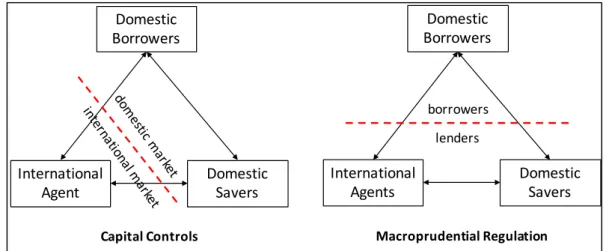
Korinek and Sandri (2016) focus on the difference in impact between capital control and macroprudential policies. Capital controls are applied exclusively to financial transactions between residents and non-residents whereas macroprudential regulation limits the domestic agents to borrow either from domestic or foreign lenders. The difference is shown in Figure 2. Korinek and Sandri (2016) argue that utilising both capital controls and macroprudential policies to complement monetary policy may moderate contractionary exchange rate depreciations. Macroprudential regulation aims to reduce the amount and riskiness of all financial liabilities, and capital controls aim to increase the
16
aggregate net worth of the economy by restraining net inflows. These measures generate an interest differential between the domestic and international credit markets, and encourage domestic saving.
Figure 2 Capital Control versus Macroprudential Regulation Source: (Korinek and Sandri, 2016)
Empirical testing of the impact of capital control comes with mixed results during different periods of observation. On the one hand, Edison and Reinhart (2001) observe that capital controls in Brazil and the Philippines, during 1999 crisis and 1997-1998 Asian financial crisis respectively, did not succeed in restricting capital flow volatility. Furthermore, countries with capital controls have a high probability of a financial crisis (Glick and Hutchison, 2005). On the other hand, Chamon and Garcia (2016) find that capital controls in Brazil may help to tame a bubble in the economy. Restricting the access to foreign financing, however, may have contributed to the low investment and growth performance during that period, given a low domestic saving rate of the Brazilian economy. One of the characteristics of capital controls is that they tend to be kept in place for a long period of time. Authorities seldom use this instrument to tackle short-term fluctuations in output, the terms of trade, or financial-stability considerations.
Ostry et al. (2012) investigate whether macroprudential policies and capital controls can enhance financial stability in the face of the risks typically associated with large capital inflows. In order to analyse this, they compose new indices of foreign currency-related prudential measures, domestic prudential measures, and financial-sector specific capital controls for 51 emerging market economies over the period 1995–2008. They point out that both capital controls and foreign currency
Domestic Borrowers
International
Agent DomesticSavers
Capital Controls
Domestic Borrowers
International
Agents DomesticSavers
borrowers lenders
17
related prudential measures are related to a decline in the proportion to the foreign exchange lending in total domestic bank credit and to a fall in the proportion of portfolio debt in total external liabilities. Other prudential policies provide support in limiting the intensity of aggregate credit booms.
The increasing number of central banks that both macroprudential measure or capital controls need to take into the account the adequacy of their international reserves (Jeanne, 2016). Massive capital inflows into emerging market countries are subject to reversal. Thus, the authorities must preserve the possibility of fire-sales which can be caused by the Value-at-Risk constraint in the global banking system. Sudden stops in capital inflows are normally related to large contractions in real activity. Jeanne (2016) argues that the best policy to tackle this problem is through managing international reserves by absorbing the capital inflows and supplying the market during the outflow episode.
6.
Conclusions and Future Research
As the results provided in the preceding discussion point out, the body of literature on monetary and macroprudential policies is arguably still in its infancy. Extensive debate between scholars is still ongoing as to whether financial friction affects the macroeconomy and, also, how to put financial stability into a framework of macroeconomic stability. However, all previous reviewed studies highlight that monetary policy alone is not sufficient to maintain the stability of the macroeconomy given the complexity of the environment.
As demonstrated in the previous discussion, financial intermediation plays a major role in achieving financial system stability and macroeconomic stability. The macroprudential policy appears to have played a major role after the global financial crisis, thus, there may be limited experience of practising this policy (Galati and Moessner, 2013). A substantial range of macroprudential instruments has been discussed without recognising a primary instrument. Macroprudential instruments tend to be customised according to the challenges that a particular country has to face (Claessens, 2015).
The systematic review of the literature performed in this study points to several promising avenues for future research. First, inclusion of several macroprudential instruments, such as
loan-to-18
value ratio and multi-version of reserve requirements which are commonly implemented in several countries10, will improve our knowledge about the framework of monetary and macroprudential policies. Second, as the systematic literature review highlights the importance of maintaining the exchange rate – both in level or volatility – with the stability of the economy, it is recommended to incorporate foreign exchange intervention in the framework of monetary and macroprudential policies. As the review findings point out, the intervention is mainly performed under a discretionary basis. Central banks, particularly in emerging markets, need to put foreign exchange operation into the framework of monetary and macroprudential policies. Third, given the importance of the payment system to provide the foundation for settlement and credit supply, there is an absence of discussion about the payment system within the monetary and macroprudential policies framework. It may be interesting to explore whether a policy regarding the payment system, such as electronic transfer fees or limitation of nominal value to be settled in the large payment system in the central bank, may have an impact on either macroeconomic or financial stability, or both. Finally, the question remains concerning how the interaction of monetary and macroprudential policies works in a framework to achieve price and financial stability. This question requires further development and assessment of the model.
Reference
Abo-Zaid, S. (2015), “Optimal long-run inflation with occasionally binding financial constraints”,
European Economic Review, Vol. 75, pp. 18–42.
Agénor, P.-R., Alper, K. and Pereira da Silva, L.A. (2014), “Sudden floods, macroprudential
regulation and stability in an open economy”, Journal of International Money and Finance, Vol. 48, pp. 68–100.
Agénor, P.-R. and Aynaoui, K. El. (2010), “Excess liquidity, bank pricing rules, and monetary policy”, Journal of Banking & Finance, Vol. 34 No. 5, pp. 923–933.
Aghion, P., Angeletos, G.-M., Banerjee, A. and Manova, K. (2010), “Volatility and growth: Credit constraints and the composition of investment”, Journal of Monetary Economics, Vol. 57 No. 3, pp. 246–265.
Aiyar, S., Calomiris, C.W. and Wieladek, T. (2016), “How does credit supply respond to monetary policy and bank minimum capital requirements?”, European Economic Review, Vol. 82, pp. 142–165.
Akram, Q.F. and Eitrheim, Ø. (2008), “Flexible inflation targeting and financial stability: Is it enough to stabilize inflation and output?”, Journal of Banking & Finance, Vol. 32 No. 7, pp. 1242–
19
1254.
Alba, J.D., Su, Z. and Chia, W.-M. (2011), “Foreign output shocks, monetary rules and
macroeconomic volatilities in small open economies”, International Review of Economics &
Finance, Vol. 20 No. 1, pp. 71–81.
Angelini, P., Neri, S. and Panetta, F. (2014), “The Interaction between Capital Requirements and Monetary Policy”, Journal of Money, Credit and Banking, Vol. 46 No. 6, pp. 1073–1112. Angeloni, I. and Faia, E. (2013), “Capital regulation and monetary policy with fragile banks”, Journal
of Monetary Economics, Vol. 60 No. 3, pp. 311–324.
Bailliu, J., Meh, C. and Zhang, Y. (2015), “Macroprudential rules and monetary policy when financial frictions matter”, Economic Modelling, Vol. 50, pp. 148–161.
Barnea, E., Landskroner, Y. and Sokoler, M. (2015), “Monetary policy and financial stability in a banking economy: Transmission mechanism and policy tradeoffs”, Journal of Financial Stability, Vol. 18, pp. 78–90.
Baxa, J., Horváth, R. and Vašíček, B. (2013), “Time-varying monetary-policy rules and financial stress: Does financial instability matter for monetary policy?”, Journal of Financial Stability, Vol. 9 No. 1, pp. 117–138.
Benes, J. and Kumhof, M. (2015), “Risky bank lending and countercyclical capital buffers”, Journal
of Economic Dynamics and Control, Vol. 58, pp. 58–80.
Bernanke, B.S., Gertler, M. and Gilchrist, S. (1999), “The Financial Accelerator in a Quantitative Business Cycle Framework”, in Taylor, J.B. and Woodford, M. (Eds.), Handbook of
Macroeconomics, Vol. 1 Part C, North-Holland, Amsterdam, pp. 1341–1393.
Bianchi, J., Boz, E. and Mendoza, E.G. (2012), “Macroprudential Policy in a Fisherian Model of Financial Innovation”, IMF Economic Review, Nature Publishing Group, Vol. 60 No. 2, pp. 223–269.
Borio, C. and Zhu, H. (2012), “Capital regulation, risk-taking and monetary policy: A missing link in the transmission mechanism?”, Journal of Financial Stability, Vol. 8 No. 4, pp. 236–251. Brzoza-Brzezina, M. and Kolasa, M. (2013), “Bayesian Evaluation of DSGE Models with Financial
Frictions.”, Journal of Money, Credit & Banking (Wiley-Blackwell), Vol. 45 No. 8, pp. 1451– 1476.
Brzoza-Brzezina, M., Kolasa, M. and Makarski, K. (2015), “A penalty function approach to occasionally binding credit constraints”, Economic Modelling, Vol. 51, pp. 315–327.
Cavoli, T. and Rajan, R.S. (2015), “Capital inflows and the interest premium problem: The effects of monetary sterilisation in selected Asian economies”, International Review of Economics &
Finance, Vol. 39, pp. 1–18.
Cecchetti, S.G. (2016), “On the separation of monetary and prudential policy: How much of the precrisis consensus remains?”, Journal of International Money & Finance, Vol. 66, pp. 157– 169.
Cecchetti, S.G. and Li, L. (2008), “Do capital adequacy requirements matter for monetary policy?”,
Economic Inquiry, Blackwell Publishing Inc, Vol. 46 No. 4, pp. 643–659.
Chamon, M. and Garcia, M. (2016), “Capital controls in Brazil: Effective?”, Journal of International
Money & Finance, Vol. 61, pp. 163–187.
Claessens, S. (2015), “An Overview of Macroprudential Policy Tools”, Annual Review of Financial
Economics, Vol. 7, pp. 397–422.
Cúrdia, V. and Woodford, M. (2010), “Credit Spreads and Monetary Policy”, Journal of Money,
Credit and Banking, Blackwell Publishing Inc, Vol. 42 No. s1, pp. 3–35.
20
Propagation of Shocks”, Economic Policy, Vol. 27 No. 70, pp. 319–359.
Devereux, M.B. and Sutherland, A. (2008), “Financial globalization and monetary policy”, Journal of
Monetary Economics, Vol. 55 No. 8, pp. 1363–1375.
Diamond, D.W. and Rajan, R.G. (2012), “Illiquid Banks, Financial Stability, and Interest Rate Policy.”, Journal of Political Economy, University of Chicago Press, Vol. 120 No. 3, pp. 552– 591.
Edison, H. and Reinhart, C.M. (2001), “Stopping hot money”, Journal of Development Economics, Vol. 66 No. 2, pp. 533–553.
Fazio, D.M., Tabak, B.M. and Cajueiro, D.O. (2015), “Inflation targeting: Is IT to blame for banking system instability?”, Journal of Banking & Finance, Vol. 59, pp. 76–97.
Forbes, K., Fratzscher, M. and Straub, R. (2015), “Capital-flow management measures: What are they good for?”, Journal of International Economics, Vol. 96, pp. S76–S97.
Fornaro, L. (2015), “Financial crises and exchange rate policy”, Journal of International Economics, Vol. 95 No. 2, pp. 202–215.
Freixas, X. and Parigi, B. (1998), “Contagion and Efficiency in Gross and Net Interbank Payment Systems”, Journal of Financial Intermediation, Vol. 7 No. 1, pp. 3–31.
Galati, G. and Moessner, R. (2013), “Macroprudential policy - A literature review”, Journal of
Economic Surveys, Blackwell Publishing Ltd., Oxford, Vol. 27 No. 5, pp. 846–878.
Gerali, A., Neri, S., Sessa, L. and Signoretti, F.M. (2010), “Credit and Banking in a DSGE Model of the Euro Area”, Journal of Money, Credit and Banking, Vol. 42 No. 6, pp. 107–141.
Gertler, M., Gilchrist, S. and Natalucci, F.M. (2007), “External constraints on monetary policy and the financial accelerator”, Journal of Money, Credit and Banking, Vol. 39 No. 2–3, pp. 295–330. Giannetti, M. (2007), “Financial liberalization and banking crises: The role of capital inflows and lack
of transparency”, Journal of Financial Intermediation, Vol. 16 No. 1, pp. 32–63.
Glick, R. and Hutchison, M. (2005), “Capital controls and exchange rate instability in developing economies”, Journal of International Money and Finance, Vol. 24 No. 3, pp. 387–412. Glocker, C. and Towbin, P. (2012), “Reserve Requirements for Price and Financial Stability: When
Are They Effective?”, International Journal of Central Banking, Vol. 8 No. 1, pp. 65–114. Goodfriend, M. and McCallum, B.T. (2007), “Banking and interest rates in monetary policy analysis:
A quantitative exploration”, Journal of Monetary Economics, Vol. 54 No. 5, pp. 1480–1507. Goodhart, C.A.E., Sunirand, P. and Tsomocos, D.P. (2006), “A model to analyse financial fragility”,
Economic Theory, Vol. 27 No. 1, pp. 107–142.
Gray, S. (2011), “Central Bank Balances and Reserve Requirements”, IMF Working Papers, Vol. 11 No. 36, p. 1.
Greenwood-Nimmo, M. and Tarassow, A. (2016), “Monetary shocks, macroprudential shocks and financial stability”, Economic Modelling, Vol. 56, pp. 11–24.
De Gregorio, J., Edwards, S. and Valdés, R.O. (2000), “Controls on capital inflows: do they work?”,
Journal of Development Economics, Vol. 63 No. 1, pp. 59–83.
Hasan, I., Renzis, T. De and Schmiedel, H. (2013), “Retail payments and the real economy”,
European Central Bank Working Paper, Vol. 1572/Augus, available at:
http://ideas.repec.org/p/ecb/ecbwps/20131572.html.
Iacoviello, M. (2005), “House Prices, Borrowing Constraints, and Monetary Policy in the Business Cycle.”, American Economic Review, American Economic Association, Vol. 95 No. 3, pp. 739– 764.
21
IMF Policy Papers.
Jeanne, O. (2016), “The Macroprudential Role of International Reserves”, American Economic
Review, Vol. 106 No. 5, pp. 570–573.
Jun, J. (2008), “Friction model and foreign exchange market intervention”, International Review of
Economics & Finance, Vol. 17 No. 3, pp. 477–489.
Kahn, C.M. and Roberds, W. (2001), “Real-time gross settlement and the costs of immediacy”,
Journal of Monetary Economics, Vol. 47 No. 2, pp. 299–319.
Kiyotaki, N. and Moore, J. (1997), “Credit cycles.”, Journal of Political Economy, University of Chicago Press, Vol. 105 No. 2, p. 211.
Korinek, A. (2010), “Regulating capital flows to emerging markets: An externality view”,
Unpublished Manuscript, No. May, pp. 1–39.
Korinek, A. and Sandri, D. (2016), “Capital controls or macroprudential regulation?”, Journal of
International Economics, Vol. 99, pp. S27–S42.
Lacker, J.M. (1997), “Clearing, settlement and monetary policy”, Journal of Monetary Economics, Vol. 40 No. 2, pp. 347–381.
Llosa, L.-G. and Tuesta, V. (2008), “Determinacy and Learnability of Monetary Policy Rules in Small Open Economies”, Journal of Money, Credit and Banking, Vol. 40 No. 5, pp. 1033–1063. Medina, J.P. and Roldos, J. (2014), “Monetary and Macroprudential Policies to Manage Capital
Flows”, IMF Working Papers.
Mendoza, E.G. (2010), “Sudden Stops, financial crises, and leverage”, American Economic Review, Vol. 100 No. 5, pp. 1941–1966.
Merola, R. (2015), “The role of financial frictions during the crisis: An estimated DSGE model”,
Economic Modelling, Vol. 48, pp. 70–82.
Merrouche, O. and Nier, E. (2012), “Payment systems, inside money and financial intermediation”,
Journal of Financial Intermediation, Vol. 21 No. 3, pp. 359–382.
Mimir, Y. (2016), “Financial Intermediaries, Credit Shocks and Business Cycles”, Oxford Bulletin of
Economics and Statistics, Vol. 78 No. 1, pp. 42–74.
Moll, B. (2014), “Productivity Losses from Financial Frictions: Can Self-Financing Undo Capital Misallocation?”, American Economic Review, Vol. 104 No. 10, pp. 3186–3221.
Ostry, J.D., Ghosh, A.R., Chamon, M. and Qureshi, M.S. (2012), “Tools for managing financial-stability risks from capital inflows”, Journal of International Economics, Vol. 88 No. 2, pp. 407–421.
De Paoli, B. and Paustian, M. (2013), “Coordinating Monetary and Macroprudential Policies”,
Federal Reserve Bank of New York Staff Report, Vol. 653, pp. 1–50.
Patnaik, I. and Shah, A. (2012), “Did the Indian Capital Controls Work as a Tool of Macroeconomic Policy?”, IMF Economic Review, Palgrave Macmillan, Basingstoke, Vol. 60 No. 3, pp. 439–464. Quint, D. and Rabanal, P. (2014), “Monetary and Macroprudential Policy in an Estimated DSGE
Model of the Euro Area”, International Journal of Central Banking, Vol. 12 No. 3, pp. 169–236. Rubio, M. and Carrasco-Gallego, J.A. (2014), “Macroprudential and monetary policies: Implications
for financial stability and welfare”, Journal of Banking & Finance, Vol. 49, pp. 326–336. Samarina, A. and Bezemer, D. (2016), “Do capital flows change domestic credit allocation?”, Journal
of International Money and Finance, Vol. 62, pp. 98–121.
Shi, S. (2015), “Liquidity, assets and business cycles”, Journal of Monetary Economics, Vol. 70, pp. 116–132.
22
Taylor, J.B. (1993), “Discretion versus policy rules in practice”, Carnegie-Rochester Conference
Series on Public Policy, Vol. 39, pp. 195–214.
Tong, H. and Wei, S.-J.J. (2011), “The Composition Matters: Capital Inflows and Liquidity Crunch During a Global Economic Crisis.”, Review of Financial Studies, Oxford University Press / USA, Vol. 24 No. 6, pp. 2023–2052.
Unsal, D.F. (2013), “Capital Flows and Financial Stability: Monetary Policy and Macroprudential Responses”, International Journal of Central Banking, Vol. 9 No. 1, pp. 233–285.
Valencia, F. (2014), “Monetary policy, bank leverage, and financial stability”, Journal of Economic
Dynamics and Control, Vol. 47, pp. 20–38.
Williamson, S.D. (2003), “Payments systems and monetary policy”, Journal of Monetary Economics, Vol. 50 No. 2, pp. 475–495.