Mastering the Basic Math
Facts in Addition and
Mastering the Basic Math
Facts in Addition and
Subtraction
Strategies, Activities & Interventions to
Move Students Beyond Memorization
Susan O’Connell and John SanGiovanni
HEINEMANN Portsmouth, NH
Heinemann 361 Hanover Street
Portsmouth, NH 03801–3912 www.heinemann.com
Offices and agents throughout the world
© 2011 by Susan O’Connell and John SanGiovanni
All rights reserved. No part of this book may be reproduced in any form or by any electronic or mechanical means, including information storage and retrieval sys-tems, without permission in writing from the publisher, except by a reviewer, who may quote brief passages in a review; and with the exception of reproducibles (iden-tified by the Mastering the Basic Math Facts in Addition and Subtraction copyright line), which may be photocopied for classroom use.
“Dedicated to Teachers” is a trademark of Greenwood Publishing Group, Inc.
Library of Congress Cataloging-in-Publication Data O’Connell, Susan.
Mastering the basic math facts in addition and subtraction : strategies, activities & interventions to move students beyond memorization / Susan O’Connell and John SanGiovanni.
p. cm.
Includes bibliographical references. ISBN-13: 978-0-325-02963-4
ISBN-10: 0-325-02963-6
1. Addition—Study and teaching (Primary). 2. Subtraction—Study and teaching (Primary). I. SanGiovanni, John. II. Title.
QA115 .O33 2011
372.7’2—dc22 2010046911
Editor : Victoria Merecki Production: Victoria Merecki
Cover and interior designs: Palmer Creative Group
Composition: Publishers’ Design and Production Services, Inc. Manufacturing: Steve Bernier
Printed in the United States of America on acid-free paper 15 14 13 12 11 VP 1 2 3 4 5
Dedication
To sweet Bailey with love S.O.
To Kay, thank you for being a mentor and friend J.S.
Contents
Foreword xiii
Acknowledgments xv
Introduction 1
What are basic facts? 1
What constitutesmastery of basic facts? 2
Why do we need to know basic facts? 2
Why is it important to understand math facts? 3
How can we help students master basic math facts? 5
How can this book help you? 7
How is this book organized? 8
What is the teaching sequence of math facts within this book? 9
Why are activities and resources on a CD? 12
Resource for Professional Learning Communities 13
Our Goal 13
C h a p t e r 1
Understanding Addition and Subtraction
15
Exploring Big Ideas to Develop Math Fact Strategies 16
Building Understanding Prior to Focusing on Fluency 18
Using Models to Represent Addition and Subtraction 18
Exploring the Concepts of Addition and Subtraction Through Problems 23
Exploring Operations Through Children’s Literature 25
Partner Explorations 26
The Classroom Environment 27
Mastering the Basic Math Facts in Addition and Subtraction
viii
C h a p t e r 2
Plus One and Plus Two
31
Focusing on the Big Ideas 32
Understanding +1, +2 Facts 34
Literature Link: Mouse Count 34
Exploring the Facts: Number Strips to Visualize 1 More and 2 More 38
Supporting All Learners 39
Building Automaticity 41
Targeted Practice 42
Monitoring Progress 45
Connecting to Subtraction 46
C h a p t e r 3
Adding Zero
51
Focusing on the Big Ideas 52
Understanding +0 Facts 53
Literature Link: Gray Rabbit’s 1, 2, 3 53
Exploring the Facts: Acting Out +0 Facts 54
Supporting All Learners 56
Building Automaticity 58
Targeted Practice 58
Monitoring Progress 60
Connecting to Subtraction 60
C h a p t e r 4
Adding Ten
63
Focusing on the Big Ideas 64
Contents
Literature Link: If You Give a Mouse a Cookie 65
Exploring the Facts: Using Double Ten-Frames 66
Supporting All Learners 68
Building Automaticity 70
Targeted Practice 70
Monitoring Progress 72
Connecting to Subtraction 72
C h a p t e r 5
Doubles
77
Focusing on the Big Ideas 78
Understanding Doubles 78
Literature Link: Double the Ducks 78
Exploring the Facts: Creating Equal Sets 81
Supporting All Learners 82
Building Automaticity 85
Targeted Practice 85
Monitoring Progress 88
Connecting to Subtraction 88
C h a p t e r 6
Making Ten
93
Focusing on the Big Ideas 94
Understanding Making Ten 95
Literature Link: Ten Apples up on Top! 95
Exploring the Facts: The Cupcake Problem 97
Mastering the Basic Math Facts in Addition and Subtraction
x
Building Automaticity 101 Targeted Practice 101 Monitoring Progress 106 Connecting to Subtraction 107 C h a p t e r 7Using Tens
111
Focusing on the Big Ideas 113
Understanding Using Tens 114
Literature Link: Diary of a Worm 114
Exploring the Facts: Counters In and Out 117
Supporting All Learners 118
Building Automaticity 121
Targeted Practice 121
Monitoring Progress 123
Connecting to Subtraction 124
C h a p t e r 8
Using Doubles
127
Focusing on the Big Ideas 128
Understanding Using Doubles 129
Literature Link: Fish Eyes 129
Exploring the Facts: Doubles and One More 131
Supporting All Learners 132
Building Automaticity 134
Targeted Practice 134
Monitoring Progress 136
Contents
One Lonely Fact 140
Retaining Math Facts 140
Automatic Recall of Facts 142
Conclusion 143
References 145
Professional References 145
Children’s Literature 145
Professional Learning Communities Study Guide 147
Guiding Questions 149
A Guide to the CD-ROM 155
Organization of the CD Files 155
Teaching Resources 155
Teaching Tools 155
Fact Cards 155
Assessment Tools 156
Foreword
Being able to add and subtract within 20 and multiply and divide within 100 is essential during the early years of schooling, and the basic facts of addition/ subtraction and multiplication/division are a critical baseline, not only then but also during later work with fractions, decimals, ratio, proportion, and more. Foundational? You better believe it. Essential? Absolutely.
That said, the basic facts are also problematic. The goal is for most stu-dents to know, fluently, and with automaticity, the addition/subtraction facts, typically by the end of second grade and the multiplication/division facts, typ-ically by the end of third grade. But far too many teachers are unable to help their students reach these goals. “Not this year,” they may mutter, or, “Not all my students,” or worse, “Not ever.” Why is fluency with the basic facts such a challenge for so many students? In our digit-conscious culture students can spout off multiple phone and pin numbers, but not the product of 6 × 7! I meet and work with middle school students who are still wondering about 8 × 7 or 48 ÷ 6 and other basic facts. Why do far too many students fail to realize that the commutative property means that 9 + 7 and 7 + 9 get you to the same place, 16? This drives us all crazy! Have we neglected the basics? Is this about just having students memorize the facts? No, and no!
Over twenty years ago the Curriculum and Evaluation Standards for School
Mathematics noted that “children should master the basic facts of arithmetic that are essential components of fluency with paper-pencil and mental
com-putation and with estimation” (47).1 The National Research Council’s Adding
It Up dedicates almost ten pages to synthesizing the research dealing with
basic fact acquisition.2 More recently, the Final Report of the National
Math-ematics Advisory Panel points out that computational proficiency with whole
number operations depends on the practice (I prefer the term rehearsal)
neces-sary to develop automatic recall of addition/subtraction and multiplication/
division facts.3 Nurturing computational facility in elementary school requires
that students be fluent with the basic facts of arithmetic. How do we get this done?
1 National Council of Teachers of Mathematics. 1989. Curriculum and Evaluation Standards for School Mathematics.
Reston, VA: National Council of Teachers of Mathematics.
2 National Research Council. 2001. Adding It Up: Helping Children Learn Mathematics. Washington, DC: National
Academy Press.
3 National Mathematics Advisory Panel. 2008. Foundations for Success: The Final Report of the National Mathematics
Mastering the Basic Math Facts in Addition and Subtraction
xiv
Over the years teachers have tried and continue to use a myriad of practice activities—oral and written exercises, games, and classroom and homework assignments, many of them now via the Internet. At last we have a more
effec-tive option—Susan O’Connell and John SanGiovanni’s Mastering the Basic Facts
in Addition and Subtraction: Strategies, Activities & Interventions to Move Students Beyond Memorization and Mastering the Basic Facts in Multiplication and Division: Strategies, Activities & Interventions to Move Students Beyond Memorization. What a find!
Based on Thornton’s pioneering work4 emphasizing how thinking
strat-egies facilitate fact acquisition, both books present activities that develop facility with the basic facts by building a conceptual understanding of the operations; following a teaching sequence designed to develop a sense of number using fact strategies and the commutative property; and using rep-resentational models and context-based problem solving. (The activities that link facts to their conceptual representations are also powerful diagnostic tools.) But there’s more—related children’s literature, partner activities, a pro-fessional-learning-community study guide. All these components add up to resources that engage students, from beginning activities that promote an understanding of arithmetic concepts, through fluency with the basic facts.
One final consideration: these books will be very helpful to teachers whose students’ mathematical knowledge require some level of intervention. The powerful instructional opportunities these books provide not only make sense but also meet one of the key recommendations of the What Works
Clear-inghouse’s Practice Guide Assisting Students Struggling with Mathematics.5
These books won’t end up on a shelf at the back of your room. (And if you are a third/fourth-grade teacher you will probably need both of them.) You’ll use them every day. You’ll carry them home with you and talk about them in the faculty lounge. Just as the basic facts are “must haves” on the path to compu-tational fluency, these books are “must haves” to help you navigate the route.
Francis (Skip) Fennell
L. Stanley Bowlsbey Professor of Education & Graduate and Professional Studies McDaniel College, Westminster, MD
Past President, National Council of Teachers of Mathematics
Project Director, Elementary Mathematics Specialists and Teacher Leaders Project http://mathspecialists.org
4 Thornton, C.A. 1978. “Emphasizing Thinking Strategies in Basic Fact Instruction.” Journal for Research in Math-ematics Education. 16: 337–355.
5 Gersten et al. 2009. Assisting Students Struggling with Mathematics: Response to Intervention (RtI) for Elementary and Middle Schools. Washington, DC: Institute of Education Sciences.
Acknowledgments
Many thanks to the students whose conversations about math facts inspired and excited us as we worked on this manuscript. Thanks to the following stu-dents who contributed work samples or allowed their photographs to appear within this book: Samantha Anderson, Jack Bacon, Julia Basket, Riley Benson, Justus Black, Krysta Carte, Eric Chen, Mason Chizhik, Esme Chu, Anessa Coleman, Ben Dyer, Nolan Dyer, Eric Ellis, Satya Emerick, Jonah Eng, Maxi-millian Fagerstrom, Anna Farley, Maya Frye, Emily Gomez, Maggie Inskeep, Ashley Jeon, Megan Keeley, Christopher Kennedy, Alexandra Liberto, DJ Lindahl, Emerson Mako, Caitlyn McDonald, Brooke Miller, Joshua Morton, Adam Mostafa, Brooke Naidu, Dylan Nguyen, Josh Oberly, Rona Okojie, Zion Olibris, Allison Peay, Jamie Roberts, Hannah Williams, Nushrat–I Rabban, Jack Ryder, Annie Schinkai, Sydney Schinkai, Oscar Schoenfelder, Deryn Schoenfelder, Lauren Stipe, Delaney Thompson, Laya Vanga, and Jilienne Widener. It was a pleasure watching them investigate math facts.
We appreciate the collaboration of colleagues in gathering materials for this book, in particular the following teachers, math coaches, and supervisors who welcomed us into their classrooms, provided insights from their own teaching, or allowed us to listen to the ideas of their students: Elizabeth Bare, Linda Chrest, Connie Conroy, Heather Dyer, Michelle Glenn, Carol Hahn, Renee Holdefelder, Ami Holden, Nena Hupp, Rhonda Inskeep, Arthurlea Kimbrough, Amanda Lewis, Kristen Mangus, Jamie Pickett, Kay Sammons, and Lee Ann Tanis. Thanks, too, to Josie Robles who had the inspiration to use ten-bead counters with her second grade students.
We are grateful to Victoria Merecki, our Heinemann editor, for her guid-ance on this project from start to finish. We value her insights for the writ-ing and production of the book. In addition, we thank Emily Birch for her vision for this book. Her discussions in the early stages of the book were invaluable.
Special thanks to our families for their patience and understanding dur-ing the writdur-ing of this book. To Sue’s husband Pat, and her children Brendan and Katie, and to John’s wife Kristen, and Oscar and Deryn, our warmest thanks for your continued support.
Introduction
As math teachers, we want all of our students to develop a quick recall of
single-digit addition and subtraction facts. We label them basic math facts
because they provide a foundation for math success. We expect that all stu-dents will master these basic skills, but that is not a simple goal to achieve. We watch some students effortlessly remember the facts and others struggle with the very same task. And we labor to find just the right strategies and activities to help all students succeed.
As teachers, we are constantly reminded that our students learn in a vari-ety of ways. Although some students have very strong memory skills, others struggle to remember simple facts. Although some students make sense of math concepts on their own, others struggle to connect meaning to simple expressions like 4 + 3. Although some students intuitively use their knowl-edge of one math fact to find the solution to a related fact, others simply get frustrated and discouraged when they cannot remember a specific sum. Our students are so different, and yet our goal for each of them is the same: to mas-ter basic math facts so they have a strong foundation for more complex math skills and procedures. The goal of this book is to explore numerous strate-gies and activities that support all students in understanding basic addition and subtraction math facts and committing those facts to memory. Whether you are introducing students to basic math facts, reviewing previously taught facts, or providing interventions for students who continue to struggle, this book supplies you with instructional considerations, teaching tips, practical strategies, and numerous classroom-tested activities.
What are basic facts?
In this book, facts with addends of 0–10 are considered basic facts. In some programs, facts with single-digit addends (0–9) are considered basic facts, but because of our emphasis on students’ use of strategies when learning basic facts, we have included 10 as an addend. When adding 9 + 6, a student might reason that 10 + 6 = 16, so 9 + 6 is 1 less, or 15. That reasoning is not possible without an understanding of 10 as an addend. To ensure that stu-dents have the basic number understandings to reason in this way, addends of 0–10 are addressed. The strategies and activities within this book will focus on mastery of these basic math facts.
Mastering the Basic Math Facts in Addition and Subtraction
2
What constitutes mastery of basic
math facts?
In the past, much of mathematics was taught in a drill and practice style. Students were simply asked to memorize their math facts, often without much attention to conceptual understanding. Through worksheets filled with single-digit computations or lengthy flash card sessions, students were asked to memorize addition and subtraction facts. Our goal in today’s math class-rooms has shifted from memorizing facts and procedures to increased under-standing of math skills and concepts. We want our students to be able to do mathematics, but we also want them to understand the math they are doing. We recognize that as math tasks increase in complexity, an understanding of facts, formulas, and algorithms will help them experience continued success. We have not changed our view of the importance of basic math facts. We know that they are a foundational skill without which our students will view even simple math tasks as daunting. We have simply expanded our expecta-tions to include understanding as an important component of our teaching of basic math facts. So, what do we expect of our students? Our goal is both auto-maticity and understanding. Autoauto-maticity is students’ ability to effortlessly recall a fact. If students are automatic, they have successfully committed the facts to memory. In addition, we want our students to understand, not simply remember, these important math facts.
Why do we need to know basic
math facts?
Ask math teachers what they would like their students to know and be able to do and the recall of basic math facts will undoubtedly rank high on most of their wish lists. Teachers recognize that once their students know 2 + 5, those students are better able to explore 20 + 50 or 22 + 55. Teachers recognize that students will have an easier time finding the solution to $1.20 + $1.50 or .21 + .53. These teachers know that their students will be more successful when they are challenged with 2–8 + 5–8. As math tasks become more complex, we want our students to have a solid foundation for success.
We have gained insights from brain research about demands on the work-ing brain. As students begin to learn math facts, their brains are focused on these basic computations, but as students become automatic with basic facts,
Introduction
their brains are able to focus on other aspects of the task like the challenges of place value, decimals, or fractions. Being automatic with basic facts frees the brain to focus on other math processes.
Committing basic math facts to memory speeds up math tasks. As math tasks increase in complexity, they often require multiple steps to find the solution. Addition with three-digit addends and subtraction with deci-mals are examples of more complex computational tasks. These tasks are time-consuming, and often stressful, for students who must stop to figure out each basic fact along the way. And stopping to determine each fact disrupts the flow of the math procedure. The National Mathematics Advisory Panel (2008) urges that students develop automatic recall of addition and related subtraction facts to be prepared for the study of algebra, in which solving multistep equations is a fundamental task. The panel suggests that by the end of grade 3, students should be proficient with the addition and subtraction of whole numbers (National Mathematics Advisory Panel 2008).
Students who have committed basic math facts to memory are able to per-form critical mental math tasks. They estimate answers prior to solving prob-lems so they are able to compare their estimates to the actual answers and determine the reasonableness of their solutions. When playing a playground kickball game, students with mental math skills can determine the new game score after three more runs are scored, or can compare the team scores to fig-ure out how many runs they will need to score in the final inning to win the game. As students spy a dozen cookies, they are able to quickly determine how many will be left after six are eaten, and students with a knowledge of math facts can efficiently find their total score in a family board game. Mas-tery of basic facts provides the foundation for everyday mental math tasks.
Automaticity is the quick and effortless recall of math facts. No need to count every object, no need to think about related facts, no need to extend patterns. The answer is automatically known. Automaticity with basic facts is a goal for our students, but alone it is not enough. Students must also under-stand the facts they are being asked to commit to memory.
Why is it important to understand
math facts?
The ability to recall items is enhanced when understanding is connected to
the task. Memorizing a chain of nonsensical words (e.g., sat chair red girl a in
Mastering the Basic Math Facts in Addition and Subtraction
4
have meaning (e.g., A little girl sat in the red chair). Asking students to
memo-rize dozens of number facts can be discouraging and confusing when stu-dents view them simply as pairs of numbers. The understanding that 7 + 4 represents the combined total of those two quantities, and that the sum is clearly close to 10, aids our ability to recall the sum.
Students who simply memorize math facts miss a prime opportunity to expand their understanding of equations. Problem solving is the central focus in today’s math classrooms. To be a successful problem solver, students must be able to accurately compute answers, but more than that, they must be able to figure out how to build equations that correspond to problem situations.
Kellen’s mother asked him to pick up the toy cars he left in the middle of the floor. He put 7 of them on top of his dresser. He put 6 more in his toy box. How many cars did he have?
This problem certainly requires the student to know that 7 + 6 = 13, but even before the student can use his knowledge of math facts to find the answer, he must understand how to build an equation that works with this problem.
Some cars were placed on the dresser and others were placed in the toy box. I need to know how many he had altogether so I need to add. 7 + 6 will be how I find the answer.
As we discuss the connection between the meaning of the equation and the basic math fact, we are supporting both students’ computation skills as well as building a strong foundation for problem solving.
Both the Common Core State Standards (National Governors Association
Center for Best Practices and Council of Chief State School Officers 2010) and
the National Council of Teachers of Mathematics’ Principles and Standards
(2000) emphasize the importance of our students understanding the concepts
of addition and subtraction. The Common Core State Standards recommend that
kindergarten students be given opportunities to explore addition as combin-ing or addcombin-ing to and subtraction as separatcombin-ing or takcombin-ing away. Understandcombin-ing is developed first, with practice for fluency coming later.
Introduction
How can we help students master basic
math facts?
We expect that our students will recall math facts without the need for manipulatives or counting strategies and that the recall will take place within several seconds. Certainly memorization of math facts is our goal, but memo-rization that comes from ongoing practice and engagement with math facts tasks, not memorization that comes from traditional drill and practice. And we recognize that our students benefit from varied opportunities to explore basic math facts before engaging in practice tasks designed to promote auto-matic recall. Through hands-on activities and thoughtful discussions, stu-dents develop deeper understandings about math facts and cultivate useful strategies related to these basic facts. An instructional approach in which stu-dents investigate the conceptual understanding of basic facts, explore strate-gies to support their understanding of numbers, and then engage in strategic practice in order to automatically recall the facts provides students with a strong and balanced foundation for mastery.
Conceptual Understanding
Understanding operations is fundamental to understanding math facts. Situa-tions are symbolically represented by expressions. 2 + 5 is more than numbers and symbols. The addition sign helps us understand the relationship between the numbers. 2 + 5 represents the combined total of two quantities. The understand-ing of this relationship is critical to makunderstand-ing sense of the expression. Through problem posing, hands-on explorations, real-world examples, classroom dis-cussions, and exploring situations from children’s literature, students develop deeper understandings of operations. An addition scenario that shows combined groups, or a subtraction story that shows comparisons, helps students strengthen their understanding of operations, and students who understand operations will find that math facts make sense.
Strategic Thinking
There are many ways that students might arrive at an answer to a math fact. When adding 8 + 3, Jason might simply count every object being added, and Katie might simply remember that 8 + 3 = 11. Math fact strategies lie some-where between counting each object and simply memorizing the answer.
They are predictable and efficient ways to find answers. Colin might count on
Mastering the Basic Math Facts in Addition and Subtraction
6
must be 1 more than 10, or 11. Strategies help students find an answer even if they forget what was memorized. Teaching math fact strategies focuses attention on number sense, operations, patterns, properties, and other critical number concepts. These big ideas related to numbers provide a strong foun-dation for the strategic reasoning that supports mastering basic math facts. For addition and subtraction, understanding the concept of tens, knowing that the order of addends will not affect the sum, and recognizing that vari-ous numbers can create the same sum (e.g., 5 + 4 = 9 and 6 + 3 = 9) and that there is a unique relationship between those two equations (e.g., in the sec-ond expression, the first addend is one more and the secsec-ond addend is one less) allows students to use their knowledge to build strategies to find sums and differences. Providing opportunities for students to explore math facts through active engagement and meaningful discussions builds their under-standing of critical ideas about numbers (Fosnot and Dolk 2001; Gravemeijer and van Galen 2003; Van de Walle 2004) and is an important component of math fact mastery.
Practice for Fluency
Once an understanding of operations has been developed and students have explored strategic reasoning to find solutions to basic math facts, it is time to engage students in meaningful practice so they can commit the facts to mem-ory. Rather than long practice sessions (Remember the lengthy flash card drills of days past?), consider activities that are short in duration but easy to imple-ment, so you can frequently engage students in valuable practice. Scattered practice—five to ten minutes a day, spread throughout the school year—yields powerful results (Marzano, Pickering, and Pollock 2001). And varying the practice activities ensures that students stay motivated and engaged in learn-ing their math facts. Automaticity is achieved through brief, frequent, interac-tive activities that provide students with repeated exposure to math facts.
Because of the anxiety associated with memorization tasks for many stu-dents, the practice tasks in this book do not focus on speed or elimination. Although speed drills or elimination games may be enjoyed by some students, these types of activities often intensify the frustration and anxiety of others. Students who struggle with rote memory tasks, those students who are the reason we include math fact activities in our daily schedule, are just the ones who become discouraged by the speed drills, experience humiliation when they are the first to be eliminated, and sit on the sidelines where they do not get the practice that they need.
Introduction
There are multiple practice activities within this book that engage stu-dents in math fact practice without increasing their anxiety or allowing them to get discouraged. The practice tasks are interactive and hands-on, and pro-vide students with repeated exposure to each set of math facts in a gradual progression in which each new set of facts builds on previous ones. Select the activities that work best for your students. Although some students might find competitive activities fun and motivating, others thrive on collegial tasks. Throughout this book, you will find activity choices to allow you to personal-ize math facts practice for your students.
How can this book help you?
This book is a practical guide for helping students master addition and subtrac-tion facts. It includes insights into the teaching of basic math facts including a multitude of instructional strategies, teacher tips, and classroom activities designed to help students master their facts. The emphasis is on strengthen-ing students’ understandstrengthen-ing of numbers, patterns, and properties as an essen-tial component of math fact teaching. This book provides valuable resources, insights, and options to help you introduce your students to basic facts, pro-vide reviews to support mastery, or develop interventions for students who have not yet mastered basic facts.
In this book, you will find activities and resources for introducing stu-dents to basic math facts. You will find tips for generating student talk about math facts including examples of questions and prompts that direct students’ thinking toward big ideas and lead them to insights that will simplify the task of mastering the facts. You will find activities to support varied levels of learn-ers so that you can choose the right activity to extend learning for high-level students or modify skills to support struggling students. You will find strat-egies that are hands-on, engaging, and interactive to motivate reluctant stu-dents. You will find activities perfect for small-group interventions and others that work well for whole-class instruction or individual support. And you will find a CD filled with resources to ease your planning and preparation.
This book is a compilation of strategies and activities that are organized to provide a solid math facts program; however, the individual activities and strategies can be easily integrated into your existing math program to pro-vide you with additional resources and varied instructional approaches. You may read the book from start to finish or you may focus on specific sections that address your needs. Consider your students and select the strategies and activities to match their needs, interests, learning styles, and abilities.
Mastering the Basic Math Facts in Addition and Subtraction
8
How is this book organized?
Throughout the following chapters, a multitude of teaching strategies and activities are shared to build students’ understanding and automaticity with math facts. Each chapter is organized to develop essential understanding and provide a menu of possible activities for instruction, practice, and assessment. Following are highlights of the key elements in Chapters 2 through 8.
Making Connections and Focusing on the Big Ideas
Each chapter begins by connecting the new fact set to students’ previous experiences and provides a brief review of big ideas that play a key role in students’ understanding of the facts and students’ development of strategies related to the facts.
Developing Understanding
Each chapter provides two introductory lessons that focus on developing con-ceptual understanding of the highlighted math facts. One lesson is a Litera-ture Link, introducing the facts through a story context. The other lesson, Exploring the Facts, provides a language-based and/or hands-on exploration of the new set of facts. The activities in this book employ varied instructional techniques, including the use of manipulatives, visuals, tables, literature, hun-dred charts, and discussions, ensuring that students experience addition and subtraction facts in diverse ways and that each student will be likely to expe-rience these facts in a way that makes sense to him.
In Supporting All Learners, you will find more ideas for those students who may need additional or different types of experiences to develop under-standing of the targeted facts. These activities might be done with the whole class but may also be perfect for small teacher-led groups of students. For some sets of facts, you may choose to use several of these activities; at other times, your students may not need the additional exposure. These activi-ties simply provide you with more and varied possibiliactivi-ties for developing understanding.
Building Automaticity
This section focuses on building students’ fluency and is broken into two parts: Targeted Practice and Monitoring Progress. In Targeted Practice, a variety of activities are shared that provide practice for that specific set of math facts. Stu-dents will have fun rolling number cubes, spinning spinners, and pulling num-ber cards from a deck as they engage in ongoing practice through interactive
Introduction
activities. It is through repeated and targeted practice that students gain fluency with math facts. Templates for these activities can be found on the accompany-ing CD.
Along with repeated practice to gain fluency with math facts, students need constant monitoring to ensure that they are progressing in their mastery of facts. Monitoring Progress provides ideas for monitoring students’ prog-ress toward automaticity including ideas for conducting frequent fact checks, techniques for tracking students’ progress, and suggestions for varied ways to monitor progress including student conferences, progress graphs, and individ-ual goal setting.
Connecting to Subtraction
Addition facts are the primary emphasis throughout this book because of our focus on building math fact fluency. When posed with a subtraction math fact, the most efficient way to solve it is by knowing the related addition fact. When the recall of addition facts is automatic and students understand the connec-tion between addiconnec-tion and subtracconnec-tion facts, their fluency with subtracconnec-tion facts naturally increases.
Lessons to develop students’ understanding of related subtraction facts are included in each chapter. In addition, you will find suggestions through-out the book of activities to build subtraction fact fluency. To attain fluency with subtraction facts, students need ongoing opportunities to practice the facts and explore their connection to addition facts.
What is the teaching sequence of math
facts within this book?
The chapters of this book are organized based on strategies that support stu-dents’ understanding of addition and subtraction facts. These strategies allow students to make sense of math facts and, therefore, support their mastery of these facts. The strategies are based on big ideas about numbers and oper-ations. The understanding of these big ideas helps students create effective math strategies related to the facts and to ultimately commit those facts to memory. This book is not simply a collection of activities; it is intended to highlight big ideas that provide a perfect focus for math facts instruction, to broaden your repertoire of instructional strategies, to provide you with dozens of easy-to-implement activity ideas, and to stimulate your reflection
Mastering the Basic Math Facts in Addition and Subtraction
10
related to the teaching of math facts. In reviewing the organization of this book, you may notice that the math facts appear in a sequence that focuses on the complexity of the number concepts and carefully links each new set of facts to previously explored facts, building upon students’ prior knowledge.
Rather than asking our students to memorize 121 combinations of addi-tion facts and then 121 combinaaddi-tions of subtracaddi-tion facts, this book focuses on helping students understand groups of facts and then building on that under-standing with additional sets of facts. Over time, our students are given a strong foundation of number sense and number understanding.
Students begin by exploring facts that are one more and two more. These
+1/+2 facts are linked to their counting experiences, as they are able to count
on to find the sums. Exploring facts that are one less and two less allows
stu-dents to investigate the addition/subtraction connection.
Once students have explored and begun to practice these facts, addition with zero is presented. Although the +0 facts are actually easier for automa-ticity than +1/+2 facts, the concept of joining is a bit harder to understand (What does it mean to add zero? Why do we add if we have nothing to add?). These facts are better addressed after students have had multiple experiences with +1/+2 facts and have developed the concept of addition.
Ten as an addend is explored next to allow students to develop automatic recall of +10 facts (e.g., 10 + 2 = 12 or 4 + 10 = 14). This skill will be critical later as students use +10 facts as a way of simplifying facts that are near 10 (e.g., 9 + 4 is simplified to 10 + 3).
Exploring doubles is addressed next. Through hands-on experiences, stu-dents explore the concept of doubling, find the sums of doubles, and begin to practice these facts for fluency. The automatic recall of doubles facts provides a foundation for more complex facts.
Next, students explore facts with a sum of 10. With 10 being central to our number system, students need many opportunities to explore ways to com-bine numbers to form 10. Once these facts are mastered, students have devel-oped a strong foundation on which to build mastery of other facts. If students know that 8 + 2 = 10, they can use that understanding to find the sum of 8 + 4 or 8 + 5.
Once our students have explored +1, +2, +0, +10, doubles, and making-
ten facts, they have been exposed to the foundation facts. The remaining
unknown facts can be found by building on this foundation. At this point, students have mastered 83 of the 121 addition facts. And they are armed with an understanding of tens and doubles, which will help them with their still unknown facts.
Introduction
Using tens is a strategy that assists our students with sums that are near-ten facts. They have not yet explored 8 + 3 but their knowledge that 8 + 2 = 10 aids them. “It’s 11 because 3 is just 1 more than 2 and 8 + 2 = 10, so 8 + 3 = 11!”
Next, our students explore more unknown facts using their doubles knowledge. Their previous experiences with doubles facts support students with more difficult facts like 6 + 7. “I know 6 + 6 = 12, so 6 + 7 is just 1 more. It’s 13!”
Through their known facts and their previously explored strategies, stu-dents now build mastery with the remaining facts. Although most of the basic facts have been connected to a specific strategy, it is important that students recognize the flexibility of these strategies, knowing that several strategies may work for a given fact. This flexibility allows students to find the answers for the two math facts that have not been specifically addressed (e.g., 5 + 3, 6 + 3). Although flexibility of strategies is addressed throughout the program, the final pieces of the teaching sequence focus on different ways students might use known facts to find an unknown fact. Discussions that show flexibility are criti-cal to expanding students’ thinking about numbers and the many ways they can be joined or separated. These students share their thoughts about finding the sum of 5 + 3:
“5 + 2 = 7 and it’s just 1 more, so 5 + 3 = 8.”
“If you double 3 it’s 6, and 5 is 2 more than 3, so 5 + 3 = 8.” “7 + 3 = 10, so 5 + 3 = 8 because it’s 2 less than 10.”
There is more than one way to think about joining numbers. These com-ments demonstrate students’ strategic reasoning and their enhanced under-standing of numbers.
Connecting new facts to previously discussed number concepts allows stu-dents to continually build mastery of addition and subtraction basic facts. Fig-ure 1 outlines a brief rationale for the sequence in which the facts are introduced within this book. We recognize, however, that students and instructional pro-grams differ and that teachers might choose, or be required, to introduce facts in a different sequence. Although we believe that there is strong justification for this sequence, we have carefully developed strategies and activities that support instruction of math facts even if the order in which you present the facts differs from the sequence described below.
The lessons and activities in this book focus on strengthening students’ number concepts to support their mastery of basic math facts. Teachers who have a deep understanding of big ideas related to numbers and the ways in
Mastering the Basic Math Facts in Addition and Subtraction
12
which those big ideas relate to the teaching of math facts, and who have devel-oped a repertoire of instructional techniques and classroom activities to high-light those big ideas, are able to simplify the task of mastering basic math facts for their students.
Why are activities and resources on a CD?
Along with the many easy-to-implement student activities described within the book, you will find a teacher-friendly CD filled with customizable versions of the activities. Because the CD materials are produced in a Microsoft Word format, you can easily modify the activity pages to make them simpler or more complex, personalize the tasks to insert your students’ names or names of familiar places or events, and adapt the activities to work with any set of math facts. On the CD, you will find the featured activities (described within the book) for each set of facts as well as some additional activities, often modi-fied from a featured activity for a different set of facts, to provide a multitude of practice tasks from which you can choose. The CD also includes teacher Foundation Facts
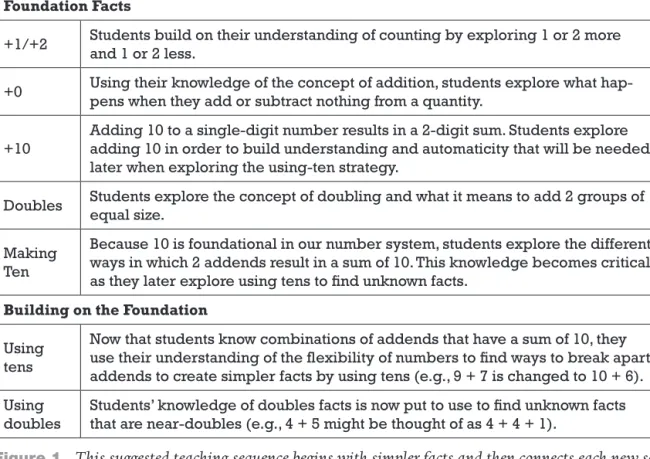
+1/+2 Students build on their understanding of counting by exploring 1 or 2 more and 1 or 2 less. +0 Using their knowledge of the concept of addition, students explore what hap-pens when they add or subtract nothing from a quantity. +10
Adding 10 to a single-digit number results in a 2-digit sum. Students explore adding 10 in order to build understanding and automaticity that will be needed later when exploring the using-ten strategy.
Doubles Students explore the concept of doubling and what it means to add 2 groups of equal size. Making
Ten
Because 10 is foundational in our number system, students explore the different ways in which 2 addends result in a sum of 10. This knowledge becomes critical as they later explore using tens to find unknown facts.
Building on the Foundation
Using tens
Now that students know combinations of addends that have a sum of 10, they use their understanding of the flexibility of numbers to find ways to break apart addends to create simpler facts by using tens (e.g., 9 + 7 is changed to 10 + 6). Using
doubles
Students’ knowledge of doubles facts is now put to use to find unknown facts that are near-doubles (e.g., 4 + 5 might be thought of as 4 + 4 + 1).
Figure 1. This suggested teaching sequence begins with simpler facts and then connects each new set of facts to students’ previous experiences.
Introduction
tools (e.g., hundred charts, addition tables, assessments, and game templates) to simplify your planning and reduce your preparation time.
Resource for Professional Learning
Communities
Effective teachers constantly reflect on their own teaching. They gather new ideas, try them with students, reflect on their successes, and find ways to con-tinually refine their teaching. At the conclusion of this book, questions are posed to stimulate reflection about the key points within the chapters. These guiding questions are designed for your personal reflection or for use in school-based study groups. Discussion about math facts instruction within our pro-fessional learning communities broadens our understanding and improves our teaching.
Our Goal
The purpose of this book is to explore ways to support all students in mas-tering addition and subtraction facts. By focusing on big ideas, strengthening students’ understanding of math operations, developing strategic thinking, and providing varied and engaging practice tasks to promote fluency, our stu-dents will be better equipped to both understand math facts and commit the facts to memory. Whether you are introducing students to basic facts, review-ing facts, or providreview-ing remediation for strugglreview-ing students, this book provides you with insights and activities to simplify this complex and vital component of math teaching.
77
C h a p t e r F i v e
Doubles
W
e continue to add to our students’ repertoireof math facts, this time focusing on doubles facts. Because both addends are the same, there is no need to address the commutative property, so this fact set is quite small—just eleven doubles facts in all. And because students have already explored and practiced +0, +1, +2, and +10 facts, they already know the sums for 0 + 0, 1 + 1, 2 + 2, and 10 + 10, leaving only seven unknown doubles facts. These facts are usually easy for students to recall and provide important links to future facts. Students will later refer back to these facts to find the sums of more complex near-doubles facts.
+ 0 1 2 3 4 5 6 7 8 9 10 0 0 1 2 3 4 5 6 7 8 9 10 1 1 2 3 4 5 6 7 8 9 10 11 2 2 3 4 5 6 7 8 9 10 11 12 3 3 4 5 6 7 8 9 10 11 12 13 4 4 5 6 7 8 9 10 11 12 13 14 5 5 6 7 8 9 10 11 12 13 14 15 6 6 7 8 9 10 11 12 13 14 15 16 7 7 8 9 10 11 12 13 14 15 16 17 8 8 9 10 11 12 13 14 15 16 17 18 9 9 10 11 12 13 14 15 16 17 18 19 10 10 11 12 13 14 15 16 17 18 19 20 KNOWN FACTS Doubles TARGETED FACTS 2 UNKNOWN FACTS
Mastering the Basic Math Facts in Addition and Subtraction
Focusing on the Big Ideas
Exploring big ideas about mathematics provides the backdrop for our explora-tion of doubles facts. Some big ideas include the following.
Doubling is the process of joining two groups of the same quantity.
The term doubling refers to the process of adding a quantity to itself.
Dou-bling is joining two like groups. It is when both parts that make up a whole
are equal quantities.
Halving is the opposite of doubling.
Separating a set into two equal groups results in halves. By halving a set, we can determine the quantity for the two equal parts that make the whole. Separating half from a set will result in a difference that is the same as the amount that was separated (i.e., in 12 – 6 = 6, 6 was separated from the set and 6 remain in the set).
Addition and subtraction are inverse operations.
If students know that doubling 5 results in 10, or 5 + 5 = 10, then they will also know that halving 10 results in 5, or 10 – 5 = 5. Knowing a doubles fact (addition) supports students in knowing halves (subtraction).
Key questions related to the big ideas for doubles are:
What does it mean to double an amount? What does it mean to find half of an amount?
How are doubling and halving alike? How are they different?
Our goal is to continually reinforce the big ideas related to math facts as we help students develop addition and subtraction strategies.
Understanding Doubles
Literature Link: Double the Ducks
In Double the Ducks (2003), Stuart J. Murphy tells the story of a boy with 5 ducks. When 5 duck friends follow them home, the boy must double every-thing as he cares for the 10 ducks.
Chapter Five d o U b l e s
79
Before Reading Ask students to brainstorm types of animals that live ona farm. Ask them what kinds of things a farmer does to take care of the differ-ent animals. Ask studdiffer-ents what it means to double something. Can they give an example of a double? Read the title and ask students to predict what the story might be about.
During Reading As you read each number in the story and what it rep-resents, record the number and item on chart paper (e.g., 1 person, 2 hands, 3 sacks of food, etc.). Pause after reading that each duck brought back a friend. Ask students to predict what the farmer will need in order to take care of 10 ducks. Continue reading to check their predictions.
After Reading After finishing the story, compare the predictions that stu-dents made with the actual events of the story. Talk about what it means to double by referring to the items on the chart paper as examples. Pose a few related farm problems, having students turn and share the double with a part-ner. Keep the quantities small to assess students’ understanding of the con-cept of doubling rather than their computation skills.
His ducks love to eat bread. He needs 4 loaves of bread to feed his ducks. How many loaves of bread will he need if we double the ducks? How do you know?
His pigs are very muddy. He uses 3 bars of soap to bathe them. How many bars of soap will he use if we double the pigs? How do you know?
His horses love to eat sugar cubes. He needs 5 bags of sugar cubes for his horses. How many bags of sugar cubes will he need if we double the horses? How do you know?
Once you are confident that students understand the concept of doubling,
begin a task to explore doubles with addends of 6–10. Give students a Double
the Animals recording sheet (see CD) and a set of 20 counters to represent ani-mals. Students will work with partners to find the doubles sum for a set of cows, pigs, goats, and horses. Have partners work together, with one partner spinning a 6–10 spinner (see CD) to see how many cows are on the farm, and the other partner placing counters in a row to represent that number of cows. Partners then double the cows by creating a similar row to show the doubles set. Partners find the total number of cows, the sum, and record the addi-tion number sentence on their recording sheets. Have partners switch roles
6–10 Spinners 6 7 10 8 9 6 7 10 8 9 6 7 10 8 9 6 7 10 8 9 Name: __________________________________________________________________
Double the Animals
Spin the spinner and write the number of each animal on the farm. Double the animals.
Write a number sentence and draw a picture to show how many.
Animals
Total when DOUBLED (number sentence and picture)
____cows
____pigs
____goats
____horses
Write another animal that could be on a farm. Spin the spinner to see how many there are. Tell how many there would be if we doubled them.
______________________________________________________________ ______________________________________________________________
Mastering the Basic Math Facts in Addition and Subtraction
and spin again, finding the number of pigs and the double for that number of pigs. As they work together to double all of the animals, observe how they are finding the sums. Do they know what it means to double? Are they count-ing all of the counters? Are they uscount-ing any strategies? Do they have automatic recall of any doubles facts? Make a note of students who already have recall of some doubles facts. For the next lesson, those students might be transitioned to some of the doubles practice tasks, and those who were noted to be strug-gling with the concept might be asked to join you for additional explorations and discussions of the doubling process.
Once pairs have determined doubles for their animals, have them share some of their doubles facts, recording the number sentences on the board to provide a check for accuracy of the 6–10 doubles facts.
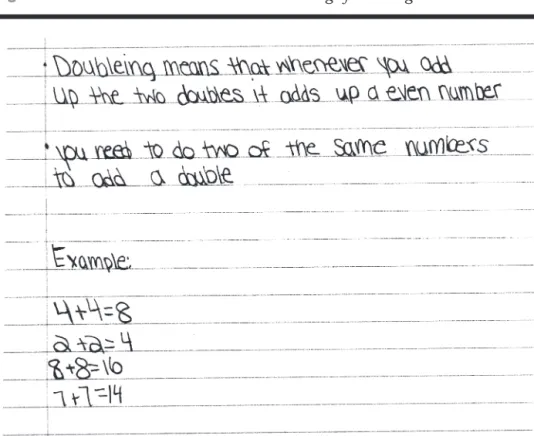
Finally, have students respond to the following prompt, as in Figure 5.1, in their math journals.
What does it mean to double a number?
If students have a difficult time explaining their understanding of doubles in words, remind them that they can draw pictures or give examples to show
Chapter Five d o U b l e s
81
their thinking. Sharing their writing with a partner, or presenting it during circle time, is an effective way to summarize the doubling concept.
Exploring the Facts: Creating Equal Sets
Visualizing the doubling process helps students better understand its connec-tion to an addiconnec-tion equaconnec-tion. When considering the part-part-whole concept, both parts are of equal size. Model equal sets for students by creating sets on an overhead projector, document camera, or SMART Board. Lining objects in two equal rows helps students quickly see that sets are equal.
Pose some doubles problems.
4 orange fish were in the fish bowl. 4 black fish were in the fish bowl. How many fish were in the fish bowl?
6 boys were at the park. 6 girls were at the park. How many children were at the park?
Bailey had 7 flower stickers. She had 7 bunny stickers. How many stickers did she have?
Liam had 6 red cars and 6 blue cars. How many cars did he have?
Colin had 9 soccer balls. He had 9 baseballs. How many balls did he have?
Allow students to use manipulatives to create the two equal-sized groups. A part-part-whole mat (see CD) provides a great template for this exploration. Students place a group of manipulatives in the top left section, then create an equal-sized group in the top right section. Pause to ask students about the two groups. Are they the same size? Have them record an addition equation to show the two parts, and then pull the two parts together to make one whole group. Have them find and record the sum. Continue to pose problems as you observe students at work.
Part-Part-Whole Mat
Part Part
Whole
The use of motion, pulling groups together, provides an important visualization of the concept of joining, or finding a total or whole set. An overhead projector or document camera allows us to physically move sets together, as do many SMART Boards. Magnetic graphics or student actors can also be joined to demonstrate the action of addition.
Mastering the Basic Math Facts in Addition and Subtraction
Supporting All Learners
The following classroom activities provide you with additional lesson ideas for the whole class or for small teacher-led groups with students who might need to explore doubles in a different way.
Act Out Doubles Pose doubles problems for students to act out. You might have 4 students put their hands on their heads and then double the number of students putting their hands on their heads. You might have 6 students jump up and down and then double the number jumping up and down. Have fun doubling the students and recording the addition number sentences to repre-sent the doubles.
Roll and Double It Provide students with 20 counters. Roll a 1–6 num-ber cube and ask students to make a row with that numnum-ber of counters. Ask them to double it by making another row of the same size. Have them count to find the sum. Record the addition number sentence. Roll another number and repeat the process.
Ask students how they will know they are doubling when they see an addition number sentence. Do they notice that both addends in the number sentence are the same? Do they understand that means the size of each group is the same? Ask questions to guide students in observing the connection between the numbers in the equation (the same numbers) and the number of counters in each group (the same size groups).
Revisit Double the Ducks For struggling students, it may be helpful to
reread Double the Ducks and allow them to use manipulatives to double each
item in the story. Students can use the Doubles for Ducks recording sheet (see
CD) to show their work. Watch them as they work, asking questions to guide their thinking and assess their understanding. After completing the story items, brainstorm other farm items and have them select a few and find the doubles.
Magical Doubles Share this doubles story to engage students in solving and writing doubles problems.
Name: __________________________________________________________________
Doubles for Ducks
1.Look at the list of things from the story. 2.Double each one.
3.Write a number sentence and draw a picture to show how many. Things
Total when DOUBLED (number sentence and picture) 1 farmer 2 hands 3 sacks of food 4 bundles of hay 5 ducks
On the back, write three other things that could be on a farm and then tell how many there would be if we doubled them.
Chapter Five d o U b l e s
83
Mork was a famous magician. Children loved to see his magic shows. Morkmade a penny disappear and then reappear behind someone’s ear. Amaz-ing! He cut a scarf in half and with a wave of his wand made it a whole scarf again. Unbelievable! But most of all, children loved when Mork took out his magic hat. Mork put 1 cuddly bunny into his hat, waved his wand and chanted: “Magic hat, don’t give me trouble. These children want to see a double!” He reached into the hat and pulled out 2 cuddly bunnies! The children cheered and shouted for more. Mork reached into his pocket and pulled out 2 shiny quarters, put them into his hat, waved his magic wand, and chanted: “Magic hat, don’t give me trouble. These children want to see a double!” He reached into his hat and pulled out 4 shiny quarters!
Ask students to turn and tell a partner what Mork pulled out of his magic hat when he put these items into it:
3 purple purses 4 red balls 5 salty pretzels 6 juicy grapes 7 silver spoons 8 spotted owls 9 rotten potatoes 10 gray mice
Allow students to use beans or counters to explore the sums, if needed. Record each doubles number sentence on the board.
Have students talk with partners to decide on something else to put in Mork’s hat. Go around the room to have pairs tell you what Mork put in and what he took out.
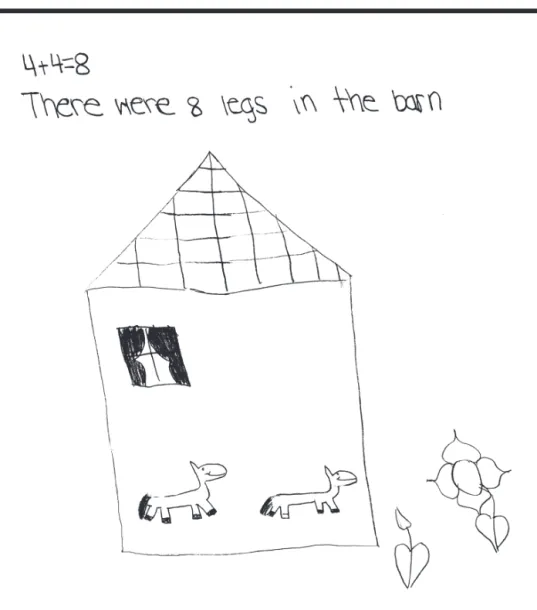
Class Doubles Book As a class, make a list of things that come in 1, 2, 3, 4, and so on (i.e., 1 trunk on an elephant, 2 horns on a bull, 3 lights on a traffic light, 4 legs on a table, 5 fingers on a hand, etc.). Have students pick an item from the list and figure out how many there would be if the items were doubled. Have each student draw a picture and write a number sentence for a class doubles book (see Figure 5.2).
Holey Doubles Give each student a piece of paper and have them fold it in half. Students pick a 1–10 number card (see CD) and, with the paper folded,
Mastering the Basic Math Facts in Addition and Subtraction
use a handheld paper punch to punch that number of holes in their paper. Stu-dents then open the folded paper to reveal double the holes. StuStu-dents record the doubles number sentence on their paper and write a doubles story about their holes (i.e., “There were 5 spiders and 5 more crawled in. How many were there?”). Students can get creative and decorate around the holes to make them look like flowers or spiders or lollipops or suns. The doubles art can be posted on a bulletin board to display a variety of doubles equations as in Figure 5.3.
Chapter Five d o U b l e s
85
Building Automaticity
Targeted Practice
Individualized Fact Card Practice Referring to each student’s Fact Check will allow you to select specific fact cards that meet her needs. Are there specific doubles facts that this student struggles to recall? Practice with targeted facts allows for more repetition of those facts and narrows the scope of the task for each student. Students can be given the job of finding their “focus facts” in their deck of fact cards before beginning a focused fact card practice.
A Fact Card Menu Fact cards (see CD) can be a source of activities that students do independently at school or at home. The following activities alle-viate the stress that is sometimes associated with fact cards as they emphasize knowledge of the answer rather than speed. Suggest one of the following for students who need additional practice with the facts.
Pick a card and draw a picture to show the fact.
Pick an addition fact card and write a subtraction fact that goes with it.
Pick a card and write the fact three times.
Pick a card and write a story problem for the fact.
Pick a card and show the fact on a number line. Record the number
sen-
tence by the number line.
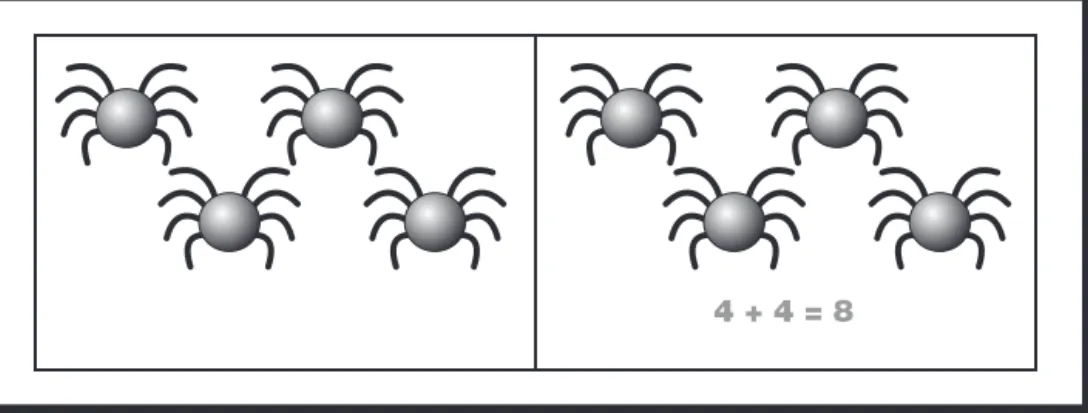
Figure 5.3 Four holes are punched on the outside of the folded paper to reveal double the holes when the paper is opened. Students can decorate the holes to look like spiders and add a doubles number sentence.
Doubles Fact Cards—Addition
0 + 0 1 + 1 2 + 2 3 + 3 4 + 4 5 + 5 6 + 6 7 + 7 8 + 8 9 + 9 10 +10 4 + 4 = 8
Mastering the Basic Math Facts in Addition and Subtraction
The Teacher’s Role During Game Time While students play games, you might either observe their play or capitalize on your opportunity to work with a small group of students. Watching students as they play games allows you to gain insights about their fluency with math facts. You will quickly identify those who have mastered facts and those who need additional support.
Although those observations are extremely helpful, it might also be benefi-cial to take the opportunity to address the needs of specific students. As most students are developing their rapid recall of facts through the games, you might conduct small-group assessments, lead intervention groups, or conduct indi-vidual interviews. Think about both assessment and instruction as you balance opportunities to observe students at play and support students individually or in small groups.
Double Ten-Frames Provide each pair with two sets of ten-frame cards (see CD) containing frames with 0–10 dots. Have students work with partners to find doubles (i.e., locate the frames with 6 dots on each frame), find the sums, and record the number sentences.
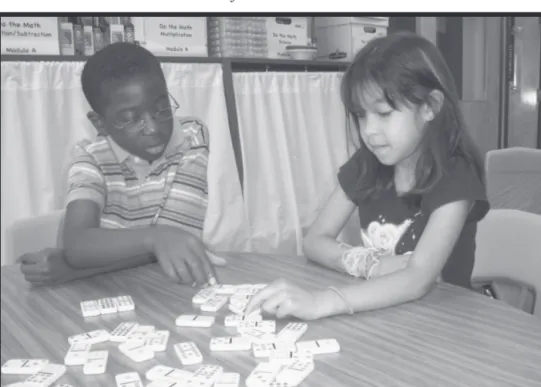
I Spy Doubles Have students search for double dominoes, dominoes with the same number of dots on each side, and write matching addition equations (see Figure 5.4). See the CD for domino templates.
Ten-Frame Cards Directions: Cut out ten-frame cards on bold lines to create eleven cards representing 0–10.
Domino Cards
Chapter Five d o U b l e s
87
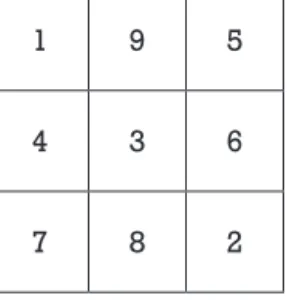
Beanbag Addition Create a floor mat with a white shower curtain liner or large poster board, marking nine sections, each containing a number from 1–9 (see Figure 5.5). Students take turns tossing a beanbag and calling out the number it lands on and the double. Students record their double equations.
Squares The goal of Squares is to be the first player to have markers on four numbers that form a square on the game board. Students play
with partners. Each pair needs a Squares spinner and game board (see
CD) along with game markers (e.g., beans or counters). Players take turns spinning, finding the sum, and placing their marker on the board. The first player to have four markers arranged to form a square is the win-ner. For a noncompetitive option, have partners work together to spin, add, and cover doubles sums, talking together about where to place each marker as they try to form a square. When a square is formed, students clear the board and start again.
Doubles Memory In Doubles Memory, students try to match a doubles fact card (5 + 5) with the cor-rect sum (10). Students work in pairs and spread the cards (see CD) facedown on a desk, table, or floor. Each player takes turns choosing two cards. If the cards go together (the doubles fact and the sum), the player keeps the cards and gets another turn. If the cards do not match, the player returns them to the same spot on the desk, facedown, and his turn is over. The player with the most cards at the end of the game is the winner.
1 9 5
4 3 6
7 8 2
Figure 5.5 Tossing beanbags at a number chart on the floor, and doubling the number the bag lands on, incorporates movement into math facts practice.
Squares 20 12 8 14 16 4 6 10 6 8 2 18 20 2 14 16 10 14 8 6 12 20 18 2 4 16 6 12 8 4 10 12 4 14 10 18 Directions: 1.The player who spins
the highest number goes first. 2.Players take turns
spinning the spinner and adding. 3.They find a space on
the board with that sum and place their marker on it. 4.The first player to
make a square (see below) wins. 6 12 4 14 Squares Spinner 7 + 7 6 + 6 10 + 10 3 + 3 9 + 9 4 + 4 8 + 8 5 + 5 1 + 1 2 + 2
0
2
4
6
8 10
12 14 16
18 20
Doubles Memory Cards 0 + 0 1 + 1 2 + 2 3 + 3 4 + 4 5 + 5 6 + 6 7 + 7 8 + 8 9 + 9 10 +10
Mastering the Basic Math Facts in Addition and Subtraction
Monitoring Progress
Individual Teacher-Guided Fact Checks Individual student assess-ment might be indicated for students who have extreme difficulty with the cumulative Fact Checks. Using a set of fact cards, assess the child’s fluency verbally, beginning with simpler facts and then moving to those that are caus-ing difficulty. As a child misses, set the card aside. When a child misses five facts, stop and set a goal for those facts. Give the missed fact cards to the student, discuss any strategies that might help them better remember those facts, and determine a time frame for when you will recheck for mastery of the facts.
Connecting to Subtraction
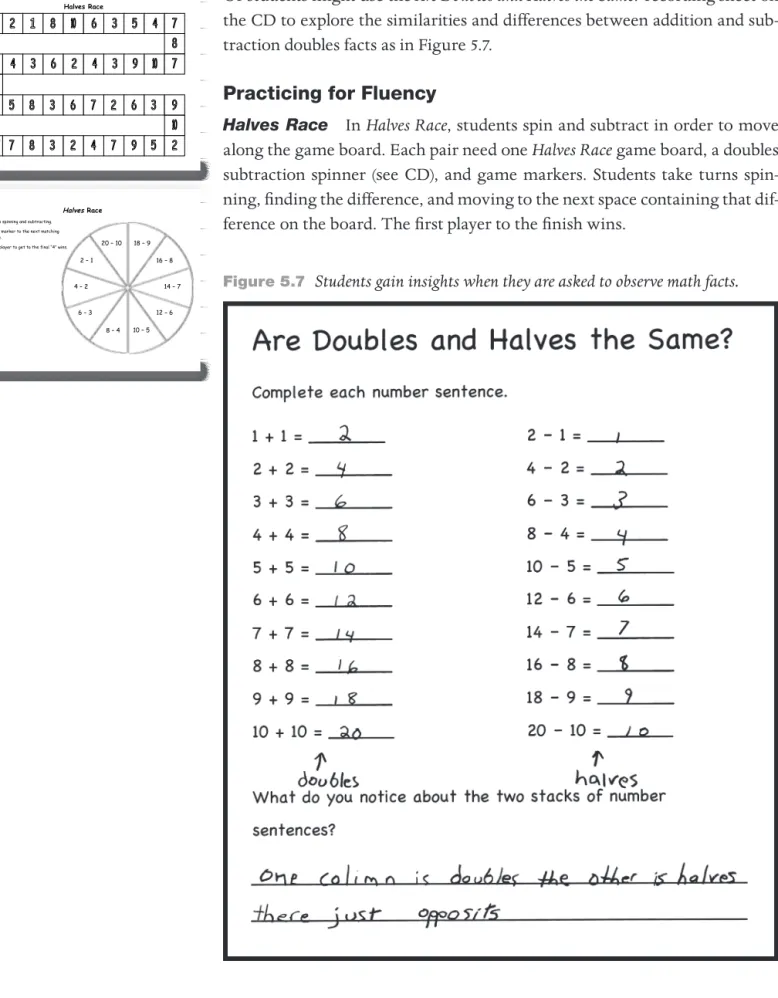
As students develop an understanding of doubles facts, take every opportunity to talk about the connection between addition and subtraction facts. Discuss-ing halves will demonstrate the inverse of doubles and show what happens when one half is separated from the other—the same amount always remains. The two addends in a doubles number sentence can be thought of as halves.
Thinking halves simplifies finding the difference for doubles subtraction.
Literature Link: Martha Blah Blah
In Martha Blah Blah (1996) by Susan Meddaugh, a dog gains the ability to speak when eating alphabet soup but encounters problems when half of the letters are removed from the soup.
Before Reading Have students turn and tell a partner what they think dogs might say if they could speak. Share a few of their ideas. Tell students you will be reading a story about a dog who speaks. Before you begin read-ing, have students recite the alphabet as you record the letters on chart paper
or the board. Count the total number of letters in the alphabet and record 26
on the board.
During Reading After reading that Granny Flo removed half of the let-ters, pause to identify and cross off the letters she removed. Ask students to predict if she removed more than, less than, or about half of the letters.
After Reading Ask students if the 13 letters removed were half of the alphabet. Give partners 26 counters to represent the letters. Have students explain how they know that 13 is half of 26.
Many students have difficulty with timed tests. Teacher-administered oral fact checks provide a clear picture of fact mastery.
Chapter Five d o U b l e s
89
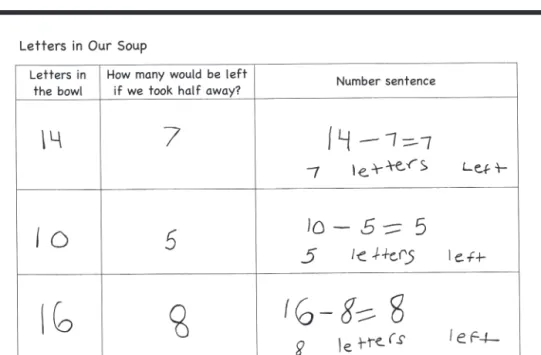
Prepare bowls of cereal letters, or magnetic letters, to represent bowls of alphabet soup. Have bowls with the following amounts of letters: 2, 4, 6, 8, 10, 12, 14, 16, 18, and 20. The actual letters in each bowl do not matter, just the quantity of letters in the bowls. Have students work in pairs or groups to count the letters in their bowls and then remove half of the letters like Granny Flo did. Students must find out how many letters are left in their bowls and
record the subtraction number sentence on the Letters in Our Soup recording
sheet (see CD) as in Figure 5.6. As students finish, have them switch bowls with another group and do it several more times.
After students have worked with several bowls of soup, have students share, as you record, the different number sentences for half of the letters. Once you have completed the subtraction number sentences, write associated doubles addition sentences next to the subtraction sentences. Ask students to describe how the addition and subtraction sentences are the same and how they are different. Their comments will likely include:
They have the same numbers in them, but in different places. They all have 2 numbers that are the same and 1 that is different. If you take a half away, you get the other half.
Figure 5.6 This student explores subtraction by removing half of the letters from his soup.