Developing constraint-based applications with spreadsheets
A. Felfernig, G. Friedrich, D. Jannach, C. Russ,
and
M. Zanker
Computer Science and Manufacturing
Universit¨at Klagenfurt
A-9020 Klagenfurt, Austria
felfernig,friedrich,jannach,russ,zanker @ifit.uni-klu.ac.at
Abstract
Spreadsheets are in wide-spread industrial use for light-weight business applications, whereby the broad acceptance is both founded on the underly-ing intuitive interaction style with immediate feed-back and a ”programming model” comprehensible for non-programmers. In this paper we show how the spreadsheet development paradigm can be ex-tended to model and solve a special class of search and optimization problems that occur in many ap-plication domains and would otherwise require the involvement of specialized knowledge engineers. We present a development framework that ex-tends a state-of-the-art spreadsheet environment by smoothly incorporating a light-weight Constraint Satisfaction reasoner into the spreadsheet develop-ment paradigm. Based on a real-world example from the domain of product configuration, we de-scribe the components of the developed framework and discuss the types of problems that can be tack-led with this approach. Finally, a comparison of our approach with related work in the field and alterna-tive approaches is given.
1 Introduction
Spreadsheet applications are in wide-spread industrial use for supporting several business processes like, e.g., back-office data analysis or cost estimation and quotation in the sales process. The broad acceptance of these systems is founded on two main pillars: First, the intuitive (tabular) spreadsheet user interface paradigm allows the user to directly manipulate the data. In addition, immediate user feedback is given in a way that the user is capable of detecting the effects of inputs and changes such that different scenarios can be easily ana-lyzed. In fact, because many users are already accustomed to this specific interaction style, a spreadsheet-like interface can be used as mere front-end for more complex applications that would otherwise require more technical knowledge by the domain-expert [12; 14].
On the other hand, from the software development point of view, spreadsheets are a valuable tool that allow non-programmers to develop their own, small applications that support them in their work without requiring classical pro-gramming skills: The spreadsheet development model does (in principle) not require that the user understands concepts
likevariablesor program flowin the first place. Moreover, the test and debugging process is alleviated for these applica-tions as the user can immediately see the effects of changes in his/her program, i.e., the formulae.
However, the main restriction of pure spreadsheet applica-tions is their limited functionality, i.e., the main concepts are cells containing values and a set of predefined (mostly arith-metic) functions that contain references to other cells or ar-eas. For these cases where complex business logic is required, industrial-strength spreadsheets environments like Microsoft Excel offer the possibility to use an imperative (scripting) lan-guage for extending the application’s functionality. Such ex-tensions, however, require classical programming skills from the application developer. Thus, the idea of having the do-main expert as software engineer who develops his/her small software system based on his requirements without a classical knowledge acquisition or requirements engineering process in a programming team is no longer possible.
Within this paper we present an approach to develop a spe-cial class of sales configuration systems based on the ex-tension of the functionality of standard spreadsheet environ-ments; our goal is to narrow the gap between classical KBS development and standard software engineering processes us-ing a interface that smoothly integrates the advanced reason-ing capabilities into the spreadsheet interface paradigm. Note, that although knowledge-based systems and various forms of search algorithms have been successfully used for configura-tion applicaconfigura-tions in the last decades, the problem of simple knowledge acquisition and maintenance based on high-level conceptualizations has gained more importance only in recent years based e.g., onBusiness Rules1 or on UML [3].
Us-ing a spreadsheet interface can be seen as a complementary approach for supporting the system development and main-tenance process for small-scale sales configuration and quo-tation scenarios. Our work is driven by real-world require-ments and application scenario from the domain of intelligent product configuration outlined in Section 2. In Section 3 we describe the architecture of the CSSOLVER (Constraint
Sat-isfaction Solver) system consisting of a domain-independent object-oriented constraint solver and its integration into the
Microsoft Excel2 spreadsheet system. In the final sections,
we discuss related work in the field and give our conclusions based on first evaluations of the prototype system.
1ILOG’s JConfigurator 2http://www.microsoft.com
1 3 2 5 4 6
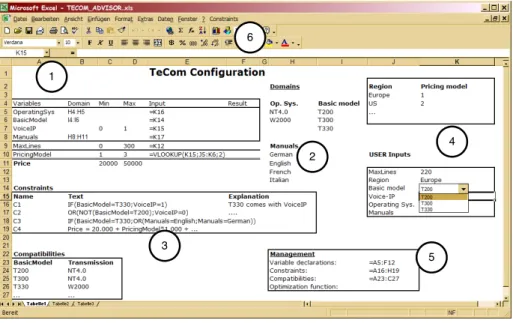
Figure 1: Application screenshot for telecommunication switch configuration
2 Application domain / Example problem
Product configuration deals with tailoring a configurable arti-fact (product or service) according to specific customer needs. The market demand for such systems is driven by the business model ofmass customization[10] : nowadays, the variety of customizable goods and services ranges from personal com-puters, cars, or clothing to complex technical systems like, e.g., telecommunication switches [5].
The result of an interactive configuration process is a customer-specific variant of the product, whereby this prod-uct constellation conforms all given business rules or technical constraints and is good or optimal with respect to some objec-tive function. Starting from rule-based systems in the early eighties, over the last decades several AI-techniques have been successfully applied to configuration problems [15]. In particular, Constraint Satisfaction techniques [16] have shown to be specifically suited for these problems in real-world set-tings due to the simple, declarative knowledge representation paradigm and the efficient solving algorithms that are avail-able. Informally speaking, a Constraint Satisfaction Prob-lem (CSP) consists of a set of probProb-lem variables, each one assigned a finite domain of atomic values, and a set of con-straints describing legal combinations of value assignments to the variables. A solution to a CSP is a value assignment to each problem variable such that no constraint is violated.
Let us consider a small example that shows the correspon-dence of CSPs to configuration problems. We chose a simpli-fied example from the domain of sales configuration of pri-vate telecommunication switches that we also addressed in the CAWICOMS3project. In this business scenario, the sales
engineer together with the customer tailor the telecommuni-cation switch by selecting values from a set of features like
maximum number of subscriber lines or Voice-over-IP sup-port.
3see www.cawicoms.org for reference
In the CSP representation, the variables with their domains correspond to the different options, e.g.,
The example constraints in our example are:
The T300 is always delivered with voiceIP option. No voiceIP available for the T200 model.
Manuals for T330 are English and German only.
Let us further assume that the price is determined by some function based on the individual user choices and other pric-ing rules. Amongst others, the key requirements of an actual implementation are typically as follows:
the user should not be forced to specify values for all choices, i.e., the system should be able to compute fitting values,
the system should give immediate feedback on incompat-ible choices or remove choices that are no longer avail-able due to prior selections,
the system should be able to compute a good/optimal so-lution with respect to some objective function.
The mapping of this simplified application problem to a CSP is quite straightforward. However, due to the shortcom-ings of currently available systems like notation or integration into standard software environments, the development of such an application typically requires significant coding efforts and highly-specialized development staff. Moreover, the transfor-mation of the domain knowledge to the expert system’s repre-sentation requires a possibly error-prone knowledge engineer-ing process.
In order to overcome these problems, we developed the CSSOLVER system as an extension to standard spreadsheets
environments; the major design goals were to fit our exten-sions to the interaction and development paradigm for spread-sheets as much as possible while hiding the technical details of the underlying reasoning process. Figure 1 shows, how the example problem described above can be solved using our system.
In the first step (1 - see Figure 1) the user defines the named problem variables with their domain. This domain can either be an integer interval or an enumeration of symbolic values in a specified area (2). In addition, the developer can specify what the (user) inputs for the problem variables are, by refer-encing to other parts of the spreadsheet (4). Note that all the standard functionality of the spreadsheet system can be used for computing the input from e.g., some static data from the application domain. In our case, for instance, the input for the field ”pricing model” is computed by looking up the pricing model in (4) that corresponds to the user input from K13 (the customer’s geographic location). The placement and layout of the fields for the user input can be arbitrarily chosen by the developer; in our case we use a listbox control for selecting the type of the basic model. In addition - with modern spread-sheet environments - it is also possible to integrate external data sources smoothly into the application, for instance via an ODBC (Open Database Connectivity) interface. This is a key requirement in our application domain of product configura-tion where product data is already stored in an e.g., underlying Enterprise Resource Planning system and should not be stored redundantly; moreover the results of the configuration process have to be transferred back to this system for order generation and invocation of other business processes.
In the next step (3) the developer defines the problem con-straints: This can be done in two ways. In many domains, compatible value tuples for individual variables are naturally given in compatibility tables, i.e., the constraint is defined in
explicitform by enumerating all allowed constellations. As a second choice, the user can state the constraints by using a constraint language having the same syntax as the stan-dard ”language” in our spreadsheet environment. For exam-ple, a conditional statement of type
is expressed in Microsoft Excel as IF(cond;val1;val2). Currently our constraint lan-guage supports standard arithmetic, relational, and logic
oper-ators for integer
vari-ables (no floating point arithmetic). In addition, some con-straints that can typically be found in Constraint Satisfaction problems likeAllDifferent - meaning that all variables of a given set of variables must take a different value - where in-troduced although there is no direct correspondence to a sim-ilar standard spreadsheet function. Note that the developer of the spreadsheet application has to be aware of the fact that formulated restrictions aredeclarativeconstraints rather than
functions, which he can use in ordinary spreadsheet applica-tions.
Note that the developer states the constraints as plain text which is then parsed online, immediately translated into the internal representation of the underlying constraint solver, and dynamically added to the problem space. The individual con-straints can be annotated with a name and an explanatory text. The constraint name and the parse errors are prompted in cases where the constraint parser detects syntactic or se-mantic errors, e.g., a reference to an undefined variable name
or a type error. The explanatory text will be used if - dur-ing the propagation process of the user inputs - the solver de-tects a constraint violation. In these cases, the user will be prompted the information which of his/her selections caused a constraint violation and which value selections have to be undone or changed. Note however that the frequency of such situations is small because the underlying constraint propaga-tor is capable of inferring the set of still consistent (allowed) values for the remaining variables after each user input imme-diately.
All the information of the constraint problem is simply en-tered at arbitrary places in the spreadsheet application4. In a Managementarea (5) we define which areas contain the actual constraint satisfaction problem which allows us to arbitrarily design the layout of the application.
The standard spreadsheet environment is extended with a menu (6) that allows the developer to a) define the location of theManagementarea and b) initiate the search or optimization process. If the constraint solver finds a consistent assignment the result is displayed in the output area of (1). In the exam-ple from Figure 1, the solver can derive fitting values for the operating system, the basic model and so forth. These com-puted values can then be referenced from within other parts of the spreadsheet application. During the interaction process where the user sequentially enters the input values, the solver can immediately propagate the effects of the new input and remove inconsistent values from the domains of the remain-ing problem variables. At any stage, the user can initiate the search process such that the constraint engine computes con-sistent values for the remaining problem variables where no user input was given. As a net result for the developer the trial and error interactive development style of spreadsheet appli-cations without (lengthy) compilation, test, and debug runs is preserved. On the other hand when using the application -high interactivity with immediate feedback is possible such that the user of the system can explore different solution vari-ants and scenarios.
3 The C
SSOLVERsystem
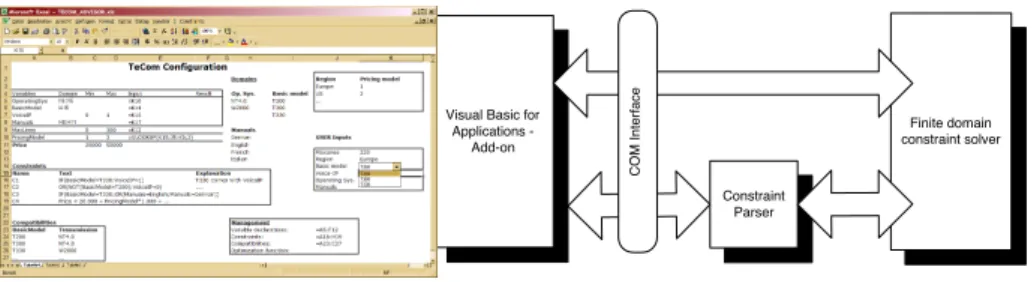
Architecture of the CSSOLVER system: In Figure 2,
we sketch the different components that make up the CSSOLVER system. The core of the system is formed by a
small object-oriented finite-domain constraint solving library that is built in the tradition of the first approach from [11] that combines Constraint Programming and Object-Orientation using C++, i.e., variables, constraints as well as search goals are classes of the framework. The main advantages of such an approach that can also be found in commercial constraint solvers like ILOG Solver5are twofold: First, constraint solv-ing functionality can be easily incorporated in an (object-oriented) application without needing a bridge to some e.g., Logic Programming environment. Second, the inherent ex-tensibility of object-oriented systems can be exploited: The components of the framework can be subclassed for the given application domain, e.g., by introducing a specific type of constraint or new search heuristics. The library implements
4Typically, the constraint problem is only a part of a larger
appli-cation that e.g., includes reports or diagrams.
Visual Basic for Applications - Add-on Constraint Parser Finite domain constraint solver COM Interface
Figure 2: Architecture overview. a forward-checking and backtracking search algorithm and
a variant of the AC-3 [16] algorithm for maintaining arc-consistency and reducing the search space.
The library was developed inC#, a programming language from Microsoft’s.Net Framework6. C# is an object-oriented
language that is syntactically and semantically similar toJava
and introduces only a few novel language concepts. The most interesting feature from our perspective is interoperability between applications written in different programming lan-guages which is made possible by compilation of the source code to an intermediate language. Consequently the devel-oped constraint library can be easily included in other appli-cations, which is a key requirement for broad acceptance of knowledge-based systems in industrial environments. Within the CSSOLVERsystem, communication between the
spread-sheet environment and the core solver is based on a COM
(Component Object Model) interface. While the standard be-havior of the solver that can be accessed via the spreadsheet interface is limited in order to preserve simplicity, the solver’s API allows programmers to access the full functionality of the underlying solver engine; thus, specific search heuristics or complex functions can be incorporated by the library de-velopers.
The other components of the CSSOLVER system are a
small add-on program written in the scripting language of the spreadsheet environment that catches the events triggered by the user (e.g., definition of variables or initiation of the search process) and appropriately forwards data to the back-end con-straint solver. When the user defines his/her concon-straint prob-lem using the spreadsheet interface, the application-dependent constraints have to be transformed to the internal representa-tion of the solver which is accomplished by a compiler that parses the expressions and issues calls to the solver library accordingly.
Constraint Satisfaction and Object Orientation:In [11], a C++ library (ILOG Solver) was presented that for the first time combined object-oriented programming with concepts from Constraint Programming [16] like variables, constraints and backtracking search. Later on also other systems like CHIP7, that were originally based on Prolog, were available
as libraries for imperative languages (C and C++). For the CSSOLVERsystem we adopted a similar approach using the
language, whereby at the moment only a subset of the functionality of commercial software packages is available, e.g., no floating-point arithmetic.
6http://www.microsoft.com/net 7see http://www.cosytec.fr
A fragment of how to use the constraint library is sketched below:
1: CsSolver s = new CsSolver(); 2: CsVar a = s.createIntVar(0,3,"a"); 3: CsVar b = s.createIntVar(0,3,"b"); 4: s.addConstraint(a != b); 5: s.addGoal(new CsInstantiate(s,a)); 6: s.addGoal(new CsInstantiate(s,b)); 7: if (s.solve()) 8: Console.WriteLine("Found Solution"); After initialization of a new solver object that manages the constraint networks (1) two constrained variables with a fi-nite domain [0..3] are declared. In line (4) a constraint is de-clared that in a consistent solution these two variables must have a different value. Note that we can utilize theoperator overloadingfeature of the language such that an intuitive representation of the constraints is possible. In the following lines, the search goals (instantiation of variables) are declared and finally the solution search is initiated.
The important benefits of such an implementation are as follows (see also [11]): Since all the CSP related concepts are implemented as classes, the framework is intrinsically exten-sible for specific application domains that require e.g., special sorts of constraints, heuristics, or actions to be taken during the search process. For these cases, the particular behaviour for the application domain can be implemented by subclass-ing the framework’s classes. On the other hand, the classes of the framework can certainly be members of other application-specific classes such that the constraint variables are instanti-ated for each application specific object.
3.1
Comparison with other tools
The business scenarios addressed with the CSSOLVERsystem
comprise e.g., on-site sales configuration and quotation, i.e., the users of the spreadsheet application are sales representa-tives that - possibly together with a customer - interactively tailor the solution to the customer’s needs. Our experiences show that for these cases, companies tend to equip their sales representatives with sales force automation tools that are de-veloped for the given application domain. These tools are typically implemented by incorporating an intelligent reason-ing system like a rule engine, a Logic Programmreason-ing environ-ment, or a constraint reasoner. Within rule-based systems, the knowledge is encoded in terms ofif-thenrules which are on the one hand easy to understand for non-programmers (in cases where there is an intuitive notation) but on the other hand have shown to cause severe maintenance problems [1]. Moreover, these systems are limited in their expressiveness,
optimization is only based on heuristics, and they are limited with regard to explanation both in cases where no solution can be found as well as in cases where the customer wants to know the reasons why the system came up with a partic-ular solution. Logic Programming systems like 8
of-fer a complete programming environment including constraint solving capabilities; constraint-based optimization tools like ILOG Solver provide a whole suite of different algorithms for complex, large-scale optimization problems. In principle, the latter two classes of systems can theoretically be used as a back-end for our CSSOLVERenvironment. However, when
us-ing Logic Programmus-ing environments, specialized program-ming staff and skilled knowledge engineers are required; in addition, the user interface is typically developed using a tra-ditional programming language which can lead to integration problems if there are several development teams involved. On the other hand, commercial optimization tools are in many cases heavy-weight libraries that exceed the functionality that is required in our targeted application domains. Finally, given the small fraction of utilized functionality, the typically high license costs for these advanced systems may also hamper the wide-spread application of these systems.
In many cases we encountered limited acceptance for these sales-force automation tools by the sales personnel because of proprietary user interfaces: The terminology used in the in-terface is related to the underlying reasoning technology and therefore not understandable for the domain expert. In addi-tion the problem solving process in many cases requires com-plex interactions where the user has to jump back and forward through different input screens. In fact, we encountered cases where the sales personnel did not use the provided sales-force automation tools but rather built small stand-alone systems based on spreadsheets by themselves. Note again, that we see our approach as a light-weight means for feature-based sales configuration and quotation for domains where we do not deal with configurable sub-components or connections be-tween components.
Another method of solving optimization problems which is supported by spreadsheet tools like Microsoft Excel are Op-erations Researchtechniques like linear optimization. In fact there are many problems that can be more efficiently modeled and solved using different variants of classical mathematical algorithms like the Simplex method9.
A combination of Interval Analysis and Interval Constraint Solving was the basis of [7], a spread-sheet extension that allowed the user to take uncertainties of values into account by using intervals instead of concrete val-ues. Beside introducing new problem solving methods for spreadsheet programs one of their main design goals was the smooth integration of the new functionality into the standard spreadsheet interaction paradigm.
We see our work as complementary as these methods re-quire a certain amount of mathematical background knowl-edge from the users that model the problem. The Constraint Satisfaction approach has its advantages as it relies on a very simple basic model and the relations among the variables can
8http://www.icparc.ic.ac.uk/eclipse.
9More powerful optimization algorithms are implemented in
the commercial Excel add-ons from e.g., Frontline Systems (www.solver.com)
be intuitively modeled using a constraint language. While mathematical methods in many cases are able to compute
oneoptimal solution, the search method used in our approach gives the user the possibility to compute multiple alternative solutions for cases where the optimization criterion cannot be expressed as purely mathematical function as the (more or less vague) user preferences have to be taken into account. Finally, the AI-based CSP approach enables the system to generate explanations, why a certain solution was found or no solution was found, which is an important factor in interactive appli-cations.
4 Related work
In [12], Renschler describes a practical application for the configuration of radio base stations using a spreadsheet-like interface. From the end user’s perspective, this approach is similar to ours regarding the application domain of product configuration: the end user can interactively select the de-sired features and gets immediate feedback on incompatible choices whereby this computation is based on the integration of an underlyingConstraint Logic Programmingenvironment and a finite domain constraint solver. There are, however, sev-eral important differences when we compare their work with ours: First, although the interaction style is called ”Configu-ration spreadsheet”, in our opinion, the actual implementation resembles the main characteristics of spreadsheet only in the sense that the user interface elements are arranged in tabu-lar form, no hard-coded sequence of interaction is required, and immediate feedback is given. The user of the system can not, however, insert any formulae or use additional input or output fields. Moreover, the user interface is extended with domain and search-specific input controls which are unknown in standard spreadsheet applications and therefore require a certain amount of knowledge on the reasoning mechanism by the system’s user. Their approach addresses the aforemen-tioned paradigm mismatch of easy-to-use spreadsheets and constraint programming only from the end user’s perspective (using the spreadsheet as mere frontend) but does not solve the problem of program development for the knowledge base. TheKnowledgesheetapproach presented in [6] is the most similar work compared with our CSSOLVERsystem: it relies
on an extension of the function-based spreadsheet paradigm with predicates or constraints that are evaluated by an un-derlying Constraint Programming system. Likewise, with their system, a certain class of constraint problems can be modeled and solved requiring only a limited knowledge of declarative constraint programming concepts like variables or constraints. The main difference compared to our ap-proach is the integration aspect into state-of-the-art spread-sheet environments: while their approach was validated by building a Java-based prototype that interacts with a fully-fledged Constraint Logic Programming (CLP) environment (Eclipse), the CSSOLVERsystem is completely integrated into
the widespread Microsoft Excel spreadsheet environment and only requires a light-weight object-oriented constraint solver. Finally, the constraint language in Knowledgesheet follows the notation of the underlying CLP system, whereas we wanted to have a notation for constraints that is as similar as possible to the ordinary spreadsheet functions in the spread-sheet environment. In our opinion, this basically syntactical
difference is an important one because in typical applications, the search/optimization problem is always part of a larger (spreadsheet) problem where the standard spreadsheet func-tionality will be utilized (which is not supported in Knowl-edgesheet).
An even earlier approach to combine the power of interactive software development with spreadsheets and Logic Programming is described in [14]: Based on the idea of Programming-by-Example, the authors propose a spreadsheetlike programming environment (PERPLEX -System) for end users of logic programs. The tabular rep-resentation is used to overcome the usability limitations of classical line-oriented interfaces to logic programs: Using a spreadsheet interface, the end-user of the logic program can both incrementally extend the program by posting additional predicates as well as query the contents which are then dis-played in tabular form. Compared with our approach, their work only uses the spreadsheet as extended interface for a given logic program, the program itself (i.e., the rules and facts) is still encoded in some logic programming language, like Prolog.
Despite their wide-spread use in various application do-mains, e.g., Management Information or Decision Support, many facets of spreadsheet programs and spreadsheet devel-opment are still unexplored. The main research efforts in that direction aim at applying established software engineering practices to the spreadsheet development, see e.g., [8] or [13]. The significant demand for adequate development support is driven by the fact that most spreadsheet programs are devel-oped by people who are not IT-professionals, which results is error-prone systems and severe maintenance problems. Com-plementary, current research efforts exist, that try to apply the intuitive spreadsheet interaction paradigm for general soft-ware development based on Visual Programming, see, e.g., [2].
5 Conclusions and future work
Our first experiences with the developed CSSOLVER
frame-work showed the applicability of the approach for a wider range of search and optimization problems that can be mod-eled as Constraint Satisfaction Problems like product config-uration or time-tabling. The first feedback received from po-tential end-users of the spreadsheet interface for modeling and solving such problems shows that only a small amount of ad-ditional background on Constraint Satisfaction concepts have to be learned in order to be able to design and use the system. Our future work will be focused on improving the under-standability of the reasoning process for the end-user. This includes both explanation of a solution or explanation of a failure [9] and repair support [4].
References
[1] V.E. Barker, D.E. O’Connor, J.D. Bachant, and E. Soloway. Expert systems for configuration at Digi-tal: XCON and beyond. Communications of the ACM, 32, 3:298–318, 1989.
[2] M. Burnett, J. Atwood, R. W. Djang, J. Reichwein, H. Gottfried, and S. Yang. Forms/3: A first-order vi-sual language to explore the boundaries of the
spread-sheet paradigm. Journal of Functional Programming, 11(2):155–206, 2001.
[3] A. Felfernig, G. Friedrich, and D. Jannach. UML as domain specific language for the construction of knowledge-based configuration systems. International Journal of Software Engineering and Knowledge Engi-neering (IJSEKE), 10(4):449–469, 2000.
[4] A. Felfernig, G. Friedrich, D. Jannach, and M. Stumpt-ner. Consistency-based diagnosis of configurator knowl-edge bases. In European Conference on Artificial Intelligence (ECAI2000), Berlin, Germany, 2000. IOS Press.
[5] G. Fleischanderl, G. Friedrich, A. Haselb¨ock, H. Schreiner, and M. Stumptner. Configuring Large Systems Using Generative Constraint Satisfaction. In B. Faltings and E. Freuder, editors, IEEE Intelligent Systems, Special Issue on Configuration, volume 13,4, pages 59–68. IEEE, 1998.
[6] G. Gupta and S.H. Akhter. Knowledgesheet: A graphi-cal spreadsheet interface for interactively developing a class of constraint programs. In Practical Aspects of Declarative Languages, Lecture Notes in Computer Sci-ence 1753, pages 308–323. Springer Verlag, 2000. [7] De Pascale S. Hyv¨onen, E. A new basis for spreadsheet
computing: Interval solver for microsoft excel. In Pro-ceedings of AAAI-99/IAAI-99, Orlando, Fl., 1999. AAAI.
[8] T. Isakowitz, S. Schocken, and H. C. Jr. Lucas. Toward a logical/physical theory of spreadsheet modeling.ACM Transactions on Information Systems, 13(1):1–37, 1995. [9] U. Junker. Quickxplain: Conflict detection for arbi-trary constraint propagation algorithms. In IJCAI’01 Workshop on Modelling and Solving problems with con-straints, Seattle, WA, 2001.
[10] B.J. Pine, S. Davis, and B.J. Pine II.Mass Customization : The New Frontier in Business Competition. Harvard Business School Press, 1999.
[11] J. F. Puget. A C++ implementation ofCLP. In Proceed-ings of the Second Singapore International Conference on Intelligent Systems, Singapore, 1994.
[12] A. Renschler. Configuration spreadsheet for interactive constraint problem solving. InPractical Applications of Constraint Technology, PACT98, 1998.
[13] B. Ronen, M. A. Palley, and Henry C. Luca. Spread-sheet analysis and design.Communications of the ACM, 32(1):84–93, 1989.
[14] M. Spenke and C. Beilken. A spreadsheet interface for logic programming. InProc. Computer-Human Interac-tion, CHI98, 1998.
[15] M. Stumptner. An overview of knowledge-based config-uration. AI Communications, 10(2), June, 1997. [16] E. Tsang. Foundations of Constraint Satisfaction.