INDUCTIVELY COUPLED PLASMA MASS SPECTROMETRY
FOR THE DETERMINATION OF
237Np IN SPENT NUCLEAR
FUEL SAMPLES BY ISOTOPE DILUTION METHOD USING
239
Np AS A SPIKE
KIHSOO JOE*, SUN-HO HAN, BYUNG-CHUL SONG, CHANG-HEON LEE, YEONG-KEONG HA, and KYUSEOK SONG
Korea Atomic Energy Research Institute 150 Duckjindong Yusung, Daejeon, Korea 305-353
*Corresponding author. E-mail : [email protected]
Received August 27, 2012
Accepted for Publication February 01, 2013
1. INTRODUCTION
Transuranic elements, such as Np, Pu, Am, and Cm, in spent nuclear fuel are important for fuel characterization [1,2], burnup credit [3,4,5,6], and the management of radi-oactive wastes [7] and are used for code validation through which the amount of nuclides produced or decayed during neutron irradiation is predicted. For the determination of 237Np in spent nuclear fuel samples, the selection of an appropriate tracer is required depending on the detection technique, such as alpha spectrometry or mass spectrometry, as 237Np has a very low specific activity owing to its long half life (2.14x10⁶y), which controls the sample amounts according to the detection method and the type of tracer. Generally, the determination of 237Np in environmental samples has been performed by alpha spectrometry, induc-tively coupled plasma mass spectrometry (ICP-MS), thermal ionization mass spectrometry, and neutron activation gamma spectrometry using 235Np (t1/2=396.1d, α) [8], 236Np (t1/2= 5000y, β) [9, 10] and 239Np (t1/2=2.35d, β, γ) [11] as tracers. The method used for environmental samples is relatively simple compared to that used for radioactive
materials, especially spent nuclear fuel samples. The spent fuel includes many radio-nuclides, which require cumber-some sample pretreatments, and an individual separation should be performed prior to the measurement, especially for alpha-emitting nuclides. For the spent fuel samples, the tracers 235Np and 236Np can also be used even though a small amount of these nuclides, equivalent to about 0.01% of 237Np as an activity base, is already contained in the spent fuels with a burnup of 50 GWd/MtU and 5 years of cooling time. However, they have some limitations in their use since they are not available in our laboratory. 239Np cannot be used as a tracer since a considerable amount of 239Np as an activity base is already included in the spent fuel itself. In this case, another method should be used as an alternative. Thus, an isotope dilution method for the determination of 237Np in a spent fuel sample using 239Np as a spike was previously developed in our laboratory, in which 237Np was detected by alpha spectrometry and 239Np by gamma spectrometry [12,13]. However, this method has a weak point showing a high measurement uncertainty owing to too low an alpha specific activity of 237Np and a A determination method for 237Np in spent nuclear fuel samples was developed using an isotope dilution method with 239Np as a spike. In this method, inductively coupled plasma mass spectrometry (ICP-MS) was taken for the 237Np instead of the previously used alpha spectrometry. 237Np and 239Np were measured by ICP-MS and gamma spectrometry, respectively. The recovery yield of 237Np in synthetic samples was 95.9±9.7% (1S, n=4). The 237Np contents in the spent fuel samples were 0.15, 0.25, and 1.06 µg/mgU and these values were compared with those from ORIGEN-2 code. A fairly good agreement between the measurements (m) and calculations (c) was obtained, giving ratios (m/c) of 0.93, 1.12 and 1.25 for the three PWR spent fuel samples with burnups of 16.7, 19.0, and 55.9 GWd/MtU, respectively.
high gamma specific activity of 239Np for a given sample
amount, which causes too low an activity ratio of 237Np/ 239Np. This ratio is used as one of the terms in the equation
related to the isotope dilution method.
In this work, inductively coupled plasma mass spec-trometry (ICP-MS) was taken for the measurement of 237Np
instead of alpha spetrometry to reduce measurement errors caused by the too low alpha activity of 237Np because
ICP-MS has a higher sensitivity, lower measurement uncertainty, and more convenience in measurement compared to alpha spectrometry. This method was applied to PWR spent fuel samples and the 237Np contents were determined. The
measured values were compared with the values calculated using the ORIGEN-2 code [14].
2. EXPERIMENTS
2.1 Reagent and Apparatus
The standard solution of 243Am (North America
Scien-tific Inc) was used for 239Np as a spike as 243Am enters a
radioequilibrium state with 239Np after a certain time
dep-ending on the half lives of the two nuclides. The standard solution of 237Np for ICP-MS was obtained from the Damri
company of France (CEA). An anion exchanger (AGMP-1 x 8, (AGMP-100-200 mesh size) was obtained from Bio-Rad Laboratories, USA. A disposable polyethylene column filled with an anion exchanger (7 mm id x 70 mm h) was used. Inorganic acids such as hydrochloric acid and nitric acid used for the sample treatments were the products of an extra pure grade from the Junsei Company, Japan and GR from Merck Company, Germany, respectively. Hydroxylamine-hydrochloride and hydriodic acid used for the reduction of Pu and Np, and elution of Pu, respectively, were of GR grade from Merck Company. Radiation shielded inductively coupled plasma atomic emission spectroscopy (ICP-AES), used for the determination of uranium in the sample solu-tions, was an IRIS-HS model from Thermo Jarrell Ash, USA. The inductively coupled plasma mass spectrometer (ICP-MS) used for the determination of 237Np was a Finnigan
Mat, Element model from Finnigan, Germany. 2.2 Sample Preparations
Three PWR spent fuel samples with burnups of 16.7-55.9 GWd/MtU were taken from a nuclear power plant in Korea (Table 1). The initial concentration of 235U was
4.51wt% and the cooling time for the spent fuel samples was 3.2 years. A small piece of each specimen (~ 0.5g) was dissolved in (1+1) nitric acid under a reflux condenser in a chemical hot cell. A mother solution was diluted to ~ 0.2
µgU/mL, and an appropriate amount of the diluted solution
was sent to a glove box using a pneumatic transfer. The uranium content in the diluted solutions was determined by a radiation-shielded ICP-AES followed by a neptunium separation.
2.3 Separation and Measurements
Two appropriate amounts of diluted sample solutions, equivalent to ~10 µgU each, were taken as the "sample" and "spiked sample." The solution for the "spiked sample" was spiked with 30 Bq of 239Np (243Am). The two sample
solutions were treated with HNO3and HCl on a hot plate
two or three times repeatedly. The residue was dissolved by 3 mL of 0.05 M NH2OH.HCl-0.1M HCl and left
over-night to obtain Pu(III) and Np(IV). Finally, prior to the separation, the sample solutions were made in a medium of 9M HCl-0.1M HNO3. In this step, Pu(III) is oxidized
to Pu(IV). Two anion exchange columns were prepared for the "sample" and "spiked sample." The treated sample solutions were loaded onto each column. The following steps were conducted according to the procedure shown in Fig. 1 [15]. The Np fraction was collected by an elution of 12 mL of 4 M HCl after the elution of Pu with 12 mL of 9 M HCl-0.1 M HI. The collected fraction of Np was evaporated on a hot plate, and the medium was changed into nitrate form using c-HNO3. The gamma activities of 239Np
were measured as soon as possible after separation, and the 237Np amounts were measured by ICP-MS. Finally, the 237Np contents in the sample solutions were obtained through
an isotope dilution equation using the ratios of 237Np/239Np
in the “sample” and “spiked sample,” respectively.
3. RESULT AND DISCUSSION 3.1 Method Validation
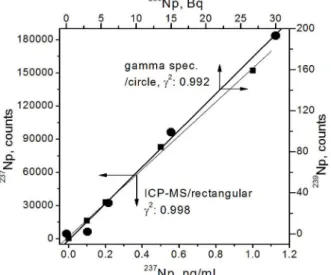
First, two calibration curves for 239Np and 237Np were
obtained through gamma spectrometry and ICP-MS spec-trometry, respectively. The gamma activities of 239Np were
measured at 277.86 KeV for 3, 6, 15, and 30 Bq for 5000 sec. The gamma spectrum of 239Np has a number of peaks
at energies of around 90 to 300 KeV, as shown in Fig. 2. In this study, the peak at 277.86 KeV was selected for measurements because this peak has the highest energy and a relatively high branching ratio (14.1%). The peaks at about 100 KeV with high peak intensities were not taken owing to a high background effect. The calibration curve showed a good linearity (γ2=0.992) as shown in Fig. 3.
However, it revealed a limitation for an amount of less than 5 Bq of 239Np, which showed a relatively higher
meas-urement uncertainty (RSD>15%). For the 237Np by ICP-Samples GWd/MtU 235wt%Uini. Irradi.,day Cooling,y Fuel soln
µg/g-soln SF1 SF2 SF3 16.7 19.0 55.9 4.51 4.51 4.51 1425 1425 1425 3.2 3.2 3.2 216.0 259.7 236.1
MS, the calibration curve also expressed a good linearity (γ2=0.998) within a range of 0.1 to 1 µg/mL (Fig. 3). The
recovery yields for 237Np were measured from a synthetic
sample including 10 ng of 237Np and 30 Bq of 239Np. In
this experiment, 30 Bq of 239Np was additionally added as
a spike. The recovery yield for 237Np from the synthetic
sample was 95.9±9.7% (Table 2), which was obtained from the data of 237Np and 239Np using equation (1) after Fig. 1. Separation of Actinides from Fission Products.
the measurements by ICP-MS and gamma spectrometry, respectively. The gamma activity of 239Np was measured
within as short a time as possible (<5-8h) after separation from243Am owing to its short half life (t
1/2=2.35d). Thus,
decay corrections were made for the time interval between the end of the separation and the start of the measurement, and during the measurement time using equations (2) and (3), respectively. Finally, the measured activity (Bq) of 239Np
was converted into weight (ng) using a specific activity of 239Np (1.27x10⁻⁷ ng/Bq).
where Cxis the concentration of 237Np in the sample
solu-tion, Ctis the concentration of 239Np in the spike solution, mxis the sample weight, mtis the weight of the spike solu-tion added, Mx is the average molecular weight of Np in the mixture of the sample and spike solution, Mt is the average molecular weight of Np in the spike solution,Rt
is the ratio of 237Np/239Np in the spike solution, Rmis the
ratio of 237Np/239Np in the mixture,Rxis 237Np/239Np in the
sample solution, ΣxRi is (237N/239Np+239Np/239Np) in the
sample solution, and ΣtRiis (237Np/239N+239Np/239Np) in the
spike solution. In addition, f1, f2are the correction factors for the decay times from the end of the separation to the beginning of the measurement, and during the measurement time, respectively. Also, λAis a decay constant (0.693/t1/2)
of the analyte, tSis the start time for the measurement, tE is the end time of the separation, and tGis the total meas-urement time.
3.2 Determination of 237
Np in the Spent Fuel Samples The contents of 237Np in the spent fuel samples were
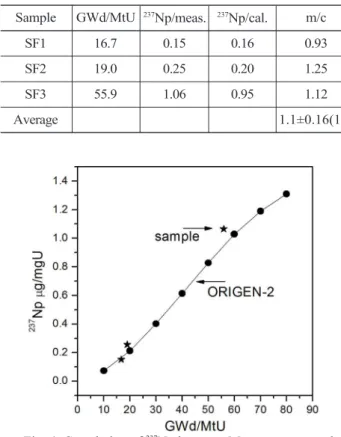
determined using an isotope dilution method, as mentioned above. The measured values of 237Np were 0.15, 0.25, and
1.06 µg/mgU for SF1, SF2 and SF3, respectively (Table 3)
and were compared with those predicted by a calculation using the ORIGEN-2 code. The measurement values (m) agreed with the calculation values (c) as a ratio (m/c) of 0.93, 1.12, and 1.25, respectively, within about 10% difference on average. Fig. 4 shows a correlation curve between the measurement and the calculation as a function of burnup. In the literature reporting 237Np content in spent
nuclear fuels, the measurement values of 237Np obtained
from the PWR spent fuel from the Takahama-3 reactor were found to be in good agreement to within 4% difference at a high burnup (30-47.25 GWd/MtU) and showed a range of 34.2-71.8% of differences at a low burnup (7- 28.9 GWd /MtU) compared to the calculated values [16]. The contents of 237Np in the MOX fuel irradiated up to 120 GWd/MtU
in the Mark-II reactor of JOYO in Japan were greatly biased from the calculated values [17]. From these results a higher deviation of the measurement from the calculation was observed in low burnup and MOX fuel. This means
(1)
(2) (3)
Fig. 3. Calibration Curves for 237Np and 239Np. Rectangular: 237Np by ICP-MS, Circle: 239Np by Gamma Spectroscopy
Cat Added(ng) Found(ng) Recov.(%)
S1 S2 S3 S4 average * Sample: 237Np 10ng+239Np 30Bq, spike: 239Np 30Bq 10 10 10 10 10 9.1 8.7 9.7 10.9 9.6 95.9±9.7(1S)
Table 2.Recovery Yield of 237Np from the Synthetic Samples by
that the deviation increases as the content of 237Np goes
down and the fuel type is more complicated. In this work, the measurement values showed a fairly good agreement (~10% difference on average) with the calculated values compared to other works. However, it is difficult to find a correlation between the deviation and the fuel burnup owing to a lack of data.
4. CONCLUSION
In this work, ICP-MS was taken for the determination of 237Np in spent nuclear fuel samples instead of alpha
spectrometry in the previously developed isotope dilution method. Two calibration curves for 237Np and 239Np were
established by using ICP-MS and gamma spectrometry, respectively, for the verification of the measurement values. Finally, this method was applied to the three PWR spent nuclear fuel samples after a recovery yield test from the synthetic samples. The result showed that the measurement values agreed with the calculated values within an acceptable error range.
In the future, this method will be validated using the
237Np data obtained through other methods and will also be
used further to contribute to the buildup of 237Np database
in the spent nuclear fuels.
ACKNOWLEDEMENT
This work was supported by the National Research Foundation of Korea (NRF) grant funded by the Korea government.
REFERENCES_______________________________
[ 1 ] J. M. Barrero Moreno, M. Betti and J. I. Garcia Alonso, “Determination of Neptunium and plutonium in the presence of high concentration of uranium by ion chromatography-inductively coupled plasma mass spectrometry,” J. Analytical Atomic Spectrometry, 12, 355-361 (1997).
[ 2 ] J.I. Garcia Alonso, Fabrizio Sena, Philippe Arbore, Maria. Betti and Lothar Koch, “Determination of fission products and actinides in spent nuclear fuels by isotope dilution ion chromatography inductively coupled plasma mass spec-trometry.” J. Analytical Atomic Spectrometry, 10, 381-393 (1995),
[ 3 ] M. C. Brady, T. L. Sanders, “A validated Methodology for Evaluating Burnup Credit in Spent Fuel Cask,” CONF-910993-7, Oak Ridge National Laboratory (1991). [ 4 ] U.S. DOE, “Isotope validation for PWR actinide-only
burnup credit using Yankee Rowe Data,” DOE/RW/00134 -M97-020, U.S. DOE (1997).
[ 5 ] Meraj Rahimi, Dale Lancaster, Bernie Hoeffer and Marc Nicols, “Isotopic Biases for actinide-only burnup credit,” CONF-970607-8, Oak Ridge National Laboratory (1997). [ 6 ] Emilio Fuentes, Dale B. Lancaster and Meraj Rahimi,
“Actinide-only burnup credit for pressurized water reactor spent nuclear fuel-II: Validation,” Nuclear Technology, 125, 271-291 (1999).
[ 7 ] Nicolaou, G, “Provenance of unknown plutonium material”, J. Environmental Radioactivity, 99, 1708-1710(2008). [ 8 ] G. Rosner, R. Winkler, M. Yamamoto, “Simultaneous
radiochemical determination of 237Np and 239Np with 235Np
as a tracer, and application to environmental samples”, J. Radioanal. and Nucl. Chem., Articles, 173(2),273-281 (1993).
[ 9 ] Timothy C. Kenna, “Determination of plutonium isotopes and neptunium-237 in environmental samples by inductively coupled plasma mass spectrometry with total sample disso-lution”, J. Anal. At. Spectrom., 17, 1471-1479(2002). [ 10 ] T.M. Beasley, J.M. Kelley, T.C. Maiti and L.A. Bond,
“237Np/239Pu atom ratios in integrated global fallout: a
reassessment of the production of 237Np”, J. Environmental.
Radioactivity,38(2), 133-146(1998).
[ 11 ] St.N. Kalmykov, R.A. Aliev, D.Yu. Sapozhnikov, Yu. A. Sapozhnikov, A. M. Afinogenov, “Determination of Np-237 by radiochemical neutron activation analysis combined with extraction chromatography”, Applied Radiation and Isotopes, 60, 595-599(2004).
[ 12 ] Kihsoo Joe, Byung-Chul Song, Young-Bok Kim, Sun-Ho Han, Young-Shin Jeon, Euo-Chang Jung and Kwang-Yong Jee, "Determination of the transuranic elements inventory in high burnup PWR spent fuel samples by alpha spec-trometry", Nuclear Engineering and Technology,39(5), 673-682(2007).
[ 13 ] Kihsoo Joe, Byung-Chul Song, Bok Kim, Young-Shin Jeon, Sun-Ho Han, Euo-Chang Jung and Kyuseok Song, "Determination of the transuranic elements inventory in high burnup PWR spent fuel samples by alpha
spectrometry-Sample GWd/MtU 237Np/meas. 237Np/cal. m/c
SF1 SF2 SF3 Average 16.7 19.0 55.9 0.15 0.25 1.06 0.16 0.20 0.95 0.93 1.25 1.12 1.1±0.16(1S)
Table 3.The Contents of 237Np in Spent Fuel Samples (unit:
mg/mgU)
Fig. 4. Correlation of 237Np between Measurements and
Calculations in the Spent Fuel Samples. Star: Samples, Circle:S
II", Nuclear Engineering and Technology, 41(1), 99-106 (2009).
[ 14 ] Gauld, I.C., Herman, O.W., Westfall, R.M., “ORIGEN-S: Scale system module to calculate fuel depletion, actinide transmutation, fission product burnup and decay, and associated radiation source terms”, ORNL-TM-2005/39 Version 6, Oak Ridge National Laboratory (2009). [ 15 ] Takeo Adachi, Mamoru Ohnuki, Sen-ichi etc., “Dissolution
study of spent nuclear fuels,” JAERI-M91-010, p43 (1991).
[ 16 ] C. E. Sanders, I. C. Gauld, “Isotopic analysis of high-burnup PWR spent fuel samples from the Takahama-3 reactor”, NUREG/CR-6798, ORNL/TM-2001/259, (2003).
[ 17 ] Shin Ichi Koyama, Yuko Otsuka, Masahiko Osaka, Katsfumi Morozumi, Koichi Konno, Mikio Kajatani and, Toshiaki Mitsugashira, “Analysis of Minor Actinides in Mixed Oxide Fuel Irradiated in Fast Reactor, (I), Determination of Np-237”, J. Nuclear Science and Technology, Vol 3(6), 406-410(1998).