Contents lists available atScienceDirect
Operations Research Perspectives
journal homepage:www.elsevier.com/locate/orp
Lean implementation in small and medium enterprises: Literature review
Abdullah Alkhoraif
a,⁎, Hamad Rashid
b, Patrick McLaughlin
aaCranfield University, College Rd, Cranfield MK340AL, United Kingdom bUniversity of Sharjah
A R T I C L E I N F O Keywords:
Lean manufacturing Lean Implementation (LI)
Small and Medium Enterprise (SME's) Literature review
Organizational Culture (OC) Critical Successful Factors (CSFs)
A B S T R A C T
There have been many literature reviews carried out on Lean implementation (LI) in larger organisations with specific focus on the automobile industry. Lean implementation among Small and Medium Enterprises (SMEs) has not been so extensively researched. This paper attempts to bridge this gap by reviewing the literature that discussed Lean implementation in SMEs with a perspective of identifying the main challenges faced. We applied the Systematic Review Methodology proposed by Tranfield et al. (2003). This methodology allows for more comprehensive and profounder analysis along three stages: planning, conducting, and reporting. For this study, 403 papers were utilized, with their titles, abstracts and keywords separately studied at early stages of the review. These were collated from specific databases that included: ABI/INFORM Global, Taylor & Francis, Emerald, Sage, Inderscince, BSCO Business Source Premier, ScienceDirect and Scopus. The collected information was classified into four categories for more synthesis. The aim of this study is to establish the current position of global understanding of Lean implementation in SME's, including examining the main categories of Lean im-plementation in the context of SMEs. Next, an inclusive discussion of associated Critical Success Factors (CSFs) for Lean implementation within SME's is established that can be used as guide for SME's owners and managers. Suggestions for future research orientations are thus provided.
1. Introduction
These days, markets are characterised by strong competitive forces, honed over the years[180]. The competitive nature of organisations has been encouraged by macroforces influencing both supply and de-mand. Supply has been influenced by the rise in globalisation and the deregulation of trade, which has allowed companies to trade with greater ease on a global scale [70]. In addition, advancements and accessibility to technology have facilitated better supply abilities among companies[70]. Demand has been shaped by the increase in options available to customers, who now take time to determine the best value or product available when deciding to purchase an item[13]. Companies now need to realise that they must increase their competi-tive capabilities in order to trade profitably in the markets today. This consists of a recognition of what the customer considers of value combined with the most effective methods of operation and production in order to provide customers with what they want so as to generate profits for the company[20]. The“Lean” business ideology[14]is a business method that promotes efficiency and elimination of waste, while also focusing on a high level of awareness of what the customer wants[13,153]. Due to this ideology the method has been adopted by many companies so as to direct their outlooks and exertions to best
improve their operations. This shows how Lean is not limited to one type or size of company, but rather all types, sizes and industries that strive to increase their competitive advantages, operations and profits in the regional and global markets. This review explains how Lean manufacturing tactics should be altered to suit each individual com-pany, a belief encouraged by Cooney[33]who states the value of the universal business environments, the character of the buyer/supplier relationship and the construct of social and political establishments. The researcher will additionally discuss the significance of the business cycles that influence the individual functions in companies.
Zhou[197] would be considered the main researcher into SMEs adopting Lean methods. To date, the research has mainly focused on larger companies implementing it[40], in particular in the automobile industry. However, it should be acknowledged that SMEs can also take advantage of the Lean methodologies as long as they can successful adapt them to suit their individual situations. Any company, regardless of size, faces challenges and the Lean methods have proven themselves beneficial, especially in the manufacturing industry, over the years. This has been supported by the number of companies adopting the methods and the large number of studies carried out that have sup-ported its success in their results[80].
Companies come under one of two sizes: Large Enterprises (LEs);
https://doi.org/10.1016/j.orp.2018.100089
Received 12 July 2018; Received in revised form 10 November 2018; Accepted 5 December 2018 ⁎Corresponding author.
E-mail address:a.a.alkhoraif@cranfield.ac.uk(A. Alkhoraif).
Available online 07 December 2018
2214-7160/ © 2018 The Authors. Published by Elsevier Ltd. This is an open access article under the CC BY-NC-ND license (http://creativecommons.org/licenses/BY-NC-ND/4.0/).
and Small-Medium Enterprises (SMEs). It is noticeable that the level of integration of Lean manufacturing in SMEs is quite low[154]and that even knowledge of it is poor also[3]. Many reasons for this have been identified, some of which will be discussed later on in this review. Al-though there have been many studies based on the general im-plementation of Lean [73,78,121] the majority of the research has concentrated on large enterprises and has omitted SMEs ([23,57]). This discrepancy is significant and deserves rectification. Therefore, this study will complete a review on the Literature relevant to the im-plementation of Lean in SMEs and will attempt to identify the main issues and obstacles to this.
This study started by a preliminary limited-scale review of con-temporary literature in Lean implementation with a focus on SME's. This initial review comprised 25 papers that explored literature spanned through the previous 15 years in thefield. The purpose of the preliminary review was to establish researchable gaps that – when answered–can provide for better understanding of Lean implementa-tion within SME's. Simple template analysis approach was applied to basically identify these researchable gaps that are then presented in the following set of research questions that this review will aim to answer: Q1 What are the main categories (and their characteristics) that have been identified in research studies that addressed Lean in SMEs?
Q2 What are the inhibitors and enablers of Lean implementation in SMEs manufacturingfirms?
Q3 What are the most usual barriers and challenge facing lean im-plementation in manufacturing SMEs?
Q4 What is the impact of contemporary research studying lean im-plementation on practitioners within manufacturing SME's? Q5 What areas could be further researched on this topic that would benefit SMEs when implementing Lean?
This review aims to achieve a contribution of three folds:
•
To provide an all-inclusive categorized literature review on the implementation of Lean methods in SMEs which is currently lacking.•
To provide information, guidelines and suggestions regarding Leanimplementation for SME owners and managers.
•
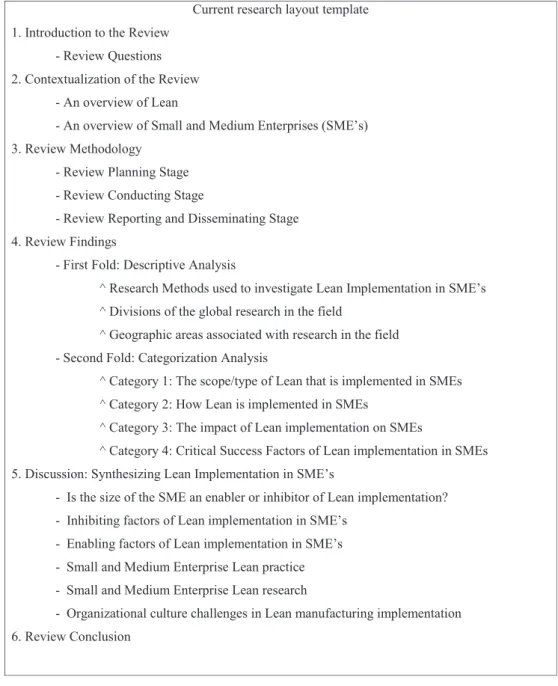
To suggest areas of further research for academia in the future. The current review will be presented via the following structure:2. Contextualization of this review
2.1. An overview of lean
Lean implementation refers to a company's management philosophy and a long-term strategy [107]. In summary, it can be described as ‘doing more with less’and, although this may seem a simplification, it sums up the Lean concept as a more efficient use of the resources available, when needed. Waste, both time and materials, is identified and removed so as to maintain quality while reducing manufacturing costs[153]. The successful implementation of Lean does not solely rely on the application of specific tools. There have been studies carried out that have identified several factors that can prove to be barriers to success. Bhasin[14]has identified several such barriers arising in both small and medium sized companies, as well as large companies, while Hancock and Zayko[69]have also recognised issues faced by manu-facturing companies while implementing Lean. On the other hand, successful implementation has several factors associated with it. Abernathy et al.[2]identified that Japanese automobile companies, for example, Toyota, have a high implementation success rate due to their tenacity in thorough planned management of employees, resources and equipment,”an observation agreed by Liker[108]. The researcher ex-plains that long-term planning and diligence is of more importance than
short-term gratification and that successful companies recognise this and plan accordingly. Dombrowski et al.[40]have identified several areas of activities that Lean consists of, including: continuous im-provement; workplace organisation; 5S; process standardisation; visual management; total quality management (TQM); total productive maintenance (TPM); just-in time (JIT); and production levelling (hei-junka).
The term“Lean”wasfirst used by Krafcik[94]in his thesis for the Massachusetts Institute of Technology and was used to describe the Toyota Production System (TPS)[153]. It was then referenced in two books, The Machine that Changed the World[189]and Lean Thinking [190], which lead to its mainstream introduction. Lean became a con-cept designed to describe the multiple activities carried out by Japanese companies that explained their heightened competitiveness advantages at that time. This was known as the“Japanese Way of Working” . Elements of the“Lean Idea”include: operations methods (such as zero inventories[68]; just-in-time (JIT)[89]and lots of small volumes[24]; the reinforcing of quality processes demonstrated by complete pro-ductive maintenance (TPM); and total quality management (TQM). Also included were empowered workers and employee contributions which questioned the bureaucratic top-down management structures and four function-orientated structures of organisation that had conventionally characterised many“western”companies[77].
This interpretation of Lean was validated by Shah and Ward[155] who organised the Lean factors into four‘bundles’: just-in-time bundle; total quality management bundle (TQM); total productive maintenance (TPM) bundle; and human resources management (HRM) bundle. To successfully implement these Lean factors in a company required a co-ordinated approach, steadfast management and a transparent align-ment with the company's structural plan. Taking these factors into ac-count, Lean would appear to be the opposite of the mass production method of manufacture, which is characterised by the competitive ad-vantage of economies of scale. This is a bulk cost adad-vantage considered to be advantageous, but in reality, creates substantial ineffectiveness between the functions. The Lean method opposes this as it makes companies and their supply chains concentrate on reducing waste– materials and time, and any activity that did not add value to the customers.
Some of the benefits of the Lean method include increasing a company's efficiency and effectiveness at an operations level. In addi-tion to the apparent benefits there are less obvious benefits of Lean implementation:
(1) Supply chain members incorporation–the members of a supply chain become co-dependent and so have a common goal to achieve Lean implementation. This is translated across the entire supply chain, typified by the Japanese Keiretsu supply networks[100]. These net-works are based on a foundation of trust and common goals and can increase capabilities across the whole supply chain network. This ex-plains how the development of inter-organisation links built to facilitate Lean implementation among companies leads to greater collaboration and strategic so-operation between the supply chain members. (2) Lean facilitates a high-speed of learning– Spear[162] explored that this advantage can be sustain. He clarified that by:
•
The problems Identified and corrected in fast way;•
Solving the problems in better way to structure new knowledge; and•
Sharing this knowledge more efficient across thefirm.As part of the Lean process, these cooperative and collaborative behaviours are developed, and these are then developed at an in-creasingly rapid rate, more so than companies who have not introduced the Lean method. There are obviously many direct and indirect ad-vantages to Lean but, in general, there is no single comprehensive de-finition for it. There have been many studies completed on the Lean method and many results reached. However, this has only led to several interpretations of what it actually is and what precise“characteristics
should be identified with the Lean concept”[13].
Pettersen[131]tried to summarise the Lean method by categorising it into four main approaches. He used the works of Hines et al.[73]and Shah and Ward[153]as his base and built on their proposals:
•
“Leanness”, an operational philosophy;•
“Lean thinking”, a strategic philosophy;•
“Tool box Lean”, an operational practice; and•
“Becoming Lean”, a strategic practice.This highlights the various types of Lean and warns researchers to consider the different categories as Lean refers to different things to different people. In general, however, there are some common features shared by all categories of Lean[153]:
•
To constantly look for and concentrate on those values important to customers;•
To align the function of the main and supporting processes with the delivery of these customer values;•
To make sure that the organisation as a whole is concentrating on supporting these processes so as to eliminate waste;•
To ceaselessly improve the fundamentals, for example, improving quality, capabilities, empowering individuals and teams and en-couraging affiliations between other companies;•
To promote and encourage a system-wide belief in constant im-provements.2.2. An overview of SMEs
Organizations such as SMEs are enormous role and function in sector of manufacturing for around the world in term of production employment generation. In addition, Emerging technologies and glo-balization have a massive impact on SMEs. SMEs firms are trying roughly to apply a new methodologies /approaches /principle like Lean to fulfil continues performance. Unluckily, for the concept of adopting Lean Manufacturing has not been applied by a large number of Small and Medium Enterprises (SMEs) regarding to the fright to time, cost and posterior advantages. Authors explored Critical Successful Factors (CSFs) of Lean implementation within SMEs include: organization cul-ture,finance position, expertise and skill, performance of evaluation system, and leadership style and management[3,133]. Panizzolo et al. [129] proposed that Lean manufacturing permeation in Indian SMEs and explored that organizational culture, vision and the strategy drives substantial improvement in the organization performance, most of the failure for implementing Lean in SMEs are: using wrong tool, using one tool to solve the problems, misunderstanding the situation, badly de-cision-making process, poor of external support such as customers, government, suppliers, organizational culture (wrong strategy and vi-sion) and wrong consultants will collapse the implementation of Lean in SMEs to be successful [145]. In contrast, LEs are more successful to implement Lean Manufacturing usage than SMEs ([109];[183];[155]). However,firms were using Lean tools such as 5S, JIT, TQM, etc., ob-served considerable improvements in delivery cycles, lead time, quality levels and productivity, rejection rates, and satisfaction of the customer [109,161].
Although Lean has been accepted as a method capable of vast im-provements within company operations, several researchers have stated that, for the most part, only larger companies have implemented Lean and done so successfully ([155]; [13]). This has raised the issue of whether SMEs would be able to benefit from the use of Lean methods, a matter of importance as the Lean method is generally accepted to be vital for the development of the World's economies. In the literature, it is worth noting how SMEs are defined. Importantly, that is no one definitive definition worldwide[89], although the European Commis-sion (EC) have agreed on a description.
This is not the same as in China or the US as, for example, in the
former, SMEs should only have less than 999 employees, while in the latter, this number is 499.Table 1illustrates the differences in SMEs worldwide.
Although it is important to keep in mind the differences between the various definitions for SMEs, of greater importance in this study is whether there is a difference in how LEs versus SMEs apply Lean methods[144]. The issue here is whether a company's size is a de-termining factor in whether Lean methods can be applied in a company. This research will try to answer this question by examining the litera-ture based on SMEs and Lean and the issues related to this. The initial explanation for Lean would indicate that any Lean-based improvements are beneficial and even initiating Lean methods at the simplest stage of production will change and improve the overall values and beliefs of the company and its supply chain partners. This initial definition of Lean is obviously simpler and quicker to employ, which indicates that the scope of Lean needs to be determined for this literature review into Lean and SMEs. In addition, thefinancial outlay needed to introduce a full version of Lean could be out of thefinancial range of SMEs. Other aspects that need to be considered alongside the size and available re-sources of the company include the level of control the SME has over its supply chain and the influence it has over the demand for its products (some of the research has identified that this can heavily determine success rates, e.g. levelling offdemand variability)[46,47]. Additional factors that influence the success rate for implementation are an ex-perienced and capable management with a focused vision and com-mitment to the Lean method, an invested workforce with a strong commitment to training, a salary and remuneration system that pro-motes success for the Lean method, a strong performance measurement system, an encouraging organisational culture and a commitment to quality. These can all be used to determine the extent that SMEs will be successful, or not, when implementing Lean.
Several studies have been carried out on the Lean method literature, including the evolution of Lean by Hines et al.[73], the ancestry of Lean production by Holweg [78], a guideline synopsis of Lean by Moyano-Fuentes and Sacristan-Diaz[121], andfinally a literature re-view on Lean manufacturing by Bhamu and Singh Sangwan,[13]. None of these studies, however, have specifically examined the im-plementation of Lean in SMEs as they all focused on large companies or Lean in general. The aim of this research, therefore, is to bridge this omission in the literature and complete a review on Lean im-plementation in SMEs and to supply information to SME owners and managers who wish to apply Lean methods and, finally, to propose further topics for research for academics and researchers.
Source:[53], no date;[36]; Ministry of Industry and Innovation Technology of PRC[117], 2011)
SMEs are the most common size of company in Europe and make up 99% of all companies in the EU according to the EU Commission[53] and provide 90 million workers with jobs. Guidelines issued by the EU Commission outline the regulations for a company to be described as small or medium, which include turnover or employee numbers. These twofigures don't have to be considered concurrently for a company to be deemed small or medium.
Wymenga, et al.[193]have stated that SME companies in Europe are well behind those in Japan and the USA, particularly in relation to the competitive capabilities. European SMEs lack innovation andfi -nancial backing from their governments and, in addition, do not see the
Table 1
SMEs definitions in different countries.
Area Definition of SMEs
Australia To 200 employees
Canada To 199 employees
China To 999 employees
EU & UK To 250 employees
benefit of introducing new management methods or even researching them like, for example, the Middle East where there is very little re-search carried out on Lean implementation[87]. On the other hand, a company's size may provide benefits, for example, in their ability to be flexible to change with their manufacturing processes (Floyd and McManus, [55]. Also, smaller companies can respond quicker to the changing needs of their customers because they can observe the need to increase variety quicker. Additionally, Deros[38]has explained how small and medium enterprises are better able to present personalised services, which they can use as a competitive advantage. Most im-portantly is that because SMEs are usually young companies, they are staffed by younger employees with a morefluid organisational struc-ture who may be more inclined to try innovative ideas and take risks. These authors also point out how SMEs are responsible for minimising the efficiency disparity between the EU and the USA. These ideas have been validated by Seitz[151]who stated that SMEs are, by their dis-position, better able to become Lean. He explains this statement by listing the company advantage that could enhance the implementation of Lean methods. These include: centralisation of power; empowering the workforce; simplifying the difficulty of interactions; organised communication; a fast decision-making process; transparent plan for the future; and the willingness to deliberate every idea and every em-ployee's opinion. These were chosen because they are the character-istics of SMEs that potentially could cause barriers for the im-plementation of Lean.
This research aims to investigate theses aspects through the litera-ture review.
3. Review methodology
The aim of this research was to complete a literature review on lean implementation in SMEs, based on the research questions. It was decided to use the systematic review methodology [178] for several reasons. First, the systematic review can achieve a clear, scientific and reproducible process of analysis from previous research, ([166,178]). Second, although there are other systematic review guidelines available ([5],[48], and[152]), the version proposed by Tranfield et al.[178] was deemed the most appropriate. This is because this method ex-panded the medical science systematic review method and applied it to management research, including greater descriptive details on ex-hibiting results and evaluating the literature[139,174].
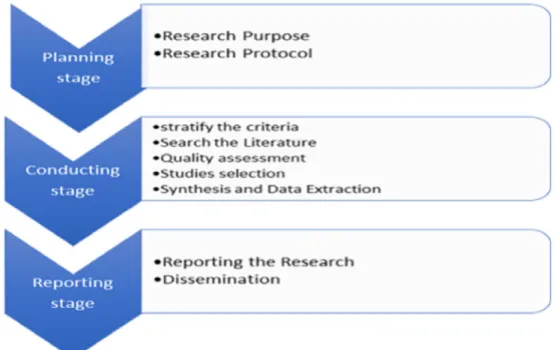
This method had been extensively used across the management research area, in both innovation and organisational learning[178]for example (e.g. [11,34,139]) operations management and the supply chain [30,63,166] and in the management of small companies (e.g. [56,85,111]). The systematic review devised by Tranfield et al.[178] suggested three stages for review: the planning stage; the conducting stage; and the reporting/dissemination stage.
3.1. Planning stage
A review panel was established during the planning stage made up of four researchers, all experienced in academia and industry. This was done to comply with Tranfield et al.’s[178]recommendations that a group be created consisting of experts from the relevant area. Following four meetings, the direction of the systematic literature review was agreed, the research questions were formulated and the criteria to be included and excluded were defined (seeTable 2).
English-language papers were included, from both academic and trade journals as the researchers agreed that scholars frequently publish theirfindings on Lean in trade journals. However, newspapers, maga-zines and reports were not included as it was felt that these pieces provided only a glimpse into lean implementation instead of the com-prehensive specific information or debate required for this research. Working papers were also omitted as it was felt that these contained personal opinions, and that these could be changed. During the
meetings, the researchers also agreed on the bibliographic databases to be used, and included Taylor & Francis, Emerald, ABI/INFORM Global, EBSCO Business Source Premier, Scopus, Sage, Inderscince finally ScienceDirect and the core databases in the area of business and man-agement. In addition, keywords were established for searching the lit-erature. As the topic of this study is Lean implementation within SMEs, ‘Lean’and‘SMEs’were the main phrases used in the literature search. Also, because‘Lean’was established subsequent to 1988, phrases such as TPS and JIT[150]were also included as keywords in the research as they are core components of Lean. SME is short-hand for small medium enterprise so small organisation, small business and small company were used in the search also. The panel's expertise was beneficial for providing suggestions for cross-checking the viability and strength of the method used, for example by identifying omissions or exclusions among the search phrases, periods of time or suitable databases. This provided validation for the systematic review process.
3.2. Conducting stage
At the conducting stage,‘search strings’were composed from the search phrases agreed in the planning stage (seeTable 3). Every search sentence was then input in an identical manner into the bibliographic databases and organised by abstract, title and keywords. The result was 405 papers, with a cut-offdate of the 2nd of Dec 2017.
These 405 papers were then reviewed by each researcher to ensure that their title, abstract and keywords matched the focus of the re-search. This resulted in 196 papers being excluded as inconsequential. Among these were non-academic literature, for example,‘grey litera-ture’ and other writings that did not include information into Lean implementation matters in SMEs. This led to an additional 70 papers being excluded as they were listed in two or more databases. This left 126 papers, containing either empirical research or conceptual search, that were again reviewed independently by the same four re-searchers for relevance. These papers were then entered an Excel spreadsheet and their information noted. This included the title, the publication year, authors, journals and further aspects of the articles that included the research topic, Lean implementation method, methods used in the research, areas of geographic research and the authors’profiles. Any papers that seemed ambiguous were classed as ‘unsure’and were reviewed by the other three panel members for re-vision. The researchers and the panel had a discussion on the reasoning behind the panel's decisions and suggestions and a consensus decision was agreed for each item. This level of scrutiny and cross-checking of the documents for the literature review was to improve the validity of the study and the results. This sorting and subcategorising of the 126 papers distinguished four main categories among them (like the method used by Suarez-Barraza et al.[166]in Lean literature review). Thefinal organisation was reviewed, cross-referenced and agreed by the entire panel.
3.3. Reporting and dissemination stage
As per the Tranfield et al.[178]method, it is recommended that this stage should include two sections: a descriptive analysis; and an ana-lysis of the categories input onto an Excel spreadsheet, to present the “current state map”from the selected articles a descriptive analysis was undertaken. Secondly, four key categories that emerged from the lit-erature review in categories analysis presented an in-depth look. In addition, a critical analysis of the review presents a discussion of how some factor strongly effecting the adopting of Lean Implementation (SeeFig. 2for literature review methodology).
4. Reviewfindings
4.1. First fold offindings: descriptive analysis
A descriptive analysis of Lean SMEs literature considered in this section. Tranfield et al. [178]described that the descriptive analysis should consist of a “descriptive account of the field” by sorting the literature into categories. These categories are the research methods, distribution of author profile and geographic areas.
4.1.1. Research methods used to investigate lean implementation in SME's The single case study was the main method of research used in the 126 papers, which made up 34% of the overall documents (seeFig. 3) (e.g.[66,110,160,195]). Surveys made up 30% of the documents (e.g., [25,43,83,102,140]). At 16% were the conceptual papers that were based on the development of theoretical frameworks, models or guides for SMEs to implement Lean (e.g.[84,182]). The shortage of research into Lean implementation in SMEs in multiple case studies, mixed methods research and action research now becomes apparent. Only 14 papers (11%) used multiple case studies (e.g. [3,165]). A further 9 papers (7%) used mixed methods, to include surveys, interviews or case studies[14,102,133,176]. As explained by Bhasin[14]mixed methods is the best method to guarantee validly of the results, for example a questionnaire, as the various data sources can be cross-checked and cross-referenced. A recent study carried out by Emmitt et al.[50]using an action research method detected and introduced variations in a small building company with the introduction of Lean. Emmitt et al.’s [50] used Lewin's [105] action research processes and proposed a comprehensive account of Lean implementation and included details of the collaboration between the researchers and the practitioner to apply Lean methods. Hence, this led to the opportunities for researcher to apply other methodology such as grounded theory and ethnography
[16].
4.1.2. Division of the global researchfield
Nearly all research in Lean implementation is carried out by aca-demicians utilize manufacture information. In aggregate, 104 of re-searchers (82.78 %) are essentially in the academic field [3,42,43,71,72,75,95,153] also only 6 authors (4.78 percent) are practitioners (e.g.[41,79,147,167,168]). In total, 16 of the researchers (12.44 percent) are both academics and practitioners (seeFig. 4).
4.1.3. Geographic areas associated with research in thefield
Out of the 126 papers 87 detailed the geographic area used. During the analysis stage, it became apparent that the majority of previous research has been based in western regions as 32% of the papers were EU based, 29% in the USA (United State of America) and Canada and 8% were from New Zealand and Australia (seeFig. 5and6). In Asia (West Asia countries) which is arguably a major player in the global market, only 20 of the papers (28%) were based here (e.g. [64,95,102,106,129,137,143,158,168]). Of these 20 Asian papers, it was found that the majority of them were based in India. Only 2 of the papers were concerned with the implementation of Lean in China and these examined Wenzhou's industrial industries[133] and the auto-mobile industry in Taiwan[64]. There are currently 10 million SMEs in China, or 90% of all of China's companies, which make up 60% of China's overall GDP[7]. This would indicate the importance of further research into Chinese SMEs and their progress with Lean implementa-tion and a necessity for addiimplementa-tional SME Lean research in the World's other developing areas such as South America, Africa and the Middle East.
Table 2
Critical paper of selection.
Criteria Reasons
Inclusive criteria
Papers written in English Most leading academic journals are published in English
Papers published in both academic and trade journals The authors recognised many Lean-related articles written by scholars are published in trade journals Papers study Lean implementation issues This review is designed for Lean implementation
Papers focus on SME SME is the main focus of this review
Exclusive criteria
Newspapers, magazines and reports These types of articles were more likely to provide a snapshot of Lean implementation Working papers These often represent researchers’temporary thinking and are subject to change Papers do not focus on Lean and SME They They do notfit the thematic areas of this review
General commentaries or grey literature They They do not provide sufficient insights into the research area
Table 3 Keyword search.
Search string combinations Database
(Lean implementation)AND(small and medium enterprise) ABI
(Toyota Production System (TPS))AND(small and medium enterprise) EBSCO
(Just in Time (JIT))AND(small and medium enterprise) ScienceDirect
(Lean)AND(small and medium business) Emerald
(Toyota Production System (TPS))AND(small and medium business) SAGE
(Just in Time (JIT))AND(small and medium business) Scopus
(Lean)AND(small and medium organization) Inderscince
(Toyota Production System (TPS))AND(small and medium organization) Taylor & Francis (Just in Time (JIT))AND(small and medium organization)
(Just in Time (JIT))AND(small and medium company)
(Toyota Production System (TPS))AND(small and medium company) (Just in Time (JIT))AND(small and medium company)
(Lean)AND(small and medium manufacturing (SME))
(Just in Time (JIT))AND(small and medium manufacturing (SME)) (Lean implementation)AND(small and medium manufacturing) (Toyota Production System (TPS))AND(small and medium manufacturing) (Toyota Production System (TPS))AND(small and medium manufacturing)
4.2. Second fold offindings: categorization analysis
Tranfield et al. [178]stated that investigation into the literature review categories would explain the extent of whether there is an agreement or not regarding the categories of applicable literature re-view areas and would highlight the developing categories and pro-spective questions for the research. There were four main categories recognised from the categorising and subcategorising exercise, com-pleted in a manner similar to that used by Suarez-Barraza et al.[166]in literature previous lean literature review:
•
Category 1: examined the Lean range/type found in the literature as used by SMEs;•
Category 2: reviewed on the degree to which Lean is implemented in SMEs;•
Category 3: assessed the influence of Lean implementation on SMEs; and•
Category 4: assessed Lean implementation in SMEs’critical success factors (CSFs).4.2.1. Category 1: the scope/type of lean that is implemented in SMEs The model or process used for Lean implementation in SMEs was identified in the literature review by its apparent stress on internal operations (Table 4). The studies by Wanitwattanakosol and Sopadang [182]and AlManei et al.[9]made reference to the importance of in-cluding supply chains within lean implementation roadmaps and fra-meworks. This agrees with the results of a study by Bhasin[14]on Lean in UK manufacturing companies where he discovered that although 80% of the companies had implemented Lean internally, only 20% had applied it to their entire value chain. Referring to Pettersen's[131] typology of Lean, SMEs would seem to be concentrate more on opera-tions, the Lean method implementation seen as a variation of an op-erational custom or an opop-erational belief. SMEs wouldn't often consider it strategic or beneficial to connect and integrate with their supply chain partners. This is in contrast to the Lean in LEs literature, where is it usually considered to be a strategic belief. Also, Stuart and Boyle [165]stated that Lean application is not often observed outside of the factory of SMEs. However, Karlsson and Ahlstrom[89]argue that Lean is applicable to SMEs supply chains, although there is not much to in-dicate if this is true.
4.2.2. Category 2: how lean is implemented in SMEs
Most of the studies based on Lean in SMEs is focused on how SMEs go about implementing Lean. There are two subcategories to the cate-gorisation analysis:
1 Approaches to implement Lean in SMEs. The literature shows that there are many approaches and Lean tools available to SMEs that would help to implement the Lean method (seeTable 5). There are several articles that discuss and demonstrate this (Table 5). Some of these tools include mapping tools, Value Stream Mapping (VSM), Kanban and 5S/6S work place organisation schemes that can work in conjunction with visual management. TPM and standardised work are two other options.
There are several less popular tools mentioned in the SME Lean literature, including 5 Whys, Small Lot Sizing and Single Minute
Exchange of Die, Level scheduling and Kaizen (SMED). Bhasin[14] discussed the unpopularity of some tools among SMEs compared to the popularity of those same tools among LEs. SMEs also seem to prefer a more varied choice of tools, rather than LEs, when im-plementing Lean. Mathur et al.[113]advise SMEs to choose and use the simpler less expensive tools because of the limited time and budgets available to them. Despite this advice, there is very little in the literature that discusses the justification or motivation for the selection and permutations of the tools or methods used. This seems to be an obvious omission as the holistic approach is best re-commended for the successful implementation of Lean[76]. 1 How other supporting initiatives can be combined with the Lean
approach in SMEs. There is another aspect worth noting in the lit-erature and that is the blending of Lean methods with additional supportive methods (Table 6). The most common method is the Fig. 2.Methodology stage.
0%
5%
10%
15%
20%
25%
30%
35%
34%
30%
16%
11%
7%
2%
Single-case study
Survey
Conceptual study
Mulple-case studies
Mixed methods
Acon research
implementation of Lean and Six Sigma. Six Sigma is a method that focuses on quality control and assists improvements by collecting data and completing statistical analysis[123], with the end goals to be the reduction of manufacturing and services costs and an increase in customer satisfaction[172]. Lean and Six Sigma have an obvious connection and several SMEs are making use of this. Where this has occurred, it is observed that some researchers who have used Lean with Six Sigma have developed their own models, or Lean Sigma models, while others have generated less specific processes or methods for implementing Lean in SMEs. The focus in the Lean Sigma model is on assimilating certain Lean applications into the DMAIC methodology (define measure, analysis, improvements and control). A case of this is where Kumar et al.[95], Roth and Fran-chetti[146]and Thomas et al.[172]detail the use of Lean tools, for
example VSM and TPM, for every stage of DMAIC. Gnanaraj et al., [58]criticised this approach because they argued that the majority of SMEs were unable to implement Lean for various reasons and so, taking these into account, they suggested the DOLADMAICS model ([57]a, p. 300). This version considers the features specific to SMEs that would hinder them and devises solutions through 5 levels ([58], 2012). This was a much more realistic model applicable to SMEs and included both Lean and Six Sigma factors. There was very little practical evidence that verified the entire implementation of this model.
IT is another extremely important support system for Lean im-plementation and indeed all aspects of modern-day company opera-tions. This means that systems such as Material Requirements Planning
82.78%
4.78%
12.44%
ACADEMICIAN
PRACTITIONERS
BOTH
Fig. 4.Distribution of author profile.
32%
29%
28%
8%
2%
1%
EU
UNITED STATES OF AMERICA/CANADACANADA
ASIA
AUSTRALIA/NEW ZELAND
CROSS-COUNTRY (MIDDLE EAST,SOUTH AMERICA AND
WEST EUROPE)
AFRICA
(MRP) and Enterprise Resource Planning (ERP) are necessary for every SME planning to introduce Lean. Powell, et al.[135]devised a system for incremental IT implementation over a long period of time to take into account the Lean method of operating. Some of the other ap-proaches sometimes combined with Lean include Accounting Method, Cellular Manufacturing, Project Management, Quality Function De-ployment (QFD), Theory of Constraints (TOC) and Quick Scan although none of these are as popular[80].
4.2.3. Category 3: the impact of lean implementation on SMEs
Generally, Lean implementation is examined at a micro level (the in-house manufacturing or processes of operation in SMEs) resulting in waste reduction arising as the main goal for the implementation of Lean
in SMEs. Lean SMEs are mainly focused on efficiency incentives for example decreases in stock, storage, time (i.e. substitution time, dis-tribution time, lead time and throughput time) and the price of pro-ducts, all of which, if successful, can provide huge benefits to SMEs [19,62,110]. Quality and efficiency (the use of the workforce) are two other areas where progress is important[43,43,106,146]. Among the literature, only one study mentions Lean implementation in the supply chain (see Category 1), while several studies discuss the results of Lean on SMEs in terms of suppliers and customers[60,160,181]. Again, only one paper could be found that detailed thefinancial benefits of Lean implementation in SMEs, which would seem an obvious area of im-portance[198].
This means that there could be a possible lag between execution and Fig. 6.Geographic map.
Table 4
Lean implementation process.
The scope of the implementation processes Authors
External–supply chain [182]; AlManei et al.[9]
Internal–production and operation processes ([31,40,57,64,66,95,160,172,146];[59];[17];[116];[179])
Table 5
The key main tools used in SMEs.
Lean tools Authors
Value stream mapping (VSM) Kumar et al.[95]; Lummus et al.[110];[27]; Roth and Franchetti[146]; Wanitwattanakosol and Sopadang[182]and[184] TPM Gunasekaran and Lyu[64]; Lee,[102]; Gunasekaran and Cecille, Gunasekaran and Cecille,[65]; Kumar et al.[95] 5S/6S and visual management Gunasekaran and Lyu,[64]; Gunasekaran and Cecille,[65]; Kumar et al.[95]; Rose, Deros and Rahman,[144] Fishbone diagram Sohal and Naylor,[160]and Thomas et al.[172]
Kanban Sohal and Naylor,[160]; Lee,[102]; Abdul-Nour, Lambert and Drolet,[1]; Gunasekaran and Cecille,[65]; Roth and Franchetti,[146]
Kaizen Deb, et al (2010) and Rose et al.[144]
5 whys [27]and Deb et al (2010)
Level scheduling Sohal and Naylor[160]
Small lot sizing Mathur et al.[113]
SMED Chin and Rafuse[31]and Mathur et al.[113]
any monetary benefits, but Chiarini's[29]analysis of accounting ben-efits from implementation show that the impact cannot be clearly ob-served from conventional methods of accounting. A further tendency observed is where few researchers have examined how certain CSFs for the implementation of Lean in SMEs can be altered or developed. Some of these CSFs include employee participation, support from senior management, dedication to the goal, teaching and learning, and changes to the organizational culture. Increased motivation among employees, interests and ability [60,64,66,129,132,160]and the em-powerment of employees[150]were examined, however Manoochehri [112] alone illustrated changes in organisational culture through the implementation of JIT. This can all be observed in Table 7, which clearly shows the that Lean SME research has mainly concentrated on improvements in efficiency as opposed to effectiveness.
4.2.4. Category 4: Critical Success Factors (CSFs) of lean implementation in SMEs
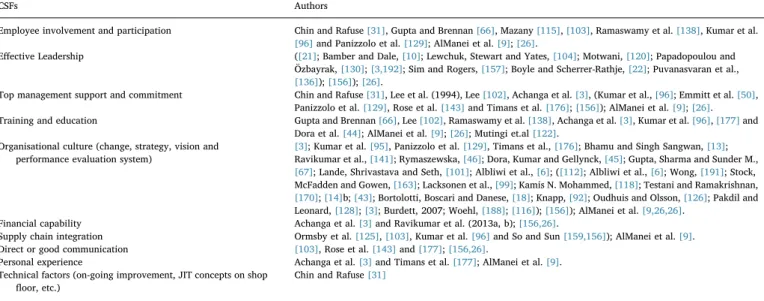
Only a single study could be found that focuses on examining CSFs for Lean implementation in SMEs[3]. The results of this study so far have identified that organisational culture, governance and manage-ment's strategies, funding availability, employee professionalism and ability are the most important aspects for a SME to take into account when trying to implement Lean successfully. CSFs are, however, men-tioned both directly and indirectly in several of the other papers (see Table 8). When these papers were examined, several trends became apparent. Thefirst is that Achanga et al.[3]considered employee in-volvement and participation to be additional and important factors. Panizzolo et al. [[129], p. 785] agreed that by including employees in quality improvement initiatives and increasing their levels of in-dependence and accountability has been extremely beneficial in certain improvements in the performances of companies. [76], (p. 18) also verified this view, stating that it is vital to include all staffin the process of implementing Lean, regardless of the dimensions of the company. Other regularly observed CSFs include senior management assistance and dedication, teaching and learning and organizational change (which includes the beliefs, plans and vision of the company), all of which support Achanga et al.’s[3] findings. Additionally, Panizzolo et al. [129]corroborated this view by stating that willingness, senior assistance and dedication, competence and willingness to alter an
organisation's culture and the improvement of skills among individuals and teams were some of the crucial factors to include for successful Lean implementation in SMEs. Further newer emphasis on cultural factors of individuals that can facilitate a change towards adopting lean and overcoming human and cultural barriers was presented by De-Sanctis et al.[39]who showed that reducing uncertainty, identifying future orientation and adopting an institutional collectivism are key inputs in such an orientation. . Although Bhamu and Singh Sangwan, [13]agreed that these were all vital aspects they argued that they were crucial aspects for companies of any size and so not specific to SME concerns. Ormsby et al.[125]first stated that small companies should be urged to promote a supportive environment in its supply chain partners to successfully implement JIT. So and Sun[159]showed how the continuous use of Lean in SMEs shows beneficial influences from supplier integration policies, for example, the sharing of information and including ebusiness. The importance of incorporating customers and working in unison with supply chain members was also highlighted by Timans et al.[177]. This would indicate that the inclusion of supply chain members should be an important addition to the CSF list (this was not mentioned in Achanga et al.’s[3]study. Panizzolo et al. [[129], p. 786] explained the importance of top management and their level of commitment towards a long-term vision of added value for not just customers, but society in general, and to the improvement and support of employees and partners. Importance of management commitment towards lean was further recently emphasized by Mutingi et al.[122]. In another fold, Mazany[115]stated that the main barrier to successful implementation isn't technical but human. In the papers, Achanga et al. [3]pointed out thefinancial restrictions of SMEs but only a single study identified availablefinances as a CSF. This would indicate the lack of a definitive agreement towards the relevance of available finances in SMEs for implementing Lean successfully. It is also important to note that the research into CSFs goes beyond internal organisation to the supply chain in recognition of how necessary it is to incorporate sup-pliers and customers.
Two more important CSFs to consider are communication and personal experience. Lee[102]claimed that only by maintaining direct communication between management and the workforce would JIT implementation be successful. Timans et al. [177] discussed the re-levance of personal experience, for example a prior role as a quality Table 6
Supporting approaches for implementation of Lean.
Other approaches Authors
Six sigma Kumar et al.[97]; Kumar et al.[96];[173]; Nabhani and Shokri[123]; Gnanaraj et al. [[58];[59], Roth and Franchetti[146];[28]and[177]
IT (MRP, ERP, computer simulation, CAD/CAM and fuzzy system)
Santacecilia,[148]; Chin and Rafuse[31,106],Achanga et al.[4], Wanitwattanakosol and Sopadang[182],[52], Powell et al.,[135]and Iris and Cebeci[83]
Accounting (ABC accounting and VSM accounting) Chiarini,[29]
Cellular manufacturing Boughton and Arokiam[19]
Project management Abdul-Nour et al.[1]
QFD Ramaswamy et al.[138]
TOC Lee[102]
Quick scan Thomas et al.[173]
Table 7
Critical for assessing the impact of Lean on SMEs. Efficiency(e.g. waste reduction, cost reduction, quality and
productivity improvement)
([54]; Kaufman,[90];[112]; Erem and Massey,[51];[23,60,64,66,132,160];[183];[19]; Kinney and Wempe, [91];[110,158]; Koh et al.,[93];[150];[62]; Kalafsky,[86];[119];[137,146]; Deb et al., 2010;[106]; Thun et al.,[175]; Bhasin,[15];[113]; Mazanai,[114];[129,181];[198];[28];[50,144]; Seay and Narsing,[149]; [38,43];[12]; Cunha et al.,[35]; Lande et al.,[101])
Effectiveness
Organisational Cultur ([112]; Albliwi et al.,[6]; Wong,[191]; Stock et al.,[163]; Lacksonen et al.,[99]; Kamis,[118]; Testani and Ramakrishnan,[170];[14,43]; Bortolotti et al.,[18]; Knapp,[92]; Oudhuis and Olsson,[126]; Pakdil and Leonard,[128];[3]; Burdett, 2007; Woehl,[188];[116])
Employee empowerment [150]
manager, as a CSF. Despite this, however, there is little actual evidence for these CSFs as Lee came to his conclusion following a conceptual analysis and Timans et al.[177]devised his results following a single interview. It has been suggested, at this point, that successful Lean implementation requires a clear guiding framework and not a reliance on the Lean tools, although this is not summarised in the papers re-viewed. There have, however, been several standard frameworks pro-posed to facilitate synchronised use of Lean tools and methods (see [66]).
A usual starting point for Lean implementation is to develop en-gagement and education between employees and managers to prepare them for Lean. Chin and Rafuse,[31]; Gunasekaran and Lyu[64]and Van Landeghem [179] agreed with this when they recommended starting with training and developing employees and managers instead of diving straight in with Lean tools. Chin and Rafuse[31]also sug-gested continuing this education and learning throughout the Lean implementation. Dombrowski et al.[40]completed an exercise where he equated and compared three methods of acquiring Lean-based in-formation, that could be taught at various stages of the process. There will be a summary of the results and conclusions reached in this re-search that will be illustrated later that can educate SMEs on how to implement Lean.
5. Discussion: synthesizing lean implementation in SME's
5.1. Is the size of the SME an enabler or inhibitor of lean implementation? SMEs are, obviously, smaller than LEs, but the relevance of that for this research is whether size influences a company's ability to success-fully implement Lean? The literature would seem to suggest that it does, in both the company and the supply-chain, and also that several aspects of SMEs that are of actual advantage when applying Lean.
5.2. Inhibiting factors of lean implementation in SME's
A consideration in relation to size is the issue of the control over the supply chain. This plays a part in the degree to which a SME can de-velop dependable supplier networks and how much they can include them into the Lean scheme. Dowlatshahi and Taham[47]and Wilson and Roy[186]explained how the usually smaller volumes produced by SMEs limited their negotiating powers in contrast to the larger sup-pliers. Finch[54]further said that including customers and suppliers in
JIT delivery and standardised workloads was unrealistic as SMEs had not the negotiating power with their suppliers. Manoochehri [112] expanded on this and stated that in order to fully implemented JIT, the company, regardless of magnitude, needs to be able to:
•
Alleviate demand;•
Produce merchandise or parts in smaller JIT runs; and•
Take receipt of component materials from suppliers in the necessary amounts at the correct time.Manoochehri[112]accepts that, due to the status of the majority of SMEs in the marketplace, they are unable to achieve thefirst and third of these. This would indicate that Lean in SMEs is more like JIT pro-duction (i.e. an improvement in the operations through waste reduc-tion) rather than JIT delivery, where it can be included into the supply chain. Therefore, it is more common for SMEs to promote the JIT process and aim for influencing the Lean supply chain, instead of actual compulsory practice (see e.g.[129]).
A study carried out by Karlsson and Ahlstrom [89] considered whether the Lean method and principles could be used by SMEs. The results stated that, for the most part, they could the principles con-cerned with procurement and distribution would need to be adapted for SMEs. No other found paper in the literature review examined SMEs ability to apply Lean to their supply chains. Further barriers to Lean application within SME's were identified by Shrimali et al.[156]who listed lack of support of top management, resistance to change from the middle management as main drawbacks. Other barriers that arose from the literature for Lean implementation were at an operational level and included poor processes and quality control systems ([103]and[102]). Additionally, in SMEs, the majority of the workforce are taken up with day-to-day operations and so any changes to these operations could be difficult. Organisational culture would seem to be the remedy for this as this would include more than just a plan for improving operations [129]. The benefit of this is that it would also manage the organisa-tional strategic issues needed for Lean implementation and the HR department, for example: developing the employees, encouraging au-thorisation and inclusion in making decisions and guaranteeing that there is an accommodating organisational culture for Lean (if none, develop it). Most of the research didn't take the importance of organi-sational culture into account, focusing instead on operations and not considering any of the cultural issues and factors that need to be managed simultaneously[3,44,98,171]. Another study by Chaple et al. Table 8
Summary of CSF.
CSFs Authors
Employee involvement and participation Chin and Rafuse[31], Gupta and Brennan[66], Mazany[115],[103], Ramaswamy et al.[138], Kumar et al. [96]and Panizzolo et al.[129]; AlManei et al.[9];[26].
Effective Leadership ([21]; Bamber and Dale,[10]; Lewchuk, Stewart and Yates,[104]; Motwani,[120]; Papadopoulou and Özbayrak,[130];[3,192]; Sim and Rogers,[157]; Boyle and Scherrer‐Rathje,[22]; Puvanasvaran et al., [136]);[156]);[26].
Top management support and commitment Chin and Rafuse[31], Lee et al. (1994), Lee[102], Achanga et al.[3], (Kumar et al.,[96]; Emmitt et al.[50], Panizzolo et al.[129], Rose et al.[143]and Timans et al.[176];[156]); AlManei et al.[9];[26]. Training and education Gupta and Brennan[66], Lee[102], Ramaswamy et al.[138], Achanga et al.[3], Kumar et al.[96],[177]and
Dora et al.[44]; AlManei et al.[9];[26]; Mutingi et.al[122]. Organisational culture (change, strategy, vision and
performance evaluation system)
[3]; Kumar et al.[95], Panizzolo et al.[129], Timans et al.,[176]; Bhamu and Singh Sangwan,[13]; Ravikumar et al.,[141]; Rymaszewska,[46]; Dora, Kumar and Gellynck,[45]; Gupta, Sharma and Sunder M., [67]; Lande, Shrivastava and Seth,[101]; Albliwi et al.,[6]; ([112]; Albliwi et al.,[6]; Wong,[191]; Stock, McFadden and Gowen,[163]; Lacksonen et al.,[99]; Kamis N. Mohammed,[118]; Testani and Ramakrishnan, [170];[14]b;[43]; Bortolotti, Boscari and Danese,[18]; Knapp,[92]; Oudhuis and Olsson,[126]; Pakdil and Leonard,[128];[3]; Burdett, 2007; Woehl,[188];[116]);[156]); AlManei et al.[9,26,26].
Financial capability Achanga et al.[3]and Ravikumar et al. (2013a, b);[156,26].
Supply chain integration Ormsby et al.[125],[103], Kumar et al.[96]and So and Sun[159,156]); AlManei et al.[9]. Direct or good communication [103], Rose et al.[143]and[177];[156,26].
Personal experience Achanga et al.[3]and Timans et al.[177]; AlManei et al.[9]. Technical factors (on-going improvement, JIT concepts on shop
floor, etc.)
[26]showed that lean application within SME's may also be hindered due to insufficient management time, lack of adequate supervisory lean processes skills and, in fact, inadequate senior management specialized skills in thefield.
Financially, the majority of the researchers explained that most SMEs lacked the budget necessary for the implementation of Lean ([61]; [125]; [103];[47]; Thomas et al., implementation[173]; Ma-zanai, [114]) and buildings or amenities (Bought on and Arokiam, 2000; [129]). The continuous implementation of a full Lean method necessitates largefinancial outlays prior to any benefits being observed and most SMEs simply may not have this level offinances available to them, in addition to the time needed for education and the development of knowledge (see e.g. Mazanai, [114]). Take, for instance, infra-structure, which has been identified as a key performance indicator (KPI) system supportive of Lean but is also a barrier for SMEs as they might not have needed such a system previously, compared to LEs. In the same vein, Zhang et al. [196] highlighted that successful im-plementation of lean usually requires advanced technologies of high costs, that may not be available for SMEs. In consequence they would rely on their conventional manufacturing facilities, thus resulting in lean implementation failures.
Also, SMEs may not have the budget to employ specialised Lean facilitators. From the point of view of the customer, some of the papers stated that varying demands was a problem for SMEs as, due to their size, they had limited control over their customers with which to direct trends. This made them predictable and secure ([19,47]; Rymaszewska, [46]).
5.3. Enabling factors of lean implementation in SME's
Karlsson and Ahlstrom[89]noticed that SMEs usually focused on certain areas of business, which meant that their suppliers were reliant on them because there are no other alternative buyers available. This actually provided the SMEs with the ability to direct the supply chain, which provides a counterbalance to the barriers discussed above. SMEs have other beneficial factors for implementing a Lean strategy. Com-munication is a vital component of successful strategy, both up, and down, within the company hierarchy and among roles and sections [89]. This actually suits the structure of SMEs because some of their main characteristics include a lot of groups working together and a positive culture of interconnection that aren't limited by functional limitations. Also, communication in small companies is more straight
forward and staffand management work closer together, which enables greater opportunities for one-on-one interaction[47]. Production sys-tems in SMEs are more adaptable due to their smaller size and are able to manufacture products in small runs to comply with multiple re-quirements of their customers[103]. This actually gives them the ad-vantage over LEs that are designed around economies of scale for their product manufacturing policies. SME leadership can also be of benefit as SMEs are usually owned privately. Therefore, the owner usually has a long-term focus with a strong commitment to progressing and main-taining their business.
This is vital for a successful Lean implementation, so it is extremely supportive if the owner/leader is committed to the Lean strategy[142]. This is also recently concluded by Bevilacqua et.al[12]who showed that operations in SME's–by default–could largely reflect the owner/ mangers way of thinking–including positive adoption of various lean processes and tools. Again, due to size, the owners/leaders of SMEs also have greater access to their customers and can better appreciate and foresee their needs and values. This gives them the ability to respond quicker, which is a vital component in any Lean project.
As mentioned previously, SMEs can often experience difficulties when trying to finance a serious project like Lean, however, Dowlatshahi and Taham[47]highlighted that there is often support and grants available from governments or other agencies that specifi -cally focus on SMEs. Unfortunately, dependence on external assistance, like a consultant, for implementing Lean can cause its own problems [81].Table 9illustrates the barriers and benefits connected to the size of an organisation when considering SMEs trying to implement Lean. So, although there are some obvious advantages to a smaller size, SMEs are generally at a disadvantage when it comes to implementing Lean. Therefore, the barriers to this need to be eliminated or reduced or the benefits need to be used to their maximum advantage.
5.4. Small and medium enterprise lean practice
There are implications for practitioners in this paper. It contains a comprehensive list of Lean CSFs and possible enablers and barriers for an effective and workable Lean implementation, which practitioners need to know when they begin their project. These CSFs and possible enablers and barriers were collated during this systematic review and provide a guide for the SME owners, managers and practitioners.
The veryfirst thing a SME needs to consider when introducing Lean is the organisational culture. The owners or managers need to ensure Table 9
Enablers and inhibitors for SMEs.
Aspects Enablers Inhibitors
Supplier relationship Suppliers may be highly dependent on a SME focusing a market niche (there are no other customers for the supplier to switch to, so SME has more power to influence the Lean agenda)[89]
SMEs may lack the market power to influence supplier network in adopting Lean practices ([61];[125];[103],[47,102,186]; Mazanai, [114]); AlManei et al.[9]
Intra-SME Organizational Owner's long-term commitment to survival and profitability can give Lean the backing and support it may need[142]; Bevilacqua et.al.[12]
Potential lack of vision, management commitment and support as the SME leader may be highly involved in day to day operations and other matters ([103];[102,129]; Rymaszewska,[46];[186,195,156]) Multi-skilled, cross-functional employees better positioned to be able to
support Lean process improvement across the organisation ([142];[103])
Lack of support for training and knowledge development required for Lean initiatives ([61];[47,102]; Mazanai,[114];[129]Rymaszewska, [46]; Yang et al.,[194])
Higher level of group teamwork and cohesiveness, a feature of the Lean way of working ([103];[47]) Ease of communication (Rymaszewska, [46]; Winston and Heiko,[187])
Workforcefluctuation (SME employee turnover maybe higher so the knowledge of Lean may be more easily lost) (Rymaszewska,[46]; Williams,[185])
Supporting a culture change towards lean implementation thus overcoming human barriers (resistance) towards it[39]
Lack of adequate skills of lean processes within SME's higher management and supervisory levels[26]
Operational Poorer process and quality control tools and systems ([103],[102])
Financial Government support more likely to be available[47]–but dependence on outside agencies like consultants to implement Lean can be problematic (Hu et al.,[82])
Lack of sufficient funding and capital ([61];[125];[103];[47]; Mazanai, [114]; Rymaszewska,[46];[173])
Lack of infrastructure and facilities[19,129,196])
Customer relationship More direct contact with customers[142] Less able to influence demand volatility and variability ([19,47]; Rymaszewska,[46])
that this is supportive and fully engaged in Lean implementation. Operational issues need to be reviewed during the planning process for Lean and these can include organisational level issues, for example, planning the investment strategy (when to buy new equipment of or improving the processes surrounding the existing equipment), which are key for an SME strategic implementation plan. SMEs need sufficient resources tofinance Lean and not need immediate performance awards to come through.
Also, because of the various types of Lean, the owners/managers need to agree the version they plan on implementing before beginning. This version can be reviewed and amended during the process. In ad-dition, SME owners or managers need to continuously pursue external sources of funding and support, for example, from government agencies or Lean specialists.
Lean success depends on recognising what is considered as‘of value’ by the customers. This, therefore, needs to be established from the outset and will guarantee that SMEs can direct the Lean process towards a concise comprehension of what the customer values. These values could be constantly reviewed as they sometimes change. SMEs usually have aflat organisational structure and work to informal working re-lationships. This enables direct and rapid communication between management and employees. This type of structure allows a more ef-ficient dispersal of the Lean method throughout the SME and guaran-tees employee engagement. Employee training is another vital issue to consider for Lean implementation, but SMEs have long been considered remiss in the development of knowledge, which is necessary for Lean. This is why SME owners or managers mayfind that the use of specialists may be beneficial. Prior to the commencement of the Lean im-plementation, SMEs need to be assured of their processes’ quality, components and end products. Lean eliminates time and inventory waste but needs a‘rightfirst time’operation. If quality is inconsistent this could mean a failure of Lean, which has disastrous consequences for the customer. A quality audit is recommended to determine if a company is ready to commence Lean or not. Due to thefinancial and human resource constraints experienced by SMEs, the most necessary Lean tools need to be applied initially (for example visual management, 5S/6S, VSM and Standard Work) in addition to organisational im-provements such as performance evaluation systems and appraisal criteria, while the more complicated tools (TPM) and supportive in-itiatives (IT) that require greater financial outlay, time and training (performance investment) can be introduced later on in the Lean pro-ject. It is important to recognise that no improvement in organisational performance might be apparent until, at minimum, the basic tools have been utilised. This reflects the time lag that occurs between the im-plementation of Lean and any visual benefits. This was explained by Chiarini's[29]review of the usual accounting process that prevents any immediate observable advantages of the implementation of Lean.
The“performance improvement”stage requires constantfinancial input, but the performance benefits are apparent. Another character-istic of SMEs is their inability to influence their supply chain due to their size so, instead, it is recommended that they utilise Lean internally up to the point of their supplier. This paper concludes that im-plementing Lean is a long-term process and that SMEs need to take the long-view approach by improving their organisational process gradu-ally.
5.5. Small and medium enterprise lean research
One of the aims of this review was to identify areas of additional research on Lean implementation. These areas will be detailed as fol-lows. Initially, three areas became apparent from the‘descriptive’ lit-erature review. Thefirst is that there was very little research carried out that used grounded theory and ethnography, the mixed method, or action research when researching Lean implementation in SMEs. These methods are particularly good for obtaining a more in-depth view of Lean implementation in SMEs. Second, most of Lean research up until
now has focused on the Western countries and have largely ignored developing countries such as the Middle East and Asia. Suitable aspects of research based on this could include comparative case studies of SMEs implementing Lean in developed versus developing countries to determine the application of Lean tools in SMEs in developing econo-mies. Third, Lean's current focus is in academia, mainly due to its ori-gins in the academic sector, but, as it is nowfinding popularity in the manufacturing sector, research is needed in this context.
Six areas for further research became apparent from the‘categories’ literature review. It was obvious that prior studies had mainly con-centrated on methods used to implement Lean in SMEs. Further, fo-cusing on soft issue is needed for example, influenced by organisational culture, rather than on technical and tools issue on why certain tools and techniques were chosen. Lean also needs to be scrutinised at a higher organisational and theoretical level, which would explore issues concerned with strategy and philosophy. Additionally, areas such as why Lean is adopted by SMEs, how it is assimilated into their existing strategies and how Lean influences business direction and culture in SMEs are all worth investigating. Lean is a method with substantial ramifications to the way an entire company is operated. A study on the difference between SMEs and LEs based on this would also be worth investigating. As previously discussed, SMEs are limited in the extent of their influence over their supply chain, but this is seen as a crucial component for a fully implemented Lean method and so would seem to be an important area to research further. Again, as discussed pre-viously, the size of SMEs causes certain issues in comparison to LEs, so an area for further study is: how much of an issue is this when im-plementing Lean?
Another area worth concentrating on is thefinancial issues faced by SMEs. Monetary capabilities and the effect on Lean in SMEs, in addition tofinancial benefits from Lean should all be reviewed. Research should also be carried out on the operational benefits that go beyond devel-opments in improvements.
Finally, because much has been made of the issue of organisational size when implementing Lean, this has been identified as a common and vital issue for SMEs. Further information is needed on the differences and similarities in Lean implementation between SMEs and LEs in re-gards their sizes. Further empirical studies, for example longitudinal studies, would be useful for additional examining of CSFs discovered in prior research, and to assess their effectiveness for both SMEs and LEs. In addition, there is a need for a framework for SMEs manufacturing to facilitate Lean implementation by levering aspects of organizational culture.
5.6. Organizational culture challenges in lean manufacturing implementation
First, the link among organization culture as well as Lean manu-facturing implementation is highly critical and sensitive. The different between nations have different labor intensity, development, culture, customs relation, industrialization position, education and training, land cost, traffic situation, etc.firms should take these challenge mat-ters into their consideration when adopting and apply Lean manu-facturing. Organizational cultural contribute for Lean cooperation is recommended to apply and the implementation basics of the Lean manufacturing ([127]; Chen and Meng, 2010a). Organizational cultural variation relate fundamentally for the openness and change's resistance internally [37]. The gaining of Lean manufacturing implementation relies on broadly on the workfirm's practices. For instance, Toyota have done in 1990 s works with skill based on practices from a seniority based on strategy planner. Several crucial workfirms’practices wide-spread to the manufactories that succeeded implemented the principle of Lean manufacturing are: discipline and control, standardization, team-based organization, continuous training as well as learning, multi skilling, participation, empowerment, reward system, common values, commitment, methods of work, communication, etc.[49,124]. In the