Education and development the
issues and the evidence -
Education Research Paper No. 06,
1993, 61 p.
Table of Contents EDUCATION RESEARCH
Keith M. Lewin Centre for International Education University of Sussex July 1993 (Reprinted July 1997)
Serial No. 6
ISBN: 0 902500 66 X
Department For International Development
Table of Contents
Department for International Development - Education papers Preamble
1.1 Context
1.2 Recession, debt and structural adjustment 1.3 Population growth and demographic change.
1.3.1 Population growth 1.3.2 Fertility and health 1.3.3 Increasing HIV infection 1.3.4 Urbanisation
1.3.5 Displaced populations and refugees 1.4 Scientific and technological change
1.5 Environmental degradation
1.6 Good government and human rights. 1.7 The education of girls and women
2. An analysis of research evidence on education and development
2.1 Education and economic development 2.1.2 Education and productivity
2.1.3 Educational investment and externalities 2.1.4 Education, equity and income distribution 2.1.5 Concluding remark
2.2 School achievement, the IEA data and effective schools studies 2.2.1 School achievement studies
2.2.2 Recent methodological developments 2.2.3 Some results from the IEA science studies 2.2.4 A note on the effective schools literature 2.3 Technical and vocational education
2.3.1 Rationales 2.3.2 Approaches 2.3.3 Purposes
2.3.5 Some conclusions
2.4 The balance of investment between educational levels 2.5 Private expenditures and cost recovery
2.5.1 Private financing
2.5.2 Cost recovery and user fees 2.5.3 Loans
2.5.4 Some conclusions
2.6 Organisational reforms, assessment and alternative delivery systems 2.6.1 Organisational issues
2.6.2 Achievement and automatic promotion 2.6.3 Assessment and examinations
2.6.4 Alternative delivery strategies 2.7 Literacy
2.7.1 Definitional issues
2.7.2 Literacy and development 2.7.3 Literacy and language
2.7.4 Strategies to promote literacy 2.7.5 Concluding remarks.
3. Postscript 4. Bibliography
Appendix extracts from synthetic reviews
A. Summary: school factors and achievement in the developing world B: General education and development research review
Education and development the issues and the evidence - Education Research Paper No. 06, 1993, 61 p.
[Table of Contents][Next Page]
Department for International
Development - Education papers
This is one of a series of Education Papers issued from time to time by the Education Division of the Department for International Development. Each paper represents a study or piece of commissioned research on some aspect of education and training in developing countries. Most of the studies were undertaken in order to provide informed judgements from which policy decisions could be drawn, but in each case it has become apparent that the material produced would be of interest to a wider audience,particularly but not exclusively those whose work focuses on developing countries. Each paper is numbered serially, and further copies can be obtained through the DFID's Education Division, 94 Victoria Street, London SW1E 5JL, subject to availability. A full list appears overleaf.
Although these papers are issued by the DFID, the views expressed in them are entirely those of the authors and do not necessarily represent the DFID's own policies or views. Any discussion of their content should therefore be addressed to the authors and not to the DFID.
List of other DFID education papers available in this series
No. 1 Pennycuick, D. 1993 'SCHOOL EFFECTIVENESS IN DEVELOPING COUNTRIES: A SUMMARY OF THE RESEARCH EVIDENCE' ISBN: 0 902500 61 9
No. 2 Hough, J.R. 1993 'EDUCATIONAL COST-BENEFIT ANALYSIS' ISBN: 0 902500 62 7
No. 3 Gray, L. et al 1993 'REDUCING THE COST OF TECHNICAL AND VOCATIONAL EDUCATION' ISBN: 0 902500 63 5
No. 4 Williams, E. 1993 'REPORT ON READING ENGLISH IN PRIMARY SCHOOLS IN MALAWI' ISBN: 0 902500 64 3
No. 5 Williams, E. 1993 'REPORT ON READING ENGLISH IN PRIMARY SCHOOLS IN ZAMBIA' ISBN: 0 902500 65 1
No. 6 Lewin, K. 1993 'EDUCATION AND DEVELOPMENT: THE ISSUES AND THE EVIDENCE' ISBN: 0 902500 66 X
No. 7 Penrose, P. 1993 'PLANNING AND FINANCING: SUSTAINABLE
EDUCATION SYSTEMS IN SUB-SAHARAN AFRICA' ISBN: 0 902500 67 8
No. 8 (not issued)
No. 10 Rogers, A. 1994 'USING LITERACY: A NEW APPROACH TO POST-LITERACY METHODS' ISBN: 1 861920 70 9
No. 11 McGrath, S. King, K. et al. 1995 'EDUCATION AND TRAINING FOR THE INFORMAL SECTOR' Vol 1. and Vol. 2 - Case studies. Vol. 1 ISBN: 0 902500 59 7 Vol. 2 ISBN: 0 902500 60 0
No. 12 Little, A. 1995 'MULTI-GRADE TEACHING: A REVIEW OF RESEARCH AND PRACTICE' ISBN: 0 902500 58 9
No. 13 Bilham, T. Gilmour, R. 1995 'DISTANCE EDUCATION IN ENGINEERING FOR DEVELOPING COUNTRIES' ISBN: 0 902500 68 6
No. 14 Barnett, E. de Koning, K. Francis, V. 1995 'HEALTH & HIV/AIDS
EDUCATION IN PRIMARY & SECONDARY SCHOOLS IN AFRICA & ASIA' ISBN: 0 902500 69 4
No. 15 Gray, L. Warrender, A.M. Davies, P. Hurley, G. Manton, C. 1995 "LABOUR MARKET SIGNALS & INDICATORS' ISBN: 0 902500 70 8
No. 16 Lubben, F. Campbell R. Dlamini B. 1995 'IN-SERVICE SUPPORT FOR A TECHNOLOGICAL APPROACH TO SCIENCE EDUCATION' ISBN: 0 902500 71 6
No. 17 Archer, D. Cottingham, S 1996 'ACTION RESEARCH REPORT ON REFLECT' ISBN: 0 902500 72 4
No. 18 Kent, D. Mushi, P. 1996 'THE EDUCATION AND TRAINING OF ARTISANS FOR THE INFORMAL SECTOR IN TANZANIA' ISBN: 0 902500 74 0
No. 19 Brock, C. Cammish, N. 1997 'GENDER, EDUCATION AND
DEVELOPMENT - A PARTIALLY ANNOTATED AND SELECTIVE BIBLIOGRAPHY' ISBN: 0 902500 76 7
No. 20 Taylor, P. Mulhall, A. 1997 'CONTEXTUALISING TEACHING AND
LEARNING IN RURAL PRIMARY SCHOOLS: USING AGRICULTURAL EXPERIENCE' Vol 1 ISBN:1 861920 45 8 Vol 2 (Case Studies) ISBN: 1 861920 50 4
No. 21 Kutnick, P. Jules, V. Layne, A. 1997 'GENDER AND SCHOOL ACHIEVEMENT IN THE CARIBBEAN ISBN: 1 86192 080 6
Other DFID education studies also available
Threlfall, M. Langley, G. 1992 'CONSTRAINTS ON THE PARTICIPATION OF WOMEN IN TECHNICAL COOPERATION TRAINING DUE TO LACK OF ENGLISH LANGUAGE SKILLS'
Swainson, N. 1995 'REDRESSING GENDER INEQUALITIES IN EDUCATION' Wynd, S. 1995 'FACTORS AFFECTING GIRLS' ACCESS TO SCHOOLING IN NIGER'
Phillips, D. Arnhold N. Bekker, J. Kersh, N. McLeish, E. 1996 'EDUCATION FOR RECONSTRUCTION'
Rosenberg, D. 1996 'AFRICAN JOURNAL DISTRIBUTION PROGRAMME: EVALUATION OF 1994 PILOT PROJECT'
All available free of charge from DFID Education Division, 94 Victoria Street, London SW1E 5JL. A free descriptive catalogue giving further details of each paper is also available.
Education and development the issues and the evidence - Education Research Paper No. 06, 1993, 61 p.
[Previous Page][Table of Contents] [Next Page]
Preamble
The material for this review was first gathered as part of a report "Dialogue for
Development; A Policy Review of British Educational Aid Towards 2000" which was submitted to the Overseas Development Administration in mid 1992. Those parts of the work which discuss general issues in education and development and collate recent research findings are presented here so that the work may reach a wider audience. This review falls into two main sections. The first part¹ identifies key dimensions of the policy debate that will condition future patterns of investment in education. The themes chosen are the impact of recession, the effects of debt and structural adjustment
programmes on the resources available for education; the implications of demographic trends in developing countries; technological change and changing patterns of
employment and livelihoods; the continued degradation of the global environment, the new priorities attached to human rights and good government; and the importance of gender issues in education and development.
¹an abridged version of this part of the material will appear in Oxford Studies in Comparative Education, Vol 3(2) 1994
The second part provides an up to date culling of the research literature relating to seven specific fields. These are education and economic development issues; school effectiveness and student achievement; technical and vocational education; the balance of investment between educational levels; private educational expenditure and cost recovery programmes; organisational reforms, assessment practices and alternative delivery strategies; and literacy programmes.
The discussion of the school effectiveness literature has been extended by David Pennycuick in his related review published in this series. Angus Ross assisted in collecting material for this study, in developing the section on literacy, and in refining its presentation.
This review has made use of a wide range of the most recent source material drawn from the Institute of Development Studies library. I am grateful to the assistance of many colleagues at the IDS, in the University of Sussex, and in the ODA who drew my attention to relevant studies. This work was completed before the recent World
Symposium on the Economics of Education sponsored by the ODA, British Council, the World Bank and the GTZ which was held at Manchester in April 1993. The papers from this conference extend some of the analysis and arguments presented here.
Keith Lewin
Hove 2nd June 1993
Education and development the issues and the evidence - Education Research Paper No. 06, 1993, 61 p.
[Previous Page][Table of Contents] [Next Page]
1. Education and development -
Defining the issues
1.1 Context
1.2 Recession, debt and structural adjustment 1.3 Population growth and demographic change. 1.4 Scientific and technological change
1.5 Environmental degradation
1.6 Good government and human rights. 1.7 The education of girls and women
Education and development the issues and the evidence - Education Research Paper No. 06, 1993, 61 p.
[Previous Page][Table of Contents] [Next Page]
1.1 Context
In the early 1990's the ODA bilateral programme was disbursing over a billion pounds annually of which about 10% was classified as educational aid. Educational aid is therefore a major component of British assistance to development, particularly when it is remembered that these figures exclude multi-lateral contributions and educational aspects of projects predominantly located in other sectors.
The significance of human resource development supported by education and training is manifest. It contributes to medium term institution building, is an essential
complement to many investments in physical infrastructure, and is an integral part of any definition of development that sees access to educational services of appropriate quality as a basic human right. In order to improve the planning of educational assistance it is necessary to take a view on some of the major factors that will shape educational development over the next decade. These are discussed below after an introduction to some recent trends which map the terrain over which these factors operate.
The social and economic environment in which development is taking place has been changing rapidly. The 1980's have been characterised by increased differentiation
between developing countries in their human development status. The experience of the last three decades has been used by UNDP to classify countries into three groups those where sustained human development has taken place (e.g. Botswana, Costa Rica, the Republic of Korea, Malaysia and Shri Lanka), those where human development has been disrupted (e.g. Chile, China, Colombia, Jamaica, Kenya and Zimbabwe), and those where opportunities for human development have been missed (e.g. Brazil, Nigeria and Pakistan) (UNDP 1990:42). This differentiation is the result of the interaction of a wide range of factors which include political instability, economic mismanagement, widespread recession, falling commodity prices, rising interest rates and levels of indebtedness, and increased distributional skews.
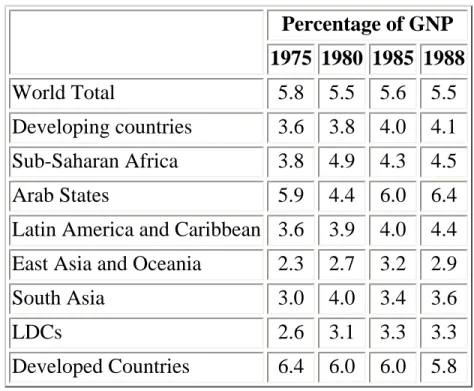
Global patterns of investment in education are complex and there are many choices in how to analyse them. UNESCO data yields Table 1 which shows how public
expenditure as a proportion of GNP has been changing. Table 1. Public Expenditure on Education 19-70-88
Percentage of GNP 1975 1980 1985 1988 World Total 5.8 5.5 5.6 5.5 Developing countries 3.6 3.8 4.0 4.1 Sub-Saharan Africa 3.8 4.9 4.3 4.5 Arab States 5.9 4.4 6.0 6.4
Latin America and Caribbean 3.6 3.9 4.0 4.4 East Asia and Oceania 2.3 2.7 3.2 2.9
South Asia 3.0 4.0 3.4 3.6
LDCs 2.6 3.1 3.3 3.3
Developed Countries 6.4 6.0 6.0 5.8 Source: UNESCO 1991:36 Table 2.9
This indicates that in general proportional allocations averaged across regions have remained fairly stable. Those in Sub-Saharan Africa, which includes a disproportionate number of countries where GNP growth has been minimal, experienced a significant decline in the mid 1980's but there has been some subsequent recovery. Alongside this pattern the proportion of the national budget allocated to education in many developing countries appears to have been falling. Two recent analyses indicate that the
proportions of central government expenditure allocated to education in the developing countries on which there is data (about 35), show a fall in more than twice as many cases as there have been increases over the period 1972-1982 and 1972 - 1986 (Lewin 1987:56, Hallak 1990:27). The proportions allocated to health have also declined more often than they have increased. In countries with primary gross enrolment ratios
(GERs) below 90 in 1986 more than half (13 out of 21) experienced a decline in the proportion of central government expenditure on education over the last five years on which there were data (Colclough with Lewin Table 2.1 1993) Eight of these countries are in Sub Saharan Africa.
If this partial picture is complemented by data on expenditure per student some finer resolution of the consequences of the changed climate for educational investment
becomes possible. Table 2 shows expenditures in US$ and in units of GNP per capita in the main regions.
Year All levels First Level Second level
1 st & 2 nd Levels
Third level US$ Units US$ Units US$ Units US$ Units US$ Units All developing countries [72] 1975 49 0.15 33 0.10 1980 106 0.17 73 0.12 1998 129 0.18 93 0.13 Sub-Saharan Africa [26] 1975 101 0.44 49 0.21 251 1.09 75 0.33 2675 10.7 1980 133 0.32 70 0.17 296 0.72 101 0.24 3521 8.5 1988 89 0.31 50 0.17 175 0.61 70 0.24 1549 5.4 Arab States[11] 1975 140 0.21 105 0.16 633 0.9 1980 227 0.16 174 0.13 1019 0.7 1988 313 0.19 240 0.15 1467 0.9 Latin America Caribbean[25] 1975 166 0.15 81 0.07 196 0.18 100 0.09 694 0.6 1980 328 0.14 164 0.07 326 0.14 195 0.09 1286 0.6 1988 293 0.15 163 0.09 246 0.13 180 0.09 863 0.5 East Asia Oceania [8] 1975 19 0.09 17 0.08 353 1.6 1980 46 0.11 36 0.09 538 1.3 1988 73 0.13 43 0.08 89 0.16 55 0.10 446 0.8 South Asia [5] 1975 32 0.17 17 0.09 34 0.18 21 0.11 116 0.6 1980 83 0.24 50 0.15 96 0.28 63 0.19 195 0.6 1988 110 0.19 69 0.12 123 0.21 86 0.15 445 0.8 LCDs [19] 1975 34 0.23 18 0.12 55 0.38 25 0.17 513 3.5 1980 50 0.24 26 0.13 90 0.44 36 0.18 858 4.2 1988 45 0.22 25 0.12 86 0.43 35 0.17 422 2.1 Developed Countries [31] 1975 1098 0.24 834 0.18 2637 0.6 1980 1862 0.23 1417 0.18 4019 0.5 1988 2888 0 24 1983 0.16 6520 0.5
Note: Units refer to units of GNP per capita; numbers in parentheses in column 1 refer to the number of countries.
Sub-Saharan African countries have seen total expenditure per pupil drop by fully one third in US$ terms between 1980 and 1988, with smaller declines in Latin America and the Caribbean (11%). In other regions expenditure per pupil in US$ has increased - by as much as 38% in the Arab countries, and by 55% in the developed countries over the same period. A contrasting picture emerges if expenditure is accounted for in units based on GNP per capita. These figures indicate that countries in Sub-Saharan Africa allocate greater proportions of GNP per capita to education than is the case in other regions. The relative economic burden of increasing access to education in these
countries is therefore greater than elsewhere since a larger proportion of GNP has to be allocated to enrol additional students. This is a particularly acute issue in those African countries where GNP growth has been sluggish or negative.
The most recent figures suggest that gross enrolment rates (GERs) at the first level have fallen in Sub-Saharan Africa as a whole from 77% in 1980, to 71% in 1985 and to 67% in 1990. In all other regions GERs have increased, though the rate of increase slowed in the second part of the last decade. Regional GERs also remained below 100 in the Arab States and in South Asia. GERs actually declined in 16 of the 37 countries which had GERs of less than 90 in 1986 over the six year period 1980-86 (Colclough with Lewin 1993: Table 2.1). Twelve of these countries were in Sub-Saharan Africa. Analysis of enrolment growth by level shows a slowing at all levels in all regions during the 1980's, a consistent tendency for growth rates to be higher at secondary and tertiary, and again Sub-Saharan Africa experiencing some of the greatest declines in growth (Table 3). Estimates of the grade 4 survival rates of a cohort entering grade 1 in 1988 indicate that 67% survive in Sub-Saharan Africa, 91% in the Arab States, 78% in East Asia and Oceania, 55% in Latin America and the Caribbean, and 63% in South Asia (UNESCO 1991:31). This illustrates that large numbers fail to complete four grades even in those regions where mean GERs for primary exceed 100. GERs, it should be remembered, underestimate net enrolment rates, sometimes very substantially. Where repetition is high and overage entry common the differences may be 20% or more suggesting that internal efficiency is low and that many remain unschooled.
Disparities in enrolment rates between girls and boys remain striking. In Sub-Saharan Africa in 1990 there were 23% more boys than girls at the first level, 35% more at the second level, 180% more at the third level. The Arab States (24%, 34%, 64%) and South Asia (34%, 70%, 128%) had similar patterns (UNESCO 1991:53, Table 3.2). All but one of the countries with a GER of less than 90 in 1986 had smaller female
enrolments at the first level, with an unweighted average value of 68% of male enrolment (Colclough with Lewin 1993: Table 2.1). The weighted mean for all low income countries for females as a percentage of total enrolments is 43% (Lockheed and Verspoor 1990:169).
Table 3 Enrolment Growth Rates by Level of Education 197088 (Percentages) and GER (First Level)
Years First Second Third GER Level Level Level Level 1
All Developing Countries 1970-5 5.3 7.7 11.9 92.8 1975-80 2.2 5.7 7.1 94.9 1980-88 1.1 3.1 4.5 98.1 Sub Saharan Africa 1970-5 7.4 14.3 13.3 58.1 1975-80 9.4 14.4 14.0 77.1 1980-88 1.8 4.3 8.1 66.7 Arab States 1970-5 5.7 10.2 15.1 73.1 1975-80 4.4 8.8 10.4 79.9 1980-88 4.0 5.9 5.6 83.4 Latin America Caribbean 1970-5 5.1 3.4 17.3 97.0 1975-80 2.9 6.9 6.0 104.8 1980-88 1.5 3.7 4.7 109.3 Eastern Asia Oceania 1970-5 6.9 11.7 11.4 113.2 1975-80 0.6 5.2 15.5 109.7 1980-88 0.8 0.7 7.3 119.9
South Asia 1970-5 3.6 4.6 9.5 75.8
1975-80 2.2 4.6 3.5 77.0 1980-88 3.5 6.0 1.1 88.4 Least Developed Countries 1970-5 7.7 8.3 8.3
1975-80 5.4 5.0 11.1 1980-88 3.5 4.5 6.8
Note First level GERs are for 1975, 1980 and 1990 (projected). Source: UNESCO 1991 Tables 2.4, 2.5)
Literacy rates have been increasing and in most developing countries literacy amongst 15-19 year olds is greater than in the adult population as a whole suggesting this trend will continue. However in Sub Saharan Africa (47%), the Arab States (51%) and South Asia (46%) adult literacy is still low. Illiteracy is concentrated amongst women - in the least developed countries adult literacy rates for women are 28% compared to 51% for men (UNESCO 1991:26). India and China account for about 53% of adult illiterates
and about 21% of the remaining illiterates are concentrated in eight developing countries. Current projections suggest that the absolute number of adult illiterates is likely to fall but by only about 1 % by the end of the century (UNESCO 1991:25). The trends selectively reviewed above present donors with a sharply differing set of education and development issues in different countries. In some regions notably Sub-Saharan Africa - and in particular countries dispersed across the regions, a stagnation or decline has occurred in enrolment ratios at primary level and proportions of GNP and of the national budget allocated to education have fallen. In many of these cases there are other signs of distress. Individual examples are not difficult to find where salaries of teachers have diminished substantially in real terms below levels necessary to provide a livelihood, non-salary expenditure has been squeezed to derisory levels, and evidence from achievement studies suggests that standards have declined. By contrast, many countries which have not suffered economic deprivation have been able to consolidate first level enrolment gains, often to near universal levels, and direct concerted attention towards other aspects of educational improvement, most notably increasing
achievement and improving quality at primary and subsequent levels.
Education and development the issues and the evidence - Education Research Paper No. 06, 1993, 61 p. [Previous Page][Table of Contents] [Next Page]
1.2 Recession, debt and structural
adjustment
A common proposition advanced to explain why educational expenditure has been falling in particular countries is to argue that it has been "crowded out" by other pressing demands on government budgets (Noss 1991:23). Escalating debt and defence spending are most commonly cited as responsible. Levels of debt have indeed been increasing (thirteen fold from 1970 to 1990 (UNDP 1992:45) albeit that only 20 countries are responsible for nearly 60% of this debt. In Sub-Saharan Africa debt is comparable in
magnitude to the annual GNP of all the countries together and the IMF alone was receiving net transfers of 0.7 US$ billion a year from these countries between 1986 and 1990 (UNDP 1992:46). Debt servicing represented 25% (weighted mean) of the value of exports in 1990 and nearly 83% of GNP per capita amongst low income economies as a whole (World Bank 1992:264 Table 24). The debt burden on developing countries continues to siphon off as much as US$ 170 billion a year (UNDP 1991:79).
Relatively small concessions or debt swaps for human resource development could therefore have a major impact on national budgetary allocations in a number of the most indebted countries.
By contrast global military spending is falling after a long period of rapid growth as the cold war comes to an end. In both developed and developing countries military expenditure appears to have been shrinking at about 3 % a year potentially releasing large amounts of resources for other purposes. Unfortunately this trend is not yet observable in many of the poorest countries in Asia and Sub-Saharan Africa (UNDP 1992:85) and it has not been uncommon to find that military expenditure has been rising much faster than the national budget as a whole. There remain very wide disparities in the relationships between military and social sector expenditure - in some states military expenditure is between two and five times social sector spending (e.g. Somalia, Nicaragua, Ethiopia, Pakistan). In others it may be less than one fifth (e.g. Botswana, Ghana, Mexico and Costa Rica). The ratio of soldiers to teachers varies over a similar range (UNDP 1992:87). Paradoxically countries that spend a lot on the military (more than 4% of GNP) receive approximately twice as much Official Development Assistance per capita as those that are low spending (less than 2% GNP) (UNDP 1992:44).
Some defence spending is of course fully justified. More than 30 developing countries were involved in armed conflicts in the late 1980's with the effects often spreading well beyond their borders. In those countries most severely affected there are likely to have been substantial negative effects on GDP growth and on the level of non-defence related public sector spending. A recent study argues that 21 out of 53 African states have experienced war as one of the largest factors in suppressing economic growth, comparable only to the effects of decline in the terms of trade. This has resulted in a decline in GDP growth regionally from a probable 5-6% to an actual 2-3% (i.e. below the average rate of population growth, representing a per capita reduction in GDP in many cases (Green 1991)).
However, low allocations of expenditure on primary education do not seem to be simply linked to relatively high levels of indebtedness or defence spending (Colclough with Lewin 1993:18). The mean value of defence spending as a proportion of GNP in those developing countries with primary gross enrolment ratios (GERs) of less than 90 and GNP per capita of less than US$ 2000 in 1986 was
substantially lower than the mean for all developing countries with GNP per capita below US$ 2000. And the levels of indebtedness of those countries with GERs below 90 were similar to the mean for all
countries in the group.
Thus, though the proposition that high levels of debt servicing and defence spending are related to lower levels of educational investment is plausible, it appears that the chain of causality is more complex than a simple linear relationship. It remains consistent to argue that, in particular cases, the problem of
insufficient resources for education may indeed result from excessive allocations to the military beyond reasonable need, and/or levels of indebtedness that reduce the resources available to governments to levels insufficient to allow effective implementation of educational development policy.
There has been a considerable debate on the extent to which structural adjustment programmes have
contributed to diminutions in social sector spending in general and for education in particular, and whether Adjustment with a Human Face" (Cornia, Jolly and Stewart 1987) - a response to concerns with the
impact of structural adjustment programmes on social welfare - has led to some protection for investment in social sector programmes.
Structural adjustment programmes are broadly intended to support the ordered transition of economies experiencing changed external conditions (oil price shocks, high interest rates, exchange rate fluctuations, deteriorating terms of trade etc.) to new points of budgetary equilibria and to create the conditions for economic growth. About 70 countries had received over 200 adjustment loans by the end of 1 990. Recently the balance has shifted in favour of adjustment loans targeted on particular sectors. Most of the loans were to low income countries in Sub Saharan Africa and to highly indebted middle income
countries. The policy conditionality associated with most of these loans carries four main implications for educational investment. Public sector recurrent and capital spending is usually constrained to reduce budget deficits. Wage restraint and public sector establishment rationalisation is usually required of public services. Reductions in public subsidies and the recovery of costs are encouraged. Most recently social policy conditionalities have been introduced into to attempt to protect the most vulnerable groups from the impact of adjustment policies (Noss 1991:2).
Recent contributors to the debate on the impact of structural adjustment include Stewart (1991a), Noss (1991), and Sahn (1992) and contributions to special issues of the IDS Bulletin (1989 Vol 20 Nol) and World Development (1991 Vol 19 No 12). Stewart argues that adjustment policies have not had the desired effects of restoring economic growth and that the balance of the experience was "undoubtedly negative (Stewart 1991 b: 1848). In both Latin America and Sub Saharan Africa per capita income and investment declined and inflation accelerated. Moreover, although there was a variety of experience among adjusting countries, on balance government per capita spending declined. As a result social sector spending per capita declined by 26% in Africa and 18% in Latin America between 1980 and 1985. In a
sample of 34 countries 60% of those which received structural adjustment loans experienced declines in educational expenditure per capita, whilst the majority of those that did not receive such loans experienced increases (Kakwani, Makonnen and Van der Gaag 1989).
There is some evidence that primary education expenditure as a whole may have been protected in some Sub Saharan African countries. Its share of total educational spending appears to have increased more frequently than it decreased (Berstecher and Carr-Hill 1990) but, where population growth was high, per capita expenditure may still have been falling. Partly as a result of cost recovery strategies being pursued, parental expenditure per primary school child appears to have increased in some countries to reach 7-20% of GNP per capita in Zambia, Mali, Sierra Leone and Togo (Jespersen 1991).
More generally Stewart argues that in many countries stabilisation and adjustment policies in combination with other factors have had an adverse impact on the poorest slowing and sometimes reversing progress in educational development. Thus in the first period of adjustment in the Philippines poverty increased
substantially and educational expenditure per child fell significantly. Despite this it seems that some countries have succeeded in combining adjustment, growth and social progress (e.g. Indonesia) and others have been able to sustain social progress during a period of adjustment in the absence of much growth (e.g.
Noss's comprehensive review of the impact of adjustment on education details the analytic problems which make it difficult to reach simple conclusions and cites a recent UNDP report which argues that "problems of data and methodology have thus far been so severe as to preclude any systematic evaluation of the social impacts of adjustment programmes" (shapelier and Tabatabai 1989). However, this has not prevented many from trying. As early as 1984 Hicks and Kubisch explored the effects of consecutive year reductions in government expenditure on social sector spending in 37 countries and concluded that it suffered less than other sectors. They noted large differences between cases in their sample and recognised the limits of its representativeness. This analysis suffers from being insensitive to longer term and
cumulative effects that may result from reduced government expenditure under conditions of austerity and adjustment (Lewin 1987:57) social sector spending is likely to be difficult to reduce rapidly since it is concentrated in salaries, the effects of adjustment may only become apparent in the medium term as salaries are eroded by inflation and fewer new staff are hired.
Vulnerability coefficients (the ratio of percentage change in educations share to percentage change in total government expenditure) can be used to indicate whether education is more or less protected than other sectors. For Guinea this coefficient was 0.64 between 1986 and 1989 (real educational spending fell by 25% but the government budget fell by 40% and education was relatively protected); by contrast for Malawi over the period 1982-88 it was 5.5 (government spending fell by 3.3% but educational spending fell by 17.4% and education appears to have been more vulnerable than other sectors). Cornia, Jolly and Stewart (1987) present data suggesting that during recession education has suffered more than other sectors and is therefore more vulnerable though this study uses data that pre-date most structural adjustment programmes.
(1990) has compared allocations to education amongst fiscally distressed (adjusting) and other (non-adjusting) developing countries and Sahn has explored changes in the share of education of the
government budget before and after the first World Bank adjustment loans. Neither are able establish systematic effects though Gallagher concludes that reductions in social sector spending are associated with slower economic growth. Conversely Kakwani, Makonnen and Gaag (1990) and a recent World Bank study (World Bank 1990) associate adjustment directly with declining resources: these studies suggest the share of the public budget and GDP allocated to education increased in all country groups after 1980 except those that experienced intense adjustment.
In a later paper Sahn (1992) restates his argument that there is no pattern of increase or decrease in real levels of social sector spending before and after adjustment. This study is based on unweighted country statistics of a sample of 22 Sub Saharan African countries in the 1980's; it fails to support predictions of widespread negative effects of adjustment. It appears to demonstrate that educational expenditures increased after structural adjustment as a percentage of discretionary government expenditure in 6 cases (e.g. Ghana increased from 20.5% to 23%, Kenya from 19.3% to 21.7%) and fell in 10 (e.g. Sierra Leone 16.6% to 9.9°/0, Nigeria 9.4% to 7.4%). In about half the cases the changes were very small. Real
expenditures per child may have behaved very differently to this especially where significant devaluation has occurred (Nigeria, Ghana, Sierra Leone) and where relationships between total government
expenditure and total government discretionary expenditure have varied, to name just two complicating factors. Sahn (1992) concludes by suggesting that there is no compelling evidence that structural
adjustment of itself worsens provision of social services; rather deterioration is a chronic problem in failing economies which are those most likely to require adjustment programmes. Noss (1991) also takes the view that though there is correlation between adjustment programmes and reductions in public
expenditure - and thus social sector provision - causal relationships are poorly understood and analysis is extremely complex.
Education Expenditure as % of Total Discretionary Government Expenditure
Source: based on data in Sahn [1992: Table 7, p 686]
The ideas of Adjustment with a Human Face developed in the mid 1980's were designed to protect vulnerable groups from the adverse effects of adjustment. In summary (Van der Hoeven 1991) these consisted of including in the adjustment process:
more expansionary macroeconomic policies aim at sustaining levels of output, investment, and human needs satisfaction over the adjustment period:
sectoral policies aimed at restructuring within the productive sector to strengthen employment and income-generating activities and raise productivity amongst low-income groups:
the use of mesopolicies on taxation, government expenditure, foreign exchange and credit to influence the distribution of income and resources: improvements in the equity and efficiency of social sector expenditure through public expenditure restructuring:
compensatory programs to protect basic health and nutrition of low-income groups; monitoring of living standards, health and nutrition:
integrating adjustment policies with longer term visions which take into account economic, human, sociological and ecological contexts.
Though these ideas have begun to appear more frequently in the discussion of adjustment programmes and attempts have been made in some cases to incorporate them, progress in this direction appears to have been slow. Stewart (1991 b: 1861) judges that though acknowledgement of the importance of protecting the poorest groups is evident in recent negotiations there is little evidence that macroeconomic policies of international financial institutions have been modified with this in mind. What modifications there have been, have tended to be add-one which are marginal to the main thrust of policy. Reductions in food subsidies, the introduction of user charges, and price decontrol remain central features of most adjustment programmes, and these have not been complemented with adequate safeguards for the poorest.
Planning for austerity and under conditions of adjustment is unlikely to be simply the opposite of planning for growth. There are a range of organisational, procedural, political and psychological reasons why this is so (Lewin 1987:88). The consequences of austerity and of adjustment programmes designed to restructure public spending to accommodate new conditions can be broadly classified into seven propositions. These are:
Pressure to reduce public sector spending as a whole increases, with serious consequences for social sector and education spending since this is one of the largest single budgetary items in many countries. Reallocation of expenditure within the education sector to favour salary recurrent expenditure at the expense of non-salary recurrent and capital spending occurs in both planned and unplanned ways. Reallocation between educational levels (primary, secondary, tertiary) takes place for reasons of budgetary expediency as much as a rational response to planned needs and developmental benefits. Concentration of government support on formal rather than non-formal educational spending increases. Emphasis grows on cost reducing: reforms, which act to reduce the unit costs per child, and is reflected in increased pupil teacher ratios and declining salaries.
Greater stress is placed on cost recovery schemes and more private financing to reduce public expenditure on education.
Short term considerations and budgetary constraints are overemphasised at the expense of medium and long term concerns in decision making.:
The dimensions of these different but inter-related possible outcomes have been explored in some detail in Lewin (1987:54-87). As might be expected, evidence that one or more of these tendencies has
accompanied economic austerity programmes is not difficult to find for specific countries over a particular time scale. Thus, as is reported above, the vulnerability of educational spending in some countries has been high (Noss 1991:24). Capital expenditure has declined in many of the poorest developing countries with an increasing amount financed by donors; non-salary recurrent expenditure has also declined, often to derisory levels (Lewin with Berstecher 1989:60). Higher education appears to have been relatively
protected in some cases - in Costa Rica between 1980 and 1986 primary allocations fell to 65% of their 1980 value and those for higher education to only 90% (Noss 1991:28). Data on non-formal expenditures by governments are notoriously difficult to obtain. There are however very few examples where ministries of education under financial stress appear have explicitly increased their commitment in this area. Salary levels of teachers have fallen widely, especially in Africa (Tibi 1990). Cost recovery schemes, which include the levying of fees, voluntary contributions and encouragement of private schooling are
widespread with many consequences for equity (Lewin with Berstecher 1989:63-71). And "cultures of cuts" in public sector organisations, with the various symptoms of crisis management, are not unrelated to the emergence of good government as a development priority in many countries as administrative capacity decays.
Charting the mechanisms through which such changes come about is far more difficult than demonstrating the existence of trends in particular countries which are consistent with the propositions. This is because many factors will be specific to the social and economic conditions of each country, and the impact of adjustment programmes will depend on the nature of the adjustment that is planned, and the details of how
it is implemented. And not all the tendencies identified necessarily have adverse consequences for development. For example, whether shifts towards or away from higher education support are
developmentally desirable will depend at a minimum on what the existing balance is, the ratio of unit costs at different levels, the efficiency of different types of institution, and the strength of demand for
educationally qualified staff at different levels.
Stewart (1991 b: 1849) may be right to argue that it is inappropriate to adopt a "conterfactual approach to assessments of the impact of changes associated with austerity and adjustment (where actual
developments are compared with what might have happened if no adjustment had taken place) since, from the point of view of effects on human conditions, it is actual developments that are significant. If
deterioration has occurred, development has not taken place. If changes of the types listed have taken place, and where these have not widened access, increased efficiency, and maintained educational quality, there is a prima facie case for assistance that might lessen the deleterious impact of such changes.
One way of approaching this set of problems raised by austerity and adjustment for educational investment and international assistance is to explore educational policy options that can respond to austerity which consciously seek to minimise effects which erode the quantity and quality of educational investment. Work initiated for the World Conference on Education for All (Colclough and Lewin 1990) has been extended to provide a new analysis how this might be achieved. An operational definition of basic education provision is used that allows for the achievement of Gross Enrolment Rates of 100% and substantial reductions in drop-out rates and repetition. Policy reforms are applied which are cost saving, cost shifting and quality enhancing. These include various measures concerned with double shifting, class size, community assistance, higher education subsidies, expenditure on learning materials, teachers
salaries, and repetition and drop out. In summary, using both aggregated and individual country level simulations, this work demonstrates that through selective use of educational reforms many countries could finance more efficient educational systems with broader access and improvements designed to enhance quality, without allocating disproportionate amounts of public resources to education. Reformed, relatively efficient systems with GERs of 100 or more, which allow for real improvements in the resources available to improve quality (e.g. for educational materials and for real increases in teacher's salaries) can be no more demanding on the public budget than expanded but inefficient systems without quality
enhancements (Colclough with Lewin 1993).
The implications for educational assistance of the various trends outlined above are complex and many dimensioned. It is not simply the case that countries which do not succeed in providing adequate education to most of their populations are resource constrained in so doing. In some failure to achieve this is the result of conscious decisions to allocate resources for other purposes whether these be military, excessive levels of borrowing to sustain levels of public expenditure, or other preferred uses of public funds. This one issue stands out above all others in relation to the policy dialogue between donors and recipients. To what extent is failure to provide adequate access to educational services a function of resource constraints, cost constraints or relative neglect? This bears directly on the question of whether aid can contribute to improvements in those countries where many experience little or no access to schools and other
educational services.
has been pursued and of the constraints which apply. A more detailed analysis of this problem is provided in Colclough with Lewin (1993) as it relates to educational investment at the first level. This illustrates how assessments can begin to be made. In principle this analysis suggests the value of examining public sector budgets in terms of levels of expenditure on education as a percentage of GNP, and expenditures per student as a percentage of GNP per capita. These can then be associated with the enrolment ratios achieved to judge an implied level of commitment to education and begin to indicate policy priorities. It can help distinguish cases that are resource constrained (where a relatively high proportion of GNP is already allocated) from those that are cost constrained (where unit costs at primary are a relatively high proportion of GNP per capita), and from those that may be both. The case for external assistance may be strongest where resources are constrained. Cost constraints imply the need for cost reducing reforms which may also benefit from some types of external assistance directed towards this end. Where neither resources nor costs are constrained the case for assistance is weakest since restricted access is evidently a reflection of domestic priorities which then becomes an issue to be taken up in the policy dialogue.
The final point to stress is that in the medium term most of the costs, at least at primary and secondary level will remain recurrent and relate directly to teachers' salaries. The problems of improving access to schooling and enhancing its quality are inescapably recurrent in nature and this adds a dimension to the debate concerning appropriate assistance. Donors have been unwilling to commit themselves to recurrent support since it seems to represent a potentially open ended commitment with a lower level of
accountability than does capital and project aid. Where the basic costs of financing education are capable of domestic financing, as they are in most middle and upper income developing countries given
appropriate political will, this is probably a sound policy. In low income countries, especially those with high population growth rates, low economic growth, and considerable unsatisfied demand for education amongst the poorest groups, the situation is more complex. Excessive emphasis on capital projects builds up recur rent burdens that may not be sustainable and compromises the effectiveness of the assistance that is given. Project aid with a very large capital element may therefore exacerbate deficits in recurrent
finance which will not resolve themselves.
There is therefore a compelling case for considering general forms of recurrent budgetary support alongside more conventional capital aid and project assistance in those countries which are both
committed to educational development and demonstrably incapable of financing its provision. This need not be an open ended commitment in so far as it can be phased in and out over negotiated time scales. Neither need it be any less accountable than other types of assistance if an appropriate policy dialogue occurs which agrees the conditions under which it might be provided. Without support of this kind in some countries aid may indeed result in perverse effects which undermine the capacity to deliver general educational services to the majority of the population equitably. This may occur both because of
increasing and unsustainable burdens on recurrent expenditure which result from an accumulation of aid financed projects over time, and because such projects may attract critical staff and resources away from the national government and deplete the capacity for efficient educational administration of the system as a whole.
In conclusion, what pertains in particular countries is a product of a combination of the willingness to support education in competition with other sectors and the ability to do so, especially where austerity has become a recurrent feature of public expenditure bargaining (Lewin 1987). Where there is evidence of low
proportional allocations the temptation is to conclude that the first task is to transform the policy making environment so that espoused priorities are reflected in actual allocations. The only exceptions will be where there really are irreducible forward commitments that prevent this. Even in these cases the two most commonly cited obstacles - debt servicing and defence needs - are open to scrutiny to see whether there really is room to manoeuvre. Where costs are high relative to countries at comparable levels of economic development, and this is responsible for limited access, the opportunity exists to explore the extent to which efficiency reforms could reduce unit costs and allow greater access.
Education and development the issues and the evidence - Education Research Paper No. 06, 1993, 61 p.
[Previous Page][Table of Contents] [Next Page]
1.3 Population growth and
demographic change.
1.3.1 Population growth 1.3.2 Fertility and health 1.3.3 Increasing HIV infection 1.3.4 Urbanisation
1.3.5 Displaced populations and refugees
Five major issues related to population influence the magnitude and quality of the educational development assistance problem. These are concerned with population growth, the related issues of fertility and child health, the impact of increasing levels of HIV infection, urbanisation, and the movements of displaced peoples and refugees.
1.3.1 Population growth
Population growth remains the single most important factor in determining the long term growth of demand for educational services. It is intimately linked with the problems of providing adequate resources to meet expanded demand. Put simply in countries where the growth rate of the school age group exceeds the rate of economic growth it is clear that, ceteris paribus, larger and larger proportions of central
government expenditure will have to be allocated to financing education to maintain current enrolment ratios. Without these increases, the expenditure per student will have to decline with probable consequences for the quality of what can be delivered and the access that can be provided to educational services. Improving levels of expenditure per student from their widely inadequate existing levels implies a concomitantly greater financial burden.
Population growth rates for the 6- 11 year old population in low income countries projected to the year 2000 have a weighted mean of 2.7% excluding China and India (Lockheed and Verspoor 1990:165). For Sub-Saharan Africa the weighted mean is 3.3% (World Bank 1988:158). If the school age population grows at 3.3% annually it will increase by 50% in about 12 years and double in 20 years. School age dependency
rates (the number of 6-14 year olds compared to the 15-64 year old population) have generally been declining and now average about 33% across all developing countries. Sub Saharan Africa still has an increasing ratio which is approaching 50% implying that there are only two adults per school age child potentially available for employment. This has obvious implications for the resources available to support the education
system. It also implies that a significant proportion of working age literate adults would have to become teachers if teacher pupil ratios are to be kept within reasonable bounds - as many as one in forty according to a recent estimate (UNESCO 1991:22).
In those countries with low population growth rates the problems of financing
education systems are much less severe than elsewhere. An example is China which has achieved high participation rates partly as a result of favourable demographic changes without an excessive increase in the financing required (Lewin with Coldough 1993: Chapter 3). Overall population growth rates have fallen from 2.2% (1965-80) to 1.2% (1980-87) and are projected to remain at this low level into the next century (World Bank 1989 a: 214). More particularly the rate of growth of the 6- 11 year old age group declined from 3.3 % (1965-75) to 0.6% (1975-80). From 1980-85 the age group
actually contracted at a rate of -3.9% (Lockheed and Verspoor 1990:165). This
contraction is a direct result of family planning and the one child policy. The 6-11 year old age group is now expected to grow at only 0.8% for the rest of the decade.
The effects of demographic changes are still working their way through. If the
projections of population growth made by the World Bank in 1984 (World Bank 1984: Table 3.3) became a reality the number of 7-12 year olds in China would reduce by 50 million between 1983-and 2000 (from 144 million to 94 million) and there would be a decline in total primary enrolments by 42 million. This would enable a gross enrolment ratio of 100 to be achieved with 70% less school places than were available in 1983. In fact the school age population has shrunk more slowly than anticipated in the early
1980's. A more recent projection (Lockheed and Verspoor 1990:165) suggests that the 6- 11 year old population will recover from a low of 122 million in 1985 to 137 million by the year 2000 - this is however comparable with the total number of school places provided in 1983. Even modest economic growth could therefore ensure rising levels of expenditure per student.
In another recent analysis we have modelled the effects of falling population growth on educational costs. A simulation model based on data derived from Sub-Saharan African education systems was constructed (Colclough with Lewin 1993: Chapter 5). In the basic model population growth was assumed as 3.3% the weighted mean for the region. Initially the model was used to show the costs of increasing primary GERs from their current value (69.5) to 100 by the year 2000 and maintaining them at this level until 2005. Primary recurrent costs increase by 100% in 2000 and by 137% by 2005. Reducing population growth lowers these costs to 71% and 87% of their 1990 values respectively potentially releasing more resources for improvements in quality.
Significant reductions in the costs of secondary begin to appear after 2000 as the
reduced cohort moves through the simulated system. In this model the proportion of the government recurrent budget that would need to be allocated to education in 2005 reduces by about 15% as a result of slower population growth. These effects are cumulative and ultimately, when the model returns to equilibrium, costs will grow at the new rate of population growth.
Reductions in population growth rate therefore ease the financial burdens of increased access to education and improve school age dependency rates. In those countries with very high growth rates and much lower expectations of economic growth, improving access to schools and preventing reductions in the per student expenditure on education are only likely to be possible if population growth rates moderate.
1.3.2 Fertility and health
Population growth rates are closely related to fertility rates on the one hand and child survival rates on the other. A considerable body of research suggests that it is the education of females that has one of the strongest impacts on family size and on the nutritional and health status of children. More educated mothers tend to have smaller families, at least above certain thresholds of educational level (Cochrane 1979, Birdsall 1988). Claims that a secondary education for females reduces the average number of children from 7 to 3 (World Bank 1992:8) may be over optimistic but the direction of the association is no longer disputed. It may be that the conventional economic
explanation stands up to analysis - that more educated women pay off higher child quality with child quantity recognising the opportunity costs of increased family size on quality, and are more efficient users of contraceptives and more productive in ensuring the quality of their siblings. This narrow view does not seem sufficient to explain the wide variety of forms that the association between maternal education and smaller family size appears to take. It is also noted elsewhere that there is an established relationship between enrolment disparities between boy and girls and overall low enrolment ratios. Closing this gap, by enrolling more girls, would potentially have the double benefit of increasing participation for what is in many countries one of the most educational underprivileged groups, and subsequently reducing the rate of growth of the school age population. These issues are discussed further in the section below on the education of girls and women.
Changes in the health status of children also have an impact on the number of school age children in ways which are likely to be complex. If more children survive the size of the age cohort will increase and if morbidity diminishes school attendance rates are likely to improve. Greater survival rates may encourage some parents to have fewer children. Which effect is dominant will depend on the interaction of several factors cultural, economic, access to family planning etc.
The greatest causes of death amongst children remain a relatively small number of preventable diseases and conditions. These are dehydration, pneumonia, tetanus, measles, and whooping cough. These five conditions will account for two thirds of all child deaths and over half of child malnutrition in the 1990's (UNICEF 1990:16). Low cost vaccines, oral rehydration therapy, and antibiotics could prevent the majority of these deaths. The technology to achieve this is widely available at reasonable cost levels. The problems are those of political commitment, access to primary health care, the provision of assistance to ease the flow of vaccines and drugs, and of education. Ignorance of simple procedures is responsible for far too many preventable cases of death and malnutrition. Oral rehydration requires no expensive ingredients, no instruments to administer, and only basic knowledge of procedure - yet it has been estimated that 2.5 million deaths occurred which could have been prevented by using ORT in 1988. Similarly much malnutrition is preventable if basic health information is widely disseminated and mothers are aware of the signs and causes. UNICEF (1990:30) reports studies which estimate that the rate of child malnutrition could be more than halved by the widespread use of simple procedures and knowledge of good practices over the next decade. The impact of malnutrition of growth and achievement is reviewed in Pollitt's (1990) recent book. The provision of basic health information, which also encourages hygienic living conditions and awareness of nutritional
requirements, are central to educational development directed at poverty alleviation and the relief of unnecessary suffering.
1.3.3 Increasing HIV infection
A growing but as yet unquantified threat to public health, which may have a substantial impact on population growth, arises from the spread of the HIV virus and the
subsequent development of AIDS. The number of HIV seropositive cases identified appears to be rising substantially in those countries worst affected. This presents a major challenge for educational development. A brief summary of recent research is available in the Institute of Development Studies research review Insights (Spring 1992).
If the worst prognostications prove well founded mortality rates will continue to rise both amongst 1-5 year olds infected by their parents, and amongst the most at risk groups - 15-40 year old adults. The latter is particularly critical since it is this
population that is the most economically active and it is from this population that the majority of teachers in most countries are drawn. Significant increases in mortality in this group will increase the school age dependence ratio, making it much more difficult to finance educational services, will deplete the often inadequate teaching force
available, and reduce the working lifetime of teachers trained at considerable cost. The Economist Intelligence Unit speculates in a Zambian study that AIDS will cause a
steady increase in the incidence of breakdowns, accidents, delays and misjudgements, and output will suffer. The danger is that skilled workers, supervisors and managers will die of AIDS faster than replacements can be trained (Southern African Economist 1992:19). One Bank has already lost 55 skilled personnel since 1989 and has been forced to close some branches as a result. Some employers are now screening workers and reconsidering their education and training programmes. In Zimbabwe, where the average length of service of skilled workers with a particular company is thought to be about three years, attempts are being made to resist employment discrimination against workers carrying the virus. Many of those infected will have a productive working life that extends beyond the length of time in any particular job.
The full implications of the spread of HIV have yet to be established and there
continues to be much uncertainty as to how the disease will develop and what effects it will have on population growth and health status. If mortality rates do reach the levels of the most pessimistic predictions the working age population may be decimated and the social fabric of societies severely damaged. A recent prognosis suggests that
population growth rates could decline by between 1 % and 2 % as a result of increased adult and child mortality and a consequent decline in life expectancy (Anderson et al 1991). Seroprevalence rates vary widely from country to country and reliable data which might provide a comprehensive picture is largely absent. Reported rates of
seroprevalence amongst pregnant urban women who have been tested range from 5% to 20% or more in Sub-Saharan Africa, amongst sex workers figures as high as 70% to 80% have been found in some populations (de Bruyn 1992:249). In some central African capitals 50% of the admissions to hospitals are now aids related (World Bank 1991).
African HIV infection occurs heterosexually. Patterns of infection vary but it appears to be most common for seroprevalence rates to be greater amongst 15-29 year old females than males, with the opposite trend amongst 30-50 year olds. In Tanzania the majority of known cases of HIV are amongst women and about a quarter of those who were pregnant and infected gave birth to infected children. About 30% of women attending ante-natal clinics in Lusaka carry the virus. In Angola child mortality is estimated to increase by 17% by the year 2000 as a result of AIDS. Women are responsible for about 70% of the agricultural production in rural areas and the burden of caring for sick children may result in declining food production. Estimates from Zambia suggest that there may be as many as 600,000 orphans by the year 2000. In Sub Saharan Africa as a whole the figure may be as high as 5 to 10 million orphans, with a further 10 million children infected with AIDS by their parents (Southern African Economist 1992). The direct costs of treatment have been estimated to range from 36% to 200% of GNP per capita (Southern African Economist 1992:4). These are substantial, especially in countries which have seen spending on health decline, and place an unsustainable burden on public health systems as the numbers infected grow.
Many countries are now introducing sex education into schools. Extensive efforts are being made to provide information on safe practices both through sex education in schools, through the primary health care system and through the efforts of NGO's in circulating free educational materials. In Zimbabwe, Zambia and Botswana Action magazine is widely available and carries health and environmental stories in comic strip form to wide audiences (see for example Action Magazine No 8). This magazine is supported by grants from ODA, SIDA, the Zimbabwe Trust and the Gabarone Round Table. Redd Barna amongst others sponsors a schools HIV/AIDS education programme which has produced over 400,000 booklets for students and teachers, a range of posters and other learning materials, has sponsored over 60 in-service training workshops, and has assisted in the incorporation of information on HIV into the school curriculum. An evaluation report (Marangwanda 1991) indicates that most of these programme
objectives have been achieved. In an extensive survey of educational administrators, parents and adolescents Dzvimbo and Schatz (1992) have traced knowledge about and attitudes towards sex education directed partly towards HIV awareness and intended to lead to behavioural changes. Their data illustrates how complex and varied reactions are to the introduction of these matters into the school curriculum. Views of educational administrators, parents and students were at variance with each other and within the groups there were differences associated with different types of school mission, district authority etc. Wilson, Greenspan and Wilson (1989) illustrate that despite campaigns to provide information misconceptions remain prevalent amongst secondary school
students in Zimbabwe. More than 40% of their sample believed that most people with AIDS in Africa were homosexual that HIV seropositive individuals look unhealthy and that HIV can be contracted from toilet seats and mosquitoes.
In other regions, many countries are introducing HIV related content into school curricula. To give only one example amongst many, the Community School Board in Papua New Guinea has now agreed that sex education should now be part of upper primary curriculum with the support of the Council of Churches who were previously unenthusiastic. This is a result of growing concern both with population growth and with sexually transmitted diseases (Education Now 1991:6).
A pervasive problem for educational programmes designed to promote low risk sexual behaviour is that whilst it is relatively easy to show that informational messages are being received, there is little firm evidence on the extent to which this alters risk behaviours. The analytical problems are formidable, and, in such a sensitive area, data is often inaccessible and unreliable. The analytical problems are similar to those
involved in studying other risk behaviour. Recent modelling of risk assessments related to cigarette smoking identifies three sources of information that influence perception of risk. First there are prior risk assessments that individuals have derived from general attitudes and prejudices, second there are risk assessments based on direct experience and that of significant others around them, and third there are risk assessments that are influenced by information deliberately provided by educational and health
organisations. It is the last element that educational campaigns may influence.
As far as smoking is concerned there is some evidence that government campaigns can influence the perception of risk in voluntary health related behaviours. Studies of smoking seem to indicate that young people are more influenced by campaigns and more likely to over estimate risks than are comparable older individuals. This is thought to be because direct and indirect experience indicates to older individuals levels of true risk, whilst information on the, adverse effects of smoking is usually unquantified but implied to be very risky (Viscusi 1991). The analytic problem becomes most acute when attempts are made to link perception of risk to actual decisions on whether to smoke. In these there often appears not to be a direct or high correlation between
perceived level of risk and actual behaviour. This has part of its explanation in different dispositions to risk avoidance. Some individuals are highly risk averse, with low levels of risk influencing behaviour. Others, whose perception of risk is the same, are more inclined to accept the risk. Few studies in developing countries appear to have tried to apply risk analysis to safe sexual behaviour perhaps unsurprisingly given the
difficulties in collecting data on private behaviour in areas which are often culturally very sensitive.
Whilst there appears no effective antidote, and treatment is relatively costly,
educational programmes targeted at reducing behaviour thought to increase risk are an obvious option. Much is already being done in providing information packages,
developing curriculum materials, and training teachers in how to introduce the topic. Evidence on the effectiveness of these efforts is beginning to emerge which indicates that messages on safe sexual practice do get across, though not necessarily to all
members of target groups. It is argued in the literature that HIV prevention is a gender issue since seroprevalence rates tend to be much higher amongst certain groups of young women, the responsibilities of care for AIDS patients often fall on women, and the role of women in child care means that their health is especially important in continued reductions in child mortality and reducing the number of orphaned children (Bassett and Mhloyi 1991, de Bruyn 1992). There is therefore a case to place special emphasis on the education of girls and women about risk patterns and safe practices, alongside efforts to encourage men to be more well informed and adopt patterns of behaviour which reduce the spread of HIV.
The role donors can play in these efforts must be approached very carefully. In many societies human sexual behaviour is not regarded as a legitimate field with which governments or donors should concern themselves. Assistance for AIDS/HIV educational programmes depends on it being possible to agree on appropriate relationships which are mutually beneficial.
Urbanisation in the developing world is changing the nature of the educational challenge that confronts developing countries. In 1991 a majority (48%) of the
populations of medium human development countries lived in urban areas (excluding China). Only in the lowest human development countries were rural populations
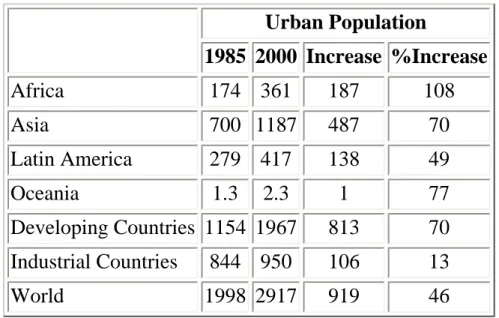
predominant (71% excluding India) (UNDP 1992:136). Poverty is endemic in many of these urban areas and is often comparable to that in rural areas. Table 4 shows how urban populations are likely to grow.
It is striking that cities often produce high proportions of countries GDP. Estimates made in the early 1980's suggested that Lima in Peru, with 27% of total population was responsible for 43 % of GDP Manila with 13 % of the population accounted for 33%, Lagos with 5% of the population produced 57% of the value added by manufacturing, and Port Au Prince in Haiti with 14% of the population generated 40% of national income (UNDP 1990:86). These figures may have overstated the importance of cities to national economies since much rural production may not be traded. However since these estimates were made urbanisation has continued rapidly and the economic
polarisation implied by these estimates has probably increased. In 1960 there were only three cities with a population of more than 10 million in the developing world, by 2000 there are likely to be at least 18. There were only 9 cities with a population of more than 4 million in 1960 in the developing world, by 2000 there are likely to be 50 (UNDP 1990:86).
Table 4 Rate of Increase in Urban Population 1985-2000
Urban Population 1985 2000 Increase %Increase Africa 174 361 187 108 Asia 700 1187 487 70 Latin America 279 417 138 49 Oceania 1.3 2.3 1 77 Developing Countries 1154 1967 813 70 Industrial Countries 844 950 106 13 World 1998 2917 919 46
Source: UNDP 1990:87 Table 5.1
Both because urbanisation means that increasing proportions of the population are urban and because many of these urban dwellers are poor, shifts are implied by
urbanisation in patterns educational assistance targeted on poverty alleviation. These shifts are not only of a quantitative kind. Urban environments are different to rural environments; employment opportunities have a different quality, and different types of educational provision may be thought relevant.
1.3.5 Displaced populations and refugees
Displaced populations have been growing. In the Sudan, in Southern Africa, and in parts of South East Asia there are substantial flows of people driven by war, drought and famine to seek safer and more tolerable living conditions. For example more than 400,000 refugees are estimated to be in makeshift camps in Kenya coming from the surrounding countries at rates of anything up to 1000 an hour (Sunday Times
7.6.92:22), and there are almost certainly more than ten million displaced persons throughout Africa. These populations, and others like them, represent some of the most marginalised and educationally underprivileged groups whose prospects are the most bleak. The states in which they reside may or may not recognise their citizenship and are unlikely to place a high value on educational provision for either adults or children. As the numbers of refugees have grown so their social and economic characteristics have been changing. Most are now from rural, poorly educated and economically
deprived backgrounds moving from one developing country to another through force of circumstance (Preston 1991). The need for emergency assistance to these groups is widely recognised. The politics of educational assistance are much more complex. The needs exist at several levels. Basic health and nutritional information is a priority to keep such populations as healthy as is feasible under difficult conditions. In some c