EFFICIENT LANGUAGE PROCESSING:
THE ROLE OF MEMORY AND VISUO-SPATIAL CONTEXT
BY
RACHEL A. RYSKIN
DISSERTATION
Submitted in partial fulfillment of the requirements for the degree of Doctor of Philosophy in Psychology
in the Graduate College of the
University of Illinois at Urbana-Champaign, 2016
Urbana, Illinois
Doctoral Committee:
Associate Professor Sarah Brown-Schmidt, Chair Professor Aaron S. Benjamin
Professor Gary S. Dell Professor Kara Federmeier Professor Ranxiao Frances Wang
Abstract
A hallmark of adult language processing is the efficiency with which it unfolds despite the massive amount of ambiguity present in the linguistic signal. Prior work has shown that visuo-spatial (e.g., Heller et al., 2008; Ryskin et al., 2014) and pragmatic (Sedivy et al., 1999) contextual information can be rapidly integrated during the comprehension process. In this dissertation, I explored the use of this information during on-line language processing and how it is supported by learning and memory mechanisms. In Chapter 2, I examined whether individual differences in working memory, basic recall, and memory cue generation predict the ability to make use of information about visual perspective differences during comprehension. A targeted re-analysis of these data (Experiment 2), examined how perspective-taking evolves within a conversational pair, over the course of the conversation. In Chapter 3, I explored the use of spatial perspective-taking during comprehension. In two experiments (Experiments 3 and 4), I examine how listeners encode spatial perspectives in a speaker-specific fashion and use this information during interpretation of spatial language. In Chapter 4, I examined whether listeners can learn high-level, pragmatic information about a speaker through exposure and integrate it with the visual context on-line, during sentence processing. I examined the ability of listeners to learn and transfer this information across contexts (Experiments 5a and 5b), as well as the ability to use this information within a context (Experiment 6). The results of the work reported in this dissertation point to an important role for context-specific learning in the ability of the language processing system to rapidly and efficiently integrate visual, spatial, and pragmatic information during on-line comprehension.
TABLE OF CONTENTS
CHAPTER 1: INTRODUCTION………1
INDIVIDUAL DIFFERENCES IN MEMORY AND VISUAL PERSPECTIVE-TAKING………..1
SPEAKER-SPECIFIC SPATIAL PERSPECTIVE-TAKING………7
LEARNING THE PRAGMATICS OF USING VISUAL CONTEXT………….14
CHAPTER 2: INDIVIDUAL DIFFERENCES IN MEMORY AND VISUAL PERSPECTIVE-TAKING…..………..………..…………..19
EXPERIMENT 1…...………19
EXPERIMENT 2…...………46
CHAPTER 3: SPEAKER-SPECIFIC SPATIAL PERSPECTIVE-TAKING…………...56
EXPERIMENT 3..……….57
EXPERIMENT 4...………69
CHAPTER 4: CONTEXT-SPECIFIC LEARNING OF PRAGMATICS……….75
EXPERIMENT 5a.………76
EXPERIMENT 5b……….84
EXPERIMENT 6………..……….91
CHAPTER 5: CONCLUSIONS..………..99
REFERENCES.………...102
CHAPTER 1: INTRODUCTION
Despite the incredible complexity and variability intrinsic to language, in everyday life we are able to comprehend and produce language without giving a second thought to the many cognitive processes recruited for those purposes. For example, to understand and respond to your colleague’s simple question, “What did you think of that talk?,” your language system will bring to bear visual input (e.g., to identify the speaker), search long-term memory (e.g., to recall what talks you have been to recently), and draw pragmatic inferences (e.g., to assume your colleague is referring to a talk she also attended but has not yet discussed with you), among many other sources of information.
This extra-linguistic information is critical to our ability to communicate efficiently in daily life. By integrating information from all available, relevant sources (e.g., who the speaker is, where they are located, what has been said in the past), the listener discovers constraints on the meaning of a sentence as it unfolds and narrows down the set of candidate referents. Predicting features of upcoming language input, allows for a more rapid and fluid
comprehension process (see Kuperberg & Jaeger, 2016 for a review) where interlocutors rarely fail to converge on the same interpretation of a sentence despite under-specification in the
linguistic signal. The nature and scope of this extra-linguistic information, as well as the memory mechanisms that support its integration, are not well understood. I have explored these issues in three related lines of research.
Individual Differences in Memory and Visual Perspective-taking
Many activities of everyday life require individuals to imagine a world that differs from the one they currently inhabit—whether it’s finding common ground with someone who has had
different life experiences or predicting what you will remember in the future. A common setting that requires taking a different perspective into account is face-to-face conversation. When two individuals converse, some of what they might want to discuss is known to both parties and some is known only to one of them. Partners in a dialogue must model each others’ knowledge states in order to communicate efficiently (Clark, 1992; 1996; Stalnaker, 1978).
Similarly, when writing a reminder note for oneself to do something at a later time, such as to call a friend to ask for their new home address after they’ve moved, some notes will be more effective than others. For example, when you read a note that says “Call Rob” you might wonder what it is you were supposed to call him about. On the other hand, “Call Rob about address” may provide the appropriate cue to bring to mind all the relevant details of what action needs to be taken. When writing a reminder note for yourself, it is necessary to accurately assess aspects of your future state at the time of retrieval (Tullis & Benjamin, 2015a, 2015b). This assessment is analogous to perspective-taking of your future self—you must determine what will be common between your current self and your future self and what is privileged information in your current state.
Perspective-taking in Language Comprehension
One set of relevant evidence comes from the visual world eye-tracking paradigm (Tanenhaus, Spivey-Knowlton, Eberhard, & Sedivy, 1995) in which participants’ eye gaze is monitored as they observe scenes with real-world objects or images while listening to auditory stimuli. This research suggests that listeners represent information about the perspective of the speaker, and use this information to guide processing of the speaker’s utterances (Brown-Schmidt, Gunlogson, & Tanenhaus, 2008; Ferguson & Breheny, 2012; Hanna, Tanenhaus, & Trueswell, 2003; Heller, Grodner, & Tanenhaus, 2008). For example, Heller et al. (2008) asked a
speaker (the experimenter) and listener (the participant) to sit on either side of a physical display with cubbyholes containing objects (see Figure 1). Most of these objects were mutually visible from either side of the display and therefore common ground. In critical conditions, one object was placed in a cubbyhole that was occluded from the speaker’s view—that object was in the listener’s privileged ground. Eye-movement data indicated that listeners took into account the privileged status of that object when interpreting the speaker’s instructions and did not consider it to be a potential referent. In other words, listeners inferred that the speaker could not be referring to the occluded object even when the speaker’s utterance was potentially consistent with it. In order to do this, listeners must form a representation of the speaker’s perspective on the visual display and access this perspective information when interpreting the speaker’s instructions.
Figure 1. Example stimuli (in four conditions) from Heller et al. (2008), as seen by the listener. Items with a white background are visible to a speaker seated on the other side of the cubbyhole display. Items with a grey background are hidden from the speaker’s view. When interpreting an instruction such as “Click on the big duck.” listeners make more fixations, during “big”, to the target (big duck) in the 2 contrasts - privileged condition, compared to 2 contrasts – shared. Listeners infer that “big” cannot be referring to the cup in the 2 contrasts - privileged condition because the speaker doesn’t see the small cup.
Perspective-taking in Language Production
When choosing what to say to another person, speakers take into account what the addressee does and does not know. At the most basic level, Spanish-English bilingual children know from an early age to speak in English to English speakers and Spanish to Spanish speakers (Genesee, Nicoladis, & Paradis, 1995). At a more fine-grained level, speakers modulate their use of adjectives based on the listener’s knowledge (Nadig & Sedivy, 2002; Matthews, Lieven, Theakston, & Tomasello, 2006; Yoon, Koh, & Brown-Schmidt, 2012; Yoon & Brown-Schmidt, 2014). For example, Nadig and Sedivy (2002) examined a situation in which participants had to instruct a listener (the experimenter) about which object in a cubbyhole display to pick up (e.g., “Pick up the cup”). The target object was sometimes in a size-contrasted pair (i.e., there was a big cup and small cup in the display). When both members of the pair were common ground, adult participants, and even 5 and 6-year-olds, always used an adjective (e.g., “Pick up the big cup”) to make clear which cup they were referring to. When one of the pair members was occluded from the listener’s view (e.g., the small cup was in the speaker’s privileged ground), such that there was only one cup visible from the listener’s perspective, participants used the size adjective only half of the time. These different choices reflect the fact that the speaker has a mental representation of what information the listener has available and that the speaker uses that information to guide what she says.
Perspective-taking in Memory Cue Generation
Individuals often prospectively generate cues for themselves. For example, students take notes in a class in order to be able to recall the class material at a later time. Recall is more likely to occur when the retrieval context and the encoding context are more similar (Tulving &
at the time of retrieval—in other words, taking the perspective of one’s future self. Similarly, memory retrieval spurred by a previously generated cue and perspective-taking in
comprehension both require taking the generator’s (yourself in the past or another person) point of view into account in order to interpret the received cue.
Evidence that cue generators do take the perspective of their future selves comes from Tullis and Benjamin (2015b), who asked participants to generate either one-word descriptions of target words or one-word cues that would support later cued recall of targets. Generated cues elicited higher recall than generated descriptions, suggesting that learners tailor their mnemonic cues to their future cognitive state. Learners were even able to hedge against future interference among to-be-remembered synonyms by trading off cue-target associative strength for cue
distinctiveness when necessary. Further, in much the same way as in speech production, learners tailor mnemonic cues for different intended recipients; cues are more idiosyncratic when
generated for themselves than for others (Tullis & Benjamin, 2015a). Individual Differences in Perspective-taking
Despite how widespread perspective-taking seems to be in everyday life, it is not
something that individuals do effortlessly (Keysar, Lin, & Barr, 2003; Birch & Bloom, 2007; cf. Ryskin & Brown-Schmidt, 2014). Children under the age of four often fail to appreciate that other people may hold different beliefs (Wimmer & Perner, 1983) when probed in an explicit verbal task. On the other hand, implicit measures show that 15-month-olds are more surprised when an agent looks for a toy in the correct location if the agent has never seen the toy be placed in that specific location (Onishi & Baillargeon, 2005). The latter result suggests that children may form representations of others’ perspectives very early, but lack the cognitive resources to select verbal answers that reflect this knowledge until much later in development. These findings
are consistent with evidence that the development of theory of mind in children goes hand in hand with the development of inhibitory control (Carlson & Moses, 2001). More specifically, children with better executive function are more likely to take into account the perspective of a conversation partner when speaking or listening (Nilsen & Graham, 2009).
Similar relationships between executive function and perspective-taking during language comprehension and production have been reported in adults as well. Listeners with superior executive control and working memory are more adept at using the speaker’s perspective to anticipate the correct referent of a sentence (Brown-Schmidt, 2009; Lin, Keysar, & Epley, 2010). Speakers are more likely to tailor their utterances appropriately given a listener’s viewpoint when they have higher working memory (Wardlow, 2013). It is worth noting however, that these effects appear to be very small and do not consistently replicate (Brown-Schmidt, 2012; Ryskin, Brown-Schmidt, Canseco-Gonzalez, Nguyen, & Yiu, 2014; Brown-Schmidt & Fraundorf, 2015).
Executive function also plays a role in a variety of memory tasks that require prospection. Individuals with high working memory capacity and superior executive control are more likely to remember to carry out an intended action at a specified point in the future (Marsh & Hicks, 1998; Kliegel, Martin, McDaniel, & Einstein, 2002; Brewer, Knight, Marsh, & Unsworth, 2010; Unsworth, Brewer, & Spillers, 2012). They are also more likely to adopt retrieval cues that allow for an organized, efficient approach to recalling a list of heterogeneous items (Fiechter,
Benjamin, & Unsworth, in press; Unsworth & Spillers, 2010, Unsworth, Brewer, & Spillers, 2013; Unsworth & Engle, 2007). Further, executive and working memory processes have been linked to the specificity and richness of representations during future simulation (D’Argembeau, Ortoleva, Jumentier, & Van der Linden, 2010; Hill & Emery, 2013).
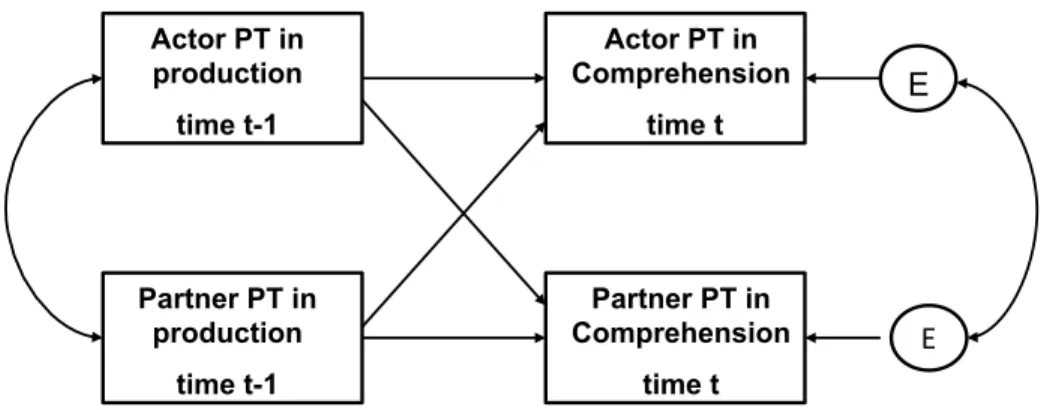
In Chapter 2, I will examine how individual differences in memory (working memory, prospective memory, cued recall), perspective-taking during production, and executive function relate to listeners’ ability to make joint use of the visual context and perspective information. Uncovering these relationships will shed light on the types of cognitive processes brought to bear during comprehension when perspective-taking is required. Furthermore, I will examine how these individual differences in perspective-taking ability interact at the level of the
conversational dyad. In a dialogue, partners may differ in their ability to produce effective descriptions of referents. An open question is whether an efficient listener can learn to adjust when the speaker fails at perspective-taking and how such a process of adjustment might unfold over time.
Speaker-Specific Spatial Perspective-taking
In order to understand a speaker, listeners must consider the speaker’s perspective (Clark, H. H., 1992) and how it may differ from their own. Indeed, listeners are sensitive to differences in perspectives between themselves and an interlocutor and bring this information to bear in the early moments of processing a sentence (Nadig & Sedivy, 2002; Hanna, Tanenhaus, &
Trueswell, 2003; Heller, Grodner, & Tanenhaus, 2008; Brown-Schmidt, Gunlogson, & Tanenhaus, 2008; Brown-Schmidt, 2009; Brown-Schmidt, 2012). The bulk of this evidence comes from paradigms in which a difference in perspectives between the speaker and listener is created by occluding an item from the speaker’s view (see Figure 1). Much of this research, including results from Chapter 2, shows that listeners (at least partially) discount occluded objects as potential referents, on the assumption that the speaker is unlikely to speak about something they have no knowledge of. This successful use of perspective corresponds to what
is visible to oneself from what is visible to others, as in occlusion situations. Level 1 knowledge emerges early in development and is thought to require little cognitive effort, even by age three (Flavell, Everett, Croft, & Flavell, 1981; Masangkay, McCluskey, McIntyre, Sims-Knight, Vaughn, & Flavell, 1974).
Differences in perspective can arise from situations other than occlusion, as well. In particular, differing spatial viewpoints require interlocutors to take this into account in order to understand each other (Schober, 1993). It has been argued that this Level 2 knowledge—the ability to appreciate not only that another person sees something, but how they see it—emerges later in development and is more cognitively effortful than Level 1 knowledge (Flavell, Everett, Croft, & Flavell, 1981; Salatas & Flavell, 1976; Apperly & Butterfill, 2009).
In daily life, the spatial viewpoints of conversation partners are often misaligned. In fact, in some sense, they are never truly aligned because interlocutors can never inhabit the exact same location at the same time (Schober, 2009). Speakers frequently and spontaneously take into account such differences in perspectives when communicating (Tversky & Hard, 2009). For instance, when giving walking directions to a friend, you might say, “From Sixth Street you’ll take a left on Daniel Street, and I’ll be standing halfway up the block.” From your own
perspective, your location is actually to the right of Sixth Street but, as a courtesy to your friend who is unfamiliar with the area, you take their perspective in order to avoid confusion. Indeed, Schober (2009) found that when participants with high spatial perspective-taking ability are matched with participants with low abilities, they adopt spatial language consistent with that partner’s perspective more often when giving directions compared to when they are paired with someone who is equally capable at spatial perspective-taking. Similarly, speakers use their egocentric perspective less when directing a person who is unable to provide immediate
feedback about whether they understood the spatial instruction (Schober, 1993). The fact that speakers often choose to start with their own perspective when they know that any confusion can be easily resolved (i.e., when the person receiving the instructions can ask for clarification) points to the inherent difficulties of performing a spatial perspective transformation. Spatial Perspective-taking and Memory
Studies of memory for spatial layouts of objects indicate that a mental change in viewpoint renders information about object-to-object relations more difficult to retrieve compared to when the viewpoint remains stable (e.g., Shelton & McNamara, 1997; Shelton & McNamara, 2001; Simons & Wang, 1998). Rieser (1989) asked participants to memorize an array of objects and then tested their ability to retrieve the relative spatial location of an object from a novel point of view. Participants had more difficulty doing so when the novel location was reached by a rotation (e.g., turning 90°) than by a simple translation (e.g., taking three steps forward). One potential explanation for this processing cost associated with viewpoint rotation comes from evidence that participants most often encode the environment, and objects within it, using an egocentric reference frame (e.g., Wang, 2007; Wang, 2012). As a result, taking another perspective requires the effortful transformation of the original (egocentric) reference frame to fit a new orientation (Easton & Sholl, 1995; Mou, McNamara, Valiquette, & Rump, 2004; Kessler & Thomson, 2010). Others have argued that the processing cost results primarily from the sensorimotor interference created between the coordinates in the person’s own perspective and those in the imagined perspective (May, 2004; Brockmole & Wang, 2003; Wang, 2005).
Furthermore, the difficulty of spatial perspective-taking increases with the angular disparity between the participant’s viewpoint and the novel viewpoint presented at test (e.g., Rieser, 1989; Kessler & Thomson, 2010; Kessler & Rutherford, 2010; Surtees, Apperly, &
Samson, 2013; Huttenlocher & Presson, 1973; Levine, Jankovic, & Palij, 1982). The detrimental effects of greater angular disparity suggest that spatial perspective-taking is an embodied
cognitive process (Kessler & Thomson, 2010). Thus, a listener taking into account the
perspective of her conversation partner will mentally rotate her egocentric perspective to align it with the partner’s.
One way to reduce the cognitive burden of spatial perspective-taking is by providing advance information about a viewpoint. Studies asking participants to imagine a perspective before seeing an array from the new viewpoint show that the representation of a perspective can be maintained in memory in the absence of the visual array that it applies to (Avraamides, Ioannidou, & Kyrianidou, 2007; Avraamides, Theodorou, Agathokleus, & Nicolaou, 2013; c.f. Wang, 2005). Further, Galati, Michael, Mello, Greenauer, and Avraamides (2013) provide evidence that speakers do learn and store representations of their future conversation partner’s spatial viewpoint, when it is made available to them in advance. However, the nature of these representations and how they are stored and accessed may differ substantially between speakers and listeners. The task of the speakers is to put into words the spatial perspective that they have chosen to adopt whereas the listeners must remain flexible enough in their representations to adapt to whichever unknown perspective they are about to hear an instruction from (e.g., the speaker might turn out to be egocentric and say “I’ll be to the right of Sixth Street,” rather than “From Sixth Street, you’ll take a left on Daniel Street.”).
Spatial Perspective-taking during Language Processing
The challenges involved in representing others’ spatial perspectives are well documented. Yet, the comprehension processes involved in interpreting spatial language from a perspective
that differs from one’s own are less well understood. It is clear that speakers often produce spatial language from the intended recipient’s perspective and that listeners (or readers) can come to understand spatial directions that are given from a different perspective (Schober, 1993; Tversky & Hard, 2009; Taylor & Tversky, 1992). Yet, little is know about the mechanisms involved in, or the time-course of, adopting a different perspective during comprehension of spatial language.
The integration of an occlusion-based difference in perspectives occurs rapidly during sentence interpretation (e.g., Heller et al., 2008). However, the processes involved in computing a differing perspective are not the same when that difference is the result of occlusion compared to when it stems from an alternative spatial orientation (Michelon & Zacks, 2006). Occlusion prompts participants to use a simple line-of-sight tracing strategy to compute the differences between their perspective and that of their partner. By contrast, when spatial perspectives are misaligned, participants must undergo an imagined transformation of their perspective and remapping of reference frames, which may lead to a conflict between the imagined and egocentric reference frames. Thus, spatial taking and occlusion-based perspective-taking may differently guide the on-line comprehension of utterances.
Nonetheless, some evidence suggests that listeners are able to use information about a speaker’s spatial viewpoint to constrain the interpretation of a sentence as it unfolds. Ryskin, Brown-Schmidt, Canseco-Gonzalez, Yiu, & Nguyen (2014) monitored the eye movements of listeners as they processed sentences with potentially ambiguous spatial language. Participants heard instructions to move objects around a complex display of animals with accessories (e.g., a hat, a purse). The instructions, such as “Go left to the pig with the hat,” were given either from the participant’s egocentric perspective (i.e., “left” = participant’s left) or the opposite
perspective (a 180° rotation; “left” = participant’s right). The displays were designed such that instructions were temporarily ambiguous between two potential referents. For example, “the pig with the...” was temporarily consistent with two different pigs on the screen, one of which was located to the left of the starting position (e.g., a pig with a hat), and the other was located to the right of the starting position (e.g., a pig with a purse). Critically, this temporary ambiguity could be resolved early by integrating the speaker’s perspective on-line during comprehension.
Analysis of eye-gaze to the potential referents revealed that instructions that were generated from the opposite spatial perspective posed challenges and delayed processing. However, despite these challenges, participants showed a clear target preference well before the onset of the
disambiguating word (e.g., hat), demonstrating that even when spatial perspectives are
misaligned, listeners are able to use knowledge about the speaker’s spatial viewpoint to interpret their utterances as they unfold.
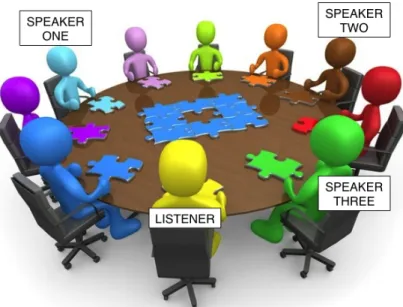
Though we know that listeners can remember one speaker’s spatial perspective and use it to interpret language online, little else is known about how comprehension processes and spatial perspective-taking processes interact. How might a listener represent multiple perspectives and switch between them, as one often has to do when conversing with multiple people who all have varying perspectives on the visual array in question (see Figure 2)? Additionally, is the task of tracking these perspectives made more difficult when the speakers’ perspectives are more dissimilar from the listener’s (e.g., a 135° rotation vs. a 45° rotation)?
Figure 2. Example scenario where a listener must comprehend spatial language produced by multiple speakers. Speaker One, Two, and Three have different spatial perspectives and will likely take turns talking, so the Listener must flexibly switch between their perspectives. The Speakers are unlikely to get up and switch places so their spatial perspectives are strongly tied to their identity. Speaker Three’s perspective is more similar to the Listener’s perspective than Speaker One and Speaker Two’s.
Because a given speaker’s viewpoint is likely to be relatively stable over the course of a conversation, listeners can predict, with some certainty, that their conversational partner will continue using the same perspective throughout the dialogue. It may then be computationally efficient to store memories of an interlocutor’s spatial perspective along with other cues tied to speaker identity. Previous findings of angular disparity effects (e.g., Kessler & Thomson, 2010; Kessler & Rutherford, 2010; Surtees et al., 2013) indicate that storing or accessing this
representation will be more challenging when it requires a larger rotation. In Chapter 3, I examine whether listeners encode spatial perspectives that differ from their own in a partner-specific way.
Learning the Pragmatics of Using Visual Context
Another way in which the language processing system resolves the challenge of
ambiguity is through the use of referential context. Speakers are sensitive to the visual context in which they are about to refer to an item (Olson, 1970). When referring to a particular object, speakers attend to the contrasts that are present in their visual field and design definite referring expressions in order to unambiguously pick out the intended referent with respect to those contrasts. Cues to contrast can appear in the forms of modifiers or prosodic contours, among others. For example, when describing a tall glass in the context of an unrelated item such as a teddy bear, speakers will use the bare noun phrase, the glass, to ask for it. On the other hand, when the context item is a shorter glass, speakers will distinguish the tall from the short glass using a scalar adjective: the tall glass. Similarly, speakers may use a prosodic contour known as L+H*, characterized by an initial drop in F0 followed by a steep rise (Beckman & Ayers, 1997; Pierrehumbert & Hirschberg, 1990), to distinguish an intended referent from a contrasting alternative, as in “not the short glass, but the TALL [L+H*] one” (e.g., Watson, Tanenhaus, & Gunlogson, 2008).
Evidence from the visual world paradigm indicates that listeners rapidly integrate
contrast information into the comprehension process (Sedivy et al., 1999). While interpreting the ambiguous portion of a sentence such as “Pick up the big cup” (i.e., “Pick up the big…”),
listeners make more fixations to the big cup if there is an item in a size contrast with it (i.e., a small cup) on the screen. Scalar adjectives, in particular, are interpreted contrastively, whereas color adjectives do not always lead to the inference that a contrast is present in the scene (Eberhard, Spivey-Knowlton, Sedivy, & Tanenhaus, 1995; Sedivy, 2003).
Multiple proposals have been put forth about the mechanism driving this interpretive process and the rapid anticipatory eye-movements associated with it. On the one hand, the semantic information extracted from a size adjective may automatically trigger fixations to pairs of objects. On the other hand, listeners may be looking at the pair of size-contrasted objects because they are drawing an inference about the speaker’s intent, namely, that the speaker would not have used the size adjective if the referent were not in a contrast set. If pragmatic
interpretation plays a role, then the anticipatory eye-movements should be diminished when the listener has no reason to infer that the speaker’s use of an adjective reflects contrastive intent.
Grodner and Sedivy (2011) examined whether the listener’s contrastive interpretation of scalar adjectives could be canceled in a situation where information about the speaker points to their use of scalar adjectives being infelicitous. Participants engaged in a task modeled after Sedivy et al. (1999), where they heard pre-recorded instructions such as “Pick up the tall glass” and observed four-picture displays that either contained the target and a size-contrasting item (e.g., a tall glass and a short glass; Contrast condition) or just the target item (No Contrast condition). Critically, half of the participants were in the Infelicitous Speaker condition and the other half in the Felicitous Speaker condition. In the Infelicitous Speaker condition, participants were told that the instructions were recorded by a speaker with “an impairment that caused language and social problems,” the speaker mislabeled objects and referred to inappropriate locations, and the speaker was consistently over-informative in the use of size adjectives. In the Felicitous Speaker condition, no information was provided about the speaker’s mental status, the speaker made no labeling errors, and was only over-informative in the critical No Contrast trials. Listeners in the Felicitous Speaker condition made more fixations to a modified target item (e.g., tall cup) when a contrast item (e.g., short cup) was present, replicating Sedivy et al. (1999).
However, listeners in the Infelicitous Speaker condition did not have differential fixation patterns in the Contrast and No Contrast conditions, suggesting that they were not drawing a contrastive inference from the scalar adjectives when the speaker was known to be infelicitous. This result lends support to the idea that pragmatic inference plays a role in the interpretation of size adjectives. Similarly, Kurumada, Brown, Bibyk, Pontillo, and Tanenhaus (2014) exposed subjects to speakers who used prosodic cues to contrast felicitously (e.g., “Show me the yellow square. Now, show me the GREEN square.”), or infelicitously (e.g., “Show me the yellow square. Now, show me the YELLOW circle.”). When the speaker was infelicitous, a subsequent test found that listeners did not draw pragmatic inferences when they heard an L+H* accent in a new task with the same speaker. However, if the speaker used prosody felicitously during the exposure phase, listeners interpreted the L+H* accent contrastively (Ito & Speer, 2008; Watson et al., 2008). Consistent with recent proposals that adaptation constitutes a key mechanism allowing listeners to make sense of the tremendous variability in the input (Kleinschmidt & Jaeger, 2015), this work suggests that listeners adapt their language models to the features of a particular speaker. When a speaker is known to produce utterances that disrupt the
comprehension process, listeners refrain from anticipating the intended meaning. Grodner and Sedivy (2011) used an explicit instructional manipulation to convey unreliability of the speaker’s use of scalar adjectives. In daily life it is very rare to be provided with a top-down characterization of a speaker’s pragmatic intent. An open question is whether listeners can learn about the features of a speaker’s use of adjectives from exposure alone and then apply this newly learned pragmatic information during on-line comprehension of referring expressions. This is the question that I aim to address in Experiments 5 and 6.
According to Gricean principles (Grice, 1975), listeners typically expect their
interlocutors to be cooperative and provide appropriately informative descriptions. Thus, creating a context in which listeners discard this expectation may be difficult. Aditionally, adapting quickly to an infelicitous speaker would allow for more efficient comprehension, but over-generalizing and discarding expectations of cooperativity after only a few instances of infelicitous speech would be inefficient as well. Due to the need to strike a balance between relying on well-founded expectations and adapting to new evidence, listeners may require top-down knowledge or overwhelming bottom-up evidence to change their pragmatic inferences. The results from Kurumada et al. (2014) suggest that a more bottom-up route to forming a new speaker model is viable, though this may differ by domain. Pragmatic information conveyed by prosodic cues may be more variable by speaker to begin with (Pierrehumbert, 1980) and thus more susceptible to felicity manipulations.
A second question concerns the generalizability of pragmatic learning. Pogue, Kurumada, & Tanenhaus (2016) find that listeners expect under-informative referential expressions to have been produced by speakers that have previously been under-informative. Critically, these expectations extend to new scalar modifiers. But, will this expectation transfer across domains? In Experiments 5a and 5b, I test whether listeners can learn that speakers are infelicitous in their cues to contrast across domains or whether this learning is restricted to the domain from which they have evidence. It may be advantageous for the listener to infer that a speaker who produces infelicitous prosodic cues is also likely to produce infelicitous modifiers. This would allow faster adaptation of the speaker model based on fewer bits of evidence. On the other hand, extending expectations of infelicity to new linguistic domains for which there is no prior evidence may lead to less efficient processing if the generalization is not warranted. Results from these studies
provide important insights into how the language processing system strikes a balance between rapid adaptation and over-generalization.
CHAPTER 2: INDIVIDUAL DIFFERENCES IN MEMORY AND VISUAL PERSPECTIVE-TAKING
The goal of this experiment and its re-analysis is to evaluate the contribution of individual differences in memory and executive function to performance during an on-line perspective-taking task. To do so, we measured perspective-taking in language comprehension using a conversation task in which both members of a conversational dyad were naïve
participants whose eye-movements were monitored. We also collected measures of perspective-taking during cue generation and language production, as well as measures of individual differences in working memory, cued recall, inhibitory control, and cognitive failures in everyday life. The results of Experiment 1 were reported in Ryskin, Benjamin, Tullis, and Brown-Schmidt (2015).
Experiment 1 Method Participants
One hundred fifty-two undergraduate students at the University of Illinois at Urbana-Champaign participated in this experiment in exchange for partial course credit. This large sample size was necessary for an amply powered examination of individual differences.
Participants had normal or corrected-to-normal vision and were self-reported native speakers of English.
Materials and design
Participants were recruited in pairs and both came in for two sessions that were 48 hours apart. Members of each pair did not know each other beforehand. During the first session, which
lasted approximately one hour, participants generated mnemonic cues for the cue generation task and completed four executive function tasks. During the second session, participants were given the cues that they had generated on the first day and attempted to recall the corresponding targets for each item. Next, they completed a cued recall task and a questionnaire. Finally, they took part in the conversation task as a pair. The second session lasted about two hours.
Cue Generation. The cue generation task was made up of two parts—the study session and the test session—that were separated by a 48-hour delay. This delay ensures that
participants’ performance is not at ceiling and has been used in previous work with this task (Tullis and Benjamin, 2015a, 2015b). During the study session, participants saw 80 words one at a time, in random order. They were told to generate a one-word cue for each target word.
Participants were informed that they would be tested on all the target words later and that they should pick cues that would be most helpful to them for retrieving the target. They were not allowed to use the target itself as a cue, but the selection was otherwise unconstrained.
During the test session, participants were presented with the 80 cue words they had generated in a new random order. They were asked to recall the target that corresponded to each cue. In both sessions, participants typed in responses and proceeded through the task at their own pace.
Target words were collected from the University of South Florida Free Association Norms (Nelson, McEvoy, & Schreiber, 1998). As in Tullis and Benjamin (2015a, 2015b), these to-be-remembered words were selected with the intention that college-aged subjects would have some personal experiences with the items. Sixty of the target words were identical to those used by Tullis and Benjamin (2015b). Examples of words include “dancing,” “haircut,” and
Thorndike-Lorge written frequencies of the targets ranged from 27 to 2218, with a mean of 536 and a standard deviation of 510.
Conversation Task. The conversation task was used to measure perspective-taking in both language production and comprehension. The focus of this dissertation will be primarily on the comprehension data. During the task, participants were seated in separate rooms but
communicated with each other via wireless microphones. Partners saw identical 3 x 3 grids with eight objects and a fixation cross in the center (Figure 3a). They were told to imagine that their partner was sitting on the other side of a physical grid with cubbyholes (similar to Heller et al., 2008). The displays were mirror-reversed such that, from each participant’s perspective, the items were positioned as if they were indeed looking at opposite sides of a grid of cubbies. Participants were informed that a gray background in a cell indicated that their partner couldn’t see that object; these items were in the participant’s privileged ground. Conversely, a black cell indicated that their partner could see something in that cell (i.e., it had a gray background on their partner’s display and was in their partner’s privileged ground). The target item was circled on the speaker’s display. Participants randomly alternated telling each other which item on the screen to click on. Each room was equipped with an Eyelink-1000 desktop-mounted eye-tracker so that eye movements, as well as synchronized voice recordings, were collected for both participants throughout the conversation task.
Collecting both speech and eye-tracking data from both participants allowed us to evaluate the perspective-taking ability of both participants in both language production and comprehension. This feature of the design affords—for the first time in the substantial literature on conversation—a within-subjects comparison of perspective-taking in language production and comprehension. The conversation task consisted of 288 trials and lasted about one hour.
One-third (96) of the trials constituted critical trials for one participant in the pair, another One-third of these trials constituted critical trials for the other participant in the pair, and one-third were filler trials. All trial types were randomly intermingled. Stimulus presentation for all tasks, except for the questionnaire, which was on paper, was controlled using the Psychophysics Toolbox Version 3 (PTB-3; Brainard, 1997) for MATLAB.
Language Comprehension. Perspective-taking during comprehension was measured by monitoring listeners’ eye movements while their partner provided an instruction. On critical comprehension trials, the speaker’s display was always unambiguous with respect to the
instruction they were intended to produce (i.e., critical production trials were not used as stimuli for comprehension). The rate of production errors on these trials was low (6%) and trials
containing speaker errors were not included in the analyses of comprehension data1. In other words, we can be confident that the instruction given, though unscripted, provided an appropriate auditory stimulus.
The three critical conditions2 (Figure 3a-c) were modeled after Heller et al. (2008), and were designed to assess the listener’s sensitivity to the speaker’s perspective. Across conditions, listeners always heard an instruction that included a size modifier and a target object to click on (e.g., “Click on the big banana”). In the Two Contrasts-Shared condition (Figure 3a), listeners saw two sets of items that formed a size contrast (e.g., a big banana, a small banana, a big
1 All the analyses were also done with speaker error trials included and the results did not differ. The reliability of the individual measure of perspective-taking in comprehension was slightly improved when the error trials were excluded so all analyses reported here do not include the 6% of trials with errors.
2 There were two other “comprehension” conditions during which the participant acted as a listener but these trials were not of interest in terms of the analysis of perspective-driven eye movements. On these trials, the listeners often heard an instruction with no size modifier (e.g., “Click on the banana”) and there was no temporary referential ambiguity because the listener only saw one instance of the target item (e.g., there was only one banana on their screen). The purpose of these trials was simply to provide a recipient for the partner’s critical production trials.
balloon, and a small balloon)3 and three other filler items on the screen. One of the filler items was in the listener’s privileged ground (indicated by the gray background) and the contents of one cell were hidden from the listener (indicated by the black square). The competitor—for all conditions—was defined as the item that was also part of a contrast set and the same size as the target (e.g., the big balloon when the big banana was the target). In the Two Contrasts-Privileged condition (Figure 3b), listeners saw two sets of items that formed a size contrast (e.g., a big balloon, a small balloon, a big banana and a small banana) and three other filler items on the screen. Critically, the item that contrasted in size with the competitor (i.e., the small balloon when the competitor is the big balloon) was in privileged ground (indicated by the gray background). The contents of one cell were hidden from the listener (indicated by the black square). In the One Contrast condition (Figure 3c), listeners saw one set of items that formed a size contrast (e.g., a big banana and a small banana), one item that was cohort and size
competitor for the target (e.g., a big balloon) and four filler items. One of the filler items was in privileged ground (indicated by the gray background) and the contents of one cell were hidden from the listener (indicated by the black square).
a. Two Contrasts - Shared b. Two. Contrasts - Privileged c. One Contrast
Figure 3. Sample displays from the three critical conditions during the comprehension trials of the conversation task.
a. Contrast - Shared b. Contrast - Privileged c. No Contrast
Figure 4. Sample displays from the three critical conditions during the production trials of the conversation task.
+"
+"
+"
Language Production. Perspective-taking during language production was measured using the speakers’ correct use of size adjectives given the visual context. The three critical4 conditions (Figure 4) were modeled after Nadig and Sedivy (2002). A green circle appeared around one of the objects on the screen and speakers instructed their partner to click on that object. In the Contrast-Shared condition, the display contained two5 sets of items that formed a size contrast (e.g., a big banana, a small
banana, a big balloon, and a small balloon) and three other filler items on the screen. One of the filler items was in privileged ground (indicated by the gray background) and the contents of one cell were hidden from the speaker (indicated by the black square). The target item—circled in green—was part of a size contrast (e.g., the big banana). The correct instruction in this case is “Click on the big banana” because the listener sees two different-sized bananas. This production condition is equivalent to the Two Contrasts-Shared comprehension condition. In the Contrast-Privileged condition, the display
contained two sets of items that formed a size contrast (e.g., a big banana, a small banana, a big balloon, and a small balloon) and three other filler items on the screen. Critically, the item that contrasted in size with the target (i.e., the small banana) was in privileged ground (indicated by the gray background). The contents of one cell were hidden from the participant (indicated by the black square). The correct instruction in this case was “Click on the banana” because the listener only sees one banana, despite the fact that the
4 There were two other production conditions during which the participant gave instructions but these trials were not of interest for the analysis of perspective-driven utterances. On these trials, speakers saw one contrast set (e.g., big balloon, small balloon) and the target was one item in that pair such that (similar to Two Contrasts – Shared) they should produce an instruction with a size modifier (e.g., “Click on the big balloon”). The purpose of these trials was simply to provide the auditory stimulus for the partner’s critical comprehension trials (Two Contrasts – Privileged and One Contrast).
speaker sees two. In the No Contrast condition, speakers saw one target item (e.g., a big banana), one set of items that formed a size contrast (e.g., a big balloon and a small balloon), and four filler items. One of the filler items was in privileged ground (indicated by the gray background) and the contents of one cell were hidden from the speaker (indicated by the black square). The correct instruction in this case was “Click on the banana” because the listener and speaker only see one banana.
Each critical trial consisted of a random pairing of condition (comprehension: Two Contrasts-Shared, Two Contrasts-Privileged, One Contrast, or production: Contrast-Shared, Contrast-Privileged, No Contrast) and cohort set (e.g., banana-balloon, ant-anvil). The Two Contrasts-Shared/Contrast-Shared condition was critical for both
comprehension and production trials. So as not to diminish the statistical power of our analyses, we made it into two conditions (one critical for production, the other for comprehension). Therefore, there are 32 trials of Two Contrasts-Shared, 16 of Two Contrasts-Privileged, and 16 of One Contrast for each participant’s eye-movement data. There are also 32 trials of Contrast-Shared (the same trials as the 32 Two Contrasts-Shared trials), 16 of Contrast-Privileged, and 16 of No Contrast for each participant’s production data.
Individual Differences. During the first session, participants completed four tasks measuring individual differences in executive function. These tasks were chosen to be similar to those used in prior work linking perspective-taking and executive function (Brown-Schmidt, 2009; Wardlow, 2013; Nilsen & Graham, 2009). In addition, two measures of individual differences in memory were collected during the second session. The six measures are listed below:
1. Stroop Task One: Participants viewed color words presented in a colored text that did not match the meaning of the word. For instance, the word “green” might appear in blue text. In the first block of trials, participants were instructed to simply read the word and say it out loud (e.g., “green”). In the second block, they were instructed to ignore the word and say the color of the text out loud (e.g., “blue”). Across the two blocks, the word and the color of the text were always incongruent. Each color word appeared on the screen for 700ms and participants’ spoken responses were recorded throughout. Recordings were later hand-coded for accuracy; the proportion of correct responses across the two blocks was used as a measure of inhibitory control.
2. Stroop Task Two: Participants viewed color words presented in a colored text in front of a patch of color. For instance, the word “green” might appear in blue text in front of a red rectangle. In the first block of trials, participants were instructed to ignore the word and say the color of the patch out loud (e.g., “red”). In the second block of trials, participants were instructed to ignore the word and say the color of the text out loud (e.g., “blue”). All trials were self-paced and participants’ reaction times (latency of button press to advance to the next trial) and spoken responses were recorded throughout. The first block was 15%
congruent (i.e., the patch color matched the word) and the second block was 51% congruent (i.e., the color of the word matched the word). Each participant
received an interference score, obtained by subtracting the average reaction time for saying the patch color from the average reaction time for saying the text color. Thus, a lower score signified less interference of the incongruent color word or
superior inhibitory control. These scores were recoded so that a higher score on Stroop Two (as well as Stroop One) indicated superior inhibitory control. 3. Minus-Two Span Task: In this working memory span task, participants saw a set of numbers, one by one. After each set they were asked to recall (and type in), in order, the numbers they had just viewed, subtracting two from each number. The set size varied from two to seven. Each set size was used twice for a total of twelve blocks. The score was determined by adding together the proportions correct for each block. For instance, if the participant recalled four items from the block of six correctly, that block would receive a score of 4/6. The maximum possible score was twelve.
4. Operation Span Task: This working memory task was modeled after one described by Unsworth, Heitz, Schrock, and Engle (2005). Participants saw a set of math problems (e.g., (3 x 2) + 4 =?) followed by a number (e.g., 9). They were told to respond “True” (by pressing a keyboard key) if that number was the answer to the preceding math problem and “False” if it was not (in this case, “False”). After each response they saw a letter (e.g., R). At the end of a set, they were asked to recall and type in all the letters they had seen in that set, in order. Participants were told to maintain their accuracy on the math problems above 85% and were given feedback about their accuracy throughout the task. Pacing was calibrated to each subject by averaging their speed of response to practice math problems and using a speed that was 2.5 standard deviations above that average. The set size varied from three to seven. Each set size was used three times for a total of fifteen blocks. The score was determined by adding together
the proportions correct for each block. For instance, if the participant recalled four letters from the block of six correctly, that block would receive a score of 4/6. The maximum possible score was fifteen.
5. Cued Recall Task: In this task, participants studied forty pairs of words (e.g., bitter – lemon) on the screen for three seconds each. They were told to try to remember them for a later test. After they studied the forty pairs, they were given the left word from each pair (e.g., bitter - ?) and were asked to type in the right-side member of the pair. Number of words recalled correctly was used as a measure of basic memory recall ability.
6. Cognitive Failures Questionnaire (CFQ): The questionnaire is intended to measure the rate of a person’s memory deficits, absent-mindedness and slips of action in daily life (Broadbent, Cooper, Fitzgerald, & Parkes, 1982), because such events presumably relate to one’s ability to engage in successful perspective-taking in more ecologically relevant circumstances than those measured by the word-list procedure. It contains questions such as: “Do you find you confuse left and right when giving directions?”, “Do you find you forget appointments?”, “Do you daydream when you ought to be listening to something?” Answers are given on a 0 (Never) to 4 (Very often) scale, and each participant’s score consists of the sum of their responses on all twenty-five questions.
Predictions Perspective-taking effects
In the cue generation task, if participants can take the perspective of their future selves, they will create effective cues for themselves and retrieve a substantial number of
targets despite the two-day delay between study and test. I also expect that cues that lead to successful retrieval will be characterized by their idiosyncracy and distinctiveness (Tullis & Benjamin, 2015b).
If participants can take into account their partner’s perspective during on-line language comprehension, they will be more likely to fixate the target in the Two Contrasts-Privileged condition than the Two Contrasts-Shared condition, because the speaker’s use of an adjective will only be consistent with one possible referent in the display when a member of a size contrast pair is in privileged ground. I also expect that participants will be most likely to fixate the target in the One Contrast condition because only one item will be consistent with the speaker’s use of an adjective—no other size contrasts appear in the display.
If participants can tailor their utterances to the perspective of their partner, they will use an adjective to describe the target referent more frequently in the Shared condition than the Privileged condition, because in the
Contrast-Privileged condition the referent is fully disambiguated without the use of an adjective. I also expect participants to use an adjective very infrequently in the No Contrast condition because the target is not in a size contrast with anything else in the display.
Relationships between tasks
Given prior findings of a link between executive function and working memory and perspective-taking, I predict that performance on the Stroop tasks, the Operation Span task, and the Minus Two Span task should predict perspective-taking ability in comprehension. If successful perspective-taking in conversation relies on the same
perspective-taking ability as the cue generation task and language production task, then I would expect individual differences across the three tasks to correlate.
Results Evidence for perspective-taking in three domains
Cue Generation. Performance on the cue generation task was based upon strict scoring, such that only the responses that matched the target identically were counted as correct. For example, if the target was “dancer”, “dance” would be counted as incorrect. On average, participants retrieved 42.13 (SD=13.62) of the 80 target words they had generated cues for.
Two major characteristics of learner-generated cues were measured: (1) the association between cue and target and (2) cue overload. Cue-to-target associative strength was determined using the normative cue-to-target associative strength found in the University of South Florida Free Association Norms (Nelson, et al., 1998). Cued recall performance typically increases as cue-to-target associative strength in a word pair increases (Feldman & Underwood, 1957). Second, cue overload, or the number of possible targets associated with each cue, was measured by counting the total number of targets in the Free Association Norms associated with each cue, by summing the cue-to-target associative strengths from the cue to all possible cue-to-targets in the database, and by counting whether the cue was in the database at all. Cues that are associated to fewer possible targets limit the search space during recall and are typically associated with better memory performance (Anderson, 1974). The characteristics of successful vs. unsuccessful cues are summarized in Table 14 in the Appendix. As expected and as shown in prior literature (Tullis & Benjamin, 2015a), cues that lead to later successful
retrieval had higher cue-to-target associative strength, a lower number of associates from cue, lower total associative strength from cue, and were less likely to be in the database. This suggests that when learners tailored their cues to be more normatively associated, but also idiosyncratic and distinctive, they were more successful at retrieving the target.
To assess how consistent participants are in the cue generation task, we measured coefficient α (the mean of all possible split-half reliabilities) using the psych package in R (Revelle, 2014). The results of this analysis indicate that the cue generation task is a highly reliable measure of participants’ ability to generate effective cues for later retrieval (α = 0.9, 95% CI = [0.88, 0.93]).
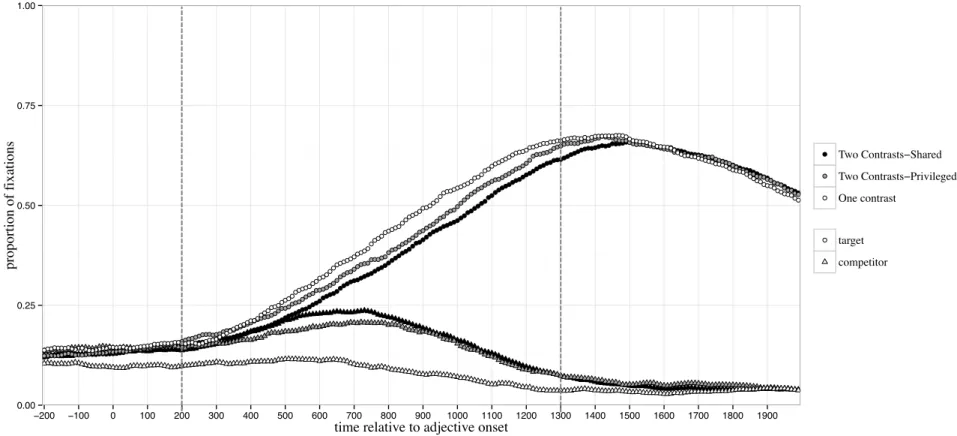
Language Comprehension. To assess perspective-taking during comprehension, we measured the eye movements that listeners made as they interpreted the speaker’s instruction (e.g., Click on the big banana). The time-course of target and competitor fixations across conditions can be seen in Figure 5. Eye movements associated with the interpretation of the instruction were analyzed in terms of a binary measure: whether the participant fixated the target during the specified time window or not.6 A fixation was coded as a fixation to the target referent if the x,y fixation coordinates landed within the cell containing the target object (e.g., the big banana).
6 Note that eye-gaze analyses in the visual world paradigm sometimes use a proportion measure (proportion of target fixations in a time-window). We used a different approach because inspection of the trial-by-trial proportion-based measure revealed that the data distribution was highly zero-inflated and would violate the linear model assumption of normally distributed residuals. Further, a binary measure of comprehension is more analogous to the production measure used in this paper, which is also binary (whether speakers use an adjective or not). Because our goal here is to compare these two measures, the binary comprehension measure is preferred.
Figure 5. Proportion of fixations to targets and competitors over time, during interpretation of an instruction (e.g., “Click on the big banana.”). The gray dashed lines indicate the approximate time-window used for analysis, beginning 200ms after the onset of the adjective (e.g., “big”).
0.00 0.25 0.50 0.75 1.00 −200 −100 0 100 200 300 400 500 600 700 800 900 1000 1100 1200 1300 1400 1500 1600 1700 1800 1900 time relative to adjective onset
proportion of f ixations Two Contrasts−Shared Two Contrasts−Privileged One contrast target competitor
Target fixations were measured in one time window (average duration 1100 milliseconds) that began at the onset of the scalar adjective (e.g., big) and ended 600 milliseconds after the onset of the noun (e.g., banana); the average duration of the noun was 600 milliseconds. This large analysis window allows us to examine the full
interpretive process occurring as the participant learns which item is the target. The time-window was offset by 200 milliseconds due to the time needed to program and launch an eye movement (Hallett, 1986).
Target fixations were analyzed in a multilevel logistic regression, using the lme4 software package in R (Bates, Maechler, Bolker, & Walker, 2014). The three conditions (Two Contrasts-Shared, Two Contrasts-Privileged, and One Contrast) were entered in the fixed effects as weighted orthogonal contrast codes. The first contrast compares Two Contrasts-Shared and Two Contrasts-Privileged with the One Contrast condition, and was used to test for the presence of a competition effect (fewer target fixations) in the
presence of a second size-contrast set. The second contrast compares Two Contrasts-Shared to Two Contrasts-Privileged. The second contrast was our critical comparison, and tested the ability of listeners to use perspective information to eliminate the second size-contrast set from consideration. Subjects and cohort pairs (e.g., banana - balloon) were entered as crossed random effects with by-subject and by-cohort pair random slopes for condition.
Within the selected time-window, listeners were less likely to fixate the target (e.g., the big banana) when they were in one of the Two Contrast conditions than in the One Contrast condition (Table 1). Critically, listeners were less likely to fixate the target
when they were in the Two Contrast-Shared condition than when they were in the Two Contrast-Privileged condition. This latter finding shows that listeners successfully took into account the speaker’s perspective, reducing consideration of the contrast object (big balloon) when the small balloon was privileged ground (as there would be no need for the speaker to say the size of the balloon in that case).
Fixed Effects β SE z-value p-value
(Intercept) 1.393 0.064 21.720 < 2.00 e-16
Two v. One Contrast(s) -0.414 0.119 -3.491 0.0005 *
Shared v. Privileged -0.247 0.115 -2.150 0.032 *
Random Effects Variance
Subjects (Intercept) 0.230
Two v. One Contrast(s) 0.282 Shared v. Privileged 0.070
Cohort Pairs (Intercept) 0.172
Two v. One Contrast(s) 0.684 Shared v. Privileged 0.773
Number of observations: 8466; Groups: Subjects, 152; Cohort Pairs, 96
Table 1. Effect of Condition on binary measure of target fixations (* indicates a significant effect and † indicates a marginal effect at an α level of 0.05 unless otherwise specified)
In order to examine individual differences related to this comprehension measure it is important to first assess its reliability as a measure of perspective-taking. To
determine how consistent these effects are within a subject, we split the data in two halves based on odd and even trial numbers and extracted each subject’s random slopes for both contrasts. The Spearman-Brown adjusted correlation between the Two Contrasts v. One Contrast random slopes of each half was ρ*=0.29. The Spearman-Brown adjusted correlation between the Shared v. Privileged random slopes of each half was ρ*=0.497. Note that a measure is typically considered internally reliable if its reliability is larger
than 0.7 (Nunnally, 1978); this convention is derived primarily from psychometric testing and may not offer a useful benchmark for experimental measures of language processing. To my knowledge, there has been very little prior investigation of the reliability of
experimental effects in the language domain. This level of reliability does, however, place an upper bound on the magnitude of the relationship that this measure can bear with other measures.
Language production. The dependent measure used to index speakers’
appreciation of their partner’s perspective was the presence or absence of a size adjective in their production of an instruction (e.g., “Click on the big banana” vs. “Click on the banana”), in response to a target item being circled on the screen. On average,
participants produced a size adjective 97% of the time in the Contrast-Shared condition, 65% of the time in the Contrast-Privileged condition and 8% of the time in the No Contrast condition. Recall that successful perspective-taking would be indicated by not using a size-adjective in the Contrast-Privileged condition (as the listener only saw one, e.g., banana).
Adjective use was analyzed in a multilevel logistic regression. The three
conditions were entered in the fixed effects as weighted orthogonal contrast codes. The first contrast compared Contrast-Shared and Contrast-Privileged with the No Contrast condition, and examines sensitivity of adjective use to the presence of a second size-contrast in the scene. The second size-contrast was our critical comparison, and compared Contrast-Shared with Contrast-Privileged. Successful perspective-taking would be indicated by fewer size-adjectives in the Contrast-Privileged condition. Subjects and
cohort pairs (e.g., banana-balloon) were entered as crossed random effects with by-subject and by-cohort pair random slopes for condition.
Participants were more likely to use a size adjective when they were in one of the Contrast conditions than in the No Contrast condition (Table 2). Critically, speakers took perspective: they were significantly less likely to mention target object size in the
Contrast-Privileged condition vs. the Contrast-Shared condition.
Fixed Effects β SE z-value p-value
(Intercept) 1.49 0.13 11.44 <2e-16
Contrast v. No Contrast 6.91 0.24 28.70 <2e-16 *
Shared v. Privileged 3.13 0.27 11.50 <2e-16 *
Random Effects Variance
Subjects (Intercept) 1.04
Contrast v. No Contrast 2.74 Shared v. Privileged 6.57
Cohort Pairs (Intercept) 0.51
Contrast v. No Contrast 1.48 Shared v. Privileged 1.14
Number of observations: 9685; Groups: Subjects, 152; Cohort Pairs, 96 Table 2. Effect of Condition on production of size adjectives
In order to determine how consistent these effects are within a subject, we split the data in two halves based on odd and even trial numbers and extracted each subject’s random slopes for both contrasts. The Spearman-Brown adjusted correlation between the Contrast v. No Contrast random slopes of each half was ρ*=0.68. The Spearman-Brown adjusted correlation between the Shared v. Privileged random slopes of each half was ρ*=0.89. As opposed to the comprehension measure, the production task provided a highly reliable measure of individual perspective-taking ability.
Descriptive statistics and reliabilities for the individual differences measures can be found in Table 15 in the Appendix. Pearson product-moment correlations between all measures of individual differences are summarized in the correlation matrix in Table 3.
Stroop One Stroop Two Minus Two Span Operation Span Cued Recall CFQ Stroop One - Stroop Two 0.07 -
Minus Two Span 0.03 0.10 -
Operation Span 0.21 0.09 0.30* -
Cued Recall 0.22 0.02 0.21 0.32* -
CFQ 0.01 0.02 0.02 0.02 0.18 -
Table 3. Correlation matrix for all individual difference measures. All scores were centered and standardized. The Stroop One scores were first logit-transformed because they were proportions. Asterisks indicate bivariate correlations significant at a
Bonferroni-corrected alpha level of 0.05/15 = 0.003. See Table 16 in the Appendix for disattenuated correlations.
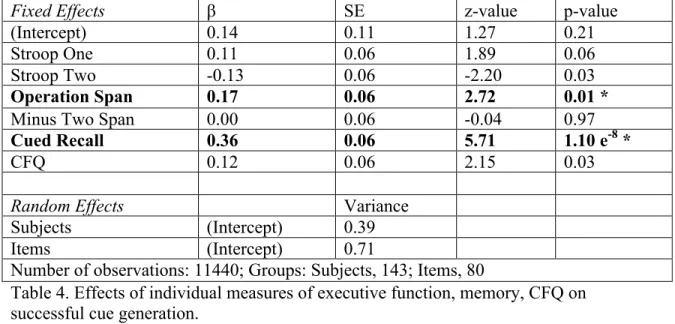
Mixed-effects logistic regression models were used to assess the contributions of individual differences in inhibitory control, working memory, recall, and CFQ to
performance in the cue generation (Table 4), production (Table 5), and comprehension (Table 6) tasks. The multilevel modeling approach provides conservative parameter estimates that are adjusted for multiple comparisons (Gelman, Hill, & Yajima, 2012). Nonetheless, given that three separate models were fit to the same set of predictors, we adjusted the alpha level for the two analyses to follow using the Bonferroni correction for multiple comparisons, resulting in an overall alpha level of 0.05/2=0.025.
Fixed Effects β SE z-value p-value
(Intercept) 0.14 0.11 1.27 0.21
Stroop One 0.11 0.06 1.89 0.06
Stroop Two -0.13 0.06 -2.20 0.03
Operation Span 0.17 0.06 2.72 0.01 *
Minus Two Span 0.00 0.06 -0.04 0.97
Cued Recall 0.36 0.06 5.71 1.10 e-8 *
CFQ 0.12 0.06 2.15 0.03
Random Effects Variance
Subjects (Intercept) 0.39
Items (Intercept) 0.71
Number of observations: 11440; Groups: Subjects, 143; Items, 80
Table 4. Effects of individual measures of executive function, memory, CFQ on successful cue generation.
Fixed Effects β SE z-value p-value
(Intercept) 3.365 0.134 25.194 <2e-16
Shared v. Privileged 3.254 0.270 12.060 <2e-16 *
Stroop One -0.135 0.115 -1.174 0.240
Stroop Two -0.115 0.111 -1.037 0.300
Operation Span 0.007 0.118 0.056 0.956
Minus Two Span -0.044 0.112 -0.395 0.693
Cued Recall 0.059 0.123 0.480 0.632 CFQ -0.127 0.112 -1.132 0.258 Shared v. Privileged x Stroop One -0.031 0.252 -0.124 0.902 Shared v. Privileged x Stroop Two -0.086 0.247 -0.348 0.728 Shared v. Privileged x Operation Span 0.675 0.267 2.527 0.012 * Shared v. Privileged x
Minus Two Span 0.178 0.253 0.704 0.482
Shared v. Privileged x Cued
Recall 0.289 0.268 1.079 0.281
Shared v. Privileged x CFQ -0.157 0.247 -0.637 0.524
Random Effects Variance
Subjects (Intercept) 0.842
Shared v. Privileged 5.812
Cohort Pairs (Intercept) 0.426
Shared v. Privileged 1.068